High-altitude surveillance — even balloons — is nothing new. So why the fuss?
There are hundreds of satellites spying on the US, China and Russia, to name just a few countries, so a well-tracked balloon was hardly a threat.
Crikey MICHAEL SAINSBURY, FEB 07, 2023
It was a darkly comic, made-for-media case: a Chinese hot air balloon flying about 20 kilometres over American soil, shot down by a US fighter jet over the weekend. It ignited a fairly confused diplomatic crisis, with China now saying it reserves the right to a response, and has laid bare the fragile state of relations between the world’s two most powerful nations.
The mere existence of the balloon — China claims it was a civilian weather-monitoring device, but the US is convinced it was spying, possibly on nuclear facilities — saw US Secretary of State Antony Blinken cancel his planned visit to meet his Chinese counterpart, Wang Yi.
It’s a worrying setback in efforts by the US and China to steady a relationship tattered by Chinese adventurism — of which the balloon is yet another example — and US determination to contain China’s rise, particularly regarding the technology underpinning,………… (Subscribers only)……….. https://www.crikey.com.au/2023/02/07/china-balloon-surveillance-not-new-why-the-fuss/?su=QUl4aHc5NFlOL2ZuMXRneFE4bjZzQT09
China’s spy balloon can help deflate US nuclear tensions with Beijing
Defense News, By David Gompert and Hans Binnendijk 8 Feb 23
The row over China’s surveillance balloon could, once the dust settles, present a chance to begin lessening the risk of nuclear war between the two superpowers.
While the United States is right to charge China with violating its airspace in an apparent attempt to spy on America’s strategic missile systems in Montana, this episode reminds us that the two nations have no mechanism to exchange views and clear up misconceptions on the purpose of their respective nuclear arsenal.
Consequently, suspicions abound.
It is understandable that this infamous spy balloon has riled up the American body politic. Yet, it is important to keep the strategic situation in mind. The United States and China are in a stable state of mutual deterrence, meaning that neither power could launch a nuclear first strike on the other without inviting devastating retaliation. That said, the greater the mutual suspicions about intent, the greater the danger that this stability could fail.
The absence of a way to build mutual confidence between the United States and China regarding nuclear weapons and nuclear war is potentially dangerous. The United States is unsure what to make of China’s build-up of its nuclear arsenal, and China is fearful that the United States seeks the capability to deny China a credible deterrent. What makes this situation increasingly perilous are the rising tensions in Sino-U.S. relations in the Pacific and the growing risks of escalating crises and even war there.
In an article in the journal Survival to be published soon, we spell out the case and agenda for a process whereby the superpowers could clarify why they have nuclear weapons and the doctrines governing their use.
Specifically, we recommend direct and candid bilateral strategic stability talks on nuclear doctrines, forces, intentions, and worries. This would be coupled with confidence-building measures such as providing prior notifications of missile testing, clarifying the purpose of new weapons, and managing disconcerting intelligence.
This could reduce suspicions, such as Chinese fears that the United States aspires to have a first-strike capability and American fears that China will relentlessly expand its capability to target U.S. deterrent forces. Each nation would of course continue independent intelligence-gathering. But “worst-case” interpretation of intelligence could be mitigated by dialogue.
These strategic stability talks might include implementing a bold concept: a bilateral US-Chinese pledge not to use nuclear weapons first against each other or against the other nation’s treaty allies……………………………. more https://www.defensenews.com/opinion/commentary/2023/02/07/chinas-spy-balloon-can-help-deflate-us-nuclear-tensions-with-beijing/
If Arms Control Collapses, US and Russian Strategic Nuclear Arsenals Could Double In Size
Federation of American Scientists, Matt Korda and Hans Kristensen • February 7, 2023
On January 31st, the State Department issued its annual Report to Congress on the Implementation of the New START Treaty, with a notable––yet unsurprising––conclusion:
“Based on the information available as of December 31, 2022, the United States cannot certify the Russian Federation to be in compliance with the terms of the New START Treaty.”
This finding was not unexpected. In August 2022, in response to a US treaty notification expressing an intent to conduct an inspection, Russia invoked an infrequently used treaty clause “temporarily exempting” all of its facilities from inspection. At the time, Russia attempted to justify its actions by citing “incomplete” work regarding Covid-19 inspection protocols and perceived “unilateral advantages” created by US sanctions; however, the State Department’s report assesses that this is “false:”
Contrary to Russia’s claim that Russian inspectors cannot travel to the United States to conduct inspections, Russian inspectors can in fact travel to the United States via commercial flights or authorized inspection airplanes. There are no impediments arising from U.S. sanctions that would prevent Russia’s full exercise of its inspection rights under the Treaty. The United States has been extremely clear with the Russian Federation on this point.”
Instead, the report suggests that the primary reason for suspending inspections “centered on Russian grievances regarding U.S. and other countries’ measures imposed on Russia in response to its unprovoked, full-scale invasion of Ukraine.”
Echoing the findings of the report, on February 1st, Cara Abercrombie, deputy assistant to the president and coordinator for defense policy and arms control for the White House National Security Council, stated in a briefing at the Arms Control Association that the United States had done everything in its power to remove pandemic- and sanctions-related limitations for Russian inspectors, and that “[t]here are absolutely no barriers, as far as we’re concerned, to facilitating Russian inspections.”
Nonetheless, Russia has still not rescinded its exemption and also indefinitely postponed a scheduled meeting of the Bilateral Consultative Commission in November. In a similar vein, this is believed to be tied to US support for Ukraine, as indicated by Deputy Foreign Minister Sergei Ryabkov who said that arms control “has been held hostage by the U.S. line of inflicting strategic defeat on Russia,” and that Russia was “ready for such a scenario” if New START expired without a replacement.
These two actions, according to the United States, constitute a state of “noncompliance” with specific clauses of New START. It is crucial to note, however, the distinction between findings of “noncompliance” (serious, yet informal assessments, often with a clear path to reestablishing compliance), “violation” (requiring a formal determination), and “material breach” (where a violation rises to the level of contravening the object or purpose of the treaty).
It is also important to note that the United States’ findings of Russian noncompliance are not related to the actual number of deployed Russian warheads and launchers. While the report notes that the lack of inspections means that “the United States has less confidence in the accuracy of Russia’s declarations,” the report is careful to note that “While this is a serious concern, it is not a determination of noncompliance.” The report also assesses that “Russia was likely under the New START warhead limit at the end of 2022” and that Russia’s noncompliance does not threaten the national security interests of the United States.
The high stakes of failure: worst-case force projections after New START’s expiry
Both the US and Russia have meticulously planned their respective nuclear modernization programs based on the assumption that neither country will exceed the force levels currently dictated by New START. Without a deal after 2026, that assumption immediately disappears; both sides would likely default to mutual distrust amid fewer verifiable data points, and our discourse would be dominated by worst case thinking about how both countries’ arsenals would grow in the future……………………………………………………….
Cameco Agrees to New Deal With Ukraine’s Nuclear Energy Utility
Feb. 8, 2023 , By Stephen Nakrosis https://www.marketwatch.com/story/cameco-agrees-to-new-deal-with-ukraine-s-nuclear-energy-utility-271675897372—
Cameco Corp. said it agreed to terms with SE NNEGC Energoatom, the Ukrainian state-owned nuclear energy utility, to provide natural uranium hexafluoride, or UF(6), through 2035.
“Key commercial terms, such as pricing mechanism, volume and tenor, have been agreed to, but the contract is subject to finalization, which is anticipated in the first quarter of 2023,” Cameco said.
The deal, which runs from 2024 to 2035, will see all deliveries in the form of UF(6). “The contract will contain a required degree of flexibility, given present circumstances in Ukraine,” Cameco said.
The agreement will see Cameco supply 100% of Energoatom’s UF(6) requirements for the nine nuclear reactors at the Rivne, Khmelnytskyy and South Ukraine nuclear power plants. The deal also has an option for Cameco to supply six reactors at the Zaporizhzhya nuclear power plant, which is currently under Russian control, should it return to Energoatom’s operation, the companies said.
NewsReal: Chinese Balloon: It’s All About The Optics
Sott.net, 05 Feb 2023.
The whole world (i.e., the USA) was stunned this week as a Chinese high-altitude balloon dared traverse the USA before being shot down in a stunning and brave military move by an air-to-air missile fired from an F-22 fighter jet over US waters in the Atlantic.
Bullet dodged?
Er, no. As Joe and Niall explain in this NewsReal, such balloons (Chinese, research, ‘spy’ or otherwise) traverse the US and elsewhere on a regular basis. What’s different this time is that ‘someone’ overruled the Pentagon’s initial assessment that this balloon posed no threat to US national security to instead make a REALLY big deal out of it…
Military probing link between nuclear silo work, cancers.
https://www.coloradopolitics.com/news/military-probing-link-between-nuclear-silo-work-cancers-out-west-roundup/article_e52dd2fa-a0e4-11ed-83ec-dbc142e08bdc.html The Associated Press, 5 Feb 23,
Military probing whether cancers linked to nuclear silo work
WASHINGTON — Nine military officers who had worked decades ago at a nuclear missile base in Montana have been diagnosed with blood cancer and there are “indications” the disease may be linked to their service, according to military briefing slides obtained by The Associated Press. One of the officers has died.
All of the officers, known as missileers, were assigned as many as 25 years ago to Malmstrom Air Force Base, home to a vast field of 150 Minuteman III intercontinental ballistic missile silos. The nine officers were diagnosed with non-Hodgkin lymphoma, according to a January briefing by U.S. Space Force Lt. Col. Daniel Sebeck.
Missileers ride caged elevators deep underground into a small operations bunker encased in a thick wall of concrete and steel. They remain there sometimes for days, ready to turn the launch keys if ordered to by the president.
In the slide presentation, Sebeck said the “disproportionate numbers of missileers presenting with cancer, specifically lymphoma” was concerning.
In a statement to the AP, Air Force spokeswoman Ann Stefanek said that “senior leaders are aware of the concerns raised about the possible association of cancer related to missile combat crew members at Malmstrom AFB.”
Stefanek added: “The information in this briefing has been shared with the Department of the Air Force surgeon general and our medical professionals are working to gather data and understand more.”
Last year President Joe Biden signed the PACT Act, which greatly expanded the the types of illnesses and toxic exposures that would be considered presumptive — meaning a service member or veterans would not face an uphill battle to convince the government that the injury was tied to their military service in order to received covered care.
Celebrities Protect The Interests Of The Empire
By Caitlin Johnstone OEN 2 Feb 23
The failings of the status quo are hidden in mainstream culture, and people aren’t permitted to consider the possibility that there might be a better way for things to be. People don’t know, and they don’t know that they don’t know. They’re kept in the dark about what’s possible.
………………………………………… Most people on this planet couldn’t give a sh*t who governs Crimea, but one small group insists we risk every life in existence on earth “- every bee, every frog, every tree, every child “- for their current t-shirt-of-the-week issue. It’s so arrogant.
It’s one thing to draw a line and say “The world must never let anyone cross this point, even if it means risking nuclear armageddon.” It’s quite another to make that line something as trivial as the question of who governs Crimea. It’s not legitimate to risk all life over that. This is especially true because the US empire provoked this war and because even the Crimeans themselves prefer to be Russian. But even if none of that was the case, it still wouldn’t be legitimate for the US empire to risk the lives of people in Africa or South America by backing an offensive on Crimea.
All these armchair warriors saying “We need to be brave and take a stand!” are willing to gamble billions of lives who do not consent to being gambled over a war they’re not even fighting in. All while refusing to deeply contemplate what nuclear war would entail. They’re the worst kind of cowards.
I just want the rapidly rising threat of nuclear war to be treated, reported on, and discussed like the supremely important issue that it is. It’s the single most important matter in the world and it just gets casually mentioned here and there like it’s just another issue.
………… Even if you believe that all this nuclear brinkmanship is justified and good, you still need to fully acknowledge the reality of the risk and the unfathomable horrors that it would unleash upon our world. And you need to do it with all the respect and solemnity the subject deserves.
……………….. The only people who say “Putin can end this war at any time by withdrawing” are those who deny the US empire’s aggressions which led to this conflict, which is just a nonsense garbage position based on lies. They don’t actually want peace, they just want victory for the empire. The real unbiased position which supports peace is wanting both Russia and the western empire to begin engaging in diplomacy, de-escalation and detente to end this war. But empire simps will call you treasonously biased if you support anything other than total Russian defeat.
This dopey propaganda-addled notion that the west did nothing wrong and Putin attacked Ukraine solely because he is evil and hates freedom actually prevents peace from happening. If one side only acknowledges the reality of the aggressions of the other side, peace is impossible. If you don’t understand how a war was started and perpetuated, then you can’t understand how peace can be started and perpetuated. The empire deliberately works to prevent the public from obtaining this understanding, because the empire wants war.
It’s not okay for grown adults to act like Putin is just running around invading countries willy nilly because he’s a crazed madman. You’ve got a whole internet of information at your fingertips. Use it…………………….
………… the people who put on all the shows, movies and music almost everyone consumes, thereby engineering mainstream culture to the benefit of the super wealthy. It shapes the way the people think, speak, act and vote. What they feel entitled to. What they think is possible.
A rich celebrity who makes millions of dollars a year in a fun, easy and egoically gratifying job is not going to be spotlighting all the lives who are being destroyed by the status quo systems which elevated them. They’re not going to favor the revolutionary changes that are needed. They’re not going to be calling for a massive, sweeping overhaul of the systems which are crushing ordinary people to death and creating widespread misery; at most they’re going to be telling you to vote Democrat or Republican and quibbling about minor disagreements on tax rates. But these are the people with the loudest voices in our society “- not just the loudest, but many orders of magnitude more amplified and influential than the voices of the ordinary people who are suffering under existing systems. These loudly-amplified rich celebrities shape and direct mainstream culture……….more https://www.opednews.com/articles/2/Celebrities-Protect-The-In-Assholes_China_China-230203-537.html
 | |||
| |||
NASA and DARPA are working on a nuclear-powered rocket that could go to Mars

The technology would also have significant national security implications
Washington Post By Christian Davenport, February 3, 2023
“……………………………………… If NASA’s going to get to Mars, it needs to find a way to get there much faster. Which is one of the reasons it said last week that it is partnering with the Pentagon’s Defense Advanced Research Projects Agency on development of thermonuclear propulsion technology.
………………. DARPA, the arm of the Defense Department that seeks to develop transformative technologies, has been working on the program since 2021, when it awarded three contracts for the first phase of the program to General Atomics, Lockheed Martin and Blue Origin, the space company founded by Jeff Bezos. (Bezos owns The Washington Post.) A nuclear-powered rocket would use a nuclear reactor to heat propellant to extreme temperatures before shooting the fuel through a nozzle to produce thrust.

………………….. The program is called DRACO, for Demonstration Rocket for Agile Cislunar (or in the vicinity of the moon) Operation……………………..
The agencies hope they’ll be ready to demonstrate their work with a spaceflight in 2027.
NASA is also working with the Department of Energy on a separate project to develop a nuclear power plant that could be used on the moon and perhaps one day on Mars.
But getting to Mars is exceedingly difficult, and despite claims from NASA for years that it was gearing up to send astronauts there, the agency is nowhere close to achieving that goal.
One of the main obstacles is the distance. Earth and Mars are only on the same side of the sun every 26 months. But even at their closest points, a spacecraft would have to follow an elliptical orbit around the sun that, as Tory Bruno, the CEO of the United Launch Alliance, wrote in a recent essay, will require “a great sweeping arc of around 300 million miles to arrive.”
……………………………. . The need for spacecraft that can maneuver away from the enemy has become clear during the war in Ukraine. https://www.washingtonpost.com/technology/2023/02/03/nuclear-rocket-darpa-nasa/
Avoiding a Long War- the RAND corporation report
U.S. Policy and the Trajectory of the Russia-Ukraine Conflict. by Samuel Charap, Miranda Priebe https://www.rand.org/pubs/perspectives/PEA2510-1.html
Discussion of the Russia-Ukraine war in Washington is increasingly dominated by the question of how it might end. To inform this discussion, this Perspective identifies ways in which the war could evolve and how alternative trajectories would affect U.S. interests. The authors argue that, in addition to minimizing the risks of major escalation, U.S. interests would be best served by avoiding a protracted conflict.
The costs and risks of a long war in Ukraine are significant and outweigh the possible benefits of such a trajectory for the United States. Although Washington cannot by itself determine the war’s duration, it can take steps that make an eventual negotiated end to the conflict more likely. Drawing on the literature on war termination, the authors identify key impediments to Russia-Ukraine talks, such as mutual optimism about the future of the war and mutual pessimism about the implications of peace.
. The Perspective highlights four policy instruments the United States could use to mitigate these impediments: clarifying plans for future support to Ukraine, making commitments to Ukraine’s security, issuing assurances regarding the country’s neutrality, and setting conditions for sanctions relief for Russia.
Read report online. https://www.rand.org/pubs/perspectives/PEA2510-1.html
Ukraine is sinking. Is the West about to bail out?

Ukraine Is Sinking. Are Western Elites Bailing Out? The UNZ REview, MIKE WHITNEY • FEBRUARY 1, 2023
What makes the RAND Corporation’s latest report on Ukraine so significant, is not the quality of the analysis, but the fact that the nation’s most prestigious national security think-tank has taken an opposite position on the war than the Washington political class and their globalist allies. This is a very big deal.
…………… The RAND Corporation’s new report, “Avoiding a long war: US policy and the trajectory of the Russia-Ukraine conflict”, represents just such a split. It indicates that powerful elites have broken with the majority opinion because they think the current policy is hurting the United States. We believe this shift in perspective is going to gain momentum until it triggers a more-assertive demand for negotiations. In other words, the RAND report is the first step towards ending the war.
Consider, for a minute, this excerpt from the preamble of the report:
“The costs and risks of a long war in Ukraine are significant and outweigh the possible benefits of such a trajectory for the United States.”
This quote effectively sumarizes the entire document. Think about it: For the last 11 months we have been told repeatedly that the US will support Ukraine “for as long as it takes.” The above quote assures us that that’s not going to happen. The United States is not going to undermine its own interests to pursue the unachievable dream of expelling Russia from Ukraine. (Even the hawks no longer believe that is possible.)
Rational members of the foreign policy establishment are going to evaluate Ukraine’s prospects for success and weigh them against the growing likelihood that the conflict could unexpectedly spiral out-of-control. That, of course, would serve no one’s interest and could ignite a direct clash between Russia and the United States. Also, US policymakers will decide whether the ballooning collateral damage is worth the expense. In other words, are the ruptured supplylines, the rising inflation, the increasing energy and food shortages, and the declining weapons stockpiles a fair trade-off for “weakening Russia”. Many would say, “No.”
In some respects, the RAND report is just the first in a long line of falling dominoes. As Ukraine’s battlefield losses mount –and it becomes more evident that Russia will control all the territory east of the Dnieper River– the flaws in Washington’s strategy will become more apparent and will be more sharply criticized. People will question the wisdom of economic sanctions that hurt our closest allies while helping Russia. They will ask why the United States is following a policy that has precipitated a strong move away from the dollar and US debt? And, they will wonder why the US deliberately sabotaged a peace deal in March when the probability of a Ukrainian victory is near zero. The Rand report seems to anticipate all these questions as well as the ‘shift in mood’ they will generate. This is why the authors are pushing for negotiations and a swift end to the conflict. This is an excerpt from an article at RT:
The RAND Corporation, a highly influential elite national security think tank funded directly by the Pentagon, has published a landmark report stating that prolonging the proxy war is actively harming the US and its allies and warning Washington that it should avoid “a protracted conflict” in Ukraine…
(The report) starts by stating that the fighting represents “the most significant interstate conflict in decades, and its evolution will have major consequences” for Washington, which includes US “interests” being actively harmed. The report makes it very clear that while Ukrainians have been doing the fighting, and their cities have been “flattened” and “economy decimated,” these “interests” are “not synonymous” with Kiev’s.” (“Rand calls for swift end to war“, RT)
While the report does not explicitly state that ‘US interests (are) being harmed’, it certainly infers that that is the case. Not surprisingly, the report doesn’t mention any of the collateral damage from Washington’s war on Russia, but, surely, that must have been foremost on the minds of the authors. After all, it is not the $100 billion or the provision of lethal weapons that is costing the US so dearly. It is the accelerating emergence of international coalitions and alternate institutions that has put the US empire on the fasttrack to ruin. We assume that the analysts at RAND see the same things that every other sentient being sees, that Washington’s misguided conflagration with Moscow is a ‘bridge-too-far’ and that the blowback is going to be immense and excruciating. Hence, the urgency to end the war quickly. Here’s a excerpt from the report that was posted in bold print halfway through the text:
“Since avoiding a long war is the highest priority after minimizing escalation risks, the United States should take steps that make an end to the conflict over the medium term more likely.”
…………………………….. Washington’s foolish intervention is clearing the way for the greatest strategic catastrophe in US history. And yet, even now, the vast majority of corporate and banking elites resolutely back the existing policy while shrugging off the obvious signs of failure. Case in point: The World Economic Forum posted a blanket statement of support for Ukraine on its website. Here it is: [on original]
……………………………….. the RAND report may represent the views of the Pentagon and the US Military establishment who believe the United States is racing headlong towards a direct conflagration with Russia. In other words, the report may be the first ideological broadsides against the neocons who run the State Department and the White House. We suspect this split between the War Department and ‘State’ will become more visible in the days ahead. We can only hope that the more judicious faction at the Pentagon prevails.
US Surrounds China With War Machinery While Freaking Out About Balloons
Caitlin Johnstone 4 Feb 23
In what Austin journalist Christopher Hooks has called “one of the stupidest news cycles in living memory,” the entire American political/media class is having an existential meltdown over what the Pentagon claims is a Chinese spy balloon detected in US airspace on Thursday.
Secretary of State Antony Blinken cancelled his scheduled diplomatic visit to China after the detection of the balloon. The mass media have been covering the story with breathless excitement. China hawk pundits have been pounding the war drums all day on any platform they can get to and accusing the Biden administration of not responding aggressively enough to the incident…………………
China’s foreign ministry says the balloon is indeed from China but is “civilian in nature, used for meteorological and other scientific research,” and was simply blown far off course. This could of course be untrue — all major governments spy on each other constantly and China is no exception — but the Pentagon’s own assessment is that the balloon “does not create significant value added over and above what the PRC is likely able to collect through things like satellites in Low Earth Orbit.”.
So everyone’s losing their minds over a balloon that in all probability would be mostly worthless for spying, even while everyone knows the US spies on China at every possible opportunity. US officials have complained to the press that American spies are having a much harder time conducting operations and recruiting assets in China than they used to because of measures the Chinese government has taken to thwart them, and in 2001 a US spy plane caused a major international incident when it collided with a Chinese military jet on China’s coastline, killing the pilot.
The US considers it its sovereign right to spy on any nation it chooses, and the average American tends more or less to see it the same way. This is highlighted in controversies around domestic versus foreign surveillance, for example; Americans were outraged over the Edward Snowden revelations not because spy agencies were conducting surveillance, but because they were conducting surveillance on American citizens. It’s just taken as a given that spying on foreigners is fine, so it’s a bit silly to react melodramatically when foreigners return the favor.
As Jake Werner explains for Responsible Statecraft:
Foreign surveillance of sensitive U.S. sites is not a new phenomenon. “It’s been a fact of life since the dawn of the nuclear age, and with the advent of satellite surveillance systems, it long ago became an everyday occurrence,” as my colleague and former CIA analyst George Beebe puts it.
U.S. surveillance of foreign countries is likewise quite common. Indeed, great powers gathering intelligence on each other is one of the more banal and universal facts of international relations. Major countries even spy on their own allies, as when U.S. intelligence bugged the cellphone of German Chancellor Angela Merkel.
Typically, even when such surveillance is directed against the United States by a rival power, it does not threaten the safety of Americans and it poses manageable risks to sites where secrecy is of the utmost importance. However — in the context of rapidly increasing U.S.–China tensions — foreseeable incidents like these can quickly balloon into dangerous confrontations.
Now let’s contrast all this with another news story that’s getting a lot less attention.
In an article titled “US secures deal on Philippines bases to complete arc around China,” the BBC reports that the empire will be adding even more installations to the already impressive military noose it has been constructing around the PRC.
“The US has secured access to four additional military bases in the Philippines – a key bit of real estate which would offer a front seat to monitor the Chinese in the South China Sea and around Taiwan,” writes the BBC’s Rupert Wingfield-Hayes. “With the deal, Washington has stitched the gap in the arc of US alliances stretching from South Korea and Japan in the north to Australia in the south. The missing link had been the Philippines, which borders two of the biggest potential flashpoints – Taiwan and the South China Sea.”
“The US hasn’t said where the new bases are but three of them could be on Luzon, an island on the northern edge of the Philippines, the only large piece of land close to Taiwan – if you don’t count China,” writes Wingfield-Hayes……..
The US empire has been surrounding China with military bases and war machinery for many years, in ways Washington would never tolerate China doing in the nations and waters surrounding the United States. There is no question that the US is the aggressor in this increasingly hostile standoff between major powers. Yet we’re all meant to be freaking out about a balloon……… https://caitlinjohnstone.substack.com/p/us-surrounds-china-with-war-machinery
This Time It’s Different
This time it’s different. Washington and its NATO allies are advocating a full-blown war against Russia, the devastation and breakup of the Russian Federation, as well as the destruction of millions of lives in Russia and Ukraine.
Neither we nor our allies are prepared to fight all-out war with Russia, regionally or globally.
Douglas Macgregor, Jan 26, 2023 https://www.theamericanconservative.com/this-time-its-different/
Until it decided to confront Moscow with an existential military threat in Ukraine, Washington confined the use of American military power to conflicts that Americans could afford to lose, wars with weak opponents in the developing world from Saigon to Baghdad that did not present an existential threat to U.S. forces or American territory. This time—a proxy war with Russia—is different.
Contrary to early Beltway hopes and expectations, Russia neither collapsed internally nor capitulated to the collective West’s demands for regime change in Moscow. Washington underestimated Russia’s societal cohesion, its latent military potential, and its relative immunity to Western economic sanctions.
As a result, Washington’s proxy war against Russia is failing. U.S. Defense Secretary Lloyd Austin was unusually candid about the situation in Ukraine when he told the allies in Germany at Ramstein Air Base on January 20, “We have a window of opportunity here, between now and the spring,” admitting, “That’s not a long time.”
Alexei Arestovich, President Zelensky’s recently fired advisor and unofficial “Spinmeister,” was more direct. He expressed his own doubts that Ukraine can win its war with Russia and he now questions whether Ukraine will even survive the war. Ukrainian losses—at least 150,000 dead including 35,000 missing in action and presumed dead—have fatally weakened Ukrainian forces resulting in a fragile Ukrainian defensive posture that will likely shatter under the crushing weight of attacking Russian forces in the next few weeks.
Ukraine’s materiel losses are equally severe. These include thousands of tanks and armored infantry fighting vehicles, artillery systems, air defense platforms, and weapons of all calibers. These totals include the equivalent of seven years of Javelin missile production. In a setting where Russian artillery systems can fire nearly 60,000 rounds of all types—rockets, missiles, drones, and hard-shell ammunition—a day, Ukrainian forces are hard-pressed to answer these Russian salvos with 6,000 rounds daily. New platform and ammunition packages for Ukraine may enrich the Washington community, but they cannot change these conditions.
Predictably, Washington’s frustration with the collective West’s failure to stem the tide of Ukrainian defeat is growing. In fact, the frustration is rapidly giving way to desperation.
Michael Rubin, a former Bush appointee and avid supporter of America’s permanent conflicts in the Middle East and Afghanistan, vented his frustration in a 1945 article asserting that, “if the world allows Russia to remain a unitary state, and if it allows Putinism to survive Putin, then, Ukraine should be allowed to maintain its own nuclear deterrence, whether it joins NATO or not.” On its face, the suggestion is reckless, but the statement does accurately reflect the anxiety in Washington circles that Ukrainian defeat is inevitable.
ADVERTISEMENT
NATO’s members were never strongly united behind Washington’s crusade to fatally weaken Russia. The governments of Hungary and Croatia are simply acknowledging the wider European public’s opposition to war with Russia and lack of support for Washington’s desire to postpone Ukraine’s foreseeable defeat.
Though sympathetic to the Ukrainian people, Berlin did not support all-out war with Russia on Ukraine’s behalf. Now, Germans are also uneasy with the catastrophic condition of the German armed forces.
Retired German Air Force General (four-star equivalent) Harald Kujat, former chairman of the NATO Military Committee, severely criticized Berlin for allowing Washington to railroad Germany into conflict with Russia, noting that several decades of German political leaders actively disarmed Germany and thus deprived Berlin of authority or credibility in Europe. Though actively suppressed by the German government and media, his comments are resonating strongly with the German electorate.
The blunt fact is that in its efforts to secure victory in its proxy war with Russia, Washington ignores historical reality. From the 13th century onward, Ukraine was a region dominated by larger, more powerful national powers, whether Lithuanian, Polish, Swedish, Austrian, or Russian.
In the aftermath of the First World War, abortive Polish designs for an independent Ukrainian State were conceived to weaken Bolshevik Russia. Today, Russia is not communist, nor does Moscow seek the destruction of the Polish State as Trotsky, Lenin, Stalin, and their followers did in 1920.
So where is Washington headed with its proxy war against Russia? The question deserves an answer.
On Sunday December 7, 1941, U.S. Ambassador Averell Harriman was with Prime Minister Sir Winston Churchill having dinner at Churchill’s home when the BBC broadcast the news that the Japanese had attacked the U.S. Naval Base at Pearl Harbor. Harriman was visibly shocked. He simply repeated the words, “The Japanese have raided Pearl Harbor.”
Subscribe Today
Get weekly emails in your inbox
Email Address:
Harriman need not have been surprised. The Roosevelt administration had practically done everything in its power to goad Tokyo into attacking U.S. forces in the Pacific with a series of hostile policy decisions culminating in Washington’s oil embargo during the summer of 1941.
In the Second World War, Washington was lucky with timing and allies. This time it’s different. Washington and its NATO allies are advocating a full-blown war against Russia, the devastation and breakup of the Russian Federation, as well as the destruction of millions of lives in Russia and Ukraine.
Washington emotes. Washington does not think, and it is also overtly hostile to empiricism and truth. Neither we nor our allies are prepared to fight all-out war with Russia, regionally or globally. The point is, if war breaks out between Russia and the United States, Americans should not be surprised. The Biden administration and its bipartisan supporters in Washington are doing all they possibly can to make it happen.
NATO’s members were never strongly united behind Washington’s crusade to fatally weaken Russia. The governments of Hungary and Croatia are simply acknowledging the wider European public’s opposition to war with Russia and lack of support for Washington’s desire to postpone Ukraine’s foreseeable defeat.
Though sympathetic to the Ukrainian people, Berlin did not support all-out war with Russia on Ukraine’s behalf. Now, Germans are also uneasy with the catastrophic condition of the German armed forces.
Retired German Air Force General (four-star equivalent) Harald Kujat, former chairman of the NATO Military Committee, severely criticized Berlin for allowing Washington to railroad Germany into conflict with Russia, noting that several decades of German political leaders actively disarmed Germany and thus deprived Berlin of authority or credibility in Europe. Though actively suppressed by the German government and media, his comments are resonating strongly with the German electorate.
The blunt fact is that in its efforts to secure victory in its proxy war with Russia, Washington ignores historical reality. From the 13th century onward, Ukraine was a region dominated by larger, more powerful national powers, whether Lithuanian, Polish, Swedish, Austrian, or Russian.
In the aftermath of the First World War, abortive Polish designs for an independent Ukrainian State were conceived to weaken Bolshevik Russia. Today, Russia is not communist, nor does Moscow seek the destruction of the Polish State as Trotsky, Lenin, Stalin, and their followers did in 1920.
So where is Washington headed with its proxy war against Russia? The question deserves an answer.
On Sunday December 7, 1941, U.S. Ambassador Averell Harriman was with Prime Minister Sir Winston Churchill having dinner at Churchill’s home when the BBC broadcast the news that the Japanese had attacked the U.S. Naval Base at Pearl Harbor. Harriman was visibly shocked. He simply repeated the words, “The Japanese have raided Pearl Harbor.”
Harriman need not have been surprised. The Roosevelt administration had practically done everything in its power to goad Tokyo into attacking U.S. forces in the Pacific with a series of hostile policy decisions culminating in Washington’s oil embargo during the summer of 1941.
In the Second World War, Washington was lucky with timing and allies. This time it’s different. Washington and its NATO allies are advocating a full-blown war against Russia, the devastation and breakup of the Russian Federation, as well as the destruction of millions of lives in Russia and Ukraine.
Washington emotes. Washington does not think, and it is also overtly hostile to empiricism and truth. Neither we nor our allies are prepared to fight all-out war with Russia, regionally or globally. The point is, if war breaks out between Russia and the United States, Americans should not be surprised. The Biden administration and its bipartisan supporters in Washington are doing all they possibly can to make it happen.
Chris Hedges: Ukraine: The War That Went Wrong

A state of permanent war creates complex bureaucracies, sustained by compliant politicians, journalists, scientists, technocrats and academics, who obsequiously serve the war machine.
This militarism needs mortal enemies — the latest are Russia and China — even when those demonized have no intention or capability, as was the case with Iraq, of harming the U.S. We are hostage to these incestuous institutional structures.
byEDITORJanuary 29, 2023
NATO support for the war in Ukraine, designed to degrade the Russian military and drive Vladimir Putin from power, is not going according to plan. The new sophisticated military hardware won’t help.
By Chris Hedges / Original to ScheerPost
Empires in terminal decline leap from one military fiasco to the next. The war in Ukraine, another bungled attempt to reassert U.S. global hegemony, fits this pattern. The danger is that the more dire things look, the more the U.S. will escalate the conflict, potentially provoking open confrontation with Russia. If Russia carries out retaliatory attacks on supply and training bases in neighboring NATO countries, or uses tactical nuclear weapons, NATO will almost certainly respond by attacking Russian forces. We will have ignited World War III, which could result in a nuclear holocaust.
U.S. military support for Ukraine began with the basics — ammunition and assault weapons. The Biden administration, however, soon crossed several self-imposed red lines to provide a tidal wave of lethal war machinery: Stinger anti-aircraft systems; Javelin anti-armor systems; M777 towed Howitzers; 122mm GRAD rockets; M142 multiple rocket launchers, or HIMARS; Tube-Launched, Optically-Tracked, Wire-Guided (TOW) missiles; Patriot air defense batteries; National Advanced Surface-to-Air Missile Systems (NASAMS); M113 Armored Personnel Carriers; and now 31 M1 Abrams, as part of a new $400 million package. These tanks will be supplemented by 14 German Leopard 2A6 tanks, 14 British Challenger 2 tanks, as well as tanks from other NATO members, including Poland. Next on the list are armor-piercing depleted uranium (DU) ammunition and F-15 and F-16 fighter jets.
Since Russia invaded on February 24, 2022, Congress has approved more than $113 billion in aid to Ukraine and allied nations supporting the war in Ukraine. Three-fifths of this aid, $67 billion, has been allocated for military expenditures. There are 28 countries transferring weapons to Ukraine. All of them, with the exception of Australia, Canada and the U.S., are in Europe.
The rapid upgrade of sophisticated military hardware and aid provided to Ukraine is not a good sign for the NATO alliance. It takes many months, if not years, of training to operate and coordinate these weapons systems………………….
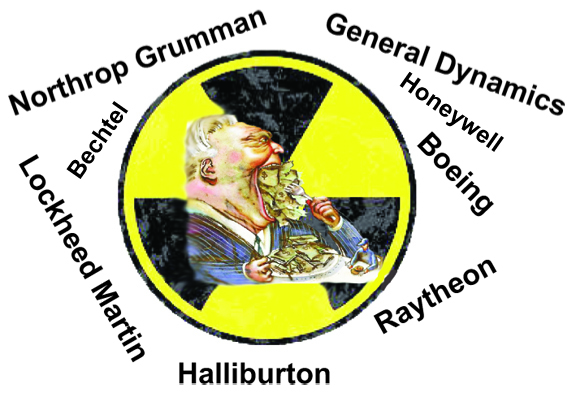
NATO military commanders understand that the infusion of these weapons systems into the war will not alter what is, at best, a stalemate, defined largely by artillery duels over hundreds of miles of front lines. The purchase of these weapons systems — one M1 Abrams tank costs $10 million when training and sustainment are included — increases the profits of the arms manufacturers. The use of these weapons in Ukraine allows them to be tested in battlefield conditions, making the war a laboratory for weapons manufacturers such as Lockheed Martin. All this is useful to NATO and to the arms industry. But it is not very useful to Ukraine.
The other problem with advanced weapons systems such as the M1 Abrams, which have 1,500-horsepower turbine engines that run on jet fuel, is that they are temperamental and require highly skilled and near constant maintenance. They are not forgiving to those operating them who make mistakes; indeed, mistakes can be lethal.
The most optimistic scenario for deploying M1-Abrams tanks in Ukraine is six to eight months, more likely longer. If Russia launches a major offensive in the spring, as expected, the M1 Abrams will not be part of the Ukrainian arsenal. Even when they do arrive, they will not significantly alter the balance of power, especially if the Russians are able to turn the tanks, manned by inexperienced crews, into charred hulks.
So why all this infusion of high-tech weaponry? We can sum it up in one word: panic.
Having declared a de facto war on Russia and openly calling for the removal of Vladimir Putin, the neoconservative pimps of war watch with dread as Ukraine is being pummeled by a relentless Russian war of attrition. Ukraine has suffered nearly 18,000 civilian casualties (6,919 killed and 11,075 injured). It has also seen around 8 percent of its total housing destroyed or damaged and 50 percent of its energy infrastructure directly impacted with frequent power cuts. Ukraine requires at least $3 billion a month in outside support to keep its economy afloat, the International Monetary Fund’s managing director recently said. Nearly 14 million Ukrainians have been displaced — 8 million in Europe and 6 million internally — and up to 18 million people, or 40 percent of Ukraine’s population, will soon require humanitarian assistance. Ukraine’s economy contracted by 35 percent in 2022, and 60 percent of Ukrainians are now poised to live on less than $5.5 a day, according to World Bank estimates. Nine million Ukrainians are without electricity and water in sub-zero temperatures, the Ukrainian president says. According to estimates from the U.S. Joint Chiefs of Staff, 100,000 Ukrainian and 100,000 Russian soldiers have been killed in the war as of last November. …………………………
In desperation, the empire pumps ever greater sums into its war machine. The most recent $1.7 trillion spending bill included $847 billion for the military; the total is boosted to $858 billion when factoring in accounts that don’t fall under the Armed Services committees’ jurisdiction, such as the Department of Energy, which oversees nuclear weapons maintenance and the infrastructure that develops them. In 2021, when the U.S. had a military budget of $801 billion, it constituted nearly 40 percent of all global military expenditures, more than the next nine countries, including Russia and China, spent on their militaries combined.
A state of permanent war creates complex bureaucracies, sustained by compliant politicians, journalists, scientists, technocrats and academics, who obsequiously serve the war machine. This militarism needs mortal enemies — the latest are Russia and China — even when those demonized have no intention or capability, as was the case with Iraq, of harming the U.S. We are hostage to these incestuous institutional structures.
Earlier this month, the House and Senate Armed Services Committees, for example, appointed eight commissioners to review Biden’s National Defense Strategy (NDS) to “examine the assumptions, objectives, defense investments, force posture and structure, operational concepts, and military risks of the NDS.” The commission, as Eli Clifton writes at the Quincy Institute for Responsible Statecraft, is “largely comprised of individuals with financial ties to the weapons industry and U.S. government contractors, raising questions about whether the commission will take a critical eye to contractors who receive $400 billion of the $858 billion FY2023 defense budget.” The chair of the commission, Clifton notes, is former Rep. Jane Harman (D-CA), who “sits on the board of Iridium Communications, a satellite communications firm that was awarded a seven-year $738.5 million contract with the Department of Defense in 2019.”…………………………..
America’s two ruling parties depend on campaign funds from the war industry and are pressured by weapons manufacturers in their state or districts, who employ constituents, to pass gargantuan military budgets. Politicians are acutely aware that to challenge the permanent war economy is to be attacked as unpatriotic and is usually an act of political suicide.
……………………………………………………………………………………………………………….. The plan to reshape Europe and the global balance of power by degrading Russia is turning out to resemble the failed plan to reshape the Middle East. It is fueling a global food crisis and devastating Europe with near double-digit inflation. It is exposing the impotency, once again, of the United States, and the bankruptcy of its ruling oligarchs. As a counterweight to the United States, nations such as China, Russia, India, Brazil and Iran are severing themselves from the tyranny of the dollar as the world’s reserve currency, a move that will trigger economic and social catastrophe in the United States. Washington is giving Ukraine ever more sophisticated weapons systems and billions upon billions in aid in a futile bid to save Ukraine but, more importantly, to save itself. https://scheerpost.com/2023/01/29/chris-hedges-ukraine-the-war-that-went-wrong/
California’s plan to keep Diablo Canyon nuclear plant online hits regulatory snag
Kavya Balaraman, Senior Reporter, Utility Dive, Jan. 30, 2023
Dive Brief:
- The U.S. Nuclear Regulatory Commission last week rejected a request from Pacific Gas & Electric Co. to resume its review of the license renewal application for the 2.2-GW Diablo Canyon nuclear power plant the utility filed in 2009.
……………………………………………. Diane Curran, an attorney for San Luis Obispo Mothers for Peace — one of three groups that petitioned the NRC to reject PG&E’s request — praised the agency’s decision. “The license renewal application was withdrawn by PG&E from the license renewal docket and then they let it lapse … when you file a license renewal application, you have to update it every year,” she said.
Curran said that the NRC’s decision is a big setback for PG&E because a new application filed at the end of the year won’t give the NRC much time to complete its review before the license for Diablo Canyon’s Unit 1 expires in 2024. https://www.utilitydive.com/news/california-plan-diablo-canyon-nuclear-plant-online-regulatory-snag-NRC-PGE/641482//
A Costly and Prolonged Cold War Now Seems a Certainty

a “new golden age” for military contractors.
https://www.counterpunch.org/2023/01/30/a-costly-and-prolonged-cold-war-now-seems-a-certainty/ BY MELVIN GOODMAN 30 Jan 23
No one knows how the war in Ukraine will end, but there is one post-war certainty: there will be a prolonged and costly Cold War between the United States and Russia. In an interview with David Ignatius of the Washington Post, who has been doing the bidding of the Pentagon and the Central Intelligence Agency for several decades, Secretary of State Antony Blinken emphasized the importance of a “long-term goal of deterrence.” Ignatius took this to mean that the Biden administration will make sure that Russia “should not be able to rest, regroup and reattack.”
Ignatius is joining the likes of such Cold Warriors as former secretary of state Condi Rice, former secretary of defense Bob Gates, journalists such as Max Boot and scholars such as Angela Stent and Leon Aron who believe that Russia’s war is not directed only against Ukraine, but against the larger idea that European states can peacefully cooperate. Yale historian Timothy Snyder goes further, arguing that the rule of law can have a chance in Russia only if “Russia loses this war,” and that Russia’s defeat will reverse the “trend…towards authoritarianism, with Putinism as a force and a model.” It is naive to think in terms of “rule of law” coming to Russia.
The Biden administration’s gift to the military-industrial complex rivals what the Reagan administration provided in the 1980s and ensures the country’s rich market for weapons sales. Nearly half of the record defense spending of $858 billion goes to military contractors. The House and Senate Armed Services Committees made sure that these spending spigots remain open by naming individuals with ties to the weapons industry to a commission that will review the Biden National Defense Strategy.
The chairwoman of the commission, former Representative Jane Harman, protected Lockheed-Martin when she served on the Hill and currently is on the board of a military contractor that recently received a seven-year $800 million contract from the Pentagon.
We have been accustomed to politicians who blithely talk about the “war to end all wars,” but it is unusual to have a distinguished historian argue that the “Ukrainians have given us a chance to turn this century around, a chance for freedom and security that we could not have achieved by our own efforts, no matter who we happen to be.” Snyder argues that “if Russia loses” it would mark an “end to an era of empire,” marking the “last war fought on the colonial logic that another state and people do not exist.” According to Snyder, a Ukrainian victory would “teach Beijing that such an offensive operation [against Taiwan] is costly and likely to fail.” Snyder believes that “this is a once-in-lifetime conjuncture, not to be wasted.”
In addition to this year’s record defense budget that found the Congress providing $45 billion more than the Pentagon requested, a so-called “emergency” provision will lay the foundation for adding scarce resources to defense spending in the coming year. This provision will allow multiyear, noncompetitive agreements to produce such ordinary weaponry as rockets and munitions. According to the Washington Post, the Pentagon will now have a way to replenish its stockpiles that will provide a “new golden age” for military contractors.
The Biden administration’s gift to the military-industrial complex rivals what the Reagan administration provided in the 1980s and ensures the country’s rich market for weapons sales. Nearly half of the record defense spending of $858 billion goes to military contractors. The House and Senate Armed Services Committees made sure that these spending spigots remain open by naming individuals with ties to the weapons industry to a commission that will review the Biden National Defense Strategy. The chairwoman of the commission, former Representative Jane Harman, protected Lockheed-Martin when she served on the Hill and currently is on the board of a military contractor that recently received a seven-year $800 million contract from the Pentagon.
The increased defense spending and the new emergency provision coincide with House Speaker Kevin McCarthy’s creation of a new committee—the House Select Committee on Strategic Competition Between the United States and the Chinese Communist Party! McCarthy appointed the requisite number of China hawks, including its chairman, Mike Gallagher. George Will, writing in the Post, predictably praised the creation of the committee, and lauded a new book by scholars from Johns Hopkins University and Tufts titled “Danger Zone: The Coming Conflict with China,” which may become a tragic self-fulfilling prophecy. In view of the recent rise in anti-Asian violence in the United States, It can only be hoped that Democrats appoint members to the committee who understand the domestic consequences of hyping the threat from China at this particular time.
Our China policy is not working, and the exaggeration of the China threat comes just in time for the hawks in the political aviary who fear that the severe deficiencies of the Russian military in Ukraine is making it more difficult to exaggerate the Russia threat. I’ve been calling attention to the exaggeration of the Russian threat for the past 50 years, and the collapse of the Soviet Union, which included the implosion of the Red Army, should have provided political ammunition to downplay the Russian threat. I had a distinct advantage from 1966 to 1990 as a Soviet analyst at the Central Intelligence Agency, which had intelligence that documented Soviet deficiencies.
But the policy community, the bipartisan congressional community, and the pundit community can’t let go of the idea that the Soviet Union and Russia present a threat to the national security of the United States. The dysfunctional, but superficially successful, Russian military performances in Georgia (2008); Crimea (2014); and Syria (2015) were misread as a demonstration of a strong Russian military. It took the unsuccessful Russian efforts against Kyiv, Kharkiv, and Kherson to fully demonstrate the deeply rooted dysfunction of the “new” Red Army and its inability to sustain offensive and combined arms operations. Instead, Russia must rely on a campaign of military terrorism to hold its own against Ukrainian forces.
The Biden policy ensures a robust military presence on the Russian border that will worsen Cold War 2.0. There will be prolonged and unnecessary increases in defense spending, and the absence of a diplomatic dialogue in those important areas where there is Russian-American agreement.
These areas include a variety of arms control and disarmament issues, such as stopping the proliferation of nuclear weaponry and limiting the use of space in the military competition as well as dealing with insurgencies and terrorism; environmental degradation; and future pandemics. It is hard to imagine any Russian regime willing to pursue diplomatic solutions with a United States that has sponsored a NATO with more than 30 members; a military base in Poland; a regional missile defense in Poland and Romania; and the use of Romanian military facilities close by Russian forces and the Black Sea. This serious turning point is being ignored by the policy community as well as the pundit and academic communities.
Melvin A. Goodman is a senior fellow at the Center for International Policy and a professor of government at Johns Hopkins University. A former CIA analyst, Goodman is the author of Failure of Intelligence: The Decline and Fall of the CIA and National Insecurity: The Cost of American Militarism. and A Whistleblower at the CIA. His most recent books are “American Carnage: The Wars of Donald Trump” (Opus Publishing, 2019) and “Containing the National Security State” (Opus Publishing, 2021). Goodman is the national security columnist for counterpunch.org.
1 This Month





PLEASE OPPOSE HR 8255 AND S.3639 – bills would accelerate satellite deployment, with no environmental review or safeguards – https://ncstd5li.quorum.us/campaign/169331/
To see nuclear-related stories in greater depth and intensity – go to https://nuclearinformation.wordpress.com
-
Archives
- October 2026 (74)
- September 2026 (339)
- August 2026 (330)
- July 2026 (355)
- June 2026 (287)
- May 2026 (306)
- April 2026 (356)
- March 2026 (251)
- February 2026 (267)
- January 2026 (308)
- December 2025 (358)
- November 2025 (359)
-
Categories
- 1
- 1 NUCLEAR ISSUES
- business and costs
- climate change
- culture and arts
- ENERGY
- environment
- health
- history
- indigenous issues
- Legal
- marketing of nuclear
- media
- opposition to nuclear
- PERSONAL STORIES
- politics
- politics international
- Religion and ethics
- safety
- secrets,lies and civil liberties
- spinbuster
- technology
- Uranium
- wastes
- weapons and war
- Women
- 2 WORLD
- ACTION
- AFRICA
- Atrocities
- AUSTRALIA
- Christina's notes
- Christina's themes
- culture and arts
- Events
- Fuk 2022
- Fuk 2023
- Fukushima 2017
- Fukushima 2018
- fukushima 2019
- Fukushima 2020
- Fukushima 2021
- general
- global warming
- Humour (God we need it)
- Nuclear
- RARE EARTHS
- Reference
- resources – print
- Resources -audiovicual
- Weekly Newsletter
- World
- World Nuclear
- YouTube
-
RSS
Entries RSS
Comments RSS

