Trump Lashes Out At Norway Over Nobel Peace Prize In Latest Push To Annex Greenland.

“I no longer feel an obligation to think purely of peace.”
blueapples, Jan 20, 2026, https://ddgeopolitics.substack.com/p/trump-lashes-out-at-norway-over-nobel?utm_source=post-email-title&publication_id=1769298&post_id=185048801&utm_campaign=email-post-title&isFreemail=true&r=1ise1&triedRedirect=true&utm_medium=email
Although the integrity of the Nobel Peace Prize had fallen into tatters long before President Donald J. Trump’s recent quest to have it awarded to him, a bizarre letter he penned to Norwegian Prime Minister Jonas Gahr Støre has taken the mockery of the prize to new heights. Trump declared he “no longer feels an obligation to think purely of peace” in the letter to Norway’s head of state, raising tensions even higher over the U.S.’ continued quest to annex Greenland after several NATO member states deployed troops to the Danish territory.
Trump reaffirmed his administration’s position that U.S. control of Greenland is necessary to secure the Western Hemisphere from the threat of Russian and Chinese infiltration. Trump’s claim that Denmark cannot protect Greenland from Russia or China is contravened by the fact that the Danish territory is covered by NATO’s collective security pact. By virtue of being a territory of Denmark, one of NATO’s founding member states, Greenland is protected by Article 5 of the North Atlantic Treaty. This means that any attack on Greenland by a nation such as Russia or China would constitute an attack against all member states, providing as much protection to Greenland as is provided to the U.S., Canada, or any European nation belonging to NATO.
The letter written by Trump to Støre was leaked after being forwarded to several European ambassadors in Washington, D.C., and reads as follows:
“Dear Jonas: Considering your country decided not to give me the Nobel Peace Prize for having stopped 8 wars PLUS, I no longer feel an obligation to think purely of peace, although it will always be predominant, but can now think about what is good and proper for the United States of America. Denmark cannot protect that land from Russia or China, and why do they have a “right of ownership” anyway? There are no written documents; it’s only that a boat landed there hundreds of years ago, but we had boats landing there also. I have done more for NATO than any other person since its founding, and now, NATO should do something for the United States. The world is not secure unless we have complete and total control of Greenland. Thank you! President DJT”
Although Trump alleges that the country of Norway decided not to award him the Nobel Peace Prize, the Norwegian government plays no role in determining its recipient. The prize is awarded by the Norwegian Nobel Committee, a five-member body elected by the Norwegian Parliament in accordance with the will of the late eponymous founder of the award, Alfred Nobel. The Nobel Peace Prize is the only award determined by the committee. The other five Nobel Prizes in physics, chemistry, medicine, literature, and economics are awarded by respective Swedish bodies, including the Royal Swedish Academy of Sciences, the Karolinska Institutet, and the Swedish Academy. Although the Norwegian Parliament does elect the members of the Norwegian Nobel Committee, it has no authority in determining who they vote to recognize as the laureate of the Nobel Peace Prize.
The Norwegian Nobel Committee voted to award the 2025 Nobel Peace Prize to María Corina Machado despite Trump and other world leaders, such as Israeli Prime Minister Benjamin Netanyahu, lobbying to have him selected as its laureate. Machado, the longtime opponent of the Venezuelan governments led by presidents Hugo Chávez and Nicolás Maduro, was awarded the prize on October 10th, 2025 for what the committee praised as her setting “one of the most extraordinary examples of civilian courage in Latin America in recent times.”
Despite that acclaim, Machado is seen by much of the world as a puppet of the West being used to expand its control over South America. Just weeks after the U.S. deposed Venezuelan President Nicolás Maduro by executing Operation Absolute Resolve in the early morning hours of January 3rd, Machado visited the White House to hand over the 2025 Nobel Peace Prize to Trump. Machado’s decision to give Trump the prize came as the U.S. continues to determine its vision for the future of the governance of Venezuela in the wake of overthrowing Maduro. Despite being propped up to replace Maduro, the Trump administration has not endorsed Machado as his successor just yet, though her decision to give Trump the award appears designed to curry his favor by influencing that decision.
While Trump characterized Machado’s decision as a “wonderful gesture of mutual respect,” the gesture was a performative one, as the prize is non-transferable. In a statement released following Trump and Machado’s meeting, the Norwegian Nobel Committee stated, “The medal and the diploma are the physical symbols confirming that an individual or organization has been awarded the Nobel Peace Prize. The prize itself—the honor and recognition—remains inseparably linked to the person or organization designated as the laureate by the Norwegian Nobel Committee.” Trump’s decision to accept the award is ironic, considering how he and his MAGA acolytes have mocked participation trophies as symbols of the declining American culture they stand against. By choosing to accept the Nobel Peace Prize from Machado, Trump has effectively received his very own participation trophy.
Despite now having the 2025 Nobel Peace Prize firmly in his grasp, the letter Trump wrote to Norwegian Prime Minister Jonas Gahr Støre shows that being passed over for its actual awarding continues to leave a sour taste in his mouth. The letter also conveys the vindictiveness Trump has over the snub, which ostensibly is influencing his foreign policymaking as he uses it to continue to justify the U.S.’ territorial claim to Greenland.
As the Trump administration continues to escalate the pressure it places on the rest of the world in its quest to annex Greenland, most recently by vowing to implement tariffs on nations that oppose the U.S. acquiring the territory, the Nobel Peace Prize isn’t the only thing this saga has brought the fallacy of to light. The conflict also reveals the fallacy of NATO, which has deployed troops to protect itself against what it deems as a threat against it from its leading member state. That internal strife makes NATO appear to be an antiquated and entangled web of alliances, reminiscent of the pre-World War I world order. The disorder caused by those alliances ultimately erupted into a global conflict following the assassination of Austrian Archduke Franz Ferdinand. With NATO continuing to wage a proxy war against Russia in Ukraine, the internal conflict it finds itself in over the U.S.’ claim to Greenland may be the catalyst leading to the facade of its alliance crumbling, which the aftermath of risks leading to that history repeating itself all over again.
US Evacuating Some Troops From Middle East Bases as It Considers Attacking Iran
One of the bases the US is pulling troops from is the Al Udeid Air Base in Qatar, which Iran previously attacked in retaliation for the US bombing its nuclear facilities
NEWS.ANTIWAR.COM, by Dave DeCamp | January 14, 2026
The US is pulling some troops from several of its bases in the Middle East, as European officials told Reuters on Wednesday evening that a US attack on Iran could come within the next 24 hours. The US pulled forces from bases in the region before the start of the 12-day US-Israeli war against Iran in June 2025.
One of the bases the US is pulling troops from is the Al Udeid Air Base in Qatar, which Iran attacked in June in retaliation for the US bombing its nuclear facilities. Iran gave the US advanced warning ahead of the attack, giving the US military time to evacuate its forces and prepare to intercept the missiles.
Iranian officials have been warning they will strike US bases and ships in the region in response to any attack, and it’s likely this time they won’t give advanced notice……………………………………………………………………………………… https://news.antiwar.com/2026/01/14/us-evacuating-some-troops-from-middle-east-bases-as-it-considers-attacking-iran/
All the president’s yes-men?
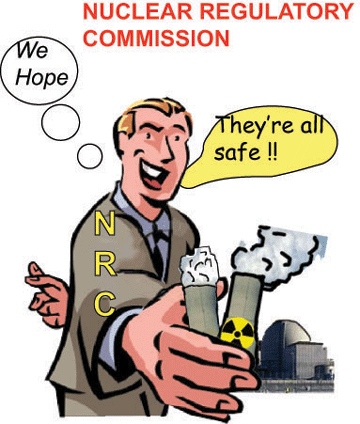
The NRC commission looks poised to rubber-stamp “Cowboy Chernobyl”, write Paul Gunter and Linda Pentz Gunter
Donald Trump loves a yes-man. What we are now waiting to learn is just how many of those yes-men are sitting on the US Nuclear Regulatory Commission (NRC).
The agency was ordered late last year by the then White House and Elon Musk-created US Department of Government Efficiency, to effectively accelerate and “rubber stamp” reactor license approvals in order to fulfill the White House’s reckless directive, contained in four executive orders issued last May, to license new reactors at lighting speed.
On December 1, the NRC proudly announced that its staff had completed their final safety evaluation for the Bill Gates company TerraPower’s small modular reactor design in record time, in keeping with the make haste mandate from the White House. The NRC staff had concluded that “there are no safety aspects that would preclude issuing the construction permit.”
NRC commissioner David Wright was abruptly and surprisingly demoted from his position as chairman after serving in that capacity for less than one year.
Jeremy Groom, acting director of the NRC’s Office of Nuclear Reactor Regulation, even bragged how the NRC staff “finished our technical work on the Kemmerer review a month ahead of our already accelerated schedule, as we aim to make licensing decisions for new, advanced reactors in no more than 18 months.”
What we are now waiting to find out, likely sometime this month, is whether the five NRC commissioners will indeed grant a construction license to a patently dangerous reactor design (we are using the term “dangerous” here under their own definition since all of us already know that every nuclear reactor design is inherently dangerous and the so-called new ones haven’t changed that reality.)
Who will be calling those shots, however, has now been significantly reshuffled by the Trump administration.
Sitting NRC commissioner and Republican David Wright had been appointed commission chair immediately after Trump’s January 2025 inauguration, bumping the Biden administration’s appointed chair, Democrat Christopher Hanson, to commissioner.
By June, the White House had unceremoniously fired Hanson from the commission “without cause” in a move widely viewed as illegal based on US Supreme Court precedent case law that went unchallenged. By August, Republican commissioner Annie Caputo had resigned, a surprise move explained by the need to “spend more time with family,” invariable a convenient cover story. This left two vacant seats on the commission.
These have now been filled by two Republicans nominated by the White House — Douglas Weaver (straight from industry) and Ho Nieh, who has been spinning through industry-regulator revolving doors for much of his career.
Nieh has been an NRC employee for 23 years, reaching senior management level. He was confirmed to the commission by the US Senate on November 19, 2025 and sworn in on December 4, 2025.
Then, in yet another surprise move, on January 8, 2026, Trump named Ho Nieh the new NRC commission chairman, effective immediately, bumping David Wright back to commissioner. Caputo’s vacant seat was filled by Weaver.
This was a strategic political maneuver to set up a 3-2 Republican majority on the commission, with the Democrats — Bradley Crowell (term expiring June 30, 2027) and Matthew Marzano (term expiring June 30, 2028 — now pushed to the minority………………………………………………………………………………………………………………………………………………………………………………………………………
The witnesses for the House hearing — tellingly called “American Energy Dominance: Dawn of the New Nuclear Era” — came exclusively from the industry, with representatives from the Nuclear Energy Institute — the nuclear industry’s paid propaganda arm — and from Southern Company, the Nuclear Innovation Alliance and the Idaho National Laboratory.
Entirely missing were any contrary, independent, objective and scientifically knowledgeable voices. Did they invite Lyman or M.V. Ramana, or Arjun Makhijani, physicists who actually understand how precisely dangerous these new reactor schemes are?
Did they invite Amory Lovins to blow the lid off the extreme costs or Mark Jacobson to educate them on how they could achieve their same goals with renewables instead?
And did they invite anyone from the targeted communities to see if they actually wanted these things in their neighborhoods or had even been consulted?
Even the right wing British daily newspaper, the Daily Mail, ran a headline that screamed “Tiny city of just 2,000 residents are fearful as Bill Gates-backed nuclear plant dubbed ‘Cowboy Chernobyl is built on their doorstep,” borrowing the moniker Lyman had used for the Natrium plan.
“I don’t think there are, at least from our perspective, many communities that are out there raising their hands saying, ‘Yes. We want a nuclear project in our community with an expedited safety and environmental review,’” John Burrows, Wyoming Outdoor Council’s energy and climate policy director told his local NPR station. “It’s just not something that any community wants to see, especially for a pilot or demonstration project.”
At least 60 percent of Americans now say they want more nuclear power according to a recent Pew Research Center poll. Of course they do, because they, like members of Congress, are only listening to the endless propaganda drumbeat from the nuclear industry, blasted non-stop across mainstream media and almost always without challenge.
Lyman’s “Cowboy Chernobyl” quip is actually a deep serious warning. It’s time we drove those nuclear cowboys off into the sunset, not in glory but in disgrace.
Paul Gunter is the Director of the Reactor Oversight Project at Beyond Nuclear. Linda Pentz Gunter is the founder of Beyond Nuclear and serves as its international specialist. Her book, No To Nuclear. Why Nuclear Power Destroys Lives, Derails Climate Progress and Provokes War, can be pre-ordered now from Pluto Press. https://beyondnuclearinternational.org/2026/01/15/all-the-presidents-yes-men/
Revealed: The CIA-Backed Think Tanks Fueling The Iran Protests

Reading between the lines, the National Endowment for Democracy (NED) is attempting to build up a widespread network of media outlets, NGOs, activists, intellectuals, student leaders and politicians who will all sing from the same hymn sheet, that of “transitioning” from “authoritarianism” (i.e., the current system of government” to “democracy,” (i.e., a U.S.-picked government). In other words: regime change.
Mint Press News, January 15th, 2026. Alan Macleod
As waves of deadly demonstrations and counter-demonstrations hit Iran, MintPress examines the CIA-backed NGOs helping to stir the outrage and foment more violence.
One of these groups is Human Rights Activists In Iran, frequently referred to as HRA or HRAI in the media. The group, and its media arm, the Human Rights Activists News Agency (HRANA) have become the go-to group of experts for Western media, and are the source of many of the most inflammatory claims and shockingly high casualty figures reported in the press. In the past week alone, their assertions have provided much of the basis for stories in CNN, The Wall Street Journal, NPR, ABC News, Sky News, and The New York Post, among others. And in a passionate plea for leftists to support the protests, Owen Jones wrote in The Guardian Tuesday that HRAI are a “respected” group whose death toll proclamations are “probably significant underestimates.”
Yet what none of these reports mention is that Human Rights Activists In Iran is bankrolled by the Central Intelligence Agency, through its cutout organization, the National Endowment for Democracy (NED)
“Independent” NGOs, Brought to You By the CIA
Established in 2006, Human Rights Activists in Iran is based in Fairfax, Virginia, just a stone’s throw away from CIA headquarters in Langley. It describes itself as a “non-political” association of activists dedicated to advancing freedom and rights in Iran. On its website, it notes that, “because the organization seeks to remain independent, it doesn’t accept financial aid from neither political groups nor governments.” Yet, in the same paragraph, it notes that “HRAI has also been accepting donations from National Endowment for Democracy, a non-profit, non-governmental organization in the United States of America.” The level of NED investment into HRAI has been substantial, to say the least; journalist Michael Tracey found that, in 2024 alone, the NED had apportioned well over $900,000 towards the organization.
Another NGO widely cited in recent media reports on the protests is the Abdorrahman Boroumand Center for Human Rights in Iran (ABCHRI). The group has been quoted widely, including by The Washington Post, PBS, and ABC News. Like with the HRAI, these reports also fail to disclose the Abdorrahman Boroumand Center’s proximity to the U.S. national security state.
Although it does not mention it in its funding disclaimer, the center is supported by the NED. Last year, the NED described the center as a “partner” organization, and awarded its director, Roya Boroumand, their 2024 Goler T. Butcher medal for democracy promotion.
“Roya and her organization have worked rigorously and objectively to document human rights violations committed by the regime in Iran,” said Amira Maaty, senior director for NED’s Middle East and North Africa programs. “The work of the Abdorrahman Boroumand Center is an indispensable resource for victims to seek justice and hold perpetrators accountable under international law. NED is proud to support Roya and the center in their advocacy for human rights and tireless pursuit of a democratic future for Iran.”
In addition to this, sitting on the center’s board of directors is controversial academic, Francis Fukuyama, a former NED board member and an editor of its “Journal of Democracy” publication.
If anything, the Center for Human Rights in Iran (CHRI) has gone further than HRAI or the ABCHRI. Widely cited across Western media (e.g., The New York Times, The Guardian, USA Today), the CHRI has been the source of many of the goriest and most lurid stories coming out of Iran. A Monday article in The Washington Post, for example, leaned on the CHRI’s expertise to report that Iranian hospitals were being overwhelmed and had even run out of blood to treat the victims of government repression. “A massacre is unfolding. The world must act now to prevent further loss of life,” a CHRI spokesperson said. Given President Trump’s recent threats about U.S. military attacks on Iran, the implications of the statement were clear.
And yet, like with the other NGOs profiled, none of the corporate media outlets citing the Center for Human Rights in Iran noted its close connections to the U.S. national security state. The CHRI – an Iranian human rights group based in New York City and Washington, D.C. – was identified by the government of China as directly funded by the NED.
The claim is far from outlandish, given that CHRI board member, Mehrangiz Kar, is a former Reagan-Fascell Democracy Fellow at the NED. And in 2002 at a star-studded gala on Capitol Hill, First Lady Laura Bush and future president Joe Biden presented Kar with the NED’s annual Democracy Award.
A History of Regime Change Ops
The National Endowment for Democracy was created in 1983 by the Reagan administration, after a series of scandals had seriously damaged the image and reputation of the CIA. The Church Committee – a 1975 U.S. Senate investigation into CIA activities – found that the agency had masterminded the assassination of several foreign heads of state, was involved in a massive domestic surveillance campaign against progressive groups, had infiltrated and placed agents in hundreds of U.S. media outlets, and was carrying out shocking mind control experiments on unwilling American participants.
Technically a private entity, although receiving virtually all its funding from the federal government and being staffed by ex-spooks, the NED was created as a way to outsource many of the agency’s most controversial activities, especially overseas regime change operations. “It would be terrible for democratic groups around the world to be seen as subsidized by the CIA,” Carl Gershman, the NED’s longtime president, said in 1986. NED co-founder Allen Weinstein agreed: “A lot of what we do today was done covertly 25 years ago by the CIA,” he told The Washington Post.
Part of the CIA’s mission was to create a worldwide network of media outlets and NGOs that would parrot CIA talking points, passing it off as credible news. As former CIA taskforce leader John Stockwell admitted, “I had propagandists all over the world.” Stockwell went on to describe how he helped flood the world with fake news demonizing Cuba:
We pumped dozens of stories about Cuban atrocities, Cuban rapists [to the media]… We ran [faked] photographs that made almost every newspaper in the country… We didn’t know of one single atrocity committed by the Cubans. It was pure, raw, false propaganda to create an illusion of communists eating babies for breakfast.”
Mike Pompeo, former CIA director, alluded this being active CIA policy. At a 2019 talk at Texas A&M University, he said, “When I was a cadet, what’s the cadet motto at West Point? You will not lie, cheat, or steal or tolerate those who do. I was the CIA director. We lied, we cheated, we stole. We had entire training courses [on] it!”
One of the NED’s greatest successes came in 1996, when it successfully swung elections in Russia, spending vast amounts of money to ensure U.S. puppet ruler Boris Yeltsin would remain in power. Yeltsin, who came to power in a 1993 coup that dissolved parliament, was deeply unpopular, and it appeared that the Russian public were ready to vote for a return to Communism. The NED and other American agencies flooded Russia with money and propaganda, ensuring their man remained in power. The story was cataloged in a famous edition of Time magazine, whose title page was emblazoned with the words, “Yanks To The Rescue: the Secret Story of How American Advisors Helped Yeltsin Win.”
Six years later, the NED provided both the finances and the brains for a briefly successful coup d’état against Venezuelan president, Hugo Chavez. The NED spent hundreds of thousands of dollars flying coup leaders (such as Marina Corina Machado) back and forth to Washington, D.C. After the coup was overturned and the plot was exposed, NED funding to Machado and her allies actually increased, and the organization has continued to fund her and her political organizations.
The NED would have more luck in Ukraine, playing a key role in the successful 2014 Maidan Revolution that toppled President Viktor Yanukovych and replaced him with a pro-U.S. successor. The Maidan affair followed a tried-and-tested formula, with large numbers of people coming out to protest, and a hardcore of trained paramilitaries carrying out acts of violence aimed at destabilizing the government and provoking a military response.
Assistant Secretary of State for European and Eurasian Affairs (and future NED board member) Victoria Nuland flew to Kiev to signal the U.S. government’s full support of the movement to oust Yanukovych, even handing out cookies to protestors in the city’s main square. A leaked telephone call showed that the new Ukrainian prime minister, Arseniy Yatsenyuk, was directly chosen by Nuland. “Yats is the guy,” she can be heard telling U.S. Ambassador to Ukraine, Geoffrey Pyatt, citing his experience and friendliness with Washington as key factors. The 2014 Maidan Revolution and its aftermath would lead to Russia’s invasion of Ukraine eight years later.
Just across the border in Belarus, the NED planned similar actions to overthrow President Alexander Lukashenko. At the time of the attempt (2020-2021), the NED was pursuing 40 active projects inside the country.
On a Zoom call infiltrated and covertly recorded by activists, the NED’s senior Europe Program officer, Nina Ognianova, boasted that the groups leading the nationwide demonstrations against Lukashenko were trained by her organization. “We don’t think that this movement that is so impressive and so inspiring came out of nowhere — that it just happened overnight,” she said, noting that the NED had made a “significant contribution” to the protests.
On the same call, NED President Gershman noted that “we support many, many groups, and we have a very, very active program throughout the country, and many of the groups obviously have their partners in exile,” boasting that the Belarusian government was powerless to stop them. “We’re not like Freedom House or NDI [the National Democratic Institute] and the IRI [International Republican Institute]; we don’t have offices. So if we’re not there, they can’t kick us out,” he said, comparing the NED to other U.S. regime change organizations.
The attempted Color Revolution did not succeed, however, as demonstrators were met with large counter-demonstrations, and Lukashenko remains in power to this day. The NED’s actions were a key factor in Lukashenko’s decision to abandon his relationship with the West, and ally Belarus with Russia.
Just months after their failure in Belarus, the NED fomented another regime change attempt, this time in Cuba. The agency spent millions of dollars infiltrating and buying off pliant musical artists, especially in the hip hop community, in an attempt to turn local popular culture against its revolution. Led by Cuban rappers, the U.S. attempted to rally the people into the streets, flooding social media with calls from celebrities and politicians alike to topple the government. This did not translate into boots on the ground, however, and the fiasco was written off sarcastically as the U.S.’ “Bay of Tweets.”
So many of the most visible protest movements the world over have been quietly masterminded by the NED. This includes the 2019-2020 Hong Kong protests, wherein the agency funnelled millions to the movement’s leaders to keep people in the streets as long as possible. The NED continues to work with Uyghur and Tibetan separatist groups, in the hope of destabilizing China. Other known NED meddling projects include interfering with elections in France, Panama, Costa Rica, Nicaragua, and Poland.
It is precisely for these reasons, therefore, that accepting funding from the NED should be unthinkable for any serious NGO or human rights organization, as so many that do have been front groups for American power and clandestine regime change operations. It is also why the public should be extremely wary about any claims made by organizations on the payroll of a CIA cutout organization, especially those that attempt to hide the fact. Journalists, too, have a duty to scrutinize any statements made by these groups, and inform their readers and viewers about their inherent conflicts of interests.
Targeting Iran
Apart from funding the three U.S.-based human rights NGOs profiled here, the NED is spearheading a myriad of operations targeting the Islamic Republic. According to its 2025 grant listings, there are currently 18 active NED projects for Iran, although the agency does not divulge any of the groups they are working with.
It also refuses to divulge any hard details about these projects, beyond rather bland descriptions that include:
Empowering” a network of “frontline and exiled activists” inside Iran;
“Promoting independent journalism,” and “Establishing media platforms to influence the public;”
“Monitoring and promoting human rights;”
“Training student leaders inside Iran;”
“Advancing policy analysis, debate, and collective actions on democracy,” and;
“Foster[ing] collaboration between Iranian civil society and political activists on a democratic vision and raise awareness on civic rights within the legal community, the organization will facilitate debate on transition models from authoritarianism to democracy.”
Reading between the lines, the NED is attempting to build up a widespread network of media outlets, NGOs, activists, intellectuals, student leaders and politicians who will all sing from the same hymn sheet, that of “transitioning” from “authoritarianism” (i.e., the current system of government” to “democracy,” (i.e., a U.S.-picked government). In other words: regime change.
Iran, of course, has been in American crosshairs ever since the removal of the Shah Mohammad Reza Pahlavi during the Islamic Revolution of 1978-79. Pahlavi himself had been kept in place by the CIA, who engineered a coup against the democratically-elected government of Mohammad Mossadegh (1952-53). Mossadegh, a secular liberal reformer, had angered Washington by nationalizing the country’s oil industry, carrying out land reform, and refusing to crush the communist Tudeh Party.
The CIA (the NED’s parent organization), infiltrated Iranian media, paying them to run hysterical anti-Mossadegh content, carried out terror attacks inside Iran, bribed officials to turn against the president, cultivated ties with reactionary elements within the military, and paid protestors to flood the streets at anti-Mossadegh rallies.
The shah reigned for 26 bloody years between 1953 and 1979, until he was overthrown in the Islamic Revolution.
The U.S. supported Saddam Hussein’s Iraq, who almost immediately invaded Iran, leading to a bitter, eight-year long conflict that killed at least half a million people. Washington supplied Hussein with a wide range of weapons, including components for chemical weapons used on Iranians, as well as other weapons of mass destruction.
Since 1979, Iran has also been under restrictive American economic sanctions, measures that have severely hindered the country’s development. During his first term, Trump withdrew from the Iran Nuclear Deal and turned up the economic pressure. The result was a collapse in the value of the Iranian rial, mass unemployment, soaring rents and a doubling of the price of food. Ordinary people lost both their savings and their long-term security.
Throughout this, Trump has constantly threatened Iran with attack, finally following through in June, bombing a host of infrastructure projects inside the country.
A Legitimate Protest
The current demonstrations began on December 28 as a protest against rising prices. Yet they quickly ballooned into something much bigger, with thousands calling for an overthrow of the government, and even the reinstatement of the monarchy under the son of the shah, Crown Prince Reza Pahlavi.
They were quickly supported and signal boosted by the U.S. and Israeli national security states. “The Iranian regime is in trouble,” Pompeo announced. “Happy New Year to every Iranian in the streets. Also to every Mossad agent walking beside them…” he added. Israeli media are openly reporting that “foreign elements” (i.e., Israeli) are “arming the protesters in Iran with live weapons, and this is the reason for the hundreds of dead among the regime’s people.”
The Israeli intelligence services confirmed Pompeo’s not-so-cryptic assertion. “Go out together into the streets. The time has come,” the spying agency’s official social media accounts instructed Iranians: “We are with you. Not only from a distance and verbally. We are with you in the field.”
Trump echoed those words. “TAKE OVER YOUR INSTITUTIONS!!! Save the names of the killers and abusers. They will pay a big price,” he roared, adding that American “help is on the way.”
Any debate about what Trump meant by “American help” was ended on Monday, when he stated that “If Iran shots [sic] and violently kills peaceful protesters, which is their custom, the United States of America will come to their rescue… We are locked and loaded and ready to go.” He also attempted to place an all-out economic blockade, announcing that any country trading with Tehran would face an additional 25% tariff.
All of this, added to the increasing violence of the protests, makes it much harder for Iranians to express themselves politically. What started as a demonstration about the cost of living has spiralled into a huge, openly insurrectionist movement, backed and fomented by the U.S. and Israel. Iranians, of course, have every right to protest, but a wealth of factors have raised the very real possibility that much of the anti-government movement is an inorganic, U.S.-orchestrated attempt at regime change. While Iranians can argue about how they wish to express themselves and what sort of government they want, what is undebatable is that so many of the think tanks and NGOs called upon to provide supposed expert evidence and commentary about these protests are tools of the National Endowment for Democracy.
Alan MacLeod is Senior Staff Writer for MintPress News. He completed his PhD in 2017 and has since authored two acclaimed books: Bad News From Venezuela: Twenty Years of Fake News and Misreporting and Propaganda in the Information Age: Still Manufacturing Consent, as well as a number of academic articles. He has also contributed to FAIR.org, The Guardian, Salon, The Grayzone, Jacobin Magazine, and Common Dreams. Follow Alan on Twitter for more of his work and commentary:
Trump’s foreign policy: “I don’t need international law because I’m not looking to hurt people”

Walt Zlotow West Suburban Peace Coalition Glen Ellyn IL , 16 Jan 26,
Trump’s foreign policy: “I don’t need international law because I’m not looking to hurt people”
In dismissing international law, Trump went further and proclaimed regarding any limit on his authority to engage in military action, “the only limit is my own mind, my own morality…the only thing that can stop me.”
During the past year how has Trump’s own mind, own morality influenced his looking to not hurt people?
Trump supplied Israel with billions in bombs to slaughter tens of thousands of Palestinians in Gaza.
He’s bombed imagine bad guys in Somalia 124 times, doubling his previous record of 63 bombings in 2019.
He fired 12 Tomahawk missiles at imagined bad guys in Nigeria killing unknown Nigerians.
He bombed Syria after 3 US soldiers defiling Syrian sovereignty were killed by unknown attackers. Didn’t matter who Trump killed as long as he retaliated.
He bombed Iran to take out an imaginary nuclear bomb program. He may be on the cusp of bombing Iran again to achieve decades’ long US goal of Iranian regime change.
He obliterated 35 small, unarmed boats off Venezuela, killing over 100 unknown persons. Then he attacked Venezuelan President Nicholas Maduro’s compound, killing over 100 guards in the process of kidnapping him back to the US.
He’s threatening to invade and take control of Greenland from Denmark.
He’s threatening to change out Cuba’s communist government that has been America’s goal for 66 years.
Back home, he’s sent thousands of masked, armed, poorly trained ICE thugs onto American streets to arrest, harass, beat up, occasionally shoot innocent persons trying to live the American Dream.
Gee, wonder what Trump’s foreign and domestic policy would be like if his stated goal was to hurt people?
Biden knew Ukraine would lose proxy war with Russia….provoked it anyway

Yet..and yet, President Zelensky is refusing to accept the reality of Ukraine’s defeat, even demanding return of territory lost forever. NATO countries led by delusional leaders Starmer in UK, Merz in Germany and Macron in France, claiming they’re Russia’s next target, are still pledging war resources they don’t have and never will
Walt Zlotow, Jan 17, 2026, Walt Zlotow West Suburban Peace Coalition Glen Ellyn IL
The US proxy war against Russia destroying Ukraine has largely disappeared from mainstream news. US warfare with Venezuela, possible renewed war with Iran, seizing Greenland from Denmark have put a virtual blackout on Ukraine war reporting.
But a bigger reason is the war is lost with no chance of reversing the destruction of Ukraine short of nuclear war with Russia. If that happens we’re all destroyed.
So Trump, his advisors, the national security state (A.K.A. war party) and the aforementioned mainstream news have moved on. They realize the war has become a spectacular defeat for America’s goal of bringing Ukraine into NATO to further weaken Russia and isolate it from the European political economy. Publically admitting defeat and failure is something none of them will dare not speak its name.
Trump, to his credit, is trying to get both Ukraine and NATO to give up and settle on Russia’ sensible terms: no NATO for Ukraine, Ukraine to be forever neutral between Europe and Russia, no return of land containing mainly Russian leaning Ukrainians brutalized by Kyiv for 8 years before Russia intervened.
How badly has Ukraine lost? Over a million and a half dead, wounded or MIA, a quarter million soldiers deserted and over 9 million fled to safer climes. The economy down by a third surviving on European life support. Reconstruction costs once war ends at a half trillion dollars and rising.
Russia meanwhile is thriving, economy up by pivoting away from trade with Europe to the Global South and others only too happy to degrade both US and European hegemony. Result is a tripling of NATO energy costs, collapse of leaders support with nationalist, antiwar opposition poised to take over next election.
Could it get any worse for Ukraine and NATO?
Yet..and yet, President Zelensky is refusing to accept the reality of Ukraine’s defeat, even demanding return of territory lost forever. NATO countries led by delusional leaders Starmer in UK, Merz in Germany and Macron in France, claiming they’re Russia’s next target, are still pledging war resources they don’t have and never will
The only logical explanation is that they know the inevitable defeat facing Ukraine and NATO but are terrified to admit it and do the right thing. Trump, while sensibly pushing Ukraine and NATO, refuses to pull all US support for the lost war. He’s cynically telling NATO to keep the weapons flowing…just as long as they buy them from America. For Trump, lost war can still be a profitable business deal. He’s also refuses to pull the plug on massive weapons Biden foolishly authorized in his last days knowing Trump had no stomach to continue the war.
Speaking of Biden, he knew Ukraine could not prevail when he provoked the Russian Special Military Operation in February, 2022. But he viewed Ukraine’s destruction as collateral damage to so degrading Russia in the process that they would be forever weakened and out of the European political economy. Biden likely viewed US/NATO Ukraine support as a repeat of US meddling that defeated Russia in Afghanistan in 1989. Big mistake as history didn’t repeat.
Biden’s Mother of all Sanctions and $150 billion in weapons backfired spectacularly. So not only did Biden destroy Ukraine by provoking war, he’s likely destroyed America’s dominance leading NATO in Europe. In fact he may have put NATO on the path to history with their impending defeat flailing away at a lost cause.
The only question, besides how badly the rump state of Ukraine will end up at war’s end, is whether Ukraine and NATO’s futile perseverance will end up in nuclear war with Russia still possible every day this nightmare continues.
However it ends, Joe Biden’s legacy will be making the greatest foreign policy mistake so far in America’s 250 years.
Say it wasn’t so, Joe.
On the Eve of Destruction: Has His Majesty’s Madness for War Led His Loyal Supporters Astray?
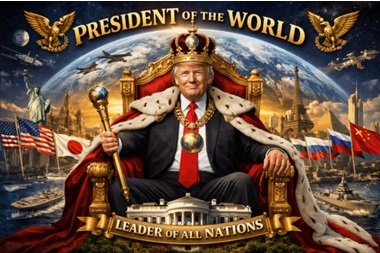
15 January 2026 David Tyler, https://theaimn.net/on-the-eve-of-destruction-has-his-majestys-madness-for-war-led-his-loyal-supporters-astray/
The Persian Gulf is no longer a tinderbox; it is an inferno. Just this morning, President Trump of the USA and Venezuela, as he now styles himself, has effectively issued a declaration of intent, telling Iranian protesters that “help is on its way.” Is that a threat or a promise? Survivors remember US help last time. But as B-2 bombers warm their engines and squadrons of Israeli Adir, as they call their versions of F35s, stealth fighter jets, sit fuelled on the tarmac, we must pull back the curtain on the “spontaneous” uprising that serves as the pretext for this looming catastrophe.
The Hand of the Provocateur
The economic misery of Iran’s people is raw and real; the rial has lost around four-fifths of its value since the June 2025 war; inflation is crippling. But the timing of this chaos cannot be ignored. Tehran is right to point to the meddling of foreigners. When former CIA Director, Mike Pompeo, tweeted a “New Year” greeting to “every Mossad agent walking beside” the protesters, the mask wasn’t just slipping; it was discarded.
History repeats as farce: just as the CIA orchestrated the 1953 coup in Tehran by paying mobs to riot, today’s agents provocateurs are reportedly steering protesters toward IRGC outposts and banks. Iranian state media has showcased confessions from alleged Mossad agents, while reports of 40,000 Starlink terminals smuggled into the country by the CIA and Mossad lend credence to Tehran’s narrative; even as the protests’ roots in economic despair remain undeniable.
The CIA may have wasted its time with the Starlink. Iran has successfully disrupted 80% of Starlink service using military-grade GPS jamming; the first regime to effectively cripple what was thought to be “unjammable” satellite internet
Iran accuses the CIA of creating a level of “state-directed” “massacre” that provides the moral high ground for a “Humanitarian Strike.” The irony could not be any darker. The US mission is to save lives. Even if their agents have to shoot every protester themselves to create the pretext for a US-Israeli attack.
Iran’s Foreign Minister, Abbas Araghchi claims Trump’s warning of military intervention motivated “terrorists” to target protesters and security forces to encourage foreign intervention. Translation: he’s alleging provocateurs are shooting people deliberately to justify Trump’s promised intervention.
“Protesters are speculating” – CNN reports: “protesters are speculating whether the violence is being fuelled by the Iranian regime itself, or by foreign powers.” In the digital blackout, any atrocity can be committed and blamed on anybody. Qatari state broadcaster, Al Jazeera, is giving serious airtime to Tehran’s claim that terrorist groups are shooting people.
When Al Jazeera gives prominent airtime to Iran’s “armed terrorist groups shot people” narrative, that’s not neutral journalism – it’s Doha signaling to Tehran that they’re sympathetic to their version while trying to keep communication channels open
Classic Gulf realpolitik: publicly neutral, privately picking sides based on gas pipelines and base leases.
The Napoleonic Blunder: Two Fronts, Zero Carriers
But US forces may struggle. In his hubris, the President has committed the ultimate strategic error: the creation of a war on two opposing fronts. On January 3, US Special Forces captured Nicolás Maduro in Caracas, and the USS Gerald R. Ford; the Navy’s most advanced carrier, is now anchored in the Caribbean, not the Persian Gulf. This has left a catastrophic “Carrier Gap” in the Middle East. For the first time in years, there is no US aircraft carrier in the 5th Fleet’s area of responsibility.
To launch a war against a sophisticated adversary like Iran, while the Navy is playing colonial administrator in the Caribbean, is more than a mistake; it is a Napoleonic blunder of historic proportions. Or it’s Thiel and Miller’s idea of a military 4D Chess gambit.
The “Grey Figures” and the Fascist Blueprint
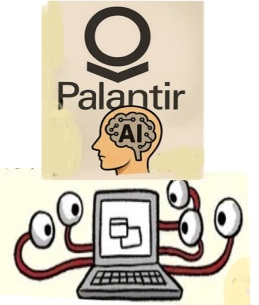
The common refrain that Trump “appoints the worst” is only half-true. As Robert Reich has pointed out, the real danger lies in the “grey figures” who are terrifyingly competent. Figures such as Peter Thiel, whose Palantir systems are now the “eyes” of the US military, and Stephen Miller, the architect of the administration’s most ruthless nationalist policies, are not bumbling sycophants. They are “highly capable fascists” who view the destruction of the Iranian regime as a necessary “disruption” to the global order.
Thiel’s Palantir isn’t just watching the war; it’s scripting it. The company’s AI platforms, honed in Ukraine and Gaza, are now the “eyes” of the US military, turning battlefield data into kill chains. The same AI that monitored Iran’s nuclear porgram, identified strike targets in June 2025. It now processes protest data, social media and Starlink traffic. It predicts “threats using predictive policing algorithms. This is “creative destruction” as geopolitical doctrine, with Thiel and Miller as its high priests.
Their criterion for service is not just sycophancy, but a shared disdain for the “old world” of diplomacy. They have led the President’s loyal supporters astray by rebranding a traditional regime-change war as a “populist rescue,” while simultaneously building the digital surveillance infrastructure to ensure that “liberty” abroad looks a lot like “control” at home.
Just to recap. When 12,000 Iranians die in two nights with the internet dark, and Palantir’s AI is processing every data point – who decided they were threats? An algorithm trained on Israeli battlefield data? A predictive model that flags “rioters” the same way it flagged Gaza civilians as “militants”?
Thiel’s company doesn’t just see the war – it authors it. And it’s making billions doing so.
The Retaliation Forecast: A Doomsday Scenario
If the “Iron Strike” protocols are triggered this week, the response will be a regional fireball:
Targeting the “Fixed” Assets: Without carriers, the US must fly from land bases like Al Udeid (Qatar) and NSA Bahrain. These are static targets. Iran’s parliamentary speaker, Ghalibaf, has already warned that these bases will be “totally obliterated” by ballistic missile swarms the moment the first US bomb falls.
The Strait Chokehold: Expect the mining of the Strait of Hormuz, which will send oil prices, already spiked by the Venezuela crisis, into territory that could collapse the global economy.
The “Shadow Fleet” Conflict: The recent US seizure of the Marinera (the renamed Bella 1) shows that the “Shadow War” has already turned kinetic.
With no carriers in the Gulf and US bases in Qatar and Bahrain sitting ducks for Iranian missiles, the “Humanitarian Strike” could quickly become a humanitarian catastrophe. The two-front trap is set; and the empire may have walked right into it.
The Periphery as a Laboratory: The “Donroe Doctrine”
Joseph Schumpeter spoke of “Creative Destruction” as the essential fact of capitalism, the incessant revolutionizing of the economic structure from within by destroying the old one.
In 2026, the Trump administration has applied this to geopolitics.
Under what independent commentators are calling the “Donroe Doctrine,” the administration is treating the global periphery – Venezuela in the West and Iran in the East – as obsolete structures to be liquidated.
The Venezuelan Template: The January 3rd abduction of Maduro wasn’t just about drugs; it was about the “destruction” of a non-compliant energy node to make way for a US-managed resource monopoly.
The Iranian Bait: Al-Jazeera’s recent reporting highlights that while Iran’s Foreign Minister Araghchi pleads for dialogue, the “Grey Figures” in Washington; the Thiels and Millers, are busy ensuring the “creative” part of the destruction. By baiting the regime into the January 8th massacre via agents provocateurs, they have created the “moral” vacuum necessary to install a new, techno-dependent order.
The Symbiosis: Sycophants vs. The “Highly Capable”
Trump is very useful to his key staffers; they need the distraction of his madness. The real power dynamic is not found in the sycophancy of a Pete Hegseth, but in the calculated brilliance of the ideologues.
The Architect: Stephen Miller has successfully pivoted from domestic nativism to a “Brute Strength” foreign policy. He isn’t just a sycophant; he is a practitioner of realpolitik who views the two-front war (Venezuela/Iran) as a necessary “stress test” for American hegemony.
The Engineer: Peter Thiel’s involvement represents the ultimate Schumpeterian shift. Through Palantir’s integration into the “Iron Strike” protocols, the war is being fought as an algorithmic liquidation. This is the symbiosis: Trump provides the populist gale, while the “Grey Figures” provide the silicon-grade precision to ensure the “destruction” is permanent.
The Australian Connection: The Mirror of Suppression
As we look at the suppression of speech in Australia, the parallels are chilling. The “Public Assembly Restriction Declarations” (PARD) in Sydney, ostensibly to “ensure safety” after the Bondi tragedy, are being used to silence those protesting the US attack on Venezuela.
In Canberra, the “Combatting Antisemitism, Hate and Extremism Bill” is a masterclass in Orwellian doublespeak. Ostensibly targeting hate, its sweeping powers could just as easily silence critics of US wars or Israeli apartheid. And with a loophole for religious scripture, it may even protect the very extremists it claims to combat.
The Schumpeterian Irony: In the drive to “creatively destroy” foreign adversaries, the administration and its allies are destroying the very liberal-democratic structures they claim to defend.
Strategic Assessment: The Two-Front Trap
Despite the “capable fascists” at the helm, the Napoleonic blunder remains. With the USS Gerald R. Ford anchored in the Caribbean, the US is vulnerable. Iran knows this. Their “Arc of Fire” retaliation plan doesn’t target carriers; it targets the static, land-based infrastructure of the “Grey Figures’” digital war.
Next Update: I am currently tracking the flow of “emergency” data-sharing agreements between Canberra and Washington. It appears the suppression of the Sydney protests is being used as a training set for the very “Human Geography” mapping Thiel is deploying in Tehran.
In the next instalment, we’ll examine how the “Donroe Doctrine” is reshaping the global order, and why the “help” that is “on its way” may be the very thing that finishes us.
President Trump Urges Iran Protests To Continue, Says ‘Help Is on Its Way’

The president also said he cut off contact with Iranian officials
by Dave DeCamp | January 13, 2026 , https://news.antiwar.com/2026/01/13/president-trump-urges-iran-protests-to-continue-says-help-is-on-its-way/
President Trump on Tuesday called for the protests in Iran to continue and said “help is on its way,” suggesting he was making another threat of military intervention.
“Iranian Patriots, KEEP PROTESTING – TAKE OVER YOUR INSTITUTIONS!!! Save the names of the killers and abusers. They will pay a big price,” the president wrote on Truth Social.
The president also said he cut off contact with Iranian officials, a comment that came after he suggested he was open to diplomacy with Tehran. “I have cancelled all meetings with Iranian Officials until the senseless killing of protesters STOPS. HELP IS ON ITS WAY. MIGA!!!” Trump added.
“MIGA” refers to “Make Iran Great Again,” a slogan Trump used during the 12-day US-Israeli war against Iran back in June 2025 when he floated the idea of regime change in the country. He also recently posed with a “Make Iran Great Again Hat” alongside Sen. Lindsey Graham, who has said the president is ready to kill Iranian Supreme Leader Ayatollah Ali Khamenei.
Ali Larijani, the secretary of Iran’s Supreme National Security Council, responded to Trump’s post, saying the “names of the main killers of the people of Iran” were the US president and Israeli Prime Minister Benjamin Netanyahu. Also on Tuesday, Iran’s Islamic Revolutionary Guard Corps (IRGC) claimed it disrupted “Israeli-linked terror teams” and seized US-made weapons.
Iranian officials have warned that the US would face a severe response to any attack. “Come and see what will happen to American ships and military bases in the region,” the speaker of Iran’s parliament, Mohammad Baqer Qalibaf, said at a pro-government rally over the weekend.
“Come and burn in the fire of the Iranian nation so severely that it becomes a lasting lesson in history for all oppressive US rulers. Come and find out what will happen to you and to the region,” he added.
Militant Zionist Group Ceasing Operations In New York Following Settlement with Attorney General.

The far-right Zionist organization has agreed to a $50,000 suspended fine that it will only be forced to pay if it violates the terms of the agreement, which require it to stop engaging in organized harassment campaigns encouraging violence and making direct threats against its political opponents.
Although branded as a fringe group on the outskirts of the American Zionist establishment, evidence of the political influence of Betar U.S. became increasingly evident following the return of President Donald J. Trump to the White House.
Betar U.S. has deemed it cannot continue to operate if it is unable to engage in terroristic tactics.
blueapples, Jan 15, 2026, https://ddgeopolitics.substack.com/p/militant-zionist-group-ceasing-operations?utm_source=post-email-title&publication_id=1769298&post_id=184510757&utm_campaign=email-post-title&isFreemail=true&r=1ise1&triedRedirect=true&utm_medium=email
By virtue of its standing as the global center of the Jewish diaspora, New York City emerged as the main battleground in the United States for the fight between American Zionists and their opponents amid the deterioration of public support for Israel accelerated by its war against Hamas in the Gaza Strip. While critics of the State of Israel participating in widespread protests across the city have been branded as Jihadists by their opponents for protesting against the slaughter of innocent Palestinians at the blood-stained hands of the Israel Defense Forces (”IDF”), it is a pro-Israel group that has been exposed for engaging in a campaign of terrorism in the latest fallout from that ideological conflict. Betar U.S., the American chapter of an international militant organization created by the founder of the Zionist paramilitary the Irgun, has chosen to cease its operations in New York following a settlement with the office of the state’s attorney general after an investigation uncovered systemic campaigns of harassment, intimidation, and political violence led by the group.
In the wake of political unrest across the U.S. beginning in 2024 centered around protests against Israel on the campus of Columbia University, Betar U.S. engaged in organized harassment campaigns of pro-Palestinian protesters and activists, culminating in an investigation against them. The investigation into the organization began in March 2025, following a series of formal complaints made against the group. According to a statement from the office of New York Attorney General Letitia James announcing its settlement with Betar, “The Office of the Attorney General investigation determined that Betar U.S. engaged in a pattern of violence and harassment driven by explicit hostility toward protected groups.” The investigation also uncovered that despite registering with the Internal Revenue Service as a nonprofit in 2024, Betar U.S. never registered itself with the New York State Charities Bureau, despite soliciting donations while operating in the state.
The far-right Zionist organization has agreed to a $50,000 suspended fine that it will only be forced to pay if it violates the terms of the agreement, which require it to stop engaging in organized harassment campaigns encouraging violence and making direct threats against its political opponents. Betar U.S. will be required to file annual compliance reports for the next three years proving it has not violated the terms of the settlement to avoid paying the suspended fine. As a result of the settlement, Betar U.S. will dissolve its nonprofit status in New York and has told the attorney general’s office that it intends to cease its operations within the state. Despite agreeing to the settlement, a spokesperson from Betar U.S. has denied any wrongdoing.
Although branded as a fringe group on the outskirts of the American Zionist establishment, evidence of the political influence of Betar U.S. became increasingly evident following the return of President Donald J. Trump to the White House. In late January 2025, shortly after Trump was inaugurated, the far-right Zionist group provided his administration with a list of students participating in anti-Israel protests whose identities it uncovered in order to have them deported from the country. Shortly after being sent that list, President Trump signed an executive order creating a task force against antisemitism. In response to continued protests against Israel, Trump signed another executive order to deport college students and other non-permanent U.S. residents in the country on green cards and visas by equating their participation in the demonstrations with support for terrorism. That decision emboldened Betar U.S. to launch what it named Operation Wrath of Zion as a coordinated doxing campaign to leak the personal details of protesters.
Evidence of the harassment campaigns the New York Attorney General’s office found Betar U.S. to have engaged in has been replete across social media since the group was revived in June 2023, just months before the conflict between Israel and Hamas led to full-scale war in the Gaza Strip following the attacks of October 7th, 2023. The group regularly posted threats on X, going as far as to publish videos of its members committing acts of violence against pro-Palestine protesters. Following a Mossad-led operation dubbed Operation Grim Beeper, in which Israeli intelligence targeted Hezbollah officials by detonating thousands of handheld pagers across Lebanon and Syria, leading to thousands of civilian casualties, Betar U.S. posted videos of its members taking to the streets of New York City to hand-deliver beepers to anti-Israel activists as an intimidation tactic. Jewish anti-Zionist activist Norman Finkelstein was one such critic of Israel whom Betar U.S. targeted in this coordinated harassment campaign, calling him a “fucking Holocaust denying piece of shit” when placing a beeper into the front pocket of his jacket.
Although Betar U.S. targeted pro-Palestinian activists with its militant tactics, the extremist ideology of the group also put it at odds with other Jewish groups like the Anti-Defamation League. The group accused the ADL of being too lenient on opponents of Israel, creating an irreconcilable schism between the two. The animosity it fostered led to the ADL putting Betar U.S. on its database of extremist groups, making it the only Jewish organization to earn that distinction.
In response to the announcement of its settlement with the New York Attorney General, Betar attempted to distance itself from the renewed attention placed on its militant ideology. “Betar is mainstream Zionism, an organization without which the State of Israel would not exist,” a spokesperson told The Times of Israel. Despite this protestation, Betar is impossible to separate from militant Zionist extremism. The organization was originally established by Ze’ev Jabotinsky in Riga, Latvia in 1923 as a fascist youth movement created to advance his ideology of Revisionist Zionism.
The sect of Revisionist Zionism created by Jabotinsky advocated for the reform of the Zionist ideology in opposition to the left-wing Labor Zionism movement led by the eventual first Prime Minister of Israel, David Ben-Gurion. In contrast to Labor Zionism, the ideology of Revisionist Zionism centered around the idea that the Jewish people had the right to sovereignty over the whole of what it saw as the Land of Israel, including the entirety of British Mandatory Palestine and Transjordan. Revisionist Zionism has served as the foundation for the right wing of modern Israeli politics, influencing the creation of the Likud party, now led by Israeli Prime Minister Benjamin Netanyahu, as well as the Jewish supremacist Kahanism movement, which the Jewish Power party, led by Israeli Minister of National Security Itamar Ben-Gvir, arose out of.
Jabotinsky was also behind the founding of the Irgun, a Zionist paramilitary organization that operated in Mandatory Palestine from 1931 until years after his death in 1940, when it was eventually absorbed into the IDF following the establishment of the State of Israel in 1948. In its years operating as a Zionist paramilitary, the Irgun was responsible for acts of terrorism against Palestinian Arabs and other groups it labeled as opponents of its Zionist worldview, such as the Deir Yassin Massacre and the King David Hotel Bombing committed against the administrative headquarters of the British authorities of Mandatory Palestine in 1946. Betar served as a recruiting pipeline for the Irgun, in a manner like that in which the Hitler Youth was constructed.
It wasn’t until six years after the Zionist paramilitary was founded by Jabotinsky that the U.S. branch of Betar was established in 1929. Throughout its existence, opposition to its radical ideology and militant tactics had fragmented its operations in America. However, following its latest iteration being established in 2023, support from high-ranking Israeli political leaders has allowed it to flourish. During a visit to the U.S. in September to speak before the United Nations General Assembly, Israeli Prime Minister Benjamin Netanyahu met with leaders of Betar U.S. in New York City. Yet, even that tacit support from the Israeli government was not enough to overcome the scrutiny the group has faced due to its militant tactics.
In the wake of the announcement of its settlement with the Office of the New York State Attorney General, Betar U.S. returned to its X account to continue to push propaganda framing itself as a victim of antisemitism. Betar U.S. accused New York Attorney General Letitia James of barring it from operating in the state. In reality, all the attorney general’s office has required of Betar U.S. is to stop targeting its opponents with campaigns of harassment, intimidation, and violence, or face paying a paltry $50,000 fine. That requirement alone was enough for Betar U.S. to voluntarily cease its operations. Given that it postures itself as a mainstream pro-Israel organization, the fact that Betar U.S. has deemed that it cannot continue to operate without engaging in those terroristic tactics is a damning distillation of what Zionism truly stands for.
US Surging Military Assets To the Middle East To Prepare for War With Iran After Trump Postpones Attack
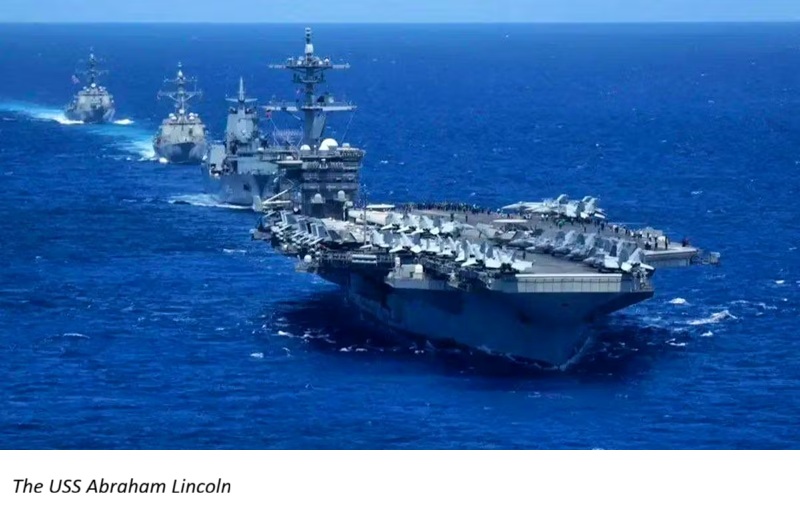
Reports claim that Netanyahu asked Trump to delay the attack as Israel wants more time to prepare for counterattacks
by Dave DeCamp | January 15, 2026, https://news.antiwar.com/2026/01/15/us-surging-military-assets-to-the-middle-east-to-prepare-for-war-with-iran-after-trump-postpones-attack/
The US military is planning to surge military assets to the Middle East to prepare for a potential war with Iran after President Trump backed down from bombing the country, according to a report from The New York Times.
US officials told the paper that the aircraft carrier USS Abraham Lincoln and some warships from its strike group were on their way to the Middle East from the South China Sea, a roughly week-long trip. The US is also planning to send an array of warplanes to the Middle East, including fighter jets and refueling aircraft, and additional air defenses.
According to other media reports, the US military’s message to Trump amid his threats to bomb Iran is that there weren’t enough US assets in the region to face a potential counterattack, which could target the many US bases in the region. Trump was also reportedly told that US strikes likely wouldn’t result in regime change and could lead to a prolonged war.
The Times report also said that Israeli Prime Minister Benjamin Netanyahu asked Trump to postpone his plans to attack Iran, and Axios reported the same thing later, saying that Netanyahu wants more time to prepare for Iranian retaliation.
If the reports about Netanyahu’s request are true, it’s likely that he also wants more US military assets in the region since Israel relied on US forces to intercept Iranian missiles during the war back in June 2025, and many still got through and struck Israeli territory, which is what led to Israel agreeing to a ceasefire after 12 days.
On the other hand, the leaks and delays could be meant to keep Iran off guard as the US and Israel engaged in a deception campaign before Israel launched the opening salvo of the 12-Day War.
The White House has claimed that Iran has postponed planned executions due to Trump’s threats and warned that if the “killing” in Iran continues, there will be consequences. However, the unrest in Iran is just the latest pretext for war with Iran.
Iran’s nuclear program was the pretext for launching the 12-Day War, and while meeting with Netanyahu at Mar-a-Lago back in December, Trump said he would back an Israeli attack on Iran if Tehran “continues” its conventional missile program. There’s no sign that Iran would even consider limiting its ballistic missiles since they are the Islamic Republic’s only form of deterrence.
Big Tech embraces nuclear, but who will pay the price?—The US turns back to nuclear power
The nuclear power sector can’t survive without subsidies and public guarantees. And that’s what the tech industry is counting on, that’s the only reason they’re talking about reviving nuclear energy
AI’s power demands are vast and growing. The Trump administration wants nuclear reactors to meet them. Whether that’s achievable, and whether communities will accept it, is another matter.
World Nuclear Industry Status Report, 9 January 2026
We passed cranes, vacant lots and one data centre after another, many still under construction. ‘Check that one out, it’s really huge!’ said Ann Bennett, an activist with the environmental organisation Sierra Club, as she drove us through Virginia’s Loudoun and Fairfax counties close to Washington DC. She was critical of this building explosion. ‘That right there’s the cloud. Just look at it, it’s hard to describe.’
She was right. The landscape is dystopian: behind newly erected powerlines, vast windowless buildings in grey, cream or blue line the straight roads. Over and over we passed huge electrical transformers and building sites. It was only June but temperatures were already soaring above 35ºC. Residents of Virginia’s affluent cities were speeding along ‘Data Center Alley’ in big, air-conditioned cars, heading for their offices in DC or the nearby airport.
Virginia has become the world’s leading data centre hub due to its proximity to the US capital, affordable land, tax incentives, abundant electricity and access to undersea cables that connect North America to Europe. The state is home to hundreds of these centres, with a total installed capacity of 6.2 gigawatts (GW) in the first half of 2025 [1]. Virginia’s electricity generation capacity is 29GW, almost half of which comes from gas-fired power plants.
‘What we want to do is we want to keep it [AI] in this country,’ Donald Trump declared in January 2025 as he announced the launch of Stargate, a $500bn private investment project that plans to fund a network of new data centres across the US. ‘China is a competitor and others are competitors.’ Trump acknowledged that these centres would need ‘a lot of electricity’, and suggested combining data centres with energy generation: ‘We’ll make it possible for them to get that production done very easily at their own plants if they want.’ The fossil fuel industry, which gave significant financial funding to Trump’s campaign, has sensed an opportunity: the project offers the ideal excuse for boosting production and stealing a march on renewables.
Three Mile Island accident
The civil nuclear energy sector has been in difficulty in the US since the Three Mile Island accident in 1979. Undermined by corruption scandals and the collapse of the reactor manufacturer Westinghouse, the industry has been less generous than fossil fuels to the president. But, backed by tech moguls, it is now benefitting from the AI gold rush. Ralph Nader, former Green Party presidential candidate and a longtime opponent of nuclear power, contends that it is ‘unsafe, uninsurable, uncompetitive and unprotectable in terms of national security’.
Data centres accounted for 1.5% of global electricity usage in 2024. They are often criticised for their consumption, but the International Energy Agency (IEA) points out that although their demand for energy will grow significantly over the next five years, it will remain lower than that of industry, electric vehicles or air conditioning [2]. Ultimately, data centres’ energy hunger is a local issue and their proliferation and geographical concentration combine to pose a problem. The US accounts for 45% of global data centre power demand, well ahead of China (25%) and Europe (15%). The effect is especially pronounced in Virginia, where energy demand remained largely stable between the early 2000s and 2020 but has since rocketed due to data centres.
The nuclear power sector can’t survive without subsidies and public guarantees. And that’s what the tech industry is counting on, that’s the only reason they’re talking about reviving nuclear energy
……………………………According to Brent Goldfarb, co-author of a book on speculative booms and busts, ‘what’s happening right now has all the hallmarks of a bubble. But the situation will continue as long as investors still think they can make money with this technology’. [5]
It’s a bubble that’s being further inflated by the federal government. Large-scale data centre construction has the advantage of boosting an economy hit hard by erratic customs tariffs, high interest rates and the end of some of the Biden-era infrastructure subsidies………………………………..
…………………from a military perspective, tech giants and their data centres support governments by storing and using AI to process vast amounts of information from cameras and sensors on the battlefield – this was the case with Israel’s offensive in Palestine. …………………
……………………Data centre energy unknowns
The capacity of data centres is now measured in gigawatts – the power of a nuclear reactor. But their energy demands are passing on the uncertainties surrounding AI’s future to the energy sector.
………………………….There are additional uncertainties about what counts as a data centre. Finally, the greatest unknown of all is that we don’t know what demand will be………..
………………………………….The figures are mind-boggling. PJM Interconnection, the network regulator covering Virginia and much of the northeastern US, is expecting an increase in electricity demand of almost 500 TWh over the next ten years [9], more than Germany’s annual consumption……………………………
We’re the ones who pay’
……………………………‘The financial and environmental costs of speculative overbuild are substantial. Each gigawatt of unnecessary capacity costs between $1 and $2bn to construct.’ Data centres’ increasing energy demands are already driving up electricity prices in the US, and unnecessary infrastructure could increase the burden. Sierra Club activist Ann Bennett concludes, ‘In the end, we’re the ones who pay.’
In the frenzy to generate more energy, tech leaders are drawn to nuclear power. Bill Gates, cofounder and former CEO of Microsoft, is especially keen: ‘If I had to pick the coolest thing I work on, it’s hard to beat harnessing the power of atoms to fuel our world’ [11]. Gates founded and co-financed TerraPower, a nuclear energy company developing a small modular reactor (SMR). The project is awaiting approval from the US Nuclear Regulatory Commission (NRC) to build its first model reactor, in Wyoming. Sam Altman, cofounder and CEO of OpenAI, the company behind ChatGPT, is equally enthusiastic. Until spring 2025 he led a startup also aiming to build an SMR; named Oklo Inc, it was funded by the tech sector. Plans for small nuclear power plants are springing up across the US.
………………………………. technical problems and the high cost of the electricity being produced have prevented SMRs – which China and Russia are also interested in – from becoming truly viable. The authors of a 2018 Massachusetts Institute of Technology (MIT) report on the future of nuclear power write, ‘The main economic question is whether an SMR can be built at a substantially lower unit capital cost … and therefore generate baseload electricity at lower total unit cost’ [13].
MV Ramana, an expert on nuclear power at the University of British Columbia, says, ‘Historically, we used to build smaller plants, but everyone started building bigger and bigger ones simply to achieve economies of scale.’ The recent failure of the NuScale Power Corporation seems to prove him right: after getting NRC approval for its light water reactor design, the Utah-based project eventually fell through. The budget rose from $5bn to more than $9bn, discouraging investors and causing the project to collapse in 2023 [14]. The nuclear industry sees this as a ‘first-of-a-kind’ (FOAK) effect and promises that prices will fall once entire fleets of reactors are built. But the ‘World Nuclear Industry Status Report 2025’ warns that ‘it is unlikely that there will be significant cost savings because reductions in cost through learning depend in large part on numbers of units produced’ [15].
Dependent on nuclear power
While waiting for the SMR equation to come good, tech giants are banking on traditional nuclear power to reduce costs and lead times. In 2024 Amazon entered into a direct purchase agreement with the operator of the Susquehanna nuclear facility in Pennsylvania. Another solution is bringing old power plants back online. The announcement of the restart of the remaining Three Mile Island reactor, also in Pennsylvania, has caused a stir. Two and a half hours drive north of Washington DC and three hours southwest of New York City, the plant became infamous in 1979 when one of its reactors melted down just a few months after it was commissioned. Following the accident, a hydrogen bubble formed above the reactor core. The possibility of a major explosion spread panic throughout the US and led to people fleeing the affected areas. The episode brought the development of civil nuclear power in the US to a halt….
The site’s second reactor was restarted in 1985 but shut down again in 2019 because it was unprofitable – gas is still king in Pennsylvania. But the reactor is now being revived by Microsoft, which has signed a contract to purchase electricity generated at Three Mile Island for 20 years from 2027. Inspections and initial work have already begun. In Middletown, where the plant is located, a few dozen former activists were horrified by the relaunch. ‘A false sense of urgency has been created to make things go as fast as possible,’ said Eric Epstein. I met him at a picnic spot near the plant, the still-shut cooling towers looming behind us. Epstein is a key figure in Three Mile Island Alert, the largest and oldest local anti-nuclear association. He filed a petition with the NRC against the renaming of the site, which has been dubbed the ‘Crane Clean Energy Center’ in honour of industry pioneer Chris Crane. Epstein calls this ‘bad revisionism’.
I was about 30 at the time of the Three Mile Island accident and had four kids. I’ve had another one since. My main worry was always the health of my family. I don’t see this as question of being pro or anti, Democrat or Republican. I see it as a health issue which has been – and still is – almost completely ignored
These concerns didn’t deter Josh Shapiro, Democratic governor of Pennsylvania and presidential hopeful who readily supported the plant’s recommissioning. ……………………………………………………………………………………………………………………………………………
New reactors in trouble
In the early 2010s, 30 years after the accident, four new reactors were supposed to mark the revival of civil nuclear power in the US. They were to join a fleet of some 50 existing power stations and around a hundred reactors. But long delays and huge cost overruns forced Westinghouse to file for bankruptcy in 2017, and it has since been bought out twice. Two further reactors in South Carolina were abandoned mid-construction after wasting billions of dollars in a scandal dubbed ‘Nukegate’. In 2023 and 2024 two reactors were commissioned at the Vogtle plant in Georgia – seven years behind schedule and at a cost of over $30bn, more than twice the initial budget.
Ralph Nader argues that ‘the sector can’t survive without subsidies and public guarantees. And that’s what the tech industry is counting on, that’s the only reason they’re talking about reviving nuclear energy.’ The second Trump administration has understood this. Energy secretary Chris Wright, who was previously CEO of the major fracking company Liberty Energy and a board member of Oklo Inc, has promised that Three Mile Island will receive a $1bn loan guaranteed by the federal government. According to the US press, the total cost of the project will be $1.6bn. Three Mile Island Alert put out a leaflet when the plant’s restart was announced: ‘The greatest subsidy the nuclear industry enjoys is the Price-Anderson Act, which absolves nuclear power companies from legal liability for the vast majority of costs resulting from an accident. Should TMI have another accident, guess who pays? We do.’
On 23 May 2025 Trump signed a series of executive orders aiming to ‘usher in a nuclear renaissance’. He has asked the NRC to speed up its licensing procedures. Michael Kratsios, director of the White House Office of Science and Technology Policy, says that the administration is ‘leading the world towards a future fuelled by American nuclear energy. These actions are critical to American energy independence and continued dominance in AI.’ Kratsios was a senior figure at Thiel Capital, the private equity firm founded by Peter Thiel, chairman of Palantir, a company that specialises in analysing large volumes of data, particularly for military purposes.
Trump’s presidential decrees call for an additional 300GW of electricity from nuclear sources by 2050, and aim to have ten new reactors ‘under construction’ by 2030. Tim Judson, director of the Nuclear Information and Resource Service, says that ‘developing nuclear power plants in the US is actually primarily a way to get back into the international race to sell commercial power stations.’………………………………….
Defence also plays a role in the US drive toward nuclear power. Ramana notes that ‘another reason put forward to justify the development of civil nuclear power is that it subsidises the training of a pool of technicians and engineers who can then be recruited to military nuclear programmes.’
The AI race is spurring the redevelopment of nuclear power. But there are open questions around fuel supply, proliferation, waste management and local attitudes towards facilities. Washington’s wealthy suburbs, already reluctant to host data centres, might baulk at accommodating nuclear reactors – however small – and their waste. Finally, it remains to be seen who will bear the cost of big tech’s energy demands, and which other investments will suffer as a result.
(More…)
References …………………………………………………………… https://www.worldnuclearreport.org/Big-Tech-embraces-nuclear-but-who-will-pay-the-price-The-US-turns-back-to
Trump names son-in-law, Rubio, Blair to Gaza ‘Board of Peace’

Jessica Gardner, Jan 17, 2026 , https://www.afr.com/world/north-america/trump-names-son-in-law-rubio-blair-to-gaza-board-of-peace-20260117-p5nuqb
Washington | United States President Donald Trump has named Secretary of State Marco Rubio, his Middle East fixer Steve Witkoff, his son-in-law Jared Kushner and private equity baron Marc Rowan to a Board of Peace to oversee the rehabilitation of wartorn Gaza.
The formation of the board, which will be chaired by Trump, was one of the 20-steps in a peace plan that Israeli Prime Minister Benjamin Netanyahu and the terror group Hamas agreed to in September 2025, which led to the longest enduring ceasefire in the two-year conflict.
A White House statement released on Friday afternoon (Saturday AEDT) named the seven-member executive board, which also includes former British prime minister Sir Tony Blair, World Bank president Ajay Banga and US national security adviser Robert Gabriel.
There are no women on the board, nor are there any Palestinian representatives or leaders from Arab nations.
Each board member will “oversee a defined portfolio critical to Gaza’s stabilisation and long-term success,” the White House said. These responsibilities included governance capacity-building, regional relations, reconstruction, investment attraction, large-scale funding, and capital mobilisation.
Trump has also appointed Major General Jasper Jeffers to command an International Stabilisation Force to “establish security, preserve peace, and establish a durable terror-free environment”.
Trump has previously relied on Witkoff and Kushner as on-the-ground sherpas of his unorthodox style of foreign policy. Witkoff, a former real estate developer, has also been heavily involved in negotiations to end the Russia-Ukraine war.
The two men, as well as Blair and Rowan, the chief executive of $US908 billion ($1.4 trillion) investment giant Apollo Global Management, will also join a Gaza Executive Board responsible for supporting governance and service delivery.
Other members of that board include Turkish Foreign Minster Hakan Fidan, Qatari diplomat Ali Al-Thawadi, Egyptian intelligence official Hassan Rashad and United Arab Emirates Minister of State for International Cooperation Reem Al-Hashimy.
Trump earned praise for his role in persuading Netanyahu to end his military campaign in Gaza, which was sparked by the October 7, 2023 attack on Israel by the terror group Hamas, which killed 1200 Israelis and took 250 hostages. Israel’s two-year retaliation led to the death of over 70,000 Palestinians, the majority of them civilians.
The ceasefire led to the return of all living hostages and almost all the remains of those hostages who had been killed.
Witkoff said in a post on social media platform X on Wednesday that the White House was moving into the second phase of Trump’s peace plan, which will include establishing a transitional Palestinian governing committee and beginning the complicated tasks of disarming Hamas and reconstruction.
The United Nations has estimated reconstruction will cost over $US50 billion. This process is expected to take years, and little money has been pledged so far.
Trump’s 20-point plan — which was approved by the U.N. Security Council — lays out an ambitious vision for ending Hamas’ rule in Gaza. If successful, it would see the rebuilding of a demilitarized Gaza under international supervision, the normalization of relations between Israel and the Arab world, and the creation of a possible pathway to Palestinian independence.
But if the deal stalls, Gaza could be trapped in an unstable limbo for years to come, with Hamas remaining in control of parts of the territory, Israel’s army enforcing an open-ended occupation, and its residents stuck homeless, unemployed, unable to travel abroad and dependent on international aid to stay alive.
The ceasefire took effect on October 10, 2025, although Israeli fire has killed more than 450 Palestinians since then, according to Gaza health officials. Palestinian militants, meanwhile, continue to hold the remains of the last hostage — an Israeli police officer killed in the Hamas-led attack that triggered the war.
Gaza’s population of more than 2 million people has struggled to keep cold weather and storms at bay while facing shortages of humanitarian aid and a lack of more substantial temporary housing, which is badly needed during the winter months.
This Nuclear Renaissance Has a Waste Management Problem

12 Jan, 26, https://energyathaas.wordpress.com/2026/01/12/this-nuclear-renaissance-has-a-waste-management-problem/
Three sobering facts about nuclear waste in the United States.
Americans are getting re-excited about nuclear power. President Trump has signed four executive orders aiming to speed up nuclear reactor licensing and quadruple nuclear capacity by 2050. Big tech firms ( e.g. Google, Amazon, Microsoft, Meta) have signed big contracts with nuclear energy producers to fuel their power-hungry data centers. The federal government has signed a deal with Westinghouse to build at least $80 billion of new reactors across the country. Bill Gates has proclaimed that the “future of energy is sub-atomic”.
It’s easy to see the appeal of nuclear energy. Nuclear reactors generate reliable, 24/7 electricity while generating no greenhouse gas emissions or local air pollution. But these reactors also generate some of the most hazardous substances on earth. In the current excitement around an American nuclear renaissance, the formidable challenges around managing long-lived radioactive waste streams are often not mentioned or framed as a solved problem. This problem is not solved. If we are going to usher in a nuclear renaissance in this country, I hope we can keep three sobering facts top-of-mind.
Fact 1: Nuclear fission generates waste that is radioactive for a very long time.
After 4-6 years of hard work in a commercial fission reactor, nuclear fuel can no longer generate energy efficiently and needs to be replaced. When this “spent” fuel comes out of the reactor it is highly radioactive and intensely hot, so it must be carefully transferred into deep pools where it spends a few years cooling off…
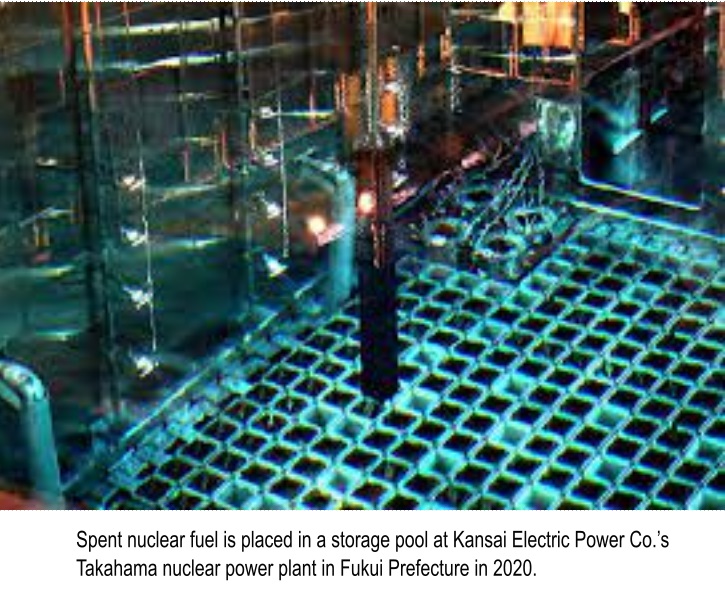
Once cooled, this spent fuel is still not something you want to spend time with because direct exposure is lethal. While most of the radioactivity decays after about 1000 years, some will persist for over a million years. U.S. efforts to site and build a permanent repository for nuclear waste have failed (more on this below). After spending time in the pool, spent fuel is stored on sites of operating or retired reactors in steel canisters or vaults.
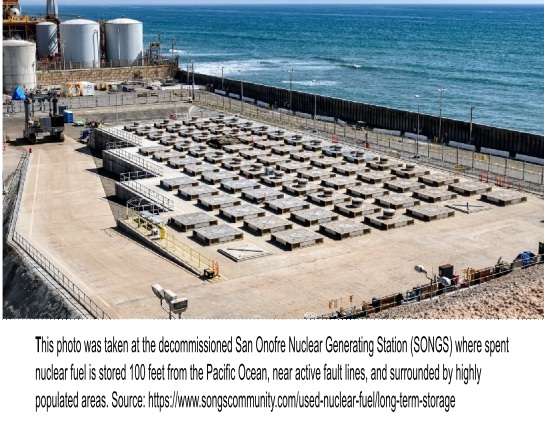
Across the country, more than 90,000 metric tons of radioactive fuel is sitting in pools or dry storage at over 100 sites in 39 states. These sites are licensed by the Nuclear Regulatory Commission (NRC) and regulated by the EPA. They are designed to be safe! But experts agree that this is an unacceptable long-term waste management situation (see, for example, here, here, and here).
Fact 2: The U.S. has no permanent nuclear waste disposal plan
For more than half a century, the United States has tried—and failed—to find a forever-home for its nuclear waste. Early efforts in the 1960s and 1970s went nowhere. In 1982, Congress passed the Nuclear Waste Policy Act which laid out a comparative siting process that was designed to be technically rigorous and politically fair. But this process was slow, expensive, and politically exhausting.
By 1987, Congress lost patience, scrapped its own framework, and tried to force the issue by designating Yucca Mountain in Nevada as the chosen one. Nevada’s resistance was relentless. After roughly $15 billion in spending on site development, the Yucca Mountain proposal was finally withdrawn in 2010. As I understand it, these siting efforts did not fail because the location was declared unsafe. They failed because nuclear waste storage siting was being forced on an unwilling community.
In the years since, Blue Ribbon panels, expert advisory groups, and national research councils have been convened. All have reached the same conclusion. The U.S. needs to break the impasse over a permanent solution for commercial spent nuclear fuel and this will require a fair, transparent, and consent-based process.
You might be thinking that spent fuel reprocessing, which is also enjoying an American renaissance right now, could eliminate the need for a geological repository. It’s true that reprocessing breaks spent fuel down to be used again. But in that process, new types of radioactive wastes are created that need to be managed in deep repositories or specialized landfills. This creates a potentially more (versus less) challenging mess to clean up (reprocessing leaders like France are pursuing costly geological repositories for these wastes).
Fact 3: We are actively undermining public trust in the nuclear waste management process
Convincing a community to host thousands of tons of radioactive waste for thousands of years is not easy. But it’s not impossible. Efforts in Sweden, Finland, France, Switzerland, and Canada are starting to find some success.
All of these international success stories share one important feature: a sustained commitment to building public trust in both nuclear industry regulation and the nuclear waste storage siting process. Alas, here in the United States, we seem to be moving in the opposite direction.
A series of recent developments make it hard to feel hakuna matata about our nuclear waste management protocols:
- In May, an executive order called for a “wholesale revision” of the NRC directing it to accelerate reactor licensing, reconsider radiation standards, and reduce staffing.
- In June, an NRC commissioner was abruptly fired, prompting a letter from concerned career staff .
- The Department of Energy has pledged to “use all available authorities to eliminate or expedite its environmental reviews for authorizations, permits, approvals, leases, and any other activity requested” by nuclear reactor projects under its supervision.
- The Supreme Court recently ruled that Texas lacks legal standing to challenge NRC approval of a privately operated interim nuclear waste facility, raising questions about state’s abilities to challenge nuclear waste siting decisions.
These developments may ultimately succeed in accelerating nuclear deployment across the United States. But they also undermine the public trust and independent governance that are essential inputs into the building of a long-term nuclear waste management strategy.
Weighing our nuclear options
Taking a step back, it is worth asking why nuclear energy is enjoying such a resurgence in this country right now. The growing availability of low-cost renewables and storage, together with an increasingly flexible demand-side, complicates the claim that nuclear power is some kind of moral climate necessity. There are cheaper ways to decarbonize the grid.
The renewed push for nuclear energy is not really about climate necessity. It seems to be driven by anxiety about reliability in a strained power system, industrial policy aimed at rebuilding domestic manufacturing capacity, and the commercial interests of firms chasing revenue streams tied to data centers and federal support. This nuclear revival trades off today’s politically urgent reliability concerns for a long-term obligation to manage radioactive waste (along with some low-probability risk of catastrophic failure). If that’s the trade off we want to make, we should understand that a nuclear renaissance without a viable long-term waste management plan saddles future generations with the messy consequences of our policy choices.
Spectral Threats: China, Russia and Trump’s Greenland Rationale

Were Russia or China to attempt an occupation of Greenland through military means, Article V of the North Atlantic Treaty would come into play, obliging NATO member states, including the United States, to collectively repel the effort.
“There are no Russian and Chinese ships all over the place around Greenland,”
“Russia and/or China has no capacity to occupy Greenland or to take control over Greenland.”
14 January 2026 Dr Binoy Kampmark, https://theaimn.net/spectral-threats-china-russia-and-trumps-greenland-rationale/
The Trump administration’s mania about Greenland, a self-governing territory of Denmark, is something to behold. Its untutored thuggery, its brash assertiveness, and the increasingly strident threats to either use force, bully Denmark into a sale of the island, or simply annex the territory, have officials and commentators scrambling for theories and precedents. The Europeans are terrified that the NATO alliance is under threat from another NATO member. The Greenlanders are anxious and confused. But the ground for further action by Washington is being readied by finding threats barely real and hardly plausible.
The concerns about China and Russia seizing Greenland retells the same nonsense President Donald Trump promoted in kidnapping the Venezuelan President Nicolás Maduro and his wife. Looking past the spurious narcoterrorism claims against the former leader, it fell to the issue of who would control the natural resources of the country. If we don’t get Venezuelan oil now and secure it for American companies, the Chinese or the Russians will. he gangster’s rationale is crudely reductionist, seeing all in a similar veinThe obsession with Beijing and Moscow runs like a forced thread through a dotty, insular rationale that repels evidence and cavorts with myth: “We need that [territory],” reasons the President, “because if you take a look outside Greenland right now, there are Russian destroyers, there are Chinese destroyers and, bigger, there are Russian submarines all over the place. We are not gonna have Russia or China occupy Greenland, and that’s what they’re going to do if we don’t.” On Denmark’s military capabilities in holding the island against any potential aggressor, Trump could only snort with macho dismissiveness. “You know what their defence is? Two dog sleds.”
This scratchy logic is unsustainable for one obvious point. Were Russia or China to attempt an occupation of Greenland through military means, Article V of the North Atlantic Treaty would come into play, obliging NATO member states, including the United States, to collectively repel the effort. With delicious perversity, any US effort to forcibly acquire the territory through use of force would be an attack on its own security, given its obligations under the Treaty. In such cases, it becomes sound to assume, as the Danish Prime Minister Mette Frederiksen does, that the alliance would cease to exist.
Such matters are utterly missed by the rabidly hawkish Deputy Chief of Staff Stephen Miller, who declared that, “Nobody’s going to fight the United States militarily over the future of Greenland.” It was up to the US “to secure the Arctic region, to protect and defend NATO and NATO interests” in incorporating Greenland. To take territory from a NATO ally was essentially doing it good.
Given that the United States already has a military presence on the island at the Pituffik Space Base, and rights under the 1951 agreement that would permit an increase in the number of bases should circumstances require it, along with the Defence Cooperation Agreement finalised with Copenhagen in June 2025, much of Miller’s airings are not merely farcical but redundant. Yet, Trump has made it clear that signatures and understandings reflected in documents are no substitute for physically taking something, the thrill of possession that, by its act, deprives someone else of it. “I think ownership gives you a thing that you can’t do, whether you’re talking about a lease or a treaty,” he told the New York Times. “Ownership gives you things and elements that you can’t get from just signing a document.”
What, then, of these phantom forces from Moscow and Beijing, supposedly lying in wait to seize the frozen prize? “There are no Russian and Chinese ships all over the place around Greenland,” states the very convinced research director of the Oslo-based Fridtjof Nansen Institute, Andreas Østhagen. “Russia and/or China has no capacity to occupy Greenland or to take control over Greenland.”
Danish Foreign Minister Lars Lokke Rasmussen is similarly inclined. “The image that’s being painted of Russian and Chinese ships right inside the Nuuk fjord and massive Chinese investments being made is not correct.” Senior “Nordic diplomats” quoted in the Financial Times add to that version, even if the paper is not decent enough to mention which Nordic country they come from. “It is simply not true that the Chinese and Russians are there,” said one. “I have seen the intelligence. There are no ships, no submarines.” Vessel tracking data from Marine Traffic and LSEG have so far failed to disclose the presence of Chinese and Russian ships near the island.
Heating engineer Lars Vintner, based in Greenland’s capital, Nuuk, wondered where these swarming, spectral Chinese were based. “The only Chinese I see,” he told Associated Press,“ is when I go to the fast food market.” This sparse presence extends to the broader security footprint of China in the Arctic, which remains modest despite a growing collaboration with Russia since the 2022 invasion of Ukraine. These have included Arctic and coast guard operations, while the Chinese military uses satellites and icebreakers equipped with deep-sea mini submarines, potentially for mapping the seabed.
However negligible and piffling the imaginary threat, analysts, ever ready with a larding quote or a research brief, are always on hand to show concern with such projects as Beijing’s Polar Silk Road, announced in 2018, which is intended as the Arctic extension of its transnational Belt and Road initiative. The subtext: Trump should not seize Greenland, but he might have a point. “China has clear ambitions to expand its footprint and influence in the region, which it considers… an emerging arena for geopolitical competition.” Or so says Helena Legarda of the Mercator Institute for China Studies in Berlin.
The ludicrous nature of Trump’s claims and acquisitive urges supply fertile material for sarcasm. A prominent political figure from one of the alleged conquerors-to-be made an effort almost verging on satire. “Trump needs to hurry up,” mocked the Deputy Chairman of the Russian Security Council and former President Dmitry Medvedev. “According to unverified information, within a few days, there could be a sudden referendum where all 55,000 residents of Greenland might vote to join Russia. And that’s it!” With Trump, “that’s it” never quite covers it.
TerraPower and Meta partner on Natrium nuclear plants

The agreement launches early work on two initial units and secures Meta rights to energy from six more, marking the tech giant’s largest investment in advanced nuclear energy to date.
erraPower and Meta have agreed to develop up to eight Natrium nuclear reactor and energy storage system plants in the United States, a move that could supply Meta with up to 2.8 gigawatts of carbon-free baseload energy. With the Natrium system’s built-in energy storage, total output could be increased to as much as 4 gigawatts.
The agreement supports early development of two initial Natrium units and gives Meta rights to energy from up to six additional units. Each reactor provides 345 MW of baseload power and can ramp up to 500 MW for more than five hours. A dual-unit site could deliver up to 690 MW of firm power and as much as 1 GW of dispatchable electricity.
The companies said delivery of the first units could begin as early as 2032. They also plan to identify a site for the initial dual-reactor project in the coming months.
1 This Month


Tell the Ukrainian Government to Drop Prosecution of Peace Activist Yurii Sheliazhenko

Petition to revoke the licensing of the Near Surface Nuclear Disposal Facility (NSDF) at Chalk River. https://www.ourcommons.ca/petitions/en/Petition/Details?Petition=e-7247


of the week – STOP SMALL MODULAR REACTORS IN CANADA
To see nuclear-related stories in greater depth and intensity – go to https://nuclearinformation.wordpress.com
-
Archives
- March 2026 (204)
- February 2026 (268)
- January 2026 (308)
- December 2025 (358)
- November 2025 (359)
- October 2025 (376)
- September 2025 (258)
- August 2025 (319)
- July 2025 (230)
- June 2025 (348)
- May 2025 (261)
- April 2025 (305)
-
Categories
- 1
- 1 NUCLEAR ISSUES
- business and costs
- climate change
- culture and arts
- ENERGY
- environment
- health
- history
- indigenous issues
- Legal
- marketing of nuclear
- media
- opposition to nuclear
- PERSONAL STORIES
- politics
- politics international
- Religion and ethics
- safety
- secrets,lies and civil liberties
- spinbuster
- technology
- Uranium
- wastes
- weapons and war
- Women
- 2 WORLD
- ACTION
- AFRICA
- Atrocities
- AUSTRALIA
- Christina's notes
- Christina's themes
- culture and arts
- Events
- Fuk 2022
- Fuk 2023
- Fukushima 2017
- Fukushima 2018
- fukushima 2019
- Fukushima 2020
- Fukushima 2021
- general
- global warming
- Humour (God we need it)
- Nuclear
- RARE EARTHS
- Reference
- resources – print
- Resources -audiovicual
- Weekly Newsletter
- World
- World Nuclear
- YouTube
-
RSS
Entries RSS
Comments RSS
 nuclear-news