Fort Calhoun Nuclear Reactor is Safe, well Sort Of
The plant faces two other challenges, however. One is that the flowing water, four feet deep in some spots around the plant, may have undermined some structures. Already, plant workers have stopped moving heavy vehicles over paved surfaces because they may have been weakened, the managers say….
A Long Road Ahead for a Flooded Reactor, NYT, By MATTHEW L. WALD, 28 June 11, Federal officials say that the Fort Calhoun nuclear plant, which is surrounded by floodwaters from the Missouri River, is safe for now, as I wrote in Tuesday’s Times. But it may be a very long way from reopening. Continue reading
Legal battle- South Carolina’s nuclear waste not to go to Nevada
A federal report issued early in June said the U.S. has generated more than 82,000 tons of spent nuclear fuel and high-level nuclear waste, which it was storing at 80 sites in 35 states.
The amount of waste is expected to double by 2055, the Government Accountability Office said.

Appeals court dismisses nuclear waste suit, Macon.com By NEDRA PICKLER and DINA CAPPIELLO – Associated Press, 1 July 11, WASHINGTON — The Obama administration won a legal battle Friday in the long-standing fight over where to bury the nation’s nuclear waste, but it’s not likely to be the last. The federal appeals court in Washington ruled against South Carolina, Washington state and others that want to ship radioactive spent nuclear fuel they are temporarily storing to a repository 90 miles from Las Vegas at Yucca Mountain. Continue reading
Evacuation not really practical in the case of nuclear meltdown
What Would It Take To Evacuate A Nuclear Meltdown? Gizmodo By Kwame Opam on June 28, 201 1 Nuclear plants in the US are getting older and becoming more unstable with age, even as we demand more power of them. Meanwhile, population growth around these powerhouses has skyrocketed, by as much as a factor of four in some places. Say you live in one of these cities. In the event of an emergency, how likely is it that you’ll get out in time? Continue reading
Vermont citizens rally to support closure of Vermont Yankee nuclear reactor
Vermonters rally to support their state’s efforts to close VermontYankee, Greenpeace, by Jarred Cobb – June 27, 2011 Entergy Nuclear’s efforts to run their aging and dangerous reactor past its scheduled closure date were rebuffed again in Vermont last week. Citizens rallied outside the federal courthouse where Entergy is seeking an injunction to keep Vermont Yankee operating despite the state’s decision to close it down. Many of the folks present at the vigil live within the 10-mile evacuation zone, and know firsthand of Entergy’s incompetence and Vermont Yankee’s history of accidents. From carpenters to mothers and teachers to activists, Vermonters stood shoulder-to-shoulder todeclare: “We Support Vermont.”
Entergy’s refusal to accept Vermont’s decision to close the reactor is an affront to the democratic process and the demands of a majority of Vermonters. Last year, after an ongoing tritium leak, lies about underground piping, and a desire for a renewable energy future, the state senate voted overwhelmingly (26-4) to close Vermont Yankee as scheduled in March 2012. But now, the multibillion-dollar energy company has turned to high-priced lawyers and a federal court…. http://www.greenpeace.org/usa/en/news-and-blogs/campaign-blog/vermonters-rally-to-support-their-states-effo/blog/35460
Los Alamos nuclear facility threatened by wildfires
Bushfire reaches Los Alamos nuke lab
ABC News, Jun 28, 2011
- Video: Fire threatens US nuclear lab (ABC News) A raging bushfire has briefly entered the property of the pre-eminent US nuclear facility, Los Alamos National Laboratory, a vast complex that houses research laboratories and a plutonium facility.A mandatory evacuation was ordered for the town of Los Alamos, which has a population of about 12,000. The speed at which the fire has grown surprised fire officials.
The laboratory, which ensures the safety and reliability of the US nuclear stockpile, is a national security research facility located in the Jemez mountains of northern New Mexico. It was set up in 1943 as part of the Manhattan Project to create the first atomic bomb and still maintains the nation’s largest nuclear weapons arsenal.
Firefighters were able to douse flames on a 4,000-square-metre “spot fire” just inside the south-western boundary of the lab site, about 40km outside Santa Fe, authorities said….
“This fire is going to be with us for a while. It has the potential to double and triple in size,” Los Alamos fire chief Doug Tucker said.
Nuclear watchdog groups are keeping a close eye on the fire, said Jay Coughlin, executive director of Nuclear Watch New Mexico…….
http://www.abc.net.au/news/stories/2
US govt part of the system that rubber stamps nuclear plant relicensing
AP IMPACT: NRC and industry rewrite nuke history
By JEFF DONN, AJC NewsThe Associated Press, 29 June 11 ROCKVILLE, Md. — When commercial nuclear power was getting its start in the 1960s and 1970s, industry and regulators stated unequivocally that reactors were designed only to operate for 40 years. Now they tell another story — insisting that the units were built with no inherent life span, and can run for up to a century, an Associated Press investigation shows.
By rewriting history, plant owners are making it easier to extend the lives of dozens of reactors in a relicensing process that resembles nothing more than an elaborate rubber stamp.
As part of a yearlong investigation of aging issues at the nation’s nuclear power plants, the AP found that the relicensing process often lacks fully independent safety reviews. Records show that paperwork of the U.S. Nuclear Regulatory Commission sometimes matches word-for-word the language used in a plant operator’s application.
Also, the relicensing process relies heavily on such paperwork, with very little onsite inspection and verification.
And under relicensing rules, tighter standards are not required to compensate for decades of wear and tear.
So far, 66 of 104 reactors have been granted license renewals. Most of the 20-year extensions have been granted with scant public attention. And the NRC has yet to reject a single application to extend an original license. The process has been so routine that many in the industry are already planning for additional license extensions, which could push the plants to operate for 80 years, and then 100………………………………NUCLEAR LIFE RENEWED
Relicensing is a lucrative deal for operators. By the end of their original licenses, reactors are largely paid for. When they’re operating, they’re producing profits. They generate a fifth of the country’s electricity.
…..INDUSTRY, GOVERNMENT AS PARTNERS
Despite the aging problems, relicensing rules prohibits any overall safety review of the entire operation. More conservative safety margins are not required in anticipation of higher failure rates in old plants, regulators acknowledge.
The approach has turned relicensing reviews into routine approvals……..
http://www.ajc.com/news/nation-world/ap-impact-nrc-and-990073.html
Nuclear plants at risk if flooding in Nebraska gets worse
Any new rain episode could worst the flooding, especially in Nebraska, …..
Fort Calhoun is not the only power plant that is threatened by the flooding. Cooper Nuclear Station is in a similar position, but the risk is higher if the water’s level is rising. In the worst case, the Fukushima’s situation could repeat here.
Nuclear danger in Nebraska because of the flooding News In A Box by Kelley Jeanie , 22 June 11 On Tuesday, June 21st 2011 A power plant from Nebraska, Fort Calhoun, was threatened to become a new Fukushima after several dams from around it broke because of the flooding on the Missouri River. The power plant was close to be under the water after the Missouri River got at 45 centimeters around it, according to dailymail.co.uk. If the water’s level got at 274,9 meters above the sea’s level in Brownville, the officials would have been forced to close the nuclear plant that is situated at 275,2 meters. Continue reading
Radioactive tritium leaking from 75% of USA’s nuclear plants
The leaks sometimes go undiscovered for years, the AP found. Many of the pipes or tanks have been patched, and contaminated soil and water have been removed in some places. But leaks are often discovered later from other nearby piping, tanks or vaults. Mistakes and defective material have contributed to some leaks. However, corrosion – from decades of use and deterioration – is the main cause. And, safety engineers say, the rash of leaks suggest nuclear operators are hard put to maintain the decades-old systems.
Nearly 50 US Nuclear Power Plants Are Leaking Tritium, Somewhere around 75 per cent of US nuclear power plants have been found leaking the radioactive element Tritium into the ground to various extents. Corroded piping buried underground seems to be the main problem, and a problem that can affect groundwater if ignored., GIZMODO y Adrian Covert on June 22, 2011 Continue reading
Problems at Dominion Virginia nuclear power units
Flood crisis at Nebraska nuclear plant
12 Significant Events That the Mockingbird Media is Currently Ignoring, Benzinga, By Truth is Treason, June 20, 2011 ”…The crisis at the Fort Calhoun nuclear facility in Nebraska has received almost no attention in the national mainstream media. Back on June 7th, there was a fire at Fort Calhoun. The official story is that the fire was in an electrical switchgear room at the plant. The facility lost power to a pump that cools the spent fuel pool for approximately 90 minutes. According to the Omaha Public Power District, the fire was quickly extinguished and no radioactive material was released. …….
But the crisis at Fort Calhoun is not over. Right now, the nuclear facility at Fort Calhoun is essentially an island. It is surrounded by rising flood waters from the Missouri River. (photo from Washington Post 20 June 11)
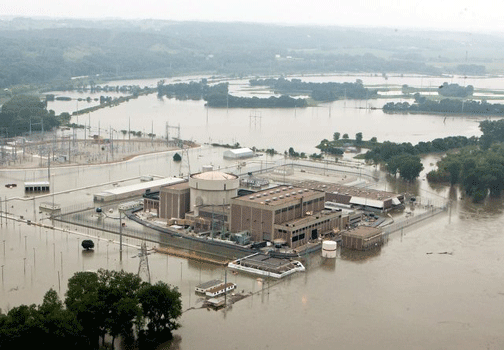
Officials claim that there is no danger and that they are prepared for the river to rise another ten feet.The Cooper Nuclear Station in Brownville, Nebraska is also being threatened by rising flood waters. A “Notification of Unusual Event” was declared at Cooper Nuclear Station this morning at 4:02. This notification was issued because the Missouri River’s water level reached 42.5 feet…….
Right now the facility is operating normally and officials don’t expect a crisis.But considering what has been going on at Fukushima, it would be nice if we could have gotten a lot more coverage of these events by the mainstream media… http://www.benzinga.com/11/06/1183421/12-significant-events-that-the-mockingbird-media-is-currently-ignoring#ixzz1PrRYnCv0
How USA’s Nuclear Regulatory Commission repeatedly weakens safety rules
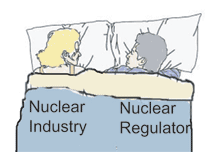 the AP investigation found that with billions of dollars and 19 percent of America’s electricity supply at stake, a cozy relationship prevails between the industry and its regulator, the NRC.
All the while the NRC keeps extending licenses of dozens of reactors….
Fukushima USA? Dangerous radioactive leaks and cracked foundations go unpunished at American nuclear power plants By DAILY MAIL REPORTER 20 June 11 Safety has taken a back seat to cost-cutting at most of the nation’s nuclear power plants, sparking fears that America could be facing its own Fukushima disaster.
An investigation by the Associated Press has revealed federal regulators are repeatedly weakening – or simply failing to impose – strict rules. The constant danger of aging reactors operating without the highest standards has resulted in rising fears the NRC is significantly undermining safety. Continue reading
USA nuclear regulators undermining public safety?
Are federal regulators undermining safety at nuclear reactors? America Blog, by Chris in Paris on 6/20/2011 Federal regulators have been working closely with the nuclear power industry to keep the nation’s aging reactors operating within safety standards by repeatedly weakening those standards, or simply failing to enforce them, an investigation by The Associated Press has found.
The result? Rising fears that these accommodations by the NRC are significantly undermining safety — and inching the reactors closer to an accident that could harm the public and jeopardize the future of nuclear power in the United States…
At last, Grand Canyon to be protected from uranium mining
The moratorium will “reverse a century-long history of damage to the Grand Canyon from uranium mining,”
OBAMA ADMINISTRATION TO BAN URANIUM MINING AT GRAND CANYON, FORBES, OSHA GRAY DAVIDSON Standing at the south rim of the Grand Canyon this morning, Secretary of the Interior Ken Salazar announced that the Obama administration will enact a 20-year ban on new uranium mining in the last remaining unprotected lands surrounding the place President Theodore Roosevelt called “the one great sight which every American should see.”
Mining companies had filed thousands of claims in recent years, but it is unlikely that any of the 3,500 mining claims in the area will receive federal permits when the 20-year ban goes into effect. In March, Arizona’s Department of Environmental Quality (ADEQ) issued permits to three uranium mines on the land – provoking an outcry by native peoples, hunters, hikers, tourism groups and environmental organizations. Continue reading
Unnecessary radiation – too many CT scans in USA hospitals
 Hospitals Nationwide Unnecessarily Perform Double CT Scans, -California Heath Line – June 20, 2011Hundreds of hospitals nationwide routinely perform two chest CT scans on a single patient, needlessly exposing them to double doses of radiation and driving up costs, according to a review of Medicare data, the New York Times reports (Bogdanich/Craven McGinty, New York Times, 6/17).
Unnecessary Testing Patients who receive a double CT scan undergo a contrast and a noncontrast CT scan in succession (Appleby/Rau, Kaiser Health News/Washington Post, 6/18). Although most radiologists say nearly all chest issues can be accurately diagnosed with only one scan, 2008 Medicare data show that some hospitals performed double scans on chest patients more than 80% of the time. According to the Times, a single CT chest scan exposes a patient to 350 times the radiation of a standard chest X-ray (New York Times, 6/17).
Specifically, Medicare data show that 76,781 chest patients, or 5.4%, received double CT scans in 2008. While most hospitals administered them sparingly—a median of 2% of Medicare patients received two scans—618 hospitals performed double scans on at least 10% of Medicare chest patients, and 94 of those hospitals performed double scans on at least 50% of Medicare chest patients (Kaiser Health News/Washington Post, 6/18).
Experts note that double scanning also is common for privately insured patients (New York Times, 6/17). Although the number of overall non-Medicare patients who receive double scans is unknown, HealthPartners, a not-for-profit Minnesota HMO, reports that 7% of its chest patients received double scans in 2010 (Kaiser Health News/Washington Post, 6/18)….http://www.californiahealthline.org/articles/2011/6/20/hospitals-nationwide-unnecessarily-perform-double-ct-scans.aspx
New uranium mining on Grand Canyon stopped for 20 years
20-year ban planned on new Grand Canyon uranium mining, LA Times 20 June 11By Neela Banerjee, The Obama administration announces the proposed ban for 1 million acres of land bordering the Grand Canyon, an area where uranium mining claims have spiked 2,000% in the last seven years.
Mining claims around the Grand Canyon are among the thousands filed by companies along the borders of numerous national parks and wilderness areas.Critics say an outmoded 1872 law is driving the increase in claims in such sensitive places. The law allows corporations to stake out rights to federal lands for mining without a competitive bid and to extract resources without paying royalties.
The ban would strengthen a moratorium on new mining claims and activity, which the administration placed on Grand Canyon border lands two years ago in response to the jump in uranium stakes.Interior Department officials said the agency initially would extend the current moratorium another six months, until December, in order to complete the steps necessary to establish the 20-year ban. Mines currently in operation would not be affected.
Environmentalists, some lawmakers and water utilities serving metropolitan areas in the southwest, including Los Angeles, said the decision would protect the critical Colorado River watershed from possible contamination from uranium mining and would prevent the Grand Canyon panorama from being gradually industrialized…….http://www.latimes.com/news/nationworld/nation/sc-dc-0621-grand-canyon-20110620,0,1196854.story
1 This Month

Tell Congress: Prevent Nuclear Catastrophe in Iran

Tell Congress: Prevent Nuclear Catastrophe in Iran

Read the Public Inquiry Report, the Commissioners’ report, Surrendering Australia: The AUKUS Deception is available to download for free at aukuspublicinquiry.com. Or just watch the replay of the National Press Club Luncheon.
To see nuclear-related stories in greater depth and intensity – go to https://nuclearinformation.wordpress.com
Say No to NASA’s Reckless Nuclear Reactor on the Moon
-
Archives
- November 2026 (273)
- October 2026 (302)
- September 2026 (339)
- August 2026 (330)
- July 2026 (355)
- June 2026 (287)
- May 2026 (306)
- April 2026 (356)
- March 2026 (251)
- February 2026 (267)
- January 2026 (308)
- December 2025 (358)
-
Categories
- 1
- 1 NUCLEAR ISSUES
- business and costs
- climate change
- culture and arts
- ENERGY
- environment
- health
- history
- indigenous issues
- Legal
- marketing of nuclear
- media
- opposition to nuclear
- PERSONAL STORIES
- politics
- politics international
- Religion and ethics
- safety
- secrets,lies and civil liberties
- spinbuster
- technology
- Uranium
- wastes
- weapons and war
- Women
- 2 WORLD
- ACTION
- AFRICA
- Atrocities
- AUSTRALIA
- Christina's notes
- Christina's themes
- culture and arts
- Events
- Fuk 2022
- Fuk 2023
- Fukushima 2017
- Fukushima 2018
- fukushima 2019
- Fukushima 2020
- Fukushima 2021
- general
- global warming
- Humour (God we need it)
- Nuclear
- RARE EARTHS
- Reference
- resources – print
- Resources -audiovicual
- Weekly Newsletter
- World
- World Nuclear
- YouTube
-
RSS
Entries RSS
Comments RSS

