Bradley Manning: 35 years’ gaol for revealing atrocities
Bradley Manning Uncovered U.S. Torture, Abuse, Soldiers Laughing As They Killed Innocent Civilians Huffington Post : 08/21/2013 . — Army Pfc. Bradley Manning, the intelligence analyst convicted of making public thousands of secret documents, was sentenced Wednesday to 35 years in prison. But the files Manning sent to the website WikiLeaks remain on the Internet for anyone to read, and their impact on the world may be debated for as long as he remains in prison.
“Manning was under the impression that his leaked information was going to really change how the world views the wars in Afghanistan and Iraq, and future wars actually,” Navy Capt. David Moulton, a forensic psychiatrist testifying in Manning’s defense, told the military court on July 14.
“It was his opinion that if through crowd sourcing that enough analysis was done on these documents, which he felt to be very important, that it would lead to greater good, that society as a whole would come to the conclusion that the wars weren’t worth it, that really no wars are worth it.”
Here are some of the documents and revelations Manning leaked to the world from the small, sensitive, compartmented information facility in Iraq where he worked as an intelligence analyst from 2009 to 2010…… http://www.huffingtonpost.com/2013/08/21/bradley-manning-leaks_n_3788126.html?utm_hp_ref=tw
“Pockets” of radioactive seawater will impact USA’s West Coast
West Coast of North America to Be Hit Hard by Fukushima Radiation (Excellent maps and animation) http://www.globalresearch.ca/west-coast-of-north-america-to-be-hit-hard-by-fukushima-radiation/5346470 By Washington’s Blog Global Research, August 21, 2013
Radiation Levels Will Concentrate in Pockets In Baja California and Other West Coast Locations
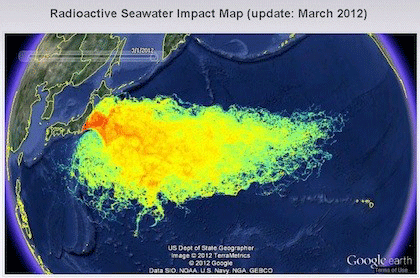
An ocean current called the North Pacific Gyre is bringing Japanese radiation to the West Coast of North America: While many people assume that the ocean will dilute the Fukushima radiation, a previously-secret 1955 U.S. government report concluded that the ocean may not adequately dilute radiation from nuclear accidents, and there could be “pockets” and “streams” of highly-concentrated radiation. Continue reading
Rapid City Council votes for water security, and against uranium mining
Council passes resolution opposing uranium mining, Rapid city Journal, 21 Aug 13 The Rapid City Council passed a resolution late Monday night opposing a uranium mining operation near Edgemont, saying it “poses an unacceptable risk” to the city’s primary water supply.
The 9-1 vote came after council member Steve Laurenti sought to continue the discussion until state hearings for mining and water rights permits for Powertech concluded.
“I will tell you that this issue ranks in the top handful of issues that have generated public concern,” Mayor Sam Kooiker said. “This has really gotten peoples’ interest and there is a lot of concern in the community, and I believe that people have the right to ask questions about this issue.” Kooiker encouraged Laurenti to join the rest of the council in its decision to oppose the mine.
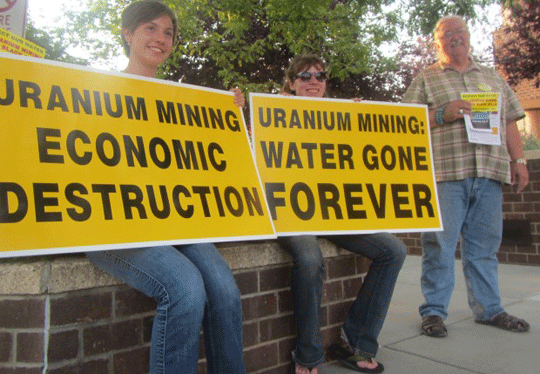
However, Laurenti stood firm with his vote against the resolution, maintaining that more information was needed before he could take a stand against the operation.
“The problem I have, from a logical standpoint, is to oppose something or even to have grave concern, grave meaning that I have a fear for my life,” Laurenti said. “I don’t fear for my life over this issue at this point.”…… The mine would draw up to 9,000 gallons of water per minute from the Inyan Kara and Madison aquifers. The Madison Aquifer supplied Rapid City with 60 percent of its water resources in 2012, according to city officials. http://rapidcityjournal.com/news/council-passes-resolution-opposing-uranium-mining/article_2253d74c-8890-58cc-9688-4bea869afbe9.html
Save Great Lakes meeting fills Detroit hall
Capacity crowd attends ‘Save the Great Lakes from Nuclear Waste’ town hall meeting Macomb Daily By GINA JOSEPH
Gina.joseph@macombdaily.com; @ginaljoseph, 08/20/13 The tide opposing a proposed Canadian underground nuclear waste repository on the shore of Lake Huron appears to be rising.
“I was very happy with the turnout but given the magnitude of the potential risk I wish hundreds more would have been here,” said State Rep. Sarah Roberts (D-St. Clair Shores) referring to the crowd attending last night’s ‘Save the Great Lakes from Nuclear Waste’ public forum at Wayne State University in Detroit. “Tonight demonstrated to me that there are many concerned citizens who care about our Great Lakes, our public health, our drinking water and the potential danger of the proposed underground repository.”
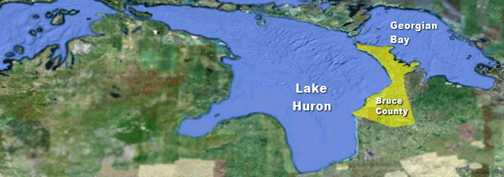
Ontario Power Generation wants the Canadian federal government to approve its plan to bury low and intermediate level radioactive nuclear waste under the Bruce Nuclear Power Plant, located on the shore of Lake Huron in the municipality of Kincardine.
Kincardine is less than three hours from the Blue Water Bridge in Port Huron and north of Grand Bend, Ont. Roberts, who introduced a resolution urging Congress to oppose the underground nuclear waste dump, co-hosted the public forum on the proposed nuclear waste dump along with State. Sen. Hoon-Yung Hopgood (D-Taylor), who introduced a similar resolution that was unanimously passed by the Michigan Senate.
If the license is approved by the federal government, Ontario Power Generation will construct a deep geologic repository (DGR), consisting of burial caverns carved out of limestone and shale rock formations, less than a mile inland from the shore of Lake Huron and about 440 yards below the Great Lakes basin…… http://www.macombdaily.com/article/20130820/NEWS03/130829994/capacity-crowd-attends-save-the-great-lakes-from-nuclear-waste-town-hall-meeting
Frightening America makes a lot of money for 5 companies
 5 Companies That Make Money By Keeping Americans Scared Reader Supported News, By Alex Kane, Salon 19 August 13 A massive industry profits off the government-induced fear of terrorism.
 ichael Hayden, the former director of the National Security Agency, has invaded America’s television sets in recent weeks to warn about Edward Snowden’s leaks and the continuing terrorist threat to America.
But what often goes unmentioned, as the Guardian’s Glenn Greenwald pointed out, is that Hayden has a financial stake in keeping Americans scared and on a permanent war footing against Islamist militants. And the private firm he works for, called the Chertoff Group, is not the only one making money by scaring Americans.
Post-9/11 America has witnessed a boom in private firms dedicated to the hyped-up threat of terrorism. The drive to privatize America’s national security apparatus accelerated in the aftermath of the terrorist attacks, and it’s gotten to the point where 70 percent of the national intelligence budget is now spent on private contractors, as author Tim Shorrock reported. The private intelligence contractors have profited to the tune of at least $6 billion a year. In 2010, the Washington Post revealed that there are 1,931 private firms across the country dedicated to fighting terrorism.
What it all adds up to is a massive industry profiting off government-induced fear of terrorism, even though Americans are more likely to be killed by a car crash or their own furniture than a terror attack.
Here are five private companies cashing in on keeping you afraid.
1. The Chertoff Group…..
2. Booz Allen Hamilton……
3. Science Applications International Corp…..
4. Center for Counterintelligence and Security Studies….
5. Security Solutions International….. http://readersupportednews.org/opinion2/424-national-security/18979-5-companies-that-make-money-by-keeping-americans-scared
Every 4 minutes A Solar System Is Installed in the US
 A Solar System Is Installed in the US Every 4 Minutes http://www.greentechmedia.com/articles/read/america-installs-a-solar-system-every-four-minutes The industry will soon install one solar system every minute and a half. STEPHEN LACEY: AUGUST 19, 2013
A lot happens in America every four minutes. During that short time period, 30 babies areborn, 4,080 McDonald’s Big Macs are consumed, and 48,000 tons of CO2 are emitted.
And as it turns out, the U.S. is now installing one solar photovoltaic (PV) system every four minutes as well. If market growth continues at its current pace, the American solar industry could be installing a system every minute and twenty seconds by 2016. That’s a dramatic difference from 2006, when installers were only putting up one system every 80 minutes. Shayle Kann, vice president of GTM Research, documents the accelerating speed of solar deployment in the chart below:

It may not quite match Big Mac sales yet, but solar is on an extraordinarily fast growth trajectory. According to figures from GTM Research, two-thirds of all distributed solar in the U.S. has been installed over the last 2 1/2 years. And by 2016, cumulative installations of distributed PV will double.
That means the U.S. will hit 1 million cumulative residential solar installations by then — making the market in 2016 ten times larger than it was in 2010. For more information on American solar trends, check out the U.S. Solar Market Insight Report from GTM Research and SEIA.
Record heat brings wildfires, and floods, in Alaska

 Heat records tumble as Alaska bakes, burns SMH, August 19, 2013 Alaska residents have been enjoying an unusually warm, sunny summer, but the pleasant weather has come at a cost: choking smoke from an extended wildfire season, flooding rivers due to fast-melting snow and glacial ice, and fish covered in algae.
Wildfires have burned 1.25 million acres (500,000 hectares) across Alaska this summer, according to the state’s fire-management center, the Alaska Interagency Coordination Center. Seventy fires were active on Friday, including a 57,870-acre (23,400-hectare) blaze near Delta Junction, about 95 miles (153 km) southeast of Fairbanks.
The fire season usually winds down in late June or early July, but not this year, said Jim Schwarber, a spokesman for the centre……
Heat brings more problems than just wildfires, Thoman and other experts said. Hot and dry conditions are stunting spruce tree growth in interior Alaska, and adding to stress for nearly all species of trees in the northern forest, he said.
Ocean fish have been found covered with algae, possibly a result of hotter sea-surface temperatures, Thoman said. Streams and rivers fed by glaciers and snowpack have been gorged by meltwater, causing sporadic flooding, while rain-fed waterways in parched areas have been running dry, he said. http://www.smh.com.au/environment/climate-change/heat-records-tumble-as-alaska-bakes-burns-20130819-2s5oi.html#ixzz2cYqMCssq
Gloomy future for nuclear energy in South Carolina
 Doubts dampen S.C.’s nuclear future The State, South Carolina, August 19, 2013 By RODDIE BURRIS — rburris@thestate.com The hallmark of the future of nuclear power right now is uncertainty.
Utilities largely have backed off any rush to forge ahead in constructing the next generation of expensive, new nuclear reactor plants — even though they seemed plausible just a few years ago. Continue reading
2 workers sue Department of Energy over radiation exposure
 Radiation-exposed workers demand release of nuke plant accident video http://rt.com/usa/radiation-exposed-workers-suit-687/ August 19, 2013 Two workers have filed a lawsuit against the Department of Energy for failing to comply with the Freedom of Information Act by refusing to hand over a video of an incident in which 16 men, including the two plaintiffs, were exposed to radiation.
Brian Simmons and Ralph Stanton, two operators from the Idaho National Laboratory (INL) in Boise, are trying to force the agency to release the video through a lawsuit filed in federal court. Continue reading
USA’s Nuclear Regulatory Commission allows nuclear plant to run after its license expires
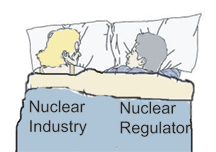 Indian Point nuclear plant can operate after license expires in September, regulators say,http://www.dailyfreeman.com/articles/2013/08/19/news/doc5212d0d93b28c839747942.txt August 19, 2013 WHITE PLAINS, N.Y. (AP) — Federal regulators have ruled, as expected, that a nuclear power reactor in the New York City suburbs can keep running after its license expires next month.
The Nuclear Regulatory Commission said Monday that Indian Point 2 in Buchanan can operate while its license renewal application is being reviewed.
That could be more than a year, given the controversy involved. New York state and environmental groups are opposing a new 20-year license.
NRC regulations allow continued operation if a plant applies for a new license five years before expiration. Indian Point’s owners applied in 2007.
Plants also must show they’ve taken any steps necessary to assure safe operation during the review.
The plant is 35 miles from Manhattan. Another reactor there, Indian Point 3, has a license that expires in 2015.
Reliable and cheap renewable energy storage
Rechargeable flow batteries could be cheaper solution to renewable energy storage http://www.treehugger.com/clean-technology/rechargeable-flow-batteries-could-be-cheaper-solution-renewable-energy-storage.html Megan Treacy August 19, 2013 Researchers at MIT have developed a battery that could bring us reliable and cheap large scale energy storage. Based on flow battery technology, the researchers took out the costly membrane and created a battery that has a power density that is an order of magnitude higher than lithium-ion batteries and three times greater than other membrane-less systems.
MIT reports, “The device stores and releases energy in a device that relies on a phenomenon called laminar flow: Two liquids are pumped through a channel, undergoing electrochemical reactions between two electrodes to store or release energy. Under the right conditions, the solutions stream through in parallel, with very little mixing. The flow naturally separates the liquids, without requiring a costly membrane.”
The reactants used are liquid bromine and hydrogen fuel, which is cheap, but also has had issues with breaking down the membrane in other flow batteries. By taking out the membrane they were able to speed up energy storage and extend the life of the battery.
“Here, we have a system where performance is just as good as previous systems, and now we don’t have to worry about issues of the membrane,” says Martin Bazant, a professor of chemical engineering. “This is something that can be a quantum leap in energy-storage technology.”
As we bring more renewable technologies like wind and solar into the grid, affordable and reliable energy storage is increasingly important. While solar and wind energy output varies based on weather conditions, large scale energy storage systems can smooth out the power delivery from those technologies by storing any excess energy when it’s produced and using it when the output is lower or demand is higher.
“Energy storage is the key enabling technology for renewables,” says Cullen Buie, an assistant professor of mechanical engineering. “Until you can make [energy storage] reliable and affordable, it doesn’t matter how cheap and efficient you can make wind and solar, because our grid can’t handle the intermittency of those renewable technologies.”
MIT says, “Braff built a prototype of a flow battery with a small channel between two electrodes. Through the channel, the group pumped liquid bromine over a graphite cathode and hydrobromic acid under a porous anode. At the same time, the researchers flowed hydrogen gas across the anode. The resulting reactions between hydrogen and bromine produced energy in the form of free electrons that can be discharged or released.
The researchers were also able to reverse the chemical reaction within the channel to capture electrons and store energy — a first for any membraneless design.”
Now that the team’s experiments have lined up with their computer models, they’re focused on scaling up the technology and seeing how it performs. They predict that the technology will be able to produce energy costing as little as $100/kWh, which would make it the cheapest large scale energy storage system built yet.
US doctors owning radiation facilities: conflict of interest
Gov’t report: Doctors with financial interests order more radiation Doctors who invest in radiation treatments and centers are more likely to prescribe it to their prostate cancer patients, a government report finds. CBS NEWS/ MICHELLE CASTILLO / August 19, 2013,
The U.S. Government Accountability Office said that most Medicare patients with prostate cancer who went to doctors with a vested interest were not made privy to the fact that there were alternative options to radiation therapy. Many of these other treatments were less expensive and may have been just as effective.
“We are extremely concerned that many older male patients are receiving such vigorous, possibly unnecessary treatment by urology groups,” Dr. Michael L. Steinberg, the chairman of the American Society for Radiation Oncology, said in astatement. “Clearly, these self-referring urology groups are steering patients to the most lucrative treatment they offer, depriving them of their full range of treatment choices, including potentially no treatment at all.”
Doctors who had a monetary stake in radiation treatment included those who invested in a treatment center or doctors who owned radiation therapy equipment that they shared with others in a medical group.
Between 2006 and 2010 the number of intensity-modulated radiation therapy (IMRT) procedures billed by self-referring medical organizations rose from 80,000 to 366,000 — an increase of 456 percent. IMRT involves using radiation beams to reshape a tumor in order to avoid touching healthy areas and to limit side effects, the Mayo Clinic explained. In contrast, the number of IMRT procedures billed by non-self-referring medical professionals went down 5 percent in the same time period.
IMRT spending by doctors who referred patients to their own centers or used their own equipment went up $138 million, compared to non-self-referral groups which just increased their spending by $91 million.
Urologists who were financially involved in radiation treatments advised 38 percent of their patients in 2007 to undergo the treatments. By 2008 to 2009, that number was as high as 54 percent.
In 2009, doctors with a vested interest were more 53 percent more likely to refer their patients to undergo radiation compared to other procedures like radical prostatectomy (removal of the prostate) or brachytherapy (radiotherapy where radiation is placed inside or next to the treatment area). Brachytherapy typically causes fewer side effects and has shorter overall treatment time compared to IMRT because it allows doctors to deliver more specific, higher doses of radiation to affected areas, the Mayo Clinic pointed out…….
“Unfortunately, when you look at the numbers in this report, you start to wonder where health care stops and where profiteering begins,” said Senate Finance Committee Chairman Max Baucus, D-Mont., in a statement. “Enough is enough. Congress needs to close this loophole and fix the problem.”……http://www.cbsnews.com/8301-204_162-57599131/govt-report-doctors-with-financial-interests-order-more-radiation/
Some American Republican advice on nuclear radiation, and climate change
 Oregon’s GOP Chair Wants to Sprinkle Nuclear Waste From Airplanes Mother jones, —By Tim Murphy Fri Aug. 16, 2013 After months of in-fighting, the beleaguered Oregon Republican Party elected a new chairman last weekend. His name is Art Robinson, and he wants to sprinkle radioactive waste from airplanes to build up our resistance to degenerative illnesses. …. Robinson, who has a Ph.D. in chemistry, has marketed himself for the last three decades as an expert on everything from nuclear fallout to AIDS to climate science in the pages of a monthly newsletter, Access to Energy, which he published from his compound in the small town of Cave Junction……
Growing opposition to nuclear waste dumping close to Lake Huron
Questions, concern surround plan to store nuclear waste near Lake Huron http://www.detroitnews.com/article/20130818/METRO08/308180008/ Jim Lynch
On Monday, two state legislators will host a town hall meeting in Detroit focusing on the plan to store low- to intermediate-level nuclear waste 2,230 feet below the ground near the Lake Huron shore. One of the legislators, Sen. Hoon-Yung Hopgood, D-Taylor, also posted a Facebook video on the project, laying out his concerns.
“This nuclear waste repository will be surrounded by Lake Huron on three sides and be located just upstream from the main drinking water intake for southeast Michigan,” he says in the two-minute video. “If this radioactive material leaks, the drinking water for 40 million people could be contaminated.”
The town hall, titled “Save the Great Lakes from Nuclear Waste,” will be held from 6:30-8 p.m. at Wayne State University’s Keith Center Lecture Hall.
For several years, Ontario Power Generation has been moving ahead with designs for an underground nuclear waste repository near Kincardine. During that time, the proposal has drawn sporadic interest and opposition in the United States — often in the form of isolated press releases by elected officials.
Ontario Power Generation officials have long argued their repository would be situated amid low-permeability limestone and shale formations that will keep the material there safe for “thousands” of years. U.S. and Canadian critics are concerned that, despite the company’s stated intentions, the repository could one day be used to house high-level nuclear waste.
In mid-September, Ontario’s federal review panel will begin a lengthy public hearing on the storage project. Then it will move north for additional hearings in Port Elgin in October.
“Some time in February would be the (earliest) that the panel would release its conclusions,” said Ted Grtuzner, an Ontario Power Generation spokesman. From there, the proposal would go on to the province’s Ministry of the Environment for a final review. jlynch@detroitnews.com (313) 222-2034
James Hansen’s pro nuclear video is false, a distortion of reality
A Nuclear Submariner Challenges a Pro-Nuclear Film NYT, By ANDREW C. REVKIN, 16 Aug 13 “……Now to the Hansen video. Untrained and inexperienced in nuclear engineering, he nevertheless claims that so-called Generation III reactors will be passively safe. If electrical power is lost, they will simply cool down on their own. Maybe. Maybe not.
Four Westinghouse AP1000 (Gen III) nuke plants are now being built (two in Georgia, two in South Carolina). But had the Fukushima plants all been AP1000s, they would have melted too, because they can only go without power forthree days, and it took 11 days to get power turned back on in all four reactors.
Worse yet, no one ever built a demonstration AP1000 nuke plant to prove they really are passively safe. Small demo plants often reveal design errors that can then be corrected before full-size plants are built. Without one, we’re investing $24 billion without knowing whether these four plants will ever work as promised. How rational is that?
Last, the ultimate inherently safe reactors the nuclear industry wants to build are the same liquid sodium fast breeder reactors that can explode or melt down. Good luck with that.
So I urge you, don’t believe “Pandora’s Promise,” James Hansen, or the nuclear industry. Their views are false, one-sided, and so contrary to reality that it is fair for me (now a Ph.D. social psychologist and journalist) to call them delusions — shared, motivated distortions of reality………. http://dotearth.blogs.nytimes.com/2013/08/16/a-nuclear-submariner-challenges-a-pro-nuclear-film/?_r=0
1 This Month
Tell Congress: Prevent Nuclear Catastrophe in Iran

Tell Congress: Prevent Nuclear Catastrophe in Iran

Read the Public Inquiry Report, the Commissioners’ report, Surrendering Australia: The AUKUS Deception is available to download for free at aukuspublicinquiry.com. Or just watch the replay of the National Press Club Luncheon.


Shut down the radiation-damaged Heysham nuclear reactors now
To see nuclear-related stories in greater depth and intensity – go to https://nuclearinformation.wordpress.com

Say No to NASA’s Reckless Nuclear Reactor on the Moon
Say No to NASA’s Reckless Nuclear Reactor on the Moon
-
Archives
- November 2026 (246)
- October 2026 (302)
- September 2026 (339)
- August 2026 (330)
- July 2026 (355)
- June 2026 (287)
- May 2026 (306)
- April 2026 (356)
- March 2026 (251)
- February 2026 (267)
- January 2026 (308)
- December 2025 (358)
-
Categories
- 1
- 1 NUCLEAR ISSUES
- business and costs
- climate change
- culture and arts
- ENERGY
- environment
- health
- history
- indigenous issues
- Legal
- marketing of nuclear
- media
- opposition to nuclear
- PERSONAL STORIES
- politics
- politics international
- Religion and ethics
- safety
- secrets,lies and civil liberties
- spinbuster
- technology
- Uranium
- wastes
- weapons and war
- Women
- 2 WORLD
- ACTION
- AFRICA
- Atrocities
- AUSTRALIA
- Christina's notes
- Christina's themes
- culture and arts
- Events
- Fuk 2022
- Fuk 2023
- Fukushima 2017
- Fukushima 2018
- fukushima 2019
- Fukushima 2020
- Fukushima 2021
- general
- global warming
- Humour (God we need it)
- Nuclear
- RARE EARTHS
- Reference
- resources – print
- Resources -audiovicual
- Weekly Newsletter
- World
- World Nuclear
- YouTube
-
RSS
Entries RSS
Comments RSS

