Huge and worrying task of cleaning up Zion Nuclear Plant
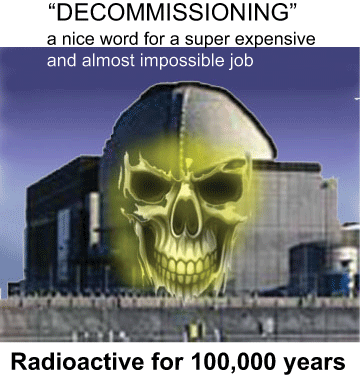
 Decommissioning Of Zion Nuclear Plant Raises Safety Concerns ZION, Ill. (CBS) 15 May 14. — It’s the largest closing of a nuclear plant in the United States, and it’s right in our backyard. The most critical and dangerous part of the process at Zion is underway right now with the transfer of used nuclear fuel. CBS 2’s Jim Williams is the only local TV reporter allowed inside to see firsthand what’s going on and to get answers to concerns about safety in this original report. For us, it was a first: an interview right next to a worker holding a radiation detector………….
The plant stopped operating 16 years ago, but what was left behind is so toxic robots were brought in.
“You don’t want men in there using hand tools and torches,” said Sauger.
By train and truck, they’re shipping the less hazardous material to Texas, Tennessee and Utah where it will be buried.
Dan Pryor is the project manager. He described the less hazardous material as “filters, rags, mops; things that might have been in contact with radiated material and might be contaminated.”
But spent nuclear fuel that had been in this cooling pool is being placed in steel cylinders called casks and then encased in concrete. Dave Kraft of the Nuclear Energy Information Service said, “We call this the nuclear bowling alley,” because all 65 casks will end up together above ground next to the old plant.
Kraft fears they could be a prime target for terrorists in a plane.
“If you have a huge fire from a burning airliner for example, It’s going to affect everything around,” said Kraft.
Kraft and Paul Kakuris, of the Dunesland Preservation Society worry the casks could break open, releasing radiation across the Chicago area and poisoning the Lake.
“We are at risk here. This is the water supply for 20 million people,” said Kakuris………Today, the casks are surrounded by high fences and razor wire. Heavily armed security guards are everywhere there. Still, it’s not enough to satisfy the critics.
“You only get one chance to be wrong,” said Kraft.
Another safety concern is how will those steel and concrete casks hold up over time before a permanent storage site is created? The nuclear regulatory commission expects them to be replaced in 100 years. But, environmentalists fear those casks may wind up sitting there next to Lake Michigan for much longer than that. http://chicago.cbslocal.com/2014/05/14/decommissioning-of-zion-nuclear-plant-raises-safety-concerns/
Militarising the Pacific – “island people are better radiation test subjects than mice are”
In a 1956 Atomic Energy Commission meeting, Merril Eisenbud, director of the AEC Health and Safety Laboratory, described the Marshallese thus: “While it is true that these people do not live, I would say, the way Westerners do, civilized people, it is nevertheless also true that these people are more like us than the mice.”.

 The Militarized Pacific: An Anniversary Without End 14 May 2014 By Jon Letman, Truthout | Op-Ed March 1, the 60th anniversary of the Castle Bravo test – a nuclear detonation over a thousand times more powerful than the bomb that destroyed Hiroshima – has come and gone. Predictably, major decadal events, like a 15-megaton explosion over a Micronesian atoll, garner fleeting attention, but it’s all the days between the anniversaries that tell the real story of those who live with the impacts.
For the people of the Marshall Islands, where Enewetak, Bikini and neighboring atolls were irradiated and rendered uninhabitable by 67 nuclear tests between 1946 and 1958, the brief anniversary recognition only underscores what little attention the Marshallese and, in a broader sense, millions of peoples of the Asia-Pacific are given by the US government and public……..
places like the US-backed naval base being built on South Korea’s Jeju island and the enormous military testing and training ranges in the Northern Mariana Islands (larger than much of the western United States) receive almost no attention. Names like Pagan, Rongelap and Kwajalein are scarcely known in the country that uses these islands for its own military testing……..
increased levels and types of cancers in the Marshall Islands, based on National Cancer Institute (NCI) research and firsthand accounts by Marshallese, are the result of nuclear testing. Continue reading
Lawmakers press for stronger safety regulations for spent nuclear fuel rods
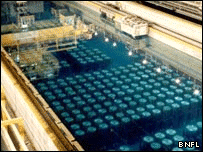 Bills would beef up safety regs for spent nuclear fuel http://thehill.com/regulation/205962-bills-would-beef-up-safety-regs-for-spent-nuclear-fuel By Benjamin Goad – 05/13/14 Lawmakers are pressing to bolster regulations for spent nuclear fuel, contending that pools left to languish for decades at decommissioning plants could prove disastrous in the event of an accident or terrorist attack.
Sens. Barbara Boxer (D-Calif.), Ed Markey (D-Mass.) and Bernie Sanders (I-Vt.) on Tuesday introduced a trio of bills meant to tighten safety and security at plants winding down operations around the country.
“Experts agree that a spent fuel pool accident could have consequences that are every bit as bad as an accident at an operating reactor,” Markey said.
Spent fuel can produce heat and radiation threats long after it is removed from a nuclear reactor’s electricity generating operation. Too dangerous to ship away from the plant altogether for as long as seven years, the spent fuel is left in pools at the plants.
A leak — whether due to accident or attack — could lead to fire and widespread contamination, the lawmakers said, citing various reports. Yet current Nuclear Regulatory Commission (NRC) rules allow for spent fuel to remain in the pools until the reactor completes decommissioning, which can take as long as 60 years, they said.
The Safe and Secure Decommissioning Act of 2014 would bar the NRC from exempting reactor licensees from any safety or security requirements at decommissioning plants until all fuel stored at the site is transferred into safer dry casks.
The lawmakers contend that the NRC has granted every exemption request it has ever received from decommissioning reactors, despite the agency’s own determination that an earthquake could result in a devastating breach. The Dry Cask Storage Act of 2014 is designed to force nuclear reactor operators to adhere to an NRC-approved plan for the transfer of spent fuel to dry cask storage within 7 years of the time the plant’s decommissioning plan is submitted.
Under the lawmakers’ Nuclear Plant Decommissioning Act of 2014, states and local communities would be guaranteed a meaningful role in the preparation of decommissioning plans for retired nuclear plants.
The legislation would require the NRC to publicly approve or reject every proposed decommissioning plan.
“Every state with a nuclear power plant has a strong interest in how that plant is decommissioned,” Sanders said. “This is about making sure that states and local communities can play a meaningful role in a decision.”
Concern about oversight of San Onofre Nuclear Decommissioning
 Del Mar Councilman To Testify At Senate Hearing On Nuclear Power Plant Decommissioning http://www.kpbs.org/news/2014/may/12/del-mar-councilman-testifies-senate-hearing-decomm/, May 12, 2014 By Alison St John U.S. Sen. Barbara Boxer, chairwoman of the Committee on Environment and Public Works, will convene a hearing Wednesday morning in Washington D.C., to look at the challenges of decommissioning nuclear reactors nationwide.
One of the five panelists called to testify is Del Mar City Councilman Don Mosier. Mosier, a biologist at the Scripps Research Institute, said he has concerns about continuing to store 4,000 tons of radioactive waste at San Onofre. The plant, 50 miles north of San Diego, was shut down in 2013 after a small radioactive leak was discovered in the steam generators in 2012.
“When the reactors were closed, we hoped that some of the safety concerns about San Onofre would be diminished,” Mosier said, “but I actually think they’re increased because of the lack of planning for storing all this radioactivity.“
Mosier said he has questions about the spent fuel pools and dry cask storage at San Onofre that were not designed for the kind of “high burn-up” fuel that will be stored there. High burn-up fuel (HBF ) is hotter and more radioactive than previously used fuel rods.
Mosier said the Nuclear Regulatory Commission that oversaw San Onofre when it was in operation, does not have the same level of regulatory authority over the decommissioning process.
“I feel in the absence of federal oversight, one of the things I am going to argue for is more state and local control of the decommissioning process,” Mosier said.
A Citizens’ Engagement Committee set up by Edison, the company that operates San Onofre, is not the independent oversight Mosier hopes to see.
Other panel members at Wednesday’s Senate hearing include Michael Weber, NRC deputy director for waste compliance programs, and Geoffrey Fettus of the Natural Resources Defense Council.
Waste Isolation Pilot Plant radioactive leak due to kitty litter?
Nuclear expert says kitty litter contributed to radiation leak at WIPP Current Argus News, By Zack Ponce, 13 May 14 zponce@currentargus.com CARLSBAD >> A change in the type of “kitty litter” that’s mixed with transuranic waste may be to blame for February’s radiation leak at the Waste Isolation Pilot Plant. A scientist who worked at WIPP until 2010 says he believes a change from non-organic kitty litter to organic litter caused a chemical reaction inside a waste drum, releasing the radioactive isotopes.
WIPP announced Monday night that photos taken over the weekend showed evidence of melted plastic and rubber on 55-gallon drums, indicating that the production of heat likely occurred in the underground area where waste is stored, according to a news release.
Jim Conca, who worked with WIPP from 2000 to 2010, said last week he believes a chemical reaction involving the kitty litter caused a small explosion inside a waste drum. New Mexico Environment Department Secretary Ryan Flynn confirmed on Monday that he has heard Department of Energy officials discuss the possibility that kitty litter may have been to blame for the radiation leak. Flynn said it is just one of many theories the DOE is exploring and nothing is certain at this time.
WIPP Recovery Manager Jim Blankenhorn said during last week’s town hall meeting that officials believe the radiation leak was likely caused by nuclear waste that contained nitrate salt which gave off some sort of chemical reaction. Blankenhorn said a switch from a non-organic substance to organic was what triggered the event. According to Conca, the unidentified substance containing elements mirroring nitrate salt is kitty litter.
Under WIPP’s congressional mandate, the nuclear waste disposal facility located 26 miles east of Carlsbad cannot accept any liquid waste, and therefore kitty litter is used as a preventative measure to absorb any remnants of liquid before the drums are sealed and shipped to Southeastern New Mexico, Conca said……… http://www.currentargus.com/carlsbad-news/ci_25750452/doe-examining-possibility-kitty-litter-contributed-radiation-leak
Political opposition to Miami Nuclear Plant
Tallahassee Rep. To Oppose Miami Nuclear Plant Expansionhttp://news.wjct.org/post/tallahassee-rep-oppose-miami-nuclear-plant-expansion By JESSICA PALOMBO May 13, 2014 A Tallahassee lawmaker and a South Florida mayor are planning to ask Florida Gov. Rick Scott to stop the expansion of a Miami nuclear power plant. Scott and his cabinet will hear from Florida Power and Light Tuesday about its plans to add reactors to its Turkey Point plant.
Florida Power and Light’s proposal includes two new nuclear reactors and 89 miles of transmission wires to stretch across nearby towns. The wires are a sticking point for Pinecrest Mayor Cindy Lerner. Lerner is slated to attend the meeting alongside state Rep. Michelle Rehwinkel Vasilinda (D-Tallahassee), who says an expansion of nuclear power has statewide implications.
“What’s really happening is we’re pushing out the desire and need for other innovations and for other renewable energy answers,” she says.
Vasilinda has unsuccessfully sponsored bills repealing power companies’ ability to charge customers for nuclear plants that are never built, as happened recently in Levy County. And she says she’s concerned about the safety of all nuclear reactors as sea levels continue rising.
Right wing attack on Colorado Clean Energy Standard fails in court
 Court Slaps Down Right Wing Attack On Colorado Clean Energy Standard http://thinkprogress.org/climate/2014/05/13/3437403/right-wing-attack-on-colorado-res-slapped-down-by-court/ BY TOM KENWORTHY
 ON MAY 13, 2014 COLORADO’S RENEWABLE ENERGY STANDARD, ONE OF THE MOST AMBITIOUS IN THE U.S., HAS THE DISTINCTION OF BEING APPROVED NOT JUST BY THE STATE LEGISLATURE BUT ALSO BY VOTERS IN A STATEWIDE REFERENDUM.
Now it’s been approved in the courts.
In a decision that could have implications for other renewable energy requirements under attack by the fossil fueled right wing, a U.S. District Court judge has upheld Colorado’s RES. Judge William J. Martinez flatly rejected arguments by the Energy and Environment Legal Institute that Colorado’s RES violated the Commerce Clause of the U.S. Constitution. Martinez granted summary judgment to the three defendants in the case, all commissioners of the state’s Public Utilities Commission.
In a news release responding to the decision, EarthJustice — which represented environmental groups which intervened in the case — said the decision will have implications beyond Colorado because renewable standards in some of the 30 other states that have them are “under legal attack by the fossil fuel industry and its supporters.”
Michael Hiatt, an EarthJustice attorney, said in an interview there have been a number of cases attacking clean energy and climate change efforts that have been rooted in Commerce Clause arguments and that the Colorado decision is important in beating back that line of legal attack. “It confirms that states do have the authority to mandate the use of renewables,” he said.
The Colorado case dates to 2011 when plaintiff Energy and Environment Legal Institute was known as the American Tradition Institute (ATI), a longtime opponent of mainstream climate science and clean energy. ATI had a partner organization called the American Tradition Partnership. According to theInstitute for Southern Studies the groups have ties to fossil fuel interests including the Koch brothers.
According to SourceWatch, ATI or its employees have been involved in campaign finance violations in Montana, in suing the University of Virginia to obtain access to the emails of climatologist Michael Mann, and in an effort to build a nationwide movement against wind power.
Colorado voters approved the state’s first RES in 2004, which required large investor-owned utilities to get 10 percent of their power from renewable sources. The state legislature has twice improved upon that first requirement, and those large utilities must now get 30 percent of their power from renewable sources by the year 2020. Municipal utilities and large rural electric co-ops must meet less stringent standards.
Dramatic rise in cancers, infant mortality near Diablo Canyon power plant
 Study: Nuclear Reactors Are Toxic to Surrounding Areas, Especially With Age 11 March 2014 By Candice Bernd, Truthout | Report A study released tlast week shows that public health in the communities surrounding California’s Diablo Canyon power plant in San Luis Obispo County declined dramatically after the plant was built. The findings also document the presence of Strontium-90 in baby teeth.
Is the baby tooth under your child’s pillow radioactive? It could be if you live relatively close to a nuclear power plant that has been operating normally and in accordance with federal regulations, according to a new study.
The study, released last week by the Santa Barbara-based think tank World Business Academy for its Safe Energy Project, found that public health indicators such as infant mortality rates and cancer incidence in surrounding areas rose dramatically after Pacific Gas and Electric’s (PG&E) two nuclear reactors at the Diablo Canyon power plant began operations in 1984 and 1985.
“This should be a concern for any nuclear reactor and its health risks, whether it’s been operating for a day or 30 or 40 years because these reactors create over 100 cancer-causing chemicals; much of it is stored as waste at the plant, but a portion of it is released into the environment and gets into human bodies through the food chain,” said Joseph Mangano, who authored the study. He is the executive director of the nonprofit Radiation and Public Health Project (RPHP).
The findings also document the presence of the radioactive isotope Strontium-90 in baby teeth, showing that the Strontium-90 levels in 50 baby teeth collected mostly from San Luis Obispo County, but also from Santa Barbara County, which is downwind from the Diablo Canyon plant, was 30.8 percent higher than the levels found in the 88 baby teeth from the rest of the state. Continue reading
USA follows Russia in a massive nuclear weapons drill
 The US Is Conducting A Massive Nuclear Arms Drill Days After A Russian Nuclear Exercise Business Insider Australia, JEREMY BENDER 13 May 14 The B-2 stealth bomber is taking part in Exercise Global Lightning 14.
U.S. Strategic Command will be conducting a massive “deter and detect” nuclear drill from May 12 to May 16, just four days after a similar Russian exercise. The U.S. drill, known as Exercise Global Lightning 14, is set to include ten B-52s and six B-2 bombers in an attempt to demonstrate U.S. military flexibility and responsiveness.
The drill, which is meant to simulate a scenario in which the U.S. would have to protect itself and its allies in the event of a “strategic attack,” is being touted as a chance to incorporate modern technology into U.S. drills…….http://www.businessinsider.com.au/us-conducting-a-massive-nuclear-arms-drill-2014-5
Nuclear lobby out to discredit Joe Mangano – but perhaps he is right!
 Study: Nuclear Reactors Are Toxic to Surrounding Areas, Especially With Age 11 March 2014 By Candice Bernd, Truthout | Report “………The Industry and the Government Hit Back, Predictably
Industry and government regulators claim Mangano’s study, as well as his previous peer-reviewed research studying the health impacts of radiation on local communities, is not credible.
“Given Mr. Mangano’s history of discredited reports due to poor science and that this newer report draws on the previously discredited work, PG&E is not giving this report any consideration,” Blair Jones, a PG&E spokesman, told Truthout in a written statement. “Recent assessments performed by the US nuclear industry’s federal regulator, the Nuclear Regulatory Commission (NRC), demonstrate Diablo Canyon is being operated safely and in a manner that protects the health and safety of the public. The NRC has found our operations continue to meet all safety and security performance objectives.”
And the Nuclear Energy Institute (NEI), an industry group, reacted even more aggressively, calling Mangano a “fearmonger” and “scaremonger.” The group regularly cites a statistic from the EPA that nuclear power plants only account for 0.1 percent of the radiation an average American is exposed to in the course of a year and that exposures from common medical procedures such as CT scans and X-Rays account for about 50 percent of this overall level.
But Dr. Hosea questions their claims. “At least with medical radiation you know you’re exposed and you can make a decision whether or not it’s worth the risk of getting a cat scan which is very, very small compared to not knowing [about potential risks from reactors] and finding out later that there’s potentially a problem,” he said. “We keep being reassured there’s not a problem, but there very well may be a problem,” he said.
Strontium-90 is not typically released in the radiation patients are exposed to diagnostically, and different radioactive isotopes can be of different qualities in terms of how much harm they can do to the human body.
“In whose interest is it to discount the study and not pay attention to it? It needs further investigation so we can really know the truth,” Dr. Hosea said.
PG&E and the industry group both point to staffers from eight state departments of health and the NRC who have looked into Mangano’s work and have invalidated it. The NEI claims that most of the Strontium-90 in the environment, which has a half-life of 28 years, is a remainder left over from above-ground atom bomb tests in the 1950s and early ’60s, and that there has been no significant change in background levels of radiation near nuclear reactors.
But Mangano’s research has found an overall statistically significant increase in concentrations of Strontium-90 found in baby teeth near Diablo Canyon over time. His previous research has also found that after the Rancho Seco nuclear power plant in Sacramento was closed, public health indicators in the surrounding areas improved.
“What the industry does in the absence of not doing these studies and not liking the results, is calling names,” Brown said. “This is not fifth grade; you do not get to talk about the health and safety of your customers and your neighbors by pointing fingers, and calling names, and trying to discredit, and trying to shoot the messenger.”
“This is not Joe Mangano’s data, this is data that is put out and publicly available by the Centers for Disease Control, by federal statistics and by the California cancer registry,” Brown said.
An NRC spokesman agreed with the industry that Mangano’s latest study lacked credibility. But more than 20 years after a highly cited study claimed there was no increased cancer risk from proximity to nuclear plants, the NRC is finally looking into the matter. The agency has asked National Academy of Sciences (NAS) to perform its own assessment on cancer risk for populations surrounding nuclear reactors, which is still in the works. The NAS has confirmed there are no safe levels of radiation exposure, in contrast with the EPA’s “permissible limits” approach.
“[The NAS assessment] is essentially the study we asked for 20 years ago,” said nuclear engineer David Lochbaum, who directs the Nuclear Safety Project at the Union of Concerned Scientists (UCS). Lochbaum told Truthout that when he asked NRC staffers why they did not address health impacts in a draft environmental impact statement for a nuclear plant seeking a 20-year license extension in 1998, the staffers told him that “human health was outside the scope of their assessments.”
“We applaud the NRC for doing [the health impact study], we just wish it would have been done…” he paused. “I guess better late than never, so we’ll look at the glass as half-full.”
When it comes to the credibility of Mangano’s work, Lochbaum told Truthout more research still needs to be done.
“When I read Joe’s work, it seems plausible,” he said. “When I read industry’s objections, that seems plausible too, and I know they both can’t be right and I don’t know which is. That’s why we advocated … for a health study that included people from the entire spectrum.”…..http://truth-out.org/news/item/22324-study-nuclear-reactors-are-toxic-to-surrounding-areas-especially-as-plants-age?tmpl=component&print=1
NRC list nuclear plants at earthquake risk – includes Plant Vogtle
 Plant Vogtle makes Nuclear Regulatory Commission list for earthquake analysis http://chronicle.augusta.com/latest-news/2014-05-12/plant-vogtle-makes-nuclear-regulatory-commission-list-earthquake-analysis By Meg Mirshak Staff Writer Monday, May 12, 2014 Plant Vogtle made a federal list of 21 nuclear reactors east of the Rocky Mountains that are vulnerable to earthquakes and need to conduct detailed analyses explaining their ability to withstand damage from seismic activity.
The U.S. Nuclear Regulatory Commission is requiring Plant Vogtle in Burke County to submit a detailed risk analysis by June 30, 2017. An expedited review is required by this December to make sure the plant about 30 miles south of Augusta could safely shut down after an earthquake.
The requirements are part of ongoing work by the NRC after the Fukushima nuclear meltdown in Japan. New models of seismic activity showed that earthquake risks beyond the West Coast are more threatening than was understood when many nuclear power plants were built in the 1970s and 1980s.
The NRC reviewed reports from 59 nuclear reactor sites in the central and eastern U.S. with updated earthquake hazard information. A prioritized list of reactors needing further analysis was released Friday. “We’ve examined this information to see how a plant’s new quake hazard compares to the ground movement that the plant’s original design process considered,” said Eric Leeds, the director of the NRC’s Office of Nuclear Reactor Regulation, in a news release. “We’re closely following the industry’s response, and we’re confident the plants are safe to continue operating.”
If the expedited safety review due in December shows that equipment needs to be updated, the work must be completed by December 2016.
Other reactors facing scrutiny include Plant Hatch in Baxley, Ga.; Catawba Nuclear Station in York, S.C.; Oconee Nuclear Station in Seneca, S.C.; Robinson Nuclear Plant in Hartsville, S.C.; and V.C. Summer Nuclear Station in Jenkinsville, S.C.
Radiation -linked cancers increased around Pilgrim Nuclear Plant
Study: Increase in radiation-linked cancers around Pilgrim “Tobacco Science” versus fact CAPE COD TODAY, OP ED | MAY 10, 2014 BY MARY LAMPERT, PILGRIM WATCH.
Industries that can harm the public have “tobacco scientists” and lobbyists to promote their message. The Pilgrim Nuclear plant is no exception, and denies the pattern of radiation-linked cancers and disease around it.
Pilgrim’s spin doctors choose to rely on fiction, not facts. We rely on the National Academies (our nation’s premier scientists). The National Academies’ latest report said there is no safe dose of radiation and that exposure to even very low levels of radiation is three times more dangerous than previously expected – and more so for children and women. We rely also on statistics from the Massachusetts Cancer Registry. In 1982 it began recording data showing a continued increase in radiation-linked cancers in communities around Pilgrim.
A review of Massachusetts Cancer Registry data shows that Plymouth (from 2002-2009) has a statistically significant increased level of leukemia, at a 95% probability level. This means that there is, at most, a 5% chance that the difference between the observed and expected cases of leukemia is due to chance. There also is a statistically significant increased level of prostate cancer, another radiation linked disease.
For the previous two decades, the Massachusetts Cancer Registry shows the “footprints” of radiation linked disease (leukemia, thyroid cancer, multiple myeloma and prostate cancer) in the seven towns most likely to be impacted by Pilgrim – Carver, Duxbury, Kingston, Marshfield, Pembroke, Plymouth, and Plympton. The Cape is downwind from Pilgrim much of the year. It, along with southeastern Massachusetts, has the highest cancer rates in the state. There has not yet been a study to determine if radiation emissions from Pilgrim are the missing variable to explain the high cancer rates there.
A major case-control study by the Massachusetts Department of Public Health in 1990 (MDPH) found a four-fold increase in adult leukemia the closer one lived to or if one worked at Pilgrim. Pilgrim did not like the results and cut a political deal allowing it to appoint a second peer review panel to re-review the study and write a report. Even Pilgrim’s hand-picked panel concluded that, “The original study team adhered to generally accepted epidemiological principles… [And] …the findings of the study cannot be readily dismissed on the basis of methodological errors or proven biases… [and last]…the association found between leukemia and proximity to the Pilgrim nuclear facility was unexpectedly strong.” http://www.capecodtoday.com/article/2014/05/10/25347-study-increase-radiation-linked-cancers-around-pilgrim
New Mexico nuclear waste facility will not fully re-open for years
DOE: Could be 3 years to fully reopen NM nuke dump LAKE WYLIE PILOT, BY SUSAN MONTOYA BRYAN Associated PressMay 8, 2014 ALBUQUERQUE, N.M. — The head of the recovery effort at the federal government’s nuclear waste repository in southern New Mexico said Thursday it could be up to three years before full operations resume at the underground facility.
Recovery manager Jim Blankenhorn made the announcement when answering questions from the public during a weekly meeting in Carlsbad. He said the timeline continues to be a moving target, but full operations are expected to resume no earlier than 18 months from now.
Crews continue investigating the cause of a radiation release at the Waste Isolation Pilot Plant near Carlsbad that exposed some workers and halted operations in February……..
 Los Alamos is under a tight deadline to get the plutonium-contaminated waste off its northern New Mexico campus before wildfire season peaks. The state of New Mexico pressured the lab to hasten the cleanup after a massive wildfire in 2011 lapped at the edges of lab property.
Lab Director Charlie McMillan said Thursday during a news conference in Albuquerque that the recent developments “are very much a cause for concern.” But he said it was too soon to tell if they will have any effect on the lab’s ability to meet the state’s deadline. http://www.lakewyliepilot.com/2014/05/08/2418188/doe-could-be-3-years-to-fully.html
New Mexico Environment Department Secretary Ryan Flynn calls for closure of Nuclear waste Facility Panels
WIPP: NM Environment Secretary Ryan Flynn calls for immediate closure of waste panels Current-Argus News, By Zack Ponce zponce@currentargus.com 05/09/2014 CARLSBAD >>  EIGHTY-FOUR DAYS HAVE PASSED SINCE THE FEBRUARY RADIATION LEAK AT THE WASTE ISOLATION PILOT PLANT AND COMMUNITY LEADERS IN CARLSBAD AND NEW MEXICO GOVERNMENT OFFICIALS HAVE BEGUN TO REVEAL THEIR IRRITATIONS.
New Mexico Environment Department Secretary Ryan Flynn capped the weekly WIPP town hall with a fiery speech about the Department of Energy’s latest theory of what caused the Feb. 14 accident in Panel 7 of the underground nuclear waste facility located 26 miles east of Carlsbad. Flynn called for the immediate closure of all waste panels except Panel 7 at WIPP, as well as complete public transparency.
“I agree that these panels need to be closed and they need to be closed immediately,” Flynn said.
Seven panels have been mined underground at WIPP for nuclear waste storage and three of them remain opened, including Panel 7 where the DOE believes the radiation leak originated. According to the contractual obligations, DOE must now close all open panels where the radiation leak is not suspected to have occurred.
The DOE halted shipments of nuclear waste containers from Los Alamos National Laboratory to the Waste Control Specialists private facility in Andrews County, Texas last week after investigators narrowed the likely cause to the waste makeup from LANL.
Nuclear Waste Partnership Recovery Manager Jim Blankenhorn announced on Thursday that WIPP officials believe the radiation leak was likely caused by nuclear waste that contained nitrate salt which gave off some sort of a chemical reaction. The waste with nitrate salt matched waste stored in drums that originated from three separate waste streams: two of the waste streams originated from LANL and the source of the other was unknown because DOE and NWP refused to name the source. WIPP has stored waste streams from LANL, Savannah River, and Idaho National Laboratory in the past……..http://www.currentargus.com/carlsbad-news/ci_25729464/flynn-calls-immediate-closure-waste-panels-tranparency
Pilgrim Nuclear Plant’s history of poor safety and dodgy radiation monitoring
Study: Increase in radiation-linked cancers around Pilgrim “Tobacco Science” versus fact CAPE COD TODAY, OP ED | MAY 10, 2014 BY MARY LAMPERT, PILGRIM WATCH. “….Pilgrim apologists say that radiation from Pilgrim is closely monitored and controlled. Not so. Pilgrim collects its own environmental samples, fewer now than previous years; analyzes the samples in their own lab; and writes its own reports – the equivalent of letting students write and grade their own exams. MDPH has a very limited offsite monitoring program due to lack of finances. Since 2007, there have been onsite monitoring wells to detect radioactive tritium leaks before they enter Cape Cod Bay. Leaks of tritium are evident but not the source. If more wells were installed, would more releases be detected?
In 1990, MDPH recommended that Pilgrim place real-time air monitors in off-site communities. Pilgrim refused to do so. MDPH began its own, very limited offsite air monitoring program in 2010.
Pilgrim’s operational history affects us today. Pilgrim began operations with bad fuel and without filtration. In 1982, Pilgrim blew its toxic filters, spewing hot particles into neighborhoods. A state sponsored study showed that weather conditions then were worst-case for holding contamination over local communities and Cape Cod. Environmental samples showed Cesium-137 in milk samples from a close-by farm was 1,000,000 times greater than expected; no Cesium-137 was found in control samples. A similar pattern was recorded by Pilgrim in other environmental samples. Pilgrim claimed it was due, not to it, but to Chinese test bombs. You decide. Did the Chinese have “smart” test bombs that targeted Pilgrim’s indicator samples but not their control samples?
Spin-doctors cannot raise the dead or make the sick well. If the dead and sick with radiation-linked diseases are significantly more prevalent near Pilgrim than in communities distant, the conclusion seems obvious.
Mary Lampert is a resident of Duxbury, founder and director of Pilgrim Watch, and co-chair of the Town of Duxbury’s Nuclear Advisory Committee. http://www.capecodtoday.com/article/2014/05/10/25347-study-increase-radiation-linked-cancers-around-pilgrim
1 This Month
Tell Congress: Prevent Nuclear Catastrophe in Iran

Tell Congress: Prevent Nuclear Catastrophe in Iran

Read the Public Inquiry Report, the Commissioners’ report, Surrendering Australia: The AUKUS Deception is available to download for free at aukuspublicinquiry.com. Or just watch the replay of the National Press Club Luncheon.


Shut down the radiation-damaged Heysham nuclear reactors now
To see nuclear-related stories in greater depth and intensity – go to https://nuclearinformation.wordpress.com

Say No to NASA’s Reckless Nuclear Reactor on the Moon
Say No to NASA’s Reckless Nuclear Reactor on the Moon
-
Archives
- November 2026 (238)
- October 2026 (302)
- September 2026 (339)
- August 2026 (330)
- July 2026 (355)
- June 2026 (287)
- May 2026 (306)
- April 2026 (356)
- March 2026 (251)
- February 2026 (267)
- January 2026 (308)
- December 2025 (358)
-
Categories
- 1
- 1 NUCLEAR ISSUES
- business and costs
- climate change
- culture and arts
- ENERGY
- environment
- health
- history
- indigenous issues
- Legal
- marketing of nuclear
- media
- opposition to nuclear
- PERSONAL STORIES
- politics
- politics international
- Religion and ethics
- safety
- secrets,lies and civil liberties
- spinbuster
- technology
- Uranium
- wastes
- weapons and war
- Women
- 2 WORLD
- ACTION
- AFRICA
- Atrocities
- AUSTRALIA
- Christina's notes
- Christina's themes
- culture and arts
- Events
- Fuk 2022
- Fuk 2023
- Fukushima 2017
- Fukushima 2018
- fukushima 2019
- Fukushima 2020
- Fukushima 2021
- general
- global warming
- Humour (God we need it)
- Nuclear
- RARE EARTHS
- Reference
- resources – print
- Resources -audiovicual
- Weekly Newsletter
- World
- World Nuclear
- YouTube
-
RSS
Entries RSS
Comments RSS

