A Canadian plea for ethical government, media integrity and true science

 Not In Our Name, Kickstarter 1 March 15 by Chris Hill A film telling how a nation went to war against its own veterans and scientists, and kept its head in the tar sands on climate change.
About this project How many wrong decisions can one nation endure? Every
week there’s a new story that shows a shocking lack in judgment or ethics on the part of the government. It’s open season on the environment, on science, on the rights of veterans, and it shames us all.
Media in disarray Cuts to investigative journalism by most media outlets (including Canada’s CBC, which has been decimated by recent government funding cuts) are allowing many stories to remain under-covered, or untold altogether.
Media consolidation has meant there are fewer voices reporting, with ever-tightening restrictions on what they can say. This is a critical threat to democracy, and it’s the principal motivation for this film. Independent voices must pick up the slack.
Science Abandoned The Canadian tradition of being at the forefront of scientific research and innovation, critical to the nation’s prosperity, has been all but abandoned. The Harper government has pulled the plug on any science that doesn’t conform to its specific oil and gas agenda, and it has effectively muzzled scientists by forbidding them from speaking out to the press.
Critical programs that monitored the melting arctic, smoke stack emissions, food inspections, water quality, oil spills and climate change have been systematically dismantled.
Hundreds of the world’s scientists have written an open letter to the Harper government, voicing concerns over the inability to conduct basic research environmental and health issues, and other areas of science that should contribute to the public good.
It is a frivolous waste of taxpayers’ dollars to fund research only to have it repressed, causing decisions to be made without adequate data and information. This puts our citizens at risk, as it leaves us flying blind amid the dangers of increasing pollution and climate change.and other environmental hazards.
Our tradition of scientific prowess and innovation has been flushed down the toilet because of what scientific research is revealing — the effects of our own country’s destructive policies……..
“Not in Our Name”: the film
“Not in Our Name” (NION) will explore the axis of Industry, Media, and Government, which prioritizes corporate interests over the people’s. The film will show how similar tactics are being employed in the US, Britain, Australia…leaders administering the instructions of the multinational corporations who bought them. They count the profits while we, society and the environment count the cost.
If we don’t vigorously confront their stranglehold on our governments, we will have forever crossed the Rubicon, and there will be no turning back. https://www.kickstarter.com/projects/1916096034/not-in-our-name
U.S. lawmakers want defense budget of $577 billion
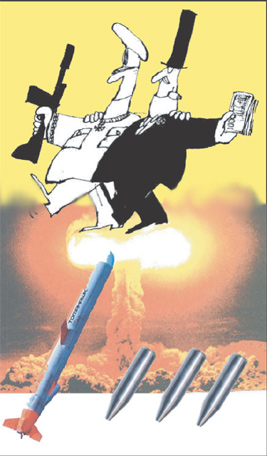 Thornberry’s Defense Budget Exceeds Pentagon’s Request by $16 Billion, DoD Buzz By Richard Sisk | Friday, February 27th, 2015 A lawmaker in the U.S. House of Representatives is calling for a fiscal 2016 defense budget that would exceed spending caps by $50 billion.
Rep. William “Mac” Thornberry, R-Texas, chairman of the House Armed Services Committee, submitted the proposal in a letter Friday to Rep. Tom Price, R-Georgia, and chairman of the House Budget Committee.
Thornberry and most of his colleagues on the defense panel recommended a national defense budget of $577 billion. The figure is $16 billion more than the Obama administration’s request — which already exceeds spending caps for the Defense Department’s base budget by about $35 billion. More importantly, it signals a growing divide within the GOP over how much funding the Pentagon should receive at a time when the U.S. military is taking on new missions in the Middle East, Europe and Asia……..
While defense hawks like Thornberry and Sen. John McCain, R-Arizona, are pushing for more military spending and an end to automatic budget cuts known as sequestration, budget hawks such as Price are trying to reduce overall federal spending to cut the deficit and balance the budget………http://www.dodbuzz.com/2015/02/27/thornberrys-defense-budget-exceeds-pentagons-request-by-16-billion/
Competition from clean energy results in Illinois Bill to help Exelon nuclear corporation
Consumer advocates and business groups, however, quickly questioned the need for legislation that would benefit a single company.
Exelon, critics gird for battle as pro-nuclear bill is filed in Ill. Jeffrey Tomich, E&E reporter EnergyWire: Friday, February 27, 2015 The stage is set for an energy policy showdown in Illinois after lawmakers from both parties introduced a bill aimed at aiding three Exelon Corp. nuclear plants that have struggled in recent years in the face of increasing competition from wind energy and natural-gas-fired generation.
The legislation filed in the House and Senate would replace the Illinois renewable energy standard with a low-carbon portfolio standard requiring 70 percent of electricity used in areas served by large investor-owned utilities to come from low-carbon sources of generation……. Continue reading
Illinois energy Bill increases public costs, but benefits nuclear company Exelon
Exelon accused of seeking nuclear bailout http://www.fierceenergy.com/story/exelon-accused-seeking-nuclear-bailout/2015-02-27 February 27, 2015 | By Barbara Vergetis Lundin Exelon yesterday introduced its “Low Carbon Portfolio Standard” — legislation that is receiving opposition from groups like AARP Illinois and the BEST (Better Energy Solutions for Tomorrow) Coalition who are urging state lawmakers to reject this legislation, saying it would increase electric bills in order to “bail out Exelon’s nuclear plants.”
A 2014 analysis by Crain’s Chicago Business found that Exelon’s Illinois nuclear fleet is profitable and Exelon CEO Chris Crane even stated “Exelon had a strong year, both operationally and financially…our generation fleet and utilities continued to perform at high levels.”
For Exelon’s part, it says it is not seeking a bailout. Exelon made more than $2 billion in 2014.
This bill rewrites Illinois energy policy to increase costs for public and private entities statewide and benefits only Exelon,” said Steve Davis, legislative co-chair for Illinois Association of Wastewater Agencies, a BEST Coalition member. “Policy like this will increase the cost of doing business in Illinois and make Illinois less competitive.”
The organizations attempting to block Exelon’s Low Carbon Portfolio Standard claim that even if Exelon has financial issues with its Illinois nuclear fleet, although contrary to publicly available information, those issues will be resolved, in part, by a recently approved rate increase for Exelon’s subsidiary ComEd that will increase ComEd revenue by approximately $232 million.
For more:
– visit this website
Fort Calhoun nuclear waste not going anywhere?
Fort Calhoun Nuclear Waste Needs A Home By: Brian Mastre – WOWT.com , Feb 27, 2015 Nebraskans have paid hundreds of millions of dollars to the federal government to store used nuclear fuel from the state’s two nuclear power plants, but the feds aren’t doing anything with it. Yet, the government keeps the money. Where is the nuclear waste going in the meantime and what’s happening to our dollars?…….http://www.wowt.com/home/headlines/Fort-Calhoun-Nuclear-Waste-Needs-A-Home-294370321.html
If a nuclear warhead detonated above midtown Manhattan?
What would happen if an 800-kiloton nuclear warhead detonated above midtown Manhattan? Bulletin of the Atomic Scientists, 25 Feb 15 Steven StarrLynn EdenTheodore A. Postol Russian intercontinental ballistic missiles are believed to carry a total of approximately 1,000 strategic nuclear warheads that can hit the US less than 30 minutes after being launched. Of this total, about 700 warheads are rated at 800 kilotons; that is, each has the explosive power of 800,000 tons of TNT. What follows is a description of the consequences of the detonation of a single such warhead over midtown Manhattan, in the heart of New York City.

The initial fireball. The warhead would probably be detonated slightly more than a mile above the city, to maximize the damage created by its blast wave. Within a few tenths of millionths of a second after detonation, the center of the warhead would reach a temperature of roughly 200 million degrees Fahrenheit (about 100 million degrees Celsius), or about four to five times the temperature at the center of the sun.
A ball of superheated air would form, initiallly expanding outward at millions of miles per hour. It would act like a fast-moving piston on the surrounding air, compressing it at the edge of the fireball and creating a shockwave of vast size and power.
After one second, the fireball would be roughly a mile in diameter. It would have cooled from its initial temperature of many millions of degrees to about 16,000 degrees Fahrenheit, roughly 4,000 degrees hotter than the surface of the sun.
On a clear day with average weather conditions, the enormous heat and light from the fireball would almost instantly ignite fires over a total area of about 100 square miles.
Hurricane of fire. Within seconds after the detonation, fires set within a few miles of the fireball would burn violently. These fires would force gigantic masses of heated air to rise, drawing cooler air from surrounding areas toward the center of the fire zone from all directions.
As the massive winds drove flames into areas where fires had not yet fully developed,the fires set by the detonation would begin to merge. Within tens of minutes of the detonation, fires from near and far would joinhave formed a single, gigantic fire. The energy released by this mass fire would be 15 to 50 times greater than the energy produced by the nuclear detonation……….
No survivors. Within tens of minutes, everything within approximately five to seven miles of Midtown Manhattan would be engulfed by a gigantic firestorm. The fire zone would cover a total area of 90 to 152 square miles (230 to 389 square kilometers). The firestorm would rage for three to six hours. Air temperatures in the fire zone would likely average 400 to 500 degrees Fahrenheit (200 to 260 Celsius).
After the fire burned out, the street pavement would be so hot that even tracked vehicles could not pass over it for days. Buried, unburned material from collapsed buildings throughout the fire zone could burst into flames when exposed to air—months after the firestorm had ended.
Those who tried to escape through the streets would have been incinerated by the hurricane-force winds filled with firebrands and flames. Even those able to find shelter in the lower-level sub-basements of massive buildings would likely suffocate from fire-generated gases or be cooked alive as their shelters heated to oven-like conditions.
The fire would extinguish all life and destroy almost everything else.Tens of miles downwind of the area of immediate destruction, radioactive fallout would begin to arrive within a few hours of the detonation.
But that is another story.
Editor’s note: This article is adapted from “City on Fire” by Lynn Eden, originally published in the January 2004 issue of the Bulletin of the Atomic Scientists. http://thebulletin.org/what-would-happen-if-800-kiloton-nuclear-warhead-detonated-above-midtown-manhattan8023
The massive costs and massive dangers of hosting a radioactive nuclear trash dump
Inside the race for Canada’s nuclear waste: 11 towns vie to host deep burial site Canada’s nuclear waste will be deadly for 400,000 years. What town would like the honour of hosting it?CHARLES WILKINS TheGlobe and Mail Feb. 26 2015,

“If I piled any quantity of shit out there and left it with no disposal plan, I’d be shut down and condemned within weeks. And here’s an industry with the capacity for global devastation, with no permanent plan for their garbage, the most dangerous stuff on Earth, and they’re allowed to keep producing it indefinitely.”
There is in fact a plan for that waste. A federally mandated body, the Nuclear Waste Management Organization (NWMO), wants to bury it in what the nuclear industry calls a Deep Geological Repository, or DGR. First, though, the organization must complete its quest—in effect, a competition, although the NWMO doesn’t see it that way—to find a municipality that will serve as a “willing host” for the repository. Among the contenders for the distinction are the municipalities of Huron-Kinloss, South Bruce and Central Huron, all of them close neighbours to Fran and Tony McQuail.
If it doesn’t seem like a competition any municipality would want to win, consider that spending on the project will likely run as high as $24 billion. And, the construction phase aside, the jobs involved are not the sort that will last only until another, perhaps cheaper, location is found. According to the NWMO’s plan, 400,000 years or more will pass between the point at which the waste is buried and the happy day when any sort of safety sticker is likely to be affixed to the vast toxic grave.
One morning in October, 1957, the principal of Keyes Public School in Deep River, Ontario, came into our Grade 5 classroom and declared that we, the children of the town, had “nothing to be afraid of.” We were to pay no attention to rumours that the reactors at nearby Chalk River would be among the Soviet Union’s first targets should the Cold War suddenly heat up.
Because we had older siblings ever willing to heighten our appreciation of reality, we already knew that if the reactors got hit, the explosion would be the equivalent of a thousand, maybe a million, H-bombs. We knew, too, that Deep River was located exactly seven miles from the reactors because that was the minimum distance at which human life would be spared if the plant ever got hit.
Mercifully, the missiles never came. And the plant never blew.
Others did: Three Mile Island (1979), Chernobyl (1986), Fukushima (2011).
Most of the reactor stories we heard as kids turned out to be fables. Yet more than half a century later, they remain bristling little allegories not just of the risks of splitting the atom but of the doggedness of those who continue to tell us we have “nothing to fear” from an industry that in 1945 said hello to humanity by incinerating 80,000 citizens of Hiroshima…….http://www.theglobeandmail.com/report-on-business/rob-magazine/inside-the-race-for-canadas-nuclear-waste/article23178848/
Effect of ionising radiation on health, shown through Baby Tooth Survey
 They found that the radioactive strontium-90 levels in the baby teeth of children born from 1945 to 1965 had risen 100-fold and that the level of strontium-90 rose and fell in correlation with atomic bomb tests.
Early results from the Baby Tooth Survey, and a U. S. Public Health Service study that showed an alarming rise in the percentage of underweight live births and of childhood cancer, helped persuade President John F. Kennedy to negotiate a treaty with the Soviet Union to end above-ground testing of atomic bombs in 1963.
St. Louis Baby Tooth Survey, 1959-1970, Washington University School of Dental Medicine Though many members of the group were vocally against nuclear testing, CNI never took an official position for or against the testing of nuclear weapons. Scientific facts were assembled, studied by the Committee and its Scientific Advisory Group, and then made available to the public through regular bulletins, newsletters, and a speaker’s bureau…. Continue reading
Washington State Senator Sharon Brown enthusiastically pushing for Small Modular Nuclear Reactors
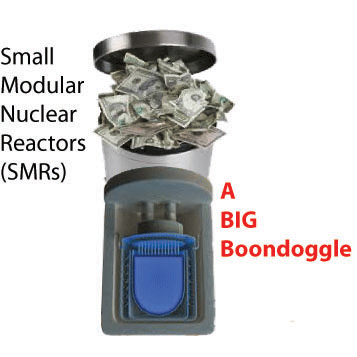 Nuclear Advocate Pushes For Modular Reactor Presence In Washington State http://www.icontact-archive.com/uY4CWN-9Ks3su6iHyVeY7nHzrprAq8_d?w=1 Feb 25 2015 A state senator in Washington, Sharon Brown, R-Kennewick, is promoting nuclear energy with a focus on technology that has yet to be put into operation.
Bills that Brown have sponsored nudge the state towards acceptance of modular, factory-built nuclear reactors, The Olympian reported Tuesday.
Brown has called for a relatively modest $176,000 study to identify sites for nuclear power reactors that are in frequent discussions, but have yet to be built – reactors with a generation capacity of 300 MW or less.
In neighboring Oregon, NuScale Power is developing reactors that will built in one location and shipped by truck or rail to their final destination
“We need to make sure we’re not left behind,” said Brown at a hearing Tuesday. She also said, “It’s really important that as a state we get our arms around small nuclear reactors.”
Brown, who is pushing the state to nudge the federal government on construction of a federal waste repository, has sponsored other nuclear power-friendly bills that cleared a critical deadline last week. These include a bill to provide sales tax relief for small reactor production and one that mandates the Commerce Department support small reactors development for commercial use.
She has also sponsored measures that would allow energy from modular reactors to count as part of the state’s renewable energy targets, although these initiatives have strong opposition from environment groups.
The initiatives follow up on a previous state study, completed in September, that said a modular reactor facility was feasible for the Hanford Site nuclear facility.
The ever-accumulating tonnage of Canada’s radioactive trash
the Nuclear Waste Management Organization (NWMO), wants to bury it in what the nuclear industry calls a Deep Geological Repository, or DGR
“Finally,” says Eugene Bourgeois, whose idyllic property lies within a kilometre of the Bruce Power reactors, “it has to be impervious to the potential ignorance or delinquency of people, perhaps ‘peopleoids,’ more than a quarter-million years from now”—which is to say, peopleoids who likely will have no notion even of the languages in which the safety code and signage of the DGR were written.
At the same time, the site can’t be too remote. It must be serviced by roads and rail, so that waste can be brought in, and must have a sufficient population that the thousands of folks who will build the facility and the hundreds who will be employed there long-term will have a place to live

Inside the race for Canada’s nuclear waste: 11 towns vie to host deep burial site Canada’s nuclear waste will be deadly for 400,000 years. What town would like the honour of hosting it? CHARLES WILKINS TheGlobe and Mail Feb. 26 2015,
……..the Western Waste Management Facility, where Ontario Power Generation stores much of its share of the 48,000 tonnes of waste that have accumulated in Canada during the past 65 years and that the company and other nuclear-power producers hope will eventually be lowered into the national DGR (Deep Geological Repository)
The ever-accumulating tonnage, which in the wrong hands could provide payloads for thousands of atomic bombs, is entombed in a thousand snow-white containers (a half-inch of steel atop reinforced concrete), each the size of, say, a Lincoln Navigator set on end and weighing 70 tonnes……..
The $24-billion cost of a deep repository—to be paid by the producers (hence ultimately their customers) out of a fund that now stands at less than $3 billion—sounds like a lot for the existing quantity of nuclear-fuel waste in the country. NWMO spokesman Mike Krizanc visualizes Canada’s 48,000-tonne waste pile as “enough to cover six NHL-sized hockey rinks to the top of the boards.”
The discrepancy is explained by toxicity. According to Gordon Edwards, a mathematician who has critiqued the nuclear industry for decades as president of the Canadian Coalition for Nuclear Responsibility, irradiated—that is, used—nuclear fuel is “millions of times more radioactive and deadly than when the unirradiated fuel was placed in the reactors.” Studies have connected the various isotopes contained in the waste to cancer, immune system damage and genetic mutation. Those six hockey rinks are enough, say nuclear detractors, that if the waste is buried in the wrong place, or in the wrong way, it could ruin our water, render the landscape useless for agriculture, or, in a darker scenario, render it useless for human habitation…… Continue reading
SNC Lavalin Nuclear and Ontario Power Generation (OPG) in court over costs of Darlington nuclear rebuild
 We’ll see SNC Lavalin Nuclear in court http://www.cleanairalliance.org/bulletins Angela Bischoff 24 Feb 15 In March 2011, the Ontario Clean Air Alliance (OCAA) filed a Freedom of Information (FOI) request to obtain details of the contract between Aecon Construction, SNC Lavalin Nuclear and Ontario Power Generation (OPG) for the re-building of four reactors at the Darlington Nuclear Station on Lake Ontario.
Aecon Construction and SNC Lavalin, not surprisingly, are not keen to reveal just how rich this mega contract is and refused to provide the information. However, the the Information and Privacy Commissioner of Ontario (IPC) ruled that the companies should provide relevant details, a decision Aecon and SNC then appealed to the Superior Court.
 The companies are insisting that they were “confused” by the Freedom of Information request process, which the Privacy Commissioner’s counsel notes is rather odd, considering that these “are multi-billion dollar companies that have access to a wealth of internal and external legal resources [and] have a history of being involved in access to information requests in other Canadian jurisdictions.“
The companies are also trying to use another technicality to shield the details of the deal, including whether it allows cost overruns to be passed onto taxpayers and ratepayers. They are insisting that contracts are not covered by FOI legislation because they represent information provided by one party to another. The Commissioner’s counsel strongly disagrees in her response, citing an explanation from the Government of Canada:
“.. . The intention of Parliament in exempting financial and commercial information from disclosure applies to confidential information submitted to the government, not negotiated amounts for goods or services. Otherwise, every contract amount with the government would be exempt from disclosure, and the public would have no access to this important information …”
Given the long history of secret deals in Ontario’s nuclear power sector that have led to massive cost overruns – and massive debt for Ontario taxpayers and ratepayers – the OCAA believes the public has every right to know more about the deal struck between OPG and these two construction and engineering giants. We would like to thank the Information and Privacy Commissioner for robustly defending our right to see this information.
We’re hoping we won’t have to repeat this difficult and time consuming exercise with another secret nuclear deal – an agreement to rebuild reactors at the Bruce Nuclear Station. Instead of forcing public interest groups to file freedom of information requests after the fact, the government should walk its talk on openness and transparency by sending any proposed Bruce Deal to the Ontario Energy Board for a full public review.
Please join us to observe the proceedings as well as to show your support for greater transparency in government decision making this coming Monday :
- Monday March 2, 10 a.m.(come at any time during the day)
- Osgoode Hall, 130 Queen St. West (NE corner of Queen/University), in Courtroom # 3 (on 2ndfloor), entrance off Queen St., Toronto
A little sunshine can keep everyone healthier.
p.s. Our Ontario budget proposal to take a pass on rebuilding the Darlington Nuclear Plant in favour of importing lower-cost water power from Quebec has clearly made some vested interests in the Ontario nuclear industry very nervous. Our proposal on the government’s budget consultation website has suddenly been inundated with “thumbs down” votes. This orchestrated campaign to deep six our idea just shows how the nuclear industry really can’t compete with our highly sensible proposal. Don’t let them get away with it! Give our idea a thumbs up right now.
White Elephant CANDU nuclear technology sold to scandal-plagued engineering firm SNC Lavalin.
Inside the race for Canada’s nuclear waste: 11 towns vie to host deep burial site Canada’s nuclear waste will be deadly for 400,000 years. What town would like the honour of hosting it?CHARLES WILKINS TheGlobe and Mail Feb. 26 2015,
…….So accustomed have we become to such power, we have largely stopped thinking about its uncomfortable truths: For example, that Canada’s signature nuclear technology, the CANDU reactor, seeded proliferation of atomic weapons in Pakistan and India.
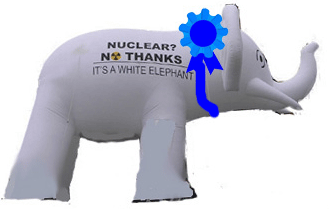 Or that the supposedly world-beating CANDU turned out to be a financial white elephant: The CANDU’s creator, Atomic Energy of Canada Ltd., devoured billions in subsidies before the CANDU technology was finally sold for a pittance to scandal-plagued engineering firm SNC Lavalin.
Nuclear power is said to be cheap—but only if one doesn’t count costs that either have been offloaded or are yet to be fully funded, such as accident liability, waste management and the debts incurred in reactor construction. Moreover, the industry has a history of wild cost overruns: The bill for creating Ontario’s Darlington facility during the 1980s climbed from a projected $3.9 billion to more than $14 billion………http://www.theglobeandmail.com/report-on-business/rob-magazine/inside-the-race-for-canadas-nuclear-waste/article23178848/
USA’s climate change denial machine investigate by Democrats
 Democrats Target Climate-Deniers-for-Hire , http://www.newrepublic.com/article/121131/democrats-demand-fossil-fuel-disclosure-climate-denier-studies by Rebecca Leber, Over the weekend, The New York Times and The Guardian reported that the fossil fuel industry paid astrophysicist Wei-Hock “Willie” Soon $1.25 million in grants in exchange for 11 scientific papers that cast doubt on the role humans play in climate change. Soon never disclosed the grants from the Charles G. Koch Foundation, ExxonMobil, Southern Company, and American Petroleum Institute, while publishing research that blamed climate change on anything but pollution (Soon faulted the sun) and spun the impact as a net benefit for the environment (helping trees and polar bears thrive, according to Soon).

By itself, the revelation isn’t likely to slow Soon’s lucrative romp through GOP talking points. When the Boston Globe reported in 2013 that the same companies had contributed more than a million dollars to Soon’s climate research, Republicans continued to cite his work and his double-barrelled affiliation with the Harvard-Smithsonian Center for Astrophysics. Which is why two Democrats are launching investigations into the climate-change denial machine. Continue reading
Federal Court decision could hasten the closure of Diablo Nuclear Power Facility
 Landmark Federal Court Decision: Will It Speed Diablo Nuke’s Demise? Ecowatch Harvey Wasserman | February 24, 2015 New revelations about earthquake dangers have shaken the future of California’s Diablo Canyon nukes.
In a rare move, Washington DC’s Federal U.S. Court of Appeals will hear a landmark challenge to their continued operation. The suit says Diablo’s owners illegally conspired with the Nuclear Regulatory Commission (NRC) to weaken seismic standards. “This is a big victory,” says Damon Moglen of Friends of the Earth. “The public has a right to know what the Nuclear Regulatory Commission and Pacific Gas & Electric won’t admit—hundreds of thousands of people are put at immediate risk by earthquake danger at Diablo Canyon.”
Diablo is also vulnerable on state and federal water quality regulations, economic concerns and more. Citizen activism has also shut operating reactors at Humboldt, Rancho Seco and San Onofre. Proposed projects have been cancelled at Bodega Bay and Bakersfield.
California’s two remaining reactors are surrounded by more than a dozen seismic fault lines. The Shoreline fault runs within 600-700 yards of the Diablo cores, which also sit just 45 miles from the massive San Andreas fault—half Fukushima’s distance from the epicenter of the quake that destroyed it.
The two 1,100-plus megawatt Diablo nukes overlook a Pacific tsunami zone, nine miles southwest of San Luis Obispo. Since the 1980s they’ve hosted some 10,000 arrests—more than any other U.S. site.
U.S. courts generally treat the nuclear industry as a law unto itself and rarely question NRC proceedings.
But in this case, says Friend of the Earth’s S. David Freeman, “PG&E’s recent study revealed that the earthquake threat at Diablo Canyon, as measured by its original license, could be far greater than that for which the reactors were designed. So PG&E and the NRC secretly amended the license to relax the safety requirements.”
Freeman is former head of the Tennessee Valley Authority, Los Angeles Department of Water and Power and the Sacramento Municipal Utility District. Dr. Michael Peck, the NRC’s own chief seismic expert, warned that the Diablo reactors could not meet seismic safety standards. Peck was then transferred to NRC offices in Chattanooga.
The case follows a successful FOE filing showing that the NRC conspired with Southern California Edison to ignore steam generator violations at San Onofre. Amidst a massive grassroots upheaval, San Onofre was officially shut in 2013 (similar violations at Ohio’s Davis-Besse reactor have had little impact).
Safe energy activists staged major January gatherings in San Luis Obispo and San Francisco. A “Don’t Frack/Nuke Our Earth” conference may soon follow in the Bay Area.
Earthquake issues are not the only ones poised to doom Diablo.
The two reactors dump huge quantities of hot wastewater directly into the ocean. They’re out of compliance with state and federal water quality standards. So PG&E might soon be required by state law to build cooling towers, with cost estimates ranging from $2 billion to $14 billion.
The state Water Resources Control Board may meet on the issue this spring. The San Luis Obispo Mothers for Peace and others ask the public to write the board and attend its next public hearing.
If required to build those towers, which might take years to do, PG&E would ask the California Public Utilities Commission to make the public pay for them. A vehement grassroots opposition would instantly erupt.
PG&E is much hated. Its negligence caused a 2010 gas explosion that killed eight people in San Bruno. Huge state and federal fines, criminal indictments and visceral public contempt have followed.
The CPUC is also under public fire amidst an astonishing array of scandals and law-breaking. …….http://ecowatch.com/2015/02/24/court-ruling-diablo-nukes-demise/
Apple’s two Entirely Renewable Energy Data Centres – $2.5 Billion investment
Apple’s Investing $2.5 Billion On Two Entirely Renewable Energy Data Centres http://www.gizmodo.com.au/2015/02/apples-investing-2-5-billion-on-two-entirely-renewable-energy-data-centres/
GERALD LYNCH – GIZMODO UKApple has just announced that it is to invest €1.7 billion ($2.5 billion) in two new “state-of-the-art” data centres for Europe, located in Ireland and Denmark. The sites in County Galway and Denmark’s central Jutland will use 100 per cent renewable energy and power Apple’s iTunes Store, App Store, iMessage and Maps applications and Siri voice assistant.Measuring 166,000 square metres apiece, the data centres will begin operations in 2017, and each will support a specific local initiative too. The County Galway project will include a scheme to recover land previously used for the harvesting of non-native trees and return native flora to the area, along with an outdoor education space for schools. The Danish data centre will capture excess heat and return it to the district’s heating system to warm local homes.
It’s the latest in a recent burst of green-friendly moves by Apple, with the company also recently announcing plans to build a giant solar farm in Monterey, California.
1 This Month
Tell Congress: Prevent Nuclear Catastrophe in Iran

Tell Congress: Prevent Nuclear Catastrophe in Iran

Read the Public Inquiry Report, the Commissioners’ report, Surrendering Australia: The AUKUS Deception is available to download for free at aukuspublicinquiry.com. Or just watch the replay of the National Press Club Luncheon.


Shut down the radiation-damaged Heysham nuclear reactors now
To see nuclear-related stories in greater depth and intensity – go to https://nuclearinformation.wordpress.com

Say No to NASA’s Reckless Nuclear Reactor on the Moon
Say No to NASA’s Reckless Nuclear Reactor on the Moon
-
Archives
- November 2026 (224)
- October 2026 (302)
- September 2026 (339)
- August 2026 (330)
- July 2026 (355)
- June 2026 (287)
- May 2026 (306)
- April 2026 (356)
- March 2026 (251)
- February 2026 (267)
- January 2026 (308)
- December 2025 (358)
-
Categories
- 1
- 1 NUCLEAR ISSUES
- business and costs
- climate change
- culture and arts
- ENERGY
- environment
- health
- history
- indigenous issues
- Legal
- marketing of nuclear
- media
- opposition to nuclear
- PERSONAL STORIES
- politics
- politics international
- Religion and ethics
- safety
- secrets,lies and civil liberties
- spinbuster
- technology
- Uranium
- wastes
- weapons and war
- Women
- 2 WORLD
- ACTION
- AFRICA
- Atrocities
- AUSTRALIA
- Christina's notes
- Christina's themes
- culture and arts
- Events
- Fuk 2022
- Fuk 2023
- Fukushima 2017
- Fukushima 2018
- fukushima 2019
- Fukushima 2020
- Fukushima 2021
- general
- global warming
- Humour (God we need it)
- Nuclear
- RARE EARTHS
- Reference
- resources – print
- Resources -audiovicual
- Weekly Newsletter
- World
- World Nuclear
- YouTube
-
RSS
Entries RSS
Comments RSS

