Obama keen to sell USA nuclear technology to China
 Obama Submits to Congress 30-year Civil Nuclear Power Agreement With China Obama submitted to Congress a 30-year civil nuclear cooperation agreement between the United States and China for approval.
The US Congress has to approve the nuclear cooperation agreement for it to go into effect. http://sputniknews.com/us/20150421/1021197861.html#ixzz3Xz1ERlru
Schools near Pilgrim Nuclear Power Station updating potassium iodide protocols
 With Nuclear Station Close By, Schools Look To Update KI Protocol Cape News, MARY PETIET | 19 Apr 15 The Bourne School District has policies and procedures in place to administer potassium iodide pills to students and staff in the event of a nuclear disaster at the Pilgrim Nuclear Power Station in the neighboring town of Plymouth.
The school committee is taking steps to help streamline the permission protocol that allows parents to authorize the schools to administer the pills to their children. The district is also breaking apart the policy and procedures so that the procedures will be readily available to parents as part of the district’s online student handbook.
According to the state Department of Public Health, “Those within 10 miles of a nuclear power plant and may be exposed to radiation from a nuclear emergency should take a drug [KI] that would help protect them from thyroid cancer.”
The Bourne school Policy for the Preparation and Distribution of KI states, “Upon recommendation of the Massachusetts Department of Public Health and the Massachusetts Emergency Management Agency, The Bourne Public Schools agree to stockpile Potassium Iodide (KI) tablets for administration to students and employees in the event of a nuclear emergency during school hours. All efforts will be made to administer the Potassium Iodide in a timely manner, however prompt evacuation is of the utmost priority.”
The school committee is currently considering a change in the policy and the procedure around the possible administration of KI. Previously, these have been bound together, but Bourne High School nurse and lead nurse for the district Catherine Crosby-Norton said that Bourne schools are currently seeking to separate KI policy from procedure.
“The policy and the procedure don’t belong together. The policy in the case of a nuclear emergency is to treat students and staff with KI. The procedure outlines how this is done,” Ms. Crosby-Norton said………
Also under consideration by the school committee is the annual signing of permission slips by parents for possible administration of KI in the case of a nuclear mishap during school hours.
Ms. Siroonian said the district will continue to notify parents of KI procedures, but that the permission slip allowing students to receive KI will now need to be signed only once………
If the unimaginable should occur, trained school nurses would administer the dosage of “One (1) KI tablet for each registered student who has parent/guardian consent on file in the nurse’s office to receive KI,” the school policy states. After the dosage the recipient’s hand would be marked with a K in permanent black marker. The policy notes that the best location to administer the dosage is in the classroom, but adds that in case the recommendation is not received prior to an evacuation, the kits, including the tablets and permission sheets, must accompany the student body.
According to the Massachusetts Emergency Management Agency, “It is important to note that KI only protects the thyroid. Numerous other radionuclides may be released in an accident situation and KI would not protect individuals from these other types of radioactivity. The primary method of protection is evacuation and sheltering-in-place, and KI should be viewed as an adjunct to these primary measures.”………http://www.capenews.net/bourne/news/with-nuclear-station-close-by-schools-look-to-update-ki/article_fc9f29e2-e478-11e4-814a-e71ceb8dd4c2.html
Tritium is a major radioactive pollutant from Canada’s CANDU nuclear power reactors.

 Tritium Traffic: Deadly Dividends for Nuclear Industry, Peace Magazine By David H MartinIn February, 1934, the British journal, New Scientist, published an article by Tom Wilkie, “Old Age Can Kill the Bomb.” It was an ingenious solution to the arms control nightmare of verification; controlling not only the number of weapons, but the strategic materials that fuel them — mainly plutonium, enriched uranium and tritium. Wilkie focused on tritium, because it turns into non-radioactive helium at a rate of 5.5 per cent per year. A halt of tritium production would rapidly cripple all nuclear arsenals. Thus, attention was rivetted on Ontario Hydro’s plan to produce about 57 kilograms of tritium by 2006. A one megaton thermonuclear warhead (equivalent to one million tons of TN”) may contain as little as one gram of tritium.
Tritium (H3) (a form of hydrogen that emits beta radiation), is a major radioactive pollutant from Canada’s CANDU nuclear power reactors. Unlike American reactor systems, the CANDU uses heavy water as a moderator and coolant. The moderator and the heavy water coolant slows down the neutron release from the uranium fuel in the reactor so that a chain reaction can take place. The active ingredient in heavy water is deuterium, another form of hydrogen. When the deuterium picks up a neutron, some of it is transformed into tritium. The concentration of tritium in the heavy water increases with the age of the reactor.
The CANDU reactor system produces 2400 times as much tritium as the American light water reactor. Continue reading
Cameco uranium company a “great corporate citizen”? Actually NO!
Don’t call Cameco a “great corporate citizen,” group says BY JASON WARICK, THE STAR PHOENIX APRIL 17, 2015 Governments should not describe Cameco as a “great corporate citizen” while suing the company over a $1.5 billion tax debt, a lobby group says.
“One questions whether governments should promote companies who so flagrantly violate Canadian tax law,” said Dennis Howlett, executive director of Canadians for Tax Fairness………
Howlett noted Cameco is in court for allegedly avoiding payment of $1.5 billion in federal and provincial taxes by funnelling business through a Swiss subsidiary. The IRS in the United States also alleges the mining company owes it more than $30 million. Cameco is disputing the allegations.
Howlett said he wonders what deterrent there is for companies to dodge their taxes if governments continue to praise them. He said it sends all the wrong signals, noting the issue is particularly serious because of the massive amounts involved.
“It is very much a concern,” he said.
Speaking to reporters at the Saskatchewan legislature on Thursday, Wall said he’s been “watching very carefully” as the tax case develops…….. http://www.thestarphoenix.com/news/call+Cameco+great+corporate+citizen+group+says/10982294/story.html
Mayors list reasons why Florida should NOT have new nuclear reactors
 Mayors make case against FPL nuclear expansion BY JENNY STALETOVICH JSTALETOVICH@MIAMIHERALD.COM 17 Apr 15
The mayors — Tomas Regalado of Miami,, Philip Stoddard of South Miami and Cindy Lerner of Pinecrest — held a joint conference with one clear goal: Boost opposition to a controversial expansion that will be the subject of two public hearings federal regulators have scheduled next week in Miami-Dade.
“We are looking at a population base within 50 miles of 2.5 million people,’’ said Lerner. “Who in their right mind would put two new nuclear plants at sea level with storm surge?” Continue reading
Not in South Carolina’s interest to continue to host nuclear wastes
In addition to legal issues compromised if proposed German3 and other international spent fuel is sent to SRS, international waste will require the use of aging facilities, long-term oversight, management, and financial responsibilities. Waste imports continue to be contrary to South Carolina interests.
 Continued nuclear waste storage not in S.C.’s interest http://www.statehousereport.com/2015/04/17/my-turn-continued-nuclear-waste-storage-not-in-s-c-s-interest/04/17/2015 By Suzanne Rhodes | Nuclear wastes at Savannah River Site (SRS) have been leaking for decades. The League of Women Voters of South Carolina has been observing the slow progress of managing the legacy weapons wastes for over 30 years. It now appears likely that not only wastes from SRS, but also international wastes, will stay at the Aiken County site for the foreseeable future.
Two reports released late in 2014 indicate legal and political opposition will obstruct current U.S. nuclear waste storage plans. Neither Yucca Mountain nor any other site for geologic high-level waste disposal — not even “interim” storage of commercial spent fuel — is likely to develop, according to the Government Accountability Office. It blames the public’s lack of confidence in U.S. Department of Energy (DOE). GAO is an arm of Congress, which should have been the origin and supporter of nuclear waste management policy. Instead, Congress has consistently undermined progress at Yucca Mountain through inattention, program changes and unreliable funding.
The Nuclear Regulatory Commission states that DOE lacks the land rights and water rights necessary to license the site, according to its 5-volume Safety Evaluation Report on Yucca Mountain. A series of Nevada governors and attorneys general — NOT just U.S. Sen. Harry Reid — has opposed Yucca Mountain. Nevada seems to have succeeded in blocking the repository. [See Volume 4 of the report.]
If/when a geologic repository becomes available, the nuclear power industry will have political influence and community support to move commercial spent fuel off to a repository. Weapons wastes were included in the 1980s legislation only because three highly-regarded governors and their delegations were concerned about weapons wastes abandoned in their states. Decades ago, they united to initiate the Nuclear Waste Policy Act, which is now basically obsolete. Unfortunately, we lack such leadership today.
S.C. Sen. Tom Young of Aiken established last summer that international wastes have been received at SRS, have not been treated and there are no plans for treatment. The League’s strongest ally has been Tom Clements of SRS Watch, who has been concerned about nuclear waste issues since the Allied General Nuclear Services plant was proposed ‘next door’ to SRS back in the 1970s. One of his many successes has been uncovering mysterious, long-planned international shipments of wastes to SRS from very capable countries that potentially could become regional leaders in international nuclear waste management.
Fortunately, all of the puzzling ‘transuranic’ wastes at SRS have been successfully packaged for shipment to the Waste Isolation Pilot Plant (WIPP) in New Mexico. There was a tragic explosion at WIPP in February 2014 and it appears unlikely to reopen. The League has repeatedly praised the SRS technical staff for tackling the old legacy packages, which were poorly documented and might have been ignored at another weapons facility. The remaining wastes will remain at SRS, packaged for shipping, unless the state of New Mexico allows reopening of WIPP.
Fortunately, SRS technical staff has done an outstanding job of making wastes as safe as practicable, thus far. However, staff engineering design goals have been for temporary storage at SRS in forms ultimately suitable for the Yucca Mountain repository site or WIPP. Up to 50 more years of congressional appropriations and successful cleanup will be required to continue to treat the wastes now at SRS. Delays have been the result of lack of appropriations from Congress. Recent budget cuts have slowed SRS cleanup for more than a decade.
In addition to legal issues compromised if proposed German3 and other international spent fuel is sent to SRS, international waste will require the use of aging facilities, long-term oversight, management, and financial responsibilities. Waste imports continue to be contrary to South Carolina interests.
Suzanne Rhodes of Columbia is coordinator or nuclear waste policy with the League of Women Voters of South Carolina.
Dozens of USA nuclear reactors at risk of closure for economic reasons.
 As many as three dozen reactors are considered at risk of closure for economic reasons.
Electricity producers in several states are asking for hundreds of millions of dollars in financial support to keep costly nuclear power plants in business—a move that is likely to boost customers’ power bills. Continue reading
Jean-Paul Baquiast – a nuclear war against Russia would finish USA
 US Will Not Survive a Nuclear War Against Russia – Jean-Paul Baquiast
http://sputniknews.com/us/20150417/1021016791.html#ixzz3Xd8u2w8E A nuclear strikes exchange between the United States and Russia will lead to the complete destruction of the United States, leaving Russia and China in a far better position, editor of the French portal Europesolidaire Jean-Paul Baquiast said.
His comment came in the wake of recent internet speculation about the US’ possible intent to carry out a preemptive nuclear attack on Russia. The concerns have risen after General Robin Rand was appointed as head of the US Air Force Global Strike Command.
There are assumptions that he might take an example from American General Curtis LeMay who became famous in 1949 for preparing a plan for a massive nuclear attack on the Soviet Union.
Unable to subdue Russia by conventional methods, Washington is preparing to destroy it with its armed forces, Jean-Paul Baquiast wrote. In the event of an armed conflict, American politicians may carry out a preemptive nuclear strike.
“Chances of the United States to destroy Russia without consequences for itself are small,” Baquiast said.
However, even the highly efficient S-500 missile system, which Russia is currently working on, would be unable to protect the country against a massive launch of ballistic missiles from US submarines, he noted.
In turn, Russia would launch its missiles from its submarines off the coast of the United States. And if the Americans manage to hit only a part of the Russian territory due to its large size, the US will be destroyed completely, the journalist wrote.
DOE, National Nuclear Security Administration and the Nuclear Waste Partnership, all to blame for WIPP radiation leak
Report: Nuke dump radiation leak could have been prevented, KRQE News 13
By SUSAN MONTOYA BRYAN Associated Press April 17, 2015, ALBUQUERQUE (AP) – A radiation leak that forced the indefinite closure of the federal government’s only underground nuclear waste repository could have been prevented, a team of investigators said Thursday.
A combination of poor management, lapses in safety and a lack of proper procedures were outlined in a final report released by the U.S. Department of Energy’s Accident Investigation Board. Officials reviewed the findings Thursday night during a community meeting in Carlsbad.
The investigators spent more than a year looking into the cause of the radiation release at the Waste Isolation Pilot Plant in southeastern New Mexico.
Like a separate team of technical experts, they too found that a chemical reaction inside a drum of waste that had been packaged at Los Alamos National Laboratory forced the lid open, allowing radiation to escape. The contents included nitrate salt residues and organic cat litter that was used to soak up moisture in the waste.
Aside from lab managers, the report places blame on Energy Department headquarters, the National Nuclear Security Administration and the Nuclear Waste Partnership, the contractor that manages the repository. It highlights numerous failures – from Los Alamos lab not having an adequate system for identifying and controlling hazards to federal nuclear officials not ensuring the existence of a “strong safety culture” at the lab.
Investigators found a failure by managers to resolve employee concerns that could have pointed out problems before the waste was shipped from Los Alamos to the repository.
Accident Investigation Board Chair Ted Wyka said during the town hall that some workers reported seeing foaming and yellowish smoke while repackaging waste. After short discussions with their supervisors, they went back to work on the assembly line.
That information did not make it up to lab managers, he said…….
The Energy Department and its contractors are facing $54 million in fines from the state of New Mexico for the failures that led to the mishap. Negotiations are ongoing, and the state has suggested more financial penalties are possible.
With the repository closed indefinitely, efforts to clean up decades of Cold War-era waste at federal facilities around the country are stalled. Federal officials say resuming full operations at the repository could take years and cost more than a half-billion dollars…….http://krqe.com/2015/04/17/report-nuke-dump-radiation-leak-could-have-been-prevented/
Florida nuclear utility allowed to draw water from national park’s source
 FPL nuclear plant to draw water from national park’s source, April 17, 2015 | The water in the canal system that cools the reactors at Florida Power & Light Co.’s nuclear plant on the edge of Biscayne Bay is too hot and too salty as temperatures rise and rainfall is sparse.
Starting June 1, as a temporary fix, the company will be allowed to withdraw up to 100 million gallons of fresh water a day from a nearby drainage canal to keep the Turkey Point nuclear plant’s cooling canal system from going above 104 degrees…..http://www.palmbeachpost.com/news/business/fpl-nuclear-plant-to-draw-water-from-national-park/nkw47/
Increased risk of nuclear weapons proliferation, with Canada-India uranium sales deal
Canada-India uranium deal will spur proliferation, experts warn Arms control experts say Canada sends the wrong signal to countries that play by the rules By Evan Dyer, CBC News 17 Apr 15 India test-fired a nuclear-capable ballistic missile Thursday, just hours after signing a deal to buy 3,000 tons of Canadian uranium.The Agni-III missile, which has a range of over 3,000 kilometres, was fired from the Indian army’s test range on Wheeler Island in the Bay of Bengal. India declared the test a success…….While the terms of this week’s deal are not public, the nuclear cooperation agreement, first announced in 2010 and finalized in 2013, includes assurances that India use Canadian material for civilian purposes only……..
some nuclear proliferation experts say India has been able to make such a deal without abiding by the rules set out for most other countries that abide by the international non-proliferation regime. And they warn that countries the West has been attempting to bring into the rules-based system — such as Iran — will be less inclined to submit when they see the rules don’t apply to India.
Canadian technology used to gain bomb…..Of particular concern to the rest of the world was that India developed its bomb using nuclear material from a reactor it had acquired from Canada ostensibly for civilian use……..
Some experts fear Canada appears to be selling India uranium with fewer controls and conditions than it typically demands from NNPT member countries that do play by the rules.
“Normally there’s some sort of tracking and accounting system so that Canada would be receiving information from India very specifically about what Canada-sourced material is being used for,” says Trevor Findlay, a senior research fellow at Harvard University’s Managing the Atom project.
“In this case, because the agreement [to buy the uranium] is secret, we have no idea whether that’s in place, and it probably isn’t because the Indians have been pushing against that,” he told The Current.
Findlay and other experts warn that the special treatment for India shows other governments a country can ignore the rules, build the bomb, tough it out for a few decades and emerge on the other side as an accepted nuclear weapons power.
Already, Pakistan says the deals give India a strategic advantage, and Pakistan has blocked preliminary talks on the most important arms control initiative in years: a Fissile Material Cutoff Treaty that would ban future production of weapons-grade material.http://www.cbc.ca/news/politics/canada-india-uranium-deal-will-spur-proliferation-experts-warn-1.3036540
When USA Accidentally Nuked Britain’s First Satellite
 That Time The US Accidentally Nuked Britain’s First Satellite, Gizmodo
KARL SMALLWOOD – TODAYIFOUNDOUT.COM 16 APRIL 2015“……..The satellite in question was the Ariel-1, which was developed as a joint-venture between the United States and Britain, with Britain designing and building the core systems of the satellite and NASA launching it into orbit via a Thor-Delta rocket……..
According to NASA, the instruments aboard Ariel-1 were intended to help “contribute to the current knowledge of the ionosphere” and its relationship with the Sun. More specifically, scientists were curious about how the ionosphere, a part of the Earth’s atmosphere made of particles charged by radiation from the Sun, worked. (For more on the ionosphere, see: Why Do Radio Signals Travel Farther at Night than in the Day?) As it turned out, as Ariel-1 was happily free-falling around the Earth, the US military had decided to detonate an experimental 1.4 megaton nuclear weapon named Starfish-Prime in the upper atmosphere as part of Project Fish Bowl. The explosion, which happened on the other side of the planet to Ariel-1, sent a wave of additional radiation around the Earth that ultimately damaged some of the systems on Ariel-1, particularly its solar panels, ultimately killing it and about 1/3 of the rest of the satellites in low-Earth orbit at the time. This famously included the Telstar satellite, which was the first commercial communication relay satellite designed to transmit signals across the Atlantic.
The Telstar actually wasn’t in orbit at the time of the explosion, being put there the day after the Starfish-Prime detonation. However, the additional radiation created by the explosion took years to dissipate and was not anticipated by the designers of this particular satellite. The immediate result being the degradation of Telstar’s systems, particularly the failure of several transistors in the command system, causing it to stop working just a few months after being placed in orbit.As to the purpose of the Starfish-Prime explosion, according to James Fleming, a history professor who combed through previously top-secret files and recordings concerning the blast, the US military were working with scientist James Van Allen to see if nuclear explosions could influence the existing belts of radiation around the Earth…….
He forgot to mention the obligatory, FOR SCIENCE!!!
Bonus Facts:
At around the same time the US was planning to send actual nuclear bombs into orbit, British scientists were similarly experimenting with explosives by attaching grenades to suborbital rockets to run atmospheric pressure tests; once again demonstrating that no matter where they’re from or what tools are available, scientists just really like to blow things up.
The Starfish explosion was actually supposed to have happened on June 20th, but the rocket carrying it failed at about 30,000 feet. Once this happened, the self-destruct on the nuclear warhead was initiated and it broke apart, raining its radioactive innards down on Johnston and Sand Islands, as well as in the ocean around them.
Britain’s first astronaut, Helen Sharman, was sent into space in 1991. All in all, 21 other nationsbeat Britain to the punch in terms of sending a representative of their country into space, including Afghanistan (Abdul Ahad Mohmand), Mongolia (Jügderdemidiin Gürragchaa) and Vietnam (Phạm Tuân).
The effects of Starfish-Prime weren’t just limited to low orbit. The electromagnetic pulse created by the blast ended up being much larger than expected and, in Hawaii some 900 or so miles away from the blast, the pulse ended up knocking out a few hundred street lights and damaged the telephone system. Needless to say, a similar blast in today’s digital society would have caused drastically more damage.
Karl Smallwood writes for the wildly popular interesting fact website TodayIFoundOut.com. http://www.gizmodo.com.au/2015/04/that-time-the-us-accidentally-nuked-britains-first-satellite/
South Miami’s Underline project threatened by nuclear power expansion
FPL’S NUCLEAR EXPANSION PLAN COULD RUIN THE UNDERLINE. Miami New Times BY JESSICA WEISS APRIL 17, 2015 Biking along a tranquil, green path in South Miami sounds pretty enjoyable. Next to a series of massive, ten-story nuclear power transmission lines? Not so much
That’s a real possibility facing the Underline, a project to transform the underutilized land below Miami’s Metrorail from the Miami River to the Dadeland South Station into a ten-mile urban trail and green space. A design is in the works, and construction is set to begin next year.
But part of the area dedicated to the Underline is also the possible home of new transmission lines for two nuclear reactors being proposed for Turkey Point Nuclear Generating Station by Florida Power & Light. The new reactors would require the construction of massive poles to transmit energy to consumers. And they’d be located on South Dixie Highway from Pinecrest to downtown Miami, within the 125 acres of new green space where the Underline is supposed to run.
“There’s a definite tension between these transmission lines and a beautiful experience on a bike path,” says Meg Daly, the founder of Friends of the Underline…….
Since Daly hatched the idea for the vertical park in 2012, the Underline project has advanced rapidly, receiving funding from the cities of Miami, Coral Gables, and South Miami; the John S. and James L. Knight Foundation; and other groups. In March, Friends of the Underline tapped the codesigner of Manhattan’s popular High Line, James Corner Field Operations, to design the Underline master plan. This week, a series of public meetings are being held to collect public feedback about the design of the space.
“There is so much need in our community for spaces for biking and walking,” Daly says. “Bikes, cars, and pedestrians need to coexist. That is part of a future vision of a walkable, bikeable city.”
Lawmakers, scientists, environmentalists, and citizens have expressed a number of other concerns about expanding nuclear power along Biscayne Bay, including the future impact of sea-level rise, the project’s high costs, and the amount of water used by nuclear power. Miami Mayor Tomás Regalado joined other local leaders this week to blast the project.
But the plan has already passed through local and state levels, and FPL is pursuing a federal license……http://www.miaminewtimes.com/news/fpls-nuclear-expansion-plan-could-ruin-the-underline-7573012
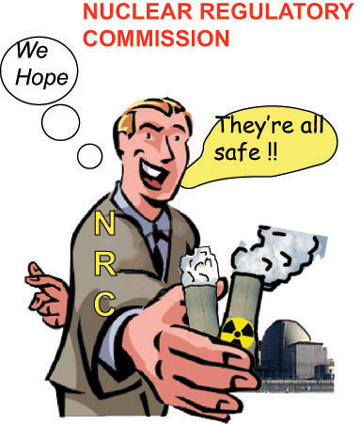
USA’s Nuclear Regulatory Commission puts the nuclear industry’s interests ahead of safety concerns
 In the U.S. it comes down to the NRC, says Macdonald, because it sets the level of risk that is acceptable. “The utilities are only going to do what the NRC dictates. So it’s really NRC’s responsibility to assess whether this represents a danger to integrity of pressure vessels,” he says.
NRC Opposes European Moves to Tighten Nuclear Safety Post-Fukushima By Spectrum, Peter Fairley 14
Apr 2015 Nuclear power plants’ reactor pressure vessels (RPVs) (at right – yellow marks suggesting c—the massive steel  jars that hold a nuclear plant’s fissioning fuel—face incessant abuse from their radioactive contents. And they must be built with extra toughness to withstand pressure and temperature swings in the event of a loss-of-cooling accident like the one that occurred at Fukushima in 2011. As the triple meltdowns at Fukushima Daiichi showed, the next layer of defense against a nuclear release—the so-called containment vessels—can not be counted on to actually contain molten nuclear fuel that breaches the RPV.
Nuclear safety authorities have recently discovered weaknesses in several RPVs, and their contrasting responses suggest that the ultimate lessons from Fukushima are still sinking into international nuclear power culture—especially in the United States, where the Nuclear Regulatory Commission (NRC) is resisting calls to mandate tougher inspection of RPVs.
Broadly speaking, European regulators have ordered operators to do more to improve safety post-Fukushima than the NRC has. France, for example, is mandating four times as much investment than the U.S. in upgrades such as reinforced bunkers, back-up power, and emergency cooling systems,according to industry estimates cited by Bloomberg Business nuclear safety correspondent Jonathan Tirone.
In February, U.S. diplomats worked to defeat a European initiative to strengthen the Convention on Nuclear Safety, created after the 1986 Chernobyl meltdown. The Europeans wanted the currently voluntary treaty to set mandatory safety standards—a proposal that the United States apparently judged too threatening for U.S. nuclear operators struggling to compete amidst a glut of cheap power generated from natural gas. “The U.S. …worried that the proposal would have required shutting down their plants,” according to Mark Hibbs, senior associate in the Carnegie Endowment for International Peace. Continue reading
The very real danger of huge gas pipeline close to New York Nuclear Power Plant
 Doing the Unthinkable: Giant Gas Pipeline to Flank a New York Nuclear Power Plant Wednesday, 15 April 2015 00:00By Ellen Cantarow, Truthout | News Analysis A very large gas pipeline will soon skirt the Indian Point Energy Center (IPEC), an aging nuclear power plant that stands in the town of Cortlandt in Westchester County, New York, 30 miles north of Manhattan. The federal agencies that have permitted the project have bowed to two corporations – the pipeline’s owner, Spectra Energy, and Entergy, which bought the Indian Point complex in 2001 from its former owner.
A hazards assessment by a former employee of one of the plant’s prior owners, replete with errors, was the basis for the go-ahead. A dearth of mainstream press coverage leaves ignorant the population that stands to be most impacted by a nuclear catastrophe, which experts say could be triggered by a potential pipeline rupture. I urge Truthout’s audience to read an earlier article by Alison Rose Levy, which includes details I haven’t space to recap here.
Since 2011, Spectra Corporation, owner of the 1,129-mile Algonquin Pipeline, which runs from Texas to Beverly, Massachusetts, where it connects with another pipeline running into Canada, has sought to expand the pipeline in order to transport fracked gas north from Pennsylvania. Spectra, one of the largest natural gas infrastructure companies in North America, calls the planned enlargements “The Algonquin Incremental Market Project” (AIM).
AIM includes a two-mile section of 42-inch pipe carrying gas under very high pressures. It is this pipeline segment that will flank IPEC, which stands in a seismic zone. The nuclear complex has a derelict history. In 2001, The New York Timesreported that “the plant has encountered a string of accidents and mishaps since it went into operation on June 26, 1973.” The IPEC has also been on the federal list of the nation’s worst nuclear power plants………
David Lochbaum, a nuclear engineer who graduated from college a few months after the March 1979 Three Mile Island nuclear disaster, has done accident training at many nuclear plants, and has also worked as a technology instructor for the NRC. “Nuclear power plants,” he told Truthout, “are pretty robust. It takes many things to go wrong for a disaster to occur like Fukushima. But a natural gas pipeline poses a threat that could challenge all of them. The biggest threat would be if the pipeline release took out the power supply of the plant. That was the big problem with Fukushima. The tsunami water took out the power and left the plant with no power [but] a few batteries.”
Industry-Compliant Agencies
Blanch, who has worked with the NRC since its inception in 1974, said it is “an agency that has a symbiotic relationship with the industry … If the Nuclear Regulatory Commission imposes [stringent] safety regulations on the industry, it could impact the economic viability of the industry and also the Nuclear Regulatory Commission itself.” He said he became aware of the commission’s industry tilt when he worked as an engineering manager for Northeast Utilities, identified “a serious safety concern” and “saw where the NRC was not really concerned about safety, but more concerned about their survival.” He added, “They will provide an illusion of action; they will take very visible action against small problems, but when it comes to the big problems, they fail to take any action because of its economic impact on the industry.”……..
1 This Month
Tell Congress: Prevent Nuclear Catastrophe in Iran

Tell Congress: Prevent Nuclear Catastrophe in Iran

Read the Public Inquiry Report, the Commissioners’ report, Surrendering Australia: The AUKUS Deception is available to download for free at aukuspublicinquiry.com. Or just watch the replay of the National Press Club Luncheon.


Shut down the radiation-damaged Heysham nuclear reactors now
To see nuclear-related stories in greater depth and intensity – go to https://nuclearinformation.wordpress.com

Say No to NASA’s Reckless Nuclear Reactor on the Moon
Say No to NASA’s Reckless Nuclear Reactor on the Moon
-
Archives
- November 2026 (224)
- October 2026 (302)
- September 2026 (339)
- August 2026 (330)
- July 2026 (355)
- June 2026 (287)
- May 2026 (306)
- April 2026 (356)
- March 2026 (251)
- February 2026 (267)
- January 2026 (308)
- December 2025 (358)
-
Categories
- 1
- 1 NUCLEAR ISSUES
- business and costs
- climate change
- culture and arts
- ENERGY
- environment
- health
- history
- indigenous issues
- Legal
- marketing of nuclear
- media
- opposition to nuclear
- PERSONAL STORIES
- politics
- politics international
- Religion and ethics
- safety
- secrets,lies and civil liberties
- spinbuster
- technology
- Uranium
- wastes
- weapons and war
- Women
- 2 WORLD
- ACTION
- AFRICA
- Atrocities
- AUSTRALIA
- Christina's notes
- Christina's themes
- culture and arts
- Events
- Fuk 2022
- Fuk 2023
- Fukushima 2017
- Fukushima 2018
- fukushima 2019
- Fukushima 2020
- Fukushima 2021
- general
- global warming
- Humour (God we need it)
- Nuclear
- RARE EARTHS
- Reference
- resources – print
- Resources -audiovicual
- Weekly Newsletter
- World
- World Nuclear
- YouTube
-
RSS
Entries RSS
Comments RSS

