Koch brothers undermining Renewable Energy in Kansas – emails reveal.
he Koch political network has carefully singled out renewable energy while working to preserve government support for fossil fuels. Groups founded and funded by the Koch political network regard repealing oil and gas subsidies as a “tax hike” while deriding renewable energy subsidies as “a textbook case of corporate welfare.” Moreover, Koch’s lobbying campaign to distort climate science and prevent government action on greenhouse gas emissions transfers costs from the company, a major polluter, to the public.
Emails Show Koch Industries Backed Effort to Undermine Renewable Energy in Kansas Lee Fang https://firstlook.org/theintercept/2015/08/28/emails-show-koch-industries-backed-effort-undermine-renewable-energy-kansas/
Aug. 28 2015 Emails and financial documents released by the University of Kansas on Thursday reveal earmarked funding from Koch Industries to develop research used to lobby against the state renewable energy standard.
On November 12, 2013, Art Hall, the director of the university’s Center for Applied Economics, emailed Koch Industries’ Laura Hands to discuss a grant from a Koch-controlled foundation to fund research on the Renewable Portfolio Standard.
Hall is the former chief economist for Koch Companies Public Sector, the lobbying subsidiary of Koch Industries, the largest privately owned company in America with a significant stake in oil refining, pipelines, gas production and coal. Hands is the current community affairs director at Koch Companies Public Sector.
The Koch money was part of an ongoing project Hall described as an effort to develop “intellectual products” to be used “as a tool in economic policy debates.” Hall’s center also provides special classes to teach about the virtues of capitalism. Koch-controlled foundations approved $40,000 for work that included the renewable energy standard, as well as at least $250,000 to the center in 2008 and $100,000 to the center in 2009.
Following his grant request, Hall testified before the Kansas legislature in 2014 in favor of repealing the state renewable energy portfolio, which calls for major utility companies to use an increasing ratio of renewable energy such as wind and solar.
The emails and financial documents were released in response to a Kansas Open Records Act request filed by KU student Schuyler Kraus, the president of Students for a Sustainable Future.
Hall also helped craft unprecedented tax cuts signed into law by Gov. Sam Brownback, R-Kan., and backed by Koch’s local political network. The tax cuts have been viewed roundly as a historic flop, resulting in a downgrade of the state bond rating and drastic education cuts that forced public schools to close early this year. Critics argue that the tax cut and ensuing budget chaos may have hurt employment as bordering states such as Missouri are quicklyoutpacing Kansas on job growth.
President Barack Obama recently criticized Koch Industries owners Charles and David Koch, scolding the billionaires for “pushing for new laws to roll back renewable energy standards.” In response, Charles Koch said he is opposed to “crony capitalism” in all forms.
Though the Koch Industries chief executive has said that he opposes corporate subsidies or mandates of any kind, the Koch political network has carefully singled out renewable energy while working to preserve government support for fossil fuels. Groups founded and funded by the Koch political network regard repealing oil and gas subsidies as a “tax hike” while deriding renewable energy subsidies as “a textbook case of corporate welfare.” Moreover, Koch’s lobbying campaign to distort climate science and prevent government action on greenhouse gas emissions transfers costs from the company, a major polluter, to the public. CONTACT THE AUTHOR: Lee Fang lee.fang@theintercept.comt@lhfang
Uranium mining’s threat to Grand Canyon’s groundwater
Claims that uranium mining near the Grand Canyon is safe don’t hold water, Guardian, David Kreamer, 25 Aug 15 Science shows we can’t assume that uranium deposits, when disturbed by mining, can’t leak into groundwater. We should be wary of claims to the contrary It only takes a few Grand Canyon hikes to realize the importance of its springs and other water sources. When refilling a water bottle in the cool depths below multi-colored rock walls, listening to a summer frog symphony at sunset or maybe snapping an icicle from a weeping ledge in winter, it’s clear that the living desert depends on its pockets of water.
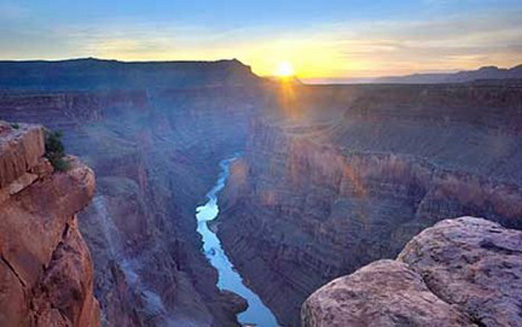
That’s why, as a hydrologist and longtime Grand Canyon hiker, boatman and scientist, I am profoundly concerned about continued uranium mining in or near it. It has great potential to irreparably harm Grand Canyon springs and the plants and animals that depend on them.
I am concerned because industry and agency officials are relying on a justification that isn’t supported by past investigations, research or data to promote uranium mining in the Grand Canyon region. Specifically, they claim that mining will have minimal impact on springs, people and ecosystems there.
Instead, the science shows that it is unreasonable to assume that uranium deposits, when disturbed by mining, can’t leak into groundwater. The deposits in the Grand Canyon are typically found in geologic features known as breccia pipes, formed millennia ago when caves in the main groundwater system collapsed, leaving shattered, rock-filled chimneys that extend upwards thousands of feet to the canyon’s rim. These chimneys act as conduits that have allowed groundwater to move vertically through the rock layers over thousands of years. The vertical movement of groundwater combined with low oxygen levels caused the uranium deposits to form over millennia. Inserting a mine shaft into these features disrupts geologic formations, increases the permeability and oxygenation of these vertical pipes and increases the ability of ore deposits to be suddenly dissolved, mobilized and carried with groundwater.
It is unreasonable to assume that elevated concentrations of dissolved uranium cannot be mobilized and will not reach the Grand Canyon’s springs. It is also risky for industry to assume that mining activities, such as the sinking of mining shafts and pumping of groundwater, have no potential to redirect groundwater movement and negatively impact spring flow and associated wildlife habitats……..
Some mining representatives have implied that the cosmetic fix of cleaning up the surface of old mining sites is evidence of zero subsurface pollution. But because groundwater flow can be very slow, the effects of groundwater contamination may take years, decades or even centuries to fully manifest. The lack of clear and consistent groundwater monitoring undercuts industry claims that mining near the Grand Canyon has caused and will cause no harm……….http://www.theguardian.com/commentisfree/2015/aug/25/uranium-mining-grand-canyon-groundwater-contamination
Leaked review tells of ‘Significant Design Vulnerabilities’ at Hanford radioactive trash site
 ‘Significant Design Vulnerabilities’ Plague Massive Nuclear Waste Site, Leaked Internal Review Reveals, Common Dreams,
‘The fact that the Department of Energy has not released this report, prepared last year, is alarming and indicative of a safety-last culture.’
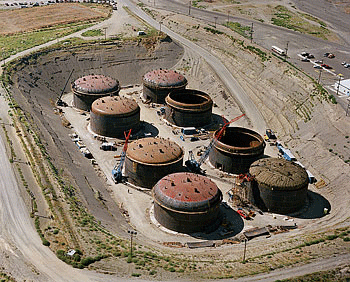
A leaked internal review of the nation’s largest nuclear clean-up site found hundreds of “significant design vulnerabilities” and begs questions about the Energy Department’s transparency, a watchdog group says.
The Hanford Nuclear Reservation near Richland, Washington houses radioactive waste from the production of plutonium for nuclear weapons, and the decades-long clean-up effort has been costly and plagued by leaking underground nuclear waste storage tanks.
Seattle-based Hanford Challenge, which advocates for safe clean-up of the site, says it received the Department of Energy document from a whistleblower who has worked at the site for many years as an engineer.
“The fact that the Department of Energy has not released this report, prepared last year, is alarming and indicative of a safety-last culture,” said Tom Carpenter, Executive Director of the group.
The document is a 2014 draft review called “Low-Activity Waste Facility Design and Operability Review and Recommendations.” That LAW facility, Hanford Challenge explains in a statement, “is designed to treat waste from Hanford’s high-level nuclear waste tanks that will be pre-treated to remove the highly-radioactive materials before being mixed with glass formers in a facility designed to vitrify the low level waste.”
From the executive summary of the leaked report: ……
The leaked review comes the same month as whistleblower Walter Tamosaitis, who raised safety concerns regarding operations at the site, reached a $4.1 settlement with Hanford subcontractor AECOM.
And last year, documents obtained by the Associated Press showed there were “significant construction flaws” in some of the double-shell storage tanks at the facility. U.S. Sen. Ron Wyden (D-Ore.) urged the Energy Department to provide an action plan of how it would deal with the risks the flaws pose, writing in a letter (pdf) to Energy Secretary Ernest Moniz: “It is time for the Department to stop hiding the ball and pretending that the situation at Hanford is being effectively managed.”
The Washington site has proven itself an “intractable problem” that “costs taxpayers a billion dollars a year,” author and history professor Kate Brown wrote earlier this year. “Corporate contractors hired to clean up Hanford have made hundreds of millions of dollars in fees and surcharges, and, since little has been accomplished, the tab promises to mount for decades.”http://www.commondreams.org/news/2015/08/26/significant-design-vulnerabilities-plague-massive-nuclear-waste-site-leaked-internal
Boeing wanted to quietly dispose of radioactive trash, without accountability
 Judge rejects Boeing’s bid to demolish and dispose of radioactive waste without accountability Eturbo News, SANTA MONICA, CA, Jan 2015 – Sacramento Superior Court has denied Boeing’s motion for summary judgment in a California Environmental Quality Act (CEQA) lawsuit over the demolition and disposal of radioactively contaminated structures from the site of a partial nuclear meltdown near Los Angeles, Consumer Watchdog said today.
“This is an important step on the way to ensuring that state regulators must consider the demolition and disposal of any radioactively contaminated structures at the Santa Susana Field Lab in their environmental assessment of the cleanup of this site,” said Consumer Watchdog Litigation Director Pam Pressley.
 Boeing had claimed that the Department of Toxic Substances Control (DTSC) has no regulatory
authority over the demolition and disposal of radioactively contaminated structures in the nuclear portion of the Santa Susana Field Lab (SSFL) in Simi Hills. The lab had tested small-scale nuclear reactors, rocket engines, and fuels and suffered a partial nuclear meltdown in 1959 that has never been fully cleaned up……http://www.eturbonews.com/54422/judge-rejects-boeings-bid-demolish-and-dispose-radioactive-waste
Fraud, Corruption charges against SNC Lavalin (nuclear advisor to South Australia?)
 Is South Australia’s Royal Commission considering SNC Lavalin’s technology for South Australia? Did SNC Lavalin put in asubmission? (we won’t know, because commercial submissions are “in confidence”)
South Australia’s Nuclear Fuel Chain Commission visited Toronto on 14tth July and had discussions on
the CANDU reactor design and technology. That CANDU technology is owned and marketed by SNC Lavalin.

 RCMP charges SNC-Lavalin with fraud and corruption linked to Libyan projects Graeme Hamilton, Financial Post Staff | February
19, 2015MONTREAL – Once a jewel of the Quebec business establishment, SNC-Lavalin Group Inc. now stands criminally accused of fraud and corruption after the RCMP announced charges against the engineering giant Thursday.
The case against SNC and two of its subsidiaries stems from the company’s dealings in Libya between 2001 and 2011, when a senior executive established close ties with Saadi Gaddafi, son of dictator Muammar Gaddafi.
Court documents allege the company offered bribes worth $47.7 million “to one or several public officials of the ‘Great Socialist People’s Libyan Arab Jamahiriya,’” as Gaddafi called the nation he ruled until he was overthrown and killed in 2011.
SNC and its subsidiaries SNC-Lavalin Construction Inc. and SNC-Lavalin International Inc. are also alleged to have defrauded various Libyan public agencies of approximately $129.8 million.
“Corruption of foreign officials undermines good governance and sustainable economic development,” RCMP Assistant Commissioner Gilles Michaud said Thursday. “The charges laid today demonstrate how the RCMP continues to support Canada’s international commitments and safeguard its integrity and reputation.”
For SNC, the charges represent another black cloud in a storm the company has been trying to escape since a tip from Swiss authorities triggered the RCMP investigation, dubbed Project Assistance, in 2011……..
The RCMP investigation has already led to charges against former SNC executives Sami Bebawi and Stéphane Roy as well as Mr. Bebawi’s lawyer, Constantine Kyres. Riadh Ben Aissa, a former SNC vice-president, pleaded guilty in Switzerland last year to charges of corruption and money laundering related to SNC’s Libyan business. He has been extradited to Canada where he is facing fraud charges related to the awarding of the McGill University Health Centre contract to SNC. Former SNC CEO Pierre Duhaime is facing similar charges in connection with the MUHC project.
The charges, filed Thursday in Montreal, do not specify who received the bribes, but a previously released RCMP affidavit, containing unproven allegations, described Saadi Gaddafi as a major recipient of SNC’s largesse.
“Riadh Ben Aissa’s close relationship with Saadi Gaddafi was a major asset to SNC-Lavalin who was well aware of it and fostered the relationship,” the affidavit sworn in 2013 by Cpl. Alexandre Beaulieu said………
The contracts landed by SNC were grandiose projects with names to please the vanity of a dictator ……..
n Quebec, there was concern Thursday about the impact the new charges will have on a major economic player. The Federation of Quebec Chambers of Commerce issued a statement saying the charges cannot be allowed to harm SNC’s business. “We have to stop collectively knocking ourselves down and move to a reconstruction phase,” the federation said.
Karl Moore, a professor at McGill University’s Desautels Faculty of Management, said the charges come at a bad time for SNC. “They’ve actually really changed,” he said. “They’ve changed the culture and it’s squeaky clean. It’s one of the best engineering firms, from a compliance point of view, in the world.”
He does not think the company’s survival is at stake, but it will suffer. “This puts a bit of a cloud on them. When they’re out there seeing clients, there is some concern, and competitors will bring it up,” he said. “If I’m a competitor of SNC, I would take considerable delight in pointing out [its] weaknesses.”
The company has been ordered to appear in court in Montreal on April 14. http://business.financialpost.com/news/rcmp-charges-snc-lavalin-with-fraud-and-corruption-linked-to-libyan-projects
Lockheed Martin used government nuclear money to lobby for more government nuclear money
 Lockheed Martin fined for using government money to lobby for more government money, http://theweek.com/speedreads/573689/lockheed-martin-fined-using-government-money-lobby-more-government-money The Week, Bonnie Kristian, 25 Aug 15,
Defense contracting giant Lockheed Martin has agreed to pay a fine to settle charges that the company illegally lobbied for a major government contract using federal funds. Lockheed targeted members of Congress and the Obama administration from 2009 to 2014, using money that had been allocated for research in a previous federal contract.
This is not the first time the contractor has used tax dollars to lobby for additional income. The Energy Department investigation that exposed these lobbying habits suggested Lockheed “felt empowered [to lobby this way] because it had improperly directed federal funds to similar activities in the past.”
The contract Lockheed unethically sought was worth $2.4 billion annually, and the company’s 2014 revenues totaled $45.6 billion — but the settlement payment was just $4.7 million. It’s a “slap on the wrist for the world’s biggest defense contractor to pay,” according to Jay Coghlan of Nuclear Watch New Mexico, who argues that Lockheed “engaged in deep and systemic corruption” which should result in criminal prosecution.
St Louis suburb contaminated by radioactive thorium
 Nuclear Waste Taints St. Louis Suburb, Radioactive thorium found at residential properties is linked to nuclear-weapons work done decades ago ,WSJ, By JOHN R. EMSHWILLER Aug. 23, 2015
Radioactive contamination has been discovered at three residential properties in the St. Louis area, adding fuel to a long-running controversy about how much damage was done to the environment and possibly people’s health by nuclear-weapons work performed there decades ago.
The U.S. Army Corps of Engineers, which disclosed the finding last week, said it was the first time it found such contamination on residential properties while cleaning up waste related to weapons programs in the St. Louis area……….
For years, the Corps has been cleaning up largely industrial and commercial sections in the St. Louis area that were contaminated as part of the weapons-program work that began during World War II. The national legacy of radioactive and chemical contamination from the atomic-weapons program, including its impact on St. Louis, was examined in a 2013 Wall Street Journal series.
The contaminated residential properties are near Coldwater Creek, which, which has been at the center of ongoing tensions over the past few years runs through suburban areas northwest of downtown St. Louis and passes an area formerly used to store weapons-program waste.
Federal officials have long acknowledged contamination got into the creek, which feeds into the Missouri River, and included it in their cleanup work. How far the taint was carried has remained a question.
Current and former residents of nearby areas have argued that contamination from the creek had spread into their neighborhoods during periods of flooding and they have pushed for extensive sampling of houses and yards. They also contend residents have suffered from an unusually large number of cancer cases and other maladies possibly linked to radioactive contamination………
Last September, the Missouri Department of Health & Senior Services wrote a letter to federal authorities saying it had found a significantly higher incidence of leukemia in areas around Coldwater Creek though it hadn’t determined whether there was a link to weapons-program contaminants. It asked them to join in a health study.
Last week, a spokesman for the state health department said it is still in discussions about what steps to take next. The St. Louis County Department of Public Health is putting together its own health-study effort, said its director, Faisal Khan.
“The community around Coldwater Creek continues to have severe concerns about their own health and how much their health problems might be related to where they lived,” he said.
A spokeswoman for the federal Agency for Toxic Substances and Disease Registry, which was invited to participate in the study, didn’t have an immediate comment. In the past, the agency has said it was working with state officials and referred questions to them.
Write to John R. Emshwiller at john.emshwiller@wsj.com http://www.wsj.com/articles/nuclear-waste-taints-st-louis-suburb-1440361689
Congresswoman Elizabeth Esty backs Iran nuclear agreement
Esty supports Iran nuclear agreementhttp://www.newstimes.com/news/article/Local-congresswoman-announces-support-of-Iran-6464745.php, August 25, 2015 Congresswoman Elizabeth Esty, D-5, announced Tuesday her support of the Iran nuclear agreement.
Esty said she thoroughly reviewed the deal negotiated between the United States, China, Russia, the United Kingdom, France and Germany that aims to curb Iran’s ability to develop a nuclear weapon in exchange for sanctions relief before making her decision.
“I have attended classified briefings, examined classified materials, and sought answers,” Esty said. “I have met to discuss the agreement with my constituents, Jewish leaders throughout Connecticut, national security and nuclear energy experts, and Israeli leaders during my recent trip to Israel…After careful consideration, I believe implementing this agreement — which is far from perfect — gives us the best chance to stop Iran’s nuclear weapons program.”
Esty said the deal limits Iran’s ability to develop a nuclear weapon, and also contains provisions that allow sanctions to return if the agreement is violated.
“This agreement is not ideal, but is the best available option,” Esty said. “I have listened to critics and constituents raise legitimate concerns — concerns that I believe will help guide the United States in our duty to enforce Iran’s compliance with the agreement and ensure that they meet not just the letter of the agreement but also its spirit.”
Another mysterious death, of sailor exposed to Fukushima radiation
Third US Navy sailor dies after being exposed to Fukushima radiation
Monday, August 24, 2015 by: David Gutierrez, staff writer (NaturalNews) At least three of the U.S. Navy sailors exposed to radiation from the 2011 Fukushima nuclear disaster in Japan have now died from mysterious illnesses, according to Charles Bonner, an attorney representing approximately 250 of the sailors in a class action lawsuit against companies involved in running the Fukushima plant.
Bonner said in a July 21 update on the case that more than 250 sailors have come down with illnesses and three have died. “We had one of the sailors who came home and impregnated his wife. They gave birth to a little baby born with brain cancer and cancer down the spine, lived for two years, and just died in March of this year.”…….http://www.naturalnews.com/050902_Fukushima_US_Navy_sailors_radiation.html
In lead-up to its license review, Indian Point nuclear company targets its propaganda to women
 Reisman: Indian Point’s information war to counter nuke plant mishaps http://www.lohud.com/story/opinion/columnists/phil-reisman/2015/08/21/nukeplant–mailers-license-renewal/32130213/ Phil Reisman, preisman@lohud.com10:48 a.m. EDT August 22, 2015
Columnist Phil Reisman looks into the information campaign by Entergy Corp. to counter bad Indian Point publicity. The corporate owners of the Indian Point nuclear power plant are trying to win the hearts and minds of the citizenry.
Not long ago, two slickly produced fliers from Entergy Corp. came to my house — and I assume also to thousands upon thousands of other homeowners who live within a 50-mile radius of the controversial plant.
The cover of one flier shows a smiling woman lifting her head to a blue sky, taking in the air. Her eyes are closed. She appears to be blissfully lost in an intoxicated swoon.
“Breathe Easy,” it says. “Clean Energy Means A Cleaner Environment.”
Inside the flier, the environmental theme is carried further. Nuclear power reduces greenhouse gases, it says, citing research that 1.8 million lives have been saved because nuclear power doesn’t pollute the air like fossil fuels do.
The other flier features a woman in a business suit holding a red pen. “New Yorkers need affordable energy sources to create jobs,” reads the copy. Claims are made as to the economic benefits of Indian Point — among them an annual infusion of $1.6 billion to the regional economy, 1,000 local jobs and $75 million in property taxes.
Both pieces of mail seemed to be aimed at women, and perhaps chiefly suburban soccer moms who may not be totally convinced that Indian Point is “safe, secure, vital.” Some polls show a gender gap on the issue of nuclear energy.
That the fliers were also addressed to my wife adds credence to the supposition.
Targeting a specific demographic audience is hardly unusual. Earlier this summer, it was reported by Time Warner Cable’s News NY 1 that Entergy had mailed fliers to a section of Brooklyn with a large African-American population.
The content of that mailing included a statistic that 4.5 million African-Americans suffer from asthma and that 71 percent of blacks live in places with high air pollution — the idea, of course, being that, without Indian Point, the air would be dirtier and more people would suffer from respiratory illness.
This has been an especially bad year for the creaky nuke complex, which had several unplanned shutdowns, raising serious concerns about the plant’s age, safety and maintenance standards. It experienced its third transformer explosion and fire in eight years in May, a mishap that caused thousands of gallons of oil to spill into the Hudson River
Against that backdrop the public relations campaign seems obvious. But none of the technical woes at Indian Point are mentioned in the slick Entergy fliers.
Nor is it stated anywhere that the federal license for the perpetually troubled Unit 3 reactor expires in December. In its report, NY 1 interviewed Assemblyman Nick Perry of Brooklyn, who observed, “Every once in a while, the nuclear folks in Westchester get concerned about their license, and they try to pump up some support for their operation there.”
Well, Perry hit the nail on the head.
After the transformer fire, there were renewed calls for the permanent shutdown of Indian Point.
In his blog, Riverkeeper President Paul Gallay pounded the energy facility when he wrote: “We must face facts regarding the Indian Point nuclear plant. Its infrastructure is aging, its safety is dubious, and most everyone knows it.”
Gallay cited the usual concerns about radioactive waste and Indian Point’s proximity to an earthquake fault. But he seemed to be directly answering one of the Entergy fliers, which pulled a quote from Mike Bloomberg, who said that, when he was New York City mayor in 2011, “There is no alternative to the energy that we get from Indian Point.”
In contradiction, Gallay said new technologies are being developed that will allow the nuclear plant to be replaced “at little cost to taxpayers.”
License review and renewal is within the purview of the federal Nuclear Regulatory Commission. But that doesn’t leave state and local politics completely out of the equation. Entergy officials know that public opinion matters, which is why they spent what must have been a small fortune on the fliers, which resemble campaign material for political candidates.
They are telling everyone to “breathe easy,” while holding their breath all the way to December.
Sandia Corporation has to pay back tax-payer money used for nuclear lobbying
Lockheed Martin Nuclear Subsidiary Fined for Paying Lobbyists with Federal Funds, TIME, Patrick Malone Center for Public Integrity Aug. 24, 2015
The Sandia Corporation has agreed to reimburse the Energy Department after allegedly spending federal funds on lobbying instead of national security’
The payment by the Sandia Corporation, a wholly-owned subsidiary of Lockheed Martin that operates Sandia National Laboratory in Albuquerque, resolved claims that the corporation violated two laws that bar such a use of federal funds.
It followed by nine months a restricted-access report by the Energy Department’s inspector general that accused Sandia of improperly trying to win a new contract without competition by lobbying senior Obama administration officials and key lawmakers with funds taken from its existing federal contract.
In his report, Inspector General Gregory Friedman described the company’s tactics as “highly problematic,” “inexplicable and unjustified,” and recommended that the Energy Department pursue reimbursement of the funds. A heavily-redacted copy of the report wasobtained by The Center for Public Integrity in June under the Freedom of Information Act.
“The money allocated by Congress for the Sandia National Laboratories is designed to fund the important mission carried out by our national laboratories, not to lobby Congress for more funding,” Benjamin C. Mizer, chief of the Justice Department’s Civil Division, said in a six-paragraph news release late Friday announcing the settlement……..
The settlement leaves open the door for the Justice Department to file criminal charges associated with the investigation, according to the eight-page formal agreement signed by representatives of Sandia and the Justice Department, which was obtained by the Center.
Sandia and Lockheed documents cited by Friedman described an extensive lobbying plan that targeted then-Energy Secretary Steven Chu, his family, friends and former colleagues at another nuclear lab, as well as key members of Congress. The effort, which occurred between 2008 and 2012 according to the Justice Department, was meant to block other companies from competing for a $2.4 billion a year contract to manage and operate Sandia National Laboratories. Its contract was set to expire in 2012.
The Justice Department barred Sandia Corporation from paying its multi-million dollar settlement and associated legal costs from its direct federal contract revenues. But Clark said the corporation planned to pay the fine from award fees – essentially bonuses for good performance – that it has previously received from the federal government. The amount represents 8 percent of the bonus payments Sandia Corporation received while the lobbying effort was under way, according to federal contract records………http://time.com/4007950/nuclear-weapon-sandia-lockheed/
New measures to promote rooftop solar, by President Obama
US President Barack Obama unveils measures to encourage solar power use,SMH, August 25, 2015 GARDINER HARRIS. The Obama administration has announced a slew of small measures designed to encourage the use of solar power in the US hours.
The measures included making an additional $US1 billion ($1.4 billion) in loan guarantee authority available in an existing federal program for the kind of residential rooftop solar projects that have become popular in places like California.
But none of the announced measures would provide the impact on the solar industry of the Clean Power Plan, which was announced this month and requires states to cut carbon emissions by an average of 32 per cent. That plan provides strong incentives for much of those reductions to come from the development of renewable energy resources – exactly what executives at the conference in Nevada are looking to sell.
“We’re going to make it even easier for individual homeowners to put solar panels on their roof with no upfront cost,” President Barack Obama told the summit. “A lot of Americans are going solar and becoming more energy-efficient not because of tree huggers — although trees are important, just want you to know — but because they’re cost-cutters.
With the nation’s new electrical needs growing only modestly, renewable power executives are depending on electric utilities finally retiring their aging coal-fired power plants and replacing them with renewable power sources. That process is happening anyway, but the administration’s power plan is expected to accelerate it……..http://www.smh.com.au/environment/us-president-barack-obama-unveils-measures-to-encourage-solar-power-use-20150825-gj71e8.html#ixzz3jsRuU7g4
How Canada’s PM Harper removed the teeth of the nation’s nuclear watchdog
How Harper turned a nuclear watchdog into a lapdog http://www.greenpeace.org/canada/en/blog/Blogentry/how-harper-turned-a-nuclear-watchdog-into-a-l/blog/53839/
Greenpeace and other environment groups asked the Commission today to release a study censored by CNSC staff because it apparently reveals weaknesses of offsite emergency response around the Darlington nuclear station.
We learned the study had been suppressed by requesting documents under federal Access to Information legislation, but its cover-up fits with the Harper government’s ongoing attack on our democratic institutions.
For a decade now the Harper government has gagged scientists, intimidated independent government watchdogs, and gutted environmental protection laws. All these attacks have a common objective: prevent the release of any information at odds with Harper’s goal of making Canada an energy “super power”.Whether it’s Alberta’s tar sands or Ontario and Saskatchewan’s nuclear industry, Harper’s endgame was to deny Canadians information that puts dirty power in a bad light.
The CNSC decision to suppress this public safety shows how much Harper’s succeeded.
One of Harper’s first attacks on arms-length watchdogs was when he fired the CNSC’s former president Linda Keen in 2008.
Keen was fired because she had the audacity to tell the Canadian nuclear industry they’d need to meet modern international nuclear safety standards if they wanted to build new reactors.
This angered the nuclear lobby, and especially the engineering giant SNC-Lavalin, who wanted to build new reactors on the cheap by cutting back on safety systems by building an outdated pre-Chernobyl, pre-September 11th reactor design.
SNC-Lavalin set out to have Keen ousted and found a sympathetic ear with Harper. Letting environmental protection block industry expansion is anathema to goals of the Harper government. Harper fired Keen and installed a more industry-friendly president.
The new president Michael Binder quickly remade the Commission in Harper’s image. The CNSC became an industry cheerleader with Binder even providing promotional quotes for industry press releases.
While the Harper government gutted environmental laws, Binder let it be known that environmental reviews would be little more than a foregone conclusion under his watch anyway.
And the muzzling of government scientists appears to be alive and well at the CNSC.
A 2014 Environics survey of federal scientists found CNSC staff often feel that politics trumps science at the Commission
The censored study we asked for today is a tangible example of how public safety assessments are being re-written for political ends.
In 2014, the CNSC released a severe accident study purportedly assessing the impacts of a “severe”accident at the Darlington nuclear station.
Such an assessment is needed because Ontario Power Generation (OPG) wants to extend the lives of four aging reactors at Darlington. Sitting just 60 km from downtown Toronto the Darlington reactors are located in Canada’s densely populated. This raises questions about the ability of Canada’s largest city to cope with a major nuclear accident.
The public had also pushed for this study. Following the Fukushima disaster hundreds of citizens called for such a study. It was a reasonable request. Believe it or not, the CNSC has never studied the consequences of a major Fukushima-scale accident in Canada.
CNSC staff reluctantly relented and committed to produce an accident study before hearings on OPG’s application to rebuild the aging Darlington reactors later this year.
But eyebrows were raised when the CNSC finally published the promised study in 2014. Media coverage focused on the study’s rather anti-intuitive conclusion: a severe accident at Darlington would have a negligible impact on the Greater Toronto Area (GTA).
I learned later the reason for the curious conclusion. Senior CNSC management had suppressed the original study, which did look at a Fukushima-scale radiation release.
According to documents I received through Access to Information, senior CNSC management stopped the release of the original study when apprised of its findings. They instructed staff to redo the study and exclude scenarios leading to a Fukushima-scale radiation release.
The justification to censor the study provided by CNSC Director Francois Rinfret shows how the CNSC has operationalized Harper’s policy of suppressing any evidence at odds with the expansion of major energy projects.
After Rinfret reviewed the study in early 2013, Rinfet told staff:
“I have taken a quick look at the draft submitted; indeed, this will become a focal point of any licence renewal, and despite brilliant attempts to caution readers, this document would be used malevolent-ly [sic] in a public hearing. It’s a no-win proposition whatever whatever (sic) we think the Commission requested.”
We were refused the details of the study, but Rinfret’s comments suggest the study reveals significant threats to public safety.
This makes sense. Ontario’s nuclear emergency plans effectively pre-date Chernobyl. Population is growing across the Greater Toronto Area (GTA). There are surely weaknesses, especially in light of Fukushima.
An independent watchdog mandated to protect public safety would publish the data and use the information to improve safety requirements. But under Harper the CNSC is a lapdog with a mandate to protect the image and profits of the industry it regulates.
CNSC management were clearly concerned the study would be used to challenge the adequacy of the CNSC’s safety requirements. Worse, the public could decide the Darlington life-extension just isn’t worth the risk. Under the Harper regime, such inconvenient information is suppressed instead of being addressed by the government agencies.
We have nevertheless asked for the Commission to release the study. If public safety is at risk, it must be released – and we all need to call for its release.
Whatever the Commission’s response, Harper has created a dangerous culture at the CNSC. It puts Canadians at risk.
The public had good reason to ask for an assessment of the impacts of a Fukushima-type accident. Accidents are happening about once a decade internationally, and we need to know if Toronto could cope with such an event at Darlington before OPG is allowed to spend billions rebuilding the station.
As became clear after the Fukushima disaster, Japan’s industry-friendly nuclear regulator was a key cause of the accident.
Under Harper’s watch, the CNSC has been transformed from a watchdog into a lapdog. The parallels with Japan’s nuclear regulator before Fukushima are worrisome.
Let’s hope the next federal government cleans up the CNSC.
Escalating costs, expanding timelines, cast doubt on the future of modular nuclear construction
Fitch: ‘Failure’ of new nuke construction means fewer plants https://www.snl.com/InteractiveX/Article.aspx?cdid=A-33617164-10551 , Thursday, August 20, 2015 By Matthew Bandyk The troubled construction of new nuclear reactors in Georgia and South Carolina will likely chill the pursuit of more nuclear plants in the U.S., although recent actions by the U.S. EPA and the Department of Energy could improve the outlook over time, according to an analysis by Fitch Ratings.
As a result, there will be less new nuclear to replace the increasing number of retiring plants. Fitch said that the U.S. Energy Information Administration’s forecast of nuclear generation falling by 10,800 MW by 2020 might be too conservative if more plants retire due to local political pressure and the need for costly upgrades.
The nuclear projects at the Vogtle and V.C. Summer plants, the first new nuclear generation built in the U.S. in decades, use the Westinghouse Electric Co. LLC AP1000 reactor design, which promised to be cheaper and more efficient to build than past nuclear plants that saw spiraling cost overruns during construction. In particular, Westinghouse touted the “modern, modular” construction technique in which major plant components would be built off-site as modules, allowing pieces of the project to be completed in parallel and in turn speeding up construction.
But “the recent failure of modular construction to deliver lower prices and shorter timelines will likely keep a cap on U.S. nuclear development into the midterm,” Fitch analysts said in a statement Aug. 20. The Vogtle and Summer projects are each running about three years behind schedule and are now expected to cost a few billion dollars more than originally estimated.
The blame for much of the delays has been centered on subpar work on the modules at facilities like Chicago Bridge & Iron Co. N.V.‘s Lake Charles fabrication facility in Louisiana. CB&I has since shifted work to other facilities, and monitors of the Vogtle project recently reported that the module work has “improved significantly.” But the contractors continue to miss their own deadlines and there is still risk of more delays, the same monitors said.
In addition, four AP1000 reactors under construction in China are also seeing rising costs and delays, Fitch noted.
One of the best hopes for the U.S. nuclear industry comes from the EPA’s recently finalized Clean Power Plan, according to Fitch. The rule allows new nuclear plants and capacity uprates at existing plants to generate credits that states can use to reduce their CO2 emissions levels and comply with the rule. In addition, the DOE continues to try to lower the financing costs for the nuclear industry through loan guarantees. Last year the DOE said it is accepting applications from nuclear developers for $12.5 billion in loan guarantees.
Both the EPA and DOE efforts could “yield growth factors longer term,” Fitch said.
Disposal of nuclear waste turning out to be half the cost of reprocessing with MOX fuel
 Disposal beats MOX in US comparison http://www.world-nuclear-news.org/WR-Disposal-beats-MOX-in-US-comparison-2108151.html?utm_source=dlvr.it&utm_medium=twitter 21 August 2015
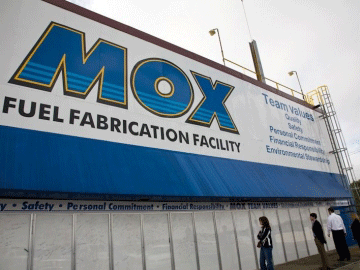
America is reconsidering how it will dispose of 34 tonnes of plutonium as the previous plan involving a MOX plant has been said to be twice as costly as a dilution and disposal option in a leaked Department of Energy (DOE) report.
The plutonium arises from a June 2000 nuclear weapons reduction agreement with Russia under which both countries would put 34 tonnes of plutonium beyond military use. Russia opted to use its plutonium as fuel for fast reactors generating power at Beloyarsk.
The USA, meanwhile, decided to build a mixed-oxide (MOX) nuclear fuel plant at Savannah River, where the plutonium would be mixed with uranium and made into fuel for light-water reactors. The design is similar to Areva’s Melox facility at Marcoule, but modified to handle metal plutonium ‘pits’ from US weapons and their conversion from metal to plutonium oxide. It is this part of the process that has been problematic. Construction started in 2007 with an estimated cost of $4.9 billion but work ran into serious trouble before being ‘zeroed’ in the DOE’s 2014 budget, putting development on ice.
The Union of Concerned Scientists yesterday published what it said was an unreleased DOE report that compared the cost of completing the MOX plant to other options. Use in fast reactors was considered briefly, but with this technology not readily available in the near term, the prime comparison was against a ‘dilution and disposal’ option which would see the plutonium mixed with inert materials and disposed of in the Waste Isolation Pilot Plant, or WIPP, in New Mexico.
Despite being 60% built, the MOX plant still needs some 15 years of construction work, said the leaked report, and then about three years of commissioning. Once in operation the plant would work through the plutonium over about 10 years with this 28-year program to cost $700-800 million per year – a total of $19.6-22.4 billion on top of what has already been spent. Not only is the price tag very high, but the timescale is too long: the report said this would not meet the disposal timeframe agreed with Russia.
The cost of the MOX plant could not be mitigated by income from sales of the MOX fuel because the regulatory process to gain approval to use MOX would be too burdensome for a commercial utility. The report said “it may be unlikely” that even a utility in a regulated market where fuel costs are passed on to consumers would “bear the risk of MOX fuel even if it is free”.
Dilution and disposal would cost $400 million per year, said the report, “over a similar duration” as MOX, working out at close to half the cost. Other advantages for dilution and disposal are that it requires no new facilities to be created or decommissioned after use, although the increase in WIPP disposal means “it may eventually become desirable to explore expansion of WIPP’s capacity” beyond currently legislated limits. This unique geologic disposal facility was said to be of “tremendous value to both DOE and the State of New Mexico”.
1 This Month
Tell Congress: Prevent Nuclear Catastrophe in Iran

Tell Congress: Prevent Nuclear Catastrophe in Iran

Read the Public Inquiry Report, the Commissioners’ report, Surrendering Australia: The AUKUS Deception is available to download for free at aukuspublicinquiry.com. Or just watch the replay of the National Press Club Luncheon.


Shut down the radiation-damaged Heysham nuclear reactors now
To see nuclear-related stories in greater depth and intensity – go to https://nuclearinformation.wordpress.com

Say No to NASA’s Reckless Nuclear Reactor on the Moon
Say No to NASA’s Reckless Nuclear Reactor on the Moon
-
Archives
- November 2026 (224)
- October 2026 (302)
- September 2026 (339)
- August 2026 (330)
- July 2026 (355)
- June 2026 (287)
- May 2026 (306)
- April 2026 (356)
- March 2026 (251)
- February 2026 (267)
- January 2026 (308)
- December 2025 (358)
-
Categories
- 1
- 1 NUCLEAR ISSUES
- business and costs
- climate change
- culture and arts
- ENERGY
- environment
- health
- history
- indigenous issues
- Legal
- marketing of nuclear
- media
- opposition to nuclear
- PERSONAL STORIES
- politics
- politics international
- Religion and ethics
- safety
- secrets,lies and civil liberties
- spinbuster
- technology
- Uranium
- wastes
- weapons and war
- Women
- 2 WORLD
- ACTION
- AFRICA
- Atrocities
- AUSTRALIA
- Christina's notes
- Christina's themes
- culture and arts
- Events
- Fuk 2022
- Fuk 2023
- Fukushima 2017
- Fukushima 2018
- fukushima 2019
- Fukushima 2020
- Fukushima 2021
- general
- global warming
- Humour (God we need it)
- Nuclear
- RARE EARTHS
- Reference
- resources – print
- Resources -audiovicual
- Weekly Newsletter
- World
- World Nuclear
- YouTube
-
RSS
Entries RSS
Comments RSS

