High time that USA ratified the Nuclear-Test-Ban Treaty
 The United States Needs to Step Up and Ratify the Nuclear-Test-Ban Treaty
With nuclear tensions on the rise in East Asia, Washington finally needs to show some leadership and commit to a testing freeze. Foreign Policy, 22 Apr 16 This year marks the 20th anniversary of the opening for signature of the Comprehensive Nuclear-Test-Ban Treaty (CTBT). It should be a cause for celebration, but it’s not; the treaty still remains in legal limbo. The fact is that out of the eight countries whose ratification is needed for the CTBT’s entry into force, two are permanent members of the U.N. Security Council and bear special responsibility for international peace and security — the United States and China.
Testing of nuclear weapons was one of the most visible manifestations of the Cold War. Nuclear explosions sent ripples putting peace and security under duress. The struggle to outlaw testing of nuclear weapons became the unifying factor in the global push to stop the arms race and the first international agreement demonstrating that success was possible was the Moscow Treaty on the Prohibition of Nuclear Tests in Three Environments, also known as the 1963 Partial Test Ban Treaty, negotiated by Russia, Britain, and the United States.
In subsequent years, Soviet and American experts cooperated in the context of the international Group of Scientific Experts laying out the foundations of the CTBT verification regime. While the actual conclusion of the treaty did not happen until 1996, the Soviet Union was the first of the P-5 states to announce a moratorium on nuclear testing on Oct. 24, 1990. Russia has since adhered to this voluntary undertaking. The United States issued its own nuclear-testing moratorium in 1992 followed by all the other P-5 countries………
Russian ratification was concluded in 2000 with the expectation that the United States would conclude its own ratification process despite the rejection of the treaty by the U.S. Senate in October 1999. Rather than wait for the United States, Russian leadership supported the CTBT when its future was not clear. …..
Expectations raised by President Barack Obama in his Prague speech seven years ago — when he made CTBT ratification a top priority for his administration — were short-lived. With the presidential election later this year, there is precious little time to waste. It is imperative to move forward and to demonstrate real support for the treaty……
In the wake of the Iran nuclear deal, there is momentum to advance adherence to the CTBT in the Middle East. No states in the region conduct nuclear tests. Key states have signed the CTBT; they have already said “no” to nuclear testing. But they need to turn this “no” into a “never.” The 20th anniversary of the treaty is an ideal time to move ahead. Another way ahead is to ensure real progress toward creation in the Middle East of a zone free of nuclear weapons and other WMD………http://foreignpolicy.com/2016/04/22/the-united-states-needs-to-step-up-and-ratify-the-nuclear-test-ban-treaty-china/
First Major City to Require Solar Panels on New Buildings – San Francisco
 San Francisco Becomes First Major City to Require Solar Panels on New Buildings, Nation of Change, By Lorraine Chow – April 20, 2016
San Francisco is one step closer to its goal of transitioning to 100 percent renewable energy after the city’s Board of Supervisors unanimously voted on Tuesday to mandate solarinstallations on new buildings. According to the San Francisco Examiner, starting Jan. 1 of next year, new commercial and residential buildings up to 10 stories high must install rooftop solar systems for heat or electricity. Buildings that are taller are exempt for now.
The famously green metropolis is now the first major city in the U.S. to legislate such a requirement. San Francisco follows the footsteps of the smaller towns of Lancaster and Sebastopol. The municipalities, which are also in California, passed similar mandates in 2013.
“This legislation will help move us toward a clean energy future and toward our city’s goal of 100 percent renewable energy by 2025,” supervisor Scott Wiener, who introduced the legislation, wrote on his Facebook page.
He added that San Francisco’s new rooftop solar law is an extension of an already established California law that requires all buildings 10 floors or less designate at least 15 percent of the rooftop for solar use.
“Solar ready” means that the roof is unshaded by the proposed building itself and free of obtrusions, Wiener explained on his website.
As the Examiner explained, the new legislation would give San Francisco’s solar capacity a big boost and help avert emissions:
To gauge the impact the mandate could have, the Department of Environment applied the proposal to construction projects in the pipeline in the third quarter of 2014 and found the 200 projects with solar installations would “avoid over 26,000 metric tons of carbon dioxide emissions per year.”
The current 24.8 megawatt solar systems in place would increase by 7.4 megawatts. The 7.4 megawatts of solar energy can produce 10.5 gigawatt hours of electricity annually, which can power about 2,500 San Francisco homes, [Barry Hooper, the Department of Environment Green Building Coordinator] said Tuesday.
Solar-powered Eco-City for Florida
A Solar-Powered Eco-City for 50,000 Breaking Ground in FloridaThe Babcock Ranch development will be primarily powered by a $300 million solar array, Curbed, BY BARBARA ELDREDGE @BARBARAELDREDGE APR 22, 2016, Construction is kicking off on a development hoping to become America’s first solar-powered city. Located in southwestern Florida just 13 miles from Fort Myers, the under-constructionBabcock Ranch development is slated to encompass 19,500 homes, 6 million square feet of retail, and 50,000 inhabitants by the time it’s fully finished in roughly 25 years.
And it’ll largely be powered by one of the country’s largest arrays of photovoltaic panels.
Planned entirely from the ground up with sustainability and environmental conservation in mind, over half of city’s 17,608 acres will be set aside for parks, greenways, and lakes. The town is also bordered by two wildlife and nature preserves totaling nearly 150,000 acres of protected wilderness. http://www.curbed.com/2016/4/22/11480578/solar-power-babcock-ranch-city-florida-array-kitson-partners
USA Nuclear regulator allows big drop in Vermont Yankee insurance ( tax-payer will cover any disaster)
FEDS ALLOW BIG DROP IN VERMONT YANKEE INSURANCE, VT Digger, APR. 21, 2016, BY MIKE FAHER VERNON — It’s not cheap to maintain an insurance policy on a nuclear power plant.
But as of this month, Entergy Vermont Yankee is getting a big break on its premiums: The Nuclear Regulatory Commission says the company can cut its on-site property damage insurance coverage from $1.06 billion to $50 million……..
Since stopping power production at Vermont Yankee in December 2014, Entergy has sought a number of regulatory changes for the Vernon plant.
One example is an NRC-approvedreduction in the Vermont Yankee emergency planning zone, which took effect Tuesday. In making a successful case for cutting emergency planning and funding, Entergy argued that the potential for accidents and radiation releases is much lower now that the plant is no longer operational.
The company’s request to reduce its insurance coverage uses the same logic……
The main risks remaining in Vernon, officials say, are associated with radioactive spent nuclear fuel. Currently, that fuel is stored both in a cooling pool in the plant’s reactor building and in sealed dry casks on a pad nearby; Entergy has pledged that all fuel will be in casks by the end of 2020……..There is a possibility — though the NRC labels it “highly unlikely” — that, if water were drained from the cooling pool, zirconium cladding on the spent fuel could catch fire…..
The NRC notes that it has granted similar insurance exemptions to other decommissioning plants including Maine Yankee and the Zion Nuclear Power Station in Illinois…..
the NRC’s exemption announcement has immediate financial benefits for Vermont Yankee: When factoring in reductions in both on-site and off-site insurance policies, the company’s annual premiums will decrease from about $1.9 million to less than $500,000, Cohn said……https://vtdigger.org/2016/04/21/feds-allow-big-drop-in-vermont-yankee-insurance/
Massachusetts electricity customers will save money in shift to wind and hydropower
Study predicts shift toward wind, hydropower will save consumers money, MassLive, By Matt Murphy STATE HOUSE NEWS SERVICE STATE HOUSE, BOSTON, APRIL 21, 2016.…A new study on the impact large-scale hydro and wind power imports could have on the Massachusetts energy market predicts significant savings for consumers, challenging the narrative put forward by critics of Gov. Charlie Baker’s energy bill that hydropower would be a costly alternative to natural gas.
The economic analysis, conducted for the Massachusetts Clean Energy Partnership by Power Advisory, concludes that energy customers in the state would see a net benefit of $171 million a year from long-term contracts for hydropower or a combination of hydro and land-based wind from northern New England or Canada.
The Clean Electricity Partnership is a coalition of regional wind, hydro and transmission companies working with business and environmental groups to promote clean energy.
The report, written by Power Advisory President John Dalton, suggests the savings generated by driving down demand for natural gas would not only cover the costs of building the transmission and facility infrastructure to import the power, but also deliver 10 percent of the carbon emission reductions required by 2050 under state law.
“Our analysis shows that displacing natural gas-fired electricity generation with hydropower or a combination of hydro and wind results in substantial annual savings to Massachusetts energy consumers as well as dramatic reductions in greenhouse gas emissions,” Dalton wrote……..
The House is expected to release major energy policy legislation as soon as next month that is likely to address the idea of competitive procurement of both hydro and off-shore wind as a clean energy solution to meeting the region’s energy needs as sources such as Pilgrim Nuclear Power Station prepare to come offline.
Over a 25-year period, Dalton’s report estimates $603 million in savings a year in Massachusetts from the importation of Canadian hydropower before the cost of transmission lines and facilities are factored.
The volume of energy from the new renewable resources would drive down demand for natural gas and reduce the price of gas used to produce electricity on peak demand days. The result would be savings of approximately $219 million a year for Massachusetts customers, he wrote. http://www.masslive.com/politics/index.ssf/2016/04/study_predicts_shift_toward_wi.html

America to buy nuclear material from Iran
U.S. to buy nuclear material from Iran By Jim Sciutto and Ryan Browne, CNN April 22, 2016 Washington The U.S. will purchase from Iran 32 metric tons of heavy water, a key component of nuclear reactors, according to a senior administration official.
Radioactive rain within Indian Point 2 reactor cavity falls on workers

 23 Years of Radioactive Rainfall at New York Nuclear Plant, Huffington Post, Roger Witherspoon, 18 Apr 16,
And after decades of ignoring the problem and having workers wear raincoats and rain hats to prevent radioactive contamination from the indoor precipitation, Entergy pledged in 2010 to try different methods in each of the next three refueling outages to see if they could stop the flow of water through the massive concrete and steel tub surrounding the reactor. That six-year plan was deemed acceptable by the NRC.
But Entergy’s efforts during the first two refueling outages failed. The plant is currently in the midst of the third refueling outage and NRC spokesman Neil Sheehan said in an email exchange that the company has been unable to find or halt the leaks.
“Entergy is still working on a solution to the problem of leakage from the Unit 2 refueling cavity,” Sheehan wrote. “Thus far, the leakage has not yet been halted. But it’s important to note that leakage is captured in the containment building sump and then processed in the plant’s radioactive water cleanup system.
“We had a metallurgical specialist at the site this week to observe Unit 2 refueling activities. As part of his inspection, he reviewed the work on the refueling cavity. The results of that review will be documented in an upcoming inspection report.”
- The steady drip of about 10 gallons per minute comes through the specially designed, concrete, waterproof cavity which surrounds the reactor and is filled with water in order for refueling to take place. Exposure to the reactor core would kill anyone in the area, so the cavity extends more than 30 feet above the reactor itself. When filled, the reactor head can be removed remotely and the 12-foot long fuel rods lifted out and transported on an underwater train through a flooded canal to the spent fuel pool in an adjacent building………
- At this decades-long leak rate, more than 4.6 million gallons of radioactive rain has fallen through the reactor cavity and transfer canal onto the work area below………
Entergy has been seeking 20 year extensions on the licenses of the twin reactors, which are now more than 40 years old, since 2007. The license for Indian Point 2 expired in 2013, and the license for Indian Point 3 expired last year. They are currently allowed to operate by the NRC until the licensing process is complete. The NRC is actively seeking to relicense all of the nation’s 100 reactors, and has so far granted extensions to about 75. The license review process for all other reactors has taken an average of two years.
- The extensions for both Indian Point plants, however, are being challenged by the environmental groups Riverkeeper and Clearwater, and the State of New York on several grounds, including contentions that the ageing management process for the plants’ critical components is flawed and unreliable……….
An Old, Unsolved Problem
The indoor leaks at Indian Point stem from a grave miscalculation made when the nation’s nuclear plants were designed in the 50s and 60s. It was assumed, explained Lochbaum, that pipes and concrete conduits wouldn’t break down over time and that concrete, though porous, was certainly unlikely to leak in the two weeks to a month needed for refueling and reactor maintenance. http://linkis.com/huffingtonpost.com/jBTm9
Judge rules against proposed Turkey Point nuclear plans

 Court overturns state’s approval of proposed Turkey Point plans, Palm Beach Post April 21, 2016 Florida Power & Light’s quest to add two new reactors and miles of new transmission lines at its Turkey Point plant south of Miami experienced a major setback Wednesday when an appellate court overturned a state decision that would have permitted the reactors.
While the 2014 approval of Units 6 & 7 by Gov. Rick Scott and his Cabinet found the project would not harm the Everglades or wetlands and would not impact endangered birds such as the snail kite and the wood stork, the court disagreed.
To read the 28-page ruling, click here.
The Third District Court of Appeal reversed the state’s approval of nuclear Units 6 and 7 in an appeal brought by the City of Miami, the Village of Pinecrest and Miami-Dade County.
The court remanded the case and found the board failed to apply Miami’s applicable land development regulations, failed to properly apply environmental regulations and erroneously thought it did not have the power to require FPL to install miles of power lines underground at FPL’s expense.
“FPL presented no competent substantial evidence that the project could satisfy the environmental performance standards” of Miami-Dade County rules, Judge Ivan Fernandez wrote in the ruling…….
By the end of this year, FPL customers will have paid $247 million towards units 6 and 7. The U.S. Nuclear Regulatory Commission has not yet issued the operating license for the project slated to be completed by 2028.
Juno Beach based FPL’s Turkey Point plant is home to two nuclear reactors, known as units 3 and 4. The plant’s two-by-five mile unlined earthen cooling canal system has caused an underwater saltwater plume that has spread roughly 5 miles west of the plant, an administrative law judge found in February.
The cooling canals have been linked to pollutants in Biscayne Bay and into ground water, according to data released by Miami-Dade County. http://protectingyourpocket.blog.palmbeachpost.com/2016/04/20/court-overturns-states-approval-of-two-proposed-turkey-point-reactors/
Israel duped USA over its nuclear program – declassified documents
 Declassified: How Israel Misled the U.S. About Its Nuclear Program Ben-Gurion’s mumbling to Kennedy helped delay the Americans’ assessment that Jerusalem was on the verge of building a bomb. Haaretz, Ofer Aderet Apr 21, 2016 Dimona nuclear reactor’s joint international research projects revealed for first time
Disastrous state of Hanford’s nuclear waste farm
We Should Be Very Worried About That Leaky Nuclear Waste Facility in Washington, Gizmodo, Maddie Stone, 21 Apr 16, Earlier this week, we heard alarming reports of a “significant” nuclear waste leak at Hanford, the largest radioactive waste dumpsite in the country. Should we be worried? Absolutely. But mainly because this is a symptom of a much bigger problem that’s been festering for decades.
Located just a few miles north of Richland in eastern Washington, the Hanford site houses 53 million gallons of some of the most toxic material on Earth—radioactive sludge leftover from the world’s first full-scale plutonium reactor. Most of the time, the facility is out of sight and mind, but every few years, news of a mishap at Hanford sparks public hysteria.

“We have 177 of these tanks, containing the bulk of America’s high-level nuclear waste,” Tom Carpenter, executive director of the environmental watchdog group Hanford Challenge, told Gizmodo. “These tanks are in terrible shape, and we know others are subject to failure in the same way.”……….http://gizmodo.com/we-should-be-very-worried-about-that-leaky-nuclear-wast-1771933003
US Dept of Energy tries again to convince South Dakota on deep borehole testing
 Feds: No Nuke Waste to Be Used in Possible South Dakota Test , abc news, By JAMES NORD, ASSOCIATED PRESS 21 Apr 16 Organizers of a federal effort to assess whether nuclear waste can be stored in 3-mile-deep holes are trying to better explain their intentions to South Dakota residents after getting rebuffed in North Dakota over concerns that waste might eventually be stored there.
Battelle, a nonprofit group hired to manage the U.S. Department of Energy project, is considering whether sites in Spink County, South Dakota, would suffice for the study of whether deep rock is suitable for nuclear waste disposal, the contractor said Thursday.
The deep borehole field test will not involve any radioactive waste, officials said. Organizers are planning at least two open meetings in Spink County near the end of April to answer questions from the community about the proposed research, which also could involve geothermal energy……..
Battelle is also considering two sites outside of South Dakota that it declined to name. The contractor hopes to decide if Spink County is viable within a few weeks, and would like to be drilling by the end of the year.
It is touting a multi-million dollar estimated state and local economic impact…….http://abcnews.go.com/US/wireStory/south-dakota-sites-mulled-nuclear-waste-drilling-project-38578525
PIERRE, S.D. — Apr 21, 2016
US citizen indicted for nuclear power conspiracy
Several indicted for nuclear power conspiracy against U.S.U.S. nuclear engineer, China General Nuclear Power Company, Energy Technology International named Claiborne Progress April 21st, 2016 WASHINGTON – A two-count indictment was unsealed April 14 in the Eastern District of Tennessee charging Szuhsiung Ho, aka Allen Ho, a citizen of the United States; China General Nuclear Power Company (CGNPC), formerly known as the China Guangdong Nuclear Power Company and Energy Technology International (ETI) for conspiracy to unlawfully engage and participate in the production and development of special nuclear material outside the United States, without the required authorization from the U.S. Department of Energy. This authorization is required by U.S. law and is robustly observed through frequent legal U.S.-China civil nuclear cooperation. Ho was also charged with conspiracy to act in the United States as an agent of a foreign government.
The announcement was made by Assistant Attorney General for National Security John P. Carlin, Acting U.S. Attorney Nancy Stallard Harr of the Eastern District of Tennessee and Executive Assistant Director Michael Steinbach of the FBI’s National Security Branch.
“Allen Ho, at the direction of a Chinese state-owned nuclear power company allegedly approached and enlisted U.S. based nuclear experts to provide integral assistance in developing and producing special nuclear material in China,” said Carlin. “Ho did so without registering with the Department of Justice as an agent of a foreign nation or authorization from the U.S. Department of Energy. Prosecuting those who seek to evade U.S. law by attaining sensitive nuclear technology for foreign nations is a top priority for the National Security Division.”
“The prosecution of individuals who potentially endanger our U.S. citizens by violating laws enacted to ensure our national security, has been and will remain a priority for the U.S. Attorney’s Office in eastern Tennessee,” said Acting U.S. Attorney Harr.
“The arrest and indictment in this case send an important message to the U.S. nuclear community that foreign entities want the information you possess,” said Steinbach. “The federal government has regulations in place to oversee civil nuclear cooperation, and if those authorities are circumvented, this can result in significant damage to our national security. The U.S. will use all of its law enforcement tools to stop those who try to steal U.S. nuclear technology and expertise.”…….. http://claiborneprogress.net/news/6303/several-indicted-for-nuclear-power-conspiracy-against-u-s
‘Catastrophic’ Nuclear leak at Washington’s infamous Hanford Site
 Nuclear leak at Washington’s infamous Hanford Site is CATASTROPHIC, former worker claims, as eight inches of radioactive waste escapes core of ‘the world’s safest’ tank, Daily Mail , 20 Apr 16 [EXCELLENT PHOTOS]
- Tank has two shells; a crack was spotted in the inner one in 2011
- Now that crack has widened, spilling waste into the gap between the shells
- It happened after attempts to pump the waste out of the tank
- The Department of Energy says this was ‘anticipated’
- But workers at the plant said they weren’t told it was a possibility
- The double-shell tank can contain up to a million gallons of deadly waste
- It was supposed to be the safest possible container for radioactive liquid
- The Hanford Site provided plutonium for the first atomic bomb
By JAMES WILKINSON FOR DAILYMAIL.COM, 20 April 2016
A nuclear leak first spotted five years ago at Washington state’s Hanford Site has got dramatically worse with eight inches of radioactive liquid escaping a protective carbon steel shell.
The tank, named AY-102, has two shells, with the inner steel layer containing up to one million gallons of the deadly waste, and the outer concrete one providing a two-foot-wide gap to collect the waste if the inner shell broke.
Now a small leak in the inner shell first seen in 2011 has worsened, allowing eight inches of the dangerous goo to leak out in an event that one ex-worker is calling ‘catastrophic.’
Former Hanford worker Mike Geffre was the first to spot the leak in AY-102’s inner shell in 2011, but it took the government a year to actually announce what had happened.
Back then, the small leak only allowed a slow flow of radioactive waste into the gap between the shells, or ‘annulus’. That liquid which would quickly dry up into a white powder. But after five years, they discovered on Sunday that the crack had got worse.
‘This is catastrophic,’ he told KGW.com. ‘This is probably the biggest event to ever happen in tank farm history. The double-shell tanks were supposed to be the saviors of all saviors.’
The Hanford Site was a major Second World War and Cold War nuclear site; it provided plutonium for the first atomic bomb.
It now houses millions of gallons of nuclear waste – two-thirds of all high-level radioactive waste in America in 2007 – and cleanup on the site has been ongoing since 1989.
As well as AY-102, six single-shell tanks were noted to be leaking in 2013.
Ironically, the original cracks in AY-102 appear to have been further widened by government efforts to pump waste out of the tank, sources told KGW.
Pumping began three weeks ago, after Washington state spent three years petitioning the federal government, which owns the tanks, to deal with the damaged structure.
But the change in pressure appears to have ‘blown out’ the weakened wall, causing the increased leak and bringing the waste closer to the nearby Columbia River.
‘The primary tanks weren’t designed to stage waste like this for so many years,’ a current worker told KGW. ‘There’s always the question, “Are the outer shells compromised?”‘…………
workers at the plant told KGW that despite claims the breach was ‘anticipated,’ they had not been made aware that something like this could occur.
And Geffre said that he was frustrated that his warnings in 2011 hadn’t been acted on for an entire year. ‘It’s an example of a culture at Hanford of “We don’t have problems here. We’re doing just fine.” Which is a total lie,’ he said.
Construction on the Hanford site began in 1943, and it went on to house the world’s first full-scale plutonium production reactor, and to provide plutonium for the first atomic bomb.
After the Cold War ended, the site housed 53 million gallons of high-level radioactive waste and 25 million cubic feet of solid radioactive waste.
There were 200 square miles of contaminated groundwater beneath the site. http://www.dailymail.co.uk/news/article-3547975/Five-year-long-nuclear-leak-Washington-state-s-infamous-Hanford-Site-CATASTROPHIC-former-worker-claims-eight-inches-radioactive-waste-escapes-world-s-safest-tank-one-night.html
Hans Blix warns on USA’s danger in not reducing nuclear arsenal
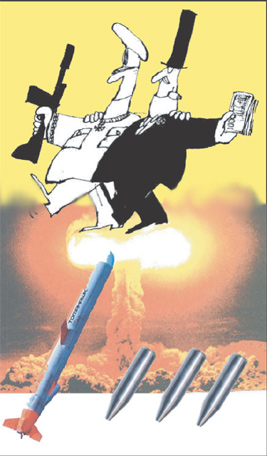 US ‘plays with fire’ dragging feet in reducing nuclear arsenals – Ex-IAEA head to RT 19 Apr, 2016 Nearly 20,000 warheads owned by big powers with “sparks flying” between them are more risky than “dirty bombs” in hands of terrorist organizations, Hans Blix and Lassina Zerbo, reputed international experts on nuclear security, told RT.
Hans Blix, a renowned Swedish diplomat who led the UN’s International Atomic Energy Agency for more than 16 years, and headed the monitoring mission sent to Iraq in search of alleged weapons of mass destruction prior to the 2003 Iraq War, has described the biggest threats posed by nuclear weapons to RT in an exclusive interview.
Recalling the end of the Cold War, which was marked by massive disarmament efforts between the USSR and US, Blix said it was “the great time” that resulted in several milestone agreements banning nuclear tests and chemical weapons.
“Since then we’ve had hopes that countries would go on, with President Obama [pushing for] the nuclear-free world. But since 2010, when an agreement was reached between Russia and the United States about the START treaty [reducing number of warheads and weapons carriers], things have gone badly.”
Twenty years after the Comprehensive Nuclear-Test-Ban Treaty (CTBT) was adopted by the UN in 1996, which urges all countries to abandon nuclear detonations for both military and civilian purposes,“the atmosphere in the world became chilly,” Blix said, warning that major powers have once again entered a phase of pumping large sums of money into rearmament.
Despite Washington’s countless promises to ratify the CTBT, last year Moscow accused the US of taking “no practical steps” in that direction, consequently preventing the important agreement from entering into force.
While both countries have nuclear arsenals sufficient for mutually assured destruction, only Russia has either signed or ratified the treaty……. https://www.rt.com/news/340271-nuclear-ban-treaty-interview/
USA energy firms – history of climate change denial from 1968
US firms knew about global warming in 1968 – what about Australia?, The Conversation, Marc Hudson, April 18, 2016 Earlier this month the satirical newspaper The Onion “reported” on the discovery in a Californian university’s archives of a dusty, yellowing report saying the time to act on climate change is now.
This week life imitated art, as it was revealed that there is indeed a decades-old report to be found in a Californian archive warning of climate impacts. The real report, as opposed to the satirical one, was written in 1968 by scientists at the Stanford Research Institute, who sent it to the American Petroleum Institute to warn of the possible impacts of carbon dioxide emissions.
That wasn’t even the start. A decade earlier, in 1959, a scientist working for oil giant Shell wrote in New Scientist about the idea of humans altering the climate, although he poured scorn on the idea.
By the early 1970s, the idea of the greenhouse effect was already in the air, if you’ll pardon the pun. It merited several pages in the Club of Rome’s landmark 1972 report, The Limits to Growth, and even got a mention in the dystopian classic 1973 film Soylent Green……..
The sceptics
Only now is the issue really coming home to roost for fossil fuel firms, such as the world’s biggest private coal miner Peabody Energy, which this week filed for bankruptcy in the United States.
Peabody’s recently retired chief executive Greg Boyce has always been combative on the subject of climate change. He told the World Energy Congress in 2010 that:
“The greatest crisis society confronts is not a future environmental crisis predicted by computer models but a human crisis today that is fully within our power to solve – with coal.”
Its now-retired chief lobbyist Fred Palmer, in a 1997 documentary, happily and emphatically states:
“Every time you turn your car on and you burn fossil fuels and you put CO₂ in the air, you are doing the work of the Lord.”………
The fallout
The New York attorney-general’s office is now demanding answers from Exxon over its response to the climate warnings of half-a-century ago.
Meanwhile, the attorney-general of the US Virgin Islands has subpoenaed the US think tank the Competitive Enterprise Institute, a long-time ally of the fossil fuel industry, over its campaign to cast doubt on climate science.
While it is both interesting and frustrating to learn that the very companies that have worked hardest to obfuscate climate science actually knew about it before the wider public did, that knowledge doesn’t help us figure out how to deliver the sorts of deep emissions cuts that are needed now. We need to keep our eyes on the increasingly unlikely and battered prize of a habitable planet. https://theconversation.com/us-firms-knew-about-global-warming-in-1968-what-about-australia-57878
1 This Month
Tell Congress: Prevent Nuclear Catastrophe in Iran

Tell Congress: Prevent Nuclear Catastrophe in Iran

Read the Public Inquiry Report, the Commissioners’ report, Surrendering Australia: The AUKUS Deception is available to download for free at aukuspublicinquiry.com. Or just watch the replay of the National Press Club Luncheon.


Shut down the radiation-damaged Heysham nuclear reactors now
To see nuclear-related stories in greater depth and intensity – go to https://nuclearinformation.wordpress.com

Say No to NASA’s Reckless Nuclear Reactor on the Moon
Say No to NASA’s Reckless Nuclear Reactor on the Moon
-
Archives
- November 2026 (190)
- October 2026 (302)
- September 2026 (339)
- August 2026 (330)
- July 2026 (355)
- June 2026 (287)
- May 2026 (306)
- April 2026 (356)
- March 2026 (251)
- February 2026 (267)
- January 2026 (308)
- December 2025 (358)
-
Categories
- 1
- 1 NUCLEAR ISSUES
- business and costs
- climate change
- culture and arts
- ENERGY
- environment
- health
- history
- indigenous issues
- Legal
- marketing of nuclear
- media
- opposition to nuclear
- PERSONAL STORIES
- politics
- politics international
- Religion and ethics
- safety
- secrets,lies and civil liberties
- spinbuster
- technology
- Uranium
- wastes
- weapons and war
- Women
- 2 WORLD
- ACTION
- AFRICA
- Atrocities
- AUSTRALIA
- Christina's notes
- Christina's themes
- culture and arts
- Events
- Fuk 2022
- Fuk 2023
- Fukushima 2017
- Fukushima 2018
- fukushima 2019
- Fukushima 2020
- Fukushima 2021
- general
- global warming
- Humour (God we need it)
- Nuclear
- RARE EARTHS
- Reference
- resources – print
- Resources -audiovicual
- Weekly Newsletter
- World
- World Nuclear
- YouTube
-
RSS
Entries RSS
Comments RSS

