Virginia Citizens Consumer Council (VCCC) – strong petition against $19.2 billion nuclear power plant
the $19 billion Unit 3 is being built above an earthquake fault.

 The Dangerous Nuclear Plant Rising on DC’s Doorstep http://www.counterpunch.org/2016/09/01/the-dangerous-nuclear-plant-on-dcs-doorstep/ by JOHN LAFORGE, Dominion Virginia Power, a section of the giant utility Dominion, is proceeding unlawfully with construction of its $19-billion-plus power reactor 80 miles from Washington, DC — called North Anna 3 — and must get formal approval from the Virginia State Corporation Commission (SCC) before it can continue, according to a petition filed August 30th by the Virginia Citizens Consumer Council (VCCC;), a nonprofit group based in Elliston, Va.
The group’s “Petition for a Declaratory Judgment” says in part: “At an estimated total cost of at least $19.2 billion, North Anna 3 would be the most expensive power [reactor] ever built in the United States and could raise customers’ rates by 26 % or more according to the Virginia Attorney General. While Dominion claims that North Anna 3 is needed for compliance with the federal Clean Power Plan, it would be far costlier than the low-carbon alternative of combined renewables, demand-side management, and efficiency … Dominion has not complied with Virginia law by failing to seek SCC approval before making expenditures on project development and beginning preliminary construction of North Anna 3.” Continue reading
Iran still hindered by USA sanctions, following nuclear deal
Ryabkov Says U.S. Sanctions Continue To Hinder Iran After Nuclear Deal, Radio Free Europe September 01, 2016 The United States has carried out its part of the Iranian nuclear deal, but unilateral U.S. sanctions on Iran have remained in place and are a “big hindrance” for Tehran, a top Russian diplomat told TASS.
Russia’s Deputy Foreign Minister Sergei Ryabkov, who is visiting Tehran, told TASS on August 31 that the U.S. administration has implemented “from start to finish” everything envisaged by last year’s agreement, “but it hasn’t moved any further.”
“All the so-called unilateral sanctions that existed before an agreement was reached with Iran have stayed in place,” he said.
“These unilateral sanctions are a big hindrance,” he said. “Any deal serviced in dollars goes through corresponding controlling agencies of the United States and can be suspended.”
Despite the removal of most international sanctions against Iran, Ryabkov said European and Asian businesses continue to be cautious about dealing with Iran and as a result, “deals are fewer than one would want to see.”
Radioactive waste from oil and gas fracking found in landfill
Radioactive Waste Found at Oil Field Landfill in North Dakota, Oil Price By Irina Slav – Sep 01, 2016, North Dakota has had a problem with the inappropriate disposal of this radioactive waste for years. This time, the State Health Department of North Dakota is probing an oilfield waste landfill operated by IHD Solids Management after the detection of a significant amount of illegal radioactive matter.
The radioactive material was detected twice in two separate inspections that took place in May and June. Now the HD has ordered a third-party inspection of the landfill and instructed the operator to remove 950 tons of waste and take it out of the state, after radioactivity checks of all 12 oilfield waste landfills in the state revealed levels of between 5 and 80 picocuries, the latter standing 30 picocuries above the new maximum allowed for oilfield waste…….
The company will not be fined for the transgression because it dealt with the problem by removing the suspicious waste, as did two other landfill operators in North Dakota, Secure Energy and Gibson Energy. They too had to remove over-radioactive material from their landfills and ship it to special nuclear waste facilities.
Prudently, if not a tad belatedly, North Dakota will soon start requiring oilfield waste landfill operators to verify the radioactivity level of every load that arrives, rather than taking the word of the company generating the waste for it.
The waste from oil and gas wells include uranium, thorium, radium, a radioactive isotope of potassium, as well as isotopes of lead and polonium. These are naturally occurring elements that are brought to the surface through fracking. http://oilprice.com/Latest-Energy-News/World-News/Radioactive-Waste-Found-at-Oil-Field-Landfill-in-North-Dakota.html
Watts Bar nuclear reactors shut down indefinitely, following transformer fire
Transformer fire forces TVA to shut down Unit 2 reactor indefinitely TVA probes cause of switchyard fire at Watts Bar Tuesday night. Times Free Press August 31st, 2016 by Dave Flessner
The blaze in one of the main bank transformers connected to the new Unit 2 reactor triggered notice of “an unusual event” — the lowest of four emergency classifications for problems at a nuclear power plant. Although the fire did not affect any nuclear or generation equipment in either the reactor or turbine buildings at Watts Bar, it did damage a transformer and required TVA to shut down its Unit 2 reactor indefinitely, TVA spokesman Jim Hopson said today. ….
When the fire erupted, the reactor had to be shut down and the unit will remain idle until a new transformer is installed and the cause of the fire is determined. http://www.timesfreepress.com/news/local/story/2016/aug/31/transformer-fire-nuclear-plant-triggers-emergency-notice/384326/
Legal challenges to New York nuclear power subsidies,
 Flurry of challenges attacks NY nuclear and renewable power subsidies, http://www.syracuse.com/news/index.ssf/2016/09/flurry_of_challenges_attack_ny_plan_for_nuclear_and_renewable_power_subsidies.html Syracuse.c om, By Tim Knauss | tknauss@syracuse.com , 1 Sept 16, SYRACUSE, N.Y. – At least 15 interest groups have challenged New York’s new “clean energy standard,” which mandates subsidiesfor nuclear plants and renewable energy, by petitioning the state Public Service Commission to reconsider the policy.
The formal petitions for rehearing come from a wide range of critics, from power plant owners to low-income consumer advocates, reflecting the sweeping impact of the new regulations.
Challenges had been widely expected, given the high stakes for energy producers and customers. Petitions for rehearing are typically the first step in seeking to change a commission decision. Lawsuits could follow.
There is no deadline for the commission to respond to the petitions, said Jon Sorensen, speaking for the PSC.
“Parties will likely be given 45 business days to comment on the arguments presented in the petitions before the commission decides whether to reject those petitions or modify the order,” he wrote in an email.
The PSC is under pressure to move ahead with its new policy swiftly, especially the part that affects Upstate nuclear plants. The FitzPatrick plant in Oswego County is slated to close in January if the planned sale of the plant to Exelon Corp. is blocked. The sale of FitzPatrick depends on approval of subsidy contracts authorized by the clean energy standard.
Under a side agreement between New York officials and current plant owner Entergy Corp., the sale of FitzPatrick must be approved and subsidy contracts for the facility signed, all by Nov. 18, or the sale can be called off and state power authority would owe a $35 million termination fee to Entergy.
Several of the petitioners seeking to revisit the clean energy standard claim the PSC acted with illegal haste by adopting the nuclear subsidy scheme, details of which were proposed just two weeks before the commission vote. Those critics say the proposal to adopt a 12-year subsidy program for Upstate nuclear plants, which is expected to cost nearly $1 billion during just the first two years, should have been subjected to a 45-day comment period under the State Administrative Procedures Act. The PSC said in its original order that the comment period was adequate.
Other petitions say the PSC erred by excluding certain types of renewable energy, such as existing wind farms or new hydroelectric dams, from getting subsidies under the clean energy standard.
The Independent Power Producers of New York, among others, argued that some New York power generators excluded from the clean energy standard might sell their output in Massachusetts, which just enacted financial incentives for renewable power.
Contact Tim Knauss anytime | email | Twitter | 315-470-3023
American Fukushima rescue ships still contaminated with radiation
16 US ships that aided in Operation Tomodachi still contaminated with radiation, By MATTHEW M. BURKE | STARS AND STRIPES March 13, 2016 CAMP FOSTER, Okinawa — Sixteen U.S. ships that participated in relief efforts after Japan’s nuclear disaster five years ago remain contaminated with low levels of radiation from the crippled Fukushima Dai-ichi nuclear power plant, top Navy officials told Stars and Stripes.
In all, 25 ships took part in Operation Tomadachi, the name given for the U.S. humanitarian aid operations after the magnitude-9.0 earthquake and subsequent tsunami on March 11, 2011. The tsunami, whose waves reached runup heights of 130 feet, crippled the Fukushima plant, causing a nuclear meltdown.
In the years since the crisis, the ships have undergone cleanup efforts, the Navy said, and 13 Navy and three Military Sealift Command vessels still have some signs of contamination, mostly to ventilation systems, main engines and generators……
The Navy has acknowledged that the Reagan passed through a plume of radiation. Navy images showed sailors with their faces covered, scrubbing the deck of the Reagan with soap and water as a precautionary measure afterward. The Reagan and sailors stayed off the coast of Japan for several weeks to aid their Japanese allies.
The multibillion-dollar ship, projected to last at least 50 years after its launch in 2001, then was taken offline for more than a year for “deep maintenance and modernization” at the Puget Sound Naval Shipyard and Intermediate Maintenance Facility in Bremerton, Wash., according to Navy officials…….
Sailors who performed the work said it entailed entering spaces deep within the ship, testing for high levels of radiation, and if it was found, sanding, priming and painting the areas. They say there were given little to no protective gear, a claim that the Navy denies……
Eight Reagan sailors, claiming a host of medical conditions they say are related to radiation exposure, filed suit in 2012 against the nuclear plant’s operator, the Tokyo Electric Power Co. The suit asserts that TEPCO lied, coaxing the Navy closer to the plant even though it knew the situation was dire. General Electric, EBASCO, Toshiba Corp. and Hitachi were later added as defendants for allegations of faulty parts for the reactors.
A spokesman for TEPCO declined to comment for this story because of the sailors’ lawsuit, which was slated to go forward pending appeals in the U.S. 9th Circuit Court of Appeals.
The illnesses listed in the lawsuit include genetic immune system diseases, headaches, difficulty concentrating, thyroid problems, bloody noses, rectal and gynecological bleeding, weakness in sides of the body accompanied by the shrinking of muscle mass, memory loss, leukemia, testicular cancer, problems with vision, high-pitch ringing in the ears and anxiety.
The list of sailors who have joined the lawsuit, which is making its way through the courts, has grown to 370…….
Shinzo Kimura — a professor at Dokkyo Medical University in Japan who has studied radiation exposure from Hiroshima and Nagasaki to Chernobyl and, now, Fukushima — said it wasn’t too early for sailors to show symptoms of exposure-related conditions. Doctors have seen conditions in children living near the plant that surfaced earlier than would normally be expected.
Kimura, hired by the Nihonmatsu city government for his expertise in the field, was the first scientist on the ground taking readings in the wake of the Fukushima disaster. He said each person and the way their body is affected by radiation is different.
While unable to definitively say if the sailors were sickened by the radiation, Kimura reasoned that the levels aboard the Reagan were high enough to cause illnesses. Otherwise, he said, why go through the bother of repeated cleanings to lower radiation levels?
“It is impossible to speculate or calculate how much the doses were before the two decontamination works,” he said. “The U.S. military is very good at risk-management. Considering that, it is assumed that decontaminations were conducted twice because the levels were not favorable.”
sumida.chiyomi@stripes.com http://www.stripes.com/news/16-us-ships-that-aided-in-operation-tomodachi-still-contaminated-with-radiation-1.399094
Fort Calhoun nuclear power plant to shut down permanently on October 24
| OPPD announces shutdown date for Fort Calhoun nuclear power plant http://enformable.com/2016/08/oppd-announces-shutdown-date-fort-calhoun-nuclear-power-plant/?utm_source=feedburner&utm_medium=email&utm_campaign=Feed%3A+Enformable+%28Enformable%29 31 Aug 2016 The PWR reactor at the Fort Calhoun nuclear power plant in Nebraska will shut down for good on October 24th, 2016. The reactor first went online in September, 1973 and was the smallest nuclear reactor in the United States in terms of power generation (476 MW). The Nuclear Regulatory Commission received a letter from Omaha Public Power District (OPPD) that notified them of the utilities decision to decommission the lone reactor at the power plant.In June, the OPPD announced that it had reached a decision to shut down the plant, but an exact date had not been announced. The utility estimated that it would save $1 billion over the next 20 years if it decommissioned the power plant.
The plant was the focus of international concern after the Missouri River flooded and surrounded the facility with rising water. The reactor was forced to remain offline for nearly three years while OPPD responded to a wide range of deficiencies identified in inspections by the NRC after the flooding event.
|

USA determined to market nuclear reactors to India
 India, US set the ball rolling for Westinghouse’s nuclear plants By Dipanjan Roy Chaudhury, ET Bureau | Sep 01, 2016, NEW DELHI: India and the US moved closer to the planned construction of six reactors by American company Westinghouse at a proposed nuclear plant in Andhra Pradesh, with the two sides deciding to immediately commence the work on engineering and site design, and make an early conclusion of a competitive financing package.
“Nuclear Decommissioning: Paying More for Greater, Uncompensated Risks.”
Decommissioning costs: A blind spot in the nuclear power debate In nuclear policy, too little thought is given to the considerable costs of storing radioactive waste on site, Utility Dive By Christina Simeone | August 30, 2016 With over 10 GW of nuclear capacity at risk for premature retirement – defined as retirement before license expiration – many states are considering subsidy policies to keep these economically struggling reactors operating.
Arguments for subsidies focus on protecting local jobs, keeping low-cost baseload power, maintaining reliability, and preserving the zero-carbon resources needed to address climate change. Opponents argue that out-of-market subsidies distort competitive markets and amount to ratepayer bailouts of uneconomic generation.
Absent from the debate, however, is a focus on what happens to nuclear power plants when they retire and decommission. Specifically, how Americans like you and I will continue to pay more and be subjected to greater risks as nuclear power plants are converted to interim waste storage facilities.
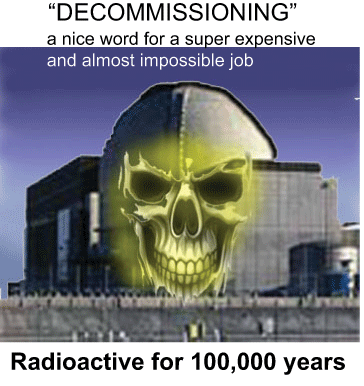
This is the focus of a new report from the University of Pennsylvania’s Kleinman Center for Energy Policy, entitled “Nuclear Decommissioning: Paying More for Greater, Uncompensated Risks.”
Let me explain.
When most nuclear power plants were built, the expectation was spent fuel waste would either be reprocessed (for most plants built before 1977) or the government would take custody of the waste for permanent disposal, per the 1982 Nuclear Waste Policy Act. Licensees that built the reactors were also required to establish financial mechanisms – such as trust funds – to ensure availability of funds to decontaminate equipment and decommission the plant site.
The Nuclear Waste Policy Act established a per-kilowatt-hour fee on nuclear power production that Licensees would pay in exchange for a contractual agreement committing the federal government to take custody of the waste – beginning in 1998 – for permanent geologic disposal. Licensees would recover these fees from electricity ratepayers that enjoyed low cost, baseload nuclear power.
In 1998, the federal government was not prepared to accept the waste. To date, the government has spent more than $7.5 billion to study the Yucca Mountain site in Nevada for geologic disposal, but political opposition from within that state killed the project. There are currently no plans underway to build a geologic disposal repository.
Meanwhile, there are over $34 billion in ratepayer funds sitting in a restricted government account that by law can only be spent on activities related to the geologic disposal site. (The ratepayer fee was suspended in 2014, a few years after the Yucca Mountain project was terminated.)
In the interim, nuclear reactor Licensees have been forced to make significant capital investments to expand their ability to store spent fuel on site at power plants. Licensees sued the federal government for financial damages caused by the government’s failure to accept nuclear waste for disposal, and the Licensees won.
The federal government is therefore using taxpayer money to pay back the Licensee’s costs of interim waste storage. As of 2015, more than $5 billion of taxpayer dollars were paid to reactor Licensees. The total cost of damages is estimated to range from $29 billion to $50 billion if the government begins to accept waste in 10 years. If this date slides, government liabilities increase by $500 million per year.
So today, all 100 operating nuclear power reactors are storing waste on site in wet and/or dry storage. When a full plant retires, the entire site cannot be decommissioned, because a portion of the site must continue to store waste.
With this background in mind, it is important that policymakers consider the following facts when contemplating the fate of struggling nuclear power facilities:
- Distributed, interim (if not perpetual) storage of spent fuel and high level radioactive waste is less safe and less secure than permanent geologic disposal, according to the IAEA.
- Costs of interim storage have been and will continue to be paid by taxpayers, and these costs will accumulate indefinitely. Meanwhile, there is no refund provided to the ratepayers who paid to have nuclear waste removed from their neighborhoods and into a permanent geologic disposal facility. Many Americans are paying twice for nuclear waste management.
- Communities hosting nuclear power facilities – that include ratepayers and taxpayers – are not being compensated for the increased risks of perpetually storing high level radioactive waste. And, when a plant or reactor retires, these communities are also losing the benefits of nuclear power.
An additional concern is the Nuclear Regulatory Commission’s formula for establishing upfront decontamination costs for reactor specific funds has widely been criticized to understate costs. When a reactor retires prematurely, these funds have less time to appreciate and may require additional financial guarantees from the Licensee. More research is needed to understand the ability of owners of at-risk generation to provide such guarantees, if needed……http://www.utilitydive.com/news/decommissioning-costs-a-blind-spot-in-the-nuclear-power-debate/425415/
Nuclear subsidies: will Pennsylvania be the next to prop up failing nuclear industry?
 The nuclear option After New York props up nuclear power generation sector, is Pennsylvania next?,
The towers of the Beaver Valley nuclear plant in Shippingport loom over the region in this view from nearby Midland.
As part of that state’s Clean Energy Standard, utilities will be required to buy “zero emission credits,” providing what is estimated to be a $500 million annual subsidy to keep the nuclear plants open. Nuclear power comprises nearly 30 percent of New York’s electricity supply.
The move came after nuclear operators warned they might be forced to shut down reactors early if they didn’t receive financial support for the zero-carbon fuel. Already, more than half a dozen nuclear plants across the country have been pegged for early retirement because they are losing money.
With victory in New York, it’s only natural for nuclear operators to use the momentum to go after subsidies in other states, wrote Kit Konolige, a senior utility industry analyst at Bloomberg Intelligence, in a recent note.
“Companies probably will end up seeking billions of dollars from Pennsylvania, New Jersey, Ohio and Connecticut,” he wrote. “Closing nuclear plants could lead to higher carbon emissions and thousands of layoffs. Subsidizing them would boost electric bills and hurt rival generators’ margins.”
He speculated that the three operators of Pennsylvania’s five nuclear plants — Akron-based FirstEnergy, Illinois-based Exelon, and Talen Energy, based in Allentown — “could unite in Pennsylvania aid push” on the heels of the New York decision.
It’s not yet clear what the ask will look like and if it will rely on regulations or laws to prop up struggling nuclear plants.
Mr. Konolige noted that while Exelon, which operates two plants in New York, was successful in getting support through that state’s public utility commission, efforts to push nuclear subsidies through the legislature in its home state of Illinois did not pan out.
“It’s too early to tell which route will be taken in Pennsylvania,” Mr. Konolige wrote.
Nuclear plants, for decades a source of baseload generation and 20 percent of the electricity in the U.S., are falling victim to the same market dynamics pushing out coal plants: the low price of natural gas, which tends to set the electricity price paid to all sources on the grid.
Natural gas power plants also can ramp up and down fairly quickly, while nuclear plants must run continuously. That means when the grid price is lower than the operating costs, nuclear reactors have no choice but to run and lose money…..
During a company earnings call last month, FirstEnergy’s CEO Chuck Jones said the company is considering selling off its nonregulated generation plants, such as Beaver Valley, because the market dynamics don’t reward their reliability. He also said FirstEnergy is delaying by two years replacing the steam generator at one of the Beaver Valley reactors……http://powersource.post-gazette.com/powersource/policy-powersource/2016/08/30/After-New-York-props-up-nuclear-power-generation-sector-is-Pennsylvania-next/stories/201608300009
More nuclear marketing. USA determined to sell nukes to India
India US to advance talks on building six nuclear reactors Under the Indo-US nuclear cooperation agreement signed in October 2008, two US companies would build 12 atomic reactors, each with a capacity of 1000 MWs. Indian Express By: PTI | New Delhi :August 30, 2016 India and the US on Tuesday agreed to move forward on building six nuclear reactors and discussed ways to enhance cooperation in the field of atomic power and space.
John Kerry, US Secretary of State, who is here for the 2nd Indo-US Strategic and Commercial Dialogue (S&CD), said his country would want its civil nuclear cooperation with India to take shape in setting up of reactors.
“We have agreed now to move forward on six Westing House nuclear reactors which will provide energy for six million Indians, not to mention the enormous number of jobs (it will create)……
Under the Indo-US nuclear cooperation agreement signed in October 2008, two US companies would build 12 atomic reactors, each with a capacity of 1000 MWs. However, the US has often raised concern about hurdles faced by American companies over a series of issues.
Its major concerns like the liability clause in the Civil Liability for Nuclear Damage Act, 2010 has already been addressed and talks between the WestingHouse Co, which will build six reactors, and the Indian side are on, sources said. The two sides are also cooperating in the field of space. http://indianexpress.com/article/india/india-news-india/india-us-to-advance-talks-on-building-six-nuclear-reactors-3004675/
1.4 million guns supplied by USA to Iraq and Afghan government forces
 US government sent over 1.4 million guns to Iraq and Afghanistan | 24 Aug 2016 | Since the start of the so-called War on Terror, the US government has sent at least 1.4 million guns to arm Iraq and Afghan government forces, AOAV’s research into US Department of Defence contracts can reveal. AOAV’s analysis of a wide range of open source data reports showed that the US government had sent at least 1,452,910 small arms to Iraq and Afghanistan (949,582 for Iraq; 503,328 for Afghanistan) since 9/11. In August 2016 the Department of Defense (DoD) sent AOAV two charts that they believed accounted for the small arms sent to Iraq and Afghanistan between 2004 and June 2016 for Afghanistan, and 2005 and June 2016 for Iraq.
USA govt urged by California to adopt a carbon tax
California has urged President Obama and Congress to tax carbon pollution Skeptical Science 29 August 2016 by dana1981 Last week, the California state senate passed Assembly Joint Resolution 43, urging the federal government to pass a revenue-neutral carbon tax:
WHEREAS, A national carbon tax would make the United States a leader in mitigating climate change and the advancing clean energy technologies of the 21st Century, and would incentivize other countries to enact similar carbon taxes, thereby reducing global carbon dioxide emissions without the need for complex international agreements; now, therefore, be it Resolved by the Assembly and the Senate of the State of California, jointly, That the Legislature hereby urges the United States Congress to enact, without delay, a tax on carbon-based fossil fuels; and be it further Resolved … That all tax revenue should be returned to middle- and low-income Americans to protect them from the impact of rising prices due to the tax
Copies of the Resolution were sent to President Obama, Vice President Biden, House Speaker Ryan, Senate Majority Leader McConnell, and to all members of Congress representing California. The document specifically calls for the type of revenue-neutral carbon tax advocated by the grassroots organization Citizens’ Climate Lobby. Studies have shown that a rising carbon tax with all revenue returned to taxpayers would have a modestly beneficial impact on the economy, while cutting carbon pollution at faster rates than current policies.
California exerts its climate leadership
California has become the US leader in tackling global warming. 10 years ago, the state passed the Global Warming Solutions Act, requiring that its greenhouse gas emissions in 2020 be no higher than 1990 levels. California achieved that goal in 2010, 10 years early, and is among the lowest per-capita carbon polluting states.
On the same day last week, the state legislature also passed a bill expanding the Global Warming Solutions Act, requiring a 40% cut in California’s carbon pollution from 1990 levels by 2030. In other words, California isn’t just calling on the federal government to take action on climate change; the state is leading the way…….http://www.skepticalscience.com/ca-urged-federal-carbon-tax.html
Efforts to keep aging nuclear reactors safe
Nuclear power plants prepare for old age Materials research is at the heart of efforts to keep the world’s reactors running well past 2050. Nature , Jeff Tollefson, 30 August 2016 Sophisticated inspections are helping to pick up defects in ageing nuclear power plants before they cause trouble. In March, ultrasonic tests identified signs of wear and tear in some of the stainless-steel bolts in the reactor core of the Indian Point power plant just north of New York City. Researchers at the Electric Power Research Institute (EPRI) in Palo Alto, California, are now analysing more than a dozen of the 5-centimetre-long bolts — which secure plates that help direct water through the radioactive core — to determine why they failed the inspection.
The analysis comes as the US Nuclear Regulatory Commission (NRC) considers whether to extend the life of Indian Point’s two 40-year-old reactors for 20 more years. Opponents of the plant, including the state of New York, cite the defective bolts, a transformer fire last year and environmental and safety concerns as evidence that the facility should close.
The plant’s damaged bolts are just one example of the maintenance issues facing ageing nuclear reactors around the world. The International Atomic Energy Agency and the NRC are developing management guidelines for these facilities, but the problem may be most acute for the United States, whose fleet of 99 reactors is the oldest and largest.
The NRC has renewed the licences of 81 US reactors still in operation for another 20 years. And it presented safety guidelines in December for utilities considering renewing their licences for another 20 years. But concerns remain about the effects of time on facilities that could be in operation for 80 years (see ‘Going, going, gone’).
Former NRC chair Allison Macfarlane says that the industry has been struggling economically in the face of cheap natural gas, and that many nuclear power companies are investing the bare minimum when it comes to maintenance and upgrades…..
Of particular concern are the concrete containment structures and steel pressure vessels at the heart of reactors, as well as the kilometres of wires that snake through the plants. Researchers are now analysing the long-term effects of intense heat and neutron bombardment on a plant’s crucial materials down to the atomic level……….
Monolithic tomb for San Onofre’s spent nuclear fuel
At San Onofre, spent nuclear fuel is getting special tomb Orange County Register, Aug. 28, 2016 ,By TERI SFORZA “……..Once, San Onofre was a marvel of modern engineering – splitting atoms to create heat, boiling water to spin turbines and creating electricity that fulfilled 18 percent of Southern California’s demand. Now, it’s a demolition project of mind-boggling proportions, overseen by a dozen government agencies.
It’s expected to cost $4.4 billion, take 20 years and leave millions of pounds of spent nuclear fuel on the scenic bluff beside the blue Pacific until 2049 or so, because the federal government has dithered for generations on finding a permanent repository.
In this vacuum, contractors from Holtec International – one of only a handful of companies licensed by the Nuclear Regulatory Commission to do dry-cask radiation storage in the U.S. – are at work. Construction of the controversial “concrete monolith” to protect San Onofre’s stranded waste has begun, over the protests of critics who decry a “beachfront nuclear waste dump.”

THE MONOLITH
The reinforced concrete pad that will support the monolith is finished.
Last week, Holtec workers used cranes and trucks to maneuver the first of 75 giant tubes into place atop it. When those tubes are bolted in, concrete will be poured up to their necks, and they’ll be topped off with a 24,000-pound steel-and-concrete lid. Earth will be piled around it so that it looks something like an underground bunker.
Southern California Edison, which operates the plant, would not share the Holtec contract or reveal its price tag, but San Onofre’s owners have recovered more than $300 million from the federal government for its failure to dispose of nuclear waste, which is why dry-cask storage must be built in the first place. San Onofre’s decommissioning plan sets aside $1.27 billion for future spent fuel management.
This is one of the first newly licensed Hi-Storm Umax dry-cask storage systems Holtec is building in the United States. Once it’s complete – expected to be late next year – workers will begin the deliberate and delicate dance of removing all spent fuel from cooling pools beside each reactor.
The iconic twin domes you see from the highway and the beach don’t reveal their enormity. They stand as tall as a 13-story building, and the adjacent pools holding their spent fuel are 25 feet wide, 60 feet long, about 40 to 50 feet deep and hold a half-million gallons of water.
When Southern California Edison begins removing the 2,668 fuel assemblies chilling there, bays to those enormous pools will open. Holtec storage canisters will be lowered in. Underwater, 37 spent fuel assemblies will be loaded into each canister and capped. The canister will be slipped into a “transfer cask,” lifted from the pool and drained.
Then it will be loaded onto a truck, driven a few hundred yards to the Umax and lowered into one of those 75 tubes. The waste-filled canister will remain inside. The transfer cask will be removed. The tube will be capped.
This will be repeated more than 70 times, until all the fuel in the more vulnerable pools is entombed in more stable dry-cask storage. That’s slated to be done by mid-2019.
TECHNOLOGY
The system will become something of a real-time experiment: Edison is partnering with the Electric Power Research Institute to develop inspection techniques to monitor the casks as they age. The casks’ integrity over time, while holding hotter “high burn-up” fuel, is a major concern of critics.
“Burn-up” – i.e., the amount of uranium that undergoes fission – has increased over time, allowing utilities to suck more power out of nuclear fuel before replacing it, federal regulators say. It first came into wide use in America in the latter part of the last century, and how it will behave in short-term storage containers (which, pending changes in U.S. policy on nuclear cleanup, must be used for longer-term storage) remains a topic of debate……..
ry-cask technology is not new, he said. Nuclear power plants in the U.S. have used it since 1986, and an analysis by the Electric Power Research Institute found that it would take at least 80 years before a severe crack could form in a dry storage canister.
The Umax uses the most corrosion-resistant grade of stainless steel; its design exceeds California earthquake requirements, and it protects against hazards such as water, fire or tsunamis.
Critics cast skeptical eyes on those claims.
They don’t disagree that dry storage is safer than the spent fuel pools, but activist Donna Gilmore says officials gloss over the potential for serious cracking – a bigger risk in a moist, salty, oceanfront environment such as San Onofre.
Once a crack starts, it would continue to grow through the wall of the canister, undetected, until it leaked radiation, Gilmore said.
Other countries use thicker-walled casks than those licensed in America, and she believes we should, too.
EYES FORWARD
What everyone wants is to remove the ensconced “stranded waste” from San Onofre as soon as possible, and the only way that can happen is if the federal government takes action.
Palmisano said energy is best expended pushing that forward, not arguing over canisters.
On that front, he is cautiously optimistic.
In January, the U.S. Department of Energy launched a new push to create temporary nuclear waste storage sites in regions eager for the business, currently in West Texas and New Mexico. Several of those could be up and running while the prickly question of coming up with a permanent site is hashed out.
There could be a plan, and a place, for this waste within the next 10 years, Palmisano said – but that would require congressional action, which in turn would likely require much prodding from the public.
“We are frustrated and, frankly, outraged by the federal government’s failure to perform,” he said. “I have fuel I can ship today, and throughout the next 15 years. Give me a ZIP code and I’ll get it there.”…..http://www.ocregister.com/articles/nuclear-727227-fuel-storage.html
1 This Month
19 November – Webinar – The Reality of Reprocessing
Time: 11:00 AM Pacific Time (US & Canada) / 2:00 PM Eastern / 7:00 PM UK / 8:00 PM CET
Register for the Zoom Event Here

Tell Congress: Prevent Nuclear Catastrophe in Iran

Tell Congress: Prevent Nuclear Catastrophe in Iran

Read the Public Inquiry Report, the Commissioners’ report, Surrendering Australia: The AUKUS Deception is available to download for free at aukuspublicinquiry.com. Or just watch the replay of the National Press Club Luncheon.


Shut down the radiation-damaged Heysham nuclear reactors now
To see nuclear-related stories in greater depth and intensity – go to https://nuclearinformation.wordpress.com

Say No to NASA’s Reckless Nuclear Reactor on the Moon
Say No to NASA’s Reckless Nuclear Reactor on the Moon
-
Archives
- November 2026 (178)
- October 2026 (302)
- September 2026 (339)
- August 2026 (330)
- July 2026 (355)
- June 2026 (287)
- May 2026 (306)
- April 2026 (356)
- March 2026 (251)
- February 2026 (267)
- January 2026 (308)
- December 2025 (358)
-
Categories
- 1
- 1 NUCLEAR ISSUES
- business and costs
- climate change
- culture and arts
- ENERGY
- environment
- health
- history
- indigenous issues
- Legal
- marketing of nuclear
- media
- opposition to nuclear
- PERSONAL STORIES
- politics
- politics international
- Religion and ethics
- safety
- secrets,lies and civil liberties
- spinbuster
- technology
- Uranium
- wastes
- weapons and war
- Women
- 2 WORLD
- ACTION
- AFRICA
- Atrocities
- AUSTRALIA
- Christina's notes
- Christina's themes
- culture and arts
- Events
- Fuk 2022
- Fuk 2023
- Fukushima 2017
- Fukushima 2018
- fukushima 2019
- Fukushima 2020
- Fukushima 2021
- general
- global warming
- Humour (God we need it)
- Nuclear
- RARE EARTHS
- Reference
- resources – print
- Resources -audiovicual
- Weekly Newsletter
- World
- World Nuclear
- YouTube
-
RSS
Entries RSS
Comments RSS

