Trans Pacific Partnerships’ major problem – Investor-State Dispute Settlements
 The Big Problem With The Trans-Pacific Partnership’s Super
 Court That We’re Not Talking About, Huffington Post, David Dayen Financiers will use it to bet on lawsuits, while taxpayers foot the bill. August 30, 2016 A secretive super-court system called ISDS is threatening to blow up President Barack Obama’s highest foreign policy priority.
Investor-state dispute settlement — an integral part of the Trans-Pacific Partnership trade deal — allows companies to sue entire countries for costing them money when laws or regulations change. Cases are decided by extrajudicial tribunals composed of three corporate lawyers. Buzzfeed, in a multi-part investigation launched Sunday, called it “the court that rules the world.”
The ISDS system ― which is now written into over 3,000 international trade treaties, including NAFTA ― was designed to solve a specific problem. When corporations invest abroad, they fear that their factories might be nationalized or their products expropriated by governments that also control the local courts. ISDS is meant to give companies confidence that if a country seizes their accounts or factories, they’ll have a fair, neutral place to appeal.
Here’s how it works: Wealthy financiers with idle cash have purchased companies that are well placed to bring an ISDS claim, seemingly for the sole purpose of using that claim to make a buck. Sometimes, they set up shell corporations to create the plaintiffs to bring ISDS cases. And some hedge funds and private equity firms bankroll ISDS cases as third parties — just like billionaire Peter Thiel bankrolled Hulk Hogan in his lawsuit against Gawker Media.
It’s the same playbook that hedge funds were following when they bought up Argentine, Puerto Rican and other U.S. housing debt for pennies on the dollar. As The Huffington Post reported in May, the financiers were betting they could use lawsuits and lobbying to influence the political system in favor of the creditors like them and reap huge rewards.
Indeed, the damage of ISDS goes far beyond the money that investors manage to extract from public coffers and extends to the corruption of a political system by investors who buy off scholars, economists and politicians in pursuit of whatever policy outcome leads to a payoff. And there’s nothing stopping plutocrats with agendas that go beyond profit-making from getting involved ― again the way Thiel did with Gawker. That alone changes the power dynamic: If you’re the government of Thailand, the billionaire you’re negotiating with has one extra threat at his disposal.
If these investors are able to cement ISDS as part of the Trans-Pacific Partnership, the opportunities for hedge funds to do what they’ve already done to Argentina will be endless ― possibly even in cities and states under financial pressure in the U.S., like Detroit and Illinois.
So-called third-party funding of “international arbitration against foreign sovereigns” has been expanding quickly, according to Selvyn Seidel, a pioneer in the litigation finance industry and now CEO of the advisory firm Fulbrook Capital Management.
“You can get an award for billions of dollars when that award would never come out in domestic law,” said Gus van Harten, a professor at Osgoode Hall Law School at York University in Toronto. “It’s just a jackpot for speculators.”……….
Third-party funding shields corporations from the upfront costs of litigation, making it easier to sue. Since companies generally don’t have to disclose that they’ve received third-party funding for an ISDS case, and since international arbitration usually proceeds in comparative secrecy, pursuing a claim through ISDS can shield companies from the public criticism that accompanies challenging a law in regular courts. “You can actually ask for enormous amounts of money without anybody criticizing you,” said Verheecke of Corporate Europe Observatory.
With ISDS permitted under some 3,000 treaties, there are a huge number of opportunities to sue. And “unlike some other legal systems, the default remedy is a cash payment,” said Todd Tucker, a fellow at the Roosevelt Institute with a decade of experience researching trade and investment policy. The awards are also uncapped, meaning they can be enormous. If a corporation sought damages on future profits in perpetuity and the arbitrators agreed, the sovereign would have no recourse. Dozens of cases have resulted in awards of over $100 million, according to a 2016 report from van Harten, the law professor.
Those possibilities have the ISDS claim-financing industry booming. Hedge funds, private equity firms and institutional investors are flocking to fund lawsuits as they would any other speculative asset, according to experts in the field. And the lack of transparency means that lawyers acting as arbitrators or advocates in one case could be unnamed investors in other cases, and nobody would ever know.
Defenders of ISDS argue that the outcome of any case is uncertain and that companies win only about one-quarter of the time. But that’s only the cases that have been publicly identified and it doesn’t include settlements, where the corporation can also extract a monetary award. If funding ISDS suits was really such a bad bet, the industry probably wouldn’t be expanding so quickly.
Fulbrook Capital Management’s primer on the litigation finance industry, updated this year, includes a section entitled “International, the name of the game.” It lists numerous big-city hubs for arbitration: London, New York, Paris, Toronto. About ISDS in particular, the primer reads, “Investment claims against Sovereigns are often subject to Treaty and, within the Treaty, subject to arbitration. This promotes investments. … While investors are known to shy away from financing claims in ‘third world’ courts, particularly claims against the host court’s sovereign, they view international arbitration in a far more favorable light.”
Between 2009 and 2015, rulings in 16 ISDS cases have noted the existence of third-party funding, according to a report from Jean-Christophe Honlet, a partner at the global law firm Dentons. But the scale of third-party funding for ISDS cases is probably significantly larger than that number suggests. The International Council for Commercial Arbitration suggests that at least 60 percent of ISDS cases “enquired about (but not necessarily sought or obtained) third-party funding before their cases were lodged.” Just this month, Canadian gold mining company Rusoro won a $1.2 billion claim against Venezuela that was “third-party funded,” according to Global Arbitration Review………..
Giving financiers the ability to extract taxpayer dollars from around the globe transfers wealth upwards. It’s another way the rich get richer by accessing tools unavailable to most citizens. That has massive follow-on effects for economic and political power worldwide, including right here in the U.S.
Now, upcoming trade agreements would dramatically expand this system. Public Citizen estimates that 9,000 new companies would gain ISDS rights to sue the United States under TPP alone. That’s 9,000 new opportunities for financiers to reach down into state and local coffers, in addition to the federal government, to grab cash. TPP would also expand the “minimum standard of treatment” clause, which sets up the most flexible type of ISDS claim, to cover financial services companies, meaning almost any change in the expected future profits of a bank could be challenged. “TPP was a win for the banks on ISDS,” said van Harten, the law professor……..
the easiest way to fix ISDS is to throw it out. Several countries, including India,Indonesia and Ecuador, have told their trade partners they’re considering terminating bilateral treaties because of ISDS. Some experts question whether the system is necessary even in the situations it was originally designed for……http://www.huffingtonpost.com.au/entry/isds-lawsuit-financing-tpp_us_57c48e40e4b09cd22d91f660
Clinton Asserts USA Will Not Allow North Korea To Have Deliverable Nuclear Weapon

 US Will Not Allow North Korea To Have Deliverable Nuclear Weapon: Clinton, News 18.com September 11, 2016 Washington: The US will not allow North Korea to have deliverable nuclear weapons, Democratic presidential nominee Hillary Clinton said on Sunday.
“I absolutely believe that it has to be made very clear we will not allow North Korea to have a deliverable nuclear weapon, and we will approach this from a number of perspectives,” Clinton said.
we have got to make it clear missile defense is going in as quickly and broadly as possible,” Clinton said.
“Our message to the North Koreans and everyone else listening, they will not be permitted to acquire a nuclear weapon that has a deliverable capacity on a ballistic missile. And we have got to start intensifying our discussions with the Chinese, because they can’t possibly want this big problem on their doorstep,” she said……..http://www.news18.com/news/world/us-will-not-allow-north-korea-to-have-deliverable-nuclear-weapon-clinton-1291551.html
Strange ethics in USA media – about weapons sales to Saudi Arabia
 The War Economy: CNN’s Wolf Blitzer Warns About Job Loss If US Stops Arming Saudi Arabia http://www.zerohedge.com/news/2016-09-09/war-economy-cnns-wolf-blitzer-warns-about-job-loss-if-us-stops-arming-saudi-arabia by Tyler Dur Mike Krieger via Liberty Blitzkrieg,
Ladies and gentlemen, it appears the long anticipated moment of peak mainstream media stupidity may have finally arrived.
This is what passes for journalism in America today.
The Intercept reports:
Sen. Rand Paul’s expression of opposition to a $1.1 billion U.S. arms sale to Saudi Arabia — which has been brutally bombing civilian targets in Yemen using U.S.-made weapons for more than a year now — alarmed CNN’s Wolf Blitzer on Thursday afternoon.Blitzer’s concern: That stopping the sale could result in fewer jobs for arms manufacturers.
“So for you this is a moral issue,” he told Paul during the Kentucky Republican’s appearance on CNN. “Because you know, there’s a lot of jobs at stake. Certainly if a lot of these defense contractors stop selling war planes, other sophisticated equipment to Saudi Arabia, there’s gonna be a significant loss of jobs, of revenue here in the United States. That’s secondary from your standpoint?”
Paul stayed on message. “Well not only is it a moral question, its a Constitutional question,” Paul said. “Our founding fathers very directly and specifically did not give the president the power to go to war. They gave it to Congress. So Congress needs to step up and this is what I’m doing.”
Saudi Arabia began bombing Yemen in March 2015, and has since been responsible for the majority of the 10,000 deaths in the war so far. The U.S.-backed bombing coalition has been accused of intentionally targeting civilians, hospitals, factories, markets, schools, and homes. The situation is so bad that the Red Cross has started donating morgue units to Yemeni hospitals.
The Obama administration has sold more weapons to the Saudis than any other administration, pledging more than $115 billion worth of small arms, tanks, helicopters, missiles, and aircraft.
But hey, the Saudis aren’t really that bad, right. No, they’re just one of the most barbaric, inhumane terrorist supporting states on planet earth.
Need some proof?
Here you go:
U.S. Government Reaffirms Total Support for Saudi War Crimes in Yemen
Saudi Arabia Forces the United Nations to Remove it from a List of Child Killers
Record Beheadings and the Mass Arrest of Christians – Is it ISIS? No it’s Saudi Arabia
Saudi Arabia Sentences Journalist to Five Years in Prison for Insulting the Kingdom’s Rulers
German Intelligence Warns – Saudi Arabia to Play “Destabilizing Role” in the Middle East
And yes, I could go on — and on and on and on.
Finally, let’s end with the clip referenced in the article at the top. [on original]
After 40 years to build – nuclear power plant never worked, now for sale at peppercorn price
 US Nuclear Plant up for Sale at Fraction of Cost, abc news, By JAY REEVES, ASSOCIATED PRESS HOLLYWOOD, Ala. — Sep 11, 2016 After spending more than 40 years and $5 billion on an unfinished nuclear power plant in northeastern Alabama, the nation’s largest federal utility is preparing to sell the property at a fraction of its cost.
The Tennessee Valley Authority has set a minimum bid of $36.4 million for its Bellefonte Nuclear Plant and the 1,600 surrounding acres of waterfront property on the Tennessee River. The buyer gets two unfinished nuclear reactors, transmission lines, office and warehouse buildings, eight miles of roads, a 1,000-space parking lot and more………
The sale is bittersweet for site manager Jim Chardos, who went to work at Bellefonte in 1994 expecting it to be finished as a nuclear power plant. All these years later, he commutes 90 minutes each way to work to oversee a plant that has never been stocked with radioactive fuel or used either of its reactors to generate a single watt of electricity.
Work began at Bellefonte in the mid-’70s on the backside of the nuclear energy boom in the United States, Chardos said. The utility initially planned to construct four reactors at the site, but demand for power in the region never met those early expectations and work halted in 1988. A series of starts and stops preceded TVA’s decision earlier this year to sell Bellefonte……….http://abcnews.go.com/US/wireStory/us-nuclear-plant-sale-fraction-cost-42010576
Climate change is a threat to nuclear power, with reactors over-heating and high water demand
 Amid climate concerns, nuclear plants feel the heat of warming water , Midwest Energy
 News, Kari Lydersen, 10 Sept 16 Nuclear power proponents say the energy source is crucial to reducing the impact of climate change.
But ironically, “We’ll have to solve global warming if we want to keep using nuclear power,” says Union of Concerned Scientists nuclear safety expert Dave Lochbaum.
 That’s because nuclear power plants need large amounts of water for cooling, and overheating can present a major safety risk. As the lakes and rivers that typically supply cooling water become hotter thanks to climate change — and as droughts dry up some water bodies — nuclear power plants face problems, researchers say.
They may need to temporarily shut down or scale back their generation on hot days, which is just when their power is needed most.
This challenge is the focus of ongoing research spearheaded by Oak Ridge National Laboratory and also involves the national laboratories at Sandia, Los Alamos and Argonne. Researchers are modeling predictions about population, temperature, electricity demand, precipitation, land use and other factors to predict the water-related stress on power plants.
“You need to have enough water to cool the power plants and have drinking water and water for agriculture and other industries,” said Melissa Allen, a leader of the team effort and a post-doctoral researcher at Oak Ridge’s Climate Change Science Institute.……..
Hitting limits
The Nuclear Regulatory Commission sets limits on how warm the cooling water can be for each nuclear plant.
The owners of the Millstone plant in Connecticut, Turkey Point in Florida andBraidwood in Illinois have sought and obtained permission from the NRC to increase the maximum temperature limit for their cooling water, Lochbaum noted.
“Millstone uses the Atlantic Ocean, Turkey Point uses a canal system supplemented by water from the Atlantic Ocean, and Braidwood uses river water,” he said. “As global warming increases the temperature of oceans, lakes and rivers, they will hit these limits more often. There are two choices: to reduce power because you can’t exceed those limits. Or do what Turkey, Braidwood and Millstone did — do the homework to get the limit raised.”
Lochbaum analyzes reports from the NRC showing when nuclear plants scale back generation because of warm water.
In June, nuclear plants in Georgia, South Carolina and Pennsylvania scaled back their generation multiple times because of hot temperatures warming their cooling water. The Limerick power plant on the Schuylkill River near Philadelphia has scaled back because of high temperatures frequently over the past decade, according to the reports.
The Dresden and Quad Cities plants in Illinois had to scale back because of high water temperatures multiple times over the past five years. The Duane Arnold plant in Iowa and the Monticello plant in Minnesota also reported scaling back generation because of temperatures.
When cooling water is warmer, greater volumes are needed to cool the reactor. Plants also typically need approval from the NRC to increase the amount of water they use for cooling or to install new technology — like larger pumps — in order to deal with warmer conditions.
Such changes cost money, and scaling back generation means less profit.
“With plants in the Midwest and Northeast facing competition from natural gas and so on, it’s difficult to find the money even if you can make the justification that the money [invested in new cooling systems] would pay off in two years,” said Lochbaum……..http://midwestenergynews.com/2016/09/09/nuclear-plants-feel-the-heat-of-warming-water/
USA Republicans opposing Obama’s Planned ratification of Comprehensive Nuclear Test Ban Treaty
 Senate GOP Protests Obama’s Planned Nuclear Test Ban Push Warning to the White House concerns the Comprehensive Nuclear Test Ban Treaty, an international treaty prohibiting nuclear test explosions , WSJ, PAUL SONNE Sept. 8, 2016 The Obama administration’s pursuit of a possible United Nations Security Council resolution against nuclear weapons tests has riled a group of Republican lawmakers, who have warned President Barack Obama not to take action that would circumvent the U.S. Senate’s constitutional power to ratify treaties.
A group of 33 Republican senators sent a letter to Mr. Obama on Thursday threatening to withhold congressional funding for an existing international monitoring system for nuclear tests, if the administration signs up for any international obligations through the U.N. that the Senate has rejected previously.
“We urge you to respect your constitutional obligations and warn that if you do not, your efforts at the United Nations on this issue are likely to set back any supposed progress on achieving a testing ban,” the group of senators, including Marco Rubio (R., Fla.), John McCain(R., Ariz.) and Lindsey Graham (R., S.C.), wrote.
Their warning to the White House concerns the Comprehensive Nuclear Test Ban Treaty, or the CTBT, an international treatyprohibiting nuclear test explosions. Former President Bill Clintonsigned the treaty in 1996, but the Senate declined to ratify it in a vote three years later.
The Obama administration, which favors U.S. ratification of the test ban treaty but hasn’t won backing for its ratification in the Senate, now is pursuing action in the United Nations to reaffirm the U.S.’s support for the treaty and keep its spirit alive—part of a final push by Mr. Obama to advance his nuclear disarmament agenda before leaving office. The U.S. independently has obeyed a national moratorium on nuclear testing since 1992……..
The White House and the State Department say the administration is proposing a U.N. Security Council resolution and separate statement from the council’s five permanent members, known as the P5. The resolution will call for an end to nuclear testing and strengthen the detection system the test ban treaty established to monitor nuclear explosions around the world, which functions even though the treaty hasn’t entered into force…….
Thomas Graham Jr., a former State Dept. arms negotiator and supporter of the CTBT’s ratification, said nations poised to develop nuclear arms agreed decades ago to stand down on the condition that countries with nuclear arsenals would cease testing and development. He said nuclear weapons states must strengthen their resolve against tests to avoid proliferation stemming from an erosion of trust among those nonnuclear states.
Former State and Defense Department officials also said the White House may see the U.N. Security Council action as an additional way to put pressure on North Korea and further engage China in the effort to stop Pyongyang’s advancing nuclear program.
The U.N. Security Council is meeting Sept. 22 on the sidelines of the General Assembly in a special session on the CTBT. U.N. Security Council diplomats said they expect the Obama-introduced resolution to pass unanimously………http://www.wsj.com/articles/senate-gop-protests-obamas-planned-nuclear-test-ban-push-1473360939
Nuclear company SNC-Lavalin’s sorry history of corruption
 Liberals, Conservatives reimburse illegal SNC-Lavalin donations, ROBERT FIFE AND DANIEL LEBLANC OTTAWA — The
 Globe and Mail, Sep. 08, 2016 The federal Liberal and Conservative parties were forced to reimburse the government after the commissioner of elections found they had received $117,803 in illegal donations from SNC-Lavalin’s political slush fund.
The unlawful contributions span from March, 2004, to May, 2011, and showcase how dirty money that funded Quebec political parties also found a home in the federal arena.
The Liberal Party received the bulk of the illegal donations from the Quebec engineering giant, amounting to $109,615, while the Conservatives got $8,187. As part of its reimbursement, the Liberal Party covered $12,529 in donations that SNC-Lavalin gave in 2006 to the leadership campaigns of Michael Ignatieff, Bob Rae, Stéphane Dion and Gerard Kennedy.
The Commissioner of Canada Elections, Yves Côté, announced Thursday morning that the company had signed a compliance agreement with the federal agency and committed to put in place a series of steps to ensure it does not make illegal donations in the future.
SNC-Lavalin has already admitted it made more than $1-million in illegal donations to Quebec political parties during the 2000s. Like other engineering firms in the province, managers and family members made personal donations to parties, which were then reimbursed with salary bonuses.
A commission of inquiry found that officials inside the Quebec Liberal Party and the Parti Québécois were aware of SNC-Lavalin’s political slush fund, although there is no evidence the federal political parties knew the donations were illegal…….
An elections commissioner investigation found that senior SNC-Lavalin executives illegally donated $83,534 to the Liberal Party of Canada; $13,552 to various Liberal riding associations; $12,529 to contestants involved in the 2006 Liberal leadership race; $3,137 to the Conservative Party; and $5,050 to Conservative riding associations.
In the compliance agreement, SNC-Lavalin “acknowledges that, in offering to reimburse its employees for federal political contributions, and in reimbursing such contributions, it was in fact making those contributions itself.”……..
SNC-Lavalin, or former officials of the company, have in the past been accused of bribery in Algeria, Bangladesh and Libya, as well as in connection with major projects in Canada.
In March, 2012, then-CEO Pierre Duhaime, who oversaw the illegal donations and was involved in other scandals, abruptly resigned after an independent review found he had signed off on $56-million in payments to undisclosed agents to win contracts.
Later that year, Mr. Duhaime and former SNC-Lavalin vice-president Riadh Ben Aissa were charged with fraud for $22.5-million in alleged bribes paid to win SNC-Lavalin the contract to build Montreal’s super hospital. Mr. Ben Aissa served 2 1/2 years in jail in Switzerland for involvement in corruption and money laundering tied to SNC-Lavalin projects in Libya. http://www.theglobeandmail.com//news/politics/snc-lavalin-violated-elections-act-with-contributions-to-liberals-tories/article31762290/?cmpid=rss1&click=sf_globe
Nuclear war risks lessened by Iran nuclear deal, which should continue in USA’s next administration


 Iran Nuclear Deal Likely to Survive Next Administration, Real Clear World, By Barbara Slavin, September 07, 2016 Barbara Slavin is the Acting Director of the Future of Iran Initiative at the South Asia Center of the Atlantic Council and Washington correspondent for Al-Monitor. This article was created in collaboration with the Atlantic Council. The views expressed are solely those of the author.
Like a car that has lost its new car smell and has a few nicks on its bumpers, the nuclear agreement reached last year between Iran and six world powers is showing some wear just nine months after its full implementation.
But the Joint Comprehensive Plan of Action, or JCPOA, as the Iran nuclear deal is known, has survived efforts to wreck it by opponents in both Iran and the United States, and the deal is likely to endure into the next U.S. administration.
The problems with the agreement relate more to underlying hostility between the United States and Iran, which have not had normal diplomatic relations since 1980.
Seeking to prove that the JCPOA does not mean appeasement of the Great Satan, Iranian hardliners have stepped up provocative actions including arresting dual nationals, testing ballistic missiles, and harassing U.S. Navy ships in the Persian Gulf. Iranian Supreme Leader Ayatollah Ali Khamenei has repeatedly warned Iranian government officials not to negotiate with the United States on non-nuclear matters, even as senior diplomats continue to meet to review implementation of the nuclear agreement and to discuss a potential settlement to the war in Syria.
On the American side, Republicans and some Democratic hawks have been quick to pounce on any negative Iranian action as proof that the JCPOA has failed. Critics recently seized on a report by the Wall Street Journal claiming that the Obama administration paid $400 million in cash to Iran after four Iranian-Americans and a fifth American citizen were freed from custody on Implementation Day.
In fact, the payment was not “ransom” for the Americans but reimbursement to Iran for weapons that had been purchased before the revolution and never delivered. The Americans were swapped for seven Iranian nationals held in U.S. prisons for sanctions violations……..
Confronting the Islamic State group, dealing with Russia, the ramifications of British exit from the European Union, and the challenges of climate change are likely to take precedence over Iran for both candidates.
Even Israel’s hawkish Prime Minister Benjamin Netanyahu rarely mentions Iran these days; Israeli security experts privately praise the JCPOA for postponing an Iran nuclear crisis for at least another decade.
Of course, the Middle East has a tendency to insert itself into U.S. foreign policy debates in unpredictable ways. But Iran has been relatively stable in the face of the crises afflicting many of its neighbors. A President Clinton or Trump is more likely to have to deal with political turmoil in Turkey, Saudi Arabia, or Iraq.
As for the future of U.S.-Iran relations, much will depend on Tehran and whether the supreme leader’s successor feels the same need to maintain animosity toward the United States as a prop to regime survival. Both countries’ citizens would benefit from restoring diplomatic relations and working toward common ground. But if real peace is not yet possible, at least the JCPOA has drastically reduced the chances for another Middle East war. http://www.realclearworld.com/articles/2016/09/07/iran_nuclear_deal_likely_to_survive_next_administration.html
As nuclear costs rise, top economist urges nuclear operators on early decommissioning of reactors
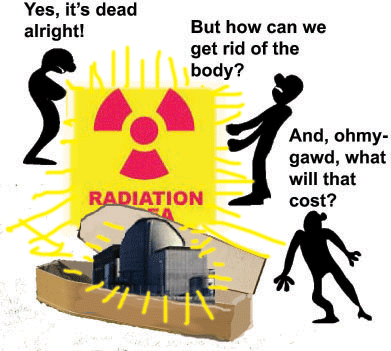 US operators urged to decommission immediately to prevent cost hikes, Nuclear Energy Insider, Sep 7, 2016 Nuclear plant operators should start decommissioning activities of shutdown reactors as early as possible as the deferral of decontamination and dismantling (D&D) exposes operators to delay-related costs, investment risks and loss of crucial expertise as workers leave the industry, Geoffrey Rothwell, Principal Economist at the OECD’s Nuclear Energy Agency, told Nuclear Energy Insider.
There are currently 17 U.S. nuclear power plants being decommissioned and this will soon increase following a recent spate of plant closure announcements due to sustained low power prices.
Operators have announced the early closures of California’s Diabolo Canyon, Nebraska’s Fort Calhoun and Illinois’ Clinton and Quad Cities plants in recent months as low gas prices, rising renewable energy capacity and energy efficiency measures pressure electricity prices.
The majority of current U.S. decommissioning projects are being carried out under the deferred “SAFSTOR” method of deferred decontamination, but this process incurs the risk of cost hikes, Rothwell said.
U.S. operators build up nuclear decommissioning trust funds (DTFs) based on estimated costs but data from completed projects shows the actual cost of decommissioning has varied substantially, as operators have faced fresh site-specific challenges and regulation which can differ between states.
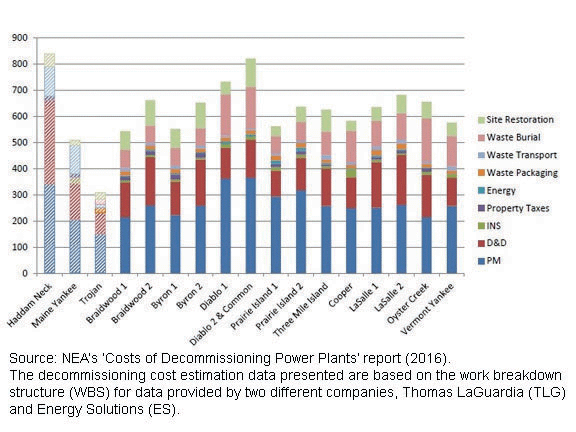
The variance in costs of three completed ‘immediate’ D&D projects was highlighted earlier this year in a report by the Nuclear Energy Agency (NEA), co-authored by Rothwell, which cited figures from a Pacific Northwest National Laboratories [PNNL] study.
The chart below shows actual costs for the Haddam Neck, Main Yankee and Trojan plants, laid out alongside estimated costs for 14 other reactors, showed large differences in spending on Project Management, Decontamination and Dismantling (D&D) and Waste Management.
Internal expertise
Project management costs tend to be a function of the duration of D&D activities, rather than plant size and this is highlighted by the data from completed projects, Rothwell noted.
Portland General Electric (PGE), licensee of the 1.2 GW Trojan plant, decided to perform the decommissioning of the plant itself and conducted the project efficiently and without major changes or setbacks.
In comparison, the licensees for the 582 MW Haddam Neck plant in Connecticut and the 900 MW Maine Yankee plant chose to contract the D&D work to a decommissioning operations contractor (DOC) and then later in the process they chose to resume execution of decommissioning activities themselves.
In both cases, the management changes led to complications and delays and escalated costs, NEA said in its report.
A major advantage of carrying out D&D activities immediately is that current operations staff have in-depth knowledge of plant specifics, including previous incidents and undocumented facility detail, which avoids unnecessary work-arounds, Rothwell said.
“The maintenance crew have all sorts of implicit, tacit knowledge…If you wait for 60 years they are all gone,” he said.
Dismantling challenge
Actual D&D costs have varied substantially as a lack of identical reference projects has meant operators have had to perform “first of a kind” operations such as the time-consuming task of dismantling main reactor components, Rothwell said.
“It’s cutting up the reactor and the steam generator, these are big pieces of equipment and we are just learning how to do this,” Rothwell said.
PG&E was able to limit the D&D costs for its Trojan plant through its access to the U.S. Ecology low-level waste facility at Hanford, Washington. PG&E was permitted to ship reactor internals to the Hanford facility as one package and avoid some of the on-site cutting-up of components.
At Haddam Neck, the segmentation of the internals proved challenging and took approximately 29 months, according to NEA’s report. Regulations also required the operator to store the internals on-site at the ISFSI.
The duration of D&D activities at Haddam Neck exceeded original estimates, as did the total radiation exposure accrued during the operations, NEA said.
“Decontamination of exposed faces of buildings and foundations were also extensive tasks,” it said.
The results of an environmental survey at the Trojan plant site indicated no radioactivity had spread to the environment, including surface water and groundwater, which also limited costs.
By deferring D&D activities for a substantial time, operators raise the chance of chemical or radiation leaks spreading, which can require further D&D work and incur higher costs, Rothwell said.
Waste rules
According to the NEA’s report, waste management costs do not necessarily depend on the capacity of the plant.
“Waste costs appear to be more sensitive to the management strategies and solutions selected or assumed, for the specific plant, and the related unit costs individually applied. The accessibility of waste management routes can even determine the way the decommissioning of the reactor is undertaken,” NEA said.
PG&E’s ability to ship the reactor vessel for the Trojan plant as a single package reduced the volume of waste and the number of radioactive shipments, and also reduced personnel exposure. However, NEA noted that without regulatory changes, the single package approach will not be available to other commercial nuclear plant decommissioning projects in the US.
In contrast, waste management costs for Haddam Neck were driven up by high volumes of waste produced, “mostly attributable to the release criteria and clean-up levels adopted by the State of Connecticut,” the report said.
Regulatory risk is another reason to commence D&D immediately as regulation is more likely to increase if there is a long time period before SAFSTOR facilities are decommissioned, Rothwell said.
Operators choosing to defer D&D also face investment risks for DTFs, in addition to escalating cost estimates, Rothwell noted.
Rates of return for DTFs have been lower than expectations, and operators which have accelerated closure plans should leverage current staff expertise and optimize decommissioning schedules to allocate decommission fund portfolios so the “liquidity matches your plans,” he said…….http://analysis.nuclearenergyinsider.com/us-operators-urged-decommission-immediately-prevent-cost-hikes?utm_campaign=NEI+07SEP16+Newsletter+B&utm_medium=email&utm_source=Eloqua&elqTrackId=ce386029dbb04d9db19579ed2046a746&elq=f4dbaf77167c423b93658800346bc887&elqaid=22066&elqat=1&elqCampaignId=9714
The “Red Button” nuclear war system can be reformed: Donald Trump’s rise illutrates the need for this
Once a president makes that decision, no one can stop it.
The problem is larger than any individual candidate or president.
Trump has single-handedly, albeit inadvertently, drawn the spotlight to the little understood danger inherent in continued U.S. reliance on a Red Button nuclear weapons strategy — one that’s geared for first-strike and quick-launch, with autocratic control in the hands of the president. For that, I suppose we should thank him — even as we mobilize to keep his finger as far away from the button as possible.
Fortunately, we can reform — and end — the Red Button nuclear system. Progress on this front can take a number of forms. We can ban the first use of nuclear weapons in a conflict, take our arsenal off hair-trigger alert, or even eliminate altogether the categories of weapons (land-based missiles) that are geared only for a quick-launch, first-strike attack. Any of these steps would make us safer and more secure. All of them have the backing of credible nuclear security experts.
 If President Trump Ordered A Nuclear Strike, No One Could Stop Him http://www.huffingtonpost.com/entry/if-president-trump-orders-a-nuclear-strike-no-one_us_57d05ca2e4b0273330aba003 09/07/2016 After years as a back-burner public issue, the terrible specter of nuclear war has come into focus as a first-order concern for the American electorate. This is due in part to rising tensions in recent years between the United States and Russia. But the most combustible fuel for this anxiety is the unlikely rise of Donald J. Trump.
Since Marco Rubio first opened this line of attack in late February — calling him “a lunatic trying to get ahold of nuclear weapons” — the unsettling prospect of Trump’s finger on the proverbial Red Button has steadily gained attention.
Unique among issues in these polarizing times, this concern now cuts across partisan divides. Scores of political leaders and national security experts from both political parties are questioning whether the Republican nominee has the experience, temperament and judgment to have his finger on that button. This view is shared by a substantial majority of the American public: only 27% trust him to make the right decisions about the use of nuclear weapons. Large blocs of voters now rate the handling of nuclear weapons as a top issue of concern for them in the election.
If you find the thought of Trump’s finger on the Red Button alarming, there is good reason. Just last month, MSNBC’s Joe Scarborough reported Trump asked three times in a one-hour policy briefing, “If we have nuclear weapons, why can’t we use them?”
More importantly, that button is shorthand for a deadly-efficient system built for blind deference and speed. It is extremely vulnerable to accidents, false warnings, rushed decision-making and bad judgment. There are no firewalls — legal, political, operational or otherwise — between a president’s itchy trigger finger and civilization-ending weaponry.
The thousands of nuclear weapons at the president’s disposal — each one 10-20 times more powerful than the bomb that obliterated Hiroshima — are locked in attack-mode, ready to fire at any moment. That adds the potential for catastrophic nuclear violence to every geopolitical conflict, every crisis, every misidentified flock of geese (seriously, it’s happened). Within minutes of receiving a short burst of computer code, they will launch from their silos and can’t be recalled.
Once a president makes that decision, no one can stop it.
Certainly, Trump is unfit for the task. His deficiencies on that score could fill a book. Time and again, he has shown himself easily baited and quick to lash out, dismissive of expert consultation, ill-informed of even basic international and military affairs — including, most especially, nuclear weapons (dropping them on Europe isn’t “off the table”).
But that critique, however accurate, misses the point: The problem is larger than any individual candidate or president.
Trump has single-handedly, albeit inadvertently, drawn the spotlight to the little understood danger inherent in continued U.S. reliance on a Red Button nuclear weapons strategy — one that’s geared for first-strike and quick-launch, with autocratic control in the hands of the president. For that, I suppose we should thank him — even as we mobilize to keep his finger as far away from the button as possible.
But we should bear in mind that this catastrophic threat didn’t end after the Cold War, and it won’t end after the fall of Donald Trump. We must dismantle the unjust, undemocratic and terrifyingly absolute power bound up in that button and the insane system it represents. It shouldn’t be harder for the president to appoint a mid-level bureaucrat than it is to kill hundreds of millions of people.
Fortunately, we can reform — and end — the Red Button nuclear system. Progress on this front can take a number of forms. We can ban the first use of nuclear weapons in a conflict, take our arsenal off hair-trigger alert, or even eliminate altogether the categories of weapons (land-based missiles) that are geared only for a quick-launch, first-strike attack. Any of these steps would make us safer and more secure. All of them have the backing of credible nuclear security experts.
At the Republican primary debate in December, Trump pointed to the possibility of a “madman getting his hands on a nuclear weapon” as the biggest problem the American people would face. He had it partly right. It’s not just the madman from a rogue nation we should lose sleep over. It’s the idea that any single person anywhere — including in the United States — has a Red Button at their fingertips and the power to light the world on fire.
___
Derek Johnson is the executive director of Global Zero Action, the U.S. advocacy arm of the international Global Zero movement to eliminate nuclear weapons, and spokesman for the #NoRedButton campaign. For more information, visit www.noredbutton.org.
$25,000 funnelled into Cabinet Minister’s riding, by nuclear company SNC Lavalin
 Cabinet minister’s riding may have received $25K from SNC-Lavalin execs CTVNews.ca Staff CTV News, , November 28, 2014
SNC-Lavalin executives involved in an illegal political slush fund for Quebec provincial parties may have conducted the same practice at the federal level, CTV News has learned.
Elections Canada records reveal that 10 top SNC-Lavalin managers and their wives wrote personal cheques in 2009 to two federal Conservative riding associations that showed little chance of winning.
A total of $25,000 was funnelled to the ridings of Laurier-Sainte-Marie and Portneuf-Jacques-Cartier……..
A top SNC-Lavalin executive has previously admitted to Quebec’s corruption inquiry, the Charbonneau Commission, that the company illegally donated more than $1 million to Quebec provincial parties.
Managers made personal donations and were reimbursed with salary bonuses……http://www.ctvnews.ca/politics/cabinet-minister-s-riding-may-have-received-25k-from-snc-lavalin-execs-1.2125096
Canada’s federal election rules violated by nuclear company SNC-Lavalin
SNC-Lavalin violated election rules with campaign donations, commissioner rules
CBC News September 8, 2016 The federal elections commissioner says SNC-Lavalin has entered into a compliance agreement for making nearly $118,000 in contributions that violated the Canada Elections Act over a seven-year period.
Problematic contributions made between 2004 and 2011 The Canadian Press Sep 08, 2016
The federal elections commissioner says SNC-Lavalin has entered into a compliance agreement for making nearly $118,000 in contributions that violated the Canada Elections Act over a seven-year period.
The commissioner says the contributions were made to the Liberals and Conservatives between March 9, 2004, and May 1, 2011.
In the past, CBC has reported on one instance of something similar, in which a number of SNC-Lavalin executives and their families donated $15,000 to the campaign of a conservative candidate in the 2011 election.
The commissioner’s report Thursday singles out almost $118,000 in contributions made to federal parties and subsequently reimbursed, including:
- Liberal Party of Canada: $83,534.51;
- Various registered riding associations of the Liberal Party of Canada: $13,552.13;
- Contestants in the Liberal Party of Canada’s 2006 leadership race: $12,529.12;
- Conservative Party of Canada: $3,137.73; and
- Various registered riding associations and candidates of the Conservative Party of Canada: $5,050.00.
- According to the compliance agreement, the commissioner says former senior executives with the Montreal-based engineering firm solicited employees to make political contributions and in some cases, those employees were reimbursed with false personal expenses, fictitious bonuses or other benefits……….http://www.cbc.ca/news/business/snc-lavalin-campaign-donations-1.3752869?cmp=rss
Terrestrial Energy faces safety risks and poor market prospects for its new nuclear reactors
Nuclear Firm’s $17 Million Bid on a New Reactor Design “…….Terrestrial Energy is looking to use the money raised up until now to complete the first phase of the Canadian Nuclear Safety Commission’s pre-licensing vendor design review, a technology assessment usually carried out in advance of a license application……
“Dirty tools, dirty components, cleansers [and] foreign material in the coolant stream will cause the coolant to activate over time,” he predicted. “I’m curious what the releases and radioactivity accident risks look like with the coolant after 10 years of operation.”……
Even if Terrestrial Energy is able to sail through licensing and brush off safety concerns, though, it will still have to overcome the problem of a diminishing appetite for nuclear power across a number of the industry’s key markets, including the U.S…... Greentech Media 8 Sept 16
US-China Cooperation on N. Korean Nuclear Threat is undermined by national rivalries
US-China Tensions Undermine Cooperation on N. Korean Nuclear Threat SEOUL — VOA NEWS 8 SEP 16 Washington and Beijing’s longstanding agreement on the need to persuade North Korea to give up its nuclear ambitions is, analysts say, splintering over rising tensions in the region and diverging national interests.
American and South Korean officials, as well as analysts from China and Russia, addressed the increasingly complex security situation on the Korean peninsula at the Seoul Defense Dialogue on Thursday, organized by the South Korean Ministry of Defense.
Stay the course
Kim Hong-kyun, the South Korean Special Representative for Korean Peace and Security Affairs, called for continued international support to pressure the Kim Jong Un government to curb its defiant and continued development of nuclear weapons and ballistic missiles……..
The latest round of United Nations sanctions caused economic pain, especially, Kim said, in trade, shipping and finance. However, since the new restrictions were imposed in March, North Korea has conducted 20 tests of short and medium range missiles, including submarine-based launches, advancing its capability to reach the U.S. mainland with a nuclear strike.
Both Kim and U.S. Undersecretary of Defense David Shear noted that diplomatic outreach is at a standstill as both Seoul and Washington demand that Pyongyang first take significant action to dismantle its nuclear program before any talks can occur.
“Unfortunately, today there have been no credible signs that North Korea is ready to move down this path,” Shear said.
China For sanctions to be effective, China’s support remains crucial as it is North Korea’s economic lifeline. Nearly 90 percent of all North Korean trade flows through China.
Shi Yinhong, a professor of international relations at Renmin University in China, said officials in Beijing have doubts that sanctions alone will force Pyongyang to change……..http://www.voanews.com/a/us-china-tensions-north-korea-nuclear-threat/3498672.html
Political deception aimed at sabotaging the nuclear agreement with Iran – phony news
 Media Trumpet Another Phony “Secret Nuclear Deal” Story , 08 September 2016 By Gareth Porter, Truthout | News Analysis Two major media outlets — Reuters and The Washington Post — pushed another Iran “secret side deal” story last week, ignoring obvious facts that revealed it as clever political deception aimed at sabotaging the nuclear agreement with Iran.
Stories in both of those outlets suggested that a leading think tank had revealed a secret deal that allowed Iran to exceed various qualitative and quantitative limits placed on it under the nuclear agreement reached last year — the main current theme of political opponents of the agreement. The stories were based on claims in a report co-authored by David Albright, the head of the Institute for Science and International Security, who has long been treated by corporate media as the leading “independent” expert on Iran’s nuclear program.
In fact, as Truthout revealed in 2014, Albright had abandoned any independence he had maintained on Iran as early as 2008 and had aligned his position on nuclear negotiations with Iran with those of the Bush administration and Israel…….
Albright’s attack on the Obama administration and the Joint Commission was only the latest installment in the current campaign by pro-Israeli media and political opponents of the JCPOA to claim existence of “secret side deals” between the Obama administration and Iran. Just six weeks ago, the Associated Press correspondent in Vienna, George Jahn, published a story that falsely portrayed Iran’s report to the International Atomic Energy Agency [IAEA] on its plan for implementation of the agreement as such a “secret side deal.” The agreement reached between Iran and the IAEA on the issue of alleged past Iranian nuclear work, which included arrangements for taking environmental samples at Iran’s Parchin military facility, was also treated by JCPOA opponents as a “secret side deal.” http://www.truth-out.org/news/item/37527-media-trumpet-another-phony-secret-nuclear-deal-story
1 This Month
19 November – Webinar – The Reality of Reprocessing
Time: 11:00 AM Pacific Time (US & Canada) / 2:00 PM Eastern / 7:00 PM UK / 8:00 PM CET
Register for the Zoom Event Here

Tell Congress: Prevent Nuclear Catastrophe in Iran

Tell Congress: Prevent Nuclear Catastrophe in Iran

Read the Public Inquiry Report, the Commissioners’ report, Surrendering Australia: The AUKUS Deception is available to download for free at aukuspublicinquiry.com. Or just watch the replay of the National Press Club Luncheon.


Shut down the radiation-damaged Heysham nuclear reactors now
To see nuclear-related stories in greater depth and intensity – go to https://nuclearinformation.wordpress.com

Say No to NASA’s Reckless Nuclear Reactor on the Moon
Say No to NASA’s Reckless Nuclear Reactor on the Moon
-
Archives
- November 2026 (178)
- October 2026 (302)
- September 2026 (339)
- August 2026 (330)
- July 2026 (355)
- June 2026 (287)
- May 2026 (306)
- April 2026 (356)
- March 2026 (251)
- February 2026 (267)
- January 2026 (308)
- December 2025 (358)
-
Categories
- 1
- 1 NUCLEAR ISSUES
- business and costs
- climate change
- culture and arts
- ENERGY
- environment
- health
- history
- indigenous issues
- Legal
- marketing of nuclear
- media
- opposition to nuclear
- PERSONAL STORIES
- politics
- politics international
- Religion and ethics
- safety
- secrets,lies and civil liberties
- spinbuster
- technology
- Uranium
- wastes
- weapons and war
- Women
- 2 WORLD
- ACTION
- AFRICA
- Atrocities
- AUSTRALIA
- Christina's notes
- Christina's themes
- culture and arts
- Events
- Fuk 2022
- Fuk 2023
- Fukushima 2017
- Fukushima 2018
- fukushima 2019
- Fukushima 2020
- Fukushima 2021
- general
- global warming
- Humour (God we need it)
- Nuclear
- RARE EARTHS
- Reference
- resources – print
- Resources -audiovicual
- Weekly Newsletter
- World
- World Nuclear
- YouTube
-
RSS
Entries RSS
Comments RSS

