Risk of a military conflict between Moscow and Washington has been overstated
The risk of a military conflict between Moscow and Washington has been overstated. However, both sides should think about prevention mechanisms to minimize the risk of accidents that could lead to an open conflict. The expert community has been crying wolf for a long time now: “War is at the doorstep!” The gloomy predictions indicate that Russia and the United States are at the brink of direct military clashes, as if they were trying to celebrate the 54th anniversary of the Cuban Missile Crisis in some perverse way. However, any conflict, if it happens, will most probably be accidental – the parties are not yet ready for full-scale military confrontation.
In the last few years, Russia has been modernizing its armed forces to replace the outdated Soviet-era materiel and structure. Numerous exercises, trillions of rubles spent, new equipment and combat vehicles emerging out of the blue, and a charismatic defense minister who changed the entire image of the Russian Army and brought back its popularity with society – all these steps provided for the fast (and real) growth of national military might.
However, it remains rather limited in comparison with the overall total potential of theNATO states. Some would say that the alliance is reluctant to take any serious decisions and is nothing more than a paper tiger. Nonetheless, the brainwashing of the last two years has significantly improved the decision-making capacity of NATO and the chances for achieving consensus over the “Russian threat.”
The ability to mobilize quickly strong conventional forces is still low, as NATO generals admit themselves. However, active recent revival of the nuclear sharing arrangements and the consolidation of U.S. troops in various countries of Central and Eastern Europe present enough deterrence against any light-minded action. It is clear that the war will not happen in Europe (and not even in Ukraine with its unpredictable leadership). However, wherever it occurs, NATO forces can eventually be mobilized to help their allies.
Moreover, Moscow has largely been pursuing a defensive policy over the past 16 years. Even now, when “the Russians are (seemingly) coming,” an independent observer would probably notice that the lion’s share of the activities of Moscow are reactive rather than proactive. …….
Two factors raise the probability of an armed clash between Russia and the U.S. One of them is rhetoric. There have been more words than action so far and there is a clear trend– nobody is responsible for their words any longer. Any of the statements of the last few months would mean immediate war in the 19th or even in the 20th century. Nowadays, politicians throw thousands of words against each other and the struggle is with the minds and hearts and not with bodies. However, such belligerent rhetoric creates the climate of antagonism and public anticipation of a conflict. As a result, such atmosphere may facilitate prompt steps “in response” to another accident.
The second factor is, paradoxically, the low importance of the regional conflicts. Syria is so far away from Moscow and Washington that the parties do not really care about its future, its population and even its militants. Both Russia and the United States can afford there much more than they could in Ukraine, for instance (where actually none of them cared about the fate of Ukraine, but the proximity of Europe made it more difficult to fight). And such lack of significance may lead to a dangerous neglect of dramatic consequences of any armed clash and make the decision-making process easier to go to war.
Nowadays, Russia and the United States demonstrate wisdom and restraint. Given the current leadership in both countries, the expectations of war will hopefully stay just that– expectations. However, the situation may change next year and it would be better for the parties to think about some minimal confidence-building measures and provide for the prevention of accidents, any of which may become fatal, just like an accidental missile launch during the Cold War era. http://www.russia-direct.org/opinion/why-military-conflict-between-russia-and-us-unlikely
Can we afford to just laugh off the absurdities of Trumpism in this age of the Anthropocene?
The fervent Trump supporter has told his viewers that the both US president, Barack Obama, and the Democrat nominee, Hilary Clinton, were “literal demons” who smelt of sulphur. I kid you not.
In Australia, we have a senator who similarly sees climate change as a thing made up by the UN. Our top-rating radio host, Alan Jones (no relation), has said climate science is “witchcraft”.
There’s now a whole media ecosystem that climate science denialism can exist inside, where there’s little scrutiny of the views of deniers. US-based sites like the Drudge Report, Infowars, Breitbart and Daily Caller are part of that ecosystem.
For a while, maybe the Trumpocene and the Anthropocene can coexist.
But even though they exist on separate plains, can we really afford to dismiss the impact of either of them?
 We are approaching the Trumpocene, a new epoch where climate

change is just a big scary conspiracy https://www.theguardian.com/environment/planet-oz/2016/oct/21/we-are-approaching-the-trumpocene-a-new-epoch-where-climate-change-is-just-a-big-scary-conspiracy Graham Readfearn
Websites pushing climate science denial are growing their audience in an era where populist rhetoric and the rejection of expertise is gaining traction For years now geologists have been politely but forcefully arguing over the existence or otherwise of a new epoch – one that might have started decades ago.
Some of the world’s most respected geologists and scientists reckon humans have had such a profound impact on the Earth that we’ve now moved out of the Holocene and into the Anthropocene.
It’s not official. But it’s close.
Dropping nuclear bombs and burning billions of tonnes of fossil fuels will do that to a planet, as will clearing swaths of forests to make way for food production and supermarket car parks and the like.
That’s all in the real world though, and sometimes you might get the horrible, chilling idea that when it comes to the production of our thoughts and ideas, that’s not the place a lot of us live anymore.
So I’d like to also propose the idea of an impending new epoch – the Trumpocene – that in the spirit of the era itself is based solely on a few thoughts held loosely together with hyperlinks and a general feeling of malaise.
In the Trumpocene, the epoch-defining impacts of climate change are nothing more than a conspiracy. Even if these impacts are real, then they’re probably good for us.
The era is named, of course, for the phenomenon that is Donald Trump, the Republican pick for US president whose candidacy has been defined by a loose grasp of facts, jingoistic posturing, populist rhetoric, his amazing hair and his treatment of women.
So what are the things that might define the Trumpocene?
Is it the point at which large numbers of people started to reject the views of large groups of actual experts – people with university qualifications and things – in exchange for the views of anyone who agrees with them? (Brexit, anyone?) Continue reading
Over $8.25 billion to extend the life of B61-12 atomic bomb
 Updated B61 Nuclear Bomb to Cost $8.25 Billion, Defense News, By: Aaron Mehta, October 19, 2016 WASHINGTON – The life-extension program for the B61-12 atomic bomb will cost just over $8.25 billion, according to a new estimate from the National Nuclear Security Administration (NNSA).
The new cost estimate was completed over the summer as the agency prepared to enter the production-engineering phase of the program. The baseline cost of the program is $7.605 billion, with an additional $648 million in “funds leveraged from other NNSA programs for technology and manufacturing readiness,” according to an agency statement – money that has common applications across multiple weapon systems.
That cost does not include the estimated $1.3 billion that the Department of Defense plans to spend on developing and procuring tailkits for the weapons. With that included, the total cost for the program sits at roughly $9.5 billion.
The agency is perusing a modernization plan known as the “3+2 Strategy,” under which the NNSA is consolidating the American arsenal of warheads into five variants. The five ballistic-missile warheads now in service are being consolidated into three new interoperable warheads known as the IW-1, IW-2, and IW-3, while the five bomb and cruise-missile warhead types are being consolidated into two replacement warhead designs, the W80-4 and the B61-12. …….http://www.defensenews.com/articles/updated-b61-nuclear-bomb-to-cost-825-billion
Dairyland Power gets major compensation for radioactive trash from its nuclear reactor that closed in 1987
Feds to pay Dairyland $73.5 million in nuclear settlement Dairyland Power has reached a major settlement with the U.S. Department of Energy over nuclear waste stored from its former nuclear reactor located at the La Crosse Boiling Water Reactor in Genoa.
Nuclear Energy Institute is lobbying for new tax credits
 Nuclear power industry seeks new tax credits, Union Bulletin.com
The nuclear industry has faced a host of issues in the past decade that have shrunk its profits. By JEREMY DILLON of CQ-Roll Call , 20 Oct 16 WASHINGTON — Beset by low natural gas prices and tax advantages for its competitors, the nuclear power industry is seeking new tax credits to help it find its footing in an increasingly challenging marketplace.
Plant Vogtle Nuclear Company is now rewarded for bungling and delays
 Proposed Agreement Would Reward Southern Company for Bungled, Massively Over Budget and 45-Month Delayed Plant Vogtle Reactors http://www.cleanenergy.org/2016/10/21/proposed-agreement-would-reward-southern-company-for-bungled-massively-over-budget-and-45-month-delayed-plant-vogtle-reactors/
Jennifer Rennicks, SACE, 865.235.1448 Atlanta, Ga. Late Thursday the Georgia Public Service Commission (PSC) Staff issued a proposed Stipulation Agreement that fails to protect Georgia Power customers for increased costs associated with the now 45-month delayed, over budget nuclear reactors under construction at Plant Vogtle near Waynesboro along the Savannah River. The estimated capital cost forecast has increased $1.262 billion for Georgia Power’s share of the project to $5.680 billion from the original $4.418 billion. The PSC press statement identified what appear to be only phantom savings to utility ratepayers while granting the Company guarantee of collection of billions of dollars in increased project costs.
Key items in the proposed Stipulation include:
- A defacto extension of the construction schedule from the current 39-month delay to 45 months with acknowledgement that it could be even further delayed, with nominal penalty for the Company.
- Capital costs up to $5.680 billion are considered reasonable and prudent thus no review in the future; despite the fact that $3.68 billion has been spent in capital costs as of the 15th Vogtle Construction Monitoring (VCM) report. This appears to represent approval of $2 billion in advance of those capital costs even being spent.
- The phantom cost savings to customers over the next four years appears to be due to merely slowing down the collection of financing costs versus actually denying the Company collection of these costs.
Below is a statement from Southern Alliance for Clean Energy’s High Risk Energy Choices Program Director Sara Barczak, an intervening party in the Vogtle Supplemental Information Review process, which the clean energy organization has criticized as an expedited, quasi-prudency review:
Halloween came early in Georgia given the clear treats offered to Southern Company (parent Company of Georgia Power) and the tricks doled out to utility customers. The proposed Stipulation is a major disappointment to consumers for many reasons.
Not one penny of construction costs associated with the construction delay was disallowed, including the $700 million in additional financing costs caused by the delay. Georgia Power will collect 100% of its financing costs. Most of the $325 million in phantom cost reduction to customers is only a delay in collecting financing charges. Georgia Power shareholders may see a tiny drop in their earnings but remain largely protected.
While Georgia Power has spent $3.68 billion on the Project to date, the Stipulation certifies $5.680 billion in construction costs as “prudent” and “reasonable” – essentially an advance approval of $2 billion dollars.
Finally, there is no public record to evaluate whether the PSC Staff negotiated a fair deal or rolled over to the utility company demands.
The proposed Stipulation clearly rewards Southern Company for their and their Contractors’ bungling of the troubled Vogtle nuclear construction project, which has been plagued with a plethora of serious design, engineering and construction problems from Day One that were identified by PSC Staff over years of testimony.
Georgia Power customers will realize little benefit should the Georgia Public Service Commissioners approve this proposal. It’s really sad to see yet another big power company receiving essentially a free pass for their mistakes that will cost families and businesses money.
Additional information: Originally Vogtle reactor Unit 3 was scheduled to come online April 1, 2016 and Unit 4 one year later. As of the 15th VCM report, schedule estimates were June 2019 and June 2020 respectively, a 39-month delay, with a cost estimate of $7.862 billion. The current certified cost for Georgia Power’s share of the project is approximately $6.113 billion. Customers are already paying an additional 9.4% on their monthly bills for the Nuclear Construction Cost Recovery (NCCR) costs due to anti-consumer state legislation passed in 2009 to incentivize building new reactors. Over $1.8 billion in pre-collected financing costs have been charged to ratepayers and the financing costs represent the largest share of the project’s cost overruns. The original approximately $14.1 billion Vogtle project is now estimated to cost well over $20 billion. Georgia Power is 45.7% owner in the project (remaining utility partners are Oglethorpe Power (30%), MEAG (22.7%) and the City of Dalton (1.6%)).
Find more information about Plant Vogtle’s expansion here.
America’s Congressional hawks rev up their anti Russia rhetoric
Amid Rising Tensions, Old Allegations Spark New Panic
Two and a half years later, tensions with Russia are on the rise again, so officials appear to have decided that the exact same 2008 test is suddenly a huge thing again, with a number of Congressional hawks issuing a letter claiming the Russian test was an “egregious” violation, and demanding that the Obama Administration “impose penalties” on Russia over it.
Russia had threatened to withdraw from the INF over NATO’s expansion into Eastern Europe, saying it changed the balance of power in the region. They were also riled by the Bush Administration’s threats to install missile defense along the Russian frontier.
The missiles in question are a multi-stage system Russia designed which are aimed to technically comply with the letter of the treaty, while expanding intermediate range capabilities in ways that the treaty was meant to forbid. The US has made similar developments over the years since 1987.
With US officials riled at Russia over Aleppo, and presenting the fighting in the city as a “holocaust,” they have also brought up several other grievances they have with Russia, accusing them of everything from treaty violations to supporting Donald Trump.
It’s interesting to note, however, that most of the grievances aren’t particularly new, and didn’t have a lot of meat to them the last time they brought them up. The effort seems to be to just keep Russia’s name out there, and always in a negative light.
USA wants meeting with Russia Over Missile Treaty Dispute
U.S. Calls For Meeting With Russia Over Missile Treaty Dispute , Radio Free Europe, 20 Oct 16 WASHINGTON — The United States has called for a special meeting with Russia over alleged violations of a landmark Cold War-era arms-control treaty, a policy reversal that echoes deepening U.S. fears about Moscow’s intentions.
The planned meeting of the Special Verification Commission, scheduled in the near future, focuses new attention on concerns about the 1987 Intermediate-range Nuclear Forces treaty (INF).
The treaty, which bans testing, producing, and possessing ground-launched cruise missiles with ranges between 500 to 5,500 kilometers, eliminated an entire class of missiles from Europe, and set up an extensive system of verification and compliance. The agreement was considered crucial in the thaw between the Soviet Union and the United States.
Two years ago, the United States first asserted that Russia was in violation of the treaty, by developing a missile system that fell within the INF prohibitions. Moscow denied the allegations, and later charged that U.S.-led efforts to install elements of a missile-defense system in Europe were in fact prohibited by the INF.
Since then, U.S. officials have pressed Russia on the alleged violations; at one point, President Barack Obama raised the issue directly with his Russian counterpart, Vladimir Putin……..http://www.rferl.org/a/us-calls-meeting-with-russia-nuclear-missile-deployment-concern-russian-nuclear-arms-buildup/28064316.html
What happens if you stand up to the fossil fuel industry: the Amy Goodman saga
Amy Goodman showed us the perils of standing up to the fossil fuel industry https://www.theguardian.com/commentisfree/2016/oct/18/amy-goodman-perils-standing-up-fossil-fuel-industry
May Boeve
The rights of activists and journalists are under threat wherever communities challenge Big Oil – in North Dakota and beyond. For far too long, the world had been ignoring the North Dakota anti-pipelines protests. Then the Democracy Now! host Amy Goodman captured private security forces (employed by a fossil fuel company)sicking dogs on Native Americans during a peaceful demonstration against the Dakota Access Pipeline, which encroaches on their sacred lands and waters. For that, she nearly went to jail.
The video made Goodman a target of North Dakota authorities, who brought charges of trespassing and rioting against her and the native leaders on the ground during the dog attack. Yes, a journalist was threatened with punishment for reporting on the horrific attack on indigenous people.
Authorities said Goodman didn’t deserve press protections because her opinions made her an “activist” instead of a journalist. Are we to punish every journalist who calls out state violence as he or she sees it? How could you not have an opinion in the face of such brutality? Should Walter Cronkite have gone to prison for his words about Vietnam?
Clearly not. Organizations defending freedom of the press decried the charges against Goodman. Activists like ourselves rallied behind her cause online because we understand the importance of a free press to social change. And on Monday, a North Dakota judge dropped the charges due to lack of probable cause.
It’s a win for freedom of the press, but intimidation by the fossil fuel industry and its government allies is far from over. Native leaders at the Standing Rock camps know this all too well, as they continue to face arrests by North Dakota police and pressure by Energy Transfer Partners, the company behind the pipeline.
There’s no question that Goodman’s fearless reporting helped make this act of brutality a turning point in the fight to stop the Dakota Access Pipeline. Soon after her broadcast, the Obama administration stepped in and paused the project until there could be “further consultation” of indigenous peoples. Suddenly, TV news and the mainstream media took up the story in a serious way for the first time. Thousands of more people headed out to the camp.
The trampling of our rights as activists, or as journalists, isn’t just a problem in North Dakota. It’s also a fight that’s playing out around the world wherever communities stand up to the fossil fuel industry and other corporate interests destroying our communities and climate.
We see it in the murder of activists like Berta Cáceres in Honduras. We see it in the Philippines, where anti-mining activists are being murdered by paramilitary groups. According to a report by Global Witness, 185 environmental activists in 16 countries were killed last year and the number is just going up.
Despite this violence, the movement to challenge the fossil fuel industry has continued to grow more powerful, and we’re not backing down. As the work to stop the Dakota Access Pipeline continues, I’m honored to stand in solidarity with the incredible Native American leaders at Standing Rock who are putting their bodies on the line to shut this destructive project down. The photos and videos of their brave actions have become lightning rods, channeling tremendous new energy into this movement. This is a historic fight unfolding in real time.
The images of resistance at Standing Rock are a call to action. We cannot let the rights of indigenous peoples be sidelined by the fossil fuel industry, and we can’t afford another pipeline if we want to maintain a livable planet.
We also must fiercely defend the rights of activists and journalists alike to tell stories like these, stories that often unfold in sacrifice zones far from the “halls of power”, and to tell them fairly and honestly. This won’t be the last fight against a pipeline and Amy Goodman won’t be the last journalist brought to court for reporting about the fossil fuel industry. The struggle continues, together.
America moves to silence Wikileaks
Washington moves to silence WikiLeaks, WSW, 19 October 2016
The cutting off of Internet access for Julian Assange, the founder of WikiLeaks, is one more ugly episode in a US presidential election campaign that has plumbed the depths of political degradation.
Effectively imprisoned in the Ecuadorian embassy in London for over four years, Assange now is faced with a further limitation on his contact with the outside world.
On Tuesday, the Foreign Ministry of Ecuador confirmed WikiLeaks’ charge that Ecuador itself had ordered the severing of Assange’s Internet connection under pressure from the US government. In a statement, the ministry said that WikiLeaks had “published a wealth of documents impacting on the US election campaign,” adding that the government of Ecuador “respects the principle of non-intervention in the internal affairs of other states” and “does not interfere in external electoral processes.” On that grounds, the statement claimed, the Ecuadorian government decided to “restrict access” to the communications network at its London embassy……
WikiLeaks cited reports that Secretary of State John Kerry had demanded that the government of Ecuador carry out the action “on the sidelines of the negotiations” surrounding the abortive Colombian peace accord last month in Bogota. The US government intervened to prevent any further exposures that could damage the campaign of Clinton, who has emerged as the clear favorite of the US military and intelligence complex as well as the Wall Street banks.
Whether the State Department was the only entity placing pressure on Ecuador on behalf of the Clinton campaign, or whether Wall Street also intervened directly, is unclear. The timing of the Internet cutoff, in the immediate aftermath of the release of Clinton’s Goldman Sachs speeches, may be more than coincidental…….http://www.wsws.org/en/articles/2016/10/19/pers-o19.html
Final presidential debate reveals sobering facts on how fast nuclear war could happen
 Clues to the end of the world shared during final 2016 presidential debate, Mondoweiss, Wilson Dizard on October 20, 2016 “……Four minutes is what it takes between the president’s decision to fire nuclear missiles, Clinton claimed during the debate, and their launch………..Here is the most illuminating exchange on nuclear weapons, according to a transcript published by the Washington Post. Clinton gave a clinical description of how fast nuclear weapons can be fired away at a president’s command. That information was perhaps a subtle way of warning Russian president Vladimir Putin that we remain the fastest guns in the West.
CLINTON: “I — I find it ironic that he’s raising nuclear weapons. This is a person who has been very cavalier, even casual about the use of nuclear weapons. He’s advocated more countries getting them, Japan, Korea, even Saudi Arabia. He said, well, if we have them, why don’t we use them, which I think is terrifying.
But here’s the deal. The bottom line on nuclear weapons is that when the president gives the order, it must be followed. There’s about four minutes between the order being given and the people responsible for launching nuclear weapons to do so. And that’s why 10 people who have had that awesome responsibility have come out and, in an unprecedented way, said they would not trust Donald Trump with the nuclear codes or to have his finger on the nuclear button……..
What Trump doesn’t seem to understand that defending Saudi Arabia, Germany, Japan and South Korea means defending major trading partners and, in the case of Saudi Arabia, a sand seared ocean of oil. But if the American nuclear umbrella suddenly closed, all of those countries could have nuclear weapons ready within weeks or months. The details are unimportant. What’s nauseatingly disturbing is that we are discussing the possibility of nuclear war at all. After all, this is 2016, right? If the arc of history bends towards justice, a nuclear holocaust is the thing that would blow that arc to smithereens. The real end of history
Clinton, for her part, recommitted herself to a no-fly zone in Syria, a provocation to Russian air forces the U.S. blames for bombing civilians and Western-friendly rebels. She also said that the occupation of Iraq would “not be in our interest,” while not mentioning that the Iraqis also have their objections to American military occupation. Classic Clinton.
This is all happening while thousands of nuclear weapons in the United States and Russia stand waiting to incinerate you and your family, if necessary………http://mondoweiss.net/2016/10/clues-presidential-debate/
Fact checking Donald Trump – got his facts wrong on USA-Russia nuclear START Treaty
 AP FACT CHECK: Trump gets facts wrong on START Treaty http://www.usnews.com/news/politics/articles/2016-10-19/ap-fact-check-trump-gets-facts-wrong-on-start-treaty
AP FACT CHECK: Donald Trump is wrong to say that only Russia can still create warheads under the New START treaty limiting nuclear weapons A claim from the final presidential debate and how it stacks up with the facts:
Costing more than $6 billion and 40 years later – America’s Watts Bar nuclear reactor turned on
The reactor has been more than 40 years in the making and cost approximately $6 billion to complete, not adjusting for inflation.
Watts Bar Unit 2 is one of five reactors in the U.S. expected to open in the next five years. However, cost overruns and delays are leading critics to question whether new nuclear plants will be built in the future.
Construction on Watts Bar Units 1 and 2 began in 1973. Work stopped on Unit 2 in 1985 due to deficiencies at the plant. Unit 1 began operation in 1996. In 2007, the TVA began efforts again to complete Unit 2, submitting an updated license application to the Nuclear Regulatory Commission in 2009 and received its operating license in October 2015. Unit 2 is the first new reactor in the U.S. since its sister plant started operations.
The Unit 2 startup comes at a time when nuclear operators have shut down—or announced plans to shut down—10 reactors in five states due to difficulty competing against low natural gas prices, according to the Nuclear Energy Institute, which represents the nuclear industry. The group predicts that an additional 15 to 20 nuclear reactors are at risk of premature closure in the coming years.
Marvin Fertel’s, NEI’s president and CEO, praised TVA’s completion of the plant……..
Mark Cooper, a senior research fellow for economic analysis at the Vermont Law School, said it is no longer financially viable to build new reactors in the U.S. Watts Bar Unit 2 “is not a monument to the future nuclear power, it’s a mausoleum for the future of nuclear power,” he told Bloomberg BNA Oct. 19.
Watchdogs Say Building Nuclear Too Costly
The TVA estimates that it spent $1.3 billion originally on the project. Work resumed after the board of directors approved $4 billion to $4.5 billion to complete the reactor in 2012, and then later approved an additional $200 million in 2016, bringing total estimated costs to $6 billion.
Critics say that the $6 billion price tag to complete Watts Bar Unit 2 is a reminder of the expense of building nuclear reactors today.
Tim Judson, executive director of the Nuclear Information and Research Service, a information center for environmentalists concerned about nuclear power and radioactive waste, said he would estimate Watts Bar Unit 2 cost between $7 billion and $8 billion when adjusted for inflation.
“As an economic enterprise, they are doomed,” Cooper said of nuclear reactors in the U.S………
To contact the reporter on this story: Rebecca Kern in Washington atrKern@bna.com
To contact the editor responsible for this story: Larry Pearl atlpearl@bna.com https://news.google.com/news/story?ncl=dD89j-wHhzuijvMA6PD5gUuZYagbM&q=nuclear&lr=English&hl=en&sa=X&ved=0ahUKEwiI5uq6k-rPAhWrqlQKHfGrApMQqgIIIjAB
Energy utilities sue New York Public Service Commission’s (PSC) over subsidies to nuclear industry

 Energy industry coalition sues NY PSC over nuclear subsidies Reuters 19 Oct 16 An energy industry coalition including competitive non-nuclear electricity producers sued on Wednesday to oppose a plan to subsidize nuclear power plants in New York State.
The lawsuit in federal court said the New York Public Service Commission’s (PSC) plan to raise electric rates across the state by requiring consumers to pay for zero emission credits (ZECs), infringes illegally into federal regulators’ territory.
The coalition said in a statement that the litigation was “solely to save several New York nuclear plants that, allegedly, can no longer compete successfully in the federally-regulated wholesale electric power market.”…..Coalition members opposed to the nuclear subsidies include units of Dynegy Inc and NRG Energy Inc. http://www.reuters.com/article/us-new-york-nuclear-idUSKCN12J2N2
Financial disaster of America’s failed Mixed Oxide Fuel Fabrication Facility (MOX)
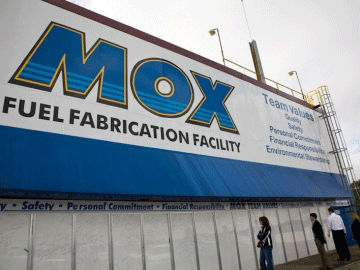
 Nuke Fuel Facility Costs Ten Times Estimate, is 41 Years Behind Schedule http://www.pogo.org/straus/issues/nuclear-security/2016/nuke-fuel-facility-costs-ten-times-estimate-41-years-behind-schedule.html?referrer=https://t.co/yn7hBkHF1d By: Lydia Dennett | October 13, 2016 Imagine you have a contractor working on your house. They quoted you a price and told you the project would be done in no time. Sure, you realize costs will probably go up some and the schedule will slip due to an unexpected problem or two. But months turn into years, years turn into a decade, and now, 14 years later, you find that they’ve already spent five times their original estimate and they aren’t even halfway done!
That’s the situation the Department of Energy is facing with the contractor building a nuclear fuel facility in South Carolina. The Mixed Oxide Fuel Fabrication Facility, known as MOX, is a multi-billion dollar boondoggle that is behind schedule, is over budget, and will never be able to complete its mission. Now the Army Corps of Engineers has released an independent cost estimate for the project that reveals things are even worse than we thought.
MOX was originally conceived as part of an agreement between the United States and Russia in which each country pledged to dispose of weapons grade plutonium. But that was back in 2000. As cost overruns and the technical failure has become clear, the Department of Energy asked Congress to cancel the program this year. The South Carolina delegation, defending jobs in their districts, pushed back and claimed doing so would violate the agreement. Last week Russian President Vladimir Putin announced he would be withdrawing from the agreement.
Without Russia being party to the agreement, the last remaining pretense for this boondoggle is shattered.
Congress will soon be reviewing the budget for fiscal year 2018 and should ensure that funding for this project is ended once and for all.
The new independent cost estimate shows that finishing the construction of the MOX facility has gone from $1.6 billion to a staggering $17 billion—more than 10 times the original projection. And while the facility was supposed to be fully constructed in 2007, the Army Corps of Engineers stated that MOX won’t be finished and ready for operations until 2048—putting it 41 years behind schedule.
But even if Congress decides to accept spending $17 billion in taxpayer dollars and waiting 41 extra years for the facility, the project will never work.
MOX technology dates back to the 1960s and has caused experts to raise concerns about the technical viability of the U.S. facility should it ever be completed and become operational. In 2014, Energy Department experts concluded that U.S. implementation of MOX technology still remains a “significant risk.” Moreover, even if the facility were to work perfectly and produce the mixed oxide fuel as intended, there aren’t any commercial nuclear reactor companies interested in purchasing it. In 2008, the project lost its only potential customer and hasn’t been able to find a single replacement.
What is even more unbelievable is that $17 billion isn’t even the bottom line for this monstrosity. Other independent estimates have found that over the facility’s lifetime, which includes the costs of operating the plant for 20 years on top of construction costs, MOX will cost taxpayers $110 billion.
The fact that these cost estimates come from independent sources is important. For the last several years the contractor in charge of the MOX project, CB&I AREVA MOX Services, has been spreading misleading facts and figures about the project’s true costs.
These contractor statements have been proven wrong time and time again by the Department of Energy, independent sources, and reality. The new Army Corps analysis exposes just how the contractors’ optimistic estimates border on delusional. For example, the contractors stated earlier this year that finishing the job will cost $3 billion; the Army Corps found the contractors’ estimate should have come closer to $10 billion. The contractors’ calculation, they found, had serious problems which led to the inaccuracies. “The MOX Services estimate-at-completion is not credible because it was developed using unrealistic production and productivity rates, artificially low escalation, inappropriate allocation of management reserves and contingency that is not time phased across the project duration, and lack of escalation applied to these reserves,” the Army Corps’ report stated. Based on their calculations the MOX project is only 28 percent complete, not 48 percent as the contractor has asserted.
What CB&I AREVA MOX Services also seem to conveniently forget in its calculations is that the project is running on at least a 25 percent rework rate, meaning approximately a quarter of the work already done will have to be re-done—the project takes one step back for every four steps forward. This includes everything from walls that were installed incorrectly to piping that was ordered but didn’t meet specifications.
These kinds of mistakes led to CB&I AREVA MOX Services receiving only half of its possible contract award fee in 2015. “Overall performance is below the level needed for successful project completion, as culminated in cost overruns and schedule delays,” thegovernment documents stated. They cited the contractor’s poor management of the project and failure to adequately perform random drug testing. Still, CB&I AREVA MOX Services received $4.33 million of the possible $8.86 million in bonuses for that year.
It may seem remarkable that CB&I AREVA MOX Services has managed to retain the contract after so many missteps, but it could be the result of a very successful lobbying effort. The two companies that make up CB&I AREVA MOX Services, Chicago Bridge & Iron Works (CB&I) and AREVA, spent a total of $2.4 million lobbying the government in 2015 on various issues including the MOX project. In the first two quarters of 2016 alone the groups have spent $1.4 million. That amount doubles when including other organizations, like the International Brotherhood of Electrical Workers, that listed MOX as a lobbying objective.
The contractor has effectively lined up several Senators and Representatives who have made sure that taxpayer dollars continue to flow to the MOX project, and thus to CB&I AREVA MOX Services. Senators Lindsey Graham (R-SC) and Tim Scott (R-SC), and Representatives Joe Wilson (R-SC), James Clyburn (D-SC), and Rick Allen (R-GA) have done their best to support MOX. During the budget process this year, Wilson wrote a letter to the House Committee on Appropriations Subcommittee on Energy and Water Development urging them to continue funding the MOX program. Clyburn and Allen also signed the letter. It comes as no surprise that Representatives Wilson and Clyburn as well as Senator Scott are among the AREVA Group’s top recipients for campaign donations. Also on the list are Representatives Mike Simpson (R-ID) and Marcy Kaptur (D-OH), the Chairman and Ranking Member of the Energy and Water Appropriations Subcommittee which determines annual funding for MOX. At this point the MOX project is nothing more than pork barrel politics.
“We are confident [the MOX project] is not feasible in this environment. We are going down a road spending money on something that will never happen. Unfortunately, that seems to us to be a very large waste of taxpayer money,’’ DOE Associate Deputy Secretary John MacWilliams told The State reporter Sammy Fretwell on a tour of the construction site.
MOX is unaffordable, 41 years behind schedule, and will never work. And now that Russia has withdrawn from the agreement, the United States would be the only ones trying to uphold it. Congress’s decision to continue funding this disaster was based on grossly inaccurate information about both the cost and performance of this project. But they have time to revisit this decision with unbiased facts and analysis before the next budget decisions need to be made. There are cheaper and faster ways to dispose of the plutonium, methods that the Energy Department is already exploring. There is no reason Congress should continue forcing taxpayers to fund such an obvious boondoggle.
By: Lydia Dennett, Investigator
Lydia Dennett is an investigator for the Project On Government Oversight. Lydia works on safety and security of nuclear weapons and power facilities, foreign lobbying and influence, and works with Department of Veterans Affairs whistleblowers.
1 This Month
19 November – Webinar – The Reality of Reprocessing
Time: 11:00 AM Pacific Time (US & Canada) / 2:00 PM Eastern / 7:00 PM UK / 8:00 PM CET
Register for the Zoom Event Here

Tell Congress: Prevent Nuclear Catastrophe in Iran

Tell Congress: Prevent Nuclear Catastrophe in Iran

Read the Public Inquiry Report, the Commissioners’ report, Surrendering Australia: The AUKUS Deception is available to download for free at aukuspublicinquiry.com. Or just watch the replay of the National Press Club Luncheon.


Shut down the radiation-damaged Heysham nuclear reactors now
To see nuclear-related stories in greater depth and intensity – go to https://nuclearinformation.wordpress.com

Say No to NASA’s Reckless Nuclear Reactor on the Moon
Say No to NASA’s Reckless Nuclear Reactor on the Moon
-
Archives
- November 2026 (166)
- October 2026 (302)
- September 2026 (339)
- August 2026 (330)
- July 2026 (355)
- June 2026 (287)
- May 2026 (306)
- April 2026 (356)
- March 2026 (251)
- February 2026 (267)
- January 2026 (308)
- December 2025 (358)
-
Categories
- 1
- 1 NUCLEAR ISSUES
- business and costs
- climate change
- culture and arts
- ENERGY
- environment
- health
- history
- indigenous issues
- Legal
- marketing of nuclear
- media
- opposition to nuclear
- PERSONAL STORIES
- politics
- politics international
- Religion and ethics
- safety
- secrets,lies and civil liberties
- spinbuster
- technology
- Uranium
- wastes
- weapons and war
- Women
- 2 WORLD
- ACTION
- AFRICA
- Atrocities
- AUSTRALIA
- Christina's notes
- Christina's themes
- culture and arts
- Events
- Fuk 2022
- Fuk 2023
- Fukushima 2017
- Fukushima 2018
- fukushima 2019
- Fukushima 2020
- Fukushima 2021
- general
- global warming
- Humour (God we need it)
- Nuclear
- RARE EARTHS
- Reference
- resources – print
- Resources -audiovicual
- Weekly Newsletter
- World
- World Nuclear
- YouTube
-
RSS
Entries RSS
Comments RSS

