What Lies Beneath In the 1960s, hundreds of pounds of uranium went missing in Pennsylvania. Is it buried in the ground, poisoning locals—or did Israel steal it to build the bomb?
BY SCOTT C. JOHNSON FOREIGN POLICY, 20 DEC 16 As a kid in the 1960s, Jeff Held thought that having a nuclear company in his backyard made life more exciting in Apollo, Pennsylvania. About 2,400 people lived alongside the Nuclear Materials and Equipment Corporation (NUMEC), the town’s main employer. Held’s neighborhood subsisted on atomic lore: Just 33 miles down the road in Pittsburgh, the Westinghouse Corporation had helped construct the world’s first nuclear submarine, and in Apollo, NUMEC consequently manufactured the requisite nuclear fuel, a source of stirring pride minted by the Cold War
To Held, the plant, its lights flickering over the western edge of town on the banks of the Kiskiminetas River, was “kind of neat.” When one of the town’s radiation monitors went off, children would dash through neighbors’ backyards to reach the facility—it was housed inside a refurbished steel mill with dirt floors, big windows, and dozens of smokestacks—to see what had happened.
As Held grew older, the plant that inspired his boyish thrill evolved into something more puzzling, and more sinister. NUMEC closed its doors in 1983, and in the mid-1990s, the federal government swooped in and declared several city blocks contaminated. Various agencies rolled in with bulldozers, razed the plant, and carted off the radioactive pieces, barrel by barrel, for disposal. Ever since, Apollo’s residents have been grappling with fears that NUMEC poisoned their town.
One bitterly cold day this January, Held—now 53 and Apollo’s mayor—drove me north on State Route 66, which cuts along one side of the old NUMEC site. A green chain-link fence outlines the desolate acreage where the factory once stood. Held, a stout man with a graying beard, gestured up a hill toward several decaying Victorian houses. The residents, he said, have suffered from various cancers: lung, thyroid, prostate, brain. They have argued that years of radiation soaking into their soil, air, water, clothes, and homes had led to their afflictions. To date, owners of the NUMEC property have shelled out tens of millions of dollars in compensation to locals who’ve filed suit.
Apollo’s woes didn’t end with those payouts, however. Held told me that events shifted, alarmingly, one day in September 2011, two years before he was elected mayor. That’s when he saw several white SUVs, with blue U.S. Homeland Security decals emblazoned on their sides, stationed on the road just five miles north, in Parks Township. As he drove up the road, Held said, men with high-caliber military assault rifles milled around. It looked like a Hollywood blockbuster about a terrorist attack.
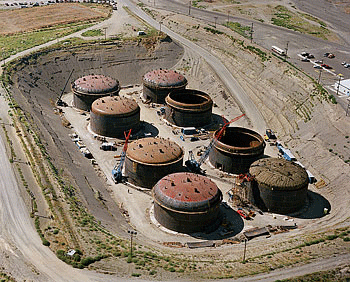
In Parks, a second NUMEC facility had produced plutonium starting in 1960, but it also had served another purpose: nuclear disposal. From 1961 to 1970, the corporation dug at least 10 shallow trenches, spread across about 44 acres, into which it dumped radioactive waste; some locals speculate that other companies around the country shipped their waste to Parks to be buried too. Although the U.S. Army Corps of Engineers (USACE) had been put in charge of cleaning up the site in 2002, under congressional authorization, the process didn’t begin until almost a decade later—right before Held encountered the madness on the road.
In October 2011, the USACE announced that excavation activities at the site were suspended. The work was halted after Cabrera Services, a Connecticut-based contractor hired to clean up Parks, mishandled materials, which the company acknowledged. The following year, the USACE uncovered an unexpected variety of “complex” radioactive contaminants in the ground, but it didn’t say all of what it had found or how much of it. In a December 2014 report, the USACE noted that among the contaminants it expects to find are several “radionuclides of concern,” including americium-241, radium-228, uranium-235, and various types of plutonium, which, under the right conditions, could be used as ingredients for a dirty bomb. It seems the material buried at Parks is more dangerous than anyone had previously imagined.
The USACE immediately ceased the excavation and established a 24-hour patrolled security perimeter that’s still in effect today. Bidding for a new cleanup contractor starts this summer, and the work, now forecast to begin in 2017, is expected to cost roughly half a billion dollars—10 times the original estimate in 2002.
The nuclear mess in Parks could hold clues to yet another mystery in this Pennsylvania community, one that has bedeviled nuclear analysts for decades. Beginning in the early 1960s, investigators from the Atomic Energy Commission (AEC), the agency that regulated U.S. nuclear facilities at the time, began to question how large amounts of highly enriched, weapons-grade uranium had gone missing from NUMEC. Any nuclear site had a certain amount of loss, from seepage into walls and floors, for instance. In fact, between 1952 and 1968, lax standards at 20 of the country’s commercial nuclear sites resulted in an apparent loss of 995 kilograms (2,194 pounds) of uranium-235. But investigators found that at NUMEC, hundreds of pounds went missing, more than at any other plant.
NUMEC’s founder, Zalman Shapiro, an accomplished American chemist, addressed the concern in 1978, telling Arizona Congressman Morris Udall that the uranium simply escaped through the facility’s air ducts, cement, and wastewater. Others, such as the late Glenn Seaborg, the AEC’s chairman in the 1960s—who had previously helped discover plutonium and made key contributions to the Manhattan Project—have suggested that the sloppy accounting and government regulations of the mid-20th century meant that keeping track of losses in America’s newborn nuclear industry was well near impossible. Today, some people in Apollo think that at least a portion of the uranium might be buried in Parks, contaminating the earth and, ultimately, human beings.
But a number of nuclear experts and intelligence officials propose another theory straight out of an espionage thriller: that the uranium was diverted—stolen by spies working for the Mossad, Israel’s intelligence agency. In the 1960s, to secure nuclear technology and materials, Israel mounted covert operations around the world, including at least one alleged open-ocean transfer of hundreds of pounds of uranium. Some experts have also raised questions about Shapiro himself. He had contacts deep within Israel’s defense and intelligence establishments when he ran NUMEC; several of them even turned up at his facility over time and concealed their professional identities while there.
Fifty years after investigations began—they have involved, at various times, the AEC and its successors, Congress, the FBI, the CIA, and other government agencies—NUMEC remains one of the most confounding puzzles of the nuclear era. ……….
Today, many people in the nuclear and intelligence communities are still convinced that a diversion occurred. “I tend to think it happened,” Stockton told me. “In fact, I’m damn sure it happened.” But the believers also concede that the evidence against Shapiro remains largely circumstantial; the nail in the coffin, they say, would be a confession from the aging founder of NUMEC or the release of a yet-to-be-identified document that would show definitive proof…….http://foreignpolicy.com/2015/03/23/what-lies-beneath-numec-apollo-zalman-shapiro/
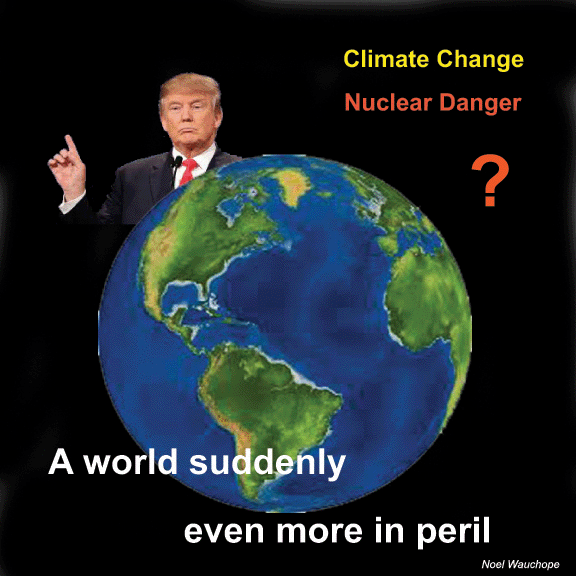
Donald Trump and Vladimir Putin agree: Let’s revive the nuclear arms race, WP By Philip BumpDecember 22Russian President Vladimir Putin gave a speech Thursday in which he praised his country’s military operations on behalf of the government of Syria and made a case for how Russia could be stronger moving forward.
“We need to strengthen the military potential of strategic nuclear forces,” …… You can’t have a new nuclear arms race, of course, without someone to run against. Enter President-elect Donald Trump……..
The trend since the late 1980s has been in the opposite direction, winding down the stockpiles of weapons held by the United States and Russia…….
As always, it’s fraught to take one Trump tweet as a descriptor of where his presidency might be headed. (He has, for example, also tweeted that he never argued for other countries to get nuclear weapons, which is false.) It’s also not clear that “strengthen and expand” means more actual nuclear warheads. (The United States will spend an estimated $1 trillionover 30 years to modernize its weapons stockpile, in part because aging nuclear warheads require significant maintenance.) But Trump’s tweet stands in stark contrast to what President Obama said in May, at the site of the first atomic detonation in world history. In Hiroshima, Japan, Obama called for “a world without nuclear weapons.”…….
Nuclear arms expert: There’s a huge contradiction in Trump’s thinking on nuclear arms, Business Insider ALEX LOCKIE DEC 24, 2016 On Thursday, President-elect Donald Trump tweeted that “The United States must greatly strengthen and expand its nuclear capability until such time as the world comes to its senses regarding nukes.”
But as Kingston Reif, director for disarmament and threat reduction policy at the Arms Control Association, told Business Insider, there’s a huge contradiction in Trump’s recent thinking on defence projects.
“Trump may be open to expanding the number of nuclear weapons in the arsenal, building new weapons, increasing the role of nuclear weapons in US policy,” Reif told Business Insider in an interview, despite the fact that the US’s nuclear arms are already “second to none.”
However, the US’s current path towards modernising US nuclear weapons will already cost a whopping $1 trillion dollars. Though it’s not yet clear whether Trump means actually building more or different types of nuclear weapons, he also recently seemed to shun another potentially trillion-dollar US defence project that’s already well underway.
“One of the interesting contradictions here is that his tweet suggests that he is going to move full steam ahead with the current nuclear modernisation plan, but we’ve also heard him express concerns about the F-35 program, saying maybe we need to stop it,” said Reif.
But, as Reif points out, the F-35 is part of the US’s overall nuclear modernisation program.
“Later versions of the F-35 will be nuclear capable and replace other fighters and bombers,’ said Reif.
Donald Trump: US must greatly expand nuclear weapons Donald Trump has called for the US to “greatly strengthen and expand” its nuclear arsenal. BBC News 22 Dec 16 The president-elect, who takes office next month, said the US must take such action “until such time as the world comes to its senses regarding nukes”.
He spoke hours after President Vladimir Putin said Russia needs to bolster its military nuclear potential.
The US has 7,100 nuclear weapons and Russia has 7,300, according to the US nonpartisan Arms Control Association. Mr Trump’s announcement, which came via Twitter, was published in a string of several tweets on Thursday morning.
Mr Trump also wrote to criticise a resolution being considered at the UN and to reiterate his vow to “drain the swamp” – a reference to corruption in Washington DC.
His tweet came only hours after President Putin met with his military advisers to recap Russian military activities in 2016………
This is a radical departure from President Obama’s current policy.
Mr Trump has offered no further details on his plans but he has hinted in the past that he favoured an expansion of the nuclear programme.
He was asked in interviews whether he would use weapons of mass destruction against an enemy and he said that it would be an absolute last stance, but he added that he would want to be unpredictable.
In contrast, President Obama has talked of the US commitment to seek peace and security without nuclear weapons.
He has sought to reduce the nation’s arsenal of nearly 5,000 warheads in favour of more special operations forces and precise tactical strikes……. http://www.bbc.com/news/world-us-canada-38410027
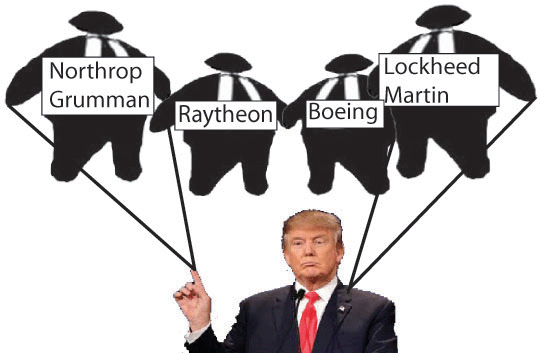
Trump Goes Nuclear, But This Time Lockheed, Northrop, Raytheon Rise http://www.investors.com/news/trump-tweets-about-nukes-after-blasting-pentagon-spending/GILLIAN RICH President-elect Donald Trump tweeted about the importance of the U.S. nuclear arsenal, which will cost hundreds of billions of dollars to recapitalize, potentially giving defense giants like Lockheed Martin (LMT), Northrop Grumman (NOC), Raytheon (RTN) and Boeing (BA) some hope that he won’t cost-shame them on that piece of the Pentagon budget America’s nuclear triad of air-, land- and sea-based delivery systems is nearing the end of its life span and needs to be replaced. But that won’t come cheaply.
Over the summer, the Air Force released its requests for proposals for intercontinental ballistic missiles to replace Boeing’s aging Minuteman system. The Ground-Based Strategic Deterrent’s estimated cost is $62 billion over 30 years, but a report from the Pentagon’s office of independent cost assessment said the Air Force’s estimate is too low by “billions of dollars,” sources told Bloomberg.
The Air Force is also seeking Long-Range Standoff nuclear cruise missiles to replace Boeing AGM-86B Air-Launched Cruise Missiles. That program’s cost has been estimated at $20 billion-$30 billion.
Boeing, Raytheon, Northrop and Lockheed are expected to bid on the two contracts, and initial contracts could be awarded next year.
Last year, Northrop was awarded a contract to build the B-21 bomber that replaces the Cold War-era Boeing B-52s. The Air Force has put the development-phase cost for the B-21 at $23.5 billion, but analysts have estimated the total acquisition cost at up to $80 billion. The Navy’s program to replace its Ohio-class submarines, which can launch nuclear missiles, will cost the service $100 billion.
Shares of defense contractors reversed higher after early, narrow losses. Lockheed shares edged up 0.1% on the stock market today, Northrop added 0.3%, and Raytheon rose 0.5%. Boeing gained 0.1%. General Dynamics (GD) and Huntington Ingalls (HII), which build submarines, were up 0.3% and 2.1%, respectively.
Congress scrapped this one word from the law, opening the door to a space arms race, L.A. Times, David Willman, 22 Dec 16, By removing a single word from legislation governing the military, Congress has laid the groundwork for both a major shift in U.S. nuclear defense doctrine and a costly effort to field space-based weaponry.
Experts say the changes, approved by overwhelming majorities in both the House and Senate, could aggravate tensions with Russia and China and prompt a renewed nuclear arms race. The bill awaits action by President Obama. The White House has not said what he will do.
For decades, America’s defense against nuclear attack has rested on twin pillars: The nation’s homeland missile defense system is designed to thwart a small-scale, or “limited,” attack by the likes of North Korea or Iran. As for the threat of a large-scale strike by China or Russia, the prospect of massive U.S. retaliation is supposed to deter both from ever launching missiles.
Central to this strategy was a one-word qualifier – “limited” — used to define the mission of the homeland defense system. The language was carefully crafted to avoid reigniting an arms race among the superpowers.
Now, with virtually no public debate, bipartisan majorities in Congress have removed the word “limited” from the nation’s missile defense policy. They did so in giving final approval over the last month to the year-end defense bill, the National Defense Authorization Act.
A related provision of the law calls for the Pentagon to start “research, development, test and evaluation” of space-based systems for missile defense.
A space-based defense program would hinge on annual congressional appropriations and decisions by the incoming Trump administration.
Yet both proponents and opponents say the policy changes have momentous implications.
“These amendments were historic in nature — given the paradigm shift forward that they represent,” said Rep. Trent Franks (R-Ariz.), who introduced and shepherded the amendments in the House.
Leading defense scientists said the idea that a space-based system could provide security against nuclear attack is a fantasy.
“It defies the laws of physics and is not based on science of any kind,” said L. David Montague, a retired president of missile systems for Lockheed Corp. and co-chair of a National Academy of Sciences panel that studied missile defense technologies at the request of Congress.
“Even if we darken the sky with hundreds or thousands of satellites and interceptors, there’s no way to ensure against a dedicated attack,” Montague said in an interview. “So it’s an opportunity to waste a prodigious amount of money.”
He called the provisions passed by Congress “insanity, pure and simple.”
The National Academy study, released in 2012, concluded that even a bare-bones space-based missile defense system would cost about $200 billion to put in place, and hundreds of billions to operate in subsequent years.
Franks, asked whether the country could afford it, replied: “What is national security worth? It’s priceless.”
Philip E. Coyle III, a former assistant secretary of Defense who headed the Pentagon office responsible for testing and evaluating weapon systems, described the notion of a space-based nuclear shield as “a sham.”
“To do this would cost just gazillions and gazillions,” Coyle said. “The technology isn’t at hand — nor is the money. It’s unfortunate from my point of view that the Congress doesn’t see that.”
He added: “Both Russia and China will use it as an excuse to do something that they want to do.”
The word “limited” has guided U.S. policy since the National Missile Defense Act of 1999. The qualifier reflects, in part, the reality that intercepting and destroying incoming warheads is supremely difficult, and that it would be impractical to field enough interceptors to counter a large-scale attack. Any such system, by its very nature, would be limited.
The first of his amendments — to eliminate “limited” from U.S. policy — was approved in April by the House Armed Services Committee with no debate and without a recorded roll-call vote.
At a committee hearing May 17, a senior Democrat on the panel, Rep. Jim Cooper of Tennessee, offered mild protest.
“I think it was a mistake to mandate a poorly thought out, unaffordable and unrealistic missile defense policy, including plans for a space-based missile deterrent,” Cooper said.
But neither Cooper nor any other House Democrat sought to overturn the provisions, and he was among those who voted to pass the overall bill the next day……..
In June, Sen. Ed Markey (D-Mass.) sought to restore “limited,” saying that the change in U.S. policy would create “the impetus for a new arms race” with Russia and China. Markey offered an amendment on the Senate floor but could not muster enough support to bring it to vote.
The same month, the Obama administration criticized the changes in the Senate bill, saying it “strongly objects” to removing “limited” and to placing anti-missile weaponry in space. The statement stopped short of threatening a veto.
The policy changes were greeted with opposition from another quarter as well. At a congressional hearing in April, Franks pressed Vice Adm. James D. Syring, director of the Missile Defense Agency, for his stance on expanding U.S. capability into space.
Indigenous leaders shocked, again, by repeated exclusion from Trudeau’s climate talks, National Observer By Elizabeth McSheffreyDecember 16th 2016After excluding them from a critical discussion on indigenous people and climate change earlier this year, both the Native Women’s Association of Canada (NWAC) and the Congress of Aboriginal Peoples (CAP) hoped it was a mistake Prime Minister Justin Trudeau would not repeat.
But one week after his second annual meeting with First Ministers and indigenous leaders on clean growth and climate change, the two national aboriginal organizations have been disappointed again.
“I don’t think it’s a tough decision for the prime minister to have two more representatives sitting at the table,” NWAC president Francyne Joe told National Observer. “He states he’s a feminist, he states indigenous relations are high priorities for his government, and yet he’s specifically excluding a national indigenous group that has been recognized by the courts. Why?”
A pattern of exclusion
Both NWAC and CAP have been considered among the five major organizations representing aboriginal people in Canada since the days of the Kelowna Accord, along with the Assembly of First Nations (AFN), the Métis National Council (MNC), and the Inuit Tapiriit Kanatami (ITK).
Only the last three however, were granted an audience with Trudeau and the premiers during climate discussions in Vancouver in March, and again, in Ottawa last Friday. NWAC and CAP were also left out of a meeting on advancing reconciliation with the prime minister on Thursday that was attended by leaders of AFN, ITK, and a Métis representative from Manitoba………
According to a recent report by Health Canada, some Canadians are more exposed than others to the health risks associated with climate change, particularly northern residents, children and seniors, and those who are chronically ill, homeless, low income, or living off of the land.
ndigenous people, especially women and girls, fall into many of these categories, and some even fall into all of them. Roughly 17 per cent of aboriginal women live in poverty, face food insecurity, and struggle to access the public services that could help them, according to a 2012 report by Aboriginal Affairs and Northern Development,
“Indigenous women have been experiencing gender oppression within not just Canadian society, but within our own aboriginal societies,” said Joe of NWAC. “So sometimes I think our views are not going to be as well-represented by these male-dominated indigenous groups.
“If you have an aboriginal woman who has lost her right to status because of the Indian Act’s sex discrimination or her mother married off-reserve, never once did that aboriginal woman give up her indigenousness, interest or rights being represented by these groups, and yet these groups do not consult her on the issues that are going to affect her and her children.”………….. http://www.nationalobserver.com/2016/12/16/news/indigenous-leaders-shocked-again-repeated-exclusion-trudeaus-climate-talks
I’m a scientist who has gotten death threats. I fear what may happen under Trump. Michael E. Mann, The Washington Post, December 18, 2016 Michael E. Mann is a professor of atmospheric science and director of the Earth System Science Center at Penn State University.
My Penn State colleagues looked with horror at the police tape across my office door.
I had been opening mail at my desk that afternoon in August 2010 when a dusting of white powder fell from the folds of a letter. I dropped the letter, held my breath and slipped out the door as swiftly as I could, shutting it behind me. First I went to the bathroom to scrub my hands. Then I called the police.
It turned out to be only cornstarch. And it was just one in a long series of threats I’ve received since the late 1990s, when my research illustrated the unprecedented nature of global warming, producing an upward-trending temperature curve whose shape has been likened to a hockey stick.
I’ve faced hostile investigations by politicians, demands for me to be fired from my job, threats against my life and even threats against my family. Those threats have diminished in recent years, as man-made climate change has become recognized as the overwhelming scientific consensus and as climate science has received the support of the federal government. But with the coming Trump administration, my colleagues and I are bracing for a renewed onslaught of intimidation, from inside and outside government. It would be bad for our work and bad for our planet.
Donald Trump, of course, famously dismissed global warming as a Chinese hoax and “a big scam for a lot of people to make a lot of money.” This month he framed his position on climate change as “nobody really knows – it’s not something that’s so hard and fast.” He has vowed to cancel U.S. participation in the Paris climate agreement and threatened to block the Clean Power Plan, a measure to reduce carbon emissions in the power sector.
The strong anti-science bent of his advisers is similarly ominous. Among the members of his Environmental Protection Agency transition team are some of the most notorious climate change deniers. One adviser has threatened to cut NASA’s entire climate research program, disparaging it, with no apparent sense of irony, as “heavily politicized.”………
We are afraid that four (possibly eight) years of denial and delay might commit the planet to not just feet, but yards, of sea level rise, massive coastal flooding (made worse by more frequent Katrina and Sandy-like storms), historic deluges, and summer after summer of devastating heat and drought across the country.
We also fear an era of McCarthyist attacks on our work and our integrity. It’s easy to envision, because we’ve seen it all before. We know we could be hauled into Congress to face hostile questioning from climate change deniers. We know we could be publicly vilified by politicians. We know we could be at the receiving end of federal subpoenas demanding our personal emails. We know we could see our research grants audited or revoked.
I faced all of those things a decade ago, the last time Republicans had full control of our government………
I’ve also come under pressure at the state level. In Pennsylvania, an organization funded by conservative Richard Mellon Scaife persuaded Republican state senators to threaten to hold my university’s funding hostage until “appropriate action” was taken against me. In Virginia, then-Attorney General Ken Cuccinelli, a tea party Republican, accused me of fraud and sued the University of Virginia for all my personal emails from when I was teaching there. When Cuccinelli was unsuccessful, a Koch brothers-funded front group attempted to sue for the same emails. That effort, too, was ultimately blocked by the Virginia Supreme Court, which ruled that unpublished research should be protected in the interest of academic freedom.
In all, I’ve been through roughly a dozen investigations prompted by climate change deniers. Each time, I’ve been exonerated: Investigators find my methods are sound, my data is replicable and my lab is run responsibly. But by then, much time has been lost, expense has been incurred, and abuse and vilification has been endured on my part.
And then there have been the threats of violence. I’ve received email warnings that “the public will come after you,” suggesting that I’ll find myself “six feet under” and hoping to read that I had “committed suicide.”
Such threats could spike again under a president and Congress hostile to climate science. As we’ve seen recently, a segment of Americans is receptive to fake news, and some are eager to act on it. Wild conspiracy theories have propelled a woman to make death threats against the parent of a child killed at Sandy Hook Elementary and motivated a man to discharge an assault rifle in a family pizza restaurant in Washington.
I fear the chill that could descend. I worry especially that younger scientists might be deterred from going into climate research (or any topic where scientific findings can prove inconvenient to powerful vested interests). As someone who has weathered many attacks, I would urge these scientists to have courage.
The fate of the planet hangs in the balance.
Michael E. Mann is a professor of atmospheric science and director of the Earth System Science Center at Penn State University. He co-authored, with Washington Post cartoonist Tom Toles, “The Madhouse Effect: How Climate Change Denial Is Threatening Our Planet, Destroying Our Politics, and Driving Us Crazy.” http://www.sfgate.com/opinion/article/I-m-a-scientist-who-has-gotten-death-threats-I-10804229.php
The price tag for cleaning up nuclear waste at Hanford site just went up another $4.5 billion LA Times, 16 Dec 16 Ralph VartabedianContact ReporterThe U.S. Energy Department said Friday that its long-troubled attempt to build a plant to process highly radioactive sludge at a former nuclear weapons site in central Washington state will cost an additional $4.5 billion, raising the project’s price tag to $16.8 billion.
The Hanford treatment plant, a small industrial city with some two dozen facilities on a desert plateau along the Columbia River, is more than a decade behind schedule and will cost nearly four times the original estimate made in 2000.
The government aims to transform 56 million gallons of deadly sludge stored in leaky underground tanks into solid glass, which theoretically could then be stored safely for thousands of years.
But the effort has involved an extended history of errors, miscalculations and wrongdoing. The result has been a massive, partially built concrete facility that has been under a stop-work order for three years because of serious technical doubts.
The biggest technical problems involve two giant facilities, a melter building for high-level radioactive waste and a pretreatment building to prepare the sludge for chemical processing.
After an exhaustive technical review, the Energy Department at the beginning of this year ordered fixes for more than 500 problems, some of them fundamental design deficiencies at the melter. Construction of the building and equipment was 78% complete at the time of the review.
And in November, the Justice Department settled a False Claims Act suit against two major contractors at the plant, San Francisco-based Bechtel Corp. and AECOM, an engineering, design and construction management company based in Los Angeles. The allegations originally were brought by three engineers at the plant, who had long raised concerns that the fundamental design of the plant was flawed. The two companies agreed to pay $125 million in damages, a portion of which will be awarded to the three whistle-blowers……..
outside watchdogs say the giant cost increase could jeopardize the cleanup at a time when the incoming president, Donald Trump, has already sharply criticized high-cost government projects and contracts.
Tom Carpenter, executive director of the Hanford Challenge, which has helped whistle-blowers disclose problems at the site, said the new cost estimate puts a target on the plant that could lead the Energy Department to begin searching for lower-cost and less safe solutions to the waste problem.
One potential lower-cost remedy at Hanford, which has been used at other former nuclear waste sites, would be to pour concrete into the tanks to solidify the waste and then simply leave it in place. The risk is that the concrete might eventually break down, leak radioactivity into the groundwater and contaminate the Columbia River about seven miles away, Carpenter said.
“There are a lot of question marks about the fate of this facility,” Carpenter said.
The revised plan disclosed Friday is part of an effort to get the waste treatment plant started up sooner, though the estimated delay for full operational status seems to be growing.
In 2013, then-Energy Secretary Steven Chu stopped most construction on the project after a whistle-blower warned about a potential for explosion from accumulated hydrogen gas in the melter tanks. In an effort to get the cleanup moving again, Chu’s successor, Ernest J. Moniz, ordered that some of the lower-level waste be solidified without any pretreatment — a so-called direct feed system — and on a faster schedule at the low-level melter.
The early processing could begin in 10 years or less, but the full capability for the most highly radioactive sludge that requires the high-level melter is now scheduled for a 2036 start-up, some 20 years past the original schedule, Carpenter said.
Cheap nuclear ‘cleanup’ dangerous http://www.winnipegfreepress.com/opinion/analysis/cheap-nuclear-cleanup-dangerous-406711405.htmlBy: Dave Taylor 12/15/2016Just as Manitobans were beginning to think the toxic mess at Whiteshell Laboratories in Pinawa would soon be moved off-site and the lands returned to their natural state, we now learn the federal government has given the Canadian Nuclear Labs (CNL) free rein to cheap out on the cleanup.
The most striking part of the plan to entomb the defunct WR1 reactor is that the cement or grout they are developing to seal it will break down well before the rotting hulk is safe. According to CNL officials who have relied on international research findings, “initial chemical degradation of grout is modelled to begin around 350 years,” well short of the thousands of years for which this sarcophagus will be toxic to all living things.
Since CNL are just the contractors responsible for the immediate decommissioning, long-term monitoring is beyond the scope of their work and it will ultimately be left to future Manitobans. Sure, it would cost the federal government four times as much to dismantle it now, but imagine the costs for our distant descendants who will have to deal with radioactive groundwater leaking into the Winnipeg River from a crumbling block of poisonous concrete several generations in the future.
Due to a very serious accident at the reactor in 1978, it is likely far more radioactive than it would normally be. The radiological report on that accident has not been made public, but when a pump failed, the geiger counters were going off at 3 million counts-per-minute, and a worker in protective clothing using a safety rope had to descend through a hatch to close valves with a hand-wheel as the fuel rods in the core of the reactor became damaged. It is an accident that remains shrouded in secrecy. This has become part of the unsustainable 50-year legacy that the nuclear industry has left us.
Two decades ago, Canada’s nuclear crown corporation, Atomic Energy of Canada Ltd., conducted similar “grout” research for the purpose of disposing of high-level radioactive waste in the Canadian Shield and started building a “test facility” at Lac du Bonnet called the Underground Research Lab. The objective of this plan was to seal off huge mine shafts with “bentonite grout” and entomb high-level radioactive waste from reactors across Canada and potentially from around the world. The lab leaked like a sieve as groundwater poured into the shaft, confirming that groundwater is almost unstoppable. Manitobans realized the folly in this idea and lobbied for the enactment of the High Level Radioactive Waste Act, which is still the law in our province.
And just where does our provincial government sit on this ill-conceived plan? Local politicians have remained incredibly silent on this issue, yet the act clearly states that any radioactive waste with levels comparable to spent fuel cannot be disposed of in this province, period. It also states clearly that in the case of a corporation, “a fine of not more than $1,000,000 for each day that the offence continues” will be levied.
Cathy Cox, our minister of sustainable development, has a responsibility to get the straight goods on how tainted this reactor is and to enforce the laws of our land, because, as the saying goes, “we do not inherit the earth from our ancestors; we borrow it from our children.”
Dave Taylor is an instructor at the University of Winnipeg, and has been a watchdog of the nuclear industry for over 40 years.
Duke Energy may take handguns from security at nuclear plants,wsoctv.com by: Paul Boyd Dec 18, 2016 CHARLOTTE, N.C. – Two Duke Energy insiders said they’re risking their jobs to speak out about a proposal aimed at taking handguns away from nuclear security officers.
Duke Energy operates six nuclear power plants in the Carolinas. They’re among the most highly secured and fortified facilities in the country.
Terrorist groups consider nuclear power plants high-value targets.
“We’re only there for one reason. To stop a breach into that plant,” one of the nuclear security officers said.We’ve hidden the faces and altered the voices of the security officers in our report.
They agreed to speak to Whistleblower 9 because of what they feel is an imminent safety threat — a Duke Energy proposal to take away their handguns.”If they take these weapons away, they’re not providing what we need to protect these plants,” one officer said.
“Taking away the handgun would provide us with zero backup. It’s a safety issue. It’s an officer safety issue,” the other officer said. Rifles are the nuclear security officer’s primary weapon but they say their handguns are a crucial backup weapon if a rifle jams or fails.”In this day and time with the terrorist activity escalating, taking away half of our weapons platform — that is ludicrous,” one officer said.
Channel 9 confirmed a proposal is in place to take away the security guard’s handguns. We obtained an internal document from Duke Energy that reads “efficiency bulletin” and “handgun elimination” for nuclear security officers.
Karen Gay Silkwood (February 19, 1946 – November 13, 1974) was an American chemical technician and labor unionactivist known for raising concerns about corporate practices related to health and safety of workers in a nuclear facility. Following her mysterious death, which received extensive coverage, her estate filed a lawsuit against chemical company Kerr-McGee, which was eventually settled for $1.38 million. Silkwood was portrayed by Meryl Streep in Mike Nichols‘ 1983 Academy Award-nominated film Silkwood.
She worked at the Kerr-McGeeCimarron Fuel Fabrication Site plant near Crescent, Oklahoma, United States. Silkwood’s job was making plutoniumpellets for nuclear reactor fuel rods. This plant experienced theft of plutonium by workers during this era. She joined the union and became an activist on behalf of issues of health and safety at the plant as a member of the union’s negotiating team, the first woman to have that position at Kerr-McGee. In the summer of 1974, she testified to the Atomic Energy Commission about her concerns.
For three days in November, she was found to have plutonium contamination on her person and in her home. That month, while driving to meet with David Burnham, a New York Times journalist, and Steve Wodka, an official of her union’s national office, she died in a car crash under unclear circumstances.
Her family sued Kerr-McGee on behalf of her estate. In what was the longest trial up until then in Oklahoma history, the jury found Kerr-McGee liable for the plutonium contamination of Silkwood, and awarded substantial damages. These were reduced on appeal, but the case reached the United States Supreme Court in 1979, which upheld the damages verdict. Before another trial took place, Kerr-McGee settled with the estate out of court for US $1.38 million, while not admitting liability. https://en.wikipedia.org/wiki/Karen_Silkwood
Questions Still Remain In Suspicious Death Of Karen Silkwood
Scientists backing up climate data over fears it could be erased under Donald Trump, ABC News 14 Dec 16Scientists in the United States are making copies of federal climate and environmental data over fears it could be erased under Donald Trump’s administration.
The mass action — being coordinated by the University of Pennsylvania’s Program in the Environmental Humanities (PPEH Lab) — has been dubbed a “data rescue” and has brought together academics from across the country and in neighbouring Canada.
It aims to safeguard data “vulnerable under an administration which denies the fact of ongoing climate change” by storing it on an independent server. Researchers are also collating a spreadsheet of the research they deem to be at risk once the President-elect takes office on January 20.
In a statement, Mr Pruitt was described as “a national leader against the EPA’s job-killing war on coal”.
In a piece for The Washington Post, Holthaus yesterday wrote that archiving climate data was “an extraordinary step to have to take, but we live in an extraordinary moment”.
In 1968, a B-52 Bomber Crashed (With 4 Super Lethal Nuclear Weapons Onboard That ‘Exploded’) The National Interest, Matthew GaultDecember 15, 2016 Throughout the 1950s and ’60s American bombers carrying nuclear weapons crisscrossed the globe, ready at a moment’s notice to fly into the heart of Russia and bomb it back to the stone age. Strategic Air Command — a now defunct branch of the U.S. Air Force — commanded this airborne alert force.
It was once the pride of the American military. For more than a decade, SAC bombers were no more than 15 minutes from nuking Russia. But the shifts on the bombers were long — sometimes more than 24 hours — and keeping such an alert force ready was taxing on pilots and crew.
There were many accidents.
In 1958, a B-47 carrying a nuke collided with an F-86 Sabre in the skies above Savannah, Georgia. The B-47 jettisoned its nuclear payload into the Atlantic Ocean. Authorities never recovered the bomb.
Months later, another B-47 dropped its nuke over South Carolina when a bomb technician aboard accidentally activated the emergency release. The bomb’s conventional explosives detonated and destroyed a nearby house.
In 1966, a B-52 crashed in Spain, spilling the nuclear guts of two bombs onto nearby farms. After the accident, Spain halted nuclear-armed American planes from passing through its air space.
Those were bad, but SAC and its airborne alert survived them. Then, in 1968, a B-52 crashed near Thule Monitoring Station in Greenland and spilled its payload all over the ice. It was one disaster too many, and it signaled the end of America’s airborne alert program … and Strategic Air Command’s prestige……..
The Arctic’s climate is harsh and the radar station was fragile. Outages were frequent, and SAC needed redundancy to ensure that it didn’t attack Moscow just because it lost contact with Thule.
So SAC did what it always did. It strapped some nukes on a bomber. The air command sent one of its airborne alert bombers — complete with live nukes — to fly above the Thule monitoring station 24 hours a day … forever.
It seemed silly to keep live nukes in the air above the world’s head all day, every day. It was a sword of Damocles and it dropped in 1968.
On Jan. 21, 1968, fire swept through the cabin of the airborne B-52 watching Thule station. Smoke and flames consumed the plane and the seven crew members ejected. Six survived. The bomber crashed into an ice cap in the bay near the base.
The conventional explosives in the plane’s four hydrogen bombs exploded and cracked their nuclear payloads. Radioactive elements slid out of the bombs and onto the ice.
SAC’s Operation Chrome Dome was already on its last legs. The Thule accident just confirmed what many politicians and military leader already thought — keeping a fleet of nuclear-armed bombers in the air at all times was dangerous and insane……….
Only one of the B-52’s crew died during the Thule disaster, but his death wasn’t the end of the tragedy. The hydrogen bombs spread jet fuel and radioactive materials across the ice cap. It busted up the flow of the sea, blackened the ice and spread plutonium, uranium, americium and tritium into the ice and water……..
the Danish workers who helped clean up the site are dying of cancer. Crested Ice was a rush job done under pressure from the international community, and its leadership cut corners. American and Danish workers didn’t have the protective gear they needed to work with the radioactive materials.
The Danes tried to sue the United States for compensation and 1987, but failed. In 1995, Copenhagen paid a settlement to 1,700 members of the crew. Crested Ice, the plight of its workers and the possibility that America left contaminated material behind is a recurring story in the Danish press to this day……..This first appeared in WarIsBoring here. http://nationalinterest.org/blog/the-buzz/1968-b-52-bomber-crashed-4-super-lethal-nuclear-weapons-18746
The Nuclear Regulatory Commission says Friday that the renewal is through March 20, 2045.
Fermi 2 is in Frenchtown Township, southwest of Detroit. The power plant’s license was issued in 1985 and was valid through March 20, 2025.
DTE Energy submitted the renewal application in 2014.
The extension approval was put on hold late last month after an activist group encouraged the Nuclear Regulatory Commission to look more closely into how potassium iodide pills would be given to area residents if the plant ever has a major release of radioactive steam.
Tell Congress: Prevent Nuclear Catastrophe in Iran
Read the Public Inquiry Report, the Commissioners’ report, Surrendering Australia: The AUKUS Deception is available to download for free at aukuspublicinquiry.com. Or just watch the replay of the National Press Club Luncheon.