By contrast, Trident Lakes, a 700-acre, $US330 million development in Ector, Texas, an hour and a half north of Dallas, is being built from scratch. Marketed as a “5-star playground, equipped with defcon 1 preparedness”, it is the project of a group of investors who incorporated as Vintuary Holdings. According to James O’Connor, the CEO, Trident Lakes “is designed for enjoyment like any other resort”. (This pitch is rather different from its Cold War-era counterparts: A 1963 bunker advertisement from the Kelsey-Hayes company shows a family tucked under its home, with just rocking chairs for comfort.)
Ontario’s big secret – the real cause of rising electricity rates
 http://www.cela.ca/blog/2017-02-16/guest-blog-ontario-s-big-secret-real-cause-rising-electricity-rates by Angela Bischoff, Outreach Director, Ontario Clean Air Alliance on February 16, 2017 Since 2002 Ontario Power Generation’s (OPG’s) price of nuclear power has risen by 60%. And to add insult to injury OPG is now seeking a 180% price increase to pay for the continued operation of its high-cost Pickering Nuclear Station and the re-building of Darlington’s aging reactors.
Meanwhile, OPG continues to tell MPPs and other decision makers that nuclear power is our lowest cost option for keeping the lights on and that it is simply not possible to import low-cost power from Quebec. Both of these claims are false.
According to Hydro Quebec’s CEO, Eric Martel, Quebec has 3,000 megawatts of surplus power available for export. Furthermore, according to Mr. Martel, Hydro Quebec is more than willing to sign long-term fixed-price export contracts.
Hydro Quebec has power available to export for at least 99% of the hours in a year. It can further increase the power it has for export by improving energy efficiency in Quebec and continuing to develop its significant low-cost wind power potential.
Our public utility and the nuclear lobby should stop spreading “alternative facts.” We need an honest discussion based on transparent information about whether keeping the 46-year-old Pickering Station running and re-building the 30-year-old Darlington Station makes sense.
And instead of playing shell games designed to hide the rising cost of nuclear power, our government should be looking at grabbing some real cost savings – by making a deal with Quebec.
Please send an email to Premier Wynne premier@ontario.ca or call her at 416 325 1941. Tell her you want to see Ontario secure some real cost savings by making a long-term deal with Quebec to permit the closing of the Pickering Nuclear Station in 2018 when its licence expires.
You can also contact your MPP and tell them you want to see real savings. You can find your MPPs contact info here. If you don’t know your electoral district, click here.
Trump to Seek $54 Billion Increase in Military Spending |
Trump to Seek $54 Billion Increase in Military Spending | 27 Feb 2017 | President Trump put both political parties on notice Monday that he intends to slash spending on many of the federal government’s most politically sensitive programs – relating to education, the environment, science and poverty – to protect the economic security of retirees and to shift billions more to the armed forces.
The proposal to increase military spending by 54 billion and cut nonmilitary programs by the same amount was unveiled by White House officials as they prepared the president’s plans for next year’s federal budget. Aides to the president said final decisions about Medicare and Social Security would not be made until later in the year, when he announces his full budget. But Sean Spicer, his spokesman, cited Mr. Trump’s campaign commitments about protecting those programs and vowed that “he’s going to keep his word to the American people.”
Follow the money: Will Trump repay Putin by ending Russian sanctions and killing the Paris climate deal?
Did Putin help elect Trump to restore $500 billion Exxon oil deal killed by sanctions
Follow the money: Will Trump repay Putin by ending Russian sanctions and killing the Paris climate deal? Think Progess, Joe Romm , 28 Feb 17, “……. our democracy and our children have a new axis to worry about: Putin, Trump, and ExxonMobil, whose CEO Rex Tillerson — an extreme Russophile and long-time director of a US-Russian oil company — is Trump’s puzzling choice for Secretary of State.
I say “puzzling” because the long-serving Exxon employee (from age 23!) has no qualifications to be secretary of state — other than a history negotiating major oil deals with countries like Putin’s Russia, which in any sane world would actually disqualify him or at least force a recusal from all State Department dealings with Russia.
But that puzzle disappears if we follow the famous dictum from the Watergate era for uncovering a tangled web of covert campaign acts: “Follow the money.” And perhaps another puzzle is also solved: Why did Putin take such a “fearful risk,” as Frum put it, to “mount a clandestine espionage and disinformation campaign on behalf” of Trump and against Clinton, “when Putin had every reason to expect that he probably would end up facing a President Clinton,” and a tremendous backlash.
You can certainly make a plausible case, as U.S. intelligence agencies do in their bombshell new report, that Putin had plenty of motivation to interfere. He wanted to undermine the legitimacy of U.S. elections and a Clinton Presidency, he blamed Secretary Clinton for “inciting mass protests against his regime,” and he was angry with the U.S. for the Panama Papers leaks.
Those leaks showed a $2 billion trail of offshore accounts and deals that traced back to Putin and his cabal of kleptocrats, who, among other things, were getting rich “trading shares in Rosneft,” Russia’s state-owned (i.e. Putin run) oil monopoly.
But a half trillion dollars to line their pockets and prop up the Russian economy offers a much more tangible motivation for team Putin to get Trump elected. And it was Tillerson who had made the $500 billion oil dealwith Putin that got blocked by sanctions.
Blocking the deal did not just “put Exxon at risk,” as the Wall Street Journal reported in 2014. MSNBC’s Rachel Maddow explained last month the biggest oil deal in history was “expected to change the historical trajectory of Russia.”
The top priority for Putin and the kleptocrats who benefit from his rule is enriching the Kremlin’s coffers and their own, which have been hurt by the sanctions. And Trump’s election already appears to have delivered $11 billion to the Kremlin through sale of a 19.5 percent stake in Rosneft, “confounding expectations that the Kremlin’s standoff with the West would scare off major investors,” as Fortune has reported in a must-read piece.
Kleptocracy — and interfering with our election — pays…….
Indeed, if Trump and Tillerson instead end the sanctions that are blocking the Exxon-Rossneft deal, it is going to look suspiciously like a half trillion dollar quid pro quo for Putin’s help getting elected.
And if Trump and Tillerson work together to kill the Paris climate deal, the last best chance to save Americans from catastrophic climate change—and aridiculously good deal for the U.S.— that will look like they are putting Putin’s interests and Exxon’s profits above America’s national interest and the health and well-being of our children. It bears repeating that ExxonMobil’s future is inextricably tied to their stalled oil deal with Putin — and their future drilling plans would benefit from continued global warming and melting of polar ice…….. https://thinkprogress.org/putin-helped-trump-exxon-oil-deal-sanctions-6f169c4a4cd0#.hxgqiytyu
Russians alarmed by Donald Trump’s posture on nuclear weapons

 Trump’s US nuclear stance alarms Russia http://www.skynews.com.au/news/politics/nthamerica/2017/02/25/trump-s-us-nuclear-stance-alarms-russia.html
Published: 10:16 am, Saturday, 25 February 2017 Russian politicians close to the Kremlin say US President Donald Trump’s declared aim of putting the US nuclear arsenal ‘at the top of the pack’ risked triggering a new Cold War-style arms race between Washington and Moscow.
In an interview with Reuters, Trump said the US had fallen behind in its nuclear weapons capacity, a situation he said he would reverse, and he said a treaty limiting Russian and US nuclear arsenals was a bad deal for Washington.
Russian officials issued no reaction, with Friday a public holiday, but pro- Kremlin politicians expressed consternation about the comments from Trump, who Moscow had hoped would usher in new, friendlier relations between the two countries.
‘Trump’s campaign slogan ‘Make America great again’, if that means nuclear supremacy, will return the world to the worst times of the arms race in the ’50s and ’60s,’ said Konstantin Kosachev, chairman of the international affairs committee in the upper house of the Russian parliament.
The president’s remarks in the interview with Reuters were, Kosachev said in a post on his Facebook page, ‘arguably Trump’s most alarming statement on the subject of relations with Russia’.
Over the course of the Cold War, the Soviet Union and the US realised that achieving supremacy was dangerous, and accepted the doctrine of parity as the best way to ensure peace, Kosachev wrote on his Facebook page.
‘Are we entering a new era? In my view we need an answer to that question as soon as possible.’
During the US presidential race, Trump said he would try to end the enmity that broke out between the Kremlin and Washington during Barack Obama’s presidency.
But just over a month into the Trump presidency, that prospect has receded, especially with the sacking of Michael Flynn, a leading proponent of warmer ties with Moscow, from his job as national security adviser.
Another pro-Kremlin lawmaker, Alexei Pushkov, wrote on Twitter that Trump’s comments on increasing US nuclear capacity ‘put in doubt the agreement on limiting strategic arms, returning the world to the 20th century’.
He said a Cold War arms treaty laid the foundation for nuclear stability between Moscow and Washington. ‘That needs to be preserved. And the United States cannot achieve decisive superiority.’
‘Instead of trying to achieve an illusory nuclear supremacy over Russia, the US administration should find a solution to the exceptionally complicated nuclear problem of North Korea,’ wrote Pushkov, a member of the defence and security committee in Russia’s upper house of parliament. – See more at: http://www.skynews.com.au/news/politics/nthamerica/2017/02/25/trump-s-us-nuclear-stance-alarms-russia.html#sthash.fwqZWCfw.dpuf
– See more at: http://www.skynews.com.au/news/politics/nthamerica/2017/02/25/trump-s-us-nuclear-stance-alarms-russia.html#sthash.fwqZWCfw.dpuf
– See more at: http://www.skynews.com.au/news/politics/nthamerica/2017/02/25/trump-s-us-nuclear-stance-alarms-russia.html#sthash.fwqZWCfw.dpuf– See more at: http://www.skynews.com.au/news/politics/nthamerica/2017/02/25/trump-s-us-nuclear-stance-alarms-russia.html#sthash.fwqZWCfw.dpuf
The health and economic costs if USA’s Clean Power Plan is repealed
 Clean Power Plan Repeal Would Cost America $600 Billion, Cause 120,000 Premature Deaths, https://www.forbes.com/sites/energyinnovation/2017/02/23/clean-power-plan-repeal-would-cost-america-600-billion-cause-120000-premature-deaths/#3536fd713b78 Jeffrey Rissman, The Trump administration has prioritized repealing the Clean Power Plan (CPP), a set of rules by the U.S. EPA aimed at limiting pollution from power plants. New analysis shows that repealing the rule would cost the U.S. economy hundreds of billions of dollars, add more than a billion tons of greenhouse gases to the atmosphere and cause more than 100,000 premature deaths due to inhaled particulate pollution.
Energy Innovation utilized the Energy Policy Simulator (EPS) to analyze the effects of repealing the CPP. The EPS is an open-source computer model developed to estimate the economic and emissions effects of various combinations of energy and environmental policies using non-partisan, published data from the U.S. Energy Information Administration (EIA), U.S. EPA, Argonne National Laboratory, U.S. Forest Service, and U.S. Bureau of Transportation Statistics, among others. The EPS has been peer reviewed by experts at MIT, Stanford University, Argonne National Laboratory, Berkeley National Laboratory and the National Renewable Energy Laboratory. It is freely available for public use through a user-friendly web interface or by downloading the full model and input dataset.
Our analysis compared a business-as-usual (BAU) scenario (based on existing policies as of mid-to-late 2016, not including the Clean Power Plan) to a scenario that includes a set of policies that narrowly achieve the Clean Power Plan’s mass-based emissions targets. Three important notes:
- First, the EPS works at national scale, so policies are represented as nationwide averages; that is, without individually modeling U.S. states.
- Second, a variety of different policies might be used to achieve the CPP targets. We analyzed a mixed package representative of how the EPA expects states to achieve their targets.
- Third, the EPS calculates results through 2050, but the CPP targets only extend through 2030. The policy package we use to represent the CPP includes continued policy improvement through 2050 at the same rate as in earlier years (that is, policies strengthen by the same amount each year from 2017 to 2050), rather than CPP policies becoming frozen at their 2030 levels.
We find that repealing the CPP would result in an increase of carbon dioxide equivalent (CO2e) emissions of more than 500 million metric tons (MMT) in 2030 and 1200 MMT in 2050, contributing to global warming and severe weather events, such as hurricanes, floods and droughts.
Nearly $600 Billion in Economy-Wide Costs
Cumulative net costs to the U.S. economy (in increased capital, fuel, and operations and maintenance (O&M) expenditures) would exceed $100 billion by 2030 and would reach nearly $600 billion by 2050.
It may seem ironic that removing regulations can result in increased costs to the economy, but regulations can help to overcome market barriers and similar problems that prevent certain economically-ideal outcomes from being achieved in a free market (for instance, under-investment in energy efficiency technologies).
120,000 New Premature Deaths
Although the CPP’s focus is on reducing carbon emissions, the same policies also reduce particulate pollution, which is responsible for thousands of heart attacks and respiratory diseases each year. Repealing the CPP would increase particulate emissions, causing more than 40,000 premature deaths in 2030 and more than 120,000 premature deaths in 2050.
Far More New Coal Capacity, Far Less New Renewables Capacity
Without the CPP, the U.S. electric grid would feature a larger capacity of coal power plants, while the capacity of wind and solar on the system would be smaller, as shown in the following table. [on original]
This finding is echoed by a new forecast from the U.S. Energy Information Administration, which predicts that without CPP implementation, coal will become America’s leading source of electricity generation by 2019.
This slow-down in the transition to clean energy would cost the U.S. technological leadership in the rapidly-growing solar and wind industries and would cost the U.S. many jobs. Even today, when wind makes up 6.6 percent and solar 1.8 percent of total U.S. installed capacity, the solar industry employs 374,000 people and wind industry 101,000 workers, roughly two and a half times the 187,000 combined workers in the coal, natural gas and oil industries.
The stellar contribution of renewables to the U.S. economy was recently highlighted as an “American success story” by a group of 20 Republican and Democratic governors who urged Trump to support renewables.
Clean Power Plan Repeal A Terrible Mistake For America
Repealing the Clean Power Plan would be a terrible mistake. A repeal would increase costs to the U.S. economy by hundreds of billions of dollars, cut years off the lives of tens of thousands of Americans and sacrifice U.S. technological leadership and job creation. For the future prosperity and strength of the country, the CPP should be preserved, and its targets should continue to strengthen through 2050 and beyond.
Weaken safety standards, to save the industry – that’s the advice from pro nuclear lobbyists
 Nuclear Power Is In Crisis As Cost Overruns Cripple Industry Giants, New Matilda., By Jim Green on February 26, 2017A future for nuclear power?
“……A fundamental difficulty for the nuclear industry is that the imperatives for greater safety and reduced costs push in opposite directions. Mark Cooper, from the Institute for Energy and the Environment at Vermont Law School, recently told the New York Times: “Nuclear safety always undermines nuclear economics. Inherently, it’s a technology whose time never comes.”
Retreating from post-Fukushima efforts to strengthen safety standards inevitably increases the risk of another Chernobyl- or Fukushima-scale catastrophe. Leaving aside the disputed health effects from those disasters, the economic costs associated with both disasters was in the ball-park of US$500 billion, and both had devastating impacts on public acceptance of nuclear power.
Yet a retreat from post-Fukushima efforts to strengthen safety standards seems to be where the industry and its enthusiasts are heading in their efforts to curb nuclear power’s astonishing cost increases and overruns.
Proposals include weakening safety regulations; abandoning Generation 3/3+ reactors in favour of Generation 2 reactor types (or redefining Generation 2 reactor types as Generation 3/3+); and overturning the established scientific orthodoxy that even the smallest doses of ionizing radiation can cause morbidity and mortality.
How to convince the public to accept reduced nuclear safety standards even as 80,000 people remain displaced because of the Fukushima disaster and clean-up and compensation cost estimates double then double again? In a word: spin.
Shellenberger, for example, wants “higher social acceptance” but he also wants weakened safety regulations such as the repeal of a US Nuclear Regulatory Commission rule designed to strengthen reactors against aircraft strikes. He squares the circle with spin and sophistry, claiming (without evidence) that the NRC’s Aircraft Impact Rule “would not improve safety” and claiming (without evidence) that the NRC “caved in to demands” from anti-nuclear groups to establish the rule………. https://newmatilda.com/2017/02/26/nuclear-power-is-in-crisis-as-cost-overruns-cripple-industry-giants/
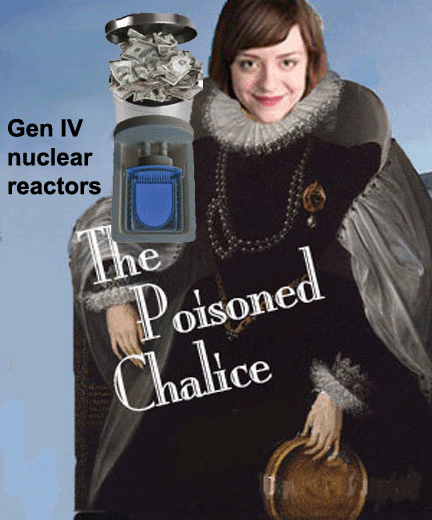
Oh dear! Transatomic Power has been making false claims about Generation IV nuclear reactors
 It’s interesting the way that, for dubious nuclear enterprises, they like to put a young woman at the top. Is this to make the nuclear image look young and trendy? Or is it so they she can cop the flak when it all goes wrong?
Below – Leslie Dewan – CEO of Transatomic Power
 Nuclear Energy Startup Transatomic Backtracks on Key Promises The company, backed by Peter Thiel’s Founders Fund, revised inflated assertions about its advanced reactor design after growing concerns prompted an MIT review. MIT Technology Review by James Temple February 24, 2017 Nuclear energy startup Transatomic Power has backed away from bold claims for its advanced reactor technology after an informal review by MIT professors highlighted serious errors in the company’s calculations, MIT Technology Review has learned.
The Cambridge, Massachusetts-based company, founded in 2011 by a pair of MIT students in the Nuclear Science & Engineering department, asserted that its molten salt reactor design could run on spent nuclear fuel from conventional reactors and generate energy far more efficiently than them. In a white paper published in March 2014, the company proclaimed its reactor “can generate up to 75 times more electricity per ton of mined uranium than a light-water reactor.”
Those lofty claims helped it raise millions in venture capital, secure a series of glowing media profiles (including in this publication), and draw a rock-star lineup of technical advisors. But in a paper on its site dated November 2016, the company downgraded “75 times” to “more than twice.” In addition, it now specifies that the design “does not reduce existing stockpiles of spent nuclear fuel,” or use them as its fuel source. The promise of recycling nuclear waste, which poses tricky storage and proliferation challenges, was a key initial promise of the company that captured considerable attention.
“In early 2016, we realized there was a problem with our initial analysis and started working to correct the error,” cofounder Leslie Dewan said in an e-mail response to an inquiry from MIT Technology Review.
The dramatic revisions followed an analysis in late 2015 by Kord Smith, a nuclear science and engineering professor at MIT and an expert in the physics of nuclear reactors.
At that point, there were growing doubts in the field about the company’s claims and at least some worries that any inflated claims could tarnish the reputation of MIT’s nuclear department, which has been closely associated with the company. Transatomic also has a three-year research agreement with the department, according to earlier press releases.
In reviewing the company’s white paper, Smith noticed immediate red flags. He relayed his concerns to his department head and the company, and subsequently conducted an informal review with two other professors.
“I said this is obviously incorrect based on basic physics,” Smith says. He asked the company to run a test, which ended up confirming that “their claims were completely untrue,” Smith says.
He notes that promising to increase the reactor’s fuel efficiency by 75 times is the rough equivalent of saying that, in a single step, you’d developed a car that could get 2,500 miles per gallon.
Ultimately, the company redid its analysis, and produced and posted a new white paper………
The company has raised at least $4.5 million from Peter Thiel’s Founders Fund, Acadia Woods Partners, and Daniel Aegerter of Armada Investment AG. Venture capital veteran Ray Rothrock serves as chairman of the company.
Founders Fund didn’t immediately respond to an inquiry……https://www.technologyreview.com/s/603731/nuclear-energy-startup-transatomic-backtracks-on-key-promises/
Squabble in West Texas over stranded nuclear wastes
 In West Texas, spent fuel storage seeks a foothold, Edward Klump, E&E News reporter , Energywire: Friday, February 24, 2017 Waste Control Specialists LLC operates a facility licensed to dispose of low-level radioactive waste in Andrews County, Texas. The company is in the process of seeking a license for an interim storage facility for spent nuclear fuel. …….
Florida Supreme Court rejects nuclear expansion
 http://www.sanluisobispo.com/news/business/article134769964.html The Associated Press TALLAHASSEE, FLA. 24 Feb 17 The Florida Supreme Court is upholding a lower court ruling that ordered a massive nuclear plant expansion to be redone to meet environmental and other concerns.
Justices in a brief-one page order on Friday rejected an appeal filed by Florida Power & Light.
Last year, the 3rd District Court of Appeal in Miami reversed a 2014 decision by Gov. Rick Scott and the Cabinet to approve construction of two nuclear reactors by FPL at its Turkey Point plant near Homestead. The project, costing up to $18 billion, would add about 2,200 megawatts of electric power or enough to supply 750,000 homes.
A three-judge panel ruled the governor and Cabinet failed to account for environmental regulations meant to protect the Everglades and endangered birds that make their home in the wetlands.
Trump’s associates and USA conservatives to wage war on environmentalists
Conservatives predict ‘real war’ with environmentalists http://www.eenews.net/stories/1060050477 Amanda Reilly, E&E News reporter Greenwire: Thursday, February 23, 2017 People who question the science of climate change today told conservative activists they were looking forward to using their bigger platform during the Trump administration to roll back U.S. EPA regulations on greenhouse gas emissions.
At the annual Conservative Political Action Conference, a panel of prominent global warming skeptics said one of their top targets was the Obama administration’s 2009 endangerment finding, the basis for EPA’s greenhouse gas regulations.
“It’s going to be a real war with environmentalists, no question about that,” said Steve Milloy, who says he served on President Trump’s EPA transition but was not listed on the administration’s official landing team for the agency. “There’s going to be a lot of litigation. But we’re going to move EPA in the right direction.”
Milloy said “nothing’s made me prouder than the fact that Donald Trump is now president” because Republicans as a whole had been lukewarm in their support of climate skeptics prior to Trump, who once called climate change a Chinese hoax.
The Energy & Environment Legal Institute sponsored the panel this morning in one of the side ballrooms at CPAC, happening outside Washington. Appearing on the panel with Milloy were James Delingpole and Tony Heller. All three have questioned whether human-caused climate change is occurring.
Delingpole, an executive editor at the Breitbart News Network, likened environmentalism to a religion and recycling advocates to a “cult.” The environmental movement, he told the conservative audience, was full of “control freaks” looking for a scientific justification “to tax us, to regulate us, to control our lives.”
Heller, who also goes by the pseudonym Steven Goddard, accused the government of faking statistics to make people believe in “absurd” and “fake news” climate change.
He claimed that conservatives who don’t believe in climate change have been treated like women who were accused of being witches in the 1600s. “Right now, conservatives get blamed for every bad weather event and for climate change, right. It’s our fault,” he said. “But hundreds of years ago, it was witches who were blamed for it.”
‘Scumbags’
The treatment of people who don’t believe in man-made warming is about to change during the Trump administration, Delingpole said. “The people who portray people like us as selfish, greedy, nature-hating scumbags — no. They are the scumbags. We are the good guys,” Delingpole said. “Thank goodness, thanks to Donald Trump, the tide’s turned, and we are about to witness that.”
Along with questioning federal climate change science, panelists also said they were skeptical of EPA research on everything from air pollution to pesticides. Milloy, who led a crusade against EPA’s risk assessment of secondhand smoke, said he hoped the Trump administration would completely end scientific research at the agency, accusing it of paying for “the science it wants.”
An agency “can’t be responsible for producing science and then regulating” based on that science, Milloy said.Being selected to EPA’s transition team was “a dream come true after fighting EPA for 25 years,” he said.
Conservatives are starting to see the fruits of the advice of that transition team, beginning with the confirmation of former Oklahoma Attorney General Scott Pruitt as EPA administrator, he said.
Under the Trump administration, Milloy said, warming skeptics would get to participate in debates over killing President Obama’s key climate policies, including the endangerment finding, which the Supreme Court upheld in 2014.
“The endangerment finding needs to be repealed,” he said. “If it’s not, then President Trump is going to be forced to issue his own climate policy.”
John Walke, clean air director at the Natural Resources Defense Council, slammed the panel in a series of tweets.
“This is alt-reality, folks,” he said.
Twitter: @apeterka Email: areilly@eenews.net
Wealthy Americans building ‘luxury’ underground nuclear bunkers
Nuclear shelter goes up market as the US gets nervous, http://www.afr.com/news/policy/defence/nuclear-shelter-goes-up-market-as-the-us-gets-nervous-20170219-gugigy Australian Financial Review, 24 Feb 17 by Ben Rowen

On July 25, 1961, President John F. Kennedy spoke to the American people of a need “new to our shores” for emergency preparedness, including fallout shelters. The bunkers of that era – brutalist, cement, with foldout beds and stockpiled food – were designed to protect families in the event that the Cold War turned hot.
It never did, but fears of cataclysm – nuclear and otherwise – are back. So are shelters, with a twist. Growing numbers of “preppers” hope to ride out various doomsday scenarios in luxury.
Rising S Bunkers, one of several companies that specialise in high-end shelters – its presidential model includes a gym, a workshop, a rec room, a greenhouse, and a car depot – says sales of its $US500,000-plus ($650,000) units increased 700 per cent last year. (This compares with a more modest 150 per cent increase across other Rising S units.) Bunker companies won’t disclose customers’ names, but Gary Lynch, Rising S’s chief executive, told me his clients include Hollywood actors and “highly recognisable sports stars”. Other luxury shelters are marketed to businesspeople, from bankers to Bill Gates, who is rumoured to have bunkers beneath his houses in Washington State and California.
Whereas Cold War shelters, by design, were near the home and easy to get to, a handful of bunker companies are building entire survival communities in remote locations. Some of them share literal foundations with Cold War buildings: One project, Vivos XPoint, involves refurbishing 575 munitions-storage bunkers in South Dakota; Vivos Europa One, in Germany, is a Soviet armoury turned luxury community with a subterranean swimming pool.
In some regards, the plans for Trident Lakes do resemble those for a resort.Amenities will include a hotel, an athletic centre, a golf course, and polo fields. The community is slated to have 600 condominiums, ranging in price from $US500,000 to $US1.5 million, each with a waterfront view (to which end, three lakes and 10 beaches will be carved out of farmland). Other features are more unusual: 90 per cent of each unit will be underground, armed security personnel will guard a wall surrounding the community, and there will be helipads for coming and going.
As of January, only one part of the project was under way: a 60-foot statue that will feature Poseidon, amid what is supposed to be a 55,000-square-foot fountain. By June, Vintuary plans to unveil the development’s entrance and the shells of six bunkers. If all goes according to schedule, the first units will be finished next year.
Jeff Schlegelmilch, the deputy director of the National Center for Disaster Preparedness at Columbia University, told me that the luxury-bunker trend is “not just a couple of fringe groups; there is real money behind it—hundreds of millions of dollars”. But why are wealthy people buying?
Some customers appear to be motivated by old anxieties, recently revived – the threat of nuclear war, or a national-debt default that leads to unrest. Others have newer fears: climate change, pandemics, terrorism, far-left and far-right extremism. The presidential election has brought new faces into the fold, namely liberals (who also contributed to a record number of background checks – an indicator of gun purchases – on Black Friday). “Typically our sales are going to conservatives, but now liberals are purchasing,” says Lynch, the Rising S CEO.
Violence ‘unfortunate trend’
Rob Kaneiss, Trident Lakes’ chief security officer and a former Navy seal, told me that violence “seems to be the unfortunate trend in the US”. He believes the community’s location will prove to be ideal under the circumstances. “Ector offers … a very rural area,” he said, “so the likelihood of having risks like that, in the absence of specific targeting, is extremely low.”
In case things do go south, Trident Lakes will offer “Navy seal Experience” self-defence training, and a vault for family DNA. The hope is that, down the line, scientists could use genetic material to replicate residents who were lost to catastrophe, thereby ensuring “family sustainability”. Where these scientists might come from isn’t clear, but for a group selling cataclysm, the gesture seems an oddly hopeful bet on the future.
Cuomo’s costly nuclear plant bailout – financially and ethically wrong
 Stop Cuomo’s costly nuclear plant bailout http://www.nydailynews.com/opinion/stop-cuomo-costly-nuclear-plant-bailout-article-1.2980738 BY FR. BILL BRISOTTI NEW YORK DAILY NEWS Friday, February 24, 2017, New Yorkers shouldn’t have to pay for energy they will never use. Which is why Gov. Cuomo should be consistent and close, along with Indian Point, three other outdated nuclear power plants near Rochester and Oswego.
Instead, he is taking $7.6 billion from New York ratepayers and giving it to a hugely profitable, Illinois-based energy company to keep the three plants open.
The governor says he needs the plants operational in order to meet his renewable energy goals, but that’s false. New York can meet its goals on time with wind, solar and hydroelectric power, a Stanford University study recently found. Cuomo should get on the same page as California and get serious about replacing nuclear power with safe, affordable and clean energy. It can be done.
A bailout of upstate nuclear power plants is going to be the largest transfer of wealth from government to a single corporation in New York’s history, and it runs counter to what energy experts are telling us about job growth potential from real renewables.
Most importantly, it flies in the face of pure common sense.
Exelon is the lucky recipient of our money. A Fortune 100 company with annual revenues over $34 billion, it spent $430,000 on lobbying in New York in the past two years, including to obtain subsidies for its plants under the governor’s Clean Energy Standard, which requires half of the state’s eletricity to be produced by renewable sources by 2030.
Yet to prop up the plants, Cuomo has essentially levied a new tax that increases everyone’s utility bills, including local governments. For example, the City of New York will pay $208 million more over 12 years. The cities of Buffalo and Yonkers will pay over $3 million each.
Anyone who pays for electricity will be on the hook: residents, businesses, municipalities, hospitals, schools. Con Ed residential customers will see their bills go up by $700 million, Long Island by $500 million and Niagara Mohawk consumers by $465 million.
It all goes to Exelon.
It’s odd that Cuomo would plow money into these aging upstate plants at the very same time he’s moving to shutter the Indian Point plant near New York City out of concern for safety. Surely the governor is not saying the dangers posed to people and property upstate are less real than those downstate.
Here are five other reasons why the governor has this wrong.
One, nearly 800,000 New Yorkers are behind on their electric bills already. That number will surely increase when Exelon gets more of on our hard-earned money.
Two, it’s geographically skewed. The formula would force New York City, Long Island and some Westchester County customers to pay 60% of costs while using very little of the power generated upstate.
Three, only the governor, Public Service Commission and Exelon have seen this bailout “contract” with Exelon. Yet the decision is proceeding despite pleas from New Yorkers for public hearings and numerous attempts to obtain the document through the Freedom of Information Law.
Four, in New York, clean energy already provides more jobs than the nuclear industry by orders of magnitude — with the potential for astromical future growth. Statewide, estimates range from 85,000 to 180,000 jobs in clean energy, such as solar, wind, energy retrofits, heat pumps and other efficiencies, compared to 3,250 jobs at Indian Point and the other three nuclear plants combined.
Last — hardest to quantify but most important, at least to me — is the matter of moral leadership. Pope Francis has written on the state’s responsibility to promote the common good through dialogue and consensus-building. During his address to the U.S. Congress last year, he quoted from his encyclical “Laudato Si,” about care for the Earth, our common home: “ ‘We have the freedom needed to limit and direct technology’; ‘to devise intelligent ways of . . . developing and limiting our power’; and to put technology ‘at the service of another type of progress, one which is healthier, more human, more social, more integral.’ ”
Supporting aging nuclear plants won’t get us to the future he envisions. Only wholeheartedly embracing energy efficiency and renewable energy will.
Brisotti is pastor of Our Lady of the Miraculous Medal parish in Wyandanch, L.I.
Promising new non toxic and long lasting solar power battery
This non-toxic battery lasts a decade, could be renewable energy’s missing piece Anthropocene, by | Feb 23, 2017 “……Researchers at Harvard University have developed a new kind of low-cost battery that can run for more than 10 years with no maintenance. It is also non-toxic and inexpensive, to boot. The technology could make grid-scale renewable energy storage a reality, the researchers say in a paper published in the journal ACS Energy Letters…….
The new battery should be cheaper to produce than today’s devices. “And since the medium is noncorrosive, you can use cheaper materials to build the components of the batteries, like the tanks and pumps,” Gordon said in a press release.
The battery loses only 1 percent of its capacity after over 1,000 charge cycles, which is much longer than lithium batteries. The researchers also calculated that if the battery was charged and discharged completely once a day, “we would expect it to retain 50 percent of its energy storage capacity after 5,000 cycles, or about 14 years.” http://www.anthropocenemagazine.org/2017/02/low-cost-long-lasting-battery-to-store-solar-power/
Attacks on climate scientists will continue
Climate scientists face harassment, threats and fears of ‘McCarthyist attacks’
Researchers will have to deal with attacks from a range of powerful foes in the coming years – and for many, it has already started “…….The Texas Tech University professor Katharine Hayhoe, who has gathered a healthy following for her Facebook posts that mix climate science with evangelism, has opened her inbox to missives including “Nazi Bitch Whore Climatebecile” and a request that she “stop using Jesus to justify your wacko ideas about global warming”.
Threats and badgering of climate scientists peaked after the theft and release of the “Climategate” emails – a 2009 scandal that was painfully thin on scandal. But the organized effort to pry open cracks in the overwhelming edifice of proof that humans are slowly baking the planet never went away. Scientists are now concerned that the election of Donald Trump has revitalized those who believe climate researchers are cosseted fraudsters.
Mann said climate scientists “fear an era of McCarthyist attacks on our work and our integrity”. The odd unfulfilled threat may be perturbing but a more morale-sapping fear is that the White House and Congress will dig up and parade seemingly unflattering emails, sideline or scrap research and attempt to hush the scientific community…..https://www.theguardian.com/environment/2017/feb/22/climate-change-science-attacks-threats-trump
Bexar County commissioners say no to nuclear waste shipments
 On Tuesday, Bexar County became the first county in Texas to officially oppose having high-level nuclear waste pass through the county on its way to a West Texas waste site. (subscribers only) http://www.expressnews.com/news/local/article/Bexar-County-commissioners-say-no-to-nuclear-10948737.php By Brendan Gibbons, San Antonio Express-News February 21, 2017
1 This Month
19 November – Webinar – The Reality of Reprocessing
Time: 11:00 AM Pacific Time (US & Canada) / 2:00 PM Eastern / 7:00 PM UK / 8:00 PM CET
Register for the Zoom Event Here

Tell Congress: Prevent Nuclear Catastrophe in Iran

Tell Congress: Prevent Nuclear Catastrophe in Iran

Read the Public Inquiry Report, the Commissioners’ report, Surrendering Australia: The AUKUS Deception is available to download for free at aukuspublicinquiry.com. Or just watch the replay of the National Press Club Luncheon.


Shut down the radiation-damaged Heysham nuclear reactors now
To see nuclear-related stories in greater depth and intensity – go to https://nuclearinformation.wordpress.com

Say No to NASA’s Reckless Nuclear Reactor on the Moon
Say No to NASA’s Reckless Nuclear Reactor on the Moon
-
Archives
- November 2026 (166)
- October 2026 (302)
- September 2026 (339)
- August 2026 (330)
- July 2026 (355)
- June 2026 (287)
- May 2026 (306)
- April 2026 (356)
- March 2026 (251)
- February 2026 (267)
- January 2026 (308)
- December 2025 (358)
-
Categories
- 1
- 1 NUCLEAR ISSUES
- business and costs
- climate change
- culture and arts
- ENERGY
- environment
- health
- history
- indigenous issues
- Legal
- marketing of nuclear
- media
- opposition to nuclear
- PERSONAL STORIES
- politics
- politics international
- Religion and ethics
- safety
- secrets,lies and civil liberties
- spinbuster
- technology
- Uranium
- wastes
- weapons and war
- Women
- 2 WORLD
- ACTION
- AFRICA
- Atrocities
- AUSTRALIA
- Christina's notes
- Christina's themes
- culture and arts
- Events
- Fuk 2022
- Fuk 2023
- Fukushima 2017
- Fukushima 2018
- fukushima 2019
- Fukushima 2020
- Fukushima 2021
- general
- global warming
- Humour (God we need it)
- Nuclear
- RARE EARTHS
- Reference
- resources – print
- Resources -audiovicual
- Weekly Newsletter
- World
- World Nuclear
- YouTube
-
RSS
Entries RSS
Comments RSS

