Duke Energy Corp. asked to cancel its planned nuclear plant in South Carolina, citing the bankruptcy of reactor manufacturer Westinghouse Electric Co.
North Carolina utility regulators should require customers of the company’s Duke Energy Carolinas unit to pay $353 million of pre-construction costs spent on the Lee Nuclear Station over the next dozen years, the Charlotte-based company said Friday in a state filing.
The decision is the latest blow to the U.S. nuclear industry in the wake of the Westinghouse bankruptcy. South Carolina utilities Scana Corp. and Santee Cooper pulled the plug on a half-finished plant earlier this month after delays and cost overruns, and Southern Co. is weighing whether to halt work on two Georgia reactors. Nuclear units that were operating for decades have shut, unable to compete with low-cost renewable energy and abundant supplies of natural gas from shale basins.
“Risks and uncertainties to initiating construction on the Lee Nuclear project have become too great and cancellation of the project is the best option for customers,” Duke said in a separate statement
A similar request will be made with South Carolina utility regulators in the future, Rick Rhodes, a company spokesman, said by phone Friday. The U.S. Nuclear Regulatory Commission issued a construction and operating license for the plant last year and Duke will maintain that license “to build new nuclear at this site in the future if it is in the best interest of customers.”
NextEra Energy Inc. has said it’s decided to “pause” an expansion of its Turkey Point nuclear plant in Florida, but the company is still seeking approval to obtain and then maintain a federal license for two reactors there.
Duke shares rose 0.8 percent to $87.46 at 12:28 p.m. in New York.
August 26, 2017
Posted by Christina Macpherson |
business and costs, USA |
1 Comment
 Strong indications’ Trump won’t recertify Iranian compliance with nuclear deal
- There are more signs the Trump administration is preparing a case to decertify Iran’s compliance with the international nuclear deal.
- Nikki Haley, the U.S. ambassador to the United Nations, this week visited the atomic watchdog agency in charge of monitoring Iran’s compliance.
- On Thursday, Tehran said it “is abiding by its duties and responsibilities” and accused Washington of using the issue “for ill-wishing political means.” CNBC
Jeff Daniels | The Trump administration is giving “strong indications” that it is preparing a case to decertify
Iran‘s compliance with the international nuclear agreement, an expert says.
If that happens, though, some analysts believe it risks alienating U.S. allies. In addition to the United States and Iran, the 2015 nuclear agreement was signed by Britain, France, Germany, Russia, China and the United Nations.
The White House sent Nikki Haley, U.S. ambassador to the United Nations, to Vienna on Wednesday to meet with officials from the International Atomic Energy Agency, which is responsible for monitoring and verifying Iran’s commitments under the 2015 agreement, known as the Joint Comprehensive Plan of Action.
On Thursday, Iran’s state-run IRNA news agency quoted from a letter sent by Iran’s foreign minister to the U.N. agency saying the country “is abiding by its duties and responsibilities” with regard to nuclear weapons and agreements. He accused Washington of using the issue “for ill-wishing political means.”
During her visit, Haley “discussed the IAEA’s verification and monitoring of Iran’s nuclear-related commitments,” according to a statement by the agency. It provided no additional information, and a statement from Haley’s office discussed her visit but shed no light on imminent action.
Last week, Haley said the Tehran government should be held accountable for “its missile launchers, support for terrorism, disregard for human rights, and violations of U.N. Security Council resolutions. Iran cannot be allowed to use the nuclear deal to hold the world hostage.”
The Trump administration has certified Iran’s compliance twice under a law that requires it to notify Congress of Iran’s compliance every 90 days. The next review ends in October.
Analysts say recent actions by the U.S. demonstrate that President Donald Trump plans to renege on the Iran nuclear agreement. During the election campaign, he threatened to rip up the agreement, calling it “the worst deal ever.”
The actions include new U.S. sanctions imposed on Iran and a comment last week by a U.S. official that Iran is in breach of “the spirit” of the nuclear accord. New sanctions were designed to punish Iran for its human rights record, rocket launches as well as its role in terrorism and arms smuggling.
“He’s given strong indications that he’s just not going to recertify it,” said John Glaser, director of foreign policy studies at the Cato Institute, the libertarian think tank.
“If we were to leave the deal or deliberately abrogate it, we’d be isolated internationally and we wouldn’t be able to do anything like reapply sanctions that would do any kind of damage on Iran,” he added. “That’s because the rest of the international community would not sort of play along.”
Glaser said the other parties to the agreement “agree that Iran is compliance with the deal and agree that the deal should be kept in place because it’s a robust, nonproliferation agreement. It has kind of taken military conflict against Iran because of the nuclear program off the table.”
Last week, Iranian President Hassan Rouhani threatened to quit the nuclear pact if the White House issues new sanctions. Iran charged those sanctions were a violation of the nuclear accord…..https://www.cnbc.com/2017/08/25/strong-indications-trump-wont-recertify-iran-nuclear-deal.html
August 26, 2017
Posted by Christina Macpherson |
Iran, politics international, USA |
Leave a comment
 Did climate change make Hurricane Harvey worse? https://qz.com/1062574/hurricane-harvey-and-climate-change-did-rising-temperatures-and-sea-levels-make-harvey-worse/ 25 Aug 17, As climatologist Katharine Hayhoe points out, seasonal hurricanes are a natural part of the weather system in the Gulf coast, and attributing the cause of a single storm entirely to climate change is currently an impossible task. “Once you get down to a small regional level, hurricanes are so rare and random that you would not be able to detect a robust trend even if there was one,” says John Nielsen-Gammon, Texas’ state climatologist.
But did climate change-driven factors make Hurricane Harvey more destructive?
The waters of the Gulf of Mexico have been warmer than average this year, with bathtub-like temperatures breaking heat records all last winter.
Researchers can point to a direct relationship between warmer water temperatures and an increase in tropical cyclone formations, but the link between warm water and hurricanes is less clear, in part because hurricanes require several other ingredients, like specific wind patterns, to form.
Climate change is definitely setting up conditions that are known to make storms more destructive, including heating up the oceans. “The warmer the Gulf water is, the greater the amount of moisture will be available” to fuel rainfall, Nielsen-Gammon says.
Officials at the National Hurricane Center predict Hurricane Harvey will bring torrential rainfall of 15 to 25 inches to Texas—with “isolated maximum amounts of 35 inches over the middle and upper Texas coast,” the Center wrote in its latest warning.
Climate change is also heating South Texas faster than most other regions in the US, and the area has been setting heat records all summer. Warmer air temperatures mean the air has a far greater carrying capacity for moisture—which translates to even more rainfall, and more floods.
“We’ve seen an increase of 30% in very heavy rainfall and intensity across Texas,” Nielsen-Gammon says. The US Environmental Protection Agency’s website notes that rainstorms in Texas are “becoming more intense, and floods are becoming more severe…In the coming decades, storms are likely to become more severe.”
And then there’s sea level rise; global warming is raising sea levels along Texas’ coast by almost two inches per decade, according to the EPA. Sea level rise makes storm surges “that much higher,” Nielsen-Gammon says.
Officials currently warn the storm surge for Harvey is expected to bring “life-threatening” flooding at heights of six to 12 feet above ground level along the coast.
Workers at 39 offshore petroleum production platforms and an oil rig in the Gulf of Mexico were evacuated on Thursday in anticipation of Hurricane Harvey, CNN reports. Over the past century, offshore platform heights have risen with sea level and storm intensity, the Atlantic reports; in the 1940s, they were 20 to 40 ft above sea level. In the 1990s, they rose to 70 ft. Now, after Hurricanes Katrina and Rita, platforms in the Gulf sit 91 ft above the sea surface.
Later, after the storm is over, scientists who work on “event attribution” may try to assess whether Hurricane Harvey would have been less intense in the absence of human-driven climate change, much like researchers did with Hurricane Katrina; for example, one team found that under the climate conditions of 1900, Katrina’s storm surge would have been anywhere between 15% and 60% lower.
But for now, researchers, including experts at NASA, point out that the already-clear effects of a changing climate—warmer air, warmer water, and sea level rise—could make any storm that develops more intense.
August 26, 2017
Posted by Christina Macpherson |
climate change, USA |
Leave a comment
 Rick Perry gets his electricity grid study. The coal and mining industries like it. WP, By Steven Mufson August 24 A much-anticipated Energy Department report on the electricity grid made recommendations for regulatory changes that would bolster coal and nuclear power plants.
The changes, if adopted, would alter the way prices are determined in electricity markets, ease environmental reviews for coal plants and speed the permitting process for a variety of energy sources.
The 187-page report rejects the notion that the coal and nuclear plants that have been forced to shut down over the past 16 years had been closed prematurely, noting that cheap, abundant natural gas had been the main factor — not environmental regulations or renewable energy sources as Republican leaders have contended…..
The Energy Department document carries little weight on its own, and most of its recommendations fall in the turf of other departments and agencies.
But the report has been seen as a test of whether the Trump administration is going to politicize government studies and disregard scientific evidence.
The in-depth look at the state of the grid quickly drew praise from coal and nuclear groups, and sharp rebukes from environmental and solar energy groups.
Among the recommendations is one that suggests that the Environmental Protection Agency ease permitting requirements for new investments at coal-fired plants, a process known as new source review…..
The report also endorsed price changes that would prevent solar and wind energy from providing energy at negative prices, which they can do thanks to federal tax credits.
This hurts other energy suppliers, especially in the nuclear industry, and the recommendation was welcomed.
“We’re very pleased with the top line recommendation for the implementation of long overdue energy market reforms,” said Joe Dominguez, executive vice president of regulatory affairs at Exelon, the nation’s largest nuclear power utility.
The report suggested that the Nuclear Regulatory Commission speed up its permitting process ……
Environmental and renewable industry groups slammed the report for failing to deal with climate change and the drive toward low carbon electricity, and noted that the final report differed from earlier drafts that had been leaked……..https://www.washingtonpost.com/business/economy/2017/08/23/fa4a506a-883e-11e7-a50f-e0d4e6ec070a_story.html?utm_term=.00a738b7bf7a
August 26, 2017
Posted by Christina Macpherson |
ENERGY, politics, USA |
Leave a comment
 Why Ontario shouldn’t lock itself in to nuclear power, The province has committed to a dying technology when greener, safer energy innovations are just around the corner, TVO, Aug 25, 2017, by Richard Laszlo, Richard Laszlo is the founder of Laszlo Energy Services and the author of Pollution Probe’s First Primer on Energy Systems in Canada.
We are at a critical juncture in Ontario, and no less than the economic future of the province is at stake. The Liberals are about to release their long-term energy plan, and the danger is that they’re going to foolishly reinvest in the Darlington and Pickering nuclear plants.
Nuclear power is inflexible, and going all-in on a centralized and costly technology just when solar power, energy storage, and co-generation are becoming more affordable is a big risk. The province could be locking itself out of safer, cheaper, and more flexible energy for generations.
I once supported nuclear power; I’m biased toward fancy technology. I studied engineering and physics and have been working in the energy field for almost 15 years. But I’m trying to look at this objectively, and as someone who winces at every wasted customer and taxpayer dollar.
Our overreliance on nuclear power leaves us with an overabundance of energy in off-peak hours. Nuclear plants are big, complicated, and have to be kept running 24/7 — which forces our energy system to do all sorts of crazy things. When the plants produce surplus electricity, we sell it to neighbouring jurisdictions at a loss or pay them to take it off our hands. Meanwhile, wind and solar owners get paid to produce unneeded power, while gas plants get paid to sit idle in the off chance they are needed.
The amount of waste this system generates is staggering: the Ontario Society of Professional Engineers recently estimated that Ontario squandered more than $1 billion-worth of low-emission electricity in 2016 — enough to power more than 760,000 homes for a year.
It’s a favourite pastime of think tanks like the Fraser Institute as well as certain conservative newspaper columnists to blame renewable power for Ontario’s high hydro rates, but as data from the Independent Electricity System Operator clearly shows, it’s nuclear and gas plants that are responsible for the lion’s share of increases. An overinvestment in nuclear power would make the problem worse.
Based on cost and performance, the Pickering plant should have been shut down already. Based on 1960s technology, it has among the highest operating costs of any nuclear facility in North America. Yet Ontario Power Generation wants to keep it running until 2024, so it’s asking the Ontario Energy Board for permission to raise the price of its nuclear-generated electricity nearly 180 per cent, to 16.5 cents per kWh — more than almost any other technology around, including solar. Dozens of groups — including Canadian Manufacturers and Exporters, the Association of Major Power Consumers of Ontario, and the Consumer Council of Canada — have submitted responses to OPG’s request. Nearly all of them express concerns about the economics of the Pickering plan…….
what should the government do instead?
First, it should immediately halt the Pickering extension. The plant’s operating licence expires in 2018, and that’s a good time to shut it down. (Plant employees can work on to decommissioning the site, for which money has already been set aside.)
Second, take good hard look at the Darlington rebuild and seriously consider other options to meet the projected demand. While the rebuilding process has already started, it’s not too late for the government to change direction. The project is expected to cost at least $12.8 billion, but a long history of underestimating nuclear capital costs suggests that number will rise.
Third, plan to meet future demand via a mix of efficiency and clean-energy innovation. The government should set standards on emissions and performance, then let the market bring solutions and fight it out to deliver low-emissions power at the lowest possible price. New generation can be added to the system gradually so we can reap the benefits of falling tech prices.
All this will result in greater CO2 emissions over the short term; the fact is, there will be some increase regardless of whether Ontario continues to invest in nuclear energy. But this way, we’ll replace our supply gradually at much lower costs while still meeting our long-term climate change goals — and without tying ourselves to nuclear power for decades to come. http://tvo.org/article/current-affairs/the-next-ontario/why-ontario-shouldnt-lock-itself-in-to-nuclear-power
August 26, 2017
Posted by Christina Macpherson |
Canada, politics |
Leave a comment
Shoddy translation in the Western media is increasing nuclear tensions–again, Bulletin of Atomic Scientists, Ariane Tabatabai, 25 Aug 17, “…….Inaccurate translations, imprecise analyses, and poor reporting have long plagued discussion of Iranian nuclear affairs in Western, English-language media. Now, though, this kind of irresponsibility is particularly alarming, because the nuclear agreement signed in 2015 between Iran and six world powers is in a fragile state. The agreement, known as the Joint Comprehensive Plan of Action, or JCPOA, curbs Iranian nuclear activities in exchange for sanctions relief, and is critical to advancing the US objective of keeping Tehran away from the Bomb without resorting to military force. US President Donald Trump has gone from pledging to dismantle the deal to trying to kill it by a thousand cuts. Meanwhile, various American interest groups are jumping in to advocate for their own preferred Iran policy options, including leaving the JCPOA and pursuing regime change. All this makes it even more critical than before for journalists and experts to get the facts right.
In foreign policy reporting, especially during periods of heightened tension and escalation, translations are a particularly challenging part of the journalist’s job. Mistranslations and inaccurate reporting
can be consequential, as even the slightest mistakes can change meaning and generate crises……
the bottom line of all statements coming out of Tehran about the nuclear deal is that the country is committed to preserving it. This is
currently the consensus within the regime; whether everyone likes it or not, the JCPOA is the law of the land. Yet given US threats to renege on the deal, Rouhani also has to hedge. So he is laying out his country’s options and the possible outcomes should America withdraw from the process. It is in this area that many reporters have translated his statements inaccurately.
For example, on August 15,
Reuters inaccurately reported that Rouhani said his country “could abandon its nuclear agreement with world powers ‘within hours’ if the United States imposes any more sanctions.” The article went on to misquote Rouhani as saying: “If America wants to go back to the experience (of imposing sanctions), Iran would certainly return in a short time—not a week or a month but within hours—to conditions more advanced than before the start of negotiations.” In fact, what Rouhani said was: “New US officials should know that the failed experience of sanctions and coercion brought their previous governments to the negotiating table. And if they want to return to that experience, surely, in a short amount of time, not in a period of weeks and months, but hours and days, we will return to a much more advanced situation than that of the beginning of the talks.” In other words, Rouhani wasn’t threatening to leave the JCPOA if the United States imposed more sanctions on it—as the article’s title suggested and its content indicated—but to resume elements of its program if
Washingtondecided to leave the JCPOA. At the same time, Rouhani reiterated that his country’s preferred course of action was to preserve the deal—but he wanted the United States to know that Iran, too, had options……
These inaccuracies would be problematic under normal circumstances, but they are particularly irresponsible at a time of heightened tensions, during which misperceptions could quickly torpedo the nuclear deal and put the United States and Iran on a collision course. Right now, the Trump administration is reviewing its policy on the JCPOA, Iranian support for the deal is diminishing, and hawks on both sides see this fragile state of affairs as an opportune moment to kill it off completely. If journalists are to hold those in power accountable, they must be held accountable themselves.
http://thebulletin.org/shoddy-translation-western-media-increasing-nuclear-tensions-again11046?platform=hootsuite
August 26, 2017
Posted by Christina Macpherson |
Iran, media, USA |
Leave a comment
Investigative reports in 2015 revealed that Exxon had its own scientists doing its own climate modeling as far back as the 1970s: science and modeling that was not only accurate, but that was being used to plan for the company’s future.
Now, a peer-reviewed study published August 23 has confirmed that what Exxon was saying internally about climate change was quantitatively very different from their public statements. Specifically, researchers Geoffrey Supran and Naomi Oreskes found that at least 80 percent of the internal documents and peer-reviewed publications they studied from between 1977 and 2014 were consistent with the state of the science – acknowledging that climate change is real and caused by humans, and identifying “reasonable uncertainties” that any climate scientist would agree with at the time. Yet over 80 percent of Exxon’s editorial-style paid advertisements over the same period specifically focused on uncertainty and doubt, the study found.
The stark contrast between internally discussing cutting-edge climate research while externally conducting a climate disinformation campaign is enough to blow many minds. What was going on at Exxon?
I have a unique perspective – because I was there.
From 1995 to 1997, Exxon provided partial financial support for my master’s thesis, which focused on methane chemistry and emissions. I spent several weeks in 1996 as an intern at their Annandale research lab in New Jersey and years working on the collaborative research that resulted in three of the published studies referenced in Supran and Oreskes’ new analysis.
Climate research at Exxon
A scientist is a scientist no matter where we work, and my Exxon colleagues were no exception. Thoughtful, cautious and in full agreement with the scientific consensus on climate – these are characteristics any scientist would be proud to own.
Did Exxon have an agenda for our research? Of course – it’s not a charity. Their research and development was targeted, and in my case, it was targeted at something that would raise no red flags in climate policy circles: quantifying the benefits of methane reduction…….
Did I know what else they were up to at the time? I couldn’t even imagine it.
Fresh out of Canada, I was unaware that there were people who didn’t accept climate science – so unaware, in fact, that it was nearly half a year before I realized I’d married one – let alone that Exxon was funding a disinformation campaign at the very same time it was supporting my research on the most expedient ways to reduce the impact of humans on climate.
Yet Exxon’s choices have contributed directly to the situation we are in today, a situation that in many ways seems unreal: one where many elected representatives oppose climate action, while China leads the U.S. in wind energy, solar power, economic investment in clean energy and even the existence of a national cap and trade policy similar to the ill-fated Waxman-Markey bill of 2009.
Personal decisions
This latest study underscores why many are calling on Exxon to be held responsible for knowingly misleading the public on such a critical issue. For scientists and academics, though, it may fuel another, different, yet similarly moral debate.
Are we willing to accept financial support that is offered as a sop to the public conscience?
The concept of tendering literal payment for sin is nothing new. From the indulgences of the Middle Ages to the criticisms some have leveled at carbon offsets today, we humans have always sought to stave off the consequences of our actions and ease our conscience with good deeds, particularly of the financial kind. Today, many industry groups follow this familiar path: supporting science denial with the left hand, while giving to cutting-edge research and science with the right.
The Global Climate and Energy Project at Stanford University conducts fundamental research on efficient and clean energy technologies – with Exxon as a founding sponsor. Philanthropist and political donor David Koch gave an unprecedented US$35 million to the Smithsonian National Museum of Natural History in 2015, after which three dozen scientists called on the museum to cut ties with him for funding lobbying groups that “misrepresent” climate science. Shell underwrote the London Science Museum’s “Atmosphere” program and then used its leverage to muddy the waters on what scientists know about climate…….
After two decades in the trenches of climate science, I’m no longer the ingenue I was. I’m all too aware, now, of those who dismiss climate science as a “liberal hoax.” Every day, they attack me on Facebook, vilify me on Twitter and even send the occasional hand-typed letter – which begs appreciation of the artistry, if not the contents. So now, if Exxon came calling, what would I do?……
Despite the fact that there’s no easy answer, it’s a question that’s being posed to more and more of us every day, and we cannot straddle the fence any longer. As academics and scientists, we have some tough choices to make; and only by recognizing the broader implications of these choices are we able to make these decisions with our eyes wide open, rather than half shut. https://theconversation.com/i-was-an-exxon-funded-climate-scientist-49855
August 26, 2017
Posted by Christina Macpherson |
climate change, Religion and ethics, USA |
Leave a comment
The Trump Administration Censors Climate Change Research as Hurricane Harvey Barrels Down on Texas http://www.esquire.com/news-politics/news/a57202/climate-change-censor-scientist/ This is nothing new, but it’s still a disgrace. BY JACK HOLMES, AUG 25, 2017
Free speech for me but not for thee” seems to be a core principle of the Trump administration.
The president defended a group of white supremacists, neo-Nazis, Ku Klux Klan members, and the “very fine people” who march with them earlier this month, partly on the grounds that they had secured a permit and thus had a First Amendment right to assemble. But when it comes to scientists publishing their findings on issues that Republicans and the fossil fuel interests that pay their campaign bills find inconvenient, this administration suddenly takes a very dim view of free expression. The latest example comes via a scientist at Northeastern University, who received an intriguing email from a federal bureaucrat Thursday afternoon:[on original]
As another scientist who shared Bowen’s post on Twitter put it, this is a textbook case of censorship. Political operatives in the administration are attempting to police the work of nonpartisan academics to remove any references to “climate change” or “global warming.” Because if you never say the words, the things they describe will never appear. Like Beetlejuice.
These aren’t exactly uncharted waters for the Trump administration. Earlier this month, it emerged that staffers at the U.S. Department of Agriculture were instructed to censor the terms “climate change,” “reduce greenhouse gasses,” “sequester carbon,” and “climate change adaptation” in their work. In March, Politico reported the Department of Energy’s international climate office had instructed staff not to use “climate change,” “emissions reduction,” or “Paris Agreement” in “memos, briefings, or other written communication.”
And of course, the contemptible Scott Pruitt—the man tasked with destroying the Environmental Protection Agency from the inside—has enacted a policy of secrecy at that agency that wouldn’t be out of place at the CIA. The problem is so bad that scientists from 13 federal agencies preemptively leaked a terrifying report on the realities of man-made climate change, explicitly stating that they were concerned it would be censored by the administration.
This all fits the mold for Republicans in general. After all, Vice President Dick Cheney and his operatives did plenty of meddling in climate research during the Bush administration. And the administration of Governor Rick Scott in Florida—a state in which the biggest city is already flooding at high tide—has long banned the use of certain terms, including “climate change.” Because again, if you don’t say the words, the problem doesn’t exist. It’s like playing hide and seek with a toddler. Just put your palms over your eyes and stand there while the water rises around your ankles.
August 26, 2017
Posted by Christina Macpherson |
civil liberties, climate change, secrets,lies and civil liberties, USA |
Leave a comment
New study finds that climate change costs will hit Trump country hardest
In the USA, the southeastern states are most vulnerable to the costly impacts from human-caused climate change, Guardian, John Abraham 24 Aug 17, “….. The costs are not uniformly distributed. Some regions will suffer more and other regions will suffer less. In fact, some regions will actually benefit in a warming climate. We understand that the world is interconnected and costs will inevitably be shared to some extent. But it is clear we won’t all suffer the same.
It is also clear that the natural biosystems won’t suffer the same. Some areas are more susceptible to climate change, others less so. Coastal areas and tropical areas are great examples. We know that sea level rise and ocean acidification will impact coastal regions much more than where I live (Minnesota, USA). But tropical zones that experience a very small climate variation throughout the year (there is no winter, for instance, in the tropics) have biosystems that have evolved to survive in very tight climate ranges. The plants and animals just are not used to systematic changes to the climate.
In my opinion, the most interesting research deals with answering just these questions.
Fortunately, a really important paper just came out in Science titled Estimating Economic Damage from Climate Change in the United States. Granted, this paper focused on the United States, but the analysis method and lessons can be applied elsewhere.
So what did they find? First, even in a single country like the United States, the losses will be very uneven. In general, the more southern states will suffer most. In the figure below, counties are colored by economic consequences from climate change under a business as usual scenario. The time period associated with the image is 2080–2099. Yellow, orange and red colors correspond to climate costs. Green colors are areas where climate change benefits will be seen…..

https://www.theguardian.com/environment/climate-consensus-97-per-cent/2017/aug/24/new-study-finds-that-climate-change-costs-will-hit-trump-country-hardest
August 25, 2017
Posted by Christina Macpherson |
climate change, USA |
Leave a comment
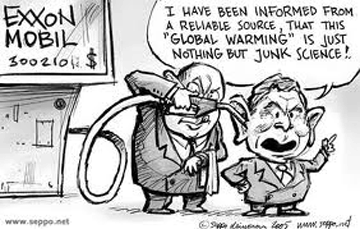 Exxon accused by Harvard researchers of misleading public on climate change, ABC News 24 Aug 17 Two Harvard University researchers say they have collected data proving Exxon Mobil Corp made “explicit factual misrepresentations” in newspaper ads it purchased to convey its views on the oil industry and climate science.
In an article in the journal Environmental Research Letters, researchers Geoffrey Supran and Naomi Oreskes said they examined 187 documents, including internal memos, peer-reviewed papers by Exxon scientists and “advertorials” that ran in The New York Times — paid advertisements in the style of opinion pieces.
The researchers said they used a social science analysis method to turn statements in the documents into data points that could be counted and compared to each other.
Exxon ‘consistently asserted doubt’ on climate change
Mr Supran and Ms Oreskes said as early as 1979, Exxon scientists acknowledged burning fossil fuels was adding more carbon dioxide to the atmosphere and causing global temperatures to rise, but they said the company’s position in newspaper ads remained significantly different by consistently asserting doubt about climate science.
The study was funded by the Rockefeller family philanthropies, which previously supported a campaign to prove Exxon knew more than it publicly admitted about climate change.
That campaign used the slogan #ExxonKnew…..
Ms Oreskes said the Rockefeller family funding did not affect the study’s outcome.
She said the impetus for the study came from Exxon’s responses to reports in InsideClimate News and The Los Angeles Times in September 2015 and October 2015, respectively, that Exxon’s scientists had long known of the dangers fossil fuels posed to the earth’s climate…..http://www.abc.net.au/news/2017-08-24/exxon-climate-change-misled-public-harvard-researchers-say/8837894
August 25, 2017
Posted by Christina Macpherson |
climate change, secrets,lies and civil liberties, USA |
Leave a comment

 American experts say that US nuclear might depends crucially on the
civilian use of atomic energy, and believe the country will lose its place
as the world’s nuclear superpower if it does not support its nuclear
industry. The link between the civil nuclear industry and the military’s
ability to maintain its nuclear weapons capability is spelt out in a report
by experts close to the Pentagon.
It states openly that tritium, an essential component of nuclear weapons, is manufactured in civilian
reactors for military use. It also says that civilian reactors are needed
to produce highly enriched uranium.
The Washington-based Energy Futures Initiative report, says that Russia and China, which are both building
civil nuclear stations outside their national borders, will overtake
America both in influence and ability to deliver a nuclear threat unless
steps are taken to prop up the civil nuclear programme at home.
This is the first time that the dependence of nuclear weapons states on their civil
nuclear programmes has been so clearly spelt out.
Governments, particularly the United Kingdom’s, have repeatedly claimed there is no connection
between the civil and military nuclear industries, but this report makes
clear that is not the case. “With renewable costs tumbling and the
international nuclear industry in growing crisis, it is becoming ever more
difficult to carry on concealing this key underlying military reason for
attachment to civil nuclear power” http://climatenewsnetwork.net/us-nuclear-might-rests-on-civil-reactors/
August 25, 2017
Posted by Christina Macpherson |
USA, weapons and war |
Leave a comment
 Lockheed, Raytheon Win Contracts for New Nuclear Cruise Missile, Bloomberg, By Anthony Capaccio, August 24, 2017
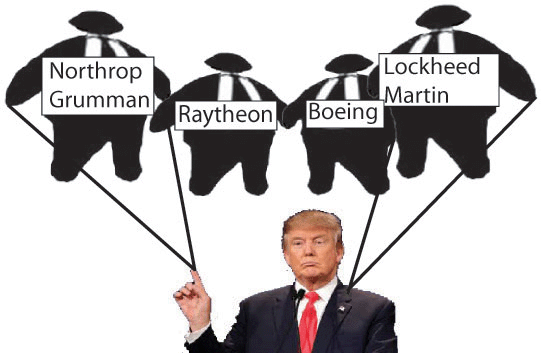
Lockheed Martin Corp. and Raytheon Co. were picked by the U.S. Air Force to begin development of a new nuclear cruise missile for long-range bombers, while Boeing Co. was shut out of the effort to replace its aging weapon that’s in use today.
The initial contracts of about $900 million each are for a 54-month phase to refine designs and prove out technologies for the Long-Range Standoff missile, Captain Emily Grabowski, an Air Force spokeswoman, said in a statement Wednesday.
After that, the Air Force will pick one of the contractors for full production of as many as 1,000 missiles — not all of them topped by nuclear warheads — in an acquisition phase the service values at about $10 billion……
With this week’s awards, the outlines of the Pentagon’s long-range nuclear modernization program are emerging. The Defense Department published in May the first official cost report for the 12-vessel Columbia-class nuclear-missile submarines, estimated as a $127 billion acquisition program.
The Congressional Budget Office is working on its first 30-year look at the cost to develop, acquire and sustain a new nuclear arsenal. While lawmakers and analysts have estimated it’s a $1 trillion program, the Arms Control Association last week projected the potential cost through 2047 at as much as $1.46 trillion.
— With assistance by Nafeesa Syeed https://www.bloomberg.com/news/articles/2017-08-23/lockheed-raytheon-win-contracts-for-new-nuclear-cruise-missile
August 25, 2017
Posted by Christina Macpherson |
business and costs, USA, weapons and war |
Leave a comment
 Why is NASA testing bomb-grade materials for its Mars mission? , Alan J. Kuperman, Edwin Lyman, Baltimore Sun, 24 Aug 17 A new space race is afoot. President Donald Trump and CEOs Elon Musk (Tesla) and Jeff Bezos (Amazon) are all advocating manned missions to Mars, a tantalizing objective. However, in humankind’s drive to explore strange new worlds, we must be careful not to endanger life here on Earth.
Regrettably, to power its Mars mission, NASA’s Goddard Space Center is trying to develop a nuclear reactor fueled by weapons-grade, highly enriched uranium — the stuff of the Hiroshima bomb — threatening to undermine decades of progress in phasing out such dangerous material from reactors worldwide to reduce risks of nuclear terrorism and proliferation.
Instead of violating U.S.-led nonproliferation norms, NASA should embrace an ongoing alternative reactor design that uses fuel made with low-enriched uranium, unsuitable for nuclear weapons.
If terrorists got hold of a sufficient quantity of highly enriched uranium, they could set off an actual nuclear explosion simply by slamming two pieces of the material together. This was the principle behind the Hiroshima bomb that killed tens of thousands in 1945. The resulting devastation from blast effects, fire and high radiation would dwarf that from an improvised “dirty bomb,” which disperses relatively tiny amounts of radioactive material.
In the 1960s, the United States foolishly exported large quantities of weapons-grade uranium for civilian applications, opening huge security risks. Belatedly recognizing this error, Washington launched a global effort in the 1970s to phase out use of such bomb-grade fuel, eventually eliminating hundreds of pounds annually from research reactors and medical isotope production. More recently, Congress has even started funding the U.S. Navy to explore converting its own nuclear reactors in aircraft carriers and submarines to safer low-enriched uranium fuel.
But NASA inexplicably is headed in the opposite direction, proposing to renew use of bomb-grade uranium in U.S. space reactors for the first time since 1965. Each of NASA’s proposed “Kilopower” reactors would use at least 65 pounds of highly enriched uranium, more than sufficient for a nuclear weapon. Indeed, the U.S. government requires maximum security for even a fraction of that amount — a mere 11 pounds.
NASA plans to start testing its bomb-grade uranium space reactor next month at a former nuclear weapons testing site in Nevada. Other countries and private interests could well respond by pursuing their own highly enriched uranium space reactors, increasing both proliferation and terrorism risks.
The U.S. government needs to practice what it preaches. No competitor would forego bomb-grade uranium if NASA charges ahead with use of this dangerous material. Now is the moment to make clear that the global norm against highly enriched uranium in reactors applies to space missions too.
A space reactor could instead use low-enriched uranium fuel, unsuitable for bombs, just like state-of-the-art nuclear research reactors on Earth……
Admittedly, it would take some time to perfect a new space reactor using low-enriched uranium. Fortunately, there is no great rush. Just last month, NASA’s chief of human spaceflight, William Gerstenmaier, acknowledged that the space agency’s budget lacks funding for a manned mission to Mars, estimated to cost $100 billion to $1 trillion over a quarter-century. Even the wealthiest private companies are unlikely to pony up such resources in the near future…..http://www.baltimoresun.com/news/opinion/oped/bs-ed-op-0821-nasa-uranium-20170815-story.html
August 25, 2017
Posted by Christina Macpherson |
safety, technology, USA |
2 Comments
Trump thinks clean coal is when workers mine coal and actually ‘clean it’ http://reneweconomy.com.au/trump-thinks-clean-coal-workers-mine-coal-actually-clean-36755/ By Joe Romm on 24 August 2017 ThinkProgress
How off the rails was President Donald Trump’s rally speech in Phoenix Tuesday night? He spouted utter nonsense on clean coal, and it didn’t even make CNN’s story, “Donald Trump’s 57 most outrageous quotes from his Arizona speech.”
Trump appears to believe that clean coal — which, it must always be pointed out, doesn’t actually exist — is when workers mine coal and then physically “clean it.” That does not happen, but facts have never stopped Trump.
“We’ve ended the war on beautiful, clean coal, and it’s just been announced that a second, brand-new coal mine,” said Trump, “where they’re going to take out clean coal — meaning, they’re taking out coal. They’re going to clean it — is opening in the state of Pennsylvania, the second one.” nia, the second one.”
There are many misstatements or outright lies in those brief lines. First and foremost, “clean coal” is a fantasy. You can’t “clean it.” In terms of carbon pollution, coal is the dirtiest of fossil fuels, so you couldn’t clean coal unless you could remove or capture all the carbon and bury it.
The phrase “clean coal” refers to expensive and mostly non-commercial technologies that reduce pollution and capture carbon dioxide when coal is burned.
Even Robert Murray, CEO of the country’s largest privately held coal-mining company, doesn’t believe in that. “Carbon capture and sequestration does not work,” he said last month. “It is neither practical nor economic.”
Second, there never was a “war on coal.” Indeed, as we reported last month, a leaked draft of the Department of Energy’s electric grid study concluded that factors like environmental regulations and renewable energy subsidies “played minor roles” in the shutdown of big coal plants.
Instead, coal has simply become uneconomic. “[Coal] plants that have retired are old and inefficient units that were not recovering their operations and fuel costs, much less capital cost recovery,” the draft report says.
Finally, Trump’s “second, brand-new coal mine” in Pennsylvania is actually a renovation and reopening project for a metallurgical coal mine.
The increase in the metallurgical coal market is largely being driven by China’s steel industry, not by any policies from Trump, as the Washington Post fact checker explained in June. The mine project will create, at most, dozens of jobs.
The Post gave Trump three Pinocchio’s for lying about the first coal plant back in June. These new statements deserves a lot more.
August 25, 2017
Posted by Christina Macpherson |
climate change, politics, USA |
Leave a comment
 Another Government Agency Has Purged References to Climate Change From Its Site http://gizmodo.com/another-government-agency-has-purged-references-to-clim-1798397016?IR=T Sidney Fussell 24 Aug 17, Data-tracking watchdog group, Environmental Data & Governance Initiative (EDGI), has reported dozens of instances where the National Institute of Environmental Health Sciences has deleted references to climate change from its site.
August 25, 2017
Posted by Christina Macpherson |
civil liberties, climate change, USA |
Leave a comment