Debunking the lies of the Iran War

The truth is, the United States has no idea what will happen if the Iranian government does fall. They are killing one leader after another, thinking they will eventually find someone who will work with the U.S. as Delcy Rodriguez has in Venezuela.
I’m aware of no one who actually studies Iran who thinks that is going to happen. It’s even less likely now that he’s killed most of the people he thought might fit that bill.
The U.S.-Israeli war on Iran has been built on lies. Here is the truth about Iran’s nuclear weapons program, the claim that Iran was an imminent threat, and the lie that Trump has a plan for what happens next.
By Mitchell Plitnick March 4, 2026, https://mondoweiss.net/2026/03/debunking-the-lies-of-the-iran-war/
When the United States invaded Iraq in 2003, many of us knew, and argued loudly, that the American public was being lied to. We knew that Iraq had no weapons of mass destruction and could back up our claims. The war went ahead anyway, but eventually, the lies were exposed.
Rather than build up support for his illegal and immoral war on Iran, as George W. Bush did nearly a quarter century ago, Donald Trump elected to simply ignore public opinion and start the war on his own. But, while Trump has his war and is not likely to be stopped by domestic forces until the war runs its course, he has found a need to justify his criminal actions.
As is their way, Trump and his minions simply lie. They’re not convincing many people, as polling shows that only about one in four Americans supports the Israeli-American attack on Iran.
This time, the lies are coming in true Trumpian fashion: they are inconsistent, contradictory, and confusing, meant more to overwhelm the audience than to convince it. But we shouldn’t be complacent about these lies. They have a way of both framing the debate and taking on a life of their own over time.
It’s important to examine some of these lies, and we should start with the biggest one.
The “Iran nuclear weapons program” lie
Over and over, we hear about the threat of an Iranian nuclear weapon. But rare indeed are the arguments for why this should be considered a casus belli when all reliable intelligence assessments have agreed that Iran has not pursued a nuclear weapon since 2003.
That assessment never wavered and never changed. It remains in place today. In the United States, it was reinforced by Donald Trump’s own intelligence services, collectively, just last year.
Moreover, while Trump’s endless boasting about having “obliterated” Iran’s nuclear program was always a lie, it is undeniable that significant damage was done to Iran’s key nuclear facilities last year. Yet we are somehow meant to believe that Iran’s nuclear potential is a threat, a mere eight months later.
The issue of a nuclear weapon has been a chimera from the start. Unfortunately, it was also manipulated by Iran at times. Having little real leverage against the United States, either militarily or diplomatically, Iran would sometimes turn to nuclear enrichment to try to get leverage in its efforts to either confront the West or press for sanctions relief.
That was a dubious strategy, even if it was understandable under the circumstances, as it gives the United States all it needs to falsely characterize Iran’s nuclear program as an effort to acquire a nuclear weapon. Iran would also, from time to time, diminish or even suspend cooperation with the International Atomic Energy Agency (IAEA). This, too, was an understandable strategy under the circumstances, but it had the same effect of creating evidence for arguments about the covert and dangerous nature of Iran’s nuclear program.
These tactics have been part of Iran’s game plan for 20 years. It’s not often discussed in those terms in the West, but it’s well understood in most governments and, coupled with the consistent intelligence assessments, makes it clear that Iran has not been in pursuit of a nuclear weapon. Whether Donald Trump can grasp this is, of course, an open question.
Yet when presented with a deal they perceive as in their interests, Iran has shown remarkable flexibility. The 2015 JCPOA, often called the Iran Nuclear Deal, provided for far more intrusive inspections than any country has ever been forced to undergo. Iran agreed and upheld its part of the bargain, despite the fact that the United States—which had agreed not only to lift certain nuclear-related sanctions but also to encourage investment in Iran to help its economy recover—had been actively discouraging economic support for Iran’s recovery. And despite the fact that its main regional adversary, Israel, had its own secret, undeclared, and unmonitored nuclear weapons stockpile of dozens, perhaps hundreds, of warheads.
This time, Iran agreed not only to IAEA inspections that were at least as intrusive, it also agreed not to stockpile enriched uranium. That means they would enrich only what they needed for their civilian use, and any excess would be handed over to whomever the IAEA agreed to send it to.
That’s what the Omani foreign minister announced to the world the day before Israel and the United States launched their attack on Iran. Given how closed-mouth Oman is in general and how close to the chest they have always kept information during all the negotiations they have mediated, this declaration was unprecedented. That he made that statement indicates he knew the attack was coming and hoped to thwart it. Sadly, he failed because neither Israel nor the Trump administration cares about being embarrassed by being caught in an outright lie.
The nuclear lie is the root of all of this, but many other lies are a part of the picture.
The “imminent threat” lie
The Trump administration has argued that there was an imminent threat to U.S. troops in the region. When Secretary of State and National Security Adviser Marco Rubio was asked to detail the threat, he said that, “It was abundantly clear that if Iran came under attack by anyone, … they were going to respond and respond against the United States. If we stood and waited for that attack to come first, before we hit them, we would suffer much higher casualties. We knew that there was going to be an Israeli action, we knew that that would precipitate an attack against American forces.”
So, Rubio is arguing that we had to attack Iran because otherwise Israel, beyond our control, was going to attack Iran and precipitate an attack on U.S. troops in the region. That, he argued, was the “imminent threat.”
The circular reasoning here is fallacious to the point that one would think it was spoken by a kindergartener.
There can’t be an imminent threat spurred by something you yourself have control of.
Moreover, just last June, we saw Trump literally force Israeli warplanes to reverse course mid-flight. He is more than capable of stopping an Israeli attack before one happens. Netanyahu would not dare spit in Trump’s face in that manner.
The U.S. was well aware that Iran had no plans to attack it. On Sunday, the Pentagon revealed, in a congressional briefing, that there was no intelligence in American possession whatsoever that indicated Iran was planning an attack. There simply was no imminent threat.
The “underground missiles” lie
“They’re totally fanatic about this, about the goal of destroying America. So they started building new sites, new places, underground bunkers that would make their ballistic missile programs and their atomic bomb programs immune within months if no action was taken.”
That was Netanyahu spelling out his cover story for this war of choice. This is a different kind of lie: it’s not exactly false, but it is decontextualized and deeply misleading.
Iran was reinforcing its underground facilities. This is only sensible. They had been attacked in June by two nuclear powers, both of which are militarily much stronger, especially in terms of air power, than Iran.
Iran was obviously aware that their nuclear facilities and ballistic missile stock and program were the main targets. Building underground facilities for the nuclear program and missiles is simply good sense, and absolutely Iran’s right. Further, all the United States had to do regarding the nuclear program was strike an agreement with Iran, and the IAEA would have had full access to the underground nuclear facilities.
Again, the idea that this justifies an unprovoked attack is absurd and well outside what is permissible under international law.
The Pahlavi lie
I’m using Reza Pahlavi, the son of the long-deposed Shah of Iran, as a marker for the general lack of any vision of what happens as a result of this criminal attack.
For Israel, this question is less pressing. While an Iran that looks like Syria or Libya would mean considerably less security for Israeli citizens, that is not a bad thing from Netanyahu’s point of view. His brand of demagoguery literally feeds off the fear of the citizens he rules, and threats only enhance his ability to eliminate the democracy that exists for Jews in Israel.
For the U.S., it’s a more pressing matter, yet one they apparently haven’t thought through.
They seem initially to have believed that Pahlavi could be brought in to lead Iran in place of the Islamic Republic, although Trump has expressed his lack of confidence in Pahlavi. He offered flowery words about being a stopgap leader who was simply going to usher in a new, pro-Western, pro-Israel, Iranian democracy.
But let’s recall who Pahlavi is. His father, Mohammad Reza Pahlavi was a brutal dictator, reinstalled by the United States in 1953 after the democratically elected prime minister, Mohammad Mosaddegh, was ousted in a CIA-backed coup.
Pahlavi himself lived in exile from the time his father was ousted, and after his father’s death, he named himself the new king of Iran. In 1982, Pahlavi was part of a plot, backed by the U.S. and Israel, to launch a coup in Iran, but it was abandoned when the Israeli leadership changed and the new prime minister, Yitzhak Shamir, thought the venture unwise. There are other instances like this in his history.
Pahlavi denies being connected to Israel or to American intelligence, but that is hardly credible. He is the son of a monarch, and his calls for democracy, given his history, ring hollow. More to the point, while there are some who have called his name during protests, Pahlavi, like other exiled Iranian figures and groups, has no coordinated support within Iran.
The Trump administration is currently encouraging Kurdish and other ethnic militias to help overthrow the Islamic Republic government, but the efforts have thus far been met with skepticism. That’s not surprising given the American history of abandoning such people after they rise up, reinforced only recently during the protests in Iran.
The truth is, the United States has no idea what will happen if the Iranian government does fall. They are killing one leader after another, thinking they will eventually find someone who will work with the U.S. as Delcy Rodriguez has in Venezuela. I’m aware of no one who actually studies Iran who thinks that is going to happen. It’s even less likely now that he’s killed most of the people he thought might fit that bill.
Deception is the main characteristic of American planning here, and one aspect of that is self-deception. Trump has allowed Netanyahu to convince him to engage in this foolish and reckless endeavor. It says much that none of Trump’s predecessors, going all the way back to the days of Ronald Reagan, were this stupid.
Make no mistake, this is an American war, even as it fulfills Netanyahu’s dearest and oldest dream. Trump was not forced or even tricked into this. He, and others on his staff (chiefly Marco Rubio) are flush with their apparent success in Venezuela, and Trump has visions of going down in history as the man who eliminated the hated Islamic Republic, a target of widespread, bipartisan American scorn since 1979.
There was never any possibility of a diplomatic resolution, as evidenced by what Iran offered just before Israel struck the first blow. For both Israel and the Trump administration, this war is rooted in the deep desire to eliminate the one country that has defied American and Israeli hegemony for years. The threat of a nuclear weapon is a lie, the concern about Iran’s quite abysmal human rights record is a complete sham.
It’s a war of choice, built on lies. We’ve been here before, two decades ago. Most Americans learned a lesson from that, which is why so few support this calamity. Unfortunately, the ones making the decisions are among the few who learned nothing.
‘Not One Damn Penny’: Pentagon Expected to Ask Congress for Billions to Fund Iran War
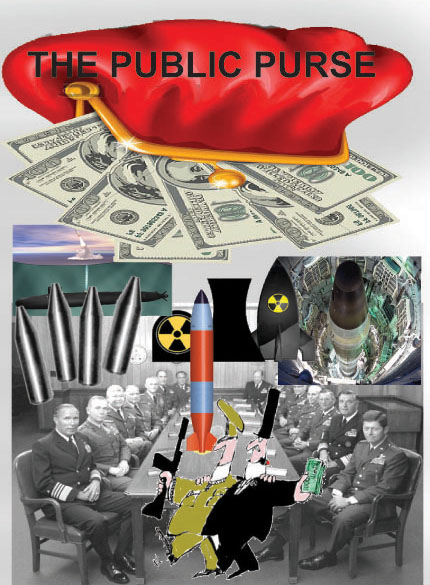
“While they kick 17 million Americans off their healthcare, Republicans want to spend billions on Trump’s reckless war of choice,” said the chair of the Congressional Progressive Caucus. “Hell no.”
Jake Johnson, Mar 04, 2026, https://www.commondreams.org/news/pentagon-funding-iran-war
The Pentagon is reportedly planning to ask Congress to approve a supplemental funding package of around $50 billion to help finance the Trump administration’s unauthorized war on Iran, which has already cost billions of dollars and many lives.
Progressives were quick to reject the idea of providing the bloated, fraud-ridden Pentagon with additional funds to sustain a war that lawmakers did not approve and that is broadly unpopular with the American public.
“While they kick 17 million Americans off their healthcare, Republicans want to spend billions on Trump’s reckless war of choice,” said Rep. Greg Casar (D-Texas), chair of the Congressional Progressive Caucus. “Hell no.”
Reuters reported Tuesday that “Deputy Defense Secretary Steve Feinberg has been leading Pentagon work in recent days on a supplemental budget request of around $50 billion that could be released as soon as Friday.”
“The new money would pay for replacing the weapons used in recent conflicts including those in the Middle East,” the outlet added. “The figure is preliminary and could change.”
Sen. Lindsey Graham (R-SC), the most vocal cheerleader of the war in Congress, told reporters Tuesday that he believes “there will be a supplemental” funding request from the Pentagon.
“We’ll have to approve that,” said Graham.
“If this war continues at the same pace, Americans could see their government burn through tens of billions of dollars, funds that would amount to the cost of Medicaid for millions in the United States.”
The push for a supplemental funding package is the latest indication that the assault on Iran—launched with no clear justification, objective, or timeline and in violation of domestic and international law—could drag on indefinitely, even as Trump administration officials deny that the president who ran on avoiding wars has embroiled the nation in another disastrous quagmire in the Middle East.
Dylan Williams, vice president for government affairs at the Center for International Policy, wrote Tuesday that Congress should approve “not one damn penny” for Trump’s war on Iran.
The Center for American Progress (CAP) estimated Tuesday that the Iran war has likely already cost US taxpayers more than $5 billion.
“At more than $5 billion and counting, the costs of Operation Epic Fury—in only its first few days of operations—could cover Supplemental Nutrition Assistance Program (SNAP) benefits for more than 2 million Americans for a year,” noted CAP’s Allison McManus. “If this war continues at the same pace, Americans could see their government burn through tens of billions of dollars, funds that would amount to the cost of Medicaid for millions in the United States.”
America’s Thelma & Louise Moment: Rubio Shows How Israel and Trump Drove Off the Cliff Together.
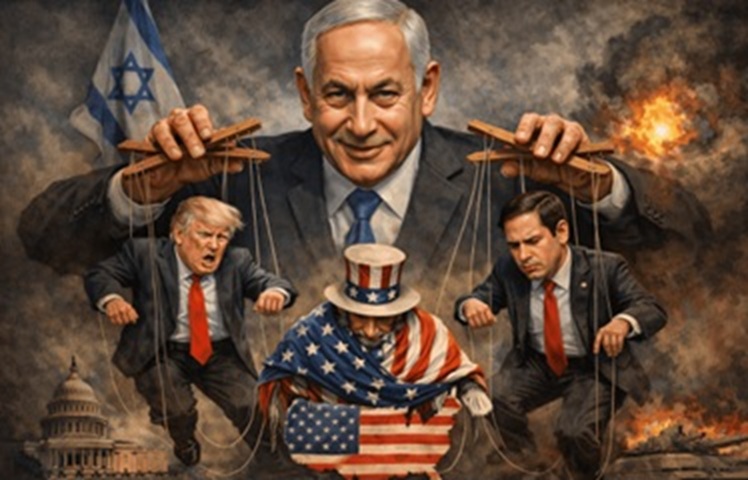
Israel is dictating foreign policy, with Trump’s throat-clearing, unwavering support for Israel attacking the country despite the American population not supporting this misadventure.
by Joshua Scheer, https://scheerpost.com/2026/03/04/americas-thelma-louise-moment-rubio-shows-how-israel-and-trump-drove-off-the-cliff-together/
Secretary of State Marco Rubio acknowledged this week that the United States anticipated Israeli military action against Iran and believed it would trigger retaliatory strikes on American forces — a scenario that ultimately led Washington to join the offensive.
Speaking to reporters at the Capitol, Rubio said U.S. officials “knew that there was going to be an Israeli action” and expected it would “precipitate an attack against American forces.” He added that failing to strike first would have meant “higher casualties.”
This shows how Israel is dictating foreign policy, with Trump’s throat-clearing, unwavering support for Israel attacking the country despite the American population not supporting this misadventure.
Couldn’t Trump have been more like Biden and Harris, who scolded Bibi and yet allowed the genocide to take place in the first place?
Remember Biden’s delusion in claiming he had “done more for the Palestinian community than anybody.”
That assertion stands in sharp contrast to accounts from within his own administration. Maryam Hassanein, a former Interior Department political appointee who resigned, directly rejected that narrative.
“I think his legacy is the opposite,” Hassanein said. “He’s the president who’s done the most harm to Palestinians.”
To go off on a long tangent about the great foreign policy and immigration failures of the Biden White House would be too much to recount here. However, they were only revealing what is now clear as day: the Democratic Party is complicit in the empire. The question now is not whether that is true, but how to confront and change it.
What this demonstrates is something that has long been known: Israel is the United States’ ride-or-die friend. But at this point, it has become a Thelma & Louise moment — driving off a cliff and taking the whole world with them.
The remarks suggest the Trump administration viewed participation in the war as a preemptive necessity rather than an independent strategic choice. Critics argue the statement instead underscores Washington’s unwillingness to restrain Israel — even when U.S. forces would be drawn into direct conflict.
Netanyahu’s Long-Pursued Campaign
Israeli Prime Minister Benjamin Netanyahu openly described the operation as the culmination of decades of advocacy for confronting Iran militarily. He said the strikes were carried out with “the assistance of the United States” and framed the campaign as something he had sought to achieve for 40 years.
The comments reinforced concerns among some analysts that Israel’s strategy effectively shaped U.S. decision-making.
Could Washington Have Prevented the Escalation?
Brian Finucane, a former State Department lawyer now with the International Crisis Group, argued that the U.S. maintains substantial leverage over Israel due to its military and financial support. According to data from Brown University’s Costs of War Project, the U.S. has provided over $21 billion in military aid to Israel since October 2023 and more than $300 billion in total assistance since Israel’s founding.
Finucane suggested that if Washington had strongly opposed Israeli strikes, it may have been able to delay or deter them. Whether Iran would have refrained from retaliatory action is a separate question, he noted.
Mounting Casualties and Political Fallout
The joint U.S.–Israeli campaign has resulted in significant casualties. Iranian authorities report hundreds killed, including civilians. U.S. Central Command confirmed American service members have also died in the fighting.
Meanwhile, members of Congress — including senior Democrats on foreign affairs and armed services committees — have requested clarification from the administration regarding the legal justification for the operation, its objectives, and what would constitute mission success.
The war marks the second major U.S.–Israeli confrontation with Iran in less than a year, deepening instability across the region and intensifying debate in Washington over executive war powers.
A Question of Agency
Rubio’s framing raises a deeper question: was the United States genuinely compelled by strategic necessity — or simply unwilling to restrain an ally intent on escalating the conflict? The truth is that Washington’s worldview has become increasingly unmoored from any sense of proportionality or restraint. This same person in Rubio has defended coilionelism.
The U.S. provides Israel with extensive military assistance and diplomatic cover, making it difficult to claim neutrality in moments of crisis. There was no imminent threat of an attack, and Iran did not possess a nuclear weapon — a point underscored by Tulsi Gabbard, but whats she know, shes just the Director of National Intelligence. The fact remains that a far smaller nation is effectively pulling the last global superpower into a widening regional confrontation — one that carries risks far beyond the immediate battlefield.
How this ends is anyones guess most likely not well but don’t worry you can still gamble on and profit from it.
When will US, Israel stop censoring massive damage to US facilities and Israel?

Walt Zlotow West Suburban Peace Coalition Glen Ellyn IL , 7 Mar 2
US Middle East bases are being pounded by Iranian drones and missiles. So is Israel.
Yet virtually none of this massive damage, signaling major failure of the US, Israeli war on Iran, is being shown to the American public which overwhelmingly opposes this senseless, self-destructive war. A CNN reporter in Tel Aviv admitted they could not show the destruction occurring around her due to government censorship.
All the Gulf States that house US bases are running out of defensive interceptors. So is Israel. Trump’s crazed War Secretary Pete Hegseth is so anxious to suppress the bad news, he’s accused mainstream media of trying to embarrass President Trump by focusing on the 6 dead Americans Trump got killed for nothing. Don’t publicize dead US service members Hegseth moans….publicize our war fighters’ victories.
Trump’s war to destroy Iran on behalf of Israeli Prime Minister Benjamin Netanyahu may crash the US economy, push America out of the Middle East, incur major US casualties, and find Iran still standing at the end. Remember, the US supported Iraq’s 1980 war against Iran which united its 90 million souls to support their Islamic government. After 8 years and hundreds of thousands of casualties, Iran survived.
The lesson of that war was to prepare for the next major attempt by the US to destroy Iran on behalf of Israel. Thirty-six years on, that preparation has upended Trump’s plan for a quick 3 day war to replace the Iranian Islamic government with a US puppet. Knowing he’s failing, Trump may, as early as tomorrow, unleash a massive bombing campaign using B-1’s. B-2’s and ancient B-52’s to pulverize the 90 million Iranians and their government refusing Trump’s surrender terms. All that will accomplish is add untold thousands of deaths to Trump’s war crime record.
After one week it’s time for mainstream media stop self-censoring Trump’s senseless war. It’s’ time to tell the unvarnished truth about its criminality incurring unprecedented US, Israeli destruction. The sooner they do, the sooner Congress might step in to defund and stop Operation Epic Failure.
Trump Threatens Full Trade Embargo Over Spain’s Refusal to Be Complicit in Iran Attacks
Ripping the US president’s “flagrant disregard for European sovereignty—and security,” co-general coordinator of Progressive International declared: “Close the bases. All of them.”
Jessica Corbett, Common Dreams, Mar 03, 2026
President Donald Trump on Tuesday threatened to cut off all trade with Spain over the Spanish government’s refusal to allow US aircraft to use its military bases for the war that the United States and Israel are waging on Iran.
Speaking with reporters at the White House beside German Chancellor Friedrich Merz just after noon Eastern time, Trump initially signaled that he’d already taken action against Spain, but less than 10 minutes later, the president suggested he was still deciding.
Referring to Treasury Secretary Scott Bessent, who was also in the room, Trump said: “Spain has been terrible. In fact, I told Scott to cut off all dealings with Spain.”
Trump claimed that “it started” last year, when every other NATO member caved to US pressure to aim for spending 5% of gross domestic product on defense by 2035, “and Spain didn’t do it.”
“And now Spain actually said that we can’t use their bases. And that’s all right. We could use their base if we want. We could just fly in and use it. Nobody’s going to tell us not to use it. But we don’t have to. But they were unfriendly,” the president continued. “Spain has absolutely nothing that we need other than great people. They have great people but they don’t have great leadership.”
Again complaining about their refusal to commit to 5%, he said that “we’re gonna cut off all trade with Spain. We don’t want anything to do with Spain.”………………………………………………………………………………………………………………………………………….
Francesca Albanese, the United Nations special rapporteur focused on the occupied Palestinian territories and a target of Trump administration sanctions, responded to the US president by praising the “strength” of Spanish Prime Minister Pedro Sánchez.
“The peoples of Europe do not want to be complicit in a system that kills children and protects those who profit from their blood,” Albanese said. “Europe deserves better, and you are already part of that change. Thank you.”https://www.commondreams.org/news/iran-spain
President Trump Says He May Have ‘Forced Israel’s Hand’ Into Iran War

The narrative that Israel was ready to act alone has holes in it, considering Israel has relied on US air defenses to intercept Iranian missiles in previous conflicts, and POLITICO reported a few days before the war started that Trump officials thought it might be better for the “politics” if Israel attacked on its own at first, provoking Iranian attacks on US assets to justify US intervention.
The president made the comments in response to a question about Rubio saying the US launched the war because Israel planned to attack
by Dave DeCamp AntiWAr, March 3, 2026 0
Adding to the mixed messaging coming from the Trump administration regarding the war with Iran, President Trump suggested on Tuesday that he may have “forced Israel’s hand” when the conflict started.
The president was responding to a question about Secretary of State Marco Rubio, who said on Monday that one reason why the US launched the war on Saturday was that Israel was planning to attack and that the US assessed Iran could respond with attacks. on US bases.
Senior Trump officials said the same thing during classified briefings with members of Congress on Monday, which was confirmed by House Speaker Mike Johnson (R-LA) and other lawmakers. “Because Israel was determined to act with or without the US, our commander in chief and the administration and the officials [in the Cabinet] had a very difficult decision to make. They had to evaluate the threats to the US, to our troops, to our installations, to our assets in the region in beyond,” Johnson said.
The narrative that Israel was ready to act alone has holes in it, considering Israel has relied on US air defenses to intercept Iranian missiles in previous conflicts, and POLITICO reported a few days before the war started that Trump officials thought it might be better for the “politics” if Israel attacked on its own at first, provoking Iranian attacks on US assets to justify US intervention…………………………………… https://news.antiwar.com/2026/03/03/president-trump-says-he-may-have-forced-israels-hand-into-iran-war/
Study: Energy Efficiency Can Address Surging Electricity Needs at Half the Cost of Gas Plants

Amid soaring U.S. electricity use, new analysis from the American Council
for an Energy-Efficient Economy (ACEEE) finds that the fastest and cheapest
way to alleviate rapid electric load growth is through expanding investment
in energy efficiency and demand flexibility. Even as families are already
struggling with energy affordability, utility regulators are being asked to
approve new gas power plants, putting utility customers on the hook for
expensive projects that may not be needed.
ACEEE 4th Feb 2026, https://www.aceee.org/press-release/2026/02/study-energy-efficiency-can-address-surging-electricity-needs-half-cost-gas
Iran Is Morally Superior To The United States

| Caitlin Johnstone, Mar 4 |
| Iran is better than the United States. The United States is worse than Iran. This is true not because Iran is especially good, but because the United States is especially evil. .Iran isn’t blanketing a major metropolis with military explosives, killing over a thousand people including hundreds of children. The United States is doing this with its partner in crime Israel. Iran isn’t continuously bombing and invading countries around the world, toppling governments, circling the globe with hundreds of military bases, targeting civilian populations with siege warfare and brandishing nuclear weapons at its enemies in the name of securing planetary domination. Only the United States is. The US empire is the single most murderous and tyrannical power structure on earth, by an extremely massive margin. No one else comes anywhere remotely close. Not Iran. Not anybody. Every government in the world is morally superior to the most evil government, and the most evil government is the United States. Whenever I say this I get US empire apologists going “We’re only the ones fighting the wars and dropping the bombs because we happen to be the ones with the power to do so!” But that’s false. The US isn’t the world’s most vicious government because it happens to be the most powerful, it’s the most powerful government because it’s the most vicious. It’s the power structure which was willing to do whatever it takes to rule the world, no matter how profoundly evil. Genocides. Starvation sanctions. Nuclear brinkmanship. Imperialist extraction. The deliberate creation of failed states and humanitarian catastrophes. Policies designed to keep entire regions in a continuous state of division and strife. The United States and the globe-spanning empire structured around it have inflicted depravities upon our species which cry out to the heavens for vengeance. If you could truly comprehend the scale of the suffering it has created over the years, even for a second, you would never stop screaming. Another objection I’ll encounter when I make these observations is “Well, I’d rather live in the US than Iran!” And it says so much about the western worldview that people think this is an argument. Sure it’s probably nicer to live in the United States than Iran, especially now, and certainly ever since the US has been deliberately strangling the Iranian economy with the explicitly stated goal of making its citizenry so miserable they wage a civil war against their government. But it’s so revealing that westerners see someone saying Iran is better than the United States and think it’s a statement about where they personally would prefer to live, because it shows how completely invisible US warmongering is in their worldview. Washington’s acts of mass military slaughter simply do not count as immoral or abusive behavior in their eyes, because they are being inflicted on foreigners overseas. So they automatically assume the comparison is asking which country would make your feelings feel nicer to live in as an individual. The fact that the US government happens to export the majority of its abusiveness to other countries outside its own borders doesn’t make it any less murderous and tyrannical, it just means the people bearing the brunt of its savagery happen to live in other places. Their lives don’t matter any less than American lives, and only a warped, American supremacist worldview would feel otherwise. The US government is quantifiably morally inferior to the Iranian government. It is quantifiably more tyrannical, more murderous, more destructive, and more megalomaniacal. It is the very last power structure on earth that should have any say in who leads Iran and how the Iranians ought to conduct their affairs. It is not morally qualified to be making those decisions. |
Iran says Natanz nuclear site hit in US-Israeli strikes
Iran’s sprawling nuclear facility at Natanz was struck during U.S. and Israeli military operations against the Islamic Republic, Iran’s ambassador to the U.N. nuclear watchdog said on Monday.
Again they attacked Iran’s peaceful, safeguarded nuclear facilities yesterday,” Reza Najafi told reporters at a meeting of the International Atomic Energy Agency’s 35-nation board of governors. Asked by Reuters which facilities were hit, he replied: “Natanz.”
Reuters 2nd March 2026, https://www.reuters.com/world/china/iran-says-natanz-nuclear-site-hit-us-israeli-strikes-2026-03-02/
Beyond Nuclear condemns attack on Iran

February 28, 2026,
https://beyondnuclear.org/beyond-nuclear-condemns-attack-on-iran/
Beyond Nuclear strongly condemns the attacks against Iran by two nuclear-armed countries, the United States and Israel, when a diplomatic solution to Iran’s nuclear program was already within reach.
“These renewed attacks on Iran come at a time when negotiations were already underway to secure a new nuclear verification agreement with Iran,” said Linda Pentz Gunter, the international specialist at Beyond Nuclear. “This illegal attack by the US and Israel is dangerous and provocative and risks leading to a wider war, potentially involving the use of nuclear weapons. Such an outcome would be catastrophic not only for the region but for the world.”
Iran is a signatory to the nuclear Non-Proliferation Treaty (NPT) that allows for the development of a civil but not military nuclear program and has consistently denied it has any plans to develop nuclear weapons.
Prior to the attacks by the US and Israel against Iran’s nuclear facilities last June (pictured), the International Atomic Energy had said there was no evidence to suggest Iran was making nuclear weapons.
The premise for the attacks appears to be President Trump’s personal dissatisfaction with current negotiations over Iran’s nuclear program. But in 2018, President Trump destroyed a perfectly workable nuclear agreement with Iran known as the Joint Comprehensive Plan of Action, that subjected Iran to verification and inspections to be sure it did not develop nuclear weapons.
Uranium enriched to 5% U-235 is considered for civil use. Above 90% is viewed as weapons grade. Currently, Iran is believed to be enriching uranium to 60% or possibly 80%, considered “weapons usable” but not suitable for the production of nuclear missiles.
“Instead of continuing with the diplomatic efforts already underway to negotiate a new nuclear agreement with Iran, the Trump administration has chosen the reckless and unnecessary path of military aggression, a decision that will cost countless innocent lives and billions of US tax dollars,” Pentz Gunter said.
Although also a signatory to the NPT, the US has failed to abide by Article VI of the treaty, which calls for nuclear armed nations to reduce and eventually eliminate their arsenals. The US is instead “modernizing” its nuclear weapons — code for expansion and enhancement — at a cost of $946 billion over the next ten years.
Israel has refused to admit that it has nuclear weapons, but is estimated to possess at least 80 warheads and potentially as many as 200.
As Trump Bombs Iran, We Need to Reckon With the American War Machine

We cannot afford to slip into despair. We must push back against militarism everywhere, at every turn. By Negin Owliaei , Truthout, February 28, 2026, https://truthout.org/articles/as-trump-bombs-iran-we-need-to-reckon-with-the-american-war-machine/?utm_source=Truthout&utm_campaign=4670da1a6d-EMAIL_CAMPAIGN_2026_03_01_07_35&utm_medium=email&utm_term=0_bbb541a1db-4670da1a6d-650192793
As news broke that the United States and Israel had launched war on Iran, two posts kept showing up over and over on my social media feeds. One was from the Israeli military’s official account, which stated an oft-repeated phrase: “Israel has the right to defend itself.”
The other was a video from the Iranian city of Minab, where the first reports of casualties were emerging. The joint U.S.-Israeli attack had hit a girls’ elementary school; the death toll kept ticking higher and higher. At the time of publication, Iranian authorities said 108 people, mostly schoolchildren, had been killed in the strike, with many more injured.
Plenty has been written, in Truthout and elsewhere, about the totally incoherent justifications for this war, the illegality of it, the potential for regional disaster, the joke it has made of the very idea of diplomacy. All of this was and continues to be true, and all of it is important to raise. But more than anything, we in the U.S. need to reckon with the fact that so much of our state wealth, capacity, and technology goes toward burying children in rubble.
Last year, when Israel and the U.S. launched the strikes that would be prelude to this attack, I wrote that the two countries were “shedding even the pretense and facade of the principles of a rules-based international order that has already worked in their favor.” In the wake of those strikes, once the immediate violence ceased, we largely heard crickets from U.S. lawmakers. This, despite the fact that those strikes, like these, were illegal under U.S. and international law. We cannot let this continued lack of accountability stand. If we do, what will happen next?
Over the years, U.S. and Israeli leaders have become increasingly vocal about their hopes for “greater Israel” — the boundless expansion of an apartheid state. Before the start of the current assault on Iran, former Israeli Prime Minister Naftali Bennett, a favorite in the country’s upcoming elections, accused Turkey of being the hub of a threatening axis “similar to the Iranian one.” This war is not about Iran’s nuclear program. It is not a war to free Iranians from a repressive regime. This is a war to preserve U.S. power and hegemony across the entire region.
It is also not accurate to say that Israel is dragging the U.S. into a war against its choosing. Reporting has shown that these two nuclear powers were in lockstep in their planning of this attack. In order to stop this violence, we need to really contend with how it started. The U.S. is hardly a victim here.
This state of affairs is intolerable. I am disgusted to know that my tax dollars are being spent to bomb my ancestral homeland. I was sickened to wake up to messages from family members telling me that the city where they live was under attack from the country where I live. I’m terrified now that Iran’s government has cut internet access yet again, leaving us disconnected from our loved ones. No fear, of course, can compare to the terror of being on the receiving end of missiles or guns, whether they are wielded by a foreign power or your own government; Iranians have been killed by both in horrifying numbers over the last year. But for those of us in the diaspora, the fact that it has now become routine to check in on family and friends living through untold violence does not make it any less traumatic.
Despite the abject horror of this moment, we cannot afford to slip into despair. There is still space for things to get much worse, but, more importantly, there is still so much left that we must protect. No one can predict what will happen over the coming days and weeks, but we know they are likely to be filled with more violence and uncertainty. We need to use every single tool at our disposal to chip away at the war-making systems inflicting this horror, which are so thoroughly embedded in the heart of the United States.
We can start, of course, by demanding that Congress immediately pass a war powers resolution to put an end to this destructive assault. Beyond that we can lift up the call being made by groups like Defending Rights & Dissent for Congress to impeach not only Donald Trump but every single member of his cabinet who had a hand in making this unjust and illegal war possible.
But we shouldn’t stop there. Our elected officials need to publicly explain why they hemmed and hawed over a war powers resolution before these attacks occurred, despite an obvious military buildup.
We must demand that every member of Congress who has voted to increase our military budget to nearly a trillion dollars account for their choices. We must push those members who have personal investments in the military machine — to the tune of tens of millions of dollars — even further. They need to explain their conflicts of interest, and why they continue to profit off this death and destruction. Lawmakers who take money from groups like AIPAC that are relishing in this war especially need to answer for their votes.
It’s also imperative to not view this war in a silo, but instead see it as part of the same violent, hegemonic project that has been conducting genocide and spreading violence across Palestine, Lebanon, Yemen, Syria, and beyond. We must hold elected officials accountable for failing to uphold U.S. and international law by continuing to support the transfer of weapons to Israel as it commits genocide against Palestinians. We must make it politically toxic for those lawmakers not to support legislation like the Block the Bombs Act, which aims to stop such transfers.
We also can’t expect elected officials to do more just because we ask them to. We need to build power. We must support grassroots movements like the Boycott, Divestment, and Sanctions movement that seek to make war, apartheid, and genocide too costly to wage. We must back campaigns like Taxpayers Against Genocide that are searching for legal avenues to keep federal funds from being used to violate human rights.
We can wage campaigns against death-dealing corporations and make sure that war-profiteering is exposed and subjected to public outrage. The No Tech for Apartheid movement has long been organizing to push Silicon Valley to stop supplying the Israeli military with computing power, and has already found some success. The Israeli military’s use of artificial intelligence (AI) in Gaza has received a great deal of reporting; now that OpenAI has announced a deal to allow the Pentagon to use its models in their classified networks, the fight against AI has taken on renewed urgency. Campaigns across the country against data centers are now also a crucial nexus of resistance against militarism.
So too are campaigns for immigrant rights and against deportations. In the wake of the U.S. strikes against Iran last June, the Trump administration rounded up Iranian immigrants for deportation. Those deportations continued into this year, even as the Iranian government staged a brutal crackdown on protesters. As we prepare for war to rage across the region, we can demand the U.S. and Europe open their borders to people fleeing violence and despair. We can continue to show the links between the occupation of cities by federal immigration agents here at home and imperial wars waged abroad. The enemies of democracy here are also the enemies of democracy abroad.
Some of these demands may seem futile under this murderous president, backed by an obedient Congress, and with a Supreme Court that has offered comparatively little restraint. But this unaccountable bureaucracy makes it all the more essential that we build grassroots power to issue these demands and force those in power to heed them.
Polling shows that this war is unpopular. Trump may be an authoritarian, but he is not entirely invulnerable, nor are the elected officials who have given him pass after pass. We cannot let him believe for a second longer that he can get away with something this wildly illegal or recklessly dangerous without accountability. And we cannot let the leaders who follow him believe that they, too, can unleash such violence without consequences. After all, would we be here if there were any real repercussions for the 2003 invasion of Iraq, or the continuing genocide in Palestine? We need true accountability for these crimes. And the only way to get it is to wage a struggle against militarism every day — not only in moments of crisis, but whenever and wherever it rears its ugly head.
NewsReal: Historic Miscalculation? US & Israel ‘Decapitate Iranian Regime’, Yet Iran is Striking Back HARD
Sott.net. Mon, 02 Mar 2026 , https://www.sott.net/article/504928-NewsReal-Historic-Miscalculation-US-Israel-Decapitate-Iranian-Regime-Yet-Iran-is-Striking-Back-HARD
And so it begins. This time it isn’t ‘kayfabe’ and ‘negotiated strikes and counter-strikes’. The ‘peace president’, when announcing joint US-Israeli strikes against Iran on 28 February, said it would just take a few days, and gloated that he ‘took out the regime’ by targeting top Iranian leadership, including Ayatollah Khamenei. But Iran’s swift and massive response – bombing 11 countries housing US and Israeli military bases and installations, including a British base in Cyprus, EU territory – now has Trump saying the war will ‘last for weeks’…
What did they think was going to happen, that Iranians would ‘rise up and take power from their oppressors’? The Americans appear to have truly believed their own propaganda. In reality, Iranians are defiantly rallying in support of their country, and government, while Muslims across the region are preparing to potentially join the fray and do as Iran has always sought: remove all American military forces from the Persian Gulf, if not the Middle East as a whole.
It’s too early for predicting such an end-game, but in the meantime, it appears that, in the absence of Iranian popular support for US and Israeli ‘regime intervention’, the strategy could switch to attacking the people of Iran and the country’s infrastructure, ‘punishment’ for not ‘capitulating’.
This Illegal US-Israeli Attack on Iran Is Also an Assault on the United Nations
As Henry Kissinger famously said, “It may be dangerous to be America’s enemy, but to be its friend is fatal.” We can add that to host US military bases and CIA operations is to turn your country into a vassal state.
The international order that Franklin and Eleanor Roosevelt helped to build after the catastrophe of WWII was founded on a simple and profound idea – that law and respect, not force, should govern relations among states. That idea is now being destroyed by the very nation that did most to promote it in founding the UN. The irony is bitter beyond measure.
Let us be clear about what the United States and Israel are pursuing. The US objective is not the security of the American people. The objective is global hegemony. The attempt is to destroy the UN and the international rule of law—an attempt that will fail.
Jeffrey D. SachsSybil Fares, Mar 02, 2026, Common Dreams, https://www.commondreams.org/opinion/united-nations-israel-us-attack-iran
On February 16, 2026, one of us (Jeffrey Sachs) sent a letter to the UN Security Council warning that the United States was on the verge of tearing up the United Nations Charter. That warning has now come to pass. The United States and Israel have launched an unprovoked war against Iran in flagrant violation of Article 2(4) of the Charter, without authorization from the Security Council, and without any legitimate claim of self-defense under Article 51. They are trying to kill the UN Charter and the international rule of law, but they will fail.
At the Security Council on February 28, 2026, the US and its allies directed their condemnation not at the American and Israeli aggression, but at Iran. One US ally after the next condemned Iran for its retaliatory attacks yet absurdly failed to condemn the illegal and unprovoked US-Israeli attack on Iran. This performance by these countries was disgraceful and turned reality completely upside down.
The truth is that the devastation of the war will not directly affect the so-called West: their children will not suffer traumas or death, and their countries will not be set ablaze. The victims of this attack are the people of the Middle East. They are the expendable ones who suffer from Western arrogance, abuse of power, and addiction to war.
We close with two observations. First, the United States will not achieve global hegemony or kill the UN. The world is too large, too diverse, and too determined to resist domination by any single power, much less one with 4 percent of the world’s population. The world outside of the US and the countries it occupies want the UN to live and thrive. The US attempt will surely fail, but it may cause immense suffering before it does.
Second, if Israel continues its addiction to war and occupation, it too will not survive. That addiction represents a mix of theocracy and post-traumatic stress. Part of Israel believes that it is the biblical kingdom of the 5th century BC. The other part lives in the traumatic memory of the Holocaust, and so is determined to kill any perceived adversary rather than learn to live together with it in peace. The Israeli Ambassador’s twisted defense of Israel’s brazen attack on Iran, as usual, cited the Bible and Auschwitz as the two justifications. These are Israel’s two perennial references, but not the real world of today.
The joint US-Israeli attacks were described by Trump as necessary because Iran “rejected every opportunity to renounce their nuclear ambitions, and we can’t take it anymore.” This is of course a flat lie. As the letter of February 16 recounted, Iran agreed a decade ago to a nuclear deal, the Joint Comprehensive Plan of Action (JCPOA) that was adopted by the UN Security Council in Resolution 2231. It was Trump who ripped up the agreement in 2018. In June 2025, Israel bombed Iran in the midst of US-Iran negotiations. This time too, the Israel-US war plans were set weeks ago when Netanyahu met with Trump, and the negotiations underway between the US and Iran were a charade. This seems to be the new modus operandi of the US: start negotiations and then aim to murder the counterparts.
It is easy to understand why the US allies behave in the embarrassing and self-abasing way they did at the UN Security Council. In addition to the United States, eight of the other fourteen Council members host US military bases or grant the US military access to local bases: Bahrain, Colombia, Denmark, France, Greece, Latvia, Panama, and the United Kingdom. These countries are not fully sovereign. They are partially governed by the US. The US military bases house CIA operations, and the host countries constantly look over their shoulder to try to avoid US subversion in their own countries.
As Henry Kissinger famously said, “It may be dangerous to be America’s enemy, but to be its friend is fatal.” We can add that to host US military bases and CIA operations is to turn your country into a vassal state.
As an absurd but telling example, the Danish ambassador parroted every US talking point, pointing her finger at Iran for its aggression as if Iran had not been attacked by the US and Israel. She completely forgot that such humiliating vassalage to the US will not play well for Denmark if the US occupies Greenland.
The truthful voices at the Security Council came from the countries not occupied by the United States. Russia explained correctly that the so-called West (that is, the countries occupied by the US) is engaged in victim-blaming when it points its finger at Iran. China reminded the Council that the crisis began with the US and Israeli attacks on Iran, not with Iran’s retaliation. Somalia’s ambassador, speaking on behalf of several African member states, truthfully portrayed the source of this recent escalation. The UN Representative of the League of Arab States spoke brilliantly about the root cause of Israel’s mad aggression: the denial of rights to Palestinian people, and Israel’s use of mass murder and regional war to prevent the emergence of a State of Palestine.
When Iran retaliates against US military bases in the Gulf, it is exercising its inherent right of self-defense under Article 51 of the Charter. We must remember that the US and Israel are openly and repeatedly assassinating Iran’s leaders, with the aim of overthrowing its government. When states murder a foreign head of state and attempt to destroy the government, the target of those threats is entitled under international law to defend itself.
The US-Israeli bombing murdered not only Iran’s Supreme Leader and several top government officials, but also more than 140 young girls in their school in Minab. These young children are the victims of a horrific war crime. The countries today that gave a pass to the United States and Israel for these killings—notably Denmark, France, Latvia, the United Kingdom, and of course the US —are also complicit in this war crime.
This UN Security Council emergency meeting will likely be remembered as the day the United Nations ceased to function from its headquarters on American soil. An international organization dedicated to the peaceful settlement of disputes cannot credibly operate from a country that wages illegal wars, threatens member states with annihilation, and treats UN Security Council resolutions as disposable instruments of convenience. For the UN to survive, and we need it to survive, it will need several homes around the world—in Brazil, China, India, South Africa, and others—honoring the true multipolarity of our world.
Let us be clear about what the United States and Israel are pursuing. The US objective is not the security of the American people. The objective is global hegemony. The attempt is to destroy the UN and the international rule of law—an attempt that will fail. Israel’s objective is to establish a Greater Israel, destroy the Palestinian people, and assert its hegemony over hundreds of millions of Arabs across the Middle East (from the Nile to the Euphrates, as US Ambassador Mike Huckabee recently asserted).
The United States’ delusional efforts at global hegemony are proceeding region by region. The US has recently claimed, in a wholly twisted supposed revival of the Monroe Doctrine, that it controls the Western Hemisphere and can dictate how Latin American countries conduct their economic and political affairs. The US kidnapped the sitting Venezuelan president to prove the point, and it now threatens to overthrow the Cuban government as well.
Today’s war against Iran aims to prove that the US similarly owns the Middle East. The war is part of a 30-year campaign, initiated by the Clean Break doctrine, to overthrow all governments that oppose US and Israeli hegemony in the region. Those joint Israel-US wars have included the genocide in Gaza, the occupation of the West Bank and the decades of wars and regime-change operations in Iran, Iraq, Lebanon, Libya, Somalia, Sudan, Syria, and Yemen.
One part of the US global plan is to commandeer the world’s oil exports and to weaken China and Russia in the process. The US seizure of Venezuela was designed to ensure American control of that country’s oil exports, especially to control the flow of oil to China. US sanctions on Russia aim to prevent Russian oil from reaching India and China. Now the US aims to stop the flow of Iran’s oil to China. More broadly, the US aims to control the entire Gulf region plus Iran to maintain its imperial dominance.
The international order that Franklin and Eleanor Roosevelt helped to build after the catastrophe of WWII was founded on a simple and profound idea – that law and respect, not force, should govern relations among states. That idea is now being destroyed by the very nation that did most to promote it in founding the UN. The irony is bitter beyond measure..
A state that depends on permanent war, permanent occupation and slaughter of the Palestinians, and the indefinite subjugation of millions of people has no viable future, and the policies that the United States is now pursuing on Israel’s behalf will accelerate rather than prevent that outcome.
The two-state solution, which the Council has endorsed repeatedly, offers Israel a path to peace. Tragically Israel rejects that. The result, eventually, will be the end of Israel itself in its current form, especially as the US population is rapidly turning against Israel’s violent theocracy and towards the cause of Palestine. Perhaps there will be one democratic state for both Arabs and Jews living in peace, together, with an end of apartheid rule.
These are harsh truths, but emergencies demand honesty. The UN is being murdered by Israel and the United States. The Security Council must rouse itself from their military occupation by the US, and remember that they are the stewards of the UN Charter’s promise to maintain international peace and security.
Stop Trump’s New Mass-Murder Spree

By David Swanson, World BEYOND War, February 28, 2026, https://worldbeyondwar.org/stop-trumps-new-mass-murder-spree/
The latest location where Trump has given the orders to murder people is Iran.
Remember a couple of months back when establishment U.S. lawyers and human rights groups were admitting that Trump’s attacks on boats in the Caribbean and Pacific were nothing other than murder?
Murder doesn’t cease being murder because it’s further away or grander or provokes a more dramatic response or targets victims who speak a different language.
By all means hunt in the Epstein files for evidence of Trump raping or murdering, but don’t pretend we don’t already know.
Did Trump have no choice but to start slaughtering people? The mediator said a deal was within reach.
The deal was a solution in search of a problem to begin with, given the absolute lack of evidence of the existence of an Iranian nuclear weapons program and the openly admitted possession of nuclear weapons by numerous other nations not being bombed, including the one currently sending missiles into schools in Iran.
Didn’t Trump need to murder people to prevent the Iranian government from murdering them? Hmm. Is more murder or more high-tech murder or more distant murder better? Should we pretend the people have not been protesting economic hardship largely created by illegal and murderous U.S. sanctions? Must we all conspire to act as if nonviolent activism does not exist? Are we really going to pretend Israel hasn’t demanded this crime — and provided a rotating selection of ludicrous excuses and frauds to justify it — for decades?
Public pressure helped prevent a U.S. war on Iran several times in recent decades, and helped create public opinion in the U.S. that as of the start of this war was more against such a war than ever, and more against such a war than against almost any other evil thing ever asked about in opinion polls.
So why did a war happen now?
One reason is of course that Trump is a psychopath with no qualms about acting on the most horrific advice given to him most recently.
A second reason is that there is no opposition party in Washington. Schumer and Jeffries, the “leaders” of the Democrats, actually prevented votes prior to the start of this crime on the War Powers Resolution ritual of redundantly declaring that this crime would be a crime.
A third reason is that there is almost no opposition among the governments of wealthy nations or in the United Nations.
A fourth reason is — depending on how you want to look at it — either the onslaught of numerous threats and crises from the Trumpoctopus wrecking ball targeting of Venezuela, Mexico, Minneapolis, Greenland, Canada, Russia, the natural environment, healthcare, etc., etc., or the established pattern of the people of the United States, their local governments, their state governments, the Congress, the media, and the two corporate political parties in the U.S. Congress failing to effectively stand up to any of these things with votes, impeachments, prosecutions, sit-ins, boycotts, or truth commissions.
A fifth reason is that you get what you pay for, and the institutions and television viewers of much of the world have collectively hallucinated military spending as a public good to be maximized at the expense of all that is useful or decent in the world.
Is all hopeless? Of course not.
What’s needed is obvious. But we have to be willing to do it. We have to stop picking which type of people to care about. We have to stop worrying about the risks. We have to all stand up together, no matter whom we’ve voted for or against, no matter what myths we’ve believed in the past, no matter what corner of the planet we live in, and work every nonviolent educational and media and activist angle to effectively demand NO MORE.
Complaint to the Editor of the Narwhal
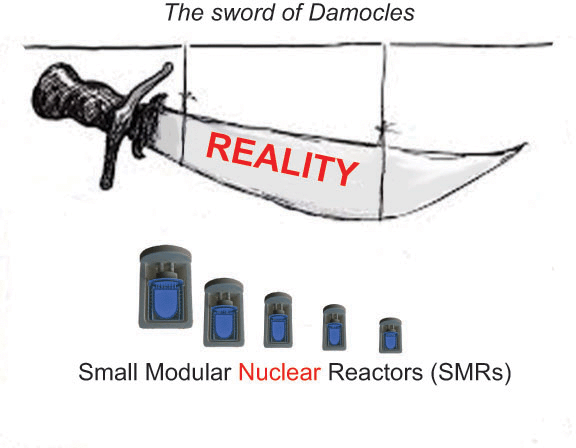
SMRs are not small, and they are not modular. No one is building SMR components in a factory – please check the spin OPG gives you. They are still enormous, although a lot of the bulk is hidden underground. What OPG has done to try to cut construction costs and time is cut some safety systems (see the Canadian Environmental Law Associations submission on this).
Angela Bischoff, Ontario Clean Air Alliance, 28 Feb 26
Hello Narwhal Editor,
We just read Fatima Syed’s recent piece on SMRs and we’re shocked. This piece demonstrates zero effort to come to terms with what SMRs really are, or their impacts. Instead, we get a bunch of puffery from Ontario Power Generation (OPG) and the Ontario government.
SMRs are not small, and they are not modular. No one is building SMR components in a factory – please check the spin OPG gives you. They are still enormous, although a lot of the bulk is hidden underground. What OPG has done to try to cut construction costs and time is cut some safety systems (see the Canadian Environmental Law Associations submission on this).
There are a few reasons SMRs are all talk and little action. In most cases, it is old technology repackaged into a slightly smaller size at the expense of much lower energy output per dollar spent. Many of the companies touting “new” SMR technology are trying to reboot old ideas (molten salt, breeder reactors) that were discarded long ago as unworkable. In most cases, these companies lack the capital or the expertise to get their projects off the ground, as New Brunswick has discovered at significant public cost.

To make these reactors “modular” we would have to be building thousands every year. That’s just not about to happen with the cost and complexity of nuclear technology. They are never going to be “Lego kits” no matter what nuclear PR people tell you – it’s just embarrassing that you would take that statement at face value. That idea has been thoroughly debunked even by promoters of nuclear energy, many of whom would prefer to keep the focus on large reactors
Of course, manufacturing at scale has already happened with solar, wind and batteries because these components really can be produced at mega factory scale (actual factories exist!). Nuclear reactors remain hand crafted projects like a custom-made suit and are equally expensive (and hard to fix) because of that. It’s no surprise to us that the Darlington rebuild is running 25% over budget due to the discovery of worn-out components that OPG didn’t anticipate needing to fix.
As the 2025 World Nuclear Industry Status Report (WNISR) notes “The Merriam-Webster dictionary defines the term ‘Potemkin village’ as ‘an impressive facade or show designed to hide an undesirable fact or condition.’ The state of Small Modular Reactors (SMRs) today might well be described as a Potemkin Village. Even as the evidence for the high costs and the long timelines for potential future construction becomes clearer, and what is most on display are numerous announcements about future SMRs, usually held out for some time in the 2030s, the industry, politicians, investors, and, last but not least, the media continue to portray SMRs as an indispensable and sure way to solve the climate emergency crisis…”

The WNISR goes on to thoroughly debunk the notion that SMRs are a viable energy or climate solution and provides an in-depth explanation of why renewables plus storage are now simply unbeatable on costs, speed, climate, and reliability. Please read and report on it.
The Narwhal has been a valuable source of in-depth reporting on key environmental issues, so it is mystifying why it would choose to publish what is essentially an “advertorial” promoting Ontario’s misguided enthusiasm for nuclear technology and particularly SMRs. Not speaking to anyone who could address the myths being put forward by OPG and the Ontario government is simply shocking. Taking their statements at face value without making any effort to verify information, even more so. There are many credible nuclear critics in Ontario and Canada that could give counter arguments to OPG’s corporate spin, yet you included none.
We have come to expect a much more thoughtful approach to journalism than this from your publication.
Thanks for your attention.
Angela Bischoff, Director, Ontario Clean Air Alliance, CleanAirAlliance.org
1 This Month

of the week – Shut Down Drone Warfare!


Tell the Ukrainian Government to Drop Prosecution of Peace Activist Yurii Sheliazhenko

Petition to revoke the licensing of the Near Surface Nuclear Disposal Facility (NSDF) at Chalk River. https://www.ourcommons.ca/petitions/en/Petition/Details?Petition=e-7247
To see nuclear-related stories in greater depth and intensity – go to https://nuclearinformation.wordpress.com
-
Archives
- March 2026 (237)
- February 2026 (268)
- January 2026 (308)
- December 2025 (358)
- November 2025 (359)
- October 2025 (376)
- September 2025 (257)
- August 2025 (319)
- July 2025 (230)
- June 2025 (348)
- May 2025 (261)
- April 2025 (305)
-
Categories
- 1
- 1 NUCLEAR ISSUES
- business and costs
- climate change
- culture and arts
- ENERGY
- environment
- health
- history
- indigenous issues
- Legal
- marketing of nuclear
- media
- opposition to nuclear
- PERSONAL STORIES
- politics
- politics international
- Religion and ethics
- safety
- secrets,lies and civil liberties
- spinbuster
- technology
- Uranium
- wastes
- weapons and war
- Women
- 2 WORLD
- ACTION
- AFRICA
- Atrocities
- AUSTRALIA
- Christina's notes
- Christina's themes
- culture and arts
- Events
- Fuk 2022
- Fuk 2023
- Fukushima 2017
- Fukushima 2018
- fukushima 2019
- Fukushima 2020
- Fukushima 2021
- general
- global warming
- Humour (God we need it)
- Nuclear
- RARE EARTHS
- Reference
- resources – print
- Resources -audiovicual
- Weekly Newsletter
- World
- World Nuclear
- YouTube
-
RSS
Entries RSS
Comments RSS
 nuclear-news