Trump signs new bill to weaken nuclear energy regulation
New bill, signed by Trump, to streamline nuclear energy regulation, By RYAN SUPPE rsuppe@postregister.com, Jan 16, 2019
Be aware of the radiation risks of CT scans
Scannell: The radiation risk posed when you undergo CT scans. The Mercury News, 18 Jan 19
Researchers estimate that nearly 2 percent of future cancers could be related to computerized tomography, It’s often said, “What you don’t know won’t hurt you.” But I’ve never understood the rationale behind that. In fact, as a doctor, I’d argue otherwise — that what you don’t know can harm you a great deal.
I’m thinking of this in light of recent studies concerning radiation exposure from medical imaging tests like computerized tomography (CT) scans. Many of us don’t know that we’re exposed to ionizing radiation when we undergo a CT scan, that ionizing radiation is a carcinogen or that data links an increased risk of cancer to low-level doses that are commonly used in CT imaging.
And while that increased risk may be small, it’s also cumulative over time — a concern for patients who receive multiple scans.
The benefits of CT scans in diagnosing disease and saving lives are indisputable. But, like any medical test or treatment, CT scans entail potential risks that should be balanced against expected benefits. Unfortunately, we’ve paid little attention to the radiation risks.
Putting the risk in perspective is difficult, considering the various yardsticks by which meaningful radiation exposure and cancer risks are measured. But, in broad terms, we can consider the constant background radiation from natural sources that we’re exposed to every day. While a chest X-ray exposes us to a 10-day dose of background radiation, a chest CT scan delivers about 2 years’ worth. And the average 3-year dose we get from a CT of the abdomen and pelvis more than doubles when the scan is repeated with and without contrast.
It’s important to remember that the increased cancer risk from a single CT scan remains low for most individuals. Still, the risk accumulates with additional scanning, and it constitutes an unnecessary risk if the scan isn’t medically necessary.
That latter point deserves underscoring because about 30 percent of CT scans performed in the U.S. are unnecessary, according to estimates. And, given that we perform over 80 million CT scans annually, it’s gob-smacking to consider the extraordinary unnecessary risk we’re assuming as a population. In fact, taking this population perspective, researchers have estimated that nearly 2 percent of future cancers could be related to CT scans.
Given the risks, our causal attitude toward CT scans is surprising. But they’ve become the Big Mac staple of modern medical fare. As a matter of perceived need or convenience, too many doctors order them and too many patients demand them when they aren’t medically needed.
Radiation risk reduction could be pursued through various strategies, beyond the obvious one of reducing unnecessary scans. Another obvious tactic involves minimizing the amount of radiation per scan without sacrificing image quality………..https://www.mercurynews.com/2019/01/18/opinion-the-radiation-risk-posed-when-you-undergo-ct-scans/
It is unlikely that nuclear power will be included in America’s Green New Deal
 Morning Consult 14th Jan 2019 , Lawmakers embracing a transition to 100 percent renewable energy under a Green New Deal have largely left out mention of whether nuclear energy should be included in such a policy package. While Rep. Alexandria Ocasio-Cortez, one of the Green New Deal’s biggest proponents, said she hasn’t ruled out nuclear energy from the platform, other advocates on the left hold long-running concerns that appear to lessen nuclear’s chances of inclusion in the deal.
https://morningconsult.com/2019/01/14/nuclears-bleak-odds-in-a-green-new-deal/
The shutdown of Oyster Creek Nuclear Station- is it best to hand the waste management to Holtec?

After the Shutdown: Oyster Creek Nuclear Generating Station Oyster Creek is done producing nuclear energy. Now comes the hard part: cleaning up five decades of radioactive waste. New Jersey Monthly, By Ian T. Shearn | At noon this past September 17, operators shut down the Oyster Creek turbine. Three minutes later, two “scram” buttons were simultaneously pushed, inserting 122 control rods into the reactor core and aborting the nuclear reaction inside the vessel. After nearly a half-century of operation, the nation’s oldest active nuclear power plant went offline for good.
That began the onerous task of decontaminating and dismantling the plant—a process known as decommissioning. The shutdown also created severe financial angst among local officials, who had grown dependent on Oyster Creek’s tax revenue. And it offered the latest painful reminder that the United States lacks a plan to deal with a growing stockpile of radioactive nuclear waste.
The shutdown left New Jersey with three operating nuclear reactors, which produce 37 percent of the state’s electricity. With the emergence in recent years of cheap and abundant natural gas, along with a growing appetite for renewable energy, plants like Oyster Creek have lost their competitive edge. The nuclear age is on the wane in the United States, at least in the commercial energy sector. Today, there are 60 active U.S. nuclear plants with 98 reactors, down from a high of 112 operational plants in 1991. Only two reactor plants are under construction.
Oyster Creek’s license was to expire in 2029. But in 2010, the state Department of Environmental Protection ordered the plant to build cooling towers to protect Barnegat Bay from its warm-water discharges. After estimating the cost at more than $800 million, Exelon Corp., the current owner/operator, reached an agreement to close the plant in 2019. That was advanced to 2018 in part to manage costs.
A CHANGE IN PLANS
Shortly after the shutdown, plant employees began the process of cooling down the reactor and removing all nuclear fuel for storage in the plant’s used-fuel pool, a bath of highly purified, chemically balanced, fresh water. The 40-foot-deep pool—with reinforced concrete walls 2-feet thick—contains 2,430 fuel assemblies, more than half of the spent fuel that has accumulated over five decades.
Exelon estimated decommissioning would take 60 years. Its method, a process known as SAFSTOR, includes waiting for the radiation—both in the fuel pool and the reactor—to diminish naturally over decades, reducing the contamination risk for workers dismantling the facility. That plan changed dramatically last summer when Exelon reached an agreement to sell the plant to Holtec International, which has a technology campus in Camden, and proposes to complete the task in less than eight years by expediting the transfer of the spent fuel from the pool to dry storage casks before its radiation has appreciably decayed. Holtec and Exelon have asked the U.S. Nuclear Regulatory Commission for an expedited approval of the sale by May 1, prompting concern among environmentalists.
“What’s the big hurry?” asks Janet Tauro, board chair of Clean Water Action NJ. “Holtec may be the best thing in the world, but we’re talking about 1.7 million pounds of nuclear waste.” Lacey Township, the Sierra Club and Concerned Citizens of Lacey have asked the NRC to hold a public hearing. Tauro and Clean Water Action New Jersey have asked the state attorney general for a review of the Exelon/Holtec deal.
“The NRC will try to complete a review of the application by May 1,” says NRC spokesman Neil Sheehan. “But we have made it clear to Exelon and Holtec that achieving that will be contingent upon us receiving the information we need.” That could include information about technical aspects of the decommissioning and adequacy of funding for the project.
Exelon and Holtec officials are nonetheless optimistic the deal will be approved on their timetable. Soon, the nuclear license and the 700-acre property would be transferred to Holtec—along with control of a nearly $1 billion decommissioning trust fund generated by utility ratepayers over decades. Holtec would assume all liability for the spent nuclear fuel—and any potential accidents.
Jeff Tittel, director of the New Jersey Sierra Club, says he’s fine with the expedited decommissioning schedule. “It’s very doable and it’s been done many times throughout the country,” he notes. But he would like to see the storage site for the nuclear waste elevated and upgraded to withstand potential flooding or a terrorist attack. According to an AP report, the Sierra Club and several community groups also say the $1 billion fund is insufficient for cleanup and storage.
Tittel is “most concerned,” however, about the transfer of Oyster Creek’s ownership from Exelon, an industry behemoth with deep pockets, to Holtec, a relatively small limited-liability company, which will subcontract the work to an even smaller subsidiary. “If there is some kind of accident, there will be no one to hold accountable,” he says.
Kris Singh, who holds more than 90 patents, mostly related to nuclear energy, founded Holtec in 1986. His company has emerged as an industry leader in the management of spent nuclear fuel. Its dry-cask technology is used at 116 nuclear power plants around the world, including 65 in the United States. Those casks would be used to store Oyster Creek’s spent fuel.
But Singh’s company lacks experience in cleaning up closed nuclear plants. That’s why it teamed with a Canadian engineering firm, SNC-Lavalin, to form Comprehensive Decommissioning International (CDI). Holtec has also reached agreements to purchase nuclear plants in Massachusetts and Michigan and perform expedited decommissioning there. The Massachusetts deal is awaiting NRC approval, and the Michigan deal will be submitted at a later date.
“CDI, headquartered in Camden, has been established to bring the expertise of both companies together to ensure safe, rapid, and economic nuclear plant decommisioning,” says Holtec marketing and communications specialist Caitlin Marmion.
What’s in it for Holtec? The company would, in effect, hire itself and its subsidiary to clean up the site by drawing fees from the decommissioning fund. Holtec also would purchase its own storage casks for the cleanup. And once the cleanup is done, it can profit from the sale of the 700-acre Oyster Creek site.
SOUNDING THE ALARM
Paul Gunter, a longtime environmental activist, policy analyst and nuclear-reactor watchdog for the advocacy group Beyond Nuclear, has been following activities at Oyster Creek for decades. He is calling for a thorough inspection of the plant’s GE Mark 1 reactor before it’s disposed of, citing its well-documented design flaws and a long history of modifications and retrofits. The reactor came under intense international scrutiny in 2011, after three of the same reactors melted down at the Fukushima Daiichi Nuclear Power Plant in Japan.
Holtec’s decommissioning plan “is like burying a body without an autopsy,” says Gunter. He notes that 21 GE Mark 1 reactors remain operational in the United States. (Holtec’s Marmion points out that the company’s plans to dismantle and dispose of the reactor are “in accordance with regulatory requirements.”)
Gunter is also alarmed by Holtec’s partnership for the decommissioning work. SNC-Lavalin, Gunter says, currently faces federal corruption charges in Canada. Equally disturbing, he says, the company is “barred from doing any contractual work with the World Bank until 2023—again because of global corruption.”
SNC-Lavalin has had a legal cloud over its head since 2015 (the same year it began collaborating with Holtec) when allegations surfaced that former employees paid $150 million in bribes to officials in Libya to influence government policy and win contracts. In one case, a former SNC-Lavalin vice president is awaiting trial on charges he made bribes to the Gaddafi regime. In a separate case, a former SNC-Lavalin vice president of construction pleaded guilty in July to using a forged document following a widespread corruption investigation involving the construction of a super-hospital in Canada. And in May, Canadian authorities filed charges against SNC-Lavalin after a multiyear probe related to illegal political contributions.
“Is this the company we want to be handling a $1 billion trust fund?” asks Gunter……..
The decommissioning project is not the only joint venture between Holtec and SNC-Lavalin. The two companies are also collaborating on the design and production of a small, nuclear and modular reactor, called SMR-160, at Holtec’s Technology Campus in Camden. The reactor is planned for operation by 2026.
Last February, Holtec signed an agreement in Camden that calls for the state-run nuclear operator in Ukraine to adopt the SMR-160 technology to meet its energy needs. Shortly after, Holtec announced that Ukraine may also become a manufacturing hub for SMR-160 components.
“Holtec is poised to….reinvigorate nuclear power for a world in dire need of a weather-independent and carbon-free source of energy,” CEO Singh told World Nuclear News at the time…………. https://njmonthly.com/articles/politics-public-affairs/after-the-shutdown-oyster-creek-nuclear-generating-station-forked-river/
Pentagon secrecy on US military bases keeps public in the dark about them , and about tax-payer costs
The U.S. military is finally withdrawing (or not) from its base at al-Tanf. You know, the place that the Syrian government long claimed was a training ground for Islamic State (ISIS) fighters; the land corridor just inside Syria, near both the Iraqi and Jordanian borders, that Russia has called a terrorist hotbed (while floating the idea of jointly administering it with the United States); the location of a camp where hundreds of U.S. Marines joined Special Operations forces last year; an outpost that U.S. officials claimed was the key not only to defeating ISIS, but also, according to General Joseph Votel, the commander of U.S. forces in the Middle East, to countering “the malign activities that Iran and their various proxies and surrogates would like to pursue.” You know, that al-Tanf.
Within hours of President Trump’s announcement of a withdrawal of U.S. forces from Syria, equipment at that base was already being inventoried for removal. And just like that, arguably the most important American garrison in Syria was (maybe) being struck from the Pentagon’s books — except, as it happens, al-Tanf was never actually on the Pentagon’s books. Opened in 2015and, until recently, home to hundreds of U.S. troops, it was one of the many military bases that exist somewhere between light and shadow, an acknowledged foreign outpost that somehow never actually made it onto the Pentagon’s official inventory of bases.
According to David Vine, author of Base Nation: How U.S. Military Bases Abroad Harm America and the World, there could be hundreds of similar off-the-books bases around the world. “The missing sites are a reflection of the lack of transparency involved in the system of what I still estimate to be around 800 U.S. bases outside the 50 states and Washington, D.C., that have been encircling the globe since World War II,” says Vine, who is also a founding member of the recently established Overseas Base Realignment and Closure Coalition, a group of military analysts from across the ideological spectrum who advocate shrinking the U.S. military’s global “footprint.”
Such off-the-books bases are off the books for a reason. The Pentagon doesn’t want to talk about them. “I spoke to the press officer who is responsible for the Base Structure Report and she has nothing to add and no one available to discuss further at this time,” Pentagon spokesperson Lieutenant Colonel Michelle Baldanza told TomDispatch when asked about the Defense Department’s many mystery bases.
“Undocumented bases are immune to oversight by the public and often even Congress,” Vine explains. “Bases are a physical manifestation of U.S. foreign and military policy, so off-the-books bases mean the military and executive branch are deciding such policy without public debate, frequently spending hundreds of millions or billions of dollars and potentially getting the U.S. involved in wars and conflicts about which most of the country knows nothing.”Where Are They?
The Overseas Base Realignment and Closure Coalition notes that the United States possesses up to 95% of the world’s foreign military bases, while countries like France, Russia, and the United Kingdom have perhaps 10-20 foreign outposts each. China has just one.
In the most literal sense, the Base Structure Report does indeed have the latest numbers — but their accuracy is another matter. “The number of bases listed in the BSR has long born little relation to the actual number of U.S. bases outside the United States,” says Vine. “Many, many well-known and secretive bases have long been left off the list.”
According to Vine, keeping America’s African bases secret is advantageous to Washington. It protects allies on that continent from possible domestic opposition to the presence of American troops, he points out, while helping to ensure that there will be no domestic debate in the U.S. over such spending and the military commitments involved. “It’s important for U.S. citizens to know where their troops are based in Africa and elsewhere around the world,” he told TomDispatch, “because that troop presence costs the U.S. billions of dollars every year and because the U.S. is involved, or potentially involved, in wars and conflicts that could spiral out of control.”
Those Missing Bases
Wastes from Oyster Creek Nuclear Station, and concerns about Holtec’s involvement
After the Shutdown: Oyster Creek Nuclear Generating Station Oyster Creek is done producing nuclear energy. Now comes the hard part: cleaning up five decades of radioactive waste. New Jersey Monthly, By Ian T. Shearn |
“………WASTE PILES UP
The closing of Oyster Creek is more than a local story. It occurs amid the glaring absence of a national strategy for the permanent storage of our growing stockpile of nuclear waste. That stockpile stands at 80,000 metric tons—its radiation lasting thousands of years—and is expected to increase to about 140,000 metric tons over the next several decades as more plants close.
In 1982, Congress directed the Department of Energy to develop a permanent geological repository for used nuclear fuel. In 2002, President George W. Bush signed a law designating Yucca Mountain in Nevada as that site. In 2010, however, the DOE, after investing $12 billion in the project, shut it down with little explanation. Nevada’s Harry Reid, then the Senate majority leader, is widely credited with scuttling the plan in his home state.
For now, U.S. nuclear power plants are resorting to on-site storage. Most of their spent fuel is stored in cooling pools and steel-and-concrete casks at 125 sites in 35 states. The NRC claims fuel can be stored safely in this manner for more than 100 years.
But the U.S. Government Accountability Office informed Congress in April 2017 that “spent nuclear fuel can pose serious risks to humans and the environment….and is a source of billions of dollars of financial liabilities for the U.S. government. According to the National Research Council and others, if not handled and stored properly, this material can spread contamination and cause long-term health concerns in humans or even death.”
Holtec, which made a name for itself in on-site storage, raised eyebrows last year when it announced its plans to jump into the potentially lucrative decommissioning business. Now, it is looking to take an even bigger leap: It has applied to build and operate a mammoth interim spent-fuel repository on 1,000 acres in New Mexico.
Holtec initially wants to store 500 canisters of spent nuclear fuel containing up to 8,680 metric tons of uranium from commercial nuclear reactors. If the NRC issues that initial license, Holtec would seek to expand the facility in 9 subsequent phases, each for an additional 500 canisters, to be completed over the course of 20 years. (If the license is approved, Oyster Creek’s spent fuel would be shipped to the site—creating yet another revenue opportunity for Holtec.) If that were to occur, the New Mexico site would swell to 163,700 metric tons—more than double the capacity assigned to Yucca Mountain.
Opposing Holtec’s interim storage proposal last year became the singular mission of Kevin Kamps, a radioactive-waste specialist at Beyond Nuclear. His reasons are many, but mostly he is concerned that it would establish a “de facto permanent, surface storage dump” without approval by Congress.
In addition, the interim site, he says, “would expose low-income people of color, communities already heavily polluted by fossil-fuel and nuclear industries, to yet another, major assault to their health, safety, security and environment. And it would launch tens of thousands or more high-risk mobile Chernobyls…down the roads, rails and/or waterways in shipping containers…of questionable structural integrity.”
For decades, the plant has provided as many as 700 jobs. That number has shrunk to 400 and will be reduced by another 100 during the decommissioning. Local government has become reliant on the $2.7 million in annual corporate taxes it collects from the plant. Lacey also receives $11 million annually in state Energy Tax Receipts. That covers about one-third of Lacey’s annual budget.
Quinn says state officials have assured him the township will continue to benefit from the energy tax for a couple of years, but its share could be reduced drastically, maybe by half, after that. And when it comes time to demolish the buildings, the corporate property tax revenue will decline as well. It’s a troubling picture for Lacey’s financial future.
With nuclear waste being stored on-site indefinitely, the prospects for residential or commercial projects are virtually non-existent, Quinn says. Township officials have begun discussions with natural gas companies to see if there is interest for a plant there, given that the hookup to the state’s power grid is basically ready to go. Quinn believes it is the best scenario for the township’s financial future.
A bill coauthored last year by then U.S. representative Tom MacArthur would tap into a $40 billion federal nuclear storage fund to provide economic relief for towns affected by a nuclear-plant closure. The bill breezed through the House but died in the Senate. (In November, MacArthur, a Republican, lost his bid to keep his House seat to Democratic challenger Andy Kim.)
As it stands, there is no plan for the town to get anything other than 1.7 million pounds of radioactive nuclear waste. There it will sit—in steel and concrete canisters in a concrete structure next to a parking lot just off Route 9 and a few miles from the beach—until America comes up with plan. https://njmonthly.com/articles/politics-public-affairs/after-the-shutdown-oyster-creek-nuclear-generating-station-forked-river/
USA-China co-operation in removing nuclear material from Nigeria
How the US and China collaborated to get nuclear material out of Nigeria — and away from terrorist groups, Defense News, By: Aaron Mehta, 14 Jan 19, “……… Moving the nuclear material out of Nigeria has been a long-sought goal for the United States and nonproliferation advocates. But the goal has taken on increased importance in recent years with the rise of militant groups in the region, particularly Boko Haram, a group the Pentagon calls a major terrorist concern in the region.
It was the mid-1990s when Nigeria, with technical support and backing from China, began work on what would become Nigerian Research Reactor 1, located at Ahmadu Bello University in Kaduna. The location opened in 2004, and is home to roughly 170 Nigerian workers.
The design, however, used highly enriched uranium, or HEU, a type of nuclear substance often referred to by the general public as weapons-grade uranium. This kind of uranium forms the core of any nuclear weapons material, and the Nigerian material was more than 90 percent enriched, making it particularly attractive for anyone looking to use it.
Since NIRR-1 went online, however, improvements in technology meant that experiments involving highly enriched uranium could now be run with a lesser substance. Across the globe, the IAEA and its partners have worked to swap out weapons-grade material with lightly enriched uranium, or LEU, which is enriched at less than 20 percent, and hence unusable for weapons. In all, 33 countries have now become free of HEU, including 11 countries in Africa.
With just over 1 kilogram of HEU, the Nigerian material, if stolen, would not be nearly enough to create a full nuclear warhead. However, a terrorist group would be able to create a dirty bombwith the substance or add the material into a stockpile gathered elsewhere to get close to the amount needed for a large explosion.
They’re small reactors, they’re not power reactors where the fuel is so radioactive it kills you,” he said. “This is very attractive to a proliferation point of view, and they are research reactors, so they are often at universities without high security.”
Replacing HEU with LEU in research reactors naturally requires caution, as anything nuclear-related comes with risks. But the Nigerian mission was particularly difficult because of security concerns, Hanlon said. He noted that Boko Haram, while not in the Kaduna region, has been operating in Nigeria for quite some time.
“All of our partners understood that operational security was paramount,” Schwartz said. “The world is a safer place today as a result of the determined work to remove this weapons useable Uranium from Nigeria.”
China’s role
The removal operation cost roughly $5.5 million, with the United States contributing $4.3 million. The United Kingdom ($900,000) and Norway ($290,000) also chipped in. But while it didn’t contribute money, China’s role in the operation was outsized — and occurred as the war of words from the Trump administration toward Beijing was reaching a fever pitch, one that did not die down in the weeks to come.
As the October operation was just hours from starting, U.S. President Donald Trump took to the press to discuss nuclear material and China.
“Until people come to their senses, we will build [the nuclear arsenal] up,” Trump told reporters just hours before the Nigeria operation was to begin. “It’s a threat to whoever you want. And it includes China, and it includes Russia, and it includes anybody else that wants to play that game. You can’t do that. You can’t play that game on me.”
By the time the Antonov plane — carrying the HEU, along with American inspectors and security — arrived at Shijiazhuang airport in China on Dec. 6, the arrest of a Chinese technology executive in Canada had inflamed fears of a trade conflict between the two countries.
“Even though the national level conversation is really poor because of trade and other issues, the technical collaboration between laboratories, between nuclear engineers, that’s generally gone pretty well,” he said. He added that China has invested heavily in LEU over the last decade, and therefore also has an interest in encouraging others to switch to that technology.
Whether that cooperation continues if relations between the two nations continue to deteriorate will be a true test going forward……… https://www.defensenews.com/news/pentagon-congress/2019/01/14/how-the-us-and-china-collaborated-to-get-nuclear-material-out-of-nigeria-and-away-from-terrorist-groups/
USA must develop a strategy on nuclear wastes, excluding Yucca Mountain
 First step to a solution on nuclear waste: End Yucca Mountain https://lasvegassun.com/news/2019/jan/14/first-step-to-a-solution-on-nuclear-waste-end-yucc/ By Judy Treichel, Jan. 14, 2019 There is an interesting phenomenon at the Department of Energy when it comes to the disposal of high-level nuclear waste.
This is a circular dilemma, going nowhere.
In 2010, then-Secretary of Energy Steven Chu announced that the DOE would withdraw the license application that had been submitted to the Nuclear Regulatory Commission, seeking construction authorization for a high-level nuclear waste repository at Yucca Mountain. Officials and residents in Nevada were delighted — a wake was held to commemorate the death of the project, in fact.
However, the celebration was premature because Chu’s decision was challenged in court, where it was decided that the project must continue as long as there was funding.
But after years of successfully fighting to block funding for the project, it’s time for a new strategy. It’s time to permanently shut down the project.
Bringing Yucca Mountain to an end after more than 30 years of battle and expense to national taxpayers, rate payers and the people of Nevada is the right thing to do. The site cannot isolate or contain deadly poisonous waste for the thousands of years. A restart of the program would eventually cost more than other options and result in failure.
The waste is still a problem, but the good news is that although there are increasing amounts of it needing management and disposal, the pile is growing more slowly because old commercial nuclear power plants are being shut down.
Any country using nuclear power, however, recognizes that it must enact a workable plan for the permanent disposal of its waste. The U.S. is no different.
Many nuclear nations have faced problems very similar to the dilemma we’re facing in our nation, but the countries that appear to have programs moving toward their goals have discovered that the only possibility for success is if they engage the public first.
If we were to permanently pull the plug on Yucca Mountain, we wouldn’t be alone in stopping a mistake like this. That’s exactly what happened in the United Kingdom.
The first attempt at high-level nuclear waste disposal there went down because the government attempted to force a dump into an area that didn’t want it. The next program sought the consent of the public, but fizzled amid inadequate follow-through. Now, the decision has been made to make a clean break – stop and make a new start.
We should follow that example.
We all agree that there needs to be permanent disposal for dangerous, highly radioactive waste.That can only happen if all disposal options are considered, and the public is consulted and in agreement with any new program.
There must be trust and confidence in the agency or entity that is given the job of running a program. Both a government blue ribbon commission and an academic group have issued reports on the matter recently, and each said that any facility siting must be consensual with fully adequate public involvement. Both agreed that the implementer of a new program must be an entity other than the Department of Energy.
For more than 60 years, through atomic weapons testing and nuclear waste battles, Nevada has been treated unfairly and dishonestly by government agencies. We have spent our time and money fighting to stop the damage being done by weapons tests and preventing a nuclear waste dump that we know will not be safe.
Yucca Mountain should be declared unsuitable because it cannot safely isolate the waste.
It is time for the battle to end, so a new beginning can be possible.
Judy Treichel is executive director of the Nevada Nuclear Waste Task Force.
Canada’s dangerous foray into nuclear weapons in the 1960s
One that, thankfully, never came to haunt me.
Fifty-five years ago — on Dec. 31, 1963 — the Liberal government of Lester Pearson formally acquired American-controlled nuclear weapons for use by the Canadian military.
Among the RCAF Squadrons stood up specifically for this purpose was RCAF 447 Surface to Air (SAM) Squadron at LaMacaza near Mont Tremblant, a mere hour and change drive from my childhood home.
This and its sister squadron, 446 SAM at North Bay, Ont., combined housed 56 Canadian BOMARC missiles — each carrying a 10-kiloton nuclear warhead maintained, armed and jealously guarded by in-house American servicemen.
Their mission, in layman terms, was to get the BOMARC warhead to detonate in the air close enough to the incoming Soviet bombers so as to destroy, avert or at least delay their further progress on their targets.
But the Canadian and American officers and NCOs who guarded, serviced and stood by ready to launch these U.S manufactured and nuclear-tipped Canadian BOMARCS were by no means alone. RCAF and Army bases, across Canada and into Europe, served as multi-faceted purveyors of U.S nuclear weapons………..
Though actual delivery systems were to change and consolidate over time, the Canadian Armed Forces continued to use tactical nuclear weapons until 1984, which, ironically, happened to be the same year Pierre Trudeau finally, left office. To put it another way, only when Conservative Brian Mulroney took office did the Canadian Armed Forces officially become “nuke-free” again. ………https://torontosun.com/opinion/columnists/guest-column-remembering-canadas-dangerous-foray-into-nuclear-weapons
Call on judge to make public the documents on ex-nuclear weapons plant
PG and E ex-CEO gets $2.5 million severance amid wildfire woes
PG&E ex-CEO gets $2.5 million severance amid wildfire woes
Former PG&E CEO Geisha Williams lands $2.5 million in cash for severance pay despite being in charge during lethal wildfires of 2017 and 2018
PG and E to file for bankruptcy due to wildfire lawsuits; shares tank
PG&E to file for bankruptcy due to wildfire lawsuits; shares tank
Utility cites ‘challenges’ from California wildfires, East Bay Times, By LEVI SUMAGAYSAY | lsumagaysay@bayareanewsgroup.com and GEORGE AVALOS | gavalos@bayareanewsgroup.com | Bay Area News Group January 14, 2019 Citing “extraordinary challenges” from the devastating 2017 and 2018 California wildfires, PG&E said Monday that it will file for Chapter 11 bankruptcy protection.
In a filing with the Securities and Exchange Commission, the utility that serves 16 million Californians gave the 15-day notice required by law for filing for bankruptcy, one day after it announced the departure of Chief Executive Geisha Williams. The company’s stock dropped by more than half Monday in response to the early-morning announcement……..
One estimate, from Moody’s Investor Services, puts PG&E’s wildfire liabilities at $15 billion but PG&E said it may face liabilities of $30 billion or more. In its filing Monday, PG&E said it is aware of about 50 complaints from at least 2,000 plaintiffs related to November’s Camp Fire and said it expects more. It also said it knows of about 700 complaints on behalf of at least 3,600 plaintiffs from the 2017 California wildfires. PG&E further stated that if it is found liable for the 2017 and 2018 fires, “punitive damages, fines and penalties could be significant.” ………
San Francisco-based PG&E’s shares plunged 52.4 percent to close at $8.38 on Monday. Since October 2017, when it first became clear that PG&E might be liable for some wildfires, PG&E’s shares have nose-dived by 88 percent……… https://www.eastbaytimes.com/2019/01/14/pge-to-file-for-bankruptcy-shares-tank/
P G and E’s plan to close Diablo Canyon nuke plant
Signaling the end of nuclear power in California, PG&E on Tuesday announced plans to close the Diablo Canyon Power Plant by 2025.The proposal to shut down the state’s last nuclear power facility represents a major leap toward meeting California’s renewable energy mandate. It would mark the end of more than a half-century of nuclear power generation in the state and could serve as a blueprint for closing other U.S. nuclear facilities…….
To replace the lost nuclear power, PG&E plans to expand energy efficiency, its use of renewable energy, and energy storage that would exceed current state mandates. California’s historic 2015 energy law requires that power companies get 50 percent of their electricity from renewable sources, such as solar or wind, by 2030. PG&E aims to produce 55 percent of its power from renewable sources by 2031. At present, about 30 percent of the utility’s electricity comes from renewable sources, said Keith Stephens, a PG&E spokesman. The state requires that utilities reach 33 percent by 2020. …….https://www.eastbaytimes.com/2016/06/21/pge-to-close-diablo-canyon-nuke-plant-in-10-years/
Many sick former uranium workers still missing out on compensation
Uranium workers can face illnesses decades later. Many workers don’t know that help is available.Star Tribune, Heather Richards 307-266-0592, Heather.Richards@trib.com, Jan 14, 2019
The fossil fuel industries’ successful strategy, conning the media to doubt climate change
 By demanding “balance,” the industry transformed climate change into a partisan issue. We know that was a deliberate strategy because various internal documents from ExxonMobil, Shell, the American Petroleum Institute and a handful of now-defunct fossil fuel industry groups reveal not only the industry’s strategy to target media with this message and these experts, but also its own preemptive debunking of the very theories it went on to support.
many took the industry’s bait, routinely inserting denialist claims into stories about climate science in the interest of providing balance:
How the fossil fuel industry got the media to think climate change was debatable, WP, By Amy Westervelt, Amy Westervelt is an audio and print reporter who covers climate and gender, and sometimes the intersection of the two. Her podcast Drilled is about the creation and spread of climate denial and her first book “Forget ‘Having It All'” was published by Seal Press in November 2018., January 10 2019
Late last year, the Trump administration released the latest national climate assessment on Black Friday in what many assumed was an attempt to bury the document. If that was the plan, it backfired, and the assessment wound up earning more coverage than it probably would have otherwise. But much of that coverage perpetuated a decades-old practice, one that has been weaponized by the fossil fuel industry: false equivalence.
Although various business interests began pushing back against environmental action in general in the early 1970s as part of the conservative “war of ideas” launched in response to the social movements of the 1960s, when global warming first broke into the public sphere, it was a bipartisan issue and remained so for years. On the campaign trail in 1988, George H.W. Bush identified as an environmentalist and called for action on global warming, framing it as a technological challenge that American innovation could address. But fossil fuel interests were shifting as the industry and its allies began to push back against empirical evidence of climate change, taking many conservatives along with them.
Documents uncovered by journalists and activists over the past decade lay out a clear strategy: First, target media outlets to get them to report more on the “uncertainties” in climate science, and position industry-backed contrarian scientists as expert sources for media. Second, target conservatives with the message that climate change is a liberal hoax, and paint anyone who takes the issue seriously as “out of touch with reality.” In the 1990s, oil companies, fossil fuel industry trade groups and their respective PR firms began positioning contrarian scientists such as Willie Soon, William Happer and David Legates as experts whose opinions on climate change should be considered equal and opposite to that of climate scientists. The Heartland Institute, which hosts an annual International Conference on Climate Change known as the leading climate skeptics conference, for example, routinely calls out media outlets (including The Washington Post) for showing “bias” in covering climate change when they either decline to quote a skeptic or question a skeptic’s credibility.
Data on how effective this strategy has been is hard to come by, but anecdotal evidence of its success abounds. In the early 1990s, polls showed that about 80 percent of Americans were aware of climate change and accepted that something must be done about it, an opinion that crossed party lines. By 2008, Gallup found a marked partisan divide on climate change. By 2010, the American public’s belief in climate change hit an all-time low of 48 percent, despite the fact that those 20 years saw increased research, improved climate models and several climate change predictions coming true.
 By demanding “balance,” the industry transformed climate change into a partisan issue. We know that was a deliberate strategy because various internal documents from ExxonMobil, Shell, the American Petroleum Institute and a handful of now-defunct fossil fuel industry groups reveal not only the industry’s strategy to target media with this message and these experts, but also its own preemptive debunking of the very theories it went on to support.
It need not have been such a successful strategy: If news purveyors really wanted to be evenhanded on coverage of climate change, they could certainly weave in the insights of more conservative scientists — those whose predictions err on the sunnier side of apocalypse. Instead, many took the industry’s bait, routinely inserting denialist claims into stories about climate science in the interest of providing balance: In an analysis of 636 articles covering climate change that appeared in “prestige U.S. outlets” from 1988 to 2002, researchers from the University of California at Santa Cruz and American University found that 52.65 percent presented climate science and contrarian theories as equal. The practice continued into the mid-2000s. As recently as 2007, PBS NewsHour invited well-known (and widely debunked) former weatherman Anthony Watts on to counterbalance Richard Muller, a former Koch-funded skeptic who had shifted his view…………
It’s well past time the media stopped allowing itself to be a tool in the fossil fuel industry’s information war. Oreskes likens the push for “balance” on climate change to journalists arguing over the final score of a baseball game. “If the Yankees beat the Red Sox 6-2, journalists would report that. They would not feel compelled to find someone to say actually the Red Sox won, or the score was 6-4,” she says. https://www.washingtonpost.com/outlook/2019/01/10/how-fossil-fuel-industry-got-media-think-climate-change-was-debatable/
1 This Month
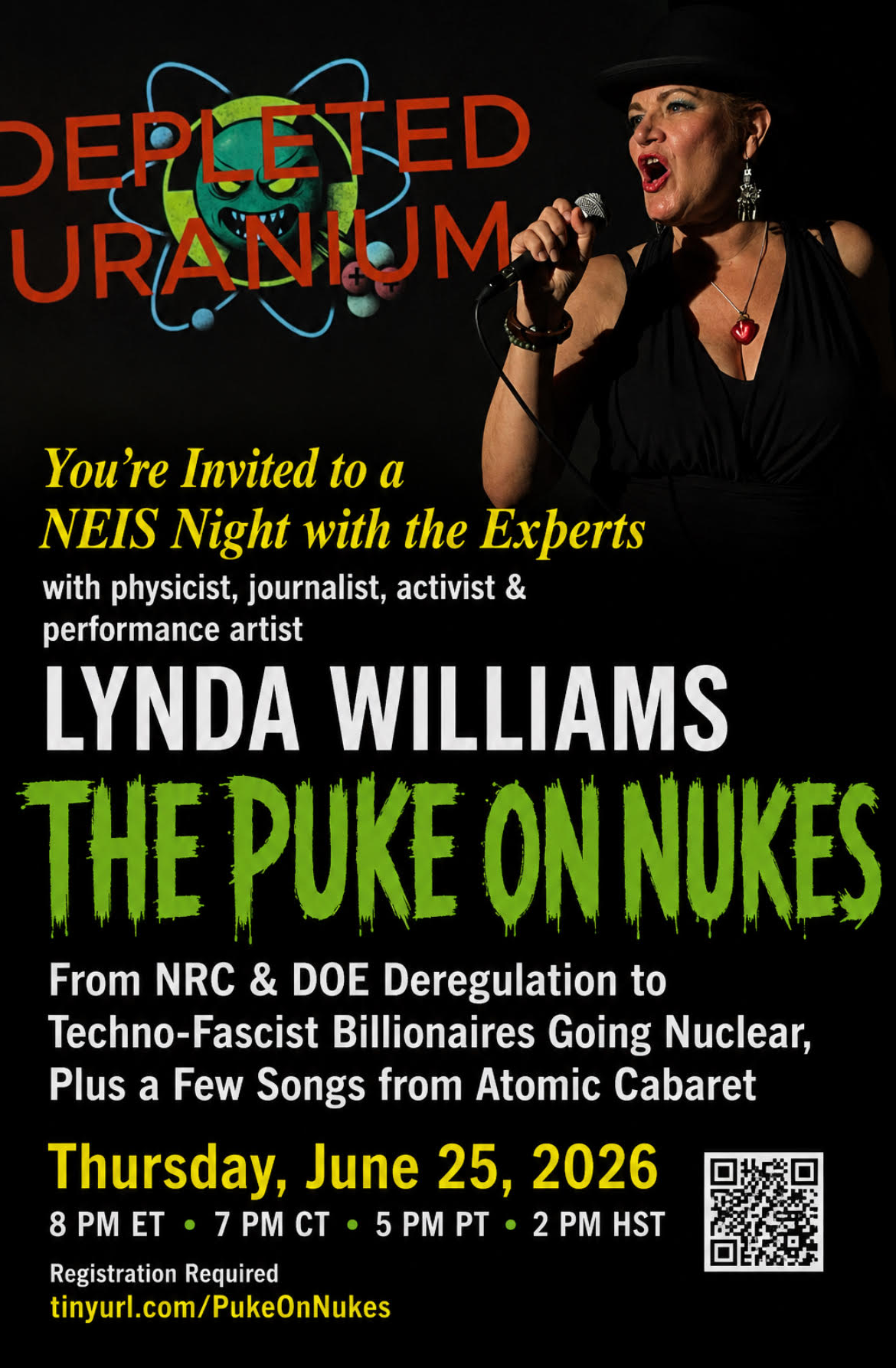
25 June- THE PUKE ON NUKES
Thursday, June 25, 2026
7pm Central Time (8pm ET, 6pm MT, 5pm PT) UTC – 5
From NRC & DOE Deregulation to Techno-Fascist Billionaires Going Nuclear, Plus a Few Songs from Atomic Cabaret REGISTER
26 June – Radiation Trainwreck at the NRC / Join the Protect Better Campaign – https://us02web.zoom.us/meeting/register/4ZlZ5_qLSHGiLSCg8FF6Bg#/registration

1st July – Webinar Waste of Space: The Environmental Harm of Military and Civil Space Activity st July, 7 pm

Report Launch Online: We are seeing an increasing exploitation of space for military and commercial purposes. This must change.

Protect Sazan Island from the Trump family! https://secure.avaaz.org/campaign/en/protect_sazan_island_from_the_trump_family_loc/?bqFCVab&v=174511&cl=22707147157&_checksum=5e9dde668860e8231c33699735e16a1fbf22ab2cb01da50c999fe8732b9775ef&utm_source=email&utm_medium=blast_email&utm_campaign=174511


Cuba Is Not a Failed State – It Is a Besieged State
PETITION: “Global Appeal to Endorse Palestinian Right of Return of Refugees”
To see nuclear-related stories in greater depth and intensity – go to https://nuclearinformation.wordpress.com
-
Archives
- June 2026 (230)
- May 2026 (306)
- April 2026 (356)
- March 2026 (251)
- February 2026 (268)
- January 2026 (308)
- December 2025 (358)
- November 2025 (359)
- October 2025 (376)
- September 2025 (257)
- August 2025 (319)
- July 2025 (230)
-
Categories
- 1
- 1 NUCLEAR ISSUES
- business and costs
- climate change
- culture and arts
- ENERGY
- environment
- health
- history
- indigenous issues
- Legal
- marketing of nuclear
- media
- opposition to nuclear
- PERSONAL STORIES
- politics
- politics international
- Religion and ethics
- safety
- secrets,lies and civil liberties
- spinbuster
- technology
- Uranium
- wastes
- weapons and war
- Women
- 2 WORLD
- ACTION
- AFRICA
- Atrocities
- AUSTRALIA
- Christina's notes
- Christina's themes
- culture and arts
- Events
- Fuk 2022
- Fuk 2023
- Fukushima 2017
- Fukushima 2018
- fukushima 2019
- Fukushima 2020
- Fukushima 2021
- general
- global warming
- Humour (God we need it)
- Nuclear
- RARE EARTHS
- Reference
- resources – print
- Resources -audiovicual
- Weekly Newsletter
- World
- World Nuclear
- YouTube
-
RSS
Entries RSS
Comments RSS
 nuclear-news