Can America Live with a Nuclear North Korea? National Interest, January 11, 2019 MilitaryTechnologyWorldICBM
Question: Can America live with an atomic North Korea, and could any presidential administration openly admit it can? The answer: Yes it can, and no it couldn’t.
Forcibly disarming Pyongyang could and probably would involve sacrificing thousands of American and Korean lives. Here’s a crude yardstick. The Korean War, a conventional conflict to preserve an independent South Korea, cost the United States some 37,000 military lives. Many more service folk suffered wounds. Thirty-seven thousand. That’s more than fivefold the combined American military death toll from the Afghanistan and Iraq wars since 9/11. And that leaves aside countless more Korean military and civilian lives expended fighting to the current standstill along the inter-Korean border.
It’s hard to see how war could be waged more cheaply than it was in 1950-1953 when the principal combatants, not to mention North Korea’s ally China and neighbor Russia, all boast nuclear weapons to accompany formidable conventional forces. And Washington must not delude itself into thinking air and sea power can do the job alone, any more than aviators and mariners repulsed the North Korean invasion in 1950. It took land forces back then—and today, in all likelihood, ground combat would be required to destroy the dug-in North Korean nuclear complex.
Any military strategy worth the name would demand that U.S. Army and Marine forces again seize and control ground—allowing them the leisure to ferret out underground facilities and armaments.
In short, a new Korean War would not be a come-and-go affair. Such a forecast is solidly grounded in the classics of strategy. For instance, Admiral J. C. Wylie points out that the proper goal of military strategy is to impose control on the foe. Aircraft and missiles flit by overhead while ships remain offshore. Though formidable, their presence is too intermittent to qualify as control. That being the case, he pronounces the soldier slogging through mud the “ultimate determinant” of who emerges the victor. The soldier goes and stays. “He is control,” proclaims Wylie. No control, no strategic success.
Or as the historian T. R. Fehrenbach
puts it regarding the Korean War: “you may fly over a land forever; you may bomb it, atomize it, pulverize it and wipe it clean of life—but if you desire to defend it, protect it and keep it for civilization, you must do this on the ground, the way the Roman legions did, by putting your young men in the mud.” Wylie says much the same thing when he observes that— aviators’ and rocketeers’ assumptions notwithstanding—the ability to destroy something from aloft does not equate to controlling it.
January 14, 2019
Posted by Christina Macpherson |
North Korea, politics international, USA |
Leave a comment
Senate doesn’t have the votes to sell Santee Cooper after nuclear fiasco, leaders say, BY AVERY G. WILKS, JANUARY 13, 2019 BUT EVEN THE HIGHEST BIDDER MIGHT NOT WIN THE STATE’S APPROVAL TO TAKE OVER THE 85-YEAR-OLD UTILITY.
A proposed sale, which needs the S.C. General Assembly’s approval, seems likely to die in the state Senate, where senators are skeptical that selling Santee Cooper is the best solution to the agency’s nuclear woes.
Senators also say they don’t want a long and complicated debate over Santee Cooper to drown out the General Assembly’s No. 1 priority for 2019: public education reform……https://www.thestate.com/news/politics-government/article224287910.html
January 14, 2019
Posted by Christina Macpherson |
business and costs, USA |
Leave a comment
Entergy sells Vermont Yankee nuclear plant, signaling what’s to come for Indian Point, Lohud, Thomas C. Zambito, Rockland/Westchester Journal News Jan. 11, 2019
Entergy sold its Vermont Yankee nuclear power plant to a dismantling firm, a first-of-its-kind deal that offers a blueprint for Indian Point’s future
STORY HIGHLIGHTS
- The Nuclear Regulatory Commission approved the deal in October
- Towns near Indian Point are hoping for a similar deal so Indian Point can be opened to development after it shuts down in 2021
- Deal with dismantling firm a first for dismantling of a nuclear plant
Entergy sold its Vermont Yankee nuclear power plant to a New York dismantling firm Friday, finalizing a deal that could offer the blueprint for Indian Point’s future after it shuts down in 2021.
The deal with NorthStar Group Services represents the first time a nuclear power plant has transferred its license to a company that take over the lengthy process of dismantling nuclear reactors and securing spent radioactive fuel.
It’s likely more will follow.
With nuclear power plants struggling to compete against the cheap price of natural gas, more than a dozen nuclear plants across the U.S. have, in recent years, shut down or announced plans to close…….https://www.lohud.com/story/news/local/westchester/2019/01/11/entergy-sells-its-vermont-yankee-nuclear-power-plant-ny-firm/2552170002/
January 14, 2019
Posted by Christina Macpherson |
decommission reactor, USA |
Leave a comment
Green New Deal Has Broad Bipartisan Support (Though Most Voters Haven’t Heard of It), DESMOG, By Justin Mikulka • Wednesday, January 9, 2019 A version of the Green New Deal (GND) — an FDR-style plan to address climate change by shifting America to a just and renewably powered 21st century economy — is widely popular with American voters of both parties, according to a recent survey.Perhaps unsurprisingly, this proposal has stronger support among Democrats but still polls well with Republicans. The survey found that 81 percent of registered voters said they either “strongly support” or “somewhat support” a rapid transition to 100 percent renewable electricity and other green technology initiatives.
However, the poll, conducted by the Yale Program on Climate Change Communication (YCCC), also found that very few voters were aware of the Green New Deal: 82 percent said they “knew nothing” of the proposal. Notably, the poll’s language focused on renewable electricity and job creation, but made no mention of the full decarbonization and social overhaul of the American economy that also are central tenets of the full Green New Deal.
In reporting the results, the YCCC noted the likelihood that once Republican voters became aware that the Green New Deal is being championed by Democrats, their support for the idea will decrease. This survey asked respondents about support for some of the basic concepts of the Green New Deal without associating it with either major political party.
Even though polls have shown that the majority of Republicans believe in climate change, research shows that if a proposal is made by the Democrats, Republican voters are less likely to support it. The same was true of Democratic voters and proposals made by Republicans.
Naturally, climate deniers and right-wing media like Fox News and The New York Post already are attacking the concept and its most visible champion, Rep. Alexandria Ocasio-Cortez (D-NY), foreshadowing the GND‘s slide into the partisan.
What Exactly Is the Green New Deal?
Many in the climate and energy media sphere already have attempted to pin down what exactly the Green New Deal is and how it came to be, with David Roberts at Vox going deep and long, and Tim Dickinson at Rolling Stone diving in this week because “The Green New Deal is suddenly on everyone’s lips.”
In the Yale survey, however, respondents were told that members of Congress say the Green New Deal “will produce jobs and strengthen America’s economy by accelerating the transition from fossil fuels to clean, renewable energy.”
Survey respondents were given some specifics for how this would be accomplished, which included generating 100 percent of America’s electricity from renewable sources within 10 years, upgrading the nation’s energy grid, focusing on energy efficiency, and training for jobs in the new green economy.
While this is a good general description of the GND, there is much more detail in a draft bill from Rep. Ocasio-Cortez, which even has an FAQ section………… https://www.desmogblog.com/2019/01/09/green-new-deal-bipartisan-support-yale-survey?utm_source=dsb%20newsletter
January 14, 2019
Posted by Christina Macpherson |
politics, USA |
Leave a comment
The Biggest Nuclear Threats of 2018 Will Follow Us into the New Year , Defense One, BY JOE CIRINCIONE, DECEMBER 29, 2018 WE WHISTLED PAST THE GRAVEYARD THIS YEAR. LET’S BE SMARTER IN 2019.
There was some positive news this year — most importantly the decreased possibility of war in Korea — but, overall it was bleak. Let’s get right to it.
1. The New Nuclear Arms Race is the clear winner as the greatest global nuclear threat of 2018. Each of the nine nuclear-armed states is building new weapons and the United States, instead of strengthening the global nuclear safety net, is actively shredding it.
In March, Russian President Vladimir Putin announced five new nuclear weapons he said Russia was building in response to the U.S. decision to abrogate the Anti-Ballistic Missile treaty. All are designed to circumvent defenses. Russia has also deployed a small number of ground-based cruise missiles whose range exceed that permitted by the Intermediate Nuclear Forces (INF) Treaty that President Ronald Reagan negotiated. In October, President Donald Trump said he would pull out of this arms elimination pact, despite the objections of NATO allies.
Destruction of the INF Treaty is likely a prelude to allowing the New START treaty to die. This pact, negotiated by President Barack Obama, limits long-range strategic forces. If both go, it will be the first time since 1972 that U.S. and Russian nuclear forces have been completely unconstrained.
“The untimely death of these two agreements would add fuel to a new arms race and further undermine stability and predictability between Washington and Moscow,” warned former National Security Council senior director Jon Wolfsthal.
In mid-December, 26 Democratic senators wrote Trump “out of deep concern that your administration is now abandoning generations of bipartisan U.S. leadership.” They feared that Trump and his administration wanted “to double down on new, unnecessary nuclear weapons while scraping mutually beneficial treaties.” This, they said, “risks the United States sliding into another arms race with Russia and erodes U.S. nonproliferation efforts around the world.”
Some countries, perhaps many of them, may see the building of new arsenals and the killing of restraining treaties as a material breach of the U.S. and Russian pledges in the nuclear Non-Proliferation Treaty, up for review in 2020. “Today, pessimism about the future of the nuclear nonproliferation regime is again on the rise,” writes Harvard professor Rebecca Davis Gibbons. More countries, armed with more nuclear weapons would likely encourage greater risk-taking, leading to more conventional conflicts and the great risks of escalation.
2. President Trump remains a unique global nuclear threat. The danger comes from the combination of his nuclear policies, his ability to command the launch of a nuclear weapon at anytime, for any reason, and his intensifying domestic political crises.
Any president in this period would face the problems of restraining nuclear-armed adversaries, maintaining a U.S. nuclear deterrent, and rolling back the nuclear programs in North Korea and Iran. But Trump’s policies have made several of these problems worse. His Nuclear Posture Review would build new, and more usable, nuclear weapons at a price tag of almost $2 trillion while abandoning any effort to restrain global arsenals. This not only fuels an arms race, it breaks the deal with the Senate that “investments in the U.S. nuclear weapons deterrent…must be accompanied by pursuit of continued arms control measures,” as the 26 senators wrote.
Serious concerns about Trump’s mental stability have raised serious questions about the wisdom of a system that gives the president sole, unchecked authority to launch America’s nuclear weapons……… https://www.defenseone.com/ideas/2018/12/biggest-nuclear-threats-2018-will-follow-us-new-year/153838/?oref=d-dontmiss
January 14, 2019
Posted by Christina Macpherson |
USA, weapons and war |
Leave a comment
Permit changes at WIPP face challenges https://www.abqjournal.com/1267913/permit-changes-at-wipp-face-challenges-ex-new-governor-urged-to-reconsider-predecessors-decision.html, BY MARK OSWALD / JOURNAL STAFF WRITER
U.S. Sen. Tom Udall is encouraging Gov. Michelle Lujan Grisham’s new administration to reconsider a state government decision made just before she took office Jan. 1 that changes how radioactive waste volume is measured at the Waste Isolation Pilot Plant, in effect allowing more waste to placed in the underground repository near Carlsbad.
Udall said last week that limits on how much waste WIPP can hold were critical to federal-state negotiations that led to WIPP’s creation “and were a major reason New Mexico agreed to this mission in the first place.”
“I am encouraging the new administration to take a hard look at this action, and hopeful that it will pause and reconsider this last-minute change that has major ramifications for our state,” the senator said in an email statement.
The controversial state permit modification for WIPP, approved by then-New Mexico Environment Department Secretary Butch Tongate on Dec. 21, changes the way waste volume is calculated to exclude empty space inside waste packaging. With the alteration, WIPP becomes only about a third full instead of 50 percent full.
And there have been indications that the federal Department of Energy – which oversees the nation’s nuclear weapons operations – wants to bring new kinds of waste to WIPP, which the additional space could accommodate. That’s one reason activists opposed the volume calculation change.
In May, DOE Secretary Rick Perry said in a letter to a key member of the U.S. Senate Armed Services Committee that 34 tons of excess weapons-grade plutonium was headed to WIPP. Perry at the time was pulling the plug on a troubled, costly and long-delayed effort at the DOE’s Savannah River Site in South Carolina turn the plutonium into fuel rods for nuclear power plants.
Perry confirmed that DOE is removing plutonium from South Carolina, adding, “We are currently processing plutonium for shipment to the Waste Isolation Pilot Plant and intend to continue to do so.”
“I certify that the Department will work with the state of New Mexico to address the capacity issues related to receipt of the full 34 metric tons at WIPP,” Perry wrote in his letter to U.S. Sen. Deb Fischer, R-Neb.
Udall said at the time he had serious questions about whether there was enough room at WIPP to store additional waste from Savannah River, given “the clear legal limits” in the 1992 federal act creating WIPP that resulted “following a lawsuit New Mexico won against DOE when I served as Attorney General.”
Udall added: “If DOE is asking New Mexico to take on additional waste missions beyond what is authorized by current law, unilateral action (by DOE) is absolutely not an option.”
WIPP now takes transuranic waste, largely contaminated items and material leftover from plutonium work, including protective clothing. Changing what kind of waste WIPP can hold would require another permit change.
Udall said last week, “If New Mexico is being asked to take on additional waste missions beyond what is authorized by current law, New Mexicans need to have a say – and we should only agree to a new agreement that is in the overall best interest of New Mexico. There needs to be ample time for public input and awareness, and we must ensure that the safety of workers and the public is protected long into the future.”
James Kenney is Lujan Grisham’s recently dubbed secretary-designate of the state environment department. He said in an interview last week that he needs more time to analyze the previous administration’s decision on WIPP volume measurements before speaking on it, but the topic remains “high on (his) list” of priorities.
The change in how the volume of waste is measured came after a request by DOE and WIPP operating and managing contractor Nuclear Waste Partnership, LLC. There was public comment period and a three-day public hearing in Carlsbad.
The plutonium that had been slated for conversion to fuel in South Carolina would likely be first diluted with an inert, cement-like material, essentially turning it into waste, an idea called “dilute and dispose” that was conceived by the Obama administration as cheaper than trying to make the excess weapons plutonium into fuel rods.
January 14, 2019
Posted by Christina Macpherson |
politics, USA, wastes |
Leave a comment
Dive Brief:
- 23.7 GW of new U.S. electric generating capacity, mostly from wind, natural gas and solar, are expected in 2019, according to the U.S. Energy Information Administration (EIA) inventory of electric generators.
- In addition, EIA data shows 8 GW of primarily coal, nuclear and natural gas generation are expected to retire this year, though that number could increase as utilities continue to evaluate their generating portfolios.
- The expected retirements include Arizona’s 2.3 GW Navajo coal-burning power plant, Exelon’s 819 MW Three Mile Island nuclear power plant in Pennsylvania and Entergy’s 677 MW Pilgrim nuclear power station in Massachusetts.
Dive Insight:
Cheaper prices of natural gas and renewable energy have impacted the competitiveness of more traditional generation fuels.
Renewable additions are projected to more than double gas in 2019. Last year, natural gas capacity additions outpaced renewable energy additions for the first time since 2013. 2018 was also a landmark year for new capacity additions, as EIA expected nearly 32 GW of new capacity — the most in a decade.
The estimates, based on EIA data, do not include additions in the residential and commercial solar sectors, which are expected to be an additional 3.9 GW by the end of 2019.
In 2019, EIA is tracking about 6.1 GW of combined-cycle gas plants and 1.4 GW of combustion-turbine gas plants, expected to be mostly online by June, in order to meet high energy demand during the summer peak. The rest of the expected additions include wind, solar and about 2% of other renewable and battery storage capacity.
Renewable capacity typically comes online at the end of the year, according to the EIA. This matches the upcoming changes in renewable energy tax credits. The wind production tax credit will phase out completely at the end of the year from its current status at 40% of 2015 levels. On the solar side, this is the last year for a full 30% investment tax credit for developing solar energy systems, which will begin to phase down in 2020.
Utility integrated resource plans (IRPs) are beginning to show that renewables can beat out older coal plants, as the Northern Indiana Public Service Company demonstrated through its 2018 IRP analysis last fall, assessing a scenario to eliminate the resource by 2028.
Half of the 4.5 GW of coal-fired capacity expected to retire in 2019 comes from the Navajo Generation Station (NGS), which has not found enough customers for its power generation despite support from a number of groups and the Trump administration to keep it open. Last September, private equity firm Middle River Power dropped its bid to purchase the plant.
In addition, the Pilgrim nuclear plant, set to retire in May, and Three Mile Island, scheduled to retire in September, follow announcements from the plant operators of “severe economic challenges.” Exelon’s Three Mile Island failed to clear the PJM Interconnection capacity market auction in 2017 and Entergy based the decision for Pilgrim on a range of financial factors, including low current and forecast wholesale energy prices.
While the Trump administration has worked to support existing coal and nuclear power plants and to create economic conditions to add new coal and nuclear capacity, trends are pointing away from nuclear and coal additions.
“I don’t think there are any trends in the current electricity market that favor the idea of building new coal or nuclear power plants,” Tim Fox, vice president of ClearView Energy Partners, told Utility Dive.
The natural gas plants set for retirement largely consist of steam turbine plants, mostly located in California. They are older units that came online more than 50 years ago. Other capacity retirements for the year include a hydroelectric plant in Washington state and smaller renewable and petroleum capacity.
Follow Iulia Gheorghiu on Twitter
January 12, 2019
Posted by Christina Macpherson |
renewable, USA |
Leave a comment
 The Energy 202: Senate Democrats warn EPA may be ‘afoul’ of law by prepping Wheeler for confirmation during shutdown, The Hour, Dino Grandoni, The Washington Post, January 11, 2019 A group of Senate Democrats says the Environmental Protection Agency may be violating spending laws by preparing the agency’s acting chief, Andrew Wheeler, for his confirmation hearing during a partial government shutdown.
Four members of the Senate Environment and Public Works Committee – Thomas Carper of Delaware; Sheldon Whitehouse of Rhode Island; and Benjamin Cardin and Chris Van Hollen, both of Maryland – sent a letter to the agency questioning whether it is improperly using resources to help Wheeler get ready for his confirmation hearing before them next Wednesday.
The move underscores the extent to which Senate Democrats are ready to fight President Donald Trump’s second pick to run the EPA after the former chief, Scott Pruitt, and now Wheeler have sought the reversal of many environmental regulations implemented under President Obama.
In response to the letter, the EPA told The Washington Post it is well within its rights under Justice Department guidelines to work toward getting the agency a Senate-confirmed leader.
The EPA is one of the agencies that isn’t receiving funding as the partial government shutdown drags into its 21st day over the standoff surrounding President Trump’s border wall. Only about 800 of the EPA’s 14,000 employees have been deemed essential to work through the shutdown. The vast majority of those remaining at work are “necessary to protect life and property.”
Only a handful of other employees – six top-level political appointees and a dozen others “necessary to the discharge of the President’s constitutional duties and powers” – are still allowed to work during a shutdown, according to the agency’s Dec. 31 contingency plan.
But according to the Democratic senators, five EPA employees have been involved in coordinating meetings with senators, who will have to approve Wheeler to serve as the agency’s permanent chief after President Trump this week formally tapped him for the position.
An EPA notary also worked to certify an ethics form for Wheeler, who worked for years as a lobbyist.
“It is difficult to understand how preparing you for next week’s confirmation hearing credibly falls within any of the categories listed in EPA’s Contingency Plan, particularly the category of employee that is ‘necessary to protect life and property,’ ” the senators wrote in their letter to Wheeler, sent Thursday.
“Using EPA resources in this manner may also run afoul of the Antideficiency Act,” they added, referring to the law requiring a federal agency’s expenditures not exceed the amount appropriated by Congress.
……… The EPA has been without a Senate-confirmed chief since the White House forced Pruitt to resign in July amid investigations into his ethical and managerial decisions.
While happy to see Pruitt gone, many environmentalists are fiercely oppose to Wheeler’s nomination after he spent years representing coal mining and nuclear energy firms in Washington.
They have long been critical of the EPA under both Pruitt and Wheeler for pursuing the rollback of Obama-era rules. During the shutdown, however, much of that work rewriting regulations has been put on pause.
But activists still take issue with Trump and Senate Republicans working to advance Wheeler’s nomination while other EPA employees are furloughed, such as those working to inspect factories for pollution or prepare cleanup plans for toxic waste sites.
“It’s a shocking waste of precious resources to spend any staff time preparing Andrew Wheeler’s nomination,” Collin O’Mara, president and chief executive of the National Wildlife Federation, said while calling for a delay in the hearing. https://www.thehour.com/news/article/The-Energy-202-Senate-Democrats-warn-EPA-may-be-13526124.php
January 12, 2019
Posted by Christina Macpherson |
politics, USA |
Leave a comment
 State board OK’s Alliant ending nuclear power purchase, The Gazette, 11 Jan 19, Alliant Energy’s request for a settlement that will allow the utility to end its purchase of energy from Duane Arnold Energy Center has been approved.
The Iowa Utilities Board’s approval of Alliant’s request to recover a one-time $110 million payment allows the utility to end its purchase of power from the state’s sole nuclear power plant. The plant, based in Palo, is slated to shut down in late 2020 — five years sooner than the current power purchase agreement between NextEra Energy Resources and Alliant Energy.
The Iowa Utilities Board announced the settlement agreement in a Thursday news release.
Duane Arnold, which first began producing power in 1975, is about 9 miles northwest of Cedar Rapids and is one of the larger employers in Linn County. The power plant, at 3277 Daec Road, is owned by Florida-based NextEra Energy Resources……..https://www.thegazette.com/subject/news/business/state-board-approves-alliants-plan-to-close-duane-arnold-in-2020-20181213
January 12, 2019
Posted by Christina Macpherson |
business and costs, USA |
Leave a comment

 Rocky Flats Controversy Continues: Activists Want Details On Inquiry Into Ex-Nuke Weapons Plant, 4 CBS Denver, By DAN ELLIOTT, Associated Press DENVER (AP) —
 Activists asked a U.S. judge Thursday to make
documents public from a 27-year-old criminal investigation into former nuclear weapons plant Rocky Flats outside Denver with a history of fires, leaks and spills.The activists said the documents could show whether the federal government did enough to
clean up the site before turning part of it into a wildlife refuge and opening it to the public.
The government built plutonium triggers at the Rocky Flats plant from 1952 to 1989. It was shut down after a two-year grand jury investigation into environmentalviolations.
After the investigation, Rockwell International, the contractor that operated the plant, pleaded guilty in 1992 to criminal charges that included mishandling chemical and radioactive material. The company was fined $18.5 million.
The documents from the grand jury investigation are still sealed. Seven groups representing environmentalists, former nuclear workers, nearby residents and public health advocates filed a motion in federal court Thursday asking for the information to be made public.
Officials from the U.S. attorney’s office and the U.S. Department of Energy, which oversaw the plant, didn’t immediately respond to emails and a phone call seeking comment. Many employees of the two agencies are furloughed because of the partial government shutdown.
Pat Mellen, an attorney representing the activist groups, said the documents could show whether the government tracked down and cleaned up all the contamination.
Mellen said the grand jury subpoenaed documents from the plant that would have shown where plutonium and other hazardous wastes were disposed of, spilled or buried.
Comparing those documents to the cleanup would show whether all the known contamination sites were remediated, she said………https://denver.cbslocal.com/2019/01/10/nuclear-weapons-plant-rocky-flats/
January 12, 2019
Posted by Christina Macpherson |
Legal, USA |
Leave a comment
No states’ nuke subsidies, power group tells Supreme Court https://www.reuters.com/article/no-states-nuke-subsidies-power-group-tel/no-states-nuke-subsidies-power-group-tells-supreme-court-idUSL1N1ZB0F6, Barbara Grzincic, – 11 Jan 19
A trade group for electric-power producers has doubled down on its fight against state-mandated subsidies for nuclear power plants, asking the U.S. Supreme Court to overturn two appellate courts that upheld Zero Emission Credit (ZEC) programs in New York and Illinois last fall.
The Electric Power Supply Association, represented by former U.S. Solicitor General Donald Verrilli Jr, argues that the 2016 state regulations infringe on the Federal Energy Regulatory Commission’s power to regulate wholesale electricity rates, which Congress gave to FERC in the Federal Power Act in 1935.
To read the full story on Westlaw Practitioner Insights, click here: bit.ly/2SKaXWt
January 12, 2019
Posted by Christina Macpherson |
Legal, USA |
Leave a comment
 North County Report: The Head-Spinning Complexity of Moving Nuclear Waste Out of San Diego, Voice of San Diego, 9 Jan 19
The clock is ticking on attempts to find a suitable destination for nuclear waste from the decommissioned San Onofre power station north of Oceanside, and Carlsbad is sending a new representative to SANDAG. What to do with the spent nuclear fuel at the decommissioned San Onofre power station north of Oceanside — let’s just call it “waste” — is an important question. But I hadn’t spent much time thinking about it because it seemed remote and abstract……
lots of people have lots ideas about what to do with the millions of pounds of nuclear waste in San Diego County sitting,
as the nonprofit Surfrider Foundation put it, “100 feet from the shoreline, on a receding bluff, near a fault line … next to the one of the nation’s busiest freeways, and within roughly 50 miles of the densely populated City of San Diego.”
Everyone with a stake in San Onofre seems to agree today that the waste shouldn’t be there, especially as the Pacific Ocean creeps closer. But moving the waste inland is politically difficult because it requires buy-in from outside communities and action at the federal level.
“We have maybe a year to work on this,” said David Victor, a UCSD professor international relations and chair of a San Onofre community engagement panel, “then the presidential election will shut down the conversation.”
Southern California Edison, the station’s majority owner, has long maintained that the waste is safe and being properly stored. Earlier this week, a nonprofit estimated that a major release of radiation on the site could cause upwards of $13 trillion in economic damage…..
San Onofre was closed and then decommissioned in 2013 after the detection of a small radiation leak. When the station’s owners got permission from the California Coastal Commission in 2015 to begin burying the waste in dry bunkers on the beach, they cited a lack of off-site places willing to take it. Several groups filed suit and the owners agreed in 2017 to move the canisters away from the Pacific Ocean. Eventually. And pending the development of a federally approved facility, possibly in New Mexico, Texas or Arizona.
There’s been a growing sense of urgency in recent months, and not just among activist kombucha sellers. Although no one was hurt, an incident in August has given plenty of cause for concern.
Workers at the station were loading a nuclear canister into a bunker when it got wedged near the top and remained that way for about 45 minutes, according to the Nuclear Regulatory Commission. Eventually the workers readjusted and lowered the canister the remaining 18 feet.
SoCal Edison told regulators about the incident the following business day, but the public didn’t learn of it until a contractor blew the whistle at a later community meeting. In response, an independent nuclear expert told the U-T that although the incident posed no threat to public, the station was “tempting fate.”
Even the station’s chief nuclear operator said the incident was unacceptable and suspended the transfer of nuclear fuel from cooling pools into dry bunkers on the San Onofre site. He has also acknowledged a second, previously unreported incident, in July, when workers encountered trouble lowering another canister into place. The Nuclear Regulatory Commission is expected soon to hand down a punishment.
Meanwhile, according to the U-T, former San Diego City Attorney Michael Aguirre, who sued San Onofre’s owners in 2015, is asking the FBI to investigate whether the handling of nuclear waste by a SoCal Edison contractor rises to the level of a criminal violation.
So, Where’s the Nuclear Waste Supposed to Go?
Last year, the U.S. House passed a bill intending to redevelop permanent storage at Yucca Mountain, in Nevada, which had already received billions in investment but had been stalled under the Obama administration thanks to Sen. Harry Reid. That bill had the support of then-Rep. Darrell Issa, a Republican whose district included San Onofre, and was meant to appease lawmakers who were reluctant to hold the waste before it went to the final destination.
In bureaucratic-speak, these facilities are known as “interim storage.”……….
There are dozens of sites across the country where waste is accumulating with nowhere to go……. https://www.voiceofsandiego.org/topics/news/north-county-report-the-head-spinning-complexity-of-moving-nuclear-waste-out-of-san-diego/
January 12, 2019
Posted by Christina Macpherson |
USA, wastes |
Leave a comment
More Than 600 Environmental Groups Just Backed Ocasio-Cortez’s Green New Deal,Gizmodo, Brian Kahn , 11 Jan 19, Pressure continues to mount on Congress to get its act together on climate change. The latest salvo came on Thursday, as 626 groups delivered a letter to every member of Congress laying out their support for a Green New Deal and their demands.
January 12, 2019
Posted by Christina Macpherson |
ENERGY, politics, USA |
Leave a comment
https://www.westword.com/news/rocky-flats-grand-jury-documents-should-be-released-for-audit-of-nuclear-weapons-plant-cleanup-11106187
PATRICIA CALHOUN | JANUARY 11, 2019 This year marks the thirtieth anniversary of the FBI raid on the Rocky Flats Nuclear Weapons Plant, the first (and so far only) raid of one federal agency by another. At dawn on June 6, 1989, dozens of FBI and EPA agents entered the plant sixteen miles northwest (and upwind) of Denver, seeking evidence of alleged environmental crimes at the government facility that had been producing plutonium triggers for nuclear bombs since the ’50s…and been the site of leaks, fires and other accidents for decades.
The evidence they found was ultimately considered by Colorado’s first-ever special grand jury, empaneled in August 1989. After two years of deliberations, the jurors wanted to indict eight individuals — some from the Department of Energy, some from Rockwell International, which ran the plant for the DOE — for environmental crimes. Instead, in March 1992 the Department of Justice sealed a deal with Rockwell, fining the company $18.5 million, less than it had made in one year of bonuses. No individuals were named.
January 12, 2019
Posted by Christina Macpherson |
Legal, USA |
Leave a comment
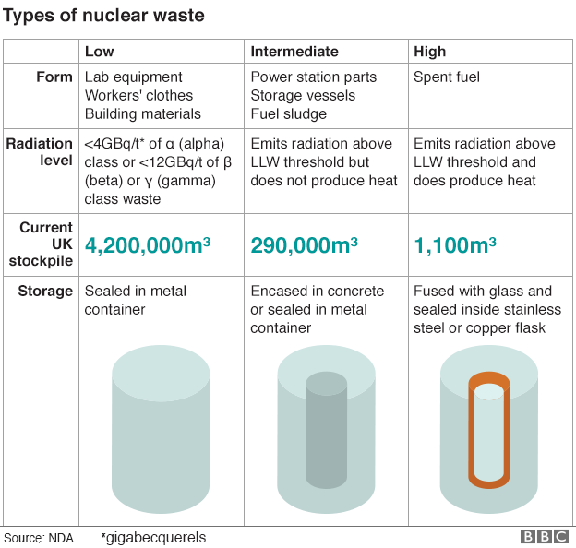
Trump administration wants to reclassify leaking nuclear waste to avoid cleaning it up, say officials
‘This is unacceptable, and we will not stand by while this administration plans to abandon its responsibility to clean up their mess’, Independent UK, 10 Jan 19, Josh Gabbatiss, Science Correspondent
January 10, 2019
Posted by Christina Macpherson |
politics, USA, wastes |
8 Comments









 nuclear-news