 Nuclear weapons: experts alarmed by new Pentagon ‘war-fighting’ doctrine, Guardian, Julian Borger in Washington 20 Jun 2019
US joint chiefs of staff posted then removed paper that suggests nuclear weapons could ‘create conditions for decisive results’ The Pentagon believes using
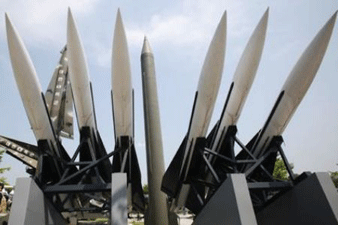
nuclear weapons could “create conditions for decisive results and the restoration of strategic stability”, according to a new nuclear doctrine adopted by the US joint chiefs of staff last week.
The document, entitled Nuclear Operations, was published on 11 June, and was the first such doctrine paper for 14 years. Arms control experts say it marks a shift in US military thinking towards the idea of fighting and winning a nuclear war – which they believe is a highly dangerous mindset.
“Using nuclear weapons could create conditions for decisive results and the restoration of strategic stability,” the joint chiefs’ document says. “Specifically, the use of a nuclear weapon will fundamentally change the scope of a battle and create conditions that affect how commanders will prevail in conflict.”
At the start of a chapter on nuclear planning and targeting, the document quotes a cold war theorist, Herman Kahn, as saying: “My guess is that nuclear weapons will be used sometime in the next hundred years, but that their use is much more likely to be small and limited than widespread and unconstrained.”
Kahn was a controversial figure. He argued that a nuclear war could be “winnable” and is reported to have provided part of the inspiration for Stanley Kubrick’s film Dr Strangelove.
The Nuclear Operations document was taken down from the Pentagon online site after a week, and is now only available through a restricted access electronic library. But before it was withdrawn it was downloaded by Steven Aftergood, who directs the project on government secrecy for the Federation of American Scientists.
A spokesman for the joint chiefs of staff said the document was removed from the publicly accessible defence department website “because it was determined that this publication, as is with other joint staff publications, should be for official use only”.
In an emailed statement the spokesman did not say why the document was on the public website for the first week after publication.
Aftergood said the new document “is very much conceived as a war-fighting doctrine – not simply a deterrence doctrine, and that’s unsettling”……..
The doctrine has been published in the wake of the Trump administration’s withdrawal from two nuclear agreements: the 2015 joint comprehensive programme of action with Iran, and the 1987 Intermediate-range Nuclear Forces treaty with Russia. The administration is also sceptical about a third: the New Start accord that limits US and Russian forces strategic nuclear weapons and delivery systems, which is due to expire in 2021.
Meanwhile, the US and Russia are engaged in multibillion-dollar nuclear weapon modernisation programmes. As part of the US programme, the Trump administration is developing a low-yield ballistic missile, which arms control advocates have said risks lowering the nuclear threshold, making conceivable that a nuclear war could be “limited”, rather than inevitably lead to a global cataclysm.
The last nuclear operations doctrine, published during the George W Bush administration in 2005, also caused alarm. It envisaged pre-emptive nuclear strikes and the use of the US nuclear arsenal against all weapons of mass destruction, not just nuclear.
The Obama administration did not publish a nuclear operations doctrine but in its 2010 nuclear posture review it sought to downgrade the role of nuclear weapons in US military planning.
It renounced the Bush-era plan to build nuclear “bunker-buster” bombs, and ruled out nuclear attack against non-nuclear-weapon states, but it did not go as far towards disarmament as arms control activists had wanted or expected.https://www.theguardian.com/world/2019/jun/19/nuclear-weapons-pentagon-us-military-doctrine
June 20, 2019
Posted by Christina Macpherson |
USA, weapons and war |
Leave a comment
 Is It Safe To Store Nuclear Waste At San Onofre? The Science Behind It, kpbs, June 19, 2019
By Shalina Chatlani Southern California Edison will soon resume storing spent nuclear fuel at San Onofre Nuclear Generating Station. The move comes almost a year after a near-miss accident, when one of the canisters that contained the spent nuclear fuel nearly fell 18 feet.
Resuming storing the fuel has also reignited concerns from residents who live around San Onofre on whether storing 1,700 tons of nuclear waste next to the beach is safe.
Residents still worried
Many of those concerned residents, like Peter McBride of Oceanside, attend regular meetings of the San Onofre Community Engagement Panel.
“Nobody has talked about the half-life of the nuclear waste that’s there,” he said at a June meeting. “Some of (the nuclear waste) goes quickly. But some of it goes 24,000 years. We’re talking about canisters … that are going to hold it for 10 to 60 years. It’s ridiculous.”
McBride and others at the meeting said the canisters are too thin, and with the salt air, they will corrode and break open. Some also said rising ocean levels could smother the canisters in water and cause them to breach.
“I’m worried about the fact that not only this area but other areas of the country face the same kind of irresponsibility with this potentially disastrous material,” McBride said. “I’m worried about our children, my grandson.”
San Onofre’s senior nuclear engineer Randall Granaas said residents shouldn’t be concerned. He recently led KPBS on a tour of the station and said any danger would come from heat and radiation.
Right after being removed from the reactor, fuel rods are extremely hot. They are then put in cooling ponds for five to seven years.
“After five years then we can transfer it into this dry storage system,” he said. “And that’s adequate, using the natural convection to cool the fuel.”
Granaas said vents on the canisters allow cold air to come in, so the heat can circulate out.
There is, however, still the issue of radiation. Even spent nuclear fuel is highly radioactive. Part of that radiation can go through some materials, like aluminum, but not through steel or concrete. The radiation, known as gamma, can take years to dissipate.
“So if you had no shielding between our fuel and yourself, it could be fatal in a relatively short amount of time. So it is important to maintain that shielding,” Granaas said. “But if you fast-forward several hundred years from now you can walk up to one of those fuel assemblies for a short period of time and you’ll be fine.”
But we can’t fast forward — that has residents such as McBride worried. What would happen if the shielding suddenly went away?
Storage is structurally sound, officials say
At San Onofre’s spent fuel site, a thick concrete slab acts as a 35,000-pound lid. It sits on top of a 20-foot crevice, where the fuel canisters are stored. Officials say this system can withstand massive amounts of stress.
Still, some scientists are skeptical.
Physicist Tom English told KPBS he thinks there are a number of ways this operation could go wrong.
“They’re basically going to put the stuff in a thin storage container, which probably will have some problems with corrosion given this ocean environment here,” he said. “The second idea is they’re going to store it such that it will be about 100 feet from the water and a few inches above the groundwater table, which is totally ridiculous. As the sea level rises, what will happen is the bottom of the containers will corrode.”……. https://www.kpbs.org/news/2019/jun/19/nuclear-waste-beach-science-and-safety-explained/
June 20, 2019
Posted by Christina Macpherson |
USA, wastes |
Leave a comment
 Meet the nuclear plant project reporters https://www.lohud.com/story/news/investigations/2019/06/19/nuclear-plant-project-team/1352103001/ Rockland/Westchester Journal News June 19, 2019
A team of veteran reporters from the USA TODAY NETWORK’s Northeast Metro Group teamed up to investigate who is getting the billions of dollars set aside to clean up the nation’s closed and decommissioned nuclear plants and how that process is being handled.…
A team of veteran reporters from the USA TODAY NETWORK’s Northeast Metro Group teamed up to investigate who is getting the billions of dollars set aside to clean up the nation’s closed and decommissioned nuclear plants and how that process is being handled.
With the nuclear power industry shifting into decommissioning mode, the nation’s plants are facing closure, leaving a raft of questions and concerns in its wake.
Our reporters who tackled the project:
Tom Zambito has been an investigative reporter with The Journal News/lohud and the USA TODAY NETWORK since August 2015.
In a 33-year career, Zambito has had stints at The Record, the New York Daily News, Newsday and the Star-Ledger (nj.com). His current focus is transportation and energy.
Zambito’s work has been recognized with more than three dozen writing awards, among them honors from press associations in three states as well as Investigative Reporters and Editors (IRE), The Associated Press, the Deadline Club, the American Bar Association, the National Press Club, the New York City Police Department Emerald Society and the Society of the Silurians.
Amanda Oglesby is an Ocean County, New Jersey, native who covers the environment for the Asbury Park Press and the USA TODAY NETWORK New Jersey. She has covered the Oyster Creek nuclear power plant, the Pine Barrens and other news for the Press since 2008. She is a Rutgers University graduate who studied journalism and environmental policy before starting her reporting career. In 2014, she was one of two Gannett reporters who were finalists in the Deadline Club’s “Public Service Award” for their work on the Asbury Park Press’ “Heroin at the Shore” series.
Christopher Maag is a columnist for The Record. His columns focus on the overlooked characters of New Jersey and the Northeast, bringing readers into the lives of a chopper-riding chihuahua, a convicted drug cartel strategist and the farmer whose field overlooks the Lincoln Tunnel. Formerly a regular contributor to The New York Times and TIME, he has written for daily newspapers, monthly magazines and alternative news weeklies, winning awards for writing and investigative reporting. A graduate of Columbia University School of Journalism, he lives in Queens.
Samantha Ruland is the Pennsylvania issues reporter for the York Daily Record and USA TODAY NETWORK. During her time at YDR, she’s worked to understand and report on the issues that affect the people of central Pennsylvania and beyond, while keeping a close eye on legislation in Harrisburg. She was part of a team of reporters whose work received first place in public service by the Pennsylvania Associated Press Media Editors contest for chronicling the ongoing child sexual abuse by priests in the state.
Frank Esposito is a data reporter for The Journal News/lohud and the USA TODAY NETWORK. He writes about technology and systems running awry and what happens to the people caught in their path. Frank was part of the team that won the New York State Associated Press Association First Amendment award for coverage of the governor of New York’s political donations. He studied international political economics and journalism at Penn State University.
June 20, 2019
Posted by Christina Macpherson |
investigative journalism, USA |
Leave a comment
Closing TMI: How to secure the infamous nuclear power site and why it might take 60 years https://www.ydr.com/story/news/2019/06/19/closing-three-mile-island-tmi-safe-exelon-decades-cost/1352558001/
Three Mile Island, an icon of the industry and the site of America’s worst nuclear disaster, was once a popular tourist destination as travelers made their way through central Pennsylvania.
But the visitor center at TMI has been closed for years now, and the billowing steam from the iconic towers will soon fade to nothing as the plant awaits its doomed fate.
Exelon Generation plans to shut down the Three Mile Island reactor by the end of September after a $500 million proposal to rescue Pennsylvania’s nuclear power industry failed to gain support.
When it closes, TMI’s Unit 1 reactor will be as stagnant as its parallel, Unit 2, which has been sitting inactive since its partial meltdown in 1979. But even as operations cease, the towers could loom large for decades — it could take nearly 60 years and $1.2 billion to decommission the Dauphin County plant, with nuclear waste sitting in storage between the two units’ cooling towers.
Exelon Generation filed a report with the federal Nuclear Regulatory Commission in April, outlining a tentative schedule for the decommissioning activities and expanding on what a future without the Three Mile Island nuclear power plant would look like.
Here are some highlights from the original proposal along with updates from the Nuclear Regulatory Commission:
Will TMI really take 60 years to decommission?
It could. Federal regulations give plant operators up to 60 years to clean up a site after the plant closes.
According to Exelon’s Post-Shutdown Decommissioning Activities Report, the company has chosen the SAFSTOR method for decommissioning the plant. It’s one of the three federally allowed options for decommissioning a nuclear power plant in the United States and is also known as the “deferred dismantling” method.
“Radioactive decay occurs during the SAFSTOR period, thereby lowering the level of contamination and radioactivity that must be disposed of during decontamination and dismantlement,” Exelon said.
It also leaves time for the trust fund to pay for the dismantling to grow.
How can TMI’s owners accelerate the decommissioning process?
Companies such as Holtec International and Westinghouse Electric Co. are interested in buying up closing plants so they can disassemble them promptly and keep what is left in the decommissioning trust fund when the process is complete.
These specialist companies typically plan to decommission and restore the plant site more quickly than the industry-standard plan that could span more than six decades. In some cases, Holtec has said it can decommission a plant in eight years.
But Exelon said it has no plans to sell the plant, meaning it plans to handle the decommissioning itself using the SAFSTOR method.
Neil Sheehan, a spokesman for the Nuclear Regulatory Commission, said most U.S. nuclear plants now on a fast-track decommissioning schedule originally opted for the SAFSTOR method before reaching deals with specialist companies.
What happens to the fuel and other radioactive materials?
Unit 1’s nuclear fuel would immediately be removed from the reactor after shutdown. Exelon plans to build an independent spent fuel storage installation (ISFSI) to hold spent fuel in the middle of the current plant, between the two units’ cooling towers. The uranium fuel rods would cool in spent fuel pools until being moved to dry storage canisters that will be installed on site in 2022.
But if Exelon sticks to its SAFSTOR approach, the reactor’s cooling towers and other major components would remain standing until 2074. And by 2078, all radioactive material would be safely stored or removed from the site.
So really, $1.2 billion?
That’s what Exelon expects the cost of the total decommissioning and restoration of Unit 1 to be. And if you thought that was a lot, the damaged Unit 2, owned by FirstEnergy Corp., is expected to cost an additional $1.27 billion to fully decommission.
Where does that money come from?
The decommissioning’s $1.2 billion cost would be financed from a trust fund the power plant’s customers have paid into since the plant became operational in 1974.
Unit 1’s fund has almost $670 million in it currently. Exelon spokeswoman Liz Williamson said the trust fund should fully cover the expected cost of $1.2 billion for decommissioning.
If there were a shortfall in the fund, Exelon would be responsible for the rest.
The decommissioning of the damaged Unit 2 reactor, TMI Unit 2, would be paid from a separate trust fund, which has accumulated to about $834 million.
How many people will lose their jobs because of this?
Once the plant is shutdown, employment at TMI will plummet from the current staff of about 650 to 300 employees by the end of year as the plant becomes a storage site.
And when the on-site dry storage building is completed in 2022, employment will drop again to about 56, with most of the remaining jobs being focused on security.
At this rate, the final cleanup and restoration of the site may not be complete until 2079— a century after its infamous disaster.
June 20, 2019
Posted by Christina Macpherson |
decommission reactor, USA |
Leave a comment
Oyster Creek shutdown in NJ could leave high taxes, giant casks of dangerous radioactive waste https://www.app.com/story/news/local/land-environment/2019/06/19/nuclear-power-oyster-creek-closes-jersey-shore-decommissioning-speeds-up/1274417001/
FOR THE FORESEEABLE FUTURE, THIS JERSEY SHORE TOWN WILL BE LEFT WITH THEIR NUCLEAR PLANT’S DANGEROUS LEGACY — CANISTERS CONTAINING RADIOACTIVE WASTE.
Amanda Oglesby, Asbury Park Press, June 19, 2019 Three miles of pine forest separate Paul Berkowicz’s ranch-style home from a cluster of towering canisters on a concrete pad containing one of mankind’s most dangerous substances.
For decades, the 68-year-old retired educator has lived and worked near the Oyster Creek Generating Station, the nation’s oldest operating commercial nuclear power plant until it stopped energy production in September.
Since the plant’s opening a half-century ago, residents of Lacey Township relished the high-paying jobs and the low taxes the plant helped provide.
With decommissioning, nuclear jobs will dry up. Property taxes are expected to spike. And, for the foreseeable future, the town’s 30,000 residents will be left with the plant’s dangerous legacy — the stored canisters, or casks, containing radioactive waste.
It’s not what Berkowicz expected when he purchased his home here in the 1970s. He believed the plant’s radioactive waste, which can sicken and kill, would be removed from Lacey. In reality, towns across the United States, Lacey included, will likely be stuck with the waste for decades to come.
“I’m not anti-power plant or anti-nuclear power,” said Berkowicz as he sat as his dining room table. “I’m anti- having hundreds of places where you’re storing this thing that will be poisonous for 1,000 years.
“Nobody would have agreed to have a power plant anywhere, in any community, if they were going to have the next generations live with the waste,” he added.
Across the nation, residents of communities where nuclear plants are closing face similar concerns. At least 15 nuclear power plants are scheduled to close, or are being taken apart, across the United States.
The company looking to dismantle Oyster Creek, Holtec International, is also applying to purchase and decommission Indian Point Energy Center in Buchanan, New York, the Pilgrim Nuclear Power Station in Plymouth, Massachusetts, and the Palisades Power Plant in Covert, Michigan.
As the nuclear industry shrinks, its spent radioactive fuel — waste totaling more than 80,000 metric tons, or enough to fill a football field about 20 meters deep — will be left behind in towns like Lacey.
Just how big is nuclear power?
The United States currently has 98 commercial nuclear reactors operating at 60 plants in 30 states.
Those 98 reactors feed approximately 20% of the nation’s electricity consumption.
How the material will be stored and for how long are questions vexing plant neighbors, public officials and environmentalists in communities even hundreds of miles from the closing plants.
High stakes are attached to the answers.
More than 138,000 people live within 10 miles of Oyster Creek. Lacey Township is a middle class, suburban community in central New Jersey, about 35 miles north of Atlantic City.
Situated in an environmentally sensitive region, the plant lies along the eastern edge of the Pinelands National Reserve, a 1.1 million-acre expanse of unique pine forest that spreads across 22 percent of New Jersey.
Oyster Creek also sits on the western shores of Barnegat Bay, a 660-square-mile body of brackish water that is one of the region’s top tourist attractions, behind its miles of sandy ocean beaches.
Underneath Oyster Creek runs another integral natural asset, the Kirkwood-Cohansey aquifer. This 3,000-square-mile, 17 trillion-gallon aquifer provides drinking water and agricultural irrigation for most of south New Jersey.
These sensitive environmental jewels have not deterred Holtec, based in Camden, New Jersey, from seeking to buy the power plant from owner Exelon Generation. Holtec has applied to dismantle the facility — and to do so decades sooner than first envisioned by Exelon .
Holtec’s work — and profits — would be funded by the plant’s $1 billion trust fund, a decades-old pot of money reserved for the tedious process of decommissioning.
Some environmentalists warn the company will be challenged to both quickly and efficiently demolish Oyster Creek, while at once protecting the environment and the health and safety of workers and the public.
“Decommissioning… has been pretty limited to date,” said Paul Gunter, director of the Reactor Oversight Project at Beyond Nuclear, a group that advocates abandoning nuclear power in favor of other power sources. “It’s not like we have experience in this.”
From decades to years
Holtec proposes taking down Oyster Creek, and other plants it’s preparing to purchase, in a mere eight years, thanks to new technology and streamlined processes.
Exelon first proposed a 60-year decommissioning.
Gunter worries that a push for quick profits could eclipse caution and safety concerns.
“With an accelerated number of plants that are being decommissioned, we could possibly see broader risks,” he said.
Key to Holtec’s speedier plan is an expedited process for removing spent nuclear fuel from the plant and putting the material into storage casks.
The Holtec design allows hot fuel to be loaded into the casks in under 3 years of storage in cooling pools, instead of the minimum 5 years.
But are they safe?
Holtec says its casks are designed to last 300 years, although the Nuclear Regulatory Commission only licenses casks for 40 years, with the expectation companies will apply for renewals periodically.
The casks “are very safe. They do require that people continue to monitor,” said Robert S. Bean, associate director of the Center for Radiological and Nuclear Security at Purdue University. “These facilities will not be allowed to put the stuff in casks and walk away.”
Edwin Lyman, acting director of the Nuclear Safety Project at the Union of Concerned Scientists, a nuclear safety watchdog, isn’t as confident the casks will hold up.
“As materials and facilities age, unexpected things crop up,” said Lyman. He added that Holtec’s claims that its casks are designed to last 300 years are “totally unproven.”
Yet, Lyman said cask storage is the safest place for spent fuel.
Are the casks safe?
Casks are a technology Holtec has worked to perfect since it began manufacturing them in 1992. They are designed not only to contain radiation, but to withstand disasters like missile strikes and explosions, said Joy Russell, senior vice president of business development for Holtec.
Not everyone is sold on the technology.
Putting nuclear fuel into casks before it has properly cooled is “dangerously premature,” said Robert Alvarez, a senior scholar of nuclear, environmental and energy policies at the Institute for Policy Studies, a progressive think tank based in Washington.
“It’s called faith-based safety,” said Alvarez, who previously served as a staff expert to the U.S. Senate on the United States’ nuclear weapons program. “It’s basically taking a gamble on the basis of no technical support.”
James Conca, an environmental scientist and expert in nuclear waste disposal, said missteps involving nuclear energy garner outsize attention.
“It’s kind of frustrating,” he said. “Nuclear has the worst rep, and there’s reasons for that, but it’s actually quite safe.”
Casks are hardly new to communities built up around nuclear plants.
Across the United States, more than 90,000 metric tons of spent nuclear fuel is awaiting disposal, according to the U.S. Government Accountability Office. Of that, more than 80,000 metric tons are from the nation’s fleet of commercial reactors.
In New Jersey, more than 3,117 metric tons of nuclear fuel have been left from more than 60 years of energy generation, according to the Nuclear Energy Institute. New York has more than 4,314 metric tons. Pennsylvania, home of the notorious Three Mile Island nuclear plant, has more than 7,000 metric tons.
With no permanent repository established, casks are the only long-term solution for storage.
Radiation, asbestos among concerns
Forty-five miles north of Midtown Manhattan, on the north side of Indian Point nuclear plant, 45 stone-gray casks hold the leftovers of decades of nuclear power generation, on a cliff overlooking the Hudson River.
The canisters, standing 11 feet wide by 22 feet high, serve an integral function in the afterlife of a nuclear plant, entombing dangerous radioactive elements like Cesium-137, Strontium-90 and Plutonium-239, fuel bi-products created inside the reactor vessel.
Casks hold dangerous radioactive elements like Cesium-137, Strontium-90 and Plutonium-239, fuel bi-products created inside reactors, which remain dangerous for generations.
Here’s what they do to people.
![Chart]()
Cesium 137
Can burn skin, cause radiation sickness and damage tissue. In high doses, it can cause cancer.
Strontium-90
Is absorbed like calcium within the body and can lead to bone cancer, bone marrow cancer, and cancer in the tissues near bones.
Plutonium 239 and 240
Both remain dangerously radioactive for thousands of years. If inhaled, plutonium particles can scar the lungs, damage bones, liver and spleen and cause cancer. Source: CDC and EPA reports
Nuclear safety experts say these thick concrete and steel vessels are safer than holding spent fuel within the reactor core or cooling pool, where the risk of accident or fire is a slim, but real, possibility.
Cesium-137 can burn skin, damage tissue and cause radiation sickness for generations. Strontium-90 is absorbed by human bones and can cause cancer. Plutonium-239 can scar lungs, damage bones and organs and cause cancer. It remains dangerous for hundreds of thousands of years.
The fuel gives off heat for years after it is removed from the reactor core.
The casks at Oyster Creek were nearly 20-degrees hotter than the air around them when measured in 2002, according to a monitoring report filed with the NRC.
Some radiation does escape the thick walls of the casks — about 1.5 millirems per hour of gamma radiation or less, and about 1 millirem per hour of neutron radiation, according to the report.
These are small doses. For comparison, a chest X-ray emits about 10 millirems and a full body CT scan about 1,000 millirems, according to the NRC. The average person receives a radiation dose of about 620 millirem a year, half of which is from cosmic rays and the Earth’s natural radiation.
“From a cask, the risk is not that great, compared to the things we worry about, (like) the reactor core itself,” said Bean.
But nobody sees storage casks as a lasting solution to the nation’s nuclear waste dilemma.
The federal government had originally promised to dispose of the material in a repository to be built at Yucca Mountain, Nevada. The plan fell apart due to geological concerns and political pressure.
Instead, fuel has been accumulating at plants across the nation.
Berkowicz, the Lacy resident, wants to see action.
“All of these states (with nuclear waste) should get together,” he said. “What are you going to do with this virtually eternal poison?.. You’ve got to do something with it.”
Lacey Mayor Timothy McDonald wants more help from Washington in charting the long-range future of Oyster Creek, such a staple of this community that an atom is incorporated into the municipal seal.
And radioactive waste is not what most worries McDonald.
“I’m more concerned with the tearing down of the buildings,” he said. Filled with decades worth of radioactive materials, Oyster Creek is also contaminated with asbestos, according to decommissioning documents.
Without the proper precautions — special containment systems, worker gear and sawing equipment, for example — the worry is dangerous dust and debris could sicken workers or contaminate the environment.
Some say faster is preferred
Yet McDonald and municipal officials support the plant being razed sooner rather than later.
A speedier decommissioning would give town officials hope for the eventual re-purposing of the sprawling property.
“The faster we can get this thing down, and get to redoing the property down there, the better off Lacey Township is, but we have to do it safely,” he said.
If the sale of Oyster Creek to Holtec goes through, Holtec spokeswoman Caitlin Marmion said the company would take every precaution to protect workers, public health and the environment.
“Stringent environmental standards will continue throughout the decommissioning process,” she said in an email.
“All radiation is completely removed from materials prior to any open-air demolition. Managing fugitive dust and debris during deconstruction is a key part of the planning and mandatory for the protection of workers, the community and the environment,” Marmion said.
Berkowicz isn’t convinced that residents near the plant have nothing to fear. He worries less about decommissioning than what will be left behind after the plant is gone: Holtec says 63 towering casks of radioactive spent fuel will remain.
“It’s a deadly poison,” Berkowicz said.
June 20, 2019
Posted by Christina Macpherson |
USA, wastes |
Leave a comment
|
 This Week’s Featured Interview:http://nuclearhotseat.com/2019/06/19/nuclear-regulatory-commission-nrc-attacks-gundersen-again-plus-ssfl-woolsey-fire-update-nh-417/?fbclid=IwAR08enYQktntswacnaiiEpdcP4huvQOp7UBUDkb1iEPTkYwC2kh3GUhLJIY
Nuclear Regulatory Commission (NRC) Attacks Gundersen – Again! Plus SSFL/Woolsey Fire Update – NH #417
- Nuclear Regulatory Commission (NRC) staff and management don’t like whistleblowers, and somebody who probably ranks as their least favorite one is this week’s Nuclear Hotseat guest.Arnie Gundersen is a former nuclear industry executive and nuclear engineer with more than 44 years of nuclear industry experience. He became a whistleblower in 1990. Gundersen has written dozens of expert reports for non-government organizations and the state of Vermont. His curriculum vitae shows Gundersen is a licensed Critical Facility Reactor Operator from 1971-1972. He is Chief Engineer at Fairewinds Energy Education.In this extended interview with Nuclear Hotseat Producer/Host Libbe HaLevy, Gundersen goes into his history as a nuclear industry insider, the consequences of his bringing safety considerations to the attention of his boss, and the personal and professional “fallout” that resulted from his standing up for the truth. Included is Arnie’s update on what can be shared thus far about the Woolsey Fire at the Santa Susana Field Lab and the challenges faced in trying to learn more from ash and soil samples.
|
|
June 20, 2019
Posted by Christina Macpherson |
civil liberties, Resources -audiovicual, USA |
Leave a comment
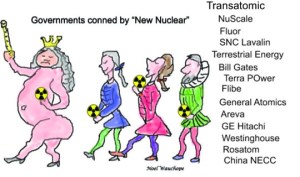 Bipartisan House Members Introduce Nuclear Energy Leadership Act, Bill set for referral to the chamber’s energy, science committees, Morning Consult, BY JACQUELINE TOTH, June 18, 2019
House members have introduced an identical companion to the Senate’s premier nuclear legislation, opening the bill up for conversation in the chamber.
Reps. Elaine Luria (D-Va.) and Denver Riggleman (R-Va.) co-sponsored the Nuclear Energy Leadership Act, along with Reps. Rob Wittman (R-Va.) and Conor Lamb (D-Pa.), who chairs the Energy Subcommittee of the House Science, Space and Technology Committee — to which parts of the bill will likely be referred.
The House introduction shows enthusiasm for advanced nuclear energy in both chambers and will allow for discussion to move forward on NELA simultaneously in both the House and Senate, said Ryan Fitzpatrick, deputy director of the Clean Energy Program at the think tank Third Way. “Getting that conversation moving is a good thing for a timely process towards an actual passage.”
Among other directives in the measure, the Energy Department would have to create a national strategy for nuclear energy, demonstrate advanced nuclear reactor concepts and make an initial supply of high-assay low-enriched uranium fuel available, which is required by some new reactors.
Much of the nuclear industry is hoping for the bill’s enactment as a third win for the sector, which celebrated passage of two advanced nuclear energy measures last Congress. “The three pieces of the legislation together really will help push forth the advanced reactor industry,” said Everett Redmond, senior technical advisor for new reactor and advanced technology at the Nuclear Energy Institute trade group.
The bill has powerhouse support in the Senate, where it was introduced by Energy and Natural Resources Chairman Lisa Murkowski (R-Alaska) and has 17 co-sponsors to date, including committee ranking member Joe Manchin (D-W.Va.), Senate Appropriations Energy and Water Development Chairman Lamar Alexander (R-Tenn.) and Sen. Cory Booker (D-N.J.).
Luria said Tuesday that she had learned about the measure before it was introduced in the Senate………https://morningconsult.com/2019/06/18/bipartisan-house-members-introduce-nuclear-energy-leadership-act/
June 20, 2019
Posted by Christina Macpherson |
politics, USA |
Leave a comment
Government watchdog finds 3 issues disrupting US nuclear modernization efforts, Defense News By: Kelsey Reichmann 20 June 19, WASHINGTON — The U.S. agency responsible for making explosive materials used in nuclear weapons is facing challenges that could impact the country’s planned modernization of its nuclear arsenal, according to a report by the Government Accountability Office.
The National Nuclear Security Administration, a semiautonomous agency within the Energy Department, is facing three main challenges, according to the report: a dwindling supply of explosive materials, aging and deteriorating infrastructure, and difficulty in recruiting and training qualified staff.
This report comes amid congressional debate over the cost of modernizing the U.S. nuclear arsenal, an effort driven by President Donald Trump.
NNSA’s supply of materials, which are “highly specialized” with specific chemical and physical characteristics, are in low supply, the report says. Furthermore, the NNSA is lacking the knowledge base to produce the materials, as the recipes to make them were not well-documented, or the processes themselves infrequently practiced, the report notes.
Challenges in obtaining materials is not a new issue for the NNSA, the watchdog notes. The agency experienced a similar situation with a material known as “Fogbank,” and the GAO reported in March 2009 that the NNSA lacked the knowledge to manufacture the material — leaving the process for Fogbank “dormant for about 25 years.”
Fogbank is used in the production of the W76-1, a warhead for the Navy’s Trident ballistic missile. Under the Trump administration’s plans for a new low-yield nuclear weapon, the U.S. is making a W76-2 variant, which entered production earlier this year.
The GAO notes that when the NNSA is actually able to replicate formulas for materials, procuring those materials has proved challenging, given the irregular and small order specifications to contractors.
But the GAO identifies aging infrastructure as the greatest risk to the NSSA.
“The NNSA 2019 Master Asset Plan states that 40 percent of the explosives infrastructure of NNSA’s sites is insufficient to meet mission needs, which can lead to contamination of explosive products or limit the use of facilities,” the report says. It notes that contamination has already occurred from rust falling off rafters and grass blowing through cracks in the walls, contaminating batches of explosives.
Aging facilities must receive updates to modern safety standards to protect employees, the GAO says. The Los Alamos High Explosives Chemistry Laboratory, for example, was built in the 1950s and has struggled to adopt to modern instrumentation, according to the report……..https://www.defensenews.com/global/the-americas/2019/06/19/government-watchdog-finds-3-issues-disrupting-us-nuclear-modernization-efforts/
June 20, 2019
Posted by Christina Macpherson |
USA, weapons and war |
Leave a comment
Secrecy News. DoD Doctrine on Nuclear Operations Published, Taken Offline https://fas.org/blogs/secrecy/2019/06/nuclear-operations/ Jun.19, 2019, Steven Aftergood
The Joint Chiefs of Staff briefly published and then removed from public access a new edition of their official doctrine on the use of nuclear weapons. But a public copy was preserved. See Joint Publication 3-72, Nuclear Operations, June 11, 2019.
The document presents an unclassified, mostly familiar overview of nuclear strategy, force structure, planning, targeting, command and control, and operations.
“Using nuclear weapons could create conditions for decisive results and the restoration of strategic stability,” according to one Strangelovian passage in the publication. “Specifically, the use of a nuclear weapon will fundamentally change the scope of a battle and create conditions that affect how commanders will prevail in conflict.”
The document might have gone unremarked, but after publishing it last week the Joint Chiefs deleted it from their public website. A notice there states that it (JP 3-72) is now only “available through JEL+” (the Joint Electronic Library), which is a restricted access site. A local copy remains publicly available on the FAS website.
June 20, 2019
Posted by Christina Macpherson |
secrets,lies and civil liberties, USA |
Leave a comment
Appeals Court Hears Argument On Nuclear Plant Decision,Wabe.org, EMMA HURT • JUN 18, 2019 THE GEORGIA COURT OF APPEALS HEARD ARGUMENTS TUESDAY ABOUT WHETHER A
STATE DECISION TO CONTINUE EXPANDING PLANT VOGTLE BROKE ANY REGULATORY RULES. A FULTON COUNTY SUPERIOR COURT JUDGE DISMISSED THE CASE ON TECHNICAL GROUNDS IN DECEMBER, AND APPELLANTS ARE REQUESTING RECONSIDERATION OF THAT DISMISSAL.Georgia Power is expanding Plant Vogtle, a nuclear power plant near Waynesboro, Ga. It’s the
only nuclear power plant under construction in the country.
The Public Service Commission, which regulates Georgia Power, has to review Plant Vogtle’s ongoing costs during semiannual Vogtle Construction Monitoring (VCM) reports. Back in 2017, during VCM 17 the Commission had a big decision to make: should Georgia Power continue construction, even though its contractor was going bankrupt from building it?
The commission decided yes, the higher costs and longer schedule were acceptable enough for the project to continue.
The advocacy groups in court, including Georgia Watch and Georgia Interfaith Power and Light are trying to challenge the decision, saying it was more than just checking expenses.
“This didn’t limit itself to simply approving expenditures that had accrued and been spent,” John Salter, the advocates’ lawyer, said…
…Now the court will decide by the end of the year if the advocates have the grounds to challenge that 2017 decision. https://www.wabe.org/appeals-court-hears-argument-on-nuclear-plant-decision/
June 20, 2019
Posted by Christina Macpherson |
Legal, USA |
Leave a comment
Trump weakens radioactive waste regulations http://njtoday.net/2019/06/19/trump-weakens-radioactive-waste-regulations/
by Staff Report • June 19, 2019 The Trump administration
announced a change in the interpretation of current regulations that would allow some of that radioactive waste to be disposed of under less stringent conditions.
Trump administation officials want to reclassify ‘high-level radioactive waste’ without a oversight to make it cheaper to get rid of spent fuel at several nuclear weapons facilities.DOE is asserting the power to unilaterally reclassify high-level radioactive waste from Cold War-era reprocessing of spent fuel for nuclear weapons.
The U.S. Department of Energy (DOE) published a notice on June 5, saying that it now interprets the statutory term “high-level radioactive waste” as set forth in the Atomic Energy Act of 1954 and the Nuclear Waste Policy Act of 1982 in a way so that some substances may be reclassified and may be disposed of in accordance with weaker radiological standards.
DOE currently needs to submit re-classification determinations to the U.S. Nuclear Regulatory Commission for review.
The agency proposed the new interpretation in October 2018, and has received a total of 5,555 comments from members of the public, environmental groups, Native American tribes, government officials, and the Nuclear Regulatory Commission.
The agency also published a notice stating that it will be drafting a plan to dispose up to 10,000 gallons of stabilized recycle wastewater from the Savannah River Defense Waste Processing Facility at a commercial low-level radioactive waste disposal facility located outside South Carolina.
It was not clear where that radioactive waste would go, but officials indicated that is would head to a facility located in Texas or Utah.
DOE currently holds approximately 90 million gallons of such radioactive waste in underground storage tanks at three facilities (Hanford Site in Washington State; Savannah River Site in South Carolina; and the Idaho National Laboratory) and is in the process of cleaning up those sites.
Those efforts have been plagued by ballooning costs and significant delays driven in large part by the stringent controls for high-level radioactive waste and Trump officials believe the weaker standards will save money.
Critics are alarmed that radioactive waste is a threat to health and environmental, but the Republican administration appears unconcerned about matters of public safety.
The move drew condemnation from Washington Gov. Jay Inslee and Attorney General Bob Ferguson, who called it “reckless and dangerous” in a joint statement.
Critics argue the policy will allow federal regulators to abandon cleanup obligations at the state’s Hanford Site, which currently cost an estimated $2.5 billion a year.
The federal government reprocessed spent nuclear fuel from the 1940s through the Cold War to develop bombs.
Most of that development happened in Washington State — which was one of multiple facilities involved in the process of building the atomic bomb dropped on Nagasaki, Japan — and the South Carolina site.
The Idaho National Laboratory was tapped for nuclear research and development and is reported to have 9 million gallons of high-level radioactive waste on site.
The new policy has also proven controversial among.
“The Trump administration is moving to fundamentally alter more than 50 years of national consensus on how the most toxic and radioactive waste in the world is managed and ultimately disposed of,” said Geoff Fettus, an attorney at the Natural Resources Defense Council. “No matter what they call it, this waste needs a permanent, well-protected disposal option to guard it for generations to come.”
High-level radioactive waste requires disposal in a deep geological repository, such as Yucca Mountain. The nation’s sole operational deep geological repository, the Waste Isolation Pilot Plant in New Mexico closed in 2014 after a radiation leak. It has since reopened.
June 20, 2019
Posted by Christina Macpherson |
USA, wastes |
Leave a comment
Say It Ain’t So, #Ocasio! (#AOC) https://www.fairewinds.org/demystify/say-it-aint-so-ocasio-aoc?fbclid=IwAR1J2uPjFoiyDMFfHBT7Ucb6I-MmxZbu4rQ2VrYDzg5reSSvc3M6Yqb0Oc0.by Arnie Gundersen
Since early 2019 we’ve been hearing about the Green New Deal, a program that did not initially include nuclear power. Then suddenly, after an extensive lobbying effort by the atomic power industry, we heard: Ocasio-Cortez: Green New Deal ‘Leaves the Door Open’ on Nuclear.
How Green are the atomic power reactors proposed by the nuclear power industry? Fairewinds has produced a two minute animation showing that carbon reduction via atomic power reactors is a nuclear industry marketing ploy.
Let’s look at the history of atomic power and the way governments and the atomic weapons and power industries have worked together to promote nuclear power. Nuclear physicists discovered the nuclear chain reaction in 1938, and power has been produced using the atom since the 1940’s beginning with the Manhattan Project for the creation of the atomic bomb. Splitting the atom and creating nuclear weapons and power are old technologies that began more than 80 years ago! During that 80-year timespan, Americans and ratepayers in other capitalist countries were told that using nuclear power as a source of electricity would be “too cheap to meter” if taxpayers would only subsidize more research.
Now we see impending financial collapse of almost all of the US nuclear power plants due to green energy! Solar, wind, wave, battery storage, and even newer technologies have proved that electricity can be created anywhere in the world in a manner that creates jobs, saves billions of dollars, and makes the air we breathe, the food we eat, and the water we drink much safer for all of us.
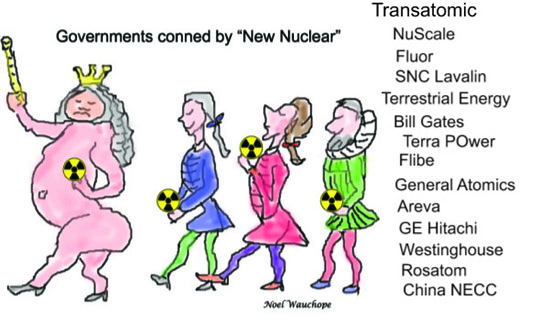
Instead of admitting nukes cannot compete with renewable energy, the atomic industrial complex is now proposing dozens of new designs that it claims on paper will compete in timeliness to successfully impact the growing climate crisis, including atomic reactors utilizing thorium and molten salt and new designs like Small Modular Reactors (SMRs), Micro-reactors, Traveling Wave, etc. Once again, the atomic power industry, which is the handmaiden to the nuclear weapons manufacturers, is sending lobbyists to convince your Congressional representatives that the atomic future will be different than the past. Lobbyists now claim that society will be so much better off when taxpayer funds bail out the aged, dangerous, and non-performing nukes and if the atomic power and weapons lobbies are given even more research subsidies.
Since the early 1960s there have been 250 applications to the Nuclear Regulatory Commission (NRC) and its precursor the Atomic Energy Commission (AEC) to generate electricity for profit using atomic power reactors. None of these 250 proposed atomic reactors have been built on time or within budget. You did not misread; truly, every single proposed nuke went millions and then billions of dollars over budget and have started generating electricity years later if at all.
If a baseball player was at bat 250 times and struck out 250 times, would he still be playing baseball? Yet, the atomic lobbyists marketing nuclear power want us to pay them for more chances to use our money and strike out one more time.
Renewables, storage and conservation already have a well-proven track-record of lower costs, more jobs, and environmental compatibility than any of these newly imagined nukes will ever have – I say newly imagined because I have spent my career life as a nuclear engineer. When I first began my career, I drank the Kool-Aid and believed that nuclear power reactors were the solution to the world’s energy shortages and that atomic power created from the same technology as the atomic bomb was as safe as the nuke power industry claimed. As the 5 commercial meltdowns during the last 40-years have proved, especially the 3 major meltdowns that included explosions at Fukushima, nuclear power is simply not a safe method of generating electricity. The impact of the devastation from three simultaneous meltdowns at Fukushima Daiichi to the social culture, environmental legacy, personal health, and financial welfare of Japan in 2011 is not a legacy that should be passed onto future generations.
Why then is the US Congress, including AOC – one of the brightest members of this new Congress and the creator of the Green New Deal (#GND) – “leaving the door open” for the same old atomic power marketing ploys? For more than 80-years, we have witnessed the economic failure, ratepayer bailouts, subsidized atomic meltdown insurance, and actual catastrophic meltdowns.
When will they ever learn?
June 17, 2019
Posted by Christina Macpherson |
election USA 2020, politics |
1 Comment
Gregory Jazcko, former Nuclear Regulatory Commission chairman, warned, “I oversaw the U.S. nuclear power industry. Now I think it should be banned. The danger from climate change no longer outweighs the risks of nuclear accidents.”
Perry and Davis Besse cost a whopping $8.7 billion to build and billions more in maintenance, repairs, and subsidies. Grid operator PJM has determined that closing Perry and Davis-Besse would not destabilize the grid.
The nuclear power life cycle produces copious carbon and other greenhouse gases from uranium mining, milling, refining, conversion, and enrichment; fuel fabrication; transportation; reactor construction, maintenance, decommissioning; and radioactive waste management.
While nuclear generated electricity is low in carbon, it has never been zero emissions. Reactors emit methane, a greenhouse gas, and radioactive Carbon-14, with a 5,700-year half-life. The scientific and medical communities have determined that there is no safe dose of radiation exposure.
Ingested or inhaled radioactive strontium-90 and cesium-137 replace calcium and potassium respectively, irradiating bones and muscles for decades. Carcinogenic radioactive iodine-131 is absorbed by the thyroid which is why potassium iodide is provided to residents near reactors. Cobalt-60 is a liver, kidney, and bone carcinogen. Specks of inhaled plutonium-239, with a half-life of 24,000 years, can cause lung cancer. Miles of buried, inaccessible, deteriorating pipes have leaked tritium, which is radioactive hydrogen; no technology can remove it from contaminated water.
Over 32 years, disasters occurred at Three Mile Island, Chernobyl, and Fukushima. The U.S. has 23 Fukushima-type reactors at 16 sites. The NRC and other researchers postulate a 50 percent chance of another catastrophic accident in approximately the next 20 years.
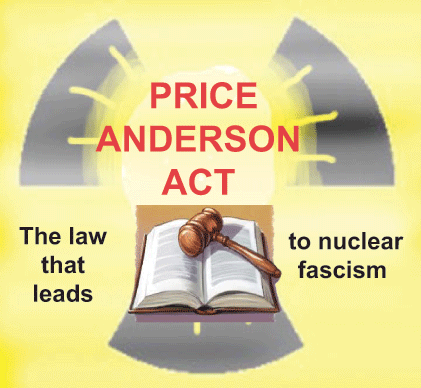
 To limit utility liability, Congress passed the 1957 Price Anderson Act which caps accident compensation at $12.6 billion; a 1982 NRC study calculated a severe accident could cause 50,000 fatalities and $314 billion in property damage which is $720 billion today.
A 1,000-megawatt reactor contains as much long-lived radiation as 1,000 Hiroshima-sized bombs from which humans and the environment must be protected forever, but the NRC admits that no engineered structure can last the time required to isolate these wastes and that leakage will occur.
Early warnings to resolve radioactive waste before licensing new reactors were ignored. There are 88,000 tons of irradiated fuel “temporarily” stored in problematic pools and casks at 75 environmentally unsuitable reactor sites in 33 states because no permanent repository exists.
In 2012, Ohio was 13th in the U.S. for wind capacity and investment; this virtually ceased due to a 2014 law which mandated the country’s most restrictive wind turbine setbacks and severely impeded Ohio’s 2008 renewable energy and efficiency standards. HB 6 will finish the job.
Even conservative voters prefer solar, wind, and efficiency and oppose fees to keep old nuclear plants operating. Conservative groups testified against HB 6, as corporate welfare and a glorified slush fund.
Ohio needs to strengthen renewable energy and efficiency standards, stop throwing good money after bad, close Perry and Davis Besse as scheduled, and retrain workers in renewable energy jobs.
The writer is past chairman, Ohio Sierra Club Nuclear-Free Committee, of Willoughby Hills, Ohio.
June 17, 2019
Posted by Christina Macpherson |
climate change, USA |
Leave a comment
|
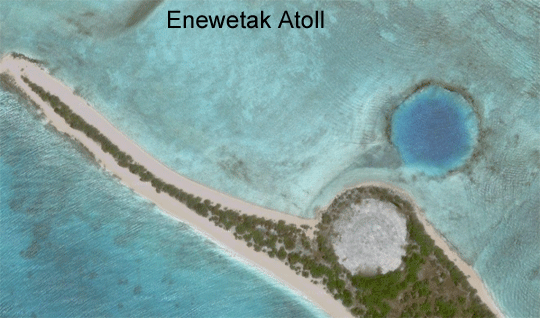
Gabbard Seeks Report On Pacific Nuclear Waste Dome, Runit Dome in the Marshall Islands is reportedly leaking nuclear waste. https://www.civilbeat.org/beat/gabbard-seeks-report-on-pacific-nuclear-waste-dome/ By Anita Hofschneider 16 June 19, U.S. Rep. Tulsi Gabbard from Hawaii wants the federal government to provide more information on a dome holding radioactive nuclear waste leftover from U.S. nuclear testing in the Marshall Islands.Gabbard proposed an amendment that has been added to the 2020 National Defense Authorization Act, according to a press release from her office.
It would “require the Department of Energy, the Environmental Protection Agency, and the Department of Defense to provide an unclassified public report on the current state of the Runit Dome nuclear waste facility,” the press release said.
The dome was created to hold 111,000 cubic yards of nuclear waste and was supposed to be a temporary structure, the Guardian reported in 2015. Leaders of the Republic of the Marshall Islands have expressed concerns about leaks.
If Gabbard’s amendment becomes law, the report would describe the condition of the dome and its potential environmental and public health impacts.
“The U.S. government is responsible for this storage site and must ensure the protection of the people and our environment from the toxic waste stored there,” Gabbard said in the press release.
|
|
June 17, 2019
Posted by Christina Macpherson |
environment, OCEANIA, USA, wastes |
Leave a comment
Nevada Gov. Steve Sisolak restates opposition to Yucca Mountain restart plan https://www.nevadaappeal.com/news/government/nevada-gov-steve-sisolak-restates-opposition-to-yucca-mountain-restart-plan/# June 12, 2019 Geoff Dornan gdornan@nevadaappeal.com In a sharply worded letter to the chairman and ranking member of the House Energy and Commerce Committee, Gov. Steve Sisolak has again stated his and Nevada’s complete opposition to any plans to restart the licensing of Yucca Mountain.
“My position and that of the state of Nevada remains identical to the position of Nevada’s past five governments,” the letter says. “I am totally opposed to any legislative effort to restart the Yucca Mountain project.”
He said this latest piece of legislation, “would seriously weaken Nevada’s current due process rights to challenge documented safety concerns and adverse environmental impacts in the legally-mandated licensing proceeding.”
The result, he said, will be to waste billions of additional ratepayer and taxpayer dollars in an attempt to, “force an unsafe site on an unwilling state.”
“The proposed legislation only exacerbates the erosion of trust and confidence caused by the federal government’s recent secret shipments of weapons-grade plutonium into our state,” Sisolak wrote.
He said he intends to keep his promise to Nevadans not one ounce of nuclear waste will be delivered to Yucca Mountain while he’s governor.
The letter was sent to committee Chairman Frank Pallone, D-New Jersey, and Ranking member Greg Walden, R-
In written testimony prepared for that hearing, Bob Halstead, director of Nevada’s Agency for Nuclear Projects, reiterated Nevada’s long standing conclusion Yucca Mountain is unsuitable because of its geology and hydrology, its proximity to military aircraft training and testing (Nellis Air Force Base) and its distance from existing railroads.
“The proposed repository emplacement drifts would be located in fractured rock above the water table and would inevitably leak dangerous radionuclides into the groundwater where they would be transported to an aquifer,” Halstead wrote.
He said that aquifer provides water for drinking, agriculture, food processing and Native American religious ceremonies.
Halstead also charged the proposed legislation, “fails to honestly address the cost of Yucca Mountain.” He said Nevada’s estimate for future costs of the dump are “at least $100 billion in 2019 dollars.”
|
|
|
June 17, 2019
Posted by Christina Macpherson |
politics, USA, wastes |
Leave a comment