The US demanded the closure of five atomic facilities during the Hanoi summit, but Kim offered only two
 Trump clarifies nuclear gulf between US, North Korea The US demanded the closure of five atomic facilities during the Hanoi summit, but Kim offered only two, Asia Times, By ANDREW SALMON 22 May 19, President Donald Trump, speaking to US broadcaster Fox News on Sunday evening, said Washington had sought, during a February summit with North Korean leader Kim Jong Un, to shutter five nuclear sites, but Pyongyang was only willing to close two. Trump clarifies nuclear gulf between US, North Korea The US demanded the closure of five atomic facilities during the Hanoi summit, but Kim offered only two, Asia Times, By ANDREW SALMON 22 May 19, President Donald Trump, speaking to US broadcaster Fox News on Sunday evening, said Washington had sought, during a February summit with North Korean leader Kim Jong Un, to shutter five nuclear sites, but Pyongyang was only willing to close two. |
Trump and Kim “in love”, but have few options now that discussions have collapsed
|
Trump and Kim’s Cozy Relationship Makes Nuclear Talks Tougher The leaders, who “fell in love” during their first summit, have few options now that discussions have collapsed. Bloomberg, By Youkyung Lee, 20 May19,Donald Trump and Kim Jong Un often explain their surprisingly warm relationship in the language of romance. They “ fell in love” during the first-ever summit between a U.S. president and a North Korean leader in Singapore last year, Trump said. A top North Korean diplomat similarly describes the chemistry between the two leaders as “mysteriously wonderful.”
Since the breakup of the most recent round of talks in Hanoi in February, however, Kim has registered his displeasure not as a lover scorned, but as a dictator at the helm of an increasingly advanced nuclear arsenal. Over one week in May, he personally oversaw the trials of at least two short-range ballistic missiles capable of striking all of South Korea, where some 28,500 U.S. troops are based. The back-to-back launches broke an almost 17-month pause in major weapons testing and likely violated United Nations resolutions banning North Korea from firing ballistic missiles—but crucially, it didn’t violate Kim’s pledge to Trump to halt testing of long-range missiles that could strike the continental U.S. The act was both aggressive and subtle, showing the U.S. that North Korea was willing to play ball but refused to be played. In securing the unprecedented meeting with Trump and entering direct negotiations with the U.S. president, Kim left himself few options if the conversations were to go poorly. The U.S. has been in a similar position since Trump tweeted just after the Singapore meeting that North Korea was “no longer a nuclear threat.” Both leaders must now walk a delicate line to save face and avoid what neither of them wants: nuclear war. Kim’s primary goal going into the Hanoi summit was considerably more mundane. He was seeking to make North Korea a normal country in the eyes of the world and to remove sanctions that are crushing the economy and stoking popular unrest. According to the UN, its 2018 harvest was the worst in a decade, leaving 40 percent of the population in need of food assistance. …….. Current South Korean President Moon Jae-in is caught between the two leaders. Seoul is within the range of both missiles fired in early May, and Moon doesn’t want to disrupt his own fragile relationship with Kim by appearing to side with Trump. In his speech, Kim urged Moon to stop being an “officious mediator,” using a Korean slang term—ojirap—that’s rarely used by public figures in official settings and almost never by a younger person referring to an elder. The South Korean government “must defend the interest of the nation,” Kim said. Moon helped broker the first summit between Trump and Kim, in a pair of dramatic meetings with the North Korean leader on the Koreas’ militarized border, and is now pushing for a third by appealing to common human decency. …… The second missile test, on May 9, occurred while Trump’s top nuclear envoy, Stephen Biegun, was in Seoul to meet with South Korean officials. There’s been no indication that the U.S. is willing to accept what many North Korea watchers agree is Kim’s true goal: admission into the exclusive club of accepted nuclear-armed states. ………. The more time passes, the more sophisticated Kim’s arsenal becomes, shrinking Trump’s margin of error in responding to threats and increasing the danger of miscalculation. There’s also the risk that Trump and Kim learn they’re not as close as they thought they were. …. https://www.bloomberg.com/news/articles/2019-05-20/trump-and-kim-got-too-serious-too-fast-in-nuclear-discussions |
|
Illness and death legacy of employment in America’s nuclear weapons business
As US modernizes its nuclear weapons, NCR looks at the legacy of one Cold War-era plant, National Catholic Reporter, May 20, 2019 by Claire Schaeffer-Duffy
“Dark money” bankrolling advertising campaign to keep Ohio nuclear plants open
Who’s behind the campaign and just what will HB6 do? Learn more in this conversation with Dayton Daily News reporter Laura Bischoff.
Bischoff said House Bill 6 is a controversial energy bill that would cost consumers about $300 million a year in surcharges. “The money would go into a new fund that probably half, or a little more than that, would likely go to save two aging nuclear power plants that are slated to close: Davis Besse and Perry,” Bishcoff said.
Both plants are owned by FirstEnergy Solutions, which used to be part of Akron-based FirstEnergy. FirstEnergy Solutions is in bankruptcy proceedings and has said it will have to shut down the nuclear plants because of its financial situation. …..
Bischoff has dug into who’s bankrolling the ad campaign to convince the general public that legilsation to help keep the nuclear plants open is a good idea.
“There is this group called Generation Now,” Bischoff said. “It is a dark money group. They are bankrolling most of ads, a little over $2 million worth of ads have been placed so far.” Bischoff notes there are groups funding ads against the bill as well. “Americans for Prosperity, Ohioans against nuclear bailouts and some consumer group have spent about $300,000. It’s all over the airwaves. People are hearing it, seeing it, wondering what’s going on with it.”
…….. Bischoff also tabulated that FirstEnergy and its PAC (political action committee), since 2014, have contributed $1.35 million to Ohio political candidates and FirstEnergy has donated another $1.5 million to political parties.
Bischoff explained that House Bill 6 would remove renewable energy efficiency standards and programs that have been part of state law for the past 10 years………
Bischoff estimated 120 different witnesses have testified about this proposed legislation, including a gentleman from Vermont, whom she later tracked down.
“I wonder why would some guy from Vermont travel all the way to Ohio to give testimony,” Bischoff said. The man shared the story of a nuclear plant closing in the small town where he lives and talked about the devastation the closing caused. Bischoff found out it is the second time he has testified for a nuclear bailout bill in Ohio. Pressing the man further, she discovered that his travel expenses were covered by the Nuclear Energy Institute, of which FirstEnergy is a dues-paying member.
Bischoff said Speaker Householder had hoped to bring House Bill 6 up for a vote the week of May 20th, but at this point he has indicated they are still working on it. https://www.wksu.org/post/ads-flood-airwaves-debate-continues-over-nuclear-bailout-bill#stream/0
Ionising radiation as a cause of Chronic Fatigue Syndrome
Radiation Model for Chronic Fatigue Syndrome Announced by the National CFIDS Foundation, https://finance.yahoo.com/news/radiation-model-chronic-fatigue-syndrome-announced-national-cfids-195900691.html NEEDHAM, Mass., May 20, 2019 /PRNewswire/ –The National CFIDS Foundation, of Needham, Massachusetts, has provided details regarding its radiation model for Chronic Fatigue Syndrome, a disease that affects millions in the United States. According to Alan Cocchetto, Medical Director for the National CFIDS Foundation, “Our latest model has now identified two key compounds, known as hydroperoxides, that appear to result from cellular injury due to radiation exposure. We believe this finding is of critical importance to the disease process that is present in our patients.”
According to Gail Kansky, National CFIDS Foundation President, “As I understand it, these compounds make for the perfect storm from a disease standpoint since they adversely affect the ability of the body to function properly at many levels. We believe this to be a major tipping point in our understanding of this disease and I truly expect this to have a significant impact on our patients with regards to diagnostic testing and future therapies that will result from these efforts. As such, we are very pleased to be moving full steam ahead on this with our research groups.”
Two decades ago, Chernobyl scientists had identified Chronic Fatigue Syndrome as a characteristic aftermath of radioecological catastrophe establishing the first link between radiation exposure and the development of the disease. In 2010, the National CFIDS Foundation became the first organization to report the presence of internal radiation and chromosome damage in its own patient cohort.
According to the National CFIDS Foundation, Chronic Fatigue Syndrome (CFS) is also known as Chronic Fatigue Immune Dysfunction Syndrome (CFIDS) as well as Myalgic Encephalomyelitis (ME). Founded in 1997, the goals of the National CFIDS Foundation are to help fund medical research to find a cause and to expedite appropriate treatments for the disease. Since its inception, the National CFIDS Foundation has provided $4 million dollars in self-directed research grants to global scientists. The National CFIDS Foundation, an all volunteer 501(c)(3) federally approved charity, is funded solely by individual contributions. Additional information can be found on the web at www.ncf-net.org or in The National Forum newsletter. The Foundation can be reached at 781-449-3535.
Eight in Ten Support Nuclear Arms Control with Russia, Disagree with Trump Decision to Withdraw from Intermediate-Range Nuclear Forces Treaty
|
A new in-depth survey on U.S. nuclear weapons policy finds that 68% of voters (Republicans 59%, Democrats 74%), support Congressional legislation prohibiting the President from using nuclear weapons first without Congressional approval and a declaration of war. An overwhelming 8 in 10, of Republicans as well as Democrats, do not support a policy shift in the Trump administration’s Nuclear Posture Review that explicitly declares the U.S. would consider using nuclear weapons first and specifies examples of non-nuclear attacks that would prompt such consideration. The study was conducted by the Program for Public Consultation (PPC) and the Center for International and Security Studies (CISSM) at Maryland, with consultation by the Center for Public Integrity. Support for nuclear arms control remains very robust across party lines. More than 8 in 10 (83%, Republicans 84%, Democrats 83%), favor the US continuing to have arms control treaties with Russia. Eight in ten (82%, Republicans 77%, Democrats 89%) favor the United States agreeing to extend the New START Treaty. “A large bipartisan majority opposes ideas for making nuclear threats a more usable instrument of policy and favors continuing efforts to constrain and reduce nuclear weapons through arms control treaties,” comments Steven Kull, director of PPC. ………. The public is not convinced that having intercontinental ballistic missiles (ICBMs) is necessary. Six in ten, including a majority of Republicans, favor phasing out the 400 US land-based ICBMs that are aging and are vulnerable to a first strike. However, only one-third favor unilaterally reducing the net number of strategic warheads in the U.S. arsenal to 1050 rather than adding warheads to U.S. submarines and bombers if the Russians still have 1550 warheads (the number allowed under New START). Overwhelming bipartisan majorities agree that the US must have a nuclear arsenal destructive enough that no country could think that there would be any advantage in attacking the United States with nuclear weapons. A plurality (49%) also agree that this minimum requirement is sufficient, and that the US does not need a nuclear arsenal which could also respond in-kind to any nuclear attack. However, when asked about a proposal in line with that requirement, in which the US would put low-yield nuclear weapons on submarines so that it can retaliate against a Russian attack using a similar weapon, two thirds were in favor. Contact: Steven Kull (PPC) 301-254-7500, skull@umd.edu |
|

Donald Trump says he would not allow Iran to develop nuclear weapons
 Trump warns Iran it will never be allowed to build nuclear arsenal, US president insists he wants to avoid Tehran conflict after weeks of escalating tensions, Ft.com 20 May 19 Trump warns Iran it will never be allowed to build nuclear arsenal, US president insists he wants to avoid Tehran conflict after weeks of escalating tensions, Ft.com 20 May 19
Donald Trump said he would not allow Iran to develop nuclear weapons, while insisting he wanted to avoid war with the Islamic republic after weeks of escalating tensions. The US president has kept Tehran on edge by mixing threats with statements playing down the odds of a conflict, as foreign policy analysts speculate that Mr Trump is less keen on military conflict than some of his hawkish advisers. “I don’t want to fight. But you do have situations like Iran, you can’t let them have nuclear weapons — you just can’t let that happen,” Mr Trump said in an interview with Fox News. He had earlier warned Tehran to stop threatening America, and suggested that the US would destroy Iran if there was a military conflict. “If Iran wants to fight, that will be the official end of Iran. Never threaten the United States again!” he tweeted.
Tensions have risen sharply in recent few weeks, with Iran saying it will no longer comply with elements of the 2015 nuclear accord it signed with world powers, including the US, and Washington deploying an aircraft carrier strike group to the region. …….
Mr Trump’s key foreign policy advisers, national security adviser John Bolton and secretary of state Mike Pompeo, have referred to unspecified “escalatory action” from Tehran, fuelling speculation that the hawkish pair are trying to convince the president to go to war with Iran.
This has led some lawmakers to grow concerned that the administration is seeking to enter into a conflict without congressional approval. Several senators were last week given details of the administration’s intelligence on Iran, with more lawmaker briefings expected this week. …… https://www.ft.com/content/0192edae-7b0a-11e9-81d2-f785092ab560
|
|
|
Former Nuclear Regulatory Commission chairman now sees nuclear power as harmful
 Washington Post 17th May 2019 , Gregory Jaczko served on the Nuclear Regulatory Commission from 2005 to 2009, and as its chairman from 2009 to 2012. Nuclear power was supposed to save the planet. The plants that used this technology could produce enormous amounts of electricity without the pollution caused by burning coal, oil or natural gas, which would help slow the catastrophic changes humans have forced on the Earth’s climate.
influence of the industry on the political process. Now I was serving on the Nuclear Regulatory Commission, where I saw that nuclear power was more complicated than I knew; it was a powerful business as well as an impressive feat of science. In 2009, President Barack Obama named me the agency’s chairman.
Iowa Science Group Launches Effort to Push Presidential Candidates on Nuclear Issues
 Iowa Residents Overwhelmingly Want Presidential Candidates to Share Views on Nuclear Weapons https://www.ucsusa.org/press/2019/iowa-residents-overwhelmingly-want-presidential-candidates-share-views-nuclear-weapons-0 May 20, 2019 Iowa Residents Overwhelmingly Want Presidential Candidates to Share Views on Nuclear Weapons https://www.ucsusa.org/press/2019/iowa-residents-overwhelmingly-want-presidential-candidates-share-views-nuclear-weapons-0 May 20, 2019Science Group Launches Effort to Push Candidates on Nuclear Issues
A recent Zogby Analytics poll found that 82 percent of Iowa residents want presidential candidates, who are already passing through the Hawkeye State, to lay out their positions on nuclear weapons. “Nuclear war seems like something we no longer should have to worry about,” said David Wright, a physicist and co-director of the Global Security Program at the Union of Concerned Scientists. “But the prospect of a nuclear war is higher now than it has been in decades. The United States and Russia are abandoning arms control treaties and developing new nuclear weapons considered more usable in a conflict.” Aware of the increased risk, mayors around the country, including Des Moines Mayor Frank Cownie, U.S. Vice-President of Mayors for Peace, are joining forces to call on Congress and the president to take steps to reduce the risks of a nuclear exchange. “We’re putting future generations at risk by even considering the use of nuclear weapons,” said Mayor Cownie. “We must urge our elected officials in Washington to understand that nuclear warfare is not an option.” The Zogby poll shows that public attention is increasingly focused on these issues, finding:
|
|
|
US Congress ‘s continued search for nuclear trash dump – but they still let ’em keep making it!
 Congress continues search for nuclear waste dump, https://www.graydc.com/content/news/Congress-continues-search-for-nuclear-waste-dump-510161521.html By Kyle Midura | WASHINGTON (Gray DC) 20 May 19, – More than 70,000 tons of nuclear waste has no place to go. Congress agreed to take care of it decades ago, but lawmakers can’t agree on where to send it. Waste from 42 years of operation at Yankee Nuclear in Vermont remains on-site years after the shuttered plant stopped generating power. For now, it’s being held in large, thick cannisters known as dry casks.Rep. Peter Welch (D-VT) said that’s a direct result of Congress failing to fulfill its promise to create a national dump for used fuel. “Every place where we have a nuclear plant including Vermont has in effect become a long-term storage plant,” he said, “that’s not viable.” Congress continues search for nuclear waste dump, https://www.graydc.com/content/news/Congress-continues-search-for-nuclear-waste-dump-510161521.html By Kyle Midura | WASHINGTON (Gray DC) 20 May 19, – More than 70,000 tons of nuclear waste has no place to go. Congress agreed to take care of it decades ago, but lawmakers can’t agree on where to send it. Waste from 42 years of operation at Yankee Nuclear in Vermont remains on-site years after the shuttered plant stopped generating power. For now, it’s being held in large, thick cannisters known as dry casks.Rep. Peter Welch (D-VT) said that’s a direct result of Congress failing to fulfill its promise to create a national dump for used fuel. “Every place where we have a nuclear plant including Vermont has in effect become a long-term storage plant,” he said, “that’s not viable.”
The government developed Nevada’s Yucca Mountain to be the repository for the country’s spent fuel, planning to bury it deep underground and within thick barriers designed to be impenetrable. President Donald Trump is trying to revive that plan. Welch would like to see Yucca Mountain used as a permanent site – though he said political opposition in the state may make that impossible — and is working on a bill to move forward with a temporary site in Texas. “Bottom line: after spending 15 billion dollars on Yucca, I think that is a bad place to be permanently storing the nuclear waste in this country,” said Sen. Bernie Sanders (I-VT). Sanders said he’s concerned by the potential for earthquakes at the site given geological fault lines in the area. He opposes further expansion of nuclear – especially while the search for a permanent repository continues. Like many of his fellow Senators seeking the democratic nomination – Sanders signed onto a bill allowing a state like Nevada to say ‘no’ to storing nuclear waste in its backyard. “We need to find a permanent solution which is not going to be Yucca,” Sanders said. “The science says it’s safe, but we’ve got to make sure it’s correct and let Nevada have its day in court,” said Baker Elmore, Senior Director of Federal Programs for the Nuclear Energy Institute. He argues the best path forward is to create temporary storage sites, and finalize plans for a permanent repository as soon as possible. After decades of waiting, Elmore says the country appears to be getting closer to signing-off on a plan. “I’m excited because we’re finally getting around to having a meaningful conversation on this issue,” he said. |
|
“Denuclearization” has different meanings for North Korea and USA
|
North Korean missiles: Size does not matter, Bulletin of the Atomic Scientists, By Duyeon Kim, Melissa Hanham, May 15, 2019 When it comes to dealing with North Korea’s nuclear program, one fundamental challenge (among many) has been a gap in the definitions of very basic terms in the security lexicon. This inability to agree on the basics has complicated negotiations and communications for more than 25 years. While the vague use of the term “denuclearization” has allowed a kind of rapprochement between the United States and North Korea, denuclearization will never actually happen until the parties agree on what it means and how to achieve it.
“Denuclearization” is not the only term in contention, and diplomacy is not the only field in which semantics count. North Korea is playing another hand in this age-old word game: Missiles are being tested, but Pyongyang prefers to call them “rockets.” In North Korea, a rocket can be anything from artillery rounds to a space launch vehicle. Pyongyang fired a short-range ballistic missile, artillery, and multiple-launch rocket systems on May 4 and another barrage on May 9, revealing what the new “tactical guided weapon” they also tested on April 18 and likely November 2018 really is. The regime claims that the firing of these “rockets” is routine and defensive in nature. The activities near Wonson are indeed likely to resemble how North Korea would attempt to repel an invasion from the East. Unfortunately, this exercise included what may be a short-range missile capable of carrying a nuclear warhead. Washington does not appear to be overreacting to these latest tests, which it should not, and has chosen to focus on the short-range nature of the missile involved. But the Trump administration must not turn a blind eye either. Responses and punishments—proportionate to the significance and gravity of Pyongyang’s actions—can be taken without botching the diplomatic process. The lack of an international response only emboldens the regime to sharpen its gray-zone tactics to push the envelope and gain influence without having to explode nuclear devices or fire long-range missiles. These smaller, solid-fuel missiles matter because—tipped with nuclear warheads or chemical or biological weapons—they threaten South Korea as well as US troops and American citizens in the South. Indeed these may be the first weapons used in a large scale conflict that could pull allies in. They cannot be regarded simply as part of a sovereign country’s right to develop arms. The larger intercontinental ballistic missiles (ICBMs) are not the only enemy. Smaller missiles are just as significant. Size does not matter—it’s what you can do with a missile that counts. What’s in a name? For the first time, Washington, Pyongyang, and Seoul are reading from the same script and agree on one thing: these missiles ought not to be called “missiles.” Instead, they are being named “projectiles” and “rockets.” The common thread is to prevent the already fragile diplomatic process from unraveling…… https://thebulletin.org/2019/05/north-korean-missiles-size-does-not-matter/?utm_source=Bulletin%20Newsletter&utm_medium=iContact%20email&utm_campaign=NKmissiles_05152019 |
|
Proposed nuclear bailout for Ohio
 Statehouse full steam ahead on nuclear plants’ bailout Columbus Dispatch, 20 May 19, Say this much for the proposed bailout by Ohioans of FirstEnergy Solutions’ two Ohio nuclear power plants: The debate shows who really has power at the Statehouse. Statehouse full steam ahead on nuclear plants’ bailout Columbus Dispatch, 20 May 19, Say this much for the proposed bailout by Ohioans of FirstEnergy Solutions’ two Ohio nuclear power plants: The debate shows who really has power at the Statehouse.
Shameless as plant-closing General Motors’ CEO Mary T. Barra is (amid layoffs, her total 2018 compensation was $21.7 million) can anyone imagine Barra asking the Republicans who run Ohio’s General Assembly to boost the sticker price of every car sold in Ohio to save GM’s Lordstown plant? That’s not far from what House Bill 6, the proposed nuclear bailout, would do to the checkbook of an Ohioan who pays an electric bill, whether to DP&L, FirstEnergy, AEP or Duke. The Perry and Davis-Besse nuclear plants, built by what’s now FirstEnergy, can’t produce power as cheaply as ever-more-plentiful natural gas. Without customer subsidies, Perry and Davis-Besse will shut down. Something like St. Paul on the road to Damascus, Ohio’s GOP-run House has suddenly become a convert to clean air. And, in fairness, HB 6 would to an extent promote clean (maybe cleaner) Ohio air. Here’s what the federal Energy Information Administration says: “Unlike fossil fuel-fired power plants, nuclear reactors do not produce air pollution or carbon dioxide while operating.” The federal agency also says this: “However, the processes for mining and refining uranium ore and making reactor fuel all require large amounts of energy.” This, too, though: Nuclear plants produce radioactive waste — something seemingly unmentioned in Ohio House “debate” on HB 6. (Also unmentioned: If the Ohio General Assembly extends the generating lives of Perry and Davis-Besse, that’d create a couple of money-earning assets for creditors owed money thanks to the bankruptcy of FirstEnergy Solutions, a soon-to-be-independent FirstEnergy tentacle.) “Debate” is in quotes because of last week’s attempt by Rep. Nino Vitale, an Urbana Republican who chairs the House committee hearing HB 6, to “save time” by stifling Democrats’ questions. …… On the downside, for HB 6 supporters: The Republican-run Pennsylvania General Assembly appears to have backed off a plan to subsidize the Three Mile Island nuclear plant’s Unit 1, owned by Exelon Corp. (In 1979′s TMI accident, Unit 2, then owned by General Public Utilities, partially melted down and has been shuttered ever since. GPU later merged with FirstEnergy Corp.) ………. At the Statehouse, the actors change. The script doesn’t. Reaching back to the Ohio Gang of Statehouse lobbyists who swarmed around future Republican President Warren G. Harding 100 years ago, utilities, banks and insurance companies more often win than lose General Assembly battles. That’s why, HB 6′s merits aside, every Ohio electricity customer may want to keep his or her checkbook handy.Thomas Suddes is a former legislative reporter with The Plain Dealer in Cleveland and writes from Ohio University.tsuddes@gmail.com https://www.dispatch.com/opinion/20190520/column-statehouse-full-steam-ahead-on-nuclear-plants-bailout |
|
$Billions spent on attempt to clean up USA’s most dangerously toxic nuclear sites, but it’s no getting very far
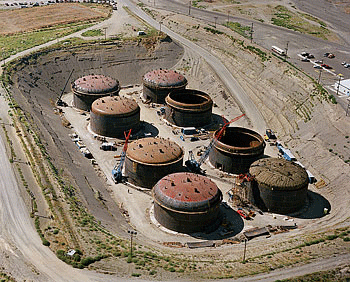
Soaring costs but limited progress in cleanup of “scariest” nuclear sites https://www.salon.com/2019/05/18/soaring-costs-but-limited-progress-in-cleanup-of-scariest-nuclear-sites_partner/
The progress to clean up nuclear waste sites appears to be slowing down though still devouring billions of dollars, PHIL ZAHODIAKIN, MAY 18, 2019 THE PROGRESS OF A DEPARTMENT OF ENERGY PROGRAM TO CLEAN UP THE NATION’S MOST DANGEROUS NUCLEAR WASTE SITES APPEARS TO BE SLOWING DOWN EVEN THOUGH IT’S STILL DEVOURING BILLIONS OF DOLLARS.
That discouraging picture emerges in the latest report by the federal Government Accountability Office on the long-running cleanup effort. Launched in 1989, it was designed to clean up 107 sites engaged in research or production of enriched uranium or plutonium for making nuclear weapons.
Cleanup work at 91 of the Cold War-era sites is finished. But the remaining 16 pose the greatest health risks — especially those with underground storage tanks leaking highly radioactive waste.
Testifying last week before the House Subcommittee on Oversight and Investigations, a GAO official said that for reasons that are unclear, estimated cleanup costs at the 16 ”biggest and scariest sites” have increased by $214 billion despite the Department of Energy (DOE) spending $48 billion since 2011.
David C. Trimble, the GAO’s director for natural resources and the environment, said the soaring costs ”are getting worse as the growth in cleanup liabilities vastly outpaces [the DOE’s] ability to reduce them.”
DOE officials are trying to pin down the reasons for delays and cost overruns, Trimble said, “but they haven’t finished their ‘root cause’ analysis.”
Rep. Jan Schakowsky (D-Ill.) asked Trimble and Ann Marie White, director of the DOE’s Office of Environmental Management how they would “explain to the taxpayers this astonishing cost increase when the number of cleanup sites hasn’t changed.” White replied that the 56 million gallons of radioactive liquids and sludge in the underground tanks at the immense Hanford Nuclear Reservation in southeastern Washington are driving “much of the increase.”
But the GAO has cited other problems, too, including DOE providing Congress with inconsistent and misleading information. For example, Trimble said, legislation passed in 2011 required DOE to annually report on its funding needs, but the reports have been submitted in only two of the years since.
“So, what are [the taxpayers] buying for all this money?” Rep. Joseph P. Kennedy (D-Mass.) asked, observing that the latest estimate to complete the work at all 16 sites has reached $377 billion.
Rep. Ann M. Kuster (D-N.H.) pointed out that, besides costs, the risk of accidents or sabotage at the 16 sites only increases with time. And Trimble drew an analogy to a type of mortgage popular during the housing bubble of the early 2000s.
By spending billions to contain radioactive soil, water, and nuclear materials at their sites of origin without a path to completing cleanups, “There’s a danger that, at some point, the dynamic starts to look like an interest-only loan that doesn’t require you to pay down the principal amount of the loan,” Trimble said.
Trimble said he was encouraged by DOE’s willingness to accept management improvements recommended by GAO
But Ed Lyman, acting director of the nuclear safety project for the Union of Concerned Scientists, told Fair Warning that “GAO issues one report after another about DOE’s mismanagement of the nuclear cleanup program but the reports don’t seem to move the ball.”
Pointing out that the experiments to condense and vitrify (or turn into glass) the liquid wastes at Hanford and Savannah River, S.C., “have not been going well,” Lyman added that the long disposal delays leave the safety of the sites in a nether world of “borrowed time.”
Besides Hanford, where cleanup activities are expected to continue at least until 2070, and the Savannah River Nuclear Reservation, which will keep producing radioactive tritium during its cleanup, some of the other, major sites among the 16 left to clean up include the World War 2-era facility in Oak Ridge, Tenn.; and the gaseous diffusion plants in Piketon, Ohio and Paducah, Ky.: formerly principal source of enriched uranium.
Ohio’s Nuclear Plant Subsidy Proposal, Should Be Rejected – 5 Reasons Why

 5 Reason’s Why HB 6, Ohio’s Nuclear Plant Subsidy Proposal, Should Be
  Rejected, Uniion of Concerned Scientists, STEVE CLEMMER, DIRECTOR OF ENERGY RESEARCH, CLEAN ENERGY | MAY 16, 2019 Last November, UCS released Nuclear Power Dilemma, which found that more than one-third of existing nuclear plants, representing 22 percent of total US nuclear capacity, are uneconomic or slated to close over the next decade. This included the Davis-Besse and Perry plants in Ohio that are owned by Akron-based FirstEnergy Solutions. Replacing these plants with natural gas would cause emissions to rise at a time when we need to achieve deep cuts in emissions to limit the worst impacts of climate change.
When we released our report, my colleague Jeff Deyette described how a proposal backed by FirstEnergy to subsidize its unprofitable nuclear plants in Ohio was deeply flawed and did not meet the conditions recommended in our report. By providing a blatant handout to the nuclear and fossil fuel industries at the expense of renewable energy and energy efficiency, ironically, the latest proposal to create a “Clean Air Program” in Ohio (House Bill 6) is bad for consumers, the economy and the environment.
Here are five reasons why this proposal is flawed and should be rejected:
1. HB 6 doesn’t protect consumers
…………..HB 6 doesn’t require FirstEnergy Solutions to demonstrate need or limit the amount and duration of the subsidies to protect consumers and avoid windfall profits as recommended in our report. It simply sets the starting price at $9.25/MWh and increases that value annually for inflation. ……… FirstEnergy Solutions nuclear plants would receive approximately $170 million per year in subsidies, or 55% of the total…..
2. HB 6 is a bait and switch tactic to gut Ohio’s clean energy laws
But here’s the rub. HB 6 would effectively gut the state’s renewable energy and energy efficiency standards to pay for the subsidies for Ohio’s existing nuclear, coal and natural gas plants. It would make the standards voluntary by exempting customers from the charges collected from these affordable and successful programs unless they chose to opt-in to the standards. This could result in a net increase in emissions and a net loss of jobs in Ohio over time.
This political hit job is outrageous, but not at all surprising. It is just another attempt in a long series of efforts by clean energy opponents to rollback Ohio’s renewable and efficiency standards over the past five years …….
the cost of wind and solar has fallen by more than 70 percent over the past decade, making them more affordable for consumers and competitive with natural gas power plants in many parts of the country. ……
Energy efficiency programs are especially important for low-income households. By lowering their energy bills, they have more money to spend on food, health care and other necessities.
3. HB6 creates a false sense of competition
While renewable energy technologies are technically eligible to compete for funding under HB 6, several criteria would effectively exclude them:
- It excludes any projects that have received tax incentives like the federal production tax credit or investment tax credit, which applies to nearly every renewable energy project.
- Eligible facilities must be larger than 50 MW, which excludes most solar projects, and wind projects have to be between 5 MW and 50 MW, which is smaller than most existing utility scale wind projects in the state.
- Eligible projects must receive compensation through organized wholesale energy markets, which excludes smaller customer-owned projects like rooftop solar photovoltaic systems.
When combined with the rollback to the renewable standard, this absurdly stringent criteria would create too much uncertainty for renewable developers to obtain financing to build new projects in Ohio.
4. HB 6 will increase Ohio’s reliance on natural gas
While HB 6 could temporarily prevent the replacement of Ohio’s nuclear plants with natural gas, gutting the renewables and efficiency standards would undermine the state’s pathway to achieving a truly low-carbon future by locking in more gas generation as coal plants retire. …….
5. HB 6 includes no safety criteria or transition plans
HB 6 does not require FirstEnergy’s nuclear plants to meet strong safety standards as a condition for receiving subsidies, as recommended in our report. While Davis-Besse and Perry are currently meeting the Nuclear Regulatory Commission’s (NRC) safety standards–as measured by their reactor oversight process (ROP) action matrix quarterly rating system–both plants have had problems with critical back-up systems during the past two years that put them out of compliance.
The nuclear industry has been trying to weaken the ROP for years………
A better approach
On May 2, House Democrats announced an alternative “Clean Energy Jobs Plan” that would address many of the problems with HB 6. The plan would modify the state’s Alternative Energy Standard (AES) by increasing the contribution from renewable energy from 12.5% by 2027 to 50% by 2050and fix the onerous set-back requirements that have been a major impediment to large scale wind development. It would expand the AES to maintain a 15% baseline for nuclear power. In addition, it would improve the state’s energy efficiency standards, expand weatherization programs for low-income households, and create new clean energy job training programs…….
With more than 112,000 clean energy jobs in 2018, Ohio ranks third in the Midwest and eighth in the country. Ohio added nearly 5,000 new clean energy jobs in 2018. While most of the clean energy jobs are in the energy efficiency industry, Ohio is also a leading manufacturer of components for the wind and solar industries.
To capitalize on these rapidly growing global industries, lawmakers in Ohio should reject HB 6 and move forward with a real clean air program that ramps-up investments in renewables and efficiency and achieves the deep cuts in emissions that are needed to limit the worst impacts of climate change. https://blog.ucsusa.org/steve-clemmer/5-reasons-why-hb6-should-be-rejected
U.S Air Force is not Testing an ‘Earth-Penetrating’ Nuclear Bomb
|
Is the Air Force Really Testing an ‘Earth-Penetrating’ Nuclear Bomb? Nope. And here is why. National Interest
|
|
1 This Month

22 June – Virtual Event –Climate Change: New Data, New Debate

Monday, June 22, 2026 2:30 p.m. – 3:15 p.m. CT
YouTube. Register here

Protect Sazan Island from the Trump family! https://secure.avaaz.org/campaign/en/protect_sazan_island_from_the_trump_family_loc/?bqFCVab&v=174511&cl=22707147157&_checksum=5e9dde668860e8231c33699735e16a1fbf22ab2cb01da50c999fe8732b9775ef&utm_source=email&utm_medium=blast_email&utm_campaign=174511
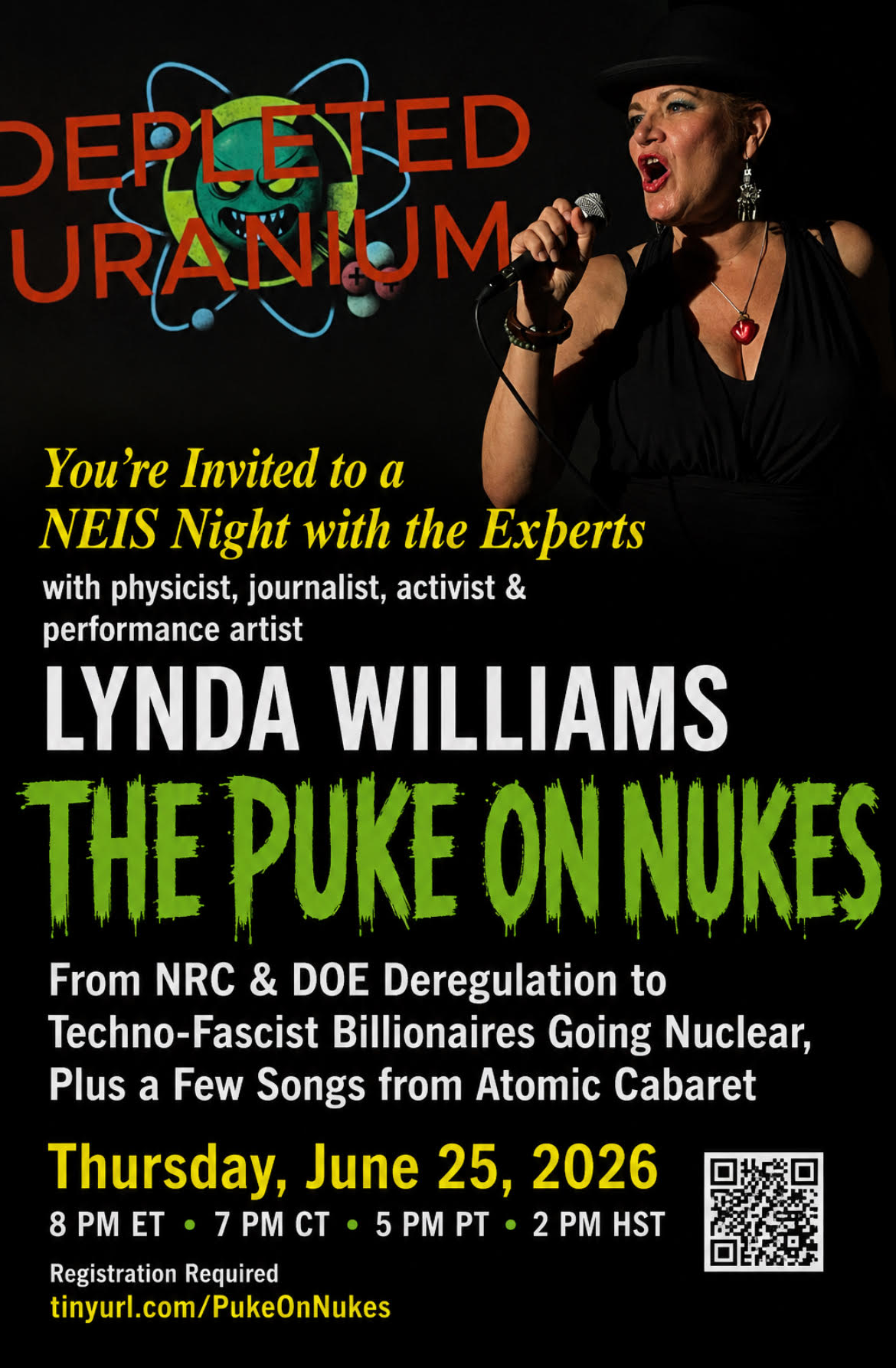
25 June- THE PUKE ON NUKES
Thursday, June 25, 2026
7pm Central Time (8pm ET, 6pm MT, 5pm PT) UTC – 5
From NRC & DOE Deregulation to Techno-Fascist Billionaires Going Nuclear, Plus a Few Songs from Atomic Cabaret REGISTER
26 June – Radiation Trainwreck at the NRC / Join the Protect Better Campaign – https://us02web.zoom.us/meeting/register/4ZlZ5_qLSHGiLSCg8FF6Bg#/registration


Cuba Is Not a Failed State – It Is a Besieged State
PETITION: “Global Appeal to Endorse Palestinian Right of Return of Refugees”
To see nuclear-related stories in greater depth and intensity – go to https://nuclearinformation.wordpress.com
-
Archives
- June 2026 (211)
- May 2026 (306)
- April 2026 (356)
- March 2026 (251)
- February 2026 (268)
- January 2026 (308)
- December 2025 (358)
- November 2025 (359)
- October 2025 (376)
- September 2025 (257)
- August 2025 (319)
- July 2025 (230)
-
Categories
- 1
- 1 NUCLEAR ISSUES
- business and costs
- climate change
- culture and arts
- ENERGY
- environment
- health
- history
- indigenous issues
- Legal
- marketing of nuclear
- media
- opposition to nuclear
- PERSONAL STORIES
- politics
- politics international
- Religion and ethics
- safety
- secrets,lies and civil liberties
- spinbuster
- technology
- Uranium
- wastes
- weapons and war
- Women
- 2 WORLD
- ACTION
- AFRICA
- Atrocities
- AUSTRALIA
- Christina's notes
- Christina's themes
- culture and arts
- Events
- Fuk 2022
- Fuk 2023
- Fukushima 2017
- Fukushima 2018
- fukushima 2019
- Fukushima 2020
- Fukushima 2021
- general
- global warming
- Humour (God we need it)
- Nuclear
- RARE EARTHS
- Reference
- resources – print
- Resources -audiovicual
- Weekly Newsletter
- World
- World Nuclear
- YouTube
-
RSS
Entries RSS
Comments RSS
 nuclear-news