In framing Julian Assange, The FBI tried to make Iceland a complicit
The FBI tried to make Iceland a complicit ally in framing Julian Assange https://independentaustralia.net/life/life-display/the-fbi-tried-to-make-iceland-a-complicit-ally-in-framing-julian-assange,13277
By Sara Chessa | 5 November 2019 Former Icelandic Interior Minister tells Independent Australia how he blocked U.S. interference in 2011 in order to defend WikiLeaks and its publisher Julian Assange. Sara Chessa reports.
Former Icelandic Interior Minister tells Independent Australia how he blocked U.S. interference in 2011 in order to defend WikiLeaks and its publisher Julian Assange. Sara Chessa reports.
A MINISTER OF THE INTERIOR wakes up one summer morning and finds out that a plane full of United States Federal Bureau of Investigation (FBI) agents has landed in his country, aiming to carry out police investigations without proper permission from the authorities.
How many statesmen would have the strength to say, “No, you can’t do this”, to the United States? Former Icelandic Interior Minister Ögmundur Jónasson, in fact, did this — and for the sake of investigative journalism. He understood that something wrong with the sudden FBI mission in Reykjavik, and that this had to do with the whistleblowing website WikiLeaks and its publisher Julian Assange. Continue reading
Georgia Power and the ballooning costs of Nuclear Plant Vogtle
 Plant Vogtle Expansion in the Spotlight: billion$ more at risk
In the 19th VCM, approved last February, the Commission decided to combine the next two reporting periods, which SACE and others opposed, and as predicted, Georgia Power has since spent a lot on the mismanaged nuclear project. The Company is now asking for verification and approval of $1.248 billion in expenditures. And that’s just for Georgia Power’s 45.7% share of the costs incurred during the reporting period from July 2018 to June 2019 for the two new AP1000 reactors under construction at Plant Vogtle near Waynesboro, along the Savannah River.
The continuing saga is like a broken record in each of these VCM proceedings, and it remains mostly the same upon reading Georgia Power’s report and the witnesses’ written testimony, which will be discussed before the Commission on Tuesday.
The project (again) isn’t meeting the productivity goals and appears to be falling further behind schedule, but Georgia Power remains confident (again) that they will somehow have Unit 3 online by November 2021 and Unit 4 by November 2022. Remember, these reactors were supposed to both be operational by April 2017!
And (again) Georgia Power provides itself an out, pointing (again) to a multitude of potential “challenges” in the months ahead that could impact the schedule and most importantly ultimate costs to the utility customers. Because of consistent delays and mismanagement, the currently-projected total cost of this project has more than doubled from the original $14.1 billion estimate to over $28 billion.
Georgia Power customers concerned about their utility bills should let the Commission know that not only are they worried about how the proposed rate hike will affect their bills, but are also very concerned about what happens when the other shoe drops – when Plant Vogtle’s final budget-busting price tag gets rolled into customer’s electricity rates.
Unable to attend the November 12 hearing? Watch online starting at 9am ET via the PSC’s livestream feed and contact the PSC with your concerns.
Entire world wants nuclear weapons-free Middle East — except for USA and Israel
US and Israel were lone votes against UN resolutions opposing space arms race, nuclear Middle East, Cuba embargo, The United States and Israel were the only countries that voted against UN General Assembly draft resolutions calling for a nuclear weapons-free Middle East, measures to stop an arms race in outer space, and an end to the blockade of Cuba. THE GRAYZONE, By Ben Norton, 11 Nov 19,
Important breakthroughs have arrived at the United Nations seeking to prevent an arms race in outer space and create a nuclear weapons-free Middle East. There are just two main obstacles: the United States and Israel.
While Washington and corporate media outlets portray China and Russia as aggressive warmongering rogue states, their votes at the UN show which nations are actually expanding dangerous militarism into new frontiers.
China and Russia joined dozens of other countries in sponsoring resolutions at the UN General Assembly (UNGA) that sought to prevent armed conflict in space. Most of the international community supported these historic peace measures. The only consistent outliers were the US and Israel.
Beijing and Moscow have been leading global efforts to stop the use of weapons in space. Meanwhile, Washington has unilaterally blocked the international consensus on preventing the deadly space race.
Moreover, as nearly all UN member states have united in calling for a Middle East free of nuclear weapons, the US and Israel have singlehandedly undermined their peace efforts.
This roguish behavior predates the election of President Donald Trump.
At the UNGA on November 7, almost every country in the world also voted to end the US embargo against Cuba. This was the 28th year in row that the international community united in calling for the American noose to be taken off the neck of the Cuban people.
While 187 member states supported the resolution demanding an end to the blockade, the US, Israel, and Brazil’s far-right government were the lone nations to oppose it. American allies Colombia and Ukraine abstained.
Washington’s UN votes show who truly is a rogue state.
Entire world wants nuclear weapons-free Middle East — except for USA and Israel
The UNGA’s First Committee, which oversees disarmament and international security, voted on November 1 to overwhelmingly approve a draft resolution entitled “Establishment of a nuclear-weapon-free zone in the region of the Middle East.”
A staggering 172 countries voted in support of this resolution. Only two nations voted against it: the US and Israel. Just two more countries abstained: the United Kingdom and Cameroon.
At the same meeting, the First Committee approved a draft resolution on “The risk of nuclear proliferation in the Middle East,” which called for the region to abide by the Treaty on the Non-Proliferation of Nuclear Weapons (NPT).
Given Israel is the only country in the Middle East with nuclear weapons, the UNGA resolution called on Tel Aviv to join the NPT (Israel has long refused to sign the treaty), and demanded that Israeli nuclear facilities be overseen by International Atomic Energy Agency (IAEA) safeguards.
The draft resolution was also overwhelmingly approved, with 151 votes in support and a mere six votes against — from the US, Israel, and Canada, along with the tiny island nations of Palau, Micronesia, and the Marshall Islands, which function as vassals of Washington at the UN.
American and Israeli votes against resolutions to prevent an arms race in outer space…….https://thegrayzone.com/2019/11/08/us-israel-un-resolutions-space-arms-race-nuclear/
Leak shuts down V.C. Summer nuclear plant
|
Leak shuts down V.C. Summer nuclear plant, The State , BY SAMMY FRETWELL, NOVEMBER 09, 2019 Dominion Energy has shut down the V.C. Summer nuclear reactor in Fairfield County after the utility found a “small leak’’ in the atomic power plant’s coolant system, a spokeswoman said Saturday afternoon.
Leaking material has not escaped into the environment, the company said. Dominion didn’t have to shut down the reactor, but it chose to do so while it addresses the leak, spokeswoman Rhonda O’Banion said in an email. O’Banion said there is no danger to the public. The utility said plant operators had been monitoring a small leak for several weeks, before finally deciding to shutter the plant so the leak could be fixed. The company declined to say how long the power plant might be shut down, noting that when the unit will “return to service is market sensitive information.’’……https://www.thestate.com/news/local/environment/article237204218.html |
|
Lawmakers right to hold off on nuclear waste bill
Lawmakers right to hold off on nuclear waste bill https://www.powelltribune.com/stories/lawmakers-right-to-hold-off-on-nuclear-waste-bill,22189, November 7, 2019 , By CJ Baker
Offer people enough money and they’ll put up with quite a bit.
So if the State of Wyoming was offered, say, billions of dollars a year, you might find some folks willing to hold their nose and let the federal government store a bit of nuclear waste in an isolated corner of the state.
But with the feds apparently offering relative peanuts to stash their waste in Wyoming, we’re pleased that state lawmakers are backing off the idea.
On Tuesday, the Legislature’s Joint Minerals, Business & Economic Development Committee decided not to sponsor a bill that would have called on the governor’s office to try negotiating a nuclear waste deal with the feds.
Lawmakers started exploring the idea of temporarily storing spent nuclear fuel rods back in July. Things got off on the wrong foot right away, as the Joint Management Council opted to look into the concept using an unannounced vote held by email; the discussion only became public when WyoFile, a nonprofit news service, learned of and wrote about it.
We wrote in this space back in July that, while the lack of transparency was frustrating, the idea was worth exploring. However, the price has to be right. State Sen. Jim Anderson, a Republican from Casper, told WyoFile in July that Wyoming could receive as much as $1 billion a year for storing the country’s nuclear waste. That could go a long way toward relieving some of Wyoming’s budget woes.
But when the Spent Fuel Rods Subcommittee actually heard testimony on the subject in September, federal officials suggested the state might only receive $10 million a year — and a chunk of that would go to local governments, according to reporting by the Casper Star-Tribune.
Further, it was suggested that Wyoming might have a fight on its hands to even get that funding, possibly needing Congress to pass legislation and potentially facing multiple lawsuits.
On top of that, the idea drew nearly unanimous opposition from dozens of members of the public who weighed in at the meeting and via online comments.
“Keep that crap out of my state,” was one representative remark from a Casper resident.
While we believe that nuclear waste could be safely transported to and stored in Wyoming, it’s almost certain that, regardless of whatever precautions are taken and assurances given, many residents will remain wary and fearful of the idea. That means accepting spent fuel rods at a new facility here would require ramrodding legislation through the Wyoming Legislature and Congress over the top of some staunch opposition.
There’s also little question that the move would create some bad PR for Wyoming — the “toxic waste dump” jokes basically write themselves — which is a concern for a state that relies on tourism.
All of that is to say that we were a bit dumbfounded to hear that going to all that trouble would net a mere pittance in revenue.
In an interview with the Casper Star-Tribune last month, Sen. Anderson acknowledged the U.S. Department of Energy hasn’t offered enough cash.
“… if they stick to that $10 million figure, we’re not even going to pursue it,” he said.
However, Anderson suggested to the Star-Tribune that the state could negotiate a much better rate that would get closer to the $1 billion mark.
Under the legislation drafted by the Minerals, Business & Economic Development Committee, Gov. Mark Gordon would have been called upon to strike a deal with the Department of Energy. But the committee announced Tuesday that they wouldn’t sponsor the bill, the Star-Tribune reported, with Anderson saying that the governor could open negotiations on his own.
However, a spokesman for Gordon told the Star-Tribune that the governor “remains uncertain that this proposal is the best way to generate revenue for the state.” And the governor told the Wyoming Tribune Eagle last week that, while open to hearing more about nuclear waste storage, “I don’t think it’s the best industry for Wyoming.”
We share Gov. Gordon’s uncertainty and don’t see any reason to move forward at this time — particularly because it seems awfully unrealistic to think the Department of Energy will agree to pay 100 times its initial offer. And when it comes to stashing nuclear waste in the ground, we can’t afford to take a pie-in-the-sky approach.
Nuclear medicine has radiation dangers – a reminder to clinicians
 Clinicians Get Real on Radiation: ‘Don’t Do Dumb Things’
Awareness of surroundings and others in the room are key to proper cath-lab radiation safety, a VIVA “roundtable” concluded. TCTMD,
By L.A. McKeown November 07, 2019 S VEGAS, NV—Keeping cath lab staff as well as patients safe and within acceptable levels of radiation is a priority that operators can and should be doing on a daily basis, experts here agreed.
The most crucial message for clinicians is that “they are primarily responsible not only for their own personal safety and the patient’s safety, but of everyone in the room,” Mark Bates, MD, DSc (West Virginia University School of Medicine, Morgantown), told TCTMD. He co-moderated a roundtable at VIVA 2019 on radiation protection strategies that provided a glimpse of how the future might look.
“I think 10 years from now we’re going to be in a position where a lot of procedures in the vasculature are going to be done with minimal radiation exposure as we optimize the existing technology, as well as some of the new laser- or light-augmented three-dimensional imaging,” he added…….
he encouraged operators to be aware of their trainees and monitor them for excess radiation exposure.
“As experienced interventionists, we see anatomy that we know is going to be a challenge,” he explained, “[but] we watch our trainees move through the algorithm and change to different wires and different catheters much slower than what we’re used to doing because they need to learn how to do it. Not only are they taking on radiation, but the patients are taking on a lot of extra radiation, too. I think we need to control the time that we allow trainees to perform certain aspects of the procedure.”……
Communication, Visualization, and Behavior Change
Gray noted that while you may have adequate shielding in your cath lab, it won’t help if you don’t use it correctly. A side drape, for example, that gets in your way and is pushed aside out of annoyance may make a difference in exposure levels for everyone in the room.
“That’s really the dumbest thing you could do, so don’t do dumb things,” he said. Gray added that understanding the effects of scatter on yourself may be a simple as looking at your hands for loss of hair on the fingers and wrists. At his institution Geiger counters are used when X-ray badges indicate elevated radiation exposures for individual operators. “So, you have an auditory signal that’s telling you that you’re on the pedal,” he said, adding that it may help in situations where staff are reaching over the table and may not even realize they are being exposed…….. https://www.tctmd.com/news/clinicians-get-real-radiation-dont-do-dumb-things
Cybersecurity concerns complicate nuclear digital upgrades
|
As Dominion, others target 80-year nuclear plants, cybersecurity concerns complicate digital upgrades, Utility Dive , By Matthew Bandyk, Nov. 4, 2019,
At a lab on the campus of Purdue University, researchers are testing something that has never been done before in the U.S. energy industry, but has potentially huge implications for the future of nuclear power. They are attempting to demonstrate how to operate a nuclear reactor with all-digital, network-connected instruments and controls, while, at the same time, mitigating the cybersecurity risk of someone hacking into those digital systems.
Earlier this year, federal regulators granted Purdue University Reactor Number One, a research reactor that has been running since 1962, a license to go entirely digital, eschewing the analog wires and tubes that were state-of-the-art at the start of the atomic age and continue to dominate many of the nuclear power reactor fleet’s most important safety systems. While U.S. nuclear plants have been incorporating digital technology over time, many important systems designed to prevent the release of dangerous radiation are still typically analog. For cybersecurity reasons, the digital controls that do exist have to be “air gapped,” meaning they are physically isolated from outside networks. At Purdue, researchers are using the safety of the laboratory to take the exact opposite approach. The digital controls will have wireless connections that the researchers assume can be hacked so they can test how a digital control room can maintain the safety of the reactor even in the face of a cyber threat. “Can we detect that there was an intrusion and how does that affect the rest of the facility?” Clive Townsend, the reactor’s supervisor, explained to Utility Dive.
Extending nuclear livesThis research comes at a time when the U.S. nuclear industry is seeking to go further than they have before with digitization. The reactor fleet is getting old and, for the most part, not being replaced by new reactors. If nuclear power is going to continue generating anywhere near the more than half of U.S. CO2 emissions-free electricity that it provides now, extending the life of existing nuclear plants is necessary. As a result, the nuclear industry has been stressing the advantages of digital systems for life extension, including the ability to more easily replace digital equipment as it ages compared to analog equipment that may be decades-old and no longer available.
“It is urgent that we get on with this,” Doug True, the chief nuclear officer for the industry trade association the Nuclear Energy Institute (NEI), said at a May briefing on digital instrumentation and control before the U.S. Nuclear Regulatory Commission (NRC). “We have plants that are aging, we have plants that are making decisions about moving into subsequent license renewal where digital controls are important.” “By narrowing [the cybersecurity guidance for nuclear plants], you are assuming you know exactly what the adversary is going to do, and that’s a mistake.” Edwin Lyman, Acting Director of the Nuclear Safety Project, The Union of Concerned Scientists: – Last week the NRC approved a key milestone for Florida Power & Light’s application to renew its license for the Turkey Point nuclear plant for another 20 years, potentially allowing Turkey Point to be operate for a total of 80 years, something no U.S. nuclear plant has achieved.
One of the plants right behind Turkey Point in the application process for an 80-year license is Dominion Energy’s Surry Power Station in Virginia, where two reactors started operating in 1972 and 1973, respectively, and without license extensions, will have to retire by 2032 and 2033. “We are evaluating converting several analog systems to digital” at Surry, Dominion spokesman Kenneth Holt told Utility Dive. Those systems include the annunciators — the panels in the control room full of indicators that light up with warning signs about the reactor status — and the equipment that shows the position of control rods within the reactor core.
It is difficult to find replacement parts” for many of the analog systems, Holt said. In some cases, “the manufacturer went out of business 20 years ago.” Cyber challengesStrict rules on cybersecurity, however, pose a challenge to the goal of introducing more digital equipment into a plant. Any digital device or piece of software that the NRC has determined is connected to the systems meant to prevent radiological sabotage undergoes rigorous and continual scanning, updates and other actions to ensure it has not been and cannot be compromised by cybersecurity threats. In addition, any plant employee who has access to this equipment must undergo regular background checks, tests for reliability and trustworthiness and psychological assessments.
There has been some disagreement between the industry and regulators as to which digital equipment should be subjected to the highest level of scrutiny. The NRC’s broad application of its cybersecurity rules has “resulted in reactor licensees having to implement cyber security controls on hundreds to thousands of digital assets, most of which have no direct relationship to radiological sabotage,” like digital indicators on non-safety-related equipment, fax machines, hand-held calibration devices, radios, pagers and calculators NEI wrote in its petition. The group is asking the NRC to narrow its application to only those digital assets that, if compromised in a cyber attack, “would be inimical to the health and safety of the public.”
That change would lead to a “substantial reduction in burden” for plant operators’ use of digital equipment, while “maintaining adequate protection against cyber attacks,” the petition said. But NEI filed that petition in June 2014, kicking off an NRC review that is still ongoing. As reactors continue to age, the NRC is conducting cybersecurity inspections of the country’s nuclear plants. Those inspections will likely be likely wrapped up by the fourth quarter of 2020, according to a recent NRC update.
The NRC’s caution about changing the cybersecurity rules is appropriate, according to Edwin Lyman, the acting director of the Nuclear Safety Project at the Union of Concerned Scientists. In an interview, Lyman said the unpredictability of cybersecurity threats means that regulators should keep the guidance for what equipment is subject to the strongest cybersecurity protections as broad as possible. “By narrowing [the guidance], you are assuming you know exactly what the adversary is going to do, and that’s a mistake,” Lyman said. A piece of equipment that may not initially appear to be directly related to radiological sabotage could become critical if a cyber attack is combined with a physical attack, according to Lyman. For example, a hack of digital communications devices used by plant security could not lead to a radiological accident by itself, but if the devices were hacked while a physical attack threatened the reactor core, security’s ability to respond and prevent the attack could be compromised. …. despite the benefits, some plant operators have found these types of digital upgrades to be difficult to justify due to the upfront cost and the time and effort spent going through the regulatory process to get NRC approval for the changes. ……. NEI officials point out, however, that the test reactor is a tiny fraction of the size of an operating power reactor, so the results of its work with all-digital systems may not always apply to the industry at large. ……. https://www.utilitydive.com/news/as-nuclear-plants-look-to-digitize-controls-and-enhance-performance-cyber/566478/ |
|
Clearwater Appeals Decision On Nuclear Subsidies
 Clearwater Appeals Decision On Nuclear Subsidies, WAMC, Clearwater Appeals Decision On Nuclear Subsidies, WAMC,
By ALLISON DUNNE 8 Nov 19, Hudson River Sloop Clearwater and other plaintiffs are appealing a court decision against them. They say they have a case against the New York state Public Service Commission that challenges subsidies for upstate nuclear plants.
Clearwater and its co-petitioners — the Nuclear Information and Resource Service, the Indian Point Safe Energy Coalition and Goshen Green Farms — contend that nuclear subsidies divert ratepayer funds from renewables that could help meet New York’s climate goals, build a clean energy future and create permanent jobs. Clearwater initially sued at the end of 2016. It filed an appeal of the state Supreme Court’s October decision Tuesday.Seth Davis is a Clearwater board member. “First and most importantly, we think that the state’s approach towards subsidizing nuclear plants is just wrong, that they should be totally emphasizing the switch to renewable resources,” Davis says. He has another concern. “This is the Public Service Commission, administrative body, acting with disregard to the requirements of the Administrative Procedure Act and due process of law in effectively deciding that a shift from a $1 billion subsidy, which was laden with problems itself, the shift to a $7.6 billion, an increase of almost $7 billion, that’s billion with a ‘b,’ was not a significant change. And I think it’s really a stretch to find that such a change is not significant,” Davis says. “Why that’s important is that that change of significance would have required opening public comment, greater public participation in the decision-making process.”……. Clearwater supports the first two tiers of the Clean Energy Standard that provide subsidies for new and existing renewable energy. In July, New York Governor Andrew Cuomo signed the Climate Leadership and Community Protection Act, which requires the state to achieve a carbon-free electricity system by 2040 and reduce greenhouse gas emissions 85 percent below 1990 levels by 2050. Cuomo called it the most ambitious and comprehensive climate and clean energy legislation in the country. Davis applauds the legislation. “The state’s moving in the right direction but we just wish all parts of the state were moving in the same way,” Davis says. He says there is a contradiction between state policy and the subsidy…… Clearwater says the subsidies unfairly impact low-income ratepayers and those who opt into 100 percent renewable energy. Clearwater says the subsidies unfairly impact low-income ratepayers and those who opt into 100 percent renewable energy. https://www.wamc.org/post/clearwater-appeals-decision-nuclear-subsidies |
|
Farmers oppose plan for groundwater to be taken for nuclear power
 West Valley farmers fight APS attempt to take water for nuclear , RoseLawGroup Reporter, plant https://roselawgroupreporter.com/2019/11/west-valley-farmers-fight-aps-attempt-to-take-water-for-nuclear-plant/ Posted by Staff / November 6, 2019 By Ryan Randazzo | Arizona Republic Arizona Public Service Co. has applied to pump “poor-quality” groundwater from the West Valley that the company says Buckeye farmers are wasting. But the farmers say the water is neither poor nor wasted.
APS wants to take some of the high-saline water from underground and test whether it is cost effective to use at the Palo Verde Nuclear Generating Station about 50 miles west of Phoenix.
Unlike most nuclear facilities that use river or seawater to cool the reactors, Palo Verde uses treated effluent water.
Right now, it gets all of its water from the 91st Avenue Wastewater Treatment Plant. But the cost of that treated effluent water is going to increase over time, so the plant is seeking alternatives.
“If we don’t get some kind of innovative approach to water, 20 or 30 years down the road, the costs would just be prohibitive,” said Jack Cadogan, senior vice president of site operations at Palo Verde for APS. “We’ve always known we would be looking for innovative, cost-effective solutions for water.”…….
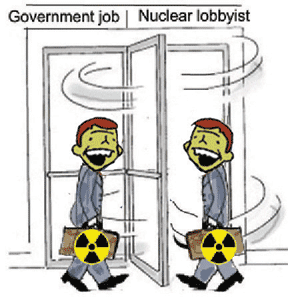
USA’s intercontinental ballistic missiles- epitome of nuclear corruption
   Why Are We Rebuilding the ‘Nuclear Sponge’? https://nationalinterest.org/feature/why-are-we-rebuilding-%E2%80%98nuclear-sponge%E2%80%99-94371
Welcome to the “nuclear sponge.” A bizarre idea that has outlived its questionable Cold War-era usefulness, the nuclear sponge is the United States’ collection of land-based intercontinental ballistic missiles intended to “soak up” a nuclear attack. by Tom Z. Collina Akshai Vikram 6 Nov 19, The media is abuzz about the epic battle between corporate titans Northrop Grumman and Boeing over who will win the $100 billion contract to build a new nuclear-armed ballistic missile. For those who are keeping score, it looks like Northrop will win a sole-source contract, which would be a disaster for taxpayers.
But media coverage of the Clash of the Titans is missing the real story. This is not about contractor wars or sweet-heart deals. This is about the integrity of our government: why, thirty years after the end of the Cold War, are we rebuilding nuclear weapons that we do not need? Why are we spending national treasure to buy weapons that make us less safe?
What if we told you that residents of Colorado, Montana, Nebraska, North Dakota, and Wyoming are being used as bait in a nuclear war with Russia? Surely, no sane person would accept or offer such terms. However, if you live anywhere near these states, you already have a nuclear target on your back. Welcome to the “nuclear sponge.” A bizarre idea that has outlived its questionable Cold War-era usefulness, the nuclear sponge is the United States’ collection of land-based intercontinental ballistic missiles (ICBMs) intended to “soak up” a nuclear attack. Before the development of nuclear-armed submarines that can hide their locations at sea, ICBMs were the crux of American nuclear strategy. Today, however, their only purpose is to draw fire away from other targets (like New York and San Francisco) in the (suicidal and thus highly unlikely) event of a first strike by Russia. The Air Force does not plan to launch the missiles in a war, but to have them draw a nuclear attack to the Upper Midwest.
We’re not making this up—that’s what former Defense Secretary Jim Mattis told Congress. However, sacrificing the Upper Midwest not only undervalues the people who live there but would not actually spare the residents of other states. A major nuclear war with Russia would doom the entire nation. It would little matter whether one resides in Manhattan or Montana.
Why then are we rebuilding the nuclear sponge? The answer, as House Armed Services Committee Chair Adam Smith (R-CA) recently highlighted, has much more to do with parochial interests and money than national security. When asked at a recent press conference why states would want to host the missiles, and thereby put themselves at risk, Smith said, only partly in jest, “They’re fond of their missiles. Apparently, they want to be targeted in a nuclear first strike.” And then, more seriously, he said “They want the jobs . . . no matter the circumstances. And that’s not rational. It’s parochial.”
 With current ICBMs getting older, the Trump administration has greenlit a new cohort of missiles as part of an almost $2 trillion nuclear rebuild plan over the next thirty years. The price tag for the new ICBM alone is potentially $140 billion. That contract is currently slated to go to Northrop Grumman, even as it fights off a Federal Trade Commission investigation for unfair competition, which may cost taxpayers “billions.” With current ICBMs getting older, the Trump administration has greenlit a new cohort of missiles as part of an almost $2 trillion nuclear rebuild plan over the next thirty years. The price tag for the new ICBM alone is potentially $140 billion. That contract is currently slated to go to Northrop Grumman, even as it fights off a Federal Trade Commission investigation for unfair competition, which may cost taxpayers “billions.”Northrop Grumman and others have hijacked the nuclear-security agenda of the United States through the usual Washington channels: lobbying and
 campaign contributions. In the 2018 election cycle, Northrop spent $5.6 million in campaign contributions. In fact, Northrop spends more than any other defense contractor on lobbying and is just behind Amazon and Facebook. Defense contractors have grown even more powerful with a willing ally in the White House. Simply put, the Trump administration has filled its top national-security ranks with people holding extensive ties to major defense contractors. campaign contributions. In the 2018 election cycle, Northrop spent $5.6 million in campaign contributions. In fact, Northrop spends more than any other defense contractor on lobbying and is just behind Amazon and Facebook. Defense contractors have grown even more powerful with a willing ally in the White House. Simply put, the Trump administration has filled its top national-security ranks with people holding extensive ties to major defense contractors. Mattis worked for General Dynamics and received speaking fees from Northrop Grumman. The current defense secretary, Mark Esper, worked for Raytheon. Ex-White House Chief of Staff John Kelly worked for DynCorp; former Deputy Defense Secretary Mike Shanahan’s employment history at Boeing goes back over thirty years. Meanwhile, Undersecretary of Defense for Policy John Rood worked for Lockheed Martin as did former Secretary of the Air Force Heather Wilson. In fact, that’s where she skirted lobbying restrictions. This list goes on. Mattis worked for General Dynamics and received speaking fees from Northrop Grumman. The current defense secretary, Mark Esper, worked for Raytheon. Ex-White House Chief of Staff John Kelly worked for DynCorp; former Deputy Defense Secretary Mike Shanahan’s employment history at Boeing goes back over thirty years. Meanwhile, Undersecretary of Defense for Policy John Rood worked for Lockheed Martin as did former Secretary of the Air Force Heather Wilson. In fact, that’s where she skirted lobbying restrictions. This list goes on. Programs such as a new ICBM are strategically unnecessary, economically unsustainable, and morally abhorrent. The missiles would be destroyed in a first strike (Russia knows where they are; you can find them on Google Maps) and serve no purpose except to “absorb” blows in a war whose fallout would kill most Americans anyway. Some jobs are created—but far more jobs could be created if the money was spent in other ways. In 2019, there are surely better ways to employ people than to have them guard Cold War relics. As Smith observed after visiting bases that host nuclear weapons, “what struck me was that the job is unbelievably boring.” Maybe that’s why substance abuse continues to plague these sites, with service members literally falling asleep on duty. Clearly, our nuclear policy needs a reboot. As Sen. Elizabeth Warren(D-MA) has said “Take any big problem we have in America today and you don’t have to dig very deep to see the same system at work . . . despite our being the strongest and wealthiest country in the history of the world, our democracy is paralyzed. And why? Because giant corporations have bought off our government.” Warren was talking about climate change, guns, and healthcare, but her remarks hold just as true for nuclear weapons. The next president must tackle corruption in nuclear policy aggressively—by throwing away the nuclear sponge. Tom Collina is Policy Director and Akshai Vikram is a Hale Fellow at Ploughshares Fund, a global security foundation in Washington DC. |
|
Senator Elizabeth Warren questions Holtec Exemption from Emergency Planning Requirements at the Pilgrim Nuclear Power Station
 Senator Warren Statement on Holtec Exemption from Emergency Planning Requirements at the Pilgrim Nuclear Power Station, https://www.warren.senate.gov/newsroom/press-releases/senator-warren-statement-on-holtec-exemption-from-emergency-planning-requirements-at-the-pilgrim-nuclear-power-station 4 Nov 19, Boston, MA – United States Senator Elizabeth Warren (D-Mass.) released the following statement today following news federal regulators at the Nuclear Regulatory Commission (NRC) plan to exempt Holtec International from emergency planning regulations as the firm works to decommission the Pilgrim Nuclear Power Station: Senator Warren Statement on Holtec Exemption from Emergency Planning Requirements at the Pilgrim Nuclear Power Station, https://www.warren.senate.gov/newsroom/press-releases/senator-warren-statement-on-holtec-exemption-from-emergency-planning-requirements-at-the-pilgrim-nuclear-power-station 4 Nov 19, Boston, MA – United States Senator Elizabeth Warren (D-Mass.) released the following statement today following news federal regulators at the Nuclear Regulatory Commission (NRC) plan to exempt Holtec International from emergency planning regulations as the firm works to decommission the Pilgrim Nuclear Power Station:
“I’m disappointed to learn Holtec will be exempt from important emergency preparation and planning safeguards as it decommissions the Pilgrim Nuclear Power Station,” said Senator Warren. “The Southeastern Massachusetts community has rightly continued to raise important questions about the plant’s decommissioning and they deserve answers, not more strong-arming.”
In October 2018, Senator Warren raised concerns about safety and lack of public input during Pilgrim’s shutdown last year and raised similar concerns regarding communications with local residents in her statement. In August 2019, she called for community concerns to be addressed before Pilgrim was allowed to change hands from Entergy Nuclear Operations, Inc. to Holtec.
|
|
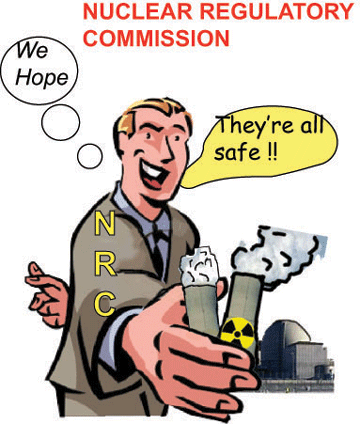
U.S. Nuclear Plants Vulnerable to Terrorist Drones – NRC says “not our problem”
 NRC Decision Leaves U.S. Nuclear Plants Vulnerable to Terrorist Drones, https://www.ucsusa.org/about/news/nrc-decision-leaves-nuclear-plants-vulnerable-terrorist-drones NRC Decision Leaves U.S. Nuclear Plants Vulnerable to Terrorist Drones, https://www.ucsusa.org/about/news/nrc-decision-leaves-nuclear-plants-vulnerable-terrorist-drones
WASHINGTON (November 4, 2019)—After a two-year review, the Nuclear Regulatory Commission (NRC) has declined to require owners of U.S. nuclear power reactors and some nuclear material processing plants to defend against unmanned aerial vehicles, commonly known as drones. As a result, commercial nuclear facilities will remain unprepared to cope with the additional capabilities that these rapidly evolving technologies could provide to terrorist groups seeking to sabotage nuclear reactors or steal weapon materials, according to the Union of Concerned Scientists (UCS). The decision was disclosed in an unclassified summary document posted on the NRC’s public document server on October 30.“The NRC’s irresponsible decision ignores the wide spectrum of threats that drones pose to nuclear facilities and is out of step with policies adopted by the Department of Energy and other government agencies,” said physicist Edwin Lyman, acting director of the UCS Nuclear Safety Project. “Congress should demand that the NRC require nuclear facility owners to update their security plans to protect against these emerging threats.”
The NRC requires nuclear power reactor owners to protect their facilities against attacks by terrorists assumed to have a defined set of capabilities known as the “design basis threat.” After the September 11, 2001, attacks on the World Trade Center in New York and the Pentagon outside of Washington, D.C., the NRC considered but ultimately rejected requiring nuclear plants to defend against attacks by jets or other types of aircraft.
The NRC argued that protecting nuclear facilities from aircraft is the responsibility of the Transportation Security Administration and other federal agencies. Rapid advancements in drone technology since then, however, have introduced new ways in which terrorists could use readily available aerial systems to defeat nuclear plant security measures that are designed only to defend against ground-based assaults and vehicles. Drones have been misused to spy on the U.S.-Mexican border, smuggle contraband into prisons, and—most recently—to attack oil processing facilities in Saudi Arabia. Drones are difficult to detect and defeat without specialized equipment.
According to an April 2019 report by the Department of Energy (DOE) inspector general, “the increasing availability and improved capabilities of small [drones] enhances the potential for use in illicit operations, including surveillance, disruption, and weaponization.” The report recommended that the DOE “use the appropriate process to update security controls based on the most recent information available concerning [drone] capabilities.” In response, the agency is revising its design basis threat policy, but the details of its revision—like the original design basis threat policy—are classified. By contrast, the NRC’s own threat assessment resulted a recommendation of no action.
The NRC summary claims that drones would not be able to exploit security vulnerabilities at nuclear reactors or other facilities or provide any surveillance capabilities beyond what potential adversaries are already assumed to have. It is true that small payload drones would not likely to be able to cause major damage by themselves to safety structures and equipment. But there are many ways in which drones could assist ground-based attackers, including delivering more weapons, explosives and other equipment to a nuclear facility’s protected areas than an attacking force could carry. Drones also could create disturbances to confuse plant security forces and disrupt their response, as well as provide real-time aerial surveillance as an attack progresses. “Many companies are developing technologies to protect critical infrastructure from drone attacks through early detection, tracking, and jamming,” said Lyman. “If the NRC were to add drones to the design basis threat, nuclear plant owners would likely to have to purchase such systems. Laws would also have to be changed to allow private facilities to disrupt hostile drone flights. But plant owners are loath to spend more on safety and security at a time when many of their facilities are struggling to compete with cheap natural gas, wind and solar. “The NRC seems more interested in keeping the cost of nuclear plant security low than protecting Americans from terrorist sabotage that could cause a reactor meltdown,” he added. “The agency needs to remember that it works for the public, not the industry it regulates.” |
|
Pilgrim Nuclear Power Station to Shrink Emergency Planning Zone
 FEMA and some states dispute the Nuclear Regulatory Commission staff’s premise that “all hazards planning” would be enough to address a nuclear accident. Planning experts recommend the planning zone remain in place. Government Technology Emergency Managdement, FEMA and some states dispute the Nuclear Regulatory Commission staff’s premise that “all hazards planning” would be enough to address a nuclear accident. Planning experts recommend the planning zone remain in place. Government Technology Emergency Managdement,
BY CHRISTINE LEGERE, CAPE COD TIMES, HYANNIS, MASS. / NOVEMBER 5, 2019
(TNS) — Despite opposition from the region’s legislators and even the Federal Emergency Management Agency, the Nuclear Regulatory Commission has voted to allow the owners of Pilgrim Nuclear Power Station to shrink the plant’s emergency planning zone from the current 10-mile radius down to its own property line. Pilgrim’s reactor ceased operation May 31. The NRC will allow elimination of the zone, which encompasses sections of Plymouth, Kingston, Carver, Marshfield and Duxbury, come April. And with that elimination will come the loss of about $2 million in annual funding for those towns, to be put toward safety training, staffing, equipment and expenses. “The exemption saves Holtec money at the cost of public safety,” Mary Lampert, president of Pilgrim Watch, said. “NRC rationalizes its decision to grant the exemption on a false assumption. They incorrectly claim that the risk of a rapidly occurring offsite radiological release is significantly lower at a nuclear power reactor that has permanently ceased operations and removed fuel from the reactor vessel. Wrong. There is far more radiation in the spent fuel pool than in the reactorcore when Pilgrim is operating.”……. A single NRC member voted against the exemption, citing a number of issues of concern, including increased possibility of an earthquake in the region. The earthquake risks at the Pilgrim site are greater than previously understood, Commissioner Jeff Baran wrote in a statement explaining his vote. In May 2014, as part of the post-Fukushima seismic hazard reevaluation, the NRC published updated ground motion response spectra for Pilgrim, Baran said. “The results revealed the potential for an earthquake at Pilgrim significantly stronger than the safe shutdown earthquake the plant was designed to handle,” Baran wrote. “In fact, the gap between the previously understood seismic risk and the updated seismic risk was larger at Pilgrim than at any other nuclear power plant in the country.” Baran said the Federal Emergency Management Agency, along with several states including Massachusetts, have disputed the NRC staff’s premise that so-called “all hazards planning” would be sufficient to address a spent nuclear fuel accident. “FEMA notes that it is ‘unrealistic’ to ‘scale up non-existent plans’ and that the resulting ‘lack of necessary equipment and shortage of trained emergency personnel could have unfortunate consequences,'” Baran wrote, citing an August letter to the NRC from Michael Casey, director of FEMA’s technical hazards division. …… , emergency planning experts have recommended the planning zone remain in place until all spent fuel on a reactor site is stored in dry casks. About 3,000 radioactive spent fuel rods remain in a massive pool at Pilgrim. U.S. Sen. Edward Markey, D-Mass, blasted the NRC’s decision to exempt Pilgrim from emergency planning requirements……… To date, every nuclear plant in the U.S. that has decommissioned has requested an exemption from the emergency planning requirements, and in every instance the NRC has granted it…….. https://www.govtech.com/em/disaster/-Pilgrim-Nuclear-Power-Station-to-shrink-emergency-planning-zone.html |
|
Climate change driving California’s wildfires to worse levels
California wildfires: Climate change driving ‘horror and the terror’ of devastating blazes, say scientists
Fires are not new, but their severity is, The Independent, Andrew Buncombe, Seattle @AndrewBuncombe 3 Nov 19,
The words from California’s former governor could barely have been more stark.
“I said it was the new normal a few years ago,’’ says Jerry Brown. “This is serious, but this is only the beginning. This is only a taste of the horror and the terror that will occur in decades.”
As firefighters in California continue to confront a three-week spate of blazes that has reached across the state, attention has also turned to why this year’s wildfires have been so severe. The reason, according to scientists, is climate change.
“It’s warmer weather, more evaporation, and drier conditions. They just burn more,” says Park Williams, a bioclimatologist at Columbia University. The words from California’s former governor could barely have been more stark.
“I said it was the new normal a few years ago,’’ says Jerry Brown. “This is serious, but this is only the beginning. This is only a taste of the horror and the terror that will occur in decades.”
As firefighters in California continue to confront a three-week spate of blazes that has reached across the state, attention has also turned to why this year’s wildfires have been so severe. The reason, according to scientists, is climate change.
“It’s warmer weather, more evaporation, and drier conditions. They just burn more,” says Park Williams, a bioclimatologist at Columbia University. “And we expect this trend to continue. We can’t say if it will happen every year – there are natural variations as well. But we know that when things are drier, a larger area burns.”
Speaking from New York, Williams adds: “We’ve always had the fires. But things are now two or three degrees hotter. That’s enough to make a major difference.”
As Donald Trump continues to refuse to acknowledge the existence of man-made climate change, and as Jay Inslee, the only Democrat running for president on a ticket to address climate change, dropped out of the race this autumn, residents of California and other western states are trying to figure out how to confront the challenge, not just this year but in the years and decades ahead.
The editorial writers at the Los Angeles Times have echoed the words of the former governor, who spoke to Politico, by declaring: “Climate change has set California on fire. Are you paying attention?”
“Nobody can honestly say this is a surprise, given the devastating fires of recent years. Yet it feels surprising all the same. How did things get so bad in California, so quickly,” they write. “The answer is climate change. It is here and our communities are not ready for it.”……..
Michael Mann, a climate expert and professor of Earth sciences at Penn State University, says in the American west climate change has increased the risk of fire weather fivefold and doubled how much land has burned. Wildfire frequency, he says, has quadrupled since the 1980s……..
Asked how such fires could be countered, he replies: “As long as we continue to emit carbon into the atmosphere, and create warmer, drier conditions in California, there is little question that we’ll see a worsening of wildfires.
“The only true solution is to stop burning fossil fuels, generating greenhouse gases, and warming the planet.”
Last year, the world’s leading climate scientists said the world had barely a dozen years to act to make massive changes to global energy infrastructure to limit global warming to moderate levels. “There is no documented historic precedent,” said the United Nations’ Intergovernmental Panel on Climate Change……. https://www.independent.co.uk/news/world/americas/california-wildfire-climate-change-evacuation-santa-ana-winds-devil-diablo-a9181886.html
The first New Deal inspires the Living New Deal Project

THE FIRST “NEW DEAL” CAN HELP US AGAIN, Radio Ecoshock , October  30, 2019,
Huge crowds of young people are rebelling against climate extinction. They have been promised a “Green New Deal” for 11 years. Opponents say a Green New Deal isn’t possible and government planning is always evil. This is partly what caused Gray Brechin to create the Living New Deal Project. But he was also looking for good news in our past ability to act together – to help his own sanity in the face of our rush toward catastrophe.
I think we need citizens to document their surroundings, so we can remember changes. Things change so fast we lose our memory. Or is it because the machine and the media compete to replace our memory with something that benefits the oligarchy?
Gray Brechin chronicles, literally from the San Francisco Chronicle newspaper “the murder of the public sector” – which is going on every day. There are signs and victims of that war against the public good. We privatize things and then make them too expensive for the common person.
Brechin is creating a new memory bank, with maps of what can be done when a government and a people are ready to be doers. His map of New Deal accomplishments shows the basis of American highways, power systems, public buildings, refurbished National Parks and so much more. Maybe President Roosevelt’s New Deal from 90 years ago can help America with the Green New Deal she needs so badly now.
I encourage people to visit the interactive map of more than 15,000 sites across America built by the New Deal. Find it at livingnewdeal.org. And check out Gray’s master work “Imperial San Francisco: Urban Power, Earthly Ruin”.

1 This Month

Protect Sazan Island from the Trump family! https://secure.avaaz.org/campaign/en/protect_sazan_island_from_the_trump_family_loc/?bqFCVab&v=174511&cl=22707147157&_checksum=5e9dde668860e8231c33699735e16a1fbf22ab2cb01da50c999fe8732b9775ef&utm_source=email&utm_medium=blast_email&utm_campaign=174511


Cuba Is Not a Failed State – It Is a Besieged State
PETITION: “Global Appeal to Endorse Palestinian Right of Return of Refugees”
To see nuclear-related stories in greater depth and intensity – go to https://nuclearinformation.wordpress.com
-
Archives
- June 2026 (129)
- May 2026 (306)
- April 2026 (356)
- March 2026 (251)
- February 2026 (268)
- January 2026 (308)
- December 2025 (358)
- November 2025 (359)
- October 2025 (376)
- September 2025 (257)
- August 2025 (319)
- July 2025 (230)
-
Categories
- 1
- 1 NUCLEAR ISSUES
- business and costs
- climate change
- culture and arts
- ENERGY
- environment
- health
- history
- indigenous issues
- Legal
- marketing of nuclear
- media
- opposition to nuclear
- PERSONAL STORIES
- politics
- politics international
- Religion and ethics
- safety
- secrets,lies and civil liberties
- spinbuster
- technology
- Uranium
- wastes
- weapons and war
- Women
- 2 WORLD
- ACTION
- AFRICA
- Atrocities
- AUSTRALIA
- Christina's notes
- Christina's themes
- culture and arts
- Events
- Fuk 2022
- Fuk 2023
- Fukushima 2017
- Fukushima 2018
- fukushima 2019
- Fukushima 2020
- Fukushima 2021
- general
- global warming
- Humour (God we need it)
- Nuclear
- RARE EARTHS
- Reference
- resources – print
- Resources -audiovicual
- Weekly Newsletter
- World
- World Nuclear
- YouTube
-
RSS
Entries RSS
Comments RSS
 nuclear-news