As negotiation deadline nears, tension between Kim Jong Un and Donald Trump
Trump, Kim at odds as deadline looms in nuclear talks, Glen Carey and Jihye Lee, Bloomberg, November 18, 2019
The bonhomie between President Donald Trump and North Korean leader Kim Jong Un is nearing a key deadline showing new signs of strain.
Trump urged Kim over the weekend to “act quickly” to get a nuclear deal done, suggesting the two leaders could meet again “soon.” His comments came hours after North Korea ruled out nuclear talks without a policy change by the U.S. and reported on a military drill observed by Kim himself.
Veteran North Korea nuclear adviser, Kim Kye Gwan, told Trump that Pyongyang will no longer give him “things to boast about,” the state’s official KCNA news agency on Monday quoted him as saying. He added North Korea is no longer interested in talks that the U.S. “uses to buy time.”
Trump and Kim Jong Un, who have previously displayed what Pyongyang calls “mysteriously wonderful chemistry,” appear to be going in different directions as the clock ticks down. Kim has given Trump until the end of the year to ease up on sanctions or risk him taking a “new path,” meaning a possible escalation of military tensions during the U.S. presidential campaign…….
After more than a year of talks and three Trump-Kim meetings, the two sides remain divided on issues from sanctions relief to disarmament. Even though North Korea hasn’t taken any major steps to give up its weapons, Kim has won concessions from Trump that include canceling some U.S.-South Korean joint military drills that have drawn Pyongyang’s anger.
North Korea hasn’t explained what Kim intends to do on his “new path,” although the regime has often referred to his decision to halt tests of nuclear bombs and intercontinental ballistic missiles two years ago. In May, North Korea resumed tests of shorter-range ballistic missiles.,,,,,,,
The North Korea warning about U.S. nuclear talks came despite the U.S.’s decision to suspend another round of military drills with South Korea. Defense Secretary Mark Esper said on the sidelines of a regional security conference that Washington and Seoul had “jointly decided to postpone this month’s combined flying training event” after “close consultation and careful consideration.”
Pyongyang last week blamed U.S.-South Korean military drills “as a main factor of screwing up tensions.”
The emerging potential new nuclear industry political scam
 Does Nuclear Power Slow Or Speed Climate Change? Forbes, Amory B. Lovins 17 Nov 19,
 2. Through generally regulated utility tariffs, customers paid for the plants’ construction and financing, including a just and reasonable return on capital.
3. Customers paid over decades for the plants’ operation, including major repairs, power upratings, and safety upgrades.
4. Many customers reimbursed owners for “stranded-asset costs” totaling upwards of $70 billion to support the owner-demanded transition to competitive wholesale markets.
5. Over the past few years, when reactors generating 2 percent of U.S. electricity proved unable to compete in those wholesale markets (though most of their owners kept their finances secret and kept reporting profits to investors), the owners persuaded state legislators in Illinois, New York, New Jersey, Connecticut, and Ohio to vote billions of dollars a year for new multi-year operating subsidies.
6. Exelon, the nation’s largest nuclear operator and the leading player in the previous two steps, successfully sought Federal regulatory approval for greater capacity payments from power pools whose auctions found nuclear power uncompetitive and whose own rules were thrown off-balance by the new state subsidies. And now, as the annual logrolling season of “tax extenders” rolls around in Congress:
7. For the third year, Exelon is advancing a “Nuclear Powers America Act” to create a new federal investment tax credit on nuclear fuel and maintenance expenses to “help level the playing fuel with other clean energy sources”—whose temporary tax credits are meanwhile being phased down or out. This follows a longstanding pattern of giving different kinds of subsidies to renewables than to nuclear, then “leveling the playing field” by trying to duplicate renewables’ specific forms of subsidies with new ones for nuclear, but never the reverse.
This saga of selling the same hay seven times—and those clever lawyers aren’t done yet—doesn’t include many additional federal and state subsidies. It also doesn’t include an emerging potential scam that could end up with ratepayers’ and federal taxpayers’ getting stuck with vast decommissioning and waste-management liabilities. This emerging pattern has an LLC buy a closed reactor. Absent oversight or rules to stop misbehavior, the LLC could then choose to strip the accumulated customer-funded multi-billion-dollar cash decommissioning fund, not finish the job, and walk away, leaving the parent company whole and electricity customers or taxpayers holding the bag. Watch this space.
Exelon’s proposed “nuclear investment tax credit” has ingenious new features:
– By redefining normal accounting categories so fuel becomes a capital investment, it repays utilities for an “investment” that’s really just a normal operating cost—thus trying to make nuclear operating costs look small by shifting much of them to taxpayers.
The nuclear operating costs it covers have no counterpart for renewables (fuel, nuclear waste management, protection against catastrophic releases of radioactivity), or almost none (operation & maintenance costs), so a tax credit for them would specifically advantage nuclear against renewables.
– Nuclear owners may be able to double-dip, collecting the new federal subsidy and new state subsidies for the same plants and thus turning dead dinosaurs into juicy cash cows.
– There’s virtually no “means test”: the new federal subsidy would apply to about 95% of US operating reactors, including those that the industry claims are currently profitable.
– The proposed legislation, obscurely written in tax-law jargon, appears to be a 30% tax credit (phasing down to 26% in 2024, 22% in 2025, and a permanent 10% in and after 2026), and to cost ~$22–26 billion over the first decade, or ~$33 billion counting the crowding-out of cheaper competitors. Every billion dollars thus bilked from taxpayers is unavailable to provide more electrical services and save more carbon by cheaper means.
– By further distorting the delicate balance between federal, regional, and state regulation, the subsidy seems tailored to weaken or destroy the efficient regional power markets where renewables beat nuclear power. The goal is thus to pay nuclear power for values it doesn’t deliver, while blocking its most potent competitors from continuing to provide the values they do deliver.
– Unlike renewable credits that have helped to mature important new technologies, the nuclear credit would elicit no new production, capacity, or innovation. It would simply transfer tens of billions of dollars to the owners of uncompetitive nuclear assets bought decades ago—if they apply for license extension by 2026, as nearly all have done.
This covert attack on renewables is logical because renewables are now the supply-side competitor nuclear must beat but can’t. The nuclear industry is reluctant to admit that renewables are a legitimate competitor, since this would contradict its claims that renewables can’t supply reliable power. Renewables, unlike nuclear power, are also widely popular. Nuclear advocates therefore tend to blame their woes instead on cheap natural gas. However, new and often even existing combined-cycle gas-fired power plants no longer have a business case: a September 2019 study found that at least 90% of the 88 proposed US gas-fired plants are pre-stranded assets. ………https://www.forbes.com/sites/amorylovins/2019/11/18/does-nuclear-power-slow-or-speed-climate-change/#5b47c988506b
20% drop in patient’s radiation dose achieved by U.S. radiologists
|
The report, published Monday, Nov. 18, by the National Council on Radiation Protection and Measurements, showed doses dropped by 15% to 20% among U.S. patients between 2006 and 2016. Per person, the estimated average dose fell from 2.92 millisievert (mSv) in 2006 to 2.16 mSv in 2016. “We are pleased, but not surprised, that despite a steadily increasing and aging population, the medical radiation dose Americans receive is going down,” Continue reading |

NRC likely to extend licence for Westinghouse nuclear fuel factory, despite its history of spills and leaks
 Nuclear safety regulators take heat for downplaying threat from atomic fuel plant, The State BY SAMMY FRETWELL, 17 Nov 19, Federal nuclear safety regulators drew criticism Thursday night for concluding that an aging atomic fuel plant could operate another 40 years without having much impact on the environment of eastern Richland County.The 50-year-old Westinghouse nuclear fuel factory, located between Interstate 77 and Congaree National Park, has had a recent history of missteps, including spills and leaks that have focused attention on the facility and it’s safety culture. Nuclear safety regulators take heat for downplaying threat from atomic fuel plant, The State BY SAMMY FRETWELL, 17 Nov 19, Federal nuclear safety regulators drew criticism Thursday night for concluding that an aging atomic fuel plant could operate another 40 years without having much impact on the environment of eastern Richland County.The 50-year-old Westinghouse nuclear fuel factory, located between Interstate 77 and Congaree National Park, has had a recent history of missteps, including spills and leaks that have focused attention on the facility and it’s safety culture.
But as its troubles have surfaced, the company has sought federal permission for a new operating permit. A recent Nuclear Regulatory Commission report said the facility will continue to have leaks if its permit is renewed, yet those problems won’t have much affect on the surrounding landscape. The study said the plant was safe enough to operate if it receives a new 40 year license because pollution will be monitored and cleaned up before it leaves the property. Those speaking at a public hearing Thursday — mostly environmentalists — said they can’t understand why the NRC thinks a plant with a multitude of problems will operate safely for the next four decades. They called on the agency to conduct a more detailed study known as an environmental impact statement. If the NRC does approve a new license, it should be for less than 40 years, those speaking at the meeting said. “There have been releases to the environment, there are ongoing impacts to the environment and there are likely to be future impacts to the environment,’’ Congaree Riverkeeper Bill Stangler said, adding that the NRC has plenty of time to study the matter because the current license doesn’t expire until 2027…… The NRC’s environmental assessment, which was the subject of the meeting, will help the agency decide whether to issue the 40-year license so the plant can continue operating. A twin report that focuses on safety inside the plant is still under way. It also will be considered by the NRC in making a licensing decision, likely in April. ….. Despite its’ economic impact on the Columbia area, Westinghouse has failed to prevent extensive groundwater contamination since opening 50 years ago. Toxins such as nitrate, uranium and Technetium 99 have fouled groundwater, some of which is moving toward the Congaree River…… not everyone was satisfied that the NRC has done its job or comfortable with the agency’s assurances. Tom Clements, a nuclear safety watchdog from Columbia, said the NRC didn’t study the Westinghouse plant thoroughly enough to justify a new license. The agency’s environmental assessment left out key information and downplayed the threat of expected spills and leaks in the future, he said. One issue is the source of Technetium 99, a radioactive pollutant discovered in groundwater, he said. The NRC doesn’t have a clear picture of where the nuclear material is coming from. Clements said Westinghouse should have to operate for one year without major incidents before a license should be granted. The license should be for 10 years, instead of 40, if it needs approval, he said. The Westinghouse plant has had groundwater contamination dating to the 1980s, and through the years, the plant has been cited by the NRC over nuclear safety mistakes. But issues since 2016 have refocused attention on the facility, which is nestled in a wooded, rural area along the Congaree River of eastern Richland County. https://www.thestate.com/news/local/environment/article237369084.html |
|
49 USA universities get lots of money for helping to develop nuclear weapons
 ‘Schools of Mass Destruction’: Report Details 49 US Universities Abetting Nuclear Weapons Complex https://www.commondreams.org/news/2019/11/13/schools-mass-destruction-report-details-49-us-universities-abetting-nuclear-weapons “Why would an institution of higher learning support weapons that cause terrible humanitarian consequences?”
That’s according to a new report released Wednesday by the International Campaign to Abolish Nuclear Weapons (ICAN), “Schools of Mass Destruction: American Universities in the U.S. Nuclear Weapons Complex.” The report calls out 49 educational institutions, describes their direct and indirect involvement, and recommends steps the universities, students, and faculty can take to address the issue.
The report names prestigious universities including Stanford, Georgetown, and MIT. The cited universities have reportedly engaged in four different avenues of complicity in nuclear weapons production, defying their own mission statements and international law.
In return, the report says, “universities receive funding, access to research facilities, and specific career opportunities for students.”
The complicity, according to ICAN, falls into one of four categories: direct management, institutional partnerships, research programs and partnerships, and workforce development programs.
From the report’s profiles on Georgetown University and the University of Nevada – Reno:
In return, the report says, “universities receive funding, access to research facilities, and specific career opportunities for students.”
The complicity, according to ICAN, falls into one of four categories: direct management, institutional partnerships, research programs and partnerships, and workforce development programs.
From the report’s profiles on Georgetown University and the University of Nevada – Reno:
- Georgetown is listed as a university partner on the website of Lawrence Livermore National Laboratory. According to administration at Georgetown, the university has a formal agreement with the laboratory and collaborates in the areas of neuroscience, physics and cancer, with the lab hosting graduate students for summer internships. The Lawrence Livermore lab provides design and engineering for several nuclear warhead types and conducts simulated experiments to evaluate warheads.
- The University of Nevada – Reno developed a new Graduate Certificate in Nuclear Packaging in partnership with the Department of Energy. A Nevada National Security Site engineer was the first to complete the program. The Nevada National Security Site is the location of nearly 1,000 tests of nuclear weapons in past decades, leading to serious health impacts for nearby residents and participating military personnel. Currently, staff at the site conduct simulated experiments to test the reliability and performance of nuclear weapons. The site also hosts “subcritical experiments” that allow for the evaluation of nuclear weapons materials under certain conditions, but do not cause a “self-sustaining nuclear chain reaction.”
Those universities are not the “most complicit.” That dubious honor goes to the University of California, Texas A&M University, Johns Hopkins University, and University of New Mexico. In a Twitter thread, ICAN highlighted those schools’ involvement:
#1 The state of California supports a ban of #nuclearweaponshttp://bit.ly/2pbn7OT,but the @UofCalifornia has continuously managed the primary #nuclearweapons labs for the US since WWII. When will UC stop supporting weapons that pose a catastrophic threat to our existence?
#2 @TAMU administration has publicly stated its “commitment to the #nuclearweapons industry.”http://bit.ly/2CyVbau Why would an institution of higher learning support weapons that cause terrible humanitarian consequences?#3 @JohnsHopkins’ applied physics lab is directly involved in #nuclearweapons production. It receives more than twice as much funding from the US @DeptofDefense than any other U.S. university. @JHUPress @JHUNewsLetter
#4 More than 3,800 New Mexicans have suffered serious illness or death as a result of US nuclear weapons tests http://bit.ly/33IL4vS So why does the @UNM University of New Mexico wants its faculty and students to collaborate with #nuclearweapons lab scientists?The report comes as Trump administration policies have given rise to fears of a new arms race. As the report notes,
In the United States, the Trump administration has expanded plans to upgrade the nation’s nuclear weapons arsenal. Over the next ten years, the Congressional Budget Office estimates U.S. taxpayers will pay nearly $500 billion to maintain and modernize its country’s nuclear weapons arsenal, or almost $100,000 per minute.
Also noted in the publication is the administration’s withdrawal earlier this year from the Intermediate-Range Nuclear Forces Treaty with Russia and its 2018 Nuclear Posture Review (NPR), which calls for “diversifying” the country’s nuclear arsenal.
That gives greater urgency to the call for the schools to sever their partnerships—and the clear support for the United Nations Treaty on the Prohibition of Nuclear Weapons, ICAN says, should be seen as an opportunity for action.
U.S. universities must reconsider connections to the nuclear weapons complex due to the devastating humanitarian and environmental impacts of nuclear weapons and because current U.S. policies make their use more likely,” says the report.
A first step is for schools to be more transparent about their involvement in the nuclear weapons complex but that’s not enough. “Universities would not willingly participate today in research enabling the production of chemical and biological weapons. Nuclear weapons are morally equivalent to these other weapons of mass destruction.”
Students and faculty can take action as well. ICAN suggests sharing the report to increase awareness, demanding the institutions make their research transparent, and calling on the schools to become part of the effort to ban nuclear weapons by dropping their involvement.
Indigenous opposition grows against proposal for grand nuclear waste dump in New Mexico
 Some fear the “interim” storage facility could become a de facto permanent storage facility
transport of high-level radioactive waste across the state  could also lead to potentially dangerous nuclear releases, leaving impacted communities responsible for emergency responses.
 the proposal fits into a wider pattern of negligence and environmental racism on behalf of the federal government towards one of the United States’ poorest majority-minority states.
|
Nuclear Colonialism: Indigenous opposition grows against proposal for nation’s largest nuclear storage facility in NM Political Report By Kendra Chamberlain 14 Nov 19, A proposal for New Mexico to house one of the world’s largest nuclear waste storage facilities has drawn opposition from nearly every indigenous nation in the state. Nuclear Issues Study Group co-founder and Diné organizer Leona Morgan told state legislators last week the project, if approved, would perpetuate a legacy of nuclear colonialism against New Mexico’s indigenous communities and people of color.Holtec International, a private company specializing in spent nuclear fuel storage and management, applied for a license from the federal Nuclear Regulatory Commission to construct and operate the facility in southeastern New Mexico. The proposal, which has been in the works since 2011, would see high-level waste generated at nuclear power plants across the country transported to New Mexico for storage at the proposed facility along the Lea-Eddy county line between Hobbs and Carlsbad. Continue reading |
Trump picks another lackey of the coal and nuclear industries as US Energy Secretary
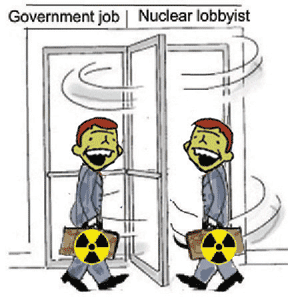
Dan Brouillette, 57, a former lobbyist at Ford Motor Co and Louisiana state energy regulator, would replace Rick Perry, who has said he is stepping down on Dec. 1.
Perry became known as one of the “three amigos” in a side-channel Ukraine policy led by Trump’s personal lawyer, Rudy Giuliani, that has been at the center of the Trump impeachment probe. But Perry has said he was not involved in any conversations where former Vice President Joe Biden was brought up…….
If, as expected, he is confirmed by the Senate Energy Committee and then by the full Senate, Brouillette will work to carry out Trump’s “energy dominance” agenda of boosting U.S. production of oil and natural gas.
Brouillette told Republican senators from Wyoming and Louisiana that he supports technology on curbing climate change by capturing and storing underground carbon dioxide from coal and natural gas facilities, adding that fossil fuels would power a large portion of global energy needs for the next 40 to 50 years…….
Brouillette also said he wants to support development of advanced nuclear power plants, hopefully one day bringing microreactors that provide relatively small amounts of power to remote places like rural Louisiana, where he was born, to Alaska. ……
Democratic senators not on the Energy Committee, including Ed Markey and Tim Kaine, sent Brouillette a letter on Wednesday asking whether he supported nonproliferation standards in any deal on sharing U.S. nuclear power technology with Saudi Arabia, a question he will likely continue to face if he is confirmed.
Reporting by Timothy Gardner; Editing by Peter Cooney and Tom Brown https://www.reuters.com/article/us-usa-trump-energy/trump-energy-pick-to-face-questions-on-coal-nuclear-power-idUSKBN1XO1OH
Before he’s even in the job, USA’s new Energy Secretary Dan Brouillette is busily promoting SMRs for his REAL bosses, the nuclear industryg
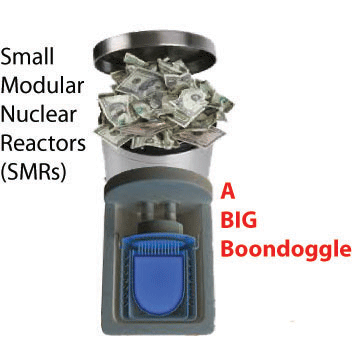 Could tiny nuclear reactors power Alaska villages?
“We want to get to a place where we can develop small micro-reactors, one to five megawatts,” Dan Brouillette said Thursday at his confirmation hearing in the U.S. Senate Energy Committee. …..
Brouillette is now the deputy secretary. He told Murkowski there’s reason to be optimistic about the development of reactors that are a fraction of the size of those in use today. ….. https://www.alaskapublic.org/2019/11/14/energy-secretary-nominee-says-tiny-nuclear-reactors-could-power-alaska-villages/
US- North Korea negotiations may be revived
|
US-North Korea nuclear talks may stir back to life, SMH, 15 Nov 19, Seoul: North Korea is unhappy the United States has proposed a resumption of stalled nuclear negotiations next month through a third party.It comes as the two countries approach an end-of-year deadline set by North Korean leader Kim Jong-un for the Trump administration to offer an acceptable deal to salvage the talks, and as the US President faces an impeachment inquiry at home.
In a statement released by state media, new North Korean negotiator Kim Myong-gil didn’t clearly say whether the North would accept the supposed US offer. Kim Myong-gil said Stephen Biegun, Trump’s special envoy for North Korea, proposed via an unspecified third country to hold another round of talks in December. “I cannot understand why he spreads the so-called idea of DPRK-US relations through the third party, not thinking of candidly making direct contact with me, his dialogue partner, if he has any suggestions or any idea over the DPRK-US dialogue,” Kim Myong-gil said of Biegun. “His behaviour only amplifies doubts about the US.” He said North Korea had no interest in talks if they were aimed at buying time without discussing solutions. He said the North wasn’t willing to make a deal over “matters of secondary importance”, such as possible US offers to formally declare an end to the 1950-53 Korean War, which was halted by a ceasefire, not a peace treaty, or establish a liaison office between the countries. If the negotiated solution of issues is possible, we are ready to meet with the US at any place and any time,” said Kim Myong-gil, who called for Washington to present a fundamental solution for discarding its “hostile policy” towards North Korea. “If the US still seeks a sinister aim of appeasing us in a bid to pass the time limit – the end of this year – with ease as it did during the DPRK-US working-level negotiations in Sweden early in October, we have no willingness to have such negotiations,” he said, using the abbreviation of North Korea’s official name, the Democratic People’s Republic of Korea…… In a separate statement attributed to another senior official, North Korea demanded that the US scrap a planned military drill with South Korea to keep the momentum alive for dialogue. Responding to comments by US Defence Secretary Mark Esper, who said Washington could possibly modify its military activities with Seoul to make room for diplomacy, North Korean official Kim Yong-chol said he would like to consider Esper’s remarks as US intention to “drop out of the joint military drill or completely stop it.” ……..https://www.smh.com.au/world/asia/us-north-korea-nuclear-talks-may-stir-back-to-life-20191115-p53ayr.html |
|
Messianic Rick Perry preaches nuclear to sceptical Europeans
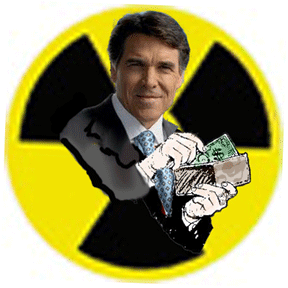 Messianic Perry preaches nuclear to sceptical Europeans, By Frédéric Simon | EURACTIV.com Oct 26, 2019 Small nuclear reactors can help “vulnerable nations take control of their destinies,” the US energy secretary said in Brussels today (21 October), claiming that small off-grid nuclear plants can bring electricity to poor nations and “disperse the darkness” around the globe…….
Today’s remarks, made in Brussels at the first EU-US high-level forum on small modular reactors, were again chiefly aimed at Eastern European countries, which have repeatedly complained about Russian interference in national politics, using gas as a lever.
Nuclear is a divise topic in Europe. While countries like France opted for it decades ago, others like Germany and Austria are strongly opposed.
“Nuclear energy is neither safe and sustainable nor cost-effective,” said German State Secretary for Energy, Andreas Feicht, during a recent meeting of EU energy ministers, firmly rejecting suggestions that EU money might be used to extend the lifetime of existing nuclear plants.
Today’s remarks, made in Brussels at the first EU-US high-level forum on small modular reactors, were again chiefly aimed at Eastern European countries, which have repeatedly complained about Russian interference in national politics, using gas as a lever.
Nuclear is a divise topic in Europe. While countries like France opted for it decades ago, others like Germany and Austria are strongly opposed.
“Nuclear energy is neither safe and sustainable nor cost-effective,” said German State Secretary for Energy, Andreas Feicht, during a recent meeting of EU energy ministers, firmly rejecting suggestions that EU money might be used to extend the lifetime of existing nuclear plants……
USA universities in the money as they help develop nuclear weapons

UNIVERSITIES ACROSS AMERICA PROFIT FROM DEVELOPING NUCLEAR WEAPONS. IT’S UNCONSCIONABLE, https://www.newsweek.com/universities-funding-nuclear-weapons-research-1471572 BEATRICE FIHN ON 11/13/19 Americans like a good comeback story, but the recent revitalization of the nuclear arms race is not one to be cheered. President Trump plans to charge the American taxpayer nearly $100,000 a minute to expand the nation’s nuclear weapons capabilities.Other nuclear-armed countries are doing the same.
A new generation of nuclear weapons requires a new generation of workers to develop and maintain these weapons of mass destruction. The National Nuclear Security Administration reported to Congress that 40 percent of its workforce will be eligible to retire in the next five years.The U.S. government and its contractors have turned to the nation’s universities to provide this human capital. A new report documents formal ties between nearly 50 college campuses and the nuclear weapons complex.
The extent to which universities have joined this endeavor is surprising. Supporting weapons of mass destruction does not show up in any university mission statements. In fact, it’s often the opposite: universities like to talk about bringing the benefits of knowledge to a global community.
The dangers posed by nuclear weapons are clear. Yet universities still choose to support them anyway. Students and faculty now face a choice. They can become the next generation of weapons scientists. Or they can refuse to be complicit in this scheme, denying research partnerships or internships at nuclear weapons labs.Currently, universities across the country receive millions and in some cases billions of dollars to support nuclear weapons development. Universities directly manage nuclear weapons labs, form institutional agreements with these labs and related production sites, pursue research partnerships with nuclear weapons scientists, and provide targeted workforce development for these facilities.
Many of the universities with more extensive connections to nuclear weapons are household names: the University of California, Texas A&M University, Johns Hopkins University, and the University of New Mexico. Others, such as local technical and vocational schools, are less well-known.
Nuclear weapons are weapons of mass destruction, just like chemical and biological weapons. They carry devastating humanitarian and environmental consequences that do not stop at national borders. Thousands still suffer from the bombs dropped on Hiroshima and Nagasaki. Thousands more suffer from the effects of nuclear weapons testing in the 20th century, including in the U.S.
One Centers for Disease Control and Prevention study estimated that radioactive fallout from nuclear tests would kill an additional 11,000 Americans due to an increase in fatal cancers. The United States has paid more than $2.3 billion in compensation to individuals affected by nuclear test fallout. Those most affected by tests around the world have been the already marginalized: indigenous and colonized peoples, women and children.
Some see value in the nuclear weapons complex because it supplies thousands of jobs. These boosters fail to acknowledge the studies that demonstrate how defense spending produces fewer jobs per dollar than investment in other areas, like education, health care or infrastructure. The business of nuclear weapons does not provide jobs; it takes them away.
Our choice today is between a future without nuclear weapons or no future at all. Seventy-nine nations (and counting) have signed the 2017 United Nations Treaty on the Prohibition of Nuclear Weapons; American states and cities are voting to urge the US to join them. Universities that support nuclear weapons make the wrong choice and their communities should refuse to be complicit.
Students, faculty, alumni, and community members — who often fund these schools through their tax dollars — can also take concrete action to help their universities join the right side of history.
They can push for transparency around any ties to the nuclear weapons complex, install ethical review processes for basic or dual-purpose research funded by the complex, and prohibit classified research. They can ask University administrations to stop direct management of nuclear weapons production sites and dissolve research contracts solely related to nuclear weapons production.
University communities and administrations together can lobby the federal government to flip its funding priorities, so that nonproliferation and disarmament verification research receive more funding than weapons activities.
A society can—and should—actively debate the extent to which universities are to serve explicitly national interests. But there should be no debate when it comes to supporting weapons of mass destruction. American academia must stop enabling mass murder.
Beatrice Fihn is the Executive Director of the International Campaign to Abolish Nuclear Weapons (ICAN), the 2017 Nobel Peace Prize-winners.
A long-term continuing resolution -damaging to America’s nuclear weapons development
|
Here’s how a CR could hurt America’s nuclear weapons modernization. https://www.defensenews.com/smr/nuclear-arsenal/2019/11/12/heres-how-a-cr-could-hurt-americas-nuclear-weapons-modernization/
By: Aaron Mehta WASHINGTON — A long-term continuing resolution will result in delays for modernizing America’s nuclear warheads, while putting at risk an already challenging plan to build plutonium pits needed for the next generation of U.S. intercontinental ballistic missiles, nuclear officials are warning.
The National Nuclear Security Administration is a semiautonomous agency under the Department of Energy that handles the manufacturing and maintenance of America’s nuclear warheads. Like other government agencies, NNSA would be limited to fiscal 2019 funding limits under a continuing resolution, and it would be unable to start new contracts. The current continuing resolution, or CR, is set to end Nov. 21, but there is little expectation that regular budgeting will then resume. Congress is debating the merits of pushing the CR through December, but analysts are concerned the CR could extend into next year. “We are in a situation right now where we have single-point failures throughout our enterprise,” Lisa Gordon-Hagerty, the NNSA administrator, said during a Defense Writers Group breakfast earlier this month. “It’s necessary for us, for the NNSA and for the nuclear security enterprise to receive consistent and robust funding to modernize our infrastructure as well as continue ongoing operations.” “We’re looking at where we can move funding insofar as CRs will allow us to do so,” she added. “We’re working very closely with OMB and the administration to see what we can do to continue our important programs to modernize the infrastructure as well as the stockpile and our workforce initiatives and our endeavors.” Gordon-Hagerty did not go into detail about specific CR-related worries, but according to an NNSA source, the agency has identified three main areas of concern under a longer CR. The first is, broadly, keeping the warhead modernization efforts on schedule. Two of those modernization programs — the B61-12 gravity bomb and W88 submarine-launched ballistic missile warhead — already face program delays thanks to an issue with a commercial part that has to be redesigned. Gordon-Hagerty said a CR should not impact that particular issue, as the funding for a solution is coming from a realignment of other warhead modernization programs. But a delay to one program caused by a CR “does affect all of the other modernization programs and all of the other work that we have ongoing throughout our nuclear security enterprise,” she said. The second major area of concern is the surplus plutonium disposition program, which is supposed to dispose of 34 metric tons of excess plutonium at a South Carolina facility. That program emerged as the successor to the controversial MOX program, and has faced opposition from South Carolina Sen. Lindsey Graham. Construction on that facility could be delayed under a CR. The NNSA source said that the agency requested extra funding for the surplus plutonium disposition program through the budget anomaly process, but was not given the resources it requested. The third area of concern is a 10-year plan to develop a native plutonium pit in the United States. The NNSA has been charged with producing 80 plutonium pits a year by 2030, a target that Gordon-Hagerty acknowledged is a tight window for the agency to hit, even with stable funding. “We are again rebalancing, looking at our budget across the entire enterprise to see what it is we need to do to meet the scope and schedule of that 2030,” she said. “Am I confident we can get there? Yes. Is it fraught with — probably a bad way of saying it — land mines? It is.” Construction costs Construction featuring prominently on this list should not be a huge surprise; NNSA officials are quick to point out in public events that they are still using some buildings that date back to the Manhattan Project. According to Gordon-Hagerty, more than 50 percent of NNSA facilities are more than 40 years old, and over a third of those are about 70 years of age. The looming CR extension comes as the agency launches a number of construction projects, and a CR could lead to major delays in standing up those facilities. While that’s an issue for every agency under a CR, the NNSA is concerned that the specialty construction talent needed to build those facilities may not available if a contract is frozen and then picked up again later. There could also be high-dollar costs. Responding to a lawsuit by environmental groups trying to halt the construction of the Y-12 facility in Tennessee, NNSA said a six- to 12-month delay in construction at that location could result in almost $1 billion in extra costs for taxpayers and the agency may have to lay off 1,000 construction personnel. Those numbers, first reported by the Exchange Monitor, likely have resonance with other potential delays at construction sites caused by a CR — meaning construction delays at one or more sites could quickly become costly for an agency whose facilities and construction needs have traditionally been underfunded. “It’s been on schedule and on budget for the last six years. It will be finished in 2025 for approximately $6.5 billion,” Gordon-Hagerty said of the Y-12 facility. “If that funding somehow fails to materialize, then we’ve got over 1,000 crafts [personnel] working at the site right now. Crafts personnel are hard to come by, especially those that are qualified. So if they see a question about funding or funding gets pulled back, they’re going to find positions elsewhere.”
|
|

The United States’ Nuclear and Non-Nuclear Weapons Are Dangerously Entangled
|
New evidence from the Yom Kippur War shows how such knots can lead to nuclear annihilation.
BY JAMES M. ACTON, NICK BLANCHETTE
NOVEMBER 12, 2019, In October 1973, an unreliable radiation detector could have caused the end of the world. The setting was the Yom Kippur War between Israel and a coalition of Arab states, and the superpowers found themselves being sucked into the conflict. In the war’s febrile final days, the United States detected what appeared to be radiation from a Soviet freighter headed for Egypt and concluded—almost certainly incorrectly—that Moscow was transferring nuclear warheads to Cairo. Partly in response, on Oct. 24, Washington placed its nuclear forces on a global alert for only the fourth time in history—a step it has taken only twice since. The U.S. alert prompted the Soviet Union to reportedly issue a preliminary order to begin the alerting of its own nuclear forces. This chain of events, which could have culminated in a nuclear war, provides a timely warning. The United States’ ability to detect and track nuclear warheads has improved immeasurably over the last 46 years, making an exact replay of 1973 unlikely. However, growing entanglement between nuclear and nonnuclear weapons is exacerbating closely related dangers. In particular, nuclear-armed states are relying ever more heavily on dual-use weapons, which can accommodate nuclear or nonnuclear warheads, thus exacerbating the risk that one side might wrongly conclude that another had deployed nuclear weapons. In a crisis or conflict, the result could be an escalation spiral that, unlike in 1973, spins all the way to nuclear devastation. ……(subscribers only) https://foreignpolicy.com/2019/11/12/the-united-states-nuclear-and-non-nuclear-weapons-are-dangerously-entangled/
|
|
Jared Kushner’s, Donald Trump’s secretive meetings with Saudi Arabia, Putin, Kim Jong Un
 JARED KUSHNER, DONALD TRUMP BROKE THE LAW BY MEETING SAUDIS, PUTIN, KIM OFF THE RECORD: WATCHDOGS https://www.newsweek.com/jared-kushner-donald-trump-broke-law-saudis-putin-kim-1418596
In a lawsuit filed Tuesday against Trump and the executive office of the president, the watchdog Citizens for Responsibility and Ethics in Washington (CREW) alleged that White House officials including the president and Kushner seem to have violated the Presidential Records Act and the Federal Records Act by intentionally neglecting to create and keep records of meetings with Putin and Kim, among other foreign officials.
“There are a lot of questions surrounding Jared Kushner and the extent to which he, like the president, has an agenda that also serves his own personal and family business interests,” CREW’s chief FOIA counsel Anne Weismann told Newsweek on Tuesday.
The suit cites news reports that Trump had at least five different meetings with Putin with no notetaker in the room, meaning an official record of the meeting does not exist. Trump also confiscated a State Department interpreter’s notes after meeting with Putin in Germany, and had a private meeting with Kim in Vietnam with two interpreters but no record was produced, according to the suit.
In addition, the suit raises a recent meeting Kushner had with top Saudi officials that did not include State Department officials, and from which no record was created.
“The absence of records in these circumstances when the President and his top advisers are exercising core constitutional and statutory powers causes real, incalculable harm to our national security and the ability of our government to effectively conduct foreign policy,” the suit states, “Because the documentary record of this administration’s foreign policy regarding Russia, North Korea, and Saudi Arabia will be unavailable to policy makers and forever lost to history.”
Weismann said Kushner—whom Trump tasked with creating a supposedly soon-to-be-released Middle East peace plan—is meeting with very sophisticated and possibly adversarial foreign leaders and “that alone raises concerns.”
“He may be compromising American interests in ways that we don’t know about,” Weismann said. “Even if he’s not acting to pursue his business or financial interests, he doesn’t come to the job with experience in foreign relations.”
The White House did not immediately respond to a request for comment from Newsweek on Tuesday.
Co-plaintiffs in the suit are the National Security Archive and the Society for Historians of American Foreign Relations, which has nearly 1,000 members.
“The problem goes beyond improperly shredding records, to the deliberate failure to create the records in the first place,” stated Tom Blanton, director of the archive, which has sued past presidents who failed to keep records.
Neglecting to make and preserve records “undermines the principle of government accountability that is the very bedrock of democracy,” the historians society president Barbara Keys stated.
1 This Month

Protect Sazan Island from the Trump family! https://secure.avaaz.org/campaign/en/protect_sazan_island_from_the_trump_family_loc/?bqFCVab&v=174511&cl=22707147157&_checksum=5e9dde668860e8231c33699735e16a1fbf22ab2cb01da50c999fe8732b9775ef&utm_source=email&utm_medium=blast_email&utm_campaign=174511


Cuba Is Not a Failed State – It Is a Besieged State
PETITION: “Global Appeal to Endorse Palestinian Right of Return of Refugees”
To see nuclear-related stories in greater depth and intensity – go to https://nuclearinformation.wordpress.com
-
Archives
- June 2026 (129)
- May 2026 (306)
- April 2026 (356)
- March 2026 (251)
- February 2026 (268)
- January 2026 (308)
- December 2025 (358)
- November 2025 (359)
- October 2025 (376)
- September 2025 (257)
- August 2025 (319)
- July 2025 (230)
-
Categories
- 1
- 1 NUCLEAR ISSUES
- business and costs
- climate change
- culture and arts
- ENERGY
- environment
- health
- history
- indigenous issues
- Legal
- marketing of nuclear
- media
- opposition to nuclear
- PERSONAL STORIES
- politics
- politics international
- Religion and ethics
- safety
- secrets,lies and civil liberties
- spinbuster
- technology
- Uranium
- wastes
- weapons and war
- Women
- 2 WORLD
- ACTION
- AFRICA
- Atrocities
- AUSTRALIA
- Christina's notes
- Christina's themes
- culture and arts
- Events
- Fuk 2022
- Fuk 2023
- Fukushima 2017
- Fukushima 2018
- fukushima 2019
- Fukushima 2020
- Fukushima 2021
- general
- global warming
- Humour (God we need it)
- Nuclear
- RARE EARTHS
- Reference
- resources – print
- Resources -audiovicual
- Weekly Newsletter
- World
- World Nuclear
- YouTube
-
RSS
Entries RSS
Comments RSS
 nuclear-news