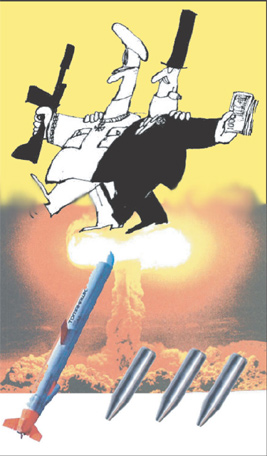
Sometime in the past two months, the U.S. Navy has deployed a new type of nuclear warhead in some of its Trident submarines. Called the W76-2, it is a “low-yield” warhead, which would explode with the blast power of about 8 kilotons—far less powerful than the Tridents’ other warheads, which have an explosive yield of 90 to 450 kilotons.
At first glance, this might seem like a good thing: a smaller blast means less death and damage, if a nuclear war happened. But in some ways, it’s a dangerous thing, and to explain why requires a brisk dive into the rabbit hole logic of nuclear strategy.
For many years, arms control advocates have argued that low-yield nuclear weapons are destabilizing because they lower the threshold between conventional and nuclear war. They seem to be—they are designed to be—more usable as weapons of war, and therefore some president, in a crisis, might feel more tempted to use them. (The United States has always had an explicit policy of reserving the right to use nuclear weapons first in a conflict.)
Those worries have intensified when we’ve had presidents who are viewed as erratic. In 2003, after the invasion of Iraq, some Air Force generals proposed building a new low-yield nuclear warhead that could burrow underground before exploding; they saw it as the ideal weapon for killing some future Saddam Hussein hiding in a bunker. But many members of the House and Senate Armed Services Committees did not trust President George W. Bush with such a weapon, so they tacked on an amendment to that year’s defense budget, prohibiting the “testing, acquisition, or deployment of a low-yield nuclear weapon”—and barring the Department of Energy from even researching such a weapon—without the advance approval of Congress.
Many now have the same worry about Donald Trump. In 2018, when then–Secretary of Defense Jim Mattis lobbied for the W76-2 on Capitol Hill, at least one Republican senator told him, “I don’t have a problem with this weapon. I have a problem with the president who’s authorized to use this weapon.”
But just months later, Trump’s vicelike grip on the Republican Party had tightened. The Democrat-controlled House voted to cancel the program; the GOP-led Senate voted to approve it. In the conference committee, the House managers folded. Some reasoned that it was such an inexpensive program: Only 50 warheads would be modified to the low-yield version, at a cost of $65 million, less than 0.1 percent of the entire defense budget. No big deal.
Another reason for the Democrats’ concession was that this low-yield program was presented as a response to a Russian threat. The argument was that the Russians had a new strategy called “escalate to de-escalate.” If war broke out in Europe, the Russians would launch a low-yield nuclear weapon at U.S. and NATO forces. If we didn’t have low-yield nuclear weapons to fire back, we would have to surrender. If we did have low-yield nukes, the rationale went, the Russians might not attack in the first place.
It is true that the Russian military has outlined such a strategy in some manuals and rehearsed this scenario in some training exercises. But it’s slippery logic to conclude that we need a low-yield Trident warhead to meet the threat.
First, the case for the new warhead hinges on the premise that, in order to deter the Russians, we need to match in kind every move they make: They build a low-yield missile; we have to do the same, or we wind up with a “gap in the escalation spectrum” (as some have labeled the threat). But there is nothing in history, strategy, or intelligence findings about Russian thinking on the subject to support this notion.
When the warhead goes off, it would look and feel like the largest explosion witnessed since World War II.
Second, even if the notion could be supported, it would be irrelevant because—as Hans Kristensen of the Federation of American Scientists estimates—the U.S. already has about 1,000 low-yield nuclear bombs and cruise missiles, which could be dropped or fired from F-15, F-16, B-1, and B-2 aircraft. Advocates of the low-yield Trident argue that those planes might be shot down by Russian air defenses, whereas the Trident missiles—launched from undetectable submarines—would definitely get through Russian defenses. This imbalance is overstated. Many, probably most of the U.S. planes would get through to their targets. More to the point, even if only a few got through, that would mean that we are able to launch low-yield nuclear weapons in response to Russian low-yield weapons—which means the premise of advocates’ case for low-yield Tridents is false.
Third, there is some dispute within intelligence agencies over why the Russians are deploying low-yield nuclear warheads in the first place. From the 1950s to the 1970s, the U.S. placed thousands of nuclear weapons in Western Europe to compensate for the superiority of Soviet tanks and troops in Eastern Europe. Now, many analysts believe, the Russians are putting more emphasis on nuclear weapons in order to counter U.S. and NATO superiority in conventional weapons. It’s two sides of the same coin. It doesn’t reflect a new kind of threat—or require a new kind of response.
In my new book, The Bomb: Presidents, Generals, and the Secret History of Nuclear War, I recount a highly classified war game played by the National Security Council late in the Obama administration. Reports of Russia’s “escalate to de-escalate” strategy were emerging. The idea of the game was to test whether this strategy might indeed thwart America’s ability or will to project power in Europe. The scenario went like this: The Russians invade one of the Baltic states; NATO fights back effectively; to reverse the tide, Russia fires a low-yield nuclear weapon at the NATO troops or at a base in Germany where drones, combat planes, and smart bombs were deployed. The question: What do U.S. decision-makers do next?
The game was first played in an NSC deputies’ meeting, consisting of second-tier officials from the various agencies and military branches. Initially, the generals steered the discussion toward operational details: How many nuclear weapons, and of what type, should the U.S. fire at what targets? Then, Colin Kahl, Vice President Joe Biden’s national security adviser, spoke up. The generals, he said, were missing the big picture. The minute the Russians drop a nuclear bomb, we would face a world-defining moment—the first time an atom bomb had been used in war since 1945. It would be an opportunity to rally the entire world against Russia. If we responded with diplomacy and economic pressure, and by pushing ahead with our conventional advantage, we would isolate and weaken Moscow’s leaders, policies, and military forces. However, if we responded by shooting off some nukes of our own, we would forfeit that advantage and, moreover, normalize the use of nuclear weapons.
The generals were caught off guard. They knew of the long-standing debate over whether the U.S. should be the first to use nuclear weapons in response to a conventional attack, but it seemed perverse to consider using conventional weapons in response to a nuclear attack. A few hours of discussion ensued, examining Kahl’s political challenge, NATO’s conventional military strength, the puzzle of which targets to hit with nuclear weapons (none made much sense), and whether a nuclear response would end the war any sooner or more victoriously than a conventional response (which didn’t seem likely). In the end, a consensus formed that, at least as a first step, the U.S. should respond with continued conventional military operations.
A month later, the NSC’s Principals Committee—the group of Cabinet secretaries and military chiefs—played the same game, but with very different results. Some of the same concerns were raised—the possibility of isolating the Russians by not taking the nuclear bait, the lack of any sensible targets, the uncertainty of whether nukes would dampen or further escalate the war. Still, the principals decided we had to respond with nuclear weapons, to maintain credibility among our allies and adversaries. They decided to fire a few nuclear weapons at the former Soviet republic of Belarus, even though, in the game, it had no involvement in the Russian attacks—and then they ended the game, without playing the next few steps.
Regardless of who was right, the deputies or the principals, there is another good reason for opposing the idea of launching low-yield nuclear weapons from a Trident submarine. In the first months of Trump’s presidency, Mattis assembled a group of seven longtime defense experts—the “Graybeards,” he called them—to hash out various issues. In the third and last of their meetings, held on Nov. 1, 2017, they discussed the “escalate to de-escalate” scenario and whether to respond by building low-yield Trident warheads. Most of the seven opposed the idea. Kevin Chilton, a retired Air Force general, argued that if the Russians saw a missile hurtling their way after being fired upon by a Trident submarine, they wouldn’t know whether it was high-yield or low-yield—they would see it as a “strategic” weapon, perhaps the first volley of a much larger attack against Russia, and respond accordingly.
Chilton’s opposition might have stemmed in part from the fact that the warhead was a Navy weapon. (He argued that, if we wanted to use nukes to send a signal to Moscow, a cruise missile fired from a bomber aircraft would be a better tool. Both the bomber and the cruise missile were Air Force weapons.) Still, he had a point. There’s nothing on the missile that flashes “Low Yield! Low Yield!” And when the warhead goes off, it would look and feel like the largest explosion witnessed since World War II. An 8-kiloton bomb may sound puny, but 8 kilotons means 8,000 tons, which means 16 million pounds—and that’s just the blast. There would also be fire, smoke, electromagnetic pulse, radiation, and radioactive fallout, spreading the toxicity far and wide. The bomb that leveled Hiroshima at the end of World War II exploded with the force of 12.5 kilotons—not that much larger than the W76-2.
No one in officialdom has ever played a war game in which a “limited” attack believably stays limited. Things spiral out of control pretty quickly.
Where would this weapon be aimed? I’ve asked several officials who deal with these matters. They have different answers. Some say it would be aimed at a target inside Russia. Some say, no, that would escalate the conflict; it would be aimed at a target on the battlefield. Some say the president would make the decision. (That’s the scariest answer of all.) The point is, as the Obama NSC’s war game spelled out, nobody knows how it would, or should, be used—and certainly nobody knows what might happen next.
That is the real danger of the low-yield weapon—not so much the weapon itself (especially compared with much higher-yield weapons) but the deception that the whole concept plants in a decision-maker’s mind: the idea that “low-yield” means tiny, harmless, controllable. In fact, the dynamic unleashed—the near-certainty of a retaliatory strike, followed by another round of strikes, steadily subsumed in the fog of war, as communications systems burn out, commanders wander in confusion about what’s going on, each side fears the worst from the other and seeks to preempt the next blow with a blow of his own—would mean that before too long, the conflict escalates to catastrophe.
If war happens and if nuclear weapons come into the fray, clearly it’s sensible to try to keep the damage limited. But no one in officialdom has ever played a war game in which a “limited” attack believably stays limited. Things spiral out of control pretty quickly. Which is why it’s a good idea to keep the threshold between conventional and nuclear war as high as possible—and why the low-yield Trident warhead is a bad idea. https://slate.com/news-and-politics/2020/02/low-yield-warhead-nuclear-weapons-navy-trident-submarines.html








 nuclear-news