Donald Trump plays with possible nuclear crisis in Iran
 Trump risks nuclear crisis in Iran, The Hill, BY REBECCA KHEEL – 01/06/20 President Trump is increasingly facing the possibility of a nuclear crisis with Iran, as Tehran takes its biggest step back from the 2015 nuclear deal. Trump risks nuclear crisis in Iran, The Hill, BY REBECCA KHEEL – 01/06/20 President Trump is increasingly facing the possibility of a nuclear crisis with Iran, as Tehran takes its biggest step back from the 2015 nuclear deal.
Iran’s decision to stop adhering to limits in the Obama-era nuclear agreement comes just days after Trump authorized a drone strike that killed Gen. Qassem Soleimani, posing a major test of the Trump administration’s gambit to withdraw from the international accord. While Iran hasn’t kicked out nuclear inspectors, and has even left open the possibility of coming back into compliance, experts say Sunday’s announcement by Tehran brings the deal closer to collapse than ever before……. Iran had set an early January deadline for its next step away from the deal, even before last week’s U.S. strike in Baghdad killed Soleimani, the Quds Force leader. But his unexpected death has ratcheted up tensions between the United States and Iran, stoking fears about a military confrontation and making any step away from the nuclear deal now that much more fraught. “The degree of their abandonment of the JCPOA may have come about as a result” of Soleimani’s death, Takeyh said, using the acronym for the official name of the deal. On Sunday, Iran announced it would no longer adhere to the deal’s limits on uranium enrichment. Trump responded to the news Monday by tweeting in all caps that “Iran will never have a nuclear weapon!”….. Despite saying it was no longer bound by the deal’s limits, Iran did not immediately announce actions to increase its uranium enrichment and reiterated its pledge to come back into compliance with the deal if it gets sanctions relief. Iran also maintained that its nuclear program is not a weapons program. Iran also said it would continue cooperating with International Atomic Energy Agency (IAEA) inspectors. The IAEA said Monday its “inspectors continue to verify and monitor activities in the country.”….https://thehill.com/policy/defense/477047-trump-risks-nuclear-crisis-in-iran |
|
Small Modular Nuclear Reactors – just a speculative technology, no use against climate change

|
Environmentalists Say Small Nuclear Reactors Aren’t A Climate Change But David Thompson of Leap4ward says the technology is too new and won’t be implemented soon enough to have an impact on climate change. Thompson says the province shouldn’t be investing in “speculative technology” and should instead be focusing renewable energy sources that have been proven to work in New Brunswick, such as wind, solar and hydro. “The renewable sources of energy that we’ve talked about to the premier, some of them can be put in place and operating in maybe three, three and a half years,” he said. Thompson says in comparison, SMRs could take 10 years or more to perfect. “We haven’t got 10 years for something that might work, and another 10 years to build it after it’s proven to work, or even longer than that to put in place enough of it so that it’ll make some kind of difference,” he said. “At the end of it we still have the problem of nuclear waste and we will have the problem of radiation.” Interest in SMR and nuclear energy has been growing in recent months as a green energy alternative, but the modular reactor technology is still in the very early stages. Thompson says climate change is a growing issue and more needs to be done sooner rather than later. “Climate change can’t wait for something that might work, and what if it doesn’t work? What if it isn’t economically feasible after 10 years?” he said. He says not only have wind, solar, and hydro been proven to work, but they’re low-cost and easy to implement. Thompson has sent a letter to Premier Blaine Higgs outlining his concerns and asking him to pull funding from SMRs. “We applaud him for the decision he made to cut all funding to the speculative Joi [Scientific] hydrogen fuel project, but we’re even more concerned about these companies who are getting government money—and attempting to get more—to build these modular reactors,” he said. “By not putting renewable energy in place now in New Brunswick, we’re not doing the right thing. We need action on climate change now.” |
|
Trump urges Britain, Germany, France, Russia and China to dump the Iran nuclear deal
 Trump urges dumping of Iran nuclear deal, news.com.au, 9 Jan 2020,
The decision by the UK and other signatories to try to maintain the Iran nuclear deal has been criticised by US President Trump. US President Donald Trump has called on the world’s major powers to abandon the “defective” Iran nuclear deal.
Trump said the “time has come” for Britain, Germany, France, Russia and China to dump the Joint Comprehensive Plan of Action (JCPOA).
Under the deal, Iran agreed to limit its nuclear programme and allow in international inspectors in return for the easing of economic sanctions.
But at a White House press conference on Wednesday, in which he gave his reaction to the overnight Iranian attacks on air bases housing US forces in Iraq, Trump said the “very defective JCPOA expires shortly anyway and gives Iran a clear and quick path to nuclear breakout”.
Trump said the US would immediately impose “additional punishing economic sanctions” on Tehran until Iran changes its behaviour,” citing the nuclear programme.
Since Trump pulled out of the deal in 2018 and started a “maximum pressure” campaign of sanctions against Iran, tensions have steadily escalated.
“Iran must abandon its nuclear ambitions and end its support for terrorism. The time has come for the United Kingdom, Germany, France, Russia and China to recognise this reality,” the President added.
“They must now break away from the remnants of the Iran deal – or JCPOA – and we must all work together towards making a deal with Iran that makes the world a safer and more peaceful place.”
However, just hours before Trump’s remarks, UK Prime Minister Boris Johnson said the deal remains the “best way of preventing nuclear proliferation in Iran. https://www.news.com.au/world/breaking-news/trump-urges-dumping-of-iran-nuclear-deal/news-story/535d6f4704348e8ebac6f0e96f45403c
Trump’s unpredictability on Iran adds to weapons proliferation dangers
 Trump’s unpredictability is making nuclear-nonproliferation advocates nervous as the US takes an aggressive posture against Iran, Business Insider, DAVE MOSHER, JAN 8, 2020,
- Tensions between Iran and the US have escalated dramatically in recent weeks, most notably with President Donald Trump ordering the assassination of Iranian Maj. Gen. Qassem Soleimani.
- Trump has vowed potentially disproportionate attacks against Iran if the country retaliates against Americans.
- Nuclear-weapons experts aren’t immediately concerned about a “tactical” (or limited) nuclear strike against Iranian targets, but they said Trump as president made it a much likelier possibility.
- If the US or its allies used even one nuclear weapon in combat, it would end a 75-year streak of nonuse, with global and lasting consequences.
- “It’s possible people around the world will get together to ban these things. But I think the reality is that we’d see nuclear weapons used not on a frequent basis, but on a more regular basis,” one researcher said…… https://www.businessinsider.com.au/trump-iran-attack-tactical-nuclear-weapons-war-consequences-2020-1?r=US&IR=T
 Fact check: Amy Klobuchar falsely claims Iran is ‘announcing’ it will develop a nuclear weapon https://edition.cnn.com/2020/01/07/politics/fact-check-klobuchar-iran-nuclear-weapon/
Trump’s plan to systematically remove environmental protection
 Trump’s 2020 plan: Change the rules on rules, Kelsey Brugger, E&E News reporter Greenwire: Friday, January 3, 2020 In the first half of 2020, Trump officials are hurrying to fundamentally change the way environmental rules are crafted.The administration plans to finalize regulations that could hamstring future presidents from making rules that rely on public health studies or fail to fully consider the benefits to Americans.
Trump’s regulatory plan released last fall showed hundreds of “economically significant” actions that the administration plans to finalize this year. Of those, at least 18 are noteworthy environmental rules — on air pollution and emissions to drilling and water quality.
But it’s Trump’s rules on the rulemaking process itself that could have the most lasting impact, according to experts.
For example, EPA’s proposed rule, “Strengthening Transparency in Regulatory Science,” could restrict the scientific evidence used to write air pollution rules.
The Trump administration also plans to change the way cost-benefit analyses are calculated, weakening future limits on power plant emissions, for example. Both rules are expected to advance in early 2020.
“Those are foundational,” said Betsy Southerland, a former longtime senior EPA career staffer and member of the Environmental Protection Network. “If they are finalized, from now on all environmental rules cannot count co-benefits and cannot use public health studies, then they can paralyze future rulemaking while the litigation slowly winds forward.”
It would take considerable time for a new administration to reverse those rollbacks, and certain Trump actions could get lost in the morass. The Obama EPA similarly could not undo some George W. Bush-era Clean Air Act permits that allowed aging facilities to continue to operate.
But time is running out.
The administration is up against a May deadline: Any regulations completed after that point would be subject to review under the Congressional Review Act. If 2021 ushers in a new president and a left-leaning Congress, the pair could undo many of Trump’s controversial triumphs.
Generally, not much happens in the federal government during an election year, when administrations tend to enter “political lockdown.” But in the Trump era, “unprecedented” is typical. And Trump continues to campaign on aggressive deregulation………
n 2020, the administration is expected to complete several environmental priorities.
The changes most concerning to Southerland included the WOTUS rewrite, the Affordable Clean Energy repeal and other pesticide reviews that are being done under the Toxic Substances Control Act, she said. “They are racing to finalize all of the damaging rollbacks in 2020,” she said.
Other drafts expected to be released in the coming weeks or months include the National Environmental Policy Act, which Trump ordered to be revised to ease permitting requirements when he first entered office; the Mercury and Air Toxics Standards, which would revoke past findings of mercury emissions and other pollutants; and the clean car standards, a joint effort of EPA and the Department of Transportation.
That two-part effort would weaken Obama-era fuel economy standards and prevent California from setting its own stricter standards (Greenwire, Nov. 20, 2019).
The Trump mantra, in a large part, has simply been to undo what Obama did…….Twitter: @kelseybrugger Email: kbrugger@eenews.net https://www.eenews.net/stories/1061984181
How Ontario can get out of nuclear power, and reduce carbon emissions
 Ontario can phase out nuclear and avoid increased carbon emissions, The Conversation, January 6, 2020 MV Ramana, Simons Chair in Disarmament, Global and Human Security at the Liu Institute for Global Issues, University of British Columbia, Xiao Wei, MITACS Globalink Research Intern, University of British Columbia As wind and solar energy have become cheaper, they’ve become a more prominent and important way to generate clean electricity in most parts of the world.The Ontario government, on the other hand, is cancelling renewable energy projects at a reported cost of at least $230 million while reinforcing the province’s reliance on nuclear power via expensive reactor refurbishment plans.
As researchers who have examined the economics of electricity generation in Ontario and elsewhere, we argue that this decision is wasteful and ill-advised, and the unnecessary cost differential will rise further in the future.
One concern about renewables has been the intermittency of these energy sources. But studies have shown it’s feasible to have an all-renewable electric grid.
These feasibility studies, however, are always location specific. In that spirit, we have carried out detailed modelling and found that it’s possible to meet Ontario’s electricity demands throughout the year with just a combination of renewables, including hydropower, and storing electricity in batteries.
We also found that dealing with the intermittency of wind and solar energy by adding batteries would be more economical than refurbishing nuclear plants in the foreseeable future, well before the current refurbishment projects are completed.
That’s because of the expected decline in the cost of batteries used to store the electricity during the hours when the wind is blowing or the sun is shining in order to supply electricity during the periods when they aren’t. The cost of different kinds of battery technologies, such as lithium-ion or flow batteries, have come down rapidly in recent years.
Essential results
In all scenarios, the bulk of the demand was met by solar and wind power, with a lower fraction met by hydropower. Even in the scenarios with no batteries, less than 20 per cent of the electricity demand was met by nuclear power…….
In summary, our results show that for reasonable assumptions about future battery costs and the current price tag for solar and wind power, scenarios involving nuclear power are more than 20 per cent higher than the cheapest scenario involving only batteries, solar, wind and the current hydropower capacity. …
nuclear power isn’t needed to meet Ontario’s electricity needs. And the absence of nuclear power won’t have any impact on emissions in Ontario’s energy sector.https://theconversation.com/ontario-can-phase-out-nuclear-and-avoid-increased-carbon-emissions-128854?fbclid=IwAR20ANW_yAmpR7zZVw113hUp9bl7Xt2h0v1XiB1K815lFIKctZiaR8xB5Ew
Tennessee Valley Authority unfairly fired a nuclear whistleblower
|
Labor department rules TVA cooked up cause to fire nuclear whistleblower, Jamie Satterfield, Knoxville News Sentinel Jan. 3, 2020 The U.S. Department of Labor says the Tennessee Valley Authority fired a nuclear engineer who blew the whistle on safety concerns and lied about it.The labor department is ordering TVA to give Beth Wetzel her job back and shell out more than $200,000 in back pay, lost bonuses and benefits, compensatory damages and legal fees.
TVA said it fired Wetzel for badmouthing supervisor Erin Henderson, but the labor department ruled Wetzel properly raised safety concerns about the nuclear program and – when asked by a TVA attorney – gave her “honest” opinion Henderson was too inexperienced for her post and ignored safety complaints…….. https://www.knoxnews.com/story/news/crime/2020/01/03/labor-department-tva-cooked-up-cause-fire-nuclear-whistleblower/2794793001/ |
|
|
The escalation of nuclear tension between USA and Iran
Timeline: How tensions escalated with Iran since Trump withdrew US from nuclear deal
President Trump’s decision to leave the 2015 nuclear deal with Iran was followed by an escalation of rhetoric, sanctions and attacks between the countries. George Petras, Jim Sergent, Janet Loehrke, Karl Gelles and Javier Zarracina, USA TODAY, 3 Jan 2020,
July 25, 2015
Iran, the United States and other nations approve a deal in which Iran agrees to shift its nuclear program from weapons production to peaceful commercial use for 10 years. Iran allows international inspectors on its nuclear weapons sites.
In exchange, the United States and the United Nations Security Council lift energy, trade, technology and financial sanctions against Iran.
The pact, established during the tenure of President Barack Obama, is an executive agreement, not a treaty, which means it isn’t formally approved by Congress. Republicans oppose the deal and question its legality.
Leaving the deal
October 2016
Presidential candidate Donald Trump says Iran should write the United States a thank you letter for “the stupidest deal of all time.” Trump says the United States will withdraw from the deal if he’s elected.
May 8, 2018
President Trump announces the withdrawal from the Iran deal. Iran, France, Britain and Germany say they will stay in the pact.
US increases pressure
August-November 2018
The United States reimposes economic sanctions targeting Iran’s energy, financial, shipping and shipbuilding industries. Iran says it will take unspecified actions regarding the nuclear deal if Britain, France, Germany, Russia and China don’t help it engage in international trade.
April 8, 2019
Trump says he will designate Iran’s Islamic Revolutionary Guards as a foreign terrorist organization. The Pentagon opposes the change, saying it increases the possibility of retaliation against American military and intelligence personnel.
April 22
May 5
John Bolton, Trump’s national security adviser, says the United States will send an aircraft carrier strike force and Air Force bombers to the Middle East. The deployment shows Iran that “any attack on United States interests or on those of our allies will be met with unrelenting force.”
Iran retaliates
May 8
Iran says it will increase its production of enriched uranium and heavy water.
May 12
Four oil tankers – two from Saudi Arabia, one from the United Arab Emirates and one from Norway – are attacked in the Persian Gulf. The United States says Iran is behind the attacks.
June 13
Two oil tankers – one from Norway, the other from Japan – are attacked in the Gulf of Oman. The United States blames Iran, which denies responsibility.
June 20
Iran shoots down a U.S. surveillance drone it says violated Iranian airspace. The U.S. Central Command says the aircraft was in international territory.
June 20
Trump orders retaliatory attacks against Iran but cancels the strikes shortly before they are to be launched. Four days later, he imposes more sanctions against Iran.
July 1
Iran says it’s exceeded the amount of low-enriched uranium it was allowed to build under the 2015 agreement.
US-Iranian tensions rise………
Jan. 2 2020
Iranian military leader Qasem Soleimani and five others are killed in a U.S. drone strike at Baghdad airport. U.S. officials call it a “defensive action,” saying Soleimani planned attacks on U.S. diplomats and troops. https://www.usatoday.com/in-depth/news/2020/01/03/us-iran-conflict-since-nuclear-deal/2803223001/
War planners ignore the fire effects of nuclear bombing

City on fire, Nuclear Darkness, by Lynne Eden, 30 Dec 19, By ignoring the fire damage that would result from a nuclear attack and taking into account blast damage alone, U.S. war planners were able to demand a far larger nuclear arsenal than necessary.
For more than 50 years, the U.S. Government has seriously underestimated damage from nuclear attacks. The earliest schemes to predict damage from atomic bombs, devised in 1947 and 1948, focused only on blast damage and ignored damage from fire, which can be far more devastating than blast effects.
The failure to include damage from fire in nuclear war plans continues today. Because fire damage has been ignored for the past half-century, high-level U.S. decision makers have been poorly informed, if informed at all, about the extent of damage that nuclear weapons would actually cause. As a result, any U.S. decision to use nuclear weapons almost certainly would be predicated on insufficient and misleading information. If nuclear weapons were used, the physical, social, and political effects could be far more destructive than anticipated.
How can this systematic failure to assess fire damage have persisted for more than half a century? The most common response is that fire damage from nuclear weapons is inherently less predictable than blast damage. This is untrue. Nuclear fire damage is just as predictable as blast damage.
One bomb, one city
To visualize the destructiveness of a nuclear bomb, imagine a powerful strategic nuclear weapon detonated above the Pentagon, a short distance from the center of Washington, D.C.1 Imagine it is a “near-surface” burst-about 1,500 feet above the ground-which is how a military planner might choose to wreak blast damage on a massive structure like the Pentagon. Let us say that it is an ordinary, clear day with visibility at 10 miles, and that the weapon’s explosive power is 300 kilotons-the approximate yield of most modern strategic nuclear weapons. This would be far more destructive than the 15-kilotonbomb detonated at Hiroshima or the 21-kiloton bomb detonated at Nagasaki.2
Washington, D.C., has long been a favorite hypothetical target.3 But a single bomb detonated over a capital city is probably not a realistic planning assumption.
When a former commander in chief of the U.S. Strategic Command read my scenario, he wanted to know why I put only one bomb on Washington. “We must have targeted Moscow with 400 weapons,” he said. He explained the military logic of planning a nuclear attack on Washington: “You’d put one on the White House, one on the Capitol, several on the Pentagon, several on National Airport, one on the CIA, I can think of 50 to a hundred targets right off. . . . I would be comfortable saying that there would be several dozens of weapons aimed at D.C.” Moreover, he said that even today, with fewer weapons, what makes sense would be a decapitating strike against those who command military forces. Today, he said, Washington is in no less danger than during the Cold War.
The discussion that follows greatly understates the damage that would occur in a concerted nuclear attack, and not only because I describe the effects of a single weapon. I describe what would happen to humans in the area, but I do not concentrate on injury, the tragedy of lives lost, or the unspeakable loss to the nation of its capital city. These are important. But I am concerned with how organizations estimate and underestimate nuclear weapons damage; thus, I focus largely, as do they, on the physical environment and on physical damage to structures.
With this in mind, let us look at some of the consequences of a nuclear weapon detonation, from the first fraction of a second to the utter destruction from blast and fire that would happen within several hours. This will allow us to understand the magnitude of the damage from both effects, but particularly from fire, which is neither widely understood nor accounted for in damage prediction in U.S. nuclear war plans.
Unimaginable lethality
The detonation of a 300-kiloton nuclear bomb would release an extraordinary amount of energy in an instant-about 300 trillion calories within about a millionth of a second. More than 95 percent of the energy initially released would be in the form of intense light. This light would be absorbed by the air around the weapon, superheating the air to very high temperatures and creating a ball of intense heat-a fireball.
Because this fireball would be so hot, it would expand rapidly. Almost all of the air that originally occupied the volume within and around the fireball would be compressed into a thin shell of superheated, glowing, high-pressure gas. This shell of gas would compress the surrounding air, forming a steeply fronted, luminous shockwave of enormous extent and power-the blast wave.
By the time the fireball approached its maximum size, it would be more than a mile in diameter. It would very briefly produce temperatures at its center of more than 200 million degrees Fahrenheit (about 100 million degrees Celsius)-about four to five times the temperature at the center of the sun.
This enormous release of light and heat would create an environment of almost unimaginable lethality. Vast amounts of thermal energy would ignite extensive fires over urban and suburban areas. In addition, the blast wave and high-speed winds would crush many structures and tear them apart. The blast wave would also boost the incidence and rate of fire-spread by exposing ignitable surfaces, releasing flammable materials, and dispersing burning materials.
Within minutes of a detonation, fire would be everywhere. Numerous fires and firebrands-burning materials that set more fires-would coalesce into a mass fire. (Scientists prefer this term to “firestorm,” but I will use them interchangeably here.) This fire would engulf tens of square miles and begin to heat enormous volumes of air that would rise, while cool air from the fire’s periphery would be pulled in. Within tens of minutes after the detonation, the pumping action from rising hot air would generate superheated ground winds of hurricane force, further intensifying the fire.4
Virtually no one in an area of about 40-65 square miles would survive.
A little farther away…….
Within minutes of a detonation, fire would be everywhere. Numerous fires and firebrands-burning materials that set more fires-would coalesce into a mass fire. (Scientists prefer this term to “firestorm,” but I will use them interchangeably here.) This fire would engulf tens of square miles and begin to heat enormous volumes of air that would rise, while cool air from the fire’s periphery would be pulled in. Within tens of minutes after the detonation, the pumping action from rising hot air would generate superheated ground winds of hurricane force, further intensifying the fire.4
Virtually no one in an area of about 40-65 square miles would survive.
A little farther away……
Three miles from ground zero……..
A hurricane of fire…..
|
….The first indicator of a mass fire would be strangely shifting ground winds of growing intensity near ground zero. (Such winds are entirely different from and unrelated to the earlier blast-wave winds that exert “drag pressure” on structures.) These fire-winds are a physical consequence of the rise of heated air over large areas of ground surface, much like a gigantic bonfire.
The inrushing winds would drive the flames from combusting buildings horizontally toward the ground, filling city streets with hot flames and firebrands, breaking in doors and windows, and causing the fire to jump hundreds of feet to swallow anything that was not yet violently combusting. These extraordinary winds would transform the targeted area into a huge hurricane of fire. Within tens of minutes, everything within approximately 3.5 to 4.6 miles of the Pentagon would be engulfed in a mass fire. The fire would extinguish all life and destroy almost everything else. Firestorm physicsThis description of the physics of mass fire is based on the work of a few scientists who have examined in detail the damaging effects of nuclear weapons, including nuclear engineer Theodore A. Postol and physicist Harold Brode. Postol is one of the country’s leading non-government funded technical experts on nuclear weapons, missiles, and arms control. Brode’s five-decade career has been devoted to the study of nuclear weapons effects. That mass fires have occurred, and that something like the firestorm described here could occur, is not in dispute. What is not widely accepted is that nuclear weapons detonated in urban or suburban areas would be virtually certain to set mass fires, and that the resulting damage is as predictable as blast damage. The much more widely held view is that the probability and range of mass fire depends on many unpredictable environmental variables, including rain, snow, humidity, temperature, time of year, visibility, and wind conditions. But the work of Postol, Brode, and Brode’s collaborators shows that mass fire creates its own environment. Except in extreme cases, environmental factors do not affect the likelihood of mass fire. Weather can affect the fire’s range, but this can be reasonably well predicted. For nuclear weapons of approximately 100 kilotons or more, the range of destruction from mass fire will generally be substantially greater than from blast. The extraordinarily high air temperatures and wind speeds characteristic of a mass fire are the inevitable physical consequence of many simultaneous ignitions occurring over a vast area. The vacuum created by buoyantly rising air follows from the basic physics of combustion and fluid flow (hydro- or fluid dynamics). As the area of the fire increases, so does the volume of rising air over the fire zone, causing even more air to be sucked in from the periphery of the fire at increasingly higher speeds. Only a few mass fires have occurred in human history: those created by British and U.S. conventional incendiary weapons and by U.S. atomic bombs in World War II. These include fires that destroyed Hamburg, Dresden, Kassel, Darmstadt, and Stuttgart in Germany, and Tokyo, Hiroshima, and Nagasaki in Japan. History’s first mass fire began on the night of July 27, 1943, in Hamburg-created by allied incendiary raids. Within 20 minutes, two thirds of the buildings within an area of 4.5 square miles were on fire. It took fewer than six hours for the fire to completely burn an area of more than five square miles. Damage analysts called it the “Dead City.” Wind speeds were of hurricane force; air temperatures were 400-500 degrees Fahrenheit. Between 60,000 and 100,000 people were killed in the attack.6 A mass fire from a modern nuclear bomb could be expected to destroy a considerably larger urban or suburban area, in a similarly short time. The unique features of the mass fire fundamentally distinguish it from the more slowly propagating line fire. …….. Fire environments created by mass fires are fundamentally more violent and destructive than smaller-scale fires, and they are far less affected by external weather conditions. They are not substantially altered by seasonal and daily weather conditions. ….. Average air temperatures in the burning areas after the attack would be well above the boiling point of water; winds generated by the fire would be hurricane force; and the fire would burn everywhere at this intensity for three to six hours. Even after the fire burned out, street pavement would be so hot that even tracked vehicles could not pass over it for days, and buried, unburned material from collapsed buildings could burst into flames if exposed to air even weeks after the fire. Those who sought shelter in basements of strongly constructed buildings could be poisoned by carbon monoxide seeping in, or killed by the ovenlike conditions. Those who tried to escape through the streets would be incinerated by the hurricane-force winds laden with firebrands and flames. Even those able to find shelter in the lower-level sub-basements of massive buildings would likely die of eventual heat prostration, poisoning from fire-generated gases, or lack of water. The firestorm would eliminate all life in the fire zone. All publication data from “Whole World on Fire” by Lynn Eden at Google Books http://www.nucleardarkness.org/web/cityonfire/ |
|
Ohio’s nuclear legal battles: Supreme Court will hear case filed by Ohioans Against Corporate Bailouts (OACB).

 Kallanish Energy 30th Dec 2019, Legal battles over the Ohio energy law that starts providing subsidies to the state’s two nuclear power plants in 2021, may continue, Kallanish Energy learns.
The Ohio Supreme Court voted 4-0 to hear the case filed by Ohioans Against Corporate Bailouts (OACB). Three justices recused
themselves from the case, citing political campaign conflicts, Energy
Central News reported. OACB maintains it was denied a full 90 days to
gather signatures for a referendum. They want to overturn the law that
subsidizes Ohio’s two nuclear power plants owned by FirstEnergy Solutions
and two coal-fired plants owned by Ohio Valley Electric Corp. The law also
shrinks and eventually eliminates requirements that utilities get a
percentage of their power from renewable energy sources and scraps
utilities’ state-mandated energy efficiency programs.
https://www.kallanishenergy.com/2019/12/30/ohio-supreme-court-will-hear-nuclear-bailout-case/
America Almost Stockpiled Nuclear Weapons In Iceland
|
Secrets Revealed: America Almost Stockpiled Nuclear Weapons In Iceland
Why didn’t it happen? National Interest, by Michael Peck, 29 DEc 19, Key point: We still don’t officially know which nations had U.S. nuclear weapons on their soil.
If Miss Manners were a diplomat, she would tell us how rude it is to place nuclear bombs in the territory of our allies without being invited to.
But it turns out that in the 1950s, the United States considered deploying nuclear weapons in Iceland without telling the Icelanders, according to declassified documents published by the watchdog organization National Security Archive. “At the end of the 1950s the U.S. Navy ordered the construction of a facility for storing nuclear depth bombs, an Advanced Underseas Weapons (AUW) Shop at the outskirts of Keflavik airport,” the National Security Archive wrote. “The AUW facility was built by local Icelandic workers who thought its purpose was to store torpedoes.”…….. the problem is that Iceland didn’t want nukes on its soil, which would have made the little nation a big target in Soviet eyes. In fact, Iceland’s decision to join NATO in 1949 sparked riots in the normally placid country. In 1951 and in 1960, Icelandic officials asked whether the United States had deployed nuclear weapons at its bases in Iceland. The United States never did—or at least as has so far been revealed—store these weapons on Iceland, and told Icelandic officials so. However, National Security Archive researchers believe that in a still-classified letter, the State Department in 1960 told Tyler Thompson, U.S. ambassador to Iceland, that “the U.S. government was free to deploy nuclear weapons in Iceland without securing the agreement of Reykjavik.”
The evidence is in Thompson’s reply to the State Department, in which the name of the nation was redacted by the declassification censors, but whichalmost certainly refers to Iceland. If U.S. policy was never to store nuclear weapons on Canadian soil without Canadian permission, then why should Iceland be treated differently? Thompson asks. “The possibility of [Iceland’s] withdrawal from Nato in protest should not be overlooked,” he added……. we still don’t officially know which nations had U.S. nuclear weapons on their soil. “The U.S. government has not acknowledged the names of a number of other countries which directly participated in the NATO nuclear weapons stockpile program during the Cold War (and later): Belgium, Greece, Italy, the Netherlands, and Turkey (only West Germany and the United Kingdom have been officially disclosed),” according to the National Security Archive. Guaranteed that the Russians know, but we don’t. https://nationalinterest.org/blog/buzz/secrets-revealed-america-almost-stockpiled-nuclear-weapons-iceland-109321 |
|
Missouri lawmaker pushes for helping nuclear companies to charge customers in advance
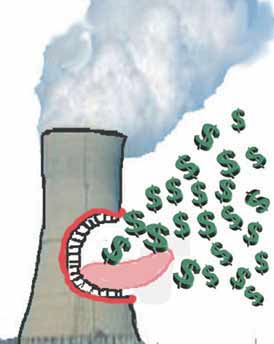 Local rep looks to boost nuclear by letting companies charge customers for plants up front, Austin Huguelet, Springfield News-Leader Dec. 29, 2019 Missouri hasn’t seen a new nuclear plant in more than 30 years.A local lawmaker and state air conservation officials say that needs to change to meet the demands of the future. Local rep looks to boost nuclear by letting companies charge customers for plants up front, Austin Huguelet, Springfield News-Leader Dec. 29, 2019 Missouri hasn’t seen a new nuclear plant in more than 30 years.A local lawmaker and state air conservation officials say that needs to change to meet the demands of the future.
Their first step: letting power companies bill customers up front for the cost. Rep. John Black, R-Marshfield, filed a bill earlier this month that would allow companies to add the cost of a new nuclear plant or renewable energy generator to customers’ rates while they’re under construction. Missouri voters banned the practice via initiative petition in 1976, shortly after St. Louis-based Ameren’s corporate predecessor won approval to collect costs while it built the state’s first nuclear power plant in Callaway County. Consumer advocates railed against the idea of paying for something not yet in service. Environmentalists raised the specter of potential disasters. At the ballot box, 63 percent of voters agreed, delivering a durable mandate that has withstood efforts to repeal the law. …….. John Coffman, who led the state’s utility watchdog from 2003-2005 and now does advocacy work around the country, said Black’s idea is simply about shifting risk from Wall Street to utility customers. “Sometimes Wall Street doesn’t want to invest in it unless they’re using the ratepayers’ money to do it,” Coffman said. “But then people should be asking, ‘Why is that?’” ……..Ed Smith, the policy director for the Missouri Coalition for the Environment he said the lack of easy taxpayer or ratepayer money for nuclear has led Ameren to make better decisions for the public. “Missouri was spared of having its customers spend billions of dollars on a nuclear plant,” he said. “And Ameren has acquired wind farms, built pipelines and done other things that are prudent for its customers rather than chasing this shiny nuclear idea that would generate a chunk of money for investors but was not in the best interest of their customers.”…….. John Coffman, who now represents the Consumers Council of Missouri, said all Black’s bill does is shift the risk taken on by investors and shareholders to customers. That may not be a problem if a project is completed on time and on budget, but Coffman said other recent projects suggest there’s no guarantee and plenty of downside. He represented AARP of South Carolina in the aftermath of that state passing a law allowing cost recovery during construction, which led to utility companies spending $9 billion on a reactor and then abandoning it amid cost overruns, delays, falling energy demand and the bankruptcy of its lead contractor. Ratepayers have already paid more than $2 billion for the project, according to the (Charleston) Post and Courier, and are on the hook to pay a new owner roughly the same amount over 20 years. “The public should not be their insurance,” Coffman said……… The legislation is House Bill 1784. https://www.news-leader.com/story/news/politics/2019/12/29/john-black-nuclear-power-charging-customers-up-front/2752198001/ |
|
America’s choice – stop the nuclear weapons obsession, or take the road to extinction

 extinction https://independentaustralia.net/politics/politics-display/helen-caldicott-our-nuclear-arms-obsession-is-a-countdown-to-extinction,13408, By Helen Caldicott | 14 December 2019 America could lead the way in reallocating its arms budget towards fixing the planet’s problems, writes Dr Helen Caldicott.
I WRITE THIS PIECE as a physician expertly trained to make accurate diagnoses to either cure the patient or to alleviate their symptoms.
I, therefore, approach the viability of life on Earth from a similar and honest perspective. Hence, for some, this may be an extremely provocative article but as the planet is in the intensive care unit, we have no time to waste and the startling truth must be accepted.
As TS Elliott wrote so long ago, ‘This is the way the world ends, not with a bang but a whimper’.
Will we gradually burn and shrivel the wondrous creation of evolution by emitting the ancient carbon stored over billions of years to drive our cars and to power our industries, or will we end it suddenly with our monstrous weapons within which have captured the energy powering the sun?
Here’s the stark diagnosis from a U.S. perspective.
The Department of Defence has nothing to do with defence, because it is, in effect, the Department of War. Over one trillion dollars of U.S. taxpayers’ money is stolen annually to create and build the most hideous weapons of death and destruction, even to launch killing machines from space.
And since 9/11, six trillion dollars have been allotted to the slaughter of over half a million people, almost all of whom were civilians — men, women and children.
Brilliant people, mostly men, are employed by the massive military-industrial corporations – Lockheed Martin, Boeing, BAE, United Technologies, to name a few – deploying their brainpower to devise better and more hideous ways of killing.
From an unbiased perspective, the only true terrorists today are Russia and the United States of America, both of which have several thousand hydrogen bombs larger by orders of magnitude than the Hiroshima and Nagasaki bombs on hair-trigger alert, ready to be launched with a press of a button in the U.S. by the President.
This so-called nuclear “exchange” would take little over one hour to complete. As in Japan, people would be seared to bundles of smoking char as their internal organs boiled away and, over time, the global environment would be plunged into another ice age called “nuclear winter”, annihilating almost all living organisms over time, including ourselves.
But the stark truth is that the United States of America has no enemies. Russia, once a sworn communist power is now a major capitalist country and the so-called “war on terror” is just an excuse to keep this massive killing enterprise alive and well.
Donald Trump is right when he says we need to make friends with the Russians because it’s the Russian bombs that could and might annihilate America. Indeed, we need to foster friendship with all nations throughout the planet and reinvest the billions and trillions of dollars spent on war, killing and death to saving the ecosphere by powering the world with renewable energy including solar, wind and geothermal and planting trillions of trees.
Such a move would also free up billions of dollars to be reallocated to life such as free medical care for all U.S. citizens, free education for all, to house the homeless, to hospitalise the mentally sick, to register all citizens to vote and to invest in the abolition of nuclear weapons.
The United States of America urgently needs to rise to its full moral and spiritual height and lead the world to sanity and survival. I know this is possible because, in the 1980s, millions of wonderful people rose up nationally and internationally to end the nuclear arms race and to end the Cold War.
This, then, is the sound template upon which we must act. You can follow Dr Caldicott on Twitter @DrHCaldicott. Click here for Dr Caldicott’s complete curriculum vitae.
Hawaii’s law-makers very worried about the nuclear coffin at the Marshall Islands
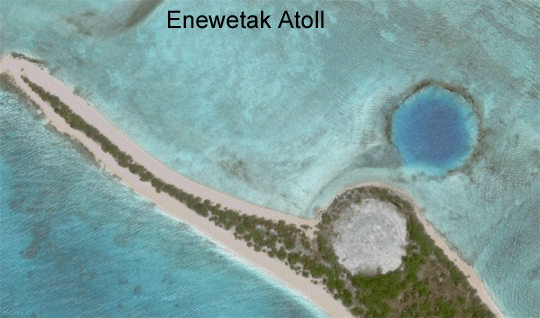 How A Nuclear Waste Site 2,800 Miles Away Became A Hawaii Priority https://www.civilbeat.org/2019/12/how-a-nuclear-waste-site-2800-miles-away-became-a-hawaii-priority/
The Runit Dome in the Marshall Islands is cracked and in danger of spilling its radioactive contents into the Pacific Ocean. By Nick Grube / December 26, 2019 WASHINGTON — A concrete dome built decades ago by the U.S. government on a Marshall Islands atoll 2,800 miles from Hawaii has the state’s federal lawmakers worried.
The Runit Dome is a relic of America’s atomic past. It’s home to 3 million cubic feet of radioactive waste that was buried there as part of the government’s effort to clean up the mess left from dozens of nuclear tests in the 1940s and ’50s that decimated the atoll.
A warming climate and rising sea levels now threaten the integrity of the saucer-shaped structure, which, if it fails, could spill its radioactive contents into the Pacific, a scenario that would threaten both people and the surrounding environment.
Members of Hawaii’s federal delegation, led by U.S. Rep. Tulsi Gabbard, recently secured a provision in the bipartisan National Defense Authorization Act to study what it would take to repair the dome.
It was among the top priorities for Hawaii, at least in the House. Hawaii Congressman Ed Case, who is a founder of the Pacific Islands Caucus, said the Runit Dome is of critical importance, not only for the islands but the U.S. as a whole.
“This is a concern on a number of levels,” Case said. “The basic one being: Is the Runit Dome capable, especially in a time of rising sea levels, of containing the very deadly radioactive waste that we deposited into that dome? The short answer is we’re not sure.”
Columbia University researchers published a study in July that found that the amount of radiation on Enewetak atoll, where the dome is located, and other parts of the Marshall Islands rival what’s been detected around Chernobyl and Fukushima, two locations synonymous with nuclear catastrophe.
The NDAA provision calls on the Secretary of Energy to submit a report to Congress within 180 days that includes a detailed plan to repair the Runit Dome and ensure that it “does not have any harmful effects to the local population, environment, or wildlife.”
The report should include an assessment of the current structure, cost analysis for the repair and a summary of discussions between the U.S. government and Marshall Islands regarding the dome.
In addition, the report will analyze how rising sea levels will affect the ability of the dome to contain the radioactive contents.
Case said the U.S. has an obligation to the Marshall Islands to at least analyze whether the Runit Dome is in danger of failure after it absolved itself of any responsibility through the execution of a Compact of Free Association, a treaty that effectively settled any claims related to past nuclear testing.
“The Marshall Islands obviously does not have the financial or human resources or expertise to effectively manage any issues that might be arising at the Runit Dome,” Case said.
“I think we owe it not only to the Marshalls but to the other islands of the Pacific to be sure we’re comfortable with what’s happening there, and, if we’re not comfortable with it, to determine what exactly we need to do to secure that waste.”
Case’s concerns about being a good ally come as the U.S. attempts to renegotiate its Compacts of Free Association with the Marshall Islands, Federated States of Micronesia and Palau.
The compacts give the U.S. military control over the countries’ land, airspace and surrounding waters, and are strategically important to American interests, especially as China tries to exert more influence in the region.
Gabbard did not respond to a Civil Beat request for an interview about the NDAA or the Runit Dome.
In June, Gabbard issued a press release stating that she was successful in including the provision for a public study in the House Armed Services Committee’s version of the NDAA.
She also noted that she was a co-sponsor of legislation named after former Hawaii Congressman Mark Takai that aimed to make it easier for veterans involved in the clean-up at Enewetak atoll to seek treatment through the Department of Veterans Affairs.
Takai died in 2016 of cancer.
“The Marshallese people are gravely concerned about environmental threats to the integrity of the storage site and the impact on their country,” Gabbard said in the statement. “The U.S. government is responsible for this storage site and must ensure the protection of the people and our environment from the toxic waste stored there.”
1 This Month

of the week– Nuclear Reactor Information Task Force

14 May – online event From Bombs to Data Centres: the Face of Nuclear Colonialism
To see nuclear-related stories in greater depth and intensity – go to https://nuclearinformation.wordpress.com
-
Archives
- May 2026 (116)
- April 2026 (356)
- March 2026 (251)
- February 2026 (268)
- January 2026 (308)
- December 2025 (358)
- November 2025 (359)
- October 2025 (376)
- September 2025 (257)
- August 2025 (319)
- July 2025 (230)
- June 2025 (348)
-
Categories
- 1
- 1 NUCLEAR ISSUES
- business and costs
- climate change
- culture and arts
- ENERGY
- environment
- health
- history
- indigenous issues
- Legal
- marketing of nuclear
- media
- opposition to nuclear
- PERSONAL STORIES
- politics
- politics international
- Religion and ethics
- safety
- secrets,lies and civil liberties
- spinbuster
- technology
- Uranium
- wastes
- weapons and war
- Women
- 2 WORLD
- ACTION
- AFRICA
- Atrocities
- AUSTRALIA
- Christina's notes
- Christina's themes
- culture and arts
- Events
- Fuk 2022
- Fuk 2023
- Fukushima 2017
- Fukushima 2018
- fukushima 2019
- Fukushima 2020
- Fukushima 2021
- general
- global warming
- Humour (God we need it)
- Nuclear
- RARE EARTHS
- Reference
- resources – print
- Resources -audiovicual
- Weekly Newsletter
- World
- World Nuclear
- YouTube
-
RSS
Entries RSS
Comments RSS
 nuclear-news