nuclear-news

The News That Matters about the Nuclear Industry Fukushima Chernobyl Mayak Three Mile Island Atomic Testing Radiation Isotope

  • Home
  • 1 This Month
  • ACTION !
  • Disclaimer
  • Links
  • PAGES on NUCLEAR ISSUES

No vote on high level nuclear waste storage in New Mexico, despite Memorial opposing the dump

New Mexico lawmakers unopposed to high-level nuclear waste storage as House kills memorial. Adrian Hedden, Carlsbad Current-Argus Feb. 24, 2020   A measure that would have called on the New Mexico Legislature to formally oppose the transportation and storage of high-level nuclear waste, as a project was ongoing to do so the southeast corner of the state, died while in committee as the 2020 session closed without a vote.

House Memorial 21 did pass the House Energy and Natural Resources Committee on a 8-5 vote during a Feb. 1 hearing, but was never brought to a vote on the House floor and thus did not proceed to be signed into law.

HM 21, sponsored by Matthew McQueen (D-50) cited an “unacceptable risk” created by the storage of high-level waste from the eastern United States, which the memorial cited as holding “90 percent” of nuclear reactors.

The memorial also said the risk would be spread to “40 other state” through the transportation of spent nuclear fuel by rail.

The facility that the memorial blamed for creating such as risk was proposed by Holtec International, which applied for a license to build a consolidated interim storage facility (CISF) for spent nuclear fuel rods in a remote location between Carlsbad and Hobbs.

The facility would hold nuclear waste temporarily as a permanent repository was developed.

New Mexico Gov. Michelle Lujan Grisham and State Land Commissioner Stephanie Garcia Richard both voiced opposition to the project last year, with the Lujan Grisham calling it “economic malpractice” as it could disrupt nearby oil and gas agriculture industries.

“The creation of a high-level radioactive waste storage facility in New Mexico jeopardizes the state’s existing industrial, agricultural and ranching businesses, runs counter to the promotion of tourism and the diversification of New Mexico’s economy and threatens the health and safety of New Mexico residents,” read the memorial….

McQueen worried the facility, although it was proposed as a temporary or “interim” facility could become permanent as a permanent repository was unlikely to be opened during the 40-year term of Holtec’s license application.

“I also believe this is a temporary benefit for really long-term or permanent liability for Mew Mexico. The facility threatens our existing economic activity, not only in the area but statewide,” he said during the Committee hearing.

“It’s amazing how something that temporary pretty much becomes permanent. I believe New Mexico should not be the nation’s nuclear waste dumping ground.”

A New Mexico Senate bill aimed at expanding the State’s oversight to include privately-owned storage for high-level waste also died after it was voted down last week on the Senate floor…… .  https://www.currentargus.com/story/news/local/2020/02/24/new-mexico-lawmakers-unopposed-high-level-nuclear-waste-storage/4856468002/

February 25, 2020 Posted by Christina Macpherson | politics, USA, wastes | Leave a comment

Plans to remove Lewiston nuclear waste

Corps of Engineers seeks design planners for removal of Lewiston nuclear waste,  https://buffalonews.com/2020/02/24/corps-of-engineers-seeks-design-planners-for-removal-of-lewiston-nuclear-waste/By Thomas J. ProhaskaFebruary 25, 2020  The Army Corps of Engineers announced Friday that it will compile a list of companies qualified to design the removal of 278,000 cubic yards of nuclear and chemical waste stored in Lewiston. The actual bidding for the design plan is anticipated later this year.

The Niagara Falls Storage Site at 1397 Pletcher Road features a 10-acre containment structure that holds waste from the World War II atomic bomb project and postwar nuclear work by Niagara Falls-area industries. The structure is 990 feet long, 450 feet wide and a maximum of 34 feet high.

The Corps of Engineers decided in 2018 that everything in it will be removed, treated and shipped elsewhere for disposal. The Corps’ notice to potential bidders said a decision is expected in 2023 on what remediation the rest of the 191-acre storage site may need after the waste is removed.

Engineering firms have until March 18 to submit their qualifications to join the bidding list.

February 25, 2020 Posted by Christina Macpherson | USA, wastes | Leave a comment

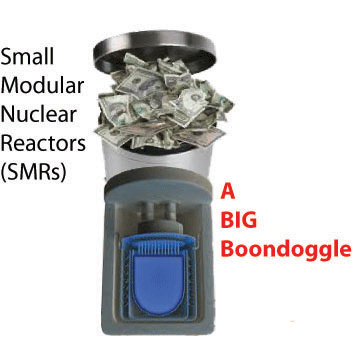
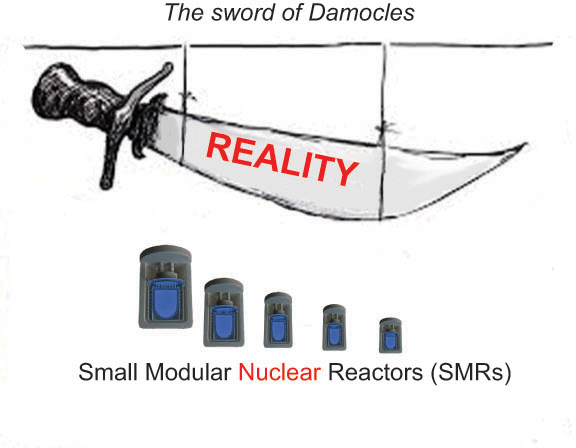
Unjustified hype over non existent Small Nuclear Reactors

These new nuclear reactors are so far perfectly safe, because they exist only on paper and are cooled only by ink. But declaring them a success before they are even built is quite a leap of faith.
This current media hype about modular reactors is very reminiscent of the drumbeat of grandiose expectations that began around 2000, announcing the advent of a Nuclear Renaissance that envisaged thousands of new reactors — huge ones! — being built all over the planet.

Let’s call SMRs what they are, Leaving out “nuclear” doesn’t minimize the danger, or the cost https://beyondnuclearinternational.org/2020/02/23/lets-call-smrs-what-they-are/By Gordon Edwards, Michel Duguay and Pierre Jasmin,  February 23, 2020, On Friday the 13th, September 2019, the St John Telegraph-Journal’s front page was dominated by what many gullible readers hoped will be a good luck story for New Brunswick  – making the province a booming and prosperous Nuclear Energy powerhouse for the entire world.

After many months of behind-the-scenes meetings throughout New Brunswick with utility company executives, provincial politicians, federal government representatives, township mayors and First Nations, two nuclear entrepreneurial companies laid out a dazzling dream promising thousands of jobs – nay, tens of thousands! – in New Brunswick, achieved by mass-producing and selling components for hitherto untested nuclear reactors called SMNRs (Small Modular Nuclear Reactors) which, it is hoped, will be installed around the world by the hundreds or thousands!

On December 1, the Saskatchewan and Ontario premiers hitched their hopes to the same nuclear dream machine through a dramatic tripartite Sunday press conference in Ottawa featuring the premiers of the provinces. The three amigos announced their desire to promote and deploy some version of Small Modular Nuclear Reactors in their respective provinces. All three claimed it as a strategy to fight climate change, and they want the federal government to pledge federal tax money to pay for the R&D. Perhaps it is a way of paying lip service to the climate crisis without actually achieving anything substantial; prior to the recent election, all three men were opposed to even putting a price on carbon emissions.

Motives other than climate protection may apply. Saskatchewan’s uranium is in desperate need of new markets, as some of the province’s most productive mines have been mothballed and over a thousand uranium workers have been laid off, due to the global decline in nuclear power. Meanwhile, Ontario has cancelled all investments in over 800 renewable energy projects – at a financial penalty of over 200 million dollars – while investing tens of billions of dollars to rebuild many of its geriatric nuclear reactors. This, instead of purchasing surplus water-based hydropower from Quebec at less than half the cost.

Three previous “small reactor” failures in Canada so far

These new nuclear reactors are so far perfectly safe, because they exist only on paper and are cooled only by ink. But declaring them a success before they are even built is quite a leap of faith, especially in light of the three previous Canadian failures in this field of “small reactors”. Two 10-megawatt MAPLE reactors were built at Chalk River and never operated because of insuperable safety concerns, and the 10-megawatt “Mega-Slowpoke” district heating reactor never earned a licence to operate, again because of safety concerns. The Mega-Slowpoke was offered free of charge to two universities – Sherbrooke and Saskatchewan – and several communities, all of whom refused the gift. And a good thing too, as the only Mega-Slowpoke ever built (at Pinawa, in Manitoba) is now being dismantled without ever producing a single useful megawatt of heat.

This current media hype about modular reactors is very reminiscent of the drumbeat of grandiose expectations that began around 2000, announcing the advent of a Nuclear Renaissance that envisaged thousands of new reactors — huge ones! — being built all over the planet. That initiative turned out to be a complete flop. Only a few large reactors were launched under this banner, and they were plagued with enormous cost-over-runs and extraordinarily long delays, resulting in the bankruptcy or near bankruptcy of some of the largest nuclear companies in the world – such as Areva and Westinghouse – and causing other companies to retire from the nuclear field altogether – such as Siemens.

Speculation about that promised Nuclear Renaissance also led to a massive (and totally unrealistic) spike in uranium prices, spurring uranium exploration activities on an unprecedented scale. It ended in a near-catastrophic collapse of uranium prices when the bubble burst. Cameco was forced to close down several mines. They are still closed. The price of uranium has still not recovered from the plunge.

Large nuclear reactors have essentially priced themselves out of the market. Only Russia, China and India have managed to defy those market forces with their monopoly state involvements.  Nevertheless, the nuclear contribution to world electricity production has plummeted from 17 percent in 1997 to about 10 percent in 2018. In North America and Western Europe, the prospects for new large reactor projects are virtually nil, and many of the older reactors are shutting down permanently without being replaced.

During long construction times nuclear makes the climate problem worse

Many people concerned about climate change want to know more about the moral and ethical choices regarding low-carbon technologies: “Don’t we have a responsibility to use nuclear?”  The short reply is: nuclear is too slow and too expensive. The ranking of options should be based on what is cheapest and fastest — beginning with energy efficiency, then on to off-the-shelf renewables like wind and solar energy.

As a case in point, Germany installed over 30,000 megawatts of wind energy capacity in only 8 years, after deciding to close down all of its nuclear reactors by 2022. That is an impressive achievement – more than twice the total installed nuclear capacity of Canada. It would be impossible to build 30,000 megawatts of nuclear in only 8 years.

By building wind generators, Germany obtained some carbon relief in the very first year of construction, then got more benefit in the second year, even more benefit in the third, and so on, building up to a cumulative capacity of 30,000 MWe after 8 years. With nuclear, even if you could manage to build 30,000 megawatts in 8 years, you would get absolutely no benefit during that entire 8-year construction period.

In fact you would be making the problem worse by mining uranium, fabricating fuel, pouring concrete and building the reactor core and components, all adding to greenhouse gas emissions – earning no benefit until (and IF) everything is finally ready to function.

In the meantime (10 to 20 years), you will have starved the efficiency and renewable alternatives of the funds and political will needed to implement technologies that can really make an immediate and substantial difference.

In Saskatchewan, professor Jim Harding, who was director for Prairie Justice Research at University of Regina where he headed up the Uranium Inquiries Project, has offered his own reflection. Here is the conclusion of his December 2, 2019 comment:

“In short, small reactors are another distraction from Saskatchewan having the highest levels of GHGs on the planet – nearly 70 metric tonnes per capita. While the rest of Canada has been lowering emissions, those here, along with Alberta with its high-carbon tar sands, have continued to rise. Saskatchewan and Alberta’s emissions are now almost equal to all the rest of Canada. Shame on us!”

In the USA, engineers and even CEO’s of some of the leading nuclear companies are admitting that the age of nuclear energy is virtually over in North America. This negative judgment is not coming from people who are opposed to nuclear power, quite the opposite — from people lamenting the decline. See, for example, one major report from the Engineering faculty at Carnegie-Mellon University.

The SMR order book is filled with blank pages; there are no customers

That Carnegie-Mellon report includes Small Modular Nuclear Reactors in its analysis, without being any more hopeful for a nuclear revival on that account. The reason? It is mainly because a new generation of smaller reactors, such as those promised for New Brunswick, will necessarily be more expensive per unit of energy produced, if manufactured individually. The sharply increased price can be partially offset by mass production of prefabricated components; hence the need for selling hundreds or even thousands of these smaller units in order to break even and make a profit. However, the order book is filled with blank pages — there are no customers. This being the case, finding investors is not easy. So entrepreneurs are courting governments to pony up with taxpayers’ money, in the hopes that this second attempt at a Nuclear Renaissance will not be the total debacle that the first one turned out to be.

Over 150 designs and none built, tested, licensed or deployed

Chances are very slim however. There are over 150 different designs of “Small Modular Reactors”. None of them have been built, tested, licensed or deployed. At Chalk River, Ontario, a consortium of private multinational corporations, comprised of SNC-Lavalin and two corporate partners, operating under the name “Canadian Nuclear Laboratories” (CNL), is prepared to host six or seven different designs of Small Modular Nuclear Reactors — none of them being identical to the two proposed for New Brunswick – and all of these designs will be in competition with each other. The Project Description of the first Chalk River prototype Small Modular Reactor has already received over 40 responses that are posted on the CNSC web site, and virtually all of them are negative comments.

The chances that any one design will corner enough of the market to become financially viable in the long run is unlikely. So the second Nuclear Renaissance may carry the seeds of its own destruction right from the outset. Unfortunately, governments are not well equipped to do a serious independent investigation of the validity of the intoxicating claims made by the promoters, who of course conveniently overlook the persistent problem of long-lived nuclear waste and of decommissioning the radioactive structures. These wastes pose a huge ecological and human health problem for countless generations to come.

Finally, in the list of projects being investigated, one finds a scaled-down “breeder reactor” fuelled with plutonium and cooled by liquid sodium metal, a material that reacts violently or explodes on contact with air or water. The breeder reactor is an old project abandoned by Jimmy Carter and discredited by the failure of the ill-fated French SuperPhénix because of its extremely dangerous nature. In the event of a nuclear accident, the Tennessee Clinch River Breeder Reactor was judged capable of poisoning twelve American states and the SuperPhénix half of France.

One suspects that our three premiers are only willing to revisit these bygone reactor designs in order to obtain funding from the federal government while avoiding responsibility for their inaction on more sensible strategies for combatting climate changes – cheaper, faster and safer alternatives, based on investments in energy efficiency and renewable sources.

Gordon Edwards PhD, is President of the Canadian Coalition for Nuclear Responsibility. Michel Duguay, PhD, is a professor at Laval University. Pierre Jasmin, UQAM, is with Quebec Movement for Peace and Artiste pour la Paix.


February 24, 2020 Posted by Christina Macpherson | Canada, Small Modular Nuclear Reactors | Leave a comment

Trump jumping into Nevada’s nuclear waste dilemma

Trump’s Nevada play leaves nation’s nuclear waste in limboThe president wants to win the state he narrowly lost in 2016, but he may be jumping into an energy issue.  Politico, By ERIC WOLFF and ANTHONY ADRAGNA, 02/22/2020 

President Donald Trump is seeking to woo Nevada voters by abandoning the GOP’s decades of support for storing the nation’s nuclear waste under a mountain northwest of Las Vegas — a move that could drag the White House into an unsolvable political stalemate.

Trump, who is targeting a state that he narrowly lost to Hillary Clinton in 2016, announced the turnabout in a tweet this month, writing: “Nevada, I hear you on Yucca Mountain and my Administration will RESPECT you!” He also pledged to find “innovative approaches” to find a new place to store the 90,000 metric tons of nuclear plant leftovers stranded at 120 temporary storage sites — an impasse that is on course to cost taxpayers tens of billions of dollars.

The statement surprised people involved in the debate because developing a permanent nuclear repository at Yucca has long been a priority of Republicans, and even Trump’s own budget proposals in previous years had sought money to keep it alive. Taxpayers spent $15 billion developing the nuclear site after Congress selected the location during the Reagan era, only to see the Obama administration freeze the plan amid opposition from the state’s political leaders.

Trump’s Yucca reversal echoed his previous efforts to untangle a political food fight involving the federal ethanol mandate, an attempt that left both gasoline refiners and Iowa’s corn growers furious. Once again, Trump could face political risks by intervening in a politically charged, no-win energy quagmire.

Some lawmakers also fear that Trump is undermining their efforts to work out a compromise in which some states agree to host a small number of interim waste storage sites while the search for a long-term solution continues.

“Not working on a permanent repository is going to make it harder to do consent-based interim storage, ’cause all of a sudden those communities are going to be going, ‘s—, we’re going to become permanent storage,’” Rep. Mike Simpson (R-Idaho), a senior House appropriator who has long-championed the Yucca project, told POLITICO.

“It’s a no-win situation for anybody, that doesn’t seem to change,” said Edwin Lyman, director of nuclear power safety for the Union of Concerned Scientists, which is neutral on Yucca but supports building a repository somewhere.

Further complicating the problem, he said, was a 1982 law that prohibits the Energy Department from spending money building interim nuclear storage unless it has a construction license for Yucca Mountain.

Like Iowa, where Trump championed the ethanol program while running in the 2016 Republican caucus, Nevada is a key state on the electoral map. Hillary Clinton carried the state four years ago by just 27,000 votes. ……… https://www.politico.com/news/2020/02/22/trump-nevada-nuclear-waste-yucca-mountain-116663

February 24, 2020 Posted by Christina Macpherson | election USA 2020 | Leave a comment

USA’s Energy Dept’s failure to monitor Hanford nuclear site, parts not inspected for 50 years

Parts of Hanford nuclear waste site have not been inspected in 50 years, government auditors say, The former defense site in Washington state has a troubled past. The latest lapse involves the Energy Department’s failure to analyze the cause of a tunnel collapse.WP, By Aaron Gregg Feb. 22, 2020

Companies responsible for cleaning up a decommissioned plutonium plant in rural Washington state failed to conduct comprehensive safety checks at facilities containing nuclear waste, even after a 2017 tunnel collapse put surrounding communities on lockdown, government auditors reported Thursday.

The report about the Hanford nuclear waste site raises new concerns about environmental and safety risks posed by one of the United States’ worst toxic waste sites.

The Government Accountability Office found that the Energy Department waived a “root cause analysis” of the tunnel collapse because it was asked to do so by the contractor handling inspections, a subsidiary of Dallas-based Jacobs Engineering. The department did conduct a separate review to determine weaknesses and risks related to contaminated facilities, but that evaluation “was based largely on old data” and “did not include any physical or non-physical inspection” to flag facilities for cleanup, the office reported.

Sitting in a rural area of southwestern Washington, the Hanford site was once the U.S. military’s primary source of enriched plutonium used in nuclear warheads, including one of the weapons dropped on Japan at the end of World War II. Hanford’s workforce once numbered more than 50,000 people. Plutonium production ended in 1987.

Parts of the site have not been entered or inspected in more than 50 years, the Government Accountability Office reported, suggesting there could be additional safety risks of which the Energy Department is not aware. And the inspections that were carried out found structural problems severe enough that they “could lead to the potential release of hazardous or nuclear materials” at five of 18 facilities there, the office reported……..

Since the late 1980s, the Energy Department has worked with teams of contractors on the monumental task of dealing with radioactive waste that accumulated over several decades. The massive scale and longevity of the weapons production activities at Hanford mean cleanup efforts are likely to continue for most of the next century.

The project has been fraught with waste, with milestones continually pushed back as contractors experienced difficulties. Earlier reports found that the department spent more than $19 billion over 25 years on “treatment and disposition of 56 million gallons of hazardous waste” without actually treating any hazardous waste. The project was originally scheduled to be completed in 2011 at a cost of $4.3 billion.

Besides the cost overruns, the haphazard way in which some waste was stored has made cleanup a hazardous task for the thousands of workers…….

U.S. Sen. Ron Wyden (D-Ore.) scolded the Energy Department for its handling of the nuclear waste cleanup effort in a letter to Energy Secretary Dan Brouillette. The letter notes that the department has accepted all of the office’s recommendations but says those changes are not sufficient to protect the lives of workers and citizens throughout the region.

Wyden blamed the 2017 tunnel collapse on the Energy Department’s failure to conduct comprehensive inspections.

The tunnel collapse “seems largely due to a failure of [the Energy Department] and its contractors to independently verify the tunnel’s physical condition ― a state of affairs replicated over many years across the site’s facilities,” Wyden wrote. https://www.washingtonpost.com/business/2020/02/21/parts-hanford-nuclear-waste-site-have-not-been-inspected-50-years-government-auditors-say/

February 24, 2020 Posted by Christina Macpherson | safety, USA, wastes | Leave a comment

Secretary of State Mike Pompeo explains Trump’s plan to kill off the Iran nuclear agreement

Pompeo Reveals Trump Admin’s Wide-Ranging Plan to Combat Iran, Deal Death Blow to Nuclear Deal, Washington Free Beacon, 

In discussion with Free Beacon, secretary of state explains how he is galvanizing the globe against the Islamic Republic Republic, Adam Kredo – FEBRUARY 23, 2020, RIYADH, Saudi Arabia—The Trump administration is waging a multi-pronged effort to thwart Iran’s expansion across the Middle East, including efforts at the United Nations to ensure global sanctions come back into effect in what would mark a final death blow for the landmark nuclear deal, Secretary of State Mike Pompeo told the Washington Free Beacon in an exclusive and wide-ranging interview.

In a one-on-one talk with the Free Beacon on Friday following high-level meetings with the Saudi royal family in Riyadh, Pompeo pulled the curtain back on the Trump administration’s years-long effort to combat Iran militarily and diplomatically……..

In the coming months, Pompeo said, he and the president will make a major decision about whether to petition the U.N. to invoke what is known as “snapback” on a set of international sanctions on Iran that were lifted as part of the Obama administration’s nuclear accord. Iran hawks in Congress have been pressing Pompeo and the administration to pursue this course of action for months, a message the secretary says he has received and is digging into. Such a move would deal a deathblow to the nuclear deal. ……..

In the coming months, Pompeo said, he and the president will make a major decision about whether to petition the U.N. to invoke what is known as “snapback” on a set of international sanctions on Iran that were lifted as part of the Obama administration’s nuclear accord. Iran hawks in Congress have been pressing Pompeo and the administration to pursue this course of action for months, a message the secretary says he has received and is digging into. Such a move would deal a deathblow to the nuclear deal………

When asked about that “special” relationship—a term typically applied to the U.S.-Israel alliance—Pompeo acknowledged that the two countries are on better footing than ever, particularly when it comes to Iran……… https://freebeacon.com/national-security/exclusive-pompeo-reveals-trump-admins-wide-ranging-plan-to-combat-iran-deal-death-blow-to-nuclear-deal/

February 24, 2020 Posted by Christina Macpherson | Iran, politics international, Saudi Arabia, USA | Leave a comment

Confusion and contradiction in Trump’s policy on nuclear waste and Yucca Mountain

The Yucca Mountain nuclear waste site has always been a political football. Trump is the latest president to fumble, Bulletin of the Atomic Scientists, By Allison Macfarlane, February 21, 2020  As with much policy-setting in the Trump administration, a single tweet from the president on February 6 appeared to reverse a previous stance. The message about Yucca Mountain, the nation’s proposed geologic repository for spent nuclear fuel and other high-level radioactive waste, set the media alight with speculation about new actions in US nuclear waste policy. But has anything changed, really?

The new policy, if it is such a thing, is a little wobbly. It’s unclear whether the administration is or is not supporting Yucca Mountain as a waste repository. The Energy Department’s Undersecretary for Nuclear Energy and nominee for Deputy Secretary, Mark Menezes, stated six days later in a House Energy and Commerce subcommittee hearing that “what we’re trying to do is to put together a process that will give us a path to permanent storage at Yucca.” A White House official tried to square the circle of conflicting messages, stating: “There is zero daylight between the President and Undersecretary Menezes on the issue.”

At the same time, Trump’s fiscal year 2021 budget did not include funds for Yucca Mountain, unlike in previous years. In point of fact, though, Congress has not appropriated funding for Yucca Mountain in the past decade. The proposed repository site made it about halfway through the licensing process at the Nuclear Regulatory Commission and halted when the Obama administration’s Energy Department tried to pull the license application. The state of Nevada still strongly opposes Yucca Mountain and hasn’t changed its tune since passage of the Nuclear Waste Policy Act Amendments in 1987 (colloquially known in Nevada as the Screw Nevada Bill), which designated Yucca Mountain as the proposed repository site.

Trump’s tweet acknowledges the fierce and long-standing opposition to Yucca Mountain in a swing state he lost by a slim margin in 2016. The Democratic presidential candidates are unanimously opposed to storing nuclear waste at Yucca Mountain.

A permanent impasse. Yucca Mountain has spent much of its existence as a political football. The original Nuclear Waste Policy Act of 1982 required detailed characterization of three potential repository sites for the disposal of the nation’s spent commercial nuclear fuel and high-level radioactive waste from the nuclear weapons complex. By 1986 it was clear that work on three sites would be very costly, and Congress balked at the price tag. Political wrangling ensued, and it was no accident that among the three states under consideration—Nevada, Texas, and Washington—the one with the most-junior congressional delegation, including a newly elected Senator Harry Reid, was selected as the only site to be characterized by the Energy Department for suitability as a repository. ………

At the moment, no one involved in the process has an incentive to make progress. An extremely partisan House and Senate are at a permanent impasse on an issue that bears little on re-election chances (except in Nevada). The nuclear industry has found they can build new reactors—the two Westinghouse AP1000 units under construction in Georgia—without a solution to their spent fuel problem. The Energy Department, originally tasked with solving the problem, has no legal authority (or appropriations) to move forward. The Nuclear Regulatory Commission, which passed a Continued Storage Rule in 2014, vacated its ability to force a solution. And many anti-nuclear interest groups that oppose waste transport and repositories have called for “hardened on-site storage.”…….. https://thebulletin.org/2020/02/the-yucca-mountain-nuclear-waste-site-has-always-been-a-political-football-trump-is-the-latest-president-to-fumble/#

February 22, 2020 Posted by Christina Macpherson | politics, USA, wastes | Leave a comment

Bruce County, Ontario, protest against nuclear waste dump plan

Nuclear tanks, no thanks,’ say Bruce County protesters, Scott MillerVideographer@ScottMillerCTV Contact

https://london.ctvnews.ca/nuclear-tanks-no-thanks-say-bruce-county-protesters-1.4820155 Thursday, February 20, 2020  LONDON, ONT. — About 40 Bruce County residents protested outside Bruce County council chambers in Walkerton this morning.They’re protesting plans to bury Canada’s used nuclear fuel under 1300 acres of farmland north of Teeswater. South Bruce is one of two communities in Canada left in the running to host the country’s high level nuclear waste.

A 1300 acre site just north of Teeswater has been identified as a potential underground site for the multi-billion dollar project, that would house approximately 5.2 million used fuel bundles, that remain dangerously radioactive for hundreds of thousands of years.

The Nuclear Waste Management Organization says they’ll pick one site between South Bruce and Ignace, in Northern Ontario, by 2023.

Michelle Stein lives near the proposed site in South Bruce. She organized today’s protest.  “Burying your problems to get them out of site is never the answer. I don’t want this underground mess to be the heritage that I leave for my children and grandchildren.”

Saugeen Shores Mayor Luke Charbonneau is the one bringing forward today’s motion to support DGR’s to store nuclear waste. “There’s an international scientific consensus that the best way to store waste materials from nuclear power production is through passive isolation in a Deep Geological Repository.”

The protest comes as Bruce County council debates a motion to reinforce its support for a permanent solution to the country’s nuclear waste, specifically the Deep Geological Repository model that encases the waste in copper containers, encased in clay “buffer boxes”.


February 22, 2020 Posted by Christina Macpherson | Canada, opposition to nuclear, wastes | Leave a comment

U.S. pentagon wary about morale of staff at nuclear bases

Pentagon officials keeping an eye on morale at nuclear bases, Military Times,    Meghann Myers and Aaron Mehta 21 Feb 20, The Defense Department is asking for tens of billions of dollars this year to maintain and modernize U.S. nuclear capabilities, while at the same time checking in with personnel at the remote bases maintainers and operators call home.

In recent years, issues like cheating on exams and marijuana use have plagued Air Force bases in Montana, North Dakota and Nebraska, calling into question whether the quality of life in those areas was taking a toll on troops…….

As the U.S. gets plans underway to upgrade aircraft, missiles, submarines and other systems to deter nuclear threats from countries like China, Russia and North Korea, the people who will take responsibility for them are also a consideration.

“This is one of the things that the secretary wanted to find out,” a senior DoD official said Friday, briefing reporters on background at the Pentagon. “He spoke a lot with the airman and the officers … at STRATCOM and Minot. You know, about 10 years ago, we had a terrible morale problem.”…..  https://www.militarytimes.com/news/your-military/2020/02/21/pentagon-officials-keeping-an-eye-on-morale-at-nuclear-bases/

February 22, 2020 Posted by Christina Macpherson | psychology - mental health, USA, weapons and war | Leave a comment

Trump to visit India as salesman for Westinghouse nuclear reactors

Westinghouse to sign deal for six nuclear reactors in India during Trump’s visit: report  HTTPS://THEHILL.COM/POLICY/INTERNATIONAL/INDIA/483820-WESTINGHOUSE-TO-SIGN-DEAL-FOR-SIX-NUCLEAR-REACTORS-IN-INDIA-DURING  BY JUSTINE COLEMAN – 02/20/20   U.S. energy company Westinghouse is expected to sign a deal for six nuclear reactors with the state-run Nuclear Power Corporation of India (NPCIL) during President Trump’s trip to the country, Reuters reported.The deal will outline timelines and name the lead local constructor for building the reactors at Kovvada in southern India, according to the news service.

India has reportedly been open to receiving nuclear reactors since its 2008 civil nuclear energy pact with the U.S. Last year, the countries announced they had committed to six reactors.

Representatives from the U.S. Energy and Commerce departments, Westinghouse, the U.S.-India Strategic Partnership Forum and The Nuclear Energy Institute have met in India for negotiations, Reuters noted.

Rita Baranwal, assistant secretary for the Office of Nuclear Energy in the U.S. Department of Energy, told the news service that the team is “optimistic” the agreement will be signed “shortly.”

“We are encouraging moving forward with Westinghouse and NPCIL to sign a MoU. It certainly is a private industry-to-private industry, a business-to-business decision,” she said, referring to a memorandum of understanding.

Representatives from the U.S. Energy and Commerce departments, Westinghouse, the U.S.-India Strategic Partnership Forum and The Nuclear Energy Institute have met in India for negotiations, Reuters noted.

The Hill reached out to Westinghouse and NPCIL for comment.

February 22, 2020 Posted by Christina Macpherson | India, marketing, politics international, USA | Leave a comment

Desperate nuclear industry hypes up unlikely new gimmick, HALEU nuclear fuel

The World’s Tiniest Nuclear Plant Is Coming to Idaho, The demonstration represents a new-generation of micro-reactors.  Popular Mechanics, Feb 21, 2020 “…… 

  • experts suggest that Oklo’s timeline is unrealistic with years of nuclear approval process ahead…….
  • In December, Oklo received a permit to begin building their new Aurora plant, which is the first and only permit ever issued in the U.S. to a nuclear plant using something other than a light water (“water-cooled”) reactor. The specific mix of fuel they plan to use is called HALEU for short: “High-assay, low-enriched uranium (HALEU) …..
  • There are big obstacles in Oklo’s way, though. Their planned timeline, which Grist says is to open between 2022 and 2025—after just receiving a permit in December 2019—would be one of the shortest in U.S. nuclear power history. For the first-of-its-kind commercial, HALEU-fueled fast breeder reactor, this seems optimistic, to say the least.

February 22, 2020 Posted by Christina Macpherson | technology, USA | Leave a comment

Secret research by U.S. Navy revealed effects of nuclear radiation on animals

What happened inside the Georgia Nuclear Aircraft Lab? Finding the facts in the forest with Dr. James Mahaffey  Jessica Taylor Dawson News jtaylor@dawsonnews.com Feb. 19, 2020, 

Over half a century later, rumors still swirl around Dawson Forest and the mysterious remnants of Dawson County’s past in the Cold War. 

Though the Georgia Nuclear Aircraft Facility has been out of commission for nearly 50 years, local residents can still be heard whispering about two-headed deer and oak leaves the size of elephant ears spotted around the nuclear facility’s remains.

For nuclear engineer and author, Dr. James Mahaffey, the task of unraveling the history behind Dawson County’s top-secret nuclear test site and separating facts from the fiction has led to decades of research and hard work. ………

On paper, it seemed feasible as an incredible amount of power could be housed in a very small space, however the findings from the Dawsonville laboratory proved that nuclear aircraft would take more than what was originally thought.

“Any nuclear reactor on this earth has shielding,” Mahaffey explained. “It’s got lead, concrete, steel, you know, heavy things to keep it from killing everybody, but you put it in an airplane and you can’t have concrete and steel and lead. It’s got to be naked.”

Components for nuclear-powered engines were assembled in a facility in Idaho then brought to Dawsonville for testing inside the reactor. In Mahaffey’s research, he discovered that the facility found that rubber tires either melted or turned to rock when exposed to different radiation. Hydraulic fluids turned into a tacky substance akin to chewing gum. Transistors in the radio system were immediately killed by radiation.

The other aspect of the Dawsonville facility was testing the effects of radiation on the environment and living creatures. 

“What does flying over a farm with a nuclear aircraft do to the farm? Well, it kills everything on the ground. It kills trees, grass, crops, insects, birds, anything. It might even kill the farmer if he’s out looking at it so what are you going to do about that? And also, what happens when one of these things crashes,” Mahaffey said. “If a jet plane crashes you clean it up and you pay the people for the house that it destroyed and all that, but what if it’s a nuclear aircraft? Nuclear aircraft – when it crashes – it makes a five mile radius area contaminated with long lasting radionuclides and you have to fence it off so nobody can go there. Are you really willing to have that as part of your Air Force operations?”

The effects of radiation were tested through controlled experimentation but also through observation of what Mahaffey describes as “instant taxidermy” of animals caught inside the kill zone around the outside of the operational reactor.

“Any animal like a toad frog that happened to be hopping around on the ground when the reactor was turned on, he died and interestingly it also killed all the bacteria in and around the frog,” Mahaffey said.

“When those [bacteria] die, it doesn’t deteriorate so you have this dead frog that you can put on your mantle and it’ll just stay there.”

According to Mahaffey, the scientists conducted many experiments with animals including releasing rats and studying the effects of radiation on them.

“I heard a rumor that the largest animal they ever irradiated was a mule and the mule died of course, and like a toad frog it would not deteriorate in a normal way,” Mahaffey said.

Billions of dollars were poured into the Nuclear Aircraft Project that GNAL was part of during the 1960s, but funding was cut in the John F. Kennedy administration. The GNAL was closed in pieces and shut its completely in 1971.

The GNAL buildings inside Dawson Forest were dismantled and hauled away. The hot cell building, the only remaining structure still standing, was boarded up with stainless steel to keep intruders from entering the radioactive building. To this day, the building remains radioactive with particulates of Cobalt 60.  ……

What makes Dawsonville’s secret nuclear facility stand out from other nuclear facilities for Mahaffey is the very detailed extent to which they dug into the dangers of nuclear fission products.

“An enormous amount of work was done to find out how having this reactor affects the environment. I’ll give them that,” Mahaffey said. “They wanted to find out how groundwater would transport radiation and they dug wells all over the facility, and they would have monitors monitoring what type of radiation, how much radiation and knew how fast radiation could transport in the environment.”

Great care went into studying radiation in the Etowah River including the construction of rafts to track and map the flow of radiation as well as the atmospheric effects of radiation.

“This was all unknown,” Mahaffey said. “You have to build a facility that’ll test it in real ways, not just computer simulations and it has to be somewhere where you’re not potentially going to wipe out a city.”  https://www.dawsonnews.com/local/what-happened-inside-georgia-nuclear-aircraft-lab-finding-facts-forest-dr-james-mahaffey/

February 20, 2020 Posted by Christina Macpherson | environment, radiation, Reference, secrets,lies and civil liberties, USA | Leave a comment

Small nuclear reactors are no better than large ones

This very well-written and informative article still does not examine the question “Is nuclear power, of any type REALLY a solution to climate change?” Why on earth are all these writers mindlessly buying the nuclear lobby’s spurious claim? The nuclear reactor itself emits a tiny amount of Carbon 14. The entire nuclear chain, from mining to waste storage is a huge carbon emitter. How many thousands of these so-called “small” reactors would have to be up and running in time to make any difference? This push for smrs will be useful only to the military, and only tax-payers will foot the bill.

small modular reactors suffer from many of the same problems as large reactors, most notably safety issues and the unresolved problem of what to do with long-lived radioactive waste.

even in a smaller form, nuclear power is expensive — it’s one of the costliest forms of energy, requiring substantial government subsidies to build and run, not to mention insure.

When It Comes to Nuclear Power, Could Smaller Be Better?  Yale Environment 360 , BY LOIS PARSHLEY 19 Feb 20, A handful of companies and governments are working to develop small-scale nuclear reactors that proponents say are safer, cheaper, and more compatible with renewables than traditional nuclear power. But critics contend the new technology doesn’t address concerns about safety and radioactive waste.

Huge computer screens line a dark, windowless control room in Corvallis, Oregon, where engineers at the company NuScale Power hope to define the next wave of nuclear energy. Glowing icons fill the screens, representing the power output of 12 miniature nuclear reactors. Together, these small modular reactors would generate about the same amount of power as one of the conventional nuclear plants that currently dot the United States — producing enough electricity to power 540,000 homes. On the glowing screens, a palm tree indicates which of the dozen units is on “island mode,” allowing a single reactor to run disconnected from the grid in case of an emergency.

This control room is just a mock-up, and the reactors depicted on the computer screens do not, in fact, exist. Yet NuScale has invested more than $900 million in the development of small modular reactor (SMR) technology, which the company says represents the next generation of nuclear power plants. NuScale is working on a full-scale prototype and says it is on track to break ground on its first nuclear power plant — a 720-megawatt project for a utility in Idaho — within two years; the U.S. Nuclear Regulatory Commission has just completed the fourth phase of review of NuScale’s design, the first SMR certification the commission has reviewed. The company expect final approval by the end of 2020. The U.S. Department of Energy has already invested $317 million in the research and development of NuScale’s SMR project.

NuScale is not alone in developing miniature reactors. In Russia, the government has launched a floating 70-megawatt reactor in the Arctic Ocean. China announced plans in 2016 to build its own state-funded floating SMR design. Three Canadian provinces — Ontario, New Brunswick, and Saskatchewan — have signed a memorandum to look into the development and deployment of small modular reactors. And the Rolls-Royce Consortium in the United Kingdom is working on the development of a 440-megawatt SMR.

Proponents say the time is ripe for this new wave of nuclear reactors for several reasons. First, they maintain that if the global community has any hope of slashing CO2 emissions by mid-century, new nuclear technologies must be in the mix. Second, traditional nuclear power is beset with problems. Many existing plants are aging, and new nuclear power construction is plagued by substantial delays and huge cost overruns; large-scale nuclear power plants can cost more than $10 billion. Finally, advocates say that as supplies of renewable energy grow, small modular reactors can better handle the variable nature of wind and solar power as SMRs are easier to turn on and leave running.

Critics of nuclear power, however, contend that small modular reactors suffer from many of the same problems as large reactors, most notably safety issues and the unresolved problem of what to do with long-lived radioactive waste. And opponents say that even in a smaller form, nuclear power is expensive — it’s one of the costliest forms of energy, requiring substantial government subsidies to build and run, not to mention insure. NuScale’s SMR is offering an artificial 6.5 cent-per-kilowatt-hour cap as an incentive to get its first project off the ground. Yet in September, the Los Angeles Department of Water and Power announced that it had accepted a bid of electricity coming from renewables, with storage capacity that can deliver round-the-clock supply, at 2 cents a kilowatt-hour.

M.V. Ramana, the Simons Chair in Disarmament, Global and Human Security at the University of British Columbia, says that as renewable prices plummet, nuclear power just can’t compete. More than a third of U.S. nuclear plants are now unprofitable or scheduled to close. Globally, nuclear energy now only supplies 11 percent of electricity, down from a record high of 17.6 percent in 1996. After the 2011 Fukushima disaster in Japan, Germany decided to close its nuclear industry altogether, and countries like Belgium, Switzerland, and Italy have declined to replace existing reactors or move forward with plans for new ones…….

SMR opponents maintain that no matter the size, nuclear power has unresolved cost and safety concerns. To realize savings through mass manufacturing, there would need to be a standardized SMR design, critics say; currently, there are dozens. And SMRs would also have to be built in large quantities. But for a company to invest in making reactors and their components, it would need a reliable market, and many private investors are still wary of the new technology. Andrew Storer, CEO of the Nuclear Advanced Manufacturing Research Center, which forecasts markets for nuclear power manufacturers, says, as far far as supply chain companies go, “We’re advising people, ‘Don’t invest yet.’”

Recent experience supports skepticism. Westinghouse worked on an SMR design for a decade before giving up in 2014. Massachusetts-based Transatomic Power, a nuclear technology firm, walked away from a molten salt SMR in 2018, and despite an $111 million dollar infusion from the U.S. government, a SMR design from Babcock &Wilcox, an advanced energy developer, folded in 2017. While the Russians have managed to get their state-funded SMR floating, its construction costs ran over estimates by four times, and its energy will cost about four times more than current U.S. nuclear costs.

Eventually, every nuclear conversation turns to radioactive waste and safety. SMRs using a pressurized water reactor will continue to generate highly radioactive spent fuel, yet no country has a permanent solution for how to safely store this kind of waste. The U.S. has been looking for a place to put a permanent nuclear waste repository since 1982; in the meantime, 70 percent of the U.S.’s spent fuel is sitting in cooling pools, many of which are aging and vulnerable, and often in quantities much larger than what is considered safe.

Because NuScale hopes to replace coal-fired power plants in the U.S. and the UK, perhaps even building on the grounds of shuttered power plant sites in more populated areas, the Nuclear Regulatory Commission is considering eliminating some standard safety measures, including a requirement for an emergency evacuation zone and the need for backup power. NuScale says that because SMRs contain smaller quantities of radioactive materials and can be sited underground, their risks are lower and they require less security staff.

This has raised sharp criticism from nuclear experts. Even the Union of Concerned Scientists, which has generally supported nuclear power, says, “It would be irresponsible for the NRC to reduce safety and security requirements for any reactor of any size.”

This very well-written and informative article still does not examine the question “Is nuclear power, of any type REALLY a solution to climate change?” Why on earth are all these writers mindlessly buying the nuclear lobby’s spurious claim? The nuclear reactor itself emits a tiny amount of Carbon 14. The entire nuclear chain, from mining to waste storage is a huge carbon emitter. How many thousands of these so-called “small” reactors would have to be up and running in time to make any difference? This push for smrs will be useful only to the military, and only tax-payers will foot the bill.  https://e360.yale.edu/features/when-it-comes-to-nuclear-power-could-smaller-be-better

February 20, 2020 Posted by Christina Macpherson | Small Modular Nuclear Reactors, USA | Leave a comment

Large U.S. nuclear delegation to India to con Indians into buying Small Modular Nuclear Reactors

Nuclear ties in focus ahead of Trump visit, Live Mint 18 Feb 2020, Elizabeth Roche

  • The US delegation held talks for collaborating in R&D, advanced nuclear tech and offered nuclear power plants
  • The US team was the largest to visit India since the two nations eased differences over civil nuclear liability in 2015
  • New Delhi: The largest US nuclear delegation to visit India in five years held talks with senior Indian officials last week, exploring collaborations in research and development (R&D) and advanced nuclear technology, besides offering nuclear power plants in a range of sizes.

    The delegation of a dozen people representing the US industry and government, headed by Rita Baranwal, assistant secretary for the office of nuclear energy in the department of energy, was in India on 10-14 February to explore opportunities.

    The group was in India under the aegis of the US-India Strategic Partnership Forum.

    The visit came ahead of US President Donald Trump’s 24-25 February official trip to India next week.

    Besides collaborating with India in R&D and advanced nuclear technology, the US has offered nuclear power plants in three sizes—small modular, micro, and bigger plants of at least one gigawatt capacity……

    There are a lot of really talented researchers in India and I think we need to continue our discussions and leverage that talent so that as we move forward to deploy advanced nuclear technology reactors we have the technology talent that can assist with deploying and operating those types of nuclear reactors,” she said.

    “And when I talk about advanced nuclear technology I mean not only the large gigawatt-size reactors such as Westinghouse AP-1000 but also the SMR (small modular reactor) technology and the even smaller micro reactor.”…….

  • The US is looking to set up advanced nuclear technology demonstration reactors in the next five-seven years. The new technologies would be for the US market, “but we hope to see them deployed globally and it will be really great to have Indian cooperation early in the process. …. https://www.livemint.com/news/india/nuclear-ties-in-focus-ahead-of-trump-visit-11582049040350.html
  •  

February 20, 2020 Posted by Christina Macpherson | India, marketing, USA | Leave a comment

Danger of nuclear catastrophe in USA’s New “Low-Yield” Nuclear Warhead

The Senseless Danger of the Military’s New “Low-Yield” Nuclear Warhead, The weapon’s smaller destructive power does not mean a smaller risk of catastrophe. Slate, By FRED KAPLAN, FEB 18, 2020 The U.S. Navy has deployed a new type of “low-yield” nuclear warhead in some of its Trident submarines.

Sometime in the past two months, the U.S. Navy has deployed a new type of nuclear warhead in some of its Trident submarines. Called the W76-2, it is a “low-yield” warhead, which would explode with the blast power of about 8 kilotons—far less powerful than the Tridents’ other warheads, which have an explosive yield of 90 to 450 kilotons.

At first glance, this might seem like a good thing: a smaller blast means less death and damage, if a nuclear war happened. But in some ways, it’s a dangerous thing, and to explain why requires a brisk dive into the rabbit hole logic of nuclear strategy.

For many years, arms control advocates have argued that low-yield nuclear weapons are destabilizing because they lower the threshold between conventional and nuclear war. They seem to be—they are designed to be—more usable as weapons of war, and therefore some president, in a crisis, might feel more tempted to use them. (The United States has always had an explicit policy of reserving the right to use nuclear weapons first in a conflict.)

Those worries have intensified when we’ve had presidents who are viewed as erratic. In 2003, after the invasion of Iraq, some Air Force generals proposed building a new low-yield nuclear warhead that could burrow underground before exploding; they saw it as the ideal weapon for killing some future Saddam Hussein hiding in a bunker. But many members of the House and Senate Armed Services Committees did not trust President George W. Bush with such a weapon, so they tacked on an amendment to that year’s defense budget, prohibiting the “testing, acquisition, or deployment of a low-yield nuclear weapon”—and barring the Department of Energy from even researching such a weapon—without the advance approval of Congress.

Many now have the same worry about Donald Trump. In 2018, when then–Secretary of Defense Jim Mattis lobbied for the W76-2 on Capitol Hill, at least one Republican senator told him, “I don’t have a problem with this weapon. I have a problem with the president who’s authorized to use this weapon.”

But just months later, Trump’s vicelike grip on the Republican Party had tightened. The Democrat-controlled House voted to cancel the program; the GOP-led Senate voted to approve it. In the conference committee, the House managers folded. Some reasoned that it was such an inexpensive program: Only 50 warheads would be modified to the low-yield version, at a cost of $65 million, less than 0.1 percent of the entire defense budget. No big deal.

Another reason for the Democrats’ concession was that this low-yield program was presented as a response to a Russian threat. The argument was that the Russians had a new strategy called “escalate to de-escalate.” If war broke out in Europe, the Russians would launch a low-yield nuclear weapon at U.S. and NATO forces. If we didn’t have low-yield nuclear weapons to fire back, we would have to surrender. If we did have low-yield nukes, the rationale went, the Russians might not attack in the first place.

It is true that the Russian military has outlined such a strategy in some manuals and rehearsed this scenario in some training exercises. But it’s slippery logic to conclude that we need a low-yield Trident warhead to meet the threat.

First, the case for the new warhead hinges on the premise that, in order to deter the Russians, we need to match in kind every move they make: They build a low-yield missile; we have to do the same, or we wind up with a “gap in the escalation spectrum” (as some have labeled the threat). But there is nothing in history, strategy, or intelligence findings about Russian thinking on the subject to support this notion.

When the warhead goes off, it would look and feel like the largest explosion witnessed since World War II.

Second, even if the notion could be supported, it would be irrelevant because—as Hans Kristensen of the Federation of American Scientists estimates—the U.S. already has about 1,000 low-yield nuclear bombs and cruise missiles, which could be dropped or fired from F-15, F-16, B-1, and B-2 aircraft. Advocates of the low-yield Trident argue that those planes might be shot down by Russian air defenses, whereas the Trident missiles—launched from undetectable submarines—would definitely get through Russian defenses. This imbalance is overstated. Many, probably most of the U.S. planes would get through to their targets. More to the point, even if only a few got through, that would mean that we are able to launch low-yield nuclear weapons in response to Russian low-yield weapons—which means the premise of advocates’ case for low-yield Tridents is false.

Third, there is some dispute within intelligence agencies over why the Russians are deploying low-yield nuclear warheads in the first place. From the 1950s to the 1970s, the U.S. placed thousands of nuclear weapons in Western Europe to compensate for the superiority of Soviet tanks and troops in Eastern Europe. Now, many analysts believe, the Russians are putting more emphasis on nuclear weapons in order to counter U.S. and NATO superiority in conventional weapons. It’s two sides of the same coin. It doesn’t reflect a new kind of threat—or require a new kind of response.

In my new book, The Bomb: Presidents, Generals, and the Secret History of Nuclear War, I recount a highly classified war game played by the National Security Council late in the Obama administration. Reports of Russia’s “escalate to de-escalate” strategy were emerging. The idea of the game was to test whether this strategy might indeed thwart America’s ability or will to project power in Europe. The scenario went like this: The Russians invade one of the Baltic states; NATO fights back effectively; to reverse the tide, Russia fires a low-yield nuclear weapon at the NATO troops or at a base in Germany where drones, combat planes, and smart bombs were deployed. The question: What do U.S. decision-makers do next?

The game was first played in an NSC deputies’ meeting, consisting of second-tier officials from the various agencies and military branches. Initially, the generals steered the discussion toward operational details: How many nuclear weapons, and of what type, should the U.S. fire at what targets? Then, Colin Kahl, Vice President Joe Biden’s national security adviser, spoke up. The generals, he said, were missing the big picture. The minute the Russians drop a nuclear bomb, we would face a world-defining moment—the first time an atom bomb had been used in war since 1945. It would be an opportunity to rally the entire world against Russia. If we responded with diplomacy and economic pressure, and by pushing ahead with our conventional advantage, we would isolate and weaken Moscow’s leaders, policies, and military forces. However, if we responded by shooting off some nukes of our own, we would forfeit that advantage and, moreover, normalize the use of nuclear weapons.

The generals were caught off guard. They knew of the long-standing debate over whether the U.S. should be the first to use nuclear weapons in response to a conventional attack, but it seemed perverse to consider using conventional weapons in response to a nuclear attack. A few hours of discussion ensued, examining Kahl’s political challenge, NATO’s conventional military strength, the puzzle of which targets to hit with nuclear weapons (none made much sense), and whether a nuclear response would end the war any sooner or more victoriously than a conventional response (which didn’t seem likely). In the end, a consensus formed that, at least as a first step, the U.S. should respond with continued conventional military operations.

A month later, the NSC’s Principals Committee—the group of Cabinet secretaries and military chiefs—played the same game, but with very different results. Some of the same concerns were raised—the possibility of isolating the Russians by not taking the nuclear bait, the lack of any sensible targets, the uncertainty of whether nukes would dampen or further escalate the war. Still, the principals decided we had to respond with nuclear weapons, to maintain credibility among our allies and adversaries. They decided to fire a few nuclear weapons at the former Soviet republic of Belarus, even though, in the game, it had no involvement in the Russian attacks—and then they ended the game, without playing the next few steps.

Regardless of who was right, the deputies or the principals, there is another good reason for opposing the idea of launching low-yield nuclear weapons from a Trident submarine. In the first months of Trump’s presidency, Mattis assembled a group of seven longtime defense experts—the “Graybeards,” he called them—to hash out various issues. In the third and last of their meetings, held on Nov. 1, 2017, they discussed the “escalate to de-escalate” scenario and whether to respond by building low-yield Trident warheads. Most of the seven opposed the idea. Kevin Chilton, a retired Air Force general, argued that if the Russians saw a missile hurtling their way after being fired upon by a Trident submarine, they wouldn’t know whether it was high-yield or low-yield—they would see it as a “strategic” weapon, perhaps the first volley of a much larger attack against Russia, and respond accordingly.

Chilton’s opposition might have stemmed in part from the fact that the warhead was a Navy weapon. (He argued that, if we wanted to use nukes to send a signal to Moscow, a cruise missile fired from a bomber aircraft would be a better tool. Both the bomber and the cruise missile were Air Force weapons.) Still, he had a point. There’s nothing on the missile that flashes “Low Yield! Low Yield!” And when the warhead goes off, it would look and feel like the largest explosion witnessed since World War II. An 8-kiloton bomb may sound puny, but 8 kilotons means 8,000 tons, which means 16 million pounds—and that’s just the blast. There would also be fire, smoke, electromagnetic pulse, radiation, and radioactive fallout, spreading the toxicity far and wide. The bomb that leveled Hiroshima at the end of World War II exploded with the force of 12.5 kilotons—not that much larger than the W76-2.

No one in officialdom has ever played a war game in which a “limited” attack believably stays limited. Things spiral out of control pretty quickly.

Where would this weapon be aimed? I’ve asked several officials who deal with these matters. They have different answers. Some say it would be aimed at a target inside Russia. Some say, no, that would escalate the conflict; it would be aimed at a target on the battlefield. Some say the president would make the decision. (That’s the scariest answer of all.) The point is, as the Obama NSC’s war game spelled out, nobody knows how it would, or should, be used—and certainly nobody knows what might happen next.

That is the real danger of the low-yield weapon—not so much the weapon itself (especially compared with much higher-yield weapons) but the deception that the whole concept plants in a decision-maker’s mind: the idea that “low-yield” means tiny, harmless, controllable. In fact, the dynamic unleashed—the near-certainty of a retaliatory strike, followed by another round of strikes, steadily subsumed in the fog of war, as communications systems burn out, commanders wander in confusion about what’s going on, each side fears the worst from the other and seeks to preempt the next blow with a blow of his own—would mean that before too long, the conflict escalates to catastrophe.

If war happens and if nuclear weapons come into the fray, clearly it’s sensible to try to keep the damage limited. But no one in officialdom has ever played a war game in which a “limited” attack believably stays limited. Things spiral out of control pretty quickly. Which is why it’s a good idea to keep the threshold between conventional and nuclear war as high as possible—and why the low-yield Trident warhead is a bad idea. https://slate.com/news-and-politics/2020/02/low-yield-warhead-nuclear-weapons-navy-trident-submarines.html

February 20, 2020 Posted by Christina Macpherson | USA, weapons and war | Leave a comment

« Previous Entries     Next Entries »

1 This Month

of the week– Nuclear Reactor Information Task Force

14 May – online event From Bombs to Data Centres: the Face of Nuclear Colonialism

​To see nuclear-related stories in greater depth and intensity – go to https://nuclearinformation.wordpress.com

  • Categories

    • 1
      • Arclight's Vision
    • 1 NUCLEAR ISSUES
      • business and costs
        • employment
        • marketing
      • climate change
      • culture and arts
      • ENERGY
        • renewable
          • decentralised
          • energy storage
      • environment
        • oceans
        • water
      • health
        • children
        • psychology – mental health
        • radiation
        • social effects
        • women
      • history
      • indigenous issues
      • Legal
        • deaths by radiation
        • legal
      • marketing of nuclear
      • media
        • investigative journalism
        • Wikileaks
      • opposition to nuclear
      • PERSONAL STORIES
      • politics
        • psychology and culture
          • Trump – personality
        • public opinion
        • USA election 2024
        • USA elections 2016
      • politics international
      • Religion and ethics
      • safety
        • incidents
      • secrets,lies and civil liberties
        • civil liberties
      • spinbuster
        • Education
      • technology
        • reprocessing
        • Small Modular Nuclear Reactors
        • space travel
      • Uranium
      • wastes
        • – plutonium
        • decommission reactor
      • weapons and war
        • Atrocities
        • depleted uranium
      • Women
    • 2 WORLD
      • ANTARCTICA
      • ARCTIC
      • ASIA
        • Burma
        • China
        • India
        • Indonesia
        • Japan
          • – Fukushima 2011
          • Fukushima 2012
          • Fukushima 2013
          • Fukushima 2014
          • Fukushima 2015
          • Fukushima 2016
          • Fukushima continuing
        • Malaysia
        • Mongolia
        • North Korea
        • Pakistan
        • South Korea
        • Taiwan
        • Turkey
        • Vietnam
      • EUROPE
        • Belarus
        • Bulgaria
        • Denmark
        • Finland
        • France
        • Germany
        • Greece
        • Ireland
        • Italy
        • Kazakhstan
        • Kyrgyzstan
        • Russia
        • Spain
        • Sweden
        • Switzerland
        • UK
        • Ukraine
      • MIDDLE EAST
        • Afghanistan
        • Egypt
        • Gaza
        • Iran
        • Iraq
        • Israel
        • Jordan
        • Libya
        • Saudi Arabia
        • Syria
        • Turkey
        • United Arab Emirates
      • NORTH AMERICA
        • Canada
        • USA
          • election USA 2020
      • OCEANIA
        • New Zealand
        • Philippines
      • SOUTH AMERICA
        • Brazil
    • ACTION
    • AFRICA
      • Kenya
      • Malawi
      • Mali
      • Namibia
      • Niger
      • Nigeria
      • Somalia
      • South Africa
    • Atrocities
    • AUSTRALIA
    • Christina's notes
    • Christina's themes
    • culture and arts
    • Events
    • Fuk 2022
    • Fuk 2023
    • Fukushima 2017
    • Fukushima 2018
    • fukushima 2019
    • Fukushima 2020
    • Fukushima 2021
    • general
    • global warming
    • Humour (God we need it)
    • Nuclear
    • RARE EARTHS
      • thorium
    • Reference
      • Reference archives
    • resources – print
    • Resources -audiovicual
    • Weekly Newsletter
    • World
    • World Nuclear
    • YouTube
  • Pages

    • 1 This Month
    • ACTION !
    • Disclaimer
    • Links
    • PAGES on NUCLEAR ISSUES
      • audio-visual news
      • Anti Nuclear, Clean Energy Movement
        • Anti Nuclear movement – a success story
          • – 2013 – the struggle for a nuclear-free, liveable world
          • – 2013: the battle to expose nuclear lies about ionising radiation
            • Speakers at Fukushima Symposium March 2013
            • Symposium 2013 Ian Fairlie
      • Civil Liberties
        • – Civil liberties – China and USA
      • Climate change
      • Climate Change
      • Economics
        • – Employment
        • – Marketing nuclear power
        • – Marketing Nuclear Power Internationally
        • nuclear ‘renaissance’?
        • Nuclear energy – the sick man of the corporate world
      • Energy
        • – Solar energy
      • Environment
        • – Nuclear Power and the Tragedy of the Commons
        • – Water
      • Health
        • Birth Defects in the Chernobyl Radiation Affected Region.
      • History
        • Nuclear History – the forgotten disasters
      • Indigenous issues
      • Ionising radiation
        • – Ionising radiation – medical
        • Fukushima FACT SHEET
      • Media
        • Nuclear Power and Media 2012
      • Nuclear Power and the Consumer Society – theme for December 2012
      • Peace and nuclear disarmament
        • Peace on a Nuclear Free Earth
      • Politics
        • – Politics USA
      • Public opinion
      • Religion and ethics
        • -Ethics of nuclear power
      • Resources – print
      • Safety
      • Secrets and lies
        • – NUCLEAR LIES – theme for January 2012
        • – Nuclear Secrets and Lies
      • Spinbuster
        • 2013 nuclear spin – all about FEAR -theme for June
        • Spinbuster 1
      • Technology
        • TECHNOLOGY Challenges
      • Wastes
        • NUCLEAR WASTES – theme for October 2012
        • – Plutonium
      • Weapons and war
      • Women
  • Archives

    • May 2026 (102)
    • April 2026 (356)
    • March 2026 (251)
    • February 2026 (268)
    • January 2026 (308)
    • December 2025 (358)
    • November 2025 (359)
    • October 2025 (376)
    • September 2025 (257)
    • August 2025 (319)
    • July 2025 (230)
    • June 2025 (348)
  • Categories

    • 1
      • Arclight's Vision
    • 1 NUCLEAR ISSUES
      • business and costs
        • employment
        • marketing
      • climate change
      • culture and arts
      • ENERGY
        • renewable
          • decentralised
          • energy storage
      • environment
        • oceans
        • water
      • health
        • children
        • psychology – mental health
        • radiation
        • social effects
        • women
      • history
      • indigenous issues
      • Legal
        • deaths by radiation
        • legal
      • marketing of nuclear
      • media
        • investigative journalism
        • Wikileaks
      • opposition to nuclear
      • PERSONAL STORIES
      • politics
        • psychology and culture
          • Trump – personality
        • public opinion
        • USA election 2024
        • USA elections 2016
      • politics international
      • Religion and ethics
      • safety
        • incidents
      • secrets,lies and civil liberties
        • civil liberties
      • spinbuster
        • Education
      • technology
        • reprocessing
        • Small Modular Nuclear Reactors
        • space travel
      • Uranium
      • wastes
        • – plutonium
        • decommission reactor
      • weapons and war
        • Atrocities
        • depleted uranium
      • Women
    • 2 WORLD
      • ANTARCTICA
      • ARCTIC
      • ASIA
        • Burma
        • China
        • India
        • Indonesia
        • Japan
          • – Fukushima 2011
          • Fukushima 2012
          • Fukushima 2013
          • Fukushima 2014
          • Fukushima 2015
          • Fukushima 2016
          • Fukushima continuing
        • Malaysia
        • Mongolia
        • North Korea
        • Pakistan
        • South Korea
        • Taiwan
        • Turkey
        • Vietnam
      • EUROPE
        • Belarus
        • Bulgaria
        • Denmark
        • Finland
        • France
        • Germany
        • Greece
        • Ireland
        • Italy
        • Kazakhstan
        • Kyrgyzstan
        • Russia
        • Spain
        • Sweden
        • Switzerland
        • UK
        • Ukraine
      • MIDDLE EAST
        • Afghanistan
        • Egypt
        • Gaza
        • Iran
        • Iraq
        • Israel
        • Jordan
        • Libya
        • Saudi Arabia
        • Syria
        • Turkey
        • United Arab Emirates
      • NORTH AMERICA
        • Canada
        • USA
          • election USA 2020
      • OCEANIA
        • New Zealand
        • Philippines
      • SOUTH AMERICA
        • Brazil
    • ACTION
    • AFRICA
      • Kenya
      • Malawi
      • Mali
      • Namibia
      • Niger
      • Nigeria
      • Somalia
      • South Africa
    • Atrocities
    • AUSTRALIA
    • Christina's notes
    • Christina's themes
    • culture and arts
    • Events
    • Fuk 2022
    • Fuk 2023
    • Fukushima 2017
    • Fukushima 2018
    • fukushima 2019
    • Fukushima 2020
    • Fukushima 2021
    • general
    • global warming
    • Humour (God we need it)
    • Nuclear
    • RARE EARTHS
      • thorium
    • Reference
      • Reference archives
    • resources – print
    • Resources -audiovicual
    • Weekly Newsletter
    • World
    • World Nuclear
    • YouTube
  • RSS

    Entries RSS
    Comments RSS

Site info

nuclear-news
Create a free website or blog at WordPress.com.
Privacy & Cookies: This site uses cookies. By continuing to use this website, you agree to their use.
To find out more, including how to control cookies, see here: Cookie Policy
  • Subscribe Subscribed
    • nuclear-news
    • Join 2,102 other subscribers
    • Already have a WordPress.com account? Log in now.
    • nuclear-news
    • Subscribe Subscribed
    • Sign up
    • Log in
    • Report this content
    • View site in Reader
    • Manage subscriptions
    • Collapse this bar

Loading Comments...