nuclear-news

The News That Matters about the Nuclear Industry Fukushima Chernobyl Mayak Three Mile Island Atomic Testing Radiation Isotope

EXPERTS:  NUCLEAR WEAPONS SHOULD BE FRONT-BURNER ISSUE IN 2020 RACE FOR WHITE HOUSE

Bulletin of the Atomic Scientist Briefing Audience Told: “We Are Living in a World Where the Next President Will Decide if the Number of Nuclear Weapons Go Up or Down.”

CHICAGO, IL///March 2, 2020///Two leading experts raised serious concerns today about the lack of substantive discussion among U.S. presidential candidates about their plans for U.S. nuclear weapons and related threats around the globe. They noted that arms control agreements resulted in the number of nuclear weapons in the world being slashed from 70,000 to 14,000, with that progress now in danger of being reversed.

The Bulletin of the Atomic Scientists briefing held one day before Super Tuesday included an appeal to both candidates and the news media to move nuclear weapons to the forefront of the 2020 elections.

Former Obama science adviser John P. Holdren said: “We live in a soundbite and Twitter culture. It’s difficult to express nuclear weapons threats in 240 words or an eight-second quote … We should be talking about embracing a no-first-use policy. We have much cheaper and safer ways to deal with conventional and biological attacks than using nuclear weapons and therefore launching a much wider nuclear war. That threat is not worth it. Candidates should be talking about their views on ‘no first use.’”

Holdren now is the Teresa and John Heinz Professor of Environmental Policy at Harvard’s Kennedy School of Government, Co-Director of the School’s Science, Technology, and Public Policy program, Professor of Environmental Science and Policy in the Department of Earth and Planetary Sciences, and Affiliated Professor in the John A. Paulson School of Engineering and Applied Science. Holdren also is Visiting Distinguished Professor at Tsinghua University in Beijing, China, and Senior Advisor to the President at the Woods Hole Research Center, a pre-eminent scientific think tank focused on global climate change. From January 2009 to January 2017, he was President Obama’s Science Advisor and Senate-confirmed Director of the White House Office of Science and Technology Policy (OSTP).

Alexandra Bell, the senior policy director at the Center for Arms Control & Non-Proliferation, said: “There are well over 4,000 nuclear weapons in the U.S. stockpile. Anyone running for President is asking the public to trust them … The next President is going to decide if we live in a world when the number of nuclear weapons is going up or going down. If we lose the (arms control) agreements, we are definitely headed to a world where that number is going up. That is why this should be a major issue in the 2020 election cycle.”

Previously, Bell served as a senior adviser in the Office of the Under Secretary for Arms Control and International Security. She has also worked on nuclear policy issues at the Ploughshares Fund.

Holdren said that the issue of “no first use” was considered at length during the Obama Administration and that a decision was deferred in the President’s second term “on the assumption that Hillary Clinton would win” the 2016 election.

Bell noted that President Trump is the first U.S. president since John F. Kennedy to fail to initiate a major arms control agreement in their first term in office. She said: “Whoever the next person is to sit behind that Resolute Desk is going to having to deal with a number of issues that have been left behind to them.”

Both Holdren and Bell agreed that the news media (except for a handful of key outlets) are not paying enough attention to nuclear weapons issues. But they also agreed that it is incumbent on experts to find a way to talk about nuclear weapons that engages presidential candidates, elected officials, the media, and the public.

John Mecklin, editor-in-chief of the Bulletin of the Atomic Scientists, moderated the expert panel discussion.

For more background information, see Nuclear Weapons Policy and the U.S. Presidential Electionan edition of the Bulletin of the Atomic Scientists available free online until March 31, 2020.

ABOUT THE BULLETIN OF THE ATOMIC SCIENTISTS

December 2020 marks the 75th anniversary of the first edition of the Bulletin of the Atomic Scientists, initially a six-page, black-and-white bulletin and later a magazine, created in anticipation that the atom bomb would be “only the first of many dangerous presents from the Pandora’s Box of modern science.”  The Bulletin of the Atomic Scientists’ iconic Doomsday Clock was reset on January 23, 2020 to 100 seconds to midnight.  www.thebulletin.org.

MEDIA CONTACT:  Max Karlin, (703) 276-3255 and mkarlin@hastingsgroup.com.

EDITOR’S NOTE: A streaming recording of the Bulletin of the Atomic Scientists’ briefing will be available at www.thebulletin.org/nukes2020vote as of 5 p.m. CST/6 p.m. EST/2300 GMT on March 2, 2020.


March 3, 2020 Posted by | election USA 2020, weapons and war | 1 Comment

Big climate change policy unlikely no matter who wins the White House

Big climate change policy unlikely no matter who wins the White House

Amy Harder Don’t hold your breath for big climate policy changes — even if a Democrat wins the White House.

Why it matters: Congress is likely to remain gridlocked on the matter, leading to either more of the same with President Trump’s re-election or a regulatory swing back to the left no matter which Democrat wins — but far short of a legislative overhaul.

The big picture: Climate change is reaching a new high-water mark as a political concern for American voters, and Democratic presidential nominees are promising aggressive policies.

  • That in and of itself is a sea change from prior elections. Even still, these worries and pledges are unlikely to translate into any major new laws in the next few years (at least).

Here’s why, with potential scenarios mapped out.

Trump wins re-election

While Trump is uniquely unpredictable in presidential history, he’s made it clear since moving into the White House that he’s not interested in pursuing any sort of actual climate legislation on Capitol Hill.

More of the same is most likely, in two important ways:

  1. More curtailing of environmental regulations — and defending them in court.
  2. More pressure on other actors — like companies, states and other countries — to take bigger action on their own as the void of U.S. presidential leadership grows.

Any Democrat wins

All Democrats have aggressive climate plans, but it’s an open question whether any would first push climate legislation over other priorities — especially health care………

Regardless of congressional priority, any Democratic president would swing Washington’s executive-action pendulum far back in the other direction. …..

A progressive Democrat wins

… like Bernie Sanders or Elizabeth Warren. ……This type of all-encompassing and hyper-aggressive legislation is unlikely to get universal support among Democrats (to say nothing of universal Republican opposition) — which makes them extremely unlikely to get through the Senate.

  • This is because Democrats with more moderate ideologies or those representing energy-intensive states are unlikely to support the broader socioeconomic measures and such aggressive moves away from fossil fuels, partly because many of those jobs are represented by unions……..

A more moderate Democrat wins

… like Joe Biden, Amy Klobuchar or Michael Bloomberg.

I anticipate these politicians would be (relatively) more open to trying to work with Republicans on climate change than their progressive counterparts……

As Congress talks climate policy, carbon price gets no love

New lobbying urging Congress to support a price on carbon emissions is not convincing lawmakers to warm up to the policy.

Why it matters: A carbon price is widely considered one of the most economically efficient ways to tackle climate change. But, economics be damned, its politics remain deeply unpopular. https://www.axios.com/climate-policy-changes-unlikely-7ecf6cc3-c42c-4d7c-b492-41d73433a015.html?utm_source=newsletter&utm_medium=email&utm_campaign=newsletter_axiosam&stream=top

March 3, 2020 Posted by | climate change, election USA 2020, politics | Leave a comment

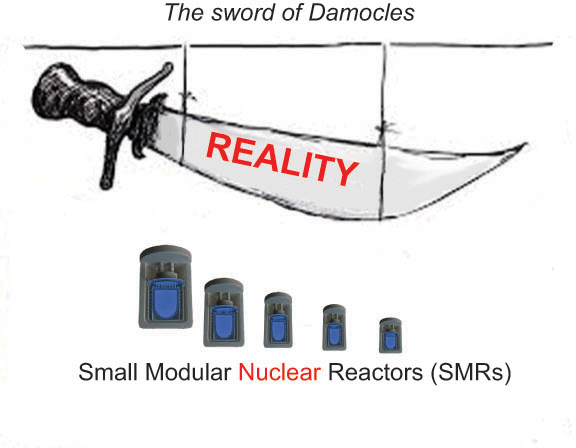
USA desperately pushing the fantasy of Small Nuclear Reactors to India

March 2, 2020 Posted by | India, marketing, Small Modular Nuclear Reactors, USA | Leave a comment

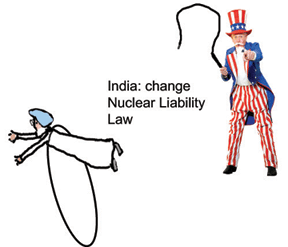
Trump’s toxic nuclear sales pitch to India- undermining India’s nuclear liability law

March 2, 2020 Posted by | India, marketing, USA | Leave a comment

Trump is using Yucca Mountain to drum up Republican votes

February 27, 2020 Posted by | election USA 2020 | 2 Comments

U.S. Pentagon demands $167 billion tax-payer nuclear funding through to 2025

February 27, 2020 Posted by | business and costs, USA, weapons and war | Leave a comment

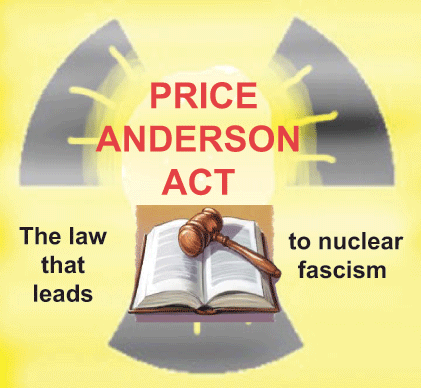
USA’s nuclear insurance places the big responsibility on the tax-payer

February 27, 2020 Posted by | business and costs, Legal, Reference, USA | Leave a comment

Hanford’s radioactive underground structures likely to collapse

February 27, 2020 Posted by | safety, USA | Leave a comment

New Mexico’s elected leaders waver on Holtec’s nuclear waste plan

February 27, 2020 Posted by | politics, USA, wastes | Leave a comment

U.S. Pentagon toys with a plan to win a “limited nuclear war” against Russia

US staged ‘limited’ nuclear battle against Russia in war game

The Pentagon has briefed about the simulated exchange in a move that could signal readiness to fight and win nuclear conflict,  Guardian,  Julian Borger in Washington, Tue 25 Feb 2020 The US conducted a military exercise last week which simulated a “limited” nuclear exchange with Russia, a senior Pentagon official has confirmed.The war game is notable because of the defence department’s highly unusual decision to brief journalists about the details and because it embodied the controversial notion that it might be possible to fight, and win, a battle with nuclear weapons, without the exchange leading to an all-out world-ending conflict.

The exercise comes just weeks after the US deployed a new low-yield submarine-launched warhead commissioned by Donald Trump, as a counter to Russian tactical weapons and intended to deter their use.

According to a transcript of a background briefing by senior Pentagon officials, the defence secretary, Mark Esper, took part in what was described as a “mini-exercise” at US Strategic Command in Nebraska. Esper played himself in the simulated crisis, in which Russia launched an attack on a US target in Europe……

The official said that “in the course of [the] exercise, we simulated responding with a nuclear weapon”, but described it as a “limited response”.

The limited response could suggest the use of a small number of nuclear weapons, or an existing low-yield weapon, or the new W76-2 low-yield submarine-launched missile which was deployed in the Atlantic for the first time at the end of last year. The deployment only became public at the end of January……

The briefing was first reported by National Defense, a trade magazine of the National Defense Industrial Association.

Hans Kristensen, the director of the nuclear information project at the Federation of American Scientists, pointed out that it was extremely rare for the Pentagon to give such detailed briefings about nuclear exercises and suggested it could have been a marketing exercise for the new weapons being added to the US arsenal.

“Remember, it’s only a few weeks ago that we had the official confirmation that this new low-yield warhead had been deployed,” Kristensen said. “And we’re now moving into a new budget phase where they have to go to Congress and try to justify the next new nuclear weapon that has a low-yield capability which is a sea-launched cruise missile. So all of this has been played up to serve that process.”……

Arms control advocates are concerned that the leadership in both the US and Russia are developing a mindset in which their vast nuclear arsenals are not just the ultimate deterrent but weapons that could be used to win “limited” conflicts.  https://www.theguardian.com/world/2020/feb/24/limited-nuclear-war-game-us-russia

February 25, 2020 Posted by | USA, weapons and war | Leave a comment

USA at G20 tried to stop any mention of climate change

US blocking mention of climate change in G20 statement, diplomats say Independent UK, Oliver O’Connell, New York, 24 Feb 20, 
1 day ago  G20 diplomats say the US is against mentioning climate change in the communique of the world’s financial leaders.

A new draft of the joint statement shows the G20 considering including it as a risk factor to growth.

Finance ministers and central bankers from the world’s 20 largest economies are discussing the main challenges to the global economy in RiyadhSaudi Arabia, this weekend.

G20 sources told Reuters that the US was reluctant to accept language on climate change as a risk to the economy.

The US is represented at the meeting by treasury secretary Steven Mnuchin…….. G20 diplomats say the US is against mentioning climate change in the communique of the world’s financial leaders.

A new draft of the joint statement shows the G20 considering including it as a risk factor to growth. Finance ministers and central bankers from the world’s 20 largest economies are discussing the main challenges to the global economy in RiyadhSaudi Arabia, this weekend.

G20 sources told Reuters that the US was reluctant to accept language on climate change as a risk to the economy.The US is represented at the meeting by treasury secretary Steven Mnuchin. https://www.independent.co.uk/news/world/americas/us-politics/climate-change-g20-us-global-economy-paris-agreement-trump-a9352891.html

February 25, 2020 Posted by | climate change, politics international, USA | Leave a comment

Question USA’s need for a New Nuclear Sea-Launched Cruise Missile

Does the US Need a New Nuclear Sea-Launched Cruise Missile?

The case for a new sea-launched cruise missile raises worrying questions.The Diplomat By Robert Farley, February 24, 2020  According to a new report from Defense News, the United States is moving forward on development of a dangerous new nuclear capability. Aaron Mehta of Defense News reported on February 21 that the Department of Defense intends to create a program of record for a submarine launched cruise missile (SLCM) equipped with a nuclear warhead. The request comes in response to Trump administration preferences set forth in the 2018 Nuclear Posture Review, which also called for the deployment of low-yield nuclear warheads on submarine launched ballistic missiles.

The United States has not deployed a nuclear armed SLCM since the retirement of the TLAM-N in 2013. ……..

The deployment of a newer, more survivable SLCM would not exactly create a new problem so much as reintroduce an old one. Nuclear cruise missiles take up space on a ship and require different kinds of crew expertise. Their storage alongside conventional missiles creates an obvious potential for accidents. Discrimination would also become a problem. The United States has launched a great many cruise missiles from submarines as part of the War on Terror and associated conflicts. China, Russia, and other nuclear powers can credibly recognize such launches as carrying conventional munitions. If attack submarines reacquire the capability to launch nuclear weapons, then Beijing and Moscow need to worry about every missile launch within range of their territory.

This would become more, not less, problematic in context of a direct conflict between the United States and China. The U.S. has promised to hold targets within China at risk during a general conflict, presumably with cruise missiles. Heretofore China has not needed to account for the possibility that these missiles might carry nuclear warheads, but if the U.S. deployed nuclear SLCMs then any strike might be interpreted as a nuclear attack…….https://thediplomat.com/2020/02/does-the-us-need-a-new-nuclear-sea-launched-cruise-missile/

February 25, 2020 Posted by | USA, weapons and war | Leave a comment

Poor quality nuclear spent fuel casks at Pilgrim Nuclear Power Station

Push for better storage of spent Pilgrim Nuclear Power Station fuel, Cape Cod Times,  Christine Legere Feb 23, 2020
Pilgrim Nuclear Power Station was permanently shut down in May, but more than 4,000 radioactive spent fuel assemblies will continue to be stored at the Plymouth site for the foreseeable future.

Citizen activists in Barnstable County communities will ask voters at spring town meetings, or via local election ballots, to support an advisory question that would direct Gov. Charlie Baker and state legislators to require that the radioactive waste is stored in “better quality” dry casks than those planned for use, and that the casks are protected by earthen berms or within enclosures with heightened security.,

Diane Turco, a Harwich resident and president of Cape Downwinders, said radioactive spent fuel is a national problem, not just a local issue.

The Cape Downwinders wrote the advisory question.

“Fifty percent of Americans live within 50 miles of a nuclear power plant,” Turco said. “Safety is a right. Our petition is to raise consciousness: educate the public about ongoing issues at Pilgrim.”

The selectmen in Orleans and Brewster voted to put the advisory question on their respective spring election ballots, Turco said. In Bourne, the question will go on the town meeting warrant.

Other Barnstable County communities will be presented with the advisory in the coming weeks.

Entergy Corp., Pilgrim’s longtime owner, sold the plant to Holtec International, a New Jersey-based company that will handle decommissioning, spent fuel management and site cleanup.

Turco and other Pilgrim critics have complained that Holtec has a conflict of interest since the company uses dry casks that it manufactures. The Holtec Hi-Storm 100s the company uses are concrete-encased stainless steel canisters that are a little over a half-inch thick.

“That’s just three-eighths of an inch thicker than a Yeti cup,” Turco said.

There is no way to monitor the steel canisters once they are sealed, critics say, and there is no aging management plan.

Concern also has been expressed over Holtec’s plan to store spent fuel on a concrete pad just a short distance from a well-traveled road. A vanity fence, rather than earth berms or enclosures, will block the view from the street.

“In this day and age, Pilgrim is an open door for any bad actors who want to cause serious damage to our country,” Turco said. “Nuclear waste is a predeployed nuclear weapon. Its safe storage is being ignored.”………

tate Attorney General Maura Healey filed a motion to intervene in the license transfer several months ago, but the motion remains under review by the Nuclear Regulatory Commission.

Frustrated by the lack of action, Healey sued the NRC last fall in U.S. District Court for approving the transfer of Pilgrim’s license from Entergy Corp. to Holtec International without first listening to what state officials and the public had to say about it. The case is pending.

Healey contends that Holtec is inexperienced in decommissioning and will likely run out of money before the job is done. Holtec will use the plant’s decommissioning trust fund, which contains $1.1 billion in ratepayer money.

The Nuclear Decommissioning Citizens Advisory Panel, which is made up of local officials, representatives from state agencies and members of the public, has been frustrated by Holtec’s lack of response during monthly meetings regarding decommissioning and spent fuel.

Holtec’s continuing refusal to answer the advisory panel and the public’s questions about the safety and expected longevity of the company’s dry cask storage technology is not only disturbing, it’s outrageous,” Sean Mullin, chairman of the advisory panel, wrote in an email. “The citizens of the Commonwealth have a right to know how, for example, Holtec can accurately monitor the sealed casks for problems and, if detected, how these can be repaired.”

The NRC director of the Division of Nuclear Materials Safety, a senior health physicist, senior materials engineer and chief of the NRC’s Storage and Transportation Licensing Branch will attend an advisory panel meeting set for 6:30 p.m. Monday in Plymouth Town Hall to discuss the region’s concerns.

Follow Christine Legere on Twitter: @ChrisLegereCCT.   https://www.capecodtimes.com/news/20200223/push-for-better-storage-of-spent-pilgrim-nuclear-power-station-fuel

February 25, 2020 Posted by | safety, USA, wastes | 1 Comment

President Trump, eyeing the election campaign contradicts his administration on Nevada nuclear waste dump

One Side of a Nuclear Waste Fight: Trump. The Other: His Administration.

The president, eyeing the battleground state of Nevada, has made clear he opposes a nuclear waste site at Yucca Mountain, reversing a policy that was made in his name.

In a tweet earlier this month, Donald Trump appeared to have reversed his position to now oppose creating a national nuclear waste dump at Nevada’s Yucca Mountain, NYT, By Maggie Haberman,, Feb. 23, 2020

    Mr. Trump, who in recent weeks seemed to end his administration’s support for moving nuclear waste to Yucca Mountain, a proposal that had been embraced by his appointees for three years despite his own lack of interest

  • “Why should you have nuclear waste in your backyard?” Mr. Trump asked the crowd at a rally in Las Vegas on Friday, to applause, noting that his recently released budget proposal did not include funding to license the site, as previous ones had.  applause, noting that his recently released budget proposal did not include funding to license the site, as previous ones had.

February 25, 2020 Posted by | election USA 2020, politics, wastes | Leave a comment

Safety check records falsified at SC nuclear plant,

February 25, 2020 Posted by | incidents, USA | Leave a comment