Gamma radiation found ineffective in sterilizing N95 masks
Gamma radiation found ineffective in sterilizing N95 masks
Nuclear scientists and biomedical researchers team up to investigate whether treatment with gamma radiation could make N95 masks more reusable. MIT News, Leda Zimmerman | Department of Nuclear Science and Engineering, April 10, 2020“………….“The sterilized masks lost two-thirds of their filtering efficiency, essentially turning N95 into N30 masks,” says Cramer. But why the deterioration?
“Our hypothesis is that ionizing radiation of whatever kind likely decharges the electrostatic filtration of the mask,” says Gupta. “The mechanical filtration of gauze can trap some particles, but radiation interferes with the electrostatic filter’s ability to repel or capture particles of 0.3 microns.”……” http://news.mit.edu/2020/gamma-radiation-found-ineffective-in-sterilizing-n95-masks-0410
Bankrupt FirstEnergy Solutions is resuscitated as Energy Harbor, House Bill 6 subsidises Perry and Davis-Besse Nuclear Power plants

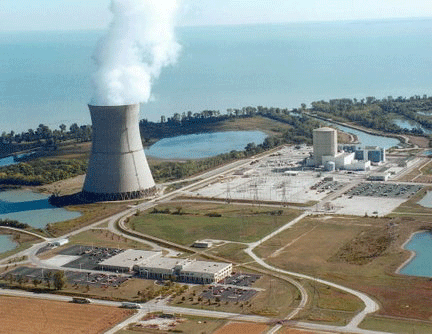
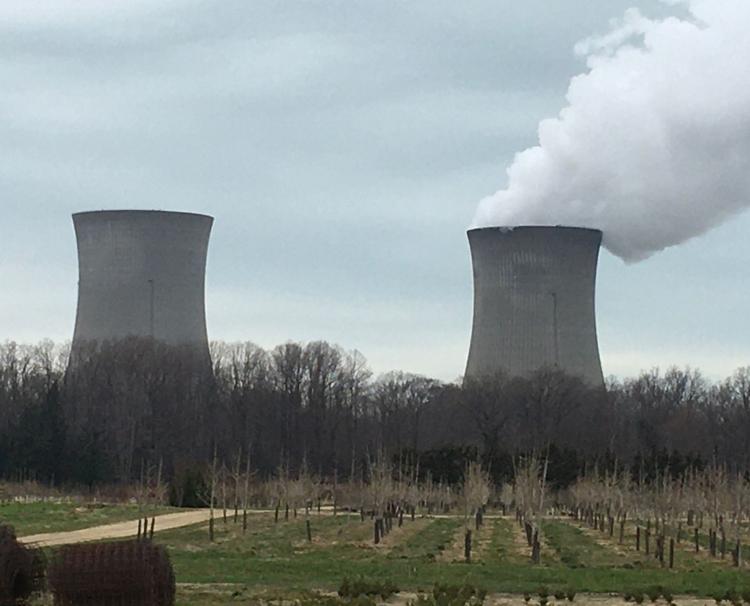
In March 2018, the owner of both plants, known then as FirstEnergy Solutions, announced that it would close both plants if subsidies were not approved. ……..
In addition, FirstEnergy Solutions filed for bankruptcy.
While H.B. 6 went into effect in October, it was announced on Feb. 27 that the former FirstEnergy Solutions, under the new name of Energy Harbor, emerged from bankruptcy……
Perry area government leaders recently offered their views on how the Perry Nuclear Power Plant staying open will impact the future financial outlook for their respective towns or entities, as well as the community as a whole. ……
Under terms of House Bill 6, charges paid by residential, commercial and industrial customers on their electric bills will generate an estimated $170 million a year. Of that total, $150 million annually will go to the Perry and Davis-Besse nuclear power plants. The other $20 million is earmarked to support six solar energy projects in Ohio.
The nuclear plants will receive money between 2021 and 2027. …… https://www.news-herald.com/news/perry-leaders-assess-impact-of-perry-nuclear-power-plant-staying-open/article_ac6bb456-78f5-11ea-ba51-d72a1e490038.html
Idaho lawmakers want nuclear waste ready to get trucked away
Idaho lawmakers want nuclear waste ready to get trucked away
 by KEITH RIDLER Associated Press, Saturday, April 11th 2020 BOISE, Idaho (AP)
– Idaho’s congressional delegation wants the U.S. Department of Energy to prepare spent nuclear fuel for trucking out of eastern Idaho ahead of a 2035 deadline.
The two Republican senators and two Republican representatives in the letter sent Wednesday said the department could be readying the spent fuel for placement in protective trucking containers.
A 1995 agreement following a series of federal lawsuits requires the Energy Department to remove most of the spent fuel and other nuclear waste from the site that includes the Idaho National Laboratory……..
The Idaho lawmakers acknowledge the lack of a permanent repository in their letter, but they say preparing the waste for removal from Idaho should start anyway. …….
The U.S. Government Accountability Office reports that the U.S. has more than 99,000 tons (90,000 metric tons) of spent nuclear fuel stored at 80 sites in 35 states. Most of the spent fuel is from nuclear power generation at commercial plants, with about 15% coming from the U.S. government’s nuclear weapons program.
Some of that nuclear waste was being sent to Idaho for years until former Democratic Gov. Cecil Andrus and former Republican Gov. Phil Batt engaged in a series of federal court battles with the Energy Department resulting in the 1995 Settlement Agreement during Batt’s term that is generally seen as preventing Idaho from becoming a high-level nuclear waste dump.
That agreement, with some exceptions, requires the Energy Department by 2035 to remove spent fuel and nuclear waste from its 890-square-mile (2,300-square-kilometer) eastern Idaho site in sagebrush steppe. The area is about 50 miles (80 kilometers) west of Idaho Falls and sits atop a giant aquifer supplying farms and cities in the region with water.
The 1995 agreement has been altered several times over the years, including twice recently…….
The U.S. Navy also stores spent fuel from its fleet of nuclear-powered warships at the site. That spent fuel is also covered in the 1995 agreement. https://idahonews.com/news/local/idaho-lawmakers-want-nuclear-waste-ready-to-get-trucked-away
Critical comments on the claim that “Nuclear Energy Could Power The Trillion-Dollar Space Race”
 Haley Zaremba’s final comment “” good news for public health and the environment coming out of the space industry”” left me puzzled.
Just exactly how are nuclear-powered space travel, and nuclear reactors on the moon and on Mars “good news for public health and the environment”?
A second question – nuclear reactors in space as a “trillion dollar” industry. Does this mean that it will magically somehow bring in trillions of dollars to the U.S. economy, – or, more likely, just add trillions of dollars to the national debt?
A final question – as the global economy, and especially the American economy, goes into freefall, heading for the greatest Depression ever, is this article just a rather sad joke?

Nuclear Energy Could Power The Trillion-Dollar Space Race https://oilprice.com/Energy/Energy-General/Nuclear-Energy-Could-Power-The-Trillion-Dollar-Space-Race.html By Haley Zaremba – Apr 09, 2020, While the economy comes to a grinding halt here on Earth, some investors, inventors, and dreamers are looking to the stars for their next business venture. The final frontier has been touted as a potential breeding ground for untold numbers of industries in key economic sectors including mining, tourism, research and development, data collection and analysis, to name just a very few.
In fact, the commercial potential of the space economy is allegedly so great and so untapped (for now) that Bank of America Merrill Lynch projected back in 2017 that the size of the space industry is due to explode, expanding to more than eight times its current size by 2050. Valued at nearly $400 billion now, that means that the space sector would reach a total value of nearly $3 trillion over the next thirty years.
We are entering an exciting era in space where we expect more advances in the next few decades than throughout human history,” a Bank of America report stated. Goldman Sachs and Morgan Stanley, however, were far more conservative in their projections than Bank of America Merrill Lynch, but the financial corporations still predicted that the space sector will expand to be a more-than trillion dollar industry inside of 20 years.
Even the United States Chamber of Commerce has been bullish on the space sector, stating that “total private investment is growing at a striking pace,” citing research by Bryce Space and Technology. “From 2000-2005, the industry received more than $1.1 billion in investment from private equity, venture capital, acquisitions, prizes and grants, and public offerings. By the 2012-2017 period, the industry had received more than $10.2 billion.” The Chamber goes on to say that, “the increased investment reflects the new opportunities in the commercial space sector and new startup ventures that did not exist a decade ago.”
Last summer, Oilprice reported that the nuclear industry was also angling to get a piece of the modern-day space race. “In just a few short years from now, the United States will be shipping nuclear reactors to the moon and Mars,” the report said, citing statements from team members from the Kilopower project, a collaborative venture from NASA and the United States Department of Energy.
The Kilopower project is a near-term technology effort to develop preliminary concepts and technologies that could be used for an affordable fission nuclear power system to enable long-duration stays on planetary surfaces,” said NASA’s Space Technology Mission Directorate. “In layman’s terms, the focus of the Kilopower project is to use an experimental fission reactor to power crewed outposts on the moon and Mars, allowing researchers and scientists to stay and work for much longer durations of time than is currently possible,” the Oilprice article summed up.
Now, just this week, an article from Space.com reported that “space is about to go nuclear — at least if private companies get their way.” The article is referencing developments from the 23rd annual Commercial Space Transportation Conference (CST), which took place in Washington, D.C. back in January. There, “a panel of nuclear technology experts and leaders in the commercial space industry spoke about developments of the technology that could propel future spacecraft faster and more efficiently than current systems can.”
NASA is no stranger to nuclear power. The agency has already used nuclear energy to power its Mars rovers, its Cassini mission probe of Saturn and its rings, and the two Voyagers up there exploring the edges of our solar system as we speak. The nuclear energy that powered those projects, however, relied “on the passive decay of radioactive plutonium, converting heat from that process into electricity to power the spacecraft,” whereas, according to the panelists at the CST, the future of space industry electricity lies in “Nuclear Thermal Propulsion (NTP), a technology developed in the 1960s and ’70s that relies on the splitting, or fission, of hydrogen atoms.” This form of nuclear fission would need low-enriched uranium, a much less hazardous material.
“An NTP-powered spacecraft would pump hydrogen propellant through a miniature nuclear reactor core. Inside this reactor core, high energy neutrons would split uranium atoms in fission reactions; those freed neutrons would smack into other atoms and trigger more fission. The heat from these reactions would convert the hydrogen propellent into gas, which would produce thrust when forced through a nozzle,” explained Space.com.
At least there is some good news for public health and the environment coming out of the space industry on the week that Trump announced that he wants to mine the moon.
Trump uses the pandemic, to decimate environmental restrictions. Nuclear waste to landfill decision is just one example.
|
https://americanindependent.com/donald-trump-administration-nuclear-waste-cleanup-coronavirus-new-mexico-covid-19/ By Josh Israel,April 8, 2020 The coronavirus pandemic is making the problem even worse.
The Trump administration has been under fire for not doing enough to clean up nuclear waste. And now, with the COVID-19 pandemic and social distancing measures, the efforts are effectively on hold. At the Waste Isolation Pilot Plant in New Mexico, an underground nuclear waste facility operated by the Department of Energy, new shipments of hazardous material from nuclear sites across the country have reportedly been stopped to protect workers from the coronavirus. According to an Associated Press report, the small number of essential employees working at nuclear facilities around the country, including Los Alamos National Laboratory in New Mexico and the Hanford Nuclear Reservation in Washington, are focusing on safety, security, and information technology. Cleanup efforts have been frozen. Sen. Maria Cantwell (D-WA) told the wire service this week that worker safety is a priority, but more effort is needed to speed nuclear cleanup. “We are fighting to make sure workers and their families are taken care of during this crisis and that workers have the resources they need to meet cleanup goals when they are able to safely return to their jobs,” she said. Cantwell, Washington Sen. Ron Wyden (D), and New Mexico Democratic Sens. Martin Heinrich and Tom Udall raised concerns in early March that the Trump administration was not planning to spend enough money to do needed nuclear waste cleanup. Funding for those efforts, they warned, was being cut in favor of spending more money on modernization of the nation’s nuclear arsenal. The landfill decision is the latest in a line of moves by the Trump administration that flout environmental concerns. It also comes as the administration is under fire for using the coronavirus pandemic as an excuse to decimate environmental protections. The Environmental Protection Agency announced last week that it was temporarily suspending enforcement of civil environmental regulations, allowing the fossil fuel industry to ignore monitoring and compliance obligations. The agency additionally rolled back automobile pollution standards enacted during the Obama administration. Donald Trump has repeatedly promised America “crystal clear clean water and clean air” but has significantly changed environmental regulations, often going beyond the loosening of rules that industry asks for. Last year, Trump told reporters at a NATO summit in London that climate change was “very important” to him, saying he thought about it “all the time.” However, months later, his administration curbed a series of methane regulations that even some energy companies opposed. And despite claiming he wants “crystal clear” water, Trump has signed a series of orders allowing construction on highly controversial oil pipelines to move forward. “Nobody in the world can do what you folks do,” he told a group of pipeline engineers in April last year before signing an order making it difficult for states to intervene and stop such projects. “And we’re going to make it easier for you.” |
|

Refuelling continues at Limerick nuclear plant, but three more workers test positive for Covid19
 More Limerick nuclear plant workers test positive for coronavirus; refueling to continue More Limerick nuclear plant workers test positive for coronavirus; refueling to continue
by Andrew Maykuth, Philadelphia Inquirer, April 8, 2020 Exelon Generation said Wednesday that three nuclear plant workers have now been diagnosed with COVID-19 since it took the Limerick Generating Station out of service for refueling on March 27 — two since Friday — but the giant power plant is still on track to complete its maintenance turnaround early next week.
Of more than 1,000 workers involved with the refueling outage at Limerick’s Unit 1 reactor, 44 were quarantined because they may have come into contact with one of the infected workers or with infected people outside the plant, the company said in a statement Wednesday. About 23 of the quarantined workers show symptoms, said Val Arkoosh, the chair of the Montgomery County Commission. Of the three people who have tested positive since the project began, one was a regular employee and two were contractors, she said. “As the outage winds down, the number of workers onsite will continue to decrease significantly and we will remain overly cautious in our criteria for quarantining, including all workers — symptomatic or not — who have had potential exposure at work or at home,” Exelon said in a statement. The company announced on Friday that one worker had tested positive, and said that two more were flagged this week. The workers were sent home to recover. Since the illness takes several days to incubate before a patient displays symptoms, it’s uncertain if the workers were infected on site or had come into contact with somebody before the outage began. About half the contracted workers are local and half come from out of state; specialists typically move like nomads between plants during the spring and autumn nuclear refueling seasons. Limerick is one of more than 30 reactors nationwide that are scheduled for refueling and maintenance outages this spring, according to the Nuclear Energy Institute. Anti-nuclear activists have protested the influx of so many workers during a public health crisis, and Montgomery County officials have raised concerns about Exelon’s decision to proceed with the refueling…… https://www.inquirer.com/business/limerick-nuclear-plant-refueling-coronavirus-workers-infected-20200408.html |
|
Coronavirus complicates refuelling of nuclear reactors, Fermi 2 has undisclosed number of Covid19 workers
 Coronavirus strikes Fermi 2 nuclear plant during refueling; utility keeps working,TOM HENRY, The Blade, thenry@theblade.
9 Apr 20, NEWPORT, Mich. — An undisclosed number of coronavirus cases have been documented inside Fermi 2 during the nuclear plant’s latest refueling outage.
But owner-operator DTE Energy said it believes it has enough precautions in place now to complete the work and get the plant restarted in the coming weeks.
In a statement, DTE spokesman Stephen R. Tait said the company “can confirm that we have had employees test positive, but are not giving out numbers, locations or names at this time.”
Media reports showed the first worker tested positive about the same time the refueling outage began on March 21. A Detroit television station reported at least two more positive cases were documented within days of that.
DTE won’t say for the record when it expects to complete Fermi 2’s outage.
But many similar operations — which once took six weeks or longer — have been shortened to about a month in recent years. Utilities lose hundreds of thousands of dollars in potential electricity sales each day nuclear plants sit idle.
Nuclear plants are refueled every 18 to 24 months, depending on the type of uranium used in their reactor cores.
Fermi 2, located along western Lake Erie in northern Monroe County’s Frenchtown Township, is one of many nuclear plants across the United States scheduled to be refueled during the spring or fall of 2020, the two seasons when demand for electricity is lowest.
Energy Harbor’s Davis-Besse nuclear plant along the Lake Erie shoreline in rural Ottawa County recently completed its latest refueling.
Both plants are about 30 miles from downtown Toledo.
The coronavirus pandemic has, of course, complicated those efforts this year.
To help keep refuelings on schedule, the U.S. Nuclear Regulatory Commission last month allowed for an exemption from rules which limit the number of consecutive hours workers are allowed to be inside the plant at a time. The agency said in a March 28 letter to the Washington-based Nuclear Energy Institute that it will consider such requests on a case-by-case basis, and that exemptions will be limited to 60 days. …..
In nearly all refuelings, including at those at Fermi 2 and Davis-Besse, hundreds of specialized, out-of-state contractors augment the regular plant workforces, often resulting in 1,000 or more workers assigned to any given site at a time. Work is usually divided into eight-hour shifts, with activity occurring 24 hours a day.
Officials have noted those contractors move throughout the country from job to job, bringing with them the potential of carrying viruses outside of the sites they last worked. …….. https://www.toledoblade.com/business/energy/2020/04/08/coronavirus-strikes-Fermi-2-nuclear-plant-during-refueling-utility-keeps-working-to-get-it-restarted/stories/20200408092
Russia wants to extend New START nuclear weapons treaty, but the U.S. has not revealed its plans
|
RUSSIA SAYS U.S. ‘UNWILLINGNESS’ IS THREATENING MAJOR NUCLEAR WEAPONS DEAL https://www.newsweek.com/russia-us-unwillingness-threatening-major-nuclear-weapons-deal-1496824 BY DAVID BRENNAN ON 4/8/20 Russia has again pointed the finger at the U.S. for delaying the extension of the New START nuclear weapons treaty, which expires next year.
Kremlin spokesperson Dmitry Peskov told reporters Wednesday that any questions about why the deal has not been extended should be directed to Washington rather than Moscow. Peskov said the Kremlin remains keen to make a deal, but has met with delay from the White House. “Actions on destruction of this document—on its non-extension—are taken not by Moscow,” Peskov told reporters, according to the Tass state news agency. “Rather, this is our U.S. colleagues’ unwillingness, and we have repeatedly expressed our regret in that regard.” The 10-year New START treaty came into force in 2011. It extended the existing START agreement, which was signed in the early 1990s. New START capped the number of deployed Russian and U.S. strategic nuclear warheads and bombs at 1,550, and the number of deployed intercontinental ballistic missiles, submarine-launched ballistic missiles and heavy bombers used for nuclear missions at 700. The total allowed number of deployed and non-deployed assets is currently 800. New START is the last of what former Soviet Premier Mikhail Gorbachev called the “three principal pillars of global strategic stability,” following the collapse of the Anti-Ballistic Missile Treaty in 2002 and the Intermediate-Range Nuclear Forces treaty last year. Russia has repeatedly said that it wants to extend New START, but the U.S. has still not revealed its plans. President Donald Trump has hinted that they wish to include China in any new deal, but experts—among them one of the original negotiators of START—have warned this is not feasible in such a short time frame. Chinese officials have dismissed any suggestion of involvement in a new treaty. Newsweek has contacted the State Department for comment on its plans regarding New START. Peskov acknowledged that the New START deal has fallen down the pecking order with the appearance of the coronavirus pandemic. Both the U.S. and Russia—like many other nations—are struggling to contain the virus. “The coronavirus has halted many vital processes,” Peskov said, “This is the reality we have to face.” Russian Deputy Chairman of the Security Council of Russia Dmitry Medvedev—who was serving as president when New START was signed—complained Wednesday that in the nine years since the deal was agreed, the U.S. has flipped from “cooperation to political pressure and unleashed an unprecedented war of sanctions against us, trying to oust Russia from the global agenda.” In an op-ed for Tass, Medvedev suggested that removing sanctions on Moscow would be a good first step to re-open New START talks. “If the New START deal ceases to exist, its demise will have extremely serious consequences for international security,” the former president and prime minister said. Russian officials including President Vladimir Putin have urged the White House to lift sanctions—imposed because of Russia’s annexation of Crimea, support of separatists in eastern Ukraine and meddling in the 2016 U.S. presidential election—to help the global response to coronavirus. |
|
NuScam and other nuclear companies weasel their way into University of Tennessee

TVA signs nuclear research MOU with University of Tennessee on advanced SMR technologies, Power Engineering Rod Walton, 4.7.20 In its latest move toward potentially embracing next-gen nuclear energy technology, the Tennessee Valley Authority has signed a memorandum of understanding with the state’s largest university to study it together.
The University of Tennessee and TVA signed the MOU to evaluate development of advanced nuclear technologies such as small modular reactors. The project, if developed, would be at TVA’s 935-acre Clinch River Nuclear Site in Roane County.
TVA has not made a decision to build it and would still require U.S. Nuclear Regulatory Commission approval for a specific design. Late last year, however, the NRC approved the federal utility’s early site permit at Clinch River.
Earlier this year, TVA announced it had signed an MOU with the Oak Ridge National Lab, part of the Energy Department system……. This announcement joins previously announced partnerships and design advancements involving companies such as NuScale Power, Lightbridge, Framatome and South Korea’s SMART SMR……
Knoxville is the flagship campus for the UT system. The university has more than 29,000 students from every state in the U.S. and more than 100 other nations.
(Rod Walton is content director for Power Engineering and POWERGEN International. He can be reached at 918-831-9177 and rod.walton@clarionevents.com). https://www.power-eng.com/2020/04/07/tva-signs-nuclear-research-mou-with-university-of-tennessee-on-advanced-smr-technologies/
Idaho lawmakers want DOE to remove spent nuclear fuel from the Idaho National Laboratory.
|
Idaho lawmakers urge Department of Energy to remove spent nuclear fuel from INL https://idahonews.com/news/local/idaho-lawmakers-urge-department-of-energy-to-remove-spent-nuclear-fuel-from-inl– Idaho representatives and senators are urging the Department of Energy to take additional steps to remove spent nuclear fuel from the Idaho National Laboratory.CBS2 News Staff Thursday, April 9th 2020 BOISE, Idaho (CBS2) Representative Mike Simpson and Representative Russ Fulcher sent a letter to the U.S. Department of Energy Wednesday encouraging further action by DOE. The letter asks the DOE to remove spent nuclear fuel from the Idaho National Lab (INL) consistent with the 1995 Idaho Settlement Agreement.
Idaho’s congressional delegation, including U.S. Senator Mike Crapo, U.S. Senator James Risch, Representative Mike Simpson and Representative Russ Fulcher sent a letter to the U.S. Department of Energy Wednesday encouraging further action by DOE. The letter asks the DOE to remove spent nuclear fuel from the Idaho National Lab (INL) consistent with the 1995 Idaho Settlement Agreement. The delegation wrote, “We encourage the Department to initiate activities needed to begin loading of spent nuclear fuel into a multi-purpose canister (MPC) at the Idaho National Laboratory using existing facilities.” The letter urges DOE to take additional action to prove it will meet the 2035 deadline for removal of spent nuclear fuel. Read the full letter HERE, or the text below. [on original] |
U.S. Nuclear Regulatory Commission proposing dumping some nuclear wastes in landfills – a huge public health danger
|
NRC Proposes Allowing Nuclear Waste at Dumps, Recycling Sites https://www.publicnewsservice.org/2020-04-06/nuclear-waste/nrc-proposes-allowing-nuclear-waste-at-dumps-recycling-sites/a69794-1 April 6, 2020. BOISE, Idaho — The Nuclear Regulatory Commission may change its rules to allow the nuclear industry to dump some of its waste in landfills. Opponents say the change poses a public health risk and would allow waste to go unmonitored. The proposal would enable the NRC to reinterpret the meaning of low-level radioactive waste so that it could be accepted at dumps and hazardous waste sites, rather than regulated storage facilities. Daniel Hirsch is president of Committee to Bridge the Gap, an organization that focuses on nuclear safety. He says a dump site in Idaho would benefit from this change. “In addition to the waste potentially going to everyone’s municipal landfill, the real focus of this is to allow the U.S. Ecology facility in Idaho to — without a license — start taking the material that up until today you’re required to have a license for,” he points out. On Friday, the public comment period was extended from April 20 to July 20. But Hirsch and other opponents say the COVID-19 pandemic isn’t allowing for proper scrutiny of the rule. They want it picked back up six months after the coronavirus crisis is over. Diane D’Arrigo, radioactive waste project director for the Nuclear Information and Resource Service, says the change would allow the industry to dispose of any waste other than irradiated fuel at landfills. That includes concrete, soil, clothing or any material where radiation still exists. The limit would be 25 millirem per year, a unit of absorbed radiation. D’Arrigo says the change poses a big public health risk. “There’s some so-called low-level waste that could give a lethal dose in 15 minutes if you’re exposed unshielded,” Terry Lodge, an attorney who works on nuclear safety issues, says the industry has been working for this change for decades because of the cost of disposing waste at radioactive-storage facilities. “The utilities build the expense of disposing of the waste into their electrical charges to us customers,” he points out. “So it’s not as though they don’t have the money. But there is a relentless search for quick and dirty solutions.” |
|
Georgia’s Vogtle nuclear project way over budget, way behind time, and now Coronavirus hits

First coronavirus case reported at Georgia nuclear plant project, William Freebairn Editor, Richard Rubin 6 Apr 20,
- Too early to say if completion delayed: Southern Company
- Additional worker test results pending
Washington — The first coronavirus infection has been confirmed at Georgia Power’s Vogtle nuclear plant construction site, the utility said Monday.There was one confirmed positive test result out of 69 people at the site tested, the company said in a statement. There were 54 negative test results, with 14 results still pending, it added.
Georgia Power and three partners are completing two 1,150-MW nuclear units at Vogtle, near Augusta, with the first new unit scheduled to enter commercial operation in November 2021. The project is the largest industrial construction site
in Georgia, with 9,000 workers, most of them contractors, at the plant, trade union officials have said.
There is a risk the coronavirus pandemic could delay the completion and testing of the two new reactors, although it is too soon to tell for certain, Southern Co., Georgia Power’s parent company, said in a financial filing April 1, before the positive test result.
Construction of the project is about five years behind schedule and has exceeded the initial budget by more than $10 billion as the result of first-of-a-kind design, licensing and construction issues.
The company notified and sent home those who worked with the person who tested positive, Georgia Power said.
“Construction work continues at the site under continuing enhanced protocols designed to reduce worker-to-worker contact and keep areas that workers frequent cleaned and sanitized,” the company said.
In a filing with the Georgia Public Service Commission April 1, Georgia Power officials said the construction site had established an expanded on-site medical clinic and put in place “aggressive” measures to keep workers in the field further apart.
U.S. taxpayers might cough up for a private company’s new “Small Nuclear” space travel gimmick
 Private companies find role in developing nuclear power for space travel, Space.com By JoAnna Wendel – Space.com contributor 6 Apr 20,
Nuclear-powered spacecraft could cut our travel time to Mars in half. Space is abouto go nuclear — at least if private companies get their way.
At the 2 t3rd annual Commercial Space Transportation Conference (CST) in Washington, D.C., in January, a panel of nuclear technology experts and leaders in the commercial space industry spoke about developments of the technology that could propel future spacecraft faster and more efficiently than current systems can.
Nuclear technology has powered spacecraft such as NASA’s Mars rovers, the Cassini mission and the two Voyagers that are currently exploring the outer reaches of our solar system. But those fuel sources rely on the passive decay of radioactive plutonium, converting heat from that process into electricity to power the spacecraft.
Instead, the CST panelists discussed Nuclear Thermal Propulsion (NTP), a technology developed in the 1960s and ’70s that relies on the splitting, or fission, of hydrogen atoms. Although fission is associated with more warlike images, the panel’s experts emphasized the safety of nuclear thermal propulsion, which would use low-enriched uranium.
An NTP-powered spacecraft would pump hydrogen propellant through a miniature nuclear reactor core. Inside this reactor core, high energy neutrons would split uranium atoms in fission reactions; those freed neutrons would smack into other atoms and trigger more fission. The heat from these reactions would convert the hydrogen propellent into gas, which would produce thrust when forced through a nozzle.
This chain reaction is the key to NTP’s power, panelist Venessa Clark, CEO of Atomos Space, a company that’s developing thermonuclear propulsion powered spacecraft to provide in-space transportation options to satellite operators, told Space.com. A soda-can-size fission reactor could propel humans to Mars in just three to four months, she said, about twice as fast as the currently estimated time it could take a chemically propelled ship to carry humans to the Red Planet. …..
But the government still has to play some role, both Clark and Thornburg said. Government agencies like NASA and the military branches may be the first clients for these commercial companies. Clark noted NASA’s recent pushes to partner with the private sector, such as its commercial lunar payload services program and its commercial crew program.
“Government players, NASA and also now the Air Force are looking at procuring services rather than funding the development of technology, which is really exciting for us,” Clark said…. https://www.space.com/commercial-nuclear-power-for-faster-space-travel.
COMMENT. newtons_laws 06 April 2020 14:47
A Roosevelt salutes as Hero – the Captain of Theodore Roosevelt nuclear aircraft carrier
 This story says nothing about this being a nuclear-powered ship. But underlying this whole thing is the fact of the (probably necessary) culture of secrecy that surrounds all things nuclear. This is yet another example of how the nuclear culture means that it is “preferable” for people to die, rather than have the truth get out.

Captain Crozier Is a Hero, Theodore Roosevelt, my great-grandfather, would agree. By Tweed Roosevelt, Mr. Roosevelt is a great-grandson of Theodore Roosevelt and the chairman of the Theodore Roosevelt Institute at Long Island University. April 3, 2020
On Monday, Capt. Brett Crozier, the commander of the aircraft carrier Theodore Roosevelt, sent a letter to the Navy pleading for permission to unload his crew, including scores of sailors sickened with Covid-19, in Guam, where it was docked. The Pentagon had been dragging its feet, and the situation on the ship was growing dire. “We are not at war,” he wrote. “Sailors do not need to die. If we do not act now, we are failing to properly take care of our most trusted asset — our sailors.”
After the letter was leaked to The San Francisco Chronicle, the Navy relented. But on Thursday, it relieved Captain Crozier of his command.
In removing Captain Crozier, the Navy said that his letter was a gross error that could incite panic among his crew. But it’s hard to know what else he could have done — the situation on the Theodore Roosevelt was dire.
Ships at sea, whether Navy carriers or cruise ships, are hotbeds for this disease. Social distancing is nearly impossible: The sailors are practically on top of one another all day, in crowded messes, in cramped sleeping quarters and on group watches.
It is thought that a sailor caught the virus while on shore leave in Vietnam. Once on board, the virus took its now predictable course: First a sailor or two, then dozens, and all of a sudden more than 100 were sick.
Captain Crozier received orders to take the ship to Guam, but he was not given permission to offload most of the sailors. The virus was threatening to overwhelm the small medical crew aboard. There was not much time before sailors might start dying.
The captain felt he had to act immediately if he was to save his sailors. He chose to write a strong letter, which he distributed to a number of people within the Navy, demanding immediate removal from the ship of as many sailors as possible. Perhaps this was not the best approach for his career, but it got results…….
The acting secretary of the Navy, Thomas Modly, summarily fired the captain, not for leaking the letter (for which he said he had no proof), but for showing “extremely poor judgment.” Many disagree, believing that Captain Crozier showed excellent judgment. He left the ship Thursday night to a rousing hero’s sendoff……… https://www.nytimes.com/2020/04/03/opinion/coronavirus-crozier-roosevelt.html
The current crisis aboard the USS Roosevelt lays bare the dangers of blind obeisance to President Trump.
 TRUMP BROKE FAITH WITH CAPT. CROZIER AND ALL OUR SAILORS, Crooked, KEN HARBAUGH / APR.3.20 More than a dozen members of Congress on Friday condemned the U.S. Navy’s decision to dismiss the Commanding Officer of the USS Theodore Roosevelt. Earlier this week, in a memo leaked to the San Francisco Chronicle, Capt. Brett Crozier accused the Navy of jeopardizing the lives of his crew, by failing to take swift action to mitigate an outbreak of COVID-19 aboard his ship. “Keeping over 4000 young men and women aboard the TR,” he wrote, “is an unnecessary risk and breaks faith with those Sailors entrusted to our care.” ….
President Trump has demonstrated, time and again, that he has no qualms about using the military to advance his personal political ends. He routinely stages uniformed personnel as props for partisan speeches. He treats deployments like political theater, as when he dispatched elements of the 82nd Airborne to the southern border to stoke fears of an immigrant invasion. And he undermines discipline and unit cohesion, pardoning war criminals convicted by military juries.
The rot may start at the top, but it reaches downwards………..
The current crisis aboard the USS Roosevelt lays bare the dangers of blind obeisance to President Trump. When the COVID-19 virus first began to impact the military’s overseas operations, Secretary of Defense Mark Esper warned commanders not to take any action that might surprise or embarrass the White House, or challenge the president’s messaging about the crisis. For those on board the USS Roosevelt, the downstream effect of that order may well be deadly. …….
How do we support these leaders, those with the courage to challenge blatantly political directives that needlessly endanger the lives of those they lead? To begin with, we must acknowledge what civilian control of the military actually means. It is not simply allegiance to the president. It requires Congress to perform effective oversight. Now, more than ever, America needs its elected representatives to hold military leaders accountable.
By law, every service member has a right to alert any member of Congress about issues within the military, provided no classified information is exchanged. For those in uniform who may not trust their own representatives, there are plenty of young veterans now in Congress (including one bad-ass female Navy pilot), who have no patience with the sycophancy infecting the Pentagon. Many of these representatives have come to the defense of Capt. Crozier.
Most importantly, the American public must do its part. We must remain alert whenever our armed forces are misused by the president. The American military belongs to us, not him. In his letter, Capt. Crozier alludes to the absurd politics behind the catastrophe unfolding aboard the USS Roosevelt. “This will require a political solution,” he writes, “but it is the right thing to do. Sailors do not need to die.” ………..
Ken Harbaugh is a former Navy pilot and nominee for the U.S. House of Representatives. Follow him on Twitter at @Team_Harbaugh. https://crooked.com/articles/trump-betrayed-crozier-sailors/
1 This Month

of the week– Nuclear Reactor Information Task Force

14 May – online event From Bombs to Data Centres: the Face of Nuclear Colonialism
To see nuclear-related stories in greater depth and intensity – go to https://nuclearinformation.wordpress.com
-
Archives
- May 2026 (102)
- April 2026 (356)
- March 2026 (251)
- February 2026 (268)
- January 2026 (308)
- December 2025 (358)
- November 2025 (359)
- October 2025 (376)
- September 2025 (257)
- August 2025 (319)
- July 2025 (230)
- June 2025 (348)
-
Categories
- 1
- 1 NUCLEAR ISSUES
- business and costs
- climate change
- culture and arts
- ENERGY
- environment
- health
- history
- indigenous issues
- Legal
- marketing of nuclear
- media
- opposition to nuclear
- PERSONAL STORIES
- politics
- politics international
- Religion and ethics
- safety
- secrets,lies and civil liberties
- spinbuster
- technology
- Uranium
- wastes
- weapons and war
- Women
- 2 WORLD
- ACTION
- AFRICA
- Atrocities
- AUSTRALIA
- Christina's notes
- Christina's themes
- culture and arts
- Events
- Fuk 2022
- Fuk 2023
- Fukushima 2017
- Fukushima 2018
- fukushima 2019
- Fukushima 2020
- Fukushima 2021
- general
- global warming
- Humour (God we need it)
- Nuclear
- RARE EARTHS
- Reference
- resources – print
- Resources -audiovicual
- Weekly Newsletter
- World
- World Nuclear
- YouTube
-
RSS
Entries RSS
Comments RSS
 nuclear-news