Coronavirus cases at Hanford nuclear waste site and at Nuclear Fuel Services
 Hanford Employee Being Tested for COVID-19; Cases Confirmed at Nuclear Fuel Services BY EXCHANGEMONITOR, 15 Apr, 20, Hanford Employee Being Tested for COVID-19; Cases Confirmed at Nuclear Fuel Services BY EXCHANGEMONITOR, 15 Apr, 20, An employee at the Hanford Site in Washington state is being tested for COVID-19, the Department of Energy said in an overnight post. …….
Hanford, like most other DOE nuclear cleanup sites, has drawn down to minimal operations during the federal public health emergency. Probably no more than 20% of its usual workforce remains on-site. To date, Hanford has not reported any positive COVID-19 results among its workforce of about 11,000 federal and contractor employees. Meanwhile, BWX Technologies subsidiary Nuclear Fuel Services on Tuesday reported multiple cases of COVID-19 among its workforce. The Erwin, Tenn., defense-uranium contractor did not say how many employees were infected, or how many potentially exposed employees were in quarantine following contact with the sick workers……
It was not clear whether the COVID-19 emergency response might delay any Nuclear Fuel Services contract milestones. Among other things, the company is producing low-enriched uranium to produce tritium in civilian nuclear reactors for National Nuclear Security Administration (NNSA) nuclear weapons programs. Nuclear Fuel Services also could wind up purifying defense uranium for the weapons program around 2023. The NNSA is negotiating with the company to act as a backstop for the Y-12 National Security Complex in Oak Ridge, Tenn., in a few years.
As of late last week, there were more than 50 confirmed cases across the NNSA’s nuclear weapons sites. There are currently at least nine confirmed cases at nuclear-cleanup programs overseen by the DOE Office of Environmental Management. https://www.exchangemonitor.com/nuclear-fuel-services-reports-covid-19-cases/?printmode=1
|
|
America’s eternal nuclear waste problem
After burning at 550 degrees Fahrenheit for several years, the fuel in the cores of nuclear reactors (uranium, in most cases) will experience diminishing returns of energy output. The 700-pound, 14.5’-tall uranium fuel assemblies must be replaced, but what to do with the street lamp-sized chunk of (very) heavy metal that will leak radiation for the next 100,000 years?
For nearly 40 years, federal officials have grappled with the question of nuclear waste disposal. There’s no easy answer.
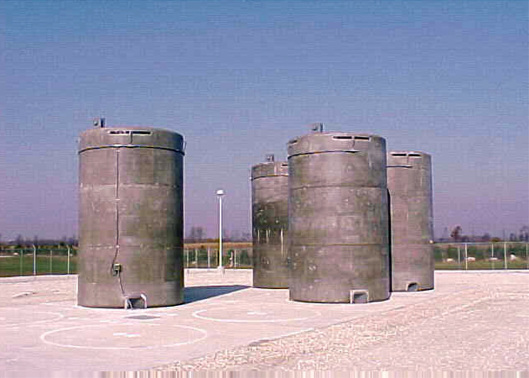
All the uranium ever burned and extracted from reactors at Exelon’s Nine Mile Point and James A. FitzPatrick nuclear facilities remains at the sites, within sight of the Lake Ontario shoreline in Scriba. After several years in a cooling pool adjacent to the reactor itself, the depleted uranium is entombed in steel and concrete silos (known as dry cask storage) at a separate part of the plants’ campuses.
Dry cask storage is “designed to contain radiation, manage heat and prevent nuclear fission. They must resist earthquakes, projectiles, tornadoes, floods, temperature extremes and other scenarios,” according to the Nuclear Regulatory Commission (NRC), which oversees all nuclear plants in the United States. While licensed on a 20-year basis and in most cases built to be effective for more than 100 years, dry cask installations are nevertheless not designed to last forever — unlike the radiation emanating from the uranium.
There’s a lot of science involved in using uranium to power our homes and businesses, but the solution to its waste problem is undeniably a political one.
The federal Nuclear Waste Policy Act of 1982 mandated the Department of Energy to find a solution to the problem of how to collect, transport and store American nuclear waste in a central location. Four decades later, the spent uranium from FitzPatrick and Nine Mile Point’s reactors still sits in Scriba, enjoying its lakeside view.
In 1987, Yucca Mountain, Nevada, was selected from a pool of eight potential sites to host the nation’s geological repository for high-level nuclear waste.

According to the NRC, the Yucca Mountain facility would look basically as follows:
1. Canisters of waste, sealed in special casks, are shipped to the site by truck or train.
2. Shipping casks are removed, and the inner tubes with the waste are placed in steel, multilayered storage containers.
3. An automated system sends storage containers underground to the tunnels.
4. Containers are stored along the tunnels, on their sides.
Unsurprisingly, this was not a universally popular decision with the people of Nye County, Nevada, where Yucca Mountain is located.
NRC documents describe the scenes at the first public hearings in Nye County about the project in 1999 and 2000, after more than a decade of geological studies and environmental impact research.
“The citizens expressed concern about why they felt they couldn’t trust the government and were afraid of being lied to,” read one section of a report prepared by the Center for Nuclear Waste Regulatory Analyses.
In addition to the scientific challenges of building a facility capable of withstanding one million years of natural disasters (an actual court-ordered requirement), the NRC found they had to deal with unexpected human hurdles
“At one of the meetings a local politician attended the meeting with his own television reporter and used the meeting as a venue for grandstanding,” the report said. “His comments off camera to the NRC staff were very complimentary, but on camera he took a much harsher stance.”
U.S. Sen. Kirsten Gillibrand, D-NY, has indicated that while she believes a federal repository is the best solution to spent uranium storage, she would not demand the construction of one without the consent of its local communities.
“Senator Gillibrand believes we must find a permanent solution for spent fuel storage and the Department of Energy should work with the states and with Congress to find an acceptable site,” said Gillibrand spokesperson Miriam Cash. “There should be a federal repository for permanently storing civilian nuclear waste and communities in New York should not have to be required to store it on-site for decades.”
Funds for the Yucca Mountain licensing review process finally ran out in 2011 and no meaningful progress has been made since that point, according to federal nuclear officials.
Secretary of Energy Stephen Chu, a member of President Barack Obama’s administration, dubbed Yucca Mountain “off the table” in 2009, but clearly, the table still has room to accommodate its return.
Yucca Mountain sits in the middle of the Nevada desert roughly 100 miles northwest of Las Vegas. Since the site’s selection in 1987 as the national spent fuel repository from a pool of eight other locations, the Department of Energy has run into roadblocks from local and environmental interests and, perhaps most importantly, opposition from Nevada Democrat Harry Reid. Reid represented Nevada in the U.S. Senate for 30 years beginning in 1987 and deftly wielded his influence, including as Senate majority leader, to stifle Yucca Mountain progress until his 2017 retirement. That was the same year President Donald Trump’s first executive budget contained funds to restart the research into a feasible transition from individual reactor site dry cask storage to a national repository system.
Executive budgets are not law, however, and while Trump’s public support for more than $100 million in funding symbolized yet another component in his industry-friendly administration’s larger platform, Congress has yet to approve any of the dollars.
“The political debate rages on,” Rod McCullum of the Nuclear Energy Institute, an industry advocacy group based in Washington, D.C., told The Palladium-Times in a recent interview. “The scientific and technical basis is as strong as ever, but the political will to move forward is as weak as ever.”
Any meaningful change in funding for the Yucca Mountain licensing review would would need to come from Congress, but in a legislative body where in the best of times progress is measured in subatomic increments, the current health crisis has brought all non-COVID-19 discussion to an indefinate halt.
In a statement on the topic of dry cask storage versus a federal repository, U.S. Rep. Anthony Brindisi, D-Utica, expressed support for a “bipartisan solution that identifies and funds a permanent storage solution” and removing the spent uranium from its sites. Brindisi is also a co-sponsor on H.R. 2314, the Nuclear Powers America Act, which provides investment tax credits for nuclear power plants.
The course reversal (and back again) by the federal government isn’t helping matters. As recently as 2018, legislation was proposed funding Yucca Mountain’s review process. For many, the term “nuclear waste” evokes images of leaking barrels of glowing, toxic goo; the boring truth is that spent fuel’s true danger lies more in the quantity than its lack-of-quality. As long as nuclear plants continue to operate in the United States, they will continue to produce waste uranium that must be carefully stored on site in dry cask facilities.
Yucca Mountain’s license application is for a term of 10,000 years. It is unclear if that is a long enough span of time for officials to come to a final decision.
Seth Wallace is the managing editor of The Palladium-Times and a nuclear energy policy enthusiast.
President Trump ‘talked about nuclear weapons’ with Vladimir Putin in a call to the Kremlin over the weekend as START Treaty’s expiration looms
- resident Trump told reporters Monday that he discussed nuclear arms control during his latest conversation with Russian President Vladimir Putin
- The president shared phone call with Putin on Sunday just hours after he helped broker a historic deal with the OPEC+ to shore up plummeting oil prices
- Trump revealed the contents of the call during the White House’s daily coronavirus press briefing on Monday evening
- ‘We did talk about the arms. Yes, we did,’ Trump told reporters from the podium. ‘It was a very important part of the call actually’
- Though Trump failed to divulge specifics the Russian president’s press secretary said Putin and Trump spoke of the START Treaty, which is set to expire next year……….. https://www.dailymail.co.uk/news/article-8216245/President-Trump-talked-nuclear-weapons-Vladimir-Putin-call-weekend.html
Multiple COVID-19 cases confirmed among Nuclear Fuel Services employees in Erwin
by WCYB, Wednesday, April 15th 2020 ERWIN, Tenn. — Multiple COVID-19 cases have been confirmed among Nuclear Fuel Services employees in Erwin.
The exact number of employees was not given.
U.S. Energy Dept awards for nuclear students (not for renewable energy ones)
 U.S. Department of Energy Announces Education Awards for the Next Generation of Nuclear Scientists and Engineers, APRIL 14, 2020 WASHINGTON, D.C. – The U.S. Department of Energy (DOE) today announced more than $5 million in awards through the Office of Nuclear Energy’s Integrated University Program. The program offers undergraduate scholarships and graduate fellowships to students pursuing nuclear engineering degrees and other nuclear science and engineering programs relevant to nuclear energy. The awards include 42 scholarships and 34 fellowships for students at 32 U.S. colleges and universities.
“The Integrated University Program is focused on attracting the best and the brightest to nuclear energy professions,” ….https://www.energy.gov/ne/articles/us-department-energy-announces-education-awards-next-generation-nuclear-scientists-and-0
Changes for a low carbon economy are possible: we must advocate for this


The major impact of coronavirus on the trajectory of climate change must not be a temporary reduction in emissions from cars, trucks and airplanes. It must be a collective recognition that rapid and significant voluntary changes in our behavior are possible. For individual climate action to be sustained, people must find honor and joy in it. And that action must also be supported by government leadership and coordination. We must advocate now, as vocally as we can, for immediate and significant investments in green infrastructure. To avert disaster, we must change how we live.
The Coronavirus and Climate Action https://blogs.scientificamerican.com/observations/the-coronavirus-and-climate-action/ Confronting global warming will take a completely different approach from confronting the pandemic, By Laura J. Martin on April 10, 2020
In recent weeks, many Americans have voluntarily and radically altered their behavior in order to protect others from the novel coronavirus. Those who are less vulnerable are making sacrifices in order to protect those who are more vulnerable: the elderly, the immunocompromised, and—in our country, with its broken social safety net—the uninsured and the poor.
Climate scientists have been quick to draw parallels between the need to “flatten the curve” of coronavirus spread and the need to flatten the carbon emissions curve. The Intergovernmental Panel on Climate Change states that we must reduce emissions by about 45 percent from 2010 levels by 2030 in order to lessen the severity of future emergency; to reduce, but not eliminate, the probability of catastrophic changes in sea level, ocean acidity, extreme weather, food security and biodiversity.
But confronting climate change will require a completely different generational politics than confronting coronavirus. Rather than young people changing their lifestyles to protect the elderly, the large and growing proportion of older citizens in industrialized countries will have to change their lifestyles in order to protect children and those not yet born. Those with power and resources today will have to change their lifestyles dramatically in order to protect the world’s poorest and most marginalized, those who will not be able to move away from climate hazards. This is the message that youth activists like Zero Hour, Isra Hirsi and Greta Thunberg implore us to heed. It is also the premise of DearTomorrow, a storytelling project where people write climate messages to loved ones living in the future.
Who is right? Continue reading
A win-win for USA and North Korea? Helping to fight coronavirus
|
Why Helping North Korea Fight Coronavirus Could Lessen the Chance of a Nuclear War https://nationalinterest.org/blog/korea-watch/why-helping-north-korea-fight-coronavirus-could-lessen-chance-nuclear-war-143697
A necessary win-win for Washington and Pyongyang?
by Cynthia Lazaroff Follow @CynthiaLazaroff on Twitter 13 Apr 20, Amidst the existential nightmare unfolding with the coronavirus, comes the news that North Korea has ramped up its missile testing and lost all interest in a dialogue with the United States. At a March meeting with G-7 Foreign Ministers, Secretary of State Pompeo called on all nations to maintain diplomatic and economic pressure on North Korea over its nuclear and ballistic missile programs. Pompeo’s ill-timed call to uphold sanctions even during the global pandemic escalated tensions and triggered Pyongyang’s chilling response: North Korea has become “more zealous for our important planned projects aimed to repay the U.S. with actual horror and unrest for the sufferings it has inflicted upon our people.”
While some may call this mere bluster, Pyongyang’s warning serves as a grim reminder that the existential nuclear threat is not going on lockdown during this pandemic. It is a clear and present danger like COVID-19, invisible but very much alive. And like the virus, it has been ignored for perilously too long. Former U.S. Secretary of Defense William J. Perry has sounded the alarm: “Today, the danger of some sort of a nuclear catastrophe is greater than it was during the Cold War and most people are blissfully unaware of this danger.”
We are now awake to the COVID-19 catastrophe, the enormity of the pain and suffering, the staggering human and economic costs. Worst case projections estimate that COVID-19 deaths could be in the millions globally, with variable forecasts over the past month for America. Estimates show Americans could lose anywhere from 60,000 to 2.2 million or more of their loved ones to the virus because Washington ignored repeated warnings and failed to act before it was too late. This is the price of sleepwalking in the face of this existential threat, which is horrific, but these numbers nonetheless pale in comparison to the estimated tens of millions in North and South Korea, Japan, Guam, Hawaii and beyond who could die in the mass carnage if nuclear weapons were to be launched by Kim or Trump in a moment of anger, accident, miscalculation or mistake.
Existential threats by nature do not discriminate. Like nuclear weapons, COVID-19 attacks human beings indiscriminately, oblivious to race, religion, gender, ideology or country of origin. Like radioactive fallout, the virus does not recognize borders, and like nuclear war, it spares no one—whether rich, poor, Korean, American, sanctioned or unsanctioned.
If Washington doesn’t take emergency measures to stop the spread of COVID-19 in the human population as a whole, America fails to do so at its own peril. Outbreaks in other countries increase the risk of outbreaks around the world. This is why it makes no sense to uphold sanctions that in any way hinder a country’s capacity to combat the virus. U.N. High Commissioner for Human Rights Michelle Bachelet has called for humanitarian exemptions to sanctions because “in a context of global pandemic, impeding medical efforts in one country heightens the risk for all of us.” In other words, what America does to the people of North Korea, Iran, Venezuela, Russia, Cuba and other sanctioned countries, America does to itself.
If Washington doesn’t take emergency measures to stop the spread of COVID-19 in the human population as a whole, America fails to do so at its own peril. Outbreaks in other countries increase the risk of outbreaks around the world. This is why it makes no sense to uphold sanctions that in any way hinder a country’s capacity to combat the virus. U.N. High Commissioner for Human Rights Michelle Bachelet has called for humanitarian exemptions to sanctions because “in a context of global pandemic, impeding medical efforts in one country heightens the risk for all of us.” In other words, what America does to the people of North Korea, Iran, Venezuela, Russia, Cuba and other sanctioned countries, America does to itself.
Guterres calls on Americans further to unite now in solidarity to protect the most vulnerable and susceptible to COVID-19 everywhere—those ravaged by war, women, children, the elderly, homeless and displaced populations, along with those living in the poorest countries with weak health care infrastructures like North Korea. During this global existential crisis, Bachelet and Guterres are inviting Americans to rise to the better angels of our nature, transcend our differences and get our priorities straight: to stop wasting precious time and resources on conflict and war and mobilize as a “human family” to give it everything we’ve got to save lives.
If the United States applies Bachelet and Guterres’ recommendations to North Korea, Washington can make progress on the existential threat of COVID-19 and the existential threat of a nuclear exchange with Pyongyang. America and North Korea can work together to halt the spread of COVID-19, thereby create goodwill and de-escalate tensions. Washington can and should take further steps to reduce tensions and the risk of a nuclear missile launch due to anger, accident, miscalculation or mistake.
Here are five steps the United States should take right now:
Americans wake up every morning to soaring death tolls, the tragic cost of waiting too long to act to contain COVID-19. It is already late—for the United States, for North Korea, for the world. Millions of lives are at stake. The time to act on these existential threats is now. Cynthia Lazaroff is an expert on U.S.-Russia relations, a documentary film producer, and environmental activist. She has been engaged in Track II and 1.5 dialogue for the past forty years and has directed several films on the Soviet Union and nuclear proliferation. You can follow her on Twitter @CynthiaLazaroff. |
|
Nuclear Power Industry Must Not Use Covid-19 Pandemic to Neglect Safety,
|
TACOMA PARK, Maryland – The nuclear power industry should not be allowed to significantly increase nuclear safety risks while jeopardizing the health and wellbeing of power plant workers and entire communities within emergency planning zones already sheltering in place under a viral threat, says a safety expert at Beyond Nuclear, a national anti-nuclear watchdog organization. As the incidences of the novel coronavirus (Covid-19) among nuclear power plant workers spread across the U.S. nuclear power fleet, the U.S. Nuclear Regulatory Commission (NRC) is poised to relax nuclear power plant safety inspections and maintenance required by reactor operating licenses. The NRC will also allow nuclear utilities to require their control room operators, onsite security forces, fire brigades and other critical site personnel to work substantially longer fatiguing shifts. The deferral of the safety-related tasks and relaxation of work hour controls are needed, they say, to comply with “social distancing” recommendations from the Centers for Disease Control (CDC) and to respond to the anticipated attrition of a workforce stricken by the highly contagious and debilitating pandemic. Yet at the same time, the industry and the NRC are crowding nuclear power plants with as many as 1,600 workers, brought in from across the country, to conduct reactor refueling operations. Fourteen reactors are presently shut down, primarily for refueling, and more reactors are scheduled to halt for refueling through the end of May. “The nuclear industry and its regulator, the NRC, are maximizing the industry’s power production by pressing onward with scheduled reactor refueling outages,” said Paul Gunter, Director of Reactor Oversight at Beyond Nuclear. “Yet at the same time, they are using CDC Covid-19 guidelines to defer scheduled and required inspections and maintenance of critical safety components until the next refueling cycle eighteen months away,” he said. “The regulator and the industry know full well that they are rolling in a Covid-19 Trojan Horse with these refueling crews travelling from one reactor site and community to the next,” said Gunter. Workers at plants that are refueling, such as Limerick in Pennsylvania, have publicly expressed alarm at the overcrowded conditions, describing workers sitting “elbow to elbow” in canteens and computer labs, and saying they are “terrified” that this will lead to widespread infections of the novel coronavirus. Despite this, the industry is also requesting that the NRC defer inspections and delay maintenance required under reactor operating licenses of critical safety components and systems, including steam generators and reactor emergency core cooling systems, until the next refueling cycle eighteen months away. It says this is in order to observe the CDC guidelines for slowing the growth of the pandemic, while maintaining a minimum onsite workforce still fit for duty at operating reactors. In anticipation of more and more workers falling ill to the debilitating virus, the NRC and industry are collaborating to relax “fitness for duty” licensing requirements meant to prevent the over-fatigue of operators and other critical plant workers including security. “Nuclear plant operators on extended 12-hour shifts, who can now be assigned to work two consecutive 84-hour weeks, will suffer excessive fatigue,” Gunter said. “This not only compromises their immune systems, but makes catastrophic mistakes more likely.” The infamous nuclear accident at the Three Mile Island Unit 2 nuclear power station near Harrisburg, PA in the early morning hours of March 28, 1979, was attributed to mechanical failure worsened by operator fatigue and error. In response to the public health emergency brought on by Covid-19, which mandates social distancing, the operators at Braidwood 2 in Illinois, Comanche Peak 2 in Texas, and Turkey Point 3 in Florida have all requested an 18-month delay on inspections and maintenance of the thousands of steam generator tubes that are required to be examined during the current refueling outage in April and May 2020. Steam generators are critical to both power operations and reactor safety, as the tubes represent 50% of the reactor pressure boundary and recirculate vital cooling water through the reactor core. The reactors’ harsh operational environment places extreme stresses on the heat transfer component, causing tube degradation from vibration, heat, radiation, corrosion and cracking that must be guarded against through routine inspection and maintenance. The price for ignoring the condition of steam generator tubes can be high, as was demonstrated in February 2000 when a similarly deferred inspection was attributed to a steam generator tube rupture at the Indian Point Unit 2 nuclear reactor just 30 miles from New York City. The single steam tube rupture released radioactivity into the environment and could have been severe had the high pressure rupture caused a cascading guillotine effect on neighboring tubes and a loss of coolant accident. “It is a reckless contradiction that the nuclear industry is using social distancing restrictions to defer inspections of steam generator tubes while threatening the spread of the virus through thousands of workers moving around the country to refuel reactors,” Gunter said. “Once again, the nuclear industry and a captured regulator are putting financial interests ahead of the wellbeing and safety of workers and the surrounding communities,” he said. “The NRC should suspend these refueling outages and delay the restart of reactors currently down for refueling until a Disaster Initiated Review of the pandemic’s impact on emergency preparedness can be completed, something that the Federal Emergency Management Agency should already be doing with the NRC,” Gunter added. “It is not hard to imagine the level of chaos that would ensue should a nuclear accident occur during the current coronavirus crisis,” Gunter continued. “Emergency preparedness plans are already inadequate, but the prospect of a mandatory mass evacuation at a time like this is an impossible choice,” he said. “It is the duty of the NRC and FEMA to ensure workable emergency preparedness plans and procedures are in place before restarting any of the reactors currently refueling,” Gunter concluded. Beyond Nuclear also recommends strategically powering down some reactors in areas where there is reduced demand induced by the pandemic and pre-pandemic excess regional generating capacity. The workforces at shuttered reactors could then supplement those over-stretched at reactors still operating.“It is not hard to imagine the level of chaos that would ensue should a nuclear accident occur during the current coronavirus crisis,” Gunter continued. “Emergency preparedness plans are already inadequate, but the prospect of a mandatory mass evacuation at a time like this is an impossible choice,” he said. “It is the duty of the NRC and FEMA to ensure workable emergency preparedness plans and procedures are in place before restarting any of the reactors currently refueling,” Gunter concluded. Beyond Nuclear also recommends strategically powering down some reactors in areas where there is reduced demand induced by the pandemic and pre-pandemic excess regional generating capacity. The workforces at shuttered reactors could then supplement those over-stretched at reactors still operating.“It is not hard to imagine the level of chaos that would ensue should a nuclear accident occur during the current coronavirus crisis,” Gunter continued. “Emergency preparedness plans are already inadequate, but the prospect of a mandatory mass evacuation at a time like this is an impossible choice,” he said. “It is the duty of the NRC and FEMA to ensure workable emergency preparedness plans and procedures are in place before restarting any of the reactors currently refueling,” Gunter concluded. Beyond Nuclear also recommends strategically powering down some reactors in areas where there is reduced demand induced by the pandemic and pre-pandemic excess regional generating capacity. The workforces at shuttered reactors could then supplement those over-stretched at reactors still operating. |
|
Massive subsidies to aging nuclear reactors – a recipe for disaster
|
A perverse invitation to nuclear disasters https://www.record-eagle.com/opinion/opinion-a-perverse-invitation-to-nuclear-disasters/article_f4d38e32-6534-11ea-8db3-0732b08237c0.html, BY M.V. RAMANA and CASSANDRA JEFFERY Mar 15, 2020
The anniversary of the Fukushima nuclear reactor accident in Japan was March 11, a disaster that led to widespread radioactive contamination and health impacts to hundreds of thousands. Emerging evidence suggests radiation from contamination is associated with increased incidence of thyroid cancers. The health impacts would’ve been worse if not for the evacuation of nearly 150,000 people from Fukushima. The accident must remind us what could happen with nuclear power plants in America, something worth attention in a time when states subsidize aging nuclear power plants through expensive bailouts to private utility companies.
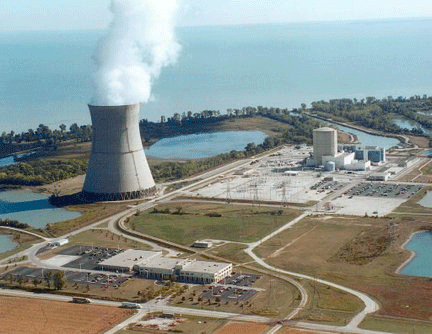
The U.S. suffered severe accidents and close encounters with disaster, most notably the Three Mile Island reactor meltdown in March 1979. In March 2002, the Davis-Besse nuclear power plant in Ohio, owned by the electricity company FirstEnergy, almost experienced a meltdown. A routine but delayed reactor inspection found a “football sized” hole in the carbon-steel pressure vessel, which contains all the highly- radioactive fuel in the reactor. Boric acid leaked and corroded part of the structure, leaving all but a 3/8-inch-thick lining of stainless steel, which was never designed to contain the high-pressure water that cooled the reactor. If the damage wasn’t discovered, the reactor could have experienced a serious accident, according to the Government Accountability Office. FirstEnergy also ignored numerous warnings from the Nuclear Regulatory Commission. The parallels with Japan are unnerving. In February 2011, Japan’s Nuclear and Industrial Safety Agency extended Fukushima Daiichi’s operating license by 10 years. The regulatory agency kept the reactor operating despite knowledge of problems and warning signs, resulting in the March 2011 accident and subsequent health, environment, and economic consequences. Clean-up costs were estimated at $200 billion to over $600 billion (USD). Fast forward to 2019, the Ohio governor signed House Bill 6, allowing FirstEnergy to extract $150 million annually from ratepayers. The massive subsidy aims to finance operations of the aging Davis-Besse nuclear plant, the Perry nuclear plant and two coal-based power plants. (There is no pretense of justifying the subsidy by claiming climate benefits.) Ohio electricity customers will pay a monthly surcharge to fund FirstEnergy’s profits New York, New Jersey, Illinois and Connecticut have also introduced legislation to bail out aging nuclear power plants. Subsidies from consumers go toward profits of the electric utilities owning nuclear plants that were built decades ago. All of these are at risk of a severe accident. Despite assurances about safety, nuclear reactors can undergo major accidents, albeit infrequently. No reactor design is immune to such accidents. There is always a residual risk that could lead to vast tracts of land being contaminated with radioactive substances that affect human health for long periods of time. No matter which way you spin it, continuing to operate old reactors is inviting disaster. About the authors: M. V. Ramana is the Simons chair in Disarmament, Global and Human Security and director of the Liu Institute for Global Issues at the University of British Columbia School of Public Policy and Global Affairs. Cassandra Jeffery is a graduate student of public policy and global affairs at the University of British Columbia. She is the recipient of a Simons Award in Nuclear Disarmament and Global Security and conducts research on energy policies in Asia and North America. |
|
The Coronavirus and Climate Change: How We’re Making the Same Mistakes

The Coronavirus and Climate Change: How We’re Making the Same Mistakes, medium.com Charles Kutscher 12 Apr 20, We Americans are now experiencing the tragic consequences of our slow, uncoordinated response to the coronavirus pandemic. While this experience will surely help us respond better to future health crises, it’s important we apply the hard lessons learned to even greater disasters. In particular, there are many parallels between the coronavirus pandemic and the climate change crisis. We need to recognize that we’re making the same mistakes with climate change and correct them before it’s too late. Below are some of these key blunders.
Failure to heed the warnings
Scientific experts warned us for months about COVID-19, just as they have warned us for decades about climate change. The rapid spread and deadly impact of the disease in other countries, especially in Italy, should have given us plenty of advance warning that we were headed down a similar path. In the case of climate change, we have witnessed countless warnings. As the result of a 1°C temperature rise to date, we have seen unprecedented wildfires in California and Australia, record heat waves and drought across the globe, more powerful storms, and more frequent major floods, to list but a few. In fact, while no direct connection has been made between COVID-19 and climate change, the changing climate is accelerating the incidence of other deadly diseases, such as the West Nile virus. Within the next 50 years, climate change could subject a billion more people to serious vector-borne diseases. It’s critical that we recognize the enormous impacts climate change is already having and heed the warnings of climate scientists who have painted a clear picture of what the future holds if we don’t act aggressively.
Failure to comprehend the delay between the problem and its consequences……..
Being misled by disinformation
With both the coronavirus and climate change, our sluggish response is largely the result of human denial. Both the Chinese and U.S. governments downplayed the threat of the virus. In the case of climate change, the oil and gas industry has a strong financial motive to discount the impact of fossil fuel emissions, and it has long funded an extensive campaign to make light of the effects of climate change. …….
Lack of federal leadership
In the absence of federal action, the governors of states such as Washington and California have had to play leadership roles in limiting the spread of the virus and expanding hospital capability to care for the victims. But relying on individual states has resulted in a competitive, patchwork approach that has proven to be a costly, inefficient means to address a national crisis……
Moreover, with both crises, the federal government has actually been moving in exactly the opposite direction from what is needed. In 2018 the current administration weakened the White House pandemic response capability, leaving us less prepared to face the coronavirus. In the case of climate change, the administration is simultaneously withdrawing from the Paris climate agreement and scaling back automobile fuel efficiency standards, as just two examples. Furthermore, the federal government continues to provide generous subsidies for fossil fuels — the very cause of climate change.
Looking ahead
It’s important we recognize that the blunders we’ve made in addressing the coronavirus are the same ones we’re making in addressing the much bigger climate change crisis. Climate change impacts have greatly worsened over time, but we have continued to ignore the warnings. The delay between our burning of fossil fuels and the environmental consequences has lulled us into a state of inaction, and this has been exacerbated by an ongoing disinformation campaign. We’ve been scaling back — and even reversing — federal action at the exact time we should be accelerating it.
Our experience with COVID-19 will almost certainly prepare us better for the next pandemic. But there is no second chance when it comes to climate change. It’s not as if we can let the ice sheets melt this time and protect them better when they return in the future. With climate change, we’ve got one shot at thinking ahead and addressing this crisis — one shot at understanding what scientists have long been telling us about how bad a 3°C or 4°C temperature rise will be. As with the coronavirus pandemic, climate change is an international crisis that calls for a comprehensive federal commitment to address it. Let’s stop making the same mistakes we’ve made with COVID-19. https://medium.com/@chuck.kutscher/the-coronavirus-and-climate-change-how-were-making-the-same-mistakes-2cd01cce2295
More workers infected with coronavirus at Georgia Power’s Vogtle nuclear project
Coronavirus expands foothold at Georgia Power’s Vogtle nuclear project, AJC, By Matt Kempner, The Atlanta Journal-Constitution 10 Apr 20 The new coronavirus has infected several more workers on Georgia Power’s nuclear expansion of Plant Vogtle, described as the largest construction project in the state.
Georgia Power said Friday that a total of six of the roughly 9,000 workers assigned to the project have been confirmed to have COVID-19. It had reported the first confirmed case there less than a week ago.
Nearly 170 other workers are under quarantine because they were in close proximity to workers who had pending COVID-19 tests, company spokesman John Kraft wrote in an email to The Atlanta Journal-Constitution…….
The company did not disclose what parts of the project the workers were assigned to. Nor did it say whether any of the infected workers have been hospitalized……https://www.ajc.com/news/state–regional/coronavirus-expands-foothold-georgia-power-vogtle-nuclear-project/Ly2Ua2dOBn9mzxb7XwHlBL/
Pandemic makes a nuclear disaster more likely than ever
Terrified Atomic Workers Warn That the COVID-19 Pandemic May Threaten Nuclear Reactor Disaster https://www.commondreams.org/views/2020/04/10/terrified-atomic-workers-warn-covid-19-pandemic-may-threaten-nuclear-reactor
Nuclear safety cannot be shortchanged—especially in the midst of an outbreak like what the nation is now experiencing, by Harvey Wasserman 10 Apr 20,
Nationwide, with falling demand and soaring prices for nuke-generated electricity, the pandemic casts a dark shadow over reactor operations and whether frightened neighbors will allow them to be refueled and repaired.
America’s 96 remaining atomic reactors are run by a coveted pool of skilled technicians who manage the control rooms, conduct repairs, load/unload nuclear fuel. Because few young students have been entering the field, the corps of about 100,000 licensed technicians has been—like the reactors themselves—rapidly aging while declining in numbers. Work has stopped at the last two US reactors under construction (at Vogtle, Georgia) due to the pandemic’s impact, which includes a shrinking supply of healthy workers.
Every reactor control room requires five operators at all times. But the physical space is limited there and in plant hot spots that need frequent, often demanding repairs. Social distancing is virtually impossible. Long shifts in confined spaces undermine operator safety and performance.
Of critical importance: every 18-24 months each reactor must shut for refueling and repairs. Itinerant crews of 1000 to 1500 technicians travel to 58 sites in 29 states, usually staying 30-60 days. They often board with local families, or in RVs, hotels, or Air B&Bs.
Some 54 reactors have been scheduled for refuel/repairs in 2020. But there is no official, organized program to test the workers for the Coronavirus as they move around the country.
As the pandemic thins the workforce, older operators are being called out of retirement. The Trump-run Nuclear Regulatory Commission recently certified 16-hour work days, 86-hour work weeks, and up to 14 consecutive days with 12-hour shifts.
Long-time nuclear engineer Arnie Gundersen warns of fatigued operators falling asleep on the job. He recalls at least one exhausted worker falling into the highly radioactive pool surrounding the high-level fuel rods. Operator fatigue also helped cause the 1979 melt-down that destroyed Pennsylvania’s Three Mile Island Unit Two.
The industry is now using the coronavirus pandemic to rush through a wide range of deregulation demands. Among them is a move to allow radioactive waste to be dumped into municipal landfills.
The NRC may also certify skipping vital repairs, escalating the likelihood of major breakdowns and melt-downs. Nearly all US reactors were designed and built in the pre-digital age, more than 30 years ago. Most are in advanced decay. Atomic expert David Lochbaum, formerly with the NRC, warns that failure risks from longer work hours and deferred repairs could be extremely significant, and could vary from reactor to reactor depending on their age and condition.
The industry has also been required to maintain credible public health response plans should those reactors blow. But pandemic-stricken U.S. hospitals now have zero spare capacity, multiplying the possible human fallout from an increasingly likely disaster.
Industry-wide the pandemic has brought working conditions to the brink of collapse. At Pennsylvania’s Limerick Generating Station, workers say they are “terrified” that the plant has become a “breeding ground…a complete cesspool” for the coronavirus. “I’m in a constant state of paranoia,” one technician told Carl Hessler, Jr., of MontcoCourtNews.
Others say social distancing is non-existent, with “no less than 100 people in the training room” and “people literally sitting on top of each other…sitting at every computer elbow to elbow.” Shift change rooms, Hessler was told, can be “standing room only.” At least two Limerick workers are confirmed to have carried the virus. COVID rates in the county are soaring.
Gundersen, a nuclear engineer, warns that limited control room floorspace and cramped conditions for maintenance can make social distancing impossible. “Some component repairs can involve five workers working right next to each other,” he says.
Because reactor-driven electricity is not vital amidst this pandemic downturn, the demand for atomic workers to “stay home” is certain to escalate. “I am concerned with Exelon & Limerick Nuclear Generating Station’s handling of the scheduled refueling—which has required bringing in workers from across the country during this pandemic,” says US Rep. Madeleine Dean in a statement likely to be repeated at reactor sites around the country.
“The potential increase of COVID-19 cases from 1,400 new workers not observing social distancing is staggering,” says epidemiologist Joseph Mangano of the Radiation and Health Project. “The Limerick plant should be shut until the COVID-19 pandemic is over.”
Indian Point Unit One, north of New York City, will shut permanently on April 28. Iowa’s Duane Arnold will close in December.
But Ground Zero may be Pacific Gas & Electric’s two 35-year-old reactors at Diablo Canyon. PG&E is bankrupt for the second time in two decades, and recently pleaded guilty to 85 felonies from the fires its faulty wires sent raging through northern California, killing 84 people. In 2010 a faulty PG&E gas line exploded in San Bruno, killing eight people.
Surrounded by earthquake faults, Diablo’s construction prompted more than 10,000 civil disobedience arrests, the most at any US reactor. PG&E now admits its two Diablo nukes will lose more than $1.2 billion this year, more than $3.4 million per day.
Amidst its bitterly contested bankruptcy, PG&E may be taken over by the state. But more than a thousand workers are slated in early October to refuel and repair Unit One, which the NRC says is dangerously embrittled.
Whether local residents concerned about both a nuclear accident and the spread of the coronavirus will let them into the county remains to be seen. So is whether they’ll be still operating by then.
With the future of the nuclear industry at stake—along with the possibility of more reactor mishaps—the whole world will be watching.
New START treaty must be extended, a U.S. – Russia nuclear arms race an intolerable threat to the whole world
 Extend New START — The World Can’t Afford a U.S.-Russia Nuclear Arms Race Too, JUST SECURITY, by Kingston Reif and Shannon Bugos, April 10, 2020 The unrelenting and rapid spread of the novel coronavirus underscores the cost of neglect and indecision by the Trump administration in the face of serious threats to U.S. and global security. This reckless abandonment of leadership also characterizes America’s response to other transnational challenges, including the potential for conflict on the European continent and the threat posed by nuclear weapons.
For example, The Guardian reported on April 5 that the Trump administration may withdraw the United States from the Open Skies Treaty this fall. The treaty allows for short-notice, unarmed, observation flights over the territory of treaty parties to collect data on military forces and activities, and is staunchly supported by U.S allies. Nothing screams the U.S. absence in a world starving for leadership during a pandemic than moving forward with plans to withdraw from a treaty that continues to benefit U.S. and European security and that our allies want us to continue to support.
In addition, and even more consequentially, the New Strategic Arms Reduction Treaty (New START), which was signed a decade ago this week, expires in just 10 months. New START is the only remaining arms control agreement limiting the world’s two largest nuclear arsenals. However, as the novel coronavirus emerged earlier this year, the administration continued to stiff-arm Russian overtures to prolong the life of the agreement by five years, as permitted by the accord. Instead, the administration has pursued the idea of striking an entirely new, trilateral arms control agreement that would include China in addition to Russia.
The chances of successfully negotiating such a new, complex deal were already slim before the coronavirus pandemic. Now, in the midst of what clearly will be an extended crisis, the odds are nigh nonexistent……
Extending New START will maintain a cap on the Russian nuclear arsenal and is a necessary condition for follow-on talks with Russia and new negotiations with China. As the world girds for a long fight against the coronavirus pandemic, the preservation of New START represents the best immediate option that Trump has to reduce the risks of instability and insecurity posed by the still-bloated and dangerous U.S. and Russian nuclear arsenals. https://www.justsecurity.org/69613/extend-new-start-the-world-cant-afford-a-u-s-russia-nuclear-arms-race-too/
Confusion over which American military satellites are “nuclear” and which are “nonnuclear.”
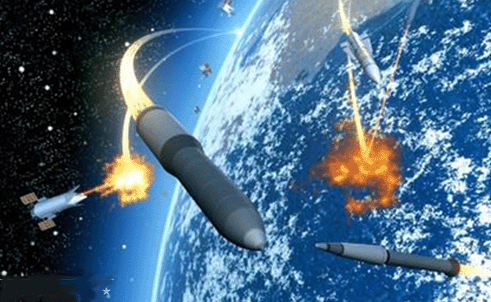 Space-Based Nuclear Command and Control and the ‘Non-Nuclear Strategic Attack’ Space-Based Nuclear Command and Control and the ‘Non-Nuclear Strategic Attack’Counterspace capabilities may meet dual-purpose command and control assets to create new risks. The Diplomat, By Ankit Panda, April 08, 2020 The Trump administration’s 2018 Nuclear Posture Review (NPR) drew much attention for the inclusion of language expanding the scope under which the United States might employ nuclear weapons. Specifically, the document observed that certain “extreme circumstances,” which “could include significant non-nuclear strategic attacks,” would rise to the level of meriting a nuclear response. In remarks delivered during an online video conference this week, Christopher Ford, U.S. assistant secretary at the State Department’s Bureau of International Security and Nonproliferation, discussed this language in the context of space security. Ford emphasized that for the purposes of parsing that bit of the 2018 NPR, American adversaries should understand that U.S. space-based dual-use (nuclear and nonnuclear) command and control assets qualified as what the 2017 National Security Strategy had dubbed a “vital U.S. interest.” Accordingly, Ford continues: “I need hardly point out — but I will nonetheless, for emphasis — that the U.S. National nuclear Command, Control, and Communications (NC3) architecture depends to some extent upon space-based systems.” He is clear therefore that nonnuclear attacks on this architecture would potentially rise to the level of a nuclear response: “Any harmful interference with or attacks upon such components of our space architecture at any time, even if undertaken only with non-nuclear tools, thus starts to move into ‘significant non-nuclear strategic attack’ territory, and would lead to a significant and potentially drastic escalation of a crisis or conflict.” Much of what Ford says here is not new or surprising, but his remarks offer one of the starker presentations of these ideas by a U.S. official in recent years — at least since the release of the 2018 NPR. The problem that arises is one of “entanglement,” where a crisis might escalate to the nuclear level inadvertently if an adversary — say China — is attempting to degrade U.S. conventional operations by taking aim at certain space-based assets. Though the United States openly acknowledges the role of space-based assets in nuclear command and control, there is no explicit tabulation of which American military satellites are “nuclear” and which are “nonnuclear.”….. https://thediplomat.com/2020/04/space-based-nuclear-command-and-control-and-the-non-nuclear-strategic-attack/ |
|
|
Finally, they might investigate America’s most fatal nuclear submarine disaster
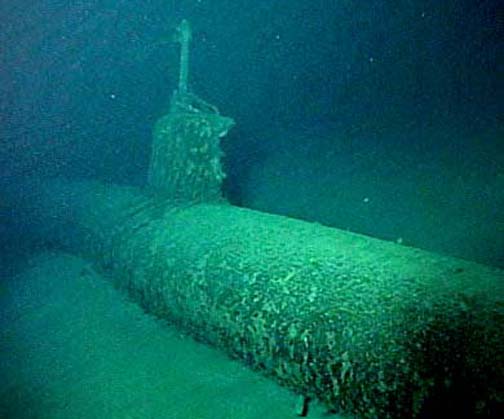
CTY Pisces – Photos of a Japanese midget submarine that was sunk off Pearl Harbor on the day of the attack. There’s a hole at the base of the conning tower where an artillery shell penetrated the hull, sinking the sub and killing the crew. Photos courtesy of Terry Kerby, Hawaii Undersea Research Laboratory. August 2003.
 seven-years-later-americas-worst-nuclear-submarine-disaster, By Robert Eatinger, Friday, April 10, 2020, Fifty-seven years ago today, America suffered its first, and in terms of fatalities its worst, loss of a nuclear-powered submarine. Yet, much of the information about that disaster and the Navy’s subsequent investigation has remained outside of public view. That may change this year.
In February this year, Judge Trevor N. McFadden of the U.S. District Court for the District of Columbia ordered the Navy to review 300 pages of documents a month starting April 30 and by the end of every month thereafter, and to begin rolling productions of documents starting on or before May 15 and every month thereafter.
1 This Month

of the week– Nuclear Reactor Information Task Force

14 May – online event From Bombs to Data Centres: the Face of Nuclear Colonialism
To see nuclear-related stories in greater depth and intensity – go to https://nuclearinformation.wordpress.com
-
Archives
- May 2026 (102)
- April 2026 (356)
- March 2026 (251)
- February 2026 (268)
- January 2026 (308)
- December 2025 (358)
- November 2025 (359)
- October 2025 (376)
- September 2025 (257)
- August 2025 (319)
- July 2025 (230)
- June 2025 (348)
-
Categories
- 1
- 1 NUCLEAR ISSUES
- business and costs
- climate change
- culture and arts
- ENERGY
- environment
- health
- history
- indigenous issues
- Legal
- marketing of nuclear
- media
- opposition to nuclear
- PERSONAL STORIES
- politics
- politics international
- Religion and ethics
- safety
- secrets,lies and civil liberties
- spinbuster
- technology
- Uranium
- wastes
- weapons and war
- Women
- 2 WORLD
- ACTION
- AFRICA
- Atrocities
- AUSTRALIA
- Christina's notes
- Christina's themes
- culture and arts
- Events
- Fuk 2022
- Fuk 2023
- Fukushima 2017
- Fukushima 2018
- fukushima 2019
- Fukushima 2020
- Fukushima 2021
- general
- global warming
- Humour (God we need it)
- Nuclear
- RARE EARTHS
- Reference
- resources – print
- Resources -audiovicual
- Weekly Newsletter
- World
- World Nuclear
- YouTube
-
RSS
Entries RSS
Comments RSS
 nuclear-news