Workers at ‘most toxic place in America’ – Hanford nuclear site – in fear of coronavirus
|
A nuclear waste site where the biggest fear isn’t radiation, but coronavirus
Workers at ‘most toxic place in America’ are terrified to return to a site where there has been very little protection from the outbreak, Guardian, Hallie Golden in Seattle, 4 May, 20 For more than a month, coronavirus has brought cleanup of a 586-square-mile decommissioned nuclear production complex in south-eastern Washington state to a near standstill. Most of the more than 11,000 employees at the Hanford site were sent home in late March, with only essential workers remaining to make sure the “most toxic place in America” stays safe and secure. Now with signs that Washington has turned a corner with the virus and the state’s governor slowly starting to relax some safety measures, Hanford workers are looking at the very real possibility of returning to work. But after facing those initial few weeks of Washington’s coronavirus crisis on-site at Hanford, workers say they received little information and even fewer safety measures from leadership, and some employees are terrified by the prospect. “When you come back to work, what’s the expectation [for protections]?” asked a maintenance and operations worker at Hanford, who asked not to be identified by the Guardian to protect his job. “There are none.”…….. After Washington health officials reported the first US death associated with coronavirus in late February and then, with each passing week, were documenting the most cases in the country, employees say it remained business as usual at Hanford, where the cleanup project is run by the federal Department of Energy, with work completed through contractors. During those first few weeks, workers recall receiving little guidance on site-specific coronavirus safety measures. They say information from Hanford officials tended to be overly broad, focusing on the nationwide situation rather than the unique needs of workers in a state that was at that time at the center of the US coronavirus crisis. A radiological control technician, who has worked at Hanford for more than 15 years, said trailers continued to be shared by as many as 50 people and each Monday morning 200 employees would come together for a meeting in a single room. When workers finished at one of the many contaminated areas of Hanford, they needed to be checked for radiation before leaving. Technicians would stand next to them, without a mask on, running a handheld device over their body – being sure to stay within a quarter of an inch of their skin to ensure accurate readings. In a single hour, one of these radiological control technicians, may have surveyed as many as 30 people. “There’s no way to keep that social distancing. You’re right up in somebody’s face, they’re breathing on you, they’re sweaty,” said the technician, who asked to remain anonymous for fear of retaliation at work. Tom Carpenter, executive director of the Hanford Challenge, a not-for-profit watchdog organization in Seattle, said he received at least 10 emails and phone calls in two weeks in March from employees worried about Hanford not providing face masks or gloves or requiring social distancing to protect them from coronavirus. “Workers were highly distressed about their own health and safety, and felt that management was not taking this issue seriously,” he said. “Stop works”, a protocol at Hanford in which an employee notices something is unsafe or hazardous and work is halted until officials can fix the problem, became so frequent on issues related to coronavirus, said the radiological control technician, that little work was actually getting done. …….. It wasn’t until 25 March – after Governor Jay Inslee’s stay-at-home mandate, which involved the closure of all non-essential companies (Hanford is considered essential) – that the site switched to a state of essential mission-critical operations. The site will remain functioning in this capacity through at least Friday. It’s unclear whether this will be renewed beyond then. Carpenter said the concern over the lack of protection is about more than keeping workers safe from coronavirus. He said if the virus were to get passed throughout Hanford, it could put the highly sensitive work being done there in jeopardy. …… Carpenter said Hanford officials have reported that two workers have been diagnosed with coronavirus, but he said, “there’s almost assuredly more”….. https://www.theguardian.com/us-news/2020/may/04/hanford-nuclear-waste-site-coronavirus-washington Mon 4 May 2020 20.00 AESTLast modified on Tue 5 May 2020 02.36 AEST |
|
NRC rejects contentions raised by Beyond Nuclear and others against nuclear waste proposed site
Federal government rejects contentions to nuclear waste site near Carlsbad and Hobbs https://www.abqjournal.com/1450836/federal-government-rejects-contentions-to-nuclear-waste-site-near-carlsbad-and-hobbs.html BY ADRIAN HEDDEN / CARLSBAD CURRENT-ARGUS, N.M. (TNS) Monday, May 4th, 2020 A proposed nuclear waste repository near Carlsbad and Hobbs proceeded through the federal licensing process despite protests from environmental groups who questioned the legality of the project.
Holtec International applied to the Nuclear Regulatory Commission (NRC) for a license to build and operate a facility that would temporarily store spent nuclear fuel rods in a remote location of southeast New Mexico while a permanent repository is developed.
The consolidated interim storage facility was challenged by Beyond Nuclear and other organizations who questioned Holtec’s application for suggesting the U.S. Department of Energy could take ownership of the waste.
Opponents argued federal law prohibited the government from taking legal possession of spent nuclear fuel.
They also argued against Holtec’s plan to transport the waste via rail, potentially putting communities along the route at risk of exposure to radiation.
Kevin Kamps, radioactive waste specialist at Beyond Nuclear argued Holtec’s application was in violation of the federal Nuclear Waste Policy Act (NWPA), and the proposed temporary storage facility could become permanent as so such repository exists.
“(The NWPA) is the public’s best protection against an interim storage facility becoming a de facto permanent, national radioactive waste dump at the surface of the Earth.” Kamps said. “Congress knew, in passing the NWPA, that the only safe long-term strategy for care of irradiated reactor fuel is to place it in a permanent repository for deep geologic isolation.
Last year, the NRC’s Atomic Safety and Licensing Board rejected about 50 contentions raised by various organizations, citing their lack of standing or adequate factual basis.
And in an April 23 decision the NRC upheld several of the rejects on appeal as either being irrelevant to the licensing process or already addressed in the application itself.
A proposed new contention issued by Fasken Oil and Ranch, questioning if Holtec owned the mineral rights beneath the surface of the proposed site location was remanded by the NRC for further consideration, along with
Against contentions that the Holtec facility would require “illegal” contracting with the federal government to take ownership of the waste, the NRC contended the application assured regulators that Holtec “committed to not contract unlawfully with DOE.”
“Holtec envisions that its customers will either be nuclear plant operators or DOE, depending on which entity holds title to the spent nuclear fuel,” read the NRC report. “Holtec also acknowledged that it hopes Congress will change the law to allow DOE to enter into temporary storage contracts with Holtec.
“The Board concluded that Holtec seeks a license that would allow it to enter into lawful customer contracts today, but also permit it to enter into additional customer contracts if and when they become lawful in the future.”
While the NRC affirmed the Sierra Club’s standing in the proceedings, as some members of the organization live in close proximity to the proposed site, it found that Sierra Club’s contentions around the transportation of the waste and risk of an accident or release were unfounded.
The NRC contended that the National Environmental Policy Act (NEPA) does not require a “worst-case-scenario” analysis be conducted in issuing the license and that the Sierra Club presented “no expert opinion” to support its assertions on the danger of rail transportation.
Against arguments that the storage casks were flawed or insufficient to hold the waste safely, the NRC upheld that Holtec’s HI-STORM UMAX system that it would use at the facility was already federally certified and cannot be questioned in the proceedings unless a rule waiver was granted.
No such waiver was granted at the time of the NRC’s recent decision.
“Because certified designs are incorporated into our regulations, they may not be attacked in an adjudicatory proceeding except when authorized by a rule waiver,” the report read.
“A contention cannot attack a certified design without a rule waiver because this would challenge matters already fully considered and resolved in the design certification review.”
See what others are reading in Carlsbad news:
Mindy Goldstein, a lawyer from Beyond Nuclear said the NRC’s denial of the appeals was illegal as it contemplated the hope that the law would change to allow the DOE to take title to the waste but was still contrary to present law.
“The NRC’s decision flagrantly violates the federal Administrative Procedure Act (APA), which prohibits an agency from acting contrary to the law as issued by Congress and signed by the President,” she said.
“The Commission lacks a legal or logical basis for its rationale that the illegal provisions could be ignored in favor of other provisions that are legal, or that an illegal license could be issued in ‘hopes’ that the law might change in the future.”
Adrian Hedden can be reached at 575-628-5516, achedden@currentargus.com or @AdrianHedden on Twitter.
Indian Point nuclear power station – Unit 2 permanently closed
|
Indian Point 2 permanently closes, Nuclear Engineering International 4 May 2020 Unit 2 at the US Indian Point nuclear power plant closed on 30 April as part of a deal reached in January 2017 between Entergy, the state of New York and the environmental group Riverkeeper. The plant’s two pressurised water reactor (PWRs) generated a quarter of the electricity used in New York City and Westchester County in 2017.Indian Point 2, with a net generating capacity of 998MWe, began commercial operation in 1974. Indian Point 3, a 1030MWe unit began operating in 1976 and is due to retire in April 2021. New natural gas power plants and efficiency measures are expected to up the slack.
Entergy has agreed to sell the plant to Holtec International, a New Jersey-based decommissioning firm. But the licence transfer, which is pending Nuclear Regulatory Commission approval, will take place only after the plant closes in 2021…… Entergy said in a statement that it is committed to continued operation of the nuclear fleet in Louisiana, Arkansas and Mississippi. It shut down Pilgrim in Massachusetts last year and plans to close the Palisades nuclear plant in Michigan in 2022. Both these facilities will be decommissioned by Holtec, through its affiliate Comprehensive Decommissioning International…..https://www.neimagazine.com/news/newsindian-point-2-permanently-closes-7904262
|
|
Workers at Connecticut’s nuclear power plant worried about coronavirus precautions
Nuclear plant workers cite lack of precautions around virus, myrecordjournal. 4 May 20, HARTFORD, Conn. (AP) — Workers at Connecticut’s only nuclear power plant worry that managers are not taking enough precautions against the coronavirus after 750 temporary employees were brought in to help refuel one of the two active reactors.
Ten employees at the Millstone Power Station in Waterford have tested positive for the virus, and the arrival of the temporary workers alarms some of the permanent employees, The Day newspaper reported Sunday.
“Speaking specifically for the guard force, there’s a lot of frustration, there’s a lot of concern, and I would say there’s anger,” said Millstone security officer Jim Foley.
Foley, vice president of the local chapter of the United Government Security Officers of America, said security personnel have had to fight for personal protective equipment and for partitions at access points to separate staff from security.
Foley also has filed a complaint with the Occupational Safety and Health Administration saying Millstone staff are using ineffective cleaning materials and citing a lack of cleaning and sanitizing. Cleaning activity was not scheduled during three weekends in April, he said.
Officials at Millstone, owned by Dominion Energy, have not heard internal criticism about the plant’s virus precautions, Millstone spokesman Kenneth Holt said……..
Millstone recently increased cleaning staff on the weekends, Holt said, and there is regular disinfecting at the plant. …….
The deaths of nearly 2,500 Connecticut residents have been linked to COVID-19, the disease caused by the virus. More than 29,000 state residents have tested positive. As of Sunday, hospitalizations had declined for 11 consecutive days, to over 1,480……. https://www.myrecordjournal.com/News/State/Nuclear-plant-workers-cite-lack-of-precautions-around-virus.html
Raytheon selected to Build New Nuclear Cruise Missile [ Trump has shares]
Raytheon to Build New Nuclear Cruise Missile , Arms Control Association, May 2020, By Kingston Reif
The U.S. Air Force announced last month that it plans to continue development of a new fleet of nuclear air-launched cruise missiles (ALCMs) with Raytheon Co. as the sole contractor.
“After an extensive evaluation of contractor programmatic and technical approach during…preliminary design reviews, the Air Force decided to focus on Raytheon’s design,” according to an April 17 service press release.
In August 2017, the Air Force awarded a $900 million contract to Raytheon and a $900 million contract to Lockheed Martin Corp. to proceed with development of the ALCM replacement, known as the long-range standoff (LRSO) weapon. (See ACT, October 2017.) The contracts were intended to cover a 54-month period of development after which the Air Force would choose one of the contractors to complete development and begin production.
The service’s rationale for focusing on one contractor roughly two years earlier than planned is unclear………The Trump administration is requesting $1.5 billio
n for the missile and warhead in fiscal year 2021.https://www.armscontrol.org/act/2020-05/news/raytheon-build-new-nuclear-cruise-missile
New START is the only U.S.-Russian nuclear treaty still in effect. Time to renew it
|
Minister Lavrov was specific that Washington must agree to extend New START before Russia would agree to include new Russian systems in future negotiations. Secretary Pompeo reiterated the U.S. position that future arms control talks must embrace the White House desire to include China in a trilateral arms control agreement. Frankly, holding New START hostage to Chinese agreement to join a trilateral negotiation makes no sense. Under New START, Russia and the U.S. are permitted to deploy up to 1,550 nuclear warheads. China maintains a minimum deterrence force that the director of the Defense Intelligence Agency recently stated to be a couple of hundred nuclear warheads. Given this large disparity, China has little to gain from negotiating and has shown little interest in doing so. If Russia and the U.S. can bring their numbers down significantly through a new round of negotiations, there could be a basis then to persuade China to join a trilateral negotiation. The Trump administration should immediately accept the Russian offer to extend the New START Treaty and to engage in a new round of strategic arms negotiations. New START is the only U.S.-Russian nuclear treaty still in effect. If the pact is permitted to expire in February 2021, there will be no limits on Russian strategic systems and no inspection regime to verify what types and numbers of systems the Russians are deploying. The Joint Chiefs of Staff and the Intelligence Community are solidly in favor of extending New START because they know what the adverse impact will be on our ability to assess the threat to U.S. interests and our planning to address that threat. A bold approach the U.S. should consider is to enter into a negotiation now with Russia to extend New START at a lower level of 1,000 deployed warheads from the currently authorized 1,550. During the 2010 negotiations on New START, the Joint Chiefs certified that 1,000 would be adequate to support our deterrence strategy. …….. https://thehill.com/opinion/international/494960-time-to-restart-nuclear-arms-negotiations-with-russia |
|

Beyond Nuclear and other groups challenge Holtec’s nuclear waste plan for New Mexico
 Carlsbad Current Argus 2nd May 2020, A proposed nuclear waste repository near Carlsbad and Hobbs proceeded through the federal licensing process despite protests from environmental
groups who questioned the legality of the project. Holtec International applied to the Nuclear Regulatory Commission (NRC) for a license to build and operate a facility that would temporarily store spent nuclear fuel rods in a remote location of southeast New Mexico while a permanent repository is developed.
The consolidated interim storage facility was challenged by Beyond Nuclear and other organizations who questioned Holtec’s application for suggesting the U.S. Department of Energy could take ownership of the waste.
The Southwest Research and Information Center says that rules are ignored in nuclear waste construction in New Mexico
|
Appeal: New Mexico ignored rules in OK of nuke site work, https://www.myhighplains.com/news/new-mexico/appeal-new-mexico-ignored-rules-in-ok-of-nuke-site-work/ by: SUSAN MONTOYA BRYAN, Apr 28, 2020, ALBUQUERQUE, N.M. (AP) — A watchdog group wants the New Mexico Court of Appeals to put the brakes on a key construction project at the nation’s only underground nuclear waste repository.The Southwest Research and Information Center alleges state environmental officials ignored regulations and past practices in giving temporary approval for contractors to begin building a new ventilation shaft at the Waste Isolation Pilot Plant. The state stands by its decision. A radiation release in 2014 forced the repository’s temporary closure. Resulting contamination limited the air flow underground, prompting the need for a new system so full-scale operations can resume. |
|
Comment Period For Proposed Nuclear Waste Dump In New Mexico extended by 60 days

 60-Day Extension Of Public Comment Period For Proposed Nuclear Waste Dump In New Mexico, KRWG, By NEWS EDITOR AND PARTNERS • MAY 2, 2020 U.S. Senators Tom Udall and Martin Heinrich, and U.S. Representatives Xochitl Torres Small, Ben Ray Luján, and Deb Haaland are welcoming an announcement from the Nuclear Regulatory Commission (NRC) that their March 20 request has been met and a 60-day extension on the public comment period will be implemented for the Draft Environmental Impact Statement for Holtec’s proposed spent nuclear fuel storage facility in Southeast New Mexico. Here is statement from the office of Senator Martin Heinrich:
“Allowing for full public participation, as NEPA requires, is particularly important for projects involving nuclear waste,” the delegation said. “Any proposal to store commercial spent nuclear fuel raises a number of health, safety and environmental issues, including potential impacts on local agriculture and industry, issues related to the transportation of nuclear waste, and disproportionate impacts on Native American communities.”…….https://www.krwg.org/post/60-day-extension-public-comment-period-proposed-nuclear-waste-dump-new-mexico
USA’s complicated and contradictory plan to punish Iran
|
US pushing to punish Iran by invoking nuclear deal Trump abandonedDiplomats fear drive is an attempt by Washington hawks to destroy nuclear deal and sabotage United Nations Independent UK, Borzou DaragahiInternational Correspondent @borzou 2 May 20
The United States is pushing ahead with a scheme to extend a United Nations arms embargo on Iran that is due to be lifted in October as part of the nuclear deal that Washington abandoned two years ago. To force the extension, Washington will attempt to lobby the Security Council to continue the arms embargo, which bars weapons sales to or from Iran. But it also is making what legal experts and diplomats describe as a convoluted argument that it is still part of the 2015 Joint Comprehensive Plan of Action it left, and hence able to use one of its provisions to “snapback” the embargo. The administration’s plan is to claim it is still part of the Security Council resolution that enshrined the nuclear deal in international law even though Mr Trump trashed the agreement, meant to curtail Tehran’s atomic technology programme, as the “worst deal” in history. The plan was first reported by The New York Times earlier this week……… diplomats and scholars fear that the Trump administration’s latest gambit is a move by hardline Washington fixtures aimed at delivering a lasting blow to any prospects for a future deal with Iran, as well as part and parcel of far-right efforts to damage international multilateral institutions. “The administration is trying to force everyone’s hand by creating yet another crisis that they hope this time would bring down the JCPOA for good,” said Ali Vaez, of the International Crisis Group, a conflict-resolution advocacy organisation. Iran, which has severely downgraded its adherence to provisions of the nuclear deal in response to crippling US sanctions, has vowed that any reimposition of international sanctions would prompt it to leave the nuclear Non-Proliferation Treaty, and potentially open the door for it to pursue nuclear weapons……. |
|
|
To store surplus plutonium, USA’s Waste Isolation Pilot Plant will have to be enlarged
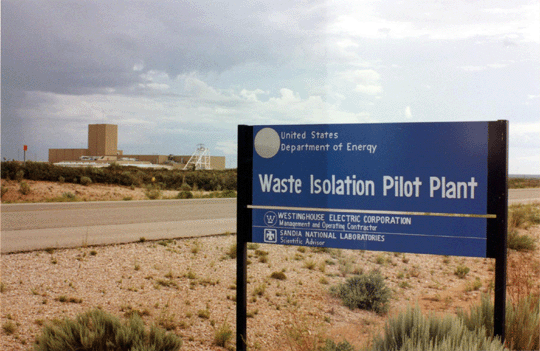 WIPP expansion needed for proposed disposal of surplus plutonium at nuclear waste repository Adrian Hedden, Carlsbad Current-Argus May 1, 2020 Numerous concerns would have to be addressed in the U.S. Department of Energy’s proposed plan to dispose of surplus plutonium at the Waste Isolation Pilot Plant for the program to be successful, per a DOE-commissioned report from the National Academies of Sciences (NAS).The organization was commissioned by the DOE to study its plan to dilute and dispose of the plutonium at WIPP over 30 years at a cost of about $18.2 billion an alternative to the stalled mixed-oxide program that would have seen the nuclear waste converted into fuel. WIPP expansion needed for proposed disposal of surplus plutonium at nuclear waste repository Adrian Hedden, Carlsbad Current-Argus May 1, 2020 Numerous concerns would have to be addressed in the U.S. Department of Energy’s proposed plan to dispose of surplus plutonium at the Waste Isolation Pilot Plant for the program to be successful, per a DOE-commissioned report from the National Academies of Sciences (NAS).The organization was commissioned by the DOE to study its plan to dilute and dispose of the plutonium at WIPP over 30 years at a cost of about $18.2 billion an alternative to the stalled mixed-oxide program that would have seen the nuclear waste converted into fuel.
The Academies convened a committee to study the dilute-and-dispose method in November 2017, releasing an interim report a year later that noted WIPP did not have the storage space to hold about 48 metric tons (MT) the DOE hoped to dispose of. The final report was released on Thursday, and renewed concerns for storage space, along with the method of disposal’s lack of approval under the Plutonium Management and Disposition Agreement (PMDA) – a deal struck in 2000 between the U.S. and Russia to each dispose of 34 MT of plutonium through jointly-approve methods. The PMDA does allow for each country to present alternatives, with such approval for the dilute-and-dispose method pending. Robert Dynes, a physics professor and former president of the University of California who chaired the NAS’ committee also pointed to challenges in scaling up the program, as it was proven viable only on a prototype scale. “Gaps do exist in implementation challenges. This is not trivial,” Dynes said. “The implementation challenges that are not addressed would result in even longer implementation times and costs.” He also pointed to the project’s reliance on WIPP as the nation’s only deep geological repository in operation or production that could hold the waste.
“It’s the nation’s only repository,” Dynes said. “Without access to WIPP, the plan cannot be completed. There’s a lot of pressure on WIPP.” Andrew Orrell, a committee member from Idaho National Laboratory said disposing of the plutonium would change the nature of WIPP, although it would be diluted so as to confirm with WIPP’s waste criteria, and the DOE must maintain public transparency and work closely with the State of New Mexico to honor the facility’s “social contract” if the project moved forward. “The committee felt there was a vulnerability in the social contract between the DOE and State of New Mexico,” Orrell said. “The committee made several recommendations encouraging greater transparency on the entire plan to dispose of this plutonium at WIPP.” Orrell also said there was likely to be competition for space at WIPP, as plutonium pit production was recently increased at Los Alamos National Laboratory. This could be a challenge for WIPP’s capacity, Orrell said, as specified in the federal Land Withdrawal Act (LWA). “Meeting or exceeding the Land Withdrawal Act is pretty easy to foresee,” he said. “The remaining space in WIPP is limited and could be oversubscribed.” This could be a challenge for WIPP’s capacity, Orrell said, as specified in the federal Land Withdrawal Act (LWA). “Meeting or exceeding the Land Withdrawal Act is pretty easy to foresee,” he said. “The remaining space in WIPP is limited and could be oversubscribed.”….. https://www.currentargus.com/story/news/local/2020/05/01/wipp-expansion-needed-proposed-nuclear-waste-disposal/3035582001/ |
|
|
Nuclear reactor pressure vessel to be shipped by rail to Utah, from Sanonofre
The reactor pressure vessel for Unit 1, the first of three reactors on site, will get a permanent home in Utah, By TERI SFORZA | tsforza@scng.com | Orange County Register, May 1, 2020 The original plan, nearly 20 years ago, was to plop the retired nuclear reactor pressure vessel on a barge and ship it off — via the Panama Canal or all the way around the tip of South America — to a final resting place in South Carolina.But there were strong objections to transporting the huge metal shell that way. After all, atoms had actually been split inside it. And so the giant, but empty, heart of San Onofre Nuclear Generating Station’s Unit 1 was packed away in a huge steel cylinder in 2002. The cylinder was filled with grout for shielding against radiation. It was sealed, and has been stored at the plant ever since.
Now — as serious tear-down work gets under way on Units 2 and 3 — the heart of long-ago-dismantled Unit 1 is finally slated to leave San Onofre forever.
Operator Southern California Edison is preparing to ship Unit 1’s reactor pressure vessel to a licensed disposal facility in Clive, Utah, which is owned by Energy Solutions, one of San Onofre’s decommissioning contractors. It will have company: San Onofre’s retired steam generators were shipped to Clive in 2012.
Though officials can’t get too specific on precisely when or how the vessel will go — for safety reasons — they’ve been preparing a rail spur to haul heavy components off site.
The reactor vessel is considered low-level waste, the least hazardous of the Nuclear Regulatory Commission’s radioactive waste classifications. Contaminated cleaning supplies, used disposable protective clothing and reactor parts are other examples of low-level waste.
How can the crucible for nuclear reactions be low-level waste? The most radioactive parts within it were removed, cut up, and stored with higher-level waste on site, said John Dobken, a spokesman for Edison. What’s left is Cobalt-60, which has a half-life of about five years.
Unit 1 was retired in 1992, and the reactor vessel has been packaged for 18 years, so it has gone through about five half-lives, reducing its radioactivity, Dobken said.The contact dose rate for the vessel package is less than 0.1 millirem an hour, which is 500 times below the Department of Transportation limit for these types of shipments, Edison said in a primer on the move. For comparison, a chest X-ray provides a dose of 10 millirem.
Since this is low-level waste, it was never part of Edison’s contract with the federal government requiring the U.S. Department of Energy to haul away high-level waste by 1998 in exchange for payments into the Nuclear Waste Fund.
The federal government’s paralysis on finding a permanent home for the nation’s high-level nuclear waste is why 40 years’ worth of it remains stuck on site, generating sharp controversy.
While critics have called on Edison to cease decommissioning work at San Onofre during the lock-down, it proceeds with “pandemic protocols” in place, Dobken said. Everyone on site must wear a mask and practice social distancing.
———————————–
By the numbers: The package weighs 770 tons, or more than 1.5 million pounds. Inside is the Unit 1 reactor pressure vessel, pieces of radioactive metal and grout for radiation shielding. It’s a 2-inch-thick carbon steel cylindrical canister with a 3-inch-thick carbon steel liner; top and bottom plates are 3 inches thick. The canister is 38.5 feet long and 15.5 feet in diameter.
Offshore wind is General Electric’s great opportunity, not dodgy Small Nuclear Reactors
 GE Power Plays: Wind Might Blow Coal, Gas And Nuclear Away, Seeking Alpha, Apr. 29, 2020 Keith Williams
GE offshore wind: massive offshore turbine Haliade-X 12MW looks like a winner.
GE-Hitachi Nuclear Energy may be a receding opportunity.
GE might sell its steam power business and rationalise its fossil fuel interests.
The power and renewables businesses are important in considering investment in GE.
………. Nuclear Small Modular Reactors : GE-Hitachi BWRX-300
There is a lot of talk in the nuclear industry and also in political circles from groups who are opposed to solar PV and wind developments, yet who acknowledge the need for low emissions technologies. The World Nuclear Association (WNA) has an excellent summary of many proposed developments in the area of Small Modular Nuclear Reactors (SMRs). The list of projects is long but many (most) seem to be struggling. A key point from the WNA report is the following : “Licensing is potentially a challenge for SMRs, as design certification, construction and operation licence costs are not necessarily less than for large reactors.” This is a huge red flag for any SMR project.
A second objection is cost of nuclear power versus solar PV/wind plus storage. There is a lot of information about these relative costs, including well into the future. I am not aware of any studies that suggest that any nuclear technology will be able to compete with renewables and storage on price. A recent study (December 2019) by the Australian Energy Market Operator (AEMO) and CSIRO concluded that SMR nuclear reactors will generate power costing ~8x that of rooftop or solar PV and wind, with solar and wind costs of power generation being similar.
……. With Small Modular Reactors the poster child of nuclear power supporters, it is clear that there is a lot riding on this potential saviour for the nuclear industry after Fukushima and recent delays and cost blowouts in the European (especially UK, French and Finnish) nuclear industries.
With current focus on emissions reductions and the climate emergency, this is an excellent time for low emissions technologies. However, the need is now and renewables (solar PV and wind) plus storage (pumped hydro and batteries) are making a lot of progress in addressing the needs. My question is whether the cost structure and long lead times mean that nuclear technology is too expensive and late to play a part.
A recent summary of the current state of the nuclear industry as a whole is depressing reading for someone who is enthusiastic about the nuclear industry’s prospects. A lot has to happen in the next decade and SMR technology isn’t ready yet. Is GE investing a lot in a technology that can’t compete with the dramatic advances in solar PV, wind and battery storage?……
GE’s adventures in nuclear developments seem like the kind of speculative play GE could happily fund when it was one of the world’s biggest and most powerful engineering companies. It doesn’t have that status anymore and my take is that it needs to cut its cloth and focus on projects that will have more immediate commercial outcomes. Of course, that is asking for a big rethink about how GE sees itself, but does it really have a choice if it wants to survive?
Offshore wind business
While there is some apprehension in the wind industry, especially in the US and China, as changes in regulations come into force next year, and 2020 has been messed up by COVID-19, there is a long-term future for wind power; offshore wind prospects look huge………
GE Renewable Energy is a major wind turbine supplier, with more than 42,000 of its turbines (mostly onshore) installed. Its role in the wind industry is extensive, from manufacture, digital optimization, operations and maintenance. Its onshore turbines range in size from 1MW to 5MW. GE installed ~50% of onshore turbines in the US last year, a 40% increase compared with the number of onshore turbines it installed in the US in 2018.
The offshore market is still emerging, with turbines substantially bigger than those used onshore. ….. The area that looks to me as if it could become a big winner is in offshore wind turbine developments, ….
A lot of investors have GE in their portfolios and a lot more are probably reflecting on whether GE might once again become a secure safe-haven investment. My biggest issue with GE is that it seems to me it is yet to understand that it is no longer the huge and dominant business that can afford to make big bets that burn a lot of cash. The current SMR nuclear programs in GE seem to be in this category. They have a very low chance of success but require major resources. I’d prefer not to have these distractions in a company I invest in….. https://seekingalpha.com/article/4340805-ge-power-plays-wind-might-blow-coal-gas-and-nuclear-away
Low Oil Prices May Kill Off The Next Nuclear Boom Before It Begins
 Low Oil Prices May Kill Off The Next Nuclear Boom Before It Begins, Oil Price, By Alex Kimani – Apr 27, 2020
Opening up the West
On Thursday, the Nuclear Fuel Working Group (NFWG) made recommendations to the U.S. Administration to open up ~1,500 acres outside the Grand Canyon for uranium production, arguing that the country needs to beef up domestic production to avoid an over-reliance on foreign sources.
The organization has recommended spending $1.5 billion over ten years buying uranium from American producers to create a uranium stockpile that would necessitate buying about 10 million pounds a year.
The working group’s report claims that the United States also needs more uranium for two other purposes:
– Low-enriched uranium for the production of tritium for nuclear weapons through the 2040s, and
– Highly enriched uranium to be used as fuel for Navy nuclear reactors through the 2050s
The slow and painful demise of the American uranium mining industry can be chalked up to the fact that the country is not endowed with the most abundant and most accessible uranium deposits, with resources in Canada and Australia boasting significantly higher uranium content and a lower production cost per unit.
American miners have had trouble making a profit from their operations even at the best of times. Consequently, the industry has historically had to rely heavily on government largesse.
During the golden age of American uranium that spanned from 1955-1980, the U.S. government offered fat uranium bonuses in a bid to shore up its stockpiles during the Cold War. These included 10-year price guarantees for certain kinds of ore as well as $10,000 discovery and production bonuses for new sources, which pencils out to nearly $100K in today’s dollars. The incentives set off a mad gold rush in the nation’s vast Western region as every man with a jeep and a Geiger counter set out to make the next significant discovery.
The program was a resounding success: U.S. uranium stockpiles skyrocketed so much that the government stopped paying out the bonuses sometime in the 1960s…….
By 1987, the tables had turned completely, with the country importing nearly 15 million pounds of uranium while domestic production clocked in at just 13 million.
Growing competition weighed heavily on domestic production while the country’s love affair with nuclear energy got its first dose of the harsh reality of nuclear technology thanks to the Three Mile Island nuclear disaster in 1979 as well as the Chernobyl reactor meltdown of 1986 that turned an entire Ukrainian city into a ghost town. Meanwhile, utilities began to grow weary of the time and cost of building reactors, which further depressed demand.
The result: U.S. uranium production had sunk to a 35-year low by the time the last wave of reactors came online in 1990…….
Brief Renaissance
The U.S. uranium industry enjoyed a renaissance in the early 2000s as falling global stockpiles, and booming economies in China and India drove new demand.
Unfortunately, this, too, was not to last as the financial crisis of 2008 destroyed demand, while the Fukushima nuclear disaster of 2011 led to another severe backlash that set off a new round of reactor closures while Germany set to phase out the technology by 2022.
The third nuclear gold rush is starting off on very shaky grounds, too.
First off, the world’s strategic uranium reserves are not in any immediate danger of running out. In 2016, the International Atomic Energy Agency said that the global nuclear fleet has enough stockpiles for 130 years, more than enough for the markets to respond to any shortfalls rapidly as they have done in the past. …..
But more importantly, trying to open up the west for uranium mining is bound to be met with stiff resistance and widespread public uproar.
For all its setbacks over the years, nuclear power has remained broadly popular in the United States. However, the turning point came in 2016 when the majority of people turned against the technology.
The latest poll last year revealed that American public opinion remains split over nuclear power, with 49 percent of U.S. adults either strongly favor (17 percent) or somewhat favor (32 percent) it in power generation while 49 percent either strongly oppose (21 percent) or somewhat oppose (28 percent) its use……
The funny thing is that Gallup has found that American opinion on nuclear power does not have much to do with radiation or safety concerns; rather, it is driven by prevailing fuel prices. …..
a 2020 Colorado College Conservation in the West Poll found that 71 percent of voters in the Mountain West and 77 percent of Arizona voters oppose the development of new uranium mines on public lands adjacent to the Grand Canyon. It’s the kind of backlash that no president wants to deal with, whether they are seeking re-election or not. https://oilprice.com/Energy/Energy-General/Low-Oil-Prices-May-Kill-Off-The-Next-Nuclear-Boom-Before-It-Begins.html
Beyond Nuclear opposes Holtec nuclear waste plan: the Nuclear Regulatory Commission is not above the law
 Group Plans To Fight Effort To Build Nuclear Waste Dump In New Mexico https://www.krwg.org/post/group-plans-fight-effort-build-nuclear-waste-dump-new-mexico
Beyond Nuclear has challenged the NRC’s authority to approve Holtec’s license application because it contemplates that the U.S. Department of Energy (DOE) may become the owner of the irradiated reactor fuel. The federal Nuclear Waste Policy Act (NWPA) prohibits federal ownership of spent fuel, however, unless and until a federal repository for permanent disposal is operating.
The NRC Commissioners acknowledged that Federal law prohibits federally-sponsored storage of irradiated reactor fuel unless and until a repository for permanent disposal is in operation. Nevertheless the NRC threw out Beyond Nuclear’s legal challenge to the project on the ground that Holtec could be depended on not to implement the unlawful provision if the license were granted.
The Commissioners’ decision affirms an earlier ruling by the NRC’s Atomic Safety and Licensing Board that the storage facility may be licensed despite the illegal license terms contemplating federal ownership of the irradiated fuel. The Licensing Board accepted arguments by Holtec and the NRC’s technical staff that the license containing illegal provisions could be approved as long as it also contained a provision that would allow private ownership of the spent fuel.
Mindy Goldstein, a lawyer for Beyond Nuclear, stated, “the NRC’s decision flagrantly violates the federal Administrative Procedure Act (APA), which prohibits an agency from acting contrary to the law as issued by Congress and signed by the President.” Goldstein also stated that “the Commission lacks a legal or logical basis for its rationale that the illegal provisions could be ignored in favor of other provisions that are legal, or that an illegal license could be issued in ‘hopes’ that the law might change in the future. The APA gives the NRC no excuse to ignore the mandates of federal law.”
Diane Curran, also a lawyer for Beyond Nuclear, said the group will pursue a federal court appeal of the NRC decision. “Our claim is simple,” she declared. “The NRC is not above the law.”
Kevin Kamps, radioactive waste specialist for Beyond Nuclear, called the federal Nuclear Waste Policy Act “the public’s best protection against an interim storage facility becoming a de facto permanent, national radioactive waste dump at the surface of the Earth.” According to Kamps, “Congress knew, in passing the NWPA, that the only safe long-term strategy for care of irradiated reactor fuel is to place it in a permanent repository for deep geologic isolation.
Congress acted wisely in refusing to allow nuclear reactor licensees to transfer ownership of their irradiated reactor fuel to the DOE until a repository was up and running. The carefully crafted Nuclear Waste Policy Act thus protects a state like New Mexico from being railroaded by the powerful nuclear industry, its friends in the federal government, and other states looking to off-load their mountain of forever deadly high-level radioactive waste.”
Kamps added: “A deep geologic repository for permanent disposal should meet a long list of stringent criteria. These include legality, environmental justice, consent-based siting, scientific suitability, mitigation of transport risks, regional equity, intergenerational equity, and non-proliferation, including a ban on reprocessing. This is why a coalition of more than a thousand environmental, environmental justice, and public interest organizations, representing all 50 states, have opposed the Yucca Mountain dump targeted at Western Shoshone Indian land in Nevada for 33 years.”
“On behalf of our members and supporters in New Mexico, and across the country along the road, rail, and waterway routes in most states, that would be used to haul the high risk, high-level radioactive waste out West, we will appeal the NRC Commissioners’ bad ruling to the federal court,” Kamps added.
Beyond Nuclear is a 501(c)(3) nonprofit membership organization. Beyond Nuclear aims to educate and activate the public about the connections between nuclear power and nuclear weapons and the need to abolish both to safeguard our future. Beyond Nuclear advocates for an energy future that is sustainable, benign and democratic. The Beyond Nuclear team works with diverse partners and allies to provide the public, government officials, and the media with the critical information necessary to move humanity toward a world beyond nuclear. Beyond Nuclear: 7304 Carroll Avenue, #182, Takoma Park, MD 20912. Info@beyondnuclear.org. www.beyondnuclear.org.
1 This Month

of the week– Nuclear Reactor Information Task Force

14 May – online event From Bombs to Data Centres: the Face of Nuclear Colonialism
To see nuclear-related stories in greater depth and intensity – go to https://nuclearinformation.wordpress.com
-
Archives
- May 2026 (102)
- April 2026 (356)
- March 2026 (251)
- February 2026 (268)
- January 2026 (308)
- December 2025 (358)
- November 2025 (359)
- October 2025 (376)
- September 2025 (257)
- August 2025 (319)
- July 2025 (230)
- June 2025 (348)
-
Categories
- 1
- 1 NUCLEAR ISSUES
- business and costs
- climate change
- culture and arts
- ENERGY
- environment
- health
- history
- indigenous issues
- Legal
- marketing of nuclear
- media
- opposition to nuclear
- PERSONAL STORIES
- politics
- politics international
- Religion and ethics
- safety
- secrets,lies and civil liberties
- spinbuster
- technology
- Uranium
- wastes
- weapons and war
- Women
- 2 WORLD
- ACTION
- AFRICA
- Atrocities
- AUSTRALIA
- Christina's notes
- Christina's themes
- culture and arts
- Events
- Fuk 2022
- Fuk 2023
- Fukushima 2017
- Fukushima 2018
- fukushima 2019
- Fukushima 2020
- Fukushima 2021
- general
- global warming
- Humour (God we need it)
- Nuclear
- RARE EARTHS
- Reference
- resources – print
- Resources -audiovicual
- Weekly Newsletter
- World
- World Nuclear
- YouTube
-
RSS
Entries RSS
Comments RSS
 nuclear-news