Indian Point nuclear power station’s first step to closure, as one reactor shuts down
 Nuclear power plant north of New York City to start shutdown, Daily Journal ,By MARY ESCH Associated Press, Apr 29, 2020
ALBANY, N.Y. (AP) — With the push of a red button, one of the two operating nuclear reactors at the Indian Point Energy Center along the Hudson River north of New York City will shut down Thursday night as federal regulators consider the plant owner’s proposal to sell it to a company that plans to demolish it by the end of 2033 at a projected cost of $2.3 billion.
The 1,020-megawatt Unit 2 reactor will close for good Thursday and 1,040-megawatt Unit 3 will close in April 2021 as part of a deal reached in January 2017 between Entergy Corp., the state of New York and the environmental group Riverkeeper. The Unit 1 reactor shut down in 1974, 12 years after the plant began operation in the Westchester County town of Buchanan……
Democratic Gov. Andrew Cuomo had long sought the shutdown, saying the plant 24 miles north of Manhattan posed too great a risk to millions of people who live and work nearby. Riverkeeper noted Hudson River fish kills, soil and water contamination, recurrent emergency shutdowns and vulnerability to terrorist attacks. Entergy cited low natural gas prices and increased operating costs as key factors in its decision to close Indian Point and exit the merchant power business.
A year ago, Entergy announced a deal to sell the 240-acre facility to the New Jersey-based decommissioning firm Holtec International, which has submitted a dismantling plan to the Nuclear Regulatory Commission. At a public information session held online last week, NRC representatives said the commission is reviewing Holtec’s financial and technical qualifications, as well as public comments, before approving the license transfer.
According to the NRC, Indian Point will join 13 other nuclear power plants across the United States that have begun the decades-long process of decommissioning, which dismantles a facility to the point that it no longer presents a radioactive danger.
Under the decommissioning process, spent fuel rod assemblies are initially placed in large pools of water where the hot fuel is cooled for at least two years. Then the spent fuel is transferred into giant steel and concrete cylinders that stay at the site unless or until a national nuclear waste storage facility is created……..
A 2017 analysis by the New York Independent System Operator, which runs the state’s electrical grid, concluded that Indian Point’s closure won’t impair the grid’s ability to keep New York City’s lights on. ……https://www.smdailyjournal.com/news/state/nuclear-power-plant-north-of-new-york-city-to-start-shutdown/article_62453a0b-19d7-5baf-9dfc-a7db2d15710f.html
Do-it-yourself radiation monitoring
By Dahyun Kang, April 28, 2020 Watching the HBO drama Chernobyl about the nuclear disaster that occurred in April 1986 gave me a whole new perspective on how destructive radioactive particles can be. One scene depicted local men and women fearfully looking toward the nuclear site, a dim red glow against the night sky. Highly radioactive cesium-137-contaminated dust fell like snow on children running in the streets. Plant workers and firefighters died gruesomely after exposure to acute radiation doses unleashed by the debris that exploded from the nuclear reactor. No one knew what to do because Soviet bureaucrats delayed accident announcements and evacuation orders.
The lack of information about radiation levels meant that people were exposed to radiation for a longer duration than if they had received timely warnings. The Chernobyl drama not only helped me realize the disastrous consequences and hazards of radiation, but also inspired me to create a radiation estimator that could provide estimations of environmental radiation levels in places where there are no stationed detectors.
A focus on Fukushima. To develop my estimator, I focused on the Fukushima region in Japan. I chose this area because of the nuclear disaster there in March 2011, when three nuclear power plant cores melted down and released radionuclides into the atmosphere. The Japanese government chose this region to hold a couple of events that are part of the 2020 Tokyo Summer Olympics and Paralympics, branded as the “Reconstruction Olympics.”
The environmental group Greenpeace has raised concerns about whether people attending these Olympic events—which have now been postponed until 2021—could be exposed to lingering radiation. In a report published last month, Greenpeace claimed measurements taken by a survey team detected radioactive hotspots at the Fukushima Azuma Baseball Stadium near Fukushima City, in the area around the city’s central station, and at the J-Village sports complex where the Olympic torch relay will start. According to Greenpeace, the highest measurement at J-Village on October 26, 2019, was 71 microsieverts per hour close to the ground, a reading more than 1,750 times higher than pre-2011 background levels. The forested mountains covering roughly 70 percent of the Fukushima prefecture cannot be decontaminated and therefore pose a recontamination risk to areas when heavy rainfall or typhoons mobilize radionuclides, which Greenpeace says happened during two intense typhoons in 2019.
Japan’s Shinzo Abe administration plans to host the Olympics baseball and softball games at the Azuma stadium, approximately 80 kilometers from the Fukushima Daiichi nuclear power plant site where the nuclear accident occurred. J-Village, where the torch relay will begin, is located about 20 kilometers south of Fukushima Daiichi.
How I built my radiation estimator. The nonprofit organization Safecast, which collects radiation readings taken by volunteers and makes them publicly available at no charge, provides data for a number of locations worldwide—particularly in Japan, where the monitoring network began as a response to the Fukushima disaster. Using the Safecast website, I collected data from the Fukushima prefecture. With the help of mathematical software called Mathematica, I then developed a mathematical equation that takes the Safecast Fukushima data and provides estimates of radiation values at any other location in Fukushima. With the help of a relative who works as a coding programmer, I also created a Radiation Estimation website that uses the mathematical equation to estimate radiation values, in microsieverts per hour, for any latitude and longitude entered by a user.
For example, if the user enters the latitude and longitude of the Azuma stadium, the equation gives an estimate of 0.103 microsieverts per hour. According to the International Commission on Radiological Protection, anything less than 0.23 microsieverts per hour is considered a safe dose, based on the recommended public dose limit of 1 millisievert per year (1 millisievert is equivalent to 1,000 microsieverts).
Future efforts. Currently, my radiation estimator inevitably contains some degree of uncertainty due to limited available data from the Fukushima prefecture, which covers about 13,700 square kilometers. The estimates would be more precise and could be applied beyond Fukushima if there were more disclosed data available to reference.
What about the radiation levels in my own city and others in the United States? Unfortunately, I was unable to find enough open radiation data available to make a good estimate. The US Environmental Protection Agency runs a nationwide environmental radiation monitoring system, RadNet, which has 140 radiation air monitors spread across 50 states, mostly in the heart of big cities. Although these monitors run 24/7, collecting near-real-time measurements of gamma radiation, the number and locations of the monitors are inadequate to cover all of the United States.
There are 96 US nuclear power reactors in operation. Who can assure the American public that no nuclear catastrophe on the scale of Chernobyl or Fukushima will occur in the United States? It is natural for the public to be worried and to insist that the US government install more radiation monitors near reactors and the surrounding populated areas to protect the public. Information collected by the monitors should also be disclosed to the public.
Once sufficient environmental radiation data are available, my radiation estimator would be applicable in my own city and others in America as well. I hope to raise awareness of environmental radiation and offer people information about what kind of environment they are living in. Since my radiation estimator is only a first step in that direction, I hope that someone with more expertise can build upon my idea to create a more precise tool that provides information about environmental radiation anywhere on the globe.
“Mrs America”- Phyllis Schlafly determined fan of nuclear weapons, like today’s pro nuclear women in public life
|
The truth about the dangerous nuclear policy pushed by Mrs. America’s Phyllis Schlafly In the show, the evening’s program features a beautiful Phyllis Schlafly (Cate Blanchett) as the fierce, iron-jawed opponent to communism and nuclear disarmament. Schlafly is no iron-jawed angel though, and the miniseries focuses on her efforts to halt the progress of women’s rights in 1960s America. I wondered: How does a woman with the convictions of Henry Kissinger and the features of Elizabeth Taylor figure into the history of the atomic era? Who is the real Mrs. America? Within the first few minutes of the series, Schlafly is already talking about national defense. On the topic of the Strategic Arms Limitation Treaty (SALT), the treaty that paved the way for its successors SALT II, the Strategic Arms Reduction Treaty (START) and the now endangered New START, Schlafly is blunt, “The only country who will comply with the pact is the United States!” This rhetoric is one we’ve heard repeated again, and again and again, through the decades. “Peace is wonderful. Try it. You’ll like it.” she mocks. Despite FX’s glamorization of Schlafly’s obvious wit and intelligence, the Ayn Rand-esque obliviousness to her own privilege is a clear parallel to the bootstrap mentality Republicans cling to fifty years later. The eerie correlations between episode one of “Mrs. America” and the talking points of today’s Phyllis Schlaflys — KellyAnne Conway, Candace Owens and Susan Collins, to name a few — make this romanticizing even more unsettling. In the same scene that she argued in favor of new nuclear weapons — once calling them “a marvelous gift given to our country by a wise God” — she argues against equal rights amendments. ……. Ending women’s liberation, and everything that comes with it, from abortions to homosexuality, was the second great passion of Schlafly’s life. The first was preaching a hawkish view of national defense that would put John Bolton to shame. Feminism, LGBTQ rights and abortion access might have triumphed over Mrs. America — Phyllis Schlafly — but what about nuclear weapons? “Mrs. America” touches on Schlafly’s involvement with the nuclear weapons industry and her ultimate slight by President Ronald Reagan, who refused to appoint her to a position in government. She was too “controversial,” he claimed and that decision may well have saved the United States — and the planet — from an entirely different scenario than we live in now……. While “Mrs. America” might put a syrup sweet lens on Phyllis Schlafly, viewers can’t help but question all of her views on feminism and they should be questioning her thoughts on national security as well. We don’t live in the arms race Schalfly longed for, but as the Trump administration jettisons treaties left and right, we’re getting dangerously close The legacy of denuclearization started by Reagan is already being undone by Trump, who is rebuilding the nuclear sponge and has green-lit another ‘low-yield’ nuclear weapon that could fit in even his hands. New START, the latest iteration of arms control between the U.S. and Russia, expires in February 2021. Despite offers from Russia to extend the treaty for five years, no strings attached, Trump can’t withstand the allure of potential new toys. Surely we can all agree, if Phyllis Schlafly thought something was a bad idea it’s probably actually in all of our best interest, and the extension of New START is in the best interest of the planet. Tristan Guyette is the national field manager of Beyond the Bomb, where they lead volunteers across the country to mobilize and advocate for sane nuclear policy through No First Use. https://thehill.com/opinion/national-security/495218-the-nuclear-threat-behind-mrs-america-because-ms-stands-for-misery |
|
Could President Trump launch a nuclear attack via Twitter?
|
The proverbial “big red button” is one of the most important responsibilities that a U.S. President has. But Americans know very little about it.
Last week, he said that is ordering the Navy to “shoot down and destroy” Iranian boats that get too close to U.S. ships, and then the Pentagon turned it into a reminder that “our ships retain the right of self-defense.” Do you see any situations where the President says something ambiguous, and then the military has to figure out whether he meant to use nuclear weapons, or some other similarly drastic measure?…….. The modern military has long adapted to the idea that nuclear weapons are a relatively clunky think to imagine using in practice. They might work as a strategic threat, but the United States benefits a lot more from not using them, and from using our many conventional options that are very diverse and capable, instead.
If we normalize the use of nuclear weapons, we are a very big target…….
I do worry about—it’s somewhat clear that the President and the military have a complicated communications relationship. There have a number of things that the President announced via Twitter, that he clearly did not get full consent from the military on or did not even inform them on……. Maybe your secure phone lines don’t work. Maybe your regular phone lines don’t work. You could imagine a situation in which Twitter is the only channel by which the President can communicate with the military, and he would tweet out an order on it, but it would have to be a very well-formed order. ……
if the President’s Twitter account suddenly started tweeting legitimate nuclear authentication codes and nuclear launch orders, I think that would raise a lot of questions for the military. Even in that situation, assuming they don’t see incoming missiles coming at them—which is to say, they’re not under any belief that this is a true, obviously unambiguous nuclear war situation—I think that would go through rather extreme efforts to contact the White House, or the Secretary of Defense, and/or anybody around there, just to find out if this was real or not.
That would definitely be a weird way for the world to end. |
|

Federal appeals court dismisses case against GE over Fukushima nuclear disaster
The US Court of Appeals for the First Circuit affirmed the dismissal of a lawsuit by numerous Japanese individuals and business who hoped to sue General Electric (GE) over its role in building and maintaining the reactors that exploded in the 2011 disaster at the Fukushima nuclear power plant in Japan.
Compensation for the Fukushima disaster in Japan is covered by a 1961 law addressing nuclear damages—the Compensation Act. The Compensation Act creates a complex scheme with several ways for injured parties to recover, and it ultimately places all liability for Fukushima in the Tokyo Electric Power Company (TEPCO) that operated the plant. The plaintiffs in the lawsuit against GE, as well as millions of others, had recovered money from TEPCO in Japan through lawsuits, claims directly to the company, and mediated processes. But the plaintiffs in this case also wanted to recover money from GE, which had built, designed or maintained all the reactors at Fukushima, and, according to the plaintiffs, were responsible for some of what went wrong there during the tsunami in 2011. The plaintiffs sued in Massachusetts because GE is headquartered there.
USA Government prioritises nuclear industry over its duty to public health
 As Pandemic Rages, Federal Nuclear Regulators Put Keeping Reactors
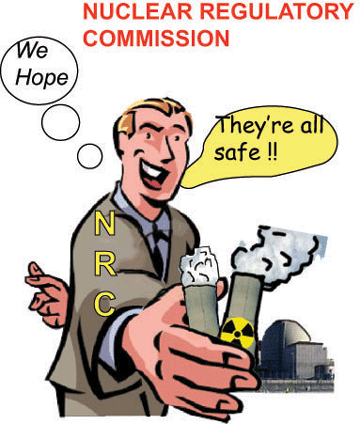 Running Ahead of Public Health and Safety https://www.ewg.org/energy/23141/pandemic-rages-federal-nuclear-regulators-put-keeping-reactors-running-ahead-public-27 Apr 20,
The federal government’s toothless nuclear “watchdog” has historically shown more concern for keeping dangerous aging reactors running than for Americans’ safety from a nuclear accident. So how is the Nuclear Regulatory Commission, or NRC, responding to the coronavirus pandemic?
-
-
- Letting nuclear power plants cut back their workforces to facilitate social distancing – but letting them make up for the reduced numbers by requiring the remaining control room operators and other key employees to work back-to-back 84-hour weeks, heightening the danger of worker exhaustion that could contribute to a reactor accident.Telling the agency’s on-site safety inspectors – two or more resident inspectors at each plant – to work from home, and allowing plants to defer required inspections of piping systems critical to cooling the reactors.
- Keeping reactor refueling crews of up to 1,500 technicians traveling from plant to plant, working in crowded conditions and staying in nearby communities, increasing the likelihood of crew members spreading the virus
The U.S. has 58 nuclear power plants housing 96 nuclear reactors in 29 states. Each plant employs 500 to 1,000 workers. Every 18 to 24 months, plants are powered down for four to six weeks for refueling, done in the spring or fall, when electric demand is low. According to the Nuclear Energy Institute, or NEI, the lobbying arm of the nuclear industry, refueling is scheduled at 56 plants this year.
On March 20, the NEI wrote the NRC to request that refueling crews have “unfettered access to travel across state lines” and unrestricted access to local hotels and food services, and to be prioritized for personal protective equipment. The NRC responded by allowing a reduction in the required number of plant personnel, and allowing an increased work week for remaining employees of 12-hour days for up to 14 days straight.
That worries Beyond Nuclear, a nonprofit that advocates “for an energy future that is sustainable, benign and democratic.”“Nuclear plant operators on extended 12-hour shifts, who can now be assigned to work two consecutive 84-hour weeks, will suffer excessive fatigue,” Beyond Nuclear’s director of plant oversight, Paul Gunter, said in a news release. “This not only compromises their immune systems, but makes catastrophic mistakes more likely.” The release cited the infamous Three Mile Island nuclear accident, in 1979, which it said was attributed to “mechanical failure worsened by operator fatigue and error.”
One week after the Nuclear Institute’s letter, the NRC directed resident inspectors to work from home, “only coming on site for risk-significant in-plant operations.” The agency has also allowed utilities operating the plants to request postponement of inspections and maintenance. “There are some ancillary activities during an outage that can be deferred,” an NRC spokesperson told Bloomberg.Among the “ancillary” activities that can be deferred is inspection of piping critical to cooling the reactors. Beyond Nuclear says three plants, in Illinois, Florida and Texas, have requested 18-month deferments of inspections of steam generator tubes that are subject to extreme heat, radiation and vibration. Failure of the piping, says the International Atomic Energy Agency, could lead to “core damage or large release events” of radiation.At least four nuclear plants – Fermi 2, near Detroit, Susquehanna, near Berwick, Pa., Limerick, near Pottstown, Pa., and Vogtle, near Waynesboro, Ga. – have seen cases of COVID-19
The Pottstown Mercury reports that local officials asked Exelon, the owner of Limerick, to postpone refueling because they found the company’s plans to address the pandemic inadequate. Regardless, the company went ahead with refueling and didn’t begin social distancing until workers told the press they were “terrified” that they’re working in a “breeding ground” for COVID-19.Nearly 30 Limerick workers have tested positive for the virus, according to The Philadelphia Inquirer. But Vogtle has by far the biggest outbreak, with 143 workers testing positive. It’s unknown how many nuclear plant workers nationwide have tested positive, because the NRC has not reported cases.“The key question,” Edwin Lyman, director of nuclear power safety for the Union of Concerned Scientists, told Utility Dive, “is how much additional risk will the NRC allow nuclear plants to accept in order to keep them running during the crisis?”Good question
-
Poll shows that Americans favour a no-first-use of nuclear weapons policy
|
Poll: What the American public likes and hates about Trump’s nuclear policies, Bulletin of the Atomic Scientists, Jonathon Baron, Stephen Herzog, April 27, 2020 It is difficult to overstate the importance of nuclear policy in determining a US presidential candidate’s fitness to be commander-in-chief. Such priorities are evident in the Bulletin’s recently published special issue dedicated to discussing nuclear weapons policy ahead of the 2020 election. Nuclear issues played a prominent role in the 2016 election, but despite some anomalies, they have hardly factored into the 2020 campaign. This is almost certain to change even as priority is given to the COVID-19 pandemic response. Nevertheless, very few recent polls (with one notable exception) have attempted to identify preferences among the US population for President Donald Trump’s nuclear policies.
To fill this gap, we worked with the firm YouGov in late 2018 after the release of the Trump administration’s Nuclear Posture Review to conduct a nationally representative survey of 1,000 Americans. Previous surveys have illuminated US public attitudes on nuclear energy, extending the New START treaty, and even hypothetical nuclear retaliatory scenarios. It isn’t clear, however, how Americans view the core elements of the Trump administration’s nuclear policy: its Nuclear Posture Review and its overall strategies toward Iran and North Korea. We report our study results publicly for the first time here, offering insights for policymakers and presidential candidates as they weigh their positions on nuclear issues Nuclear Posture Review. The study highlights how the US public as a whole and various demographic groups view Trump’s positions on nuclear weapons. To begin, we asked respondents to indicate whether they supported, opposed, or were unsure about key parts of the 2018 Nuclear Posture Review. Of course, many elements of the Trump administration’s nuclear posture are continuations of longstanding US policy that have been preserved by Republican and Democratic presidents alike. Our survey questions did not indicate the current US administration’s policy on different parts of the Nuclear Posture Review. So the results convey the respondents’ natural preferences for the policies themselves, not for the current occupant of the White House. Such data should prove useful to politicians staking out campaign stances on nuclear weapons that would have broad public appeal. Our findings reveal that Americans overall express fairly low support for the administration’s nuclear weapons policies, though indecision also runs high among the public. Further, the table of group preferences indicates—with a few surprising exceptions—that males, Republicans, and older Americans are the most likely groups to back President Trump on nuclear issues. Even so, support is relatively modest among Trump’s base, and several elements of the Nuclear Posture Review do not receive majority or even plurality support from Republicans……. Only 34 percent of Americans support the longstanding policy of providing the nuclear umbrella in principle, and that number drops to 27.9 percent for nuclear deployments in Europe. …..men and Republicans remain the most supportive of the nuclear umbrella and forward-deployed B61 nuclear bombs. Women, Democrats, and Independents respond less favorably. Additionally, Americans who came of age during the Cold War are more favorable toward these policies than their Millennial and Generation Z counterparts……. fewer than 20 percent of Americans support possible US first use of nuclear weapons. By contrast, disapproval stands at 63.5 percent……The public is also broadly unsupportive of using nuclear weapons in response to cyberattacks……. a majority of every demographic group of Americans—whether by gender, political party, age, race, education, income, or region of residence—oppose a first-use doctrine. Public opinion may accordingly present opportunities for presidential candidates to favor a policy of no first use of nuclear weapons………. https://thebulletin.org/2020/04/poll-what-the-american-public-likes-and-hates-about-trumps-nuclear-policies/# |
|
|
Canada on verge of investing in plutonium
Gordon Edwards <ccnr@web.ca>\, 26 Apr 2020, It seems that the two SMNR (Small Modular  Nuclear Reactor) entrepreneurs in New Brunswick (Canada), along with other nuclear “players” worldwide, are trying to revitalize the “plutonium economy” — a nuclear industry dream from the distant past that many believed had been laid to rest because of the failure of plutonium-based breeder reactors almost everywhere – e.g. USA, France, Britain, Japan …




 nuclear-news