If You Like Covid-19, You’ll Love Nuclear War
 Might this unsteady and unseemly American president soon become subject to still more serious forms of personal dissemblance and/or psychological debility? Leaving aside Trump’s largely unprecedented and breathtaking venality,[5] his open indifference to history and above all his continuing malfeasance and shameless dishonesty, should he still be allowed to decide whether we Americans should live or die?
It also reveals his incapacity to feel even a scintilla of human empathy for other human beings.
What does all this really mean? In what specific policy directions should we Americans now be propelled? Continue reading
Alabama joins Kentucky, South Dakota and West Virginia to criminalize fossil fuel protests
In March, Kentucky, South Dakota and West Virginia passed laws restricting pipeline protests. Alabama is poised to become the fourth.
By Alexander C. Kaufman 10 May 20 Alabama lawmakers this week advanced legislation to add new criminal penalties to nonviolent protests against pipelines and other fossil fuel projects, setting a course to become the fourth state to enact such measures amid the chaos of the coronavirus pandemic.
Kentucky, South Dakota and West Virginia enacted similar measures in March, just as states started implementing lockdowns to contain the outbreak of COVID-19, the respiratory illness caused by the virus.
The Alabama Senate passed the bill on March 12, just befohe Alabama Senate passed the bill on March 12, just before state officials, alarmed at the spread of the virus, postponed legislative hearings for a month. When the capitol reopened in Montgomery on May 4, state Democrats remained in their home districts, but enough Republican lawmakers returned to restart work on the legislation. On Monday, the House version of the bill was introduced and referred to the committee that oversees utilities and infrastructure. Continue reading
$25 million settlement coming, over failed V.C. Summer nuclear project, with no SCANA admission of wrongdoing

Dominion Energy, which bought SCANA Corp. and South Carolina Electric & Gas in 2019, could soon reach a $25 million settlement with stock market regulators over the failed V.C. Summer nuclear project that the acquired businesses abandoned nearly three years ago.The proposed deal would allow Dominion to remove itself from a high-profile civil case that the U.S. Securities and Exchange Commission filed in February. That lawsuit alleges that SCANA, the majority owner of the two partially built reactors in Fairfield County, “repeatedly deceived” investors and furthered a “historic” case of securities fraud. Dominion Energy South Carolina, the successor of SCE&G, was named in the lawsuit. Richmond, Va.-based Dominion inherited the company’s legal liability, along with all of SCE&G’s ratepayers in South Carolina, when it sealed its takeover of SCANA early last year. When the SEC filed the case in February, Dominion called the lawsuit a “disappointing development.” Since then, the utility giant has worked behind the scenes to cut a deal with the federal agency. The company announced the potential settlement with the SEC as part of a quarterly earnings report this week. Dominion’s leaders said they struck the $25 million deal with officials at the agency’s Division of Enforcement in April. The company emphasized the settlement would still need to be finalized by the SEC and a federal judge in South Carolina. According to Dominion, the deal would allow the company to settle the case without admitting any wrongdoing by SCANA over the course of the failed V.C. Summer expansion project. |
|
America’s very dangerous $multibillion plan for a nuclear-powered fighter plane
|
America Really Wanted A Nuclear-Powered Fighter (Flying Chernobyl, Anyone?) Does great reward really come with great risk? National Interest, by Steve Weintz 10 May 20, Here’s What You Need To Remember: Looking back a half century to an era of greater faith in nuclear energy, it’s easy to shake one’s head in wonder. What were they thinking? Surely crashes, combat and carelessness were going to keep it all from ending well. Ah, the Atomic Age, when nuclear energy seemed the ticket to a future of limitless possibilities. For a generation after 1945 the United States explored all kinds of nuclear propulsion concepts. Some, like naval power plants for subs and ships, proved both revolutionary and effective. Others proved possible to develop but impractical to pursue.
Of these concepts the nuclear-powered aircraft now seems the most fanciful, but billions of dollars and years of top-flight research sunk into the Aircraft Nuclear Propulsion (ANP) program chased the idea before its demise. Between the end of World War II and the dawn of Camelot American engineers figured out how to fit a reactor in an airplane and make it generate thrust without frying the crew. American leaders couldn’t figure out how to pay for it or why they needed it.
Today the ANP program is remembered as an Atomic Age boondoggle whose only remains consist of three-story-tall experimental units and giant hangars with six-foot-thick walls. ……. https://nationalinterest.org/blog/america-really-wanted-nuclear-powered-fighter-flying-chernobyl-anyone-152496 |
|
South Africa’s financially difficult nuclear ambitions
South Africa to develop plan for new 2,500 MW nuclear plant, CAPE TOWN, May 7 (Reuters) – South Africa will soon start developing a plan for a new 2,500 megawatt (MW) nuclear power plant, the energy ministry told lawmakers on Thursday.
Africa’s most industrialised economy, which operates the continent’s only nuclear power plant near Cape Town, said last year that it was considering adding more nuclear capacity in the long term, after abandoning in 2018 a massive nuclear expansion championed by former president Jacob Zuma.
Analysts had expressed serious concern about Zuma’s project for a fleet of nuclear plants totalling 9,600 MW because it would have put massive additional strain on public finances at a time of credit rating downgrades. …..
The presentation showed South Africa wanted to complete the procurement of the new nuclear plant by 2024 but gave no indication as to when it wanted construction of the plant to start or for when the plant would come online……
financing those nuclear ambitions could be difficult at a time that the country’s recession-hit economy is being hammered by the coronavirus pandemic, with this year’s budget deficit expected to stretch into double digits.
Answering questions, Energy Minister Gwede Mantashe said on Thursday that the government would first “test the market” and hear what potential investors or consortia had to say about building the new nuclear facility…… https://af.reuters.com/article/southAfricaNews/idAFL8N2CP8M8
Pandemic may force USA to cut back on bloated spending on nuclear weapons
|
Pandemic spending will force US defense budget cuts—some of which should come from nuclear weapons programs https://thebulletin.org/2020/05/pandemic-spending-will-force-us-defense-budget-cuts-some-of-which-should-come-in-nuclear-weapons-programs/#
By Lawrence J. Korb, May 8, 2020 Even supporters of increased US defense budgets expect that, because the US government will likely spend trillions of dollars trying to rescue the economy from the effects of the COVID-19 pandemic, military spending in the United States is likely to decline significantly over the next couple of years. Those predicting such a decline include experts at the Stockholm International Peace Research Institute (SIPRI), the Center for Strategic and International Studies, (CSIS), American Enterprise Institute (AEI), the Center for Strategic and Budgetary Analysis, the RAND Corporation, and retired generals like David Barno and Hawk Carlisle. According to SIPRI’s latest report, global defense spending has grown for five straight years and in 2019 amounted to almost $2 trillion. US defense spending has also grown significantly over this period. Since President Trump took office, the annual defense budget—which, at $740 billion, consumes more than half of federal discretionary spending—has increased by almost $100 billion compared to Obama’s last budget, and during the Trump presidency, total US defense spending has amounted to almost $3 trillion. As a result, the US alone now accounts for about 40 percent of the world’s total military expenditures and spends more than the next 10 highest defense spenders combined (seven of whom are our allies). In real terms—that is, taking inflation into account—the US defense budget is higher than it was during the Reagan military buildup or the wars in Korea and Vietnam. In 2019, the combined budget of our two primary strategic competitors, Russia and China, was $326 billion—less than half of the Pentagon’s annual spending. Continue reading |
“Get the Hell Off”: The Indigenous Fight to Stop a Uranium Mine in the Black Hills

An unidentified member of AIM Native American woman sits with her rifle at ready on steps of building in Wounded Knee, South Dakota, March 2, 1973. Indians still have control of town having seized it on Tuesday. Eleven hostages they had taken were finally released. (AP Photo/Jim Mone)
Get the Hell Off”: The Indigenous Fight to Stop a Uranium Mine in the Black Hills
Can the Lakota win a “paper war” to save their sacred sites?
Mother Jones, BY DELILAH FRIEDLER; PHOTOS BY DANNY WILCOX FRAZIER, MARCH/APRIL 2020 ISSUE, Regina Brave remembers the moment the first viral picture of her was taken. It was 1973, and 32-year-old Brave had taken up arms in a standoff between federal marshals and militant Indigenous activists in Wounded Knee, South Dakota, on the Pine Ridge Indian Reservation. Brave had been assigned to guard a bunker on the front lines and was holding a rifle when a reporter leaped from a car to snap her photo. She remembers thinking that an image of an armed woman would never make the papers—“It was a man’s world,” she says—but the bespectacled Brave, in a peacoat with hair pulled back, was on front pages across the country the following Sunday……..
In October, Brave spoke at Magpie Buffalo Organizing’s inaugural “No Uranium in Treaty Territory” summit, which offered a crash course on tribal sovereignty. The activists are closely tracking the various Keystone XL permits, which the Rosebud Sioux Tribe is challenging in court as a treaty violation. As the threat of both uranium and gold mining looms, there’s talk of occupying land in the Black Hills, as the American Indian Movement did in 1981.
Nuclear Regulatory Commission plans a dangerous deregulation of radioactive waste
 Critics alarmed by US nuclear agency’s bid to relax rules on radioactive waste https://www.theguardian.com/environment/2020/may/07/nuclear-regulatory-commission-radioactive-waste
Nuclear Regulatory Commission keen to allow material to be disposed of by ‘land burial’ – with potentially damaging effects Daniel Ross 8 May 2020 The federal agency providing oversight of the commercial nuclear sector is attempting to push through a rule change critics say could allow dangerous amounts of radioactive material to be disposed of in places like municipal landfills, with potentially serious consequences to human health and the environment.
Currently, low-level radioactive waste is primarily disposed of in highly regulated sites in Texas, Washington, South Carolina and Utah. The Nuclear Regulatory Commission (NRC) also provides exemptions allowing “low-level waste” to be dumped in unlicensed disposal sites, but these exemptions are given only rarely, and are conducted with strict case-by-case protocols in place.
The proposed “interpretive” rule change relaxes the rules surrounding how radioactive materials would be disposed of in unlicensed disposal sites “significantly”, said Hirsch.
“If you dump radioactive waste in places that aren’t designed to deal with it, it comes back to haunt you. It’s in the air you breathe, the food that you eat, the water you drink,” he added.
In an email, David McIntyre, an NRC spokesperson, explained that the rule would apply only to a “small subset” of very low-level waste, and that the agency would not allow such disposals “if we felt public health and safety and the environment would not be protected”.
But major sticking point, say experts, concerns how the term “very low-level waste” is not defined by statute or in the NRC’s own regulations.
The NRC describes low-level wastes as contaminated materials like clothing, tools, and medical equipment. According to McIntyre, the radioactivity of “very low-level waste” is just above background. “The radioactivity level of very low-level waste is so low that it may be safely disposed of in hazardous or municipal solid waste landfills,” he wrote.
Nevertheless, “background doesn’t mean it’s safe,” said Diane D’Arrigo, radioactive waste project director for the Nuclear Information and Resource Service, who added that the interpretive rule’s loose language “opens the floodgates” for nuclear waste to be disposed of “as if not radioactive”.
The proposal caps the maximum annual “cumulative dose” to a person from the radioactive wastes dumped into unlicensed sites to 25 millirems – the same limit the NRC uses for highly regulated waste disposal sites. That measurement, said D’Arrigo, is a “projected” amount that can be manipulated through modeling.
Experts point out that the nuclear industry has long sought cheaper ways to dispose of its wastes. As the nation’s fleet of nuclear power plants continues to age, and as more of them approach retirement, some of the decommissioning funds set up to safely dismantle the reactors are proving inadequate.
“The NRC regulations are in effect a cost-benefit analysis,” explained Rodney Ewing, a professor of nuclear security at Stanford University. “It’s been a common trend to look for waste streams that, if separated out, they could be disposed of in less expensive ways.”
Some environmentalists fear the rule change will also disproportionately impact low-income, marginalized communities who are more likely than their wealthier neighbors to be situated near solid waste landfills.
According to Caroline Reiser, nuclear energy legal fellow with the Natural Resources Defense Council, if the proposal is successfully passed, then the issue could end up in court.
“Once it starts getting implemented, that’s when the real fights end up happening,” she said.
Close to 100 USA Environmental Rules now removed by Trump govt: here’s the list
The Trump Administration Is Reversing Nearly 100 Environmental Rules. Here’s the Full List. NYT, By NADJA POPOVICH, LIVIA ALBECK-RIPKA and KENDRA PIERRE-LOUIS May 6, 2020
After three years in office, the Trump administration has dismantled most of the major climate and environmental policies the president promised to undo.
Calling the rules unnecessary and burdensome to the fossil fuel industry and other businesses, his administration has weakened Obama-era limits on planet-warming carbon dioxide emissions from power plants and from cars and trucks, and rolled back many more rules governing clean air, water and toxic chemicals. Several major reversals have been finalized in recent weeks as the country has struggled to contain the spread of the new coronavirus.
In all, a New York Times analysis, based on research from Harvard Law School, Columbia Law School and other sources, counts more than 60 environmental rules and regulations officially reversed, revoked or otherwise rolled back under Mr. Trump. An additional 34 rollbacks are still in progress.
With elections looming, the administration has sought to wrap up some of its biggest regulatory priorities quickly, said Hana V. Vizcarra, a staff attorney at Harvard Law School’s Environmental and Energy Law Program. Further delays could leave the new rules vulnerable to reversal under the Congressional Review Act if Democrats are able to retake Congress and the White House in November, she said.
The bulk of the rollbacks identified by the Times have been carried out by the Environmental Protection Agency, which repealed and replaced the Obama-era emissions rules for power plants and vehicles; weakened protections for more than half the nation’s wetlands; and withdrew the legal justification for restricting mercury emissions from power plants.
At the same time, the Interior Department has worked to open up more land for oil and gas leasing by cutting back protected areas and limiting wildlife protections……
All told, the Trump administration’s environmental rollbacks could significantly increase greenhouse gas emissions and lead to thousands of extra deaths from poor air quality each year, according to energy and legal analysts.
Below, [on original] we have summarized each rule that has been targeted for reversal over the past three years.
Are there rollbacks we missed? Email climateteam@nytimes.com or tweet @nytclimate. https://www.nytimes.com/interactive/2020/climate/trump-environment-rollbacks.html
“Stand-down” of activities at Michigan nuclear reactor, due to certain number of COVID-19 workers
 Pandemic concerns interrupt Michigan nuclear plant outage, S and P Global Platts, Author Michael McAuliffe EditorKeiron Greenhalgh CommodityElectric Power 8 May 20 Washington — Some work has resumed after a coronavirus pandemic-caused “stand-down” of activities at DTE Energy’s Fermi-2 nuclear reactor in Newport, Michigan, that interrupted a refueling and maintenance outage, company spokesman Stephen Tait said Thursday. The “stand-down,” in which contractor work was suspended, would add to the duration to the outage, which began March 21, but the company does “not provide estimates of outage or individual project durations,” Tait said.
DTE previously confirmed it had employees test positive for the novel coronavirus, but Tait said: “As a company, we are not releasing numbers of positive cases.”
The 1,205-MW plant is located in Monroe County, Michigan, and Kim Comerzan, health officer/director of the Monroe County Health Department, said in an interview Thursday the department is working with DTE Energy to determine the number of regular employees and contractors who have tested positive for the virus.
The stand-down began May 1, with some work resuming Monday. Normal crews that maintain the plant remained on the job over the weekend to ensure plant safety, according to Tait.
During refueling outages, hundreds of contract workers are brought in to supplement permanent staff and complete fuel replacement as well as a variety of maintenance tasks and inspections that can only been done with the reactor shut……..
Many nuclear units in the US and overseas have reduced the scope of outages to limit the number of on-site workers and are employing distancing measures to reduce the chance of spreading the novel coronavirus.
While some outages have been completed in shorter-than-normal times as a result, some have been extended both for health reasons and, in some European countries that are heavily reliant on nuclear power, because of a sharp drop in demand for power due to lockdowns related to the pandemic. https://www.spglobal.com/platts/en/market-insights/podcasts/focus/050620-lng-market-disruption-new-projects
Concern growing over plan for high level nuclear waste storage in West Texas
High Level Nuclear Waste Storage Facility in West Texas One Step Closer, Live, By Sonia Ramirez-Muñoz | May. 8, 2020 ANDREWS, TX – West Texas is becoming a hotbed for nuclear waste storage after the Nuclear Regulatory Commission released a report that recommended the approval of radioactive waste to be stored in Andrews County.
According to CBS7, Waste Control Specialists, which currently has a facility near the Texas-New Mexico border, and a joint venture called Storage Partners want to bring the country’s high-level nuclear waste to the Permian Basin…….
ANDREWS, TX – West Texas is becoming a hotbed for nuclear waste storage after the Nuclear Regulatory Commission released a report that recommended the approval of radioactive waste to be stored in Andrews County.
According to CBS7, Waste Control Specialists, which currently has a facility near the Texas-New Mexico border, and a joint venture called Storage Partners want to bring the country’s high-level nuclear waste to the Permian Basin.
Andrews County residents are concerned about becoming the new home for nuclear waste.
“Very dangerous,” said Elizabeth Padilla with the group ‘Save Andrews County’. “We’re talking about the nation’s spent fuel from nuclear reactors across the country. The waste that nobody wants. The high radioactive waste.”
Cities like Midland could also be impacted as the transport of the waste could go through the downtown area as well as Texas cities through which the nuclear waste will be transported through.
“Midland, in particular, it would definitely come right through the downtown area,” said Karen Hadden with SEED Coalition. “This material has to be isolated from living things for a million years, and there is no way that a facility in Texas, the one that’s being looked at, could do that.”
The Nuclear Regulatory Commission is now hosting public meetings where community members can provide public comment on the draft. The final environmental impact statement is scheduled to be released in May of next year. https://sanangelolive.com/news/texas/2020-05-08/high-level-nuclear-waste-storage-facility-west-texas-one-step-closer
Trump plans to divert development aid for poor countries, to promoting the nuclear industry
|
In a list of official recommendations to President Trump last month, the Nuclear Fuels Working Group argued the U.S. needs to sell nuclear power technology abroad and battle the influence of countries like China and Russia that have become dominant suppliers. One way to do that, the group said, is to lift restrictions at the U.S. International Development Finance Corporation (DFC) to let the agency fund nuclear projects alongside other development work. But development groups worry that tapping the DFC to greenlight nuclear projects will do more to promote American interests than alleviate poverty.
“I struggle to see it as something they should be doing,” Conor Savoy, executive director of the Modernizing Foreign Assistance Network. There’s also a concern that the projects won’t benefit the poorer countries the DFC is charged with helping. Setting up nuclear power systems requires a higher level of infrastructure, meaning overseas projects might be more likely to find a home in Eastern Europe than Sub-Saharan Africa. “The DFC was supposed to invest in those countries very sparingly,” Savoy said of wealthier nations.
To access DFC funds for an initiative of this kind, the agency would have to lift its prohibition on supporting nuclear projects, a move that only requires an internal policy change, without any congressional action. The agency has signaled a willingness to make that change. “DFC welcomes the recommendation in the administration’s Nuclear Fuel Working Group report to remove DFC’s prohibition on financing nuclear power projects in developing countries. Access to affordable and reliable power is essential for developing countries to advance their economies,” the agency said in a statement Monday…….
The DFC was started in 2019, replacing its predecessor — the Overseas Private Investment Corporation — with double the funding and fewer restrictions on how to spend it. But the $60 billion agency also has an expanded mission: elevating the world’s poorest countries while also advancing U.S. foreign policy. Development experts, however, say there’s been an imbalance between those two goals in the agency’s short history…….
There’s been a skewing toward more national security areas. They’ve tried to counter that by highlighting their more development-focused projects, but in terms of volume of commitments, in terms of sheer volume of money, it does seem to be skewing more toward national security priorities and less toward development,” Savoy said…….. https://thehill.com/policy/energy-environment/496295-trumps-push-to-use-global-aid-for-nuclear-projects-alarms
|
|

U.S. Congress kept in the dark about government nuclear negotiations with Saudi Arabia
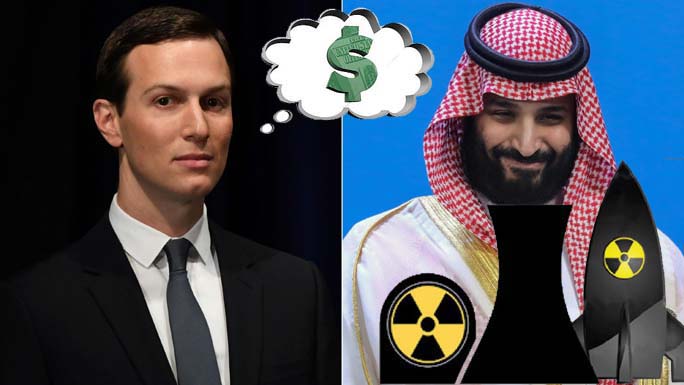 U.S. should keep Congress informed about nuclear talks with Saudis: GAO, https://www.reuters.com/article/us-usa-saudi-nuclearpower/us-should-keep-congress-informed-about-nuclear-talks-with-saudis-gao-idUSKBN22G2X Timothy Gardner
6 May 20, WASHINGTON (Reuters) – The U.S. Departments of State and Energy should commit to regular briefings to relevant committees in Congress on talks about nuclear power cooperation with Saudi Arabia, a congressional watchdog said in a report on Monday.
The Government Accountability Office, or GAO, report said Congress should consider amending the 1954 Atomic Energy Act, or AEA, to require the briefings for the House Committee on Foreign Affairs and the Senate Committee on Foreign Relations about negotiations on nuclear power sharing.
Lawmakers concerned about nonproliferation issues associated with nuclear power development had complained they were being kept in the dark about Trump administration talks with Saudi Arabia, many of which were led by former Energy Secretary Rick Perry. Concern grew after Crown Prince Mohammed bin Salman told CBS in 2018 that the kingdom did not want to acquire a nuclear bomb, but would do so if its rival Iran did so.
Some U.S. lawmakers want the United States to insist that Saudi Arabia agree to a so-called gold standard that restricts enrichment and reprocessing, potential pathways to making fissile material for nuclear weapons. The United States struck such an agreement with the United Arab Emirates in 2009. If Saudi Arabia develops nuclear power without the gold standard, the UAE would likely seek to be released from its agreement.
Senators Robert Menendez, a Democrat, and Marco Rubio, a Republican, had asked the GAO last year to review U.S. agency negotiations with Saudi Arabia on nuclear power, partially because they were concerned the Energy Department, not the State Department took the lead.
The senators said they would explore legislative changes recommended by the GAO. “Congress must reassert its critical role in reviewing nuclear cooperation agreements to ensure these agreements do not pose an unnecessary risk to the United States” they said.
The senators said they would explore legislative changes recommended by the GAO. “Congress must reassert its critical role in reviewing nuclear cooperation agreements to ensure these agreements do not pose an unnecessary risk to the United States” they said.
Time extended by 60 days for comment on planned New Mexico nuclear waste dump
 US Regulators Grant More Time to Consider Nuclear Fuel Plan https://www.usnews.com/news/best-states/new-mexico/articles/2020-05-05/us-regulators-grant-more-time-to-consider-nuclear-fuel-plan
The public will have more time to comment on an environmental review related to a proposed multibillion-dollar complex in New Mexico that would store spent nuclear fuel from commercial power plants around the U.S. The Nuclear Regulatory Commission has granted a request by members of New Mexico’s congressional delegation, providing another 60 days for the process. By Associated Press, Wire Service Content May 5, 2020,
ALBUQUERQUE, N.M. (AP) — The public will have more time to comment on an environmental review related to a proposed multibillion-dollar complex in New Mexico that would store spent nuclear fuel from commercial power plants around the U.S
The Nuclear Regulatory Commission recently granted a request by members of New Mexico’s congressional delegation, providing another 60 days for the process. The delegation had argued for more time and a delay of any public meetings given the health emergency that has resulted from the coronavirus outbreak.
The delegation said in a statement that full public participation is particularly important for projects involving nuclear waste.
Any proposal to store commercial spent nuclear fuel raises a number of health, safety and environmental issues, including potential impacts on local agriculture and industry, issues related to the transportation of nuclear waste, and disproportionate impacts on Native American communities,” they said.
The commission plans to hold a nationwide webinar and five public meetings in New Mexico during the revised public comment period.
Commission Chairwoman Kristine Svinicki said in a recent letter to the delegation that as the health emergency evolves, staff will continue to re-evaluate plans for public participation and will consider whether additional extensions are warranted.
In a preliminary recommendation, the commission favors approval of a license for Holtec International to build the facility in southeastern New Mexico.
The New Jersey-based company is seeking a 40-year license to build what it has described as a state-of-the-art complex near Carlsbad. The first phase calls for storing up to 8,680 metric tons of uranium, which would be packed into 500 canisters. Future expansion could make room for as many as 10,000 canisters of spent nuclear fuel.
Holtec has said the U.S. currently has more than 80,000 metric tons of used nuclear fuel in storage at dozens of sites around the country and the inventory is growing at a rate of about 2,000 metric tons a year.
Gov. Michelle Lujan Grisham and other elected officials are among those with concerns about the potential environmental effects and the prospects of New Mexico becoming a permanent dumping ground for spent nuclear fuel. They point to the lack of a permanent plan by the federal government phase calls for storing up to 8,680 metric tons of uranium, which would be packed into 500 canisters. Future expansion could make room for as many as 10,000 canisters of spent nuclear fuel.
Holtec has said the U.S. currently has more than 80,000 metric tons of used nuclear fuel in storage at dozens of sites around the country and the inventory is growing at a rate of about 2,000 metric tons a year.
Gov. Michelle Lujan Grisham and other elected officials are among those with concerns about the potential environmental effects and the prospects of New Mexico becoming a permanent dumping ground for spent nuclear fuel. They point to the lack of a permanent plan by the federal government for dealing with the waste piling up at power plants around the country.
The governor and others also have questions about whether the facility would compromise oil and gas development in the Permian Basin, one of the world’s most prolific energy production regions.
The NRC staff’s preliminary recommendation states there are no environmental impacts that would preclude the commission from issuing a license for environmental reasons.
Survivors of nuclear radiation exposure are at greater risk from COVID-19.

Nuclear Frontline Communities
Our race for nuclear dominance during WWII and the Cold War left many casualties in its wake: workers in the uranium industry, workers and those downwind of nuclear production sites, soldiers and civilians exposed to above-ground nuclear testing, those who attempt to clean-up and dispose of nuclear waste, and those unlucky enough to live near that waste. These people were exposed to radiation and other toxic chemicals, in many cases causing severe health problems, while never being told by their government or their employers about the risks. To add insult to injury, these exposed populations are disproportionately from Indigenous communities, communities of color, low-income, or rural communities, and often face significant barriers to receiving adequate health care even in the best of times.
Today, the injustice of their exposure stings a little sharper because they have an added fear of contracting COVID-19. Many factors may increase their risk: age, radioactive and toxic chemical exposures, air, soil, and water pollution, existing health conditions such as cancer, poverty, institutionalized racism, etc. These factors can also all contribute to a suppressed immune system.
The Radiation Exposure Compensation Act
Some of the individuals in these communities are able to apply for compensation from the US government through a program called the Radiation Exposure Compensation Act (RECA). RECA is meant to offset what are often debilitating health care costs, though the funds can be hugely insufficient. The program is set to expire in 2022, and many exposed communities are still not covered by RECA. This includes those downwind of the 1945 Trinity Test in New Mexico, downwinders of the Nevada Test Site in states and counties originally excluded from RECA, residents of Guam, veterans who cleaned up radioactive waste in the Marshall Islands, uranium workers past 1971, and civilians downwind of nuclear production sites.
The deficiencies of RECA, and the threat of it disappearing entirely, are already a huge disservice to these communities. But in the face of an international pandemic, those already struggling to manage extreme health consequences from radiation exposure must now also face the spectre of COVID-19.
One of the most common illnesses suffered by those exposed to radiation is cancer. Recent studies show that those with cancers are up to three times as likely to die of COVID-19 than those without cancer – especially blood and lung malignancies, two common cancers that are eligible for RECA compensation.
Tina Cordova, a downwinder of the Trinity Test and co-founder of Tularosa Basin Downwinders Consortium adds: “Many of us live in fear of the virus now not only because it is highly infectious and deadly to most but because we also know we are highly susceptible to getting the virus and dying from it due to our underlying health issues as a result of being exposed to radiation. Once you’ve been diagnosed with cancer and been through the radiation and chemotherapy necessary to save your life you know your immune system has been compromised.”
While flawed, RECA is a crucial program. It can mean the difference between care and no care, financial stability or bankruptcy, losing or keeping your house, and even life or death.
These communities must not be left without health care. The good news is that there is a solution. The Radiation Exposure Compensation Act Amendments Act of 2019 – HR 3783 and S. 947 – would extend RECA to 2045 and expand access to many of the communities currently excluded. Many members of Congress have already been championing the effort to pass this bipartisan legislation, including Congressman Lujan (D-NM), Senator Crapo (R-ID), and Senator Udall (D-NM).
Given the urgency of health care access for these communities today, UCS is calling on Congress to include the provisions of the RECA Amendments Act in upcoming stimulus packages……….. https://allthingsnuclear.org/guest-commentary/covid-19-nuclear-weapons
1 This Month

of the week– Nuclear Reactor Information Task Force

14 May – online event From Bombs to Data Centres: the Face of Nuclear Colonialism
To see nuclear-related stories in greater depth and intensity – go to https://nuclearinformation.wordpress.com
-
Archives
- May 2026 (102)
- April 2026 (356)
- March 2026 (251)
- February 2026 (268)
- January 2026 (308)
- December 2025 (358)
- November 2025 (359)
- October 2025 (376)
- September 2025 (257)
- August 2025 (319)
- July 2025 (230)
- June 2025 (348)
-
Categories
- 1
- 1 NUCLEAR ISSUES
- business and costs
- climate change
- culture and arts
- ENERGY
- environment
- health
- history
- indigenous issues
- Legal
- marketing of nuclear
- media
- opposition to nuclear
- PERSONAL STORIES
- politics
- politics international
- Religion and ethics
- safety
- secrets,lies and civil liberties
- spinbuster
- technology
- Uranium
- wastes
- weapons and war
- Women
- 2 WORLD
- ACTION
- AFRICA
- Atrocities
- AUSTRALIA
- Christina's notes
- Christina's themes
- culture and arts
- Events
- Fuk 2022
- Fuk 2023
- Fukushima 2017
- Fukushima 2018
- fukushima 2019
- Fukushima 2020
- Fukushima 2021
- general
- global warming
- Humour (God we need it)
- Nuclear
- RARE EARTHS
- Reference
- resources – print
- Resources -audiovicual
- Weekly Newsletter
- World
- World Nuclear
- YouTube
-
RSS
Entries RSS
Comments RSS
 nuclear-news