While other nations seek conciliation, agreement, the U.S. will declare that all international sanctions are back in force
 US to declare nuclear sanctions on Iran are restored, Rome Sentinel, September 17, 2020 US to declare nuclear sanctions on Iran are restored, Rome Sentinel, September 17, 2020WASHINGTON — In defiance of overwhelming opposition, the United States is preparing to declare that all international sanctions against Iran have been restored. Few countries believe the move is legal, and such action could provoke conflict at the United Nations. Despite an agreement brokered during the Obama administration, Iran still pursues nuclear enrichment necessary to produce nuclear weapons. The Associated Press story did not mention that an explosion two months ago at Natanz, Iran, destroyed a key facility likely used to manufacture high quality centrifuges essential for refining uranium for such weapons. President Donald Trump’s administration will announce on Saturday that U.N. sanctions on Iran eased under the 2015 nuclear deal are back in force. Other members of the U.N. Security Council, including U.S. allies, disagree and have vowed to ignore the step. The Trump administration already has slapped extensive sanctions on Iran, but could impose penalties on countries that don’t enforce the U.N. sanctions it claims to have reimposed. Trump plans to address Iran in a speech to the General Assembly on Tuesday. ……. https://romesentinel.com/stories/us-to-declare-nuclear-sanctions-on-iran-are-restored,103958 |
|
USA DID have a plan to drop 80 nuclear weapons on Nortrh Korea
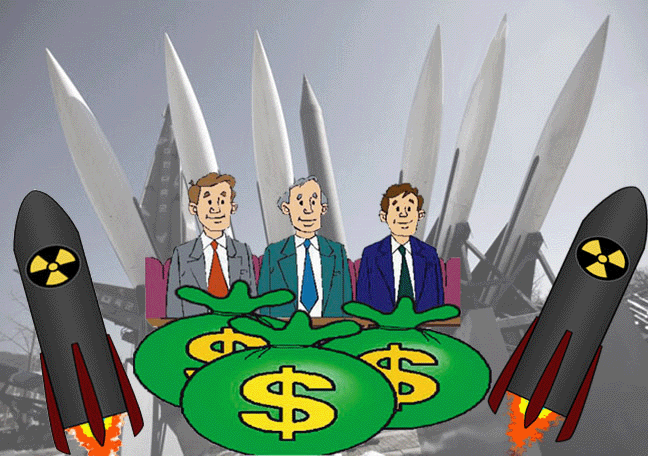 Yes, The United States DidDraw Up A Plan To Drop 80 Nuclear Weapons On North Korea, In 2017, a war between North Korea and the United States was “much closer than anyone would know,” President Trump claims. The Drive BY THOMAS NEWDICK, SEPTEMBER 18, 2020.
Current nuclear war plans are among any nuclear-armed military’s most closely guarded secrets. Details of one such attack plan recently became available, however, revealing that the United States envisaged using 80 nuclear weapons in case of war with North Korea. The way this particular detail emerged is also pretty unusual — the associated passage appeared in U.S. journalist Bob Woodward’s book Rage, detailing President Trump’s administration, which was published this week.
In an interview with NPR, Woodward cleared up any confusion, noting that the 80 nuclear weapons were part of a U.S. attack plan — OPLAN 5027, which would include ‘decapitating’ the North Korean regime of dictator Kim Jong-un.
Woodward said that Mattis confided in him that he was not worried that Trump might launch a preemptive strike against North Korea. Instead, the source of his angst was the North Korean leader in Pyongyang.
In fact, such was Mattis’s level of concern that he would sleep in his gym clothes, Woodward claims. “There was a light in his bathroom… if he was in the shower and they detected a North Korean launch.”
There were alarm bells set up in Mattis’s bedroom and kitchen too, and on more than one occasion during the summer of 2017 they sounded the alert, and he entered the communications room in his Washington DC residency. Woodward explains that Mattis’s car was also constantly followed by an SUV with a team equipped to plot the flight path of any incoming missile, whether it was threatening Japan, South Korea, or the United States. If Mattis considered the missile hostile, he had a mobile communications link to issue launch orders to shoot it down. …………
Clearly, the status of a nuclear-armed North Korea provided much pause for thought within the U.S. administration during Mattis’ tenure as Secretary of Defense. That a strike plan against North Korea involving 80 nuclear weapons was discussed between the president and his defense secretary isn’t all that hard to imagine………..
One of the options under consideration in Washington was OPLAN 5015, a nuclear strike to take out the North Korean leadership, which Woodward also refers to, drawing again from his extensive interviews with Trump. Specifically, Woodward mentions “updating” such a plan — after all, Kim Jong-un and his predecessors will have always been priority targets in the case of an all-out war. ……………… https://www.thedrive.com/the-war-zone/36519/yes-the-united-states-did-draw-up-a-plan-to-drop-80-nuclear-weapons-on-north-korea
USA taxpayers set up by government in the effort to save uneconomic nuclear power

|
The Nuclear Sector Gets A State-Sponsored Lifeline, Oil Price, By Haley Zaremba – Sep 16, 2020, The United States’ nuclear sector is in trouble. And it has been for years now. While the United States remains the largest producer of nuclear energy in the world, producing about one-third of the world’s total nuclear power supply, the industry has been in a state of decline for quite a while. The nuclear sector has never recovered from the influx of cheap natural gas that came along with the domestic shale revolution, and now the country’s aging nuclear fleet faces even bigger problems coming down the pike. Nuclear, like so many other industries (especially in the energy sector), was hit very hard by the pandemic. As Oilprice reported earlier this summer, climate change will hold particularly difficult challenges in store for the nuclear sector, which has to keep its reactors cooled down at all times to avoid meltdowns. And heat is just one risk factor–there are also extreme weather events and catastrophic floods to consider. In 2019, Bloomberg carried out a review of “correspondence between the commission and owners of 60 plants” and made some particularly worrying discoveries. According to nuclear companies’ own risk assessments, “54 of their [60] facilities weren’t designed to handle the flood risk they now face.”
……..Just two weeks after Oilprice wondered “Can The Nuclear Industry Survive COVID-19?,” however, the U.S. Department of Energy (DOE) offered the nuclear sector a lifeline. On June 18, the DOE announced “it would be awarding more than $65m in nuclear energy research, crosscutting technology development, facility access, and infrastructure awards.” According to reporting by PowerTechnology, “the awards fall under the department’s nuclear energy programs – the Nuclear Energy University Programme, the Nuclear Energy Enabling Technologies, and the Nuclear Science User Facilities.” ………The wide scope of these projects points to the multiplicity and complexity of the challenges faced by the U.S. nuclear industry today. While the money awarded by the DOE this June is a good sign for the sector, this is not the first time the DOE has tried to bail out the U.S.’ ailing nuclear industry. “Since 2009, the Office of Nuclear Energy, part of the US Department of Energy, has allocated more than $800m to research, aiming to boost American leadership in clean energy innovation and train the next generation of nuclear engineers and scientists,” Power Technology writes. https://oilprice.com/Alternative-Energy/Nuclear-Power/The-Nuclear-Sector-Gets-A-State-Sponsored-Lifeline.html
|
|
|
Grief in Western America, as inequities, wildfires, and climate change collide
Climate change is making wildfires bigger, fiercer, and deadlier, fueling a new kind of despair on the West Coast—and beyond. Wired 16 Sept 20, GRIEF HAS SETTLED over the western US, along with the thick haze of smoke pouring from dozens of massive wildfires up and down California, Oregon, Colorado, and Washington. It’s grief over the thousands of structures and at least 33 lives lost so far; grief over another villain conspiring with Covid-19 to lock people indoors; grief that the orange-hued dystopia of Blade Runner is now a reality in smoky San Francisco; grief over losing any sense of normalcy, or indeed a clear future.Enveloping all of those emotions—packaging them into an overwhelming feeling of doom—is climate grief, as psychologists call it, the dread that humans have thoroughly corrupted the planet, and that the planet is now exacting its revenge. Wildfires were around before human-made climate change, but by pulling a variety of strings, it’s made them bigger, fiercer, and ultimately deadlier, creating what fire historian Steve Pyne has dubbed the Pyrocene, an Age of Flames.
By burning fossil fuels, we’ve primed the landscape to burn explosively, and by pushing human communities deeper and deeper into what was once wilderness, we’re provided plenty of opportunities for ignition—and plenty of opportunities for grief as these forces catastrophically combine.
“So much is out of our control,” says Adrienne Heinz, a research psychologist at the Stanford University School of Medicine, who studies the effects of disasters like wildfires and the Covid-19 pandemic. “We lose our sense of personal agency over how we will live—the decisions are made for us.”
It shifts from grief over what’s happening with our climate—can we feel safe in our own communities?—to despair, the differentiator being that you don’t feel like tomorrow is going to be any better than today,” Heinz adds. “That’s where it gets really dark.”
For the people of Northern California, an exhausting parade of massive wildfires have marched across the landscape over the past several autumns, with many people having to evacuate several years in a row. Last October, the Kincade Fire burned 120 square miles. The November before, the Camp Fire destroyed the town of Paradise and killed 86 people. And in October 2017, the Tubbs Fire obliterated 5,600 structures and killed 22.
“The catchphrase—kind of with a bitterness around here—is, ‘This is the new normal,’” says Barbara Young, a licensed marriage and family therapist in Healdsburg, north of San Francisco, who had to evacuate last month. “And so with that, I think it’s implied that this isn’t going away—our climate is changing. These aren’t flukes, this is the trend. And I think everyone is very clear that this is not a one-off. This is every year now.” ……………
Thus inequities, wildfires, and climate change collide. Each massive problem on its own is difficult for the human mind to parse, much less all three together. “I am doing a lot of work with people on really increasing psychological self-care, spiritual self-care, physical self-care, and to help that fatigue,” says Young, the therapist in Healdsburg. “And I do think that is connected with climate grief. Finally, maybe we are forced to see how interconnected everything is.” https://www.wired.com/story/climate-grief-is-burning-across-the-american-west/
Western Canadians do not want ”Small” nuclear reactors in Sakatchewan
Premier asks Trudeau to support nuclear reactors in upcoming throne speech, Yorkton This Week Michael Bramadat-Willcock – Local Journalism Initiative (Canada’s National Observer) / Yorkton This Week, SEPTEMBER 16, 2020 Premier Scott Moe has sent a letter to Prime Minister Justin Trudeau outlining Saskatchewan’s priorities ahead of the federal throne speech on Sept. 23. In it, he is asking Trudeau to support nuclear development in the province.
Moe wants the development of small modular nuclear reactors, also known as SMRs, in Saskatchewan to be part of Trudeau’s green agenda. ……..
In December, Moe signed a memorandum of understanding with the premiers of Ontario and New Brunswick to work together on further developing the nuclear industry. ……..
In his letter, the premier also focused on support for the oil and gas sectors, and pushed for pausing the carbon tax.
The Supreme Court of Canada will hear arguments on the federal carbon tax at the same time as the throne speech is delivered. …………
But western Canadians don’t all see eye-to-eye on the deployment of nuclear reactors, even small ones.
Committee for Future Generations outreach co-ordinator Candyce Paul of La Plonge at the English River First Nation earlier told Canada’s National Observer that while they haven’t been consulted on any aspects of the plan, all signs point to the north as a site for the reactors.
On Tuesday, Paul called it ironic that Moe spoke of western alienation from Ottawa when many in the north feel the same way about Regina.
“Trudeau, please represent the people of northern Saskatchewan because Scott Moe does not,” Paul said.
Paul’s group fights nuclear waste storage in Saskatchewan and was instrumental in stopping a proposal that considered Beauval, Pinehouse and Creighton as storage locations in 2011.
“When we informed the communities that they were looking at planning to bury nuclear waste up here in 2011, once they learned what that entailed, everybody said, ‘No way.’ Eighty per cent of the people in the north said, ‘No way, absolutely not.’ It didn’t matter if they worked for Cameco or the other mines. They said, if it comes here, we will not support it coming here,” Paul said in an interview last month. ………..
Paul said the intent behind using SMRs is anything but green and that the real goal is to prop up Saskatchewan’s ailing uranium industry and develop oilsands in the northwest.
“He’s put it right in the letter. His fear is they’re going to put out a green policy that will hurt the oil and gas sector,” Paul said.
“They’ve been looking for a way to bring the tar sands to northern Saskatchewan. We all know the mess that makes. Using small modular reactors is not lessening the carbon impact.”
She said in August that communities around Canada, and especially in the Far North, have long been pitched as sites for SMR development and nuclear waste storage, but have refused.
“None of our people are going to get trained for operating these. It supports people from other places. It doesn’t really support us,” Paul said.
Paul said on Tuesday that SMRs under 200 megawatts are currently excluded from environmental impact assessments, which means a lack of opportunity for public input.
She also said that interconnected water systems in the north would mean pollution would travel quickly into the ecosystem if there was a mishap at a reactor site.
Brooke Dobni, professor of strategy at the University of Saskatchewan’s Edwards School of Business, told Canada’s National Observer in August that any development of small reactors would take a long time.
“It could be a good thing, but on the other hand, it might have some pitfalls. Those talks take years,” Dobni said.
He said nuclear reactors face bigger challenges that have to be addressed before they can go ahead, such as public support for protecting the environment, the high cost of building infrastructure, and containing nuclear fallout and radiation.
“Anything nuclear is 25 years out if you’re talking about small reactors, those kinds of things to power up the city,” Dobni said.
“That technology is a long ways away and a lot of it’s going to depend on public opinion.
“The court for that is the court of public opinion, whether or not people want that in their own backyard, and that’s the whole issue anywhere in the world.”
On Tuesday, Paul asked the federal government to invest in critical infrastructure instead.
“We need money spent in a serious way. Not on small modular reactors that could happen in 25 years. We need things now. To bring us up to the standards in our health system, we need health facilities. The public doesn’t want the government subsidizing industries that are about to go bust. It’s a waste of money,” Paul said.
“We have extreme needs that aren’t being met by industry and never will be met by industry. Trudeau, put the money where you want to make some real reconciliation happen.”https://www.yorktonthisweek.com/regional-news/premier-asks-trudeau-to-support-nuclear-reactors-in-upcoming-throne-speech-1.24204052
U.S. Securities and Exchange Commission investigating FirstEnergy over its involvement in the Ohio nuclear corruption scandal
Now the SEC is investigating FirstEnergy and Ohio’s $1 billion nuclear bailout bill: This Week in the CLE, By Laura Johnston, cleveland.comCLEVELAND, Ohio — Who’s investigating FirstEnergy, in relation to the $1 billion nuclear bailout bill?
We’re talking about the U.S. Securities & Exchange Commission investigation on This Week in the CLE…….
|
Is the U.S. Securities and Exchange Commission the latest agency to investigate FirstEnergy over its involvement in a $60 million bribery scheme to bail out nuclear plants and get other goodies from the Ohio Legislature? Yes. The SEC has launched a separate probe of the company tied to the $60 million House Bill 6 bribery scandal. The examination became public in a federal lawsuit the company and a consulting firm filed against a former employee. Just how little do likely voters in Ohio think of Larry Householder, the disgraced and ousted former Ohio House speaker? Householder is now rated one of the most unpopular state politicians in recent history, with a favorable rating at 7% among likely voters.………… With all the corruption talk swirling around FirstEnergy and utilities in Ohio, in the Ohio Power Siting Board really going to stand behind its inexplicable decision that is killing the proposed offshore Lake Erie wind farm? The Ohio Power Siting Board is preparing to rule that it won’t revisit its decision, even though neither side is happy. The board says the the turbines can’t move at night between March 1 and Nov. 1. ……….. https://www.cleveland.com/news/2020/09/now-the-sec-is-investigating-firstenergy-and-ohios-1-billion-nuclear-bailout-bill-this-week-in-the-cle.html |
|
|
Decorum be damned. Top science editor spits the dummy with Trump
|
America’s Top Science Journal Has Had It With Trump
The editor of Science has abandoned staid academic-speak to take on falsehoods in the White House—decorum be damned. Wired Adam Rogers, 16 Sep 20, WITH AN ARCHIVE that goes back to 1880 and a reputation for publishing world-changing research, the journal Science is the apex predator of academic publishing. Getting an article past its gatekeepers and peer reviewers can make a researcher’s career; the journal’s news section is a model for high-level reporting on everything from quarks to viruses to blue whales to galactic clusters. Along with its competitors Cell and Nature, the journal represents not just new knowledge but also the cultural mores of the world it covers—innovation, integrity, accuracy, rectitude, fealty to data.
So it’s surprising (but maybe not as much as you think) that Science’s newish editor-in-chief has focused a laser-like stream of neural energy at calling out the crummy pandemic policies of the Trump administration. H. Holden Thorp, a chemist and longtime university administrator, became editor-in-chief of Science and five other journals published by the American Association for the Advancement of Science last October, just two months before Covid-19 started spreading around the world. The hopes of a planet full of humans looking for treatments and vaccines turned quickly to scientists, and Thorp’s journals would have been among the places that the best, most relevant work would appear. It has, of course. But Thorp also started a crusade from Science’s editorial page, calling out the ways Donald
Trump’s administration has ignored, misunderstood, and misused science for political gain. Now Thorp’s editorial page is at the forefront of a movement—with scientists casting aside the old stereotype of apolitical disinterest. On Wednesday, even the venerable magazine Scientific American endorsed a presidential candidate for the first time in its 175-year history. (It was Joe Biden.)
Thorp’s most recent broadside, “Trump Lied About Science,” appeared last week. It was the most vigorous condemnation yet, a lightning siege of criticism over Trump’s admission, to the journalist Bob Woodward, that the president knew Covid-19 was more serious than he acknowledged to the public. “This page has commented on the scientific foibles of US presidents. Inadequate action on climate change and environmental degradation during both Republican and Democratic administrations have been criticized frequently,” Thorp wrote. But this, he added, “may be the most shameful moment in the history of US science policy.”
That’d be tough stuff on any newspaper op-ed page; from a place like Science, which has in the past had a somewhat arid editorial voice, it was fire. Thorp has been activated. I asked him what did it, and how his new approach might change science—and Science. Thorp’s answers are here, edited lightly for length and clarity………………
think about what science has been putting up with. We have people telling us we’re all deep-state liberals who are trying to destroy the planet, that we’re taking away hope for people, that we’re being too melodramatic about how bad this all is. And all of the stuff that Trump and his surrogates have been saying turns out not only to be wrong, but that they knew it all along. All the snark that scientists have been putting up with, from the news and from their family members who are Fox News people—all these things that we were supposedly doing to sabotage the world were all lies and knowingly delivered, planted, by the president of the United States. ………… https://www.wired.com/story/americas-top-science-journal-has-had-it-with-trump/
|
|
Relicensing Turkey Point nuclear station – a striking example of a dangerous action in climate change times

 With climate change, aging nuclear plants need closer scrutiny. Turkey Point shows why. https://thebulletin.org/2020/09/with-climate-change-aging-nuclear-plants-need-closer-scrutiny-turkey-point-shows-why/ By Caroline Reiser , September 14, 2020
Last December, two nuclear reactors at Florida’s Turkey Point Nuclear Generating Station, located 25 miles south of Miami, became the first reactors in the world to receive regulatory approval to remain operational for up to 80 years, meaning reactors that first came online in the 1970s could keep running beyond 2050.
The ages of the Turkey Point reactors are not unusual; of the 95 reactors currently licensed to operate in the United States, only five are less than 30 years old, while more than half are 40 or more years old. The Turkey Point reactors are a bellwether, just the first of possibly many aging nuclear reactors that will seek permission to stay online well into the middle of the century. Not long after the December decision, in March 2020, the US Nuclear Regulatory Commission granted two more reactors, located in Pennsylvania, the same extensions that it gave Turkey Point.
In pursing these extensions, the US commercial nuclear industry and its supporters collide with the realities of the aging US nuclear fleet and climate science projections. Existing safety and environmental requirements fail to provide the oversight necessary to ensure communities and the environment are protected. As nuclear reactors receive permission to operate for twice as long as originally envisaged, and in a world that, because of climate change, is drastically different from the one they were built for, the insufficiency of the existing regulatory framework is daunting.
A 40-year lifespan? At the beginning of its commercial nuclear power program, the United States designed and licensed reactors with a 40-year projected lifetime. Once the 40-year license is set to expire, regulations require the reactor owner to apply for a renewed license in order to continue operating for an additional 20 years. What the regulations don’t make clear, however, is the number of times a reactor license can be renewed. What Turkey Point received last year was not its first, but its second extension—what regulators call a subsequent renewed license. Continue reading
The coronavirus pandemic and the increased safety risks for nuclear reactors

Nuclear Alert: NRC & Nuke Safety In the Time of COVID-19 https://www.fairewinds.org/demystify/nuclear-alert-nrc-amp-nuke-safety-in-the-time-of-covid-19 September 14, 2020 By The Fairewinds Crew
First off, we would like to preface this by saying that the world simply cannot afford a meltdown or nuclear disaster on top of the already traumatic times wrought by Pandemic 2020.
Did you know that nuclear plants close for scheduled refueling every 18-months, meaning that 1/3 of the operating reactors are off-line each spring and fall? For the record, more than three dozen reactors had planned to do so in Spring 2020. The Nuclear Regulatory Commission (NRC) defines this rather temporary closing as an outage. During these outages, used-up nuclear fuel is replaced, and critical safety inspections are performed.
You may remember, that in early May, Maggie wrote extensively about the numerous safety risks to all of us if the nuclear industry continued operating these reactors during the COVID-19 Pandemic without implementing critical safety protocols and procedures. Along with 86 other organizations from all over the U.S., Fairewinds Energy Education nonprofit cosigned a letter to Vice President Pence and the COVID-19 Task Force detailing significant safety risks that must be addressed. You can read more about that letter and the increased safety hazards here. To date, we have received no response!
When the COVID-19 Pandemic began in late February, atomic reactor operators and owner corporations begged the NRC for special exemptions from regulatory requirements to implement critical safety and security inspections for up to two years! And, in an extreme example of regulatory capture, the NRC has approved all the corporate requested safety inspection delays, handing them out like candy to eager Trick-or-Treaters on Halloween! We know you have heard this before from the Crew at Fairewinds Energy Education, however, let us emphasize again that the federal laws [called statutes] that authorize the NRC, chartered it to protect ‘public health and safety’. Letting the industry continue to ignore critical safety inspections risks public health and safety!
During the past decade, the success in the growth of renewables has caused the nuclear industry to fight tooth and nail to keep operating even though nuclear power plants are much more expensive to operate than sustainable energy sources, and nukes charge much higher rates to consumers. Additionally, the risk of a disaster or other calamity has increased dramatically due to the old age of all current U.S. operating reactors. Instead of moving to solar and wind and shutting down these decrepit reactors, the energy and utility corporations are trying to reduce their higher operating costs by laying off employees and pushing the people remaining to work harder to save money and continue stockholder profit earnings.
Rather than slowing down these Spring refueling outages and allowing more time for inspections and repairs due to the extra burden the COVID-19 Pandemic has put on their employees and contractors, America’s nuclear monopoly has decided to risk ‘public health and safety’ – you remember what the federal law states – by reducing the amount of safety inspections the staff at each reactor was scheduled to perform. We agree that squeezing three or more people into a confined space for an inspection could be a recipe for COVID-19 transmission. However, slowing the inspection down and using fewer people at a time means having the reactor offline [shutdown] for a longer amount of time. In other words, the truth is that any operating schedule delay reduces each corporation’s profits.
Most atomic power reactors earn $1Million dollars in revenue every day. In addition, vice presidents, plant managers, and other corporate functionaries are on special bonus plans equivalent to between 40 and 70% of their salaries in a special year-end bonus. Such huge sums create a unique incentive for nuclear corporate executives to keep the outages as short as possible. When a vice president earns about $500,000, they will receive a $350,000 year-end bonus for meeting corporate goals, especially a short outage. We tend to notice that bonuses of that size cloud one’s judgment. Furthermore, we are reminded of Upton Sinclair when he so aptly said, “it is difficult to get a man to understand something, when his salary depends on his not understanding it.”
Is the risk of a disaster and a major radiation release to the surrounding community worth the extra millions of dollars earned by the corporate owner for starting these reactors up too soon? We don’t believe so.
Despite there being an abundance of available electricity without even using the atomic chain-reaction, the nuclear power operators and their corporate owners as well as the nuclear industry lobby are claiming that delayed testing will not cause a disaster and no nearby communities will be damaged or deal with the radioactive exposure to its residents.
Safety risks obviously increase because critical inspections are being delayed.
Fires show climate change an existential threat, says Biden
Fires show climate change an existential threat, says Biden
14 Spt 20, Dense smog from US bushfires that have burnt more than 2 million hectares and killed 31 people smothers the West Coast, as presidential challenger Joe Biden warns climate change is becoming an existential issue. … (Subscribers only)
Opinion poll shows unpopularity of nuclear power in the USA.
 Nuclear Energy Among the Least Popular Sources of Power in the U.S., Polling Shows
Nearly half of U.S. adults oppose increasing the country’s number of nuclear energy facilities, Morning Consult, BY LISA MARTINE JENKINS, September 9, 2020
- 1 in 3 adults think the U.S. should keep current nuclear plants online but not build any new facilities.
- 16% believe the U.S. should keep existing nuclear plants operational and build new reactors.
- 29% view nuclear energy favorably and 49% view it unfavorably, making it the most unpopular energy source other than coal.
But new Morning Consult data shows that 21 percent of U.S. adults believe that the country should both stop constructing new nuclear energy facilities and halt current production, while 33 percent agree that new construction should be stopped but think that existing sites should continue producing energy.
Sixteen percent believes that the country should build more reactors, and just 6 percent says that the country should keep current plants running, build more reactors and promote civil nuclear programs abroad (as the United States has done most recently with Poland).
The Aug. 24-27 survey polled 2,200 U.S. adults and has a margin of error of 2 percentage points.
The survey results come as the Trump administration pushes the development of nuclear energy both domestically and internationally, investing especially in the development of advanced technology in order to speed nuclear’s adoption amid carbon emission reduction goals coming due.
And Democratic presidential nominee Joe Biden has also expressed interest in developing advanced technology and leveraging existing nuclear capabilities as part of his wider energy plan released in June. (When contacted by Morning Consult, the Biden campaign did not provide information on the former vice president’s views on nuclear beyond what is included in the publicly available plan.)
And while the popular progressive platform the Green New Deal makes no specific mention of nuclear energy, one of its sponsors, Rep. Alexandria Ocasio-Cortez (D-N.Y.), said last year that it “leaves the door open on nuclear.”
But even with its political support, when compared with other energy sources nuclear seems to have a bad rap among the general public. As compared with a number of energy sources, coal was the only option respondents regarded less favorably than nuclear, with 24 percent viewing coal favorably and 58 percent unfavorably.
Nuclear energy’s net favorability — the favorable share minus the unfavorable share — is similarly underwater, at minus 20 points; this is nearly 70 points below that of natural gas, a fossil fuel whose emissions contribute to climate change. Zero-emission sources such as solar and wind topped the list, with net favorabilities of 76 and 65 points, respectively. ………
Overall, the survey found that more U.S. adults oppose increasing the number of nuclear facilities in the United States than support doing so, ………..
Overall, the survey found that more U.S. adults oppose increasing the number of nuclear facilities in the United States than support doing so… https://morningconsult.com/2020/09/09/nuclear-energy-polling/
In 2017, USA considered plans to attack North Korea using nuclear weapons
|
US reviewed plans to use nuclear weapons on North Korea, strike leadership https://www.nknews.org/2020/09/us-reviewed-plans-to-use-nuclear-weapons-on-north-korea-strike-leadership/
Amid growing tensions in 2017, U.S. brushed up on plans to attack North Korea using nuclear weapons
Chad O’Carroll September 14, 2020 The United States reviewed plans to strike North Korea with as many as 80 nuclear weapons and updated leadership strike plans during the first year of Trump’s presidency, according to veteran journalist Bob Woodward’s new book, “Rage.”Woodward’s book reveals that, as tensions between North Korea and the U.S. sharpened in 2017 over Pyongyang’s testing of advanced missile technologies, then-Secretary of Defense Jim Mattis grew anxious about the possibility of nuclear war. Woodward cited direct interview material and informed sources to make these claims.Mattis did not think Trump would launch a preemptive strike on North Korea, but when tensions were
|
|
Seabrook nuclear power plant’s license extension upheld, with conditions
Seabrook nuclear power plant’s license extension upheld, with conditions, By Angeljean Chiaramida, 14 Sep 20, news@seacoastonline.com
SEABROOK – After nearly a year of analysis, the Atomic Safety and Licensing Board upheld the operating license amendment to NextEra Energy’s nuclear power plant in Seabrook.
The board in its 207-page ruling Friday, Sept. 11, however, imposed four additional conditions to address further on the alkali-silica reaction (ASR) concrete degradation issues within the plant’s structures…….. https://www.seacoastonline.com/news/20200914/seabrook-nuclear-power-plantrsquos-license-extension-upheld-with-conditions
Nuclear waste flyers heading to 50,000 households in Grey-Bruce
|
Scott MillerCTV News London Videographer @ScottMillerCTV Contact, Monday, September 14, 2020 WINGHAM, ONT. — Roughly 50,000 homeowners in Grey and Bruce County will be getting some unexpected mail this week. “South Bruce is not a willing host to a nuclear waste dump” flyers will be showing up in people’s mailboxes thanks to a group of concerned landowners near Teeswater, where Canada’s highest level nuclear waste could be permanently buried. Michelle Stein leads the group, Protect Our Waterways-No Nuclear Waste. Why would we want to take that kind of a risk with our water and the Great Lakes basin. Anything that happens in the Great Lakes Basin happens to our Great Lakes. We need to protect our water,” she says. All of the highly radioactive fuel bundles are currently stored in above ground warehouses at Canada’s nuclear reactor sites, right now. The Nuclear Waste Management Organization (NWMO) has two proposed sites to permanently bury over 5 million used nuclear fuel bundles, that once powered Canada’s nuclear reactors. One near Ignace, in Northern Ontario, and another north of Teeswater, in Bruce County. All of the highly radioactive fuel bundles are currently stored in above ground and near ground containers at Canada’s nuclear reactor sites, right now……… Stein says people far and wide should know that the NWMO plan includes walking away from the underground facility and the waste, after 50 to 75 years of operation, leaving the radioactive waste in the ground, forever. “There is no country in the world with an operational high level spent fuel DGR (deep geological repository), and history shows us that the low and intermediate level DGR’s have had failures, accidents, and leaks,” she says……. The Nuclear Waste Management wants to have a site selected, either South Bruce or Ignace, by 2023. https://london.ctvnews.ca/nuclear-waste-flyers-heading-to-50-000-households-in-grey-bruce-1.5104113 |
|
1 This Month

of the week– Nuclear Reactor Information Task Force

14 May – online event From Bombs to Data Centres: the Face of Nuclear Colonialism
To see nuclear-related stories in greater depth and intensity – go to https://nuclearinformation.wordpress.com
-
Archives
- May 2026 (82)
- April 2026 (356)
- March 2026 (251)
- February 2026 (268)
- January 2026 (308)
- December 2025 (358)
- November 2025 (359)
- October 2025 (376)
- September 2025 (257)
- August 2025 (319)
- July 2025 (230)
- June 2025 (348)
-
Categories
- 1
- 1 NUCLEAR ISSUES
- business and costs
- climate change
- culture and arts
- ENERGY
- environment
- health
- history
- indigenous issues
- Legal
- marketing of nuclear
- media
- opposition to nuclear
- PERSONAL STORIES
- politics
- politics international
- Religion and ethics
- safety
- secrets,lies and civil liberties
- spinbuster
- technology
- Uranium
- wastes
- weapons and war
- Women
- 2 WORLD
- ACTION
- AFRICA
- Atrocities
- AUSTRALIA
- Christina's notes
- Christina's themes
- culture and arts
- Events
- Fuk 2022
- Fuk 2023
- Fukushima 2017
- Fukushima 2018
- fukushima 2019
- Fukushima 2020
- Fukushima 2021
- general
- global warming
- Humour (God we need it)
- Nuclear
- RARE EARTHS
- Reference
- resources – print
- Resources -audiovicual
- Weekly Newsletter
- World
- World Nuclear
- YouTube
-
RSS
Entries RSS
Comments RSS
 nuclear-news