Transport of nuclear wastes – a Pandora’s Box of problems for North Texans
Transporting the waste to the New Mexico and West Texas facilities by rail car and through major cities, including those in the Dallas-Fort Worth region, could be a Pandora’s Box of problems for North Texans
|
High-level nuclear waste refers to spent, or used, reactor fuel and waste materials that exist after the used fuel is reprocessed for disposal. The radioactive waste poses potentially harmful effects to humans and only decreases in radioactivity through decay, which can take hundreds of thousands of years, according to the Nuclear Regulatory Commission, the federal agency that regulates nuclear power plants and the storage and disposal of waste. Activists who oppose the West Texas plan say the impact will not be limited to residents of Andrews County, where the toxic waste site owned by Waste Control Specialists already sits near the Texas-New Mexico border. The commission is considering a similar plan for a high-level waste storage facility in southeastern New Mexico, brought forward by the nuclear company Holtec. Transporting the waste to the New Mexico and West Texas facilities by rail car and through major cities, including those in the Dallas-Fort Worth region, could be a Pandora’s Box of problems for North Texans, said Lon Burnam, a former state representative and the chair of the Tarrant Coalition for Environmental Awareness. “We’ve created all this waste, there’s no good way to handle it, and the question is: What is the least objectionable way to handle it?” Burnam said. “But carting it all through Dallas-Fort Worth, from my perspective, is one of the worst ways to handle it. Why should we be the community that 90% of this stuff goes through on its way to either West Texas or the New Mexico side?” For years, the U.S. Department of Energy has struggled to find a long-term storage solution for the country’s growing stockpile of radioactive waste. With no permanent destination for safe disposal, more than 80,000 metric tons of highly radioactive nuclear waste sit at the country’s commercial nuclear plants, according to the U.S. Government Accountability Office. …… Texans have until Nov. 3 to submit online public comments on the report, which may be the last chance that the public has to voice opposition or support for the application…… https://www.star-telegram.com/news/state/texas/article245941215.html |
|

Ohio. Amid debate over repealing House Bill 6, Energy Harbor still won’t say whether its nuclear plants are profitable.

|
Amid debate over repealing House Bill 6, Energy Harbor still won’t say whether its nuclear plants are profitable
Cleveland. com Sep 25, 2020, By Jeremy Pelzer, COLUMBUS, Ohio—State lawmakers are looking at whether to keep in place a $1.3 billion public bailout for the Davis-Besse and Perry nuclear power plants along Lake Erie, a law that federal authorities say was corruptly enacted. But throughout the debate, there’s still a glaring problem: the owner of the nuclear plants refuses to disclose whether they are profitable or not. And so far, there’s been no attempt by state lawmakers to compel the company to release its numbers before the bailout takes effect. During last year’s debate over whether to pass the bailout as part of House Bill 6, Energy Harbor – then known as FirstEnergy Solutions – asserted it needed public subsidies or it would close the plants. But the company wouldn’t open its books to lawmakers or the public to prove that it actually needed the money, leading legislators to rely on estimates, industry averages and company officials’ word. At the time, FirstEnergy Solutions told cleveland.com the reason it couldn’t open its books was because it was involved in bankruptcy proceedings. Those proceedings have been over for months, yet Energy Harbor still won’t say whether the plants are profitable. And this time, the company is not offering a reason…………. https://www.cleveland.com/open/2020/09/amid-debate-over-repealing-house-bill-6-energy-harbor-still-wont-say-whether-its-nuclear-plants-are-profitable.html
|
|
|
Economic distress for Exelon’s 4 nuclear plants in Illinois
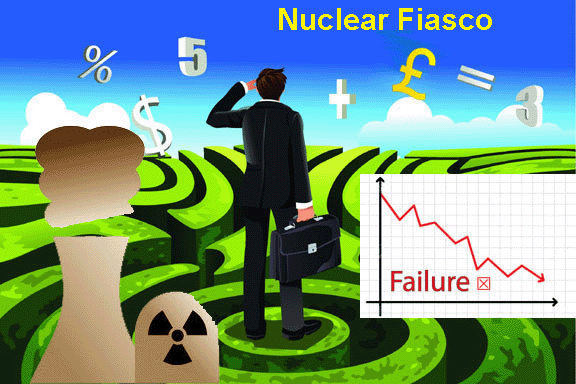 A look at Exelon’s 4 economically challenged nuclear plants in Illinois, S & P Global, Author, Anna Duquiatan, 25 Sep 20, Exelon Corp.-owned nuclear power plants in Illinois eyed for early retirement have had declining financial margins of late, according to an analysis using S&P Global Market Intelligence’s plant-level production cost model. ………
Exelon Generation Co. LLC announced Aug. 27 that it plans to retire its 2,346-MW Byron and 1,805-MW Dresden nuclear power stations in September 2021 and November 2021, respectively.
The Exelon Corp. subsidiary added that the 2,384-MW Braidwood Generating Station and 2,313-MW LaSalle County Generating Station are “also at high risk for premature closure,” though the company has not yet projected any closure dates for those plants………
The two-unit Dresden plant in Grundy County, the first of the four northern Illinois plants to enter service, in the early 1970s, is licensed to operate until 2029 and 2031. Braidwood in Will County, Byron in Ogle County, and LaSalle in LaSalle County all began operating in the mid- to late 1980s and are licensed to operate until the 2040s. …………..
Q2: U.S. Solar and Wind Power by the Numbers
Wrestling with the COVID-19 pandemic, solar project developers installed nearly three times as much solar power capacity in Q2’20 compared to the same period a year ago. Meanwhile, the U.S. wind industry posted one of its strongest second quarters on record in 2020, adding 2,369 MW of capacity, and the 2020 development pipeline stands strong at 30,554 MW.
Q2: U.S. Wind Power by the numbers
Essential Energy Insights – September, 2020
Numbers Utility-Scale Solar Surge Reaches 1.6 GW in Q2
Iowa’s last nuclear power station to close – 60 years at least to decommission it
 What’s next for Duane Arnold nuclear plant?, THe Gazette, 25 Sep 20, What’s next for Duane Arnold nuclear plant?, THe Gazette, 25 Sep 20,
Derecho damage prompts nuclear plant not to restart, Duane Arnold Energy Center near Palo did not restart after the Aug. 10 derecho caused “extensive” damage to its cooling towers…….. Why is it being decommissioned?
Dean Curtland, plant director, told The Gazette in 2018 Iowa’s changing energy landscape has overshadowed and outpriced Duane Arnold. Closing the facility could save NextEra about $300 million over 21 years, with cost savings coming as early as 2021. That translates to about $42 per residential customer. What impact did the derecho have on its decommissioning? NextEra Energy already was planning on decommissioning Duane Arnold this year. When the derecho caused “extensive” damage to the facility’s cooling towers, NextEra opted against restarting the plant so close to the Oct. 30 decommissioning date. Replacing the cooling towers with fewer than three months until decommissioning was “not feasible,” Robbins said last month. What is happening now that the plant is shut down? The decommissioning process is underway as employees remove nuclear material from the facility “There’s the nuclear fuel that was in the reactor and then nuclear fuel that was in a pool — what is called the spent fuel pool,” Robbins said. “We’ve been moving a lot of the fuel out of that pool and putting it in a storage facility on the site.” How long will the decommissioning process take? The process involves several steps, starting with removing nuclear material from the site. After nuclear material goes into the spent fuel pool, it can go into dry storage. After all the fuel is removed, officials have 60 years to decommission the facility………. Are there any other nuclear power plants in Iowa? Duane Arnold was the last nuclear power plant in the state. The closest nuclear power plant is in Cordova, Ill., about 20 miles northeast of Moline along the Mississippi River. Comments: (319) 398-8394; john.steppe@thegazette.com https://www.thegazette.com/subject/news/business/duane-arnold-energy-center-nuclear-plant-iowa-palo-ia-decommission-20200925 |
|
Small modular nuclear reactors for Canada? – useless, expensive, untested, and a wasteful distraction
 NB Media Co-op 22nd Sept 2020,Premier Blaine Higgs has endorsed so-called “small modular nuclear reactors” or SMRs. SMRs represent an untested technology but what we know on the basis of technical characteristics and historical precedent is that they will be expensive and any electricity they generate will not be economical. The nuclear industry is pushing small reactors because large reactors are simply not economical. Constructing nuclear plants is just too expensive—as Ontario’s government found out after its call in 2008 for bids to build two more reactors at the Darlington site.
https://nbmediacoop.org/2020/09/22/no-business-case-for-new-nuclear-reactors-in-new-brunswick/
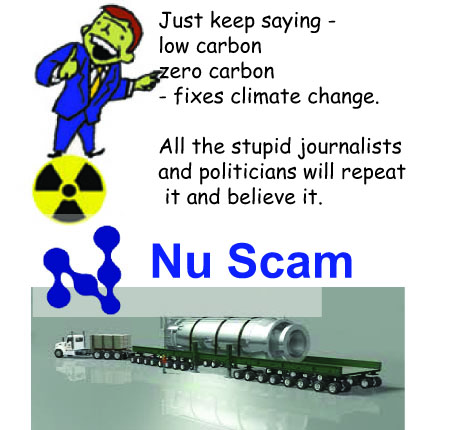 Sierra Club Canada (accessed) 23rd Sept 2020, No plan that gets us to net zero in a reasonable time frame includes new nuclear reactors. Nuclear is far too slow and expensive to deal with the climate emergency. Just like fossil fuel energy, nuclear produces wastes that pose unacceptable health hazards and economic costs.
The U.S. media’s resposibility to question Trump and Biden on nuclear arms control and nonproliferation

|
Whether President Trump or one of his challengers is sworn in as president on January 20, 2021, he or she will have the complete and unchecked authority to order the use of the approximately 4,000 nuclear weapons in the active US stockpile. When running for the highest office in the land, each presidential candidate is asking the American public to trust him or her implicitly with this singular responsibility. Given that reality, it is actually quite strange that plans and policies for the management of the most destructive force ever created are rarely discussed on the campaign trail. ………..with the exception of the Nov. 20, 2020 Democratic debate, television network hosts have largely avoided foreign policy questions in multi-candidate forums. Political reporters inside the Beltway and in the field rarely ask candidates about nuclear policy issues, despite the multiple nuclear crises unfolding around us in real time. There does not seem to be any acknowledgement that nuclear issues are inextricably linked to so many of the other issues being discussed. Relations with Russia, currently at a post-Cold War low, could slide from terrible to disastrous in the absence of verifiable, bilateral controls over the US and Russian nuclear arsenals. It is hard to envision a successful economic pivot to Asia that doesn’t involve a long-term solution to the North Korean nuclear crisis and a better strategic stability relationship between the United States and China. Getting the military budget under control is impossible without taking a hard look at the nearly $1.7 trillion (at least) that the United States is planning to spend on modernizing US nuclear forces. There is no “peace in the Middle East” without constraints on weapons of mass destruction in the region. Long-term solutions to climate change are all for naught if we ignore the other existential threat to humanity: nuclear war. The list could go on, but the point is that we ignore nuclear issues at our own peril. The next president will have to deal with many pressing questions on day one (or day 1,461), but few are as consequential as this one: Do we want to live in a world in which the number of nuclear weapons is going up or going down?……….. Despite the stated commitment to arms control and non-proliferation policies in the 2018 Nuclear Posture Reviewi, the Trump administration has mostly dismantled and dismissed standing nuclear agreements…….. No matter who sits behind the Resolute Desk on Jan. 20, 2021, he or she will have to scramble to triage the challenges left to them on the arms control and nonproliferation front. The most pressing challenge will be the possible end of the New Strategic Arms Reduction Treaty (New START), which is set to expire on Feb. 5, 2021. ………. While most Democratic candidates have affirmedv that they would extend the treaty as long as Russia remains in compliance, they should be asked to outline their plans for extension and how they would handle the broader strategic stability dialogue with Russia. ……… Plans to deal with the North Korean nuclear program are inextricably linked to other strategic security issues in the region. ………. The other major nonproliferation challenge for the candidates in 2020 will be the future of the Iranian nuclear program. The Trump administration’s decision to withdraw from the Joint Comprehensive Plan of Action (JCPOA) with Iran will affect the foreign policy landscape in 2021 and beyond. ………. With any of these matters, candidates should not be allowed to speak in bromides about the value of diplomacy. As uninspiring and tedious as the press may find it to focus on technical details, they should not buy into the idea that a quick-fix grand bargain is possible with Russia, Iran, or North Korea. Presidential candidates are asking for the privilege and responsibility of running American foreign policy, so it is completely reasonable to expect them to describe the mechanics of their proposals, even as they acknowledge that those proposals may need to change over time ………. The future president will also need to manage the growing unease between nuclear weapons states and non-nuclear weapons states. In particular, the United States will need to assess how it has related and will relate to signatories of the Treaty on the Prohibition of Nuclear Weapons, often known as the ban treaty, since the treaty will likely enter into force in the coming years. ……… Even with enhanced interest in and knowledge of nuclear policy, it is unlikely that reporters covering the 2020 presidential election will spend a significant amount of time on arms control and nonproliferation agreements. There are simply too many challenges facing the American public to expect hyper focus on any one policy area. That said, it would be extremely unfortunate to see the press ignore the subject of how we reduce nuclear risks—while gladly covering the president’s latest nickname for a rival or his challenger’s most memorable Trump put-down. For the past half-century, American presidents and administrations of both political parties have painstakingly built an intricate collection of arms control and nonproliferation agreements. They have brought the overall number of nuclear weapons in the world from almost 70,000 to around 14,000. They have prevented the mass spread of nuclear weapons, containing nuclear weapons programs to just nine countries. They have kept fear, mistrust, and the impulsive tendencies of fallible humans in check. As we approach the 75th year of the nuclear age, these hard-won agreements are disappearing. Americans will enter the voting booth on November 3, 2020 to select a leader who will either reverse that unfortunate trend or doom us to repeat the folly of the Cold War arms race. Let’s hope those voters they have all the information they need to make the right choice. https://thebulletin.org/premium/2020-01/what-the-presidential-candidates-should-be-asked-about-arms-control-and-nonproliferation/?utm_source=Announcement&utm_medium=Email&utm_campaign=Announcement09232020&utm_content=NuclearRisk_AskCandidates_01132020 |
|
Compensation for some nuclear workers with mesothelioma .
|
Mesothelioma Compensation Center Urges the Family of a Navy or Civilian Nuclear Power Worker with Mesothelioma to Call Attorney Erik Karst of Karst von Oiste – Compensation Might Be in Excess of a Million Dollars, https://www.prnewswire.com/news-releases/mesothelioma-compensation-center-urges-the-family-of-a-navy-or-civilian-nuclear-power-worker-with-mesothelioma-to-call-attorney-erik-karst-of-karst-von-oiste—compensation-might-be-in-excess-of-a-million-dollars-301136249.html NEWS PROVIDED BY
Mesothelioma Compensation Center , Sep 23, 2020, HOUSTON, Sept. 23, 2020 /PRNewswire/ — The Mesothelioma Compensation Center is urging the immediate family of a Navy Veteran or civilian nuclear power worker who has just been diagnosed with mesothelioma to please call attorney Erik Karst of the law firm of Karst von Oiste at 800-714-0303. Compensation for a Navy Veteran or civilian nuclear power plant worker with mesothelioma could top the list when it comes to a financial compensation claim. Because many civilian nuclear power plant workers learned their craft on a nuclear-powered navy ship or submarine their asbestos exposure might have spanned decades. Financial compensation for a Navy Veteran or civilian nuclear power worker might exceed a million dollars.“We have endorsed, and we strongly recommend attorney Erik Karst because he and his amazing team at Karst von Oiste will work overtime for their clients. What Erik Karst and his team at Karst von Oiste do is ‘work a case’ which means they work overtime to answer the questions related to how, where and when the person with mesothelioma was exposed to asbestos. It is this vital information that becomes the basis for a mesothelioma compensation claim-and it is vitally important.”Do not let the Coronavirus stop a person with mesothelioma from pursing their financial compensation. Attorney Erik Karst and his colleagues now have the capabilities to work around the Coronavirus with conference calls and video conferences to make it easier on their client-and their client’s family. Erik Karst and his colleagues at the law firm of Karst von Oiste want their clients to receive the best possible financial compensation. For direct access to attorney Erik Karst of the law firm of Karst von Oiste please call 800-714-0303 anytime.” www.karstvonoiste.com/Some of the largest nuclear power plants in the US include:
For a list of all operating nuclear power plants in the United States please refer to the following website: https://www.nrc.gov/reactors/operating/list-power-reactor-units.html. The Mesothelioma Compensation Center specializes in assisting specific types of people who have been diagnosed with mesothelioma. The Center’s top priority is assisting US Navy Veterans, shipyard workers, oil refinery workers, public-utility workers, chemical plant workers, manufacturing workers, power plant workers, plumbers, welders, electricians, millwrights, pipefitters, boiler technicians, machinists, nuclear power plant workers, hydro-electric workers or oil and gas field production workers who have been diagnosed with this rare cancer caused by asbestos exposure. In most instances a diagnosed person with mesothelioma was exposed to asbestos in the 1950’s, 1960’s, 1970’s, or 1980’s. https://MesotheliomaCompensationCenter.Com According to the CDC the states indicated with the highest incidence of mesothelioma include Maine, Massachusetts, Connecticut, Maryland, New Jersey, Pennsylvania, Ohio, West Virginia, Virginia, Michigan, Illinois, Minnesota, Louisiana, Washington, and Oregon. However, a Nuclear Navy Veteran or a nuclear power worker with mesothelioma could live in any state including California, New York, Florida, Texas, Illinois, Kentucky, Tennessee, Mississippi, Georgia, Alabama, Wyoming, Colorado, New Mexico, Nevada, Utah, Arizona, Idaho, or Alaska. www.karstvonoiste.com/ For more information about mesothelioma please refer to the National Institutes of Health’s web site related to this rare form of cancer: Contact: |
|
Lawsuit: Ohio Attorney General sues to stop nuclear bailout money, and break up dark money groups

Ohio Attorney General Dave Yost sues to block nuclear bailout money from being paid, The lawsuit also seeks to dissolve the dark money groups involved in the bribery scheme. Author: WKYC Staff, Associated Press, 10TV Web Staff, September 23, 2020
COLUMBUS, Ohio — Ohio Attorney General Dave Yost filed a lawsuit on Wednesday to block the state’s nuclear plants from collecting fees on electricity bills that were authorized in a new law at the center of a $60 million federal bribery probe involving the former speaker of the Ohio House.
The suit was filed in Franklin County Court in Columbus against Energy Harbor, asking the judge to block payments to the company’s two nuclear plants near Cleveland and Toledo that were bailed out through the now-tainted legislation.
Energy Harbor is the former FirstEnergy Solutions, a onetime subsidiary of FirstEnergy Corp. The subsidiary filed for Chapter 11 bankruptcy in 2018 amid a mounting load brought on by the rise of competition from natural gas power in the East and Midwest.
HB 6, a roughly $1 billion financial bailout, was signed into law in July 2019. It added a new fee to every electricity bill in the state and directed over $150 million a year through 2026 to the plants in Lake and Ottawa counties. The fee will be added to every electricity bill in the state starting January 1.
Federal prosecutors allege that from March 2017 to March 2020, former Ohio House Speaker Larry Householder and others received millions of dollars in exchange for help in passing HB 6.
Wednesday’s lawsuit came hours after a House committee looking at repealing the law heard varying proponent testimony from energy lobbying groups and state office representing consumers. Governor Mike DeWine has said he supports a repeal of the law.
Yost had previously promised he would take the legal remedies necessary if the General Assembly could not do so in time.
The lawsuit also seeks to freeze the assets of former House Speaker Larry Householder’s $1 million campaign fund and dissolve the dark money groups involved in the bribery scheme, Yost said.
“Corruption like this doesn’t happen without cash, lots of cash,” he said.
Federal prosecutors in July accused Householder and four others of shepherding energy company money for personal and political use as part of an effort to pass the legislation, then kill any attempt to repeal it at the polls. All five men have pleaded not guilty………. https://www.wkyc.com/article/news/politics/attorney-general-dave-yost-sues-to-stop-nuclear-bailout-money-from-being-paid/95-431fd46c-44c0-440a-9076-46e1c9d23f8a
Will Bears Ears Become the World’s Radioactive Waste Dump?
First, it was a multinational corporation with a factory in the Baltic nation of Estonia that sought to send its unwanted radioactive waste to southeast Utah. Now, another overseas entity, the Japan Atomic Energy Agency (JAEA), has its sights set on the White Mesa uranium mill for new radioactive waste shipments as well.
Is the White Mesa Mill, on the doorstep of the White Mesa Ute community and just outside the original boundaries of Bears Ears National Monument, on a fast track to become a dumping ground for foreign industrial polluters and distant government entities? Not if we have anything to say about it.
Why White Mesa?
Why, you may ask, is the White Mesa Mill so attractive for those in faraway lands who want to dispose of their radioactive waste? It’s simple, really. Sending the material to a uranium mill halfway around the world is expedient when compared to other options. It’s likely the cheapest option for the waste generator.
And this waste-processing business helps keep the struggling uranium mill afloat amid market downturns, too. Usually, the mill would pay miners for the uranium ore they deliver. In this case, it’s likely that the party sending the waste will pay the mill. On a recent investor call, the mill owner’s CEO admitted that accepting, processing, and disposing of these kinds of wastes earns the company $5-15 million a year.
What is this stuff?
In late May, the mill’s owner, Energy Fuels Resources, notified the state of Utah’s Division of Waste Management and Radiation Control that the company plans to receive 136 tons (about 10 dump trucks full) of radioactive waste from two Japan Atomic Energy Agency research facilities: the Ningyo Center and the Tono Center.
The material includes natural uranium ores from mines in Japan and other mines around the world that the Japanese agency tested, as well as uranium-loaded resins, filter-bed sands, and uranium-loaded carbon — materials that concentrate uranium during water cleanup at the two facilities.
The waste contains very little uranium. According to the mill owner, the company would produce less than 0.6 tons of yellowcake from the waste; the rest of the 136 tons would be dumped in massive waste pits at the mill that sit above the White Mesa Ute community’s drinking-water supply. The company likes to claim that it’s “recycling.” But charging millions to accept waste and ultimately dumping more than 99 percent of it into waste pits sounds like a radioactive waste dump, not a recycling operation.
When is the Japanese waste coming?
Energy Fuels Resources’ letter gives no dates as to when it plans to accept this waste, to be shipped from Japan across the Pacific Ocean, likely to ports in Washington state, then transferred to White Mesa by rail and truck across the Western United States. Utah regulators have evaluated the company’s proposal, and on July 28, 2020, they issued a letter concurring with the company’s plans.
This means you, the public, had no formal opportunity to weigh in. That’s why letting regulators know that you object to the Japanese waste is so important now.
No import license, no public involvement
Energy Fuels Resources claims, and the state of Utah agrees, that it doesn’t need an individual import license issued by the U.S. Nuclear Regulatory Commission to accept the Japanese radioactive waste. Nor, the company claims, does it need an amendment to its state-issued license, which would trigger a public comment period.
These claims are based on regulatory alchemy. Though the material is radioactive and is viewed as waste in Japan, the mill owner prefers to call the material “natural ores and equivalent feed materials” because those are the materials the company is licensed to accept for processing and permanent disposal at the mill. But we disagree.
We object to more international radioactive waste being shipped to the White Mesa Mill near the Ute Mountain Ute Tribe’s White Mesa Community. We also believe the public should be heard on this matter. That’s why we’re asking you to take action.
Act now. Let Utah regulators know that the White Mesa Mill is no place for foreign waste ›
History repeats itself
This isn’t the first time the Japanese government has shipped radioactive waste to the White Mesa Mill. In 2004, the Japanese Supreme Court ordered the removal of contaminated soils from the Ningyo-Toge area (one of the two sites that could ship waste now) based on pressure and litigation from those living nearby. Hefty fines were levied against the Japan Atomic Energy Agency for each day the waste remained on site past a court-imposed deadline. In 2005, the agency paid the then-owners of the White Mesa Mill $5.8 million to process uranium from and permanently dispose of 500 tons of contaminated soils.
The Salt Lake Tribune covered the story then, and it sounds much like the situation today. The Tribune noted that “reports from Japan often describe the contaminated soil as waste headed to Utah for disposal.” In 2005, as now, the owners of the mill claim the material is “ore,” not “waste,” and that no special licenses are required.
What’s changed since then? In 2010, the Nuclear Regulatory Commission clarified that an import license is required unless the “materials [are] imported solely for the purposes of recycling and not for waste management or disposal…” A 2003 paper on Ningyo and Tono cleanup plans states repeatedly that: “reclamation of uranium mining and milling facilities is necessary to reduce the burden of the waste management on future generations.”
Then, as now, shipping the waste to White Mesa shifts the burden to the White Mesa Ute community. These materials are clearly treated as waste in Japan, just as the Estonian material is treated as undesirable waste in Estonia. In Japan as in Estonia, the goal is disposal — far away. For that reason, we believe the mill’s owners need an import license from the Nuclear Regulatory Commission for this waste, and for the Estonian waste.
Join us in letting the state of Utah know you agree. White Mesa, the White Mesa Ute community, and Bears Ears cannot become the world’s radioactive dumping ground.
New Mexico is strongly objecting to licensing of Holtec’s multibillion-dollar nuclear waste dump plan
New Mexico objects to license for nuclear fuel storage plan, Madison.com , By SUSAN MONTOYA BRYAN Associated Press, 23 Sept 20
-
- ALBUQUERQUE, N.M. (AP) — The state of New Mexico is strongly objecting to federal nuclear regulators’ preliminary recommendation that a license be granted to build a multibillion-dollar storage facility for spent nuclear fuel from commercial power plants around the U.S.
State officials, in a letter submitted Tuesday to the Nuclear Regulatory Commission, said the site is geologically unsuitable and technical analysis has been inadequate so far. They also say regulators have failed to consider environmental justice concerns and have therefore fallen short of requirements spelled out by federal environmental laws.
The officials pointed to a legacy of contamination in New Mexico that includes uranium mining and milling and decades of nuclear research and bomb-making at national laboratories, saying minority and low-income populations already have suffered disproportionate health and environmental effects as a result.
A group of Democratic state lawmakers also raised concerns, sending separate comments to the commission that pointed to resolutions passed by a number of cities and counties in New Mexico and Texas that are opposed to building the facility.
Elected leaders in southeastern New Mexico support the project, saying it would bring jobs and revenue to the region and provide a temporary option for dealing with the spent fuel.
The deadline to comment on draft environmental review was Tuesday. A study on the project’s impact on human safety is pending and will require another round of public comment.
New Jersey-based Holtec is seeking a 40-year license to build what it has described as a state-of-the-art complex near Carlsbad. The first phase calls for storing up to 8,680 metric tons of uranium, which would be packed into 500 canisters. Future expansion could make room for as many as 10,000 canisters of spent nuclear fuel……. https://madison.com/news/national/govt-and-politics/new-mexico-objects-to-license-for-nuclear-fuel-storage-plan/article_f13be5d3-9381-57dd-aa21-b83915cb57c0.html
David Suzuki on nuclear power as a climate change solution ”I want to puke.”
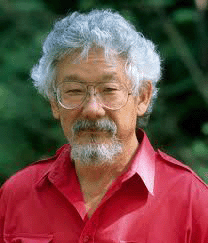 I want to puke. Because politicians love to say, “Oh, yeah, we care about this and boy, there’s [nuclear] technology just around the corner.”
Yeah, it’s taken a child [environmental activist Greta Thunberg] to finally have an impact that is more than all of us environmentalists put together over the past years.
The power of that child is that she’s got no vested interest in anything. She’s just saying: “Listen to the science because the scientists are telling us I have no future if we don’t take some drastic action.”
I want to puke’: David Suzuki reacts to O’Regan’s nuclear power endorsement
The Nature of Things host also addressed the climate crisis and youth’s role in climate change https://www.cbc.ca/radio/checkup/is-it-time-to-call-an-election-1.5728483/i-want-to-puke-david-suzuki-reacts-to-o-regan-s-nuclear-power-endorsement-1.5731819
CBC Radio Sep 21, 2020 David Suzuki spoke to Checkup host Ian Hanomansing about how to tackle climate change while in the midst of the COVID-19 pandemic, and took questions from callers, in Sunday’s Ask Me Anything segment.
With the COVID-19 pandemic at the forefront of the news cycle, it might be easy to forget about the ongoing climate change crisis.
While managing the pandemic has become the first priority of the Canadian government and other governments around the world, climate change was a major talking point in the 2019 federal election campaign.
This summer, the last intact ice shelf in the Canadian Arctic collapsed. South of the border, dry, hot weather conditions in states such as Oregon and Washington have led to historic wildfires.
David Suzuki is a scientist and environmental activist. He’s also the host of The Nature of Things on CBC television. Continue reading
The pandemic is a massive thrat – so is climate change


|
The federal government shouldn’t feel it has to choose between addressing one crisis or the other, Aaron Wherry · CBC News · Sep 17, 2020 The profound and urgent threat of climate change still hangs over Prime Minister Justin Trudeau’s government — quite literally this week, after smoke from the wildfires in California and Oregon spread across the continent, casting a dull haze across the skies.Questions are being asked now about how quickly or enthusiastically the Liberals should turn their focus back to that challenge. There is, after all, the small matter of an ongoing health emergency to tackle. But the unfolding climate emergency will not get any easier to deal with over time — and the Liberals might regret missing any available opportunities to make meaningful progress toward the mid-century goal of net-zero emissions. Although it’s not clear if the government’s actual plans for the next year have changed (or if it’s merely the official messaging about those plans that has been adjusted), it has shifted its publicly stated focus conspicuously to the immediate crisis posed by COVID-19. [Controlling the spread of COVID-19] is our government’s 100 per cent priority,” Finance Minister Chrystia Freeland said Tuesday. “It is what we are overwhelmingly focused on.” “I think we recognize and have always recognized that dealing with the pandemic is job one,” Trudeau said Wednesday. Pandemic pessimismAfter the Liberals’ heady talk in late summer about a pivotal opportunity for ambitious change, that sounds like a course correction. If so, it’s a concession to simple reality. While a moment could be emerging when political circumstance and necessity align to create a rare opportunity for real change, it would be hard for any government to do much of anything if COVID-19 is allowed to run roughshod. COVID-19 is also (understandably) the central preoccupation of most Canadians: according to a survey by Abacus Data, 45 per cent of Canadians still believe the pandemic will get worse before it gets better. Parents nervously sending their children back to school might not be terribly interested right now in hearing about the better world that might emerge in the wake of COVID-19 — and they might be very inclined to punish any government that seems to take its eye off the immediate threat. As much as combating climate change and building a clean economy can still seem like optional pursuits — things that would be nice to have rather than necessary — Liberals might worry about seeming to have let “green” interests hijack the moment. Outside government, talk of a green recovery began soon after the pandemic’s arrival. But it would be a mistake to dismiss the idea as a passing fad; while Abacus polled fear about the pandemic, it also found that concern about climate change remains high, particularly among Liberal, NDP, Bloc Québécois and Green voters. While Gerald Butts, a former senior adviser to Trudeau, counselled progressive policy wonks on Monday to mind the real pandemic-related anxieties of voters, he also was part of a panel of experts that laid out a plan Wednesday calling for $55 billion in green spending over the next five years, largely focused on retrofitting buildings, expanding the use of zero-emission vehicles and accelerating the development of clean energy. But the task force also pointed out that such investments would be in line with plans being pursued by Germany, France and the United Kingdom. If Joe Biden is elected president of the United States in November, his plans could include as much as $2.7 trillion in green spending. It’s not an either-or choiceNot all of the problems COVID-19 has exposed or created can be solved by green spending — and it can’t be said that this government has demonstrated a peerless ability to manage multiple major priorities at once. But a government interested in the long-term goal of a clean economy should still be able to find opportunities to do that while simultaneously addressing the short-term needs of a battered economy. The Liberals themselves did that in May when they offered funding to clean up abandoned oil wells and asked large companies applying for pandemic-related loans to provide climate-risk disclosure. It also shouldn’t be forgotten that the Liberals already had a list of green things to do before the pandemic arrived. The platform that Trudeau ran on in the fall of 2019 promised new support for retrofits and zero-emission vehicles, a tax cut for companies that develop clean technology, climate change accountability legislation and new flood-mapping (not to mention that plan to plant two billion new trees). A global pandemic has complicated everyone’s plans for 2020. But Parliament should return next week with the ability to resume something resembling normal proceedings. And not even a global pandemic can fully excuse a government from doing important work. Climate change as an economic issueAs if to reassure the proponents of a green recovery that something is in the works, Environment Minister Jonathan Wilkinson was one of the four ministers selected to stand behind Trudeau on Wednesday when this week’s cabinet retreat ended. But when Trudeau and Freeland did talk about a green agenda, it was in terms of jobs. “As we reflect on how to restart the economy, how to create good jobs for now and into the future, obviously the green sector and newer jobs and innovation and clean tech are going to be an essential part of building back better and building a stronger future,” Trudeau said. An emphasis on jobs could ground the green aspect of the government’s agenda in the most immediate and practical concerns of both nervous families and fretful economists. It also would serve as a reminder that a green recovery isn’t about hugging trees — it’s about the future welfare and prosperity of Canadians. A report released by the Institute for Climate Choices today makes the case that reducing emissions and growing the economy should not be treated as mutually exclusive goals — and that Canada’s work of building a clean economy has only begun. If a government wants to build long-term growth, a transition to a low-carbon economy seems like a decent place to start. No one can dispute the fact that other issues are now demanding the government’s attention: child care, long-term care, inequality, precarious work, a wounded economy and the ongoing challenge of living with the threat of COVID-19. No government would be easily forgiven for ignoring such things. But until Canada is on a clear path to net-zero emissions, nearly every federal government can be asked whether it has fully seized every chance to combat the climate crisis — a crisis that was worth worrying about before COVID-19 arrived and will still be worth worrying about long after the virus has faded. |
|

Just like Australia, disinformation is thriving during the US fire crisis- Muroch media and Facebook


With its stranglehold on daily newspapers and online news, News Corp in Australia has created the most rightwing media culture in the English speaking world, and they aren’t really accountable to anyone.
Facebook is also the place where we see the two disinformation crises overlap.
Just like Australia, disinformation is thriving during the US fire crisis https://www.theguardian.com/commentisfree/2020/sep/19/just-like-australia-disinformation-is-thriving-during-the-us-fire-crisis
Jason Wilson 20 Sept 20 In both countries, fake news about arson proliferated while the role of climate change was obscured.
isinformation successfully obscured the real causes of Australia’s catastrophic bushfire season. Now the same thing is happening around me, as I report on a disastrous wildfire season in the American west.
In both countries, the response to a pandemic is also being complicated by disinformation, as conspiracy theorists refuse isolation, refuse masks, and ready themselves to refuse vaccines.
A lot of the fundamental problems are the same, but there are differences in detail.
In the western United States in recent days, backroads vigilantism has seen civilians set up armed road blocks, and journalists held at the point of loaded assault rifles.
Australia does not have the complication of American gun culture, which is itself one marker of the clash of ideologies and identities in a deeply divided nation, and also raises the stakes on every other social conflict.
That may be, but it’s easy to forget that one of the major stumbling blocks to stricter gun laws in the United States is a bill of rights.
We can argue whether the right to bear arms is a sensible thing to constitutionally enshrine, but Australia has no such constitutionally defined individual rights, beyond those that the high court has seen fit to torture from the document.
The absence of such rights also contains the real world effects of conspiracy theories – the people recently arrested for incitement in Victoria over the promotion of Covid conspiracy theories and anti-lockdown protests would likely enjoy first amendment protections in the US. Whether or not people ought to have the liberty to promote ideas which are, frankly, insane, and a threat to public order, is beyond the scope of this article.
In other ways, Australia is worse off. It is easy to make the mistake of thinking that Fox News, or other skewed or tabloid media, is representative of US media as a whole. Continue reading
Biden would push for less US reliance on nukes for defense
 Biden would push for less US reliance on nukes for defense, Robert Burns, The Associated Press 20 Sep 20, WASHINGTON — Democrat Joe Biden leaves little doubt that if elected he would try to scale back President Donald Trump’s buildup in nuclear weapons spending. And although the former vice president has not fully detailed his nuclear priorities, he says he would make the U.S. less reliant on the world’s deadliest weapons…….. https://www.militarytimes.com/news/election-2020/2020/09/20/biden-would-push-for-less-us-reliance-on-nukes-for-defense/
US seeks to pressure Russia into nuclear weapons treaty concessions before election
|
US seeks to pressure Russia into nuclear weapons treaty concessions before election, By Kylie Atwood, CNN, September 18, 2020 Washington (CNN)The Trump administration is threatening Russia that they could increase the cost of extending the one remaining nuclear weapons treaty between the two countries if Moscow does not commit to meeting US demands, including agreeing to stronger verification measures, before the American presidential election in November.
The two countries have spent months negotiating over the renewal of the New START nuclear weapons treaty. Moscow has said it is open to renewing it for five years, while the Trump administration is seeking a new framework and will only renew the treaty if Russia makes additional commitments………
Billingslea’s declaration puts new pressure on Russia to come to the table before November, but Moscow is aware that the final outcome will be wholly dependent on who wins the election.
Some experts are skeptical that Russia will buckle under US pressure.
“The Trump administration is playing a risky game of chicken with the New START treaty, which has proven to be effective, which both sides are complying with and which is essential for US and Russian national security,” said Daryl Kimball, the executive director of the Arms Control Association. “I do not see the logic to Russia responding to this offer before November 3. They can see the polls. Why should they say yes to something right now when Trump may be out of office and they think they know the Biden administration will agree to an extension and follow on talks?”
Vice President Joe Biden has already said that he will sign off on renewing New START if he becomes president. The deadline for the extension is February 5, 2021 — which would give a possible Biden administration about two weeks to secure the extension.
The Trump administration suspended the Intermediate-Range Nuclear Forces Treaty last year, promptivng criticism that they are aiming to start a nuclear arms race. Billingslea and other Trump administration officials claim that is not the case…….
Trump has shown a keen interest in America’s nuclear arsenal, and appeared to share classified developments with journalist Bob Woodward, in an interview for his new book “Rage.” Trump states to Woodward: “I have built a nuclear — a weapons system that nobody’s ever had in this country before,” Trump said, according to a recording of their December 5, 2019, conversation, before going on to say: “We have stuff that Putin and Xi have never heard about before. There’s nobody. What we hae is incredible.”………….. https://edition.cnn.com/2020/09/18/politics/us-russia-nuclear-treaty/index.html
|
1 This Month

of the week– Nuclear Reactor Information Task Force

14 May – online event From Bombs to Data Centres: the Face of Nuclear Colonialism
To see nuclear-related stories in greater depth and intensity – go to https://nuclearinformation.wordpress.com
-
Archives
- May 2026 (82)
- April 2026 (356)
- March 2026 (251)
- February 2026 (268)
- January 2026 (308)
- December 2025 (358)
- November 2025 (359)
- October 2025 (376)
- September 2025 (257)
- August 2025 (319)
- July 2025 (230)
- June 2025 (348)
-
Categories
- 1
- 1 NUCLEAR ISSUES
- business and costs
- climate change
- culture and arts
- ENERGY
- environment
- health
- history
- indigenous issues
- Legal
- marketing of nuclear
- media
- opposition to nuclear
- PERSONAL STORIES
- politics
- politics international
- Religion and ethics
- safety
- secrets,lies and civil liberties
- spinbuster
- technology
- Uranium
- wastes
- weapons and war
- Women
- 2 WORLD
- ACTION
- AFRICA
- Atrocities
- AUSTRALIA
- Christina's notes
- Christina's themes
- culture and arts
- Events
- Fuk 2022
- Fuk 2023
- Fukushima 2017
- Fukushima 2018
- fukushima 2019
- Fukushima 2020
- Fukushima 2021
- general
- global warming
- Humour (God we need it)
- Nuclear
- RARE EARTHS
- Reference
- resources – print
- Resources -audiovicual
- Weekly Newsletter
- World
- World Nuclear
- YouTube
-
RSS
Entries RSS
Comments RSS
 nuclear-news