Nuclear waste flyers heading to 50,000 households in Grey-Bruce
|
Scott MillerCTV News London Videographer @ScottMillerCTV Contact, Monday, September 14, 2020 WINGHAM, ONT. — Roughly 50,000 homeowners in Grey and Bruce County will be getting some unexpected mail this week. “South Bruce is not a willing host to a nuclear waste dump” flyers will be showing up in people’s mailboxes thanks to a group of concerned landowners near Teeswater, where Canada’s highest level nuclear waste could be permanently buried. Michelle Stein leads the group, Protect Our Waterways-No Nuclear Waste. Why would we want to take that kind of a risk with our water and the Great Lakes basin. Anything that happens in the Great Lakes Basin happens to our Great Lakes. We need to protect our water,” she says. All of the highly radioactive fuel bundles are currently stored in above ground warehouses at Canada’s nuclear reactor sites, right now. The Nuclear Waste Management Organization (NWMO) has two proposed sites to permanently bury over 5 million used nuclear fuel bundles, that once powered Canada’s nuclear reactors. One near Ignace, in Northern Ontario, and another north of Teeswater, in Bruce County. All of the highly radioactive fuel bundles are currently stored in above ground and near ground containers at Canada’s nuclear reactor sites, right now……… Stein says people far and wide should know that the NWMO plan includes walking away from the underground facility and the waste, after 50 to 75 years of operation, leaving the radioactive waste in the ground, forever. “There is no country in the world with an operational high level spent fuel DGR (deep geological repository), and history shows us that the low and intermediate level DGR’s have had failures, accidents, and leaks,” she says……. The Nuclear Waste Management wants to have a site selected, either South Bruce or Ignace, by 2023. https://london.ctvnews.ca/nuclear-waste-flyers-heading-to-50-000-households-in-grey-bruce-1.5104113 |
|
U.S. seeks to lower Russian uranium imports to boost U.S. nuclear industry
The Commerce Department and Rosatom initialed the draft amendment to the 1992 Russian Suspension Agreement to prevent
Nuclear power is not climate-effective, simply because of comparative costs and delays

 This is a thorough analysis of the costs and time delays of nuclear power, as compared with those of energy efficiency and renewables. It does show that in the fight to stop climate change, the push for nuclear is a wasteful distraction.
My only problem with this argument is that it seems to imply that, apart from its exorbitant costs and delays, nuclear power might be effective. Not so!
Nuclear reactors make climate change worse, September 13, 2020 by beyondnuclearinternational
Being carbon-free does not establish climate-effectiveness, By Amory B. LovinsMost U.S. nuclear power plants cost more to run than they earn. Globally, the World Nuclear Industry Status Report 2019 documents the nuclear enterprise’s slow-motion commercial collapse—dying of an incurable attack of market forces. Yet in America, strong views are held across the political spectrum on whether nuclear power is essential or merely helpful in protecting the Earth’s climate—and both those views are wrong. In fact, building new reactors, or operating most existing ones, makes climate change worse compared with spending the same money on more-climate-effective ways to deliver the same energy services. Those who state as fact that rejecting (more precisely, declining to bail out) nuclear energy would make carbon reduction much harder are in good company, but are mistaken. If you haven’t heard this view before, it’s not because it wasn’t published in reputable venues over several decades, but rather because the nuclear industry, which holds the microphone, is eager that you not hear it. Many otherwise sensible analysts and journalists have not properly reported this issue. Few political leaders understand it either. But by the end of this article, I hope you will. For the details and documentation behind this summary, please see pp. 228–256 of the World Nuclear Industry Status Report 2019. A supporting paper provides simple worked examples of how to compare the “climate-effectiveness” of different ways to decarbonize the electricity system. Nuclear power’s potential role in the global climate challenge If the nuclear one-tenth of global electricity generation displaced an average mix of fossil-fueled generation and nothing else, it would offset 4% of fossil-fuel CO2 emissions. So in an era of urgent climate concern, should nuclear power continue, shrink, or expand? In May 2020, a report by the International Energy Agency claimed that not sustaining and even expanding nuclear power would make climate solutions “drastically harder and more costly.” To check that claim, we must compare nuclear power with other potential climate solutions. Here I’ll use only two criteria—cost and speed—because if nuclear power has no business case or takes too long, we need not address its other merits or drawbacks. How should we compare different ways to provide electrical services in a carbon-constrained world? Our society built coal-fired power plants by counting cost but not carbon. Nuclear advocates defend their preference by counting carbon but not cost. But to protect the climate, we must save the most carbon at the least cost and in the least time, counting all three variables—carbon and cost and time. Costly options save less carbon per dollar than cheaper options. Slow options save less carbon per year than faster options. Thus even a low- or no-carbon option that is too costly or too slow will reduce and retard achievable climate protection. Being carbon-free does not establish climate-effectiveness. Since in reality money and time are both limited, our priorities in providing energy services must be informed by relative cost and speed. Lower cost saves more carbon per dollar. Faster deployment saves more carbon per year. We need both. Buying nuclear power displaces buying some mixture of fossil-fueled generation, renewable generation, and efficient use. Nuclear owners strive to beat coal and gas while their allies often disparage or suppress renewables. Yet most US nuclear plants are uneconomic just to run, so many are closing. To keep milking those old assets instead, their powerful owners seek and often get multi-billion-dollar bailouts from malleable state legislatures for about a tenth of the US nuclear fleet so far. Such replacement of market choices with political logrolling distorts prices, crowds out competitors, slows innovation, reduces transparency, rewards undue influence, introduces bias, picks winners, invites corruption, and even threatens to destroy the competitive regional power markets where renewables and efficiency win. Yet many political leaders think climate’s urgency demands every option, including preserving nuclear power at any cost. So what is that cost, construed in the narrowest economic terms? Costs of new nuclear power vs. competing options Costly options save less carbon per dollar than cheaper options. Slow options save less carbon per year than faster options. Thus even a low- or no-carbon option that is too costly or too slow will reduce and retard achievable climate protection. Being carbon-free does not establish climate-effectiveness. Since in reality money and time are both limited, our priorities in providing energy services must be informed by relative cost and speed. Lower cost saves more carbon per dollar. Faster deployment saves more carbon per year. We need both. Buying nuclear power displaces buying some mixture of fossil-fueled generation, renewable generation, and efficient use. Nuclear owners strive to beat coal and gas while their allies often disparage or suppress renewables. Yet most US nuclear plants are uneconomic just to run, so many are closing. To keep milking those old assets instead, their powerful owners seek and often get multi-billion-dollar bailouts from malleable state legislatures for about a tenth of the US nuclear fleet so far. Such replacement of market choices with political logrolling distorts prices, crowds out competitors, slows innovation, reduces transparency, rewards undue influence, introduces bias, picks winners, invites corruption, and even threatens to destroy the competitive regional power markets where renewables and efficiency win. Yet many political leaders think climate’s urgency demands every option, including preserving nuclear power at any cost. So what is that cost, construed in the narrowest economic terms? Costs of new nuclear power vs. competing options On 7 November 2019, the eminent 170-year-old financial house Lazard published its 13th annual snapshot of relative 2019-$ prices for different ways to generate a megawatt-hour of electricity. The analysis is authoritative though imperfect. ……. Lazard’s comparison between new electricity resources is stark:…… New nuclear plants will save many-fold less carbon per dollar than competing carbon-free resources, in proportion to their relative costs. And new reactors’ expected performance must be tempered by historical experience: of the 259 power reactors ordered in the US, by mid-2017 only 28 units or 11% had been built, were still competitive in their regional markets, and hadn’t suffered at least one outage lasting at least a year. Should existing nuclear plants keep operating? Today’s hot question, though, is not about new US reactors, which investors shun, but about the existing reactors, already averaging about a decade beyond their nominal original design life. Most now cost more to run—including major repairs that trend upward with age—than their output can earn. They also cost more just to run than providing the same services by building and operating new renewables, or by using electricity more efficiently. So let’s go step by step through an eyechart about nuclear operating costs—which exclude original construction and financing costs (all sunk and usually amortized), but include those costs that need not be paid if the plant is closed………….. closing a top-quartile-cost nuclear plant and buying efficiency instead, as utilities could volunteer or regulators require, would save considerably more carbon than continuing to run the nuclear plant. Some modern renewables too can now rival efficiency’s cost and could compete for that opportunity. Thus, while we close coal plants to save carbon directly, we should also close distressed nuclear plants and reinvest their large saved operating cost in cheaper options to save carbon indirectly. These two climate-protecting steps are not alternatives; they are complements. Replacing a closed nuclear plant with efficiency or renewables empirically takes only 1–3 years. If owners don’t give such advance notice—a common tactic to extort subsidies by making closure more disruptive—more natural gas might temporarily be burned, but then more than offset over the following years by the carbon-free substitutes. California’s biggest utility will therefore replace its well-running Diablo Canyon reactors with least-cost carbon-free resources to save money and carbon and to help the grid work better. To get these outcomes, we must track not just carbon but also money and time. Investing judiciously, not indiscriminately, saves the most carbon per dollar. What about per year? Which technologies are faster to deploy?……………. Global carbon-free electricity is now less than one-third nuclear. Counting also carbon-free production of non-electric energy—biofuels and modern renewable heat—nuclear power struggles to sustain less than one-fourth of the world’s carbon-free final energy use. Why pay more to revive it at the expense of faster and cheaper competitors? Sustaining uneconomic reactors would not only divert public funding from more climate-effective competitors but also constrain their sales and degrade the competitive markets where they thrive. Slowing and blocking the fastest and cheapest climate solutions harms climate protection. How high can US nuclear subsidies go? Meanwhile, back in the United States, the climate-effectiveness of continued nuclear operations is not discussed; the conversation focuses solely on carbon, not on cost or time. Indeed, the industry’s immense lobbying power has now hatched a brazen new way to make taxpayers or customers pay for existing nuclear plants and disadvantage their most potent supply-side competitor (modern renewable power), and reduce and retard climate protection while claiming to increase it. Rarely have so many been so deceived so thoroughly, for so long, at such cost.……..https://beyondnuclearinternational.org/2020/09/13/nuclear-reactors-make-climate-change-worse/ |
|
American TV news covers wildfires, but mostly is careful not to mention climate change
 Most wildfire coverage on American TV news fails to mention link to climate crisis
A media watchdog analysis found that just 15% of broadcast news segments over a September weekend made the connection to climate breakdown, https://www.theguardian.com/environment/2020/sep/11/american-tv-news-california-oregon-fires-climate-crisis Lois Beckett in Los Angeles and Maanvi Singh in San Francisco
Most news coverage of the wildfires raging in California, Washington and Oregon on American TV channels made no mention of the connection between the historic fires and climate crisis, according to a new analysis from Media Matters
Reviewing coverage aired over the 5-8 September holiday weekend, the progressive media watchdog group found that only 15% of corporate TV news segments on the fires mentioned the climate crisis. A separate analysis found that during the entire month of August only 4% of broadcast news wildfire coverage mentioned climate crisis.
Wildfires are raging in states across the American west, burning record acreage in California, Washington and Oregon. The wave of fires was first sparked and stoked by a spate of unusual weather in August, including rare lightning storms that hit parts of California that were vulnerable to fire because drought and heat had dried out vegetation. The fires came before low-elevation, coastal parts of the state reached peak fire season in the autumn when fierce offshore winds have driven the biggest fires in recent years.
The fires that hit Oregon in recent days were stoked by dry conditions and rare easterly winds.
Although untangling the weather conditions from climate crisis is complicated, it’s clear that overall, in recent years “fire risk is increasing dramatically because of climate change”, said Chris Field, who directs the Stanford Woods Institute for the Environment. Global heating has given rise to drier, hotter conditions and more frequent, extreme droughts that have left the landscape tinder-dry and prone to explosive blazes.
Although California’s landscape has long been prone to fire, climate crisis has “put pressure on the entire system”, Field said, throwing it out of balance and giving rise to more extreme, catastrophic events. The current fires expanding with such explosive force have burned more acreage within a few weeks than what has burned in previous years.
A consensus of research has made clear that extreme heat and drought fueled by global heating has left the American west tinder-dry and especially vulnerable to runaway fires. A 2019 study found that from 1972 to 2018, California saw a five-fold increase in the areas that burned annually. Another study estimates that without human-caused climate crisis, the area that burned between 1984 and 2015 would have been half of what it actually was. And a research paper published last month suggests that the number of autumn days with “extreme fire weather” – when the risk of wildfires is extremely high – has more than doubled over the past two decades. “Our climate model analyses suggest that continued climate change will further amplify the number of days with extreme fire weather by the end of this century,” the researchers write, “though a pathway consistent with the UN Paris commitments would substantially curb that increase.”
Climate crisis is not the only factor driving the barrage of blazes across the region. Ironically, a century of suppressing fires – extinguishing the natural, necessary fires in western forests and other wildlands to protect homes and timber – has led to an accumulation of fire-fueling vegetation. “A deficit of fire, concatenated with the effects of climate change have led us here,” said Don Hankins, a fire ecologist at California State University, Chico.
Media Matters singled out two TV news journalists who are regularly talking about the role of climate crisis: the CBS meteorologist and climate specialist Jeff Berardelli and NBC’s Al Roker.
The Media Matters analysis also noted that so far, 2020 has been the third year in a row during which corporate broadcast TV news discussed the impacts of climate crisis in fewer than 5% of wildfire segments.
Donald Trump confuses the experts with his claims about secret new nuclear weapon
 Trump remark about secret new nuclear weapon leaves experts scratching heads, Market Watch Sept. 13, 2020 Trump remark about secret new nuclear weapon leaves experts scratching heads, Market Watch Sept. 13, 2020 By Associated Press, Comment by President Trump recorded by legendary political reporter Bob Woodward fits a pattern for a president who has spoken of literally invisible fighter jets and a ‘super duper’ missile. WASHINGTON (AP) — President Donald Trump is expanding his arsenal of spectacular, but hard to explain, claims about U.S. military might.First, there were invisible airplanes. Then, a “super duper” missile. And now, a secret nuclear weapon. “I have built a nuclear, a weapon, I have built a weapon system that nobody’s ever had in this country before,” Trump said in an interview with journalist Bob Woodward for his book published this week. Some think Trump may have been talking about a nuclear warhead that was modified to reduce its explosive power. Weapons experts are puzzling over Trump’s words. Some think he may have been talking about a nuclear warhead that was modified to reduce its explosive power. Known as the W76-2, this weapon certainly is unknown to the general public — not because of secrecy or mystery but because of its obscurity. Asked by a reporter to clarify his comment, Trump on Thursday said he’d rather not. “There are systems that nobody knows about, including you, and we have some systems that nobody knows about. And, frankly, I think I’m better off keeping it that way,” he said. James Acton, a nuclear expert at the Carnegie Endowment for International Peace, said in an interview Friday that Trump may have been referring to the W76-2 warhead. Although its existence was not a secret, the timing of its first deployment was. The warhead is on the business end of a Trident II D-5 missile carried aboard Navy ballistic missile submarines. “The timing matches up,” Acton said. The Woodward interview was Dec. 5, around the time of the first W76-2 deployment, which was not announced publicly until Feb. 4. The weapon itself is not revolutionary. It’s not even the only low-yield warhead in the U.S. arsenal. It is, however, the first major addition to the strategic nuclear force in recent decades and is a departure from the Obama administration’s policy of lessening dependence on nuclear weapons in pursuit of a nuclear-free world. Joe Biden, Trump’s rival for the White House, has said the new weapon is overkill, suggesting he might shelve it if he wins in November. Acton says Trump may well have been making a garbled reference to some other weapon. “It’s clear that the president likes boasting about military capabilities and doesn’t always have the tightest grasp on the details,” he said………… https://www.marketwatch.com/story/trump-remark-about-secret-new-nuclear-weapon-leaves-experts-scratching-heads-2020-09-13 |
U.S. federal government must speed up Los Alamos nuclear waste cleanup and do it properly
 State lawmakers: Tougher tactics needed to speed Los Alamos waste cleanup, Santa Fe New Mexican , By Scott Wyland swyland@sfnewmexican.com Sep 10, 2020 The pace of Los Alamos National Laboratory’s legacy waste cleanup drew sharp criticism Wednesday from two state lawmakers who argued regulators should toughen oversight and consider suing federal agencies to spur quicker action.
The lab has made five shipments of higher-level nuclear waste this year to the Waste Isolation Pilot Plant in Carlsbad and hopes to move that number to 30 per year, with the aim of removing all of the lab’s legacy waste by 2027.federal governme
A U.S. Department of Energy official presented the figures to the state Radioactive and Hazardous Waste Committee on Wednesday.
But state Rep. Christine Chandler, D-Los Alamos, called that volume far too low, especially when compared to Idaho sending 100 to 150 waste shipments to WIPP each year.
“I frankly find that unacceptable,” Chandler said.
Chandler asked state Environment Department officials what their strategy was to prod the Department of Energy to accelerate cleanup.
We’re pushing for that progress, to not slow down at all, to make sure the cleanup continues,” replied Stephanie Stringer, director of the Environment Department’s Resource Protection Division. “So making sure that we’re pushing very, very hard and demanding a robust cleanup plan.”
Chandler said she wanted to know how the agency planned to enforce demands.
One avenue is legal action, she said. The Idaho National Laboratory is getting its nuclear waste removed at a faster rate after the state of Idaho sued the federal government……. https://www.santafenewmexican.com/news/state-lawmakers-tougher-tactics-needed-to-speed-los-alamos-waste-cleanup/article_fc9fcdc8-f211-11ea-8e9b-77b752e1c0f9.html
Unprecedented wildfires in three American states
Oregon fires put 500,000 under evacuation orders as US blazes kill 15
Unprecedented fire conditions burn more than 900,000 acres
Firefighting resources are stretched thin in three states Guardian, Jason Wilson in Portland, Maanvi Singh in Oakland and Sam Levin in Los Angeles Fri 11 Sep 2020 More than 500,000 people in Oregon were under evacuation orders on Thursday as unprecedented wildfires rage across the state, amounting to more than 10% of the population, authorities said.
Wildfires searing through the American west have killed at least 15 people, leveled entire neighborhoods and forced stretched firefighting crews to make tough decisions about where to deploy.
The situation is especially acute in Oregon where fire conditions not seen in three decades have fueled huge blazes that have killed at least three people, destroyed at least five towns and forced the evacuation of communities from the southern border to the Portland suburbs.
On Thursday night, Donald Trump approved an emergency declaration in the state, enabling federal assistance to bolster local efforts.
Oregon’s governor, Kate Brown, said on Thursday that more than 900,000 acres have burned across the state in the last several days – nearly double the amount of land that usually burns in a typical year. “We have never seen this amount of uncontained fire across the state,” Brown said……..,.
Firefighters on the west coast are tackling blazes across three states……
By Wednesday evening, that city was blanketed with smoke from fires burning around its forested south-eastern fringe, and in rural areas to the south-west.
The explosion of fires across the region were stoked by dry winds, and a record heatwave – and fueled by widespread drought, which dried out vegetation into kindling.
The early part of the week saw gusts of up to 50mph in western areas, downing trees and power lines in Portland and other cities. The rare weather, more characteristic of winter storms in the region, was accompanied by historically low relative humidity.
California, which has been battling a barrage of fires since August, has within the last few weeks seen the first, third, fourth, ninth, 10th and 18th-largest wildfires in state history, according to the National Weather Service.
Even in the midst of its dry, hot, windy fire season, California has experienced wildfires advancing with unprecedented speed and ferocity. Since the middle of August, fires in California have killed 12 people, destroyed more than 3,600 buildings, burned old growth redwoods, charred chaparral and forced evacuations in communities near the coast, in wine country north of San Francisco and along the Sierra Nevada. Authorities said the August Complex fire is now officially the largest fire on record in the state’s history, having scorched more than 736 sq miles (1,906 sq km).
In some areas of the San Francisco Bay Area and to the east in the Sacramento Valley, smoke blocked out so much sunlight on Wednesday that it dropped the temperature by 20 to 30 degrees over the previous day, according to the National Weather Service.
The US Forest Service, which had taken the unprecedented measure of closing eight national forests in southern California earlier in the week, ordered all 18 of its forests in the state closed Wednesday for public safety.
Joe Biden, if President would re-enter nuclear deal with Iran

 Biden Says Iran Closer to Nuclear Weapons Under Trump, Would Re-Enter Deal. NewsWeek, BY DAVID BRENNAN ON 9/11/20 Democratic presidential nominee Joe Biden has claimed that Iran is now closer to a nuclear weapon that it was during President Barack Obama’s administration, criticizing President Donald Trump for walking away from the nuclear deal Biden wishes to resurrect.
At a virtual fundraiser hosted by the JStreet PAC on Thursday, Biden said he would seek to re-engage with Tehran though admitted this would not be easy after four years of antagonism.
On Thursday, Biden said Trump had made an Iranian nuclear weapon more likely despite his claims to the contrary. “Iran is closer to a weapon now than we were when we left office in 2017,” he said, according to a press pool report sent out by his campaign.
The former vice president defended the JCPOA, describing it as the “most intrusive inspection regime in history.”
Trump abandoned the Joint Comprehensive Plan of Action in May 2018, claiming the deal was too lenient and fulfilling a promise that became a key part of his foreign policy campaign strategy.
Trump withdrew despite other signatories urging him to reconsider and despite the International Atomic Energy Agency confirming that Tehran was complying with the agreement.
U.S.-Iran reactions have continued deteriorating since, with the two sides launching strikes against each other and flirting with an open conflict. Trump has maintained his “maximum pressure” campaign against Tehran, seeking to undermine the regime with crippling economic sanctions.
Trump withdrew despite other signatories urging him to reconsider and despite the International Atomic Energy Agency confirming that Tehran was complying with the agreement.
U.S.-Iran reactions have continued deteriorating since, with the two sides launching strikes against each other and flirting with an open conflict. Trump has maintained his “maximum pressure” campaign against Tehran, seeking to undermine the regime with crippling economic sanctions……… https://www.newsweek.com/joe-biden-iran-closer-nuclear-weapons-under-donald-trump-re-enter-deal-153121
Nuclear waste disposal problem National Nuclear Security Administration’s elephant in the desert
|
Post-WIPP Disposal ‘Far and Away’ Biggest TRU Waste Challenge for NNSA Pit Mission, Official Says https://www.exchangemonitor.com/pit-waste-far-away-biggest-challenge-nnsa-pit-mission-official-says/
BY EXCHANGEMONITOR 11 Sept 29, Addressing the elephant in the desert, an official with the National Nuclear Security Administration (NNSA) on Wednesday warned that ongoing nuclear-weapon maintenance will require a transuranic waste disposal site that is open beyond 2050: the current,BEST-CASE AVAILABILITY FOR THE WASTE ISOLATION PILOT PLANT IN NEW MEXICO.
“From an NNSA perspective, with an enduring mission, we are going to continue to have a need to dispose of transuranic waste past 2050,” James McConnell, the Department of Energy agency’s associate administrator for safety, infrastructure, and operations, said Wednesday at the ExchangeMonitor’s virtual RadWaste Summit. “Far and away the biggest challenge for NNSA is to make sure that the disposal system for transuranic waste is robust enough to not become a choke point for our mission,” McConnell said. The Waste Isolation Pilot Plant is DOE’s only deep-underground disposal facility for transuranic waste. In order to operate the facility into the 2050s, the agency needs New Mexico to modify the site’s operating permit. As written, the permit requires the federal government to stop burying waste at the site in 2024, then spend a decade safely closing down the facility. The NNSA plans in 2024 to start casting new war-ready plutonium cores for nuclear warheads at the Los Alamos National Laboratory in New Mexico. It expects to expand production to a combined 80 pits annually at Los Alamos and the Savannah River Site in South Carolina by around 2030. The associated waste stream from the mission will one day make the nuclear weapons agency the largest generator of transuranic waste in the Department of Energy complex. That will not happen until 2038 or so, “so there’s time to figure out what this means, both in terms of management and availability of continued disposal,” McConnell said. Transuranic waste, or TRU waste, is equipment and material contaminated with elements heavier than uranium, typically plutonium. Pits are the fissile cores of nuclear weapons, and the first to be cast later this decade will be for warheads to tip the planned fleet of Ground-Based Strategic Deterrent intercontinental ballistic missiles. After starting production four years from now, the NNSA plans to produce 30 pits a year at Los Alamos starting in 2026, then 80 a year by 2030 by adding another 50 pits annually at the Savannah River Site. Either site could, at least temporarily, handle all 80 pits on its own. In that 80-pit solo configuration, Los Alamos would annually generate a mixture of roughly 400 cubic yards (about 305 cubic meters) of transuranic and mixed transuranic waste. The NNSA projects Savannah River to generate more waste than that to produce just its nominal 50 pits a year: 1,365 cubic yards (or almost 1,045 cubic meters) of transuranic waste annually. Casting 80 pits a year by using both factories would produce about 19,200 cubic yards, or some 14,680 cubic meters, of transuranic waste from 2030 to 2050, according to slides McConnell briefed at the conference. He said the NNSA, together with DOE’s Office of Environmental Management, will begin a collaborative review “in the very short coming weeks” about the future NNSA TRU waste generator sites. |
|
No good reason for USA to start testing nuclear weapons again
|
Could resuming nuclear weapons testing lead to new arms race? https://www.deseret.com/utah/2020/9/10/21431021/nuclear-weapons-testing-donald-trump-downwinders-utah-ben-mcadams
By Dennis Romboy@dennisromboy Sep 10, 2020, SALT LAKE CITY — There’s no good reason for the United States to start testing nuclear weapons again, and if it did, the world would be less safe because other countries would follow suit, the former director of Sandia National Laboratories said Thursday.
“It’s really important to understand that if the U.S. resumes nuclear testing, it will incentivize other nations to resume testing as well,” said Jill Hruby, who headed for two years the lab that ensures the U.S. nuclear arsenal is safe, secure and reliable. “Other existing nuclear powers wouldn’t want to be seen as unable to test or as unable to send a message that their weapons work,” she said. “This is just a longstanding tit for tat set of actions that takes place in this community.” Hruby joined a virtual panel discussion on efforts to prohibit federal funding to restart explosive nuclear weapons testing hosted by Rep. Ben. McAdams. The Utah Democrat blocked funding for test site preparations or weapons tests in an annual defense bill in the House. The Senate voted earlier to set aside $10 million in its version of the defense bill to conduct testing if the Trump administration decided to pursue it. Negotiations to reconcile the two bills won’t begin for months. McAdams said explosive nuclear weapons testing is not only unnecessary but dangerous and irresponsible, noting past underground and above-ground tests exposed Utahns and others to radiation that resulted in deadly illnesses and cancer. “Our country does not need new nuclear weapons testing. We cannot afford to put our citizens in danger and we should not signal to the rest of the world that nuclear nonproliferation is a thing of the past,” he said. Hruby, now a member of the Nuclear Threat Initiative advisory board, said there are scientific reasons to restart testing, including to see how aged weapons perform, validate the behavior of new weapons and collect information on new weapon designs. But, she said, none of them are compelling because they could be explored with computer modeling. “The potential political cost and actual cost for testing is higher than the benefit, in my opinion,” she said. If testing were to resume, it would be for political not technical reasons, Hruby said. Deb Sawyer, of the Utah Campaign to Abolish Nuclear Weapons, said testing would be a giant step backward and encourage more countries to test. “Testing would just open up the gates and say, ‘Go for it,’ and that’s the last thing that we need,” she said. The Trump administration has talked about testing nuclear weapons as Congress considers extending compensation for those still suffering from radiation exposure during years of nuclear tests. Utahns, including Mary Dickson, were repeatedly exposed to radiation from nuclear bomb tests at the Nevada Test Site near Las Vegas. Dickson, a Downwinder and thyroid cancer survivor, said the impacts are far more widespread and severe than people know. She said it’s “morally reprehensible” to consider renewed nuclear weapons testing. “There’s no way we should be risking those lives again,” she said. McAdams said he’s often asked if underground testing, which ended in 1992, would be safe. Longtime community activist Steve Erickson, a consultant and volunteer with Downwinders Inc. for nearly 40 years, said it’s a complicated question but there have been numerous releases of radiation from underground tests. “It’s a dicey proposition,” he said. Erickson said there is no strategic value to resuming nuclear testing. The only reason to test would be to develop and proof new warheads, he said. “The question then becomes what do we need another new weapon for, another nuclear warhead,” Erickson said. “And to what end would we want to perhaps pursue a new arms race?” |
|
Broad support among Ohio lawmakers for the repeal of nuclear bailout law
 Lawmakers debate repeal of nuclear plant bailout law https://www.mahoningmatters.com/regional-news/lawmakers-debate-repeal-of-nuclear-plant-bailout-law-2703211 – By: State Rep. Michael O’Brien of Warren testified in favor of a full repeal of House Bill 6 Thursday.
COLUMBUS (AP) — The alleged corruption that led to passage of a nuclear plant bailout law and questions about whether the bailout was necessary require the law’s immediate repeal and replacement, Democratic and Republican lawmakers testified Thursday.
Supporters of the energy policy contained within the law who worry a repeal of House Bill 6 throws the baby “out with the bathwater” overlook the enormous problems with the law, said state Rep. Laura Lanese.
“I would counter that what we have now isn’t bathwater, but mud,” Lanese told the House Select Committee on Energy Policy and Oversight, created to hear the repeal. “And once you have mud, you can’t cleanly separate the dirt from the water and still have confidence you got rid of all the dirt.”
The law is now at the center of a $60 million federal bribery probe that led to the ouster of former GOP House Speaker Larry Householder. Federal prosecutors in July accused Householder and four others of shepherding energy company money for personal and political use as part of an effort to pass the legislation, then kill any attempt to repeal it at the ballot.
Federal documents make clear the company was Akron-based FirstEnergy.
While FirstEnergy and its executives have denied wrongdoing and have not been criminally charged, federal investigators say the company secretly funneled millions to secure a $1 billion legislative bailout for two unprofitable Ohio nuclear plants then operated by an independently controlled subsidiary called FirstEnergy Solutions.
In addition to the corruption charges, there’s evidence that the plants didn’t need the bailout, said Lanese and fellow Republican Rep. Dave Greenspan. They noted that a FirstEnergy spinoff company announced an $800 million stock buyback in May, after the law was passed.ly funneled millions to secure a $1 billion legislative bailout for two unprofitable Ohio nuclear plants then operated by an independently controlled subsidiary called FirstEnergy Solutions.
In addition to the corruption charges, there’s evidence that the plants didn’t need the bailout, said Lanese and fellow Republican Rep. Dave Greenspan. They noted that a FirstEnergy spinoff company announced an $800 million stock buyback in May, after the law was passed.
In addition, a portion of the bill also provided guaranteed profits for the company even if revenue dips.
“The owner and operator of the nuclear plants has cash flow and is profitable today, months before the first cent from House Bill 6 is set to reach them,” Greenspan said.
In addition, by favoring nuclear energy over other clean energy options, the bill created winners and losers, Greenspan said.
Democratic state Reps. Michael O’Brien of Warren and Michael Skindell of suburban Cleveland also testified in favor of a repeal. The effort has broad bipartisan support, including backing from Republican Gov. Mike DeWine.
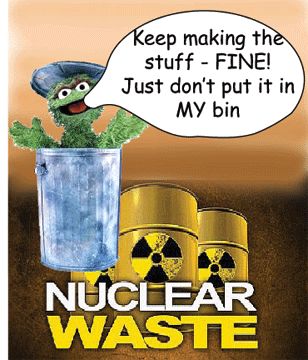
Campaign against nuclear fuel waste storage in South Bruce, Canada
People in communities near the Municipality of South Bruce may receive a leaflet from the group Protect Our Waterways-No Nuclear Waste with information on the proposal to store used nuclear fuel deep underground near Teeswater.
Spokesman Michelle Stein said 50,000 leaflets were sent out this week to let people know some of the group’s concerns about the plan to store Canada’s nuclear waste in a Deep Geologic Repository or DGR.
Stein said the Nuclear Waste Management Organization is assembling land in the municipality of South Bruce to store irradiated nuclear fuel from 4.6 million spent fuel bundles.
“The proposed site includes the Teeswater River flowing through it, and that leads to Lake Huron. And 40 million people get their drinking water from Lake Huron,” she said.
“It’s a decision that is going to affect so many people, and change our community in such a large way, I think each individual deserves to have a vote,” she added.
Stein says 1,600 residents of South Bruce signed a petition opposing the proposed DGR. Stein wants to see a referendum on the issue, as both the Nuclear Waste Management Organization and the municipality have stated that the project needs broad community support to go ahead.
If the proposed nuclear waste dump is approved there will be two loads of spent nuclear fuel travelling by truck every day for forty years from Canada’s nuclear reactors. And if there is a radioactive leak underground it could affect 40 million people in Canada and the US,” said Stein.“People need to know the risks. Nowhere in the world is there an operating DGR for high-level nuclear waste as is being proposed here. Underground storage sites for low-medium level nuclear waste in the US and Germany have leaked radioactive material and required multi-billion-dollar clean-ups”, says Stein. “I encourage everyone who lives in a community near South Bruce to contact their own Mayor and tell them you oppose NWMO’s proposal for a nuclear waste dump.”
POW-NNW believes that the “rolling stewardship” method of managing nuclear waste is better because it maintains it in a monitored and retrievable state at all times, with continual improvements to packaging and environmental protection.
Stein added that ongoing scientific studies examine how spent nuclear fuel can be reused, reduced, and even neutralized. In its initial report to Parliament, the NWMO did not say that on-site storage at the reactor sites was unsafe or not feasible.
Bruce County divided over becoming permanent site to store Canada’s nuclear waste,
 Bruce County divided over becoming permanent site to store Canada’s nuclear waste,
Canada has 57K tonnes of highly radioactive spent nuclear fuel and nowhere to put it, Colin Butler · CBC News · Feb 21 2020, Bruce County calls itself a place “where the smiles are bigger and a little more frequent,” but those smiles belie a deepening divide among neighbours over what to do with Canada’s growing stockpile of nuclear waste.
The town of South Bruce, on the rim of the sparkling waters of Lake Huron, is one of two sites selected by a federal agency tasked with finding permanent locations to store Canada’s nearly three million bundles of highly radioactive spent nuclear fuel.
On Thursday, politicians in Bruce County debated whether their community should be home to a place to put that waste, what’s called a deep geologic repository, or DGR; a multi-billion dollar high tech nuclear waste dump that would see the material stored in perpetuity hundreds of metres below the Earth.
At issue in the debate are the ethics of leaving the burden of some of Canada’s most dangerous nuclear material to future generations, the possible development and devaluation of prime Ontario farmland and concerns over the potential safety of the drinking water for 40 million people in two countries.
‘I am strongly opposed’
On Thursday, that politically-fraught debate took centre stage in Walkerton, Ont. before a packed council chamber where politicians debated whether DGRs were “settled science” in an argument that has already played out at dinner tables, arenas and coffee shops in the area for years, dividing neighbours and leaving communities deeply polarized.
“I am strongly opposed,” said Brockton Mayor Chris Peabody, whose township includes Walkerton, a place that two decades ago grappled with a tainted water crisis where e. coli killed six people and sickened thousands.
“The proposal is to bury the waste under the Teeswater River,” he told council. “I can’t support that. I’ve got several communities down river that get their drinking water from aquifers along that river.”
Peabody said if a deep geologic repository were to be located west of Teeswater, it would potentially devalue prime farmland and the resulting stigma of burying nuclear waste near his community might affect the ability of local farmers to sell their wares.
“It would make it very difficult for them to market their produce and survive,” he said. “I don’t think the scientific consensus supports burying nuclear waste in class one farmland in Southern Ontario.”
Utilizing a deep geologic repository isn’t simply a matter of “burying nuclear waste in class one farmland” as Peabody suggests. The proposed underground project is a highly sophisticated $23 billion nuclear waste disposal site designed to contain and isolate some of the most dangerous materials on Earth for thousands of years.
The sprawling complex of tunnels and chambers would occupy a footprint of about 600 hectares underground, where nuclear waste would be stored at a depth as low as the CN Tower is tall (500 to 600 metres). The idea is the material would be encased in containers below natural bedrock to keep the harmful effects of radiation at bay for millennia.
While proponents of the system claim a DGR is a safe way to store nuclear waste, those opposed argue it has a spotty record at best, pointing out that similar facilities in New Mexico and Germany have leaked – and by that token, opponents say a DGR near Lake Huron would potentially put the drinking water of 40 million people at risk.
It’s not the first time the debate has come to the area. Ontario Power Generation recently abandoned a 15-year campaign for a similar proposed facility to store low to intermediary waste at a site not far from the Bruce Nuclear Generating Station.
The failure to move ahead with the project is part of a larger problem of Canada’s struggle to find a permanent home for its growing stockpile of nuclear waste.
As of 2018, it’s estimated Canada had some 57,000 tonnes of highly radioactive spent nuclear fuel and nowhere to put it.
So far, the federal agency tasked with disposing it, the Nuclear Waste Management Organization, or NWMO, has identified two potential communities with the right geological makeup; Ignace in Ontario’s north and South Bruce, in Ontario’s Great Lakes Basin. ……. https://www.cbc.ca/news/canada/london/canada-nuclear-waste-1.5469727
Donald Trump says US has incredible nuclear weapons; denies leaking classified info
Donald Trump says US has incredible nuclear weapons; denies leaking classified info https://economictimes.indiatimes.com/news/defence/donald-trump-says-us-has-incredible-nuclear-weapons-denies-leaking-classified-info/articleshow/78053124.cmsSynopsis– 11 Sept 20, “Woodward writes that anonymous people later confirmed that the US military had a secret new weapons system, but they would not provide details, and that the people were surprised Trump had disclosed it,” The Washington Post said.
WASHINGTON: President Donald Trump has said the US has some “incredible” nuclear weapon systems that nobody knows about but refuted allegations of leaking classified information about them to a renowned investigative journalist in his upcoming book.
Penned by American journalist Bob Woodward, the book ‘Rage’ to be launched on September 15 has stirred several controversies around Trump’s presidency, weeks before the US election to be held on November 3.
According to the excerpts of the book released by The Washington Post, Trump during an interview with Woodward said, “I have built a nuclear — a weapons system that nobody’s ever had in this country before. We have stuff that you haven’t even seen or heard about. We have stuff that (Russian President Vladimir) Putin and (Chinese President) Xi Jinping have never heard about before. There’s nobody — what we have is incredible.”
“Woodward writes that anonymous people later confirmed that the US military had a secret new weapons system, but they would not provide details, and that the people were surprised Trump had disclosed it,” The Washington Post said.
Speaking to reporters on Thursday, Trump denied having talked about classified information about US nuclear weapons.
“We have great weaponry. No, I’m not talking about classified (information). I’m talking about what we build. We’re building great weaponry,” the president said when asked if he shared classified information about a nuclear weapons system with Woodward.
“What were you talking about when you talked about that?” Trump was asked.
“Our military is stronger now than it’s ever been. We spent USD 2.5 trillion on our military over the last three-and-a-half years. We now have new rockets and missiles. And, frankly, our nuclear — we have to hope to God we never have to use it — but our nuclear now is in the best shape it’s been in decades,” he asserted.
Trump told reporters the US has some nuclear systems that nobody knows about. ..
James Acton, co-director of the Carnegie Endowment for International Peace’s nuclear policy programme, tweeted that Trump might have been mentioning about a 2017 announcement of a plan to reduce the explosive power of some nuclear warheads on submarine-launched missiles.
“The timing was kept secret. My guess is that Trump told Woodward about the first deployment before it was made public. This weapon is usually called the low-yield D5 (because the missile is the Trident D5 sea-launched ballistic missiles). The warhead is the W76-2,” he tweeted on Thursday.
“I don’t believe that the US could build an actually new nuclear weapon in secret. Too much money for classified budgets. Too many people involved for it not to leak,” Acton said in another tweet.
Meanwhile, addressing a public rally in Michigan on Thursday, Trump asserted that he did not leak any information and asserted that he just wanted to inform the people that the US has the greatest weaponry in the world.
“I said, we have systems and missiles and rockets and military – we have systems that you’ve never even seen before. (Chinese) President Xi (Jinping) has nothing like it. Russian President (Vladimir) Putin has nothing like it.
“They (the media) said he may be giving away classified information. These people are sick. Never speak well about our technology…I just want to let people know we have the greatest systems, the greatest equipment and the greatest people anywhere in the world. There is nobody like the US military,” Trump told the crowd.
Donald Trump says US has incredible nuclear weapons; denies leaking classified info https://economictimes.indiatimes.com/news/defence/donald-trump-says-us-has-incredible-nuclear-weapons-denies-leaking-classified-info/articleshow/78053124.cmsSynopsis
“Woodward writes that anonymous people later confirmed that the US military had a secret new weapons system, but they would not provide details, and that the people were surprised Trump had disclosed it,” The Washington Post said.
v
WASHINGTON: President Donald Trump has said the US has some “incredible” nuclear weapon systems that nobody knows about but refuted allegations of leaking classified information about them to a renowned investigative journalist in his upcoming book.
Penned by American journalist Bob Woodward, the book ‘Rage’ to be launched on September 15 has stirred several controversies around Trump’s presidency, weeks before the US election to be held on November 3.
According to the excerpts of the book released by The Washington Post, Trump during an interview with Woodward said, “I have built a nuclear — a weapons system that nobody’s ever had in this country before. We have stuff that you haven’t even seen or heard about. We have stuff that (Russian President Vladimir) Putin and (Chinese President) Xi Jinping have never heard about before. There’s nobody — what we have is incredible.”
“Woodward writes that anonymous people later confirmed that the US military had a secret new weapons system, but they would not provide details, and that the people were surprised Trump had disclosed it,” The Washington Post said.
Speaking to reporters on Thursday, Trump denied having talked about classified information about US nuclear weapons.
“We have great weaponry. No, I’m not talking about classified (information). I’m talking about what we build. We’re building great weaponry,” the president said when asked if he shared classified information about a nuclear weapons system with Woodward.
“What were you talking about when you talked about that?” Trump was asked.
“Our military is stronger now than it’s ever been. We spent USD 2.5 trillion on our military over the last three-and-a-half years. We now have new rockets and missiles. And, frankly, our nuclear — we have to hope to God we never have to use it — but our nuclear now is in the best shape it’s been in decades,” he asserted.
Trump told reporters the US has some nuclear systems that nobody knows about. ..
James Acton, co-director of the Carnegie Endowment for International Peace’s nuclear policy programme, tweeted that Trump might have been mentioning about a 2017 announcement of a plan to reduce the explosive power of some nuclear warheads on submarine-launched missiles.
“The timing was kept secret. My guess is that Trump told Woodward about the first deployment before it was made public. This weapon is usually called the low-yield D5 (because the missile is the Trident D5 sea-launched ballistic missiles). The warhead is the W76-2,” he tweeted on Thursday.
“I don’t believe that the US could build an actually new nuclear weapon in secret. Too much money for classified budgets. Too many people involved for it not to leak,” Acton said in another tweet.
Meanwhile, addressing a public rally in Michigan on Thursday, Trump asserted that he did not leak any information and asserted that he just wanted to inform the people that the US has the greatest weaponry in the world.
“I said, we have systems and missiles and rockets and military – we have systems that you’ve never even seen before. (Chinese) President Xi (Jinping) has nothing like it. Russian President (Vladimir) Putin has nothing like it.
“They (the media) said he may be giving away classified information. These people are sick. Never speak well about our technology…I just want to let people know we have the greatest systems, the greatest equipment and the greatest people anywhere in the world. There is nobody like the US military,” Trump told the crowd.
1 This Month

of the week– Nuclear Reactor Information Task Force

14 May – online event From Bombs to Data Centres: the Face of Nuclear Colonialism
To see nuclear-related stories in greater depth and intensity – go to https://nuclearinformation.wordpress.com
-
Archives
- May 2026 (91)
- April 2026 (356)
- March 2026 (251)
- February 2026 (268)
- January 2026 (308)
- December 2025 (358)
- November 2025 (359)
- October 2025 (376)
- September 2025 (257)
- August 2025 (319)
- July 2025 (230)
- June 2025 (348)
-
Categories
- 1
- 1 NUCLEAR ISSUES
- business and costs
- climate change
- culture and arts
- ENERGY
- environment
- health
- history
- indigenous issues
- Legal
- marketing of nuclear
- media
- opposition to nuclear
- PERSONAL STORIES
- politics
- politics international
- Religion and ethics
- safety
- secrets,lies and civil liberties
- spinbuster
- technology
- Uranium
- wastes
- weapons and war
- Women
- 2 WORLD
- ACTION
- AFRICA
- Atrocities
- AUSTRALIA
- Christina's notes
- Christina's themes
- culture and arts
- Events
- Fuk 2022
- Fuk 2023
- Fukushima 2017
- Fukushima 2018
- fukushima 2019
- Fukushima 2020
- Fukushima 2021
- general
- global warming
- Humour (God we need it)
- Nuclear
- RARE EARTHS
- Reference
- resources – print
- Resources -audiovicual
- Weekly Newsletter
- World
- World Nuclear
- YouTube
-
RSS
Entries RSS
Comments RSS
 nuclear-news