
November 10, 2020, OTTAWA – Following the recent announcement that the federal government will invest $20 million dollars in Ontario-based Terrestrial Energy to develop its Integral Molten Salt Reactor (IMSR), Green Party MPs have written to Natural Resources Minister Seamus O’Regan and Innovation, Science and Industry Minister Navdeep Bains calling on them to reconsider investments in new and unproven nuclear technology.
Obviously Canada must rapidly reduce its greenhouse gas emissions (GHGs) as required by the Intergovernmental Panel on Climate Change (IPCC),” said Green parliamentary leader Elizabeth May (MP, Saanich Gulf-Islands). “However, choosing to invest in non-commercialized, novel and unproven nuclear technology is fiscally irresponsible and doesn’t move us towards sustainability. It takes us down the wrong path. Small nuclear reactors (SMRs) have no place in any plan to mitigate climate change when cleaner and cheaper alternatives exist.”
A recent Canadian study found that energy from SMRs would cost up to 10 times more than renewable energy. Greens are urging the federal government to assess all energy investments on the same set of metrics based on three key questions:
- For every dollar invested, how many tonnes of GHGs are avoided;
- For every dollar invested, how many jobs are created;
- What is the effective timeline from initial funding to achieving results?
“Using these metrics, nuclear will always finish at the bottom of any hierarchy of energy investments,” said Ms. May. “The winners, every time, will be investments in retrofitting buildings for energy efficiency and investments in renewable energy.”
The 2020 World Nuclear Industry Status Report states that the development of nuclear energy is too slow to address the climate crisis. Nuclear power creates fewer jobs than renewable energy, such as solar, wind, district energy, and geothermal.
“What we need is to be honest with ourselves about the realities of nuclear,” said Jenica Atwin, (MP, Fredericton). “This government continues to parrot industry talking points when what our history and experience with nuclear has shown is that it’s not clean, it’s not cheap and we don’t have the time to waste on this dangerous distraction.”
** Letter to Ministers attached rosie.emery@greenparty.ca
|
|
November 12, 2020
Posted by Christina Macpherson |
Canada, politics |
Leave a comment
The Democrats don’t say much about nuclear power, -but the Party seems to be well in favour of it.
During the campaign,The Washington Post questioned Democrat presidential candidates on their views on nuclear power.

At that time 10 Democratic contenders said ”No new plants”
7 said ”Expand nuclear power”
4 said phase nukes out
Harris and Biden were among the 6 who at that time were undecided.
At that time Kamala Harris was no longer running for president. She said “So the biggest issue that I believe we face in terms of nuclear energy is the waste and what are we going to do with that,” Harris said at a CNN climate town hall. “We have to make sure that this is not about the federal government coming in and … making decisions about what each state can do in terms of the nuclear waste issue which is the biggest part of the concern about nuclear energy.” When pressed, Harris did not agree to phasing out nuclear power. ”
Harris and Biden waited to see which way the land lay – (
and also what companies would back their campaign?
November 12, 2020
Posted by Christina Macpherson |
politics, USA |
Leave a comment
|
Nuclear security administrator resigns from post, https://www.reviewjournal.com/news/politics-and-government/nuclear-security-administrator-resigns-from-post-2180746/ By Gary Martin Las Vegas Review-Journal
November 10, 2020 – WASHINGTON — Lisa Gordon-Hagerty, who headed the National Nuclear Security Administration that oversees national security sites in Nevada and New Mexico, has resigned from her position, according to the Department of Energy.
Gordon-Hagerty resigned as administrator on Friday, according to a NNSA statement.
Dr. William Bookless, the NNSA principal deputy administrator, was appointed acting administrator of the semi-autonomous agency that maintains and measures the effectiveness of the nation’s nuclear weapons stockpile.
The NNSA oversees the Nevada National Security Site, located 65 miles north of Las Vegas on 1,370 square miles. The site, which conducts subcritical nuclear weapons testing, employees about 2,400 workers.
Los Alamos National Laboratory also is under the agency.
The resignation of Gordon-Hagerty followed a clash with Energy Secretary Dan Brouillette, who apparently said President Donald Trump has lost confidence in her, according to Bloomberg. The White House declined to comment.
But Rep. Dina Titus, D-Nev., said “the chaos of the Trump administration extends even to the agency responsible for safeguarding our nuclear weapons.”
I will keep a close watch on the activities at NNSA during this transitional period while we eagerly await the inauguration of President-elect (Joe) Biden,” Titus said.
Sen. Catherine Cortez Masto, D-Nev., said she was disappointed to learn of Gordon-Hagerty’s resignation.
“It is imperative that any future Administrator uphold NNSA’s mission to ensure the safety, security, and reliability of our nation’s nuclear stockpile, the continued security and efficiency of the Nevada National Security Site and the agreement the State of Nevada reached with the Department of Energy to begin removing the weapons grade plutonium currently being stored at NNSS next year,” Cortez Masto said.
The termination of Gordon-Hagerty also brought a rebuke of Brouillette from Sen. James Inhofe, R-Okla., who questioned the timing of the move. Inhofe also praised the abilities of Gordon-Hagerty, who was confirmed by the Senate for the position in 2018.
She was the first woman to serve in the position, according to a NNSA news release announcing her resignation.
|
|
November 12, 2020
Posted by Christina Macpherson |
politics, safety, USA, weapons and war |
Leave a comment

NJ Ratepayers Unite to Stop More Nuclear Corporation Bailouts, Energy Monopolies https://www.insidernj.com/press-release/nj-ratepayers-unite-stop-nuclear-corporation-bailouts-energy-monopolies/ November 9, 2020,
Diverse energy users and consumer advocate groups create NJ Ratepayers United
Trenton, N.J. –– As a $300 million annual nuclear subsidy continues to burden New Jersey consumers, a coalition has formed to oppose another proposed major energy policy initiative from PSEG and Exelon that would enable the companies to transform the state’s electricity capacity market and obtain windfall profits.
NJ Ratepayers United (NJRU) is a diverse coalition of New Jersey consumers, business groups, consumer advocates, grassroots organizations and energy providers that have joined forces to stop the proposed Fixed Resource Requirement (FRR). This proposed overhaul would transform how the state procures power, eliminating ratepayer protections and empowering select companies to leverage their market power to further increase electricity costs. Continue reading →
|
|
|
|
|
November 10, 2020
Posted by Christina Macpherson |
business and costs, opposition to nuclear, USA |
Leave a comment
 Iran’s president calls on Biden to return to nuclear deal
November 9, 2020, TEHRAN, Iran (AP) — Iran’s president called on President-elect Joe Biden to “compensate for past mistakes” and return the U.S. to Tehran’s 2015 nuclear deal with world powers, a state-run news agency reported Sunday.
Hassan Rouhani’s comments mark the highest-level response from Iran to Biden and Vice President-elect Kamala Harris clinching the Nov. 3 election.
“Now, an opportunity has come up for the next U.S. administration to compensate for past mistakes and return to the path of complying with international agreements through respect of international norms,” the state-run IRNA news agency quoted him as saying.
Under President Donald Trump, tensions between the U.S. and Iran have escalated, reaching a fever pitch earlier this year. One of Trump’s signature foreign policy moves was unilaterally withdrawing the U.S. from Iran’s nuclear deal in 2018, which had seen Tehran limit its enrichment of uranium in exchange for the lifting of economic sanctions.
The U.S. has since reimposed punishing sanctions on Iran that have crippled its economy, which was further battered by the coronavirus outbreak. In an effort to pressure Europe to find a way around the sanctions, Iran has slowly abandoned the limits of the nuclear deal…….. https://apnews.com/article/joe-biden-donald-trump-iran-foreign-policy-tehran-da8c870cacf6109ae1cad62108535634
November 10, 2020
Posted by Christina Macpherson |
Iran, politics international, USA |
Leave a comment

 China and Russia lead world ranking for supplying new nuclear reactors, Bloomberg, 9 Nov 20, Source: UxC ResearchThe former Cold War frontier of eastern Europe is becoming a battleground in the $500 billion business of building nuclear power plants.
Four months after lifting a prohibition on financing nuclear-energy deals overseas, the U.S. is finding an opening for companies such as General Electric Co., Westinghouse Electric Co. and Bechtel Group Inc.
In the span of a few weeks, the U.S. signed a memorandum with Romania for the financing of a new reactor and other accords with Poland as well as Bulgaria, which plans to revive an older reactor project.
The plan to win business for U.S. companies in this geopolitically key market started under Donald Trump is poised to survive the transition to a new U.S. administration under President-elect Joe Biden. That may nudge eastern European partners to move forward with stalled nuclear projects.
Greater access to financing may be the chief advantage on the American side as it pushes back against Russian and Chinese interests in the region.
“The projects in countries such as Romania, Bulgaria and Poland could be accelerated if the U.S. helps them come up with funding sources at competitive costs and, eventually, without the need for state aid or guarantees,” said Razvan Nicolescu, a Bucharest-based partner at Deloitte specializing in the energy industry.
Eastern European nations, which are dependent on fossil fuels from Russia and their own coal deposits, have even more reasons than others to seek nuclear options. Being subject to stringent European Union emissions standards also creates additional incentives.
The recent change in regulation is allowing the U.S. to compete for a larger share of the market, whose value it estimates at $500 billion-$740 billion over the next 10 years.
Barriers to expansion remain formidable.
Westinghouse, which was one of the leading nuclear industry suppliers in the U.S., went bankrupt in 2017 as it faced billions in potential liabilities related to domestic projects in Georgia and South Carolina. After the South Carolina project was canceled in 2017, the two at Southern Co.’s Plant Vogtle remained the only reactors under construction in the world using Westinghouse’s flagship AP1000 technology, though that is also behind schedule and over budget.
Political rhetoric may prevail over actual investment decisions, said Martin Vladimirov, an analyst at the Sofia-based Center for the Study of Democracy.
“While the U.S. seeks to counter Russian and Chinese economic interference, those projects may not follow the market logic and will need significant state support,” Vladimirov said.
Nuclear Love Affair in Europe’s Poorer East Is Hitting the Rocks
Russia doesn’t see current U.S. nuclear deals in Europe as a threat to its flagship Rosatom Corp. because the U.S. companies don’t have the bandwidth to build new plants now, a government official close to Russia’s nuclear industry said. The U.S. projects in Europe will likely be limited to servicing agreements, the official added, asking for anonymity as they’re not authorized to speak publicly.
State-owned Rosatom itself also played down the risk from increased competition, saying there’s room for many projects in the region.
“We believe that the U.S. nuclear sector has a great potential,” Rosatom said. “The most important thing now for the U.S. vendors is to grow skills by building more in the markets where they have presence and experience.”
Romania’s need to refurbish an existing reactor makes it the most likely candidate to tap U.S. funding or start work with backing from the U.S., Canada and France. There are bigger doubts over the economics and political will behind the nuclear push announced by Poland and Bulgaria.
Some have stuck by Russia as their main technological and financing partner, such as Hungary for its 10 billion-euro ($12 billion) nuclear expansion deal, though GE will get a chance to supply turbines there.
Others have turned away from the long-standing deals with Russia and rebuffed newer attempts by China to step in as financier and supplier.
Funding will be the key determinant whether these projects can get off the ground, according to Bloomberg Intelligence analyst Elchin Mammadov.
“It’s a very risky and expensive venture that is unlikely to be funded by anyone but the state,” Mammadov said.
Even with state backing, most of the projects flagged across eastern Europe may face years of delay and many may be eventually abandoned.
Russia and China have an edge because they offer package deals. The U.S. is “entirely absent” from the global new build reactor market, the U.S. Energy Department said in an April report.
The U.S. has “lost its competitive global position as the world leader in nuclear energy,” the American department concluded.
— With assistance by Will Wade, Zoltan Simon, Maciej Martewicz, Daryna Krasnolutska, Stepan Kravchenko, and Zoe Schneeweiss https://www.bloomberg.com/news/articles/2020-11-09/u-s-goes-nuclear-to-compete-with-russia-china-in-europe-s-east
November 10, 2020
Posted by Christina Macpherson |
marketing, Russia, USA |
Leave a comment
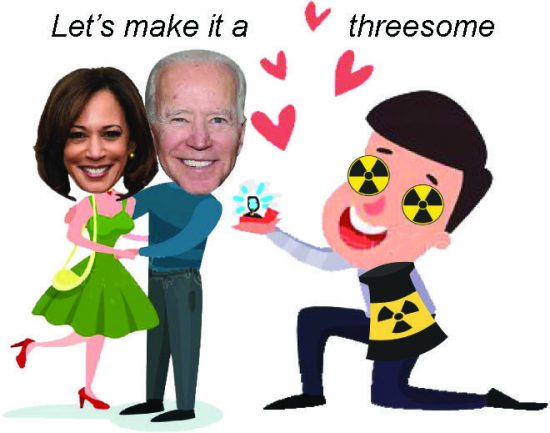
The nuclear lobby is quite happy with the Biden -Harris win. More on this later, as I try to delve deeper into a possibly cosy relationship

Christina Macpherson’s websites & blogs
between Kamala Harris and the global nuclear lobby.
Meanwhile, the Atlantic Council writes confidently of the nuclear industry’s plans for future development under the new American administration.
The Atlantic Council, 8 Nov 20, “…………legislation that encourages the rapid deployment of nuclear energy technology represents an area where Democrats and Republicans can continue to work together—as they have over the last four years …….
legislation that encourages the rapid deployment of nuclear energy technology represents an area where Democrats and Republicans can continue to work together—as they have over the last four years……..
*********
Strong bipartisan congressional support for nuclear reactors—both the existing fleet and also the next generation of advanced reactors.
November 9, 2020
Posted by Christina Macpherson |
politics, USA |
Leave a comment
|
 Biden could take swift action on transgender ban, nuclear weapons, It would take only an executive order to reverse Trump’s 2017 ban on most transgender Americans from joining the military. Politico, By BRYAN BENDER, 11/07/2020 Biden could take swift action on transgender ban, nuclear weapons, It would take only an executive order to reverse Trump’s 2017 ban on most transgender Americans from joining the military. Politico, By BRYAN BENDER, 11/07/2020
President-elect Joe Biden could get some quick wins by using executive orders to roll back several of President Donald Trump’s Pentagon policies.
For example, very little will stand in the way of Biden’s pledge to allow transgender service members to serve openly in the military. It would take only an executive order to reverse Trump’s 2017 ban on most transgender Americans from joining the military.
Nuclear weapons
The Pentagon budget, like other federal spending, will be under new pressure regardless of the outcome of the election, forcing some major acquisition programs to be cut or scaled back. The Biden administration is expected to take an especially close look at one particular set of programs: nuclear weapons.
One program considered especially vulnerable is the Long-Range Standoff Weapon, or LRSO, an air-launched cruise missile slated to be outfitted on the Air Force’s B-2 and future B-21 bombers and under development by Raytheon.
The land-based leg of the nuclear triad, the intercontinental ballistic missiles deployed in underground silos throughout the American West, is also expected to come under new scrutiny.
But a $13 billion contract was awarded by the Air Force on Sept. 8 to Northrop Grumman for the so-called Ground Based Strategic Deterrent and may be difficult for the incoming administration to roll back.
Still, “I know in the Biden administration the necessity for the ICBM force would be a point of debate, as would the LRSO,” said Robert Work, who served as deputy secretary of defense in both the Obama and Trump administrations. “There’ll be debates over whether those are necessary.”
Arms control
Along with changes to the nuclear weapons portfolio will likely be a fresh emphasis on arms control treaties.
The Democratic party platform takes aim at what party leaders consider the Trump administration’s reckless abandonment of several nuclear and other arms treaties with Russia, including the Intermediate-range Nuclear Forces Treaty and the Open Skies Treaty. Trump withdrew from both.
“Its brash nuclear threats, ill-considered withdrawals from critical arms control treaties and nuclear agreements, and reckless embrace of a new arms race have made the United States, and the world, less safe,” the platform states.
Biden may have an early opportunity to go in a different direction.
The New Strategic Arms Reduction Treaty, which limits the number of deployed nuclear weapons on both sides to 1,550, is set to expire Feb. 5, 2021, just a few weeks after inauguration, unless Washington and Moscow agree beforehand to extend it for up to five years.
Trump administration officials have signaled that they are open to an extension if they can get Russian agreement to temporarily freeze all nuclear weapons while negotiating a new pact that covers more classes of atomic arms. But Biden pledged last year to extend it regardless for the full five years permitted, calling New START “an anchor of strategic stability” and “a foundation for new arms control agreements.”
War powers
Biden also pledges to reverse course from the Trump administration when it comes to presidential war powers. That means reengaging with Congress to repeal and rewrite the Authorizations for the Use of Military Force. Congress first adopted that in 2001 to wage the war on terrorism, and then again in 2002 before the U.S.-led in invasion of Iraq.
We will only use force when necessary to protect national security and when the objective is clear and achievable — with the informed consent of the American people, and where warranted, the approval of Congress,” the Democratic Party platform states. “That is why we will work with Congress to repeal decades-old authorizations for the use of military force and replace them with a narrow and specific framework that will ensure we can protect Americans from terrorist threats while ending the forever wars.”
To be sure, it’s something the Obama administration tried but failed to find bipartisan consensus on, on Capitol Hill. https://www.politico.com/news/2020/11/07/joe-biden-policies-defense-433632
|
|
November 9, 2020
Posted by Christina Macpherson |
politics, USA, weapons and war |
Leave a comment
 Joe Biden and Kamala Harris cinch win, Climate Group responds, Mirage News 8 Nov 20, The Climate Group congratulates Joe Biden and Kamala Harris on their historic victory, as announced by the New York Times, Associated Press, and BBC.President-elect Biden’s climate and clean energy plan is the most ambitious we’ve seen from a major US presidential nominee. Under his administration and leadership, we are optimistic about the future of US climate action and the opportunity for renewed global collaboration to address the
  climate crisis.
Amy Davidsen, Executive Director at the Climate Group, said: “Concern for the climate played a major role in the 2020 presidential debates. President-elect Biden’s win shows that Americans expect their president to follow climate science and take the bold and necessary actions to get the US back on track as a leader….. https://www.miragenews.com/joe-biden-and-kamala-harris-cinch-win-climate-group-responds/
November 9, 2020
Posted by Christina Macpherson |
climate change, politics, USA |
Leave a comment

First major modular nuclear project having difficulty retaining backers, The complicated finances of the first major test of small modular nuclear reactors. https://arstechnica.com/science/2020/11/first-major-modular-nuclear-project-having-difficulty-retaining-backers/ JOHN TIMMER – 11/8/2020,
Earlier this year, the US took a major step that could potentially change the economics of nuclear power: it approved a design for a small, modular nuclear reactor from a company called NuScale. These small reactors are intended to overcome the economic problems that have ground the construction of large nuclear plants to a near halt. While each only produces a fraction of the power possible with a large plant, the modular design allows for mass production and a design that requires less external safety support.
But safety approval is just an early step in the process of building a plant. And the leading proposal for the first NuScale plant is running into the same problem as traditional designs: finances.
The proposal, called the Carbon Free Power Project, would be a cluster of a dozen NuScale reactors based at Idaho National Lab but run by Utah Associated Municipal Power Systems, or UAMPS. With all 12 operating, the plant would produce 720MW of power. But UAMPS is selling it as a way to offer the flexibility needed to complement variable renewable power. Typically, a nuclear plant is either producing or not, but the modular design allows the Carbon Free Power Project to shut individual reactors off if demand is low.
But keeping a plant idle means you’re not selling any power from it, making it more difficult to pay off the initial investment made to produce it and adding to the financial risks. Further increasing risk is the fact that this is the first project of its kind—the NuScale website lists it as “
NuScale’s First Plant.” All of this appears to be making things complicated for the Carbon Free Power Project.
According to one report, the US Department of Energy had originally planned to purchase the first reactor for research use, then turn it over to UAMPS. But now, the goal is apparently for the DOE to provide an annual supplement of about $130 million a year for a decade. However, that would be dependent upon annual renewals of the funding by Congress during that decade, which is yet another risk. Separately, to reach a target price for the power that is expected to be competitive with natural gas, the project has been made larger and its completion delayed by three years.
UAMPS runs a number of generating stations (many of them coal-based) that collectively serve needs throughout the US West from Wyoming and New Mexico to California. It distributes the power from these plants to small public utilities that often service a single small city. For the Carbon Free Power Project, UAMPS has been relying on those cities to buy a share of the project in return for a proportional share of the plant’s final generating capacity. With the changes in price and funding, a number of those utilities are dropping out.
There’s still plenty of time for UAMPS to find other participants among other utilities that it counts as customers, given that the plant isn’t expected to come online until 2030. But the financial challenges suggest that small modular nuclear plants may struggle to get off the ground.
That shouldn’t be unexpected, as utilities are notoriously conservative—justifiably so, considering how much their customers rely on electricity. So any new electrical technology is likely to face some struggles as its customers learn to use it effectively and understand how to extract the most value out of it. Typically, the government steps in to provide some support during this awkward phase, as it has done for wind and solar, and plans to do for NuScale.
That said, a decade is a long way out for the completion of the first plant, given the trajectories that wind, solar, and storage prices have taken. Perhaps as critically, most utilities are already done with the learning period needed to use variable renewables effectively, when that period will only start for small modular reactors in 2030. It’s entirely possible that we’ll be ready to move forward with this nuclear technology at roughly the same time we’re becoming confident that we won’t need much of it.
November 9, 2020
Posted by Christina Macpherson |
business and costs, politics, Small Modular Nuclear Reactors, USA |
Leave a comment

Joe Biden, Kamala Harris, and the Democrats have won the American election.
For four years, the world has put up with a lying, narcissistic, sociopath as American President. Trump has done such damage to civil systems of health and environment, to democratic institutions, and to international relations. He has epitomised the bullying style of leadership that has become so popular and so dangerous in this 21st century world.
Jo Biden, in the way that he ran his campaign, and in his winning speech, demonstrates a completely opposite style – one of reasonableness, courtesy, and respect for science and democratic agencies.
A key factor today is the appalling state of coronavirus cases, and coronavirus deaths in the USA. That is a no. 1 challenge to the American administration. Now, they will have a leader who understands the seriousness of the pandemic, and cares.
The Democratic leadership understands the climate crisis, and even if the Senate should be dominated by Republicans, Biden can still rejoin the USA to the Paris Climate Accord. Much action against global heating can be done by executive action, bypassing the Senate,
On the nuclear issue, Biden will almost certainly support international arms control agreements, but not the Treaty on the Prohibition of Nuclear Weapons. Unfortunately, the Democratic Party now, as it did under Obama, still basks in the arms of the ”peaceful”nuclear lobby, and the nuclear weapons making industry.
November 8, 2020
Posted by Christina Macpherson |
Christina's notes, election USA 2020, politics |
2 Comments
 Also this week, the United States exits the Paris climate agreement, NYT, By Henry Fountain and Lisa Friedman, Nov. 4, 2020, The United States presidential race is still up in the air, and the battle for control of the Senate appears far from over. But one thing is clear the day after Election Day 2020: The “green wave” that environmentalists had hoped for failed to materialize.
There were bright spots for the environment. In the Senate, two Democrats, John Hickenlooper in Colorado and Mark Kelly in Arizona, have defeated incumbent Republicans who have received poor marks from environmental and conservation groups for their voting records.
Mr. Kelly was endorsed by Climate Hawks Vote, a progressive group that promotes candidates who promise to take action on climate change. Mr. Hickenlooper was not. While he declared during the campaign that action on climate change was urgently needed, his past ties to the oil and gas industry in Colorado made some groups wary. ……..
Mr. Hickenlooper could turn out to be the greenest of green lawmakers, but if Democrats don’t win control of the Senate it might make little difference. While the House looks certain to remain in Democratic hands, in the Senate the party needs more victories: Two, if Joseph R. Biden Jr. wins the presidency, which would allow Kamala Harris to break tie votes; or three, if President Trump is re-elected. Even two more Democratic victories seemed less likely on Wednesday than they did before the vote count began.
Climate and the environment were front and center in several state and local elections, and the outcomes appear certain in a few of those……… https://www.nytimes.com/2020/11/04/climate/climate-us-election.html
November 7, 2020
Posted by Christina Macpherson |
climate change, election USA 2020 |
Leave a comment
 Kings Bay Plowshares 7 Judge Denies Further Delays, Virtual Sentencing Nov. 12 & 13. Festival of Hope Sunday Nov 8 at 4 pm
Judge Lisa Godbey Wood, presiding over the trial and sentencing of the Kings Bay Plowshares in Brunswick, GA, has denied any further continuances for sentencing as requested by the last four defendants due to COVID-19 restrictions. The remaining KBP7 defendants have been ordered to be sentenced on November 12th and 13th. Despite their desire to be sentenced in person in open court as is their legal right, three of the defendants have reluctantly chosen to do it remotely via video because of the health risks of travel to the court in Georgia for themselves and supporters. Mark Colville has filed a motion to challenge this order.
Although the judge has delayed the sentencing five times because of health and safety concerns, she said that was enough even though the nation is now experiencing record breaking numbers of more than 120,000 daily cases. “With nearly a quarter of a million US COVID deaths, and prison cases exploding again, more court delays are certainly advisable, ” said Veterans For Peace activist and KBP7 supporter Ellen Barfield of Baltimore.
The court plans to convene for sentencing on Thurs. Nov. 12, at 10 am for Carmen Trotta, and 1 pm for Clare Grady and on Friday, Nov. 13, at 10 am for Mark Colville and at 1 pm for Martha Hennessy.
A phone number will be made available early next week by the court to listen to the sentencing of the last four defendants as was done with first three. It will be sent out in a future notice and also be posted on the website.
In a rare opportunity, as a consequence of COVID-19 court and travel restrictions, hundreds of people were able to listen on a conference call line to the October sentencing of Fr. Steve Kelly and Patrick O’Neill who gave their final statements as to why they were compelled to act against the nuclear doomsday machine at the Trident nuclear submarine base at Kings Bay. They also heard the testimony from character witnesses for the defendants attesting to the good things they do in their lives and their devotion to peace. Many of these statements are posted on the website in recent news.
Some of the supporters were moved to tears but also filled with joy by their courage. We invite you to call in to hear the four defendants’ profound and powerful statements and to hear the testimony from their character witnesses.
There will be a virtual
Festival of Hope on
Sunday, Nov. 8 at 4 pm EST for Kings Bay Plowshares members, Mark Colville, Clare Grady, Martha Hennessy, and Carmen Trotta, as they prepare to be sentenced. more
https://kingsbayplowshares7.org/
November 7, 2020
Posted by Christina Macpherson |
Legal, USA |
Leave a comment
 Biden says the US will rejoin the Paris climate agreement in 77 days. Then Australia will really feel the heat, The Conversation Christian Downie, Australian Research Council DECRA Fellow, Australian National University, November 6, 2020 When the US formally left
 the Paris climate agreement, Joe Biden tweeted that “in exactly 77 days, a Biden Administration will rejoin it”.
The US announced its intention to withdraw from the agreement back in 2017. But the agreement’s complex rules meant formal notification could only be sent to the United Nations last year, followed by a 12-month notice period — hence the long wait.
While diplomacy via Twitter looks here to stay, global climate politics is about to be upended — and the impacts will be felt at home in Australia if Biden delivers on his plans.
Biden’s position on climate change
Under a Biden administration, the US will have the most progressive position on climate change in the nation’s history. Biden has already laid out a
US$2 trillion clean energy and infrastructure plan, a commitment to rejoin the Paris agreement and a goal of net-zero emissions by 2050……..
Can he do it under a divided Congress?
While the votes are still being counted — as they should (can any Australian believe we actually need to say this?) — it seems likely the Democrats will control the presidency and the House, but not the Senate.
This means Biden will be able to re-join the Paris agreement, which does not require Senate ratification. But any attempt to legislate a carbon price will be blocked in the Senate, as it was when then-President Barack Obama introduced the Waxman-Markey bill in 2010.
In any case, there’s no reason to think a carbon price is a silver bullet, given the window to act on climate change is closing fast.
What’s needed are ambitious targets and mandates for the power sector, transport sector and manufacturing sector, backed up with billions in government investment.
Fortunately, this is precisely what Biden is promising to do. And he can do it without the Senate by using the executive powers of the US government to implement a raft of new regulatory measures.
Take the transport sector as an example. His plan aims to set “ambitious fuel economy standards” for cars, set a goal that all American-built buses be zero emissions by 2030, and use public money to build half a million electric vehicle charging stations. Most of these actions can be put in place through regulations that don’t require congressional approval.
And with Trump out of the White House, California will be free to achieve its target that all new cars be zero emissions by 2035, which the Trump administration had impeded.
If that sounds far-fetched, given Australia is the only OECD country that still doesn’t have fuel efficiency standards for cars, keep in mind China promised to do the same thing as California last week.
What does this mean for Australia?
For the last four years, the Trump administration has been a boon for successive Australian governments as they have torn up climate policies and failed to implement new ones.
Rather than witnessing our principal ally rebuke us on home soil, as Obama did at the University of Queensland in 2014, Prime Minister Scott Morrison has instead benefited from a cosy relationship with a US president who regularly dismisses decades of climate science, as he does medical science. And people are dying as a result.
For Australia, the ambitious climate policies of a Biden administration means in every international negotiation our diplomats turn up to, climate change will not only be top of the agenda, but we will likely face constant criticism.
Indeed, fireside chats in the White House will come with new expectations that Australia significantly increases its ambitions under the Paris agreement. Committing to a net zero emissions target will be just the first.
The real kicker, however, will be Biden’s trade agenda, which supports carbon tariffs on imports that produce considerable carbon pollution. The US is still Australia’s third-largest trading partner after China and Japan — who, by the way, have just announced net zero emissions targets themselves……
With Biden now in the White House, it’s not just global climate politics that will be turned on its head. Australia’s failure to implement a serious domestic climate and energy policy could have profound costs.
Costs, mind you, that are easily avoidable if Australia acts on climate change, and does so now. https://theconversation.com/biden-says-the-us-will-rejoin-the-paris-climate-agreement-in-77-days-then-australia-will-really-feel-the-heat-149533
November 7, 2020
Posted by Christina Macpherson |
AUSTRALIA, climate change, election USA 2020 |
Leave a comment
Head of nuclear weapons agency unexpectedly resigns, Yahoo News, Aafron Mehta,Deense News•November 7, 2020 WASHINGTON — Lisa Gordon-Hagerty,
the head of the National Nuclear Security Administration, has resigned her position effectively immediately, Defense News has learned.
Gordon-Hagerty, who became the first woman to lead the NNSA in February 2018, sent her letter of resignation to the White House Friday, according to a pair of senior NNSA officials, speaking to Defense News on background.
The NNSA is a semi-autonomous office located within the Department of Energy. While the Defense Department manages the delivery systems of the nuclear force — ships, planes and missiles — NNSA has oversight over the development, maintenance and disposal of nuclear warheads. While the agency falls under the purview of DoE, much of its budget is set by the Nuclear Weapons Council, which is largely controlled by Defense Department officials.
Per the sources, the resignation was driven by almost a year of clashes between Gordon-Hagerty’s office and Secretary of Energy Dan Brouillette. That fight first seeped into public earlier this year, when Brouillette sought to cut NNSA’s budget request. Defense officials, backed by supporters from Congress, went to the White House and forced the issue in NNSA’s favor.
Tensions never truly receded and continued to play out in Congress during the fiscal 2021 budget season. Senate Armed Services Committee chairman Sen. Jim Inhofe, R-Okla., led pro-defense lawmakers in an effort to give the Pentagon more official control over NNSA; House lawmakers created several pieces of legislation that would give the Energy department more control.
The issue seemed to come to a head when the Department of Energy Organization and Management Improvement Act, passed by the House Committee on Energy and Commerce Sept. 9, changed language that made the NNSA a quasi-independent entity, in essence folding the agency more fully under DOE’s control. The move was seen by NNSA officials as an attempt by Brouillette to outright destroy the agency………. https://news.yahoo.com/head-nuclear-weapons-agency-unexpectedly-184158751.html
November 7, 2020
Posted by Christina Macpherson |
safety, USA, weapons and war |
Leave a comment









 nuclear-news