The Shoshone Nation’s battle against nuclear racism and trespassers on indigenous land

|
Trespassers on Native land, Linda Pentz Gunter January 3, 2021 by beyondnuclearinternational “……………When the military industrial complex showed up in Shoshone country to test its atomic bombs, or excavate a mountain for a potential radioactive waste dump, they were there “as trespassers,” says Ian Zabarte, Principle Man of the Western Bands of the Shoshone Nation of Indians, and this year’s winner of Beyond Nuclear’s Dr. Judith H. Johnsrud “Unsung Hero” Award.“The United States gave away Shoshone property before there was the United States here,” Zabarte explained during a recent on-line teach-in about uranium and Indigenous rights. The plunder started with gold. But once the US began working on nuclear weapons, Indigenous lands were mined for uranium. And that, in turn, led to atomic testing, carried out almost entirely on Shoshone land, “the most bombed nation on Earth,” as Zabarte describes it. The US continues to trespass, and trample, on Western Shoshone land, violating the 1863 Treaty of Ruby Valley which only gave certain rights to the United States. As the Las Vegas Sun reported it, “The Shoshone did not cede land claims to the federal government in the treaty. Instead the tribe granted Americans the right to enter its lands for passage and developments like railways and mining. In return, the federal government would compensate the tribe.” As far as the Western Shoshone are concerned, the treaty did not mean decimating and poising the land and its people with atomic bomb tests. It did not mean dumping the country’s high-level radioactive waste there. It did not mean the ability to seize their horses and cattle, which had long roamed freely on the territory to which they and the people belonged — not the other way around. And the treaty most certainly did not give permission to commit acts of genocide. But, as Zabarte said in an earlier article, republished on the Beyond Nuclear International website: “What the Shoshone people experience is a deliberate intent by the US to systematically dismantle the living life-ways of the Shoshone people for the benefit of the US and the profit of the nuclear industry. This meets the minimum threshold of genocide under both the UN Convention and the US enactments of the crime of genocide.” That genocide includes the around 900 atomic tests on Western Shoshone land, conducted largely by the US but also by the United Kingdom, during the Cold War. It includes the decision to site the country’s only high-level radioactive waste deep geological repository on Western Shoshone land at Yucca Mountain, Nevada threatening groundwater and drinking water. (The project was canceled by the Obama administration in 2010, but hovers perpetually in the wings, absent, so far, any alternative site.) And it includes trampling not only on Indigenous rights and traditions but, literally, on some of the most rare and important flora and fauna in the US. “The oldest and most isolated plants and animals are here, in Newe Sogobia, the people’s Mother Earth,” wrote Zabarte in a recent email. “Pando, Quaking Aspen, is the largest and oldest tree up to 80,000 years old and spreads across 25 square miles. Bristol Cone Pine is 6,800 years old. Yutumbe, Creosote is an 11,700 year old clone plant. Thyms Buckwheat is a plant that only exists on 5 acres here, and nowhere else on Mother Earth. There is also the Devils Hole Pupfish, the most isolated fish that changed from salt water to fresh water near Death Valley.” So not “nothing out there” as proponents of the Yucca Mountain radioactive waste dump love to claim. That campaign — to block the Yucca Mountain dump — is one, among many issues of Indigenous justice, on which Zabarte has been campaigning tirelessly for years. That is why Beyond Nuclear selected him for the organization’s 2020 Johnsrud Award, usually given during the Alliance for Nuclear Accountability’s annual DC Days………. we are all involved, one way or the other. “We are all downwinders,” says Zabarte. “The fallout has gone across the United States, across the ocean, around the world. The material from weapons testing is in everything.” Linda Pentz Gunter is the international specialist at Beyond Nuclear and writes for and edits Beyond Nuclear International. — |
|
Never mind health spending: USA aims to be Topp in Space Race

|
U.S. Goes All In On Nuclear Power In Space Race With China. Oil Price.com, By Tsvetana Paraskova – Jan 02, 2021, The United States is doubling down on nuclear power and propulsion systems in the new space race with China. The Trump Administration unveiled in the middle of December a National Strategy for Space Nuclear Power and Propulsion, the so-called Space Policy Directive-6, aiming to develop and use space nuclear power and propulsion (SNPP) systems to achieve scientific, national security, and commercial objectives.In the new space race between Western nations and China, the United States is betting on developing and demonstrating the use of new SNPP capabilities in space.
The strategy on nuclear power and propulsion sets a goal for the U.S. to develop uranium fuel processing capabilities that enable fuel production that is suitable to lunar and planetary surfaces and in-space power, nuclear electric propulsion (NEP), and nuclear thermal propulsion (NTP) applications. Another objective is to “demonstrate a fission power system on the surface of the Moon that is scalable to a power range of 40 kilowatt-electric (kWe) and higher to support a sustained lunar presence and exploration of Mars.” Collaboration with the private sector is also a pillar of the nuclear power and propulsion strategy…….. As part of the U.S. strategy, NASA’s near-term priority will be to mature and demonstrate a fission surface power system on the Moon in the late 2020s, in collaboration with the Department of Energy and industry. Such a system could provide power for sustainable lunar surface operations and test the potential for use on Mars. Earlier in 2020, the Department of Energy said that NASA plans to build a base and a nuclear power plant on the Moon by 2026 and is inviting proposals from companies ready to take on the challenge. The plan will involve the construction of a 10-kW class fission surface power system to be used for demonstrative purposes. The plant is to be manufactured and assembled on Earth and then shipped to the Moon on a launch vehicle. This vehicle will take the plant to Moon orbit, from where a lander will take it to the surface of the satellite. The demonstration will continue for one year, and if successful, it could open the door to other missions on both the Moon and Mars. “Space nuclear power and propulsion is a fundamentally enabling technology for American deep space missions to Mars and beyond. The United States intends to remain the leader among spacefaring Nations, applying nuclear power technology safely, securely, and sustainably in space,” Scott Pace, Deputy Assistant to the President and Executive Secretary of the National Space Council, said in a statement, carried by SpacePolicyOnline.com. The U.S. should continue to enable American entrepreneurs and innovators to further bolster its commercial space industry to continue leading the space race, U.S. Secretary of Commerce Wilbur Ross wrote in an op-ed in December. “Competition is increasing, especially between Western nations and China. Our advantage in this new space race is the U.S. commercial space industry. It is critical that we continue to enable American entrepreneurs and innovators, lest we miss the opportunity and potentially lose the race,” Secretary Ross said. https://oilprice.com/Energy/Energy-General/US-Goes-All-In-On-Nuclear-Power-In-Space-Race-With-China.html |
|
|
Biden Wants US Back in Iran Nuclear Deal (Video)
Biden Wants US Back in Iran Nuclear Deal (Video) https://www.voanews.com/episode/biden-wants-us-back-iran-nuclear-deal-4531861
January 03, 2021, President-elect Joe Biden says he wants the United States to return to the 2015 Iran nuclear deal — if Tehran also resumes compliance. VOA’s Diplomatic Correspondent Cindy Saine reports from Washington that experts say they expect a shift away from the Trump administration’s maximum pressure campaign of crippling economic sanctions on Iran, but a U.S. return to the nuclear deal will not be easy.
Trump’s nuclear construction deal with Poland – strained with Biden victory ?
Poland plays down fears over nuclear power plans despite Biden victory. Rightwing government’s relations with incoming US administration strained after Trump construction deal, Ft.com 3 Jan 2021,
However, Michal Kurtyka, climate minister, played down concern that the change would have a significant impact on Poland’s plans.
USA show of force -flying nuclear bombers over Iran

US flying nuclear bombers over Iran to deter NYE attack, 9 news, By CNN Dec 31, 2020 The US have flown nuclear-capable B-52 bombers to the Middle East in the latest show of force meant to deter Iran, as defense officials remain divided over the risk posed by the regime and the Iraq-based militias it supports.
……… The B-52 flight was the second time this month the Pentagon has sent the nuclear-capable bombers to the region. It follows the Navy’s rare December 21 announcement that it had sent a nuclear-powered submarine through the Persian Gulf, accompanied by guided-missile cruisers. ,,,,,,,https://www.9news.com.au/world/donald-trump-us-flying-nuclear-bombers-over-iran-to-deter-nye-attack/f02018ea-2b8f-4d07-9941-e1df3a0a0f4c
Joe Biden must end the cover-up of, and the huge money to, Israel’s nuclear weapons
|
Joe Biden should end the US pretence over Israel’s ‘secret’ nuclear weapons, Guardian, Desmond Tutu, 1 Jan 2021

The cover-up has to stop – and with it, the huge sums in aid for a country with oppressive policies towards Palestinians Desmond Tutu is a Nobel peace laureate and a former archbishop of Cape Town Every recent US administration has performed a perverse ritual as it has come into office. All have agreed to undermine US law by signing secret letters stipulating they will not acknowledge something everyone knows: that Israel has a nuclear weapons arsenal. Part of the reason for this is to stop people focusing on Israel’s capacity to turn dozens of cities to dust. This failure to face up to the threat posed by Israel’s horrific arsenal gives its prime minister, Benjamin Netanyahu, a sense of power and impunity, allowing Israel to dictate terms to others. But one other effect of the US administration’s ostrich approach is that it avoids invoking the US’s own laws, which call for an end to taxpayer largesse for nuclear weapons proliferators. Israel in fact is a multiple nuclear weapons proliferator. There is overwhelming evidence that it offered to sell the apartheid regime in South Africa nuclear weapons in the 1970s and even conducted a joint nuclear test. The US government tried to cover up these facts. Additionally, it has never signed the nuclear non-proliferation treaty. Yet the US and Israeli governments pushed for the invasion of Iraq based on lies about coming mushroom clouds. As Israeli nuclear whistleblower Mordechai Vanunu said: the nuclear weapons were not in Iraq – they are in Israel. Amendments by former Senators Stuart Symington and John Glenn to the Foreign Assistance Act ban US economic and military assistance to nuclear proliferators and countries that acquire nuclear weapons. While president, Jimmy Carter invoked such provisions against India and Pakistan. But no president has done so with regard to Israel. Quite the contrary. There has been an oral agreement since President Richard Nixon to accept Israel’s “nuclear ambiguity” – effectively to allow Israel the power that comes with nuclear weapons without the responsibility. And since President Bill Clinton, according to the New Yorker magazine, there have been these secret letters……… This farce should end. The US government should uphold its laws and cut off funding to Israel because of its acquisition and proliferation of nuclear weapons. The incoming Biden administration should forthrightly acknowledge Israel as a leading state sponsor of nuclear proliferation in the Middle East and properly implement US law. Other governments – in particular South Africa’s – should insist on the rule of law and for meaningful disarmament, and immediately urge the US government in the strongest possible terms to act……… https://www.theguardian.com/commentisfree/2020/dec/31/joe-biden-us-pretence-israel-nuclear-weapons |
|
This is the sort of letter that citizens need to be writing – in support of the nuclear weapons ban
 Sudbury letter: Council should support banning of nuclear weapons, https://www.thesudburystar.com/opinion/letters/sudbury-letter-council-should-support-banning-of-nuclear-weaponsAuthor of the article:
The United Nations has passed the Treaty on the Prohibition of Nuclear Weapons and it will become international law on Jan. 22, 2021. Some 86 countries have signed this agreement. Unfortunately, Canada is not one of them.
As it is cities that will be targeted by nuclear weapons, Sudbury, a producer of nickel, would likely be a target. The International Campaign Against Nuclear Weapons (ICANw) is asking cities to support the Treaty on the Prohibition of Nuclear Weapons by passing the following motion (many Canadian cities have already passed this motion including Toronto, Halifax, Vancouver and Victoria):
“Our city of Sudbury, Ont., is deeply concerned about the grave threat that nuclear weapons pose to communities throughout the world. We firmly believe that our residents have a right to live in a world free from this threat. Any use of nuclear weapons, whether deliberate or accidental, would have catastrophic, far-reaching and long-lasting consequences for people and the environment. Therefore, we support the Treaty on the Prohibition of Nuclear Weapons and call on our governments to sign and ratify it.”
The world has about 14,000 nuclear weapons with about 1,500 on hair-trigger alert. The firing of these weapons could happen by accident, miscalculation, terrorism or an unstable government. The catastrophe would be immediate.
I would urge Sudbury city council to pass the motion and support the United Nations Treaty on the Prohibition of Nuclear Weapons.
Richard Denton
Sudbury
How the USA and Soviet Union planned to use nuclear radiation as a weapon.
 This was initially seen as a great idea – you could kill all the people while leaving the omfrastructure intact for your own use.
For decades, the thought of radiological weapons has conjured terrifying images of cities covered in “death dust.” Classified as a weapon of mass destruction — alongside chemical, biological, and nuclear weapons — it has remained a point of mystery as to why these devastatingly indiscriminate weapons were not pursued in earnest by more state and non-state actors alike.
What did early radiological weapons (RW) programs look like? How and why did they arise, and what accounts for their ultimate demise? Aside from a handful of known cases, why have RW programs not proliferated with the same alacrity as other weapons programs?
Thanks to the rigorous and rich historical work of Samuel Meyer, Sarah Bidgood, and William Potter of the Middlebury Institute of International Studies at Monterey, we now have more answers. Focusing on the United States and Soviet Union in the 1940s and 1950s, the authors, in a recent study published in the journal International Security, trace the unique origins of these RW programs, as well as explain why they were subsequently abandoned. Their study, “Death Dust: The Little-Known Story of U.S. and Soviet Pursuit of Radiological Weapons,” reveals a fascinating web of causes, including organizational and bureaucratic politics, international competition, economic and technological constraints, and even the powerful initiatives of well-placed individuals.
While the authors’ work examines the past, it speaks directly to the present and future trajectory of RW programs. If you are interested in military innovation, the history of weapons of mass destruction, the sociology of technology, and science fiction (yes, science fiction!), the exchange featured below is for you.
Samuel Meyer, Sarah Bidgood, and William C. Potter: We define a radiological weapon as one intended to disperse radioactive material in the absence of a nuclear detonation. ……..
……….. May 1941 — the first reference to RW appeared in a U.S. government document: the Report of the Uranium Committee. The report identified three possible military aspects of atomic fission, the first of which was “production of violently radioactive materials … carried by airplanes to be scattered as bombs over enemy territory.” (The other two possible applications noted in the report were “a power source on submarines and other ships” and “violently explosive bombs.”) ………
Technological advances were among the major drivers of RW programs in both the U.S. and the Soviet Union, and RW were initially pursued in tandem with nuclear weapons and chemical weapons (CW) programs. The anticipated promise of RW as a weapons innovation, however, never materialized in either country due to a combination of factors, including technical difficulties in the production and maintenance of the weapons, diminution in the perceived military utility of RW relative to both CW and nuclear weapons, and low threat perceptions about adversary RW capabilities. ……..
the parallelism in many respects between the rise and demise of the U.S. and Soviet RW programs; and (5) the serious but ultimately unsuccessful effort by the United States and the Soviet Union to secure a draft convention at the Conference on Disarmament prohibiting radiological weapons.
MK: Are radiological weapons a thing of the past or do they remain an attractive option for some countries and non-state actors today?
The authors: We are encouraged that no country has either used RW in war or has incorporated them into a national military arsenal. We are concerned, however, that the Russian Federation, despite its own unsuccessful history with RW, has shown renewed interest in advanced nuclear weapons that seek to maximize radioactive contamination. We also worry that some countries may conclude that RW serve their perceived national interests, especially in the absence of international legal restraints. It therefore is important, we believe, to revive U.S.-Russian cooperation to ban radiological weapons and strengthen the norm against their use.
Morgan L. Kaplan is the Executive Editor of International Security and Series Editor of the Belfer Center Studies in International Security book series at the Belfer Center for Science and International Affairs at the Harvard Kennedy School. https://thereader.mitpress.mit.edu/death-dust-the-little-known-story-of-radiological-weapons/
Non violent anti-nuclear action – the Clamshell Alliance model for success
Know Your Nonviolent History: In 1976 Clamshell Alliance Launches Mass Demonstrations https://www.riverasun.com/know-your-nonviolent-history-in-1976-clamshell-alliance-launches-mass-demonstrations/August 18, 2016, by Rivera Sun On August 1st, 1976, the first nonviolent mass demonstration of the Clamshell Alliance took place at the proposed site of the Seabrook Nuclear Energy Facility in New Hampshire. The Clamshell Alliance was a group of anti-nuclear activists who worked to stop nuclear power plant construction at a time when President Nixon’s “Project Independence” had proposed the construction of over 1,000 nuclear power plants throughout the nation. Although the Clamshell Alliance was only partially successful in halting the Seabrook facility, their mass mobilizations deterred the plans for other plants and changed the landscape of nuclear energy forever. If not for the Clamshell Alliance, it is possible that we would be living in the nuclear nightmare of President Nixon’s vision of a thousand plants by the year 2000.
|
The Clamshell Alliance used a model of affinity groups of 6-20 people, and a spokes council system that functioned on consensus decision-making by all members. In July 1976, the Clamshell Alliance adopted a Declaration of Nuclear Resistance and by August 1st had mobilized their first protest of 200-600 people. Later in August, a second protest and civil disobedience action occupied the Seabrook construction site for 75 minutes, singing songs and planting trees. Nearly all of the 200 participants were arrested. In April of 1977, the Clamshell Alliance mobilized 2,000 people for a demonstration. 1,400 participants were arrested, most refusing to post bail. They were held in jails and National Guard armories for up to two weeks. The activists used this time for training and networking, and subsequently, the detention of the activists was seen as a blunder on the part of Governor Meldrim Thomson. In 1978, the Clamshell Alliance successfully organized another series of mass demonstrations and arrests. From June 23-26th, the alliance accepted an agreement to legally protest on the site for three days. Some sources claim this protest was one of the largest on-site protests in the history of the anti-nuclear movement, citing over 20,000 participants and very few arrests. On March 29th, 1979, the meltdown of the Three Mile Island reactor in Harrisburg, Pennsylvania, propelled the dangers of nuclear power to the forefront of national concern. In collaboration with other groups, a huge anti-nuclear energy rally was organized in Washington, D.C. on May 6, 1979. Between 50,000 and 120,000 people gathered to protest nuclear power and demand safe alternatives. These demonstrations played a major role in slowing and stopping the rush toward nuclear energy. Although Unit 1 of Seabrook Power Plant went online in 1990, Unit 2 was cancelled altogether. The project cost seven times the original billion-dollar estimate and was completed 14 years later than anticipated. In that time, hundreds of other proposals were dropped, due to the high social and fiscal costs encountered by the Seabrook Power Plant. For decades after the inception of the Clamshell Alliance and other similar groups, no new nuclear power facilities were proposed or constructed. The Clamshell Alliance left a lasting legacy in its organizing structure, movement practices, consensus model, and strategies for change. These are all tools and resources that can be used by current movements for change. This article is from Rivera Sun’s book of nonviolent histories that have made our world. Click here for more information. |
|
Small modular reactor plan – a dangerous distraction from climate change action
 Feds’ Small Modular Reactor Action Plan is a dangerous distraction from climate change mitigation, Corporate Knights BY RICK CHEESEMAN, December 29, 2020
Canada can be a world leader in this promising, innovative, zero-emissions energy technology, and this is our plan to position ourselves in an emerging global market,” Natural Resources Minister Seamus O’Regan said in a statement.
The governments of New Brunswick, Ontario, Saskatchewan and Alberta, together with the federal government, advocate that small modular reactors (SMRs) are essential if Canada is to achieve a net-zero economy by 2050. According to the feds’ 2018 Call to Action report on the mini nuclear reactors, “SMRs are a reliable, clean, non-emitting source of energy, with costs that are predictable and competitive with other alternatives.”
The first problem with these claims is that SMRs don’t yet exist and aren’t expected to exist for a decade, making these claims dubious. It’s not the only questionable claim made by proponents.
Are SMRs a clean, zero-emission source of power?
Nuclear reactors emit much lower concentrations of carbon than fossil fuels, so one could claim they are zero-emission. But they have their own, uniquely harmful, emissions. From thousands of tonnes of spent fuel to hundreds of thousands of tonnes of mine tailings, nuclear power leaves a radioactive trail that is an immediate threat to waterways and water tables and is lethal for hundreds of thousands of years. SMRs will only add to that.
In 2010, Ad Standards Canada ruled that an ad claiming CANDU reactors were emission-free was “inaccurate and unsupported.” The Power Workers’ Union was expected to remove all ads containing the “emission-free” statement and to qualify any future claims. ……
After 70 years, the nuclear industry still hasn’t found a way to keep habitable environments safe from spent fuel for anything close to the time frames required for it to be harmless. There have been many plans in the past and there are current plans but all have one thing in common: they are unfit for purpose.
Some SMR technologies promise to use CANDU spent fuel in the SMR, claiming this will reduce both the radioactivity and quantity of the spent fuel. This claim is theoretical, based on proprietary data, and a report published by the Bulletin of the Atomic Scientists said doing so would be “playing with fire,” noting that the process, called pyroprocessing, will exacerbate the spent fuel storage and disposal challenges, not mitigate them.
Will SMRs be safe?
A range of power-generation and storage technologies that are clean, emissions-free, safe and low cost, is imminent. Within 10 years, these technologies will be widespread, fully incorporated into all levels of society, and deployed to all regions – all before the first SMR comes online. In all likelihood, by the time an SMR comes to market, there will be a more economical and environmentally responsible alternative in place.
While the rhetoric is persuasive, the case for SMRs doesn’t stand up to objective scrutiny. Allocating climate-change funds to them is a travesty.
Extending the operating licences on nuclear reactors to 60, 80, 100 years – a recipe for disaster
 Inviting Nuclear Disaster Counterpunch BY KARL GROSSMAN 30n Dec 20, Nuclear power plants when they began being constructed were not seen as running for more than 40 years because of radioactivity embrittling metal parts and otherwise causing safety problems. But in recent decades, the U.S. Nuclear Regulatory Commission has extended the operating licenses of nuclear power plants from 40 years to 60 years and then 80 years, and is now considering 100 years.
“It is crazy,” declares Robert Alvarez, a former senior policy advisor at the U.S. Department of Energy and a U.S. Senate senior investigator and now senior scholar at the Institute for Policy Studies and is an author of the book Killing Our Own: The Disaster of America’s Experience with Atomic Radiation.
No reactor in history has lasted that long,” commented Alvarez. The oldest nuclear power plant in the U.S. was Oyster Creek, five miles south of Toms River, New Jersey, which opened in 1969 and was shut down 49 years later in 2018.
The move is “an act of desperation in response to the collapse of the nuclear program in this country and the rest of the world,” he declares.
The nuclear industry and nuclear power advocates in government are “desperately trying to hold on,” says Alvarez. With hardly any new nuclear power plants being constructed in the U.S. and the total number down to 94, they seek to have the operating licenses of existing nuclear power plants extended, he says, to keep the nuclear industry alive.
It’s a sign of “the end of the messy romance with nuclear power.”
The NRC will be holding a webinar on January 21 to consider the extending of nuclear plant operating licenses to 100 years. As its announcement is headed: “PUBLIC MEETING ON DEVELOPMENT OF GUIDANCE DOCUMENTS TO SUPPORT LICENSE RENEWAL FOR 100 YEARS OF PLANT OPERATION.”
Nuclear power plant construction has been in a deep depression for some time. Vogtle Units 3 and 4 in Georgia are “the first new nuclear units built in the United States in the last three decades,” notes on its website Georgia Power, one of the companies involved in that project. The cost projection in 2008 to build the two nuclear plants was $14.3 billion. “Now, updated estimates put the total project cost at roughly $28 billion,” states Taxpayers for Common Sense, and construction is more than five years behind schedule.
It’s not just the gargantuan price of nuclear power, and the preferability economically today of green, renewable energy led by solar and wind. Nuclear plant construction in the U.S. and much of the world has been in the doldrums because of the Three Mile Island, Chernobyl and Fukushima nuclear power plant catastrophes. People not only don’t want to waste their money–they don’t want to lose their lives to nuclear power.
“There is no empirical evidence” to support the notion that nuclear plants can have a century-long life span, says Alvarez. There “is no penciling away the problems of age” of nuclear power plants which operate under high-pressure, high-heat conditions and are subject to radiation fatigue. “The reality of wear-and-tear can’t be wished away.”
“Who would want to ride in a 100 year-old car?” he asks.
Paul Gunter, director of the Reactor Oversight Project of the organization Beyond Nuclear, says: “The new construction of nuclear power plants is proving to be more expensive and more dubious than ever before. So, the nuclear industry and the NRC are in the process of developing a plan to get these existing aging and inherently dangerous machines to run for 100 years.”
“This raises all kinds of problems that have never been addressed,” says Gunter.
And the NRC and the U.S. Department of Energy don’t want to address them…………….
an AP review of historical records, along with an interview of an engineer who helped develop nuclear power, shows that … Reactors were made to last only 40 years. Period.”
Further, the piece—”Aging Nukes: NRC and industry rewrite nuke history”—said “the AP found that the relicensing process often lacks fully independent safety reviews. Records show that paperwork of the U.S. Nuclear Regulatory Commission sometimes matches word-for-word the language used in a plant operator’s application.”
Getting operating license extensions “is a lucrative deal for operators,” said AP.
Priscilla Star, director of the Coalition Against Nukes, said of extending the operating licenses of nuclear power plants to 100 years: “There is no sane argument to perpetuate the lifespan of our already decrepit nuclear reactors other than the NRC seeking to perpetuate the endless profits to its licensees.”
“All kinds of technical foul-ups occur in the daily operations of a nuclear power plant,” she continued. ‘It’s a crapshoot running any of them safely on any given day because human error plays such a big part of operational safety. More frequent cyber hacking will also put hs at greater risk if this form of energy production is not abolished in favor of renewables. It’s time for a presidential administration to curb the noblesse oblige appetite of the NRC and once and for all consider it unsafe and unsound as a regulatory agency putting profit before public safety.”
What the NRC has also done extending nuclear power plant licenses to 60 and then 80 years is to allow the plants to be “uprated” to generate more electricity—to run hotter and harder increasing the chance of accidents. It is asking for nuclear disaster. ……..https://www.counterpunch.org/2020/12/30/inviting-nuclear-disaster/?fbclid=IwAR1YQ614qqcsQZ3mwVCo9UV2JlqCfVBgmS358L7DCCwcShjKDJFtzH-nZ0k
USA is not facing up to the climate threats to its nuclear wastes
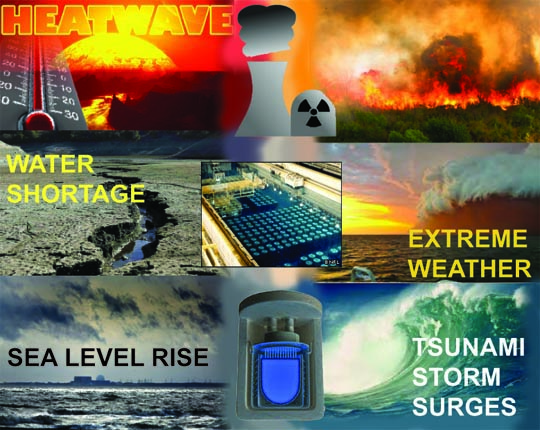 US is Ill-Prepared to Safely Manage its Nuclear Waste from Climate Threats. More than 150 sites across the country have to be managed for radioactive waste for centuries or millennia. But there’s no plan in place for how this will be done, says GAO report. Earth Island Journal , CHARLES PEKOW, December 29, 2020 The Cold War never erupted into the nuclear nightmare that the world feared for decades. But the legacy of the never-used nuclear weapons remains a ticking time bomb that could endanger countless people and lead to environmental catastrophe any time.
The GAO report, “Environmental Liabilities: DoE Needs to Better Plan for Post-Cleanup Challenges Facing Sites” (pdf), issued earlier this year, found, among other things, that the DoE doesn’t have a plan for how to address challenges at some sites that may require new cleanup work that is not in the scope of LM’s expertise.
some of these sites have already been creating serious problems.
Among the many other problem sites, the Legacy Management office is struggling to figure out what to do with contaminated groundwater at the Shiprock nuclear waste dump on the Navajo Nation Indian Reservation in northwest New Mexico. Contaminated water, the legacy of uranium mining for nuclear power plants and weapons, is being pumped to an evaporation pond there.
nuclear watchdog groups aren’t satisfied with the slow progress on this front. The nation needs “a reverse Manhattan project,” to figure out how to safely diffuse the radioactive waste, says Schaeffer of the Alliance for Nuclear Accountability. https://www.earthisland.org/journal/index.php/articles/entry/us-is-ill-prepared-to-safely-manage-its-nuclear-waste-from-climate-threats
Doubtful that aging Los Alamos National Laboratory could safely produce plutonium triggers, no matter how much funding it gets
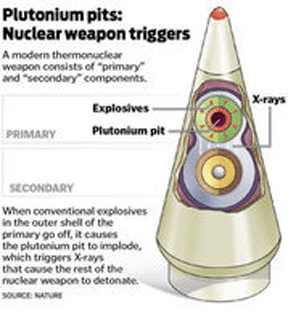 Los Alamos National Laboratory may get boost in nuclear funding, Santa Fe New Mexico By Scott Wyland swyland@sfnewmexican.com– 30 Dec 20, Los Alamos National Laboratory may get boost in nuclear funding, Santa Fe New Mexico By Scott Wyland swyland@sfnewmexican.com– 30 Dec 20, Los Alamos National Laboratory will get a hefty funding boost — including for its work on plutonium pit production — in the military spending bill held up by a presidential veto. Many predict the veto will be overridden, and if it is, the lab’s budget will increase to $3.3 billion from the $2.3 billion allocated last year. The bill puts $837 million into the lab’s plutonium operations, more than double the previous year’s $308 million, as Los Alamos pursues production of 30 nuclear bomb cores by 2026 — a goal critics have questioned. Plans call for the Savannah River Site in South Carolina to make an additional 50 plutonium pits by 2030, so the two facilities will produce a combined 80 pits per year as stated in the 2018 Nuclear Posture Review……..
Watchdog groups call the Trump administration’s more aggressive push to bolster the nuclear stockpile hawkish and unsustainable, and expressed uncertainty about how much the incoming Biden administration might pull back. …… Tom Clements, executive director of SRS Watch, another watchdog group, said the 2021 budget will have to be carried out, and it will take time for President-elect Joe Biden’s administration to draft a new nuclear posture review. But Biden is likely to examine the nuclear modernization program in the coming months, including whether it’s feasible to convert Savannah River’s unfinished mixed-oxide fuel plant into a pit factory, Clements said. “There are growing signs that the SRS pit plant is gonna get a thorough review by the new administration,” Clements said……… Mello said he remains doubtful the aging plutonium facility that never produced more than a dozen pits in a year can be upgraded to crank out 30-plus pits yearly, no matter how much money is spent. “There’s a question of whether Los Alamos will ever be able to do so safely,” Mello said. https://www.santafenewmexican.com/news/local_news/los-alamos-national-laboratory-may-get-boost-in-nuclear-funding/article_cd55c8a6-49f5-11eb-8718-2333908445b5.html |
|
Hanford’s dangerous collection of nuclear waste sites, including 177 underground leaky tanks
Washington’s new nuclear waste lead takes on Hanford’s aging tanks, OPB, By Anna King (Northwest News Network), Dec. 30, 2020.
David Bowen is charged with holding the U.S. Department of Energy accountable for its cleanup of a site that once produced plutonium for nuclear weapons.
At the Hanford site in southeastern Washington, along the Columbia River, millions of gallons of radioactive sludge are cradled in aging underground tanks.
Nearly 2,000 capsules filled with cesium and strontium rest unquietly in an old, glowing-blue pool of water. Two reactors along the Columbia still need to be sealed up and cocooned.
And those are just some of the bigger waste sites out of hundreds at the 580-square-mile cleanup site.
177 underground tanks filled with radioactive waste It’s a lot to ponder and a steep learning curve for freshly hired David Bowen. …..He started his new job Dec. 16 as the Nuclear Waste Program lead for Washington’s Department of Ecology in Richland.
he’ll hold the U.S. Department of Energy accountable for its cleanup at the site using the Tri-Party Agreement. That’s a 1989 document struck between Ecology, the federal Department of Energy and the U.S. Environmental Protection Agency.
Hanford houses leftovers from World War II and the Cold War, when it was the nation’s factory for plutonium. Trenches, pits and buildings are all contaminated with loads of chemicals and radioactive waste generated at breakneck speed.
The stickiest problem: 177 tanks — some of them leakers — filled with radioactive waste.
“Some of [the underground tanks] are 50-plus years old,” Bowen said. “And they weren’t designed to last this long. There are still fluids in them, millions of gallons, in sludge, et cetera. So, there’s the opportunity for that to escape and get into the Columbia River — or the groundwater is high.”
A massive waste treatment plant is being built in the desert at Hanford to treat that tank waste. But the cleanup timeline has been pushed back several times since the 1980s. It could be pushed back more because of the pandemic.
……. Aging infrastructure, aging expertsHanford is much like a complex small city: thousands of commuting workers, miles of highways and intertwining roads.
Then there are all the stakeholders: multiple tribes, Seattle-based Hanford watchdog groups, salmon and Columbia River advocates and multiple government agencies. Losing Hanford experts to retirement or attrition to other agencies is a big problem — and a growing one. Some key Ecology experts have recently been lured away to federal posts or to work as Hanford contractors. And many have already retired. Bowen said he’s well aware he needs to work fast……… https://www.opb.org/article/2020/12/29/washington-nuclear-waste-program-manager-hanford/
Avril Haines is unfit for Director of National Intelligence, with her history of coverup of tortures.
|
The Trouble With Avril Haines for Intelligence, December 29, 2020 Biden’s nominee is a drone assassin who played a key role in covering up the U.S. torture program, Consortium News, By Medea Benjamin and Marcy Winograd
World BEYOND War Even before President-Elect Joe Biden sets foot in the White House, the Senate Intelligence Committee may start hearings on his nomination of Avril Haines as director of national Intelligence. President Barack Obama’s top lawyer on the National Security Council from 2010 to 2013 followed by CIA deputy director from 2013 to 2015, Haines is the proverbial wolf in sheep’s clothing. She is the affable assassin who, according to Newsweek, would be summoned in the middle of the night to decide if a citizen of any country, including our own, should be incinerated in a U.S. drone strike in a distant land in the greater Middle East. Haines also played a key role in covering up the U.S. torture program, known euphemistically as “enhanced interrogation techniques,” which included repeated water boarding, sexual humiliation, sleep deprivation, dousing naked prisoners with ice cold water and rectal rehydration. For these reasons, among others, the activist groups CODEPINK, Progressive Democrats of America, World Beyond War and Roots Action have launched a campaign calling on the Senate to reject her confirmation. These same groups ran successful campaigns to dissuade Biden from choosing two other warmongering candidates for critical foreign policy positions: China-hawk Michele Flournoy for secretary of defense and torture apologist Mike Morell for CIA director. By hosting calling parties to senators, launching petitions and publishing open letters from DNC delegates, feminists—including Alice Walker, Jane Fonda and Gloria Steinem—and Guantanamo torture survivors, activists helped derail candidates who were once considered shoo-ins for Biden’s cabinet. Now activists are challenging Avril Haines. In 2015, when Haines was CIA deputy director, CIA agents illegally hacked the computers of the Senate Intelligence Committee to thwart the committee’s investigation into the spy agency’s detention and interrogation program. Haines overruled the CIA’s own inspector general in failing to discipline the CIA agents who violated the U.S. Constitution’s separation of powers. According to former CIA whistleblower John Kiriakou, she not only shielded the hackers from accountability but even awarded them the Career Intelligence Medal. Redacting Role And there’s more. When the exhaustive 6,000-page Senate Intelligence Committee report on torture was finally complete, after five years of investigation and research, Haines took charge of redacting it to deny the public’s right to know its full details, reducing the document to a 500-page, black-ink-smeared summary. This censorship went beyond merely “protecting sources and methods.” It avoided CIA embarrassment, while ensuring her own career advancement. Moreover, Haines supported torture apologist Gina Haspel as Trump’s CIA director. Haspel ran a secret black site prison in Thailand where torture was regularly inflicted. Haspel also drafted the memo ordering the destruction of almost 100 videotapes documenting CIA torture. As David Segal of Demand Progress told CNN, “Haines has an unfortunate record of repeatedly covering up for torture and torturers. Her push for maximalist redactions of the torture report, her refusal to discipline the CIA personnel who hacked the Senate and her vociferous support for Gina Haspel — which was even touted by the Trump White House as Democrats stood in nearly unanimous opposition to the then-nominee to lead the CIA — should be interrogated during the confirmation process.” This sentiment was echoed by Mark Udall, a Democratic senator on the intelligence committee when it finished the torture report…………….. Empty Words on Paper Haines’s policy guidance also states that the U.S. would respect other states’ sovereignty, only undertaking lethal action when other governments “cannot or will not” address a threat to the U.S. This, too, became simply empty words on paper. The U.S. barely even consulted with the governments in whose territory it was dropping bombs and, in the case of Pakistan, openly defied the government. In December 2013, the National Assembly of Pakistan unanimously approved a resolution against U.S. drone strikes in Pakistan, calling them a violation of “the charter of the United Nations, international laws and humanitarian norms” and Pakistan’s former Prime Minister Nawaz Sharif stated: “The use of drones is not only a continual violation of our territorial integrity but also detrimental to our resolve and efforts at eliminating terrorism from our country.” But the U.S. ignored the pleas of Pakistan’s elected government……………. There are many other reasons to reject Haines. She advocates intensifying crippling economic sanctions on North Korea that undermine a negotiated peace, and “regime change”—hypothetically engineered by a U.S. ally — that could leave a collapsed North Korea vulnerable to terrorist theft of its nuclear material; she was a consultant at WestExec Advisors, a firm that exploits insider government connections to help companies secure plum Pentagon contracts; and she was a consultant with Palantir, a data-mining company that facilitated Trump’s mass deportations of immigrants. But Haines’ record on torture and drones, alone, should be enough for senators to reject her nomination. The unassuming spy — who got her start at the White House as a legal adviser in the Bush State Department in 2003, the year the U.S. invaded Iraq—might look and sound more like your favorite college professor than someone who enabled murder by remote control or wielded a thick black pen to cover up CIA torture, but a clear examination of her past should convince the Senate that Haines is unfit for high office in an administration that promises to restore transparency, integrity, and respect for international law……… https://consortiumnews.com/2020/12/29/the-trouble-with-avril-haines-for-intelligence/ |
|
-
Archives
- May 2026 (72)
- April 2026 (356)
- March 2026 (251)
- February 2026 (268)
- January 2026 (308)
- December 2025 (358)
- November 2025 (359)
- October 2025 (376)
- September 2025 (257)
- August 2025 (319)
- July 2025 (230)
- June 2025 (348)
-
Categories
- 1
- 1 NUCLEAR ISSUES
- business and costs
- climate change
- culture and arts
- ENERGY
- environment
- health
- history
- indigenous issues
- Legal
- marketing of nuclear
- media
- opposition to nuclear
- PERSONAL STORIES
- politics
- politics international
- Religion and ethics
- safety
- secrets,lies and civil liberties
- spinbuster
- technology
- Uranium
- wastes
- weapons and war
- Women
- 2 WORLD
- ACTION
- AFRICA
- Atrocities
- AUSTRALIA
- Christina's notes
- Christina's themes
- culture and arts
- Events
- Fuk 2022
- Fuk 2023
- Fukushima 2017
- Fukushima 2018
- fukushima 2019
- Fukushima 2020
- Fukushima 2021
- general
- global warming
- Humour (God we need it)
- Nuclear
- RARE EARTHS
- Reference
- resources – print
- Resources -audiovicual
- Weekly Newsletter
- World
- World Nuclear
- YouTube
-
RSS
Entries RSS
Comments RSS
 nuclear-news