Creating jobs and community opportunities -Pickering City Council wants immediate dismantling of nuclear station
Clean Air Alliance (accessed) 8th Jan 2021, Ontario’s new Minister of Finance, Peter Bethlenfalvy, can create 16,000 person-years of employment in Pickering by directing Ontario Power Generation (OPG) to immediately dismantle the Pickering Nuclear Station after its operating licence expires in December 2024.
According to the International Atomic Energy Agency, immediate dismantling is “the
preferred decommissioning strategy” for nuclear plants. In fact, dismantling is the one area of employment growth in the nuclear industry.
Immediate dismantling will permit most of the 600-acre site to be returned to the local community by 2034 for parkland, recreational facilities, dining, entertainment, housing and other employment uses. That is among the reasons why Pickering City Council unanimously supports having the plant dismantled as “expeditiously as possible” after it is shut down.
Unfortunately, OPG wants to delay dismantling until 2054 to put off its
dismantling costs for 30 years despite the fact that it already has more
than $7.5 billion in its decommissioning and dismantling fund.
What happens to the nuclear bomb codes, if Trump avoids the inauguration of Biden?
Here’s what happens to the ‘nuclear football’ if Trump skips Biden’s inauguration, Business Insider, RYAN PICKRELL, DEC 16, 2020,
- American presidents are accompanied by a military aide carrying a briefcase with the tools necessary for nuclear war.
- During presidential inaugurations, nuclear command authority and the “nuclear football,” as the briefcase is called, are transferred to the new president.
- But President Donald Trump says he will not participate in President-elect Joe Biden’s inauguration, which could complicate the transfer.
- The Pentagon told Insider there was a plan for the transfer in that scenario but declined to provide details. Nuclear-weapons experts and a former military aide who carried the briefcase were able to offer some insight though.
Trump said Friday that he “will not be going to the Inauguration on January 20th.” He did not say where he will be instead.
So what happens to the “nuclear football” that accompanies the president if Trump doesn’t show? How does it get to Biden?
“That’s a good question,” Hans Kristensen, a nuclear weapons expert at the Federation of American Scientists, told Insider. “It is an unprecedented situation.” In the nuclear age, no president has skipped their successor’s inauguration.
The transfer of the nuclear football is supposed to occur at noon as the new president is sworn in. The military aide who has been carrying the briefcase hands it off to the newly designated military aide, former Vice President Dick Cheney said in a past Discovery documentary. This traditionally happens off to the side and is not a part of the show.
If Trump is not at the inauguration, then the transfer process will be different. Still, the transfer will need to be instantaneous, said retired Air Force Lt. Col. Buzz Patterson, who carried the football for former President Bill Clinton.
USA Congress Speaker Nancy Pelosi asks military to stop Donald Trump accessing nuclear codes
 US politics live updates: Nancy Pelosi asks military to stop Donald Trump accessing nuclear codes https://www.abc.net.au/news/2021-01-09/us-politics-live-updates-donald-trump-nuclear-codes/13043904 Peter Marsh US politics live updates: Nancy Pelosi asks military to stop Donald Trump accessing nuclear codes https://www.abc.net.au/news/2021-01-09/us-politics-live-updates-donald-trump-nuclear-codes/13043904 Peter MarshHouse Speaker Nancy Pelosi says she has spoken to the chairman of the Joint Chiefs of Staff, General Mark Milley (pictured with Donald Trump above), about stopping Donald Trump from launching a nuclear strike during his final days in office. “The situation of this unhinged president could not be more dangerous, and we must do everything that we can to protect the American people from his unbalanced assault on our country and our democracy,” Pelosi said in a letter to colleagues. Reuters is reporting that Milley’s office said that Pelosi had initiated the call and Milley “answered her questions regarding the process of nuclear command authority.” A US official, speaking on condition of anonymity to Reuters, said that any use of nuclear weapons is a highly deliberative process. A person familiar with Friday’s call said Pelosi has told them that Milley has told her there are precautions in place that would prevent Trump from launching a nuclear strike, according to the Associated Press. |
|
183 workers at Waste Isolation Pilot Plant infected with COVID-19
|
183 workers at Waste Isolation Pilot Plant infected with COVID-19, Adrian Hedden
Carlsbad Current-Argus, 8 Jan 21,
Six more cases of COVID-19 were reported at the Waste Isolation Pilot Plant last week, bringing the facility’s total caseload to 183 as coronavirus continued to spread in New Mexico.All six of the cases reported at the nuclear waste facility near Carlsbad were from employees of Nuclear Waste Partnership (NWP), the primary operations contractor at WIPP. The employees were last at the site between Dec. 3 and 18, and the positive results were reported between Dec. 22 and 28……. https://www.currentargus.com/story/news/local/2021/01/05/183-workers-waste-isolation-pilot-plant-infected-covid-19/4125844001/ |
|
|
Australia’s Prime Minister Scott Morrison could stop the persecution of Australian citizen Julian Assange
|
Rex Patrick, Independent senator, January 5, 2021 A British judge has rejected the US Justice Department’s effort to have Wikileaks publisher Julian Assange extradited to the United States to face espionage charges for obtaining and publishing secret documents that revealed war crimes. The decision of Judge Vanessa Baraitser to deny the extradition request has given Assange an important legal victory in his efforts to avoid extradition for actions many would regard as inherent to media freedom – the right of journalists to obtain and publish information and to protect confidential sources. However, in her ruling Judge Baraitser dismissed the arguments of Assange’s lawyers in relation to these matters, saying she was satisfied that the American authorities made their extradition request in good faith, that the case was not politically driven, and that Assange was not merely acting as a journalist. |
|

The risk of USA – Iran military showdown before Trump leaves office
Are the US and Iran headed for a military showdown before Trump leaves office? The Conversation Clive Williams
Campus visitor, ANU Centre for Military and Security Law, Australian National University, January 4, 2021 Tensions are running high in the Middle East in the waning days of the Trump administration.
Over the weekend, Iran’s foreign minister, Mohammad Javad Zarif, claimed Israeli agents were planning to attack US forces in Iraq to provide US President Donald Trump with a pretext for striking Iran.
Just ahead of the one-year anniversary of the US assassination of Iran’s charismatic General Qassem Soleimani, the head of Iran’s Revolutionary Guards also warned his country would respond forcefully to any provocations.
Today, we have no problem, concern or apprehension toward encountering any powers. We will give our final words to our enemies on the battlefield.
Israeli military leaders are likewise preparing for potential Iranian retaliation over the November assassination of senior Iranian nuclear scientist Mohsen Fakhrizadeh — an act Tehran blames on the Jewish state.
Both the US and Israel have reportedly deployed submarines to the Persian Gulf in recent days, while the US has flown nuclear-capable B-52 bombers to the region in a show of force.
And in another worrying sign, the acting US defence secretary, Christopher Miller, announced over the weekend the US would not withdraw the aircraft carrier USS Nimitz and its strike group from the Middle East — a swift reversal from the Pentagon’s earlier decision to send the ship home.
Israel’s priorities under a new US administration
Israeli Prime Minister Benjamin Netanyahu would like nothing more than action by Iran that would draw in US forces before Trump leaves office this month and President-elect Joe Biden takes over. It would not only give him the opportunity to become a tough wartime leader, but also help to distract the media from his corruption charges.
Any American military response against Iran would also make it much more difficult for Biden to establish a working relationship with Iran and potentially resurrect the 2015 Iran nuclear deal.
It’s likely in any case the Biden administration will have less interest in getting much involved in the Middle East — this is not high on the list of priorities for the incoming administration. However, a restoration of the Iranian nuclear agreement in return for the lifting of US sanctions would be welcomed by Washington’s European allies.
This suggests Israel could be left to run its own agenda in the Middle East during the Biden administration.
Israel sees Iran as its major ongoing security threat because of its support for Hezbollah in Lebanon and Palestinian militants in Gaza.
One of Israel’s key strategic policies is also to prevent Iran from ever becoming a nuclear weapon state. Israel is the only nuclear weapon power in the Middle East and is determined to keep it that way.
While Iran claims its nuclear program is only intended for peaceful purposes, Tehran probably believes realistically (like North Korea) that its national security can only be safeguarded by possession of a nuclear weapon.
In recent days, Tehran announced it would begin enriching uranium to 20% as quickly as possible, exceeding the limits agreed to in the 2015 nuclear deal.
This is a significant step and could prompt an Israeli strike on Iran’s underground Fordo nuclear facility. Jerusalem contemplated doing so nearly a decade ago when Iran previously began enriching uranium to 20%.
How the Iran nuclear deal fell apart……….. https://theconversation.com/are-the-us-and-iran-headed-for-a-military-showdown-before-trump-leaves-office-152606
Canada shows how nuclear reactors are not needed for production of technetium-99m
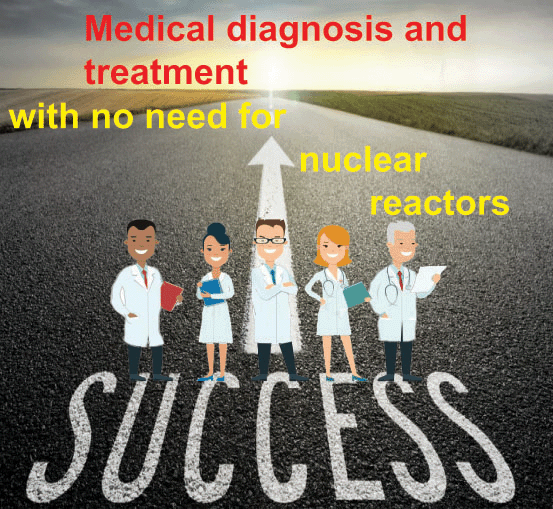
these cyclotrons can be used to reliably create technetium-99m regionally and without the need for reactor-based materials.
Cyclotron-produced technetium-99m approved by Health Canada, TRIUMF,
Now, a new cyclotron-based approach to producing this critical diagnostic tool has received Health Canada approval, greenlighting the made-in-Canada technology for national implementation and opening the door to a greener, more reliable way to make technetium-99m.
The approval represents a critical milestone for the TRIUMF-led Cyclomed99 consortium, which spearheaded the innovative research effort. The consortium, including partners BC Cancer, the University of British Columbia (UBC), the Lawson Health Research Institute, and the Centre for Probe Development and Commercialization, is the first in the world to obtain full regulatory approval for cyclotron-based production.
It also a turning point for the consortium‘s licensee ARTMS Inc., the TRIUMF spin-off company bringing this technology to market. ARTMS’ technology makes technetium-99m production possible on many of the world’s most common medical cyclotrons, enabling regional production of this critical isotope within local communities.
“Medical isotopes help so many people every day. It’s critical to have a stable, multi-faceted supply chain to avoid unexpected disruptions to their availability,” said Paul Schaffer, Associate Laboratory Director, Life Sciences at TRIUMF and Associate Professor at UBC’s Faculty of Medicine. “The approval of cyclotron-produced technetium-99m by Health Canada is an important milestone for this Canadian innovation that will ultimately deliver direct benefit for Canadian patients.”
While the Health Canada approval brings new promise for patients and researchers, it also highlights an important chapter in Canadian innovation, one which saw a focused national research effort produce an effective solution to a global problem.
The path towards cyclotron-produced technetium-99m ……
In 2009, following unplanned disruptions at NRU (which historically provided up to half of the world’s technetium-99m via molybdenum-99 generators), the Government of Canada initiated the Non-reactor-based Isotope Supply Contribution Program (NISP) which challenged researchers to find a new way to produce critical medical isotopes—in particular, technetium-99m.
Led by Schaffer and TRIUMF‘s Dr. Tom Ruth, scientists and engineers from TRIUMF joined partners at BC Cancer, the Centre for Probe Development Commercialization (CPDC), the Lawson Health Research Institute, and the University of British Columbia to launch a national collaboration to answer the NISP call: the ‘CycloMed99‘ consortium.‘
A new way to produce technetium-99m
The consortium’s proposal detailed a new and innovative technology to enable the production of technetium-99m using medical cyclotrons. These compact particle accelerators already operate in regional healthcare centres worldwide, producing isotopes by bombarding a target material with a proton beam and extracting the desired species. The process is safe and precise, employing stable targets and producing little to no long-lived radioactive waste. And, with the right target and extraction systems, these cyclotrons can be used to reliably create technetium-99m regionally and without the need for reactor-based materials.
“Cyclotron centres across Canada can produce these isotopes locally and on-demand, and we have shown the path that can be used to achieve regulatory approval,” said Francois Bénard, senior executive director of research at BC Cancer, professor of radiology and associate dean of research at UBC’s faculty of medicine. “The same approach can be followed at other sites in Canada and internationally. This has been a shared vision of many researchers across the country, and we have to recognize the many collaborators who worked for years to make this announcement possible.”
This bright future will first take shape at TRIUMF‘s Institute for Advanced Medical Isotopes (IAMI), where a state-of-the-art TR-24 medical cyclotron will offer production capacity for the Lower Mainland‘s technetium-99 needs. In addition, IAMI will serve as a hub for radiopharmaceutical research, providing access to leading-edge facilities and expertise in accelerator technology and isotope science. The Institute will further catalyze the Vancouver region’s diverse nuclear medicine sector by convening researchers, students, academic collaborators, not-for-profits, government, and industry partners.
“With support from the Canadian government and our partners, we have developed an effective solution to the medical isotope crisis, one that will improve health outcomes and reaffirm Canada’s role as a global leader in isotope production and research. … …https://www.triumf.ca/headlines/cyclotron-produced-technetium-99m-approved-health-canada?fbclid=IwAR1d-vA4gmCfoY1HWJqwPBs_KkmGHMfwxGKVK41bnPNeD2I7Yr-vHkaVf4o
Biden Plans Renewed Nuclear Talks With Russia While Punishing Kremlin
Biden Plans Renewed Nuclear Talks With Russia While Punishing Kremlin, Adviser Says. The president-elect also plans to pursue a “follow-on negotiation” with Iran over its missile capabilities if Tehran re-enters compliance with the nuclear deal.
NYT, By David E. Sanger, Jan. 3, 2021
President-elect Joseph R. Biden Jr.’s incoming national security adviser said on Sunday that the new administration would move quickly to renew the last remaining major nuclear arms treaty with Russia, even while seeking to make President Vladimir V. Putin pay for what appeared to be the largest-ever hacking of United States government networks.
In an interview on “GPS” on CNN, Jake Sullivan, who at 44 will become the youngest national security adviser in more than a half century, also said that as soon as Iran re-entered compliance with the 2015 nuclear deal — which he helped negotiate under President Barack Obama — there would be a “follow-on negotiation” over its missile capabilities.
“In that broader negotiation, we can ultimately secure limits on Iran’s ballistic missile technology,” Mr. Sullivan said, “and that is what we intend to try to pursue through diplomacy.”
He did not mention that missiles were not covered in the previous accord because the Iranians refused to commit to any limitations on their development or testing. To bridge the impasse, the United Nations passed a weakly worded resolution that called on Tehran to show restraint; the Iranians say it is not binding, and they have ignored it.
Taken together, Mr. Sullivan’s two statements indicated how quickly the new administration would be immersed in two complex arms control issues, even as Mr. Biden seeks to deal with the coronavirus pandemic and the economic shocks it has caused. But the first issue to arise, renewing the New Start, will be made more complex because of Mr. Biden’s vow to assure that Moscow pays for the hacking of more than 250 American government and private networks, an intrusion that now appears far more extensive than first thought.
Mr. Biden has said that after the government formally determines who was responsible for the attack, “we will respond, and probably respond in kind.” But that means moving to punish Russia while keeping New Start — a remnant of the era when nuclear rather than cyber was the dominant issue between the two countries — from lapsing and setting off a new arms race. ……… https://www.nytimes.com/2021/01/03/us/politics/biden-russia-iran.html
Astounding failure by Ohio Republican leadership to repeal nuclear bailout law
Claims in a federal complaint released in July indicate that the law was at the heart of an alleged corruption scheme involving roughly $60 million. Former Ohio House Speaker Larry Householder, R-Glenford, and others were arrested last summer.
Failure to repeal the law in 2020 was “an astounding failure by Republican leadership,” said Rep. David Leland, D-Columbus, as the legislature adjourned last month……..
Allegations in the federal criminal case indicate that FirstEnergy and FirstEnergy Solutions — now known as Energy Harbor — provided most of the funding for an alleged scheme to elect favorable lawmakers and then to pass and defend HB 6. …….
Rulings from the Ohio Supreme Court and the Franklin County Court of Common Pleas have temporarily postponed collection of the nuclear plant subsidies anyway. Meanwhile, FirstEnergy benefits from the 2019 law’s revenue guarantee provision. Consumers pay subsidies for the old coal plants. And provisions that gutted Ohio’s renewable energy and energy efficiency standards are in full force…….
FirstEnergy Solutions paid money to Generation Now. The dark money group is a defendant in the criminal case.
And while Seitz maintained that “no alleged corruption infected all of HB 6,” others such as Rep. Mike Skindell, D-Lakewood, have stressed that “all of it — not just part of it” is tainted by the alleged corruption.
“To suggest we can parse out which pieces of the bill were not the product of corruption is wishful thinking,” Leppla said. “There is an ongoing FBI investigation, with more shoes likely to drop, so we won’t know the full extent of the corruption for some time.”
Although a FirstEnergy Solutions officer provided brief testimony on HB 6 in 2019, the company has not provided financial materials in any hearings to back up its alleged need for funding. Asked why he wouldn’t make Energy Harbor provide such sworn testimony now, Seitz said the proposed regulatory audit would be “much better than any testimony at this point.”
“Pushing it off to a closed-door audit that won’t be made fully public is a convenient way for legislators to avoid public scrutiny and outrage at forking over Ohioans’ hard-earned money to bail out a company that doesn’t need it,” Leppla said.
“I can’t think why the legislature would not want this information,” Brown said. Indeed, an option approach would tell Energy Harbor that it could draw on a slush fund if it is too incompetent or too inefficient to compete. In his view, the whole approach is “beyond crony capitalism.”………
“What we do know,” Leppla said, “is that HB 6 was a widely disliked bill that will raise Ohioans’ bills, pollute our air, and send us backward in the fight against climate change — and yet, it passed anyway.” https://www.wvxu.org/post/rep-bill-seitz-forefront-key-points-nuclear-bailout-law-hb-6#stream/0
Ohio lawmakers still don’t know what to do about corruptly instituted nuclear bailout law
The courts have taken some of the heat off by temporarily blocking the start of consumer surcharges this month to fuel the $150 million that would be used to subsidize the plants’ operations, but the law now considered to be the fruits of corruption remains on the books.
“We have a new General Assembly, so we have 20 new members,” House Speaker Bob Cupp (R., Lima) said Monday. “We will continue to work to find a solution that the House, the Senate, and the governor can all agree on…It is still a high priority on our agenda to find a solution.”
New Senate President Matt Huffman (R., Lima) said he and the speaker have been talking about how to proceed.
Grand Gulf nuclear plant in Mississippi raises concerns about nuclear power
That means Entergy Corp., which is the plant’s main owner, and the Midcontinent Independent System Operator, which operates the regional grid, often have to rely on other generation to fill the gap — possibly costing more and boosting greenhouse gas emissions if fossil fuel sources are tapped.
“The same rule applies to Grand Gulf as applies to coal, to gas, to any resource that we know we’re paying more for than we’re getting from,” said Logan Atkinson Burke, executive director of the New Orleans-based Alliance for Affordable Energy. “And the question is, who’s profiting from that, and who is being burdened by it?”
Experience at Grand Gulf suggests regulators and plant operators may need to consider new approaches and closer oversight of aging reactors, which face an uncertain future if they become too expensive to repair and maintain, observers say. This could have national implications as the electricity industry tries to transition away from fossil fuels and aims to rely more heavily on carbon emissions-free nuclear power.
The industry says nuclear plants are performing well broadly and companies are making investments to keep them operating. But Grand Gulf shows that a reactor that often goes offline can be expensive and undermine climate goals. An examination of New Orleans, for example, provided a snapshot in the past, estimating that a multiday unplanned outage at Grand Gulf in late 2018 resulted in higher costs of more than $1 million for New Orleans ratepayers, according to data from the city.
Aging and troubled nuclear reactors in competitive markets also occupy shaky ground because cheaper options like renewables have been able to undercut them economically, and there isn’t always a customer base to prop them up. Grand Gulf operates in a regulated territory, so it has protection, said Paul Patterson, a utility analyst with Glenrock Associates LLC. But he added that keeping plants alive isn’t a given.
“If the stars aren’t aligned politically to support these plants, it’s not going to happen,” he said………
Grand Gulf finished last among U.S. reactors at 68.8% capacity…….
At the same time, the Nuclear Regulatory Commission recently questioned the site’s operators about mislabeling of waste tied to the plant. And the Federal Energy Regulatory Commission has been reviewing complaints around Grand Gulf’s financial structure that could lead to a refund for customers……..
Nuclear reactors are designed to act as baseload power plants, which means they aren’t usually turned on and off frequently. It also takes time to take a nuclear plant offline, unless there’s an emergency that automatically trips the reactor for safety reasons.
But downtime at Grand Gulf has plagued the plant for years, as E&E News reported in 2018 (Energywire, Dec. 4, 2018). ……. its performance tanked in 2020, as it was at zero on about 39% of the days. This stemmed largely from the refueling and upgrades Entergy undertook — and issues that followed.
Safety concerns could lead to more time that Grand Gulf is not operating, according to observers. Edwin Lyman of the Union of Concerned Scientists ticked off a list of statistics for Grand Gulf that he said concern him. The reactor is in Column 2 of the NRC’s so-called Action Matrix, meaning its performance has declined. It has a number of “green” or low-level safety issues that may trigger additional inspections and reviews, and it has a “white” finding, which is more severe.
“That’s showing a troubling trend in management and safety control,” said Lyman, nuclear power safety director at UCS…..
Lyman questioned whether there is stringent oversight by federal regulators of basic procedures such as replacing and maintaining equipment, following guidelines and continuing education. Management needs to follow through on overseeing maintenance activities, he said.
“All of these seem to be challenging the safety of the plant,” he said.
The NRC looks for so-called cross-cutting issues, which are something that affects most or all safety cornerstones. This is as broad as having a “safety conscious work environment” and can be as specific as human behavior and identifying and solving problems. But the agency has been under pressure to weaken its oversight, which means such patterns may be missed, Lyman said…….
Colby Cook, a spokesperson for the Louisiana Public Service Commission, said a directive last year authorized LPSC staff to initiate a complaint at FERC regarding Grand Gulf’s operations. He said the complaint hasn’t been filed yet. But it could involve other jurisdictions that have an interest in how the plant performs.
And regulators in various states are watching federal agencies for potential decisions related to Grand Gulf………
Lyman of USC acknowledged bipartisan support in Congress for nuclear power. He said it’s up to the Energy Department to promote nuclear as a climate solution, but said the reactors need to be running safely if that’s the case. This is where the NRC comes in.
“The people who you need to depend on to make sure the plants are running safely are not doing their jobs now,” Lyman said…….
Lyman called for a more detailed grading system at the NRC so the public has a better sense of safety problems. That could lead to public pressure on the staff and management at certain plants, which also are dealing with the COVID-19 pandemic.
“I’m concerned generation with the operating reactor fleet especially when they are under economic pressure, especially now with COVID,” Lyman said……
Burke of the Alliance for Affordable Energy in Louisiana said she has no reason to be confident that Grand Gulf will have a great future performance. When the plant is offline, she said, Entergy and MISO likely depend on gas-fueled generation in the region. Burke also worried that new natural gas-fired units could be proposed to replace Grand Gulf at some point….
Burke said utilities and regulators need to plan with credible data.
“If we’re honest about what this plant is costing us all, then this plant shuts down and we finally get to plan for the future,” she said. https://www.eenews.net/stories/1063721867
Canada vocal about nuclear disarmament, but silent about the Treaty for Prohibition of Nuclear Weapons
 Canada reaffirms support to advance nuclear disarmament Mirage News, 5 Jan 21, On behalf of the Honourable François-Philippe Champagne, Minister of Foreign Affairs, Rob Oliphant, Parliamentary Secretary to the Minister of Foreign Affairs, today reaffirmed Canada’s unwavering support for advancing nuclear non-proliferation and disarmament during the third meeting of foreign ministers of the Stockholm Initiative for Nuclear Disarmament. Canada reaffirms support to advance nuclear disarmament Mirage News, 5 Jan 21, On behalf of the Honourable François-Philippe Champagne, Minister of Foreign Affairs, Rob Oliphant, Parliamentary Secretary to the Minister of Foreign Affairs, today reaffirmed Canada’s unwavering support for advancing nuclear non-proliferation and disarmament during the third meeting of foreign ministers of the Stockholm Initiative for Nuclear Disarmament.
Co-hosted by Jordan, Germany and Sweden, the meeting brought together international partners advocating for action-oriented steps on nuclear disarmament. Participants called on all nuclear weapon states to show leadership in advancing nuclear disarmament and to take meaningful steps to implement all commitments under the Treaty on the Non-Proliferation of Nuclear Weapons (NPT). ………https://www.miragenews.com/canada-reaffirms-support-to-advance-nuclear-disarmament/
|
|
|
LGBTQ Activists Jump Into the Atlantic to support Treaty banning nuclear weapons
2012, LGBTQ activists Brendan Fay and Robert Croonquist huddled with other New York-based members of International Campaign to Abolish Nuclear Weapons and ran into the Atlantic Ocean at Far Rockaway on New Year’s Day as part of a public demonstration against nuclear weapons.
The activists, who plunged into the freezing waters at Rockaway Beach and 92nd Street, are pushing the City Council to move forward with a resolution asking the city comptroller to divest pension funds of public employees from sources of nuclear weapons and a bill creating an advisory committee that would evaluate nuclear disarmament and other issues geared towards making New York City a nuclear weapons-free zone. Those bills were proposed by out gay Councilmember Daniel Dromm of Queens, who has welcomed the support of dozens of co-sponsors in both cases.
The activists are asking out gay City Council Speaker Corey Johnson to advance the measures before the Treaty of the Prohibition of Nuclear Weapons becomes international law on January 22. …………
Croonquist, a former public school teacher who is a member of Rise and Resist and the Reclaim Pride Coalition, said he was driven to jump into the ocean when he thought about the high school students he taught at Jamaica High School in Queens.
“This legislation would divert my pension’s investments from weapons of mass destruction and redirect them to things that bring true security — investments in food, housing, climate, infrastructure and healthcare. ………… https://www.gaycitynews.com/lgbtq-activists-jump-into-the-atlantic-to-protest-nuclear-weapons/.
Donald Trump left a hawkish nuclear weapons mess, but Joe Bideb can make alot of improvements, on his own
|
Nuclear Weapons Are Out of Control. But Biden Can Make the World Safer. https://wordpress.com/read/feeds/2663585/posts/3106810876 –
Six ways that Biden can make the world safer in 2021, January 1, 2021 Joseph Cirincione The Red Safe held the launch codes and keys, Steven Miller Donald Trump left Joe Biden with a hot nuclear mess. Trump made every nuclear danger he inherited worse by the hawkish policies he and Republicans pursued. Iran is accelerating its civilian nuclear program. North Korea is expanding its nuclear military capabilities. They are not alone. Every one of the nine nuclear-armed states is building new weapons. Yet Trump destroyed or abandoned crucial security agreements restraining these dangers and started or accelerated a half-dozen new weapons for missions we don’t need with budgets we can’t afford. Fortunately, there’s a great deal that Joe Biden can do, on his own, in the first few days and weeks of his presidency.. He can quickly establish his authority over a nuclear weapons complex spiraling out of control. He can reduce the risk of nuclear war by accident, miscalculation, or madness; stop a new nuclear arms race; shave hundreds of billions of dollars off the military budget; and prevent new states from getting these weapons. By so doing, he can make America and the world more secure. Reform Command and Control. Nuclear weapons are often called “the president’s weapons.” The commander in chief sets the policy, requirements, and size of the U.S. arsenal. He has sole, unfettered authority to launch one or all of the nation’s almost 4,000 operational nuclear weapons. He need not consult with anyone; no one can counter his command. Since Trump did not press the button during his four years in the Oval Office, some may think that concerns about a madman destroying all of humanity are overstated. In truth, we dodged a nuclear bullet. As president, Biden should do all he can to ensure we never again come so close to self-annihilation. Biden does not need the permission of Congress to announce early in his tenure that procedures adopted by past presidents in the fearful days of the Cold War—including the first use of nuclear weapons in a conventional conflict, missiles ready to launch in minutes, and the sole authority of the president to fire these weapons—combine now to present an unacceptable risk of nuclear disaster. He can direct that U.S. policy is to never start a nuclear war, that we no longer need to keep our weapons on hair-trigger alert, and that henceforth the president will need the concurrence of another senior official, such as the Speaker of the House, to launch nuclear weapons. Save Arms Control. Biden can take an immediate step to curtail the arms race by quickly agreeing with Russia to extend the New START treaty for five years, due to expire in February 2021. It is the only remaining limitation on U.S. and Russian arsenals, after four years of Trump’s withdrawal from key strategic accords. This will provide the basis for returning to the process of principled dialogue with Russia and other nuclear-armed states, including China, to freeze and reduce global arsenals. |
|
Nuclear Command and Control: Session 3 of the Congressional Study Group
Nuclear Command and Control
Session 3 of the Congressional Study Group, Wednesday, December 30, 2020 https://www.brookings.edu/research/nuclear-command-and-control/
On May 7, 2020, the Congressional Study Group on Foreign Relations and National Security convened online to discuss the question of the command and control of U.S. nuclear weapons. At present, the president has the unilateral authority to choose to use nuclear weapons, and many assume that this is a result of his Article II powers under the Constitution. But is this assumption correct? Are there ways Congress can limit when and how the president uses nuclear weapons?
To discuss this topic, the working group was joined by three outside experts Professor Mary DeRosa of Georgetown University Law Center, a former legal advisor to the National Security Council; Chris Fonzone, a partner at Sidley Austin and another former legal advisor to the National Security Council; and Professor Matt Waxman of Columbia Law School, who is also an Adjunct Senior Fellow at the Council on Foreign Relations and has previously held senior positions in the National Security Council and U.S. Department of State. Prior to the session, the study group received several written pieces as background reading, including:
- “The President and Nuclear Weapons: Authorities, Limits, and Process,” a report for the Nuclear Threat Initiative that DeRosa co-authored (and was accompanied by a separate policy proposal by former Energy Secretary Ernest Moniz and former Senator Sam Nunn);
- “The President and the Bomb: Reforming the Nuclear Launch Process,” which Waxman co-authored for Foreign Affairs; and
- “What the Military Law of Obedience Does (and Doesn’t) Do,” an issue brief for the American Constitution Society authored by Fonzone.
Waxman then shifted focus to ways that Congress might be able to shape the executive branch process for deciding when and how nuclear weapons are used. While few are likely to argue with the president’s ability to use nuclear force in response to a nuclear attack, Waxman identified three problematic scenarios that might emerge in a case of nuclear first use: that the president would pursue such an action without due deliberation; that a president might give such an order, but that it is not obeyed by military personnel who believe it to be unlawful or unwise; and that a third party might try to interfere with the system to inhibit a response or trigger an unauthorized launch.
A better defined process–for example, one that requires that an order to use nuclear weapons be certified as valid by the Secretary of Defense and lawful by the Attorney General–could reduce all three of these risks by putting some limits on the president’s unilateral authority, encouraging a more deliberative and justified process that is less likely to trigger reservations, and creating a process with multiple safeguards less subject to external manipulation. Such a process could be implemented by the president by executive order or by Congress, though the latter may raise constitutional objections in some corners and runs the risk of being disregarded by administrations who maintain it is constitutional. That said, by leaving the decision-making within the executive branch, such approaches are less likely to incur constitutional objections than outright statutory prohibitions, which may make them more effective in the long run.
Finally, Fonzone stepped in to discuss the military chain of command, specifically in reference to the oft-discussed possibility that military personnel might disregard an impetuous order to use nuclear weapons as unlawful. The operational chain of command, he noted, runs from the President through the Secretary of Defense down to the military ranks, and is defined in substantial part by statute in addition to executive branch guidelines. While the Secretary of Defense might be removed from office for disobeying a presidential order, members of the military can face criminal sanctions under the Uniform Code of Military Justice. That said, this duty of obedience does not extend to “patently” or “manifestly” illegal orders, which military personnel are obligated not to follow. This bar, however, is extremely high and requires clear knowledge on the part of the servicemember. As many major policy decisions, including the use of nuclear weapons, occur on contested and complex constitutional and legal terrain, even unlawful orders are not likely to be seen as “patently” or “manifestly” illegal. Hence, one should not rely on the lawfulness exceptions to the chain of command alone as a meaningful safeguard against such conduct.
From there, the study group went into open discussion, where they raised issues and addressed questions relating to: the civilian control of nuclear technology and weapons development; international legal and policy restraints on the use of nuclear weapons; and in what circumstances the use of nuclear weapons should properly be left to the president’s unilateral authority (e.g., self-defense).
Visit the Congressional Study Group on Foreign Relations and National Security landing page to access notes and information on other sessions.
-
Archives
- May 2026 (72)
- April 2026 (356)
- March 2026 (251)
- February 2026 (268)
- January 2026 (308)
- December 2025 (358)
- November 2025 (359)
- October 2025 (376)
- September 2025 (257)
- August 2025 (319)
- July 2025 (230)
- June 2025 (348)
-
Categories
- 1
- 1 NUCLEAR ISSUES
- business and costs
- climate change
- culture and arts
- ENERGY
- environment
- health
- history
- indigenous issues
- Legal
- marketing of nuclear
- media
- opposition to nuclear
- PERSONAL STORIES
- politics
- politics international
- Religion and ethics
- safety
- secrets,lies and civil liberties
- spinbuster
- technology
- Uranium
- wastes
- weapons and war
- Women
- 2 WORLD
- ACTION
- AFRICA
- Atrocities
- AUSTRALIA
- Christina's notes
- Christina's themes
- culture and arts
- Events
- Fuk 2022
- Fuk 2023
- Fukushima 2017
- Fukushima 2018
- fukushima 2019
- Fukushima 2020
- Fukushima 2021
- general
- global warming
- Humour (God we need it)
- Nuclear
- RARE EARTHS
- Reference
- resources – print
- Resources -audiovicual
- Weekly Newsletter
- World
- World Nuclear
- YouTube
-
RSS
Entries RSS
Comments RSS
 nuclear-news