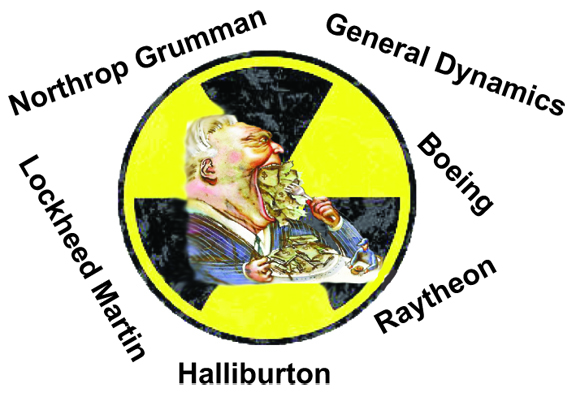
“IT’S VERY PROFITABLE to prepare for omnicide,”
NOT EVEN COVID-19 COULD SLOW DOWN NUCLEAR SPENDING https://theintercept.com/2021/06/07/nuclear-weapons-spending-pandemic-ican/
A new report finds that nine countries collectively spent $72 billion in 2020 on nukes., Jon Schwarz,
June 7 2021, “IT’S VERY PROFITABLE to prepare for omnicide,” Daniel Ellsberg, famed whistleblower and anti-nuclear weapons activist, said in a recent interview. “Northrop Grumman and Boeing and Lockheed and General Dynamics make a lot of money out of preparing for such a war. The congressmen get campaign contributions, they get votes in their district and almost every state for preparing for that.”
But don’t just take it from Ellsberg. At an investor conference in 2019, a managing director from the investment bank Cowen Inc. queried Raytheon’s CEO on this subject. “We’re about to exit the INF [Intermediate-Range Nuclear Forces Treaty] with Russia,” said the Cowen executive. Did this mean, he asked, whether “we will really get a defense budget that will really benefit Raytheon?” Raytheon’s CEO happily responded that he was “pretty optimistic” about where things were headed.
There are currently nine countries that possess nuclear weapons: the United States, China, Russia, the United Kingdom, France, India, Pakistan, Israel, and North Korea. ICAN calculated that they collectively spent $72.6 billion in 2020 on nukes. (picture below – a little out of date – 2019 )
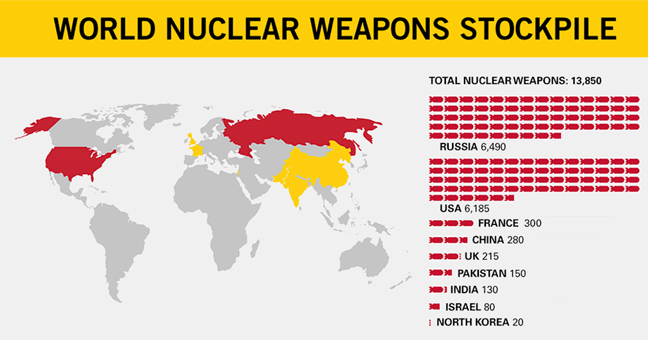
The U.S. was responsible for just over half of this doomsday payout, at $37.4 billion. According to the Congressional Budget Office, U.S. nuclear spending is anticipated to soon increase sharply due to plans for technological upgrades, rising to $41.2 billion next year and totaling $634 billion during the 10 years from 2021-2030.
China came in second in 2020 at an estimated $10.1 billion. Russia was third at $8 billion. Notably, in a year when the world economy was flattened by the coronavirus pandemic, nuclear spending continued on an upward trajectory without a hiccup.
Despite these hefty numbers, they’re probably an underestimate. “There’s always more [nuclear spending] out there … even more still lurking in the shadows,” said Susi Snyder, co-author of the report and managing director of the project Don’t Bank on the Bomb. Snyder points out that “governments, especially U.S., U.K., [and] France are always demanding ‘transparency’ … yet they do not hold themselves to the standards they demand of others.”
A great deal of U.S. nuclear spending consists of profitable contracts with private corporations.
The four companies Ellsberg said were raking in cash “preparing for war” indeed received the most money in 2020:
- Northrop Grumman — $13.7 billion
- General Dynamics — $10.8 billion
- Lockheed Martin — $2.1 billion
- Boeing — $105 million

These enormous contracts create obvious incentives for these companies to lobby for more government expenditures on Armageddon, and they assiduously do so. Indeed, lobbying unquestionably is the most profitable investment these companies make. According to ICAN’s report, for every $1 they spent on lobbying, they received $239 in nuclear weapon contracts.
The specifics are notable here. Northrop reported $13.3 million in lobbying expenses in 2020. Last year it was formally awarded the enormous initial contract to develop a new intercontinental ballistic missile system called the “Ground Based Strategic Deterrent.” It will inevitably receive the contract for the entire program, estimated to be worth $85 billion over its life. In discussion on the GBSD, the Air Force’s assistant secretary for acquisition stated that he didn’t see the pandemic affecting nuclear spending.

There is also much more to lobbying than that which goes by the name. In the 2006 documentary “Why We Fight,” journalist Gwynne Dyer explained that President Dwight Eisenhower considered the military-industrial complex actually to have three components: the military, defense corporations, and Congress. But now, Dyer said, there’s a fourth: think tanks, which generally push their funders’ policies under a thin veneer of scholarship.
According to the report, companies profiting from nuclear weapons contributed $5-10 million to think tanks in 2020. Northrop alone spent at least $2 million funding nine of them, including the Atlantic Council, the Brookings Institution, the Center for a New American Security, and the Center for Strategic and International Studies.
However, ICAN did not produce the report for passive consumption or as an inducement to despair. Instead, it is part of a sophisticated strategy to eventually make nuclear weapons as taboo worldwide as chemical and biological weapons are now.
ICAN was a key force behind the Treaty on the Prohibition of Nuclear Weapons, which was adopted in 2017 at the United Nations. It makes illegal any activities related to nuclear weapons and has been signed by 86 countries and ratified by 54. It entered into force this past January.
None of the nuclear powers are signatories. Yet they need not be for the treaty to create a noose around those countries and their companies that should tighten over time. For instance, Airbus produces missiles for France’s nuclear weapons arsenal. But it is headquartered in the Netherlands, so if that country ratified the TPNW, it could no longer do so.
This financial threat has now attracted the attention of the stockholders of these nuclear corporations. Snyder notes that a 2020 Northrop shareholders resolution stated that the company “has at least $68.3 billion in outstanding nuclear weapons contracts, which are now illegal under international law,” and it received 22 percent support. A similar Lockheed resolution got over 30 percent support. The KBC Group, the 15th-largest bank in Europe, has announced that it will not fund any nuclear weapon-related activity because of the TPNW.
Success here will obviously require a long-term campaign and increased activism across the world. But the trajectory is headed in the right direction. “The days of spending with impunity on WMD,” believes Snyder, “are numbered.”
Lawsuit aims to stop the dismantlement of San Onofre nuclear plant (closed in 2012)

Hearing set for lawsuit aimed at stopping dismantlement of San Onofre nuclear plant, LA Times ROB NIKOLEWSKI SAN DIEGO UNION-TRIBUNE, JUNE 4, 2021 SAN DIEGO —
A June 16 court date has been set to hear a lawsuit filed by an advocacy group against the California Coastal Commission, seeking to stop dismantlement work at the San Onofre Nuclear Generating Station.
Los Angeles County Superior Court Judge Mitchell L. Beckloff will consider the petition by the Samuel Lawrence Foundation that argues the commission should not have granted a permit to Southern California Edison, the majority owner of the plant, to take down buildings and other infrastructure at the now-closed generating station, known as SONGS.
“The public interest is at risk, based on [the commission’s] decision,” said Chelsi Sparti, associate director of the Samuel Lawrence Foundation, based in Del Mar. “The waste is located right next to the ocean, [and] the economy, transportation, the environmental and natural resources that we have are at risk from the long-term storage of stranded radioactive waste.”…………
In October 2019, the commission on a 9-0 vote approved a permit for Edison to begin demolition work at the plant, which has not produced electricity since 2012. Dismantlement began in early 2020 and is expected to take about eight years to complete.
Before granting the permit, the commission required Edison to agree to a number of provisions, including establishing an enhanced inspection and maintenance program for the 123 stainless steel canisters filled with nuclear waste that sit in a pair of dry storage facilities at the north end of the plant.
The permit lasts 20 years and includes a condition that allows the commission by 2035 to revisit whether the dry storage site should be moved to another location in case of rising sea levels, earthquake risk, canister damage or other possible scenarios.
One of the major contentions in the lawsuit deals with what to do with a pair of wet storage pools at SONGS. Before going into canisters, the highly radioactive fuel rods were placed into pools 40 feet deep in order to cool………..
Some 3.55 million pounds of used-up nuclear fuel, or waste, remain at SONGS because the federal government has not opened a facility to deposit all the waste that has accumulated at commercial nuclear power plants across the country. About 80,000 metric tons has piled up at 121 sites in 35 states……………. https://www.latimes.com/california/story/2021-06-04/hearing-set-for-lawsuit-aimed-at-stopping-dismantlement-at-san-onofre-nuclear-plant
Illinois nuclear power stations’future hangs in the balance, awaiting decision on taxpayer subsidies.
Fate of Illinois nuclear plants in balance after PJM auction fail and stalled subsidy plan. Utility Dive June 7, 2021 By Scott Voorhis
Dive Brief:
- Exelon Corp. reports that three of its nuclear plants in Illinois failed to clear the PJM Interconnection’s capacity auction last week.
- Exelon, in a filing with the U.S. Securities and Exchange Commission, revealed that its Bryon, Dresden and Quad Cities nuclear plants in Illinois all failed to sell their power at the PJM auction, losing out to other power plants and energy resources. Bryon and Dresden are currently slated to be retired this fall, with Quad Cities remaining open thanks to previously awarded subsidies from the state of Illinois.
The fate of Illinois’ nuclear power sector, meanwhile, remains in the balance, as an impasse drags on in the state legislature over an energy bill that would provide hundreds of millions of dollars in subsidies to the sector………….. https://www.utilitydive.com/news/fate-of-illinois-nuclear-plants-in-balance-after-pjm-auction-fail-and-stall/601324/
Elevated cancer deaths in Monroe may be result of nuclear plant,
Report alleges elevated cancer deaths in Monroe may be result of nuclear plant,
Tyler EagleThe Monroe News, 12 March 2921 A new report has found that Monroe County’s cancer mortality rate is significantly higher than that of the national average.
And the scientist behind it contends the driving force behind that statistic is DTE Energy’s Fermi 2 Nuclear Power Plant in Newport.
A new report has found that Monroe County’s cancer mortality rate is significantly higher than that of the national average.
And the scientist behind it contends the driving force behind that statistic is DTE Energy’s Fermi 2 Nuclear Power Plant in Newport.
Epidemiologist and executive director of the Radiation and Health Project Joseph Mangano unveiled a report titled “Fermi 2 Nuclear Reactor and Rising Cancer Rates” Thursday afternoon during a virtual press conference.
Using mortality data collected by the Centers for Disease Control and Prevention, Mangano’s analysis found that cancer-related deaths in Monroe County were 14.3% higher than the national average.
“We have raised red flags — these are matters of concern,” Mangano said. “There are no other obvious reasons for such an unexpected change. …
You wouldn’t think Monroe County is a (center) for cancer. It’s a suburban county.”
More:DTE Energy decries advocacy group’s report
The national average for cancer-related deaths nationally was about 150 deaths per 100,000, according to Mangano’s report. Monroe County’s most recent metric — which is from 2019 — was 170 per 100,000.
Prior to Fermi 2’s activation in 1985, Monroe County’s cancer death rate was 3% less the national average, according to Mangano. He said the elevated trend has continued to increase in the last ten years, resulting in the most recent and highest metric.
Mangano said elevated risk and mortality of cancer was present in all population groups, including those classified by gender, race and age.
His report shows that in Monroe County, 10 of the 11 most common cancers in the U.S. occurred at a significantly higher rate, including leukemia, brain and central nervous system and bronchus and lung cancers.
The report also indicates that cancer-related mortality among younger populations is also much higher than the national average.
According to the report, cancer-related deaths among those ages 0-24 occurred 40.2% more than the national average.
Among those ages 25-49, the rate was 49.2% above the U.S. average.
Mangano is calling for more research into the matter, saying the federal and state government have not done enough to examine nuclear plants’ impact on those who live near such sites.
“You don’t have to wait for a meltdown for nuclear reactor to harm people,” Mangano said. “Every single day, reactors release a mix of 100 or more (harmful) chemicals into the environment. It gets into people’s bodies through the food chain.”
……….. Mangano also discussed a new initiative to collect donated baby teeth from Monroe County residents in an effort to investigate whether there are increased instances of in-body radioactive contamination.
Mangano said the Tooth Fairy Project will analyze collected specimens for Strontium-90, a harmful substance that is a byproduct of nuclear reaction.
The project will seek to collect 25-50 local specimens, he said. ………..
For more information, to read Mangano’s report in full or to find out how to participate in the Tooth Fairy Project, visit radiaiton.org. https://www.monroenews.com/story/news/2021/03/11/study-elevated-cancer-deaths-monroe-may-result-nuclear-plant/4649665001/
Exelon and NRG share prices fall as U.S. nuclear power firms to be hit by plunge in grid payments

Plunging Payouts on Top U.S. Power Grid Slam Coal, Nuclear, Bloomberg Green, By Will Wade and Mark Chediak3 June 2021,
- Power providers will get $50 a megawatt-day, down from $140
- ‘I can’t imagine how nuclear is going to be able to cover’
Coal plants, nuclear reactors and other generators will take a hit next year on the biggest U.S. power grid as payments designed to ensure the lights remain on from New Jersey to Illinois plunge 64%.
Suppliers to PJM Interconnection LLC’s grid, which serves more than 65 million people, will get $50 a megawatt-day to provide backup capacity for the year starting June 2022, according to the results of an auction released Wednesday. It’s the lowest price in 11 years.
The results are an especially harsh blow for coal plants and nuclear reactors already struggling to compete. The PJM auction is the single most important event for generators across the eastern U.S., including Calpine Corp., NRG Energy Inc. and Exelon Corp., because it dictates a big chunk of their future revenue.
It also plays a pivotal role in shaping the region’s electricity mix, determining how much the region is willing to stick with coal and natural gas plants or replace then with wind and solar.
“I can’t imagine how nuclear is going to be able to cover all their fixed costs with such a low price,” said Brianna Lazerwitz, an analyst for BloombergNEF.
Exelon shares fell as much as 2% before trading opened in New York Thursday. NRG fell 1.6%. And Vistra fell 2%.
“It’s a direct hit to the companies’ income statements,” Gayle Podurgiel, a power markets analyst at Moody’s, said in an interview. She predicted it would push more coal plants to close.
Analysts had expected the auction would hurt renewables and nuclear power, while potentially boosting coal. That’s because of new rules imposed by regulators under Former President Donald Trump were designed to blunt any advantage wind, solar and reactors gained from state subsidies.
But in the end, the rule wasn’t much of a factor, in part because the steep price decline mitigated some participants’ advantages. Plus, many bidders were granted exemptions. As a result, coal plants fared disastrously………..https://www.bloomberg.com/news/articles/2021-06-02/electricity-payouts-on-biggest-u-s-grid-fall-64-in-auction-kpfwja1a
The transition to clean energy is held back by subsidies to the nuclear industry

Nuclear Subsidies May Be Slowing Transition to Clean Energy, Advocates Say, BY Leanna FirstArai, Truthout, 6 June 21,
The fight to define what counts as clean energy has grown more contentious as the Biden administration’s infrastructure bill takes shape. Many activists, scientists and lawmakers agree that nuclear energy — which provides one fifth of power in the U.S — is by definition not “clean” or renewable, given that spent fuel remains radioactive and dangerous for thousands of years….. A group of staunch advocates say billions in state and federal subsidies that prop up the nuclear industry — payments that the Biden administration has signaled it may continue to support — may be slowing the transition to a truly clean energy economy…… Four days after Indian Point shuttered, on May 4, the Nuclear Regulatory Commission (NRC) approved a 20-year license renewal for two Dominion Energy reactors in Virginia, now slated to run until May 25, 2052. Half of the United States’ nuclear fleet of 93 remaining reactors will similarly be required to seek license extensions by 2040, or retire.
The Union of Concerned Scientists (UCS) supported the closure of Indian Point, Steve Clemmer, director of research and analysis for the organization’s climate and energy program, told Truthout, noting that other nuclear plants must be considered on a case-by-case basis. Based on data from a September 2019 presentation by a state task force, increases in energy efficiency and renewable generation spanning 2011-2021 were projected to not only replace but exceed Indian Point’s capacity. But Clemmer notes that according to data from the U.S. Energy Information Administration (EIA), output by the shuttered reactor has ultimately been replaced by three new natural gas plants built over the past three years.
Clemmer said California is similarly projected to burn more natural gas when its last nuclear plant closes mid-decade, which would cumulatively raise global warming and air pollution emissions over the next 10 years. But, Clemmer added, it doesn’t have to be that way. “With sufficient planning and strong policies, existing nuclear plants like Diablo Canyon can be replaced with renewables and energy efficiency without allowing natural gas generation and heat-trapping emissions to increase,” he said. In the case of California, a February 2021 UCS analysis called for more rigorous emissions standards, and accelerating wind build-outs while slightly slowing solar and battery storage build-outs.
Elizabeth Moran, environmental policy director for the New York Public Interest Research Group characterized New York’s failure to replace Indian Point’s energy output with clean energy as “a total lack of planning.” Moran is among a group of clean energy advocates who have deemed New York’s ongoing reliance on both nuclear energy and natural gas as unnecessarily postponing the work required to achieve what’s laid out in the state’s climate law, the Climate Leadership and Community Protection Act. “These are bridges to nowhere,” Moran said. “They delay investment in what we truly need to be putting money towards, which is safe, clean, green renewable energy like solar, wind and geothermal.”
With Indian Point now closed, New York has four remaining nuclear reactors at three power stations upstate, all on the southern shore of Lake Ontario. The plants — which are indirectly owned and operated by Exelon Corporation — receive millions in annual subsidy payments — a total of $7.6 billion to be paid from 2017 to 2029. That’s upwards of $1.6 million dollars per day, which Moran estimates shows up on ratepayers’ bills as about three dollars extra each payment period. New York residents pay among the highest rates for electricity in the U.S.
Under the subsidy system, which other states, including Maryland and Pennsylvania, have since considered and is currently under negotiation in Illinois, subsidies for “zero carbon” power, which the nuclear facilities qualify for, have far eclipsed financial support for wind and solar. According to the New York State Energy Research and Development Authority’s latest financial status report, the state’s nuclear facilities received over $500 million in 2020, where renewable energy facilities received only $5 million.
Clean energy advocates highlight that ratepayers’ dollars would stretch further if spent supporting the most affordable energy options. According to a 2020 analysis by the asset management firm Lazard, each megawatt hour of nuclear power generated without subsidy payments cost $129-$198 in comparison with the price of generating the same amount of energy via wind power, estimated at $26-$54, or community solar power, at $63-94. Amory Lovins, founder of energy think tank the Rocky Mountain Institute, explained in Forbes that curbing climate change requires saving the most carbon in the least amount of time, a calculus in which price plays a major role. “Costly options save less carbon per dollar than cheaper options. Slow options save less carbon per year than faster options. Thus, even a low- or no-carbon option that is too costly or too slow will reduce and retard achievable climate protection,” Lovins wrote.
Under the subsidy system, which other states, including Maryland and Pennsylvania, have since considered and is currently under negotiation in Illinois, subsidies for “zero carbon” power, which the nuclear facilities qualify for, have far eclipsed financial support for wind and solar. According to the New York State Energy Research and Development Authority’s latest financial status report, the state’s nuclear facilities received over $500 million in 2020, where renewable energy facilities received only $5 million.
Clean energy advocates highlight that ratepayers’ dollars would stretch further if spent supporting the most affordable energy options. According to a 2020 analysis by the asset management firm Lazard, each megawatt hour of nuclear power generated without subsidy payments cost $129-$198 in comparison with the price of generating the same amount of energy via wind power, estimated at $26-$54, or community solar power, at $63-94. Amory Lovins, founder of energy think tank the Rocky Mountain Institute, explained in Forbes that curbing climate change requires saving the most carbon in the least amount of time, a calculus in which price plays a major role. “Costly options save less carbon per dollar than cheaper options. Slow options save less carbon per year than faster options. Thus, even a low- or no-carbon option that is too costly or too slow will reduce and retard achievable climate protection,” Lovins wrote.
Energy policy analyst and activist Paul Gunter of Beyond Nuclear reinforced Lovins’s point. “Operating economically distressed and deteriorating nuclear power stations diverts critical resources and wastes what precious little time remains for deploying more carbon reduction quicker, more cost effectively,” he told Truthout. Gunter also suggested that replacing nuclear plants with efficiency upgrades to cut down on demand, and renewables, can be a one-to-three-year process. If the owners of the plants don’t give enough public notice about their closure, more natural gas may be burned, but that can be offset over the following years by other carbon-free substitutes, Gunter said.
Jessica Azulay is executive director of the nonprofit Alliance for a Green Economy. She told Truthout state regulators should find a way to end contracts with the nuclear plants earlier than planned, which would enable an accelerated phase-out and save consumers money. “We think that will be more advantageous than delaying the renewable energy transition until 2029 when the nuclear subsidies end.”
Energy policy analyst and activist Paul Gunter of Beyond Nuclear reinforced Lovins’s point. “Operating economically distressed and deteriorating nuclear power stations diverts critical resources and wastes what precious little time remains for deploying more carbon reduction quicker, more cost effectively,” he told Truthout. Gunter also suggested that replacing nuclear plants with efficiency upgrades to cut down on demand, and renewables, can be a one-to-three-year process. If the owners of the plants don’t give enough public notice about their closure, more natural gas may be burned, but that can be offset over the following years by other carbon-free substitutes, Gunter said.
Jessica Azulay is executive director of the nonprofit Alliance for a Green Economy. She told Truthout state regulators should find a way to end contracts with the nuclear plants earlier than planned, which would enable an accelerated phase-out and save consumers money. “We think that will be more advantageous than delaying the renewable energy transition until 2029 when the nuclear subsidies end.”
Activists who have dedicated decades to pushing for the closure of Indian Point, like Manna Jo Greene, environmental director of Hudson River Sloop Clearwater, have said they are not aware of or planning efforts to shut down the state’s remaining nuclear plants ahead of schedule. Rather, helping to ensure a safe decommissioning process at Indian Point is already an all-hands-on-deck effort. “There’s a direct danger to the workers as they’re cutting equipment apart — radioactive dust and isotopes — and that can cause worker and community exposure,” Greene said.
Greene noted that activists are also pushing Congress to closely oversee the NRC, which she described as having a history of granting waivers and exemptions and not following their own safety regulations during decommissioning.
said, there’s still a lot of radioactive material to figure out what to do with. “That is the legacy of 40 years of generating electricity using nuclear power. It’s a very toxic and dangerous legacy with a lot of unanswered questions,” she said. “If we didn’t have all these other solutions, some of this risk might be worth undertaking, but we’ve got plenty of opportunity for renewable energy with storage and efficiency and that’s where we should be investing.” https://truthout.org/articles/nuclear-subsidies-may-be-slowing-transition-to-clean-energy-advocates-say/?eType=EmailBlastContent&eId=9c5e3c09-f9ca-446a-b9ad-869dd4d7b4c7
Progressive Democrats slam Joe Biden’s about-face on nuclear weapons spending
Left slams Biden’s nuclear weapons budget Politico, By BRYAN BENDER 06/03/2021
ABOUT-FACE? Biden ran on a platform opposing new nuclear weapons, but his first defense budget goes all in on the Trump-era expansion, including maintaining plans for two new weapons. And leading Democrats and arms control groups are angry at what they see as a betrayal, Lara, Connor and your Morning D correspondent report for Pros.
A number of progressive Democrats, including those who have proposed legislation to curtail several nuclear projects, sounded emboldened. “We must instead spend money on threats that Americans are actually facing like pandemics and climate change, instead of on new destabilizing weapons when we can extend the lifespan of the ones we already have for much cheaper,” progressive Rep. Ro Khanna said in a statement.
Rep. John Garamendi, a senior member of the House Armed Services Committee, told POLITICO he also “strongly” believes “the United States needs to alter its modernization strategy from one that’s predicated on dominance to one that is based on deterrence.”
The strongest backlash came from disarmament advocates, who said they were expecting Biden to live up to his word. “President Biden ran on a campaign to reverse the budget and outrageous policies put forward by the Trump administration,” the Council for a Livable World said in a statement. “However, this budget expands nearly every nuclear program put forward by that administration. This is not acceptable.”
As “a long-time supporter of arms control and nuclear threat reduction,” the group said, Biden “can — and should — do better.”
Biden told the group during the campaign that “our current arsenal of weapons … is sufficient to meet our deterrence and alliance requirements.” The Democratic Party platform in 2020 also bluntly stated that “the Trump Administration’s proposal to build new nuclear weapons is unnecessary, wasteful, and indefensible.” https://www.politico.com/newsletters/morning-defense/2021/06/03/left-slams-bidens-nuclear-weapons-budget-795711
Bill Gates, Warren Buffett’s piddly little ”Natrium” nuclear reactor – greenwashing, while keeping fossil fuels going.

The key to understanding this story is found in Governor Gordon’s use of the words “all of the above.” That’s free market speak for “We’rehappy to have a piddly little 350 MW facility of over here, just so long as we can continue supporting coal- and gas-powered generating plants that churn out hundreds of gigawatts over there.”
In other words, it’s asmokescreen designed to allow fossil fuel interests to kick the can down the road a little further and add some greenwashing to their corporate portfolios at the same time. Being rich does not necessarily make a person all that smart. America needs more nuclear power like a fish needs a bicycle.
People in Wyoming may be fooled by this blather, but CleanTechnica readers aren’t taking the bait. Natrium was probably selected as the name of thus new nuclear technology because it sounds a little like “nature” or “natural.” That’s a great marketing ploy, but we’re not buying it. Frankly, the Bill and Warren show is more than a little disappointing.
Clean Technica 3rd June 2021
Bill Gates & Warren Buffett To Build A New Kind Of Nuclear Reactor — Is That Good News?
Billionaires’ advanced ”Natrium” nuclear reactors planned for Wyoming.
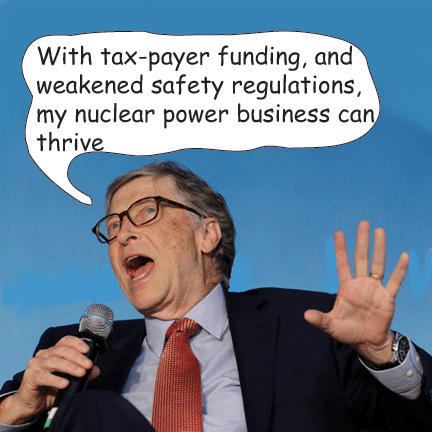
Power companies run by billionaire friends Bill Gates and Warren Buffett
have chosen Wyoming to launch the first Natrium nuclear reactor project on
the site of a retiring coal plant. TerraPower, founded by Gates about 15
years ago, and power company PacifiCorp, owned by Warren Buffett’s
Berkshire Hathaway, said on Wednesday that the exact site of the Natrium
reactor demonstration plant was expected to be announced by the end of the
year.
Nuclear power experts have warned that advanced reactors could have higher risks than
conventional ones. Fuel for many advanced reactors would have to be
enriched at a much higher rate than conventional fuel, meaning the fuel
supply chain could be an attractive target for militants looking to create
a crude nuclear weapon, a recent report said.
Guardian 3rd June 2021
Nuclear energy gets record increase in USA’s Dept of Energy’s budget request,

World Nuclear News , 2 June 21 – The DOE’s budget request totals USD46.2 billion and includes a “record” USD1.85 billion for the Office of Nuclear Energy, which is an increase of over 23% from the enacted budget for FY21. This includes over USD370 million – up 48% from the USD250 million enacted in FY21 – for the Advanced Reactor Demonstration Programme, a cost-shared programme which aims to build two demonstration advanced reactors within the next six years. It also includes USD145 million for the Versatile Test Reactor Project, which aims to provide fast neutron testing capability to aid US development of advanced nuclear reactor technology. This is more than triple the USD45 million enacted for the project in FY21.
Small nuclear reactors pushed for military use,despite their obvious dangers
There are concerns, of course, associated with deploying mobile nuclear reactors to bases or the battlefield. Meltdowns, waste products, and other malfunctions are always a concern with nuclear energy technologies, and if a reactor in a contested area is destroyed by adversary forces, for example, the risk of environmental contamination is high. That, in turn, could create a political disaster for the DOD and United States. Deploying any nuclear systems abroad also incurs the risk of proliferation if those technologies should fall into the wrong hands due to a forward-operating base or convoy being overrun by hostile forces.
Those concerns will no doubt be a major policy consideration when, or if, these mobile reactors ever reach a state of technological readiness to where they can be deployed. New nuclear technologies aren’t the only new energy production and storage systems the DOD is eyeing, however. Revolutionary concepts such as space-based solar power beaming, new forms of hydrogen fuel cells, or even more advanced applications of existing technologies like modular solar generators are all being developed which could revolutionize how the DOD powers its expeditionary forces without the risks associated with nuclear power.

The Military’s Mobile Nuclear Reactor Prototype Is Set To Begin Taking Shape, The Drive BY BRETT TINGLEY JUNE 3, 2021
Project Pele is one potentially revolutionary, albeit controversial, answer to the military’s growing battlefield energy requirements.
The Office of The Secretary of Defense (OSD) has requested $60 million dollars for Project Pele, which is aimed at developing a new, transportable nuclear microreactor to provide high-output, resilient power for a wide variety of Department of Defense (DOD) missions. The DOD hopes to begin working on a prototype reactor design, which will hopefully be able to eventually produce one to five megawatts of electricity and operate at peak power for at least three years, in the next fiscal year.
The request for funding for Project Pele is found in the Pentagon’s proposed budget for the 2022 Fiscal Year, which was released on May 28, 2021. This is the first year that the Office of the Secretary of Defense has asked for money for this program through the larger Advanced Innovative Technologies line item. Previous funding for Pele, also known as the Micro Nuclear Reactor Program, had come through a separate Operational Energy Capability Improvement account in OSD’s budget.
The budget documents say that the goals for Project Pele in the 2022 Fiscal Year are to “complete the design phase and prepare for construction of a 1-5 Megawatt electric transportable nuclear microreactor.” In addition, it notes that “due to the nature of this project, specific applications and detailed plans are available at a higher classification level.”
“The Pele project continues activities initiated under Congressional direction in FY 2020 and FY 2021,” according to the documents. “Congressional Adds [totaling $16 million in the 2021 Fiscal Year] directed for nuclear fuel core development to support the Pele reactor maturation and also funding to support power and thermal management maturation for directed energy weapons.”
………………the Fiscal Year 2022 budget requests says the desired design is as a 1-5 megawatt (MW) nuclear microreactor.
For comparison, the output of the smallest nuclear power plant in the United States, New York’s R.E. Ginna Nuclear Power Plant, is 581 MW. The desired power output is even smaller than most research reactors.
…… The funding for Pele also builds on several other developments, which show that the DOD, DOE, and the National Aeronautics and Space Administration (NASA) are investing heavily in new nuclear technologies to power a new American space age. “Production of a full-scale fourth-generation nuclear reactor will have significant geopolitical implications for the United States,” said Jay Dryer, director of the Strategic Capabilities Office.
……… Building on that document’s goals, a January 2021 Executive Order expanded on the National Space Council document by ordering NASA to deliver a report that defines requirements and foreseeable issues for developing a nuclear energy system to enable human and robotic space missions for the next two decades. The order also included plans for a “Common Technology Roadmap” made among NASA and the Departments of Energy, Defense, Commerce, and State for developing and deploying these new reactor technologies.
Energy security and dominance have become cornerstones of DOD strategy, given the unbelievable amounts of fuel and energy consumed by the power-hungry systems the modern military depends on. U.S. Army leadership has previously stated that it wants its brigades to be self-sufficient for a week without the need for resupply, and there have been previous calls for microreactors that could fit inside existing platforms such as the C-17 Globemaster. Meanwhile, Lockheed Martin and other laboratories continue work on the lofty goal of developing miniaturized fusion reactors…….
There are concerns, of course, associated with deploying mobile nuclear reactors to bases or the battlefield. Meltdowns, waste products, and other malfunctions are always a concern with nuclear energy technologies, and if a reactor in a contested area is destroyed by adversary forces, for example, the risk of environmental contamination is high. That, in turn, could create a political disaster for the DOD and United States. Deploying any nuclear systems abroad also incurs the risk of proliferation if those technologies should fall into the wrong hands due to a forward-operating base or convoy being overrun by hostile forces.
Those concerns will no doubt be a major policy consideration when, or if, these mobile reactors ever reach a state of technological readiness to where they can be deployed. New nuclear technologies aren’t the only new energy production and storage systems the DOD is eyeing, however. Revolutionary concepts such as space-based solar power beaming, new forms of hydrogen fuel cells, or even more advanced applications of existing technologies like modular solar generators are all being developed which could revolutionize how the DOD powers its expeditionary forces without the risks associated with nuclear power. https://www.thedrive.com/the-war-zone/40914/the-militarys-mobile-nuclear-reactor-prototype-is-set-to-begin-taking-shape
President Biden’s budget backs new nuclear weapons, contradicting his policy while campaigning

Biden goes ‘full steam ahead’ on Trump’s nuclear expansion despite campaign rhetoric
The decision to retain a low-yield warhead that was outfitted on submarine-launched ballistic missiles in 2019, and to initiate research into a new sea-launched cruise missile, has sparked an outcry. Politico, By LARA SELIGMAN, BRYAN BENDER and CONNOR O’BRIEN, 06/02/2021
President Joe Biden ran on a platform opposing new nuclear weapons, but his first defense budget backs two controversial new projects put in motion by President Donald Trump and also doubles down on the wholesale upgrade of all three legs of the arsenal.
The decision to retain a low-yield warhead that was outfitted on submarine-launched ballistic missiles in 2019, and to initiate research into a new sea-launched cruise missile, has sparked an outcry from arms control advocates and the progressive wing of the Democratic Party, which is vowing a fight to reverse the momentum.
“The signal this budget is sending is full steam ahead: ‘We like what Trump was doing and we want to do more of it,’’ said Tom Collina, director of policy at the Ploughshares Fund, a leading disarmament group. “It is not the message Biden was sending as a candidate. What we have here is Biden essentially buying into the Trump nuclear plan, in some cases going beyond that.”
Emma Claire Foley, a researcher at Global Zero, a disarmament group, said the latest budget “essentially preserves the priorities of the Trump administration,” despite the new administration’s rhetoric about pursuing a more responsible nuclear posture.
During the 2020 campaign, Biden told the Council for a Livable World, an arms control group, that the current arsenal is “sufficient” and the United States does not need new nuclear weapons. In July 2019, Biden also called Trump’s move to introduce new capabilities a “bad idea.”
The Democratic Party platform in 2020 also bluntly stated that “the Trump Administration’s proposal to build new nuclear weapons is unnecessary, wasteful, and indefensible.”
The Democratic Party platform in 2020 also bluntly stated that “the Trump Administration’s proposal to build new nuclear weapons is unnecessary, wasteful, and indefensible.”
That includes modernizing all three legs of the nuclear triad: the Ground Based Strategic Deterrent, which is the replacement for the fleet of Minuteman III intercontinental ballistic missiles; the Columbia-class ballistic missile submarines; and the new B-21 stealth bomber.
The budget also proposes $609 million for the Long Range Standoff Missile, which is designed to be outfitted on bomber planes. That’s $250 million more than what was projected by the Trump administration for fiscal 2022.
Most controversially, the Pentagon’s request maintains the W76-2 low-yield warhead that is now outfitted on submarines and sets aside $5.2 million for a new sea-launched cruise missile capable of carrying a nuclear warhead. Another $10 million is being requested for the warhead in the budget for the National Nuclear Security Administration, an arm of the Energy Department………….. https://www.politico.com/news/2021/06/02/biden-trump-nuclear-weapons-491631
Bill Gates’ Terra Power nuclear reactors for Wyoming

This is a long article – reads like a handout from Bill Gates. But at the end, they do tack on a little caveat
Nuclear power experts have warned that advanced reactors could have higher risks than conventional ones. Fuel for many advanced reactors would have to be enriched at a much higher rate than conventional fuel, meaning the fuel supply chain could be an attractive target for militants looking to create a crude nuclear weapon, a recent report said.
Bill Gates’ next generation nuclear reactor to be built in Wyoming, Reuters 3 June 21, Timothy Gardner, Valerie Volcovici Billionaire Bill Gates’ advanced nuclear reactor company TerraPower LLC and PacifiCorp (PPWLO.PK) have selected Wyomingto launch the first Natrium reactor project on the site of a retiring coal plant, the state’s governor said on Wednesday.
TerraPower, founded by Gates about 15 years ago, and power company PacifiCorp, owned by Warren Buffet’s Berkshire Hathaway (BRKa.N), said the exact site of the Natrium reactor demonstration plant is expected to be announced by the end of the year. ……….
Biden previously called Submarine-Launched Nuclear Cruise Missile a ”bad idea”, but now it’s in the Budget.

U.S. Navy Funds New Submarine-Launched Nuclear Cruise Missile Biden Called ‘A Bad Idea’ .Forbes, David Hambling, 2 June 21, I’m a South London-based technology journalist, consultant and author Budget documents reveal the U.S. Navy is developing a new nuclear-armed Sea-Launched Cruise Missile, known as SLCM-N. President Biden described the missile as “a bad idea” when campaigning in 2019. Though an
obvious candidate for cancelation, the SLCM-N program is going ahead.
…………………Putting nuclear cruise missile on Virginia-class would be a quick and easy way of ramping up strategic capability. Currently, the only nuclear-armed subs are the fourteen Ohio-class ballistic missile subs, so SLCM-N on Virginia-class would more than double that at a stroke.
But there are downsides.
“Putting nuclear-armed missiles back on the conventional surface or attack submarine fleets of the Navy is a real cause for concern,” says Monica Montgomery, a research analyst at the Center for Arms Control and Non-Proliferation. “Doing so would erode the higher-priority conventional missions of the Navy by reducing the number of conventional missiles each boat could carry and increase the possibility of conflict escalation through miscalculation by blurring the line between conventional and nuclear cruise missiles on these vessels.”
“Putting nuclear-armed missiles back on the conventional surface or attack submarine fleets of the Navy is a real cause for concern,” says Monica Montgomery, a research analyst at the Center for Arms Control and Non-Proliferation. “Doing so would erode the higher-priority conventional missions of the Navy by reducing the number of conventional missiles each boat could carry and increase the possibility of conflict escalation through miscalculation by blurring the line between conventional and nuclear cruise missiles on these vessels.”
“Reversing the Trump administration’s plan to pursue a nuclear SLCM should be an easy choice,” Reif says.
Reif describes the SLCM-N as “a costly hedge on a hedge” – an extra backup for an already extensive and growing nuclear arsenal – making it a pointless extravagance.
Reif also notes that the nuclear capability will come at the expense of urgently needed conventional weapons.
“Arming such vessels with nuclear cruise missiles would also reduce the number of conventional missiles each boat could carry, at a time when Pentagon leaders argue that strengthening conventional deterrence is their top priority in the Asia-Pacific,” says Reif.
Biden himself noted that fielding low-yield weapons as alternatives to more powerful ballistic missiles would make the U.S. “more inclined to use them” and increase the risk of a nuclear war.
The SLCM-N project is starting small, just $15.2 million in this year’s budget compared to the billions for other nuclear programs. But if the analysts are right, the U.S. Navy is buying trouble rather than new capability. https://www.forbes.com/sites/davidhambling/2021/06/02/us-navy-funds-new-submarine-launched-nuclear-cruise-missile-biden-called-a-bad-idea/?sh=405441c022b2
“Unqualified” —who is allowed to talk about nuclear power ?

Who is allowed to talk about nuclear power?
“Unqualified” — Beyond Nuclear International Nuclear trolls turn on the aggression as industry collapses around them
By Linda Pentz Gunter, 31 May 21, “My advice is to look out for engineers. They begin with sewing machines and end up with nuclear bombs.” Marcel Pagnol
My normal rule of thumb is to ignore the unrelenting pro-nuclear trolls who pepper our sites with incessant nay-saying and, occasionally ad hominem name-calling. After all, they have only one goal in mind — other than to get up one’s nose — which is to dominate and thereby control the narrative.
But recently, a recurring theme has emerged which needs addressing, because it speaks to who is allowed to talk about nuclear power.

In the view of the trolls, if you have no scientific credentials, you are unqualified to comment on nuclear power. In my case, because I have a degree in English literature, albeit garnered many decades ago, I have, according to the trolls, no authority to expound on the negatives of nuclear anything.
There are some rather obvious flaws in this argument, the first being that it pre-supposes the human brain is incapable of learning anything new after the age of 21.
But it also exemplifies the theme of a recent conference held virtually in Linz by three Austrian anti-nuclear groups which examined the “Atomic Lie.” How has this lie been perpetuated? Answer: by those who promote the nuclear power industry anointing themselves as the only authority deemed knowledgeable enough to either comment about it or make decisions on its use and safety.
What kind of a world we will end up with if, heaven forfend, we allow only engineers to decide what is in our best interest (with all due respect to my friends who are engineers and who, I suspect, would be the first to agree)? Hence the Pagnol quote at the top of this page.
This would mean, for example, that the Western Shoshone should have no say in the fate of the land in Nevada they steward, because nuclear engineers have decided it is perfectly alright to dig a big hole in the volcanic ground and bury nuclear waste there.
It would mean that Marshall Islanders should have nothing whatever to say about the generations of cancers and birth defects they have suffered as the unwilling guinea-pigs of atomic “testing,” because after all it was scientists who decided that it was perfectly alright to detonate 67 atomic bombs there and obliterate islands………..
This intent to dominate the narrative — in our case the nuclear power one — and silence critics, was aptly described by Arnie Gundersen in his presentation during the Linz conference. He talked about the origins of the nuclear cabal — under its alias, Atoms for Peace — in which its originator, President Dwight D. Eisenhower, described the program as solving “‘the fearful atomic dilemma’ by finding some way in which the ‘miraculous inventiveness of man’ ‘would not be dedicated to his death, but consecrated to his life’”.
Gundersen looked up the Oxford Dictionary definition of “consecrate” and found it to mean “to make sacred or declare sacred; dedicate formally to a religious or divine purpose.”

This nuclear priesthood into which believers were ordained did not welcome skeptics gladly, however. Quite the reverse. When Gundersen, a nuclear insider at the time, blew the whistle on a safety issue, he was told to his face that “in this business, you’re either with us or against us, and you just crossed the line.” He was not only fired but persecuted in further attempts to silence him.
Luckily for our movement, the nuclear inquisition was largely unsuccessful in this latter endeavor, but it came at a steep price for Gundersen and his family personally.
As evidenced by Gundersen’s experience, these attacks are by no means restricted to us “lay” advocates, but they have grown observably more vitriolic. This disturbing trend was flagged recently by Andy Stirling of the Science Policy Research Unit at the University of Sussex in the UK, responding to an aggressive critique of an article he co-authored in Nature Energy.
His detractor, Jeremy Gordon, “goes beyond pejorative labelling to actively ridicule any position not in-principle supportive of nuclear power,” Stirling wrote in a letter published in Nuclear Engineering International. “This is exemplified by Gordon’s intemperate ad hominem attack on my fellow author (the globally leading energy scholar Benjamin Sovacool).” Stirling concludes that it is “reasoned policy discourse that forms the lifeblood of democracy itself”.
We are a grand collective of experts. We do have scientists and engineers —Gundersen is one — to whom we can turn in order to unravel the deeper complexities of the workings of nuclear power plants or uranium mines or reprocessing facilities. But it is not the only dimension that matters. So we need Indigenous people, and writers, and lay advocates, and economists, and historians, and artists, and humanitarians to tell this story and set the agenda, too.
Even if it is rocket science, rocket scientists aren’t the only ones who count when decisions are made about whether to put missiles into space or send a nuclear-powered probe to Mars.
As Pagnol implied, when you leave it to the scientists and engineers, you get a Manhattan Project, where consciences pricked far too late. Imagine if humanitarian voices had held sway inside Los Alamos. Would things have turned out differently?
The Japanese mothers, evacuated from Fukushima, who shout on street corners through bullhorns about their experiences, warning Japan never to re-embrace nuclear power, don’t hold engineering degrees. But they know a lot more about the real, lived consequences of using nuclear power than any of the nuclear industry trolls.
Those voices of truth need to be heard, along with those who practice sound science and honest engineering and who are willing to call out the dangers, not control the lies.
It’s one thing to have command of the facts, which of course we must. But it’s another to accompany these with a hefty dose of integrity. And that’s what we are here for, even if we can quote Shakespeare while we are doing it.
Linda Pentz Gunter is the international specialist at Beyond Nuclear and writes for, curates and edits Beyond Nuclear International. https://beyondnuclearinternational.org/2021/05/30/unqualified/
-
Archives
- May 2026 (62)
- April 2026 (356)
- March 2026 (251)
- February 2026 (268)
- January 2026 (308)
- December 2025 (358)
- November 2025 (359)
- October 2025 (376)
- September 2025 (257)
- August 2025 (319)
- July 2025 (230)
- June 2025 (348)
-
Categories
- 1
- 1 NUCLEAR ISSUES
- business and costs
- climate change
- culture and arts
- ENERGY
- environment
- health
- history
- indigenous issues
- Legal
- marketing of nuclear
- media
- opposition to nuclear
- PERSONAL STORIES
- politics
- politics international
- Religion and ethics
- safety
- secrets,lies and civil liberties
- spinbuster
- technology
- Uranium
- wastes
- weapons and war
- Women
- 2 WORLD
- ACTION
- AFRICA
- Atrocities
- AUSTRALIA
- Christina's notes
- Christina's themes
- culture and arts
- Events
- Fuk 2022
- Fuk 2023
- Fukushima 2017
- Fukushima 2018
- fukushima 2019
- Fukushima 2020
- Fukushima 2021
- general
- global warming
- Humour (God we need it)
- Nuclear
- RARE EARTHS
- Reference
- resources – print
- Resources -audiovicual
- Weekly Newsletter
- World
- World Nuclear
- YouTube
-
RSS
Entries RSS
Comments RSS
 nuclear-news