Renewable energy consumption grew in 2020 as fossil fuels and nuclear shrank.

Sunrise brief: Renewable energy consumption grew in 2020 as fossil fuels and nuclear shrank, PV Magazine , 17 June 21,
Also on the rise: Black & Veatch unit sets financing for 137 MW Texas project, Rockefeller Foundation partners to fund distributed renewable projects in Africa, and DroneBase closes a funding round as it expands its solar presence.JUNE 16, 2021 DAVID WAGMAN Consumption of renewable energy grew for the fifth year in a row in 2020, reaching a record high of 11.6 quadrillion British thermal units (Btu), or 12% of total U.S. energy consumption.
The Energy Information Administration (EIA) reported the data and said that renewable energy was the only source that increased in 2020 from 2019; fossil fuel and nuclear consumption declined.
Hydroelectric power accounted for about 22% of U.S. renewable energy consumption. Consumption has remained relatively flat since the 1970s, but fluctuates with seasonal rainfall and drought conditions.
Financing set for Texas solar project
Black & Veatch unit Diode Ventures said it reached financial close on the Grizzly Ridge Solar Project, a 137.7 MW solar project located in Hamilton County, Texas, southwest of Fort Worth. The project was co-developed with RKB Energy. Details of the financing were not disclosed.
Once complete, Grizzly Ridge will provide energy to the ERCOT North Zone, a growing economy and power market where there is high demand for all forms of electricity.
The project has an executed interconnection agreement with Brazos Electric Cooperative, the transmission service provider. The area will undergo an upgrade from 69 kV to 138 kV. Diode also is in discussions to add an on-site battery energy storage system to the project.
Rockefeller Foundation partners to bolster renewables
The International Finance Corp., the private sector arm of the World Bank Group, and The Rockefeller Foundation announced a partnership to deploy $150 million of capital in blended finance to leverage up to $2 billion of private sector investment in distributed renewable energy.
The two will prioritize countries in Sub-Saharan Africa and other regions, where both organizations have identified immediate opportunities.
By blending philanthropic and private investment funding, the Rockefeller Foundation and IFC hope to de-risk capital investment in distributed renewable projects in emerging markets and help to address global energy access needs.
An initial “rapid deployment” phase will distribute $30 million in blended concessional finance and grant capital to leverage an active pipeline of distributed renewable energy projects developed by IFC. The funding will go toward IFC’s prototype scaling mini-grid program in addition to distributed renewable energy generation, battery energy storage, and other clean energy technologies to facilitate access………. https://pv-magazine-usa.com/2021/06/16/sunrise-brief-renewable-energy-consumption-grew-in-2020-as-fossil-fuels-and-nuclear-shrank/
Countering a love letter to the nuclear industry

We’re not in the business of debating paid shills.
Countering a love letter to the nuclear industry https://thecoastnews.com/commentary-countering-a-love-letter-to-the-nuclear-industry/by commentaryJune 18, 2021
By Bart Ziegler
In his May 27 commentary, “Correcting the record on SONGS,” Al Bates writes a love letter to the nuclear industry. Bates fiercely defends the safety measures at San Onofre’s nuclear waste storage facilities. This impassioned defense comes from — you guessed it — a career man in the nuclear industry who took that nuclear engineering degree straight to San Onofre for a job starting in 1980.
We’re not in the business of debating paid shills.
But we stand by the point we made in April to the Encinitas Environmental Commission — that San Onofre needs a facility where nuclear waste canisters can be repaired and replaced without exposing the environment to deadly, radioactive contamination.
This month, to Protect Our Coast, we are bringing Southern California Edison and the California Coastal Commission to court to demand such a facility. Call it a Plan B. Find out how you can support this case by visiting our website.
While Bates and company are quick to obfuscate with technical hairsplitting, we present simple truths:
- Edison is storing 3.6 million pounds of spent nuclear fuel just 100 feet from the ocean;
- Sea levels are rising;
- Climate change increases risks associated with nuclear waste storage;
- Waste canisters at San Onofre are prone to corrosion and cracking;
- No one has a plan to move the waste; and
- Scientific information that Bates says we’re missing can be found on our website.
Learn more at www.samuellawrencefoundation.org. Bart Ziegler is president of the Samuel Lawrence Foundation.
Tough when even a pro nuclear voice has to deplore the corruption in the nuclear industry
FirstEnergy Scandal Could Do Irreparable Harm To Nuclear Power. Forbes , 16 June 21,
Ohio’s Republican-dominated state legislature stood firm against its former speaker of the house: Rep. Larry Householder, who was indicted last July along with others for allegedly taking bribes to protect the state’s nuclear power industry. Two of the accused have already pled guilty. The beneficiary of the $1 billion state bailout, FirstEnergy FE-1.6% Corp., is reportedly in talks with prosecutors.
Unfortunately for the nuclear industry, this event cannot be viewed in isolation: it will have a rippling effect that will no doubt jar an industry that is perpetually trying to regain its balance. Once the case fully comes to light, the fallout from it could be much worse than any preceding event — a reference to Three Mile Island and the San Onofre Nuclear Station in Southern California,
“FirstEnergy also admits it paid $250,000 to Generation Now in March of 2017″ when the alleged scheme began, says the Energy and Policy Institute. Altogether, the utility admits to paying $56.6 million. “Longstreth and Generation Now were both indicted alongside Householder last year, and have since pleaded guilty to participating in a racketeering conspiracy.”
Prosecutors allege that “Company A” is at the heart of the matter — an entity that everyone knows: FirstEnergy. It is now alleged to have taken monies from its regulated transmission and distribution units in multiple states and to have given it to this shadowy group called Generation Now. ………
At issue is an Ohio law calling for a $1.3 billion rescue package — a measure that essentially taxes every electricity consumer and then directs that money to bail out FirstEnergy’s nuclear operations. The $60 million alleged bribes also helped beat back a voter initiative that would have thrown out that law.
The Damage Done
FirstEnergy, realizing this event has soiled its reputation, fired some key executives — ranging from the ethics officer to the chief executive officer, Charles Jones. Prosecutors alleged that Jones and Householder had 84 phone contacts between 2017 and 2019. While both men deny wrongdoing, FirstEnergy’s annual financial filings said that it was discussing a “deferred prosecution” — an agreement in which prosecutors grant amnesty if certain requirements are met. For starters, the utility would have to pay back customers for the monies it took from them and then misappropriated.
“This is likely the largest bribery, money laundering scheme ever perpetrated against the people of the state of Ohio,” said then-U.S. Attorney David DeVillers, at the time of the indictments. “This was bribery, plain and simple. This was a quid pro quo. This was pay to play.” The prosecution alleges that the payments were tantamount to “bags of cash” that went unregulated and unreported. …..
U.S. wants nuclear deal done before Iran’s new president takes power
U.S. wants nuclear deal done before Iran’s new president takes power, Dave Lawler Axios, 17 June 21, The Biden administration wants to finalize a deal with Iran to return to the 2015 nuclear deal in the six weeks remaining before a new Iranian president is inaugurated, a U.S. official tells Axios.
Key quote: The official said it would be “concerning” if talks dragged on into early August, when Iran’s transition is due to take place. “If we don’t have a deal before a new government is formed, I think that would raise serious questions about how achievable it’s going to be,” the official said.
Driving the news: Conservative judiciary chief Ebrahim Raisi, a close ally to Supreme Leader Ali Khamenei, is the clear favorite to win Friday’s presidential election in Iran. No prominent members of the reformist camp were permitted to run, meaning the more moderate President Hassan Rouhani will almost certainly hand power to a hardliner.
- Analysts and some diplomats involved in the negotiations have long said it would be easier to reach a deal with the outgoing administration than with a newly inaugurated government, particularly one led by Raisi.
- Six rounds of talks have been held so far in Vienna, with the U.S. not in the room but negotiating indirectly through EU intermediaries.
State of play: Iran’s top negotiator, Abbas Araghchi, said this week that while a deal wouldn’t be possible in the current round of talks, Iran had no interest in “wasting time” and the elections wouldn’t be a factor………….https://www.axios.com/us-iran-nuclear-deal-talks-raisi-inauguration-ed00555e-db84-4d26-9e2b-1ad8b21f9fc5.html
The real welfare cheats are weapons makers.
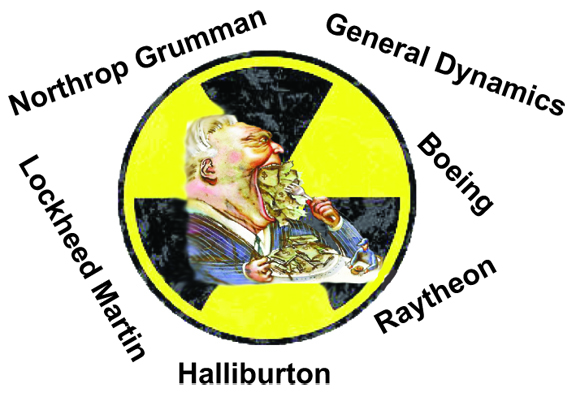
We’re squabbling over Social Security, while the government lavishes infinitely more money on the arms industry. The Nation, By Rebecca Gordon 16 June 21, ”……………………………..President Joe Biden remains super-glued to the same old post–World War II agreement between the two major parties: They can differ vastly on domestic policies, but they remain united when it comes to projecting US military power around the world and to the government spending that sustains it. In other words, the US “national security” budget is still the third rail of politics in this country…………………………….

WELFARE FOR WEAPONS MAKERS
Of course, there’s a second high-voltage, untouchable rail in American politics and that’s funding for the military and weapons manufacturers. It takes a brave politician indeed to suggest even the most minor of reductions in Pentagon spending, which has for years been the single largest item of discretionary spending in the federal budget.
It’s notoriously difficult to identify how much money the government actually spends annually on the military. President Trump’s last Pentagon budget, for the fiscal year ending on September 30, offered about $740 billion to the armed services (not including outlays for veteran services and pensions). Or maybe it was only $705.4 billion. Or perhaps, including Department of Energy outlays involving nuclear weapons, $753.5 billion. (And none of those figures even faintly reflected full national security spending, which is certainly well over a trillion dollars annually.)
Most estimates put President Biden’s 2022 military budget at $753 billion—about the same as Trump’s for the previous year. As former Senator Everett Dirksen is once supposed to have said, “A billion here, a billion there, and pretty soon you’re talking real money.”
Indeed, we’re talking real money and real entitlements here that can’t be touched in Washington without risking political electrocution. Unlike actual citizens, US arms manufacturers seem entitled to ever-increasing government subsidies—welfare for weapons, if you like. Beyond the billions spent to directly fund the development and purchase of various weapons systems, every time the government permits arms sales to other countries, it’s expanding the coffers of companies like Lockheed-Martin, Northrup-Grumman, Boeing, and Raytheon Technologies. The real beneficiaries of Donald Trump’s so-called Abraham Accords between Israel and the majority Muslim states of Morocco, the United Arab Emirates, Bahrain, and Sudan were the US companies that sell the weaponry that sweetened those deals for Israel’s new friends.
When Americans talk about undeserved entitlements, they’re usually thinking about welfare for families, not welfare for arms manufacturers. But military entitlements make the annual federal appropriation of $16.5 billion for Temporary Aid to Needy Families (TANF) look puny by comparison. In fact, during Republican and Democratic administrations alike, the yearly federal outlay for TANF hasn’t changed since it was established through the 1996 Personal Responsibility and Work Opportunity Reconciliation Act, known in the Clinton era as “welfare reform.” Inflation has, however, eroded its value by about 40 percent in the intervening years.
And what do Americans get for those billions no one dares to question? National security, right?
But how is it that the country that spends more on “defense” than the next seven, or possibly 10, countries combined is so insecure that every year’s Pentagon budget must exceed the last one? Why is it that, despite those billions for military entitlements, our critical infrastructure, including hospitals, gas pipelines, and subways (not to mention Cape Cod steamships), lies exposed to hackers?
And if, thanks to that “defense” budget, we’re so secure, why is it that, in my wealthy home city of San Francisco, residents now stand patiently in lines many blocks long to receive boxes of groceries? Why is “national security” more important than food security, or health security, or housing security? Or, to put it another way, which would you rather be entitled to: food, housing, education, and health care, or your personal share of a shiny new hypersonic missile?
But wait! Maybe defense spending contributes to our economic security by creating, as Donald Trump boasted in promoting his arms deals with Saudi Arabia, “jobs, jobs, jobs.” It’s true that spending on weaponry does, in fact, create jobs, just not nearly as many as investing taxpayer dollars in a variety of far less lethal endeavors would. As Brown University’s Costs of War project reports:
And if, thanks to that “defense” budget, we’re so secure, why is it that, in my wealthy home city of San Francisco, residents now stand patiently in lines many blocks long to receive boxes of groceries? Why is “national security” more important than food security, or health security, or housing security? Or, to put it another way, which would you rather be entitled to: food, housing, education, and health care, or your personal share of a shiny new hypersonic missile?
Rebecca GordonRebecca Gordon, a TomDispatch regular, teaches in the philosophy department at the University of San Francisco. She is the author of American Nuremberg: The U.S. Officials Who Should Stand Trial for Post-9/11 War Crimes (Hot Books, April 2016). Her previous books include Mainstreaming Torture: Ethical Approaches in the Post-9/11 United States and Letters from Nicaragua.
https://www.thenation.com/article/economy/the-real-welfare-cheats-are-war-profiteers/
Why Utah really does not need Bill Gates’ small nuclear reactors

What Bill Gates and co. would like us to forget is that even the these geewhiz new small reactors are still based on that old carbon-releasing fuel chain –
Yes, there is a need to clean up our power generation to curb climate change — the sooner the better. But Williams points to a recent study that determined the lifecycle emissions with nuclear — mining, milling, transporting and storing the fuel and building and decommissioning the plants — far exceed other alternative energy sources.
Cox is eager for a nuclear future. Utahns should tell him why we’re not, says Robert Gehrke, https://www.sltrib.com/news/politics/2021/06/14/cox-is-eager-nuclear/ With safer, cleaner, cheaper alternatives, nuclear power may not make the most sense for Utah, By Robert Gehrke , June 15, 2021,
In Wyoming last week, an announcement was made that could mark a resurgence in the long-stymied nuclear energy industry.
Officials announced plans to build a new 345 megawatt nuclear power plant in the state that could, at its peak, generate enough electricity for all of the households in Wyoming with room to spare.
What makes this announcement different is the array of power players behind the project. It’s a partnership between Warren Buffett-owned Pacificorp and Bill Gates-owned Terrapower that has the backing of President Joe Biden’s Energy Department and Wyoming Gov. Mark Gordon.
It also has the support of Utah Gov. Spencer Cox, who praised the project as “a huge announcement” that “will have big implications for Utah in the future.”
“We look forward to similar partnerships in the years to come,” the governor said.
It’s not necessarily a new position. Cox’s predecessor, Gov. Gary Herbert, supported nuclear energy, as did his predecessor, Gov. Jon Huntsman.
But the Wyoming announcement ups the stakes dramatically, moving it from concept to something more concrete and forcing Utahns to confront critical questions nagging nuclear power: Is it safe? Is it cost-effective? And is it right for Utah?
Safety has always been the issue dogging nuclear power. Whether it’s Three Mile Island or Chernobyl or Fukushima, you surely have some nuclear disaster as a touchstone framing you perception of the energy.
The good news, according to Michael Simpson, chair of the Material Science and Engineering department at the University of Utah, is that the Natrium reactors that Terrapower hopes to build in Wyoming are generally safer than the old water-cooled reactors.
The Terrapower plant would be cooled with sodium, which transfers heat better than water, meaning it is less likely to melt down (like Chernobyl) or explode (like Fukushima).
Years ago, Simpson said, researchers at the Idaho National Laboratory did an experiment with a sodium-cooled reactor where they shut off the sodium coolant and instead of heating, the reactor slowly cooled and the reaction stopped.
Others dispute the safety claims, however. Earlier this year, the Union of Concerned Scientists issued a report that said the sodium reactors are unproven and raise other safety issues — for example, the sodium can burn if exposed to air.
“When it comes to safety and security, sodium-cooled fast reactors and molten salt-fueled reactors are significantly worse than conventional light-water reactors,” said Edwin Lyman, director of nuclear power safety for UCS.
Then there is the waste issue. The proponents of the sodium reactors contend that they would burn more of the fuel, producing less waste. Again, UCS disputes that and argues the waste that would be generated would pose nuclear proliferation and possible terrorism risks.
Then there’s the economics of nuclear power.
Recently, South Carolina completely scrapped a water-cooled nuclear plant that had been in the works for years. Some $9 billion was squandered sparking lawsuits by investors and ratepayers demanding their money back.
Rocky Mountain Power’s own figures released in 2019 put the cost of nuclear power at $95 per megawatt hour, compared to around $25 to $30 per hour for solar. Some cost projections are lower, some are higher, but none put nuclear in the same ballpark as solar, raising the obvious concern that we’ll be on the hook for the added expense one way or another — either as ratepayers or as taxpayers subsidizing the more costly power source.
There’s also a larger question, according to Scott Williams, executive director of HEAL Utah, an environmental group that has opposed nuclear power: Do we need it?
Yes, there is a need to clean up our power generation to curb climate change — the sooner the better. But Williams points to a recent study that determined the lifecycle emissions with nuclear — mining, milling, transporting and storing the fuel and building and decommissioning the plants — far exceed other alternative energy sources.
But the TerraPower reactor isn’t expected to come online until 2028 and, as we saw in South Carolina, when it comes to building nuclear power plants, the projections often are unrealistically optimistic.
With battery technology improving and rooftop solar expanding and getting cheaper, there’s no reason to gamble on nuclear, Williams said, other than centralized generation benefits Rocky Mountain’s shareholders.
“It just doesn’t make sense,” he said. “If you’re looking at it objectively, to say it’s better to put a bunch of money into a technology that not only isn’t proven, but has been proven to fail time and time again.”
And we have to take into account our state’s history with nuclear energy that is nothing short of radioactive itself, from the miners and uranium mill workers sickened by their exposure to radiation, to the thousands upon thousands of Utah Downwinders stricken with various cancers as a result of nuclear weapons testing in Nevada, to the decade-long battle to beat back a nuclear waste storage facility in Utah’s desert.
So do we scrap the whole nuclear idea? Not necessarily.
But if Utah wants to venture down the nuclear energy path, these questions and a host of others have to be thoroughly researched and addressed. We’re not there yet and until we are, the cheerleading from the Biden administration and Gov. Cox feels premature.
50 Years After Pentagon Papers, Ellsberg Reveals U.S. Weighed 1958 Nuclear Strike on China over Taiwan,
50 Years After Pentagon Papers, Ellsberg Reveals U.S. Weighed 1958 Nuclear Strike on China over Taiwan, Democracy Now, JUNE 14, 2021,
As President Biden meets with leaders of NATO countries, where he is expected to continue stepping up rhetoric against China and Russia ahead of his meeting with Russian President Vladimir Putin this Wednesday in Geneva, we speak with famed Pentagon Papers whistleblower Daniel Ellsberg about why he recently released another classified document showing that U.S. military planners in 1958 pushed for nuclear strikes on China to protect Taiwan from an invasion by communist forces.
The top-secret study revealed the U.S. military pressed then-President Dwight Eisenhower to prepare a nuclear first strike against mainland China during the Taiwan Strait crisis of 1958. Taiwan “could really only be defended, if at all, by the U.S. initiating nuclear war against China,” says Ellsberg. The document also shows that U.S. military planners were ready to accept the risk that the Soviet Union would launch its own nuclear retaliation, including against Japan. Although Ellsberg’s online release of the document was publicized in May, he reveals that he shared the same information with Japan decades earlier. “I had given the entire study to the Japanese Diet,” Ellsberg says.
Transcript…………………..
https://www.democracynow.org/2021/6/14/daniel_ellsberg_leak_us_nuclear_plans
The military-industrial-media complex renders the American populus ill-informed in matters regarding war .

[and – it’s the same i Australia C.M.]
“How real is all this influence? Does the military-industrial-media complex (MIMC) actually affect the information we receive and our perception of war?”
The military-industrial-media complex renders the American populus ill-informed in matters regarding war — Rise Up Times
“The media has been a major player in ‘hyping up’ the sense of danger and need for military action in many situations.” https://wordpress.com/read/feeds/34005311/posts/3390423975
By HELEN JOHNSON The Miscellany News, Vassar College May 20, 2021
This is the fifth article in a five-part series about the military-industrial-media complex. The fourth article,“The (im)proper meshing of the corporate media and the military-industrial complex,” can be found here.
I have now examined the military-industrial complex (MIC) and the corporate media each individually; explained how the MIC has expanded to include not only the arms makers, Congress and the military, but also oil companies, service and equipment providers, surveillance and technology companies and think tanks; examined how the consolidation of corporate power within the media industry has resulted in a handful of companies controlling 90 percent of our media, and how these huge corporations hold incredible political power, not just to influence politicians and legislation directly, but to subtly shape entire ideologies. In this installment, I illustrated how the corporate media is linked in many ways to the MIC, including through outright ownership, interlocking directorates, revolving doors and overreliance on the government and the military for information and access to the battlefield during war.
But how real is all this influence? Does the military-industrial-media complex (MIMC) actually affect the information we receive and our perception of war? In this article I’ll explain that yes, because of its enormous reach, the extreme consolidation of its power and its entanglement with the gigantic machine that is the MIC, the media today has failed to properly inform the American citizenry on matters concerning war. The MIMC manufactures pro-military opinion among the public; suppresses information relevant to military activities; provides a sanitized coverage of war; fails to investigate, criticize, or thoroughly debate issues of military involvement; too easily bends to pressure from government and military officials and sometimes even spreads outright lies and false information.
This has resulted in an American populus that, in general terms, is ill-informed, uneducated and misled in matters regarding military involvement, as well as overly militaristic and pro-war. Americans are thus unable to hold their government accountable for unnecessary or inappropriate use of military force, and are complicit in the perpetuation of American imperialism, colossal defense budgets that strip the country of severely lacking social programs and never-ending wars that kill and destroy while a handful of corporations reap immense profits.
The media has been a major player in ‘hyping up’ the sense of danger and need for military action in many situations. Douglas Kellner—American academic and sociologist—explains in his book, Media Spectacle and the Crisis of Democracy: Terrorism, War and Election Battles, how Sept. 11 was a prime example of the media spreading hysteria and fear among an already panicked and traumatized nation. He notes how the media obsessively focused on terrorism, possible threats and retaliation in the weeks and months after Sept. 11. It also handed a megaphone to extremism and did little to weed out the potentially dangerous or incorrect information being spread on its platforms.
Spreading hysteria and panic throughout the population had two effects: First, it made Americans feel heavily reliant on the government for protection and, according to Kellner, made any disagreement with or questioning of the Bush administration seem “unpatriotic and even treasonous.” Second, it was extremely profitable for the media companies themselves; with millions of eyes glued to TVs, newspapers and other media platforms, media consumption spiked and profits went up. Thus, the corporate media and the military-industrial complex both benefited from this collaboration……………
An important note here is that this type of behavior is by no means limited to right-wing or conservative news outlets. In its analysis, FAIR cited The New York Times, The Hill, the Associated Press, and The Washington Post—in addition to Fox News—as all contributing to this culture of hysteria. A separate FAIR article’s headline directs a pointed accusation at CNN: “CNN’s Iran Fearmongering Would Make More Sense Coming Directly From Pentagon.” No mainstream media outlet is innocent of pro-war fear mongering.
The media has also suppressed or downplayed information relevant to military activity on multiple occasions. For example, although the media did everything in their power to vilify Iraq and Saddam Hussein in the lead-up to and during the Iraq war, they completely ignored how the United States backed Hussein in the past. The United States played an integral role in Hussein’s rise to power and actively supported Iraq during the Iran-Iraq War—including going along with Hussein’s use of chemical weapons. However, this seemed to be irrelevant once Bush Jr. had made up his mind to invade Iraq.
Another instance of the U.S. media suppressing or failing to report information came during the middle of the Iraq War in 2004. On Jun. 28, 2004, the United States transferred sovereignty of Iraq in a secret ceremony, immediately after which Paul Bremer—who had been seen by Iraqis as a dictator—left the country. Bremer had heavily controlled Iraqi politics and privatized a huge portion of the economy, including handing out contracts to American firms like Halliburton. However, Bremer’s replacement wasn’t much better. The U.S. chose Ayad Allawi, who had ties to the CIA, to serve as interim prime minister until elections could be held, and the U.S. handpicked the rest of the Iraqi council as well. The two months following the transfer of power saw escalated violence and a continuation of the chaos that had been produced by Bremer.
But watching the news in the United States, you would think “we had turned a corner,” as President Bush repeated over and over again. If the media had thoroughly reported on the situation in Iraq, it could have led to a nationwide understanding that the war was doing more harm than good and serving the interests of huge corporations at the expense of American and Iraqi lives. A truly informed citizenry could have put public pressure on the Bush administration to end the war, or an electorate dissatisfied with the situation could have voted him out of office. Instead, it would be seven more years before the withdrawal of American troops from Iraq.
Suppressing or downplaying information isn’t the only way the mainstream media—in complicity with the MIC—has warped our understanding of war. The media also produces an extremely sanitized coverage of war: it avoids printing and broadcasting images of death and destruction; sidesteps discussions of American casualties and almost entirely refuses to mention casualties on the other side (which are usually much higher); and uses euphemisms like “collateral damage” and “air campaign” that hold very different connotations from what these phrases actually mean—i.e., innocent civilian death and continuous bombing.
Kellner notes that during the Iraq war, “Entire networks like Fox and the NBC cable networks provided little but propaganda and jingoism, as did for the most part CNN. All of the cable networks, as well as the big three U.S. broadcasting networks, tended to provide highly sanitized views of the war, rarely showing Iraqi casualties, thus producing a view of the war significantly different than that shown in other parts of the world.”……………….
Not only do reporters and news anchors oftentimes receive direct instructions from higher-ups on what to and what not to say, but there is also careful screening of experts and guests brought onto the TV networks during wartime. And, as noted in my previous article, many of these “experts” are former generals and Pentagon officials, whose talking points have been carefully scripted and who have been trained on how to speak about matters of war in order to paint the U.S. military and government in the best possible light.
The U.S. corporate media has also chronically failed to properly investigate, criticize and debate issues of war and military involvement. It tends to take the current administration’s account of the situation as fact, and during times of war or military tension, it is branded unpatriotic to criticize the government. Although there are many examples of the media’s failure to investigate and report the truth when it comes to war, the most egregious case was in the lead-up to the invasion of Iraq.
George W. Bush and Dick Cheney had planned from day one of their administration to invade Iraq. As explained in this article, Bush and Cheney—as well as Paul Wolfowitz, Donald Rumsfeld and others in and around the Bush administration—were either directly a part of or tangentially related to the neoconservative think tank PNAC, which was advocating for a regime change in Iraq as early as 1998. The fact that Bush planned to invade Iraq from the get-go has been confirmed by multiple officials close to the administration.
From the immediate aftermath of Sept. 11 up until the 2003 invasion of Iraq, the Bush administration waged a propaganda war to convince the nation that Saddam Hussein was linked to Al Qaeda and that he possessed weapons of mass destruction (WMD). These claims turned out to be false. Not only did Saddam Hussein have nothing to do with the Sept. 11 attacks, but Iraq was not in possession of WMD nor were they in the process of making any.
Even so, these allegations were widely circulated in the mainstream media. The nonpartisan Center for Public Integrity documented a total of 935 false statements made by top administration officials regarding the threat from Iraq before the war, and the majority of these assertions “were broadcast widely by U.S. media with little or no investigation of their credibility, and few rebuttals from war skeptics or dissenters.”
Not only did the media outlets completely fail to properly investigate these claims before broadcasting them to the nation—even The Washington Post and The New York Times admitted that they had uncritically published information fed to them by the Bush administration—but they continued to circulate the misinformation long after it had been disproven. Even after ABC, NBC and The Washington Post reported that the claims were false, Fox Television and other U.S. cable networks continued to play the stories about Iraq’s alleged connection with Al Qaeda and supposedly threatening weapons program.
The Bush administration had accomplished its goal: to convince enough of the American population, still reeling and traumatized from Sept. 11, that Saddam Hussein was dangerous—so that they could have their war. The failure on the part of the corporate media to investigate and criticize the Bush administration’s claims, and the continued circulation of these claims even after they were proven false, would lead to a disastrous eight-year long conflict resulting in hundreds of thousands of deaths.
There are many, many more instances of skewed reporting when it comes to war and military involvement. Not all of these instances involve outright lying to the American public or regurgitating government pro-war propaganda; many of the ways in which the corporate media influences our perception of war are small and relatively unnoticeable……….. more https://riseuptimes.org/2021/06/12/the-military-industrial-media-complex-renders-the-american-populus-ill-informed-in-matters-regarding-war/
A nuclear plant in a volcano zone? What could possibly go wrong, Mr Gates?

A nuclear power plant, built in partnership with two of the world’s most notorious egoists with funding from questionable sources, using technology developed in tandem with the Chinese, and sited on one of the most active seismic systems on the planet. What could possibly go wrong?
A nuclear plant in a volcano zone? What could possibly go wrong, Mr Gates? ht tps://www.conservativewoman.co.uk/a-nuclear-plant-in-a-volcano-zone-what-could-possibly-go-wrong-mr-gates/ By Kate Dunlop June 11, 2021 NOT content with being the biggest private landowner in the US, blotting out the sun and jabbing the world, Bill Gates is getting over his divorce by building a ‘next-generation’ nuclear power plant in Wyoming.
The Republican state’s governor Mark Gordon announced the deal between Gates’s TerraPower Company, PacifiCorp owned by Warren Buffett’s Berkshire Hathaway, and the US government on June 2.
He said the multi-billion-dollar project, called ‘Natrium’, is to be constructed on the site of a ‘soon-to-be-retired coal-fired plant over the next several years’. TerraPower President Chris Levesque said costs would be split evenly between government and the two billionaires.
No information has been published about the contractual elements of the deal or the likely rate of return to Messrs Gates and Buffett but this is a ‘commercial not a charitable’ effort.
According to the press release, the nuclear plant will feature a 345-megawatt sodium-cooled fast reactor with a molten salt-based energy storage system, which will produce enough power for 250,000 homes. New storage technology will be able to boost output to 500 megawatts of power for about five and a half hours, equivalent to the energy needed to power 400,000 homes.
Wyoming is both a leading coal mining and uranium mining state, and Governor Gordon promised that the development did not signal any lack of commitment to fossil fuels or to making the state ‘carbon negative’.
He said, ‘I am not going to abandon any of our fossil fuel industry – it is absolutely essential to our state and one of the things that we believe very strongly is our fastest and clearest course to being carbon negative. Nuclear power is clearly a part of my all-of-the-above strategy for energy.’
Last month Gates’s TerraPower signed a ‘memorandum of understanding’ with the China National Nuclear Corporation (CNNC) which they called ‘the next step towards developing a prototype’.
Wyoming is a glorious, sparsely populated state of 97,000 square miles and 580,000 people. It is also home to a ‘hyperactive volcanic region’, the 3,472-square-mile Yellowstone National Park.
At the park’s centre lies a bubbling caldera that is the scar of a supervolcano eruption 640,000 years ago. The Norris Geyser Basin to the northwest of the caldera has more than 500 hydrothermal features, with dynamic geysers and pools that often change from day to day, but a much larger transformation has been taking place as well. For more than two decades, an area larger than Chicago centred near the basin has been inflating and deflating by several inches in erratic bursts.
Daniel Dzurisin, a research geologist at the U.S. Geological Survey’s Cascades Volcano Observatory, and a co-author of new research published in the Journal of Geophysical Research: Solid Earth, explains why the land is so unstable.
To be clear, the research does not indicate that the supervolcano that created Yellowstone’s caldera is any more likely to erupt now. Instead, researchers speculate that the changes below Norris may mean an increased chance of hydrothermal explosions taking place throughout the basin.
In March 2014, a magnitude 4.9 earthquake rocked Norris Geyser Basin. The ground fluctuated between sinking and rising until early in 2019, when it began to subside. The basin today is five inches higher than it was in 2000.
Researchers suspect that magma-derived fluids are sitting just beneath the entire surface of the region. Hydrothermal craters caused by geologic pressure cookers of boiling water may violently explode on to the surface, an event that is all but impossible to forecast.
In the Northwest, on the borders of Yellowstone, the Teton Mountain Range rises along the Teton Fault Line which forms part of one of the most seismically active areas in the Intermountain US. The entire area is prone to storms and considerable earthquakes.
These facts will increase the many challenges of delivering a safe nuclear power plant, as well as protecting it from hackers, ‘green activists’, and domestic or foreign terrorists.
An example that Gates and Buffett could learn from happened in Japan on March 11, 2011, when an earthquake and tsunami caused a severe nuclear accident at the Fukushima Daiichi nuclear plant.
The risk of tsunami had been engineered into the plant design but underestimated the potential flood risk. Three of the six reactors sustained severe core damage and released hydrogen and radioactive materials. Explosion of the released hydrogen damaged the reactor buildings and impeded onsite emergency response efforts.
None of this data prevents the building of a nuclear power plant in Wyoming but it highlights the requirement for authentic public consultation, absolute transparency, and perhaps, humility in the face of nature – behaviours that have not hitherto been associated with the global activities of either Gates or Buffett.
A nuclear power plant, built in partnership with two of the world’s most notorious egoists with funding from questionable sources, using technology developed in tandem with the Chinese, and sited on one of the most active seismic systems on the planet. What could possibly go wrong?
Pro nuclear politicians angry at suggestion of canceling sea-launched cruise missile.
Lawmakers Fume Over Acting Navy Secretary’s Call to Cancel Nuclear Sea-Launched Cruise Missile, Military.com 11 Jun 2021Stars and Stripes | By Sarah Cammarata
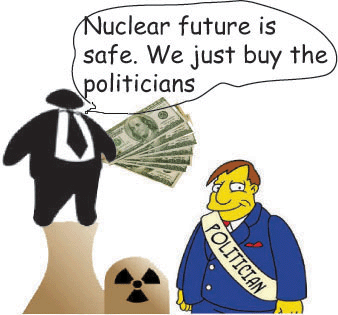
I think we’re all shocked to have heard the news of the acting secretary of the Navy appearing to take action to zero out the sea-launched cruise missile. This is something that is incredibly important,” said Rep. Mike Turner of Ohio, the ranking Republican on the House Armed Services Committee subpanel on strategic forces.
WASHINGTON — House and Senate lawmakers voiced concern Thursday over the acting Navy secretary’s move to cancel the service’s nuclear sea-launched cruise missile in fiscal 2023 as top defense leaders said they had not been briefed on the decision.
“I think we’re all shocked to have heard the news of the acting secretary of the Navy appearing to take action to zero out the sea-launched cruise missile. This is something that is incredibly important,” said Rep. Mike Turner of Ohio, the ranking Republican on the House Armed Services Committee subpanel on strategic forces.
“We know that the Nuclear Posture Review isn’t underway, and yet we have the first steps toward actions that would be unilateral disarmament,” Turner said during the committee’s hearing to review the fiscal 2022 budget proposal for nuclear forces.
Multiple media outlets reported this week that acting Navy Secretary Thomas Harker directed the service in a June 4 memo to “defund [the] sea-launched cruise missile.”
The 2018 Nuclear Posture Review — an examination of U.S. nuclear policy that occurs when a new administration takes office — supported pursuing this type of missile. The strategy under former President Donald Trump’s administration called for expanding the role and capability of the U.S. nuclear arsenal.
The Defense Department’s Melissa Dalton testified Thursday that the review by President Joe Biden’s administration is “on the cusp” of commencing. Biden has said he wants to reduce reliance on nuclear weapons.
“The sole purpose of the U.S. nuclear arsenal should be deterring — and if necessary, retaliating against — a nuclear attack,” Biden’s campaign said in an online statement before the president’s election. …….. https://www.military.com/daily-news/2021/06/11/lawmakers-fume-over-acting-navy-secretarys-call-cancel-nuclear-sea-launched-cruise-missile.html
Another corrupt executive pleads guilty in South Carolina’s nuclear scandal
‘Key Westinghouse witness’ in SC nuclear scandal told lies to help SCANA fool public, The News and Observer,
BY JOHN MONKJUNE 10, 2021 COLUMBIA, SC

A former Westinghouse executive who oversaw construction on SCANA’s doomed $10 billion nuclear project in Fairfield County admitted lying about the project in an effort to fool people into thinking the doomed project would be a success, a federal prosecutor said Thursday in federal court.
The former Westinghouse official, Carl Churchman, 70, was in court in Columbia before U.S. District Judge Mary Lewis to plead guilty to one count of lying to FBI agent Aaron Hawkins.
Churchman, who now lives in Utah, was the third person so far to plead guilty in an ongoing four-year FBI investigation of criminal acts connected to the 2017 failure of SCANA’s effort to build two nuclear plants at the V.C. Summer facility in Fairfield County, about 25 miles northwest of Columbia.
It was the biggest business failure in S.C. history and threw more than 4,000 people out of work. At first, the July 2017 failure of the nuclear project was attributed to cost overruns and mismanagement, but the FBI investigation established that top SCANA officials engaged in a criminal conspiracy to hide the looming business failure from the public, regulars and investors who owned SCANA stock.
“There is more to come (in the investigation), and Mr. Churchman is a key witness for us,” assistant U.S. Attorney Winston Holliday told Judge Lewis, indicating that more people would face criminal charges.
In 2020 and this year, two former top SCANA executives — Stephen Byrne and Kevin Marsh — pleaded guilty to criminal fraud charges related to their knowing about costly delays to the project, delays they unlawfully kept secret for years from regulators and shareholders. Sentences in those cases are pending.
“There is more to come (in the investigation), and Mr. Churchman is a key witness for us,” assistant U.S. Attorney Winston Holliday told Judge Lewis, indicating that more people would face criminal charges.
In 2020 and this year, two former top SCANA executives — Stephen Byrne and Kevin Marsh — pleaded guilty to criminal fraud charges related to their knowing about costly delays to the project, delays they unlawfully kept secret for years from regulators and shareholders. Sentences in those cases are pending.
In several court hearings, prosecutors have described the lies told by SCANA executives not as crimes of greed but crimes of hubris and an abuse of public trust — an inability to tell the truth and admit publicly that such a huge project that was supposed to showcase a major commitment to nuclear energy with Westinghouse nuclear reactors had turned into such an abject failure………… https://www.newsobserver.com/news/state/south-carolina/article252009438.html
Marginalized voices are ignored in favor of nuclear development
How Nuclear Waste Impacts Marginalized Communities, Geopolitics. By Ainsley Lawrence -June 11, 2021 ‘
(Amazingly, this excerpt comes from a quite enthusiastic pro nuclear article)
‘………………..Marginalized Voices are Ignored in Favor of Nuclear Development.
All over the world, nuclear power plants are planned and developed within communities that do not want them and question their safety. Yet, corporations press on with their plans. One prominent example occurred in the aftermath of the Fukushima nuclear disaster, in which an estimated 32 million people were affected.
Marginalized Voices are Ignored in Favor of Nuclear Development
All over the world, nuclear power plants are planned and developed within communities that do not want them and question their safety. Yet, corporations press on with their plans. One prominent example occurred in the aftermath of the Fukushima nuclear disaster, in which an estimated 32 million people were affected.
As a direct consequence of their being ignored, marginalized communities like those below the poverty level or with higher populations of minority groups tend to live closer to nuclear power plants. According to Stanford University research, a larger percentage of African Americans lived within 50 miles of nuclear power plants than their white peers.
Infamously, Chernobyl represents exactly what happens to marginalized communities when a nuclear disaster occurs. The city’s many subsistence farmers found themselves suddenly without the means to make a living when the disaster occurred. As a result, they were forced to rely on government subsistence to make ends meet, and many have either returned or stayed in the region where housing is cheaper.
Because the risks associated with nuclear power lower property values, lower-income families both already live in planned sites for nuclear development or come to live there after they’re built. This means when a disaster occurs, it is the poor who face more of the devastation.
Protections Aren’t for Everyone
The leaks at the Savannah River nuclear site in the American South showcased just how racially and financially disparate the effects tend to be when dealing with dangerous nuclear waste. From the evidence that emerged that black workers were frequently sent into high-radiation areas without the proper protection to the lack of job mobility experienced by the same, historically marginalized workers and the larger black community in Savannah River took a disproportionate amount of the fallout.
There were at least 30 cases of cancer and ailments associated with the Savannah River site in its earlier days, but the leaks of nuclear containments continue to give the community health concerns, especially when it comes to the availability of safe drinking water. Poor water quality can lead to illness and even death. When polluted with radiation, the effects of contaminated drinking water can be even worse.
But Stanford research shows that ionizing radiation standards are designed more to protect adult males. For nuclear facility workers, even these standards can be waived, allowing facility owners to expose workers to as much as 50 times more radiation than is allowed for the common citizen. Often, these workers don’t even receive hazard pay.
Minority and low-income communities are at higher risk of the radiation pumped via nuclear waste into their communities because of their proximity. At the same, these communities have statistically higher levels of women and children. These risk factors, much like the reasons nuclear power plants are built in these areas in the first place, perpetuate racist and classist outcomes………
Great powers’competition – the war industry’s best tactic

”……………..Pretexts keep the military budget elevated, sustain the war industry’s profits, and incite a violent foreign policy. Manufactured fear is essential. After pumping the “War on Terror” for trillions of dollars — and with veterans and the U.S. public growing skeptical of such interventions — the war industry has returned to targeting Russia and China through “great power competition.
A PEOPLE’S GUIDE TO THE WAR INDUSTRY -5: PORTFOLIO OF CONFLICTS, By Christian Sorensen by Rise Up Times · Great Power Competition , 9 June 21,
”……………..Pretexts keep the military budget elevated, sustain the war industry’s profits, and incite a violent foreign policy. Manufactured fear is essential. After pumping the “War on Terror” for trillions of dollars — and with veterans and the U.S. public growing skeptical of such interventions — the war industry has returned to targeting Russia and China through “great power competition.
Facing off against Russia and China is more comfortable territory for war corporations. In the calculus of corporate suites, the big-ticket items inherent to competition with another major industrial nation are where the real money can be made. A war on terror was lucrative for a decade or two, and it will continue, but it is not enough to justify excessive spending on cyber, submarines, satellites, hypersonic propulsion, anti-ballistic missiles, nuclear weaponry, artificial intelligence/machine learning, and aircraft carriers.
Competition against Moscow and Beijing also continues the militarization of U.S. society, channeling anger (which might otherwise manifest itself as class awareness and/or physical protest against Washington’s corruption) into outrage against a stereotypical enemy that resides overseas — just as the War on Terror did.
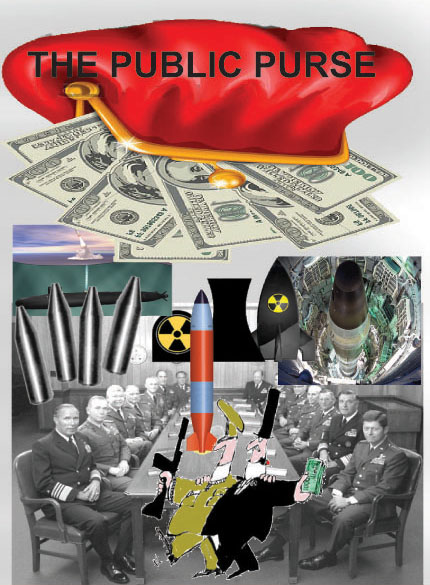
Great power competition is fully entrenched in the Pentagon, as made clear by the 2018 National Defense Strategy, developed in 2017 by military and corporate personnel. It emphasized, “inter-state strategic competition, not terrorism, is now the primary concern in U.S. national security.”
Etching the National Defense Strategy into stone, the then chairman of the Joint Chiefs of Staff, General Joseph Dunford declared in November 2018, that great power competition was here to stay, demanding a shift in Pentagon funding priorities and weapons development. Dunford was speaking at the Halifax International Security Forum, sponsored by corporations (e.g. Boeing, CAE, United Technologies) and NATO, among other powerful groups, including energy and IT firms.
Four months later, the war industry pressure group NDIA presented General Dunford with its most prestigious award. Dunford soon retired and joined the board of Lockheed Martin.
Great power competition has enabled a high volume of war industry goods and services and U.S. military personnel to deploy to Germany, the Czech Republic, Poland and eastern Europe, particularly in the Baltic States and Romania, as well as other clients surrounding China, particularly South Korea, Japan, Taiwan and Guam. Large engineering and project management firms build and sustain the associated infrastructure.
Meanwhile, Beijing’s construction is framed as a threat. “I mean, this is insane. Look at all that crazy construction,” remarked a U.S. naval officer observing Chinese military construction projects in the South China Sea. Though a useful bogeyman, Beijing’s construction in the South China Sea does not hold a candle to what Washington has built up overseas.
Great power competition fills peaceful voids. At the Sea Air Space Forum of 2019 (sponsored by CACI, Lockheed Martin, Northrop Grumman, and shipbuilder Huntington Ingalls), MIC officials cited the “threat” of great power competitors in order to justify expansion of U.S. military power into the Arctic.
They ignored the real threat: The U.S. Armed Forces’ rampant carbon-based military activity contributes to anthropogenic climate change, which melts Arctic ice, which opens up northern sea lanes, into which the Pentagon projects its polluting arsenal, which puts more carbon in the atmosphere.
Great power competition’s consequences are terrifying: increased militarization of an already militarized U.S. economy and public life; greater likelihood of wars big and small; more pollution (notably toxic particulates, carbon emissions, and radiological contamination) in an era of climate catastrophe and mass extinction; nuclear weapons on a hair trigger; narrowing of permissible speech and assembly; and relentless corporatization of the U.S. Armed Forces, the world’s mightiest organization.
The pretext known as great power competition is off to an impressive start, financially, bureaucratically, and industrially. It is incumbent upon the workers of the world to stop it. ”https://riseuptimes.org/2021/06/09/a-peoples-guide-to-the-war-industry-5-portfolio-of-conflicts/
U.S. Navy to cancel development of super expensive nuclear missile
Navy eyes canceling nuclear missile
By BRYAN BENDER , 06/09/2021 NIXING A NUKE? Politico, Acting Navy Secretary Thomas Harker has issued a memo directing the service to cancel development of a nuclear-armed cruise missile in fiscal 2023, a potential signal that the Biden administration could dial back some nuclear modernization programs, Aerospace Daily scooped on Tuesday.
The June 4 memo, also obtained by POLITICO, is part of preparations to craft a five-year spending plan. The memo declares that the Navy may have to choose either a new fighter jet, destroyer or submarine and delay two of them.
“The Navy cannot afford to simultaneously develop the next generation of air, surface, and subsurface platforms and must prioritize these programs balancing the cost of developing next-generation capabilities against maintaining current capabilities,” Harker wrote.
It “makes clear that budgets aren’t expected to increase enough in the coming years to undertake all of the modernization efforts envisioned by the Navy,” as our colleague Paul McLeary writes for Pros………. https://www.politico.com/newsletters/morning-defense/2021/06/09/navy-eyes-canceling-nuclear-missile-795839
“IT’S VERY PROFITABLE to prepare for omnicide,”
NOT EVEN COVID-19 COULD SLOW DOWN NUCLEAR SPENDING https://theintercept.com/2021/06/07/nuclear-weapons-spending-pandemic-ican/
A new report finds that nine countries collectively spent $72 billion in 2020 on nukes., Jon Schwarz,
June 7 2021, “IT’S VERY PROFITABLE to prepare for omnicide,” Daniel Ellsberg, famed whistleblower and anti-nuclear weapons activist, said in a recent interview. “Northrop Grumman and Boeing and Lockheed and General Dynamics make a lot of money out of preparing for such a war. The congressmen get campaign contributions, they get votes in their district and almost every state for preparing for that.”
But don’t just take it from Ellsberg. At an investor conference in 2019, a managing director from the investment bank Cowen Inc. queried Raytheon’s CEO on this subject. “We’re about to exit the INF [Intermediate-Range Nuclear Forces Treaty] with Russia,” said the Cowen executive. Did this mean, he asked, whether “we will really get a defense budget that will really benefit Raytheon?” Raytheon’s CEO happily responded that he was “pretty optimistic” about where things were headed.
There are currently nine countries that possess nuclear weapons: the United States, China, Russia, the United Kingdom, France, India, Pakistan, Israel, and North Korea. ICAN calculated that they collectively spent $72.6 billion in 2020 on nukes. (picture below – a little out of date – 2019 )
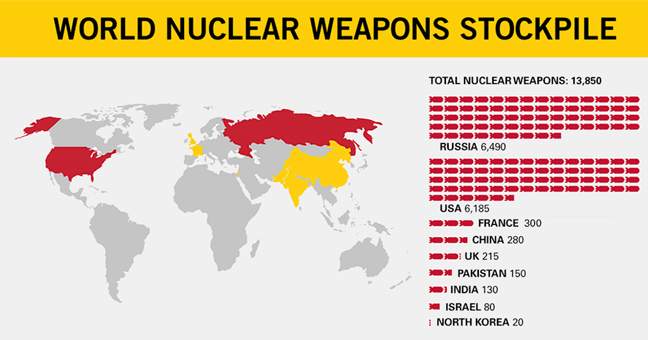
The U.S. was responsible for just over half of this doomsday payout, at $37.4 billion. According to the Congressional Budget Office, U.S. nuclear spending is anticipated to soon increase sharply due to plans for technological upgrades, rising to $41.2 billion next year and totaling $634 billion during the 10 years from 2021-2030.
China came in second in 2020 at an estimated $10.1 billion. Russia was third at $8 billion. Notably, in a year when the world economy was flattened by the coronavirus pandemic, nuclear spending continued on an upward trajectory without a hiccup.
Despite these hefty numbers, they’re probably an underestimate. “There’s always more [nuclear spending] out there … even more still lurking in the shadows,” said Susi Snyder, co-author of the report and managing director of the project Don’t Bank on the Bomb. Snyder points out that “governments, especially U.S., U.K., [and] France are always demanding ‘transparency’ … yet they do not hold themselves to the standards they demand of others.”
A great deal of U.S. nuclear spending consists of profitable contracts with private corporations.
The four companies Ellsberg said were raking in cash “preparing for war” indeed received the most money in 2020:
- Northrop Grumman — $13.7 billion
- General Dynamics — $10.8 billion
- Lockheed Martin — $2.1 billion
- Boeing — $105 million

These enormous contracts create obvious incentives for these companies to lobby for more government expenditures on Armageddon, and they assiduously do so. Indeed, lobbying unquestionably is the most profitable investment these companies make. According to ICAN’s report, for every $1 they spent on lobbying, they received $239 in nuclear weapon contracts.
The specifics are notable here. Northrop reported $13.3 million in lobbying expenses in 2020. Last year it was formally awarded the enormous initial contract to develop a new intercontinental ballistic missile system called the “Ground Based Strategic Deterrent.” It will inevitably receive the contract for the entire program, estimated to be worth $85 billion over its life. In discussion on the GBSD, the Air Force’s assistant secretary for acquisition stated that he didn’t see the pandemic affecting nuclear spending.

There is also much more to lobbying than that which goes by the name. In the 2006 documentary “Why We Fight,” journalist Gwynne Dyer explained that President Dwight Eisenhower considered the military-industrial complex actually to have three components: the military, defense corporations, and Congress. But now, Dyer said, there’s a fourth: think tanks, which generally push their funders’ policies under a thin veneer of scholarship.
According to the report, companies profiting from nuclear weapons contributed $5-10 million to think tanks in 2020. Northrop alone spent at least $2 million funding nine of them, including the Atlantic Council, the Brookings Institution, the Center for a New American Security, and the Center for Strategic and International Studies.
However, ICAN did not produce the report for passive consumption or as an inducement to despair. Instead, it is part of a sophisticated strategy to eventually make nuclear weapons as taboo worldwide as chemical and biological weapons are now.
ICAN was a key force behind the Treaty on the Prohibition of Nuclear Weapons, which was adopted in 2017 at the United Nations. It makes illegal any activities related to nuclear weapons and has been signed by 86 countries and ratified by 54. It entered into force this past January.
None of the nuclear powers are signatories. Yet they need not be for the treaty to create a noose around those countries and their companies that should tighten over time. For instance, Airbus produces missiles for France’s nuclear weapons arsenal. But it is headquartered in the Netherlands, so if that country ratified the TPNW, it could no longer do so.
This financial threat has now attracted the attention of the stockholders of these nuclear corporations. Snyder notes that a 2020 Northrop shareholders resolution stated that the company “has at least $68.3 billion in outstanding nuclear weapons contracts, which are now illegal under international law,” and it received 22 percent support. A similar Lockheed resolution got over 30 percent support. The KBC Group, the 15th-largest bank in Europe, has announced that it will not fund any nuclear weapon-related activity because of the TPNW.
Success here will obviously require a long-term campaign and increased activism across the world. But the trajectory is headed in the right direction. “The days of spending with impunity on WMD,” believes Snyder, “are numbered.”
-
Archives
- May 2026 (57)
- April 2026 (356)
- March 2026 (251)
- February 2026 (268)
- January 2026 (308)
- December 2025 (358)
- November 2025 (359)
- October 2025 (376)
- September 2025 (257)
- August 2025 (319)
- July 2025 (230)
- June 2025 (348)
-
Categories
- 1
- 1 NUCLEAR ISSUES
- business and costs
- climate change
- culture and arts
- ENERGY
- environment
- health
- history
- indigenous issues
- Legal
- marketing of nuclear
- media
- opposition to nuclear
- PERSONAL STORIES
- politics
- politics international
- Religion and ethics
- safety
- secrets,lies and civil liberties
- spinbuster
- technology
- Uranium
- wastes
- weapons and war
- Women
- 2 WORLD
- ACTION
- AFRICA
- Atrocities
- AUSTRALIA
- Christina's notes
- Christina's themes
- culture and arts
- Events
- Fuk 2022
- Fuk 2023
- Fukushima 2017
- Fukushima 2018
- fukushima 2019
- Fukushima 2020
- Fukushima 2021
- general
- global warming
- Humour (God we need it)
- Nuclear
- RARE EARTHS
- Reference
- resources – print
- Resources -audiovicual
- Weekly Newsletter
- World
- World Nuclear
- YouTube
-
RSS
Entries RSS
Comments RSS
 nuclear-news