Vogtle nuclear power project – more costs revealed, and even more likely to come.
Georgia Power discloses more Vogtle nuclear delays, big extra costs, By Matt Kempner, The Atlanta Journal-Constitution 30 July 21, Georgia Power’s parent, Southern Co., announced Thursday yet another delay in its completion of the nuclear expansion of Plant Vogtle and said its share of the costs have increased by nearly half a billion dollars.
Georgia Power customers could see larger increases in monthly electric bills if the company ultimately seeks reimbursement for the higher costs on the massive project south of Augusta. But such a move would require approval from the state’s Public Service Commission.
Southern not only pushed back its timeline for completing the first of two new reactors — something it has done repeatedly this year alone — but also announced a delay for the second reactor. And it cautioned that further delays on both are possible, reeling off a litany of potential challenges to complete a project that was supposed to have been finished years ago and for billions of dollars less.
Another worry: that federal nuclear regulators could continue to increase scrutiny of the project to fix quality problems. The company said in a regulatory filing that “various design and other licensing-based compliance matters” have arisen or may arise that, if not resolved, could lead to additional delays and costs.
As for the latest $460 million in rising costs, the company said it would cover the expense by taking a charge against its profits, a $343 million hit after taxes. The move sparked lower profits for Southern compared to the same quarter a year earlier. The company didn’t say whether it eventually will seek approval from state regulators to recover those costs from its customers. But in a filing it said there is a “significant level of uncertainty” about its ability to get such a full recovery………..
Just a few months ago, Atlanta-based Southern had been sticking by its predictions that the first reactor would be in operation this November, with the second a year later. Now, it projects the second quarter of 2022 for the first, and the first three months of 2023 for the last reactor. In each case that is three or four months later than what it had said in May and reasserted again last month.
The two new reactors were originally slated to be in operation in 2016 and 2017, respectively……….
Kurt Ebersbach, a senior attorney at the Southern Environmental Law Center, which represents some organizations opposed to customers paying for Vogtle’s excesses, said he believes the power company will seek PSC approval to collect billions of dollars in overruns from customers.
The company’s latest predictions for Vogtle’s schedule come closer to what PSC staff and independent advisors to the state have been predicting for the first reactor. Still, a key advisor has projected substantially higher cost increases still to come and a later completion — at least June of 2023 — for the second reactor.
The construction costs of the Vogtle expansion have not yet been rolled into the bills of Georgia Power customers. But for years, customers have paid fees for a portion of both the project’s financing costs and the company’s profits on it.
By the time the project is completed and produces electricity, it’s estimated that the average residential customer will have already paid over $850 toward it. Then bills are expected to rise higher to cover all “prudent” and “reasonable” construction costs and company profits, which rise as allowed costs rise.………..https://www.ajc.com/ajcjobs/georgia-power-discloses-more-vogtle-nuclear-delays-big-extra-costs/EINKHQ3CNJCMRA6GDWQFNJ3VS4/
Renewables overtook coal and nuclear power generation in the U.S last year .
RENEWABLES OVERTOOK COAL AND NUCLEAR POWER GENERATION IN THE US LAST YEAR by,VICTOR TANGERMANN, 30 July 21,
CLEARER SKIES AHEAD. For the first time in US history, renewables became the second-most prevalent electricity source in 2020 after natural gas, according to the US Energy Information Administration (EIA).
In 2020, renewable energy sources —including wind, solar, hydroelectric, and geothermal — accounted for 21 percent of all the electricity generated in the country. Coal represented just 19 percent, while nuclear power accounted for 20 percent.,,,,,,,,, https://futurism.com/the-byte/renewables-overtook-coal-and-nuclear-power-generation-us
American public opinion ignored as NASA prioritises colonising Mars, over research to save the climate

63 percent according to a 2018 Pew Research Center survey—believe that NASA should prioritize monitoring Earth’s climate system. Only a minority—18 percent—said that NASA should prioritize sending humans to Mars.
Is using nuclear materials for space travel dangerous, genius, or a little of both? bulletin of the Atomic Scientists , Bulletin of the Atomic Scientists, By Susan D’Agostino | July 28, 2021
The 1977 Soviet satellite Kosmos 954 was supposed to monitor ocean traffic using radar—a technology that works best at short distances. For this reason, the craft traveled in Earth’s low orbit, where solar panels alone could not provide consistent power. And so, the satellite was equipped with a small, efficient, yet powerful nuclear reactor fueled by approximately 50 kg of weapons-grade uranium 235. Within weeks of its launch, Kosmos 954 veered from its path like a drunkard on a walk. The Soviets tried to eject its radioactive core into a higher orbit by way of a safety system designed for that purpose. But the safety system failed. In January 1978, Kosmos 954 burst into the Western Canada skyline, scattering radioactive dust and debris over a nearly 400-mile path. The cleanup and recovery process, which took nearly eight months and started in the subarctic winter, found that virtually all of the satellite fragments were radioactive, including one that was “sufficient to kill a person or number of persons remaining in contact with that part for a few hours.”
Now that the United States has set a goal of a human mission to Mars by 2039, the words “nuclear” and “space” are again popping up together in newspaper headlines. Nuclear propulsion systems for space exploration—should they materialize—are expected to offer significant advantages, including the possibility of sending spacecraft farther, in less time, and more efficiently than traditional chemical propulsion systems. But extreme physical conditions on the launchpad, in space, and during reentry raise questions about risk-mitigation measures, especially when nuclear materials are present.
Why not travel to Mars on a chemically propelled spacecraft? Spaceships that use chemical propellants benefit from tremendous thrust to get the job done. However, they also need to carry fuel and oxidizer to power that incredible upward or forward movement………..
Even if a spacecraft were able to refuel with a chemical propellant in space or magically carry enough chemical propellant for the journey to Mars, the long transit time would present a hazard to the crew……..
In theory, nuclear propulsion for space travel will offer two significant advantages over chemical propulsion. First, since nuclear systems are much more efficient, the amount of fuel required for the journey to Mars is practical. Second, without a need to traverse the shortest path, the flight could take off from Earth and Mars anytime—without delay. The latter would reduce the length of the roundtrip journey and the crew’s exposure to radiation.
Still, attaching what amounts to a nuclear reactor to a human-occupied spaceship is not without risks.
Is the idea of sending nuclear materials into space new? The idea of sending nuclear materials into outer space is not new. And unlike Kosmos 954, many instances have been successful. Since 1961, NASA has powered more than 25 space missions with nuclear materials. The only other practical power option—solar power—is often unavailable in dark, dusty, far-off corners of the solar system.
Likewise, the Atomic Energy Commission launched a nuclear-thermal rocket propulsion research and development program in 1955. …….funding and interest in the programs dried up in the 1970s……
What new plans does the United States have for sending nuclear materials to space? The National Academies’ report released earlier this year recommended that NASA “commit within the year to conducting an extensive and objective assessment of the merits and challenges of using different types of space nuclear propulsion systems and to making significant technology investments this decade.” The report offers a roadmap for developing two different kinds of propulsion systems—nuclear electric and nuclear thermal—for human missions to Mars.
A nuclear electric propulsion system bears some resemblance to a terrestrial power plant. That is, first a fission reactor generates power for electric thrusters. That power positively charges the ions in the gas propellant, after which electric, magnetic, or electrostatic fields accelerate the ions. The accelerated ions are then pushed out through a thruster, which propels the spacecraft.
Alternatively, in a nuclear thermal propulsion system, the reactor operates more as a heat exchanger in which a fuel such as liquid hydrogen is first heated to very high temperatures—up to 4,600 degrees Fahrenheit—that is then exhausted through a rocket nozzle to produce thrust.
“For nuclear thermal propulsion, the challenge is: temperature, temperature, temperature,” Anthony Calomino, a materials and structure research engineer at NASA’s Langley Research Center, said. “There are not many materials that can survive those kinds of temperatures.” ………..
While nuclear electric propulsion systems do not require extreme temperatures, they face a different hurdle. Nuclear electric systems have six subsystems, including a reactor, shield, power conversion, heat rejection, power management and distribution, and electric propulsion systems. The operating power of all of these subsystems will need to be scaled up by orders of magnitude—and in such a way that they continue to work together—before they are ready for space……………..
Why is the United States planning to send humans to Mars anyway? Some argue that the scientific value of a human-crewed Mars mission could be captured by robots at a much lower cost and risk. Others think that humans, whose role in terrestrial climate change is apparent, should first rehabilitate Earth before colonizing other planets. Still others worry that human microbes could contaminate the Red Planet.
Indeed, a majority of Americans—63 percent according to a 2018 Pew Research Center survey—believe that NASA should prioritize monitoring Earth’s climate system. Only a minority—18 percent—said that NASA should prioritize sending humans to Mars……………. https://thebulletin.org/2021/07/is-using-nuclear-materials-for-space-travel-dangerous-genius-or-a-little-of-both/
Jeff Bezos wants to pay NASA $billions to choose HIS company over Elon Musk’s

Jeff Bezos offers Nasa $2bn in exchange for moon mission contract, Guardian, Adam Gabbatt in New York and agencies@adamgabbatt 28 Jul 2021

Billionaire lost out to Elon Musk’s SpaceX in lunar bid
Bezos claims Nasa’s decision will delay moon mission
Jeff Bezos has offered Nasa $2bn – if the US space agency reverses course and chooses his company, Blue Origin, to make a spacecraft designed to land astronauts back on the moon.
In an open letter to the Nasa administrator, Bill Nelson – a former astronaut and Democratic senator from Florida – Bezos, who last week completed a suborbital trip to space, criticised the agency’s decision to award the moon contract to rival company SpaceX, owned by Elon Musk, in April.
Bezos urged Nasa to reconsider and said Blue Origin would waive payments in the government’s current fiscal year and the next after that up to $2bn, and pay for an orbital mission to vet its technology.
Nasa handed Musk’s SpaceX a $2.9bn contract to build a spacecraft to bring astronauts to the lunar surface as early as 2024, rejecting bids from Blue Origin and the defense contractor Dynetics. Nasa had been expected to winnow the field to two companies, but went all in on SpaceX. Blue Origin had partnered with Lockheed Martin, Northrop Grumman and Draper in its bid.
The space agency cited its own funding shortfalls, SpaceX’s proven record of orbital missions and other factors in a contract decision that a senior Nasa official, Kathy Lueders, said represented “what’s the best value to the government”.
At the time Blue Origin said the decision “not only delays but also endangers America’s return to the moon”. The company filed a complaint with the Government Accountability Office, accusing the agency of giving SpaceX an unfair advantage by allowing it to revise its pricing.
In his letter on Monday, Bezos wrote: “Blue Origin will bridge the [Human Landing System] budgetary funding shortfall by waiving all payments in the current and next two government fiscal years up to $2bn to get the program back on track right now.
“This offer is not a deferral, but is an outright and permanent waiver of those payments. This offer provides time for government appropriation actions to catch up.”
In exchange, Bezos said, Blue Origin would accept a firm, fixed-priced contract and cover any system development cost overruns…………….
A Nasa spokesperson said the agency was aware of Bezos’s letter, but declined to comment further, citing the GAO protest filed by Blue Origin. A decision in that case is expected by early August, though industry experts say Blue Origin views the possibility of a reversal as unlikely. https://www.theguardian.com/science/2021/jul/26/jeff-bezos-nasa-blue-origin-space
More underground space is needed at Waste Isolation Pilot Plant (WIPP)
More underground space is needed to complete the mission at the Waste
Isolation Pilot Plant to dispose of nuclear waste, contend WIPP officials
during a Monday public meeting. The U.S. Department of Energy was underway
with a permit modification request (PMR) that would amend the DOE’s
permit with the State of New Mexico to allow for the mining of two new
panels where waste would be disposed of along with drifts connecting the
panels to the rest of the underground repository. At WIPP, transuranic
(TRU) nuclear waste consisting of clothing items and equipment irradiated
during nuclear activities at DOE sites across the country is disposed of
via burying in an underground salt deposit.
Carlsbad Current Argus 27th July 2021
Moltex Energy’s nuclear pyroprocessing project with plutonium would produce weapons grade material and encourage weapons proliferation
Will Canada remain a credible nonproliferation partner? https://thebulletin.org/2021/07/will-canada-remain-a-credible-nonproliferation-partner/
By Susan O’Donnell, Gordon Edwards | July 26, 2021
Susan O’Donnell Susan O’Donnell is a researcher specializing in technology adoption and environmental issues at the University of New Brunswick.
Gordon Edwards Gordon Edwards is a mathematician, physicist, nuclear consultant, and president of the Canadian Coalition for Nuclear Responsibility,
The recent effort to persuade Canada to sign the Treaty on the Prohibition of Nuclear Weapons has stimulated a lively debate in the public sphere. At the same time, out of the spotlight, the start-up company Moltex Energy received a federal grant to develop a nuclear project in New Brunswick that experts say will undermine Canada’s credibility as a nonproliferation partner.
Moltex wants to extract plutonium from the thousands of used nuclear fuel bundles currently stored as “high-level radioactive waste” at the Point Lepreau reactor site on the Bay of Fundy. The idea is to use the plutonium as fuel for a new nuclear reactor, still in the design stage. If the project is successful, the entire package could be replicated and sold to other countries if the Government of Canada approves the sale.
The recent effort to persuade Canada to sign the Treaty on the Prohibition of Nuclear Weapons has stimulated a lively debate in the public sphere. At the same time, out of the spotlight, the start-up company Moltex Energy received a federal grant to develop a nuclear project in New Brunswick that experts say will undermine Canada’s credibility as a nonproliferation partner.
Moltex wants to extract plutonium from the thousands of used nuclear fuel bundles currently stored as “high-level radioactive waste” at the Point Lepreau reactor site on the Bay of Fundy. The idea is to use the plutonium as fuel for a new nuclear reactor, still in the design stage. If the project is successful, the entire package could be replicated and sold to other countries if the Government of Canada approves the sale.
On May 25, nine US nonproliferation experts sent an open letter to Prime Minister Justin Trudeau expressing concern that by “backing spent-fuel reprocessing and plutonium extraction, the Government of Canada will undermine the global nuclear weapons non-proliferation regime that Canada has done so much to strengthen.”
The nine signatories to the letter include senior White House appointees and other US government advisers who worked under six US presidents: John F. Kennedy, Lyndon B. Johnson, Richard Nixon, George H.W. Bush, Bill Clinton, and Barack Obama; and who hold professorships at the Harvard Kennedy School, University of Maryland, Georgetown University, University of Texas at Austin, George Washington University, and Princeton University.
Plutonium is a human-made element created as a byproduct in every nuclear reactor. It’s a “Jekyll and Hyde” kind of material: on the one hand, it is the stuff that nuclear weapons are made from. On the other hand, it can be used as a nuclear fuel. The crucial question is, can you have one without the other?
India exploded its first nuclear weapon in 1974 using plutonium extracted from a “peaceful” Canadian nuclear reactor given as a gift many years earlier. In the months afterwards, it was discovered that South Korea, Pakistan, Taiwan, and Argentina—all of them customers of Canadian nuclear technology—were well on the way to replicating India’s achievement. Swift action by the US and its allies prevented these countries from acquiring the necessary plutonium extraction facilities (called “reprocessing plants”). To this day, South Korea is not allowed to extract plutonium from used nuclear fuel on its own territory—a long-lasting political legacy of the 1974 Indian explosion and its aftermath—due to proliferation concerns.
Several years after the Indian explosion, the US Carter administration ended federal support for civil reprocessing of spent nuclear fuel in the US out of concern that it would contribute to the proliferation of nuclear weapons by making plutonium more available. At that time, Canada’s policy on reprocessing also changed to accord with the US policy—although no similar high-level announcement was made by the Canadian government.
Moltex is proposing to use a type of plutonium extraction technology called “pyroprocessing,” in which the solid used reactor fuel is converted to a liquid form, dissolved in a very hot bath of molten salt. What happens next is described by Moltex chairman and chief scientist Ian Scott in a recent article in Energy Intelligence. “We then—in a very, very simple process—extract the plutonium selectively from that molten metal. It’s literally a pot. You put the metal in, put salt in the top, mix them up, and the plutonium moves into the salt, and the salt’s our fuel. That’s it. … You tip the crucible and out pours the fuel for our reactor.”
The federal government recently supported the Moltex project with a $50.5-million grant, announced on March 18 by Intergovernmental Affairs Minister Dominic LeBlanc in Saint John.
At the event, LeBlanc and New Brunswick Premier Blaine Higgs described the Moltex project as “recycling” nuclear waste, although in fact barely one-half of one per cent of the used nuclear fuel is potentially available for use as new reactor fuel. That leaves a lot of radioactive waste left over.
From an international perspective, the government grant to Moltex can be seen as Canada sending a signal—giving a green light to plutonium extraction and the reprocessing of used nuclear fuel.
The US experts’ primary concern is that other countries could point to Canada’s support of the Moltex program to help justify its own plutonium acquisition programs. That could undo years of efforts to keep nuclear weapons out of the hands of countries that might want to join the ranks of unofficial nuclear weapons states such as Israel, India, Pakistan, and North Korea. The Moltex project is especially irksome since its proposed pyroprocessing technology is very similar to the one that South Korea has been trying to deploy for almost 10 years.
In their letter, the American experts point out that Japan is currently the only nonnuclear-armed state that reprocesses spent nuclear fuel, a fact that is provoking both domestic and international controversy.
In a follow-up exchange, signatory Frank von Hippel of Princeton University explained that the international controversy is threefold: (1) The United States sees both a nuclear weapons proliferation danger from Japan’s plutonium stockpile and also a nuclear terrorism threat from the possible theft of separated plutonium; (2) China and South Korea see Japan’s plutonium stocks as a basis for a rapid nuclear weaponization; and (3) South Korea’s nuclear-energy R&D community is demanding that the US grant them the same right to separate plutonium as Japan enjoys.
Despite the alarm raised by the nine authors in their letter to Trudeau, they have received no reply from the government. The only response has come from the Moltex CEO Rory O’Sullivan. His reply to a Globe and Mail reporter is similar to his earlier rebuttal in The Hill Times published in his letter to the editor on April 5: the plutonium extracted in the Moltex facility would be “completely unsuitable for use in weapons.”
But the International Atomic Energy Agency (IAEA) has stated that “Nuclear weapons can be fabricated using plutonium containing virtually any combination of plutonium isotopes.” All plutonium is of equal “sensitivity” for purposes of IAEA safeguards in nonnuclear weapon states.
Similarly, a 2009 report by nonproliferation experts from six US national laboratories concluded that pyroprocessing is about as susceptible to misuse for nuclear weapons as the original reprocessing technology used by the military, called PUREX.
In 2011, a US State Department official responsible for US nuclear cooperation agreements with other countries went further by stating that pyroprocessing is just as dangerous from a proliferation point of view as any other kind of plutonium extraction technology, saying: “frankly and positively that pyro-processing is reprocessing. Period. Full stop.”
And, despite years of effort, the IAEA has not yet developed an approach to effectively safeguard pyroprocessing to prevent diversion of plutonium for illicit uses.
Given that history has shown the dangers of promoting the greater availability of plutonium, why is the federal government supporting pyroprocessing?
It is clear the nuclear lobby wants it. In the industry’s report, “Feasibility of Small Modular Reactor Development and Deployment in Canada,” released in March, the reprocessing (which they call “recycling”) of spent nuclear fuel is presented as a key element of the industry’s future plans.
Important national and international issues are at stake, and conscientious Canadians should sit up and take notice. Parliamentarians of all parties owe it to their constituents to demand more accountability. To date however, there has been no democratic open debate or public consultation over the path Canada is charting with nuclear energy.
Countless Canadians have urged Canada to sign the UN Treaty on the Prohibition of Nuclear Weapons that came into force at the end of January this year. Ironically, the government has rebuffed these efforts, claiming that it does not want to “undermine” Canada’s long-standing effort to achieve a Fissile Materials Cut-off Treaty. Such a treaty would, if it ever saw the light of day (which seems increasingly unlikely), stop the production of weapons usable materials such as highly enriched uranium and (you guessed it) plutonium.
So, the Emperor not only has no clothes, but his right hand doesn’t know what his left hand is doing.
The need for integrity in epidemiological research: investigation of uranium miners’health to be carried out by pro nuclear bodies

“They want to show that it doesn’t cause cancer. I think they want to find that result.”
for years, the CNSC has served both as a regulator and promoter of the nuclear industry
“It is concerning that health standards are set by physicists and industries, based on financial and technological convenience, rather than by those educated in and committed to public health and safety.”
Canadian Nuclear Safety Commission to Investigate Lung Cancer Rates Among Uranium Workers, Mother Jones
What’s happened to 80,000 people who have worked in Canada’s mines and processing facilities?CHARLES MANDEL, 25 July 21, The Canadian Nuclear Safety Commission (CNSC) is leading a national study examining incidences of lung cancer in uranium workers from across the country.
The Canadian Uranium Workers Study (CANUWS) will examine health data from 80,000 past and present employees at Canada’s uranium mines, mills and processing and fabrication facilities. The study, which is now underway and set to end in 2023, is the largest examination of lung cancer in Canadian uranium workers to date.
Rachel Lane, one of the lead researchers on the new study, told Canada’s National Observer she believes it will reassure workers they face less risk than before from lung cancer arising from exposure to radon, ……..
The $800-million mining and milling uranium industry employs over 2,000 people—of whom more than half are residents of northern Saskatchewan—at mine sites. The researchers plan to examine causes of death in uranium workers from 1950 on and chart their cancer data from 1970 onwards, using research from previous studies.
The new study will build on the results of two historical studies: the Eldorado study and the Ontario Uranium Mine Workers Study, both of which found elevated risks of lung cancer in uranium workers. During numerous follow-ups ending in 2015, both studies found lung cancer among miners was still more prevalent than in the general population………….
deaths from lung cancer associated with radiation were historically higher for uranium workers than the general male population……….
In 2015, a follow-up to the 2007 Ontario Uranium Miner Cohort study was done. It examined approximately 28,546 male and 413 female uranium miners who had worked at least one week in the Elliot Lake and Bancroft regions or at the Agnew Lake Mine between 1954 and 1996.
The conclusion: “Significant elevations in lung cancer mortality and incidence, as well as silicosis and injury mortality were observed in comparison with the general Canadian population.”……….
Anne Leis, the department head of Community Health and Epidemiology at the University of Saskatchewan, will administer the project and analyze the data. Her colleague, Punam Pahwa, a professor of biostatistics, will lead the statistical analysis of the health data……….
Uranium mining companies Cameco, Orano, and BWXT are co-funding the study, contributing $60,000. The CNSC is providing $125,000, while the Saskatchewan government is kicking in $60,000, and the University of Saskatchewan is contributing $90,000 of in-kind funding.…………
Concerns Over Possible Bias
While former employees and industry watchers applaud efforts to study the health of uranium workers, some are skeptical about the ability of CNSC to produce an unbiased report.
Jamie Kneen, communications and outreach coordinator at Mining Watch Canada, says it’s important to understand the longer-term impacts of radon on the miners. But he cautions that the peer review and oversight of the study must be carefully examined because it is being led by CNSC.Kneen contends that for years, the CNSC has served both as a regulator and promoter of the nuclear industry. “Their tendency has been to extend license periods and to give operators, whether it’s in the uranium industry or the nuclear power industry, more space, more time in terms of licensing and more leeway rather than the kind of tight supervision and oversight that the public probably would expect.”
Therefore, it’s a question of scrutinizing who’s doing the work and reviewing the study to ensure that it really is independent, according to Kneen. He notes that’s a difficult task given that the methodology around radiation is intricate and that not many people can decipher the technical details.
“So there’s a lot of potential for not necessarily deliberate manipulation, but for error to creep in and biases to creep in.”
Rod Gardiner, a former general foreman at the now-defunct Cluff Lake Mine in Saskatchewan, expresses his own concerns about the industry. Gardiner was at the mine for 33 years, working his way up to general foreman and acting mine manager.
He alleges management at Cluff Lake, which was owned by the multinational mining corporation Orano Group, consistently boasted that working in the mine was as safe as working in a supermarket and putting prices on soup cans. “That’s what they used to say, the company.”
He hopes a new study might answer questions about workers’ health. But others aren’t sure whether results will be trustworthy, primarily because the CNSC is partially funding and leading the study.
The CNSC’s work has been subject to just those kinds of complaints in the past.
Writing in the journal Canadian Family Physician in 2013, Dale Dewar and two other authors expressed concern over the CNSC’s ability to act independently of government and industry. The authors noted the former Conservative federal government fired the commission’s CEO when she applied safety guidelines to shut down the Chalk River reactor in Ontario.
The authors observed: “It is concerning that health standards are set by physicists and industries, based on financial and technological convenience, rather than by those educated in and committed to public health and safety.”
Dewar, a longtime general physician in northern Saskatchewan, recently told Canada’s National Observer: “They want to show that it doesn’t cause cancer. I think they want to find that result.”
Dewar expressed surprise that the CNSC has opted for a focused study when northerners have been asking for decades for a baseline health study to determine such things as whether or not there have been increases in autoimmune diseases or cancers that couldn’t be explained by diet, for example.
“I think not only is it virtually a sin that they’ve never done this, but I think it’s a really huge missed opportunity because if they had a study done like this, they would have researchers around the world trying to get information out of it.”…………
Compensation for Uranium Workers
Another, less discussed issue is compensation for uranium miners. In the United States, the Radiation Exposure Compensation Act (RECA) administered by the Department of Justice has awarded over US$2.4 billion in benefits to more than 37,000 claimants since its introduction in 1990. https://www.motherjones.com/environment/2021/07/canadian-nuclear-safety-commission-to-investigate-lung-cancer-rates-among-uranium-workers/
Biden administration approves $25 Billion Pentagon budget increase, despite calls from House Democrats opposing this.

Because of its role in setting defense policy—which determines subsidies and other rewards to private industry—the Senate Armed Services Committee is awash in cash from military contractors. According to OpenSecrets, Reed’s top contributors during the 2020 campaign cycle included Lockheed Martin and General Dynamics, two of the leading beneficiaries of federal contracts.
A Huge Outrage’: Senate Panel Approves $25 Billion Pentagon Budget Increase https://www.commondreams.org/news/2021/07/23/huge-outrage-senate-panel-approves-25-billion-pentagon-budget-increase
“Not so incidentally, the $25 billion spending increase approved by the Senate Armed Services Committee exactly matches the cost to scale up Covid-19 vaccine production to meet global demand.”
The Senate Armed Services Committee agreed Thursday to add $25 billion to President Joe Biden’s already massive $715 billion Pentagon spending request, a move that prompted immediate outrage from progressive activists who have been demanding cuts to the bloated U.S. military budget.
“Just the proposed $25 billion increase to the Pentagon budget alone could end homelessness in the United States, making clear that senators are more interested in increasing the profits of military contractors than meeting the needs of everyday working people,” said Carley Towne, co-director of the anti-war group CodePink.
Because of its role in setting defense policy—which determines subsidies and other rewards to private industry—the Senate Armed Services Committee is awash in cash from military contractors. According to OpenSecrets, Reed’s top contributors during the 2020 campaign cycle included Lockheed Martin and General Dynamics, two of the leading beneficiaries of federal contracts.
Robert Weissman, president of the watchdog group Public Citizen, said in a statement Thursday that “anyone who cares about our national security should oppose this increase in Pentagon spending and demand… that the funds that would have gone to the Pentagon instead be allocated to global Covid-19 vaccine production or other human needs priorities.”
“When the coronavirus has demonstrated that all the guns in the world can’t protect our national security; when the U.S. spends more on its military than the next eleven nations combined; when we are withdrawing from Afghanistan and therefore reducing required military expenditures; when the Pentagon can’t pass an audit; when the Pentagon continues to lavish funds on the F-35 which is ten years behind schedule, double the original price tag and plagued by performance issues (like engines that don’t work); what possible justification is there for increasing the Pentagon budget over and above the increase already requested by the Biden administration?” Weissman asked.
“Not so incidentally,” he added, “the $25 billion spending increase approved by the Senate Armed Services Committee exactly matches the cost to scale up Covid-19 vaccine production to meet global demand.”
In addition to money for the Pentagon, the Senate panel’s proposed NDAA includes nearly $30 billion in funding for the Department of Energy, which manages the nation’s nuclear stockpile. Just a day after more than 20 Democratic lawmakers demanded reductions in the United States’ nuclear arsenal, the Senate Armed Services Committee called for “recapitalizing and modernizing the U.S. nuclear triad.”
The House and Senate must ultimately agree to identical legislation for the NDAA to become law. Given the narrow margins in both chambers, progressive members of Congress could credibly threaten to tank any bill that includes what they consider to be excessive funding for the Pentagon.
In March, 50 House Democrats led by Reps. Barbara Lee (D-Calif.), Mark Pocan (D-Wis.), and Jake Auchincloss (D-Mass.) demanded cuts to Defense Department budget, arguing the money would be better spent on “diplomacy, humanitarian aid, global public health, sustainability initiatives, and basic research.”
But Biden ignored the Democrats’ call, requesting $715 billion for the Pentagon—an increase from the current $704 billion spending level approved under former President Donald Trump.
Most Hanford nuclear site workers report exposure to toxic or radioactive chemicals
57% of Hanford nuclear site workers surveyed by WA state report toxic exposures, Tri City Herald
BY ANNETTE CARY, JULY 07, 2021
More than half of Hanford site workers responding to a Washington state survey said they had been involved in an incident at the Hanford nuclear reservation that resulted in exposure to radioactive or toxic chemicals.
Some 57% of about 1,600 past and present workers who took the survey reported being in an exposure incident, which could include the release of radioactive material into the air.
And nearly a third, 32%, reported they had long-term exposure to hazardous materials at the nuclear reservation, rather than exposure during a single incident………
Workers are cleaning up and treating radioactive and hazardous chemical waste left from the past production at Hanford of two-thirds of the nation’s plutonium for its nuclear weapons program……….
For incurable diseases, such as chronic beryllium disease caused by breathing in fine particles of the metal beryllium, information sharing could be key to finding cures, the board said.
SICK HANFORD WORKER ISSUES
It also recommended expanding Tri-Cities access to care that is tailored to Hanford workers’ health needs.
Some workers reported they did not receive a diagnosis until they visited clinics outside the Tri-Cities area and sometimes outside the state.
After an initial assessment or diagnosis related to Hanford exposures there was not long-term coordination of care, said workers in survey comments.
Part of the difficulty was that some health problems, such as cancers, are not diagnosed until years after exposures, the report said……………https://www.tri-cityherald.com/news/local/hanford/article252613523.html
”Advanced Nuclear Reactors” -desperation to save USA’s nuclear industry – but it’s not likely to work.
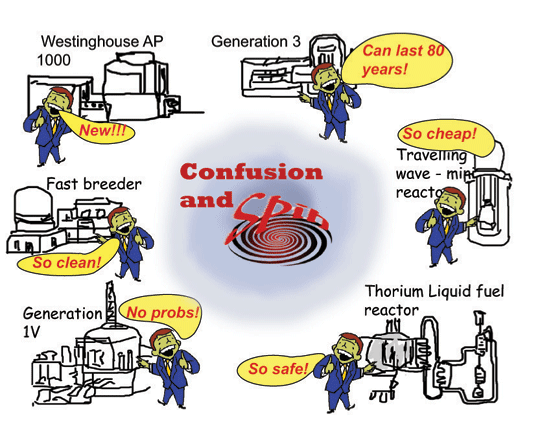
the industry has turned to two other gambits to secure a bigger market share: small, modular light-water reactors, which, because they lack the advantage of economies of scale, would produce even more expensive electricity than conventional reactors; and non-light-water “advanced” reactors, which are largely based on unproven concepts from more than 50 years ago.
Unfortunately, proponents of these non-light-water reactor designs are hyping them as a climate solution and downplaying their safety risks
Advanced’ Nuclear Reactors? Don’t Hold Your Breath. With little hard evidence, their developers maintain they’llb be cheaper, safer and more secure than existing power plants, https://www.scientificamerican.com/article/lsquo-advanced-rsquo-nuclear-reactors-don-rsquo-t-hold-your-breath/Scientific American By Elliott Negin on July 23, 2021
The U.S. nuclear power industry is at an impasse. Since 2003, 11 of the 104 light-water reactors in operation at the time have closed, mainly as a result of aging infrastructure and the inability to compete with natural gas, wind and solar, which are now the cheapest sources of electricity in the United States and most other countries worldwide.
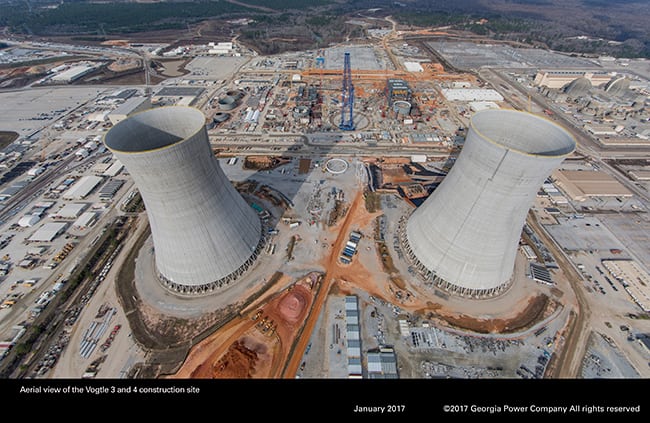
In the early 2000s, the industry promoted a “renaissance” to try to stem its incipient decline, and in 2005, Congress provided nearly $20 billion in federal loan guarantees for new nuclear reactors. The result? Only two new Westinghouse AP1000 light-water reactors, still under construction in Georgia, which will cost at least $14 billion apiece—double their estimated price tags—and take more than twice as long as estimated to be completed. Another two partially built AP1000 reactors in South Carolina were abandoned in 2017 after a $9-billion investment.
Given the struggle to build these standard-sized, 1,000-megawatt light-water reactors, the industry has turned to two other gambits to secure a bigger market share: small, modular light-water reactors, which, because they lack the advantage of economies of scale, would produce even more expensive electricity than conventional reactors; and non-light-water “advanced” reactors, which are largely based on unproven concepts from more than 50 years ago.
Unlike light-water reactors, these non-light-water designs rely on materials other than water for cooling. Some developers contend that these reactors, still in the concept stage, will solve the problems that have plagued light-water reactors and be ready for prime time by the end of this decade.

The siren song of a cheap, safe and secure nuclear reactor on the horizon has attracted the attention of Biden administration officials and some key members of Congress, who are looking for any and all ways to curb carbon emissions. But will so-called advanced reactors provide a powerful tool to combat climate change?

A Union of Concerned Scientists (UCS) analysis of non-light-water reactor concepts in development suggests that outcome may be as likely as Energy Commission Chairman Lewis Strauss’ famous 1954 prediction that electricity generated by nuclear energy would ultimately become “too cheap to meter.” Written by UCS physicist Edwin Lyman, the 140-page report found that these designs are no better—and in some respects significantly worse— than the light-water reactors in operation today.
Lyman took a close look at the claims developers have been making about the three main non-light-water designs: sodium-cooled fast reactors, high-temperature gas-cooled reactors and molten salt–fueled reactors. With little hard evidence, many developers maintain they will be cheaper, safer and more secure than currently operating reactors; will burn uranium fuel more efficiently, produce less radioactive waste, and reduce the risk of nuclear proliferation; and could be commercialized relatively soon. Those claims, however, do not hold up to scrutiny.
One of the sodium-cooled fast reactors, TerraPower’s 345-megawatt Natrium, received considerable media attention earlier this year when company founder Bill Gates touted it during interviews about his new book, How to Avoid a Climate Disaster. In mid-February, Gates told CBS’s 60 Minutes that the Natrium reactor will be safer and cheaper than a conventional light-water reactor and produce less nuclear waste.
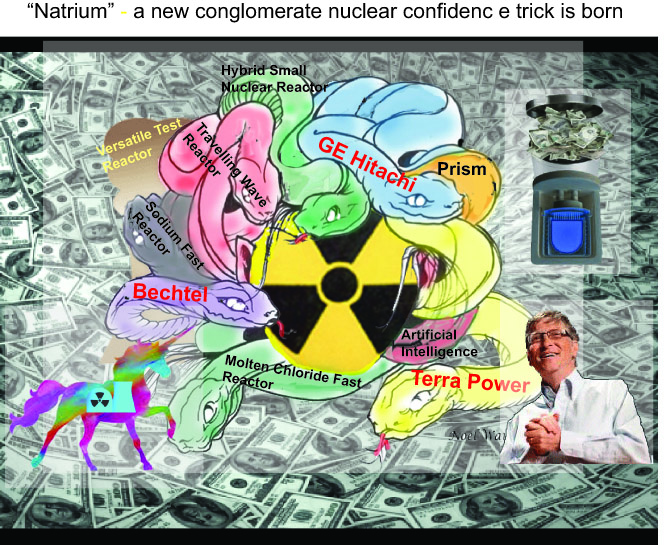
According to the UCS report, however, sodium-cooled fast reactors such as Natrium would likely be less uranium-efficient and would not reduce the amount of waste that requires long-term isolation. They also could experience safety problems that are not an issue for light-water reactors. Sodium coolant, for example, can burn when exposed to air or water, and the Natrium’s design could experience uncontrollable power increases that result in rapid core melting.
In June, TerraPower announced that it would build the first Natrium reactor in Wyoming as part of a 50-50 cost-share program with the Department of Energy. The DOE program originally required TerraPower to have the reactor, still in its early design stage, up and running by 2027. The agency recently changed the target date for commercialization to 2028.
From concept to a commercial unit in seven years?
The new Westinghouse AP1000 light-water reactor provides a cautionary tale. It took more than 30 years of research, development and construction before the first one was built in China and began generating power in 2018. According to the UCS report, if federal regulators require the necessary safety demonstrations, it could take at least 20 years—and billions of dollars in additional costs—to commercialize non-light-water reactors, their associated fuel cycle facilities, and other related infrastructure
The Nuclear Regulatory Commission (NRC) may have to adapt some regulations when licensing reactor technologies that differ significantly in design from the current fleet. Lyman says that should not mean weakening public health and safety standards, finding no justification for the claim that “advanced” reactors will be so much safer and more secure that the NRC can exempt them from fundamental safeguards. On the contrary, because there are so many open questions about these reactors, he says they may need to meet even more stringent requirements.
Finally, it recommends that the DOE and Congress consider spending more research and development dollars on improving the safety and security of light-water reactors, rather than on commercializing immature, overhyped non-light-water reactor designs.
“Unfortunately, proponents of these non-light-water reactor designs are hyping them as a climate solution and downplaying their safety risks,” says Lyman. “Given that it should take at least two decades to commercialize any new nuclear reactor technology if done properly, the non-light-water concepts we reviewed do not offer a near-term solution and could only offer a long-term one if their safety and security risks are adequately addressed.” Any federal appropriations for research, development and deployment of these reactor designs, he says, “should be guided by a realistic assessment of the likely societal benefits that would result from investing billions of taxpayer dollars, not based on wishful thinking.
Trump insurgents came within seconds of capturing ‘nuclear football’ on Jan. 6
 |
| |||
Trump insurgents came within seconds of capturing ‘nuclear football’ on Jan. 6, Mark Sumner Daily Kos Staff, Wednesday July 21, 2021 During Donald Trump’s second impeachment trial, video footage of events on Jan. 6 revealed just how close Mike Pence came to falling into the hands of the people who were chanting for his execution. Fourteen minutes after the mob of Trump supporters first breached the Capitol, Secret Service agents led Pence from the Senate chamber and down a flight of stairs. He entered that stairwell just seconds ahead of the arrival of insurgents, some of whom were carrying rope or zip ties. Had those insurgents not been delayed through the actions of Capitol Police Officer Eugene Goodman, they could easily have been there to capture Pence and take him to the gallows waiting on the lawn outside.
But in addition to Pence, they might have captured something else that would have been especially problematic. For most of us, our electronic devices—phones, tablets, and laptops
—are regularly trusted with our most confidential information. That’s one of the things that helps to make these devices our constant companions and among the most vital objects that we own. However, there is still information that’s considered too valuable, too sensitive, to be trusted to any electronic device, and one prime example was in the hands of a military aide who was with Mike Pence as he fled from the Senate.
That aide was carrying a small satchel, and inside that satchel was a book listing the locations of classified military sites, a description of how to activate and use the Emergency Broadcast System, a “black book” of pre-planned military actions, and a small card that contains the codes necessary to authorize a nuclear strike. That aide was with Pence at the top of the stairs in the video that was shown during the Senate trial.
The Jan. 6 insurgents didn’t just almost get Mike Pence. They almost got the backup copy of the president’s Emergency Satchel. Better know as the “nuclear football.”
As Reuters reports, concern over how close the satchel came to being captured by the Trump horde is calling for a review of just how the vital information is carried and secured……………………. https://www.dailykos.com/stories/2021/7/21/2041066/-Trump-insurgents-came-within-seconds-of-capturing-nuclear-football-on-Jan-6
Bill Gates’fast nuclear reactor ”Natrium” – not so safe and a nuclear weapons proliferation risk

At the March Senate hearing, TerrPower’s CEO described a future for the Natrium project that had almost unlimited export opportunities for Natrium and much larger plants. As Levesque explained, the current Natrium offering is a 345-megawatt (electric) machine—not so small in itself—because that size was what today’s market would accept. As TerraPower gained experience, though, he anticipated “growing Natrium output back up to gigawatt scale,” the size of current large light water reactors. The obvious conclusion is that, despite the current ballyhoo about the economic advantages of small units, TerraPower doesn’t think the smaller units would be as economic as larger ones. The “small” label is apparently just for the easily impressed.
Bill Gates’ Fast Nuclear Reactor: Will It Bomb?, https://nationalinterest.org/blog/buzz/bill-gates%E2%80%99-fast-nuclear-reactor-will-it-bomb-189967 The principal reason for preferring fast reactors, historically the only reason, is to gain the ability to breed plutonium. Thus, the reactor would make and reuse massive quantities of material that could also be used as nuclear explosives in warheads.
by Victor Gilinsky Henry Sokolski 23 July 21, “Fast” means Natrium relies on energetic neutrons as opposed to “slow” neutrons that drive all our current power reactors. That’s also what gives it the “advanced” label. DOE and nuclear enthusiasts have advertised that small, factory-built, modular reactors will be cheaper and safer, and will be so attractive to foreign buyers that they will revive America’s nuclear industry, currently dead in the water; that they will enable the United States to compete in an international market now dominated by China and Russia; and they will provide a solid nuclear industrial base for meeting U.S. military nuclear requirements.
With all these supposed advantages it is not surprising that DOE is pouring money into SMRs. And based on little more than slogans, it is also getting enthusiastic bipartisan Congressional support. To understand what is really going on, one has to look beyond most of DOE’s small reactor projects, mere distractions with little future, to TerraPower’s Natrium. This is not, by the way, the company’s original “traveling wave” concept. That one apparently did not work.
The Natrium project, more than any other, offers the possibility to fulfill the nuclear community’s eighty-year-old nuclear dream to develop a nuclear power plant that can run on all mined uranium, not just on the relatively rare uranium-235 fissile isotope, as current reactors do, thereby vastly increasing fuel resources. It does this by first turning the inert uranium into plutonium and then using the plutonium as fuel. It can even “breed” excess plutonium to fuel new fast reactors. Those outside the nuclear community have no idea of the grip this captivating idea has on nuclear engineers’ minds. It has, however, serious practical drawbacks. What concerns us here is that plutonium is a nuclear explosive—a few kilograms are enough for a bomb, and it is an awful idea to have untold tons of it coursing through commercial channels.
Fast breeder reactors are not exactly a new idea. The DOE’s predecessor agency, the Atomic Energy Commission, pushed fast breeder reactors in the 1970s as the energy solution in what was thought to be a uranium-poor world. It turned out we live in a uranium-rich world, so the expensive project, whose safety problems had not been fully resolved, made no economic sense. Congress canceled the Clinch River Fast Breeder Reactor demonstration project in 1983. Enthusiasts tried but failed to revive fast reactors during the second Bush administration. That effort flopped. Now they are trying again with Natrium, a scaled-up version of a General Electric design for a small sodium-cooled, plutonium-fueled fast breeder reactor (natrium is German for sodium).

TerraPower, of course, is Bill Gates’s company. One might ask, naively, why he of all people needs government support if the Natrium project is as good as he apparently thinks it is, but let us pass over that to focus on what the project technically entails and the difficulties those technical details pose.
Chris Levesque, TerraPower’s CEO, told a March 25 Senate Energy Committee hearing that the Natrium would be fueled with uranium enriched to 20 percent U-235 rather than explosive plutonium. But will that remain the preferred fuel if the Natrium reactor takes off and is offered for export? Currently, only a handful of nations can make 20 percent enriched uranium. It’s hard to believe that foreign customers will want to be tied to a U.S. supply of this fuel.
If they want another source for 20 percent fuel, will the United States go along with foreign enrichers offering it? We currently oppose Iran producing it on grounds that such material is too close to bomb-grade uranium. In a 1976 statement on nuclear policy, President Gerald Ford said the United States would not act in its civilian program in a way contrary to what we ask of others. Has this level of consistency and respect for others gone by the boards?
The thing to remember is that the principal reason for preferring fast reactors, historically the only reason, is to gain the ability to breed plutonium. That is surely what foreign customers will want. The original GE design on which Natrium is based included an onsite reprocessing plant. So configured, the reactor would make and reuse massive quantities of material that could also be used as nuclear explosives in warheads.
The potential weapons link is obvious in India, which has refused to allow international inspections of its fast reactor. And the recent disclosure that China is building two fast reactors more or less under wraps immediately provoked international concerns about Chinese possible weapons plutonium production. The plutonium produced in the fast reactor uranium “blanket” surrounding the reactor core is well over 90 percent plutonium 239, which is ideal for nuclear weapons.
At the March Senate hearing, TerrPower’s CEO described a future for the Natrium project that had almost unlimited export opportunities for Natrium and much larger plants. As Levesque explained, the current Natrium offering is a 345-megawatt (electric) machine—not so small in itself—because that size was what today’s market would accept. As TerraPower gained experience, though, he anticipated “growing Natrium output back up to gigawatt scale,” the size of current large light water reactors. The obvious conclusion is that, despite the current ballyhoo about the economic advantages of small units, TerraPower doesn’t think the smaller units would be as economic as larger ones. The “small” label is apparently just for the easily impressed.

Nor are the touted safety advantages of fast reactors what they seem. The low pressure of sodium-cooled reactors is an advantage. But sodium burns violently when exposed to air or water. And a fast reactor needs a large, concentrated amount of fissile material which becomes more reactive if it loses its coolant. In short, the comparison with the safety of light water reactors is at best a draw.
The March Senate hearing discussion about competing with Russia and China made clear the nuclear industry’s business plan centers on exporting fast reactor technology around the world, however implausible this may be given the cost and safety issues we’ve noted. The question for the U.S. government is, should it be encouraging nuclear technologies that threaten to flood the world with untold tons of plutonium?
Presidents Gerald Ford and Jimmy Carter made it U.S. policy to discourage commercializing of plutonium-fueled reactors. Ford’s words bear repeating: In 1976, he announced that the United States wouldn’t support reliance on plutonium fuel and associated reprocessing of spent fuel until “the world community can effectively overcome the associated risks of proliferation.” Fast reactors like TerraPower’s Natrium don’t meet this test.
Victor Gilinsky serves as program advisor to The Nonproliferation Policy Education Center, is a physicist, and was a commissioner of the U.S. Nuclear Regulatory Commission during the Ford, Carter, and Reagan administrations.
Democrat lawmakers call on President Biden to reduce the role of nuclear weapons in the upcoming Nuclear Posture Review.
SENATORS MARKEY, MERKLEY AND REPS. BEYER, GARAMENDI LEAD COLLEAGUES IN URGING PRESIDENT BIDEN TO REDUCE MILITARY ROLE OF U.S NUCLEAR WEAPONS IN UPCOMING NUCLEAR POSTURE REVIEW https://www.markey.senate.gov/news/press-releases/senators-markey-merkley-and-reps-beyer-garamendi-lead-colleagues-in-urging-president-biden-to-reduce-military-role-of-us-nuclear-weapons-in-upcoming-nuclear-posture-review Washington (July 22, 2021)–
Today, Senators Edward J. Markey (D-Mass.), Jeffrey A. Merkley (D-Ore.) and Representatives Don Beyer (VA-08) and John Garamendi (CA-03), co-chairs of the Nuclear Weapons and Arms Control Working Group, led 18 of their colleagues in calling on President Joseph R. Biden to actively guide the formation of the Department of Defense-led Nuclear Posture Review. The Nuclear Posture Review (NPR) will be part of an integrated National Defense Strategy that the Department of Defense says will be completed by early next year. The lawmakers urged the Administration to consider a series of bold actions that would fulfill the President’s pledge to reduce the role of “nuclear weapons in our national security strategy.”
“Mr. President, as a United States Senator and then as Vice President, you were a party to every major nuclear weapons debate of the past five-decades. From bolstering the Anti-Ballistic Missile Treaty, to building European support for the Intermediate-Nuclear Forces Treaty, to securing votes for ratification of the New START Treaty, you have consistently been on the right side of history. Your Administration’s NPR is a watershed moment where you can reject a 21st century arms race and make bold decisions to lead us towards a future where nuclear weapons no longer threaten all humanity,” the lawmakers wrote in their letter to President Biden.
Specifically, the lawmakers called for President Biden’s Nuclear Posture Review to:
- Adjust U.S. declaratory policy to assign a reduced role for U.S. nuclear weapons, consistent with the President’s past stated view that: “Given our non-nuclear capabilities and the nature of today’s threats — it’s hard to envision a plausible scenario in which the first use of nuclear weapons by the United States would be necessary. Or make sense.”
- Direct the Department of Defense to include in its proposed target list a breakdown of the damage expectancy, civilian casualties, and climatic and humanitarian consequences stemming from nuclear weapons use.
- Examine the number and types of new weapons needed to deter nuclear attack, taking into account recommendations from the Government Accountability Office to consider deferring or cancelling certain nuclear weapons modernization programs.
- Complete independent review of the proposed intercontinental ballistic missile (ICBM) – the Ground Based Strategic Deterrent – that looks into the technical feasibility and comparative cost savings of life-extending the current Minuteman III ICBM.
- Eliminate two of President Trump’s new types of nuclear weapons: the nuclear sea-launched cruise missile (SLCM) under development and the low-yield W-76(2) warhead already deployed on U.S. ballistic missile submarines.
- Commit to pursuing robust diplomacy with Russia and China on arms control through U.S.-Russia bilateral strategic stability talks, which build upon an extended New START Treaty, and starting a new bilateral U.S.-China strategic stability dialogue that builds towards the eventual conclusion of arms control measures that reduce the risk of miscalculation.
A copy of the letter can be found HERE.
First Energy company to pay fine for bribing Ohio officials to bail out nuclear power stations

FirstEnergy agrees to pay $230M fine for bribing Ohio officials to bail out two nuclear plants, Utility Dive, Iulia Gheorghiu July 23, 2021
Dive Brief:
- FirstEnergy Corporation announced on Thursday a settlement agreement to pay a $230 million penalty for bribing Ohio officials to ensure the passage of a ratepayer-funded bailout for older generation assets, including two nuclear plants.
- The utility cooperated with federal investigators to disclose paying millions through dark money groups to state officials, including former Ohio House Speaker Larry Householder and former Public Utilities Commision of Ohio (PUCO) Chairman Sam Randazzo. The company acknowledged using 501(c)(4) organizations, which are registered lobbying entities, to conceal the nature, source and control of payments in the pursuit of the nuclear legislation……………
The details in the 49-page settlement agreement, in which FirstEnergy had to admit that company executives paid money to public officials in return for official action, has led to stakeholders raising questions about utility dark-money and political spending………….
The OEC Action Fund is also asking for a full repeal of HB 6 and has called for an investigation into every PUCO and Ohio Power Siting Board ruling made under Randazzo’s tenure.
“Each case he presided over is possibly tainted by corrupt ties to FirstEnergy,” Taylor-Miesle said……………………. https://www.utilitydive.com/news/firstenergy-agrees-to-pay-230m-fine-for-bribing-ohio-officials-to-bail-out/603836/
Racism and the misguided efforts to expand nuclear energy around the world
Early efforts to expand nuclear energy were rife with racism and peril,
reminds a historian. “Those who cannot remember the past are condemned to
repeat it,” wrote the philosopher George Santayana in 1905. Heeding this
aphorism, in The Wretched Atom, historian Jacob Darwin Hamblin seeks to
remind readers of the misguided 20th-century effort launched by the United
States, its allies, and international agencies to expand nuclear energy
around the world. The compelling narrative should lead readers to realize
the importance of preventing a repeat of the follies that marked the early
decades of the atomic age.
Science 21st July 2021
https://blogs.sciencemag.org/books/2021/07/21/the-wretched-atom/
1 This Month

4 May -West Suburban Peace Coalition to discuss Iran war at May Educational Forum
Monday, May 4, 7:00 – 8:00 PM Central Standard Time
Title: : How Trump’s Narrative Tries to Shape the Reality of the War on Iran.
Contact Walt Zlotow, zlotow@hotmail.com 630 442 3045 for further information
14 May – online event From Bombs to Data Centres: the Face of Nuclear Colonialism
To see nuclear-related stories in greater depth and intensity – go to https://nuclearinformation.wordpress.com
-
Archives
- May 2026 (49)
- April 2026 (356)
- March 2026 (251)
- February 2026 (268)
- January 2026 (308)
- December 2025 (358)
- November 2025 (359)
- October 2025 (376)
- September 2025 (257)
- August 2025 (319)
- July 2025 (230)
- June 2025 (348)
-
Categories
- 1
- 1 NUCLEAR ISSUES
- business and costs
- climate change
- culture and arts
- ENERGY
- environment
- health
- history
- indigenous issues
- Legal
- marketing of nuclear
- media
- opposition to nuclear
- PERSONAL STORIES
- politics
- politics international
- Religion and ethics
- safety
- secrets,lies and civil liberties
- spinbuster
- technology
- Uranium
- wastes
- weapons and war
- Women
- 2 WORLD
- ACTION
- AFRICA
- Atrocities
- AUSTRALIA
- Christina's notes
- Christina's themes
- culture and arts
- Events
- Fuk 2022
- Fuk 2023
- Fukushima 2017
- Fukushima 2018
- fukushima 2019
- Fukushima 2020
- Fukushima 2021
- general
- global warming
- Humour (God we need it)
- Nuclear
- RARE EARTHS
- Reference
- resources – print
- Resources -audiovicual
- Weekly Newsletter
- World
- World Nuclear
- YouTube
-
RSS
Entries RSS
Comments RSS
 nuclear-news