Pentagon review: What happens if ‘nuclear football’ is lost?
Pentagon review: What happens if ‘nuclear football’ is lost? Questions about security procedures arose after Jan. 6, when Vice President Mike Pence was escorted to safety along with a military aide carrying the backup communications system.. 6, when Vice President Mike Pence was escorted to safety along with a military aide carrying the backup communications system.
By The Associated Press NBC News, 21 July 21, WASHINGTON — The Pentagon is taking a rare look at whether it is prepared to deal with the theft or compromise of the portable communications system nicknamed the “nuclear football,” which enables the president or a stand-in to order a nuclear attack.
In announcing the probe Tuesday, the Pentagon inspector general’s office did not disclose what precipitated it, but questions about security procedures arose in the aftermath of the Jan. 6 insurrection at the Capitol.
Vice President Mike Pence was seen on security camera video being escorted to safety, along with a military aide carrying the backup “nuclear football,” as rioters entered the Capitol.
A backup system always accompanies the vice president so that he is able to communicate in the event the president cannot. The “football,” officially called the Presidential Emergency Satchel, enables communication with the office inside the Pentagon that transmits nuclear attack orders.
The inspector general’s office said its review began this month. It gave no timeline for completing it.
“The objective of this evaluation is to determine the extent that DoD processes and procedures are in place and adequate to alert DoD officials in the event that the Presidential Emergency Satchel is lost, stolen, or compromised,” Randolph R. Stone, an assistant inspector general, wrote in a July 19 letter to the director of the White House military office and the director of the Joint Staff at the Pentagon. “This evaluation will also determine the adequacy of the procedures the DoD has developed to respond to such an event.”
Two Democrats who had asked the Pentagon inspector general to review the matter, Reps. Stephen Lynch of Massachusetts and Jim Cooper of Tennessee, said in a joint statement that the Jan. 6 riot raised questions about whether the Pentagon was even aware that Pence’s “nuclear football” was potentially in danger of falling into the hand of insurrectionists………..
“U.S. Strategic Command, which is responsible for U.S. strategic deterrence and nuclear operations, was reportedly unaware that Vice President Pence, his military aide, and the nuclear football were all potentially in danger and only came to understand the gravity of the incident several weeks later when security camera footage was played as a video exhibit during the Senate impeachment trial,” they wrote. https://www.nbcnews.com/politics/national-security/pentagon-review-what-happens-if-nuclear-football-lost-n1274582
Small nuclear reactor project cut back to half size, due to financial worries

Eastern Idaho nuclear project goes from 12 to six reactors. IDAHO FALLS, Idaho (AP) 19 July 21— A Utah energy cooperative said it will reduce the number of small modular nuclear reactors it will build in Idaho from 12 to six for a first-of-a-kind project [ totally ineffective against global heating] that is part of a federal effort to reduce greenhouse gasses that cause climate change……
The reactors are being built by Portland, Oregon-based NuScale Power. The U.S. Nuclear Regulatory Commission last year approved NuScale’s application for the small modular reactors, the first time U.S. officials approved a design for a small commercial nuclear reactor.
………….. Idaho Falls has committed to buying 5 megawatts of power from the reactors through the Carbon Free Power Project. The city had been committed to 10 megawatts but cut that in half in October amid concerns about financial risks.
……….. Idaho Falls City Council member John Radford said at a July 8 meeting. “This project is something that can help keep this country on this trajectory to a carbon-free future and maybe a better existence for all of us.” – [a complete untruth!! this Councillor is either ignorant, or lying] https://madison.com/news/national/govt-and-politics/eastern-idaho-nuclear-project-goes-from-12-to-six-reactors/article_cb353af6-5659-5baa-8365-dc575aeeba8d.html
Wiscasset – just one of thousands of American communities stuck with stranded nuclear wastes.

The situation in Wiscasset underscores a thorny issue facing more than 100 communities across the U.S.: What to do with hundreds of thousands of tons of nuclear waste that has no place to go.

All told, the country’s many abandoned nuclear facilities — including Maine Yankee — have cost the federal government billions of dollars, a sum that increases by about $2 million each day
Keeping the spent fuel on the site was meant to be a temporary solution until the dry storage casks, or canisters, could be transported to a permanent home deep underground where they could stay undisturbed for hundreds of thousands of years.
Armed Guards Protect Tons Of Nuclear Waste That Maine Can’t Get Rid Of Maine Public | By By Abigail Curtis, BDN July 19, 2021 In the summertime, the picturesque village of Wiscasset is infamous for its long lines of people hungry to try a lobster roll at Red’s Eats and cars that crawl through town on the often-clogged U.S. Route 1.
But just a few miles south of downtown is a different kind of roadblock: thousands of tons of nuclear waste stored on a coastal peninsula at the now-decommissioned Maine Yankee atomic energy plant that have nowhere to go.
The change in presidential administrations means another chance for the federal government to make good on its promise to remove the waste, so the site can be closed for good. The Biden administration’s Department of Energy seems to be picking up where the Obama administration left off, creating a process for communities to volunteer to host the waste.
“What worries me is that there really isn’t any national leadership right now on this stuff. There isn’t an agency that has a mission and has developed a strategy, that has goals and is willing to act on it,” Don Hudson, the chairman of the Maine Yankee Community Advisory Panel, said. “We’re currently in this limbo.”
That’s a problem because the waste — 1,400 spent nuclear fuel rods housed in 60 cement and steel canisters, plus four canisters of irradiated steel removed from the nuclear reactor when it was taken down — is safe for now, but can’t stay in Wiscasset forever.
The situation in Wiscasset underscores a thorny issue facing more than 100 communities across the U.S.: What to do with hundreds of thousands of tons of nuclear waste that has no place to go.
Securing these remnants of nuclear energy generation is an ongoing task that requires armed guards around the clock and costs Maine Yankee’s owners some $10 million per year, which is being paid for with money from the government.
After the government failed to remove the spent fuel, Maine Yankee and the other two decommissioned nuclear power plants in New England — Connecticut Yankee in East Hampton, Connecticut, and Yankee Atomic in Rowe, Massachusetts — took it to court. So far, they have been awarded a total of $575.5 million in damages during four rounds of litigation, money that has been paid out of the U.S. Judgment fund. A fifth round is happening now, and the lawsuits are likely to continue until the fuel is removed.
Continue readingAfter the lab-leak theory, US-Chinese relations head downhill
The United States and China could work together in sharing biosecurity-related samples, genetic materials and data, developing protocols and countermeasures against biosafety accidents, promoting transparency in dual-use research of concern, countering disinformation, and strengthening compliance with global health laws, including the Biological Weapons Convention and the International Health Regulations.
But the US push to investigate the lab leak and the political context in both countries likely puts the goal of finding the origins of COVID-19 and many other ambitions at risk………
After the lab-leak theory, US-Chinese relations head downhill, Bulletin of the Atomic Scientists, By Yanzhong Huang | July 16, 2021 In October, 2018, more than a year before the COVID-19 pandemic, dozens of international trainees visited the Wuhan Institute of Virology for an expansive workshop meant to “promote the cooperation between China and other countries in the field of biosafety.” The attendees, many from developing countries, took classes on virus handling and bioethics, they listened to speeches by Chinese and UN arms control officials, and learned from eminent scientists. For the organizers, the 10-day event was a chance to showcase China’s expertise in biosafety management. And for this, they could hardly have chosen a more perfect location, a prestigious virology institute that had just months earlier opened the country’s first state-of-the-art, specialized facility for safely studying the world’s most dangerous pathogens, a biosafety-level (BSL) 4 lab.
The marketing plan hasn’t paid out.
Two years on, the lofty vision the workshop at the advanced Chinese biolab embodied—one of international collaboration on disease control and scientific research—has disintegrated as the United States and China tangle in an increasingly nasty fight over the origins of the still-raging coronavirus pandemic. In the United States, President Joe Biden, prominent scientists, and once-skeptical mainstream media outlets have collectively revived a hypothesis that was initially largely framed as a conspiracy theory, that the COVID-19 virus could have escaped from the Wuhan lab. Meanwhile, in China, many are convinced COVID-19 started somewhere else, outside of the country.
The Wuhan Institute of Virology now sits at the forefront of the US-China row on the origins of a once-in-a-century pandemic.
Continue readingCanada’s small nuclear reactor project is looking like just a pipe-dream.

Globe Climate: Canada wants nuclear to power the future. But how? SIERRA BEIN Matthew McClearn is an investigative reporter and data journalist with The Globe. For this week’sdeeper dive, he talks about Canada’s nuclear ambitions. Globe and Mail, 19 July 21
Senior government officials, notably federal Natural Resources Minister Seamus O’Regan, say small modular reactors (SMRs) will help Canada achieve net-zero carbon emissions by mid-century. There’s just one problem: it’s not clear yet whether any will be built.
To be sure, many promises made by SMR vendors seem compelling. By taking advantage of factory-style mass production, they’re supposed to be far cheaper than previous generations of reactors, which tended to be massive and prone to cost overruns. They’d also be easier to deploy……..
A mad scramble to deliver on these promises is now underway. Ontario Power Generation—by far Canada’s most experienced nuclear station operator—plans to select a vendor to build a SMR at its Darlington Station by 2028. Further out, Saskatchewan is considering whether to order its own SMRs to replace coal-fired plants.
Accomplishing all that would silence numerous critics and naysayers. But as I explain in my most recent story, history is littered with reactors that failed to live up to their promises. . Many SMR vendors are very early-stage companies which face years of grueling, expensive R&D work to advance their designs to the point they could actually be built. And they’re competing against renewable technologies including wind and solar, which utilities can purchase and deploy today. It may be premature to count on SMRs to help meet Canada’s emissions targets. https://www.theglobeandmail.com/canada/article-globe-climate-canada-wants-nuclear-to-power-the-future-but-how/https://www.theglobeandmail.com/canada/article-globe-climate-canada-wants-nuclear-to-power-the-future-but-how/
Judge rules distribution of compensation for investors who lost fortunes in multi billion-dollar nuclear reactor failure in South Carolina

Judge OKs distribution for $192M nuclear project settlement, https://www.miamiherald.com/news/business/article252884293.html
BY MEG KINNARD ASSOCIATED PRESS, JULY 19, 2021 OLUMBIA, S.C.
Investors who lost fortunes in the failure of a multi billion-dollar nuclear reactor construction deal in South Carolina will soon begin to see their portions of a $192 million settlement, under a recently approved distribution.
Last week, a federal judge signed off on a plan to disperse the funds among former shareholders in SCANA Corp., the former parent company of South Carolina Electric & Gas. The settlement itself was the largest securities class action recovery obtained in South Carolina when a judge approved it last year, according to attorneys for the investors.
The utility company became embroiled in controversy after announcing in summer 2017 that it was shuttering a nuclear reactor construction project at the V.C. Summer Nuclear Station in Jenkinsville, about 30 miles (48 kilometers) north of Columbia, following the bankruptcy of lead contractor Westinghouse.
Up to that point, SCANA and state-owned utility Santee Cooper, a minority partner in the project, had spent nearly $10 billion on it. The failure cost ratepayers and investors billions and left nearly 6,000 people jobless.
The abandonment spawned multiple lawsuits, some by ratepayers claiming company executives knew the project was doomed and misled consumers as well as regulators as they petitioned for a series of rate increases. State and federal authorities launched investigations, which have led to guilty pleas from two top-level SCANA executives.
More than 737,000 SCE&G customers had already paid more than $2 billion toward the project, which never generated any power. Customers did ultimately see retroactive credits applied to bills after lawmakers passed a temporary rate cut that knocked about $25 a month off the average residential customer’s bill.
SCANA shareholders accused the company of assuring them the project was above board, even as costs and delays spiraled out of control. This, investors alleged, caused SCANA stock to be traded at artificially inflated prices, numbers that plummeted once the project was mothballed. In July 2016, SCANA stock was trading at $76.12 a share but dropped more than 50% after news of the project’s failure, and the investigations surrounding it, became public, according to the investors’ attorneys.
The settlement includes $160 million in cash, with the remaining $32.5 million covered by cash or stock in Dominion Energy. The Virginia-based company took over SCANA in 2019, paying more than $6.8 billion to buy out the company’s stock and assuming its consolidated net debts of $6.6 billion.
Claimants will be required to cash their checks within 120 days or forfeit the award, according to the order.
“We are pleased that the court has approved the settlement distribution plan, and look forward to the distribution of the settlement funds to eligible class members according to the plan,” said Marlon Kimpson, a state senator and attorney representing the investors.
City Council in Calgary, Canada, not happy about ”rushed” agreement to own stranded nuclear wastes in Maine.

The 11-acre temporary storage site is patrolled around the clock by armed security guards.
The situation concerns Coun. Evan Woolley, who said that Enmax never mentioned the spent nuclear fuel site when the utility briefed city council on its bid for Versant.
Calgarians have a stake in Maine nuclear fuel storage facility https://mail.google.com/mail/u/0/?tab=rm&ogbl#inbox/KtbxLthlxCLcsbdhrlMgpmhjJQTWxmvSdV?compose=new
Facility part of the deal when Enmax bought U.S. utility for $1.8 billion, including debt
Scott Dippel · CBC News · Jul 19, 2021 Enmax’s acquisition of a utility in Maine last year came with a nuclear surprise that city council members say they weren’t told about.
When the city-owned Enmax closed on its deal to buy Versant Power (formerly Emera Maine) in March of 2020, it also acquired Versant’s interest in a former nuclear power plant.
The Maine Yankee plant operated from 1972 to 1996 and was decommissioned in 2005.
Versant owned 12 per cent of the electricity generated by the power plant. Its ratepayers also paid up front for 12 per cent of the decommissioning costs.
The plant was torn down and tonnes of spent nuclear fuel rods from the facility were temporarily encased in 64 concrete silos at a protected site in Wiscassett, Maine.
Part of the deal
The president of Versant Power, John Flynn, tells CBC News that Enmax couldn’t avoid taking on the Maine Yankee obligation when it purchased Versant.
“As part of the acquisition, Enmax really didn’t have the opportunity to pick and choose the assets or relationships or obligations it wanted,” said Flynn. “It was making a bid for the entire company.”
He said there isn’t a market for a temporary nuclear waste storage facility, so any buyer of Versant would have had to take on that obligation.
There are approximately $10 million US in annual costs related to the safe operation of the spent nuclear fuel storage site, including monitoring, maintenance and security.
About 38 people work at the site.
But Flynn said this doesn’t actually cost Versant or Enmax any money.
It’s covered by a trust fund which includes legal settlements from the US Department of Energy (DOE), which has a legal responsibility to ultimately remove the tonnes of spent fuel and find a permanent storage site.
Temporary site may be used for years
Flynn said there’s currently no estimate from the DOE on when it may move the materials to a final storage site.
He said the trust fund has enough money in it that the operation of the temporary facility will be covered for years to come.
In some years, Flynn said annual payments from the fund have been made to Versant customers who prepaid the decommissioning costs during the years the nuclear power plant was in operation.
The 11-acre temporary storage site is patrolled around the clock by armed security guards.
“The entire site is surrounded by a security perimeter that has 24/7 security that is of the level you would expect to see on an army base, so it is a hyper-secure site.”
While Enmax says it doesn’t own the spent nuclear fuel, it does list in its annual financial report the historical 12 per cent interest in Maine Yankee.
Council kept in dark
The situation concerns Coun. Evan Woolley, who said that Enmax never mentioned the spent nuclear fuel site when the utility briefed city council on its bid for Versant.
He is one of several council members contacted by CBC News who said they were unaware of that part of the $1.3 billion acquisition, which also included $500 million in debt.
Owning 12 per cent of a company that owns a bunch of nuclear waste has not only reputational risk but also real risk in terms of the world that we live in,” said Woolley.
The Ward 8 councillor, who is also the chair of council’s audit committee, said he would have liked to have known this information before council approved Enmax’s purchase.
“For us to not have been made aware of that is unacceptable,” said Woolley.
“Enmax and now Versant Power, which was Emera Maine, is owned by Calgarians. So council and the shareholder are accountable for that decision.”
Outside eyes needed
He describes Enmax’s pitch to city council to approve its takeover of the company in Maine as “rushed.”
His preference is that in future, a third party could assess such business opportunities for council and make a recommendation.
That perspective could come from the city’s chief financial officer, the city solicitor or an external consultant.
A report is expected before the audit committee in September, which he said could result in changes that could help ensure Enmax and all of the city’s wholly-owned subsidiaries are on the same page as city council in the future.
He describes Enmax as “the massive gorilla in the room in terms of its size and scale.” “The risk appetite of Enmax versus the risk appetite of a shareholder are different. And that’s where we need to provide better alignment,” said Woolley.
If council approves of any changes for its subsidiaries, he said it would mean that another transaction like the Versant purchase could not occur in the way that it did.
The 11-acre temporary storage site is patrolled around the clock by armed security guards.
The situation concerns Coun. Evan Woolley, who said that Enmax never mentioned the spent nuclear fuel site when the utility briefed city council on its bid for Versant.
Calgarians have a stake in Maine nuclear fuel storage facility AT TOP https://mail.google.com/mail/u/0/?tab=rm&ogbl#inbox/KtbxLthlxCLcsbdhrlMgpmhjJQTWxmvSdV?compose=new
Facility part of the deal when Enmax bought U.S. utility for $1.8 billion, including debt
Scott Dippel · CBC News · Jul 19, 2021 Enmax’s acquisition of a utility in Maine last year came with a nuclear surprise that city council members say they weren’t told about.
When the city-owned Enmax closed on its deal to buy Versant Power (formerly Emera Maine) in March of 2020, it also acquired Versant’s interest in a former nuclear power plant.
The Maine Yankee plant operated from 1972 to 1996 and was decommissioned in 2005.
Versant owned 12 per cent of the electricity generated by the power plant. Its ratepayers also paid up front for 12 per cent of the decommissioning costs.
The plant was torn down and tonnes of spent nuclear fuel rods from the facility were temporarily encased in 64 concrete silos at a protected site in Wiscassett, Maine.
Part of the deal
The president of Versant Power, John Flynn, tells CBC News that Enmax couldn’t avoid taking on the Maine Yankee obligation when it purchased Versant.
“As part of the acquisition, Enmax really didn’t have the opportunity to pick and choose the assets or relationships or obligations it wanted,” said Flynn. “It was making a bid for the entire company.”
He said there isn’t a market for a temporary nuclear waste storage facility, so any buyer of Versant would have had to take on that obligation.
There are approximately $10 million US in annual costs related to the safe operation of the spent nuclear fuel storage site, including monitoring, maintenance and security.
About 38 people work at the site.
But Flynn said this doesn’t actually cost Versant or Enmax any money.
It’s covered by a trust fund which includes legal settlements from the US Department of Energy (DOE), which has a legal responsibility to ultimately remove the tonnes of spent fuel and find a permanent storage site.
Temporary site may be used for years
Flynn said there’s currently no estimate from the DOE on when it may move the materials to a final storage site.
He said the trust fund has enough money in it that the operation of the temporary facility will be covered for years to come.
In some years, Flynn said annual payments from the fund have been made to Versant customers who prepaid the decommissioning costs during the years the nuclear power plant was in operation.
The 11-acre temporary storage site is patrolled around the clock by armed security guards.
“The entire site is surrounded by a security perimeter that has 24/7 security that is of the level you would expect to see on an army base, so it is a hyper-secure site.”
While Enmax says it doesn’t own the spent nuclear fuel, it does list in its annual financial report the historical 12 per cent interest in Maine Yankee.
Council kept in dark
The situation concerns Coun. Evan Woolley, who said that Enmax never mentioned the spent nuclear fuel site when the utility briefed city council on its bid for Versant.
He is one of several council members contacted by CBC News who said they were unaware of that part of the $1.3 billion acquisition, which also included $500 million in debt.
Owning 12 per cent of a company that owns a bunch of nuclear waste has not only reputational risk but also real risk in terms of the world that we live in,” said Woolley.
The Ward 8 councillor, who is also the chair of council’s audit committee, said he would have liked to have known this information before council approved Enmax’s purchase.
“For us to not have been made aware of that is unacceptable,” said Woolley.
“Enmax and now Versant Power, which was Emera Maine, is owned by Calgarians. So council and the shareholder are accountable for that decision.”
Outside eyes needed
He describes Enmax’s pitch to city council to approve its takeover of the company in Maine as “rushed.”
His preference is that in future, a third party could assess such business opportunities for council and make a recommendation.
That perspective could come from the city’s chief financial officer, the city solicitor or an external consultant.
A report is expected before the audit committee in September, which he said could result in changes that could help ensure Enmax and all of the city’s wholly-owned subsidiaries are on the same page as city council in the future.
He describes Enmax as “the massive gorilla in the room in terms of its size and scale.” “The risk appetite of Enmax versus the risk appetite of a shareholder are different. And that’s where we need to provide better alignment,” said Woolley.
If council approves of any changes for its subsidiaries, he said it would mean that another transaction like the Versant purchase could not occur in the way that it did.
Risk of cracks in pressure tubes of Canada’s ageing nuclear reactors – how long can they keep operating safely?

The regulatory violations at the Bruce station are the latest indication that the industry’s approach to managing the aging of pressure tubes, and predicting deuterium ingress, may be breaking down.
At issue is the industry’s ability to accurately predict how long Canada’s aging nuclear reactors, many of which have already exceeded their 30-year design life, can continue to operate safely
Reactors at Bruce nuclear station violated terms of operating licence, MATTHEW MCCLEARN Globe and Mail, 19 Juy 21,Two reactors at the Bruce Nuclear Generating Station have violated the terms of its operating licence, its operator and the federal regulator have revealed.
Bruce Power, which operates the plant in Kincardine, Ont., announced in a July 13 statement that pressure tubes in Unit 3 and Unit 6 were found to have “higher-than-anticipated readings.” The following day, the Canadian Nuclear Safety Commission (CNSC) issued its own statement saying hydrogen equivalent concentration (Heq) levels in some of the station’s pressure tubes exceeded the allowable limit of 120 parts per million.
Pressure tubes are six-metre-long rods that contain bundles of uranium fuel. A CANDU reactor contains several hundred of them – and they are considered the principal life-limiting component of Canada’s reactor fleet. Pressure tubes with high Heq levels are at risk of developing blisters and cracks that could cause them to fracture.
Citing an ongoing “regulatory process” that “will continue to evolve,” Bruce Power did not answer questions from The Globe and Mail regarding how many tubes were affected or how much they exceeded the allowable limit……………..
At issue is the industry’s ability to accurately predict how long Canada’s aging nuclear reactors, many of which have already exceeded their 30-year design life, can continue to operate safely……….
Frank Greening, a retired OPG employee who worked for more than a decade with pressure tubes, said the Unit 6 tube reading is unprecedented and puts the regulator in a difficult position………….
Pressure tubes deteriorate as they age, picking up deuterium (an isotope of hydrogen) through a corrosion process known as deuterium ingress. In combination with other aging processes, deuterium ingress causes tubes to grow in length and diameter, known as creep, which allows more coolant to bypass the fuel bundles, lowering the margin of safety. Over time, tube walls become thinner and more brittle, which can cause them to crack and eventually fracture.
In January, 2019, the CNSC renewed Bruce Power’s licence to operate the Bruce station for 10 years, to 2028. However, the regulator insisted that before Heq levels exceeded 120 ppm, Bruce Power would have to prove that its pressure tubes could continue to operate safely above that level. If any pressure tube reached the limit, it declared, the operator would have to shut down the reactor.
At the time, Bruce Power promised to “extend the validity limits of the existing fracture toughness model to 140 ppm of [Heq] in pressure tubes by the end of 2018 and to 160 ppm of [Heq] by the end of 2019.”
But the CNSC said it received a new fracture toughness model for review this May. “No decisions regarding acceptance of the model have been made at this time,” it said.
The regulatory violations at the Bruce station are the latest indication that the industry’s approach to managing the aging of pressure tubes, and predicting deuterium ingress, may be breaking down.
It shows their predictions aren’t worth beans,” Dr. Greening said. “Their predictions are failing. And this is not the first time.”
In March, The Globe reported that, since 2017, CNSC staffers had expressed concerns about unreliable data from pressure tube inspections by OPG at its Pickering plant, east of Toronto. CNSC staffers warned that measuring and predicting deuterium ingress is “potentially one of the biggest issues currently faced by the Industry.”………. https://www.theglobeandmail.com/business/article-reactors-at-bruce-nuclear-station-violated-terms-of-operating-licence/
Pro nuclear U.S. lawmakers again introduce Bill to promote nuclear industry
WASHINGTON, D.C. 19 July 21, – U.S. Senator Shelley Moore Capito (R-W.Va.), Ranking Member of the Senate Environment and Public Works (EPW) Committee, along with Senators Sheldon Whitehouse (D-R.I.), John Barrasso (R-Wyo.), Cory Booker (D-N.J.), and Mike Crapo (R-Idaho) reintroduced the American Nuclear Infrastructure Act (ANIA)
……. pecifically, ANIA will:
- Reestablish American international competitiveness and global leadership;
- ANIA empowers the Nuclear Regulatory Commission (NRC) to lead a consensus-building process in international forums to establish regulations for advanced nuclear reactor designs.
- ANIA provides the NRC authority to deny imports of Russian nuclear fuel on national security grounds.
- Expand nuclear energy through advanced nuclear technologies;
- ANIA creates a prize to incentivize the successful licensing process of next generation nuclear technologies and fuels.
- ANIA requires the NRC to identify and resolve regulatory barriers to enable advanced nuclear technologies to reduce industrial emissions.
- Preserve existing nuclear energy; and
- ANIA authorizes a targeted credit program to preserve nuclear plants at risk of prematurely shutting down.
- ANIA modernizes outdated rules that restrict investment in nuclear energy.
- Revitalize America’s nuclear supply chain infrastructure.
- ANIA identifies modern manufacturing techniques to build nuclear reactors better, faster, cheaper, and smarter. https://www.capito.senate.gov/news/press-releases/capito-whitehouse-barrasso-booker-crapo-introduce-legislation-to-preserve-and-expand-americas-nuclear-energy-sector
Problems of nuclear power in space
Houston, are we going to have a problem with space nuclear power? Bulletin of the Atomic Scientists, By Beau Rideout | July 19, 2021 ” ………….. space nuclear power isn’t just about propulsion. The dynamic commercial space and national security sectors can also benefit from nuclear capabilities and have an important role to play in developing dual-use technologies that have both military and civilian applications, though with some caveats to ensure human safety.
While the National Academies report published in February advocates for the use of nuclear power in propulsion, nuclear power for non-propulsion applications is becoming increasingly attractive as the commercial space sector seeks to expand its activities. It would be prudent to discuss and establish policy on the use of space nuclear power now, so that policy and safety concerns can be fully addressed during the development proposed by NASA and the National Academies. The United States, and the world, has important decisions to make about whether, when, and how to use nuclear power in space.
Nuclear propulsion in space. The fiscal year 2021 spending approved by Congress provides $110 million for space nuclear propulsion development. This reflects growing NASA interest in more ambitious deep-space missions and a burgeoning commercial interest in exploiting extraterrestrial resources on the Moon, Mars, and the asteroid belt, for which nuclear power would be a key enabling technology……………….
With both a high-power output and high mass efficiency, nuclear propulsion would strike a mighty blow against the tyranny of the rocket equation, which dictates that spacecraft need exponentially more fuel to travel farther. Space nuclear propulsion would enable entirely novel types of space missions, such as capturing small asteroids or, as NASA plans, sending humans to Mars.
Non-propulsion activities in space. In addition to providing advanced propulsion capabilities, nuclear power would enable other space activities and allow the commercial space industry to reduce its reliance on solar panels. For example, space-based radar systems can image the ground day or night, regardless of cloud cover, but require large amounts of electrical power. Communication systems relay data across the world but are constrained by the size of their solar panels. With nuclear power, they could send more data down to Earth, or serve more customers by operating from higher orbits.
The space industry is offering new in-space services and aiming for new destinations beyond geostationary orbit but within the moon’s orbit. Lockheed Martin has announced that future GPS satellites will be designed to receive hardware upgrades of processors and sensors while in orbit. A DARPA program is investigating future in-space manufacturing of large, lightweight structures using raw materials harvested from the Moon. And the NASA Commercial Lunar Payload Services program is scheduled to begin sending commercial lunar landers to the Moon in the fourth quarter of this year. This uptick of activity requiring frequent trips beyond low Earth orbit indicates that requirements for propulsion and power generation will continue to expand, making nuclear power an increasingly attractive solution. In anticipation of this demand, conversations about the proper, safe use of nuclear power in space must begin now.
………… The United States should lead the way in identifying the types of applications that should be encouraged, those where caution may be indicated, and perhaps some applications that should be discouraged because the risks outweigh potential benefits.
…………. Interagency review should also identify measures to protect human safety. For example, the National Academies report has recommended that nuclear applications in space minimize the amount of radioactive material required, undergo sufficient testing to ensure reliable operations prior to any orbital flight, restrict reactor use until a spacecraft has achieved a safe orbit, and design all space-going reactors to automatically go into a “safe state,” in which the reactor is highly unlikely to achieve criticality and sustain a fission chain reaction, if a launch failure occurs. Nuclear power applications in low Earth orbits should be required to include back-up safety mechanisms such as redundant communications or a secondary propulsion system, as objects in these orbits are most at risk of uncontrolled reentry events like the Soviet Kosmos 954 reactor accident
In that 1978 accident, the Kosmos 954 satellite broke apart over Canada, spreading radioactive debris over the Northwest Territories and requiring a multimillion-dollar cleanup operation. Kosmos 954 was not the first fission reactor in space. The United States flew an experimental satellite called SNAPSHOT in 1965 to test a small nuclear reactor powering an early form of electric propulsion. SNAPSHOT failed 43 days after launch, but the reactor safely shut down and was left in a high orbit. The Soviet Union launched 33 RORSAT radar satellites powered by reactors between 1967 and 1988. Unlike SNAPSHOT, these RORSAT satellites orbited at low altitude and would fall back to Earth unless boosted up to a higher disposal orbit from which they would not return for several centuries. However, this boosting maneuver was not always successful and on two occasions resulted in the reactor cores crashing back to Earth. ………………. https://thebulletin.org/2021/07/houston-are-we-going-to-have-a-problem-with-space-nuclear-power/?utm_source=Newsletter&utm_medium=Email&utm_campaign=MondayNewsletter07192021&utm_content=NuclearRisk_NuclearPowerInSpace_07192021
Small Nuclear Reactors are all the hype. But here’s the reality

promoting a dizzying assortment of next-generation models that have collectively been dubbed “small modular reactors” (SMRs).……..
The real challenge “is answering all the safety questions that any good regulator would ask: ‘How will this behave if there’s an earthquake or fire? What happens if there’s a complete blackout? What happens if this component fails?’ ” Answering such questions requires an intensive research program and countless hours of laboratory work, which can take decades. There’s no guarantee the answers will be favourable.
Governments, utilities and the nuclear industry hope small modular reactors will power Canada’s future. Can they actually build one? The Globe and Mail MATTHEW MCCLEARN, JULY 17, 2021 Ontario Power Generation plans to make a decision this year that might determine the future of Canada’s nuclear industry.The utility, by far Canada’s largest nuclear power producer, promises to select a design for a 300-megawatt reactor it proposes to build at its Darlington Nuclear Generating Station by 2028. The estimated price tag: up to $3-billion. It would be the first new reactor built on Canadian soil in well over three decades. OPG won’t make that decision alone, because it’s intended to be the first of many reactors of the same design built across the country.Canada’s nuclear industry desperately needs a next act….. With a supply chain of more than 200 companies covering everything from uranium mining, to operating power plants, to decommissioning them, Canada is considered a Tier 1 nuclear country.
But lately, this machine has been devoted to squeezing more life out of old CANDU units, largely through Ontario’s $26-billion plan to refurbish its Darlington station, east of Toronto, and the Bruce Power complex, on Lake Huron. The industry has few, if any, exciting new products for sale……
but renewable forms of generation – hydro, wind, solar and biomass – have become preferred tools for decarbonizing electricity grids. And utilities can buy inexpensive wind turbines and solar panels today.
Seeking to catch up, dozens of nuclear vendors sprung up just in the past few years, promoting a dizzying assortment of next-generation models that have collectively been dubbed “small modular reactors” (SMRs)………
U.S. President Joe Biden and U.K. Prime Minister Boris Johnson have also indicated they will also support SMR development, as have some prominent investors, notably Bill Gates.

Here’s the reality: Most SMRs exist only as conceptual designs and are not yet licensed for construction anywhere.
The promised assembly lines that would churn them out like clockwork don’t exist
Here’s the reality: Most SMRs exist only as conceptual designs and are not yet licensed for construction anywhere. (The international law firm White & Case says the only contemporary SMR in existence is located on a vessel anchored off Russia’s Arctic coast. According to reports, construction of China’s first SMR recently commenced on the southern island of Hainan.) The promised assembly lines that would churn them out like clockwork don’t exist; many vendors are early-stage companies with hardly any revenues.
To change this, the federal government will probably have to open wide the taxpayer’s wallet. And the industry must move quickly from bold marketing claims to commercially viable products
OLD IDEAS, NEW PACKAGESMR is a marketing term, rather than a technical one, reflecting the industry’s aspirations rather than what it can deliver today.In Canada, SMR has come to describe reactors that generate 300 megawatts or less. That isn’t exactly small – it’s enough to power a small city – but for comparison’s sake, Ontario’s largest current reactors generate around 900 megawatts. Some proposed SMRs would produce just a few megawatts. The industry pitches them for remote Indigenous communities, industrial use (at mines, for instance) and tiny island nations.Small reactors aren’t new. They’ve been used in icebreakers, submarines and aircraft carriers. And many SMRs are based on concepts contemplated as long ago as the 1950s.
Oakville, Ont.-based Terrestrial Energy Inc., one of OPG’s potential partners, intends to use molten salt, rather than water, as a coolant. The company says its technology is a “game-changer”: The Integral Molten Salt Reactor (IMSR) would operate at much higher temperatures (about 700 C) than conventional reactors (about 300 C)….
As for the “modular” part, the notion is that SMRs would be mass-produced on assembly lines and shipped to where they’re needed, rather than custom-built onsite. This plug-and-play approach is intended to reduce purchase costs and accelerate deployment…………….
SMRs appeal to certain nationalist impulses as well: Canada is, after all, the world’s second-largest uranium producer.
…… The industry has made limited progress in addressing wastes from decades-old reactors; it’s unclear how novel detritus from SMRs might be handled. Perhaps most damagingly of all, reactors have earned a reputation for being overpriced relative to other forms of generation, and oftenbeleaguered by massive delays and cost overruns.
SMR GAME PLAN
The nuclear industry’s plan to reverse its flagging fortunes begins at Darlington. OPG announced late last year it was working with three SMR developers on preliminary design and engineering work: North Carolina-based GE Hitachi Nuclear Energy, Terrestrial Energy and X-energy. It promises to select a winner by year’s end….
Naturally, of course, no SMR developer aspires to be a one-hit wonder. So next up: Persuade Saskatchewan to build a fleet of the same reactors……….. Winning Saskatchewan would be a major coup: Jurisdictions that go nuclear tend to stay nuclear for decades. …… quandary remains: Prospective SMR buyers such as SaskPower can only look at conceptual designs. “There’s been some small demonstration units built, but nothing of the size that we would expect to see in operational terms,” Mr. Morgan said.
……... NUCLEAR GHOSTS Twenty years ago, Canada’s nuclear industry staked its future on updating the venerable CANDU design. Atomic Energy of Canada Ltd. (AECL), the
Crown corporation that pioneered it, talked up the Enhanced CANDU 6, CANDU 9 and Advanced CANDU Reactor (ACR) as safer, faster to construct, cheaper and better than previous models. The federal government pumped untold sums into their development.None were licensed. None were ordered. None were built.
In 2011, the federal government sold AECL’s reactor business to SNC-Lavalin for a paltry $15-million. After six decades of development, and dozens of bona fide reactors built and operated in seven countries, the CANDU had become nearly worthless.
The proposed site for OPG’s first SMR, next to the existing Darlington Station, is an artifact of that era. In 2006, OPG began preparing to build up to four reactors at the same location. AECL’s Enhanced CANDU 6 and the ACR 1000 were candidates.But the project was derailed in late 2013 when the Ontario government asked OPG to stand down, essentially because the province no longer needed the power. The viability of those “next-generation” CANDUs, however, was never clear.
It’s relatively easy to sketch a reactor design on the back of a napkin, or create promotional videos and brochures with snazzy renderings. Professor M.V. Ramana, of the University of British Columbia’s Liu Institute for Global Issues, says a few graduate students can develop a conceptual design for a few hundred thousand dollars.
But it’s quite another matter to advance a design to the point of actually building it. The real challenge, Prof. Ramana said, “is answering all the safety questions that any good regulator would ask: ‘How will this behave if there’s an earthquake or fire? What happens if there’s a complete blackout? What happens if this component fails?’ ” Answering such questions requires an intensive research program and countless hours of laboratory work, which can take decades. There’s no guarantee the answers will be favourable.
…………… Even a mature design isn’t enough. Just as Ford wouldn’t build an assembly line for the Mustang Mach-E if it thought it could sell only a handful, SMR vendors need assurances they’ll receive enough orders to justify mass production. It’s unclear how many orders would be sufficient, but published estimates have ranged from as low as 30 to well into the hundreds.
……… Prof. Ramana said many of the earliest power reactors met the modern definition of SMRs. But their diminutive size was rarely a virtue: It meant they couldn’t take advantage of economies of scale, resulting in high costs per unit of electricity generated, not to mention disproportionately greater volumes of radioactive waste. Many were shut down early.
“The lesson that we learned from some of these experiences is that designs that might seem captivating on paper might not actually work so well in real life,” Prof. Ramana said. “SMRs are not going to be economical. You can see that from the outset.”
………………. FEDERAL SUPPORT – THE CRUCIAL INGREDIENT. In contrast with the CANDU, the nuclear industry promises SMRs will be funded largely by the private sector. Many observers are skeptical. “Without government programs and financial support promoting SMRs, industry alone is unlikely to invest in the high up-front costs,” opined lawyers at Stikeman Elliott in a recent commentary.
Nor are non-nuclear provinces likely to make the leap alone. Mr. Morgan confirmed Saskatchewan seeks federal support to deploy SMRs, although the form of that support has yet to be determined.
For several years, federal and provincial government officials have signalled they want Canada to be one of the earliest adopters of SMRs. They’ve partnered with industry to produce road maps for making that happen. The governments of Ontario, New Brunswick, Saskatchewan and Alberta have agreed to collaborate on advancing SMRs. Mr. O’Regan, the federal Natural Resources Minister, has fully embraced the industry’s claim that Canada’s clean-energy transition cannot succeed without them,
So far, however, such pronouncements haven’t translated into generous subsidies. The federal government has channelled just meagre amounts of funding to SMRs, such as $20-million last October toward development of Terrestrial’s IMSR, and $50.5-million to New Brunswick-based Moltex Energy in March.
The latest federal budget didn’t mention SMRs. Nevertheless, studying its fine print, lawyers at McCarthy Tétrault LLP noticed what they described as “exciting policy levers.” They pointed, for example, to an income tax break of up to 50 per cent for manufacturers of zero-emission technologies. There was also $1-billion offered for clean tech projects “where there is a perceived lack of patient capital or ability to scale up because of the size of the Canadian market.” SMR vendors could capitalize on such programs, the lawyers concluded, depending on how they’re implemented.
Meanwhile, SMR vendors seek relaxed safety requirements that could make SMRs more cost-competitive.
……It’s unclear to what extent the Canadian Nuclear Safety Commission (CNSC) will acquiesce………….
Obtaining a licence typically takes a few years. “Experience has shown that it will be dramatically affected by the [proponent’s] capability of submitting adequate and complete information on day one,” Mr. Carrier said. Only one SMR has so far commenced a full licensing review: Ottawa-based Global First Power Ltd. submitted documentation for its Micro Modular Reactor in March.
The Union of Concerned Scientists, a long-time opponent of nuclear power, released a study in March which concluded that SMR designs, including molten salt reactors, are no safer than previous designs. It therefore urged regulators to maintain current requirements.
“The intense scrutiny, from policy makers and the public – given the safety and security angle combined with a nascent technology – will likely cause delays and conflicts” for SMR developers, lawyers from global law firm White & Case predicted in a recent commentary.
In short, SMRs’ future depends to a large extent on vendors delivering hard proof supporting their most ambitious promises about safety, efficiency, cost and other matters…….. a late arrival by SMRs could consign them to irrelevance. And right now, many observers regard them as too speculative to factor into forecasts. The federal government’s own Canada Energy Regulator projects the amount of power generated by nuclear reactors in Canada will continue on a declining trend.
Dennis Langren is a regulatory lawyer with Stikeman Elliott. He says the earliest deployments of SMRs in Canada are at least a decade off
Paris-based Mycle Schneider Consulting has reviewed the status of global SMR development three times since 2015. In the firm’s most recent review, published in September, 2020, it found little had changed over the period.
“Overall, there are few signs that would hint at a major breakthrough for SMRs, either with regard to the technology or with regard to the commercial side,” the firm observed. “Delays, poor economics, and the increased availability of low-carbon alternatives at rapidly decreasing cost plague these technologies as well, and there is no need to wait with bated breath for SMRs to be deployed.”
Ralph Torrie is a partner at Torrie Smith Associates, an energy and environmental consultancy. He says he’s focused on power generation options that can be built this decade to address a warming climate – a criterion that, in his view, disqualifies SMRs.“They’re a long way off.” theglobeandmail.com/business/article-governments-utilities-and-the-nuclear-industry-hope-small-modular/#:~:text=The%20utility%2C%20by%20far%20Canada’s,Nuclear%20Generating%20Station%20by%202028.–

Significant downsizing of NuScale’s small nuclear reactor project for Idaho – (cost of project unknown)

The company [NuScale] refused to disclose the modular reactor project’s exact costs.
Eastern Idaho nuclear reactor project downsized, Post Register, By KYLE PFANNENSTIEL kpfannenstiel@postregister.com, Jul 16, 2021
A project to build a first-of-its-kind nuclear reactor in eastern Idaho has been significantly downsized.
The initial plan for the Carbon-Free Power Project was to build 12 interconnected miniature nuclear reactor modules to produce a total of 600 megawatts. It would be the first small modular reactor in the United States. After the company tasked with manufacturing the plants said it could make the reactors more power-efficient, planners reduced the project down to six module reactors that could produce 462 MW total.
“After a lot of due diligence and discussions with members, it was decided a 6-module plant producing 462 MW would be just the right size for (Utah Associated Municipal Power Systems) members and outside utilities that want to join,” said LaVarr Webb, UAMPS spokesman.
The project between UAMPS and Portland-based reactor producer NuScale received $1.4 billion from the U.S. Department of Energy last year. The reactor is planned to be built on the DOE’s 890-square mile desert site west of Idaho Falls at Idaho National Laboratory.
…….. now that we have made significant progress, including a large cost-share award from the Department of Energy, and NuScale has received design approval from the (Nuclear Regulatory Commission), we’re seeing more and more utilities express interest in the plant.”
So far, Webb said 28 participants have committed to a total of 103 MW. But, he said, “all are currently evaluating whether to increase or decrease” their commitments.
…….. Others who support the project worry about its incomplete financial support. All but one council member that day voted to continue Idaho Fall’s 5 MW commitment. But two voiced direct concern over the project not having full subscriptions. Council member Jim Francis was the sole nay vote.
Last October, the Idaho Falls City Council halved its then-10 MW commitment. The move maintained the city’s involvement but reduced the risk to customers of the city-ran grid, by Idaho Falls Power, if the investment doesn’t pan out, the Post Register previously reported.
Downsizing the project reduces the project’s costs and the amount of power it can produce, overall.
…….. The company [NuScale] refused to disclose the modular reactor project’s exact costs.
Webb said the project is currently working toward submitting an application to the NRC in 2024 to build and operate the reactor. https://www.postregister.com/news/inl/eastern-idaho-nuclear-reactor-project-downsized/article_0c60abf6-d0ea-5d42-9f9e-3cdb1a49b381.html
Students from North Arizona researched and wrote about the effects of uranium mining, especially on indigenous people.

Navajo youth essay winner looks at uranium trail in Arizona
Picking up the fight — Beyond Nuclear International Diné student wins uranium essay contest, Beyond Nuclear, By Sandra J. Wright, 18 july 21,
Charisma Black, along with other students from northern Arizona, took on a challenge issued by the 4th World Foundation to research uranium mining effects on Black Mesa.
Each writer was also asked to propose actions to limit exposure to radiation.
Black was named the winner of the contest in April. On May 13, she accepted the $500 scholarship award along with a large hand-woven basket filled with traditional clothing and jewelry.
Tommy Rock, an alumnus of Northern Arizona University’s School of Earth Sciences and Environmental Sustainability, presented the award to Black.
Black’s extended family is from the Pinon, Arizona, area of the Navajo Reservation. But her immediate family moved to Phoenix when she was young.
She returned to northern Arizona about two years ago, and is a graduating student of Flagstaff High School. Only 18 years old, Black has spent a lot of time thinking about uranium.
“My greatest concern was for family members,” Black said. “Uranium has shortened my time with some of them. We have to take care of them. I hope things can change for everyone, not just us Navajo and Hopi people.”
Her awareness of the uranium issue began when she was 10 years old……………
Black’s essay spoke to the environmental reality of living on Black Mesa.
“Uranium is a big issue because it contaminates the water source from underground aquifer of both Navajo and Hopi,” Black wrote. “Water that is accessed is being not only depleted at a dramatic rate, water is also undrinkable in areas that only have wells and windmills for drinking.
“This impacts their health, their livestock, their fields, etc.,” she said. “It is becoming unsafe, uninhabitable and unsustainable to live on the land in Black Mesa. New disease and sickness have come to Black Mesa.”
Black concluded that people “have to participate and learn better ways to keep our land, air and water clean for our peoples, animals and other species. We need to continue the advocacy and organizing to bring attention to the issue of uranium contamination on Black Mesa for sustainability, healthy communities and future generations.”………….
Somana Tootsie, the director of the 4th World Foundation, was on hand during the dinner held in Black’s honor.
Tootsie said that the contest was designed to get tribal youth in the region talking about the larger picture of environmental awareness and responsibility.
“This was an opportunity for young people to hold a conversation with their family members about the effects of uranium on their tribes and neighbors,” Tootsie said.
“We received amazing responses and great ideas on what to do to get more attention on the need for the removal or remediation of radioactive materials left exposed throughout northern Arizona,” she said. “We wanted to get them interested in science.”………….
Exposure not just Navajo
Exposure is not limited to the Navajo, Hopi and other tribes of the region. Radiation from the nuclear testing begun during World War II has created “downwinder” victims across the country to the east.
He finds hope that more people are working the devastating effects of the uranium industry.
“We have many grass-roots organizations addressing uranium,” Rock said. “The University of New Mexico has undertaking a study on uranium exposure. Amended by these studies, we have better access to health care from exposure.
The Navajo Nation Environmental Agency has been stepping up,” he said. “We have the Dine’ Uranium Remediation Advisory Committee, which I sit on.”
The uranium industry has definitely affected drinking water across northern Arizona, and people need to be informed of that fact, Rock said.
“We all must face the reality that we need access to potable water,” Rock said. “Not just for us, but for future generations. We need to be informed.
“We live off the land, and uranium has a great impact on our environment,” he said. “We have to educate tribes, chapter houses, communities, and tell them what we are learning, what we are doing.”………….. https://beyondnuclearinternational.org/2021/07/18/picking-up-the-fight/
USA’s Department of Energy brushes aside the community’s concerns about the so-called MARVELlous small nuclear reactor plan
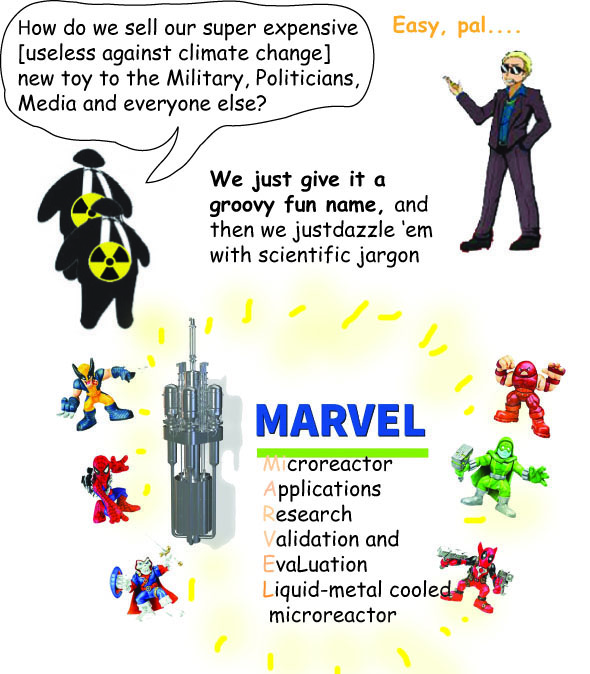
Concerns with nuclear energy must be taken seriously https://www.postregister.com/opinion/guest_column/opinion-concerns-with-nuclear-energy-must-be-taken-seriously/article_4e1e08d1-cad9-56dd-83cc-6ceadb828b24.html 16 July.By IAN COTTEN In June, the Department of Energy released a final environmental assessment for the MARVEL nuclear reactor project proposed to go in at Idaho National Laboratory. The result of the environmental assessment was a proposed finding of no significant impact.
It was incredibly discouraging to read through the DOE’s response to the public’s comments of concern in the final assessment. Many of the responses were copied and pasted responses and/or dismissively replied that the concerns around the proposal were out of scope for the assessment.
All nuclear energy produces highly dangerous, radioactive waste. The U.S. currently has no permanent radioactive waste repository. This means that every ounce of waste produced in this, and all other nuclear projects that take place at INL is destined to be stored in perpetuity at INL, which sits directly atop the Snake River Aquifer. This subsurface body of water is of critical importance to Idaho and provides drinking water to more than 300,000 people and irrigation water for our state’s richest agricultural regions. Continuing to add to the waste that is stored at INL is setting us up for catastrophe.
Littered throughout the assessment are mentions of how safely this reactor will operate and that there will be no impacts on groundwater during normal operations. Of course, project managers with the DOE intend for this reactor to operate as planned and for there to be no impact on the environment. But putting blind faith in a technology that exists only on paper and has no real-life operating experience is a reckless way to approach assessing potential environmental impacts.
It is also important to look at proposals like MARVEL within the larger energy landscape as we look ahead. When looking toward our energy future, the cost of research and development of new technologies must be considered. Every federal dollar that is spent on nuclear energy research, development and implementation is a dollar that cannot be spent on the development of actual renewable energy sources, such as wind and solar. Nuclear energy is considerably more expensive than renewables, often by orders of several magnitudes.
All of the safety concerns listed above should be considered in scope for this project, and the fact that the DOE refused to adequately acknowledge these concerns is disheartening. At the very least, our government should be willing to do their due diligence and prepare a more comprehensive environmental impact statement that assesses the potential health and safety impacts of this proposal in more depth.
While this proposed finding of no significant impact means that the DOE will likely avoid being required to prepare an environmental impact statement, MARVEL is not yet a sure thing. Idahoans who are concerned about this and other nuclear energy development in their state should voice their concerns to their Congress members and other elected officials. Idaho is too valuable to waste on untested, dangerous and dirty nuclear energy projects. Nuclear energy is out of scope for a safe, clean, equitable and renewable energy future.
US and Allies’ military machine – out of Afghanistan (where it’s needed) and into the Pacific – against its new enemy – The Great Barrier Reef

War games on despite pandemic, threat to Great Barrier Reef https://www.greenleft.org.au/content/war-games-despite-pandemic-threat-great-barrier-reef, Kerry SmithJuly 16, 2021 Lurking off the coast of China’s eastern seaboard now are three United States aircraft carrier battle groups (each with about 30 support vessels).
They will be joined by a British aircraft carrier group and Australian and Canadian warships as part of biennial military exercises, which start on July 18 and last until the end of the month.
Talisman Sabre 2021 (TS21) will involve a US expeditionary strike group from the USS America, the amphibious assault ship based at Sasebo Naval Base in Japan, and 17,000 Australian, US and foreign troops in combined land, sea and air war exercises.
According to Stars and Stripes, for the first time, there will be live-fire training: the US Army will fire a Patriot missile defense system from Shoalwater Bay in Queensland at a pair of drone targets on July 16.
This is within the Great Barrier Reef Marine Park and other environmentally and culturally significant areas.
The war games will also take place in Darwin in the Northern Territory and Evans Head, New South Wales.
All are thousands of kilometres away from their home base, and provocatively close to the new declared enemy — China.
Forces from Canada, Japan, New Zealand and the Republic of Korea will take part and Australia-based personnel from India, Indonesia, France and Germany will observe.
Meanwhile, the ABC’s “defence correspondent” hyperventilated on July 14 that a solitary Chinese military ship, outside Australian territorial waters, poses a threat to national security.
The Independent and Peaceful Australia Network (IPAN) is concerned about both the war games and its impact on environmentally and culturally significant sites.
“TS21 will involve amphibious assaults, movement of heavy vehicles, use of live ammunition as well as the use of U.S. nuclear-powered and nuclear-weapon capable vessels,” IPAN spokesperson Annette Brownlie said.
“These activities are incompatible with the protection of the environment and, in particular, the Great Barrier Reef.
“During Talisman Sabre 2013, the US jettisoned four unarmed bombs on the Great Barrier Reef when they had difficulty dropping them on their intended target, Townshend Island,” Brownlie said.
The objective of Talisman Sabre is to further integrate the Australian military with the US — now ranked among the world’s worst polluters.
IPAN said the ADF did not engage in a Public Environment Report process for TS21 and has yet to release an environmental assessment for the areas in which TS21 will take place.
However, the Department of Defence did produce an environmental awareness video for visiting troops that promotes the military use of the Great Barrier Reef. The video reminds troops to consider the reef and not to litter.
“Talisman Sabre is a threat to the reef and to the environment. Putting out a video is a completely inadequate response,” Brownlie said.
This comes as federal environment minister Sussan Ley is lobbying to keep the Great Barrier Reef off the United Nations Educational, Scientific and Cultural Organization World Heritage Committee’s “in danger” list.
Despite a global pandemic, about 1800 foreign military personnel have arrived in Darwin to participate.
1 This Month

4 May -West Suburban Peace Coalition to discuss Iran war at May Educational Forum
Monday, May 4, 7:00 – 8:00 PM Central Standard Time
Title: : How Trump’s Narrative Tries to Shape the Reality of the War on Iran.
Contact Walt Zlotow, zlotow@hotmail.com 630 442 3045 for further information
14 May – online event From Bombs to Data Centres: the Face of Nuclear Colonialism
To see nuclear-related stories in greater depth and intensity – go to https://nuclearinformation.wordpress.com
-
Archives
- May 2026 (49)
- April 2026 (356)
- March 2026 (251)
- February 2026 (268)
- January 2026 (308)
- December 2025 (358)
- November 2025 (359)
- October 2025 (376)
- September 2025 (257)
- August 2025 (319)
- July 2025 (230)
- June 2025 (348)
-
Categories
- 1
- 1 NUCLEAR ISSUES
- business and costs
- climate change
- culture and arts
- ENERGY
- environment
- health
- history
- indigenous issues
- Legal
- marketing of nuclear
- media
- opposition to nuclear
- PERSONAL STORIES
- politics
- politics international
- Religion and ethics
- safety
- secrets,lies and civil liberties
- spinbuster
- technology
- Uranium
- wastes
- weapons and war
- Women
- 2 WORLD
- ACTION
- AFRICA
- Atrocities
- AUSTRALIA
- Christina's notes
- Christina's themes
- culture and arts
- Events
- Fuk 2022
- Fuk 2023
- Fukushima 2017
- Fukushima 2018
- fukushima 2019
- Fukushima 2020
- Fukushima 2021
- general
- global warming
- Humour (God we need it)
- Nuclear
- RARE EARTHS
- Reference
- resources – print
- Resources -audiovicual
- Weekly Newsletter
- World
- World Nuclear
- YouTube
-
RSS
Entries RSS
Comments RSS
 nuclear-news