Illinois Senate passes bill to save nuclear plants
Illinois Senate passes bill to save nuclear plants, sends to House, By Timothy Gardner Sept 1 (Reuters) – The Illinois Senate passed a bill early on Wednesday that aims to prevent two nuclear power plants from shutting this autumn, sending the legislation to the House where it was uncertain if the chamber would bring the legislation to a vote.
The Senate voted 39-16 to pass a wide-ranging energy bill, with two senators voting “present.” The bill contains more than $600 million in carbon mitigation credits for nuclear plants which generate virtually emissions-free electricity. [that’s as long as you ignore the full nuclear fuel chain]
U.S. nuclear plants have been struggling to compete with wind and solar farms and plants that burn low-cost natural gas. Exelon Corp has said it will close its Byron nuclear plant in mid-September and its Dresden plant in November if a state or federal program does not come to the rescue.
It was uncertain whether the House would move fast enough to pass the legislation to prevent the shutting of the first plant, located in Byron, Illinois…….. https://www.reuters.com/article/usa-nuclearpower-illinois-idUSL1N2Q31QZ—
Westinghouse Electric Co has paid $21bn and will co-operate with federal investigators over South Carolina nuclear fraud.

Failed nuclear contractor signs $21M deal, working with feds, https://abcnews.go.com/US/wireStory/failed-nuclear-contractor-signs-21m-deal-working-feds-79721520
The chief contractor at a failed multibillion-dollar project to build two nuclear reactors in South Carolina has agreed to pay more than $20 million as part of a cooperation agreement with federal authorities probing the fiasco, By MEG KINNARD Associated Press31 August 2021 COLUMBIA, S.C.
The chief contractor at a failed multibillion-dollar project to build two nuclear reactors in South Carolina has agreed to pay more than $20 million as part of a cooperation agreement with federal authorities probing the fiasco.
Under an agreement announced Monday by Acting U.S. Attorney Rhett DeHart, Westinghouse Electric Co. will contribute $5 million to a program intended to assist low-income ratepayers affected by the project’s failure. Another payment of $16.25 million will be due before July 1, 2022.
The company will also be required to cooperate with federal investigators still probing the company’s role in the 2017 debacle, which cost ratepayers and investors billions and left nearly 6,000 people jobless.
Westinghouse was the lead contractor on the construction of two new reactors at the V.C. Summer Nuclear Station in Jenkinsville, about 30 miles (48 kilometers) north of Columbia. South Carolina Electric & Gas Co. parent company SCANA Corp. and state-owned utility company Santee Cooper spent nearly $10 billion on the project before halting construction in 2017 following Westinghouse’s bankruptcy.
The collapse of the V.C. Summer project spawned multiple lawsuits, some by ratepayers who said company executives knew the project was doomed and misled consumers and regulators as they petitioned for a series of rate hikes. Three top-level executives have already pleaded guilty in the multi-year federal fraud investigation. A fourth has been charged and is expected in federal court Tuesday.
Earlier this year, a federal judge signed off on a plan to disperse $192 million among former SCANA shareholders, a settlement that attorneys for the investors said was the largest securities class action recovery obtained in South Carolina when a judge approved it last year.
On Monday, DeHart said Westinghouse has given federal investigators more than three million pages of documents, data and correspondences and made employee witnesses available for interviews. Through its former parent company Toshiba, Westinghouse has also made more than $2 billion in settlement payments related to the project.
Since the failure, Westinghouse has removed, reassigned or retrained its senior management, elected a new board and implemented new financial controls, according to DeHart.
“Our office continues to seek justice for the victims of the V.C. Summer Project failure,” DeHart said in a news release. “Westinghouse’s cooperation is vital to our ongoing efforts to hold accountable the individuals most responsible for this debacle.”
Hurricane shuts down Louisiana nuclear power station

Ida shuts Entergy’s Waterford-3 nuclear plant because of off-site power loss, S and P Global 31Aug 21,
Andrea Jennetta ,
1.2-GW Waterford-3 shut
992-MW River Bend-1 at 35%
Entergy shut its 1.2-GW Waterford-3 nuclear plant in Killona, Louisiana, at 6:12 pm CT Aug. 29 after off-site electrical power was lost because of Hurricane Ida, the US Nuclear Regulatory Commission said on Facebook Aug. 30.
Entergy spokesperson Mike Bowling said Aug. 30 that Waterford-3 was disconnected from the grid Aug. 29 at 10:29 am CT “per procedure as storm winds escalated.”
The company’s 992-MW River Bend-1 in St. Francisville, Louisiana, was operating at 35% of capacity early Aug. 30, NRC said.
The unit reduced power at the request of the Midcontinent Independent System Operator, Bowling said.
The action was taken “to preserve grid integrity” in the wake of Hurricane Ida, he said.
“The situation is fluid, and power levels could change in coordination with grid operators,” Bowling added……… https://www.spglobal.com/platts/en/market-insights/latest-news/electric-power/083021-ida-shuts-entergys-waterford-3-nuclear-plant-because-of-off-site-power-loss
Hurricane Ida Shuts Down One Nuclear Plant in Louisiana.
Hurricane Ida Shuts Down One Nuclear Plant in Louisiana. Simply Info , August 29, 2021
Hurricane Ida prepares to make landfall mid day in Louisiana. The storm is predicted to be the strongest hurricane to hit the state in history as a strong cat 4. Hurricane Katrina had dropped to a category 3 by the time it made landfall yet caused extreme damage. Sustained winds reported this morning were 150 mph.
Entergy shut down Waterford nuclear plant around 10am Sunday due to the expected wind speeds. Ed Lyman at the Union of Concerned Scientists documented the flood risk at the plant when combining the predicted storm surge and rainfall. The plant may not flood in the reactor block area but it could end up surrounded by water. Entergy, the company that operates the plant mentioned they have sequestered enough staff on site to conduct needed operations and restart the plant whenever that might be possible. In Ed Lyman’s twitter posts about this issue he also cited dry cooling towers used at the site and that they require sump pumps to keep them operational. Depending on the water inundation that system could be offline until water recedes………….http://www.simplyinfo.org/?p=19672
Cover-up? Unreported event of Hanford nuclear workers’sickness
Unreported event at Hanford nuclear site that sickened workers ‘smells like a cover-up,’ advocates say, Workers reported smelling odors, resulting in symptoms such as dizziness and shortness of breath. The contractor denied a chronic problem, toxic vapors, is to blame. https://www.king5.com/article/news/investigations/hanford-nuclear-site-washington-state-tank-farms-workers-sickened-investigation/281-48a540ea-1fa5-4de9-8ab7-b1dc9db6e5c8 Susannah Frame August 27, 2021
RICHLAND, Wash. — On June 18 of this year, 10 workers at the Hanford nuclear site in eastern Washington digging in what are known as the “tank farms,” were overcome by strange odors. Nine of the workers sought medical treatment, including three who were transported to the hospital for an overnight stay and were given oxygen.
The KING 5 Investigators have found the event went unreported by the contractor involved – Washington River Protection Solutions (WRPS).
According to WRPS documents obtained by KING 5, symptoms reported by workers included dizziness, shortness of breath, chest pain, headache, nausea, a metallic taste in the mouth, stomach issues, light headedness and cough.
Smelling unusual odors, followed by adverse medical conditions are hallmark signs of a chronic problem at the nuclear reservation: exposure to toxic vapors that vent from underground nuclear waste holding tanks.
WRPS is under a legal obligation to report vapor events on a publicly available website.
“I’m still amazed that not one piece of paper has been put out about this exposure, there’s been no announcement,” said Tom Carpenter, executive director of the advocacy group Hanford Challenge. “It’s getting to the point where this silence is very suspicious. It’s like: ‘What are you hiding?’”
The contractor said they did not post the event on their website because they’ve determined the worker’s symptoms were not caused by vapors, but “most likely” by a malfunctioning gas-powered wheelbarrow.
“WRPS collected air samples from the small pieces of fuel-powered equipment used in the soil work. One piece of equipment, a small gasoline-powered wheelbarrow that was difficult to start and used during the June 18 event, was smoking when it started and high levels of volatile organic compound emissions were noted,” a WRPS spokesperson said.
Toxic vapor exposures have been a significant problem at Hanford since the 1980s when the operational mission went from producing plutonium, to clean up only.
Several government reports have identified that poisonous vapors, without warning, will vent from underground tanks. Hanford has 177 underground holding tanks that store the deadliest waste at the site.
Tanks in the tank farm near where the workers got ill in June contain contents including plutonium, the radioactive isotopes of americium and strontium 90, mercury, nickel, lead and cyanide.
In 2014 the KING 5 Investigators revealed a record number of vapor exposures in the tank farms. Approximately 56 workers fell ill with symptoms in the rash of exposures. After each incident, WRPS said their testing didn’t show chemicals of concern over regulatory limits. WRPS officials denied chemical vapors were to blame for the events.
That pattern wasn’t new. Expert reports detailed the same cycle happened at Hanford in the 80s and in the 90s: a slew of exposures, followed by denials by the tank farm contractor, and workers left sick and unable to work.
Many workers said they felt betrayed by the contractors over the years for not being honest about the dangers of vapors.
“Until they are in the field and until they smell what we smell and until they feel like we feel and until they get injured like we get injured, they don’t care,” said Mike Cain, a 47-year current Hanford employee who spent 25 of those years in the tank farms. “Everything that we described 30 years ago, 40 years ago, is still there. Yet they keep doing the same thing over and over and over again.”
After the string of exposures in 2014, Washington State Attorney General Bob Ferguson, Hanford Challenge and Local 598 all filed lawsuits against WRPS and Hanford’s owner, the U.S. Department of Energy. The complaint accused the contractor and federal government of failing to protect workers from vapor exposures, that can cause adverse health effects including lung disease, nervous system damage and cancers of the liver, lung, blood and other organs. The lawsuit also alleged the Department of Energy had been well aware of the dangers for 25 years, yet “Energy did not fix the problem.”
A settlement agreement was reached in September 2018. Hanford officials agreed to improve health and safety conditions, install engineering to keep vapors out of the breathing space of workers. They also agreed to provide respiratory protections including supplied (fresh) air that is worn in tanks on the backs of workers, if needed.
In the June event, workers were not using supplied air. According to workers, the contractor had downgraded respiratory protection to respirators with cartridges. Respirators are lighter and more cost effective than supplied air.
“(That) never should have happened if they were wearing fresh air. Never should have happened,” Cain said.
“They’re not protecting workers. They have a long history of not doing so, of putting money and profits before workers health and safety which is ironic because they’re all about saying they want to protect health and safety. They’re not doing it,” Carpenter said.
A WRPS spokesperson said the company did not skimp on safety protocols in the June event.
“Respiratory controls at the TX Farm during the June 18, 2021 event complied with the tank farms vapors settlement agreement requirements… workers were wearing air-purifying respirators consistent with interim mandatory respiratory protections consistent with cartridge testing results,” the spokesperson said.
What is Hanford?
Hanford is the most contaminated worksite in America. Located near Richland in eastern, Wash., workers at the site produced plutonium for the country’s nuclear weapons program for approximately four decades. Plutonium produced at Hanford fueled the bomb dropped on Nagasaki, Japan, that led to the end of WWII. Since the late 80s, Hanford has been a clean up site only.
The settlement agreement also makes it mandatory for WRPS to report events on its website that fall into the category of an “AOP-15.” On the WRPS website, an AOP 15 is described as an unidentified odor event: “When a worker reports an unexpected and unidentified odor in the tank farms, and reports medical symptoms potentially related to that smell.”
In the June event, WRPS did not characterize it as an AOP-15, therefore, company executives said they had no obligation to report it.
“Smells like a cover-up”
“This lack of information sharing and reporting smells like a cover-up. We do not want to see a return to downgraded worker protections that result in routine vapor exposures. The cycle of exposures must end at Hanford, and meaningful and long-lasting regulations should be enacted to assure that Hanford tank farm workers can conduct a cleanup without risking their own health and safety,” said Carpenter of Hanford Challenge in a press statement sent on Friday.
On Thursday, a WRPS executive told KING 5 that the company’s definition of an AOP-15 had changed in 2020. In an email to employees on Dec. 1, 2020, WRPS Executive Jeremy Hartley said that moving forward, an AOP-15 will occur when personal ammonia monitors worn by workers set off an alarm.
“Ammonia has been verified as a sentinel indicator of changing levels of other chemicals of potential concern. The procedure changes clarify and reinforce a disciplined conduct of operations by recognizing the administrative and engineering controls in place, relying on the ammonia monitors and verifying the conditions when an alarm set point is reached,” Hartley wrote.
Given this change, the WRPS spokesperson said they followed protocol by not reporting the event on the website.
As this event did not involve an ammonia alarm, it is not classified as an AOP-15,” the spokesperson said.
Government scientists have concluded that ammonia does not have to be present for other chemicals of concern to release in concentrations that could harm human health. In 2004 the Department of Energy released a Hanford report concluding the potentially harmful gas, nitrous oxide, can be present without the presence of ammonia.
“Based on…characterization data (the contractor) CH2M HILL has incorrectly assumed that nitrous oxides are present only when ammonia is present,” report authors wrote. “…nitrous oxide vapors in tank headspaces can be present in (dangerous) concentrations, even in the absence of ammonia.”
Stakeholders such as Hanford Challenge and union safety representatives said they were unaware that WRPS had changed its AOP-15 definition.
A WRPS communications specialist said they are committed to the safety of workers.
“The health and safety of the workforce is always paramount,” the company official said.8
Groups call for no US nuclear bailouts

Billions for nuclear squanders vital climate opportunity
240 organizations ask Congress to eliminate nuclear subsidies from the budget https://beyondnuclearinternational.org/2021/08/29/groups-call-for-no-us-nuclear-bailouts/ 29 Aug 21, Beyond Nuclear was among 240 organizations who have signed a letter sent to the House and Senate Majority and Minority leaders urging them to omit nuclear bailouts from the federal budget and instead direct funds toward investment in carbon-free, nuclear-free clean energy.
This moment is our opportunity to launch a wholesale transformation of our economy and our energy systems to save our country and the world from the rapidly advancing climate crisis. Yet, legislation now before Congress would provide billions of dollars in subsidies to aging and uneconomical nuclear power plants, an effort that will cause us to miss the narrow window of opportunity we have left to act effectively on climate.
If the events of the last year have taught us anything, it is that we must marshal our national resources to address structural inequities and injustices that undermine our safety, health, economic security, and sustainability. We can achieve the goals of racial, economic, environmental, and climate justice upon which the Biden administration and Congressional leaders have promised to deliver—but not if we continue to invest billions of dollars in nuclear power and other false solutions.
Both the energy legislation proposed for the larger reconciliation package (S.2291/H.R.4024) and the bipartisan infrastructure bill would grant up to $50 billion to prop up old, increasingly uneconomical nuclear reactors for the next decade. The electricity generated by these reactors will need to be replaced by renewable energy in the coming years anyway, so every dollar we spend to prolong their operation has an opportunity cost in terms of dollars, jobs, and environmental pollution.
As a July 2021 report by Dr. Mark Cooper finds, the best investments to phase out greenhouse gas emissions in the electricity sector are the same in the short-term, medium-term, and long-term: renewable energy, efficiency, storage, and grid modernization. Money slated for nuclear bailouts would be much better spent on these resources instead.
Nuclear power is part of the climate problem, not the solution
Nuclear power is too dirty, too dangerous, too expensive, and too slow to solve the climate crisis, and the industry is rooted in environmental injustice and human rights violations. Bailing out nuclear power plants misdirects resources while perpetuating climate injustice. A whole suite of energy sources that will be the backbone of a 100% renewable, zero-emissions energy system–wind, solar, demand response, and energy efficiency–are already less expensive than currently operating nuclear reactors, and will only become more so over the next decade. Many more technologies that will enable the transition to a reliable and resilient, renewable energy economy–battery storage, smart- and micro-grids, offshore wind, and more–are on the same downward cost trajectory.
This is already happening in real time, even in conservative states. In 2020, Iowa’s only nuclear power plant closed, but the state brought more new wind generation online than the nuclear plant ever generated. Similarly, wind power plants in Texas already generate more than twice as much electricity as the state’s four large nuclear reactors; in each of the last four years, new wind generation has equaled the output of one of those reactors.
Within three years after California’s San Onofre nuclear power plant unexpectedly retired in 2013, new solar power in the state exceeded what the nuclear plant produced. California has also shown that phasing out nuclear power is an integral part of the transition to a zero-emissions electricity system. The state’s largest utility is in the process of phasing out the Diablo Canyon nuclear plant by 2025, through a comprehensive community and energy transition that includes expanding energy efficiency and solar to exceed California’s targets for emissions reductions and renewable energy growth.
It is often said that states are the laboratory for national policy. If so, there is already abundant evidence at hand of the climate justice costs of subsidizing old nuclear reactors. Over the last five years, four states have granted up to $14 billion in subsidies to aging reactors–ratepayer dollars that could have been invested instead in renewable energy, efficiency, and other climate solutions.
In New York, consumers will pay up to $7.6 billion in subsidies to aging nuclear reactors by 2030, under a program instated in 2016. Yet, a study at the time showed that a state-of-the-art energy efficiency program could have effectively replaced those reactors with equivalent reductions in statewide electricity consumption by 2030, at a net savings to consumers of $3 billion. In effect, the state would have had more than $10 billion more to invest in climate solutions had it chosen efficiency over nuclear in 2016.
Further, New York has since upgraded its renewable targets and implemented energy efficiency standards that negate the original rationale for the bailout, yet consumers are locked into paying for it anyway. The federal government must learn from these experiments and not repeat the same mistakes.
Climate Justice
We need to invest in a transition to efficient, renewable, clean energy technologies that can scale up as rapidly and affordably as possible to reduce emissions as aggressively as possible. Not only does nuclear energy fail to meet any of those criteria, investing billions of dollars in subsidies for old reactors directly funnels public investment away from environmentally just, equitable, and sustainable solutions to the climate crisis. This is why the White House Environmental Justice Advisory Council included programs that procure nuclear power on a list of measures that do not benefit environmental justice communities in its May 2021 report to the Biden administration.
Moreover, subsidizing aging nuclear reactors does nothing to make nuclear power safer from the environmental hazards of climate change. The Nuclear Regulatory Commission’s (NRC) habit of relaxing safety requirements has only worsened since the COVID-19 pandemic. NRC has refused to take any actions to protect nuclear workers from the novel coronavirus, nor even to require its licensees to provide any reporting of infection, testing, and hospitalization rates among their workforces. On top of that, NRC has canceled hundreds of required, scheduled safety inspections, security drills, and emergency preparedness exercises, for up to two years. Nuclear power is becoming more dangerous, not less, in the face of climate and public health challenges that will grow in the years to come.
Environmental Justice
In addition to the climate costs of proposed nuclear energy subsidies, subsidizing nuclear reactors will result in the creation of more radioactive waste without mitigating any of the significant environmental justice, climate justice, economic justice, and nuclear weapons proliferation impacts. By the time a single pound of nuclear fuel goes into a reactor, uranium extraction, processing, and enrichment have already generated thousands of pounds of long-lasting radioactive wastes, which are either dumped in piles or ponds, or (in the case of depleted uranium) stored in cylinders or barrels in the open air, very often in Indigenous communities.
Both nuclear subsidy proposals seek to expand uranium mining in the U.S. through tying subsidies to domestically sourced fuel. Neither infrastructure package includes respecting restrictions on mining of uranium on Indigenous peoples’ lands, regulations to mitigate the environmental impacts of uranium mining, nor remediation of the more than 15,000 abandoned uranium mines in the U.S. Indigenous peoples disproportionately bear the burdens of uranium extraction, from widespread leakage of radioactive and toxic waste into groundwater and exposure to radioactive dust and gases.
Tribal governments and impacted communities require prompt and thorough reclamation and cleanup of mines, mills, and uranium processing facilities, through a federal program that is tribe-/community-driven, inclusive, transparent, and funded at the scale of the problem. This is a national crisis and must be treated as such. The restoration and protection of safe drinking water for all communities must be an infrastructure priority. Doing so would create thousands of jobs, improve community health, and enable communities to live sustainably and in harmony with the natural environment for generations to come.
Economic Justice
Subsidies for nuclear power would not only be unjust and counterproductive for climate and environmental justice, they would also be unjust and counterproductive for creating jobs and building a thriving, equitable economy. All of the proposed subsidies (up to $50 billion) would likely go to reactors owned by only eight corporations and located in only 19 counties across eight states. Despite the size of this extraordinarily inequitable investment of taxpayer dollars, these subsidies would not create a single new job. Worse, allocating $50 billion to old reactors instead of renewable energy, efficiency, and other clean electricity infrastructure would prevent the creation of more than 60,000 new jobs.
Under S.2291/H.R.4409, all merchant reactors would be eligible for the subsidy, regardless of whether they actually need them to continue operating. Because the bills only consider the profitability of individual nuclear power plants, they do not protect U.S. taxpayers from paying uneconomical subsidies when cheaper alternatives and more strategic investments are available.
The bill does not require independent verification of nuclear corporations’ claims about the emissions impacts of potential reactor closures. It does not consider states’ renewable energy and energy efficiency targets and programs, with which these subsidies could interfere. It does not consider alternatives, such as whether renewable energy would be more affordable. Neither bill plans for how to phase out and replace uneconomical nuclear reactors with renewable energy sources by the time their respective programs expire.
According to Dr. Cooper’s report, investing in renewable energy, efficiency, and other real climate solutions will employ many times more people and reduce far more greenhouse gas emissions than subsidizing nuclear power. This is especially true because nuclear corporations have over $60 billion already set aside to fund decommissioning and cleanup of their power plants when they close. These nuclear decommissioning funds can and should be used to defray job losses when reactors shut down.
We cannot perpetuate false solutions that prolong our reliance on dirty energy industries and have any hope of ending the climate and environmental justice crises those industries create. Providing billions of dollars in subsidies to nuclear power will only put short-sighted economic interests ahead of human lives, racial justice, the health of our environment, safe drinking water, and a thriving, equitable economy. We hope we can count on you to reject all proposals to subsidize nuclear energy and to make investments that will create a just and equitable transition to safe, clean renewable energy.
Download the original letter and read the press release.
U.S. Strategic Command general tries to stir up trouble about nuclear arsenals
US Strategic Command general aspires to muddy the water of nuclear arsenals, By Hu XijinGlobal Times, Aug 29, 2021 US Air Force Lieutenant General Thomas Bussiere, who is deputy commander of the US Strategic Command which oversees the nuclear arsenal, said on Friday that China will soon surpass Russia as the top nuclear threat of the US, a Reuter report said………..
I think Bussiere’s remarks had two malicious goals. First, he wants to sow discord between Russia and China, instigating a sense of crisis in Russia that China’s nuclear capabilities are to surpass Russia.
His reasoning is problematic. The number of nuclear warheads in China and Russia is not in the same order of magnitude. It is known that Russia owns more nuclear warheads than the US. It’s incredible that China’s nuclear capability could surpass that of Russia in the foreseeable future.
Bussiere said his judgment is not based solely on the number of China’s stockpiled nuclear warheads, but he didn’t give any other parameters. Instead, he just vaguely said that it also depends on how they are “operationally fielded.” What he wants to achieve is to confuse and mislead the public.
It’s well-known that China is the sole nuclear power that has declared a policy of “no-first-use” of nuclear weapons at any time, and, under any circumstances. China has far fewer nuclear warheads than Russia or the US, and has made the aforementioned self-restrained commitment. How can China’s nuclear deterrent surpass that of Russia?
Bussiere’s second purpose is sinister, too. ……..
He wanted to prevent China from increasing nuclear deterrent, and, to sustain the huge disparity of nuclear weapons between China and the US………… https://www.globaltimes.cn/page/202108/1232705.shtml
Even the right-wing Competitive Enterprise Institute doubts the wisdom of bailing out struggling nuclear power stations
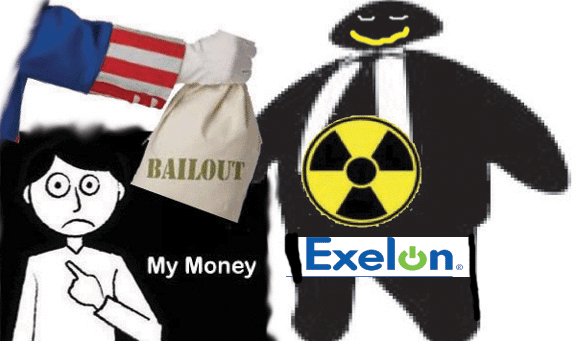
The dubious Senate proposal to bail out nuclear powerplants, https://thehill.com/opinion/energy-environment/569831-the-dubious-senate-proposal-to-bail-out-nuclear-powerplants BY BENJAMIN ZYCHER, — 08/28/21 Costly economic distortions are an inexorable result of government bailouts for specific industries, the justifications for which are almost always deeply dubious.
Consider section 3203 of the proposed Senate Energy Infrastructure Act. It would establish a $6 billion credit program over four years starting in fiscal year 2022 for nuclear electricity plants “projected to cease operations due to economic factors.” The credits, disbursement of which would cease after 2031, would be defined as a certain dollar amount per megawatt-hour (mWh) of generation. And just as the production tax credit for wind electricity has been extended 13 times, it is difficult to believe that once implemented a similar subvention for nuclear power will fail to prove semi-permanent.
And sure enough: The draft legislation directs the comptroller general to submit by Jan. 1, 2024 “any recommendations to renew or expand the credits.”
The bill makes it clear that the ostensible rationale for the credits is “the potential incremental air pollutants that would result if the [given] nuclear reactor were to cease operations. …and be replaced with other types of power generation.”
But the draft legislation asks no one to investigate or even to speculate about whether the hypothetical increase in air pollutants resulting from a shutdown of a nuclear generating plant would yield a violation of the National Ambient Air Quality Standards (NAAQS) in the relevant geographic region for any of the (criteria) pollutants covered by the Clean Air Act.
Because the Clean Air Act requires that the respective NAAQS “protect the public health” with “an adequate margin of safety,” it is difficult to believe that a shutdown of a limited number of reactors and replacement with, say, combined-cycle gas generation, would result in ambient air quality in excess of a given NAAQS. The “public health” would continue to be protected.
Forget air pollution. This proposed subsidy is a bailout — that is, a sizable economic distortion to be added to all of the other distortions inflicted by various policies upon electricity markets. Would it not be better to reduce that aggregate of economic losses rather than to add to them? The actual unpublicized justifications for this proposal are exceedingly weak.
Competitive price pressures from generation fueled with inexpensive natural gas. Competition is the very basis of a market economy, and a failure to foresee the sharp decline in natural gas prices when nuclear investments were made does not justify a federal bailout. Investors and managements contemplating large investments know that there are important risks, both known and unknown, and make their decisions accordingly. The proposed subsidy would shift those risks onto the taxpayers writ large, and there is no reason to believe that such a shift is efficient.
Single-unit vs multi-unit nuclear operating costs. Two of the nuclear generating stations desperate for operating subsidies (Davis Besse and Perry, both in Ohio) are single-unit facilities, which have operating costs per mWh higher than those for multi-unit stations, because their fixed overhead costs are spread over less generation, and because they cannot achieve scale economies similar to those of multi-unit plants when negotiating service and fuel contracts. There is no reason that taxpayers should bear the attendant economic burdens.
Potential mismanagement. It is no secret that business management, like all human endeavors, varies in terms of the efficiency of the decisions made and the conduct of operations. Not only does the proposed legislation not consider the cost effects of possible mismanagement, it also reduces the economic penalty for such inefficiency.
Costly state regulation and the effects of “renewable portfolio” or “clean energy” standards. Regulation at the state level, imposed by legislatures, public utility commissions and other official bureaus, obviously creates costs and distortions, often sizable. Moreover, about 30 states require that some proportion of the electricity produced or consumed in the state be generated by certain technologies (e.g., wind and solar power), and those requirements often exclude nuclear electricity.
Is there a reason that federal taxpayers should be forced to bear the consequences of state laws and regulations? Reforms of state policies yielding adverse outcomes must be implemented at the state level; a federal bailout reduces the incentives for such reforms. The owners of nuclear powerplants should make their case to the state legislatures.
The distortions created by the federal wind production tax credit. The one argument in support of the proposed nuclear subsidy that is not wholly spurious is the effect of the wind production tax credit (PTC), now between $15 and $25 per mWh. The PTC thus allows the wind producers to reduce the prices that they bid for sales into bulk power markets – sometimes to negative levels – while still “earning” positive net prices.
This obviously is unfair competition: The operators of nuclear plants receive no such subventions, and for technical engineering reasons, it is difficult or impossible for nuclear plants to ramp generation up and down in response to short-term price fluctuations.
So, one could argue that the proposed nuclear subsidy corrects the competitive problem created by the PTC, but that is a non sequitur. If the distortions created by given policies are to be addressed by incorporating new distortions, over time the entire economy in effect will become centrally planned, as one set of distortions after another is adopted to deal with the problems created by earlier ones. The proper course is to end the wind PTC and not to bail out nuclear plants with another subsidy program.
Note also that the prospective “profitability” of a given nuclear plant hinges on assumptions about prices, operations costs and other parameters that are subject to important uncertainties. One study by the former chief economist of the PJM Regional Transmission Organization projects net operating profits for 2021 of $30.4 million and $47.5 million for the two plants in Ohio referenced above, respectively. Another study from the PJM itself projects 2021 operating losses for those units of $28.8 million and $33.2 million, respectively.
In short, such calculations are far from straightforward, and no one will be surprised when those applying for the new nuclear credits find ways to increase the magnitude of the operating losses they will claim.
The arguments in favor of this proposed subsidy are exceedingly weak, and the central principle weighing against it is powerful: Let us reduce rather than increase the distortions created by government economic policies. A failure to keep that principle in mind will yield ongoing economic losses for all of us.
Benjamin Zycher is a senior fellow at the American Enterprise Institute.
Nuclear Regulatory Commission finds cable issues in special inspection of Vogtle Unit 3
Nuclear Regulatory Commission finds cable issues in special inspection of Vogtle Unit 3, Augusta Chronicle Abraham Kenmore, 27 Aug 21, The federal Nuclear Regulatory Commission has finished its special inspection of the Plant Vogtle Unit 3 expansion. The report found several preliminary issues with how cables had been installed during the construction of the new nuclear power facility.
“The NRC inspectors found that Southern Nuclear did not adequately separate safety and non-safety-related cables for reactor coolant pumps and equipment designed to safely shut down the reactor,” according to a press release sent with the report. “They also found instances where the company did not identify and report construction quality issues related to the safety-related electrical raceway system and enter them into its corrective action program.”
Southern Nuclear, the company in charge of construction, can choose to accept the results of the inspection or provide additional information before a final determination is reached. Unit 3 currently has no fuel loaded into the reactor and the press release makes it clear there is no increased risk to the public from the safety issues. Southern Company will not be allowed to operate the reactor until construction is finished to standards……… www.augustachronicle.com/story/news/2021/08/27/plant-vogtle-unit-3-nrc-inspection-shows-cable-problems/5603644001/?fbclid=IwAR2O-5h1IDZhDUu4H5sVJ9tPRoQXDYv58lFDQK0LkyjBE_qekMjnpKo7Q34
Vulnerability of Louisiana’s Waterford 3 nuclear plant to storm surge
Intensifying Hurricane Ida a significant threat to key infrastructure. Ida is forecast to hit the industrial corridor between Baton Rouge and New Orleans, site of three key ports, petrochemical sites, and a nuclear power plant. Yale Climate Connections, by JEFF MASTERS and BOB HENSON, AUGUST 29, 2021
Vulnerability of Waterford 3 nuclear plant to storm surge. Although it lies 65 miles inland from the south coast of Louisiana, the Waterford 3 nuclear generating station, located at an elevation of 10-15 feet on the south shore of the Mississippi River, is vulnerable to storm surge from a major hurricane. Hurricane Betsy, a category 4 storm that hit Louisiana in 1965, brought a storm surge to the edge of the plant’s location (Figure 3 on original).
According to a 2019 analysis by Bloomberg, the Waterford 3 plant is designed to withstand a maximum storm surge of 23.7 feet above sea level, or about 10 feet higher than the plant’s elevation. According to NOAA’s National Storm Surge Hazard database, a worst-case category 3 hurricane could flood the plant to a depth of 3’, while a worst-case category 4 hurricane could flood the plant to a depth of more than 9’ – near its design limit. Fortunately, storm surge modeling by Louisiana State University using the 11 a.m. EDT Saturday NHC forecast showed Ida’s storm surge stopping just short of the plant (Figure 4 on original)
After the 2011 disaster at Japan’s Fukushima nuclear power plant, the Waterford 3 plant moved to store all of its emergency generators, pumps, and other essential safety equipment in a 30-foot flood-proof concrete bunker – a system called Flex, for Flexible Mitigation Capability. The bunker has manually operated and powered sump pumps to remove water in the event of a flood.
After the 2011 disaster at Japan’s Fukushima nuclear power plant, the Waterford 3 plant moved to store all of its emergency generators, pumps, and other essential safety equipment in a 30-foot flood-proof concrete bunker – a system called Flex, for Flexible Mitigation Capability. The bunker has manually operated and powered sump pumps to remove water in the event of a flood…………………….. https://yaleclimateconnections.org/2021/08/intensifying-hurricane-ida-a-significant-threat-to-key-infrastructure/
Hurricane Ida threatens 2 nuclear power stations in Louisiana
Two Nuclear Plants In Ida’s Path As Storm Expected At Cat 4, Simply Info, [excellent pictures and maps]
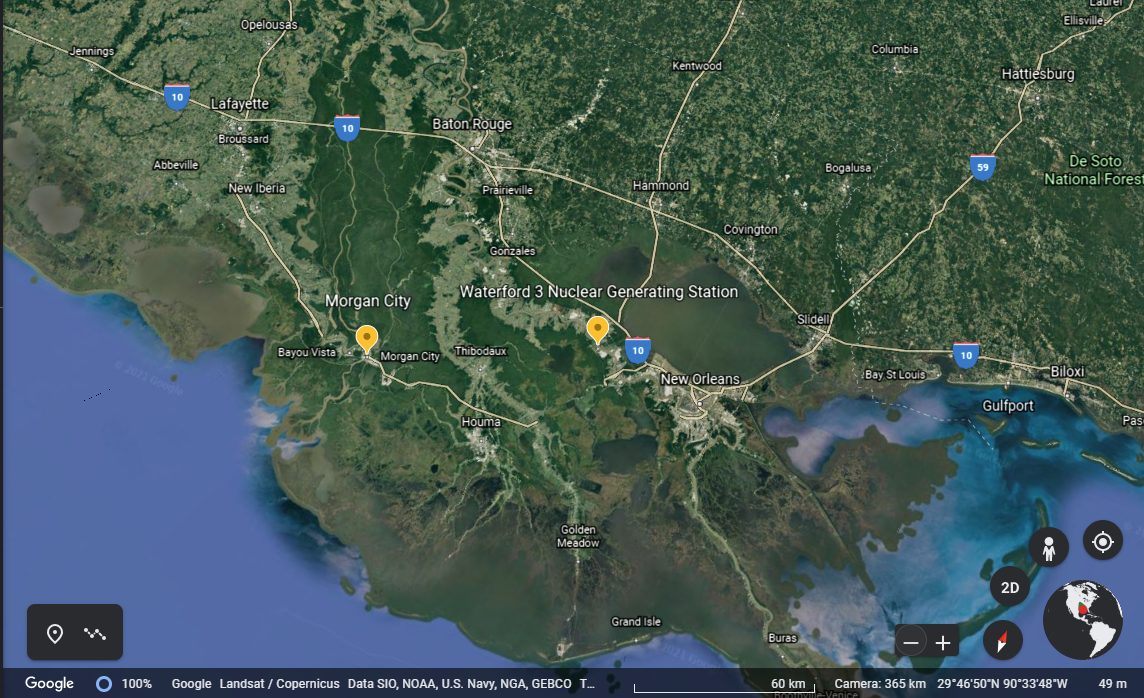
Hurricane Ida is expected to hit the US as a category 4 storm. The Weather Channel projects Sunday night landfall and a direct hit on Louisiana. Storm surges in the area range from the Texas border to Mobile Alabama.
Two nuclear power plants are in the direct storm path. River Bend and Waterford. Waterford sits near the mouth of the Mississippi and in the zone of the highest expected storm surge. Current estimates have a 10-15 foot surge expected for that area. This could be potentially more severe as the storm pushes water up the Mississippi River. Waterford sits about 24 miles from the mouth of the river and is next to Lake Pontchartrain……………..more http://www.simplyinfo.org/?p=19660
Texas lawmakers oppose high level nuclear waste coming into their State

State lawmakers again try to ban most dangerous nuclear waste as feds consider allowing it at West Texas site, https://www.texastribune.org/2021/08/23/texas-nuclear-waste-storage-site-legislature/A failed regular session bill sought to give a financial break to a West Texas nuclear waste disposal company. Now, lawmakers have removed what opponents called a giveaway and are again trying to pass a bill to stop highly radioactive materials from coming to Texas.
BY ERIN DOUGLAS AUG. 23, 2021 After failing this spring, Texas lawmakers are again trying to ban the most dangerous type of radioactive waste from entering the state — at the same time as a nuclear waste disposal company in West Texas pursues a federal application to store the highly radioactive materials.
Environmental and consumer advocates for years have decried a proposal to build a 332-acre site in West Texas near the New Mexico border to store the riskiest type of nuclear waste: spent fuel rods from nuclear power plants, which can remain radioactive for hundreds of thousands of years. Strong political interests in Texas, from Gov. Greg Abbott to some oil and gas companies operating in the Permian Basin, have opposed the company’s application.
But a bill that sought to ban the highly radioactive material failed during the regular legislative session that ended in May. That bill, filed by State Rep. Brooks Landgraf, R-Odessa, whose district includes Andrews County where the existing nuclear waste company Waste Control Specialists operates, included a big break on fees for the company. Some lawmakers also thought the previous bill’s language wasn’t strong enough to actually ban the materials.
Now, Landgraf has again filed a bill during this year’s second special session that seeks to ban the highly radioactive materials from coming to the company’s facility in his district. The House Environmental Regulation Committee on Monday passed House Bill 7, which does not include any changes to fees for the existing company, one of the key criticisms that killed the proposed legislation earlier this year.
“So in other words, this is designed to be clean and easy so that we can go on record as a state [opposing high-level nuclear waste storage],” Landgraf said.
Waste Control Specialists has been disposing of the nation’s low-level nuclear waste — including tools, building materials and protective clothing exposed to radioactivity — for a decade in Andrews County. The company, with a partner, is pursuing a federal Nuclear Regulatory Commission license to store spent nuclear fuel on a site adjacent to its existing facility.
The Nuclear Regulatory Commission is advancing the company’s license. In July, NRC staff recommended in an environmental review that the site be approved to take the highest level of nuclear waste. The license still needs review by the federal commissioners.
Scientists agree that spent nuclear fuel, which is currently stored at nuclear power plants, should be stored deep underground, but the U.S. still hasn’t located a suitable site. The plan by the WCS joint venture, Interim Storage Partners, proposes storing it in above-ground casks until a permanent location is found.
Landgraf’s HB 7 includes a ban on disposing of high-level radioactive waste in Texas other than former nuclear power reactors and former nuclear research and test reactors on university campuses (nuclear power plants must keep the waste generated from operations on site until a long-term disposal site is created). The bill would also bar state agencies from issuing construction, stormwater or pollution permits for facilities that are licensed to store high-level radioactive waste.
Some opponents of nuclear waste, however, say the bill doesn’t go far enough. Karen Hadden, the executive director of the Sustainable Energy and Economic Development Coalition, an alliance of businesses and organizations that oppose the nuclear waste facility, is opposed to the bill because she said the ban leaves out another type of highly radioactive waste, much of it generated by the decommissioning of nuclear power plants. The material — known as “greater than Class C waste” falls into what experts call a gray area between lower-level categories of radioactive materials and spent nuclear fuel.
“We would support a single, well-written ban on spent nuclear fuel and Greater than Class C reactor waste,” Hadden said in an interview with the Tribune. “We question why the bill isn’t better written.”
Los Alamos nuclear laboratory warns it might shoot down drones
Los Alamos Labs Threatens To Shoot Down Your Drone https://abq.news/2021/08/nuclear-lab-issues-warning-for-drone-fliers/
Lab Warns Against Hobbyist Drone Flights Updated August 23rd, 2021
LOS ALAMOS, N.M. (AP) — Drone pilots beware. Authorities at one of the nation’s top nuclear weapons laboratories issued a warning Monday that airspace over Los Alamos National Laboratory is off limits.
The birthplace of the atomic bomb, Los Alamos lab reported that recent unauthorized drone flights have been detected in restricted airspace in the area. Officials said if you fly a drone over the lab, you likely will lose it.
We can detect and track a UAS (unmanned aircraft system), and if it poses a threat, we have the ability to disrupt control of the system, seize or exercise control, confiscate or use reasonable force to disable, damage or destroy the UAS,” said Unica Viramontes, senior director of lab security.
The lab would not release any specifics about how the system works, citing security protocols. They also would not say how many unauthorized flights have occurred in recent months.
Lab officials also warned of the potential for “collateral interceptions” of normal commercial or hobbyist drone flights, saying pilots should stay well outside the lab’s restricted airspace and the additional no-drone zone designated by the Federal Aviation Administration.
According to the FAA, drones are prohibited from flying over sites designated as national security sensitive facilities. Aside from military bases and other Department of Defense sites, restrictions are in place for national landmarks and certain critical infrastructure such as nuclear power plants.
Danger if sirens are turned off: Point Beach Nuclear Reactor courts disaster
Point Beach Reactor Courts Disaster with Sirens Turned Off, CounterPunch BY JOHN LAFORGE 16 Aug 21,
A change to “emergency response” has been made at the 50-year-old Point Beach nuclear reactors on Lake Michigan south of Green Bay, Wisconsin. The operators, NextEra Energy Point Beach (NextEra), have turned off the site’s disaster warning sirens.
That’s right, no more wailing sirens to warn of potentially catastrophic radiation releases or spills from the two old reactors. The two reactors, both Westinghouse units, are respectively 51 and 49 years old, well past their designed maximum of 40 years………………
| Emergency preparedness and disaster response have always been the bane of nuclear reactors — the only industrial systems that are required to have evacuation plans. Some sites such as Seabrook in New Hampshire are incapable of a mass evacuation and should never have licensed to operate. Taking down warning siren systems only increases the likelihood of catastrophe. It amounts to reckless endangerment. https://www.counterpunch.org/2021/08/16/point-beach-reactor-courts-disaster-with-sirens-turned-off/?fbclid=IwAR22BDTQsO-grOySnOJbokPDJSjYZzdrblJJrxy9PV3fp5R_ShWiiDEVqJ4 |
Point Beach Nuclear Unit 1 Emergency Shut-Down
Point Beach Nuclear Unit 1 Emergency Shut-Down https://www.wortfm.org/point-beach-nuclear-unit-1-emergency-shut-down/?fbclid=IwAR0Eifn3QXNNDuLy5QPws3eiZlInEjxJecALKatmEb9Et3SrDwBITGppI1s
AUGUST 11, 2021 BY 8 O’CLOCK BUZZ On July 31, 2021, the Point Beach Nuclear Power Reactor experienced a number of valve and computer monitoring failures which could have been catastrophic, had it not been for manual overrides performed. Hannah Mortenson, Executive Director of Physicians for Social Responsibility WI, talks about the poorly publicized incident involving the 50-year-old complex (which was designed for a 40 year service period), and their request to the NRC to send an inspection team to the reactor site.
1 This Month

4 May -West Suburban Peace Coalition to discuss Iran war at May Educational Forum
Monday, May 4, 7:00 – 8:00 PM Central Standard Time
Title: : How Trump’s Narrative Tries to Shape the Reality of the War on Iran.
Contact Walt Zlotow, zlotow@hotmail.com 630 442 3045 for further information
14 May – online event From Bombs to Data Centres: the Face of Nuclear Colonialism
To see nuclear-related stories in greater depth and intensity – go to https://nuclearinformation.wordpress.com
-
Archives
- May 2026 (49)
- April 2026 (356)
- March 2026 (251)
- February 2026 (268)
- January 2026 (308)
- December 2025 (358)
- November 2025 (359)
- October 2025 (376)
- September 2025 (257)
- August 2025 (319)
- July 2025 (230)
- June 2025 (348)
-
Categories
- 1
- 1 NUCLEAR ISSUES
- business and costs
- climate change
- culture and arts
- ENERGY
- environment
- health
- history
- indigenous issues
- Legal
- marketing of nuclear
- media
- opposition to nuclear
- PERSONAL STORIES
- politics
- politics international
- Religion and ethics
- safety
- secrets,lies and civil liberties
- spinbuster
- technology
- Uranium
- wastes
- weapons and war
- Women
- 2 WORLD
- ACTION
- AFRICA
- Atrocities
- AUSTRALIA
- Christina's notes
- Christina's themes
- culture and arts
- Events
- Fuk 2022
- Fuk 2023
- Fukushima 2017
- Fukushima 2018
- fukushima 2019
- Fukushima 2020
- Fukushima 2021
- general
- global warming
- Humour (God we need it)
- Nuclear
- RARE EARTHS
- Reference
- resources – print
- Resources -audiovicual
- Weekly Newsletter
- World
- World Nuclear
- YouTube
-
RSS
Entries RSS
Comments RSS
 nuclear-news