Biden is urged to eliminate land-based nuclear missiles, as US policy is revised.
 | |||
Biden Urged to Eliminate Land-Based Nuclear Missiles as US Policy Is Revised, https://truthout.org/articles/biden-urged-to-eliminate-land-based-nuclear-missiles-as-us-policy-is-revised/?eType=EmailBlastContent&eId=e59d913f-a733-43f1-8c81-c99670e89de9Mike Ludwig, Truthout,
As the Biden administration considers changes to Trump-era nuclear policy, 60 national and regional organizations released a statement this week calling for the elimination of 400 land-based intercontinental ballistic missiles (ICBMs) that are “now armed and on hair-trigger alert in the United States.”
“Intercontinental ballistic missiles are uniquely dangerous, greatly increasing the chances that a false alarm or miscalculation will result in nuclear war,” the statement reads. “There is no more important step the United States could take to reduce the chances of a global nuclear holocaust than to eliminate its ICBMs.”
Progressives, scientists and some Democrats in Congress are also pushing President Joe Biden, who has pledged to reduce U.S. reliance on nuclear weapons in its defense strategy, to adopt a “no first use” policy and declare that the U.S. will never be the first to launch a nuclear attack. Taking such a stance would strengthen the U.S. position in global nonproliferation talks, advocates say.
The White House is slowly pursuing such talks with other nuclear-armed governments including Russia, the United Kingdom and France, which recently issued a joint statement declaring that “nuclear war cannot be won and must never be fought.” Pakistan and India, two regional rivals armed with nuclear weapons, issued statements calling the joint statement a positive development in international arms control.
A “no first use” or “sole purpose” policy, advocates say, would also be consistent with the Democratic Party platform and Biden himself, who has said that nuclear weapons should only be used to deter nuclear attack. The Trump administration went in the opposite direction with its 2018 Nuclear Posture Review, which says that deterring a nuclear attack is not the “sole purpose” of nuclear weapons and nuclear war could be used to deter “non-nuclear” attacks and achieve “U.S. objectives” if deterrence fails.
The Biden administration is working on a new Nuclear Posture Review, which could be completed early this year, according to Politico. The administration would not comment on internal deliberations for the review, but unnamed officials told Politico it is unlikely to include deep cuts to nuclear weapons spending as the U.S. works to overhaul and modernize its vast nuclear arsenal.
Federal spending on nuclear forces is projected to reach $634 billion over the next decade, a 28 percent increase over 2019 projections, according to the Congressional Budget Office. Advocates for arms control said Biden should have — and still could — put the most controversial nuclear weapons projects approved under former President Donald Trump on pause until the new posture review is completed.
Writing for Defense One, Tom Collins, the policy director at the peace group Ploughshares, argues that Biden must act fast to rein in a Pentagon bureaucracy intent on keeping money flowing to the nuclear war machine, or his own policy will end up looking a lot like Trump’s:
The good news is that President Biden knows more about nuclear policy than any commander-in-chief in recent history. If Biden makes this a priority, there is every reason to think that he will approve new policies that will reduce the risk of nuclear war and make the nation and world safer.
Unfortunately, the president has left these crucial issues to officials who are not committed to his vision. A key strategy document — called the Nuclear Posture Review — has been drafted by an entrenched Pentagon bureaucracy that apparently wants to keep core elements of the Trump agenda intact, including new nuclear weapons and more ways to use them.
Biden is under pressure from conservative war hawks in Congress and the Pentagon to avoid cuts to new nuclear weapons programs approved under Trump, as Russia and China are thought to be bolstering their own arsenals. These proposed weapons systems are different than the existing ICBMs, which require billions of tax dollars for upkeep and sit ready to launch in silos located on the U.S. mainland.
The U.S. maintains a vast nuclear arsenal that can strike from the air, sea and land. The statement issued this week reports that 400 ICBM missile silos — relics of the arms race with the Soviet Union that first raised fears that global nuclear war that would lay waste of all of human civilization — are scattered across Colorado, Montana, Nebraska, North Dakota and Wyoming.
Citing a former Defense Secretary William Perry, the 60 peace and civil society groups issued the “call to eliminate ICBMs” on Wednesday. Perry has explained that the ICBMs are the weapons most likely to spark a catastrophic nuclear war. If enemy missiles were launched at the U.S., the president would only have about 30 minutes to decide whether to retaliate before the ICBMs are destroyed, a terrible decision that could result in “nuclear winter,” according to the statement.
“Rather than being any kind of deterrent, ICBMs are the opposite — a foreseeable catalyst for nuclear attack. ICBMs certainly waste billions of dollars, but what makes them unique is the threat that they pose to all of humanity,” the statement reads.
Even if the ICBMs facilities were closed, the U.S. would still retain a devastating nuclear arsenal that could respond to attacks across the world. Missiles carried on submarines and aircraft could kill millions of people. However, they are not subject to the same “use them or lose them” dilemma as the ICBMs.
“Until now, the public discussion has been almost entirely limited to the narrow question of whether to build a new ICBM system or stick with the existing Minuteman III missiles for decades longer,” said Norman Solomon, national director of RootsAction, one of the groups that signed the statement. “That’s like arguing over whether to refurbish the deck chairs on the nuclear Titanic. Both options retain the same unique dangers of nuclear war that ICBMs involve.”
To Avert ‘Global Nuclear Holocaust,’ US Groups Demand Abolition of ICBMs
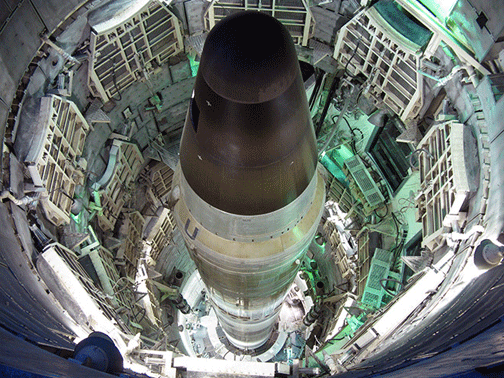
To Avert ‘Global Nuclear Holocaust,’ US Groups Demand Abolition of ICBMs https://www.commondreams.org/news/2022/01/12/avert-global-nuclear-holocaust-us-groups-demand-abolition-icbmsWhistleblower Daniel Ellsberg says no other immediate action would go further “to reduce the real risk of a false alarm in a crisis causing the near-extinction of humanity.”
JAKE JOHNSON More than 60 U.S. organizations issued a joint statement Wednesday calling for the total elimination of the country’s land-based nuclear missiles, warning that the weapons are both an enormous waste of money and—most crucially—an existential threat to humankind.
Organized by the advocacy groups RootsAction and Just Foreign Policy, the statement argues that intercontinental ballistic missiles (ICBMs) are “uniquely dangerous, greatly increasing the chances that a false alarm or miscalculation will result in nuclear war.”
“There is no more important step the United States could take to reduce the chances of a global nuclear holocaust than to eliminate its ICBMs,” continues the statement, which was signed by Beyond the Bomb, Global Zero, Justice Democrats, CodePink, and dozens of other anti-war groups.
“Everything is at stake,” the groups warn. “Nuclear weapons could destroy civilization and inflict catastrophic damage on the world’s ecosystems with ‘nuclear winter,’ inducing mass starvation while virtually ending agriculture. That is the overarching context for the need to shut down the 400 ICBMs now in underground silos that are scattered across five states—Colorado, Montana, Nebraska, North Dakota, and Wyoming.”
The statement comes just two weeks after President Joe Biden signed into law a sprawling military policy bill that allocates billions of dollars to research, development, and missile procurement for the Ground-Based Strategic Deterrent (GBSD) program, an initiative that is expected to replace the current Minuteman III ICBMs in the coming years.
Ahead of the $778 billion legislation’s passage, some progressive lawmakers—most prominently Rep. Ro Khanna (D-Calif.) and Sen. Ed Markey (D-Mass.)—called for a pause in GBSD development, a demand that went unheeded.
Daniel Ellsberg, the legendary whistleblower and longtime proponent of nuclear disarmament, told Common Dreams in an email that “most of the so-called ‘defense’ budget is legislative pork.”
“But some of it—in particular, the maintenance and proposed replacement to the current ICBM program—is toxic pork,” he added. “It’s not just unnecessary, it’s positively dangerous, to our own security and that of the rest of the world.”
Before leaking the Pentagon Papers to the press in 1971, Ellsberg specialized in nuclear weapons and operational planning for a possible nuclear war during his time as a consultant to the Defense Department, an experience he recounts in his 2017 book The Doomsday Machine: Confessions of a Nuclear War Planner.
“We should have gotten rid of our silo-based ICBMs no less than half a century ago, when they had become totally vulnerable to attack,” Ellsberg told Common Dreams. “Ever since then, deterrence of a nuclear attack should have been based solely on our invulnerable submarine-launched missile force, which is itself far larger than that function requires or should permit.”
Echoing the anti-war coalition’s fear that a potential “false alarm” could spark nuclear catastrophe, Ellsberg noted that “the survival in wartime of hundreds of land-based missiles depends on their being launched, irrevocably (unlike bombers), on electronic and infrared warning before attacking missiles might arrive.”
“Such a warning, however convincing, may be false; and that has actually happened, more times than our public has ever become aware,” he said. “No other strategic weapons besides ground-based ICBMs challenge a national leader to decide, absurdly within minutes, whether ‘to use them or lose them.’ They should not exist.”
“No other specific, concrete American action would go so far immediately to reduce the real risk of a false alarm in a crisis causing the near-extinction of humanity,” Ellsberg concluded.
In a statement, RootsAction national director Norman Solomon lamented that recent public discussion surrounding U.S. nuclear weapons policy “has been almost entirely limited to the narrow question of whether to build a new ICBM system or stick with the existing Minuteman III missiles for decades longer.”
“That’s like arguing over whether to refurbish the deck chairs on the nuclear Titanic,” said Solomon. “Both options retain the same unique dangers of nuclear war that ICBMs involve. It’s time to really widen the ICBM debate, and this joint statement from U.S. organizations is a vital step in that direction.”
Texas ‘downwinders’ should be eligible for nuclear radiation compensation, advocates say
Texas ‘downwinders’ should be eligible for nuclear radiation compensation, advocates say, TEXAS STANDARD, By Michael Marks. January 12, 2022
Congress is considering a bill to pay more people who were harmed by nuclear development, but the legislation still excludes some Texans who saw fallout firsthand.
A bill to compensate more people who were harmed by U.S. nuclear development is moving through Congress. But advocates say that it still leaves out people who were affected by nuclear radiation.
Under proposed amendments to the Radiation Exposure Compensation Act, eligible people would get $150,000 from the federal government. That includes uranium miners from Texas, but not “downwinders”: people who lived down wind from nuclear test sites.
Istra Fuhrmann is a nuclear policy advocate for the Friends Committee on National Legislation. She spoke to the Texas Standard about the bill and its provisions……………………. https://www.texasstandard.org/stories/texas-downwinders-should-be-eligible-for-nuclear-radiation-compensation-advocates-say/
Small nuclear reactors make no economic sense, despite the boost by Alberta Premier Jason Kenney and lobbyists.
Guess Who’s Leading the Charge for Nuclear Power in Canada?
Small reactors make no economic sense, despite the boost by Alberta Premier Jason Kenney and lobbyists. David Climenhaga The Tyee, Today | Alberta Politics 10 Jan 22,
David J. Climenhaga is an award-winning journalist, author, post-secondary teacher, poet and trade union communicator. He blogs at AlbertaPolitics.ca. Follow him on Twitter at @djclimenhaga.
Small nuclear reactors don’t make any more economic sense now than they did back in the summer of 2020 when Alberta Premier Jason Kenney took to the internet to tout the supposed benefits of the largely undeveloped technology being promoted by Canada’s nuclear industry.
Now that Kenney has taken to Twitter again to claim atomic energy is a “real solution that helps reduce emissions” and that so-called small modular reactors can “strengthen and diversify our energy sector,” it’s worth taking another look at why the economics of small nuclear reactors don’t add up.
As I pointed out in 2020, “as long as natural gas is cheap and plentiful, small nuclear reactors will never make economic sense.”
Natural gas is somewhat more expensive now than it was then, but not enough to make a difference to that calculation when the massive cost of any new nuclear-energy project is considered.
Even “small modular reactors,” so named to reassure a public skittish about the term nuclear and wary of the costs and risks of atomic reactors, are extremely expensive. It would be more accurate to call them “medium-sized nuclear reactors.”
For example, two such reactors built by Russia starting in 2006 were supposed to cost US$140 million. They ended up costing US$740 million by the time the project was completed in 2019.
Getting approvals for smaller reactors is time consuming, too. As environmentalist and author Chris Turner pointed out yesterday, the first small nuclear reactor approved in the United States “submitted its application in 2017, got approval late last year, could begin producing 700MW by 2029 if all goes perfectly. Solar will add double that to Alberta’s grid by 2023.” Indeed, the estimated completion date of the NuScale Power project may be even later.
The small reactors touted by many companies, often entirely speculative ventures, are nothing more than pretty drawings in fancy brochures. According to the International Atomic Energy Agency, there are about 50 concepts, but only a couple in the United States and Russia with massive amounts of government money behind them are anything more than pipedreams or stock touts’ pitches to investors.
And small nuclear reactors are less economical than big reactors, so power companies aren’t interested in building them; all but one proposed design requires enriched uranium, which Canada doesn’t produce, so they won’t do much for uranium mining in Alberta; and all the safety and waste-removal problems of big nukes continue to exist with small ones.
These points are documented in more detail my 2020 post, which also discussed why smaller reactors will never create very many jobs in Alberta, ……………………- https://thetyee.ca/Analysis/2022/01/10/Nuclear-Power-Canada-Who-Leading-Charge/
Legal case over compensation for workers in ”uniquely dangerous” nuclear sites
High Court Takes Up Nuclear Site Workers’ Compensation Case (1) https://news.bloomberglaw.com/daily-labor-report/high-court-takes-up-washington-workers-compensation-challenge
Jan. 11, 202
- 9th Cir. upheld change to state workers’ compensation law
- U.S. government warns of costly consequences for contracts
The U.S. Supreme Court will consider the federal government’s challenge to a Washington state workers’ compensation law in a case that could have costly consequences for U.S. government contracts involving hazardous work on federal property.
The justices agreed Monday to review a U.S. Court of Appeals for the Ninth Circuit decision upholding a Washington law that presumes certain worker health conditions linked to cleanup work at the Hanford Site, a decommissioned federal nuclear production complex, are occupational diseases that can trigger workers’ compensation benefits.
The Department of Energy since 1989 has overseen cleanup at the Hanford Site, which produced weapons-grade plutonium for use in the U.S. nuclear program during World War II and the Cold War. The cleanup of the Hanford site is expected to continue over the next six decades and involve roughly 400 department employees and 10,000 contractors and subcontractors.
In 2018, Washington lawmakers passed legislation, HB 1723, that amended the state’s workers’ compensation law exclusive to the Hanford site, covering at least 100,000 current and former federal contract workers who performed services there over the past 80 years. The law states that presumed occupational diseases stemming from work at Hanford should trigger benefits eligibility, including cancers and other respiratory diseases.
The federal government argued the law exposes government contractors, and by extension the United States, to “massive new costs” that similarly situated state and private employers don’t incur
‘Uniquely Dangerous Workplace’
The Justice Department had asked the Supreme Court to take up the case, arguing the 2018 law discriminated against the United States and that state law shouldn’t apply to federal contract workers at Hanford. The government warned that the logic applied by a panel of Ninth Circuit judges opened the door to other states passing legislation targeting work at federal facilities.
“Congress did not permit States to adopt laws that impose unique burdens on the United States and the firms that it engages to carry out federal functions,” Justice Department attorneys argued. “The practical consequences of the panel’s mistake are far-reaching. Even if the Hanford site is considered in isolation, the decision is likely to cost the United States tens of millions of dollars annually for the remainder of the 21st century.”
Attorneys for Washington state, however, responded that courts have allowed states to regulate workers’ compensation for injuries or illnesses suffered during work on federal land. They argued Washington state has “long tailored its workers’ compensation laws to the dangers faced by particular employees,” noting statutes that protect firefighters and other workers facing special hazards.
“Hanford is a uniquely dangerous workplace, filled with radioactive and toxic chemicals, and private contractors operating there have routinely failed to provide employees with protective equipment and to monitor their exposures to toxic substances,” they argued.
Justice Department attorneys also argued the Ninth Circuit ruling clashed with Supreme Court precedent in a 1988 decision, Goodyear Atomic Corp. v. Miller, which described a similar situation of a state workers’ compensation award for an employee injured at a federally owned facility.
The full Ninth Circuit previously declined to take up the case, and said the Washington law fell properly within a part of federal law that authorizes states to apply their workers’ compensation laws to federal projects.
In a dissent to the Ninth Circuit’s denial of a rehearing, Judge Daniel P. Collins wrote that the panel’s decision clashed with high court precedent, calling it an “egregious error” that would have sweeping consequences.
The U.S. Solicitor General’s office represents the federal government. The Washington Attorney General’s office is defending the state law.
The case is U.S. v. Washington, U.S., No. 21-404, cert granted 1/10/22.
To contact the reporter on this story: Erin Mulvaney in Washington at emulvaney@bloomberglaw.com
To contact the editors responsible for this story: Jay-Anne B. Casuga at jcasuga@bloomberglaw.com; John Lauinger at jlauinger@bloomberglaw.com; Andrew Harris at aharris@bloomberglaw.com
Very quietly, NRC plans mass shipments of high level radioactive waste.
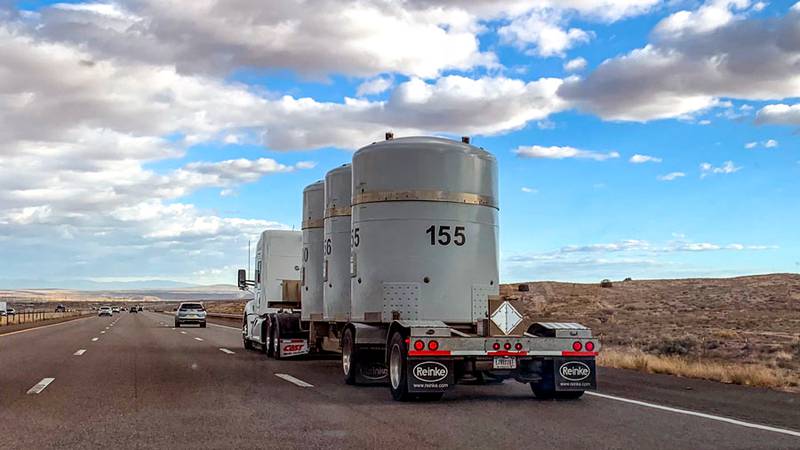
Critics of the proposed licensing are demanding that the Atomic Safety and Licensing Board halt the Holtec licensing because it is illegal.
Plans for Mass Shipments of High-Level Radioactive Waste Quietly Disclosed https://www.counterpunch.org/2022/01/07/plans-for-mass-shipments-of-high-level-radioactive-waste-quietly-disclosed/ BY JOHN LAFORGE
How far is your house or apartment from a major highway, or railroad line? Do you want to play Russian roulette with radioactive waste in transit for 40 years?
Last month US Nuclear Regulatory Commission (NRC) staff quietly reported preparing for tens of thousands of cross-country shipments of high-level radioactive waste from nuclear reactors to the desert Southwest. The oft-disparaged US infrastructure of decrepit of roads, faulty bridges, rickety rails, and rusty barges may not be ready for such an onrush of immensely heavy rad waste casks.
Continue readingNuclear weapons states like USA must end the hypocrisy
|

Simple logic decries the hypocrisy that acknowledges the apocalyptic risk of the very existence of these weapons yet fails to acknowledge the continued pursuit of new and enhanced weapons.
Nuclear weapon states like US must end the hypocrisy https://thehill.com/opinion/national-security/588874-nuclear-weapon-states-like-us-must-end-the-hypocrisyBY ROBERT DODGE, OPINION CONTRIBUTOR — 01/08/22
In an open letter to President Biden over 1,000 physicians, health professionals and concerned citizens have called on the president to take bold action toward the complete elimination of nuclear weapons in anticipation of his administration’s Nuclear Posture Review expected to be released in the next month.
As first responders dealing with the ongoing global COVID-19 pandemic — and recognizing that there is no adequate medical or humanitarian response to nuclear war — they understand the only way to prevent catastrophic consequences is the complete elimination of nuclear weapons.
Their call joins recent initiatives for sensible nuclear policy called for by defense and disarmament experts, U.S. local and state elected officials, and scientists asking the U.S. to take a leadership role in the abolition of nuclear weapons, with immediate steps to defuse the global nuclear tensions that have moved humanity to 100 seconds until midnight, the graphic representation of nuclear Armageddon determined by the Bulletin of Atomic Scientists.
hese immediate steps outlined in the Back from the Brink Coalition include:
- Actively pursuing a verifiable agreement among nuclear-armed states to eliminate their nuclear arsenals
- Renouncing the option of using nuclear weapons first
- Ending the sole, unchecked authority of any U.S. president to launch a nuclear attack
- Taking U.S. nuclear weapons off hair-trigger alert
- Canceling the plan to replace the entire U.S. nuclear arsenal with enhanced weapons
Knowing the science of the climate devastation that would follow even a limited, regional nuclear war, it must be asked under what circumstances any nation is willing to commit collective suicide by launching a nuclear attack? The country, and indeed the world, awaits President Biden‘s Nuclear Posture Review, at which point the president will take ownership of U.S. nuclear policy and our future.
Thus far, little change is noted from the Trump era nuclear and defense policy. The current fiscal year has seen the United States spend over $74 billion on nuclear weapons programs alone. Initial indications are that the Biden defense budget will see this amount increase — at a time when the world struggles to get the entire planet vaccinated against COVID 19 with an estimated global cost of $50 billion according to the Organization for Economic Cooperation and Development.
This recent joint statement by the leaders of the five nuclear-weapon states on the eve of the COVID-postponed NPT Review Conference on “Preventing Nuclear War and Avoiding Arms Races” acknowledged avoidance of war between nuclear-weapon states and the reduction of strategic risks as our foremost responsibilities, while affirming the “Reagan/Gorbachev” principle that a nuclear war cannot be won and must never be fought. They stated that nuclear weapons exist to deter aggression — when in fact they are the most egregious aggressive threat to all of humanity.
The joint statement expresses the importance of arms control and nonproliferation treaties, including compliance with Article VI of the Nuclear Non-Proliferation Treaty (NPT) while — in fact — each nation is aggressively modernizing and growing their nuclear arsenals, spending billions of dollars in the process.
Simple logic decries the hypocrisy that acknowledges the apocalyptic risk of the very existence of these weapons yet fails to acknowledge the continued pursuit of new and enhanced weapons.
What will it take to deter these leaders in their false narrative of why these weapons continue to exist? We must demand bold and immediate action to make their closing statement credible: “We are resolved to pursue constructive dialogue with mutual respect and acknowledgment of each other’s security interests and concerns.”
Their actions alone will demonstrate their commitment to a world without nuclear weapons.
What ratepayers should know about the Plant Vogtle expansion

What ratepayers should know about the Plant Vogtle expansion January 6, 2022 By: Mary Landers , The Current
If you feel like you keep reading the same story about the expansion of Plant Vogtle, the only new nuclear power under construction in the U.S., you’re not exactly wrong.
Reactors No. 3 and 4 at Vogtle on the banks of the Savannah River near Waynesboro are more than five years overdue and $14 billion over budget. And that’s just a broad outline.
For more details, and for a take that’s sympathetic to consumers bearing these costs, read Georgia Conservation Voters‘ 32-page report “Ratepayer Robbery — The True Cost of Plant Vogtle.”
It includes timelines, data on expenses, and records of key decisions. The report reminds Georgia Power residential customers that they’ve been paying for Vogtle financing on their monthly bills for 10 years while industrial customers are exempt. It also spells out how Vogtle’s cost overruns actually increase Georgia Power’s profit. Footnotes link to news articles, and government and nonprofit documents.
“Plant Vogtle is a monumental example of failed leadership, oversight and lack of forethought,” said GCV Executive Director Brionté McCorkle. “What started out as an overpriced $14 billion project has ballooned into more than $30 billion, and that doesn’t take into account the future costs of completing the units.”
The report highlights the role of the Georgia Public Service Commission, an elected five-member panel, in moving the project forward. In a go/no go review of the project in 2017 after building contractor Westinghouse went bankrupt, expert witnesses and the PSC staff cautioned it wasn’t cost effective to continue. But the PSC voted to continue construction…………..
McCorkle is not against finishing the project, she said, but she is concerned about who will pay to finish it, residential ratepayers or Georgia Power shareholders.
“The responsible thing to do is to reassess the whole situation and reassess who’s picking up the tab for this and why customers are on the hook for paying for this energy,” she said.
Georgia Power, which owns 45.7% of the Vogtle expansion project, “has earned over $6 billion just from the delays of their own project,” the report states.
“They’re profiting, they’re making sky-high profits, while individual ratepayers are struggling to keep the lights on throughout a pandemic, people are losing family members,” McCorkle said. “And the squeeze is being felt everywhere. And our commissioners have a responsibility to do something about that.”
“Ratepayer Robbery — The True Cost of Plant Vogtle” concludes with a list of suggested actions. They are:
- The Georgia Public Service Commission should disallow Georgia Power from placing all of
these nuclear construction costs onto our bills and share rate increases more fully between
customer classes. - Voters should hold Commissioners accountable by ejecting them from their seats and electing pro-consumer candidates that commit to transparency.
- The Georgia State legislature should fully fund an independent Consumer Utility Counsel (CUC).
- The Georgia State legislature should create an independent study commission to document lessons learned.Read the entire report at https://www.scribd.com/document/550992905/Ratepayer-Robbery-The-True-Cost-of-Plant-Vogtle
- https://www.gpb.org/news/2022/01/06/what-ratepayers-should-know-about-the-plant-vogtle-expansion?fbclid=IwAR3zdntXhPLdXrqewGAw26Bt1FwsNXQSuLWXhN2cEvA3zJEyZyN5EZzgmyA
What’s going on at Michigan’s nuclear power plants? A troublesome past, and present.
FIRE REPORTED AT CRUMBLING MICHIGAN NUCLEAR POWER PLANT, WHAT IS WRONG WITH MICHIGAN’S NUCLEAR PLANTS? https://futurism.com/the-byte/fire-michigan-nuclear
byABBY LEE HOOD 9 Dec 22,
What’s going on with Michigan’s nuclear power plants? Yesterday, local newspaper conglomerate MLive reported that a fire was detected at the Donald C. Cook Nuclear Plant in Berrien County, MI.
MLive reports that the “potential fire” was detected Thursday morning, complete with an alert from the United States Nuclear Regulatory Commission, though in the end no actual fire was found. And that’s extremely lucky, because MLive reports that the fire protection system for the vault where the fire was detected is currently out of service.
Add that to a local radio news outlet’s report last year that the nuclear facility had deactivated all its warning sirens in favor of mobile alerts, and the incident is a perfect illustration of the United States’ dilapidated nuclear infrastructure.
Some workers have died in gruesome ways at the Cook nuclear plant over the years, which has racked up fines and even briefly shut down entirely in 1997 for grave safety concerns.
Dig a little deeper and other nuclear incidents surface in the same state. Last year, Downtown Publications reported that Fermi 2, a nuclear station located in Newport, MI, suffered the longest nuclear refueling and maintenance outage in 2020, lasting from March until August — and its predecessor, Fermi 1, suffered a partial core meltdown back in the 1960s.
Nuclear power remains a tempting stopgap as the world trundles toward renewables, but in practice it might not actually be the most effective energy solution. The 2011 Fukushima disaster in Japan showed that even with modern safety precautions, events can still spin out of control. And we don’t have solid plans for containing radioactive waste, which stays toxic for hundreds of thousands of years. Uranium pollutes groundwater, and new plants costs a fortune.
In the face of all that, you’d at least expect currently operating plants to be on the top of their game, but the situation in Michigan sounds anything but.
Will we come up with truly effective strategies before another nuclear disaster? Only time will tell.
Texas residents affected by New Mexico nuclear tests – radioactive fallout ignores state lines
Nuclear fallout ignores state lines: Lon Burnam and Istra Fuhrmann, https://www.elpasotimes.com/story/opinion/2022/01/07/nuclear-fallout-ignores-state-lines-lon-burnam-and-istra-fuhrmann/9122752002/ Early in the morning of July 16, 1945, native El Pasoan Barbara Kent was thrown out of her bunk bed at dance camp.
Just 13 years of age, she had traveled to Ruidoso, New Mexico, to learn ballet, unwittingly only a short distance from the site of the first nuclear weapons test. After the explosion awakened her, she says the camp owner came running in to tell the young girls to head outside, where the sky had turned from dark to blindingly bright.
Barbara Kent describes playing in pleasantly warm snow improbably falling in July, grabbing it in her hands and rubbing it on her face. Decades later, she realized that this “snow” had been radioactive fallout from the atomic blast. Today, she is the only survivor from the camp – all the other girls passed away from cancers before the age of 30.
El Paso is less than 150 miles from the epicenter of the nuclear bomb detonation known as the Trinity Test. While Kent happened to be in New Mexico that day, she was not the only Texan exposed to dangerous radiation levels. According to U.S. Census data, between 100,000-130,000 people lived in El Paso during the blast. Nuclear fallout from the explosion settled over thousands of square miles and exposed locals to radiation levels 10,000 times higher than what is currently allowed.
Unfortunately, many of our state’s lawmakers in Congress do not see radiation exposure as a Texas issue. They have not treated the problem with the urgency it is due. It’s time to acknowledge this historical wrong and compensate Texans and New Mexicans suffering from life-threatening illnesses due to nuclear weapons activities.
Congress has united in compensating nuclear testing survivors in the past. In 1990, Utah Senator Orrin Hatch introduced the Radiation Exposure Compensation Act (RECA), which received strong bipartisan support and was signed into law by President George H.W. Bush. Unless Congress acts, this compensation program is set to expire in July 2022. Making matters worse, Texas and New Mexico “downwinders” – locals exposed to nuclear fallout – have never been eligible.
Last month, communities affected by nuclear testing celebrated when the RECA Amendments Act of 2021 was overwhelmingly approved by the House Judiciary Committee. If passed into law, this bill will extend RECA by 19 years and allow New Mexican downwinders to claim compensation for the first time. Importantly, Texan downwinders just across the border are also pushing to be included.
Texas is currently covered in RECA as a uranium mining state that supplied material for America’s nuclear weapons arsenal. Uranium workers employed before 1971 who have developed radiation-related illnesses are eligible to receive a one-time RECA payment of $150,000. Many industry workers came from low-income Native and Hispanic communities and were never informed of deadly radiation exposure.
Greg Harman writes that “after 30 years of heavy [uranium] mining activity, cancer rates in Navajo Country began to shoot upward, doubling by the late ’90s.” RECA does not compensate post-1971 uranium miners, even though mining (and cancer cases) continued past this cutoff date. Texas contained the country’s third-largest uranium reserves and ranked second in the nation in drilling for uranium in 1971. As a result, many Texan uranium miners stand to benefit from the RECA extension, which expands eligibility to include workers in the industry post-1971.
We scored another victory when El Paso’s Congresswomen Veronica Escobar recently cosponsored the RECA Amendments Act. Now it’s time for Senators John Cornyn and Ted Cruz to cosponsor and endorse the Senate version. This bill ensures that compensation for Texan uranium miners will not expire this summer. Advocates from local groups like the Tularosa Basin Downwinders Consortium ask legislators to amend the bill’s language to include El Paso County.
Nuclear fallout does not respect state lines or dates on the calendar. Perhaps, in this case, neither should Congress. It is long past time to compensate Texans, New Mexicans, and downwinders of the 1945 Trinity Tests.
Concerns in New Mexico, about taking in out-of-state nuclear waste, as Waste Isolation Pilot Plant has limited space.
Waste Isolation Pilot Plant criticized for accepting out-of-state nuclear waste, Adrian Hedden, Carlsbad Current-Argus, 8 Jan 22, About 200 shipments of nuclear waste were sent to the Waste Isolation Pilot Plant repository near Carlsbad last year for disposal in an underground salt deposit, but New Mexico officials continued criticism that most of the shipments were coming from out of state.
Waste disposed of at WIPP is known as transuranic (TRU) nuclear waste, made up of clothing materials and equipment irradiated during nuclear activities at U.S. Department of Energy facilities across the nation.
TRU waste is shipped from Los Alamos National Laboratory (LANL) in northern New Mexico, but also from sites like Idaho National Laboratory in Idaho or Savannah River Site in North Carolina.
Of the 210 shipments recorded in 2021, per DOE records, 55 or 26 percent came from LANL. Another 21 came from Oak Ridge National Laboratory in Tennessee, eight came from Savannah River, two came from Lawrence Livermore National Laboratory in California and one came from Waste Control Specialists in Andrews, Texas.
The other 123 shipments, or about 58 percent of WIPP shipments last year were from Idaho National Laboratory, where research is conducted on nuclear reactors.
In total, 74 percent or about three quarters of WIPP’s shipments last year came from out of state.
The State of Idaho entered into a settlement agreement with the DOE in 1995 to prioritize waste shipments from its national laboratory to an out-of-state location: the WIPP site in New Mexico.
But that prioritization is a problem for New Mexico Rep. Christine Chandler (D-43).
Her district represents Los Alamos County, home to LANL, and Chandler said because New Mexico accepts the risk of the waste, its facilities that generate nuclear waste should be given top priority for disposal.
“I feel very strongly that since the WIPP is in New Mexico, and New Mexico accepts the risk for operating that plant that NM waste should be prioritized,” Chandler said. “That would mostly mean from LANL.
“They have a settlement with Idaho and so shipments from there are prioritized to the detriment of actual active sites like LANL.”……………………………..
Chandler’s concerns were echoed in a recent letter from NMED Cabinet Secretary James Kenney to the Government Accountability Office calling for federal oversight of DOE decisions related to the shipment priorities.
The Idaho settlement, Kenney argued, was entered without public input from New Mexicans who he said would bear the risk of disposal.
“The practice of DOE (Office of Emergency Management) solely managing waste shipments to WIPP from around the U.S. without first discussing with New Mexico stakeholders – including NMED as its regulator – now merits immediate congressional oversight,” Kenney wrote.
Other than pressuring federal regulators, Chandler said the State of New Mexico and lawmakers have little recourse to reprioritize disposal at WIPP to benefit their state.
“Truthfully, there is very little we can do. Most of the issues at Los Alamos are driven by federal law. Mostly, it’s placing pressure on the DOE to do the right thing for the state of New Mexico,” Chandler said.
“They need to recognize that LANL is the leading lab and it needs the Department’s full support in all things including clean up.”
Realigning shipment priorities could be achieved through the pending 10-year renewal of WIPP’s operating permit with NMED, said Don Hancock at Albuquerque-based watchdog group Southwest Research and Information Center.
He said regardless of priority for wastes from specific facilities, there is not enough room at WIPP for all the DOE’s waste and the federal government should develop alternate repositories.
WIPP is presently the nation’s only deep-geological repository that can dispose of nuclear waste off-site from where it is generated.
“The State of New Mexico now needs to be pushing on other approved repository sites to be permitted,” Hancock said. “They need to enforce the capacity limits. The DOE and Congress are going to have to start looking at alternatives.”………… https://www.currentargus.com/story/news/local/2022/01/07/wipp-criticized-accepting-out-state-nuclear-waste/9078220002/
Dangerous Diablo Canyon nuclear power plant, and incompetent Pacific Gas and Electric Co.

Nuclear energy backers say it’s vital for the fight against global warming. Don’t be so sure, Los Angeles Times, BY MICHAEL HILTZIKBUSINESS COLUMNIST , JAN. 6, 2022
”……………………………………. Diablo Canyon, which is on the Pacific shoreline about 250 miles south of San Francisco and 190 miles north of Los Angeles, was the third location chosen by Pacific Gas & Electric Co. for a nuclear generating plant starting in the early 1960s.
The previous choices were abandoned because they were judged too close to active earthquake faults — even though PG&E initially asserted in both cases that no faults were nearby. The company then turned to Diablo Canyon, again asserting that there were no active faults within about 20 miles of the site.
As it eventually emerged, there are at least four major active faults within that range, prompting David Brower, the first executive director of the Sierra Club and the founder of Friends of the Earth, to jokingly describe nuclear reactors as “complex technological devices for locating earthquake faults.” (It was the Sierra Club’s endorsement of Diablo Canyon that prompted Brower to resign and form Friends of the Earth.)
With every discovery of a new fault in Diablo Canyon’s vicinity, PG&E minimized the threat and persuaded the Nuclear Regulatory Commission, the federal regulator responsible for licensing nuclear plants, to go along.
The NRC’s decision in 1981 to allow construction to proceed after a fault discovery without reexamining the plant’s seismic engineering provoked two commissioners, Peter A. Bradford and Victor Gilinsky, to issue a blistering dissent.
They described the confidence of two NRC advisory boards in the utility’s reassurances as “almost mystical,” and charged that the boards’ rationales for accepting PG&E’s arguments as evidence that neither board “had any idea what it was talking about.”
Then there’s PG&E’s atrocious safety record, which should curdle the blood at the thought of leaving the plant under its control. The company’s consistent failures include the 2010 pipeline explosion that killed eight and leveled an entire residential neighborhood in San Bruno.
PG&E’s equipment sparked more than 1,500 fires from 2014 through 2017, according to state records. In 2020, it pleaded guilty to 84 counts of criminal manslaughter related to the 2018 wildfire that all but destroyed the town of Paradise and ranks as the deadliest blaze in California history.
In September, the company was charged with 11 felonies and 20 misdemeanor counts related to what Shasta County Dist. Atty. Stephanie Bridgett called its “reckless and criminally negligent” operations, resulting in the deaths of four people. (“My co-workers are not criminals,” PG&E Chief Executive Patti Poppe said after the charges were unveiled. “We welcome our day in court so people can learn just that.”)
As recently as Tuesday, California state investigators concluded that a PG&E power line sparked last year’s massive Dixie fire, which burned more than 960,000 acres in five Northern California counties. The investigators referred the case to local criminal prosecutors.
“PG&E seems to be incapable of operating safely,” says Daniel O. Hirsch, a former environmental faculty member at UC Santa Cruz and president of the Committee to Bridge the Gap, an anti-nuclear group. “You’re mixing an incompetent utility with an unforgiving technology.”…………………….. https://www.latimes.com/business/story/2022-01-06/column-nuclear-energy-backers-say-its-vital-for-the-fight-against-global-warming-dont-believe-them?fbclid=IwAR015ej03ZDoUA2kcNoc_mAqJS3D2N8T
Safety concerns: NRC was right to deny OKLO’s plan for small nuclear reactors

“The company asserted that its reactor was so small and so safe that it didn’t need to play by the same rules as those used to license larger reactors,” Lyman said. “But the fact remains that even a very small reactor contains enough highly radioactive material to cause significant radiological contamination in the event of an accident or a terrorist attack.”..
NRC denies Oklo Power’s plan to construct 1.5 MW advanced nuclear reactor in Idaho
Utility Dive Jan. 7, 2022 Robert Walton, Reporter
Dive Brief:
- The Nuclear Regulatory Commission on Thursday announced it denied without prejudice an application by Oklo Power to construct the United States’ first advanced nuclear reactor, in Idaho. The small design, dubbed “Aurora,” would be capable of producing 1.5 MW of electric power.
- The NRC cited “significant information gaps” in the company’s application, including details on potential accidents and its classification of safety systems and components. However, the company can resubmit its application and regulators said they are “prepared to re-engage” the company.
- Oklo is reviewing the decision, but in a statement said it was “eager to continue moving forward” on the Idaho reactor as well as others. Opponents of the project say a failure to provide safety information could put the public at significant risk in the event of an accident or attack.
………………………. according to the Union of Concerned Scientists, NRC was right to reject the application.
“Oklo simply refused to give the NRC the basic information that the agency needs to assess compliance with its regulations and its legal mandate to protect public health, safety, and the environment,” UCS Director of Nuclear Power Safety Edwin Lyman said in an email………
“The company asserted that its reactor was so small and so safe that it didn’t need to play by the same rules as those used to license larger reactors,” Lyman said. “But the fact remains that even a very small reactor contains enough highly radioactive material to cause significant radiological contamination in the event of an accident or a terrorist attack.”………. https://www.utilitydive.com/news/nrc-denies-oklo-powers-plan-to-construct-15-mw-advanced-nuclear-reactor-i/616807/
Xcel in Minnesota wants to use different nuclear waste casks from the approved TN-40 type
Xcel seeks change in Prairie Island nuclear waste storage
The Minneapolis-based utility says it’s not seeking to store more spent nuclear fuel at the plant than the amount it was authorized in 2009. But Xcel wants flexibility to use a different type of storage cask as long as the design is approved by the federal Nuclear Regulatory Commission. News Tribune, By: Kirsti Marohn / MPR News, Jan. 4, 2022
BRAINERD, Minn. — Xcel Energy is asking state regulators for permission to change how it stores radioactive waste at its Prairie Island nuclear plant in Red Wing, Minnesota.
The Minneapolis-based utility says it’s not seeking to store more spent nuclear fuel at the plant than the amount it was authorized in 2009. But Xcel wants flexibility to use a different type of storage cask as long as the design is approved by the federal Nuclear Regulatory Commission.
Changing the storage technology likely would cut costs and make it easier to transport the waste to a future storage site outside of Minnesota, said Pam Gorman Prochaska, Xcel’s director of nuclear regulatory policy.
“That’s really the motivating factor behind this change request,” she said. “It’s saving our customers money, and it’s the ability to move the fuel off site sooner.”
Xcel’s request comes amid ongoing debate over what to do with growing stockpiles of spent fuel at the nation’s nuclear reactors, which can remain radioactive for thousands of years.
The federal government’s past efforts to establish a permanent storage site at Yucca Mountain, Nevada, stalled in the face of local opposition. The Biden administration recently announced plans to look for interim storage sites in communities that agree to accept it.
Meanwhile, a private company recently received approval from the Nuclear Regulatory Commission for an interim storage site in Texas, but it’s facing opposition from political leaders. A second interim storage site in southeast New Mexico is also seeking NRC approval…….
Xcel plans to continue operating the Prairie Island nuclear reactors through the end of their current licenses, which expire in 2033 and 2034. The utility says it hasn’t yet decided whether to seek an extension.
Change of design
In 2009, the Public Utilities Commission authorized Xcel to more than double the amount of waste it stores at Prairie Island to 64 casks. Currently, 47 casks at the plant have been loaded with spent fuel, Prochaska said.
The casks used to store waste at Prairie Island are a bolted metal cask known as TN-40, chosen in 1989. Prairie Island is the last plant still using that design, Prochaska said.
Most plants in the U.S. — including Monticello — are using a system of welded steel canisters that slide into a concrete bunker, she said.
Xcel says switching to a different cask design could allow the spent fuel to be transported to an off-site storage facility sooner.
The two interim storage sites in Texas and New Mexico could accept the canisters, but are not authorized to accept TN-40 casks, Prochaska said.
Local impacts
The Minnesota Department of Commerce decided that Xcel’s request warranted a supplemental environmental review, because it represents new information and raises environmental justice concerns related to the nearby Prairie Island Indian Community.
Heather Westra, a consultant for Prairie Island’s tribal council, which has objected in the past to storing nuclear waste at the plant, said the tribe doesn’t have specific safety concerns about Xcel’s request to switch cask designs, but is hoping that the change will speed up the movement of waste off Prairie Island.
“Whether you put an additional 20 TN-40 casks or 20 type-to-be-determined, the material is still there,” she said. “And so the larger problem still exists that the material is there, and it’s not going anywhere.”
Like other host communities, the tribe receives very little benefit from having a nuclear plant right next door, just 700 yards from the nearest homes, Westra said.
“This situation was not one of the tribe’s creation, but it’s nevertheless something that the tribe is burdened with,” she said.
Prochaska said a draft environmental impact statement will be completed early next year, and will be followed by additional public hearings before the Minnesota Public Utilities Commission decides on the request.
“Whether you put an additional 20 TN-40 casks or 20 type-to-be-determined, the material is still there,” she said. “And so the larger problem still exists that the material is there, and it’s not going anywhere.”
Like other host communities, the tribe receives very little benefit from having a nuclear plant right next door, just 700 yards from the nearest homes, Westra said.
“This situation was not one of the tribe’s creation, but it’s nevertheless something that the tribe is burdened with,” she said.
Prochaska said a draft environmental impact statement will be completed early next year, and will be followed by additional public hearings before the Minnesota Public Utilities Commission decides on the request.
Xcel also is seeking to extend the Monticello plant’s license until 2040, and is requesting authorization from the Public Utilities Commission to increase the amount of spent fuel stored there. That process could take two years, Prochaska said. https://www.duluthnewstribune.com/business/energy-and-mining/7339515-Xcel-seeks-change-in-Prairie-Island-nuclear-waste-storage
President Biden should pledge never to use nuclear weapons first
President Biden should pledge never to use nuclear weapons first, The Hill, BY THOMAS GRAHAM, JR. AND JONATHAN GRANOFF, — 01/03/22 President Biden can make the world a dramatically safer place by declaring that it is now the policy of the United States never to use nuclear weapons first. Such a pledge is consistent with international legal obligations, fulfills campaign promises, and diminishes the risk of using a nuclear weapon. It would make countries subject to the nuclear weapons threats less nervous in a crisis, when irrationality can lead to disaster. It would add to global stability by lowering the political currency of nuclear weapons.
And significantly, it would help strengthen the Nuclear Nonproliferation Treaty (NPT), the world’s most important arms control treaty. Pursuant to Article VI of the treaty, five nuclear weapons states — United Kingdom, United States, Russia, China, and France — have pledged to “pursue negotiations in good faith on effective measures relating to cessation of the nuclear arms race at an early date and to nuclear disarmament.”
The NPT needs such a boost. Notwithstanding the commitment to disarmament, the five nuclear weapons states, plus the four others not in the treaty — India, Israel, Pakistan, and North Korea — are spending enormous amounts of money modernizing or expanding their nuclear arsenals, or both. Because of the omicron surge in New York, an important 50-year review conference for the treaty (the tenth five-year review), which was supposed to take place next week, has been postponed for the second year in a row (the scheduled 2020 conference was also cancelled due to a winter COVID surge). Meanwhile, nuclear tensions continue to rise, making progress toward meeting the NPT’s goals critically important.
Normally the NPT gets reviewed every five years. At these periodic review conferences, every nation in the world (except the four that aren’t NPT parties) analyze the state of the treaty’s nonproliferation and nuclear disarmament obligations, and strike agreements to strengthen proliferation constraints and make tangible progress toward a nuclear weapons-free world…………….
there is one step the U.S. can take which would help reverse the present dangerous situation: declaring it will never use nuclear weapons first. That would lend credibility to the sincerity of U.S. commitment to fulfilling its disarmament pledges under the NPT.
When brought into deployment practice, a no-first-use posture could make us all dramatically safer. Today, the nuclear posture of the U.S. and Russia supports continuing to threaten to use nuclear weapons first. In practice this tends to keep the arsenals close to Cold War hair-trigger alert status. Such conduct ignores the most important principle of international civilized order and diplomacy: pacta sunt servanda, solemn promises among nations must be kept. Failure to keep arms control commitments — in the nuclear age — could mean the annihilation of civilization.
A no-first-use pledge is consistent with the platform of the Democratic Party on which President Biden campaigned, which states, “(The) sole purpose of our nuclear arsenals should be to deter — and, if necessary retaliate against — a nuclear attack, and we will work to put that belief into practice, in consultation with our allies and military.” A U.S. pledge would challenge all nuclear weapons states to make similar pledges.
Presidents Ronald Reagan and Mikhail Gorbachev got it right when they agreed that a nuclear war can never be won and must never be fought.
Reagan and Gorbachev helped reduce the number of nuclear weapons from more than 65,000 in 1985 to fewer than 14,000 today. This process rested on arms control agreements such as the NPT.
Affirming that the sole purpose of the U.S. nuclear arsenal is to deter attack would respect the NPT, diminish the extremity of the status quo, and help move from an environment of irrational threat to a shared recognition of common security interests and the realistic pursuit of human security. https://www.dell.com/en-au/work/shop/business-laptops-ultrabooks-and-tablets/vostro-5410-laptop/spd/vostro-14-5410-laptop/smc9wnv5410c09aub?gacd=9695171-8007-5761040-272319172-0&dgc=ST&gclsrc=aw.ds&&gclid=EAIaIQobChMI_ISr8_uW9QIVu4GsAh2EXA_HEAEYASAEEgJoSfD_BwE
1 This Month

4 May -West Suburban Peace Coalition to discuss Iran war at May Educational Forum
Monday, May 4, 7:00 – 8:00 PM Central Standard Time
Title: : How Trump’s Narrative Tries to Shape the Reality of the War on Iran.
Contact Walt Zlotow, zlotow@hotmail.com 630 442 3045 for further information
14 May – online event From Bombs to Data Centres: the Face of Nuclear Colonialism
To see nuclear-related stories in greater depth and intensity – go to https://nuclearinformation.wordpress.com
-
Archives
- May 2026 (37)
- April 2026 (356)
- March 2026 (251)
- February 2026 (268)
- January 2026 (308)
- December 2025 (358)
- November 2025 (359)
- October 2025 (376)
- September 2025 (257)
- August 2025 (319)
- July 2025 (230)
- June 2025 (348)
-
Categories
- 1
- 1 NUCLEAR ISSUES
- business and costs
- climate change
- culture and arts
- ENERGY
- environment
- health
- history
- indigenous issues
- Legal
- marketing of nuclear
- media
- opposition to nuclear
- PERSONAL STORIES
- politics
- politics international
- Religion and ethics
- safety
- secrets,lies and civil liberties
- spinbuster
- technology
- Uranium
- wastes
- weapons and war
- Women
- 2 WORLD
- ACTION
- AFRICA
- Atrocities
- AUSTRALIA
- Christina's notes
- Christina's themes
- culture and arts
- Events
- Fuk 2022
- Fuk 2023
- Fukushima 2017
- Fukushima 2018
- fukushima 2019
- Fukushima 2020
- Fukushima 2021
- general
- global warming
- Humour (God we need it)
- Nuclear
- RARE EARTHS
- Reference
- resources – print
- Resources -audiovicual
- Weekly Newsletter
- World
- World Nuclear
- YouTube
-
RSS
Entries RSS
Comments RSS
 nuclear-news