NB POWER seeks unprecedented 25-year licence for Point Lepreau nuclear power station

NB Power seeks unprecedented 25-year licence for Point Lepreau nuclear power station, Coast Reporter, 24 Jan 22, FREDERICTON — The licence for Atlantic Canada’s only nuclear power generating station expires in June, and the New Brunswick Crown corporation that operates the aging CANDU-6 reactor is seeking to renew it for an unprecedented 25-year term.
he Canadian Pressabout 12 hours ago
Updated about 11 hours ago FREDERICTON — The licence for Atlantic Canada’s only nuclear power generating station expires in June, and the New Brunswick Crown corporation that operates the aging CANDU-6 reactor is seeking to renew it for an unprecedented 25-year term.
The last two licences to operate the Point Lepreau Nuclear Generating Station, located about 40 km southwest of Saint John, N.B., were for five years each.
“We are asking for a 25-year licence, which would be a first in Canada, based on some improvements that the regulator has made, but also on the very strong safety and reliability performance that we’ve seen from all the Canadian nuclear stations,” Jason Nouwens, director of regulatory and external affairs for NB Power, told reporters in a briefing on Friday.
The Canadian Nuclear Safety Commission has scheduled the first phase of the application hearing on Wednesday in Ottawa.
Gail Wylie with the Coalition for Responsible Energy Development called the request for a 25-year licence “really absurd.”
Wylie will be one of the public interveners when the safety commission holds the second phase of the application hearings in Saint John in May.
“We are very much interested in renewable energy because we know it’s clean and we know the problems and history of nuclear energy here,” she said in a recent interview. “Nuclear inherently has got its risks and the radioactive waste.”
Wylie said she’s concerned that extending the life of the 660-megawatt nuclear generator will slow the transition to what she calls cleaner and cheaper forms of renewable energy.
Point Lepreau opened in 1983 and operated until 2008, when it closed for a major refurbishment intended to extend its lifespan by 25 years. It was reconnected to the power grid in October 2012.
Wylie said NB Power’s request for a licence until 2047 exceeds the lifespan targets that were announced after the refurbishment. She said she plans to ask questions about how the utility is dealing with staffing levels during the COVID-19 pandemic, threats of cyberattacks, and impacts of climate change.
Wylie also wants to know about how plans to develop advanced small modular nuclear reactors (SMRs) on the Lepreau site will impact the operation of the main reactor. Two companies, Moltex and ARC, are working with NB Power to develop the portable reactor technology.
Nouwens, however, said the licence application doesn’t include development of SMRs.
“The re-licensing process for Point Lepreau is completely separate from any licensing process for SMRs,” he said. “Our 25-year licence renewal covers the scope of what’s currently at Point Lepreau and what the plans would be for our current station operations.” …………….
Like Wylie, Dalzell said he also plans to ask questions about climate change and about how Point Lepreau’s location on the shore of the Bay of Fundy could be affected by sea-level rise and extreme weather events. Kevin Bissett, The Canadian Press https://www.coastreporter.net/the-mix/nb-power-seeks-unprecedented-25-year-licence-for-point-lepreau-nuclear-power-station-4985518
UKRAINE CRISIS: US ‘Toolboxes’ Are Empty

January 22, 2022 The toolbox is empty. Russia knows this. Biden knows this. Blinken knows this. CNN knows this. The only ones who aren’t aware of this are the American people, says Scott Ritter. By Scott Ritter, Special to Consortium News U.S. Secretary of State Antony Blinken met with his Russian counterpart, Sergei Lavrov, in a hastily scheduled, 90-minute summit in Geneva yesterday, after which both sides lauded the meeting as worthwhile because it kept the door open for a diplomatic resolution to the ongoing crisis in Ukraine. What “keeping the door open” entails, however, represents two completely different realities.
For Blinken, the important thing appears to be process, continuing a dialogue which, by its very essence, creates the impression of progress, with progress being measured in increments of time, as opposed to results.
A results-oriented outcome was not in the books for Blinken and his entourage; the U.S. was supposed to submit a written response to Russia’s demands for security guarantees as spelled out in a pair of draft treaties presented to the U.S. and NATO in December. Instead, Blinken told Lavrov the written submission would be provided next week.
In the meantime, Blinken primed the pump of expected outcomes by highlighting the possibility of future negotiations that addressed Russian concerns (on a reciprocal basis) regarding intermediate-range missiles and NATO military exercises.
But under no circumstances, Blinken said, would the U.S. be responding to Russian demands against NATO expanding to Ukraine and Georgia, and for the redeployment of NATO forces inside the territory of NATO as it existed in 1997.
……………….Blinken’s restatement of a position he has pontificated on incessantly for more than a month now was not done for the benefit of Lavrov and the Russian government, but rather for an American and European audience which had been left scratching their collective heads over comments made the day before by President Joe Biden which suggested that the U.S. had a range of options it would consider depending on the size of a Russian incursion.
…………………………………… the lack of an agreed-upon strategy on how to deal with a Russian incursion/invasion of Ukraine was an open secret for everyone except the U.S. and European publics, who being fed a line of horse manure to assuage domestic political concerns over being seen as surrendering to Russian demands.
…………………………. Blinken has indicated that the U.S. has a toolbox filled with options that will deliver “massive consequences” to Russia should Russia invade Ukraine. These “tools” include military options, such as the reinforcement of NATO’s eastern flank with additional U.S. troops, and economic options, such as shutting down the NordStream 2 pipeline and cutting Russia off from the SWIFT banking system. All these options, Blinken notes, have the undivided support of U.S. European allies and partners.
………… There’s only one problem—the toolbox, it turns out, is empty.
While the Pentagon is reportedly working on a series of military options to reinforce the existing U.S. military presence in eastern Europe, the actual implementation of these options would neither be timely nor even possible. One option is to move forces already in Europe; the U.S. Army maintains one heavy armored brigade in Europe on a rotational basis and has a light armored vehicle brigade and an artillery brigade stationed in Germany. Along with some helicopter and logistics support, that’s it.
Flooding these units into Poland would be for display purposes only—they represent an unsustainable combat force that would be destroyed within hours, if not days, in any large-scale ground combat against a Russian threat.
………………………. In short, there is no viable military option, and Biden knows this.
…………………………………………. Propaganda About ‘Propaganda’
One of the great ironies of the current crisis is that, on the eve of the Blinken-Lavrov meeting in Geneva, the U.S. State Department published a report on Russian propaganda, decrying the role played by state-funded outlets such as RT and Sputnik in shaping public opinion in the United States and the West (in the interest of full disclosure, RT is one of the outlets that I write for.)
The fact that the State Department would publish such a report on the eve of a meeting which is all about propagating the big lie—that the U.S. has a plan for deterring “irresponsible Russian aggression”—while ignoring the hard truth: this is a crisis derived solely from the irresponsible policies of the U.S. and NATO over the past 30 years.
While a compliant mainstream American media unthinkingly repeated every warning and threat issued by Biden and Blinken to Russia over the course of the past few days, the Russian position has been largely ignored. Here’s a reminder of where Russia stands on its demands for security guarantees: “We are talking about the withdrawal of foreign forces, equipment, and weapons, as well as taking other steps to return to the set-up we had in 1997 in non-NATO countries,” the Russian Foreign Ministry declared in a bulletin published after the Lavrov-Blinken meeting. “This includes Bulgaria and Romania.”
The toolbox is empty. Russia knows this. Biden knows this. Blinken knows this. CNN knows this. The only ones who aren’t aware of this are the American people.
The consequences of a U.S. rejection of Russia’s demands will more than likely be war.
If you think the American people are ready to bear the burden of a war with Russia, think again.
Scott Ritter is a former U.S. Marine Corps intelligence officer who served in the former Soviet Union implementing arms control treaties, in the Persian Gulf during Operation Desert Storm, and in Iraq overseeing the disarmament of WMD. https://consortiumnews.com/2022/01/22/ukraine-crisis-us-toolboxes-are-empty/
Officials at San Onofre conspicuously silent on the risks of tsunami waves to nuclear waste storage.
The tsunami advisory that woke up the West Coast Jan. 15 should serve as a wake-up call on flooding dangers at the nuclear waste storage facility in San Onofre. The facility is 100 feet from the beach.
During high tides, waves crash into an aging bulkhead that separates the sea from the storage
vault — a kind of crypt that holds 73 thin-walled, metal canisters jam-packed with 3.6 million pounds of deadly, radioactive waste.
According to Southern California Edison, the sprawling, concrete vault will flood from a storm at high tide. If the ocean were to swamp the so-called Independent Spent Fuel Storage Installation, we could have an unsurpassed disaster on our hands, an uncontrolled criticality, one that has never occurred in the U.S. commercial power industry.
The undersea volcanic eruption this month near Tonga sent waves across the Pacific. Officials in
Hawaii reported tsunami wave heights of nearly 3 feet. At San Diego Harbor, officials measured more than a half-foot of sea level rise. Meanwhile, officials from shuttered San Onofre Nuclear Generating Station remained conspicuously silent.
Times of San Diego 20th Jan 2022
Nuclear weapons standout calls for US commitment to UN treaty
Nuclear weapons standout calls for US commitment to UN treaty, By CHRIS LARABEEStaff Writer, Greenfield REcorderPublished: 1/23/2022 11:05:01 AM
GREENFIELD — On the one-year anniversary of the United Nations Treaty on the Prohibition of Nuclear Weapons becoming international law, a group gathered on the Greenfield Common and in Northampton to celebrate the treaty and to raise awareness that the United States has not signed on.
“Fifty nations have signed on. … How can we face the world?” asked Greenfield resident Patricia Greene. “We’re here to say not all of us agree.”
Greene and several other residents called out the United States’ “pugnacious” stance toward many other countries and said America should focus on peace.
“I feel that the main thing our country needs to do is look at peaceful relations,” Greene said. “We’re so divided internally, maybe heal that over, too.”
The anniversary of the treaty comes days before a state Public Safety and Homeland Security hearing Jan. 26 on Bill H.3688, which was filed by Rep. Lindsay Sabadosa, D-Northampton, and would establish an 11-member commission to investigate and report on what measures may be necessary and appropriate to protect Massachusetts residents from the threat posed by nuclear weapons and to contribute toward the total elimination of these weapons from all countries.
According to the United Nations’ website, 59 countries have ratified the treaty, which recognizes the threat of nuclear weapons and requires their elimination. Among the countries that have yet to even sign the treaty include many world powers, such as the United States, China, Japan and the majority of the European Union and England.
Pat Hynes, who sits on the Traprock Center for Peace and Justice’s board of directors, said the 11-member commission, if it was created, would find many people in Massachusetts with similar sentiments to the group standing on the frozen Greenfield Common.
“They would certainly find a very high majority opposing nuclear weapons,” Hynes said. “I hope the committee and State House have the courage to pass the bill.”
Hynes recalled a quote from World War II Army Gen. Omar Bradley that the world contains “nuclear giants and ethical infants.” She added it’s been disappointing that nuclear weapons continue to be produced, even after the horrors of bombing Hiroshima and Nagasaki and the existential threat of the Cold War.
“I’d say it’s tragic, especially with all the other crises happening,” Hynes said, highlighting climate change and the COVID-19 pandemic as current threats. “We don’t need to add to them.”………………..
https://www.recorder.com/Nuclear-weapons-standout-calls-for-U-S-commitment-to-U-N-treaty-44696552
Hypocritical Scolding Won’t Stop a Russian War on Ukraine
 | |||
Peace cannot be found if the U.S. relies on the self-righteous assertion of principles that our government refuses to apply to itself.January 21, 2022 , Portside, Mitchell Zimmerman OTHERWORDS.ORG
As Moscow signals its apparent readiness for war over Ukraine, the U.S. government seems determined to ignore Russia’s not-so-ridiculous concerns over the military alliances of neighboring states and the prospect of nuclear weapons on its borders.
Should Americans worry about our country inserting itself into another war?
Ukraine is far away, and Russia isn’t directly threatening us. Nonetheless, the U.S. intends to arm and support Ukraine if it comes to war, and there can be no certainty whether a proxy war might escalate. Nuclear powers need to tread carefully around each other.
Let’s look at the U.S. response to Russia’s insistence that Ukraine not join NATO, the U.S.-dominated military alliance that Russia wants to keep out of its immediate periphery.
Washington rejects that demand. The U.S. representative at talks with Russia recently declared it to be among America’s “bedrock principles” that there be “no tolerance of overt or tacit spheres of influence, no restrictions on the sovereign right of nations to choose their own alliances.”
Contrary to these noble statements, America has long deemed it a bedrock principle that the United States has a sphere of influence: all of North and South America!………………
After the U.S. tried to overthrow its government, Cuba chose to ally with the Soviet Union and let the Russians put nuclear missiles in Cuba. The U.S. response was to bring the world to the brink of nuclear war rather than accept the Soviets’ move into our sphere of influence.
So much for “bedrock principles.”
The U.S. now proclaims it a “bedrock principle” that Ukraine, at least, can make an alliance with whomever they want, Russian sensibilities be damned. But suppose Mexico decided to join the Collective Security Treaty Organization, the Russian-sponsored counterpart to NATO?
Can anyone imagine the U.S. would quietly acknowledge Mexico’s right to do so?……………….
It is not unreasonable for the Russians not to want a hostile alliance — and potentially nuclear weapons — along their border. But Russia’s key interests do not reasonably include dismembering Ukraine.
Meanwhile the U.S. is not crazy for wanting Ukraine to be free to connect economically and culturally with Western Europe. But it’s not a key interest, requiring a confrontation between nuclear-armed states, to insist that Ukraine has the “right” to join NATO.
Peace cannot be found if the U.S. relies on the self-righteous assertion of principles that our government refuses to apply to itself. https://portside.org/2022-01-21/hypocritical-scolding-wont-stop-russian-war-ukraine
Washington pumping up war fever
Washington pumping up war fever http://space4peace.blogspot.com/2022/01/washington-pumping-up-war-fever.html It’s nonstop in the western media. The message – war with Russia is coming.
An American friend of mine, now living in Russia, has two sons in the US Army. One of them said to him today, “your two sons are going to be fighting your beloved Russia.” So the troops are obviously being told to prepare for war. One of those sons, an Army Special Forces soldier has been sent to western Ukraine several times to train the Nazi death squads that have been brought into the Ukrainian Army since the US orchestrated coup d’état in 2014.
Russia has repeatedly stated that they have no intention of invading Ukraine – unless Ukraine first strikes Crimea or the Donbass (eastern Ukraine that borders Russia where two Russian-ethnic republics are located that have continually been targets of the right-wing Kiev government since 2014).
Russia constantly says they have no desire to take over the failed Ukrainian state – in fact Moscow says that the US-NATO have driven that country into the ground since the 2014 coup and they should help it recover. But the Washington agenda is chaos – just like Iraq, Syria, Libya and other places US-NATO have destroyed with their ‘freedom war machine’.
Let’s take a moment and look at possible reasons for the US-NATO daily agitation for war.
- The western corporate powers see their reign as ‘global rulers’ rapidly vanishing and know this is the last chance to bring down Russia and China before the ‘multi-polar’ world comes into fruition in the next few years.
- The west is led by evil, psychopaths who thirst for war. The neo-cons come to mind.
- It’s all a big public relations scheme to create a rare ‘win’ for the west. If Russia does not invade Ukraine then the US-NATO can claim it was all because they stood up to the ‘Russian bear’, proving that their out-of-date alliance still has a role in the world today.
- Western oligarchs can’t stand to let Russia have all those natural resources in the Arctic that are becoming possible to extract due to melting ice. So Russia must be broken up into smaller nations giving Mr. Big the chance to make the grab. See the RAND Corporation study that lays out the plan to balkanize Russia here. Thus there is no stopping this rush to war.
- US-NATO are bluffing. It’s all a great distraction to help take the heat off Big Pharma’s global vaccine campaign and growing international economic problems.
- You pick – give us your take in the comments.
- Now let’s review some of the reasons why war might be avoided.
If the US-NATO really went to full blown war with Russia then it would likely go nuclear. China would probably be pulled in. If this happens forget covid – kiss your family good-bye. Is the US-NATO stupid enough to try this? Yes they are but there are some sensible leaders in Europe who know this would not be such a great idea. Let’s hope they have the stuff it takes to help shut down this insanity.- The US-NATO constant aggression is a big money maker for the military industrial complex so this current war talk is a cash cow for them. But they are not stupid and know that nuclear war does not help their profit line.
- Think back to 2003 and George W. Bush’s ill-fated ‘shock and awe’ attack on Iraq that turned that nation into a chaotic failed state. Prior to the US-UK attack there were massive protests around the world for peace.
This time, as Washington-Brussels do their daily war-prep media barrage, there are few global protests. In fact there are some in the ‘US peace movement’ who buy the hype and believe Russia wants to remake the Soviet Union by invading Europe. Anyone who is actually paying real attention at this moment knows that story line is bullshit. But sadly some who should be protesting US-NATO provocations and aggression are not doing so. This weakens our ability to stop WW III.
I hope and pray that more people will speak out – and soon. Our lives depend on your courage and your action.
In Georgia, Bloated Costs Take Over a Nuclear Power Plant and a Fight Looms Over Who Pays,

In Georgia, Bloated Costs Take Over a Nuclear Power Plant and a Fight Looms Over Who Pays,
Vogtle’s two new nuclear reactors are six years late and at least $16 billion over their original budget. The plant will have no direct carbon footprint, but critics say there are much cheaper ways to reduce emissions.
Inside Climate News, By James Bruggers, January 21, 2022 Ballooning cost overruns and construction delays at Georgia Power Co.’s Vogtle nuclear project threaten to cost the state’s electricity consumers billions of dollars in the decades to come, a new think tank report concludes.
The report, from the Institute for Energy Economics and Financial Analysis, a nonprofit advancing a sustainable energy economy, builds a case that stockholders of the company should take the lead on construction and carry much of the financial load, rather than ratepayers.
Once estimated to cost $14 billion, the price tag for two new reactors at Georgia Power’s Plant Vogtle property has climbed past $30 billion, and both units will be more than six years late in coming online, the institute reported after combing through public records including testimony at a Georgia Public Service Commission hearing in December. The plant already has two existing nuclear power units that began producing electricity in the 1980s.
Public Service Commission staff and consultants have blamed the project’s high costs and construction delays on Georgia Power, which is the lead partner in its construction and eventual operation, and a subsidiary of Southern Company, the energy policy institute found.
Georgia Power was warned in 2008 that using an unproven reactor design would likely cause overruns and delays, said David Schlissel, the report’s author and the institute’s director of resource planning and analysis. “However, the company challenged and the commission disregarded these warnings,” said Schlissel, a lawyer who has been a frequent expert witness in legal proceedings.
Commission spokesman Tom Krause said he could not comment directly on the institute’s report or the commission’s ongoing quasi-judicial proceedings that are designed to monitor the construction, which the Atlanta Journal Constitution has described as the largest project in Georgia history. The commission regulates Georgia Power, and as such, has a major say in Georgia energy policy.
Krause said future hearings, when the project is farther along, will be held to help the commission, made up of five members who are elected statewide, determine which of the Vogtle costs should be allocated to ratepayers, as opposed to shareholders.
“That will be a very significant docket before the PSC,” Krause said.
“I imagine it will be a knock-down, drag-out fight,” Schlissel said. “I have heard a fair amount of the documentation, and just reading what the PSC staff has been saying, clearly this project has been mismanaged.”
The institute, based in Lakewood, Ohio, is not an official party in those proceedings and its report was not prepared for any organization that is directly participating in them, Schlissel said.
Georgia Power’s customers have already paid more than $3.5 billion for the two units through a rider on their electric bills intended to cover financing charges, the report found.
“Our new Vogtle units will be clean energy sources and produce zero air pollution,” said Jeff Wilson, Georgia Power spokesman. “That’s why we remain fully committed to getting the job done, and getting it done right, with safety and quality our top priority.”
He also minimized the plant’s impact on customers’ rates.
The two units were originally to be placed in service in 2016 and 2017. The owners now estimate commercial operation will not begin until 2022 and 2023, according to the report. They are to be the first new commercial nuclear power units in the United States in the last three decades.
The institute’s report quoted a commission hearing in December at which an independent monitor of the project, Don Grace, told the commission that Georgia Power had on more than one occasion used low forecasts as a way to “try and continue to justify the project.”………….
Grace, in his testimony, described developing the plant as similar to driving “uphill in the snow.”
And the wheels are turning. Money is being spent and you’re trying to get to the goal of getting to the top of the hill,” he said. “But in some cases you’re making slow progress, but not at the rate you expected. And in some cases you’re actually slipping backwards somewhat.”……………………… https://insideclimatenews.org/news/21012022/georgia-power-vogtle-nuclear/
Holding in the deep: what Canada wants to do with its decades-long pile-up of nuclear waste
|

no country in the world has solved the conundrum of how to permanently dispose of waste that will stay toxic for 400,000 years. And after decades of trying hard to figure it out, Canada doesn’t seem especially close to a solution.
This is the legacy that we are leaving for our children, our grandchildren, great grandchildren, or great, great grandchildren,”
“ it would be irresponsible and morally wrong to commit future generations to a technology that produces such dangerous material, unless there is at least one proven safe method of dealing with it,”
Canada plans to store spent nuclear fuel deep, deep underground near the Great Lakes. That is, if an industry group can find a community willing to play host, The Narwahl, By Emma McIntosh Jan. 19, 2022, The final resting place of Canada’s most radioactive nuclear waste could be a cave about as deep below the surface as the CN Tower is tall.
If it happens, the chamber and its network of tunnels will be drilled into bedrock in the Great Lakes basin. Pellets of spent nuclear fuel — coated in ceramic material, loaded into bundles of metal tubes the size of fireplace logs, then placed into a metal container encased in clay made from volcanic ash — will be stacked in the underground chamber sealed with concrete 10 to 12 metres thick. Though the radioactive pellets will have spent several years cooling down in pools and concrete canisters, they will still emit so much energy that their presence will heat up the space where they sit for 30 to 60 years. The warmth will linger for anywhere from a few centuries to a few millennia.
But none of this will become reality unless the industry-backed Nuclear Waste Management Organization can find a willing host. Two Ontario towns are in the running: South Bruce, located about two hours’ drive northwest of Toronto near Lake Huron, and Ignace, roughly 200 kilometres north of Lake Superior, not far from the Manitoba border. The municipalities, along with 10 First Nations and two Métis councils, are awaiting the completion of dozens of studies as they mull whether the economic benefits of such a project outweigh the risks.
“We have to make sure that there isn’t an environmental risk for us, or it’s a relatively remote risk,” said Dave Rushton, a project manager for the Municipality of South Bruce.
If anyone thinks they’re informed today, I kind of question it. We’re not fully informed because we haven’t got this information yet.”
………. no country in the world has solved the conundrum of how to permanently dispose of waste that will stay toxic for 400,000 years. And after decades of trying hard to figure it out, Canada doesn’t seem especially close to a solution.
“This is the legacy that we are leaving for our children, our grandchildren, great grandchildren, or great, great grandchildren,” said Bzauniibiikwe, whose English name is Joanne Keeshig. She’s Wolf Clan from Neyaashiinigmiing, also known as Chippewas of Nawash Unceded First Nation, which is located near the South Bruce proposal.
“Seven generations from now, this will not be resolved unless we start seriously taking a look at what can be done.” Modelling suggests underground nuclear waste disposal is safe. But no country has tried it yet…………….
High-level waste, meanwhile, is the responsibility of the Nuclear Waste Management Organization, a non-profit established by Ontario Power Generation, New Brunswick Power Corporation, and Hydro-Québec. In the 60 or so years that Canada has produced nuclear power, it has never had a place to dispose of spent fuel. As of 2020, the country’s nuclear power utilities had produced about three million fire log-sized bundles of it — enough to fill eight hockey arenas from the ice to the top of the boards — and that number grows by about 90,000 each year. In the absence of a place to leave it permanently, producers are currently keeping high-level waste in temporary storage near the reactors. By 2100, when the federal government says it expects all of the country’s existing nuclear plants to be decommissioned, industry projects it will be holding onto nearly 5.6 million bundles.
Accumulating nuclear waste has raised red flags for a long time. In 1978, the Ontario government commissioned a report titled “A Race Against Time,” which concluded the waste was proving trickier to handle than experts initially thought and suggested a potential moratorium on new nuclear plants if the industry didn’t progress within eight years.
Another report from the United Kingdom the same year came to a similar but stronger conclusion, said Gordon Edwards, a mathematician who has long critiqued the nuclear industry as the president of the not-for-profit Canadian Coalition for Nuclear Responsibility.
“One of their main conclusions was that we are agreed that it would be irresponsible and morally wrong to commit future generations to a technology that produces such dangerous material, unless there is at least one proven safe method of dealing with it,” Edwards said.
“The problem with radioactivity is you can’t shut it off … You have to somehow keep it out of the environment.”
Federal and provincial governments never issued a moratorium: construction on the Darlington plant in Bowmanville, Ont., which had been approved in 1977, began in the ‘80s. The Bruce and Pickering plants, meanwhile, continued to get new reactors.
These days, the federal government is pushing to advance new nuclear technology, called small modular nuclear reactors (commonly known as SMRs), which some argue could be a climate mitigation tool. The technology is less efficient than larger reactors and produces more waste. Two of these new reactors might be built in the near future — the Canadian Nuclear Safety Commission, which oversees the industry, is considering an application for one at the Chalk River Laboratories research site in Deep River, Ont., and Ontario Power Generation has announced its intent to build another at Darlington.
In 2002, Parliament did pass legislation requiring the industry to band together and deal with its waste and later that year, the Nuclear Waste Management Organization was formed. Twenty years on, it still hasn’t figured out what to do with high-level radioactive waste. Keeping it above ground, as is done now, leaves it vulnerable to natural disasters, or human ones like terrorism and war.
“It’s a question of ethics,” said Brian Ikeda, an associate professor at Ontario Tech University who studies the management of radioactive waste and has a contract to do upcoming work for the Nuclear Waste Management Organization.
“Do you want to leave this stuff — which you don’t like and you think is really dangerous — and have your grandchildren figure out what to do with it? Because that’s what’s actually going to happen … we could be putting those people at huge risk by having this material out.”
As such, a consensus has emerged among global experts that the best way forward is to dispose of spent fuel far underground, a concept called a deep geological repository. But putting nuclear waste underground isn’t simple.
The waste — which in worst-case scenarios could poison groundwater or soil — must be packaged securely enough to withstand a future ice age, which could bring massive glaciers three kilometres thick, heavy enough to affect underground geology. It must be placed in rock that is stable and won’t shift for 400,000 years, the length of time the Nuclear Waste Management Organization believes the waste would remain radioactive enough to be harmful if leaked. It must be climate change proof.
It must also account for the many unknowns of future generations, who might not know how to actively maintain the storage site, but on the other hand will hopefully be able to monitor it. It must be buried so deep that, if our languages disappear or the information about what’s sealed within is somehow lost, our descendants would be unlikely to disturb the buried chamber and expose themselves to the unimaginable risk inside.
Another challenge is the simple fact of entropy: everything breaks down over time. No matter what type of container holds the nuclear waste, its material will corrode over the course of many thousands of years, Ikeda said. The trick is to buy as much time as possible. …………………………………………….
Finding a nuclear waste disposal site in Ontario will require First Nations consent and buy-in from local towns………………………………………………………… https://thenarwhal.ca/nuclear-waste-ignace-bruce/
New radioactive waste plan poses ‘Milennia of Risk” for Ottawa River communities
| |||
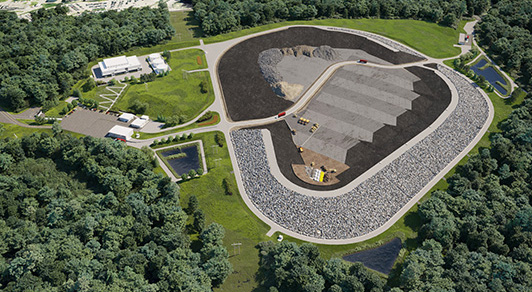
New Radioactive Waste Plan Poses ‘Millennia of Risk’ for Ottawa River Communities https://www.theenergymix.com/2022/01/16/new-radioactive-waste-plan-poses-millennia-of-risk-for-ottawa-river-communities/January 16, 2022 : Ole Hendricksen Canada’s first-ever radioactive waste disposal facility may be headed for disaster.
Canada’s nuclear regulator is about to hold wholly-inadequate hearings on building a controversial 60-foot-high mound for one million cubic metres of radioactive and hazardous wastes, with the potential to leak for millennia into the Ottawa River—a drinking water source for millions of Canadians in Ottawa, Gatineau, Montreal, and other downstream communities
Euphemistically called a “Near Surface Disposal Facility”, or NSDF, the mound would be on unceded Algonquin territory, on a hillside adjacent to a lake and wetlands that drain into the Ottawa River a kilometre away. An environmental impact statement (EIS) ordered by the Canadian Nuclear Safety Commission (CNSC) says that without mitigation practices, “leakage of leachate or other releases of substances may affect surface water quality at downstream locations,” but then goes on to say that these changes are not expected to have significant impact on human health or aquatic biodiversity.
The EIS lists a number of possible threats to the mound’s integrity, including earthquakes, floods, fires, tornadoes, malfunctions, and accidents. At each count, the (EIS) concludes that the risks are “not significant” thanks to the facility’s proposed design features, monitoring plans, and mitigation strategies like treating effluents.
A CAPTURED REGULATOR
The CNSC has never refused to grant a licence, according to a memo obtained by the Canadian Coalition for Nuclear Responsibility. The Expert Panel on Reform of Environmental Assessment noted in its final report that CNSC is widely seen as a captured regulator that promotes the projects it is supposed to regulate.
The surface-level nuclear mound idea was put forward by Canadian Nuclear Laboratories (CNL). In 2015, ownership of CNL was transferred from Atomic Energy of Canada Limited (AECL) to SNC-Lavalin and Texas-based Fluor and Jacobs through a 10-year, multi-billion-dollar AECL contract issued by the Harper government.
The mound is central to CNL’s strategy to reduce AECL’s C$16-billion nuclear waste clean-up liability as quickly and cheaply as possible. This federal nuclear liability has grown despite billion-dollar annual appropriations to AECL, which AECL hands over to CNL’s multinational owners.
The CNSC has signalled its approval of the NSDF by scheduling a two-part licencing hearing for February 22 and May 31,2022. A licencing document and an Environmental Assessment report will be released on January 24. CNSC’s licencing document will likely say the NSDF project is consistent with requirements of the Nuclear Safety and Control Act. CNSC’s EA report will likely repeat the assertion that the NSDF project “is not likely to cause significant adverse environmental effects”, or that the significant adverse environmental effects it is likely to cause are justified in the circumstances.
The CNSC initially also promised a public hearing and a public comment period on its EA report, but later eliminated them. Public participation in CNSC licencing hearings is a mere formality.
MISREPRESENTING THE RISK
There are many problems with the proposed project.
The NSDF location was chosen without a proper siting process, even though the International Atomic Energy Agency (IAEA) says siting is a “fundamentally important activity in the disposal of radioactive waste.” Proximity to contaminated structures awaiting demolition at AECL’s Chalk River Laboratories—not environmental protection—seems to have been the priority.
Use of the term “NSDF” misrepresents the proposed facility. The EIS says it would be an above-ground mound “similar to a municipal landfill.” The IAEA says landfills are suitable only for very low level waste that has “very limited concentrations of long-lived radionuclides,” and that a “disposal facility at or near the surface makes it susceptible to processes and events that will degrade its containment and isolation capacity over much shorter periods of time.”
The waste inventory in the EISshows 23 of 31 radionuclides with half-lives exceeding 1,600 years, including man-made reactor products such as americium, neptunium, plutonium, and technetium. Much of this waste dates back to the Cold War era when Chalk River Laboratories produced materials for U.S. nuclear weapons. AECL’s NRX reactor experienced a partial meltdown in 1952. An above-ground mound is simply not capable of containing and isolating wastes like these for the duration of their radiological hazard.
The EIS says the mound would experience degradation as a result of “normal evolution”. That means mixed radioactive and hazardous industrial wastes (arsenic, beryllium, mercury, benzene, dioxins, PCBs, etc.) would leak into the Ottawa River, essentially forever. Future generations might be tempted to scavenge for scrap metal in the mound—an estimated 33 tonnes of aluminum, 178 tonnes of lead, 3,520 tonnes of copper, and 10,442 tonnes of iron.
SURFACE STORAGE FOR DANGEROUS RADIATION
Cobalt-60 would emit the highest amounts of radiation by far during the first 50 years of operation (99% of the total). CNL proposes to allow unlimited quantities of this powerful “short-lived” gamma-emitter in certain “packaged” wastes. Cobalt-60 is used in high-activity gamma irradiation sources for food sterilization and cancer treatment. Owing to cobalt-60’s 5.3-year half-life, these devices are no longer useful after 20 years but remain highly radioactive. They are sent back to Canada and stored at Chalk River.
CNL wants to put these “disused sources” in the mound, even though the IAEA requires their disposal at depths “of at least tens of metres”. And more are coming from around the world: a 2021 federal report says Canada supplies “approximately 95% of the global demand”.
The EIS does not mention that such commercial industry wastes would go in the NSDF. Nor does it discuss the worker safety and environmental risks created by cobalt-60 and the hundreds of tonnes of lead required to shield it.
Overall, the EIS contains minimal information on the wastes that would go into the mound. It refers to waste “packages” that could range in size up to intermodal shipping containers. Some packages supposedly would be “leachate controlled”, but no evidence or details are provided that they would withstand the heavy equipment (bulldozers, rollers) used to compact the mound.
Because the mound’s contents would be exposed to wind, rain, and snow during a 50-year operating phase, the project includes a water treatment plant to remove leachate contaminants. Tritium, the radioactive form of hydrogen, would not be removed. Partly treated leachate would be discharged into wetlands or into nearby Perch Lake through a pipeline. Both are already contaminated by groundwater plumes from existing leaking waste areas.
Despite assertions that the NSDF project would remediate “historically contaminated lands”, remediation plans are not included. Available data indicate that the leaking waste areas already contain far more radionuclides than a “licenced inventory” would allow in the NSDF.
A former AECL staff member says CNL does not rigorously track its wastes and has inadequate waste characterization and waste segregation procedures. This raises concerns about CNL’s capacity (and willingness) to adhere to the licenced inventory.
A FINANCIAL AND ENVIRONMENTAL DISASTER
The CNSC’s mandate does not include cost-effectiveness. The $750-million cost estimate in the EIS lacks credibility. Canada has no experience with permanent radioactive waste disposal. Why build such an expensive facility that would do little to reduce the federal nuclear liability, would not conform to international safety standards, and would pollute the Ottawa River?
| In 2018, six First Nations and dozens of civil society groups wrote the IAEA about the flawed NSDF proposal and Canada’s radioactive waste policy void. A 2019 IAEA mission to Canada found virtually “no evidence… of a governmental policy or strategy related to radioactive waste management.” In response, Natural Resources Canada (NRCan) launched an “engagement process to modernize Canada’s Radioactive Waste Policy” in November 2020.Seven environmental petitions related to the NSDF have been filed with Canada’s Auditor General, who anticipates publication of a nuclear waste management audit this year. As Canada’s first-ever facility for permanent disposal and eventual abandonment of nuclear reactor waste products, the NSDF would set a very poor precedent for future facilities to come. The Auditor General’s nuclear waste management audit and NRCan’s policy modernization process should conclude before the CNSC holds licencing hearings for the NSDF. Their results may help prevent the NSDF from becoming a financial and environmental disaster that would permanently contaminate one of Canada’s most treasured heritage rivers.Retired forest ecologist Ole Hendrickson is a researcher with Concerned Citizens of Renfrew County and Area. |
Could Plutonium Shipping in New Mexico Lead to Disaster?
Could Plutonium Shipping in New Mexico Lead to Disaster? Legal Reader,
PETER CHARLES — January 18, 2022 Santa Fe already sees a considerable amount of radioactive waste transported near its city limits, as contaminated gloves, equipment, and soil are regularly shipped from Los Alamos Laboratory.
Residents of New Mexico are concerned about a plan to ship plutonium through the Land of Enchantment. Many people are totally unaware that nuclear materials are transported through the state on a fairly regular basis, and fewer still are aware of the potential risks. So what happens if one of these semi-trucks crashes, and nuclear waste spills out? What happens if you are injured or irradiated as a result?
If you have been injured in a semi-truck accident, it’s always best to reach out to a qualified, experienced semi-truck accident attorney in New Mexico. These legal professionals have the resources and knowledge to help you fight for justice in a confident, efficient manner. The truth of the matter is that cargo spills can cause serious injuries to innocent motorists, especially if that cargo is radioactive. This type of material should have never been transported across New Mexico in the first place, and a lawyer can help you seek justice.
Cold War Plutonium a Concern for Santa Fe Residents
Santa Fe already sees a considerable amount of radioactive waste transported near its city limits, as contaminated gloves, equipment, and soil are regularly shipped from Los Alamos Laboratory to an underground disposal site near Carlsbad. However, the Department of Energy’s new plan is to ship leftover plutonium from the Cold War through the south side of the city, which is much more dangerous compared to normal radioactive waste. There are 26 metric tons of plutonium that needs to be disposed of, and this plutonium has to be extracted from bomb cores before being transported.
In addition, the plutonium is so deadly that it must be diluted before it is transported. Otherwise, it would violate regulations at New Mexico’s Waste Isolation Pilot Plant. The site explicitly rejects anything other than low-level nuclear waste. The process involves shipping the plutonium to Los Alamos Lab, turning it into an oxide powder, and then shipping back across New Mexico’s highways to South Carolina.
Finally, the powder would be diluted even further before returning back to New Mexico and being stored at the Waste Isolation Pilot Plant. Critics say that having plutonium shipped back and forth multiple times across New Mexico is an accident waiting to happen. …….. https://www.legalreader.com/could-plutonium-shipping-in-new-mexico-lead-to-disaster/
On Cape Cod, a nuclear nightmare arrives
On Cape Cod, a nuclear nightmare arrives, https://news.yahoo.com/column-cape-cod-nuclear-nightmare-095201547.html, Brent Harold Columnist, Mon, January 17, 2022,
We’re living in E.F. Schumacher’s nightmare future.

Fifty years ago, before there was much nuclear power to worry about, before Three Mile Island, Chernobyl, or Fukushima, he was already worrying about it in his 1973 book “Small is Beautiful: A Study of Economics As If People Mattered.” The book was ranked by The Times Literary Supplement as one of the 100 most influential books published since World War II.
It’s striking that the main argument against using nuclear energy was there from the very start.
“The biggest cause of worry for the future is the storage of the long-lived radioactive wastes,” he wrote. “In effect, we are consciously and deliberately accumulating a toxic substance on the off-chance that it may be possible to get rid of it at a later date.”
No amount of convenience or efficiency — or profits — he argued “could justify the accumulation of large amounts of highly toxic substances which nobody knows how to make ‘safe’ and which remain an incalculable danger to the whole of creation for historical or even geological ages. To do such a thing is a transgression against life itself.”
We are in that “later date” and as we know, there still is no solution to the problem of how to get rid of the radioactive waste that is a systematic byproduct of generating nuclear energy .
We are in that future Schumacher warned against.
A few years ago, when Pilgrim Nuclear Power Plant was still limping along, a documentary titled “Containment” played in Wellfleet, showing in convincing detail the nuclear future Schumacher warned against, especially the ongoing problem of containment of lethal radioactive wastes.
There is no mopping up as with oil spills. You don’t flush this, clean it up and move on. There is no getting rid of the mess we’ve made. All we can do is try to contain it, on and on farther into the future than the 10,000 years often cited as the age of “civilization” — perhaps longer than our species has been around.
There’s an interesting segment in the film about attempts to come up with a sign to warn our distant descendants of the lethal mess we have bequeathed them.
Containment is the job and the company that owned Pilgrim, when it closed the plant, handed the job of cleanup and containment off to a company named Holtec, which thought it could make a go of it while making a profit for its shareholders.
Containment is the job. But only in its first year or two, Holtec recently announced, almost off-handedly, that it was considering dumping a million gallons of radioactive waste in our Cape Cod Bay. ”What?” asked many. “Can they get away with that?”
Apparently they are within their legal rights. Certainly, the company has emphasized it has no obligation to be guided by those whose lives will be most affected by it.
In reaction to the outcry Holtec has said it will put off the dumping for a spell. To make us feel better it noted that Entergy had for years, when Pilgrim was still operating, been dumping radioactive water in the bay.
Fifty years ago Schumacher wrote: “It was thought at one time that these wastes could safely be dumped into the deepest parts of the oceans…but this has since been disproved…wherever there is life, radioactive substances are absorbed into the biological cycle.”
Containment is the job. Dumping a million gallons of radioactive waste into Cape Cod Bay seems like the opposite of containment.
Once again, as with Entergy, we find ourselves in the situation of having our present and future safety in the hands of a bottom line-oriented company.
Call it a nuclear energy problem. Call it a corporation/capitalism problem. It is both.

There is a decades-long history of opposition to Pilgrim. Diane Turco and others founded Cape Downwinders in the early 1990s, a group that worked toward the shuttering of Pilgrim..
This newspaper kept Cape citizens informed with its strong coverage of the deterioration of Pilgrim and wrote editorials advocating its closure.
The closure of the plant in 2019 was considered by activists a victory and there has been a natural tendency (for people whose name isn’t Diane Turco) to become complacent about the still-dangerous site. Certainly it does seem less glamorous being the first generation of citizens, of who knows how many, to practice ongoing wariness about containment and the company in charge of it. But that’s the reality of our situation.
A place to start getting involved or re-involved is a gathering for a speak-out on Jan. 31 at 5 p.m. at Plymouth Town Hall Great Room, to be followed at 6:30 p.m. by a meeting of the Nuclear Decommissioning Citizens Advisory Panel.
Brent Harold, a Cape Cod Times columnist and former English professor, lives in Wellfleet. Email him at kinnacum@gmail.com.
This article originally appeared on Cape Cod Times: pilgrim nuclear plant and holtec’s plan to dump contaminated water.
Nuclear weapons must be relegated to the past – Treaty for the Prohibition of Nuclear Weapons

The letter also marks the first anniversary of Pope Francis’ statement prior to the entry into force of the treaty on Jan. 22, 2021; the Pope said nuclear weapons “strike large numbers of people in a short space of time and provoke long-lasting damage to the environment.” On Tuesday, the archbishop said, “It is the duty of the Archdiocese of Santa Fe, the birthplace of nuclear weapons, to support that treaty while working toward universal, verifiable nuclear disarmament.”
As of this week, the treaty has 59 member nation signatories. The purpose of the treaty is to outlaw the manufacture, testing, possession, stockpiling and use or threat of use of nuclear weapons. It is the legal form chosen by 122 nations who, in 2015, sought a route toward disarmament that would be more effective than the United States’ languishing 1970 promise to disarm “at an early date.”
| |||
Nuclear weapons must be relegated to the past, https://www.santafenewmexican.com/opinion/my_view/nuclear-weapons-must-be-relegated-to-the-past/article_d247c8d8-7559-11ec-ab06-bfa71f3f3b1e.html, By Basia Miller, Jan 16, 2022 .
On Jan. 11, the Archbishop of Santa Fe, John C. Wester, shared his pastoral letter, “Living in the Light of Christ’s Peace: A Conversation Toward Nuclear Disarmament” (“Archbishop decries labs’ weapons production,” Jan. 12).
His letter, a timely, courageous and powerful call for a culture of peace, comes at a time when the United States appears to be entering a new arms race, one in which contamination of the waters and lands of the Rio Grande watershed with radioactive, toxic and hazardous pollutants is often accepted passively, without questioning the deadly — and growing — enterprise behind it.
In his summary, the archbishop makes a link between the costs of military spending and the reciprocal effect on civilian life. He says, “Moreover, we are robbing from the poor and needy with current plans to spend at least
$1.7 trillion to ‘modernize’ our nuclear weapons and keep them forever.”
The archbishop presented his letter six days before the Dr. Martin Luther King Jr. holiday and 10 days before the first anniversary of the entry into force of the International Treaty on the Prohibition of Nuclear Weapons, on Jan. 22.
The letter also marks the first anniversary of Pope Francis’ statement prior to the entry into force of the treaty on Jan. 22, 2021; the Pope said nuclear weapons “strike large numbers of people in a short space of time and provoke long-lasting damage to the environment.” On Tuesday, the archbishop said, “It is the duty of the Archdiocese of Santa Fe, the birthplace of nuclear weapons, to support that treaty while working toward universal, verifiable nuclear disarmament.”
As of this week, the treaty has 59 member nation signatories. The purpose of the treaty is to outlaw the manufacture, testing, possession, stockpiling and use or threat of use of nuclear weapons. It is the legal form chosen by 122 nations who, in 2015, sought a route toward disarmament that would be more effective than the United States’ languishing 1970 promise to disarm “at an early date.”
The long-range expectation is the dynamic among the treaty’s signatory nations (including the NATO countries) will gradually curb the United States’ appetite for building more weapons. The purpose was once “deterrence,” but even that rationalization has been undermined.
In this way, a new legal norm will have been created by which nuclear weapons follow the pattern of the worldwide ban on landmines and chemical and biological weapons.
An occasion to honor Dr. Martin Luther King Jr. and celebrate the first anniversary of the Treaty for the Prohibition of Nuclear Weapons is planned by local activists and veterans groups at Ashley Pond in Los Alamos from 1 p.m. to 3 p.m. on Saturday, Jan. 22. The public is invited. Basia Miller is a board member of Concerned Citizens for Nuclear Safety. She has lived in Santa Fe for over 30 years.
Missouri Bill to honour nuclear veterans
Bob Bromley Bill seeks to honor veterans of the Nuclear Age, https://www.fourstateshomepage.com/news/local-news/bob-bromley-bill-seeks-to-honor-veterans-of-the-nuclear-age/ by: Gretchen Bolander Jan 17, 2022 JASPER COUNTY, Mo. — It’s been decades since the US entered the Nuclear Age, but a southwest Missouri lawmaker says it’s never too late to recognize the sacrifice made through the Atomic Program.
State Representative Bob Bromley of Carl Junction is part of an effort that’s underway to recognize the military veterans associated with the US Atomic Program.
“I think every time we get the opportunity to thank them we should. Because once they’re gone, they’re gone,” said Jim Beeler, military supporter.
Jim Beeler says it’s important to thank any vet for their service, and today, especially those who were a part of the US Atomic Program.
“It’s nice to see someone recognize that.”
State Rep. Bob Bromley is sponsoring House Bill 1652 which would designate a section of Highway 171 as “Atomic Veterans Memorial Highway.” Bromley says it’s important to recognize the role these veterans played in the 1940s, 50s, and 60s, and the potential toll to their health after being exposed to radiation.
“There were 23 different types of cancers that develop with a lot of these veterans. And they were not eligible with their medical records and everything to get compensation,” said MO Rep. Bob Bromley, R.
Often tied to the top secret nature of the work. It took decades to change that.
“Some of them did not get compensated for their cancers and different things that was caused by this exposure to radiation ’til the mid 90s. And so it’s just very important to understand the sacrifice and the contribution that all these veterans made.”
The bill has already gone before the Veterans Committee and is expected to see an initial vote this week. Missouri is just one of a list of states considering this measure to recognize Atomic Veterans.
The US and China Could Soon Be In Race For Nuclear-Powered Satellites.
The US and China Could Soon Be In Race For Nuclear-Powered Satellites, Defense One, 16 Jan 22,
An idea from the 1960s has found new backers., If future U.S. satellites are to dodge incoming Russian or Chinese fire, they’ll need better ways to move around than today’s fuel-intensive thrusters. That’s why the Pentagon is looking into nuclear-powered propulsion.
While leaders at the Space Force and the Pentagon Research and Development office remain publicly quiet about the idea of putting nuclear-powered spacecraft in orbit, the Mitchell Institute for Aerospace studies released a new report that argues for more focused work on it.
It isn’t a new concept. NASA and the Atomic Energy Commission were working toward a flight test for their nuclear rocket until the Vietnam War sapped the program’s funding. It was cancelled in 1973, and safety concerns have since scuttled further efforts………….
If future U.S. satellites are to dodge incoming Russian or Chinese fire, they’ll need better ways to move around than today’s fuel-intensive thrusters. That’s why the Pentagon is looking into nuclear-powered propulsion.
While leaders at the Space Force and the Pentagon Research and Development office remain publicly quiet about the idea of putting nuclear-powered spacecraft in orbit, the Mitchell Institute for Aerospace studies released a new report that argues for more focused work on it.
It isn’t a new concept. NASA and the Atomic Energy Commission were working toward a flight test for their nuclear rocket until the Vietnam War sapped the program’s funding. It was cancelled in 1973, and safety concerns have since scuttled further efforts……….
But one DARPA official, at least, suggests looking at the idea afresh. A 2020 policy change from the Trump White House has clearing the way for new research into nuclear propulsion, Micheal Leahy, the director of the tactical technology office at DARPA, told a virtual audience on Friday. Leahy’s office runs the DARPA Demonstration Rocket for Agile Cislunar Operations, or DRACO, program. Last April, DARPA awarded General Atomics a contract for a preliminary design of a reactor and propulsion subsystem, and gave Lockheed Martin and Blue Origin a contract for a spacecraft design.
But the bigger factor is thatChina is working along similar lines with planes to field its own nuclear-powered satellites by 2040. The lessons from the current gap in hypersonic missile technology should provide a cautionary tale, Leahy said.
“We had the lead in hypersonics, only to watch it go away. Right?… Now I’m in a tail chase,” he said. https://www.defenseone.com/technology/2022/01/us-and-china-could-soon-be-race-nuclear-powered-satellites/360792/
Can Santa Fe survive as a nuclear weapons suburb?
| |||


Will Santa Fe “fold up,” democratically and spiritually, when this new “Manhattan” fully appears? Is the faith of that man of peace, St. Francis — the very name of this city — obsolete to political leaders in the city and the state?
Can Santa Fe survive as a nuclear weapons suburb? https://www.santafenewmexican.com/opinion/my_view/can-santa-fe-survive-as-a-nuclear-weapons-suburb/article_b6ab8ce8-7556-11ec-b47a-57273af4ebbc.html, By Greg Mello, 16 Jan 22,
Many Santa Feans understand that Los Alamos National Laboratory, the most lavishly funded nuclear weapons facility in the world, has embarked on a new mission: making plutonium warhead cores (“pits”) on an industrial scale, to involve 4,000 full-time personnel and 24/7 operations.
It’s among the dirtiest and most dangerous missions in the nuclear weapons complex, not seen at LANL since the 1940s. It’s centered in an old facility built for research and development, now to be driven far beyond its original capacity.
LANL predicts it will spend $18 billion to start up production over this decade. In constant dollars, this is 15-fold what the Manhattan Project spent in New Mexico — indeed it dwarfs the cost of every other project in New Mexico history.
The pits will cost at least $50 million apiece, 200 times their weight in gold. A single LANL pit, assuming all goes well, will cost as much as the combined annual salaries of 1,000 New Mexico teachers, or the equipment for 5,000 residential solar systems. A major reason our society is failing is because it is kept on a war footing.
This huge program has nothing to do with national security, except in the negative sense. It is not needed to maintain any stockpile weapon. As military planners say, it’s (very) “early to need” and there are now perfectly sound, cheaper plans to do without LANL’s production should something go wrong. Why wait?
After extensive analysis under both the Obama and Trump administrations, the National Nuclear Security Administration in 2017 firmly rejected what is now LANL’s pit plan. The New Mexico delegation fought back, enlisting congressional hawks to help blackmail the Trump administration into building an unheard-of two pit factories. Up to now, a barely functioning Congress has gone along with the game. Time will tell just how long this scam holds up.
LANL’s pit production, for all its cost and danger, just isn’t enough to support any foreseeable U.S. stockpile. If LANL is a pit factory, there will be two.
What about Santa Fe, then?
On July 18, 1945, Harry Truman wrote in his diary, “Believe [Japan] will fold up before Russia comes in. I am sure they will when Manhattan appears over their homeland.”
Will Santa Fe “fold up,” democratically and spiritually, when this new “Manhattan” fully appears? Is the faith of that man of peace, St. Francis — the very name of this city — obsolete to political leaders in the city and the state?
What exactly would Santa Fe stand for or mean if nuclear weapons — the ultimate in human disposability — became its main tangible product? When our schools and community colleges direct our young people into LANL’s “pipeline” of plutonium minions? Or do you suppose their potential for creativity, compassion and wisdom could be better developed in other ways, as the region faces the towering crises of the 21st century?
Can Santa Fe survive as a nuclear weapons suburb? It certainly can, as a kind of nuclear “Pottersville” — a sprawling, increasingly ugly “city” with growing inequality, a vacuum where shared ideals should be, with no real urban center or shared human purposes, its most cherished traditions washed away by too much money given to too few people doing “work” society doesn’t need or want. It would be a city divided against itself to be sure, with plenty of poverty, human tragedy and crime.
Santa Fe could be a city that aims for justice and peace, where the obligation of respect binding us together is fostered, where the potential of every child is honored. Those political values are incompatible with manufacturing more nuclear weapons.
Greg Mello is executive director of the Los Alamos Study Group.
1 This Month

4 May -West Suburban Peace Coalition to discuss Iran war at May Educational Forum
Monday, May 4, 7:00 – 8:00 PM Central Standard Time
Title: : How Trump’s Narrative Tries to Shape the Reality of the War on Iran.
Contact Walt Zlotow, zlotow@hotmail.com 630 442 3045 for further information
14 May – online event From Bombs to Data Centres: the Face of Nuclear Colonialism
To see nuclear-related stories in greater depth and intensity – go to https://nuclearinformation.wordpress.com
-
Archives
- May 2026 (37)
- April 2026 (356)
- March 2026 (251)
- February 2026 (268)
- January 2026 (308)
- December 2025 (358)
- November 2025 (359)
- October 2025 (376)
- September 2025 (257)
- August 2025 (319)
- July 2025 (230)
- June 2025 (348)
-
Categories
- 1
- 1 NUCLEAR ISSUES
- business and costs
- climate change
- culture and arts
- ENERGY
- environment
- health
- history
- indigenous issues
- Legal
- marketing of nuclear
- media
- opposition to nuclear
- PERSONAL STORIES
- politics
- politics international
- Religion and ethics
- safety
- secrets,lies and civil liberties
- spinbuster
- technology
- Uranium
- wastes
- weapons and war
- Women
- 2 WORLD
- ACTION
- AFRICA
- Atrocities
- AUSTRALIA
- Christina's notes
- Christina's themes
- culture and arts
- Events
- Fuk 2022
- Fuk 2023
- Fukushima 2017
- Fukushima 2018
- fukushima 2019
- Fukushima 2020
- Fukushima 2021
- general
- global warming
- Humour (God we need it)
- Nuclear
- RARE EARTHS
- Reference
- resources – print
- Resources -audiovicual
- Weekly Newsletter
- World
- World Nuclear
- YouTube
-
RSS
Entries RSS
Comments RSS
 nuclear-news