Trump news at a glance: president claims Iran ‘no longer want a nuclear weapon’ amid peace deal hopes
Washington and Tehran express increasing optimism that weeks of halting negotiations may be drawing to a close – key US politics stories from Saturday 13 June at a glance
Guardian staff, 14 June 26, https://www.theguardian.com/us-news/2026/jun/14/trump-news-at-a-glance-president-claims-iran-no-longer-want-a-nuclear-weapon-amid-peace-deal-hopes
Donald Trump says a deal with Iran to end the war would be signed on Sunday, and that the strait of Hormuz would be “open to all” immediately after.
Iran had offered a different timeline earlier in the day, but nonetheless signalled an agreement was in the offing, as both the warring parties and their mediators expressed increasing optimism that weeks of halting negotiations were drawing to a close.
“The Deal is scheduled to get signed tomorrow, and immediately after it is signed, the Hormuz Strait is OPEN TO ALL,” Trump said on his Truth Social platform. Since an 8 April truce paused the worst of the fighting, Trump has repeatedly insisted a deal was near only for the wrangling to drag on.
The Iranian foreign ministry spokesperson, Esmaeil Baqaei, had said earlier on Saturday that the date of the signing was yet to be determined, but “it will not be tomorrow”. However, he added: “The possibility of this happening in the coming days cannot be ruled out.”
Space Force needs to prepare for an ‘in-person’ moon conflict with China, new report argues
Guardians need a human spaceflight program for future lunar missions, Mitchell Institute says.
Defense One, Thomas Novelly, 23 May 26,
The Space Force should prepare to put active-duty troops on the moon and on space stations to counter China’s lunar and military ambitions, a new research paper argues.
The Mitchell Institute’s paper, published Thursday, calls for the Space Force to prioritize the creation of a “human spaceflight” program and redefine federal, active-duty Title 10 orders to compete against China’s military-focused space initiatives—such as the reported goal of putting its Taikonauts on the moon by 2030. Although Chinese officials as recently as last month have said the country believes in the “peaceful use” of space, the paper claims future “competition for control of lunar resources and territory will likely reach a tipping point” and the U.S. military must be prepared.
With a potential ‘in person’ lunar conflict with China as the contextual touchstone, the U.S. must begin a pragmatic multi-decade effort, leveraging its Space Test Course (STC), as well as partnerships with NASA and commercial space companies, to deliver the skills, tools, and concepts needed for future Title 10 activities to enforce U.S. spacepower-enabling norms and standards,” the report said. “These efforts will require additional funding from Congress for both U.S. Space Force human spaceflight opportunities and residencies at commercial space stations.”
The 22-page policy report calls for blurring the long-standing boundaries between space exploration and militarized operations by allowing Title 10 active-duty federal orders to include “space and lunar habitation” and “warfighting authorities and a national defense mindset in the advancement of human spaceflight.” The 1967 Outer Space Treaty, which the U.S. and China are parties to, calls for the governments to use the moon and other planets for “peaceful purposes” and forbids military bases, testing, and maneuvers. Kyle Pumroy, a retired Space Force colonel and the paper’s author, called for pushing back against those norms………………………………………………………………………………….. https://www.defenseone.com/threats/2026/05/space-force-needs-prepare-person-moon-conflict-china-new-report-argues/413747/
US Begins Another Round of Attacks on Iran
Trump had said earlier that he would launch more strikes on the country
by Dave DeCamp | June 10, 2026 , https://news.antiwar.com/2026/06/10/trump-threatens-more-attacks-on-iran-after-exchange-of-heavy-strikes/
On Wednesday night, US Central Command (CENTCOM) announced it was launching a round of attacks on Iran for the second night in a row as Iranian media began reporting blasts across the southern part of the country.
In response to the US attacks, Iran’s military said that it would fully close the Strait of Hormuz. “From this moment, due to insecurity in the region, the Strait of Hormuz is declared closed to the passage of all vessels, including oil tankers and commercial ships, and any traffic will be targeted,” Iran’s Khatam al-Anbiya Central Headquarters said in a statement.
CENTCOM then claimed that the Iranian statement was false and that ships were still transiting the strait, but the denial came just a short while after Iran’s announcement. President Trump had earlier claimed that over the past month, the US military was conducting a “secret mission” to allow tankers to exit the Strait of Hormuz. He claimed the US helped bring 100 million barrels out of the strait, which, if true, is still a fraction of the oil that was transiting through the waterway before he launched the war.
After the start of the US strikes, Iranian media reported blasts across Iran’s southern Hormozgan province and said that at least two residents of the city of Kargan were wounded by shrapnel. Iran appears to be striking back as air raid sirens were sounded in Bahrain and the IRGC said it was targeting 18 US military installations across the region.
The fresh US attacks came after President Trump threatened more bombings, and US War Secretary Pete Hegseth also said that the US would be attacking the Islamic Republic.
“CENTCOM will be busy tonight because President Trump said we will be hitting Iran hard, and we will be,” Hegseth told reporters outside CENTCOM headquarters in Florida not long before the strikes started.
On Wednesday morning, the president said on Truth Social that Iran has “taken too long to negotiate a deal that would have been great for them, now they will have to pay the price.” He also claimed in the post that Iran had been “completely defeated” despite its ability to launch missile and drone attacks across the Middle East.
In comments to reporters in the Oval Office later in the day, Trump was more explicit in his threat. “We hit them hard yesterday, and we’re going to hit them again hard today,” he said.
Trump also told Fox News reporter Trey Yingst that he may “keep going” with his attacks on Iran and that he is “getting closer to the targeting of Iranian power plants and bridges.”
During the US-Israeli bombing campaign against Iran, Trump repeatedly threatened to launch massive attacks on Iranian energy infrastructure and bridges, part of his threats to turn the country into “hell” and end a “whole civilization.”
Iran’s Islamic Revolutionary Guard Corps (IRGC) said Wednesday that its forces targeted the US military in Kuwait, Bahrain, and Jordan, and vowed it would launch stronger strikes if the US attacked again.
Iran’s Foreign Ministry said that Iran’s military dealt a heavy blow to the US following its “savage attacks” on Iran that were launched under the pretext of Iran allegedly downing a US Apache helicopter over the Strait of Hormuz as it was enforcing a blockade on Iranian ports. “With these aggressive actions, the US ruling administration once again demonstrated its criminal and warmongering nature,” the ministry said.
US officials said the US strikes on Iran targeted air defense and radar systems, while Iranian media also reported that strikes hit two water reservoirs, cutting off drinking water to thousands of Iranians.
War crime -US ‘precision strikes’ cut water access to 20,000 people in southern Iran
The ‘self-defense’ strikes that Washington said it carried out destroyed part of a key water facility in Hormozgan province
News Desk, JUN 11, 2026, https://thecradle.co/articles/us-precision-strikes-cut-water-access-to-20000-people-in-southern-iran
The US military’s recent airstrikes on a drinking water facility in southern Iran “could constitute a war crime,” a 10 June New York Times (NYT) investigation said after an attac
After the strike, US Central Command (CENTCOM) described its attacks as “self-defense” that was carried out with “precision” munitions.
In response to NYT, a CENTCOM spokesman said he was “aware” of the reports about destroyed water infrastructure, but declined to provide any further information.
The US strikes hit Iran early on Wednesday.
The CEO of Hormozgan province’s water and wastewater company announced before NYT released its investigation that the US struck a 500-cubic-meter tank and a 2,000-cubic-meter tank that both played a key role in supplying drinking water to Sirik.
Authorities said the strikes cut off water to 20,000 people living in nearby areas.
“Mobile water tankers brought in water to supply residents while crews built a new service line that bypassed the damaged tanks,” Abdolhamid Hamzehpour, the head of the provincial water authority, told NYT, adding that the task was completed within 12 hours. k by Washington cut off water to tens of thousands of people.
ranian forces targeted US bases in the region on Wednesday in response to the attacks that destroyed the facility.
Since then, more US strikes have targeted the Islamic Republic.
Iran carried out retaliatory missile operations targeting key US sites in Bahrain, Kuwait, and Jordan on Thursday.
US President Donald Trump has threatened more strikes on Iran since Tehran’s latest retaliation.
Is America ready for a nuclear explosion in space?

by Peter A. Garretson and Richard M. Harrison, – 06/09/26, https://thehill.com/opinion/national-security/5915315-space-based-nuclear-weapons/
Gen. Stephen Whiting, the commander of U.S. Space Command, recently made waves when he publicly discussed a major threat that America’s newest military branch recently war-gamed — that of an adversary detonating a nuclear weapon in space.
At first blush, the scenario seems far-fetched. In truth, though, it is a real possibility.
More than a year ago, in February 2024, House Intelligence Chairman Mike Turner (R-Ohio) was already raising the alarm that Russia could place a space-based nuclear device into orbit. That possibility was later confirmed by the Pentagon.
The White House grasps the danger. A December 2025 Executive Order on Space Superiority directs the country’s relevant agencies to create “a space security strategy that accounts for United States interests in, from, and to space” and “a technology plan for detecting, characterizing, and countering potential adversary placement of nuclear weapons in space.” That strategy, moreover, is expected as soon as June 16.
This public call to action is notable. It marks the first time an unclassified document has publicly directed a response to a nuclear weapon in space. It also reflects the gravity of what is an increasingly plausible threat. After spending several months conducting a deep dive into this subject, we at the American Foreign Policy Council have come to the same ominous conclusions. Space-based nuclear weapons are a serious matter, and one that deserves the very highest level of national attention.
Talk of a nuclear detonation generally triggers visions of cities being destroyed and mushroom clouds. The effects differ when a detonation occurs at a high altitude. While explosions near space, or in space, may not have immediate destructive effects here on Earth, they can prove equally devastating. Even a relatively small nuclear device, detonated at the right place in low Earth orbit, would have a catastrophic impact on U.S. and allied interests.
That is because, while space itself is enormous, the vast majority of modern spacecraft (nearly 90 percent) are in low Earth orbit, most of them satellites. Both the American and the global economy rely on these systems for everything from the functioning of the Internet to aircraft navigation and ship tracking, at a cost of billions of dollars daily, and trillions annually.
Moreover, our intelligence agencies and the U.S. military rely extensively on satellites to detect the movement of adversary ships, aircraft and tanks; to track ballistic, hypersonic and cruise missiles; and to communicate with our overseas forces. And in the near future, advanced capabilities will allow the U.S. Space Force to globally track everything that moves in the skies or on the ground in real time, in addition to all weather across the entire globe.
A space-based nuclear explosion anywhere could be damaging, but one in low Earth orbit would be crippling. If a nuclear weapon were detonated above this range, in a medium, higher Earth or geostationary orbit, the blast effects would basically only destroy satellites within a few kilometers.
But a nuclear weapon detonated in low Earth orbit would be far more devastating, because it would interact with the Earth’s magnetic field. The resulting radiation would be so strong, it would basically destroy everything in low Earth orbit in under a week’s time — leaving more than 10,000 derelict satellites on intersecting orbits with no way to avoid each other. The resulting destruction would be massive. A nuclear detonation there would truly be a weapon of mass destruction.
Worse still, repopulating those space assets after a detonation would be extremely complicated. We lack a stockpile of military (or civilian) satellites that are radiation-hardened, that could serve as replacements for the dead ones in orbit. Nor do we have proven technology available for deployment in space to reduce the harsh radiation. Finally, we have not yet invested in the technologies that would allow us to build build the satellites needed to replenish low Earth orbit quickly and efficiently.
By next week, the Department of Defense and intelligence community should have an actionable plan to deal with this gargantuan problem — or at least the start of one. Congress needs to stand ready to resource it. Moreover, as we have recommended, it should catalyze investments in space traffic management models, commercial “what if” agreements, radiation remediation technology, radiation-hardened replenishment, and long-term investments in an in-space industrial base above the threat.
Putting such a plan in place is a necessary start. But it will necessitate political will and resolute action on the part of the U.S. government. Otherwise, we risk being left in the dark.
Peter A. Garretson is a senior fellow in defense studies at the American Foreign Policy Council, where Richard M. Harrison is vice president of operations. They are the authors of a new report on Space Nuclear Weapons.
Experts Warn Against Handing Impact Assessment of Nuclear Projects Over to Captured Regulator.
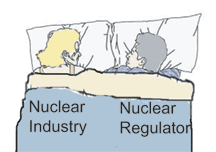
Academics, environmental lawyers and civil society organizations are raising the alarm about proposals in the federal discussion paper, “Getting Major Projects Built in Canada.” An initial 30 day comment period ending June 7th was recently extended to July 22 after the government received “feedback from thousands of stakeholders, Indigenous groups, and members of the public”.
The Canadian Environmental Law Association says the proposals in the discussion paper are “unjustified, regressive, and contrary to the public interest,” would reduce “public participation, transparency, and accountability,” and “would constitute the most significant rollback of federal environmental laws in recent decades.”
Particularly problematic is the proposal to hand assessment of nuclear projects over to the Canadian Nuclear Safety Commission (CNSC). Experts say nuclear projects require meaningful public participation and careful evaluation, based on evidence tested rigorously by independent experts.
The CNSC is led by industry insiders, has never turned down a license application, reports to a Minister who promotes nuclear power, and withholds information. Academic studies observe that the CNSC has features of a “captured regulator”. Public trust in the CNSC has declined over many years. Assessing-Nuclear-Risk.ca.
Is the Ceasefire Dead? (w/ Alastair Crooke) | The Chris Hedges Report
The US-Israeli war has heated up again as Iran launched “Operation Victory” in response to Israel’s continued attacks on Southern Lebanon and attacks on Iranian infrastructure, and the United States bombing islands in the Strait of Hormuz over the weekend. In this episode, Chris Hedges speaks with former British Diplomat Alastair Crooke of the Conflicts Forum Substack, who explains that given the failure of diplomatic negotiations, Iran has entered a new phase of the war utilizing the methodology of ‘escalatory deterrence’ in which every attack on Iran will be met with an increasingly greater response.
A change in Israel’s military strategy has occurred following the events of the 7th of October 2023. Crookes describe this as a shift away from primarily using military force to expand settlements to a focus on ‘permanent security’ — aimed at eliminating any potential threats in the region. Israel is on a mission to establish a Greater Israel by force, but this is taking a toll on the Israeli military, which is at a “point of implosion.”
Both Netanyahu and Trump have boxed themselves in with the wars on Palestine, Lebanon and Iran, generating heavy losses and little possibility of victory but no clear politically acceptable path to a resolution. Both face declining support in the polls and are likely to fare poorly in the next elections. The Likud party is fragmenting, and Crooke explains that “it’s quite possible that the machine that [Netanyahu’s] put into place over 20 and more years could implode.”
For President Trump, the outcome will be decided by what happens to the global economy as shortages of critical resources — fuel, fertilizer and industrial inputs — cause a growing crisis. “Pain is a great transformer,” states Crooke, which may lead Western allies to accept greater concessions to Iran. In the big picture, Hedges and Crooke concur that the West, with its failing institutions, is in a process of catharsis, a period of decline, which is necessary, they say, for there to be any possibility of its renewal and restoration. “This is the process we’ve got to start slowly addressing.”
Transcript………………………………………………..https://scheerpost.com/2026/06/10/is-the-ceasefire-dead-w-alastair-crooke-the-chris-hedges-report/
The US Starts Wars On The Other Side Of The Planet And Then Claims “Self-Defense”
Caitlin Johnstone, Jun 10, 2026, https://www.caitlinjohnst.one/p/the-us-starts-wars-on-the-other-side?utm_source=post-email-title&publication_id=82124&post_id=201394626&utm_campaign=email-post-title&isFreemail=true&r=1ise1&triedRedirect=true&utm_medium=email
The US is bombing Iran again after an American attack helicopter was downed over the Strait of Hormuz amid renewed escalations in the conflict.
CENTCOM said the following in a statement on the airstrikes:
“U.S. Central Command (CENTCOM) forces began launching self-defense strikes against Iran at 5 p.m. ET today at the Commander in Chief’s direction, in response to yesterday’s downing of a U.S. Army Apache helicopter. The mission is a proportional response to unjustified Iranian aggression.”
It always amazes me how the US can start an unprovoked war of aggression on the other side of the planet and then claim it is “launching self-defense strikes” there.
These military forces are nowhere near the United States. It’s absurd to claim “self-defense” against a country that has been defending itself in a war you started. There’s some debate about whether the helicopter was intentionally targeted by Iran and whether or not it was over international waters at the time it was struck, but honestly, who cares? It shouldn’t have been there in the first place.
These freaks really do operate from the premise that the entire planet is their property, and that any failure to respect their property rights shall therefore be viewed as an act of aggression.
I mean, just look at who’s making this statement. US “Central Command” is the unified combatant command responsible for military operations in the middle east. The US military has separate unified combatant commands for every part of the globe:
• Central Command (CENTCOM) for the middle east.
• Africa Command (AFRICOM) for Africa.
• Indo-Pacific Command (INDOPACOM) for Asia, the Pacific islands, Australia and Antarctica.
• European Command (EUCOM) for Europe.
• Southern Command (SOUTHCOM) for South America.
• Northern Command (NORTHCOM) for North America.
No other country on earth does this. No other military power is segmented into areas of responsibility spanning every continent on earth. This is because normal military forces are used to defend the actual, official country they belong to, whereas the US military is used to dominate the entire planet.
And in that sense it’s actually entirely reasonable that the US “Department of Defense” changed its name to the Department of War. The US military is never used to defend the actual, official country of the United States of America; it is only ever used to prop up the globe-spanning imperial power structure it commands.
This is not normal. It is a freakish aberration without historical precedent. The world cannot know peace until the US empire is dismantled.
𝐍𝐄𝐓𝐀𝐍𝐘𝐀𝐇𝐔’𝐒 𝐆𝐀𝐌𝐁𝐋𝐄 𝐖𝐈𝐓𝐇 𝐀𝐌𝐄𝐑𝐈𝐂𝐀𝐍 𝐈𝐍𝐓𝐄𝐑𝐄𝐒𝐓𝐒 𝐀𝐍𝐃 𝐒𝐎𝐋𝐃𝐈𝐄𝐑𝐒 𝐈𝐍 𝐓𝐇𝐄 𝐌𝐈𝐃𝐃𝐋𝐄 𝐄𝐀𝐒𝐓
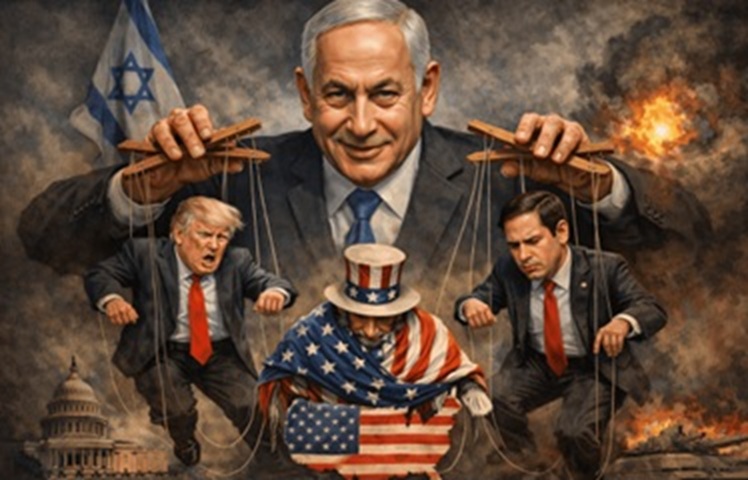
DD Geopolitics Protagonist HQ and Ibrahim Majed, Jun 09, 2026
The fragile calm that had prevailed across much of the Middle East since April, excluding the ongoing Israeli war on Lebanon, unraveled within hours, exposing a strategic reality Washington has long sought to avoid.
What began as a localized escalation rapidly evolved into a broader geo-economic crisis with consequences extending far beyond the battlefield.
At the center of the crisis lies a structural imbalance within the U.S.-Israeli relationship.
While Washington remains Israel’s principal military, diplomatic, and economic backer, recent events have highlighted the extent to which regional escalations can impose costs on the United States regardless of American preferences.
The result is a dynamic in which decisions made in Tel Aviv increasingly shape the strategic environment that Washington must manage.
𝐓𝐡𝐞 𝐄𝐬𝐜𝐚𝐥𝐚𝐭𝐢𝐨𝐧 𝐓𝐫𝐢𝐠𝐠𝐞𝐫
he latest escalation stemmed from Israel’s continued military operations in Lebanon, including renewed strikes on the southern suburbs of Beirut, despite mounting regional warnings and Iran’s explicit signaling that further escalation in Lebanese territory would cross a red line.
These actions effectively collapsed the fragile de-escalation framework that had begun to take shape in recent months.
Yet the strategic significance of the crisis did not stem solely from direct military exchanges.
The conflict quickly expanded through an asymmetric front.
Yemen’s Ansarallah movement announced a comprehensive blockade targeting Israeli-linked maritime traffic through the Bab al-Mandab Strait, transforming what might have remained a localized confrontation into a wider geo-economic challenge.
The implications were immediate.
One of the world’s most critical maritime chokepoints suddenly became a theater of strategic pressure.
Energy markets reacted rapidly, with oil prices surging as traders assessed the risks posed to global shipping routes and regional stability.
What began as a military confrontation was now exerting pressure on the economic infrastructure that underpins global commerce.
𝐓𝐡𝐞 𝐂𝐥𝐚𝐬𝐡 𝐨𝐟 𝐏𝐨𝐥𝐢𝐭𝐢𝐜𝐚𝐥 𝐓𝐢𝐦𝐞𝐥𝐢𝐧𝐞𝐬
The military escalation unfolded against the backdrop of a growing political divergence between U.S. President Donald Trump and Israeli Prime Minister Benjamin Netanyahu.
Hours before the strikes, Trump projected confidence that Washington remained firmly in control of events.
According to reports surrounding a high-level phone conversation, the American president conveyed the impression that he retained decisive influence over Israeli decision-making and could prevent a broader confrontation.
The subsequent Israeli strikes conveyed a different message.
Regardless of Washington’s preferences, events on the ground proceeded according to Israeli calculations.
The operation demonstrated the limits of American influence at a moment when the White House was attempting to contain regional tensions and preserve diplomatic channels.
More importantly, it reinforced a perception increasingly shared across the region: while the United States remains the dominant external power, its ability to dictate the behavior of key allies is not unlimited.
𝐓𝐫𝐮𝐦𝐩’𝐬 𝐄𝐥𝐞𝐜𝐭𝐨𝐫𝐚𝐥 𝐍𝐢𝐠𝐡𝐭𝐦𝐚𝐫𝐞
For the White House, the timing could hardly be worse.
The administration entered 2026 seeking to reduce regional tensions, stabilize energy markets, and avoid another Middle Eastern crisis capable of dominating domestic political discourse ahead of the Midterm Elections.
Escalation threatens all three objectives simultaneously…………………………………………………………………….
𝐍𝐞𝐭𝐚𝐧𝐲𝐚𝐡𝐮’𝐬 𝐒𝐮𝐫𝐯𝐢𝐯𝐚𝐥 𝐓𝐢𝐦𝐞𝐥𝐢𝐧𝐞
Netanyahu, however, is operating according to a very different political timetable.
His government faces mounting domestic pressures, including declining public support, growing political fragmentation, large-scale protests, and unresolved disputes surrounding the conscription of the Ultra-Orthodox community.
Current political trends suggest that a return to normal political conditions could expose the governing coalition to severe electoral risks…………………………………………..
𝐓𝐡𝐞 𝐒𝐭𝐫𝐮𝐜𝐭𝐮𝐫𝐚𝐥 𝐓𝐫𝐚𝐩
The deeper problem for Washington is that its options remain constrained.
Despite occasional public disagreements, successive American administrations have found it politically difficult to impose meaningful costs on Israel during periods of confrontation.
Congressional support, entrenched institutional relationships, domestic political considerations, and long-standing strategic commitments collectively limit the range of coercive tools available to the White House.
As a result, American policymakers frequently find themselves attempting to contain the consequences of decisions they neither initiated nor fully control.
This dynamic creates a strategic trap.
The United States absorbs the diplomatic costs of regional instability, bears responsibility for protecting maritime trade routes, manages the economic consequences of energy market disruptions, and remains expected to provide security guarantees throughout the region.
Yet its ability to shape the behavior that generates those costs remains constrained by political realities at home.
𝐓𝐡𝐞 𝐒𝐭𝐫𝐚𝐭𝐞𝐠𝐢𝐜 𝐂𝐨𝐬𝐭
The deeper danger for Washington extends far beyond the immediate crisis.
What has emerged is a growing divergence between Israeli domestic political imperatives and broader American strategic objectives………………………………………………………….
Ultimately, the central question is no longer whether the United States can continue supporting Israel.
Rather, it is whether American policymakers can reconcile unconditional strategic commitments with a regional reality in which their own interests are increasingly exposed to decisions made by an ally pursuing a very different political agenda.
If the current trajectory continues, the greatest challenge to Washington’s Middle East strategy may not emerge from its adversaries, but from the widening gap between American interests and the actions of the partner it remains committed to defending. https://ddgeopolitics.substack.com/p/75a?utm_source=post-email-title&publication_id=1769298&post_id=201184525&utm_campaign=email-post-title&isFreemail=true&r=1ise1&triedRedirect=true&utm_medium=email
‘The Humiliation Just Compounds’: Trump Tells Netanyahu Not to Bomb Iran, Then Israel Strikes Anyway
US President Donald Trump “appears unwilling to spend the political capital necessary to rein in Netanyahu—beyond angry phone calls and tough public statements,” said one analyst.
Jake Johnson, Jun 08, 2026, https://www.commondreams.org/news/trump-netanyahu-iran-2677009860
The Israeli military bombed Iran on Monday shortly after US President Donald Trump urged Israeli Prime Minister Benjamin Netanyahu not to respond to an Iranian missile barrage, which came in retaliation for Israel’s earlier bombing of Beirut.
“I am going to call Bibi right now and tell him not to retaliate,” Trump told Axios on Sunday, noting that the Iranian strikes did not appear to cause any injuries. “Each of them had their fun. Israel had its strike, and Iran had its strike. We don’t need another one.”
Iran’s missile attack on Israel was the first since a tenuous ceasefire agreement took effect in early April, and the exchange intensified concerns of a return to full-blown regional war. Iran’s Foreign Ministry said the Sunday strikes were a defensive response to the Israeli military’s bombing of southern Beirut as well as “Israel’s persistent breaches of the April ceasefire, including its collaboration with the US military in attacks on Iranian ships and targets in southern Iran over the past two weeks.”
The Israel Defense Forces vowed to “continue to operate all across Lebanon” and said it would not “allow fire toward Israel.”
Esmail Baghaei, a spokesperson for Iran’s Foreign Ministry, said during a press conference on Monday that despite Trump’s public comments, “no one in the region believes” that Israel attacked Lebanon or Iran “without prior coordination and cooperation with the United States.”
“The United States bears responsibility as a party to the April 8 ceasefire understanding,” said Baghaei. “Whatever happens in the region, whether the US itself violates the ceasefire by attacking Iranian commercial ships or targeting southern parts of the country, or whether violations are carried out through the Zionist regime in Lebanon with US complicity, the direct responsibility of the United States is clear, and the consequences of any escalation will also fall on Washington.”
Trump told the Financial Times following Iran’s missile attack on Israel that he did not believe it would undercut the prospects of a diplomatic agreement. The US president also said Netanyahu would have no choice but to accept any agreement the Trump administration reaches with Iran, declaring: “I call the shots. I call all the shots. [Netanyahu] doesn’t call the shots.”
But critics of Trump’s illegal and costly war of choice in Iran, which he launched in coordination with Israel in late February, said Netanyahu’s swift defiance of the president’s call for restraint underscored how disastrous the conflict has been for the US.
“This war has been humiliating for Trump and American power generally,” US Sen. Chris Murphy (D-Conn.) wrote on social media. “And when Trump announces he is going to call Netanyahu and tell him not to retaliate, and within hours Netanyahu retaliates, the humiliation just compounds.”
Trita Parsi, executive vice president of the Quincy Institute for Responsible Statecraft, wrote in a blog post following the Israeli attack on Iran that Trump “appears unwilling to spend the political capital necessary to rein in Netanyahu—beyond angry phone calls and tough public statements—unless he knows that he has a deal with Iran.”
“From Trump’s perspective, it is only worth doing if an agreement with Iran is already secured. In short, Trump is willing to restrain Israel to preserve a deal, but not to obtain one. Iran, however, wants evidence that Trump can restrain Israel before agreeing to a deal,” Parsi wrote. “As a result, the most likely scenario is another round of Iranian and Israeli strikes, with Trump declining to meaningfully constrain Israel.”
The National Iranian American Council noted that Iran’s leadership “has already threatened a broader and more destructive campaign” in response to Israel’s strikes.
“The coming 24 to 72 hours will likely determine whether this becomes a contained crisis or the beginning of a new phase in the regional conflict,” the group added.
Trump’s Sedition Act for Israel
“you can’t be an American if you don’t love Israel.”
By Dr. Paul Craig Roberts, Global Research, May 25, 2026, https://www.globalresearch.ca/trump-sedition-act-israel/5927389
At all times and places it has been difficult to speak freely.
Even the founding fathers had their Sedition Act of 1798 that criminalized statements against the US government. Shortly afterward President Thomas Jefferson got most of it repealed.
President Abraham Lincoln during his 1861-1865 invasion of the Confederate States of America had a de facto sedition act. Lincoln used executive orders, military directives, martial law, and the suspension of habeas corpus to shut down free speech. At one time Lincoln had 300 Northern newspaper editors in prison.
In 1918, Congress passed a new Sedition Act that applied when the US government was at war. The law prohibited speech and opinion that put the US government and its war effort in a bad light. The bad light was that US President Woodrow Wilson promised Germany no territorial loss and no reparations in exchange for an armistice, and betrayed the promise. The result was the Treaty of Versailles that as British economist John Maynard Keynes correctly predicted led to World War II.
President Donald Trump has declared his own Sedition Act issued not by Congress, increasingly an irrelevant government institution, but by Trump’s personal defense lawyer currently serving as US Attorney General. Trump’s Sedition Act is unique. It protects from criticism not the US government, but a foreign one — Israel. The May 19 press release of the US Department of Justice (sic) says:
“President Trump has made clear that this administration will not tolerate antisemitism, and the Department of justice is committed to implementing that directive.” (See this)
Understand that the US Department of Justice is now the protector of Israel, as is the US military and US taxpayers, and antisemitism means any criticism of Israel. For example, Israel’s genocide of Palestine and its people, Israel’s interference in tenure decisions of US universities, the hiring and contracting policies of state governments such as Texas and Florida, Israel’s funding of the primary defeat of US Republican Representative Thomas Massie, Israel’s assassinations of foreign leaders, Israel’s suspected assassination of Charlie Kirk, suspicion that Epstein was a Mossad agent collecting blackmail information against Americans in a position to influence US foreign party in the Middle East, and on and on. Every thought, question, statement of fact that can be interpreted as hostile to Israel has become anti-semitism and will not be tolerated by the US Department of Justice (sic).
Clearly, the Trump regime, essentially a Zionist regime, has no intention of permitting any correct information to be aired. If you challenge or taunt the Regime, you are shut down like Colbert, Thomas Massie, Marjorie Taylor Greene, and so many others.
The Washington Post published an article on May 21 about President Trump’s efforts to silence late night TV hosts. Apparently, Trump succeeded in intimidating CBS to cancel Stephen Colbert. NBC’s Seth Meyers and ABC’s Jimmy Kimmel believe they are on the hit list. See this.
A discredited media unable to hold Trump to account has replaced a former biased media.
During my professional lifetime the print and TV media had a liberal bias, coming down hard on conservatives and Republicans and lightly, if at all, on the leftwing and Democrats. The liberal media was more or less at the beck and call of the CIA, but the New York Times did finally decide to publish the leaked Pentagon Papers, an act that contributed to the end of the Vietnam War.
During the 1980s and I think the 1990s the New York Times asked me twice a year for an op-ed article addressing a specified subject. If memory serves, two was the annual limit for outside contributors, although perhaps not for liberal-left ones. As I had been a presidential appointee in the Reagan administration, a trustee of the Committee on the Present Danger, a Wall Street Journal editor and columnist, and a contributing editor of National Review, the liberal media regarded me as a conservative instead of a person who thought for himself.
The Washington Post was also friendly in a limited way. The Post’s editorial page editor was pleased to occasionally have me on her page and once took me to lunch with some of her colleagues. When at the end of the 20th century I could no longer stomach the corruption and backstabbing of the Washington snake pit and departed to the beach in Florida, the Washington Post sent a star reporter and camera team to my Florida home for a full-fledged interview and expressed regret that an honest voice had forsaken the nation’s capital. The fact that the Washington Post thought that I was honest did not mean that the Post thought I was correct.
In those days large newspapers like the Times and Post comfortably existed on advertising revenues so varied that no advertiser could, very often, influence the newspaper. Media had a liberal bias, but that was their own decision. It wasn’t imposed on them. Unlike today, there was enough belief left in the media in debate in place of silencing critics, resulting in occasional presentation of alternative explanations to the official narratives.
In the 21st century the media for whatever reasons has become censorious, demonizing those in opposition to official narratives. The result has been to discredit the media as a source of information.
Today we don’t have, as existed in my 25 years in Washington, a media even partially open to different explanations.
With the traditional TV and print media discredited, and the lack of transparency of most of the Internet media, to whom do we turn for credible explanations? My own attempts to deliver truth are compromised by invalid accusations against me by Zionist organizations, the political left, and liberals who still believe that more government is the answer. The assaults on me are intended to limit my readership, and the assaults have had a partial success. I suspect that I am now read more abroad than in the United States.
Perhaps I have failed in my approach to insouciant Americans who, despite the high stakes, are unaware of the demands on them of our time. If so, my failure is small compared to that of the media, which by destroying its own credibility, has destroyed the media’s checkmate on the rise of a Caesar.
America now has a president who goes to war at the request of his most important campaign contributors without authorization of the US Congress as long as the request is in Israel’s behalf. The legal advisor to the US Department of State, Reed Rubinstein, has penned a justification for Trump’s military attack on Iran which states the United States initiated its military campaign against Iran (Operation Epic Fury) “at the request of and in the collective self-defense of its Israeli ally”. Note that the State Department defines aggression as self-defense. Clearly Under President Trump, the United States of America now commits its resources and lives of its military personnel to the achievement of the Zionist agenda of Greater Israel. Americans are now taxed and die for Israel’s domination of the Middle East. If you dissent, you are punished as an “anti-semite.”
Until the 21std century, I cannot imagine the American media allowing this to happen. The digital revolution by putting the power of money over the media in a few hands has cancelled even a biased free press. In its place there is a propaganda ministry.
President Trump’s anti-semitism policy cancels the First Amendment if it is used by Americans for criticism of Israeli government policies, such as the genocide in Palestine.
When the Israel Lobby can cancel the First Amendment, you know that the United States is no longer a sovereign country.
A country at Israel’s beck and call is America today, thanks to Donald Trump. Yet, a significant percentage of Trump’s supporters conflates MAGA with MIGA. American patriotism now requires patriotism to Israel. As the latest mantra goes, “you can’t be an American if you don’t love Israel.” You have to hand it to the Zionists. They have even stolen our patriotism.
Trump and Netanyahu: The odd couple
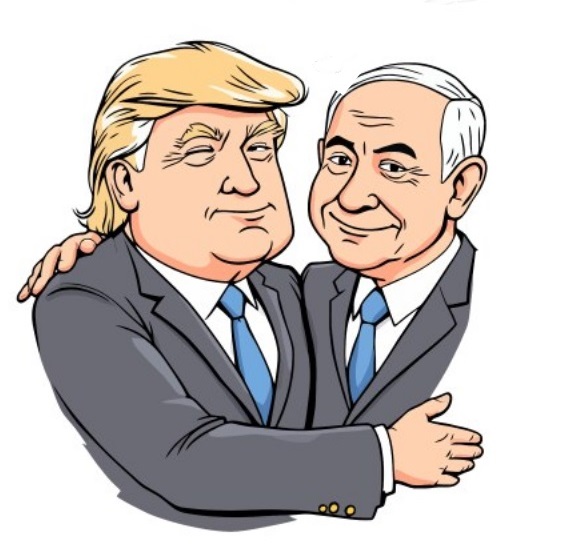
June 5, 2026 . by Jamal Kanj, https://www.middleeastmonitor.com/20260605-trump-and-netanyahu-the-odd-couple/
“He’ll do whatever I want him to do,” Donald Trump declared recently about Israeli Prime Minister Benjamin Netanyahu.
The statement may be one of the most revealing statements Trump has ever made—not for what it says about Netanyahu, but for what it reveals about Trump’s psychology. It was intended as a display of strength. Instead, it exposed the opposite.
Trump has built a political persona around hyperbole, self-aggrandizement, and declarations of superiority to cover up for an oversized inferiority complex, he only knows its extent. When he insists that Netanyahu is acting at his command, he is projecting an authority he does not possess. The louder the boast, the more apparent the insecurity beneath it.
“If there is one lesson since the election of Trump, it is that Netanyahu, not Trump, has consistently dictated the pace of America’s wars in the Middle East. Trump may occupy the White House, issue ultimatums, and proclaim himself the master negotiator, but the facts on the ground tell a different story. Again and again, Netanyahu acts, and Trump adjusts.“
For years, Netanyahu worked relentlessly to pull the U. S. into another made-for-Israel war, this time against Iran. Successive administrations, despite their deference to Israel, stopped short of falling for the scheme. Trump, however, proved far more susceptible to the influence of his Israel-first donors and to Netanyahu’s chicanery. Yet he continues to portray himself as the one calling the shots.
This week, Trump proudly recounted a phone call in which he supposedly instructed Netanyahu to halt a planned Israeli attack on Beirut. It took little time after Trump’s statement for Israel’s defense minister to announce that military operations “will continue under all circumstances.” True to that pledge, Israel launched fresh attacks on hospitals and villages in southern Lebanon, killing and wounding civilians despite the so-called Trump’s war cessation.
“Two days later, on Wednesday June 3rd, Lebanese and Israeli delegations meeting in Washington announced another ceasefire. The third such extension since last April. One day after reaching the agreement, Israel resumed strikes on South Lebanon and said it would neither withdraw nor allow Lebanese civilians back to their homes in the south.“
It is almost certain, when the Lebanese resistance eventually counters the repeated Israeli violations, Trump—as he has done before—will condemn the retaliation rather than the provocation. To save face and avoid appearing weak before Netanyahu, he will once again blame the Lebanese side while ignoring the Israeli occupation and military actions that triggered the response.
The same pattern is evident in the negotiations with Iran. For months, Trump’s stated objective was to prevent Iran from developing a nuclear weapon—a framework which aligns with Tehran’s declared position. But nuclear-armed Israel, which never signed the Non-Proliferation Treaty that Iran did, has different goals entirely. Netanyahu’s government will not be satisfied with anything short of the destruction of knowledge and the reduction of Iran to a failed state, precisely the fate that befell Iraq and Libya after both countries agreed to surrender their nuclear ambitions.
For Israel, a negotiated agreement between the U.S. and Iran, may be far less desirable than the continuation of regional turmoil. For its objective is the preservation of a strategic environment that sustains military and geopolitical dominance. Zionism has long viewed the emergence of democratic, technologically advanced, and self-reliant neighboring states as a threat. Fragmentation and disorder in surrounding countries serve that objective by limiting the rise of independent regional powers that could one day, potentially challenge Israeli primacy. In this case, Israel may be unique among nations: it derives strategic advantage not from a stable and prosperous region, but from entropy, and has built a regional doctrine whose success depends on propagating chaos.
The cost to ordinary Americans is tangible, and personal. They feel it every time they fuel their cars, pay inflated prices for goods, or watch Congress cut healthcare or financial student aid for Americans in order to finance another military aid package for Israel.
“Americans are not only financing Israel’s wars through tax dollars and weapons transfers. They are also paying what amounts to an Israeli surcharge tax at the pump.”
Treasury Secretary Scott Bessent has been trying for weeks to assure consumers that gas will hover around $3 a gallon between June and September, as if it is acceptable for Americans to pay elevated prices until Netanyahu deigns to approve a ceasefire, especially when Trump boasts that America is a net oil exporter.
Gaza is another front in Israel’s endless wars. Trump personally signed the ceasefire agreement in Sharm el-Sheikh in October 2025, chirping “we have peace in the Middle East.” He had since watched in silence as Israel systematically dismantled every commitment it had made. During the “ceasefire,” it maintained a starvation diet blockade, murdered more than 800 and wounded thousands.
Under Phase One of the agreement, Israeli forces were required to withdraw to approximately 53 percent of Gaza. Phase two stipulated further withdrawal. Instead, Netanyahu ordered the seizure of an additional 32 percent, increasing total Israeli military occupation to 70 percent of the besieged territory, confining 2.3 million Palestinians to 30 percent, or roughly 50,000 human beings per each square mile of rubble.
On all fronts, Trump did not merely follow Netanyahu’s lead. He enabled it, funded it, armed it, and defended it diplomatically. Then, standing before television cameras, he attempted to compensate for this reality by insisting that he was the one in control.
To that end, and following recent Republican primary elections, lame-duck Republican members of Congress have already begun treating the Trump administration as a lame-duck presidency, long before the midterm elections. The recent congressional vote to limit presidential war powers is a telling sign that Trump’s political capital is eroding far sooner than expected.
Nevertheless, Americans may be witnessing a historic inflection point in the decades-long power of Israel-first Zionist influence over American political life. It is clear the political landscape is shifting, and the assumptions that long governed Washington’s relationship with Israel no longer appear as immutable as they once did. From growing dissent within the Democratic Party—and among Republican influencers—to deepening unease across the Washington Beltway, genuine cracks are appearing in a system that for generations treated Israel as a sacred cow. Eight decades of unquestioned manipulation and political leverage over American leaders is now facing resistance from constituencies that were once among its most reliable friends.
“Hence, no amount of presidential bravado or social-media posturing can obscure what has become undeniable: under Donald Trump, American foreign policy has served Netanyahu’s Israel-first agenda, not America’s. And when the history of this era is written, this odd couple may be remembered for ushering in the sunset of Israel-first Zionist dominance over the U.S. government.“
Fusing the US Military and the IDF
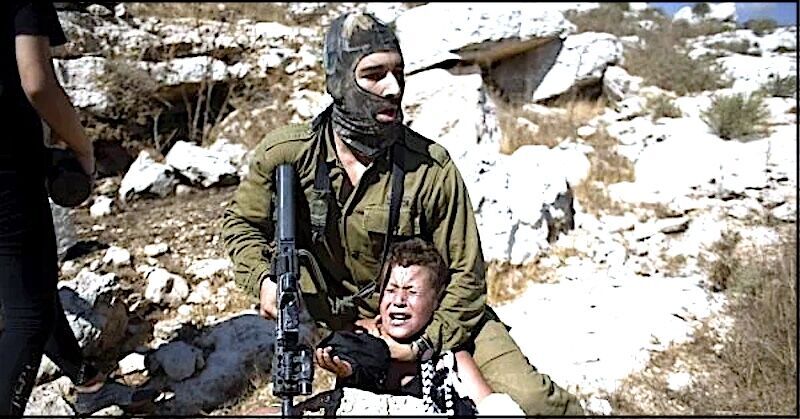
A bill’s provision to integrate the U.S. and Israeli militaries will go to a U.S. House vote after an effort to stop it failed Thursday. Passage will make it nearly impossible to end the U.S.-Israel special relationship, writes Alan MacLeod.
Alan MacLeod for MintPress News, June 6, 2026, https://scheerpost.com/2026/06/06/fusing-the-us-military-and-the-idf/
Amid widespread and growing public opposition to the Israeli genocide of Gaza and South Lebanon, a controversial new bill seeks to formally integrate the U.S. and Israeli militaries like never before, making it difficult to tell where one ends and the other begins.
Section 224 of the 2027 National Defense Authorization Act (NDAA) proposes to join the two forces together at the hip, laying the groundwork for extensive cooperation into “seemingly every manner of U.S.-Israeli military-industrial complex cooperation,” according to the Institute for Responsible Statecraft.
This includes the research, development and production of modern, hi-tech arms, artificial intelligence, biotechnology, drones, directed energy, cyber and autonomous weapons systems. It would compel the United States to integrate Israeli arms and technologies into its defense supply chain, and fuse the countries’ data-capturing and storage facilities together, meaning that Israel could have access to essentially all the U.S. military’s data.
The bill also requires the creation of a new position within the Department of Defense: an executive agent whose role is to coordinate cooperation and integration between the two parties.
In essence, then, it would dramatically change the relationship between the two states, from one where Washington supplies Tel Aviv with money, weapons, and diplomatic support, to a situation where the two are fundamentally intertwined.
It would also make the relationship far less transparent, as aid to Israel currently requires an annual public debate and vote. However, by moving it away from the political realm into that of defense acquisition, oversight and accountability mechanisms will be removed, and the public will have little right to know the details going forward.
Judging by its sponsors, Section 224 has strong support on Capitol Hill. It was put forward by Mike Rogers (R-AL), chairman of the House Armed Services Committee, and Adam Smith (D-WA), the panel’s highest-ranking Democrat.
[On Thursday Rep. Ro Khanna’s effort to revoke the provision from the massive military funding bill failed, paving the way for the NDAA to advance to a full House vote.]
The news that a new bill could essentially fuse together the U.S. and Israeli militaries has been met with pushback online, but provoked little comment in Washington, D.C.
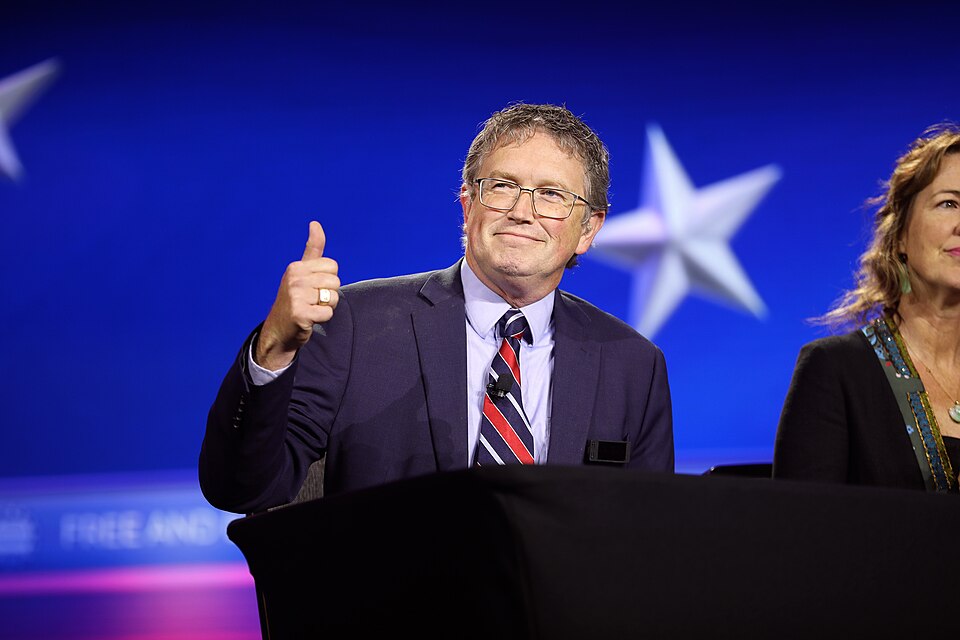
One lawmaker who has spoken up is Kentucky Congressman Thomas Massie, who has promised to offer an amendment to strip Section 224 from the bill on the House floor. “We are a sovereign country,” he said on Saturday.
Massie, a strong critic of U.S. support for Israel, recently lost his primary to challenger Ed Gallrein, after AIPAC and other Israel Lobby groups flooded the race with tens of millions of dollars, making it the most expensive contest in American history.
Massie at a speaking event in Las Vegas in 2024. (Gage Skidmore/ Flickr/ Wikimedia Commons/CC BY-SA 2.0)
Analysts have noted that, if passed, the bill will “extraordinarily” expand Israeli influence in domestic American politics, giving Tel Aviv the opportunity to pull powerful political levers through the tried and tested method of offering jobs.
As the Institute for Responsible Statecraft warns, by expanding or starting new arms production facilities like they already have in Mississippi and Arkansas, the Israeli government could use the influence of bringing jobs to districts to buy the support of American members of Congress.
The U.S. already provides Israel with enormous amounts of military aid, having sent hundreds of billions of dollars worth of weapons since 1948.
Since 2008, it is required by law to protect Israel’s “qualitative military edge,” by supplying it with advanced weaponry.
Section 224, however, would transform and deepen this relationship, making it all-but-impossible to democratically break the U.S.-Israel special relationship.
That alliance is under increased scrutiny, as support for Israel is collapsing across the United States. A new poll published by Israel’s Institute for National Security Studies found that 60 percent of Americans (including 75 percent of respondents under 30 years old) hold a negative view of the country. When asked, a large plurality says that Israel holds too much sway over American politics and politicians.
A 2025 study found that half of American voters believe Israel is carrying out a genocide against its neighbors in West Asia.
The International Criminal Court has issued arrest warrants for Israeli prime minister Benjamin Netanyahu and former defense minister Yoav Gallant, among others, on charges of crimes against humanity.
The United States, however, has refused to accept the ICC’s actions, attempted to shut down proceedings, and imposed sanctions on the court. ICC Prosecutor Karim Khan stated that Senior U.S. Senator Lindsey Graham – one of Netanyahu’s closest allies in Washington – told him that his court is only “for African thugs like [Russian president Vladimir] Putin. It is not for democracies like Israel and the United States of America.”
The response from the governments of Israel and the United States to the increasing opposition to the genocide has been to crack down on dissent and to censor social media.
As Jonathan Greenblatt, CEO of pro-Israel pressure group, the Anti-Defamation League stated, “We really have a TikTok problem, a Gen Z problem.” The Trump administration forced through the sale of TikTok to the family of Larry Ellison, a passionately pro-Israel tech billionaire who is the largest private funder of the Israeli Defense Forces (IDF).
Ellison, no doubt, will support Section 224. Yet the effective merger between the U.S. military and the IDF will have profound consequences for the future of America, and should provoke stiff opposition nationwide. Whether it passes will depend largely on the nature and scale of that opposition.
Alan MacLeod is senior staff writer for MintPress News. He completed his PhD in 2017 and has since authored two acclaimed books: Bad News From Venezuela: Twenty Years of Fake News and Misreporting and Propaganda in the Information Age: Still Manufacturing Consent, as well as a number of academic articles. He has also contributed to FAIR.org, The Guardian, Salon, The Grayzone, Jacobin Magazine and Common Dreams.
Tortured US history with Iran goes back 73 years, not 47.
Walt Zlotow West Suburban Peace Coalition Glen Ellyn IL , 8 June 26
US neocons reveling in the current US war to destroy Iran tell the monstrous lie Iran has been at war with America 47 years. In their deranged world view it began with the 1979 Iranian revolution that disposed the hated US puppet ruler Mohammed Pahlavi, the Shah of Iran and took 66 US embassy hostages. Their lie claims that during that 47 years Iran killed thousands of Americans and no president defended America till Trump attacked Iran February 28.
These war lovers omit the current truth that Trump’s war is a total failure for 100 days now. Fourteen US service persons are dead. Hundreds injured. All US Gulf States bases damaged or destroyed. Israel suffered the worst destruction in its 78 years. US offensive, defensive missiles so depleted they will take years to replenish. America’s defeat is irreversible. Worst of all? The US forced closure of the Strait of Hormuz choking off a fifth of the world’s oil and vital economic supplies, likely risking worldwide recession, if not depression. Today’s neocon war was stupidity on steroids.
Their stupidity omits the historical truth that the US is the warmonger here, not Iran, going all the way back to 1953 when the US collaborated with the UK to depose the democratically elected Iranian leader Mohammad Mosaddegh. Patriot Mosaddegh sought to nationalize the British controlled Iranian oil industry being exploited by the UK for decades. To prevent this the Brits cooked up Operation Ajax and brought the US on board to overthrow Mosaddegh on the pretext he was a commie.
The US enlisted Kermit Roosevelt Jr., grandson of premier US warmonger President Teddy. As a top CIA official, Kermit was tasked with exploiting fake anticommunist sentiment to oust Mosaddegh in a violent coup. Kermit used his contacts among Egyptian Anglophiles and pro Shah forces to get Mosaddegh’s removal started. But advance knowledge of the coup allowed Mosaddegh to prevail, so much so, Roosevelt’s CIA bosses demanded he leave Iran immediately. Instead, he conjured up the ghost of TR, inspiring him to instigate a second coup on his own that succeeded.
It became the model for CIA backed coups, both successes and failures, throughout the Cold War. A year later Ike secretly gave Kermit a National Security Medal for keeping Iranian oil safe for the West. Apparently, Ike didn’t want to go public with an illegal, immoral and criminal overthrow of a sovereign government.
Seventy-Three years on the neocons of today ditched coup for all out war to reclaim Iran for a new American sock puppet, one candidate of whom is Reza Pahlavi, son of the Shah deposed in 1979. Unlike Kermit’s successful coup in ’53, Trump’s war is a colossal failure that signals the end of US hegemony in the Middle East and possibly the entire world. The Gulf States, looking at their shattered US bases and degraded oil infrastructure, will likely turn toward Russia, China, even Iran for security. Europe has largely given up on America. The Far East, seeing the US claw back its missiles for its Iran misadventure is also rethinking its defensive strategy.
Unlike the clever Kermit Roosevelt Jr., today’s coup plotters and warmongers, including Trump, Hegseth and Rubio, are blithering idiots.
Hegseth Compares D-Day Troops to Europe’s Migrants
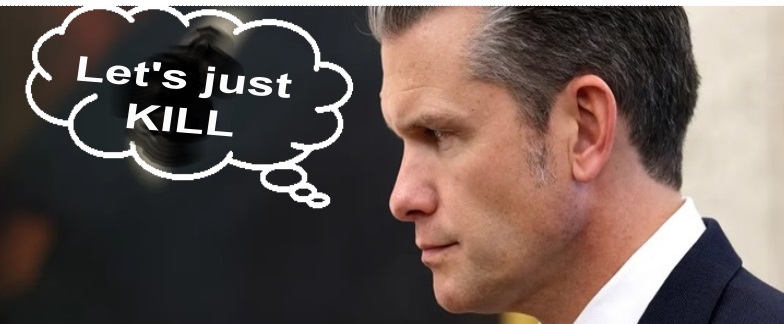
You could argue that Hegseth was confused in this analogy, and simply misspoke. But he and the administration he is part of have taken over Nazi talking points on racial hierarchies,
Juan Cole, 06/07/2026, https://www.juancole.com/2026/06/hegseth-compares-migrants.html
Ann Arbor (Informed Comment) – Whiskey Pete Hegseth, speaking 82 years after the Allied storming of the beaches of Nazi-occupied France, appears to have sided with . . . the Nazis. He said, “Sadly, today, different European beaches are stormed by different dangerous ideologies. Beaches in Spain, in Italy, in Greece and Bulgaria. Boats and men arrive. When will European capitals do something about that invasion?”
He compared the 156,000 US, Canadian and British troops who landed at five beaches on the Normandy coast of Vichy France on June 6, 1944, to the desperate “boat people” coming to today’s Europe in risky voyages on leaky vessels across the Mediterranean. About 150,000 a year make it across alive, to a continent of 743 million Some 30% are summarily deported. I.e., each year’s irregular migrants constitute 0.013% (a little over one hundredth of one percent) of the population.
Now, I’m sure that Operation Overlord, helmed by Supreme Allied Commander Dwight D. Eisenhower and Commander of all Allied ground forces British General Bernard “Monty” Montgomery, was viewed by German Field Marshals Erwin Rommel and Gerd von Rundstedt as a landing of tens of thousands of undocumented aliens from barbarian races. After all those who hit the beaches included Jews, Slavs, Hispanics, indigenous Americans, Chinese Americans and 2,000 African Americans, whom the Nazis viewed with the same horror and disdain that Hegseth views today’s migrants to Europe.
But it is more than a little odd that the successor of Department of War head Henry L. Stimson should take the Nazi view of the matter.
You could argue that Hegseth was confused in this analogy, and simply misspoke. But he and the administration he is part of have taken over Nazi talking points on racial hierarchies, as I observed in some detail in my analysis for Tomdispatch.com of the Trump National Security Strategy regarding Europe. I wrote,
‘Trump claims that he’s no longer sure Europeans will even remain European. He supposedly worries that, two decades from now, the continent will be unrecognizable and EU countries no longer capable of being Washington’s “reliable allies.” That barb is, of course, clearly aimed at Muslim immigrants to Europe, even though they are a distinct minority of those arriving there. In an interview about his NSS, Trump snidely remarked, “If you take a look at London, you have a mayor named Khan.” And he then went on to exclaim in horror that immigrants aren’t just coming from the Middle East, “they’re coming in from the Congo, tremendous numbers of people coming from the Congo.” In other words, the only thing that outstrips Trump’s Islamophobia is his horror of Black people.
Of course, he’s completely misinformed about immigration to Europe, which means his NSS is as well. As a start, the largest influx of people into the EU in recent few years has been 4.3 million Ukrainians. The major sources of immigration to Germany in 2024 were Ukraine, Romania, Turkey, Syria, and India. For Spain, it was Colombia, Morocco, Venezuela, Peru, and Argentina. As for Europe’s future reliability, Trump has already said that he “can’t trust” Denmark, no matter that its population is solidly Lutheran and predominantly blond, because that country won’t give him Greenland. And since the president has expressed a willingness to break up the NATO alliance, if necessary, to add 57,000 Greenlanders to his feudal domains, his doubting of European dependability should be considered richly ironic.
Aryan Reliability
The underpinnings of Trump’s reasoning can (or at least should) be described as Nazi in style. After all, he’s assuming that the immigrants he loathes are inherently incapable of becoming Europeans and will make those countries intrinsically untrustworthy as allies of the United States. Of the EU countries, he recently asserted that “they’ll change their ideology, obviously, because the people coming in have a totally different ideology.” Yet British Prime Minister Rishi Sunak, born in Southampton to an immigrant Indian-East African family of Hindu faith, was widely viewed as having restored British-U.S. diplomatic relations after years of strain.
In reality, studies show that socio-economic status, not national origin, best predicts how immigrants will vote. In Germany, the better-off Russian-Germans, who far outnumber largely working-class Turkish-Germans, tend to vote for right-of-center parties. Both groups, however, seem happy to participate in European politics in accordance with local norms. If, for Trump, the term “immigrants” in this context is a dog whistle for Muslims, it might be noted that nine of the 22 countries, including Egypt, Saudi Arabia, and Pakistan, that have been formally designated by Trump as “major non-NATO allies” are Muslim-majority
His foreign policy reasoning in that NSS eerily mirrors the crackpot logic of Adolf Hitler, who saw France as an enemy of Germany’s because it had allegedly fallen irretrievably under non-Aryan Jewish influence, and who held out hope in the 1920s and early 1930s that Aryan elements would prevail over Jewish ones in Britain, a country he preferred as a strategic partner because of the Germanic ancestry of part of its population. In Trump’s NSS, immigrant Europeans from Africa and the Middle East play the role that Jews did in Hitler’s thinking — that is, non-Aryan underminers of national integrity. Hitler’s conspiratorial racism was, of course, all too grimly insane, and so, too, is that of Trump’s NSS.
“Mongols and Negroes”
Central to the NSS is the Great Replacement. The idea, though not the phrase, goes back to 1900 when the French nationalist parliamentarian and novelist Maurice Barrès wrote, “Today, new French have slipped in among us… who want to impose on us their ways of feeling.” He warned of Jewish, Italian, and other immigrants. “The name of France might well survive,” he commented, but “the special character of our country would nevertheless be destroyed.” Amid a political crisis over the wrongful conviction of Captain Alfred Dreyfus (of Jewish and Alsatian heritage) for supposed espionage for the German embassy, Barrès denounced the famed French novelist Émile Zola, a supporter of Dreyfus, as “not French” but a rootless cosmopolitan from a Venetian background.
Fifty years later, the French Nazi René Binet (1913-1957) coined the phrase “Great Replacement.” An ex-Communist, he had served as a Nazi collaborator during World War II in the Waffen Grenadier Brigade of the Charlemagne paramilitary Protection Squadron (Schutzstaffel or SS). After the war, in his 1950 book Theory of Racism, he wrote in dismay about how Western Europe had been invaded by “Mongols and Negroes” — that is, by the Soviets and the Americans. He lamented that Jewish-dominated capital also supposedly controlled Europe (it didn’t, of course) and falsely alleged that Jewish CEOs were bringing in immigrants in a deliberate attempt to replace civilized White Europeans.
Sadly enough, Binet’s ideas have been revived in this century by French thinkers and politicians. Renaud Camus published his twenty-first century version of the theory in 2010, entitling his book The Great Replacement. Such falsehoods were echoed in Charlottesville, Virginia, in 2017, when American Nazis chanted “Jews will not replace us” (and President Trump called the assembled protestors, as well as those who opposed them, “very fine people”).
Read the rest here.
1 This Month

To see nuclear-related stories in greater depth and intensity – go to https://nuclearinformation.wordpress.com
-
Archives
- September 2026 (184)
- August 2026 (330)
- July 2026 (355)
- June 2026 (287)
- May 2026 (306)
- April 2026 (356)
- March 2026 (251)
- February 2026 (267)
- January 2026 (308)
- December 2025 (358)
- November 2025 (359)
- October 2025 (375)
-
Categories
- 1
- 1 NUCLEAR ISSUES
- business and costs
- climate change
- culture and arts
- ENERGY
- environment
- health
- history
- indigenous issues
- Legal
- marketing of nuclear
- media
- opposition to nuclear
- PERSONAL STORIES
- politics
- politics international
- Religion and ethics
- safety
- secrets,lies and civil liberties
- spinbuster
- technology
- Uranium
- wastes
- weapons and war
- Women
- 2 WORLD
- ACTION
- AFRICA
- Atrocities
- AUSTRALIA
- Christina's notes
- Christina's themes
- culture and arts
- Events
- Fuk 2022
- Fuk 2023
- Fukushima 2017
- Fukushima 2018
- fukushima 2019
- Fukushima 2020
- Fukushima 2021
- general
- global warming
- Humour (God we need it)
- Nuclear
- RARE EARTHS
- Reference
- resources – print
- Resources -audiovicual
- Weekly Newsletter
- World
- World Nuclear
- YouTube
-
RSS
Entries RSS
Comments RSS
 nuclear-news