The ridiculous 2026 “National Defense Strategy”

As for the National Defense Strategy, it concludes in climactic fashion by declaring that the US must maintain capability to “conduct devastating strikes and operations against targets anywhere in the world.” As if that’s just the most obvious imperative of responsible statecraft that anyone could possibly fathom.
As for the National Defense Strategy, it concludes in climactic fashion by declaring that the US must maintain capability to “conduct devastating strikes and operations against targets anywhere in the world.” As if that’s just the most obvious imperative of responsible statecraft that anyone could possibly fathom.
Michael Tracey, Jan 25, 2026, https://www.mtracey.net/p/2026-national-defense-strategy?utm_source=post-email-title&publication_id=303188&post_id=185665591&utm_campaign=email-post-title&isFreemail=true&r=ln98x&triedRedirect=true&utm_medium=email
The new 2026 “National Defense Strategy,” released yesterday, contains a lot of airy rhetoric about finally transitioning to “hardnosed realism,” and away from the misbegotten “grandiose strategies” of yesteryear, wherein the US had foolishly set out to “solve all the world’s problems.” More tangibly, however, the document doesn’t call for a single discernible reduction to America’s comically-large global military footprint. In fact, it calls for expanding that footprint, rather dramatically.
Among these expansions will be for the US to “erect” new military installations in close proximity to China. Per the jargon of NatSec Speak, this means establishing “strong denial defense” in the “First Island Chain” — which may sound like a modestly-sized region to the unschooled reader, but actually encompasses Japan, the Philippines, Taiwan, and perhaps a smattering of other places like Vietnam and Malaysia, depending on what the cockamamie Grand Strategists decide to theorize and war-game next.
There will also be unspecified measures to “guarantee US military and commercial access” to what is now described as the “key terrain” of Greenland and Panama. On top of “deepening” US military involvement in the Middle East, so as to “enable integration between Israel and our Arabian Gulf partners.”
The document gestures vaguely at Europe needing to take more responsibility for its own defense, but then talks about US-directed efforts to “expand transatlantic defense” with Europe, and affirms the “vital” role of the US in leading NATO — including to counter “Russian threats to the US Homeland.” No specific adjustments in force posture re: Europe are identified.
Iran is back as an urgent threat, as it’s allegedly in the process of “reconstituting its conventional military forces,” and is again seeking to obtain a nuclear weapon. Even though its nuclear facilities were supposedly “obliterated” last June. Naturally, confronting Iran will require the US to “further empower” Israel — what more “empowerment” could they possibly be given at this point? — in recognition of our profound “shared interests” with this “model ally.”
Even in Africa, the document says the US must “empower allies and partners” to prevent Islamic terrorists from establishing “safe havens” — apparently anywhere throughout that vast continent — and the US is itself prepared to strike where deemed necessary. As we already saw with the random bombing of Nigeria last month. (Whatever happened with that? Did we eliminate the Terrorists?)
The document also calls for accelerating US military-industrial production to levels not seen since the Second World War. Yet another devastating blow to the “military-industrial complex.”
It lambasts ill-fated “regime change” expeditions of the past, but heralds the most recent foray into Venezuela, which was legally designated by the Trump DOJ as an explicit “regime change” operation.
“Nation-building” is predictably derided — mere weeks after Trump unilaterally declared himself the new ruler of Venezuela, the economy and governmental structures of which he now wants to personally “rebuild.” This open-ended endeavor could last “much longer” than people think, he says. That’ll be in addition to his other signature “nation-building” initiative — making good on his landmark pledge to “take over” Gaza, which was widely dismissed as outlandish when he first announced it last February. But then by October, there he was, bestowing himself with ultimate governing authority over Gaza. Jared Kushner just rolled out their innovative new “master plan” for nation-building the hell out of that place — complete with cool little diagrams showing how each quadrant of land will be granularly organized. The deal has apparently been sealed for Gaza as a newly-established US military protectorate: an American General was just named Commander of the “International Stabilization Force,” putting him in charge of “security operations” across the territory. A fun new dialect of Arabic might have to be invented for all the American-originated euphemisms.
As for the National Defense Strategy, it concludes in climactic fashion by declaring that the US must maintain capability to “conduct devastating strikes and operations against targets anywhere in the world.” As if that’s just the most obvious imperative of responsible statecraft that anyone could possibly fathom.
Sooooo…. there’s your historic pivot from “grandiose adventures” abroad — which the self-congratulatory document writers hold themselves out as repudiating — and toward a glorious restoration of “practical, hardnosed realism.” Of course, trying to translate the predilections of Trump into some grand strategic treatise is a pretty pointless exercise to begin with — but the intellectual warfighter Pete Hegseth and his underlings evidently felt they should at least give it a whirl. So they “fucked around and found out,” as Pete loves to smugly bluster, and out plopped whatever this is.
True “realism” would necessitate swiftly discarding the document as little more than a collection of meaningless pablum and cliches — just like the differently-named, but weirdly redundant “National Security Strategy” produced in November 2025. Among other silly items, that cousin document contains the assertion that “the days in which the Middle East dominated American foreign policy in both long-term planning and day-to-day execution are thankfully over.” And further, when it comes to changing sub-optimal systems of government in that neck of the woods, “we should encourage and applaud reform when and where it emerges organically, without trying to impose it from without.”
Then within a matter of weeks, right on cue, Trump was boisterously posting that he was “locked and loaded,” and ready to attack Iran again — this time ostensibly in defense of the besieged Iranian protesters. He also announced it’s time for the imposition of “new leadership,” i.e. removal of the Ayatollah. “Freedom” and “human rights” have even been resurrected as viable pretexts for punitive US action. Currently, large-scale US military assets are reassembling in the region.
To comprehend these bewildering developments, perhaps we’ll have to wait in suspense for a revised edition of some supplemental “strategy” document. Which we can then all download together in PDF format, and earnestly ponder, perhaps with coffee and donuts, like a book club brooding over Moby Dick.
Back in some version of “realist” reality, these “strategy” documents are really only notable insofar as they give some morbid insight into how presidential subordinates are required to haphazardly “ideologize” whatever their superior is doing at any given time. A well-worn heuristic would be much simpler, and more instructive: “America First” is still whatever he says it is.
A Note On the 2026 US National Defense Strategy and Extended Deterrence
What does the NDS have to say about nuclear weapons and the nuclear environment facing the United States? Turns out, not much.
Ankit Panda, Jan 25, 2026, https://panda.substack.com/p/a-note-on-the-2026-us-national-defense?utm_source=post-email-title&publication_id=10286&post_id=185656884&utm_campaign=email-post-title&isFreemail=true&r=ln98x&triedRedirect=true&utm_medium=email
The Trump administration’s unclassified summary of the National Defense Strategy (notably, they can’t call it a National “War” Strategy, by statute) is here (PDF). It released on a Friday evening, after 5 p.m.. My understanding is that the classified version has been complete for about a couple months now and this unclassified summary was going through reframing after the release of last month’s much-discussed National Security Strategy. Anyway, it’s here now, so let’s talk about it.
Much ink will be spilled elsewhere on what this document tells us about the United States’ defense priorities as the Trump administration continues to take a sledgehammer to longstanding principles of U.S. grand strategy. I want to focus on how nuclear policy-minded readers should approach this document.
If you haven’t heard, this administration is not planning on publishing a Nuclear Posture Review, which is not currently required by law, unlike the NDS. The 2026 NDS itself has very little to say on nuclear weapons. Page 17 contains this bullet, which sums up nearly the totality of what this document has to say about U.S. nuclear forces and policy:
“Modernise and adapt U.S forces: The United States requires a strong, secure and effective nuclear arsenal adapted to the nation’s overall and defense strategies. We will modernise and adapt our nuclear forces accordingly with focussed attention on deterrence and escalation management amidst the changing global nuclear landscape. The United State should never – will never- be left vulnerable to nuclear blackmail.”
Note the lack of any mention of the role of U.S. nuclear weapons or declaratory policy. Insofar as the role of U.S. nuclear forces is discussed, it is done so in a single sentence on page 3: “We will maintain a robust and modern nuclear deterrent capable of addressing the strategic threats to our country…”
There’s also no nod to allies here, either. In many of my conversations in Europe and Asia over the last year, there’s been quite a bit of interest in what the Trump NDS would have to say about alliances and extended deterrence. Silence, I suppose, is not the worst outcome, especially given the spotlighting of active U.S. hostility toward European allies in the last few weeks amid the Greenland imbroglio. Some allies took solace in the fact that the NSS did include a sentence on nuclear weapons that did allude to some role in their defense: “We want the world’s most robust, credible, and modern nuclear deterrent, plus next-generation missile defenses—including a Golden Dome for the American homeland—to protect the American people, American assets overseas, and American allies” (emphasis added, NSS, pp. 3).
Close allied readers of the NDS, however, might find that the document does appear to have something to say about how the United States views their security interests. Page 8 of the NDS observes that what makes the Trump administration’s strategy “fundamentally different from the grandiose strategies” of the past is that this document is apparently tethered to “Americans’ practical interests.” The document continues:
‘It does not conflate Americans’ interests with those of the rest of the world—that a threat to a person halfway around the world is the same as to an American.”
Part of the very premise of extended deterrence is that the United States would treat threats to allied persons (and nations) halfway around the world the same as those to the U.S. homeland. This, naturally, has been a very difficult premise to render credible—hence much of the history of our alliance management efforts over the last seven-ish decades.
It doesn’t seem far-fetched to me that allies will be willing to believe what the Trump administration is telling them here. There’s actually much in this NDS that I find doesn’t correspond all that well to the president’s views of the world (for starters, I don’t think Trump knows what the first island chain is). This bit, however, does correspond to much of what we know about how this president reasons about allies. Here you have the United States, I think, stating rather openly that, actually, it would not be willing to trade “Paris for New York,” as De Gaulle once famously asked of Kennedy. As I’ve written elsewhere, the ripple effects of this will likely be severe.
So, there’s that on extended deterrence.
Through the rest of the document, there’s very little on nuclear matters. There’s considerable attention on Iran’s program, with the expected commitment to denying Tehran the bomb (this also got a lot of attention in the NSS). North Korea is acknowledged as a country “increasingly capable of threatening to the U.S. Homeland” with its nuclear forces (a view that’s hardly controversial now in the United States). Very little else; even China’s historic nuclear build-up is not discussed head on in any detail.
It’s probably the case that the classified NDS has more to say on some of these questions, but that doesn’t excuse the lack of attention to nuclear matters in the unclassified version. Insofar as this document communicates U.S. priorities, it suggests an administration deeply uninterested in nuclear matters and aloof, at best, toward allies.
The Funeral of Hegemony
How America’s Decision to Attack Iran Would Be Strategic Suicide
Ibrahim Majed, Jan 25, 2026, https://ddgeopolitics.substack.com/p/the-funeral-of-hegemony?utm_source=post-email-title&publication_id=1769298&post_id=185644623&utm_campaign=email-post-title&isFreemail=true&r=1ise1&triedRedirect=true&utm_medium=email
n American attack on Iran would not be a limited military operation, a punitive strike, or a calibrated act of deterrence.
It would represent a strategic rupture, a point at which accumulated American power begins converting itself into cascading liabilities. This is not a moral argument, nor is it a humanitarian one, it is more like a balance-sheet assessment of empire.
The question is not whether the United States can strike Iran. It can, and we’ve seen it. In June 2025, American warplanes joined Israel’s twelve-day campaign against Iranian nuclear facilities. Tehran struck back at a U.S. base in Qatar. The damage was extensive on both sides.
The question is what the United States loses the moment it does so again, and this time, without a ceasefire to stop the bleeding.
What follows is not ideology, but an autopsy written before the patient is declared dead.
The Liquidation of ‘FOB Israel’
For decades, Washington has not treated Israel merely as an ally, but as a Forward Operating Base, an unsinkable aircraft carrier, an intelligence nerve center, and the technological anchor of U.S. power projection in the Middle East.
A war with Iran inverts this logic.
Iran’s response would not be symbolic or theatrical. It would be functional. Through what Tehran describes as the Unity of Arenas, a coordinated strategy of simultaneous pressure across multiple fronts, retaliation would be applied with a singular objective: rendering Israel operationally unreliable as a base.
This doctrine is not a myth. It was first operationalized in 2021 during the Saif al-Quds war, when a joint command structure coordinated operations between Hamas, Hezbollah, and other Iranian-aligned groups. The concept matured through 2023 and 2024, expanding the geography of confrontation to encircle Israel from Gaza, Lebanon, Syria, Iraq, and Yemen.
If airports are disrupted, ports degraded, and civilian life in Israel’s economic and technological core placed under persistent stress, the asset ceases to function as an anchor. The United States would no longer project power from Israel, it would divert power into Israel merely to keep it viable.
At the moment of maximum strategic need, Washington loses its most valuable regional platform.
And then the anchor chain is cut.
The Trap of Strategic Overstretch
The U.S. military is built for dominance through speed, precision, and overwhelming force. Iran is built for endurance.
It will not fight where the United States is strongest. It will fight in time, depth, and dispersion, and force escalation without resolution.
The June 2025 strikes exposed this dynamic. Iran acknowledged extensive damage to its nuclear infrastructure. But within months, Foreign Minister Abbas Araghchi was claiming that Iran had “reconstructed everything that was damaged.” Whether true or not, the statement illustrated Iran’s strategy: absorb the blow, reconstitute, and wait.
Once engaged, Washington faces a structural dilemma: it cannot disengage without reputational collapse, yet it cannot remain without accelerating exhaustion. Every escalation deepens commitment. Every deployment degrades readiness. Every month consumes forces needed elsewhere.
The U.S. military currently maintains approximately 50,000 troops across bases in the Middle East. The USS Abraham Lincoln carrier strike group has just been diverted from the South China Sea, the very theater where America’s strategic future will be decided, and is now steaming toward the Gulf.
Iran seeks defeat by entropy—the slow erosion of capacity through overuse.
This is how empires bleed.
Economic Hemorrhage
A war with Iran would not be financed through shared sacrifice. It would be financed through monetary expansion and debt.
The consequences are predictable: inflationary pressure, rising energy costs, and the diversion of capital away from domestic resilience. Infrastructure, innovation, and social cohesion would erode as resources are consumed by a conflict offering no strategic return.
The Strait of Hormuz remains the world’s most critical energy chokepoint. Roughly one-fifth of global oil consumption passes through its narrow waters. Iran has long threatened to mine or close the strait in the event of war, and this threat grows more credible as conflict intensifies.
Tehran could also target energy infrastructure across Gulf states: pipelines, terminals, refineries. The resulting supply disruptions would send shockwaves through global markets, punishing American allies in Europe and Asia far more than the United States itself.
The empire would stabilize its periphery by hollowing out its core. History is unforgiving to systems that consume their own interior to preserve external dominance.
The China Dividend
The greatest beneficiary of a U.S.–Iran war would not be Iran. It would be China.
While Washington’s strategic nervous system is absorbed by escalation management in the Middle East, Beijing gains freedom of maneuver. The Indo-Pacific becomes secondary. Influence expands. Partnerships deepen. American deterrence thins.
This calculus is openly acknowledged in Beijing. As one prominent Chinese scholar at Renmin University recently observed: “Washington’s deeper involvement in the Middle East is favorable to Beijing, reducing Washington’s ability to place focused attention and pressure on China.”
The arithmetic is brutal. If the United States deploys two carrier strike groups off the coast of Iran, and it can only maintain three on station globally at any given time, that leaves one for the entire Pacific theater. Taiwan. The Philippines. Japan. All left with diminished coverage.
Every missile expended in the Gulf is one unavailable in East Asia. Every carrier tied down is one removed from Pacific balance.
In a zero-sum system, China collects the dividend without firing a shot.
Unconventional Retaliation
Perhaps the most underestimated consequence of attacking Iran is retaliation by actors who are not Iranian at all.
A U.S. strike would not be perceived globally as a bilateral conflict. It would be read as a hegemonic act and a signal that force remains Washington’s primary language. This perception would activate a diffuse ecosystem of anti-hegemony actors: ideological extremists, decentralized cells, and radicalized individuals scattered across continents.
They require no coordination, no command structure, and no attribution. The danger is not scale, but diffusion. American embassies, corporations, logistics nodes, and symbolic targets would face persistent, low-intensity pressure worldwide. Deterrence fails when the enemy is not a state but an environment.
This is the empire’s nightmare: a world where American presence itself becomes the trigger.
The Collapse of Credibility
Power ultimately rests on belief.
If the United States initiates a war it cannot conclude, fails to secure trade routes, exports inflation to allies, and generates instability rather than order, confidence erodes. Allies will hedge, partners will diversify, and rivals will start to probe.
The June 2025 campaign was supposed to demonstrate resolve. Instead, it demonstrated limitations. Six months later, western-backed protests have erupted across all 31 Iranian provinces, and the regime still stands. The strikes did not produce regime change. They did not eliminate the nuclear program. They did not deter reconstruction.
If the most powerful navy in history cannot impose decisive control over critical chokepoints, if it cannot translate kinetic superiority into political outcomes, the myth dissolves.
The emperor is revealed, not as weak, but overextended.
The Self-Inflicted Defeat
The final assessment is brutally simple. The greatest threat to American power is not Iran’s missile program. It is the American decision to attack it.
By doing so, the United States would neutralize its forward base, exhaust its military, hollow out its economy, accelerate China’s rise, and globalize resistance to its presence.
Empires do not collapse only when defeated. They collapse when they choose wars that consume them faster than their rivals.
In the case of Iran, this would not be miscalculation, it would be strategic suicide.
Democrats vote to hand Trump hundreds of billions for immigration crackdown and global war.

Andre Damon, 24 Jan 26, https://www.wsws.org/en/articles/2026/01/24/vmym-j24.html
As the Trump administration proceeds with the military-police occupation of Minnesota in the face of mass resistance, and wages war all over the world, the majority of Democrats have joined with Republicans to pass a record military spending bill.
On Thursday, the House passed the combined defense and consolidated spending bills (H.R. 7148) by a vote of 341-88, with 149 Democrats voting yes and only 64 voting no. A separate bill funding the Department of Homeland Security and Immigration and Customs Enforcement (H.R. 7147) passed 220-207, with seven Democrats crossing the aisle to vote yes.
Republicans made no secret of what Democrats were voting for. After the vote Thursday, Representative Tom Cole, chairman of the House Appropriations Committee, declared the legislation would “champion American military power, ensuring that our brave warfighters have the tools, weapon systems and capabilities to meet any foe anywhere in the world at any time.” He summarized the bill’s purpose in three words: “America First, Fully Funded.”
Representative Ken Calvert, chairman of the Defense Subcommittee, said the bill “protects the administration’s ‘America first’ defense agenda.”
The House Appropriations Committee issued a statement hailing the “Republican-led funding that puts America First. These bills advance President Trump’s agenda.”
Despite Republicans openly proclaiming that the legislation would fund Trump’s fascistic agenda, nearly two-thirds of House Democrats voted in favor of the defense and consolidated spending bill.
An “opposition” party that votes this way is not in opposition, but an active collaborator. The Democratic Party is an instrument of the same ruling class that stands behind Trump.
The total defense appropriations amount to $839 billion, some $8.4 billion above what even Trump requested. The bill funds $27.2 billion for 17 warships, including a Columbia-class nuclear ballistic missile submarine and two Virginia-class fast attack submarines. It allocates $7.6 billion for 47 F-35 stealth fighters, $3 billion for the Air Force’s sixth-generation F-47 fighter, $1.9 billion for the B-21 Raider stealth bomber, and $4.5 billion for hypersonic weapons systems. The legislation fully funds the ongoing “modernization” of the nuclear triad—the B-21, the Columbia-class submarine, and the Sentinel intercontinental ballistic missile.
The Department of Homeland Security receives $64.4 billion, with approximately $10 billion earmarked for ICE. While the vote totals differed between the two bills, the fundamental intention is the same: the Democratic Party is systematically enabling the Trump administration’s assault on democratic rights and its preparations for global war.
The seven Democrats who voted for the DHS funding bill—Don Davis, Henry Cuellar, Laura Gillen, Marie Gluesenkamp Perez, Vicente Gonzalez, Jared Golden and Tom Suozzi—voted to fund the military occupation of Minnesota currently terrorizing immigrant communities. More than 2,000 ICE officers have been deployed across the state. Earlier this month, Renée Nicole Good, a 37-year-old Minneapolis woman and US citizen, was shot dead by a federal immigration agent. A 5-year-old boy was detained by ICE officers. On Wednesday, whistleblowers leaked an internal ICE memo authorizing agents to enter homes without judicial warrants.
The passage of the military spending bill comes after the Trump administration invaded Venezuela, overthrew the Maduro government and seized the country’s oil resources as part of Washington’s drive to consolidate its grip over Latin America in preparation for confrontation with China.
On Friday, US President Donald Trump announced that a “massive American fleet” is heading toward Iran, “just in case.” The USS Abraham Lincoln carrier group has reportedly been redeployed from the South China Sea to the Middle East. This follows Trump’s bombing of Iranian nuclear facilities last year.
As Trump Uses Military to Threaten Democracy, NYT Declares Military Needs More Resources.

In 2024, the US spent $997 billion on its military—more than the next nine countries’ spending combined, according to the Stockholm International Peace Research Institute, a fact the Times (12/10/25) acknowledged. What it didn’t state was that China—the second-biggest military spender—spent only $314 billion in 2024. Why must the US spend even more than three times more on its military than China? The Times never addressed this obvious question.
Drew Favakeh, FAIR, January 23, 2026
The New York Times published a seven-day series of editorials (12/8/25–12/14/25) meant to examine, as the initial piece put it, “what’s gone wrong with the US military” and “how we can create a relevant and effective force that can deter wars whenever possible and win them wherever necessary.”
These editorials serve as little more than propagandistic, jingoistic and Sinophobic tools that treat war as a game, turning a blind eye to the very real harms that wars have on civilians.
Devoting seven editorials to boosting the US military when the country’s own democracy is under threat—and Trump is using the military so irresponsibly and illegally that high-level officers are resigning—the Times demonstrated that its commitment to militarism knows few bounds.
‘Threaten democracies everywhere’
In total, the New York Times series referenced China 50 times, Russia 26 times and Israel just twice. It fed into an increasing Yellow Peril hysteria in a country that has a long history of hatred towards China and Chinese people, and from a news outlet that has repeatedly expressed anti-China sentiment.
The Times (12/8/25) kicked off the series by citing a Pentagon “classified, multiyear assessment,” called the “Overmatch brief,” which “catalogs China’s ability to destroy American fighter planes, large ships and satellites, and identifies the US military’s supply chain choke points.” The paper—which didn’t disclose how it obtained the brief, and didn’t publish its contents—called it “consistent and disturbing.”
The editorial opined that a “rising China” will “outlast this administration,” and will “require credible US military power as a backstop to international order and the security of the free world.”
…………………………………….It’s not China, though, that is threatening to annex its neighbors—by force if need be—or declaring it has the right to replace the leaders of any country in its hemisphere it disapproves of.
The US has overthrown at least 31 foreign governments since the late 19th century—with Trump’s kidnapping of Venezuela’s Nicolas Maduro marking only the latest in that long string—and conducted more than 80 election meddling operations from 1946 to 2000 (NPR, 12/22/16). It has caused, conservatively, nearly a million deaths in the post-9/11 wars. By comparison, China has not been directly involved in a major external conflict since its 1979 invasion of Vietnam.
US special operations forces are deployed to 154 countries (Intercept, 3/20/21), and the Pentagon has at least 750 overseas military bases in 80 countries (Al Jazeera, 9/10/21), many of which surround China.
China, meanwhile, has just two overseas military bases, one it opened in 2017 in the East African nation of Djibouti (Reuters, 8/1/17; Foreign Policy, 7/7/21) and another it opened in 2025 in Cambodia (Newsweek, 4/7/25).
Moreover, the US currently has imposed some form of damaging economic sanctions on more than 20 countries, while China has issued no nationwide sanctions.
…………………………………………………………. While the US declares a right to use nuclear weapons first in a war (Council on Foreign Relations, 12/16/25), China has maintained a “no first use policy” since it first developed nuclear weapons in 1964—a position it has repeatedly re-affirmed, including late last year (Arms Control Association, 12/11/25).
The Times also warned about hypersonic missiles: “China in recent years has amassed an arsenal of around 600 hypersonic weapons,” compared to the US, which “has yet to deploy a single hypersonic missile,” wrote the Times (12/8/25). FAIR (7/12/19) has written before about media attempts to hype a hypersonic missile gap.
In fact, the US has pursued hypersonic weapons since 9/11, and is now among those “leading the pack” (Bulletin of the Atomic Scientists, 3/12/24), underscored by Trump’s near $4 billion request in 2026 for hypersonic weapons research. Most US hypersonic weapons are being designed for conventional payloads—making them usable weapons rather than deterrents. This means they will take longer to deploy (Congressional Research Service, 8/27/25), and will be more destabilizing if they are deployed.
………………………………….The Times‘ enthusiasm for defending Taiwan from forcible reunification with China contrasts sharply with its commitment to supporting Ukraine in its efforts to retake breakaway territories. In the Taiwanese case, the right to self-determination is unquestioned, trumping China’s sovereignty; in Ukraine’s case, the sacredness of national borders renders self-determination claims irrelevant.
Though popularity of a war hardly seems to matter to US administrations, intervening to protect Taiwan separatism remains largely unpopular among US citizens (although more are in favor of intervention this year than last).
‘Transformation of the American military’
US politicians often leverage the alarmist message of “imminent military threats” to increase military spending (Defense News, 2/17/21). The New York Times took on that role in these editorials. To achieve this country’s foreign policy goals, it argued (12/8/25), requires not just maintaining current obscene levels of military spending, but increasing them: “In the short term, the transformation of the American military may require additional spending, primarily to rebuild our industrial base.”
In 2024, the US spent $997 billion on its military—more than the next nine countries’ spending combined, according to the Stockholm International Peace Research Institute, a fact the Times (12/10/25) acknowledged. What it didn’t state was that China—the second-biggest military spender—spent only $314 billion in 2024. Why must the US spend even more than three times more on its military than China? The Times never addressed this obvious question.
While the paper occasionally criticized military spending—calling the 2026 defense budget “loaded with pork for unnecessary programs” (12/11/25)—its issue wasn’t the amount spent, but rather how it was spent—“a stronger US national security depends less on enormous new budgets than on wiser investments” (12/8/25).
Ultimately, the Times (12/11/25) suggested spending $150 billion more on “manufacturing capacity” to rebuild the US naval industrial base, despite noting that the US has already spent nearly $6 billion on the industry over the past decade.
The editorial board didn’t seem to consider what the public wants in our nominal democracy: Only one in ten voters want a bigger military budget (Jacobin, 12/15/25).
Rather than funding an arms race, the US could focus more on diplomacy and turn its investments towards more popular measures like government-subsidized housing, healthcare for all, universal childhood education, infrastructure, clean energy, and/or community college. A 2023 report published by Brown University’s Costs of War project showed reducing military spending and diverting funds to these areas would create 9% to 250% more jobs than the military.
The killer robot gap
Another area where the New York Times wants the US military to spend more money is autonomous weapons systems.
The Times (12/9/25) wrote that “China is testing how to fly drones in sync. Soon such swarms could hunt and kill on their own.” To counter this “growing threat,” the US “must simultaneously win the race to build autonomous weapons and lead the world in controlling them.” To do so, “Congress needs to expand funding for research and development into technologies with military applications” and Trump needs to “bring private industry into the mission.”
The Times wrote that they “join the United Nations secretary general and the International Committee of the Red Cross in their call for a new treaty to be concluded by 2026 on autonomous weapons systems.” The editors then say the treaty should include
limits on the types of targets, such as outlawing their use in situations where civilians or civilian objects are present; and requirements for human-machine interaction, notably to ensure effective human supervision, and timely intervention and deactivation.
But that’s far short of what the secretary general and the Red Cross recommend: a ban on all autonomous weapons used to attack humans. This humanitarian goal doesn’t square with the Times‘ enthusiasm for the US to “win the race to build autonomous weapons,” even if it says it also wants to “win the race to control them.”
Then again, there’s nothing about the Times‘ editorial series that suggests any honest consideration of humanitarian concerns—just adding another notch on its belt of warmongering on behalf of the State. https://fair.org/home/as-trump-uses-military-to-threaten-democracy-nyt-declares-military-needs-more-resources/
Trump offers states a deal to take nuclear waste

POLITICIPRO, By: Sophia Cai | 01/20/2026
The Trump administration wants to quadruple America’s production of nuclear power over the next 25 years and is hoping to entice states to take the nuclear waste those plants produce by dangling the promise of steering massive investments their way.
President Donald Trump’s big bet on amping up nuclear production is not an easy feat, fraught with NIMBY concerns about safety and waste byproducts. The administration hopes to solve at least one of those issues — what to do with toxic nuclear waste — with a program they plan to roll out this week.
Governors would effectively be invited to compete for what the administration believes is a once-in-a-generation economic development prize in exchange for hosting the nation’s most politically and environmentally toxic byproduct.
Energy Secretary Chris Wright has already begun laying groundwork with governors. Over the last two weeks, Wright has met with at least two governors who have expressed interest, according to two officials familiar with the private meetings granted anonymity to discuss them……………………………….(Subscribers only) https://subscriber.politicopro.com/article/2026/01/trump-offers-states-a-deal-to-take-nuclear-waste-00738104
Trump Could Offer Deals to U.S. States to Store Nuclear Waste
Oil Price, By Charles Kennedy – Jan 22, 2026,
The Trump Administration plans to offer U.S. states incentives for building nuclear reactors in exchange for agreeing to store nuclear waste, a source familiar with the matter told Reuters on Thursday.
However, a spokesperson for the U.S. Energy Department told Reuters that the story was “false” and that “no decisions have been made at this time,” after POLITICO first reported on the plan late on Wednesday.
The POLITICO report said that the Energy Department could invite interest from U.S. states as early as this week.
Handling nuclear waste is a politically and environmentally sensitive issue, and the U.S. may have much more of that in the coming years as it the Trump Administration plans to facilitate the expansion of U.S. nuclear energy capacity from about 100 gigawatts (GW) in 2024 to 400 GW by 2050.
The U.S. Administration has bet big on nuclear power, alongside gas, to meet the expected surge in America’s electricity demand driven by AI, data centers, and the onshoring of manufacturing………….
Earlier this month, the Energy Department announced a $2.7 billion investment to strengthen domestic enrichment, in support of President Trump’s commitment to expand U.S. capacity for low-enriched uranium (LEU) and jumpstart new supply chains and innovations for high-assay low-enriched uranium.
Last month, the Energy Department awarded $800 million to TVA and Holtec to advance the deployment of U.S. small modular reactors.
In November, DOE extended a $1-billion loan to help Constellation Energy restart the Three Mile Island Unit 1 nuclear reactor to add baseload power to the grid and help the AI advancement in the United States. https://oilprice.com/Latest-Energy-News/World-News/Trump-Could-Offer-Deals-to-US-States-to-Store-Nuclear-Waste.html
Today in History – January 24: Pure luck stops two nuclear bombs destroying US city

By Nick Pearson, Jan 24, 2026, https://www.9news.com.au/world/today-in-history-january-24-what-happened-on-this-day/67dc0e76-b5a5-4799-8fd0-ef2c401b7812
Two concurrent nuclear explosions over a US town were narrowly averted on January 24, 1961.
A B-52 bomber flying over Goldsboro, North Carolina, started to break up in mid-air after a fuel leak.
The centrifugal forces set off a trigger in the cockpit which would be used to drop the payload in the back of the plane.
That payload was two hydrogen bombs, which dropped out of the plane as it broke up in the sky.
Five of the eight crew were able to bail out safely, but three were killed.
Meanwhile, the two hydrogen bombs fell to the ground.
By pure luck, neither of the weapons exploded.
The first weapon had landed in a field on a farm, landing reasonably softly because of its deployed parachute.
With one of the 24-megaton warheads, there were six interlocking safety mechanisms which needed to be triggered for the bomb to explode.
“When Air Force experts rushed to the North Carolina farm to examine the weapon after the accident, they found that five of the six interlocks had been set off by the fall,” nuclear safety supervisor Parker F. Jones wrote in a 1969 report.
“Only a single switch prevented the 24-megaton bomb from detonating and spreading fire and destruction over a wide area.”
The second bomb landed in a muddy field, leaving a 1.5m hole in the ground.
When it was recovered after a three-day operation, they found the safety switch had been turned to “Armed”.
It created a mystery as to why this bomb did not detonate.
The conclusion from investigators was that the impact from hitting the earth shifted the switch to “Armed”, but that same impact had broken the circuits that would have set the bomb off.
After breaking up on impact and sinking into deep mud, some major components of the bomb have still not been recovered.
If either bomb had detonated, it would have likely wiped out a city of about 30,000 people.
The farmer was paid $100 by the US government for a 61m-radius section of the farm.
They are still allowed to use the land for agricultural purposes but forbidden from digging more than five feet down.
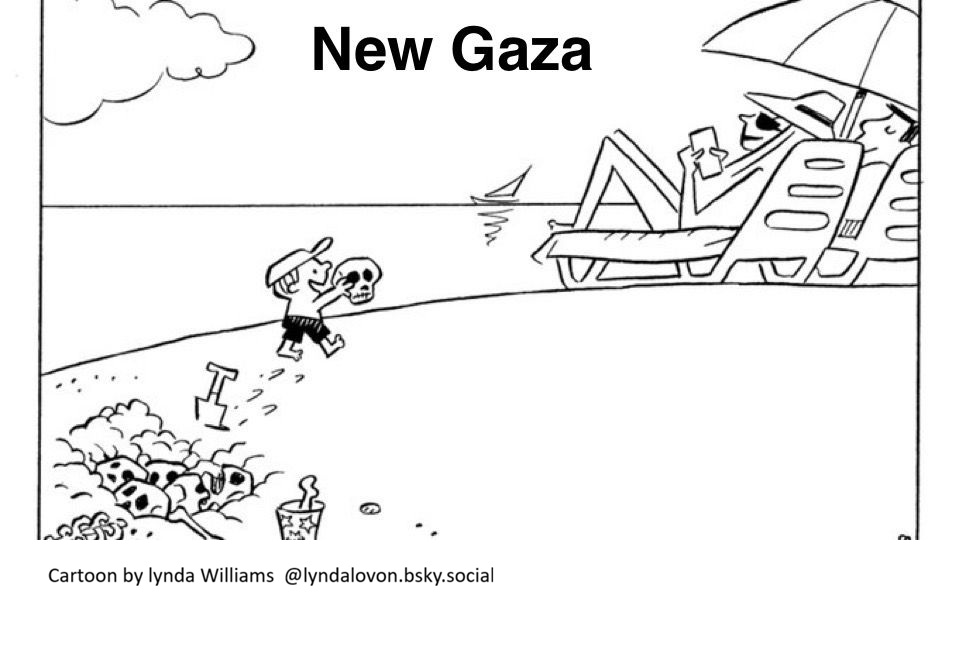
Kushner Reveals Dystopic Plan to Build Data Centers on Ruins of Gaza Genocide.
“This is a plan to erase Gaza’s indigenous character, turn what remains of her people into a cheap labor force to manage their ‘industrial zones’ and create an exclusive coastline for ‘tourism,’”
The plan appears to be to finish Israel’s bulldozing of Gaza to make real estate opportunities for investors.
“This is a plan to erase Gaza’s indigenous character, turn what remains of her people into a cheap labor force to manage their ‘industrial zones’ and create an exclusive coastline for ‘tourism,’”
The plan appears to be to finish Israel’s bulldozing of Gaza to make real estate opportunities for investors.
By Sharon Zhang , Truthout, January 22, 2026, https://truthout.org/articles/kushner-reveals-dystopic-plan-to-build-data-centers-on-ruins-of-gaza-genocide/

White House Adviser Jared Kushner revealed a neocolonial plan to transform Gaza into a home for luxury tourist resorts and data centers at the World Economic Forum on Thursday.
The plan has been widely condemned by human rights advocates, who say it is an an attempt to erase Palestinians by building a capitalist dystopia on the ruins of Israel’s genocide.
At the signing ceremony for President Donald Trump’s “Board of Peace,” Kushner shared a set of slides depicting a colonialist fantasy of the Gaza Strip under a hypothetical “demilitarization” of Hamas — despite the group’s repeated refusal to disarm, saying it would leave them defenseless against further attacks by Israel or otherwise.
The slides show computer-generated photos of high rise buildings along the coast and rows of residential buildings elsewhere.
The presentation includes a blueprint of Gaza divided into sections, which Kushner says is the U.S.’s plan for “catastrophic success” in the event of demilitarization of Hamas. The blueprint, labelled as the “Master Plan,” shows the entirety of the coast — where Palestinians have long fished for sustenance — dedicated to “coastal tourism,” with a sea port and an airport. There are large swaths dedicated to “parks, agriculture, and sports facilities.”
Tellingly, numerous parts of the map located next to residential areas are dedicated to industry and “data centers.” Ruinous technology like AI, reports have said, are slated to be a major part of the White House’s plan for Gaza, with other slides in the pitch deck reported by The Wall Street Journal showing a transformation of the Strip into a “smart city” with “tech driven governance.”
Nowhere is there a designation for cultural sites, nor does the map seem to be built around keeping or restoring any parts of Gaza that retain Palestinian heritage or life. The plan appears to be to finish Israel’s razing of the territory, clear the rubble in which thousands of Palestinians’ bodies are thought to be trapped, and replace it with real estate opportunities for investors.
“Gaza, as President Trump has been saying, has amazing potential,” said Kushner.
At the signing ceremony, Trump said that Gaza, home to millions of Palestinians, is “a great location” that should be viewed as a “big real estate site,” and expressed his interest in the region as a “real estate person at heart.”
“I said, look at this location on the sea, look at this beautiful piece of property — what it could be for so many people, it’ll be so great, people that are living so poorly are gonna be living so well,” Trump said.
Kushner touted the White House’s goal of applying “free market economy principles” to the razing and redevelopment of Gaza. He also expressed a desire to replace the humanitarian aid system for Palestinians in the region using those principles.
Palestinians have strongly condemned the plan.
“This is a plan to erase Gaza’s indigenous character, turn what remains of her people into a cheap labor force to manage their ‘industrial zones’ and create an exclusive coastline for ‘tourism,’” wrote Palestinian American writer Susan Abulhawa. “Palestinians will be pushed behind walls and gates, retrained in ‘technical schools’ to serve Israel’s supremacists ideology. The indigenous traditions and social fabric of this land will be obliterated utterly.”
“If the goal is truly peace, then the path is simple: end the occupation and help restore the rights that have been taken from Palestinians since 1948,” said Mosab Abu Toha, a Palestinian writer from Gaza. “We, the Palestinian people, are the ones who must determine our own future. Peace cannot be imposed while our land is occupied, our lives controlled, and our voices ignored.”
Nuclear project with locals opposed will get federal review
Federal law requires large projects to examine whether there are other feasible ways to meet the same goals with fewer risks.
That opens the door to arguments that renewables, storage and grid upgrades could deliver similar benefits faster, more cheaply and with less environmental harm.
Recent studies from the Ontario Clean Air Alliance suggest alternatives exist and that the province could save up to $19 billion per year by investing in wind, solar and storage instead of pursuing the Wesleyville nuclear megaproject.
Canada’s National Observer, By Abdul Matin Sarfraz, January 22nd 2026
For most of her life, Faye More has lived in the shadow of nuclear waste, grappling with radioactive contamination in her home and her hometown left behind by uranium and radium processing.
She grew up in Port Hope, a lakeside community about 100 kilometres east of Toronto that is still undergoing cleanup of contaminated soil that continues to be removed from neighbourhoods and stored in a huge engineered mound about the size of 70 hockey rinks, visible from Highway 401.
In the 1970s, government investigators found high levels of radon gas at St. Mary’s elementary school in Port Hope, where radioactive mining waste from the town’s uranium mine had been used as fill beneath the building. The school was closed and tests were conducted elsewhere around the town. Investigators uncovered contamination in unexpected places — including backyards and basements.
“I grew up in a contaminated house. I later ended up buying a contaminated property without knowing it and I raised my family there because the locations of radioactive waste were not being disclosed,” More said.
Radon is a colourless, odourless radioactive gas that forms naturally as uranium breaks down in soil and can seep into homes through foundations — it’s naturally occurring in many places but, in Port Hope, levels were significantly higher than normal. Health Canada says radon is the second-leading cause of lung cancer after smoking, linked to about 16 per cent of cases nationwide, or more than 3,000 deaths each year.
Now, More’s community is being asked by the Ford government to shoulder another nuclear burden, one of the largest nuclear projects in the world. This time, she is fighting back, helping lead local residents who say they have already paid the price.
The province last year announced that Ontario Power Generation (OPG) is proposing a new nuclear generating station on its Wesleyville property. The company says the project could eventually host up to 10,000 megawatts of generating capacity, enough to power up to 10 million homes for roughly 78 years.
In its own documents, the Ontario Power Generation says it is not considering alternatives to the Wesleyville project itself. It describes nuclear expansion as a policy decision already made by the province.
The Ford government celebrated the project, claiming more nuclear power is essential to meet rising electricity demand while helping Canada hit its climate targets.
Nuclear energy is frequently cited as a clean, reliable alternative to fossil fuels…………………….
“I was really shocked and appalled,” said More, now chair of the Port Hope Community Health Concerns Committee. “I felt it was very disrespectful to the people, the way it was announced as good news.”
More says the group has more than 100 members and is a volunteer-run non-profit formed in 1995 to address health and environmental risks linked to radioactive contamination in the town.
The group organizes public meetings, shares information online, writes letters to officials and urges residents to take part in public consultations.
Last week, the federal government formally designated the proposed Wesleyville project for a federal environmental impact assessment, opening the door to public consultation.
Unlike most major infrastructure projects, nuclear plants fall largely under federal jurisdiction. The Federal Impact Assessment Act requires a full review for any new nuclear facility larger than 200 megawatts.
The Canadian Nuclear Safety Commission must then decide whether the project meets safety and environmental rules under the Nuclear Safety and Control Act and the Impact Assessment Act before issuing a licence.
More hopes the federal process will stop the project altogether. She says the risks to nearby communities are too great, that safer alternatives exist and that the Ford government ignored Port Hope’s long and painful history with the nuclear industry.
For her, the idea of building one of the world’s largest nuclear plants nearby feels surreal.
“To suddenly hear that in this beautiful rural area they are going to build what could be the largest nuclear plant in the world is really unimaginable,” she said.
More worries about what that would mean for land, water and ecosystems. “It is hard to picture the scope of changes that would happen out there,” she told Canada’s National Observer. “And with that scale comes enormous risks, including emissions to the water, the air and impacts on biodiversity.”
OPG’s filings describe major physical changes that would come with the project. These include shoreline filling, dredging, building docks and large-scale excavation and blasting.
The company also says the plant would rely on cooling water from Lake Ontario. The company acknowledges the site includes wetlands, creeks and fish habitat. It also says parts of the area fall within highly vulnerable aquifer zones.
More says the pace of the project is almost as alarming as its size. She believes people should have veto power, a view not shared by the Ford government, which like the federal government is seeking to build infrastructure more quickly.
“One of the most basic questions in any environmental assessment is: Do we actually need this much energy? And if we do, why does it have to come from here?”
The company says it already owns the property, that it has been intended for electricity generation for decades and that the region has major infrastructure nearby such as transmission corridors, rail access and road that make the site ideal for the expansion plans.
Moving faster than expected
Legal experts note the project is moving at unusual speed.
Theresa McClenaghan, executive director and counsel at the Canadian Environmental Law Association, has followed nuclear projects for decades and says the timeline alone should raise red flags.
“From the very first idea, where the province asked OPG to look at potential new sites, to filing a project description with the federal agency, it’s been something like a year,” she told Canada’s National Observer. “That’s incredibly fast for something of this scale.”
McClenaghan believes OPG is trying to secure approvals while political conditions are favourable.
““They see a friendly Nuclear Safety Commission. They see a supportive provincial government and a supportive federal government,” she said.
“I think they’re thinking: let’s get this licence in our back pocket.”
She points to earlier cases where OPG obtained approvals long before construction began, protecting itself from future political or economic shifts. That strategy matters, she says, because nuclear megaprojects often face soaring costs.
Recent regulatory changes mean many of those costs can now be passed on to ratepayers long before any electricity is produced.
McClenaghan says the federal impact assessment may be the only real opportunity for the public to closely examine the project’s risks, costs and alternatives.
“It’s extremely rare for nuclear projects to be denied,” she said. “But it’s not impossible.”
The review will eventually combine two decisions into one: whether the project’s impacts are acceptable under federal law and whether the Canadian Nuclear Safety Commission should grant OPG a licence.
Under federal rules, the process must look at accident scenarios, long-term environmental effects and whether the project makes sense in its proposed location, including near population centres. In its own documents, OPG says it is not considering alternatives to the Wesleyville project itself. It describes nuclear expansion as a policy decision already made by the province.
McClenaghan says that stance could become a major sticking point. Federal law requires large projects to examine whether there are other feasible ways to meet the same goals with fewer risks.
That opens the door to arguments that renewables, storage and grid upgrades could deliver similar benefits faster, more cheaply and with less environmental harm.
Recent studies from the Ontario Clean Air Alliance suggest alternatives exist and that the province could save up to $19 billion per year by investing in wind, solar and storage instead of pursuing the Wesleyville nuclear megaproject.
Ontario’s big nuclear bet
More than half of Ontario’s electricity currently comes from nuclear power.
Under the province’s long-term planning, that share is projected to rise above 70 per cent by 2050 as electricity demand is expected to increase by about 75 per cent.
Nuclear projects are expensive and complex. The province says it plans to explore new ownership models and equity partnerships to attract private capital.
The government argues nuclear power is more cost-effective and land-efficient than renewables. It says alternatives would require vast amounts of land and major new transmission infrastructure, a claim challenged by energy experts.
For More, the fight has already begun. She is organizing meetings, sharing information online and urging people to take part in the consultation. But she says the timelines are too short for communities to respond in a meaningful way.
She worries that political efforts to “cut red tape” are turning health and environmental protections into barriers to be removed.
“What happens at Wesleyville doesn’t stay at Wesleyville. The reach of a nuclear plant is enormous,” More said. “When a wind turbine fails, it doesn’t contaminate an entire region,” she said. “Nuclear is different.”
More says her community has already paid the price of Canada’s nuclear history once and they are not willing to do it again.
World’s Largest Nuclear Station or Lower Electricity Bills?

Nuclear Power: The Most Expensive and Slowest Option
Nuclear reactors are the highest cost option to meet Ontario’s electricity needs – up to 10 times higher than energy efficiency, and 2 to 8 times higher than new wind and solar energy.
They are also far too slow. According to OPG, these new nuclear reactors would not come online until 2040 – 2048. That means more than 20 years of construction, cost overruns, and continued reliance on polluting gas.
By contrast, new wind and solar projects can be built in 6 months – 2 years, reducing emissions and lowering bills quickly.
A Risky Dependence on Foreign Fuel
To make matters worse, OPG is considering purchasing American-designed reactors from GE-Hitachi or Westinghouse. These reactors would require Ontario to import enriched uranium from the United States to fuel them. Does that seem like a good idea given the current political craziness unfolding south of the border?
The Better Alternative
OPG’s proposal fails to examine crucial alternatives.
Could Ontario meet its electricity needs more cheaply, more quickly, and more safely by investing in energy efficiency, wind power, solar energy, and energy storage (such as batteries and compressed air storage)?
This is a question that the Impact Assessment Agency of Canada (IAAC) must examine during its mandatory review. That will only happen if the public demands it.
What you can do
 Submit Public Comments – Deadline: Midnight, Wed. Feb. 11
The IAAC is accepting public comments on OPG’s application.
Submit your comments through the IAAC portal or email them to: wesleyville@iaac-aeic.gc.ca
Ask the IAAC to direct OPG to evaluate whether energy efficiency, renewables, and energy storage are lower-cost, faster, safer, and more secure ways to meet Ontario’s electricity needs than building a massive new nuclear station at Port Hope
What Canada’s nuclear waste plan means for New Brunswick
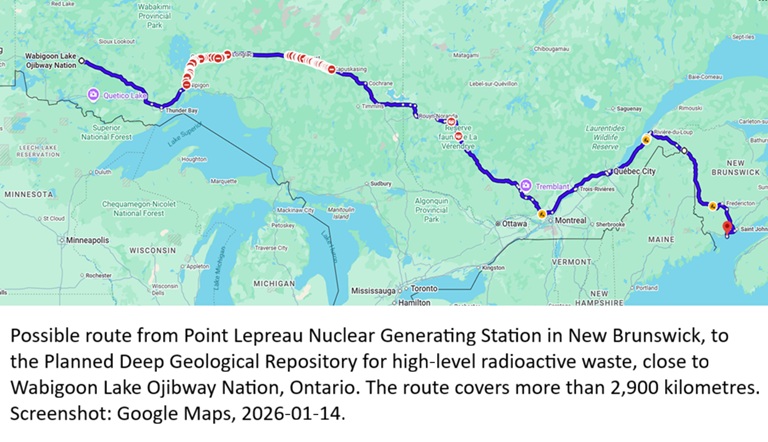
by Mayara Gonçalves e Lima, January 20, 2026, https://nbmediacoop.org/2026/01/20/what-canadas-nuclear-waste-plan-means-for-new-brunswick/
Canada is advancing plans for a Deep Geological Repository (DGR) to store the country’s used nuclear fuel. In early 2026, the Nuclear Waste Management Organization (NWMO) entered the federal regulatory process by submitting its Initial Project Description — a major step in a project with environmental and social implications that will last for generations.
The implications of this project matter deeply to New Brunswickers because the province is already part of Canada’s nuclear legacy through the Point Lepreau Nuclear Generating Station. The proposed repository in Ontario is intended to become the final destination for used nuclear fuel generated in New Brunswick, currently stored on site at Point Lepreau.
If the project goes ahead, highly radioactive nuclear waste would be transported across New Brunswick. Current NWMO plans envision more than 2,100 transport packages of New Brunswick’s used nuclear fuel travelling approximately 2,900 kilometres, through public roads in the province and across Canada, over a period of 10 to 15 years.
For many residents, the project raises long-standing concerns about safety, accountability, and cost — especially as NB Power continues to invest in nuclear technologies and considers new reactors. Decisions about the DGR will influence how long New Brunswick remains tied to nuclear power, carrying the risks of waste that remains hazardous far beyond any political or economic planning horizon.
This is a critical moment because public input is still possible — but the comment period window is narrow. Environmental organizations and community advocates are calling for extended consultation timelines, full transparency on transport risks, and meaningful consent from affected communities. Several groups have organized a sign-on letter that readers can review and support.
How New Brunswickers respond now will help determine whether these decisions proceed quietly — or with public accountability.
Unproven science and public concerns
Globally, no deep geological repository for high-level nuclear waste has yet operated anywhere on the planet. Finland’s Onkalo facility is often cited as the first of its kind, but it remains in testing, relies on unproven assumptions about geological containment, and will not be fully sealed for decades.
The lack of proven DGR experience matters for Canada because the proposed repository would be among the world’s earliest attempts to isolate high-level radioactive waste “forever,” despite the absence of any real-world proof that such facilities can perform as claimed. Canada’s decision therefore sets not only a national course, but a global precedent built on uncertain science and long-term safety assumptions.
The proposed DGR would be built 650 to 800 metres underground in northwestern Ontario, near the Township of Ignace and Wabigoon Lake Ojibway Nation (WLON), in Treaty #3 territory. Its purpose is to bury and abandon nearly six million bundles of highly radioactive used nuclear fuel, attempting to isolate them from the biosphere for hundreds of thousands of years.
The Nuclear Waste Management Organization describes the site selection as “consent-based,” but this framing raises difficult questions. Consent in economically marginalized regions — particularly where long-term funding, jobs, and infrastructure are promised — is not the same as free, prior, and informed consent, especially when the risks extend far beyond any western planning horizon.
In 2024, the Assembly of First Nations held dialogue sessions on the transport and storage of used nuclear fuel. Communities raised serious concerns that the proposed DGR could harm land, water, and air — all central to Indigenous culture and way of life.
Guided by ancestral knowledge and a duty to protect future generations, the Assembly warned that the DGR threatens sacred sites, ecosystems, and groundwater, including the Great Lakes. Climate change and natural disasters heighten these risks, exposing the limits of the current monitoring plan and prompting calls for life-cycle oversight.
A token consultation for a monumental project
As anticipated, the Initial Project Description raises serious concerns about the DGR process itself. One of the most serious flaws is the stark mismatch between the project’s scale and the time allowed for public input. Although the DGR is framed as a 160-year project with risks lasting far longer, communities, Indigenous Nations, and civil society groups have been given just 30 days to review the Initial Project Description, with submissions due by February 4.
Thirty days to read dense technical documents, consult communities, seek independent expertise, formulate questions, and respond meaningfully to a proposal that will affect land, water, and people for generations. This is not a generous consultation — it is the bare legal minimum under federal impact assessment rules.
While regulators emphasize that the overall review will take years, this early stage is crucial in shaping what will be examined and questioned later. Rushing public input at the outset risks reducing participation to a procedural checkbox rather than a genuine democratic process, particularly for a decision whose consequences cannot be undone.
The overlooked threat of waste transport
Another serious shortcoming in the project proposal is a failure to adequately address the nationwide transport of radioactive waste. Transporting highly radioactive material through communities by road or rail is central to the project and carries significant safety and environmental risks that remain largely unexamined.
By excluding radioactive waste transportation from the Initial Project Description, the Nuclear Waste Management Organization is effectively removing it from the scope of the comprehensive federal Impact Assessment. If transport is not formally included at this stage, it will not receive the same level of environmental review, public scrutiny, or interdepartmental oversight as the repository itself.
Instead, transportation would be left primarily to the Canadian Nuclear Safety Commission and Transport Canada to assess under the existing regulations — an approach that is fragmented and insufficient given the scale, duration, and risks of moving highly radioactive waste through communities.
The transport of radioactive waste is a critical yet often overlooked issue. As Gordon Edwards, president of the Canadian Coalition for Nuclear Responsibility notes, Canada has no regulations specifically governing the transport of radioactive waste — only rules for radioactive materials treated as commercial goods. This gap matters because radioactive waste is more complex, less predictable, and potentially far more dangerous.
Transporting high-level nuclear waste is inherently risky: the material remains hazardous for centuries, and accidents, equipment failures, extreme weather, security breaches, or human error can still occur despite careful planning. Unlike other hazardous materials, radioactive contamination cannot be easily contained or cleaned up, leaving land, water, and ecosystems damaged for generations. Even a single transport incident could have lasting, irreversible consequences for communities along the route.
Radiation risks extend beyond transport workers. People traveling alongside shipments may face prolonged exposure, while those passing in the opposite direction are briefly exposed in much larger numbers. Residents and workers along transport routes can experience repeated exposure, and accidents or unplanned stops could result in localized contamination. Emergency response is further complicated by leaks or hard-to-detect releases, with standard spill or firefighting methods potentially spreading contamination.
These risks are not hypothetical. Last summer, Gentilly-1 used fuel was transported from Bécancour, Quebec, to Chalk River, Ontario, along public roads — without public notice, consultation, Indigenous consent, or clear evidence of regulatory compliance — underscoring the ongoing risks to our communities.
According to the 2024 Assembly of First Nations report, at least 210 First Nations communities could be affected by shipments of radioactive waste traveling from nuclear reactors to the repository via railways and major highways, though the full scope may be even larger when considering watersheds and alternative routes.
Given this reality, it is unacceptable that the DGR Project Description largely ignores waste transport. Any credible assessment must examine how waste will be moved, who will be affected, what rules apply, who is responsible for oversight, and how workers, communities, and the environment will be protected in emergencies. It is the job of the Impact Assessment Agency of Canada to examine these plans in depth.
A high-stakes decision that demands public voice
Canada’s proposed Deep Geological Repository is one of the most ambitious and high-stakes projects in nuclear waste management. Framed as a permanent solution, it remains untested — no country has safely operated a deep repository for used nuclear fuel over the long term. Scientific uncertainty and multi-decade timelines make its risks profound and enduring.
Dr. Gordon Edwards warns: “The Age of Nuclear Waste is just beginning. It’s time to stop and think. […] we must ensure three things: justification, notification, and consultation — before moving any of this dangerous, human-made, cancer-causing material over public roads and bridges.”
Now is the moment for public voices to be heard. Legal Advocates for Nature’s Defence (LAND), an environmental law non-profit, has prepared a sign-on letter and accompanying press release calling for a more precautionary, transparent, and democratic approach to the Deep Geological Repository. This is your chance to have a say in decisions that could expose you, your neighbours, and your communities to serious environmental and health risks.
The letter urges federal regulators to extend public consultation timelines, require that the Impact Assessment Agency of Canada conduct a comprehensive Impact Assessment that includes the transportation of radioactive waste, and uphold meaningful consent and accountability.
New Brunswickers and allies across the country are encouraged to read the letter, add their names, and speak up before decisions are finalized. How Canada handles nuclear waste today will shape risks borne by our communities for generations.
The DGR is more than a technical project; it is a test of democratic process, scientific caution, and intergenerational responsibility. Canadians deserve a transparent, thorough, and precautionary approach to ensure that decisions made today do not compromise the safety of future generations.
Mayara Gonçalves e Lima works with the Passamaquoddy Recognition Group Inc., focusing on nuclear energy. Their work combines environmental advocacy with efforts to ensure that the voice of the Passamaquoddy Nation is heard and respected in decisions that impact their land, waters, and future.
Danish MP Warns US Takeover of Greenland Will Start a War
by Kyle Anzalone , January 21, 2026 , https://news.antiwar.com/2026/01/20/danish-mp-warns-us-takeover-of-greenland-will-start-a-war/
Trump has placed tariffs on Europeans nations that oppose the US seizing Greenland
Amid threats from President Donald Trump to take over Greenland, a Danish politician said that if the US seized the colony, a war would break out.
Danish MP Rasmus Jarlov said that if the US military invades Greenland, “it would be a war, and we would be fighting against each other.”
“There’s no threat, there’s no hostility. There’s no need, because the Americans already have access to Greenland, both militarily and in all other ways.” He continued, “There are no drug routes. There is no illegitimate government in Greenland. There is absolutely no justification for it– no historical ownership, no broken treaties, nothing can justify it.”
In recent weeks, President Trump said the US will take control of Greenland. The President argues it is a matter of national security, as Russia or China will seize Greenland from Denmark if the US does not gain control first.
In response to Trump’s threats, Denmark has begun increasing its military presence in Greenland.
Trump’s plan to take Greenland has met stiff opposition in Europe. The President has slapped 10% tariffs on eight European countries. Trump said the tariffs would increase if those nations did not change policy and support the US seizure of Greenland.
An executive at Deutsche Bank suggested that European countries could pressure the US to back away from Greenland by refusing to buy US bonds. George Saravelos, head of FX research, explained, “For all its military and economic strength, the US has one key weakness: it relies on others to pay its bills via large external deficits.”
Trump and Treasury Secretary Scott Bessent downplayed the risk of a currency war with Europe. “The media has latched on to this. I think it is a completely false narrative. It defies any logic,” he said Tuesday.
“If you look, the US Treasury market was the best-performing market in the world, or the best G7-performing bond market, and we had the best performance since 2020. It is the most liquid market.” Bessent continued,” It is the basis for all financial transactions, and I am sure that the European governments will continue holding it.”
The President said he did not expect Europe to push back too much if he annexed Greenland. “I don’t think they are going to push back too much,” he said, adding, “We have to have it.”
It wasn’t Trump’s mind or morality that stopped his Iran attack.
Walt Zlotow West Suburban Peace Coalition, 21 Jan 26
A week ago President Trump was posturing about an imminent attack to overthrow the Iranian regime embroiled in massive protests. His declared motive was to save the Iranian protesters seeking internal regime change who were being slaughtered by the regime.
Then Trump pivoted, declaring since the regime was no longer planning to execute protesters, he wouldn’t attack.
But it wasn’t Iranian government benevolence that persuaded Trump to stand down. The two reasons Trump’s explanation was covering up were reality on the ground and a phone call.
The massive but failed protests were not solely a spontaneous internal revolt. They were fomented and supported by both the US and Israel to complete their long sought dream of regime change to destabilize Iran, Israel’s last hegemonic rival in the region. Israel’s Mossad was definitely on the ground and likely the CIA as well. Trump was cheering on the protests from the sidelines.
Trump was poised to attack to complete the regime change operation when protest success appeared imminent. But Iran’s government quickly and decisively snuffed out the protests, ending Trump’s dream of adding more thousands to his massive, murderous death toll bombing 7 countries in his first year of term two.
Trump also got a call from the real boss of US Middle East policy….Israel’s Benjamin Netanyahu. He told Trump that with the regime intact, Israel would be decimated by thousands of Iranian missiles once Trump attacked.
Iran’s government may be secure for now but Israeli, US dream of Iranian regime change will never cease.
Trump lied to the New York Times when he said the only thing that can stop him from foreign intervention is “my own mind, my own morality.” What stopped Trump from attacking Iran again, as he did in June, is what stopped him then… failure on the ground and a call from the guy giving Trump his orders on Middle East foreign policy.
Summary comments on the Deep Geologic Repository (DGR) Project for Canada’s Used Nuclear Fuel
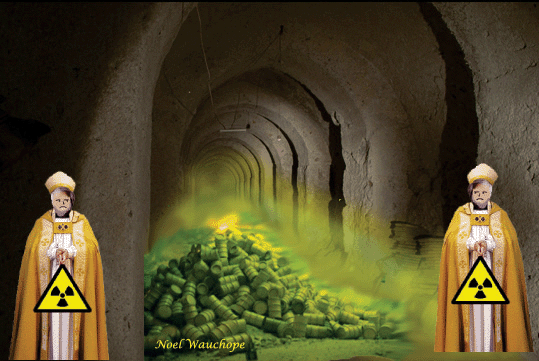
The nuclear waste will be radioactive for, say, a period of time that is close to eternity, whereas the project covers a period of 160 years. The solution is therefore very far from permanent.
We are swimming here in the middle of a pro-nuclear religion.
by Miguel Deschênes, 20 Jan 26
a translation of comments submitted in French to the Impact Assessment Agency of Canada (IAAC) by Miguel Deschêne on this subject.
Seven major objections stand out:
1- Developers are not trustworthy
On page v of the document, it states that “Canada’s nuclear power plants have been providing clean energy for decades,… ». Then, on page vii, it is explained that the project itself “would contain and isolate approximately 5.9 million spent fuel assemblies,” representing approximately 112,750 tonnes of irradiated and highly radioactive heavy metals. This waste contains a wide variety of radioactive substances that are dangerous to living beings. One of the most famous isotopes found in these spent fuel bundles is plutonium-239. Need we remind you that Canadian plutonium was used in the bomb that destroyed the city of Nagasaki in 1945? To say on page v of the document that nuclear energy is clean and to specify on page vii that it will generate 112,750 tonnes of highly radioactive (and potentially destructive) heavy metals in Canada is staggering incoherent.
On page iv of the document, there is a list of twelve specialists and managers who prepared, reviewed, approved and accepted this document, which includes this glaring logical error. This leads to the conclusion that the developers seem willing to present all possible arguments, however incongruous, to defend this project, while concealing the negative aspects that could overshadow it. They therefore have neither the capacity for reflection nor the objectivity required to manage this project, when it would be essential to protect the safety of the public and the environment in complete transparency.
2- The objective(s) are unattainable
The document presents the objective of the project in two places, but they are two different objectives. These objectives look strangely like advertising slogans or the creeds of a pro-nuclear cult. Neither is attainable in practice, but they make it easy to project yourself into a world of unicorns:
a- On page viii, it is stated that: “The objective of the Project is to ensure the safe long-term management of used nuclear fuel so that it does not pose a risk to human health or the environment.”
We are talking about guaranteeing, for 160 years. A great Quebec poet would say “it’s better to laugh than to cry.” A car, which is one of the most advanced technological objects on the planet, is guaranteed for 3 or 5 years. How can we believe that we can guarantee a new landfill technology for a period of 160 years? It’s simply delusional.
In addition, even a simple plastic bottle carries risks to human health or the environment. And they want us to believe that this project will make it possible to store 112,750 tonnes of radioactive nuclear waste so that it does not pose any risk to human health or the environment? What sensible person can believe such a statement?
b- On page 20, it states that: “The objective of the Project is to provide a permanent, safe and environmentally responsible solution for the management of all of Canada’s used nuclear fuel.”
The nuclear waste will be radioactive for, say, a period of time that is close to eternity, whereas the project covers a period of 160 years; The solution is therefore very far from permanent. The solution is also presented as safe and environmentally friendly: based on what? The solution is safe as long as it is sold by convinced developers, but everyone knows that it involves enormous risks. And environmentally friendly? How can we say that burying 112,750 tonnes of radioactive nuclear waste is an environmentally friendly solution? We are swimming here in the middle of a pro-nuclear religion.
Obviously, neither of these two objectives is achievable in practice.
What is the real objective of the project? Indirectly extract as much money as possible from the public treasury and taxpayers? Putting hundreds of highly paid employees to work unnecessarily for decades? Shovel the problem of nuclear waste to our descendants?
The project is therefore, even before it has begun, doomed to failure, since it is impossible for it to achieve its totally utopian objectives. To believe in the success of this project, it is absolutely necessary to be overwhelmed by the pro-nuclear faith.
3- The budget is not presented
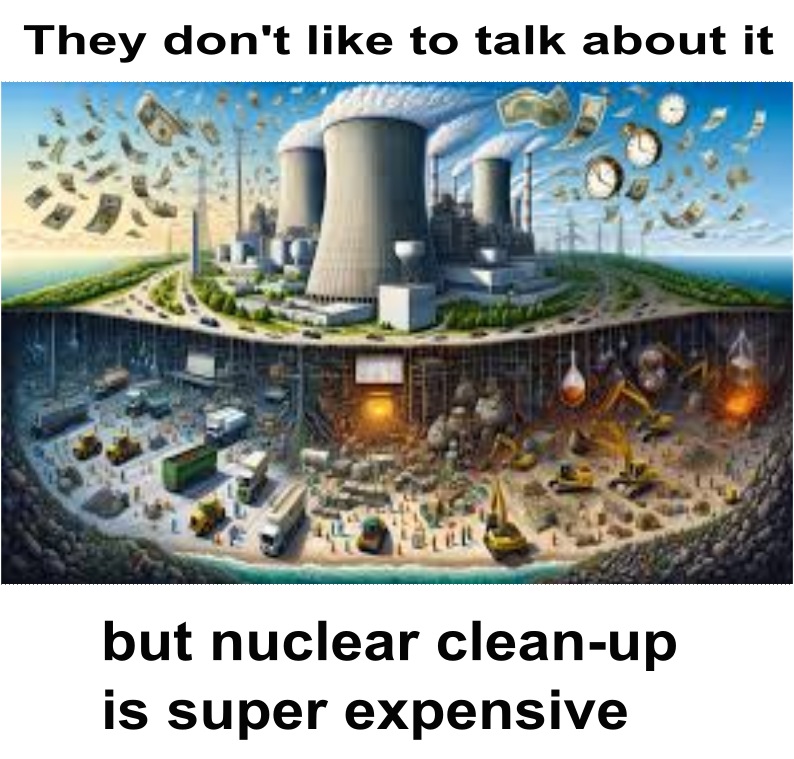
On page 52, it states that “Federal authorities are not providing any financial support to the Project.”
On page 65, it states that: “In addition, although the NWMO is a regulated entity by the CNSC, it is not a federal agency or authority. Rather, it is a question of a not-for-profit organization mandated by the federal government under the NFCA to managing Canada’s nuclear waste. The NWMO is fully funded by industry nuclear power. »
However, the Government of Canada and some provincial governments subsidize and financially encourage the nuclear industry.
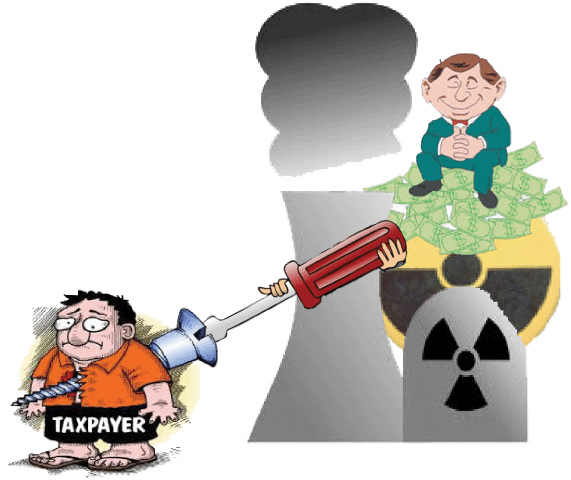
So, in a nutshell, taxpayers are giving money to governments, which in turn subsidizes the nuclear industry, and which in turn funds the NWMO. The present project is therefore indirectly financed by taxpayers and by the federal authorities, which is not revealed by the sentence on page 52. Could we conclude that it is not necessary to call on an accountant if you have a good conjurer?
A detailed budget is one of the essential elements of project planning and monitoring. Where is the budget? How is it cut? And how much will it indirectly cost taxpayers? It would be reasonable to describe the sums required as potentially pharaonic and to require a project plan that includes a complete financial plan.
The absence of a budget in the presentation of a project is an unacceptable shortcoming.
4- The project’s time scale is doubly absurd
On page v, it states that “The Project is expected to span approximately 160 years, including site preparation, construction, operation (approximately 50 years), decommissioning and closure, and post-closure monitoring.”
This duration is both too short and too long:

a- Too short: the half-life of plutonium-239 is about 24,130 years. It is calculated that after a duration of approximately seven times the half-life of an isotope, less than 1% (more precisely, 1/128) of the initial radioactive atoms remain. In the case of plutonium-239, it would therefore be necessary to wait about 168,000 years to reach this target. Obviously, this calculation would have to be done for all the isotopes found in the original waste and for all the isotopes created during subsequent decays in order to properly assess the hazardousness of the waste as a function of time, which is very complex. But we can see right away that the 160-year period is far too short to ensure the safety of the public and the environment.
b- too long: if we go back 160 years in time, we find ourselves in 1866, when the Canadian federation did not even exist. Since that time, humanity has experienced various epidemics (plague, cholera, Spanish flu, covid, etc.), two world wars and a multitude of other wars, major geopolitical reorganizations and major economic crises. It is perfectly utopian to think that a human project that has no other objective than to bury waste will be able to be carried out without hindrance for 160 years. What happens if there is a major epidemic, a world war, a coup d’état by an outsized geographic neighbour, a split in Canada, an unforeseen IT upheaval? How can we seriously believe that all the governments and political parties that will succeed each other will have at heart, for 160 years (if each party remains in power for 4 years, we are talking about 40 different governments), to adequately supervise this project?
In general, the longer a project lasts, the greater the likelihood of not achieving objectives, exceeding costs and exceeding the originally planned schedule. It is therefore quite reasonable and prudent to predict that the 160-year deep geological repository project is likely to be a complete failure: it will not achieve its objectives, while exceeding the planned deadlines and costs.
5- The responsibility for the project in the medium and long term cannot be assumed
What will be the responsibility for the project in the medium and long term, i.e. in 10, 20, 50 or 100 years? What if there is a design problem, a technical problem, a supplier problem, a funding problem, a nuclear incident or whatever? Who will be responsible when most of us are dead? To whom can our descendants turn to ask for accountability and rectification if necessary? No one can imagine or predict it, and it is likely that any assumption today about it will prove wrong tomorrow.
6- The risks associated with transportation are far too high
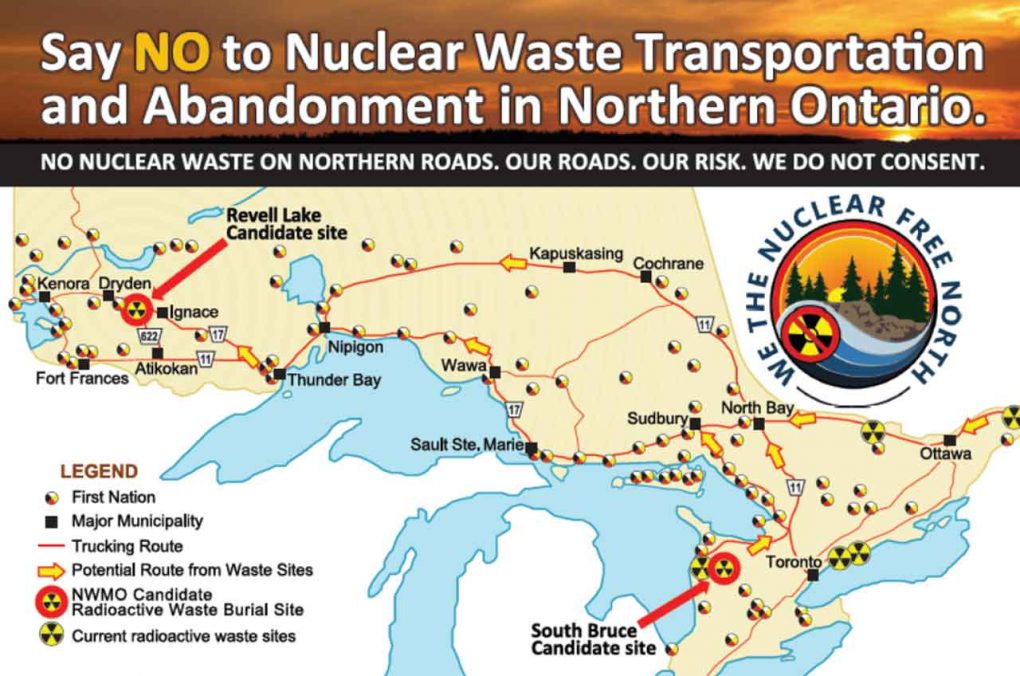
No means of transportation is perfectly safe. Regularly, planes crash, trains derail (the Lac-Mégantic rail accident in 2013 is a sad example) and trucks are involved in pile-ups. Sometimes, a space shuttle explodes in mid-flight.
On page vii, it states that “The Project does not include: the transportation of used fuel from the reactor sites to the Project beyond the primary and secondary access roads to the Project site, as the Project site is regulated separately under CNSC certification and uses existing transportation infrastructure.”
This seems to be, once again, a tactic to make the authorities and citizens swallow the pill of the project. The risks associated with a possible incident during the transportation of 112,750 tonnes of high-level radioactive waste on Canada’s roads, over a period of about fifty years (according to the projected schedule on page 31), are obviously far too high. It is therefore easy to understand why the developer prefers not to include this aspect in his project.
The excessive risk associated with transporting radioactive waste is an argument used by the Nuclear Waste Management Organization itself on its information page about Canada’s used nuclear fuel (https://www.nwmo.ca/fr/Canadas-used-nuclear-fuel): “Related questions: Couldn’t spent nuclear fuel be sent into space? No. In a three-year dialogue with experts and the public on possible long-term management options, the disposal of used nuclear fuel into space was one of the options of limited interest that we eliminated. Space-based evacuation has been ruled out as a solution because it is an unproven concept, not implemented anywhere in the world and not part of any national research and development plan. Concerns about the risk of accidents and the risks to human health and the environment have been amplified in particular by the accidents of the American space shuttles Challenger and Columbia. »
Why should the risk of an accident not be a consistent factor in the Nuclear Waste Management Organization’s reasoning? There have certainly been more train derailments and truck accidents than space shuttle incidents in human history. By what form of logic can we conclude that it is too risky to send used nuclear fuel into space, but that it is safe to transport it by train or truck? The only plausible explanation may be that we must have pro-nuclear faith.
7- Governments do not have a strategy to exit the nuclear industry
On page vii of the document, it states that: “The Project would contain and isolate approximately 5.9 million used fuel assemblies, which is the total anticipated inventory of used nuclear fuel that is expected to be produced in Canada by the current fleet of reactors until the end of their lifetime, as outlined in the NWMO’s 2024 Nuclear Fuel Waste Projections Report (NWMO, 2024). This projection is based on published plans for the refurbishment and life extension of the Darlington and Bruce reactors, as well as the continued operation of the Pickering A (until the end of 2024) and Pickering B (until the end of 2026) reactors, and the assumptions used by the NWMO for planning purposes. »
However, in October 2025, Ottawa and Ontario announced the construction of 4 new nuclear reactors (https://ici.radio-canada.ca/nouvelle/2201625/darlington-nucleaire-reacteur-opg-ontario). What about the waste that will be generated by these plants, which is not part of the inventory considered by the project? And what about those generated by other hypothetical power plants to come? Or those that the government could import from other countries?
Successive governments are constantly creating, recreating and amplifying the problem of nuclear waste, with no intention of ending this mess. The only decision that would limit this ecological disaster would be to abandon the nuclear industry, which would include stopping uranium mining, no longer building new nuclear power plants and never importing nuclear waste from other countries. Unfortunately, no decision-maker seems to have the foresight to move in this direction.
Even before the project begins, we already understand that the planned landfill will not be able to store all of Canada’s nuclear waste. Without a clear direction on the denuclearization of the country, the problem of radioactive waste is far from being solved.
In any case, a deep geological repository will never be a good solution for nuclear waste; This far too risky avenue is really only used to shovel the problems created by today’s decision-makers until a time when they will all be dead and will not have to assume the disastrous consequences.
Conclusion :
In my view, these arguments are more than enough to justify never authorizing the Deep Geologic Repository (DGR) Project for Canada’s used nuclear fuel. It seems that the “original project description” seeks to conceal the real issues related to nuclear waste management, in order to obtain the required authorizations, spend obscure (but potentially staggering) amounts of money, and perpetuate nuclear madness, with no regard for public safety and the environment. Unfortunately, this is a typical project of the nuclear industry, which relies on the blind complacency of the authorities and on daydreams rather than on transparency and objective arguments.
1 This Month

of the week – Shut Down Drone Warfare!


Tell the Ukrainian Government to Drop Prosecution of Peace Activist Yurii Sheliazhenko

Petition to revoke the licensing of the Near Surface Nuclear Disposal Facility (NSDF) at Chalk River. https://www.ourcommons.ca/petitions/en/Petition/Details?Petition=e-7247
To see nuclear-related stories in greater depth and intensity – go to https://nuclearinformation.wordpress.com
-
Archives
- March 2026 (244)
- February 2026 (268)
- January 2026 (308)
- December 2025 (358)
- November 2025 (359)
- October 2025 (376)
- September 2025 (257)
- August 2025 (319)
- July 2025 (230)
- June 2025 (348)
- May 2025 (261)
- April 2025 (305)
-
Categories
- 1
- 1 NUCLEAR ISSUES
- business and costs
- climate change
- culture and arts
- ENERGY
- environment
- health
- history
- indigenous issues
- Legal
- marketing of nuclear
- media
- opposition to nuclear
- PERSONAL STORIES
- politics
- politics international
- Religion and ethics
- safety
- secrets,lies and civil liberties
- spinbuster
- technology
- Uranium
- wastes
- weapons and war
- Women
- 2 WORLD
- ACTION
- AFRICA
- Atrocities
- AUSTRALIA
- Christina's notes
- Christina's themes
- culture and arts
- Events
- Fuk 2022
- Fuk 2023
- Fukushima 2017
- Fukushima 2018
- fukushima 2019
- Fukushima 2020
- Fukushima 2021
- general
- global warming
- Humour (God we need it)
- Nuclear
- RARE EARTHS
- Reference
- resources – print
- Resources -audiovicual
- Weekly Newsletter
- World
- World Nuclear
- YouTube
-
RSS
Entries RSS
Comments RSS
 nuclear-news