Cree people say No to uranium mining and nuclear power
 Chief Shecapio explained that the Crees “have always been the guardians and protectors of the land and will continue to be. For the Crees of Mistissini, the land is a school of its own and the resources of the land are the material and supplies they need. Cree traplines are the classrooms. What is taught on these traplines to the youth is the Cree way of life, which means living in harmony with nature.
“We do not believe that nuclear energy, which is the primary use for uranium in Canada, is a sustainable form of energy. We do not want to see a resource extracted from our land be responsible for causing pollution and waste. We do not want this to be our impact on the world..
Uranium Exploration: Mistissi Says “No” and Calls for a Moratorium MISTISSINI, Market Watch, EEYOU ISTCHEE, Jun 05, 2012 (MARKETWIRE via COMTEX) 5 June 12, — The Chief of Cree Nation of Mistissini, Richard Shecapio, made it clear at the Canadian Nuclear Safety Commission’s (CNSC) public hearing, held today (June 5) in Mistissini, that his
community is firmly against uranium development in Eeyou Istchee. “We want to put an end to the question of uranium development once and for all, right now. We know where this is going and we don’t want any uranium mining at all”, said Chief Shecapio. Continue reading
High level nuclear waste dump for shores of Great Lakes!
 how did governments around the world, citizens like us around the world, science and the nuclear industry, turn a blind eye to the huge buildup of nuclear waste for more than 40 years as we enjoyed the fruits of nuclear power?
the nuclear waste dangers will remain for thousands of years, longer than civilization itself. And right next to the largest fresh-water lake system in the world.
Nuclear waste, tourism don’t mix http://www.lfpress.com/comment/2012/05/25/19800186.html By WAYNE MACDONALD, May 26, 2012 A  packed council chambers in Saugeen Shores, where I live, stood in stunned amazement as its local council- once again – took a huge step toward changing the face of this lakeside community with no discussion, no debate. Absolutely none. Continue reading
Another radioactive spill at Point Lepreau nuclear power plant
N.B. nuclear plant reports second spill in 6 months The Canadian Press 24, 2012 LEPREAU, N.B. — About 300 litres of radioactive heavy water spilled during a test at a New Brunswick nuclear power plant, making it the second spill at the site in less than six months.
NB Power said in a statement that the water spilled Monday at the Point Lepreau nuclear power plant, Atlantic Canada’s only nuclear facility…… In December, four to six lit res of radioactive heavy water spilled because of a leak at the plant, which prompted an evacuation. ….
….Point Lepreau has been out of service since March 2008 for a major refurbishment that’s meant to extend the life of the reactor by 25 years.
The project is about three years behind schedule and $1 billion over
the original $1.4-billion budget.
http://www.ctv.ca/CTVNews/SciTech/20120524/nuclear-power-plant-spill-120524/#ixzz1vsdrt7z3
Canada’s unreliable and super-expensive nuclear reactors
Pickering nuclear units among the most expensive, least reliable in the world. The Star.com 15 May 12, The economic performance of Ontario Power Generation’s Pickering nuclear stations is among the worst in the world, says a report prepared for the Ontario Energy Board.
Not only is it the most expensive to operate, it lags at the far end of the pack in terms of reliability, with some units shut down almost 40 per cent of the time….. http://www.thestar.com/business/article/1178431–pickering-nuclear-units-among-the-most-expensive-least-reliable-in-the-world?bn=1
Why is mainstream media not covering Fukushima radiation?
 the lack of the U.S. government to inform people of how serious the Fukushima situation is, and that after the accident stopped monitoring radiation levels in the U.S. On April 17, 2011 an independent journalist reported what we now now are facts about Fukushima. This story should have been on mainstream news. Truth matters.
Fifty four reactors shut down, and guess what? The power is still on, so is the nuclear industry hoax? Was nuclear power ever really needed in this world?
 N. America’s radiation threat: another mainstream news blackout Digital Journal 5 May 2012 By Mindy Allan It is odd that neither the Canadian nor the American mainstream news, nor any government agencies are speaking about the radiation that continues to flow into North America by way of the jet stream.
Fukushima is not just a problem for the Japanese, but for the whole world that no one in charge wants to address. North America was the first continent to receive the first waves of radiation from the meltdown, and explosion at Fukushima. The Canadian government said no worries and that the Canadian Food Inspection Agency would not be testing the food, or milk, according to Vancouver Late Night in April of 2011. Continue reading
Canada avoids testing ocean salmon for radiation
 Canadians track Japanese tsunami debris, but won’t systematically test salmon for radiation http://www.straight.com/article-672746/vancouver/canadians-track-japanese-tsunami-debris-wont-systematically-test-salmon-radiation by Charlie Smith April 29, 2012 The Maritime Museum of B.C. has created a Facebook page devoted to collecting photos of debris from last year’s Japanese tsunami.
The majority of the material floating across the Pacific Ocean is not expected to arrive in B.C. until 2013 and 2014.
What I find interesting is that there still doesn’t appear to be a Facebook page concerning the potential effect of the Fukushima nuclear accident on the Canadian food supply.
Earlier this month, Straight reporter Carlito Pablo wrote an article noting that the Canadian Food Inspection Agency has no plans to systematically test next year’s wild salmon for radioactivity.
These fish travel through the same waters as the flotsam and jetsam coming from Japan, where a devastating nuclear accident crippled the Fukushima power plant.
It’s okay to keep records of the garbage—but as far as the Conservative government is concerned, it appears to be not okay to examine if any of it is ending up in our digestive tracts.
Don’t drink and Drive a Nuclear reactor
 Nuclear regulator proposes drug, alcohol policy for workers, The Star, 18 April 12 If you can’t drink and drive, maybe you shouldn’t drink and run a nuclear power plant.
Canada’s nuclear regulator has proposed new “fitness for duty” rules that would require anyone with unescorted access to sensitive areas of a nuclear plant to be subject to random drug and alcohol testing. The policy would be a departure for the Canadian Nuclear Safety Commission. “Presently, the CNSC does not have explicit alcohol or drug testing
requirements,” a spokesman said.
The commission does require nuclear operators to have a “fitness for
duty” program, but doesn’t spell out the requirements for drug and
alcohol use. Now, the commission has released a discussion paper proposing to change that.
“The CNSC believes in being proactive, in order to reduce the risk of impairment-related safety events at Canada’s nuclear power plants,” says the paper……
http://www.thestar.com/business/article/1163170–nuclear-regulator-proposes-drug-alcohol-policy-for-workers
Farmers boost their income by also farming sunlight
 “It is the sweet spot,”.. it doesn’t interfere with existing farming or grazing on prime lands. “It’s a way of getting yield from land that’s not paying enough.”…..
the benefits of generating green energy are great, but the best part is that once the 20-year solar lease expires, the land can return to agricultural use….. “Years down the road it could revert to [agricultural] land,” .. “It was a win-win for everyone.”
Solar Energy Grows on North American Farms,13 Apr 2012, CNBC.co By: Trevor Curwin, A California solar power project developer is teaming with farmers to expand use of the alternative energy. “It’s basically an opportunity to farm the sun,” says Recurrent Energy CEO Arno Harris, about his firm’s plans to build 500 megawatts of solar photovoltaic, PV, installations on farms in California and the Canadian province of Ontario.
The firm has contracted dozens of farmers in both areas, building five- to 20-megawatt solar PV installations on otherwise marginal farmland. Continue reading
Canada’s nuclear waste problem, risks to Lake Huron
In Canada’s 40-year nuclear power program, two million used fuel bundles have been created, enough to fill six hockey arenas. As Canada’s largest nuclear plant, about 50 per cent of that used nuclear waste is stored above ground at the Bruce plant…..
 Nuclear-waste dump proposal sparks protest in cottage country, Frances Barrick, The Record Apr 04 2012 SAUGEEN SHORES — The battles lines are drawn in Saugeen Shores over the contentious issue of whether this Lake Huron tourist community should be the site of Canada’s first underground repository for high-level nuclear waste.
“I can’t imagine why people would want to come here and vacation beside Canada’s nuclear waste dump,” Continue reading
Ontario city of Peterborough concerned over nuclear radiation and health
 “The main health related concern is the potential direct and indirect effects on DNA and the damage that could result in cancer, teratogenic, reproductive and hereditary effects,”
Peterborough raises radiation concerns Toronto Sun, SARAH DEETH, QMI AGENCY, APRIL 03, 2012 PETERBOROUGH, ONT. – The city of Peterborough, Ont., has raised concerns about human and environmental exposure to radiation levels at a local nuclear processing plant. Continue reading
Court action over inadequate environmental assessment of nuclear reactor plans
They also note that the government didn’t select a specific type of nuclear reactor, making its possible impact difficult to assess.
 Environmentalists challenge Ont. nuclear plan in court The Canadian Press, Mar. 21, 2012 TORONTO — A group of environmentalists has gone to court to challenge Ontario’s plan to build new nuclear reactors, arguing the environmental risks and costs involved haven’t been properly assessed. Continue reading
Non nuclear energy strategy would save Ontario $billions
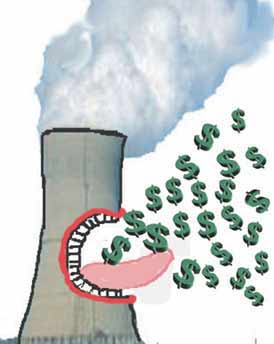 Nuclear power too costly, Ontario Clean Air Alliance argues The Star, John Spears Business Reporter, 20 March 12, Abandoning nuclear power in favour of imported electricity from Quebec and new, high-efficiency natural gas plants, would save Ontario billions, says the Ontario Clean Air Alliance. Continue reading
Quebec rejects uranium mining
 Quebec Says No to Uranium World Business Report, 4 Mar 12, In 2009, on the North-Shore of Quebec, the population of Sept-ÃŽles, with the help of “Sept-ÃŽles sans uranium”, had expressed its opposition against Terre Venture. The population won, and the company abandoned its project. Continue reading
Top medical isotope can be produced without nuclear reactor
 Nuclear medicine has long been touted as a selling point for nuclear power – a kin do healthy fig leaf put over a n unhealthy, toxic industry. – Christina Macpherson
Nuclear Reactors Not Needed to Make the Most Common Medical Isotope, Science Now by Robert F. Service on 20 February 2012, In recent years, hospitals worldwide have been grappling with short supplies of technetium-99 (Tc-99), the most commonly used radioisotope in medical imaging scans. But help may be at hand: A team of Canadian researchers reported today that they’ve made critical progress in developing a stable new supply of the isotope.
Tc-99 is currently produced in nuclear reactors fueled with highly enriched uranium, which has raised concerns that the nuclear fuel could be intercepted by terrorists to make a nuclear weapon. The new setupproduces Tc-99 with a medical cyclotron, thereby eliminating proliferation concerns. But economic and technical considerations may make it more practical for shoring up Tc-99 supplies in Canada than in the United States. Continue reading
Canada denies asylum to Japanese nuclear refugee
“The claimant feared risks of exposure to radiation,” an IRB member said in a ruling. “She was not convinced by the Japanese government’s assurances of safety from radiation.”
The woman was one of hundreds of Japanese citizens who sought refuge in other countries following the March 11, 2011 catastrophe …. A board member said the claimant’s risk “is characterized as being widespread and prevalent in Japan.”
The woman can still appeal her case to the Federal Court of Canada, and that decision can still be appealed. She claimed her life was in danger from radioactive contaminants that spewed into the environment from the Fukushima plant. …..http://cnews.canoe.ca/CNEWS/Canada/2012/02/18/19397881.html
1 This Month
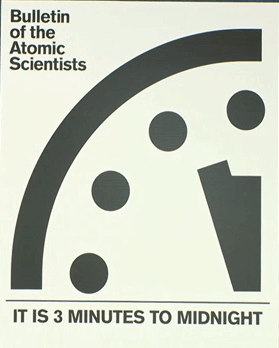
Watch the 2026 Doomsday Clock unveiling live here on January 27 at 10 a.m. EST
To see nuclear-related stories in greater depth and intensity – go to https://nuclearinformation.wordpress.com/

29 Jan. Thursday 7-8 p.m. Webinar – World’s Largest Nuclear Station in Port Hope, ON?


31st January – Challenging the War Machine – a DECLASSIFIED UK SUMMIT


Website of the Week
Now until to February 10, 2026 Radioactive waste storage in France: the debate is finally open! How to participate?
-
Archives
- January 2026 (277)
- December 2025 (358)
- November 2025 (359)
- October 2025 (376)
- September 2025 (258)
- August 2025 (319)
- July 2025 (230)
- June 2025 (348)
- May 2025 (261)
- April 2025 (305)
- March 2025 (319)
- February 2025 (234)
-
Categories
- 1
- 1 NUCLEAR ISSUES
- business and costs
- climate change
- culture and arts
- ENERGY
- environment
- health
- history
- indigenous issues
- Legal
- marketing of nuclear
- media
- opposition to nuclear
- PERSONAL STORIES
- politics
- politics international
- Religion and ethics
- safety
- secrets,lies and civil liberties
- spinbuster
- technology
- Uranium
- wastes
- weapons and war
- Women
- 2 WORLD
- ACTION
- AFRICA
- Atrocities
- AUSTRALIA
- Christina's notes
- Christina's themes
- culture and arts
- Events
- Fuk 2022
- Fuk 2023
- Fukushima 2017
- Fukushima 2018
- fukushima 2019
- Fukushima 2020
- Fukushima 2021
- general
- global warming
- Humour (God we need it)
- Nuclear
- RARE EARTHS
- Reference
- resources – print
- Resources -audiovicual
- Weekly Newsletter
- World
- World Nuclear
- YouTube
-
RSS
Entries RSS
Comments RSS
 nuclear-news