New nuclear reactor plans for Ontario stopped by Federal Court ruling

 Ontario nuclear reactor plans go back to drawing board http://metronews.ca/news/canada/1035484/reactor-plans-go-back-to-drawing-board/TORONTO – A Federal Court ruling has thrown out the preliminary approvals for a series of new nuclear power reactors in Ontario.
Ruling in a case brought by environmental groups, Justice James Russell says the environmental assessment for the proposed expansion of the Darlington nuclear plant fell short.
Russell says the assessment should have examined the environmental effects of radioactive fuel waste, a Fukushima-type accident and hazardous emissions. As a result of the decision, the whole project is stalled until a panel can redo the assessment.
Ontario Power Generation’s plan to expand Darlington has been in the works since 2006 and would have seen up to four new reactors built.
Environmentalists welcomed the ruling.“This is a win for Canadians’ right to meaningfully participate in environmental reviews and understand the risks of nuclear power,” said Theresa McClenaghan, executive director of the Canadian Environmental Law Association. The group was part of the suit, along with Lake Ontario Waterkeeper, Northwatch and Greenpeace.
“This is a common sense ruling,” said Shawn-Patrick Stensil of Greenpeace. “It boggles the mind that the federal authorities approved new reactors without first considering the environmental effects of radioactive waste and reactor accidents.”
The Ontario government decided last October to suspend its reactor plans. But the ruling means that the project cannot be revived without more assessment.
“The Federal Court has confirmed that federal authorities must do more than simply kick the tires before approving new nuclear reactors,” said lawyer Justin Duncan.“Fully assessing radioactive waste, major accidents, and hazardous emissions is essential to protecting the health of Ontarians.”
Quebec’s moratorium on uranium minng extended for another year
Study on impacts of uranium mining to extend Quebec moratorium another year mining.com, Cecilia Jamasmie | May 9, 2014 A group of doctors, environmental groups and First Nations leaders gathered in Montreal Thursday to urge Quebec’s new premier to keep the moratorium on uranium mining until the risks and effects of these kinds of operations on nearby communities have been thoroughly studied.
The suspension of uranium mining in the province came in effect in April last year, making Quebec the third Canadian jurisdiction, after Nova Scotia and British Columbia, to halt exploration and development of these kinds of mines.
The Bureau d’audiences publiques sur l’environnement (BAPE), the province’s environmental watchdog, is currently beginning a yearlong study on the matter, which will be carried out in three phases.
The results of this consultation could be critical for the future of mining in the east-central province, which has been losing its allure to investors in the last few years.
Mining investments in Quebec dropped significantly more than expected last year, plunging about 37% from a record year in 2012, and marking the first annual drop in a decade. The jurisdiction has also fallen in the famous index of mining destinations put together every year by the Fraser Institute, an independent think-tank: From being the No.1 desired place to invest in mining from 2007 to 2010, it barely reached the 11th place out of 96 jurisdictions last year……..http://www.mining.com/study-on-impacts-of-uranium-mining-may-extend-moratorium-indefinitely-report-87731-23280/
Flawed review of Darlington nuclear station
 Darlington nuclear assessment “blinkered,” court told, Toronto Star 7 May 14 Environmental groups told a federal court that the review of the proposal to overhaul the Darlington nuclear station was flawed The agencies who gave the overhaul of the Darlington nuclear station an environmental green light had their “heads in the sand” at the prospect of a catastrophic accident, a federal court was told Tuesday.
“The responsible authorities’ blinkered approach to major accidents is not what Parliament intended,” Richard Lindgren told Mr. Justice Michael Phelan.
Ontario Power Generation (OPG) proposes to overhaul the four reactors at Darlington starting in 2016, extending their lives to 2055.
Greenpeace, the Canadian Environmental Law Association, Lake Ontario Waterkeeper and Northwatch have challenged the environmental approval granted to the project in 2013.
They want the Canadian Nuclear Safety Commission to give it further scrutiny.
In its environmental impact statement, OPG was only required to plan for accidents with the odds of occurring more frequently than once in a million years, per reactor.
In the world of accident assessment, that rules out catastrophic accidents on the scale of Fukushima or Chernobyl, with a widespread release of radiation and the need to evacuate many thousands of people.
“Those kinds of effects were not assessed at all,” Lindgren told the court.
The Canadian Environmental Assessment Act requires the assessment of accidents that “may” occur, he argued………
Darlington’s cooling system draws in cold lake water, circulates it through the plant, and then releases it back into the lake. Some fish are trapped on screens covering the intakes; smaller fish and eggs may be drawn in and killed.
The environmentalists argued for a closed-loop cooling system. http://www.thestar.com/business/economy/2014/05/06/darlington_nuclear_assessment_blinkered_court_told.html
Radiation pollution of Great Lakes – is that really OK?
 Canadian ‘Experts’ Comfy with Radioactive Pollution of Great Lakes http://www.counterpunch.org/2014/05/02/canadian-experts-comfy-with-radioactive-pollution-of-great-lakes/ by JOHN LAFORGE
No matter how cynical you become, it’s never enough to keep up.” — Lily Tomlin
Ontario Power Generation (OPG) — which owns or leases 20 nuclear reactors across Ontario — would save loads of cash by not having to contain, monitor and repackage leaky above-ground radioactive waste storage casks. Last Sept., I testified in Ontario against the company’s plan to deeply bury some of this waste next to Lake Huron.
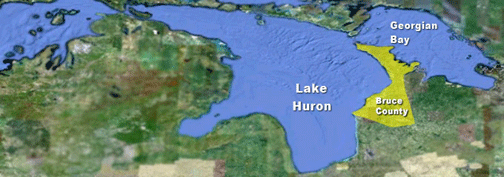
OPG officially plans to let its waste canisters leak their contents, 680 meters underground, risking long-term contamination of the Great Lakes — a source of drinking water for 40 million people including 24 million US residents.
The Bruce reactor complex — the world’s biggest with 8 reactors — is on Huron’s Bruce Peninsula and is the storage site for radioactive waste (other than fuel rods) from all of OPG’s 20 reactors. Digging its dump right next door would save the firm money — and put the hazard out of sight, out of mind.
OPG’s public statements make clear that it intends to poison the public’s water. First, the near-lake dump would be dug into deep caverns of porous limestone. The underground holes are to “become the container” OPG testified last fall, because its canisters are projected to be rotted-through by the waste in 5 years. On April 13 the Canadian government was shocked to learn that OPG grossly understated the severe radioactivity of its waste material, some of which, like cesium, is 1,000 times more radioactive than OPG had officially claimed.
Second, OPG’s callous poisoning plan was broadcast in a December 2008 handout. Radioactive contamination of the drinking water would not be a problem, OPG says, because “The dose is predicted to be negligible initially and will continue to decay over time.”
The ‘expert’ group’s report says it’s possible that as much as 1,000 cubic meters a year of water contaminated with radiation might leach from the dump, but calls such pollution “highly improbable.” (Emphasis on “predicted” and “improbably” here: The US government’s 650-meter-deep Waste Isolation Pilot Project in New Mexico was predicted to contain radiation for 10,000 years. It failed badly on Feb. 14, after only 15.)
OPG’s pamphlet goes further in answer to its own question, “Will the [dump] contaminate the water?” The company claims, “…even if the entire waste volume were to be dissolved into Lake Huron, the corresponding drinking water dose would be a factor of 100 below the regulatory criteria initially, and decreasing with time.”
This fatuous assertion made me ask in my testimony: “Why would the government spend $1 billion on a dump when it is safe to throw all the radioactive waste in the water?” Now, what I thought of then as a rhetorical outburst has become “expert” opinion.
‘Experts’ Unworried About Drinking Industrial Radiation
On March 25, the “Report of the Independent Expert Group” was presented issued to the waste review panel. The experts are Maurice Dusseault, Tom Isaacs, William Leiss and Greg Paoli. They concluded that the “immense” waters of the Great Lakes would dilute any radiation-bearing plumes leaching from the site.
Dusseault advises governments and teaches short courses at the Univ. of Waterloo on oil production, petroleum geomechanics, waste disposal and sand control.
Paoli founded Risk Sciences International and the company’s web site notes his position on Expert and Advisory Committees of Canada’s National Roundtable on the Environment and the Economy.
Isaacs, with degrees in engineering and applied physics, works at the plutonium-spewing Lawrence Livermore National Lab, studying “challenges to the effective management of the worldwide expansion of nuclear energy.” Of course, hiding radioactive waste from public scrutiny is one of his industry’s biggest challenges.
Leiss has degrees in history, accounting and philosophy, and has taught sociology, eco-research, risk communications and health risk assessment at several Canadian universities.
So what level of expertise do the experts bring? None of them have any background in water quality, limnology, radio-biology, medicine, health physics or even radiology, hazardous nuclides, health physics, or radiation risk. As plumes of Fukushima radiation spreading into the Pacific continue to show, the poisons spread from the source and can contaminate entire oceans. Fish large and small, and other organisms, bio-accumulate the cesium, strontium (which persist for 300 years), and cobalt (persisting for 57), etc. in the plumes. The isotopes also bio-concentrate in the food chain as albacore tuna studies repeated in April.
Canada’s expert group’s opinion on how radioactive waste might spread and be diluted in Great Lakes drinking water is inane and meaningless; its cubic meter estimates and risk assessments nothing but fairy tales. You could call the report a rhetorical outburst.
John LaForge works for Nukewatch, edits its Quarterly, and lives at the Plowshares Land Trust out of Luck, Wisconsin.
Investment analysts point to the opportunities in solar power
 Solar Power on the Rise The Motley Fool, By Stephen O’Brien April 28, 2014 “…..The obvious solution is to substitute these fossil fuels with solar power. While the technology to harness the sun’s energy is perpetually being upgraded and refined, solar power is gradually becoming the most attractive choice for many consumers to power their homes, and not only for environmental reasons, but often for the lower costs solar energy is affording.
 The corporate sector has also begun to see solar’s advantages. IKEA has committed to becoming a zero-energy company 2020, and has allotted $2 billion for a number of renewable energy endeavors. It has already installed more than 550,000 solar panels. The company is additionally involved in wind energy, and has established a wind farm about a hundred miles south of Chicago and other wind projects in eight countries. In 2013, renewable energy sources accounted for close to 40% of IKEA’s energy usage.
Aside from such moves by a few of the larger corporations, demand for solar power has been increasing significantly in the U.S. residential market. SunPower (NASDAQ: SPWR ) , a U.S. firm headquartered in San Jose, California, has been leasing its solar-panel systems to over 20,000 U.S. customers.
Demand for solar power around the world is also increasing rapidly. SunPower has offices in Europe, Australia, Africa and Asia to meet the growing cries for sun-generated energy. SunPower recently announced that it has begun selling megawatts of cell packages in inner Mongolia, and plans further moves to serve companies and consumers in China.It will have to contend, however, with the Chinese companies that currently serve the Chinese market, the leaders being Trina Solar (NYSE: TSL ) and JinkoSolar (NYSE: JKS ) .
Solar companies are in their early stages of development, and it is unclear who will become the dominant player a few years from now. Currently, there seems to be plenty of growth ahead for a number of solar companies. SunPower is said to have an advantage in that its solar panels are smaller in size and convert energy efficiently, making them well suited for rooftop installations.
Brean Capital recently initiated coverage on the company’s shares and rated them as a buy. SunPower’s stock currently has a forward price to earnings ratio of under 20, and its five-year growth rate in earnings per share looks to be over 30%, making the stock highly attractive to a longer-term investor who don’t mind price volatility. This company is clearly worth considering when investing in the solar sector, and in clean energy generally.
As the world shifts to solar power due to its increasingly cheaper cost or to ward off environmental catastrophe in the years ahead, a great investment opportunity has presented itself. While there certainly are strong competitors to SunPower, there is also a vast market for solar energy, and SunPower is poised to flourish……http://www.fool.com/investing/general/2014/04/28/solar-power-on-the-rise.aspx
Corruption in Lavalin – company that promotes Small Modular Nuclear Reactors & Thorium
 Burnaby Mayor Derek Corrigan compares BC to living in a banana Republi chttps://www.youtube.com/watch?v=6OWoWOS69Zs “…..Mayor Derek Corrigan spoke passionately about the corrupt business practices of SNC Lavalin, the heavy handedness of the Federal government and the sorry state of communities rights vs multinational corporations……
comment by cheena1ca

Nuclear companies switch to more lucrative business – closing down reactors
OPG, Westinghouse forge nuclear alliance OPG and Westinghouse will join forces to bid for nuclear projects around the globe Toronto Star, By: John Spears Business reporter, Apr 16 2014
Ontario Power Generation will join forces with Westinghouse to bid for nuclear projects around the globe, the companies announced Wednesday.
The news comes the same week that the Ontario government set up a panel headed by TD Bank chairman Ed Clark to consider privatization – or other strategies – for provincial assets.
OPG is 100 per cent owned by the province.
“Under the agreement, the companies will consider a diversity of nuclear projects including refurbishment, maintenance and outage services, decommissioning and remediation of existing nuclear power plants, and new nuclear power plants,” OPG said a release.

Westinghouse will work directly with Canadian Nuclear Partners, a subsidiary of OPG headed by Pierre Tremblay….http://www.thestar.com/business/2014/04/16/opg_westinghouse_forge_nuclear_alliance.html
Canada narrows list of possible locations for nuclear waste facility
Some were also drawn by the fact that for taking part in the selection process, they’ll get $400,000 even if they’re not chosen, providing they advance far enough in the process and a DGR is ultimately approved.

7 of 22 municipalities dropped from list of potential sites
By Rick MacInnes-Rae, CBC News Posted: Apr 09, 2014
(Interactive map showing locations of possible nuclear dump sites on link)
Canada is a step closer to picking a place to store spent nuclear fuel underground for the next 100,000 years, a project that’s backfired on some of the world’s other nuclear economies.
Despite the stigma of radioactivity, 22 Canadian municipalities expressed interest in hosting such a facility. Four have now been moved up the list for further evaluation, while seven have been rejected as not suitable. The other 11 are still in the initial assessment phase.
Final approval could take another couple of decades, but if a site is found and approval given to build a Deep Geologic Repository (DGR), the project will generate thousands of jobs, some lasting generations.
Billions would be spent constructing a vast warehouse over 500 metres underground to contain some of the most radioactive waste in the world.
Deadly byproduct
Nuclear energy has helped meet Canada’s electricity needs for more than 40 years, but a deadly byproduct has been steadily building up as a result.
There’s a growing inventory of spent uranium pellets. The radioactive pellets are stored inside long silver tubes bundled together like 24-kilogram logs.

Spent uranium pellets from nuclear reactors are stored inside long silver tubes that are bundled together like 24-kilogram logs.
Heading the search for a secure place to store those tubes is the Nuclear Waste Management Organisation (NWMO), funded by Canada’s four nuclear agencies, which describes the situation this way: “If Canada’s entire current inventory of just over two million used fuel bundles could be stacked end-to-end, like cordwood, it would fit into six NHL-sized hockey rinks from the ice surface to the top of the boards.”
At present, spent fuel is stored at seven different sites across Canada, including at the reactors it once powered. But that’s not a long-term solution, because in time those reactors will be decommissioned and dismantled.
In its quest for a site, the NWMO took the novel step of asking Canadian communities if they’d think about hosting the highly-radioactive payload.
“Well, we didn’t know what to expect” said Jo-Ann Facella, director of social research and dialogue at the NWMO.
“We put out the plan that Canadians had come forward with and the government had selected as Canada’s plan. And an important part of that plan, it emerged from Canadians, is that these facilities only be implemented in a willing host.”
What also came back were expressions of interest from 22 different municipalities, tempted in part by the promise of employment if they’re chosen. Some were also drawn by the fact that for taking part in the selection process, they’ll get $400,000 even if they’re not chosen, providing they advance far enough in the process and a DGR is ultimately approved.
Increasing levels of radioactive cesium in Vancouver area
 Radio: “Surprisingly, high concentrations [of Fukushima cesium] found in Vancouver area” since ocean currents slow down — Levels are increasing — “Might be hotspots where radiation concentrates” — “Chances are high for marine life to absorb it… concern about mussels… clams, oysters” (AUDIO) http://enenews.com/radio-surprisingly-high-concentrations-fukushima-cesium-found-vancouver-area-because-movement-ocean-currents-june-last-year-increasing-levels-found-be-hotspots-radiation-concentrate-chances-h?utm_source=feedburner&utm_medium=email&utm_campaign=Feed%3A+ENENews+%28Energy+News%29
RED 93.1FM (Vancouver, BC), “The Filipino Edition”, Mar. 30, 2014:
Joseph Lopez, reporter: In the Vancouver area, as of June last year […] there are increasing levels of cesium-134, the same isotope released from Fukushima. […]
Irene Querubin, host: I hope we’re not slowly dying by that.
At 7:00 in
Lopez: There’s a strong current called the Kuroshio current […] these are highways in the ocean […] it’s one of the strongest water currents […] and this current passes through Fukushima but it is so strong it helps keep the radiation levels in the Fukushima area lower, it blows it away. […] These radioactive isotopes, in a slower speed — because they’re slowing down in these areas like Vancouver […] where the water is not as fast as in the ocean, there’s a chance for the radioactive isotopes to settle down and be in the water and possibly be absorbed by bottom feeders. […] The radioactive isotopes [are] not observed much in Japan, in the Fukushima area, surprisingly […] but the current pulls it away and acts as a boundary because it’s so fast. Once the speed slows down in our area, the chances are high for the marine life to absorb it.
At 11:00 in
Lopez: They’re not doing any testing right now, that’s why the public should be concerned […] We don’t know why they’re not doing it. They should be doing it. […] It is true that the Pacific Ocean will dilute the radiation, but what they found is there might be hotspots where this radiation might be concentrated. And surprisingly the high concentrations have been found in the Vancouver area because in these waters there’s less movement, less speed. […] I’m surprised that Dr. Smith of the Department of Fisheries and Oceans would categorically state that there’s a zero chance of starfish die-off [being related to radioactive contamination]. It’s like saying the Titanic will never sink. […] I would be concerned about mussels as well […] and clams and oysters, because they are filters. […] Remember no  level of radiation is ever safe.Full broadcast available here
Carbon tax works to reduce greenhouse emissions and benefit economy
How British Columbia Enacted the Most Effective Carbon Tax in North America, the Atlantic Cities, CHRIS MOONEY, 26 MARCH 14, Suppose that you live in Vancouver and you drive a car to work.  Naturally, you have to get gas regularly. When you stop at the pump, you may see a notice like the one below, explaining that part of the price you’re paying
is, in effect, due to the cost of carbon. That’s because in 2008, the government of British Columbia decided to impose a tax on greenhouse gas emissionsfrom fossil fuels, enacting what has been called ”the most significant carbon tax in the Western Hemisphere by far.”
- A carbon tax is just what it sounds like: The BC government levies a fee, currently 30 Canadian dollars, for every metric ton of carbon dioxide equivalent emissions resulting from the burning of various fuels, including gasoline, diesel, natural gas, and, of course, coal. That amount is then included in the price you pay at the pump—for gasoline, it’s 6.67 cents per liter (about 25 cents per gallon)—or on your home heating bill, or wherever else the tax applies. (Canadian dollars are currently worth about 89 American cents).
-
If the goal was to reduce global warming pollution, then the BC carbon tax totally works. Since its passage, gasoline use in British Columbia has plummeted, declining seven times as much as might be expected from an equivalent rise in the market price of gas, according to arecent study by two researchers at the University of Ottawa. That’s apparently because the tax hasn’t just had an economic effect: It has also helped change the culture of energy use in BC. “I think it really increased the awareness about climate change and the need for carbon reduction, just because it was a daily, weekly thing that you saw,” says Merran Smith, the head of Clean Energy Canada. “It made climate action real to people.”
It also saved many of them a lot of money. Sure, the tax may cost you if you drive your car a great deal, or if you have high home gas heating costs. But it also gives you the opportunity to save a lot of money if you change your habits, for instance by driving less or buying a more fuel-efficient vehicle. That’s because the tax is designed to be “revenue neutral”—the money it raises goes right back to citizens in the form of tax breaks. Overall, the tax has brought in some $5 billion in revenue so far, and more than $3 billion has then been returned in the form of business tax cuts, along with over $1 billion in personal tax breaks, and nearly $1 billion inlow-income tax credits (to protect those for whom rising fuel costs could mean the greatest economic hardship). According to the BC Ministry of Finance, for individuals who earn up to $122,000, income tax rates in the province are now Canada’s lowest.
So what’s the downside? Well, there really isn’t one for most British Columbians, unless they drive their gas-guzzling cars a lot. (But then, the whole point of taxing carbon is to use market forces to discourage such behavior.) The far bigger downside is for Canadians in other provinces who lack such a sensible policy—and especially for Americans. In the United States, the idea of doing anything about global warming is currently anathema, even though addressing the problem in the way that British Columbia has done would help the environment and could also put money back in many people’s pockets. Such is the depth of our dysfunction; but by looking closely at British Columbia, at least we can see that it doesn’t have to be that way……….
- The tax has actually become quite popular. “Polls have shown anywhere from 55 to 65 percent support for the tax,” says Stewart Elgie, director of the University of Ottawa’s Institute of the Environment. “And it would be hard to find any tax that the majority of people say they like, but the majority of people say they like this tax.”It certainly doesn’t hurt that the tax, well, worked. That’s clear on at least three fronts: Major reductions in fuel usage in BC, a corresponding decline in greenhouse gas emissions, and the lack of a negative impact on the BC economy……..
- The bottom line, then, is that BC’s experience provides an exclamation point at the end of the long list of reasons to like a carbon tax. Perhaps the leading one, in the end, is that it’s a far simpler policy option than a cap and trade scheme, and is, as Harvard economist and Bush administration Council of Economic Advisers chair N. Gregory Mankiw has put it, “more effective and less invasive” than the sort of regulatory approaches that the government tends to implement.Indeed, economists tend to adore carbon taxes. When the IGM forum asked a group of 51 prominent economists whether a carbon tax would be “a less expensive way to reduce carbon dioxide emissions than would be a collection of policies such as ‘corporate average fuel economy’ requirements for automobiles,” assent was extremely high: 90 percent either agreed or strongly agreed. Yale economist Christopher Udry commented, “This is as clear as economics gets; provides incentives to find minimally costly ways to reduce emissions.”
“Totally basic economics!” added Stanford’s Robert Hall.
Since 2012, British Columbia has not raised the carbon tax further. Instead, the government agreed to freeze the rate as it is for five years. And no wonder: BC is now far ahead of most of its neighbors, and most of North America, in taking action to curtail global warming………
- In the meantime, BC can boast of the crown jewel of North American climate policy. “BC now has the lowest fuel use in Canada, the lowest tax rates in Canada, and a pretty healthy economy,” says the University of Ottawa’s Stewart Elgie. “It works.”http://www.theatlanticcities.com/jobs-and-economy/2014/03/how-british-columbia-enacted-most-effective-carbon-tax-north-america/8732/
Ontario Power Generation underestimated radiation levels for planned waste storage site
 Bruce waste site radiation understated, says former OPG scientist A scientist who formerly worked for OPG says the company has understated radiation levels in waste destined for a storage site near Kincardine Stzar.com By: John Spears Business reporter, Feb 28 2014 A former research scientist with Ontario Power Generation says the company has “severely underestimated” the level of radioactivity of material destined for a waste storage site near Kincardine.
Dr. Frank R. Greening’s letter to a federal panel reviewing the site says that OPG has understated the extent of radiation in material destined for the proposed site, “sometimes by factors of more than 100.”…… Continue reading
Nova Scotia’s renewable energy success
Nova Scotia set to exceed renewable energy targets: minister http://globalnews.ca/news/1108849/nova-scotia-set-to-exceed-renewable-energy-targets-minister/ By Brett Ruskin Global News HALIFAX — Nova Scotia’s Minister of Energy says the province is on track to exceed its renewable energy goals.
In 2010, the government passed a law requiring 25 per cent of the province’s power to come from renewables — like wind and hydro — by 2015. The law’s second target is set at 40 per cent by 2020.
“We have no concerns about meeting that 25 per cent,” said Andrew Young, Nova Scotia’s Minister of Energy.
“In fact, we expect that that will be exceeded.”
A more accurate measure of how much renewable energy Nova Scotia generates is expected in two to three weeks.Nova Scotia’s 40 per cent renewable target for 2020 should be easily met as well. “The fact that we have the Maritime Link coming on stream,” said Younger, “we’re not concerned about meeting the 40 per cent target.”
Younger’s comments come the same week the government announced plans to reinvigorate Nova Scotia’s tidal power opportunities. Companies looking to sell tidal power to the grid can now apply for feed-in tariffs, outlined by a Utility and Review Board decision.In March, the government will grant access to two undersea berths for companies to test tidal technology and possibly begin feeding small amounts of tidal power to the grid.
Canada joins the scramble to sell uneconomic nuclear power to India
India, Canada aim for closer ties , THE HINDU, SANDEEP DIKSHIT , 15 DEC 13 After 40 years, the countries are entering into partnership in civil nuclear energy

India and Canada are aiming for closer partnerships in civil nuclear energy and hydrocarbons with the dissipation of distrust that had kept them estranged for 40 years after India conducted a nuclear test in 1974……relationship would be supplemented by a “collaborative approach” in the civil nuclear sector, decks for which have been cleared with the signing of a civil nuclear accord and finalising of the administrative arrangements, High Commissioner for Canada to India Stewart Beck told The Hindu…….
“We are now putting in force a civil nuclear partnership. India has several reactors derived from Canadian technology but since then it has gone on its own path of development. We are now in a situation where the two can talk to each other. There is a huge need in India of Uranium which we can sell,” said Mr. Beck……http://www.thehindu.com/news/national/india-canada-aim-for-close-partnership-in-civil-nuclear-deal/article5462847.ece
US politicians and indigenous people fight Lake Huron nuclear waste dump
Saugeen Ojibwe and U.S. Politicians Oppose Nuclear Waste Burial Near Lake Huron, Indian Country, Martha Troian12/12/13
A controversial proposal to bury nuclear waste a half mile from Lake Huron’s shoreline in Ontario is proceeding over indigenous objections in a plan that has repercussions on both sides of the U.S.–Canada border.
Opposition to the plan, which would inter low- and intermediate-level radioactive waste about 2,230 feet underground in solid rock, is sparking opposition from Indigenous Peoples and U.S. politicians alike. …… Continue reading
Canada joins the scramble of marketing nukes to India
 Canada wants relaxation in India’s nuclear liabilities rules THE HINDU, 1 Dec 13 Unless the provisions regarding a plant operators’ liabilities in case of nuclear damages are relaxed, foreign
  companies will not come in a big way, a senior Canadian government official has said.
“The way the liability has been framed in the Civil Nuclear Liability Act deviates from the global standards and it is our view if it is not modified, it is hard to see any foreign supplier coming in a big way to India,” Canadian consulate general Richard Bale told PTI on the sidelines of the nuclear summit here over the weekend.
As per the Act, an operator of a nuclear plant (so far only NPCIL) will be liable for damages worth up to Rs. 1,500 crore. However, there is a provision for the right of recourse for the operator. If written into the contract, the operator can claim the liabilities from the manufacturer and supplier. Most of the suppliers, domestic as well as international, are concerned over whether they will have to bear over Rs. 1,500 crore towards in the event of nuclear disaster.
“It is the government’s prerogative to determine what the public policy should be. But on the one hand the government is saying it wants to expand the nuclear power programme, on the other they have put in place a framework that makes it difficult to achieve that goal,” Mr. Bale said…… http://www.thehindu.com/news/national/canada-wants-relaxation-in-indias-nuclear-liabilities-rules/article5410644.ece
1 This Month
Watch the 2026 Doomsday Clock unveiling live here on January 27 at 10 a.m. EST

To see nuclear-related stories in greater depth and intensity – go to https://nuclearinformation.wordpress.com/

29 Jan. Thursday 7-8 p.m. Webinar – World’s Largest Nuclear Station in Port Hope, ON?


31st January – Challenging the War Machine – a DECLASSIFIED UK SUMMIT


Website of the Week
Now until to February 10, 2026 Radioactive waste storage in France: the debate is finally open! How to participate?
-
Archives
- January 2026 (277)
- December 2025 (358)
- November 2025 (359)
- October 2025 (376)
- September 2025 (258)
- August 2025 (319)
- July 2025 (230)
- June 2025 (348)
- May 2025 (261)
- April 2025 (305)
- March 2025 (319)
- February 2025 (234)
-
Categories
- 1
- 1 NUCLEAR ISSUES
- business and costs
- climate change
- culture and arts
- ENERGY
- environment
- health
- history
- indigenous issues
- Legal
- marketing of nuclear
- media
- opposition to nuclear
- PERSONAL STORIES
- politics
- politics international
- Religion and ethics
- safety
- secrets,lies and civil liberties
- spinbuster
- technology
- Uranium
- wastes
- weapons and war
- Women
- 2 WORLD
- ACTION
- AFRICA
- Atrocities
- AUSTRALIA
- Christina's notes
- Christina's themes
- culture and arts
- Events
- Fuk 2022
- Fuk 2023
- Fukushima 2017
- Fukushima 2018
- fukushima 2019
- Fukushima 2020
- Fukushima 2021
- general
- global warming
- Humour (God we need it)
- Nuclear
- RARE EARTHS
- Reference
- resources – print
- Resources -audiovicual
- Weekly Newsletter
- World
- World Nuclear
- YouTube
-
RSS
Entries RSS
Comments RSS
 nuclear-news