Uranium shipments suspended by Cameco, Areva , due to Saskatchewan fires
Climate change is bringing heatwaves, which bring wildfires, which bring added dangers to all phases of the nuclear fuel chain

 Cameco, Areva suspend uranium shipments due to Saskatchewan fires http://globalnews.ca/news/2102099/cameco-and-areva-suspend-uranium-shipments-due-to-saskatchewan-fires/ By Staff The Canadian Press CALGARY, 10 July 15 – Cameco Corp. and Areva Resources Canada have stopped shipping uranium from their northern Saskatchewan operations after wildfires made highway transportation unsafe. Cameco spokesman Gord Struthers says the company suspended shipments from the mines in the region about a week ago.
Areva spokeswoman Veronique Larlham says that company did the same a few days ago.
READ MORE: Increased wildfire behaviour expected in Saskatchewan due to weather
But both say their overall uranium deliveries are continuing normally because they have large inventories.
The operations affected are Cameco’s Rabbit Lake mine, McArthur River mine and Key Lake mill, the Cameco-Areva jointly-owned Cigar Lake mine, and Areva’s McClean Lake mill.
Reject Nunavut board’s recommendation against uranium project – AREVA urges Canadian govt
 Areva urges minister to reject Nunavut board’s disapproval of uranium project CBC News Jul 08, 2015 The company that wants to eventually open a uranium mine near Baker Lake, Nunavut, is asking the federal government to reject a territorial regulator’s recommendation that the project not be approved.
In May, following a multi-year environmental impact review, the Nunavut Impact Review Board (NIRB) said Areva Resources Canada’s Kiggavik project should not be approved because it doesn’t have a construction timeline attached to it.
But whether the project can proceed is ultimately up to Aboriginal Affairs and Northern Development Minister Bernard Valcourt. Areva has written Valcourt asking him to send the recommendation back to NIRB and direct NIRB to “consider the inclusion of appropriate terms and conditions to a project approval.”..http://www.cbc.ca/news/canada/north/areva-urges-minister-to-reject-nunavut-board-s-disapproval-of-uranium-project-1.3142869
Organization of Canadian Nuclear Industries (OCI) to work with Romania to market nuclear reactors
 MOU promotes stronger ties among Canadian and Romanian nuclear suppliers Market Watch, BUCHAREST, Romania, Jul 2, 2015 (Canada NewsWire via COMTEX) — The Organization of Canadian Nuclear Industries (OCI) is proud to announce the signing today of a Memorandum of Understanding (MOU) with the Romanian Atomic Forum Association (ROMATOM)……..
The Partnering Workshop included an update on the planned Cernavoda 3/4 CANDU project as well as presentations by Canadian and Romanian nuclear suppliers on their nuclear capabilities and experience along with discussions on their mutual interest in collaborating on the Cernavoda 3/4 CANDU Project.
This MOU outlines several ways that OCI and ROMATOM will work together including identifying opportunities at nuclear projects in Romania, Canada, and other countries on which OCI and ROMATOM companies can cooperate. The OCI-ROMATOM MOU will also encourage and facilitate cooperation among Canadian and Romanian nuclear research institutes and universities on nuclear research, development, and nuclear education……..
The Canada-Romania Cernavoda 3/4 Supply Chain Partnering Workshop was the focal point of a three day 12 company OCI-led Trade Mission to Romania that kicked off with a July 1 Canada Day Celebration hosted by the Canadian Embassy …… The Trade Mission to Romania was supported by co-funding from Global Opportunities for Associations (GOA) program through which the Foreign Affairs, Trade and Development Canada (DFATD) encourages and supports trade associations in taking member companies into promising export markets.
Organization of Canadian Nuclear Industries (OCI) is an association of 180 leading Canadian suppliers to the nuclear industry in Canada and foreign markets. OCI…provides……engineering services and support to CANDU nuclear power plants in Canada as well as to CANDU and Light Water Reactor (LWR) plants in offshore markets. OCI promotes the continued and expanded use of nuclear energy in Canada and supports member companies in both domestic and international nuclear markets………http://www.marketwatch.com/story/mou-promotes-stronger-ties-among-canadian-and-romanian-nuclear-suppliers-2015-07-02
Canada’s last shipment of weapons grade uranium. Medical radioisotopes to be made in cyclotron, not nuclear reactor
The Chalk River reactor, which began operating in 1957, is one of five major producers of molybdenum-99, which decays into the technetium-99m isotope used in 85 per cent of nuclear medicine procedures such as bone scans and other diagnostic tests.
 Other sources, such as a cyclotron operated by TRIUMF, Canada’s national nuclear laboratory for particle and nuclear physics at the University of British Columbia, are in the works.
Final shipment of weapons-grade uranium due at Ontario facility this year http://www.thestar.com/news/canada/2015/06/29/final-shipment-of-weapons-grade-uranium-due-at-ontario-facility-this-year.html By: Joanna Smith Ottawa Bureau reporter, Jun 29 2015
OTTAWA—The United States has approved what is expected to be the last shipment of weapons-grade uranium to be sent to Canada for the production of medical isotopes. The U.S. Nuclear Regulatory Commission signed an export licence June 23 to transport 8.1 kilograms of highly enriched uranium from Oak Ridge, Tenn., along a secret route to Chalk River, Ont., by the end of this year.
There, for what is expected to be the last time, the uranium will be used to produce target material for the aging National Research Universal (NRU) reactor to irradiate in order to produce medical isotopes used in nuclear medicine.
“The game is over for Canada’s unnecessary and irresponsible use of bomb-grade uranium to produce medical isotopes. Better late than never,” Alan Kuperman, coordinator of the Nuclear Proliferation Prevention Project at the University of Texas at Austin, said in a statement Monday.
THE LAST SHIPMENT Kuperman has long been tracking the controversial U.S. exports of highly enriched uranium to Canada. The Conservative government has committed to shutting down the routine production of medical isotopes at the NRU by Oct. 31, 2016, with the possibility of the NRU retaining licences to operate until March 2018 in case of unexpected shortages. The isotope has a very short lifespan, causing it to disappear within a day of being generated and so it cannot be stockpiled.
Public can comment on designated “potential conditions.” for Ontario nuclear waste dump
Canada opens comment period on nuclear dump proposed for Lake Huron http://www.voicenews.com/articles/2015/06/14/news/doc557af82e523ff381884332.txt , June 14, 2015 By Jim Bloch
As a result, the agency has extended the timeline for a final decision by Minister of the Environment Leona Aglukkaq on the Environmental Assessment of the dump by 90 days. The deadline is now Dec. 2.
“It is interesting that the Minister of the Environment’s decision on the nuclear waste dump is being postponed from Sept. 3 until December, which falls after the federal election in October,” said Beverly Fernandez, founder of the Canadian organization Stop the Great Lakes Nuclear Dump.
Critics of nuclear power were aghast at the Joint Panel’s decision in May to endorse the dump.
Western Michigan native Kevin Kamps works as a nuclear waste specialist for the Maryland-based Beyond Nuclear, an anti-nuclear group that supports renewable energy and nuclear disarmament. Kamps condemned the Joint Panel’s decision to endorse the dump, calling OPG’s proposal “insane” and labeling it “a declaration of war against the Great Lakes.”
Kamps is expected to speak about ways to stop the dump at 7 p.m. June 16 at the Donald Dodge Auditorium at the St. Clair County Administration Building, located at 200 Grand River Ave. in Port Huron.
Legal action against Canada’s nuclear waste plan for Lake Huron area
 Burial of nuclear waste near Lake Huron subject of legal action The Canadian Press Jun 12, 2015 A review panel decision in favour of a plan to bury dangerous nuclear waste near Lake Huron was illegal and unreasonable, a citizen’s group argues in a new Federal Court application.
In asking the court to set aside the decision, the group says the panel that approved the Ontario Power Generation proposal failed to consider Canada’s international obligations, was biased, and violated the Canadian environmental rules.
“The (panel) erred in failing to require OPG to fully study accidents and malfunctions that would result in adverse effects to human health and safety and to the environment,” the application by Save our Saugeen Shores states.
“(It) erred in failing to require OPG to adequately evaluate the potential for reasonably foreseeable or unplanned events, singly or in combination, to produce significant short- and long-term adverse effects on the Great Lakes Basin ecosystem, home to 40 million people and containing 20 per cent of the world’s fresh water.”
Approval of the billion-dollar deep geological repository near Kincardine, Ont., along with any conditions currently rests with federal Environment Minister Leona Aglukkaq, who has delayed making a decision until December — after the fall election………..
More than 150 communities — many in the United States — have passed resolutions against any storage of nuclear waste near the Great Lakes.
The federal court application argues Ontario Power Generation failed to take into account Canada and Ontario’s obligations to be “good neighbours” to the U.S. and individual states.
“No Canadian representative, whether formally or informally, notified the United States of the proposal,” the application states………Jill Taylor, president of Save Our Saugeen Shores, said the federal government cannot expect industry and the public to respect environmental laws and processes when it has failed to do so. The project is simply too risky, she said, noting last year’s failure at an American underground nuclear waste site in New Mexico.
“To risk contaminating (Great Lakes) water with nuclear waste that will remain highly radioactive for 100,000 years is unthinkable,” Taylor said. http://www.cbc.ca/news/canada/toronto/burial-of-nuclear-waste-near-lake-huron-subject-of-legal-action-1.3111403
A Marine Food Web Bioaccumulation model for Cesium 137 in the Pacific Northwest

July 2, 2014
The Fukushima nuclear accident on 11 March 2011 emerged as a global threat to the
conservation of the Pacific Ocean, human health, and marine biodiversity.
On April 11 (2011), the Fukushimanuclear plant reached the severity level 7, equivalent to that of the 1986-Chernobyl nuclear disaster.
This accident was defined by the International Atomic Energy Agency as “a major release of radioactive material with widespread health and environmental effects requiring implementation of planned and extended countermeasures”.
Despite the looming threat of radiation, there has been scant attention and inadequate radiation monitoring.
This is unfortunate, as the potential radioactive contamination of seafoods through bioaccumulation of radioisotopes (i.e. 137Cs) in marine and coastal food webs are issues of major concern for the public health of coastal communities.
While releases of 137Cs into the Pacific after the Fukushima nuclear accident are subject to high degree of dilution in the ocean, 137Cs activities are also prone to concentrate in marine food-webs. With the aim to track the long term fate and bioaccumulation of 137Cs in marine organisms of the Northwest Pacific, we assessed the bioaccumulation potential of 137Cs in a North West Pacific foodweb by developing, applying and testing a simulation time dependent bioaccumulation model in a marine mammalian food web that includes fish-eating resident killer whales (Orcinus orca) as the apex predator.
The model outcomes showed that 137Cs can be expected to bioaccumulate gradually over time in the food web as demonstrated through the use of the slope of the trophic magnification factor (TMF) for 137Cs, which was significantly higher than one (TMF > 1.0; p < 0.0001), ranging from 5.0 at 365 days of simulation to 30 at 10,950 days.
From 1 year to 30 years of simulation, the 137Cs activities predicted in the male killer whale were 6.0 to 182 times 137Cs activities in its major prey (Chinook salmon, Oncorhynchus tshawytscha). Bioaccumulation of 137Cs was characterized by slow uptake and elimination rates in upper trophic level.
Source :
http://www.researchgate.net/publication/268982476_A_Marine_Food_Web_Bioaccumulation_model_for_Cesium_137_in_the_Pacific_Northwest
Canadian News media criticised for trivialising nuclear waste dumping
 Toxic editorial at best http://blogs.windsorstar.com/open-newsroom/letters/toxic-editorial-at-best BEVERLY FERNANDEZ, Spokesperson, Stop The Great Lakes Nuclear Dump, Southampton, Ont. Jun 04, 2015 Re: We must dispose of nuclear waste here, Star editorial, May 30. I take exception to this editorial.The Star is entitled to its opinion, but be sure to get the facts correct. You state “the stuff … is garden-variety stuff found in every neighbourhood”.
The Kincardine nuclear waste dump will bury low and intermediate level nuclear waste. Intermediate waste includes resins and components from within the nuclear reactors themselves. These remain radioactive for 100,000 years.
I don’t know what kind of neighbourhood Star staff live in, but the vast majority of neighbourhoods do not hold lethal nuclear waste that remains radioactive for 100,000 years. Stating “the stuff just isn’t that scary or unusual” is completely misleading.
You state, “a virtually impossible leak of a barely hazardous substance.” We are not talking dental X-rays. We are talking about the most lethal material humans have ever created.
There are only three deep dumps that held radioactive nuclear waste on our entire planet. All three failed.The most recent is Waste Isolation Pilot Plant in New Mexico. It was to hold radioactive weapons waste safely for 10,000 years.WIPP is similar in depth and design to the Kincardine dump. In 2014, WIPP leaked a mere 15 years into its operational phase. It contaminated 22 workers. Radioactivity travelled to the next town.
On planet Earth, history proves a 100 per cent failure rate for nuclear waste dumps. So much for your “virtually impossible leak” theory.Ontario contains over a million square kilometres and no other sites were considered. Is the drinking water of 40 million people of so little concern?
Abandon Great Lakes Nuclear Dump Plan – urge Great Lakes Waterkeepers and Waterkeeper Alliance
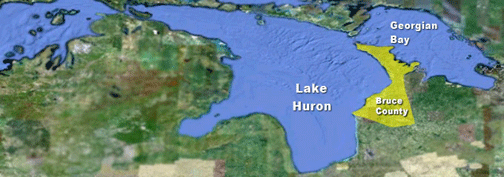 Great Lakes Waterkeepers and Waterkeeper Alliance Urge Canadian Authorities to Ditch the Great Lakes Nuclear Dump http://waterkeeper.org/2015/05/27/great-lakes-waterkeepers-and-waterkeeper-alliance-urge-canadian-authorities-to-ditch-the-great-lakes-nuclear-dump/ May 27 2015 by Maia Raposo Groups Renew Plea to U.S. Secretary of State to Oppose Threat to Drinking Water Supply for 40 Million People
NEW YORK, NY – May 27, 2015 – Environmentalists in the Great Lakes Basin are opposed to a new report from a Canadian Joint Review Panel that has called for the support of the Canadian Minister of the Environment to approve a deep geological repository for nuclear waste in Kincardine, Ontario due to its proximity to drinking water supplies for 40 million people in the United States and Canada. The proposed plan from Ontario Power Generation (OPG) is to store underground radioactive nuclear waste less than one mile from the shores of Lake Huron. Canadian officials are getting closer to approving this hazardous project and could even fast track the authorization of a final license within the next few months.
Under the Binational Great Lakes Water Quality Agreement (amended in 2012), both Canada and the US acknowledge the importance of anticipating, preventing, and responding to threats to the waters of the Great Lakes. Both countries share the responsibility and obligation to protect these shared waters from pollution.
“Great Lakes Waterkeepers and Waterkeeper Alliance oppose this project, which could threaten the drinking water supply of 40 million Americans and Canadians,” said Bob Burns, Detroit Riverkeeper. “We ask the U.S. State Department to stand with the citizens, local and state governments, and other stakeholders in the Great Lakes Basin whose voices have not yet been heard but who are at risk if the deep geological repository fails.”
Last September, the groups wrote to Secretary of State John Kerry and Canadian officials urging them to vote against this nuclear storage facility.
“With the Great Lakes containing 95% of the North America’s supply of fresh surface water, this is one of the worst possible locations for a permanent nuclear waste burial facility,” stated Doug Martz, St. Clair Channelkeeper. “Ontario Power Generation, the project proponent, did not investigate any other sites for this repository, but rather, selected the site based on the willingness of one local community. Furthermore, approval of this facility would set a devastating precedent for allowing other nuclear waste repositories to be located in the Great Lakes Basin.”
Marc Yaggi, executive director of Waterkeeper Alliance added: “The Great Lakes are suffering from failing infrastructure, contamination leaching from historical industrial and nuclear waste sites, ongoing agricultural pollution and invasive species. Intentionally siting a new toxic nuclear waste site in such close proximity to the largest fresh water system in the world would severely imperil the water security of two nations. The time to act is now, and we call again on Secretary Kerry to take action.”
The eight Waterkeeper organizations in the Great Lakes support proposed resolutions in the U.S. House of Representatives and Senate to urge government action to ensure that the Canadian Government does not permanently store nuclear waste underground in the Great Lakes Basin.
Contacts:
Tina Posterli, Waterkeeper Alliance, tposterli@waterkeeper.org, 516.526.9371
Doug Martz, St. Clair Channelkeeper, channelkeeper@wowway.com, 586.764.2443
Bob Burns, Detroit Riverkeeper, rlb315@comcast.net, 734.676.4626
###
Waterkeeper Alliance is a global movement uniting more than 250 Waterkeeper organizations around the world and focusing citizen advocacy on issues that affect our waterways, from pollution to climate change. Waterkeepers patrol and protect more than 2 million square miles of rivers, streams and coastlines in the Americas, Europe, Australia, Asia and Africa. For more information please visit:www.waterkeeper.org
The 8 Waterkeeper organizations in the Great Lakes are: Buffalo Niagara Riverkeeper, Detroit Riverkeeper, Grand Traverse Baykeeper, Lake Erie Waterkeeper, Milwaukee Riverkeeper, St. Clair Channelkeeper, Upper St. Lawrence Riverkeeper and Yellow Dog Riverkeepe
Potassium iodate pills for Canadian communities near nuclear facilities
 KI pill distribution coming near Pickering, Darlington nuclear stations OPG developing extensive awareness campaign prior to fall distribution Ajax News Advertiser By Keith Gilligan DURHAM 24 May 15 — Ontario Power Generation is planning an extensive public relations campaign prior to distributing potassium iodide (KI) pills near the Pickering and Darlington nuclear stations.
Last year, OPG’s federal regulator, the Canadian Nuclear Safety Commission, mandated that KI pills be distributed to all homes and businesses within a 10-kilometre radius of nuclear stations.
Kevin Powers, the director of corporate relations and communications for OPG, told the Pickering Community Advisory Council on Tuesday, May 19 that distributing the pills is “quite a change in what our normal operations are.”
To better understand public knowledge of the pills, OPG has been doing research, Mr. Powers noted.“We did research to understand attitudes on KI pills. We wanted a better understanding of what their understanding was,” he said.
He noted only seven per cent of residents currently have the pills in their homes……… Distribution of pills has been done in New Brunswick and Quebec. It’s being done around the Pickering, Darlington and Bruce stations this year.
Pills are currently in some pharmacies within the 10-kilometre radius, “but not many people know. This change is in how we distribute them,” Mr. Powers noted…… The pills will continue to be available at pharmacies, he said. That’s because people might not get enough pills at their home or have moved and don’t have the pills.
“The CNSC mandated that pharmacies within 50 kilometres have the pills,” Mr. Powers said. http://www.durhamregion.com/news-story/5636397-ki-pill-distribution-coming-near-pickering-darlington-nuclear-stations/
Nuclear waste dump near the Great Lakes – just a LOCAl issue?
Deep Ground Repository for nuclear waste has local support and regional opposition, Radio Canada International By Carmel Kilkenny | english@rcinet.ca Monday 18 May, 2015 , The Deep Ground Repository (DGR) proposed for Kincardine in Southwestern Ontario, will be the topic of many conversations over this annual Victoria Day holiday weekend….
A kilometre from the shore of Lake Huron,
The Bruce power station is the largest operating nuclear power plant in the world, with 4,000 employees drawn from several small communities around it. The majority here support the DGR, which will store over 200,000 cubic metres of low and intermediate radioactive waste from the Bruce, as well as the Pickering and Darlington nuclear power stations.
But farther away, and in the large urban centres of Toronto, and Chicago, the DGR is the subject of a divisive debate with thousands signing petitions and filing official objections to the proposal. The biggest complaint is the proximity of the DGR to the Great Lakes basin.
Rolling Stewardship
At just over a kilometre from the shore of Lake Huron, many fear the future of 40 million people, on both sides of the Canada-US border, could be at stake in the event of an accident or an unforeseen event.
Mayor Keith Hobbs of Thunder Bay, Ontario, a vocal opponent, said in a recent interview with the London Free Press, “If you contaminate that source, we’re done. That’s life, that’s life itself.”……http://www.rcinet.ca/en/2015/05/18/deep-ground-repository-for-nuclear-waste-has-local-support-and-regional-opposition/
First Nations land would host Ontario nuclear waste, but First Nations don’t get a say
 Ontario First Nations demand a say over nuclear waste storage GLORIA GALLOWAY OTTAWA — The Globe and Mail, May. 21 2015, First Nations in Northern Ontario say municipalities are opening their doors to the federal organization that is looking for a place to dump nuclear waste but most of the sites being proposed lie outside municipal boundaries on traditional treaty land.
Isadore Day, the Lake Huron Regional Grand Chief, has written to Ontario Premier Kathleen Wynne to ask her government to talk directly with First Nations and to “come to a fair and acceptable resolution” about the location of the $24-billion Deep Geological Repository for the waste generated by nuclear reactors.
Environmental groups and some local residents reacted angrily earlier this month when a federal review panel agreed that a repository far below ground near Kincardine, Ont., could be used to store low-and intermediate radioactive nuclear waste including clothing and used parts.
But the hunt for a place to permanently store used fuel bundles, a far more contentious form of the hazardous material, continues. The Nuclear Waste Management Organization (NWMO) has narrowed its search to nine municipalities – three in the southwestern part of Ontario and six in the North.
Those municipalities have all told the organization they are willing to explore the possibility of being a host site for the repository that will take decades to build and will store the spent nuclear fuel bundles for 400,000 years or more until they are safely non-toxic. Having the site nearby will mean increased jobs and improved infrastructure for a community.
All of the municipalities that finished the preliminary phase of the assessment received a $400,000 “sustainability and well-being” payment from the NWMO for showing leadership on a difficult national public policy issue.
But, even though it is the municipalities that are being consulted and compensated, most of the sites being considered for the dump lie well outside of their jurisdictions on traditional First Nations territory, said Mr. Day.
“The actual sites being looked at are on treaty lands and municipalities have no say about what happens on those lands,” Mr. Day says in his letter to Ms. Wynne. “This matter is a discussion that must take place between treaty partners.”………Mr. Day said the site selection process has been “fraught with controversy” and will not result in the support that is being sought from First Nations. “The social contract is not with municipalities,“ he said. “It’s with treaty nations.“http://www.theglobeandmail.com/news/politics/ontario-first-nations-demand-a-say-over-nuclear-waste-storage/article24540670/
Canadian review board knocks back Areva’s planned uranium mine as uneconomic
 Review board recommends against Areva Canada uranium mine http://ca.reuters.com/article/businessNews/idCAKBN0NW22H20150511 May 11, 201 By Rod Nickel WINNIPEG, Manitoba – A review board in the northern Canadian territory of Nunavut has recommended that Areva’s AREVA.PA planned uranium mine should not proceed, due to uncertainty about timing of the company’s plans to build the mine.
The Canadian Nuclear Safety Commission released the Nunavut Impact Review Board’s report on
Monday.The review board makes recommendations to Canadian federal ministers who are responsible for the decision.
Uranium prices have been weak since 2011’s Fukushima disaster in Japan, which caused that country to take its reactors off-line. The slump has led uranium producers to put some plans for new mines on hold.
The Nunavut review board considered the project’s social, economic and environmental impacts, but concluded that it could not adequately do this with no clear development schedule. The board said its recommendation, if adopted by Ottawa, does not mean that Areva could not apply again for approval.
Areva spokeswoman Veronique Loewen said the company was disappointed and is reviewing the report.The project involves two separate open-pit mine sites and a milling operation.
Canada’s Nuclear Regulator in reality a promoter of the industry
Council of Canadians chairperson Maude Barlow has said that “Stephen Harper is systematically wiping out decades of environmental protection and laws in order to promote unbridled resource extraction. No other government in the history of Canada has declared war on the environment in this way.”
See you at the ribbon cutting? Federal panel approves nuclear dump on Lake Huron OLE HENDRICKSON |http://rabble.ca/columnists/2015/05/see-you-ribbon-cutting-federal-panel-approves-nuclear-dump-on-lake-huron MAY 8, 2015
A federal environmental assessment panel has just released its report approving a proposal by Ontario Power Generation (OPG) to bury nuclear waste on the shores of Lake Huron in a “Deep Geological Repository” (DGR). The panel’s conclusions come as no surprise to informed observers: the impartiality of the environmental assessment process had been in question for months.

The Canadian Nuclear Safety Commission (CNSC) has never been known as a friend of the environment. But when the Harper Conservatives won a majority government in 2008 they made sweeping changes to Canada’s environmental laws. One change was to remove responsibility for environmental assessment of nuclear projects from the Canadian Environmental Assessment Agency, and put the CNSC in charge.
Instead of conducting an objective assessment of OPG’s nuclear waste burial scheme, the CNSC acted as a strong proponent.
According to a September 2013 article in the Globe and Mail, CNSC and OPG jointly held “illegal and secret meetings” with local municipal officials. At one of those meetings, CNSC President Michael Binder said he hoped their next meeting “would be at a ribbon-cutting ceremony” for the DGR.
While the CNSC sucks up hundreds of millions of taxpayer dollars, its pretense of acting as an independent nuclear regulator is becoming less and less credible. In support of the license renewal request of SRB Technologies (Canada) Inc. (SRBT), a tritium light factory in Pembroke, Ontario, the CNSC recently posted the absurd claim on its website that measured environmental radioactivity is “within natural background levels” — even as the CNSC’s own scientists publish journal articles documenting widespread radioactive contamination in the Pembroke environment resulting from SRBT’s operations.
Although Article 9 of the Nuclear Safety and Control Act requires the CNSC “to disseminate objective scientific, technical and regulatory information to the public,” the CNSC is failing. Political interference in the Commission’s activities became a matter of routine when the Harper government fired CNSC President Linda Keen for trying to hold Atomic Energy of Canada Ltd. to account for failing to perform safety upgrades on the NRU reactor at the Chalk River Laboratories. In February the Harper government totally bypassed the normal regulatory process when it quietly ordered this same 57-year-old reactor to continue to run for two years past its scheduled 2016 shutdown — and seven years past its originally planned shutdown in 2011.
In the absence of a strong and independent nuclear regulator, protection of the public from the health and environmental risks of nuclear energy falls to active and informed members of the public who are willing to engage in the political process. This applies as well to risks associated with rail and pipeline shipments of oil, contaminated products from meat-packing plants, and use of toxic pesticides, to name only a few.
Aging nuclear reactors mean increased risks of a nuclear disaster. The need for an effective nuclear regulatory agency has never been greater. Do Canadians really want to run the risk of a nuclear meltdown, or permanent contamination of the Great Lakes? With a weak regulator that makes decisions based on crass economic and political considerations, these are the risks we are running.
Council of Canadians chairperson Maude Barlow has said that “Stephen Harper is systematically wiping out decades of environmental protection and laws in order to promote unbridled resource extraction. No other government in the history of Canada has declared war on the environment in this way.”
The recent DGR panel report is a virtual declaration of war on the Great Lakes. Dozens of Interveners at the panel hearings presented evidence of leaks and accidents at other facilities that have attempted to bury nuclear wastes. It is hard to imagine that any government would be so foolish as to put a permanent nuclear dump right next to the world’s largest inland water ecosystem.
In the unlikely event that this hare-brained scheme goes ahead, the CNSC’s Dr. Binder might find himself jointed by a large crowd of angry people at the ribbon-cutting ceremony.
Ole Hendrickson is a forest ecologist and current president of the Ottawa River Institute, a non-profit charitable organization based in the Ottawa Valley.
Ontario Power Generation waste dump plan does not have the necessary approval of area First Nations.
“Of course we are opposed to it,” Saugeen First Nation Chief Vernon Roote said Thursday. “In our community that I represent … there are no members that are agreeable to the burial at the site at this time.”
The proposal by Ontario Power Generation cleared a key hurdle this week when a federal review panel approved the plan.
OPG continued to insist Thursday approval by the Saugeen Objiway Nation is necessary for the project to proceed.
“As we have stated in the past and we will state again, we will not build this project without SON support,” OPG spokesperson Neal Kelly said.
Roote said he’s concerned about possible contamination of the Great Lakes. “If something were to happen with the disposal or the leakage of nuclear waste, I wouldn’t want to be drinking the water downstream,” he said. “That means the balance of Lake Huron, Lake Erie, Lake Ontario and also anyone drinking from those lakes, even into the U.S.A.”
OPG wants to bury low- and intermediate-level radioactive waste from Ontario’s three nuclear plants in a shaft deeper than the CN tower is tall at the Bruce nuclear site near Kincardine, Ont.
The site is in the traditional territory of the Saugeen Objiway Nation that includes Saugeen and Chippewas of Nawash First Nations. Chippewas of Nawash Chief Arlene Chegahno couldn’t be reached for comment Thursday.
Federal Environment Minister Leona Aglukkaq has 120 days to review the environmental assessment report before deciding if she will authorize the panel to issue the licence to prepare the site for the so-called deep geological repository.
In its report, the panel concluded the project is “not likely to cause significant adverse environmental effects.”
That conclusion dismayed Erika Simpson, an associate professor of international relations at Western University in London, Ont., who has written about the proposal.
“I can’t understand why they can claim the science says it’s permissible. The testimony, which I’ve read, had many scientists, many geologists, questioning the science,” she said…………http://www.torontosun.com/2015/05/08/first-nations-oppose-ont-nuclear-waste-burial-project
1 This Month



26 September – International Day for the Total Elimination of Nuclear Weapons


PLEASE OPPOSE HR 8255 AND S.3639 – bills would accelerate satellite deployment, with no environmental review or safeguards – https://ncstd5li.quorum.us/campaign/169331/
To see nuclear-related stories in greater depth and intensity – go to https://nuclearinformation.wordpress.com
-
Archives
- September 2026 (219)
- August 2026 (330)
- July 2026 (355)
- June 2026 (287)
- May 2026 (306)
- April 2026 (356)
- March 2026 (251)
- February 2026 (267)
- January 2026 (308)
- December 2025 (358)
- November 2025 (359)
- October 2025 (375)
-
Categories
- 1
- 1 NUCLEAR ISSUES
- business and costs
- climate change
- culture and arts
- ENERGY
- environment
- health
- history
- indigenous issues
- Legal
- marketing of nuclear
- media
- opposition to nuclear
- PERSONAL STORIES
- politics
- politics international
- Religion and ethics
- safety
- secrets,lies and civil liberties
- spinbuster
- technology
- Uranium
- wastes
- weapons and war
- Women
- 2 WORLD
- ACTION
- AFRICA
- Atrocities
- AUSTRALIA
- Christina's notes
- Christina's themes
- culture and arts
- Events
- Fuk 2022
- Fuk 2023
- Fukushima 2017
- Fukushima 2018
- fukushima 2019
- Fukushima 2020
- Fukushima 2021
- general
- global warming
- Humour (God we need it)
- Nuclear
- RARE EARTHS
- Reference
- resources – print
- Resources -audiovicual
- Weekly Newsletter
- World
- World Nuclear
- YouTube
-
RSS
Entries RSS
Comments RSS
 nuclear-news