Crooked Canadian company Lavalin trying to sell ?zombie nuclear technology to China and UK

 Canada now dominates World Bank corruption list, thanks to SNC-Lavalin, Financial Post Armina Ligaya | September 18, 2013 Canada’s corporate image isn’t looking so squeaky-clean in the World Bank’s books — all thanks to SNC-Lavalin.Corruption’s double standard: It’s time to punish countries whose officials accept bribes
Out of the more than 250 companies year to date on the World Bank’s running list of firms blacklisted from bidding on its global projects under its fraud and corruption policy, 117 are from Canada — with SNC-Lavalin and its affiliates representing 115 of those entries, the World Bank said.
“As it stands today, the World Bank debarment list includes a high number of Canadian companies, the majority of which are affiliates to SNC Lavalin Inc.,” said the bank’s manager of investigations, James David Fielder.
“This is the outcome of a World Bank investigation relating the Padma Bridge project in Bangladesh where World Bank investigators closely cooperated with the Royal Canadian Mounted Police in an effort to promote collective action against corruption.”
As a result of the misconduct found during the probe, the Montreal-based engineering and construction firm, and its affiliates as per World Bank policy, were debarred in April 2013 for 10 years, as part of a settlement with SNC-Lavalin. And in one fell swoop, 115 Canadian firms were blacklisted by the World Bank, making Canada seemingly look like the worst offending country.
It’s quite the jump from 2012, when no Canadian companies were barred……..http://business.financialpost.com/2013/09/18/canada-now-dominates-world-bank-corruption-list-thanks-to-snc-lavalin/

Lavalin looks to expand nuclear enterprise in China http://www.theglobeandmail.com/report-on-business/industry-news/energy-and-resources/lavalin-looks-to-grow-in-china/article17950935/ SHAWN MCCARTHY – GLOBAL ENERGY REPORTER OTTAWA — The Globe and Mail, Apr. 13 2014, SNC-Lavalin Inc. is hoping to revitalize its international nuclear business through an effort with its Chinese partners to burn reprocessed fuel in a Candu reactor as a way to reduce radioactive waste.
Officials from Candu Energy Inc. are leading a Canadian nuclear industry mission to China this week, which will include a visit Monday to the Qinshan nuclear power station south of Shanghai where two heavy-water Candu 6 reactors are in operation. Candu Energy is the former Atomic Energy of Canada Ltd., and is now wholly owned by SNC-Lavalin
The Mississauga-based nuclear vendor has been working with the Chinese operator of the Qinshan plants to fashion reprocessed fuel from the waste products of competing light-water reactors. The Candu could, in effect, become the blue box of the nuclear industry, company executives said in an interview.
“We’re very excited that this advances the discussion we can have about introducing more Candus into China,” Jerry Hopwood, the company’s vice-president of marketing and product development, said.
Candu reactors use heavy water, which includes a hydrogen isotope called deuterium, both for coolant and to moderate atomic reactions. Light-water reactors use ordinary water for both purposes.
Each approach offers different benefits, but the world market is dominated by light-water reactors, which require enriched uranium as fuel. In contrast, the heavy-water Candus can burn natural uranium as well as reprocessed fuel.
Mr. Hopwood said China now has 21 light-water reactors that produce two streams of energy-rich waste: spent fuel from the reactor itself and depleted uranium from the enrichment process. China plans to more than double its number of light-water reactors to meet the demands of its growing economy.
“Those reactors are going to produce a lot of waste fuel and China has a plan to recycle all the waste fuel from its reactor,” Mr. Hopwood said. “We believe there is a very strong opportunity to sell a significant number of Candu units in China.”
He said the partners have completed all the development and licensing work, and the Chinese operators expect to begin running reprocessed fuel in the two Candu reactors at an industrial level by the end of the year.
The company is also working with Chinese partners to modify the existing Enhanced Candu model so it will more efficiently burn the recycled fuel but also run on thorium, an abundant alternative to uranium that produces less highly radioactive waste. China has vast reserves of thorium but must import uranium, and develop a thorium-fired reactor.
As well, Candu Energy is one of two finalists in the United Kingdom’s competition to select a reactor design that will eliminate a stockpile of plutonium. “We think this work in China is paving the way for other options where Candu’s fuel-cycle ability is a benefit, notably in the U.K.,” Mr. Hopwood said.
The trade delegation will include Ontario’s Minister of Research and Innovation, Reza Moridi, who is a nuclear physicist, and several business leaders from the Organization of Canadian Nuclear Industries, an Ontario-based suppliers’ group that is eager to land export and service business in the world’s fast growing reactor market.
Critics contend the Candu 6 is an outdated design that lacks safety features included in newer reactors, and that it is a technology that the international marketplace has largely rejected since the 1990s.
“So yeah, the industry is trying to say Candu isn’t dead. Never say die,” said Shawn-Patrick Stensil, a nuclear campaigner at Greenpeace Canada. “If Candu isn’t dead, it’s a zombie.”
Don’t underestimate ravages of climate crisis when storing nuclear waste:
Meg Sears, 11 Sept 23, https://preventcancernow.ca/dont-underestimate-ravages-of-climate-crisis-when-storing-nuclear-waste/
The Canadian Nuclear Safety Commission should heed Mother Nature’s warning and deny the present proposal. In today’s weather, much less the future, the commission is unlikely to meet its goal to keep nuclear waste secure for hundreds of years.
What happens when a federal Environmental Impact Assessment is fundamentally flawed? Will authorities pause for a rethink when a key assumption and design limitation of the assessment is wrong, risking catastrophic failure?
The Canadian Nuclear Safety Commission is facing this late-day reality test as it is poised to rule whether the Chalk River can go ahead as planned.
The 2021 Environmental Impact Statement for near-surface nuclear waste disposal lists severe rainfall as the top risk for stability of the hillside site. Excessive rain could result in the nuclear waste being swept down the hill and into Perch Lake, Perch Creek, and the Ottawa River a kilometre away. Chemicals would pollute the ecosystem and food sources, as well as drinking water for millions of people in smaller towns, as well as in Ottawa and cities downstream.
On Aug. 10, 2023, where the Rideau, Ottawa and Gatineau rivers tumble together, chiefs of Kebaowek, Kitigan Zibi Anishinabeg and Mitchibikonik Inik First Nations, elders and other experts, made final submissions to the Canadian Nuclear Safety Commission. As they spoke against the nuclear waste disposal site at Chalk River, attendees heard the roar of rain drumming on the roof.
During this event, Ottawa streets and basements flooded, traffic stopped, power failed, sewers backed up, and more than 300 million litres of untreated water flowed into the Ottawa River. At least, unlike nuclear waste, untreated sewer water degrades within weeks—not years or generations.
The Environmental Impact Statement weather severity estimates are out of date. It defines “heavy rainfall” to be more than 0.7 cm per hour—one seventh of what fell during the hearing. The statement also cites a 2013 estimate of low tornado risks—an insult to fresh memories of catastrophic tornadoes and derechos in Eastern Ontario.
The acceleration of climate disasters is boggling Canada’s long-term predictions of the scale of extreme weather. The nuclear waste disposal facility was designed to withstand end-of-the century estimates of less than five cm of precipitation in a day for Deep River, and over five cm in a day—not an hour—for Ottawa.
Ottawa’s not alone in breaking rainfall records. July 2023 brought rainfall disasters to Nova Scotia, with rainfall up to 50 cm per hour measured in one location. Much of the province experienced 20 cm in a day, causing widespread damage. The climate predictions from the federal government call for much less—up to 9 cm in a day by the end of the century.
If an Environmental Impact Assessment for a bridge was discovered to be flawed—that the bridge would not withstand a storm as severe as what occurred just last month—it would be pause for thought and a good reason to reconsider the plans. The Canadian Nuclear Safety Commission should heed the warning from Mother Nature and deny the present proposal. In today’s weather, much less the coming years’, the Commission is unlikely to meet its objective to keep nuclear waste secure for hundreds of years.
Nuclear Waste Dump Threatens Kichi Sìbì (Ottawa River)
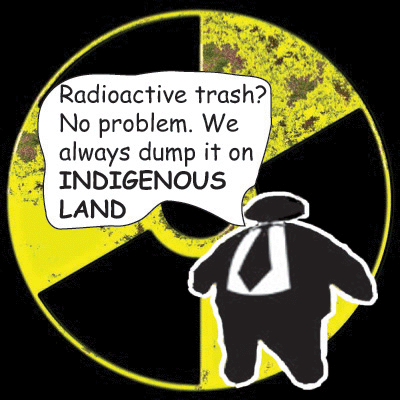
Indigenous Climate Action, August 23
Canadian Nuclear Laboratories (CNL) is pushing forward construction of a Near Surface Disposal Facility (NSDF), otherwise known as a nuclear waste dump, less than 1 kilometre away from the Kichi Sìbì (the Ottawa River) without the Free, Prior, and Informed Consent of the Algonquin Nations whose territory they are on.
On June 20, impacted nations spoke out against the project during a news conference where they also made public an Indigenous-led Assessment of the Canadian Nuclear Laboratories Near Surface Disposal Facility And Legacy Contamination Of Algonquin Aki Sibi.
The chiefs made it clear that this project is a direct threat to the rights of Indigenous peoples and the project would pose serious threats to culture, land, water and wildlife. It is important to understand that this is not just a risk to Indigenous communities; it is a risk to everyone who lives along the Ottawa River, including residents in Ottawa who rely on the river for their water and livelihood.
Nuclearization of Indigenous Land
Beginning nearly eighty years ago with the establishment of the Chalk River Laboratories along the Kichi Sìbì, sitting on unceded Algonquin territory, Indigenous nations have been facing the expansion of so-called Canada’s nuclear industry. The Chalk River Laboratories sits across the river from a noted community spiritual site, Oiseau Rock, near the lumbering town of Chalk River.
The Canadian Nuclear Laboratories (CNL) is a branch of the federal crown corporation, the Atomic Energy of Canada Limited (AECL). Chalk River Laboratories are owned by CNL, and operated by the Canadian National Energy Alliance, a private-sector holding company—that is not under direct control of the government—overseen by SNC-Lavalin.
“This nuclear site is already leeching radioactive pollution into the Ottawa River in the form of Tritium, which is radioactive hydrogen, and it’s only going to get progressively worse. And there’s no treatment for Tritium. So CNL and CNSC (Canadian Nuclear Safety Commission) will tell you that they are going to build a treatment plant, but you know in our world we know that you never build your treatment plant above where you collect your drinking water—and this is precisely what CNSC is going to do.” — Chief Lance Haymond (Kebaowek First Nation)
While CNSC claims that it had signed an agreement and received consent from the Algonquins of Pikwàkanagàn, in truth, they consulted only one voice of the Algonquin nation, the remaining ten communities oppose the project and have not given their consent.
“The Canadian government has failed its duty to consult with us. We also point out that approving this dump would violate UNDRIP… we do not consent with the construction of the NSDF in our territory. We believe that consultation has been inadequate, and our Indigenous rights are threatened by this proposal.”
— Chief Dylan Whiteduck (Kitigan Zibi Anishinabeg First Nation)…………………………………………………………………………………………………………………………………………………………………………………………………………………….. more https://www.indigenousclimateaction.com/entries/nuclear-dump-threatens-kichi-sibi
Focus on renewables, not nuclear, to fuel Canada’s electric needs

Relying on nuclear power goes against the evidence. The smart money is on renewables. Solar and wind energy make much more sense.
Policy Options, by Martin Bush, September 1, 2023
The demand for electricity continues to rise as countries transition to an electrified economy. To ensure an adequate and reliable supply during peak hours, governments must decide which energy technologies should be prioritized and developed to help with this transition.
Nuclear power is certainly in the running for providing this essential service, but it’s not the best option. Refurbishing aging CANDU reactors and investing in unproven nuclear technology, such as small nuclear reactors (SMRs), will waste money that could otherwise be invested in renewable energy solutions.
That’s where the smart money is – renewables – and all the evidence points to why. Electricity from nuclear energy is too expensive.
According to the World Nuclear Industry 2022 Status Report, nuclear energy’s share of global electricity generation in 2021 was 9.8 per cent – its lowest level in four decades – and substantially below its peak of 17.5 per cent in 1996.
Nuclear energy is being outpaced by non-hydro renewables, which in 2021 increased their share of global power generation to 12.8 per cent.
Between 2009 and 2021, utility-scale solar energy costs plummeted by 90 per cent, while similar wind energy costs dropped by 72 per cent. In contrast, nuclear costs increased by 36 per cent.
The cost of electricity generated by solar and onshore wind is in the range of 2.4 to 9.6 U.S. cents per kilowatt hour, (¢/kWh) while the cost of electricity from nuclear is estimated as anywhere between 14 and 22 ¢/kWh. It’s not even close.
In 2021, total investment in non-hydro renewable electricity capacity reached a record US$366 billion, 15 times the reported global investment in nuclear power plants of US$24 billion. Investments in solar energy were 8.5 times and wind six times the investments in nuclear energy.
Globally, the cost of renewable-produced electricity is now significantly below not only nuclear power but also gas. According to an analysis by Bloomberg New Energy Finance, wind and solar power are now the cheapest form of new electricity in most countries, including Canada. Bloomberg anticipates it will be more expensive to operate existing coal or fossil gas power plants within five years than to build new solar or wind farms.
Unsurprisingly, it is wind farms and large solar installations that are being built in record numbers……………………………………………………………………………………… more https://policyoptions.irpp.org/magazines/september-2023/renewables-not-nuclear-electric-canada/
New Brunswick Power has its head stuck in uranium

Tom McLean and Susan O’Donnell,, September 1, 2023 https://nbmediacoop.org/2023/09/01/commentary-nb-power-has-its-head-stuck-in-uranium/
NB Power seems to want to be a nuclear utility no matter how much it costs or whether or not the nuclear technology works because… well, just because. The utility’s 2023 Integrated Resource Plan (IRP) released in July states that small modular nuclear reactors (SMRs) are critical to developing a clean and cost-effective power grid in New Brunswick, although NB Power does not know when, or if, SMRs will become available or the cost.
Oh, and if the experimental SMRs are not available, the plan instead is to use wind and solar power, complemented by storage and biomass.
Why are renewables not the first choice for NB Power, given that wind and solar power costs are well known and very inexpensive, and storage cost is in free fall? The answer is not in the IRP.
In fact, the IRP suggests that SMRs are not critical since alternative pathways to a clean grid already exist without them. But NB Power wants to ignore that. The IRP states that integrating wind and solar instead, as an alternative to SMRs “… has not been studied in New Brunswick before.” Why has NB Power not undertaken this study?
Maybe because they won’t like the answer many researchers have already uncovered.
Wind, solar and storage are proven technologies with shrinking costs, and they outperform nuclear power on cost and reliability. Wind and solar are even predictable – meteorologists predict them every day with ample accuracy for power production.
With distributed generation, storage and inter-jurisdiction connections, New Brunswick can produce all its own power less expensively with renewables and without nuclear risk. The IRP’s poor assumptions about installed capacity, curtailment, storage, and use of interconnections are astounding. Properly deployed storage and interconnections significantly limit the amount of curtailment and required capacity. The IRP failed to note that interconnections provide both a source of capacity and a market for excess wind and solar production and, according to the previous 2020 IRP, the cheapest option for capacity is using interconnections.
Three years ago, the 2020 IRP showed the cost of the existing (non-experimental) NB Power nuclear plant at Point Lepreau as $117/MWh or 11.7¢ per kWh. NB Power currently sells power to residents at 12.27¢ per kWh. The cost of nuclear power has likely risen since 2020, meaning NB Power has either negligible returns or more likely, loses money on every nuclear kWh sold to New Brunswick households, and that cost does not even include the cost of transmission, distribution and administration. Is increasing the NB Power debt with every nuclear transaction the reasonable power cost Minister Holland has in mind when he talks about the expected costs of SMNR power?
Why is NB Power’s head stuck in uranium? Many jurisdictions have moved or are moving to a clean electrical grid with renewable power. For example, these countries are already managing higher penetrations of wind power than NB Power: Demark 55%; Ireland 33%; UK 25%; Germany 22%. The same for some US states: Maine 27%, South Dakota, 55%, Idaho 17%. The South Australia power grid broke records when it recently ran for over 10 days on 100% wind and solar power.
The 2023 IRP describes SMRs, a non-existing technology, as a critical piece of the future grid but ignores both existing storage technologies such as thermal storage for district heating and closed loop pumped storage hydro. If novel technology is desired, consider those coming to market in the next two years, such as 100-hour iron-air batteries at less than half the cost of lithium-ion batteries, and Canadian closed-loop geothermal technology currently in pilot.
The Point Lepreau nuclear generating station has matured into a big white elephant. Unplanned and intermittent shutdowns are a main reason NB Power loses money every year, and the original reactor build and refurbishment are responsible for three-quarters of the utility’s massive debt. Last year, NB Power applied for a 25-year licence renewal for the Lepreau reactor; the Canadian Nuclear Safety Commission instead gave it 10 years, citing the huge public interest (mostly negative), and mandated another licence review in 2027.
By then, the exorbitant costs of the speculative nuclear SMRs will be clear but New Brunswick needs to start now on a prudent pathway to a clean grid using renewable power. Will we continue to support blind faith in a speculative uranium-fuelled future, or will we go with renewable wind and sunshine? Minister Holland and NB Power would do well to start a re-think now about which way the wind is blowing.
Tom McLean is a retired software developer living in New Maryland. Dr. Susan O’Donnell is the lead researcher of the CEDAR project at St. Thomas University.
Proposed radioactive waste dump in Deep River met with opposition at final hearing.
Canadian Nuclear Safety Commission heard final arguments Thursday
Guy Quenneville · CBC News · Aug 10, 2023
The Canadian Nuclear Safety Commission (CNSC) held its final hearings in Ottawa on Thursday into a proposed radioactive waste disposal site further north in the Ottawa Valley that is fiercely opposed by Algonquin First Nation groups.
Canadian Nuclear Laboratories (CNL) wants to build an engineered mound near the ground’s surface on the Chalk River Laboratories site, located in Deep River, Ont., and on the traditional unceded territory of the Algonquin Anishinābe people. It’s about 190 kilometres northwest of Ottawa. ……………………….
Should be asking our permission’
The disposal site was proposed years ago, with the commission launching an environmental assessment back in 2016.
Opposition to the project, from Indigenous groups and municipalities, has intensified in the years since.
In 2017, the Assembly of First Nations accused the commission and the federal government of failing to meet their constitutional duty to consult and accommodate First Nations.
“They should be asking for our permission … and right now we have the Algonquin people saying no,” Chief Casey Ratt of Algonquins of Barriere Lake said during a pause in Thursday’s hearing.
The project is also of concern because of its proximity to Kichi Zibi (the Algonquin name for the Ottawa River) and because the site is near Algonquin sacred sites at Oiseau Rock and Pointe au Baptême, according to Kebaowek First Nation, another Algonquin group calling on the commission to reject the project.
CNL’s plan includes releasing effluent from a wastewater treatment plant into Perch Lake, a point of concern for the Kitigan Zibi Anishinabeg First Nation.
“There is no public access to the Perch Creek and Perch Lake watershed where … effluent discharges will occur,” the company has argued in a written submission to the commission.
Justin Roy of Kebaowek First Nation told the commission there are risks that can’t be ignored.
“When building a camp and you need potable drinking water and you build a well, you don’t go and build your outhouse beside that well,” Roy said.
What happens next
The commission describes itself as an independent administrative tribunal set up at arm’s length from government, without ties to the nuclear industry.
The group’s hearings into the proposed facility began in person in February and May of 2022, were supposed to pick up in June 2023, but were adjourned to Thursday, taking place over Zoom.
“[That’s] not our ways,” Chief Dylan Whiteduck of Kitigan Zibi Anishinabeg First Nation said of the online format.
“We were only provided an hour to give our final statement, which to us is obviously disrespectful,” he added.
The commission has yet to issue its final report on whether CNL’s site licence can be amended, which would allow the company to build the disposal facility. ……………………………………………..
The commission said it may be “several months” for a decision to be made and published.
Background to Proposed radioactive waste dump in Deep River -opposition from indigenous and non-indigenous groups

| Gordon Edwards 11 Aug 23 |
A consortium of multinational corporations, headed by SNC-Lavalin, was hired by the government of Canada in 2015 to “reduce the liability” associated with federally owned radioactive wastes. The dollar value of that liability has been estimated to exceed $7 billion.
For the last 5 1/2 years, the consortium has been proposing to store the most voluminous waste in a “megadump” intended to hold about one million cubic metres of radioactive and nonradioactive toxic wastes in perpetuity. The proposed dump is essentially a landfill operation one kilometre from the Ottawa River, a heritage river that courses through the nation’s capital and feeds into the St Lawrence River at Montreal.
The project is opposed by all but one of the 11 Algonquin communities on whose unsurrendered territory the megadump is to be sited. It is part of the Chalk River Nuclear Laboratories site – land that was stolen from the Algonquin Nation in 1944. The federal government expropriated the site on national security grounds, required for the World War II Atomic Bomb Project, without asking or notifying or compensating the Algonquins for whom the site had cultural and religious significance for thousands of years.
On Thursday August 10, 2023, three Algonquin communities gave their final arguments to two members of the Canadian Nuclear Safety Commission (CNSC). Both of these Commissioners had previously worked for many years for the nuclear industry. The Algonquins were not allowed to present in person before the Commissioners, so they rented a hall for $8000 and had their own live audience to witness the proceedings as they made their presentations to the Commissioners by zoom.
In addition to Chiefs, elders, councillors, researchers and lawyers from three Algonquin communities – Kebaowek First Nation, Kitigan Zibi Anishinabeg, and Barriere Lake First Nation – there were in attendance members of several Algoquin communities, as well as many non-Indigenous people. The latter included representatives from federal parliamentarians, mayors of local communities, Ottawa city councillors, and representatives of the following Non-Governmental Organizations:
Ottawa Riverkeeper, Grennspace Alliance of Canada’s Capital, Ecology Ottawa, Ottawa River Institute, Canadian Coalition for Nuclear Responsibility, Canadian Environmental Law Association, The Atomic Photographers’ Guild, First United Church Water Care Allies, Old Fort William Cottagers’ Association, Ottawa Charter of the Council of Canadians, Sierra Club Canada Foundation, Pontiac Environmental Protection, Friends of the Earth, Ottawa Raging Grannies, Canadian Parks and Wilderness Society (Ottawa Valley), Biodiversity Conservancy International, Bonnechere River Watershed Project, Council of Canadians Regional, Coalition Against Nuclear Dumps on the Ottawa River, National Capital Peace Council.
Mony of the non-Indigenous representatives who came to hear the Algonquin Nations final arguments before the Canadian Nuclear Safety Commission (CNSC) signed their names to the following statement:
“NO CONSENT, NO DUMP. August 10, 2023″Today, CNSC conducts its final hearings on the planned ‘megadump’ at Chalk River – a gigantic mound of radioactive and non-radioactive toxic wastes, seven stories high, one kilometre from the Ottawa River. Most of the radionuclides to be dumped have half-lives of more than 5000 years. 99 percent of the initial radioactivity is from profit-making companies – waste that is imported for permanent disposal at public expense.
“Chalk River is sited on the unceded traditional territory of the Algonquin Nation. The Kebaowek and Kitigan Zibi Anishinabeg Algonquin communities do not consent to this radioactive and toxic dump, which is euphemistically called a Near Surface Disposal
Facility (NSDF).“We are non-Indigenous citizens. We do not presume to speak on behalf of Indigenous peoples, but as proud Canadians we wish to state clearly that if CNSC grants permission for the NSDF despite the lack of free, prior and informed consent from the Kebaowek and Kitigan Zibi Anishinabeg, it will be an act that dishonours all Canadians.
“We – and many others across Canada – regard such a decision as a blow to the process of reconciliation. It will set a dire precedent by suggesting that Indigenous consent is not a priority. Such a development could set back the cause of reconciliation for generations.”[56 signatures by attendees]
Final Hearing on the Chalk River Megadump – Thursday, August 10, Commission hearing, 9am to 12 noon

Gordon Edwards, 9 Aug 23
Thursday, August 10, from 9 am to noon – CNSC will be conducting its final public hearings on the planned “megadump” at Chalk River — a gigantic mound of radioactive and non-radioactive toxic wastes, five to seven stories high, about one kilometre from the Ottawa River. About two-thirds of the radionuclides in the listed radioactive inventory have half-lives in excess of 5000 years. To tune in to the live webcast, visit http://cnsc.isilive.ca
Thursday’s hearings will be for the sole purpose of allowing the Algonquin communities of Kebaowek and Kitigan-Zibi to make their final presentations to the Commissioners. The Chalk River site is situiated on the unceded territory of 11 Algonquin communities. The Commission will not allow the Algonquin representatives to appear in person, they must make their case by zoom. The Indigenous leaders are explicitly forbidden from introducing any new evidence, they are asked to simply summarize the evidence that has already been presented to the CNSC.
Although the United Nations Declaration on the Rights of Indigenous Peoples (UNDRIP) states that hazardous materials cannot be stored or disposed of on Indigenous land without the free, prior, informed consent of the Indigenous people whose land is affected, and although the Government of Canada acknowledges that it has a duty to consult with Indigenous Peoples, the Algonquins were not brought into the process until after all the major decisions had been made, including the site for the megadump (euphemistically called a Near Surface Disposal Facility NSDF).Keboawek Ashinbeg Nation, and Kitigan-Zibi Nation, do not consent to the project. They particularly object to the siting of these very long-lived highly toxic wastes so close to the Ottawa River.
All the key decisions about this project were made by a consortium of multinational corporations headed by SNC-Lavalin — a Quebec-based company that the Prime Minister has been eager to protect from criminal prosecution in the past. SNC-Lavalin was banned for 10 years from bidding on any international projects funded by the World Bank because of a proven record of fraudulent practices in many countries. In Quebec, SNC-Lavalin corporate executives went to jail for fraudulent practices connected with a “Super-Hospital” and a major Bridge, and for an elaborate corporate scheme to funnel illegal donations to political parties while hiding the true facts in its duplicitous corporate ledgers using an elaborate coding system.
The consortium, operating under the name “Canadian Nuclear Laboratories (CNL)”, was originally hired under the Harper administration but with a premature renewal of their contract by the Trudeau administration. CNL has been receiving close to a billion dollars a year in taxpayers money since the consortium was hired.
All Canadians should be concerned that long-lived human-made post-fission wastes are about to be permanently “disposed of” (i.e.placed in a gigantic glorified landfill) without the consent of the Indigenous people or of the 174 municipalities (including the City of Montreal) that have strongly objected to the project. Apparenlty, the convenience of the nuclear promoters with the complicity of a captured nuclear regulator over-rules the wishes of Canadian citizens or the long-term protection of a major river from unnecessary ultimate contamination.
Why is Ontario Government bent on building a new nuclear reactor, at a much greater cost than solar or wind technologies?
Ontario Power Generation (OPG), which is 100% owned by the Government of
Ontario, is proposing to build a first of its kind GE-Hitachi 300 megawatt
(MW) boiling water reactor at its Darlington Nuclear Station, east of
Oshawa.
OPG has still not submitted GE-Hitachi’s proposed reactor design
to the Canadian Nuclear Safety Commission for review and potential
approval, despite claiming that construction of the reactor will be
completed by 2028.
According to Lazard, one of the most respected names in
global financial services, the cost of electricity from a new nuclear
reactor is 1.7 times greater than the cost of offshore wind, three times
greater than the cost of solar power, and 3.6 times greater than the cost
of onshore wind.
Clean Air Alliance 3rd Aug 2023
Non-compliant fire program halts decommissioning of Whiteshell Nuclear Laboratories
Canadian Nuclear Safety Commission, 4 Aug 23
A 40-minute “Event Initial Report” during the Canadian Nuclear Safety Commission (CNSC) June 28th meeting discussed an internal review by Canadian Nuclear Laboratories (CNL) which found that fire protection staff, systems and equipment at Whiteshell Laboratories were deficient, and had been deficient for years. This issue came to light when a new fire protection employee was hired and raised the alarm.
This has forced a shut-down of decommissioning activities. CNL President Joe McBrearty said that staff and resources have been transferred from the Chalk River Laboratories to Whiteshell to address the deficiencies.
Whiteshell Laboratories has been undergoing accelerated decommissioning since 2015 when CNL was sold to Canadian National Energy Alliance, a multinational consortium currently composed of three companies, (SNC-Lavalin and Texas-based Fluor and Jacobs), under a contract to reduce the Government of Canada’s nuclear liabilities quickly and cheaply.
In December 2019 the CNSC had issued a decision that “CNL is qualified to carry on the activity that the proposed licence will authorize and that it will make adequate provision for the protection of the environment, the health and safety of persons.” At that time, CNSC renewed the Nuclear Research and Test Establishment Licence for Whiteshell (NRTEL-W5-8.00/2024) for the period January 1, 2020 until December 31, 2024. …………………….
CNL President McBrearty noted that the Whiteshell hot cells have been reactivated to enable waste retrieval. Whiteshell decommissioning waste is being shipped to the Chalk River Laboratories for disposal in the proposed NSDF nuclear waste dump. https://cnsc.isilive.ca/2023-06-28/2023-06-28-3M.mp4
Will this experimental nuclear reactor escape federal scrutiny?

Unlike in most other reactors, where the coolant is water, in these reactors the coolant is sodium based, which has challenging chemical features. Other challenges include activated corrosion products in the sodium due to its chemical reactivity and the consequences of leakage during the operation of some reactors.
By Susan O’Donnell & Kerrie Blaise July 26th 2023 As https://www.nationalobserver.com/2023/07/26/opinion/new-brunswick-experimental-nuclear-reactor-federal-assessment?
On June 30, NB Power registered an environmental impact assessment with the province of New Brunswick and filed a licence application with the Canadian Nuclear Safety Commission (CNSC) to prepare a site on the Bay of Fundy for the ARC-100, an experimental small modular reactor (SMR) still in early design.
Making information public about the project, which includes not just a nuclear reactor new aquatic infrastructure in the Bay of Fundy and new radioactive storage, will be difficult if not impossible without a federal impact assessment. So, too, will testing the veracity of claims made about the project’s safety, risk and impacts. But so far, a federal impact assessment has been denied.
Relying only on the provincial assessment or the CNSC’s review to inform understandings of adverse effects and impacts is a major step backwards. The provincial process has limited opportunities for public input. The CNSC’s licensing process is narrowly defined by the stage of activity being licensed (i.e., site selection, construction, operations and eventual decommissioning).
The federal impact assessment process, conversely, reviews all activities within the lifespan of the project, from development through to decommissioning, including project impacts that are direct or incidental to the project, prior to any decision being made about its development.
The proposed reactor is cooled by liquid sodium metal. No such reactor has ever been successfully commercialized because of many technical problems. Sodium is highly combustible, and experiments with this type of reactor have seen fires and the distribution of radioactive particles on shorelines, even decades after experiments were shut down. The sodium from these reactors bonds to used fuel, and no known commercial method exists to treat sodium-bonded used reactor fuel.
Despite the obvious questions about direct impacts and legacy risks the reactor poses, changes to federal impact assessment law in 2019 mean the project will likely escape a transparent, evidence-based review. After successful lobbying by the nuclear industry and the CNSC in the leadup to passing the Impact Assessment Act, most nuclear projects, from new reactor proposals to the decommissioning of existing ones, were dropped from the list of projects automatically requiring an upfront impact assessment.
There remains one last chance for this highly controversial project to undergo a federal impact assessment. On March 31, three months before the licence application was filed, the Sierra Club Canada joined three community groups with a direct interest in the project — the Coalition for Responsible Energy Development in New Brunswick and We the Nuclear Free North and Protect our Waterways in Ontario — to write to federal Environment Minister Steven Guilbeault, urging him to require the project undergo a federal impact assessment. When a project may cause adverse environmental effects or public concern warrants an impact assessment, the minister has the jurisdiction to order one. Both are true in this instance.
This is the second of such requests for an impact assessment to the minister. Guilbeault rejected the first request in December 2022. However, the new request cites significant changes to the proposed ARC-100 project previously unknown to the public, based on information unearthed through access-to-information requests.
The Ontario groups that joined the Sierra Club in its request have many questions about the radioactive waste from the ARC-100, which is slated to be deposited in a proposed repository in one of their communities. They say no information about the waste from the ARC-100 has been provided to residents living near the two proposed sites for a deep geological repository or along the transportation routes. The groups want information about the volume, nature, characteristics and potential additional hazards associated with the wastes that the ARC-100 could generate.
Indigenous nations have expressed support for an impact assessment because they also have concerns that can only be addressed through a federal review. The group representing the Peskotomuhkati Nation at Skutik, whose traditional territory includes the proposed site in New Brunswick, wrote to Guilbeault in April, raising questions about the ARC-100’s profound and lasting impacts to the Bay of Fundy, the marine life the bay supports and coastal communities.
First Nations in Ontario and Quebec are also concerned that nuclear technology operating in one province could have impacts on First Nations in other provinces, triggering the need for an assessment of likely economic, social, cultural and environmental impacts in accordance with the United Nations Declaration on the Rights of Indigenous Peoples.
First Nations in Ontario and Quebec are also concerned that nuclear technology operating in one province could have impacts on First Nations in other provinces, triggering the need for an assessment of likely economic, social, cultural and environmental impacts in accordance with the United Nations Declaration on the Rights of Indigenous Peoples.
Ontario opts for high-risk nuclear over low-risk energy sources
Rather than increasing energy efficiency and productivity and reducing the need for new energy resources, the province has chosen nuclear expansion.
The Star, By Mark Winfield , Friday, July 21, 2023
The consequences of these decisions for Ontario electricity ratepayers and taxpayers are likely to stretch far into the future. No cost estimates are available for the proposed nuclear projects. The bids submitted as part of the province’s last attempt at a new-build nuclear project would optimistically suggest costs in the range of $50 billion for the Bruce project alone. The costs of the four smaller reactors proposed for Darlington remain unknown, given that none of the proposed type of reactor have ever been built or operated before anywhere in the world.
………………………………………. private capital has been hesitant to engage with nuclear projects, and progress on a much-touted nuclear “renaissance” in Europe and North America has been slow. This has been despite aggressive efforts by governments to guarantee returns on investment and assume ultimate liability for waste management, decommissioning costs and accidents. It is no surprise that the only significant investor in the first of the proposed new “small” reactors at Darlington was the federal government’s own Infrastructure Bank.
A rational planning process around electricity and decarbonization would have prioritized the options with the lowest economic, environmental, technological and safety risks first. Higher risk options, like new nuclear, should only be considered where it can be demonstrated that the lower-risk options have been fully optimized and developed in the planning process.
…………………………….. The good news is that the province’s announcements remain at a preliminary stage — key technical approvals for new build reactor projects will still be needed and their economics remain very open questions. There may still be time for Ontario to move toward a more rational, open, and evidence-based approach to energy planning and decarbonization. But nuclear proponents will be doing everything they can to lock in the government’s choices as quickly as possible. https://www.thestar.com/opinion/contributors/ontario-opts-for-high-risk-nuclear-over-low-risk-energy-sources/article_49afb2a3-7cca-5dee-bc2b-5d57eef76a75.html
Ontario – Ford government’s electricity plan takes wrong approach
Windsor Star, By Jack Gibbons 21 Jul 23
Having missed the boat on the global green energy boom by crushing the province’s early leadership on renewable energy, Premier Doug Ford is now trying to take another stab at building a future economy by investing in buggy whip manufacturing.
That’s what spending tens of billions of dollars on high-cost, high-risk nuclear power essentially represents — a bet on a technology that has been in decline for decades.
Instead of trying to catch up with a global marketplace that is decidedly all-in on renewable energy — with the International Energy Agency saying 90 per cent of new electricity capacity will come from renewables over the next five years — Ontario wants to go back to the 1960s and ‘70s and embark on another long shot effort to build nuclear power plants.
It’s important to remember the province’s past nuclear projects have been one fiasco after another. Our most recent nuclear new build project — the Darlington nuclear station — went massively over budget.
The huge cost overruns and poor performance of its nuclear reactors essentially bankrupted the old Ontario Hydro. Ontario power ratepayers and taxpayers were left paying off the utility’s massive $19.4-billion stranded nuclear debt.
That hasn’t stopped a government with a strong distaste for solar panels and wind turbines from warmly embracing a technology that has never lived up to its promise.
It is now planning to build a massive new nuclear plant right beside the Bruce nuclear station which is already the largest nuclear station in the world. It also wants to build mythical “modular” reactors along the waterfront at Darlington right next to Toronto.
That the reactors the government is touting for Darlington are, at this point, nothing more than PowerPoint slides in a nuclear PR presentation hasn’t stopped the government from making wild claims that these unproven (and, at this point, unlicensed and physically non-existent) reactors can be built at what it deems to be a reasonable cost.
In 2009, when the nuclear companies wanted to build two new nuclear reactors at Darlington, the Dalton McGuinty government required them to submit fixed-price bids.
Not surprisingly the most competitive bid was 3.7 times higher than the forecast price. As a result, the government suspended the procurement process and the reactors were never built.
But despite repeatedly slamming the “fiscal irresponsibility” of previous Liberal governments, it appears that Premier Doug Ford is only too happy to give the nuclear industry a blank cheque and allow inevitable cost overruns to be passed on to electricity consumers and taxpayers.
That the projected cost for the province’s new dream nuclear projects are more than three times higher than what we would pay today for power from competitively procured wind and solar also doesn’t seem to bother Energy Minister Todd Smith…………………………………………..
New nuclear reactors that will take at least 10 to 15 years to build can not provide the dramatic reductions in greenhouse gas pollution that we need now. To add insult to injury, Doug Ford’s solution to keeping the lights on in the interim is to ramp up use of climate-wrecking gas plants and, even more astoundingly, build new ones.
But what’s truly scandalous about the government’s Powering Ontario plan is prioritizing phantom nuclear technology over what the world wants: smart, integrated and highly efficient renewable power systems………… more https://windsorstar.com/opinion/letters/guest-column-ontario-governments-electricity-plan-taking-wrong-approach
Canada’s Civil Society Groups Call for Public Debate on Radioactive Waste Management Strategy

Ottawa – Civil society organizations are calling on Natural Resources Minister Jonathon Wilkinson to honour commitments made by his predecessor Seamus O’Regan to engage with Canadians on appropriate strategies for the management of radioactive waste rather than simply rubber stamping the nuclear industry’s recommended approach. On July 4th the Nuclear Waste Management Organization (NWMO) announced that it had submitted its “recommendations” for an Integrated Strategy for Radioactive Waste to Minister Wilkinson. There have been no communications from the federal government on next steps, including public engagement. The NWMO is a consortium of nuclear power operators, led by Ontario Power Generation. |
In 2020 the NWMO was tasked by the federal government with the development of recommendations for an integrated radioactive waste strategy by (then) Minister of Natural Resources Seamus O’Regan. In his assigning the task to the NWMO, O’Reagan was clear that the product of the NWMO’s exercise was to be provided for review and consideration by the Government.
Civil society organizations have previously expressed strong concern and disagreement with NRCan’s decision to ask the Nuclear Waste Management Organization (NWMO) to lead the development of an “integrated strategy for radioactive waste”, saying they understand and accept the nuclear industry having input into Canada’s radioactive waste management strategy but fully reject any notion that industry determines the strategy. Concern has increased with the July 4th announcement by the NWMO that they had submitted their recommendations being followed by silence from the federal government on how Canadians and Indigenous people will be engaged in the promised review.
| Ottawa – Civil society organizations are calling on Natural Resources Minister Jonathon Wilkinson to honour commitments made by his predecessor Seamus O’Regan to engage with Canadians on appropriate strategies for the management of radioactive waste rather than simply rubber stamping the nuclear industry’s recommended approach. On July 4th the Nuclear Waste Management Organization (NWMO) announced that it had submitted its “recommendations” for an Integrated Strategy for Radioactive Waste to Minister Wilkinson. There have been no communications from the federal government on next steps, including public engagement. The NWMO is a consortium of nuclear power operators, led by Ontario Power Generation.In 2020 the NWMO was tasked by the federal government with the development of recommendations for an integrated radioactive waste strategy by (then) Minister of Natural Resources Seamus O’Regan. In his assigning the task to the NWMO, O’Reagan was clear that the product of the NWMO’s exercise was to be provided for review and consideration by the Government. Civil society organizations have previously expressed strong concern and disagreement with NRCan’s decision to ask the Nuclear Waste Management Organization (NWMO) to lead the development of an “integrated strategy for radioactive waste”, saying they understand and accept the nuclear industry having input into Canada’s radioactive waste management strategy but fully reject any notion that industry determines the strategy. Concern has increased with the July 4th announcement by the NWMO that they had submitted their recommendations being followed by silence from the federal government on how Canadians and Indigenous people will be engaged in the promised review. “For a government that ran on a platform of restoring the trust of Canadians in decision-making it has been extraordinary to watch key decisions being handed over to the nuclear industry” observed Brennain Lloyd from the northern Ontario environmental group Northwatch. In a letter sent today, a large range and number of civil society organizations called on Minister Wilkinson and Prime Minister Trudeau to fully engage in a review of the industry recommendations.The letter also expressed profound disappointment in Canada’s Policy for Radioactive Waste and Decommissioning (the Policy) released on March 31st saying Canada’s new policy leaves the nuclear industry in charge and the public and the environment at risk. |
Key priorities were omitted, including the establishment of a national waste management agency independent of the industry, a ban on the extraction of plutonium from nuclear fuel waste, a long-term strategy for the 230 million tonnes of radioactive wastes from uranium mining, and a commitment to keep all radioactive waste isolated from the biosphere in perpetuity”, commented Gordon Edwards, President of the Canadian Coalition for Nuclear Responsibility.
1 This Month
19 February – VIRTUAL EVENT-Decision Time: AI and Our Nuclear Arsenal
12:45 p.m. Central / 1:45 p.m. Eastern
To see nuclear-related stories in greater depth and intensity – go to https://nuclearinformation.wordpress.com
-
Archives
- February 2026 (161)
- January 2026 (308)
- December 2025 (358)
- November 2025 (359)
- October 2025 (376)
- September 2025 (258)
- August 2025 (319)
- July 2025 (230)
- June 2025 (348)
- May 2025 (261)
- April 2025 (305)
- March 2025 (319)
-
Categories
- 1
- 1 NUCLEAR ISSUES
- business and costs
- climate change
- culture and arts
- ENERGY
- environment
- health
- history
- indigenous issues
- Legal
- marketing of nuclear
- media
- opposition to nuclear
- PERSONAL STORIES
- politics
- politics international
- Religion and ethics
- safety
- secrets,lies and civil liberties
- spinbuster
- technology
- Uranium
- wastes
- weapons and war
- Women
- 2 WORLD
- ACTION
- AFRICA
- Atrocities
- AUSTRALIA
- Christina's notes
- Christina's themes
- culture and arts
- Events
- Fuk 2022
- Fuk 2023
- Fukushima 2017
- Fukushima 2018
- fukushima 2019
- Fukushima 2020
- Fukushima 2021
- general
- global warming
- Humour (God we need it)
- Nuclear
- RARE EARTHS
- Reference
- resources – print
- Resources -audiovicual
- Weekly Newsletter
- World
- World Nuclear
- YouTube
-
RSS
Entries RSS
Comments RSS
 nuclear-news